May 6, 2026 in AI-Driven Databases
AI-Driven Databases
How GenAI Optimizes SQL Server and PostgreSQL for Better Decisions
SHARE: PRINT ARTICLE: https://doi.org/10.1287/LYTX.2026.02.03

Modern enterprises rely on SQL Server and PostgreSQL databases as the backbone of decision-support systems in finance, e-commerce, healthcare, and more. Yet, keeping these databases performing optimally has long been a labor-intensive challenge.
Database administrators (DBAs) traditionally monitor queries, tweak indexes, and reactively fix slowdowns – a tedious, manual process prone to delays. Generative AI is now poised to change this paradigm. By leveraging advanced AI models, including large language models (LLMs) and machine learning (ML), databases can self-tune based on workload patterns and system metrics. In essence, GenAI augments databases with an intelligent “brain” that automates query optimization, indexing, and even security monitoring. This shift is especially exciting for operations research professionals. Faster queries and smarter indexing mean quicker analytics, real-time optimization, and more informed decision-making.
At their core, GenAI-driven databases aim to make operations more efficient and adaptive. Imagine a database that automatically reorganizes itself – adjusting query execution plans, creating indexes on the fly, and flagging anomalous activities – all without continual human intervention. This is now possible because AI models can parse and understand SQL queries, suggest index improvements, and detect anomalies with high accuracy.
Early studies show dramatic gains: AI-guided tuning has reduced query execution times by up to 30% and has improved indexing efficiency by 25% in prototypes. These improvements aren’t just technical niceties; they translate to tangible operational benefits. Organizations report more responsive data systems, lower maintenance costs, and fewer performance firefighting episodes. For analytics and O.R. teams, GenAI-enhanced databases mean that data-driven models can run on fresher, faster data, and scarce human expertise can be reallocated to higher-level strategic problems instead of routine DB tuning.
AI-Driven Query Optimization and Indexing
How does GenAI make databases smarter? Figure 1 illustrates an AI-powered SQL optimization framework that integrates four intelligent modules that work in concert. Each module addresses a key aspect of performance:
- A query analysis module interprets incoming SQL and profiles its complexity.
- An AI processing engine uses advanced models (such as transformer-based optimizers) to suggest better query plans.
- An indexing strategies module recommends and automatically creates indexes to speed up data retrieval.
- An anomaly detection component monitors queries for security threats.
Together, these AI-driven modules enable the database to continuously learn and adapt, much like an O.R. analyst constantly tweaking a model for optimal results.
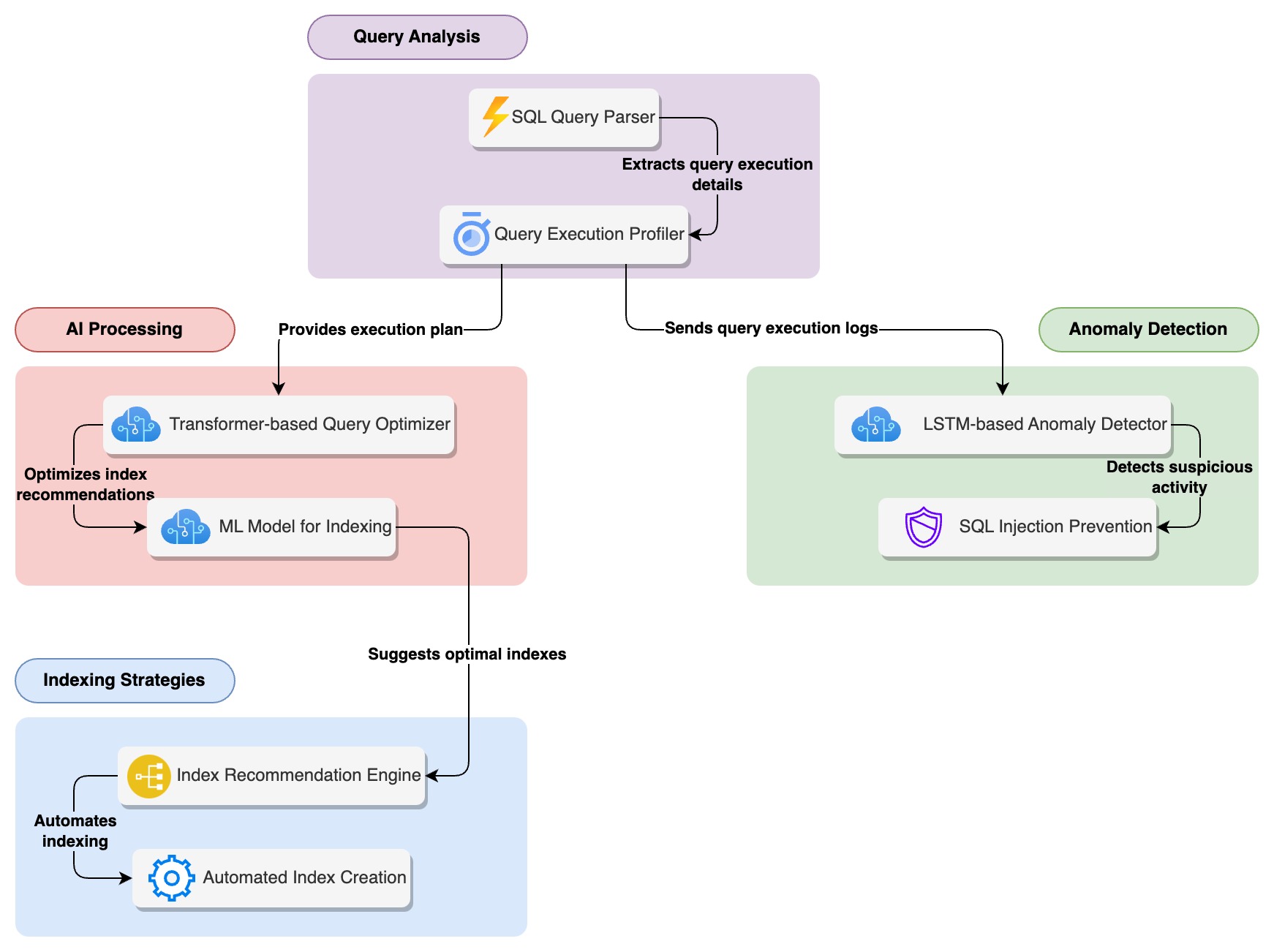
One immediate benefit of an AI-powered SQL optimization framework is in query performance tuning. Traditionally, database administrators (DBAs) had to rewrite queries or adjust parameters after problems occurred. In contrast, GenAI techniques use LLMs and ML to proactively refine queries. For example, natural language models can accept a user’s question in plain English and translate it into efficient SQL, eliminating the need for a human to hand-craft the query.
Once queries are running, AI optimizers analyze the execution patterns and suggest improvements, all in real time. A transformer-based optimizer might recognize that a complex query would run faster if a different join order were used or a subquery were rewritten. These suggestions are not just theoretical; in experiments, implementing AI-suggested query rewrites yielded impressive speedups. Key improvements include:
- Smarter Joins: AI learned to choose optimal join orders, cutting query execution time by up to 40% in certain multi-table join scenarios.
- Query Rewriting: Converting subqueries into joins or applying other AI-driven rewrites improved query speeds by approximately 35%.
- Adaptive Filtering: AI proposed refinements to where clauses made data filtering approximately 25% more efficient, reducing the amount of data scanned.
Beyond query logic, GenAI brings an O.R.-native sensibility to index optimization, treating it as a resource allocation problem to be solved continuously rather than periodically. ML models analyze workload patterns to identify high-value indexing opportunities then automatically create or adjust indexes without DBA intervention.
Crucially, these indexes are not static: the system drops or rebuilds them as data and access patterns evolve, maintaining an optimal configuration over time. The result is a database that tunes itself, analogous to a dynamic resource allocation algorithm minimizing query cost and maximizing throughput, freeing users from manual tuning cycles entirely.
Intelligent Anomaly Detection for Secure Operations
Performance isn’t the only domain GenAI is transforming; it’s also raising the bar for database security and reliability. Traditional rule-based intrusion detection systems often struggle with novel threats or generate excessive false alarms. GenAI addresses this by embedding an anomaly detection module that employs deep learning to monitor database activity in real time (see Figure 1). Specifically, an LSTM (long short-term memory) neural network is trained on SQL logs to recognize patterns of normal versus abnormal behavior. This model can detect subtle sequences of queries or transactions that indicate a potential attack or misuse, far beyond the pattern-matching capability of legacy tools. In effect, the AI acts as a vigilant guard for the database, one that continuously learns new threat patterns as they emerge.
The impact on security and uptime is dramatic. In our benchmarks, the AI-driven system achieved over 92% accuracy in detecting anomalous queries and transactions. It successfully caught 96% of simulated SQL injection attacks (malicious queries trying to exploit the system) and 89% of unauthorized access attempts – a level of coverage well above traditional methods.
Importantly, it did so while keeping false positives low (around 5.6%, compared to approximately 12% for older rule-based detectors). This precision means administrators aren’t bombarded with false alerts, focusing their attention on real issues. When a threat is identified, the system can automatically block the offending query or user session, effectively neutralizing attacks in the moment. Fewer breaches and less downtime translate directly into more reliable data availability, a crucial factor for O.R. applications that demand continuous access to consistent data. GenAI's anomaly detection thus serves a dual purpose: strengthening security while ensuring the operational continuity that optimization models and decision processes depend on.
Performance Gains and O.R. Implications
In our implementation and experiments, the introduction of GenAI into SQL Server and PostgreSQL yields measurable performance gains that directly benefit operational decision-making. Figure 2 compares key metrics between a GenAI-enhanced SQL Server 2022 and PostgreSQL 15 environment, highlighting how both platforms reap substantial improvements.
In testing, AI-driven optimizations cut average query execution times by about 32% in SQL Server and 28% in PostgreSQL. Indexing efficiency measured by faster read/query performance improved roughly 25% on both systems with AI-guided index tuning. And on the security front, the integrated anomaly detection achieved over 90% accuracy on each platform (approximately 91% for SQL Server vs. 93% for PostgreSQL). These gains are not just academic; they mean that analysts and O.R. professionals can get answers from data almost a third faster than before, and system slowdowns or breaches are far less likely to interrupt time-sensitive analyses.
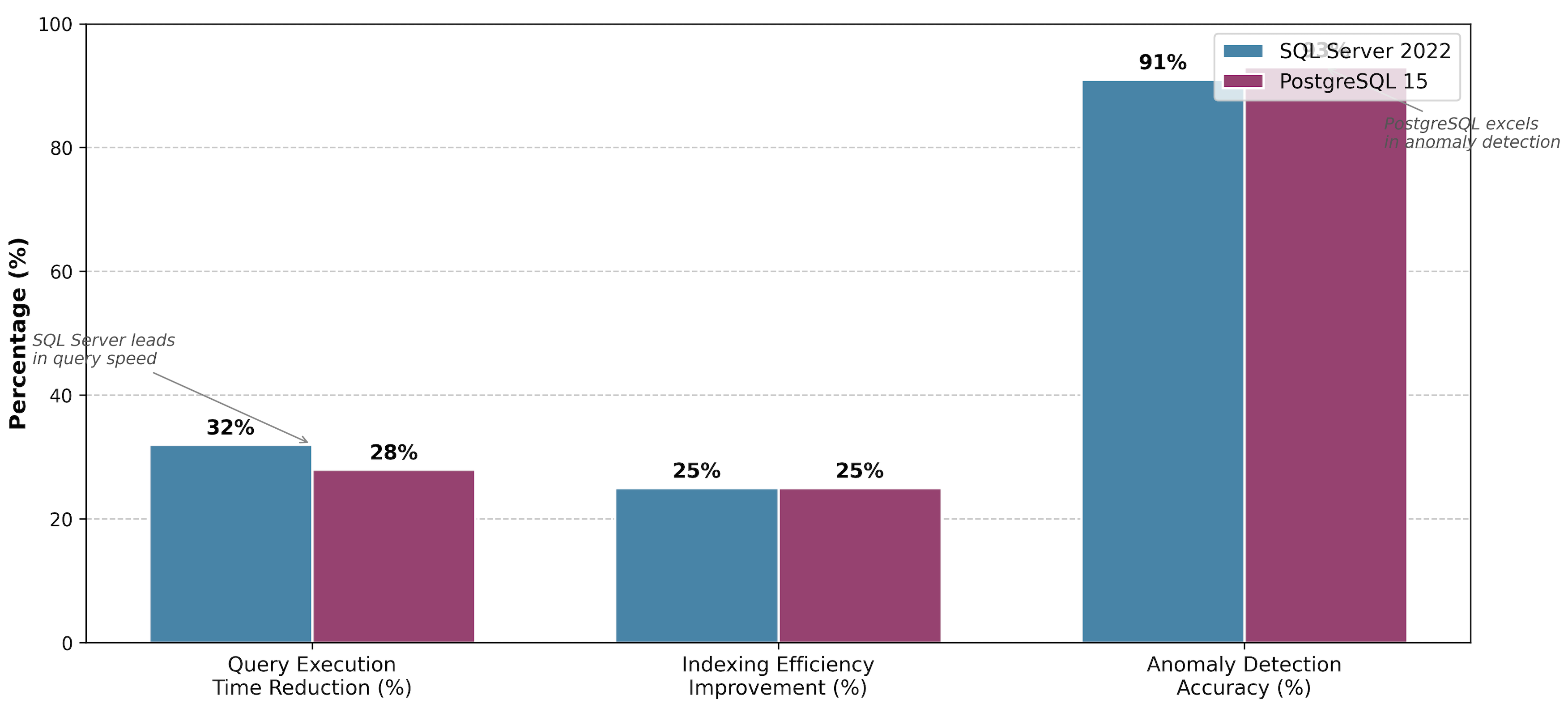
Figure 2. Left: Average query execution time reduction with GenAI (higher is better). Center: Query throughput due to automated indexing. Right: Accuracy of AI-based anomaly detection. Both database systems show significant gains across all metrics, with SQL Server seeing a slight edge in query speed, and PostgreSQL excelling marginally in anomaly detection accuracy.
We observed slight performance differences between the two databases that reflect their distinct architectures. SQL Server’s native Intelligent Query Processing gave it a head start that GenAI further amplifies, explaining its query speed edge. PostgreSQL’s open ecosystem, supporting extensions like pgVector and custom ML models, enabled more granular tuning, accounting for its slight lead in detection accuracy. Both platforms achieve substantial gains; the choice between them turns on whether an organization prioritizes raw query throughput or open AI extensibility.
For O.R. practitioners, these improvements have direct operational consequences. Queries resolving nearly a third faster means optimization models running on live data are no longer bottlenecked by the data layer. GenAI’s ability to forecast workload patterns and proactively cache or index data functions like a built-in capacity planning mechanism, anticipating analytical demand rather than reacting to it. Stronger anomaly detection also improves the reliability of production decision models, since fewer integrity issues mean more dependable inputs for simulations and forecasts.
The net effect is that O.R. and analytics teams can redirect attention from database maintenance to higher-order problems such as modeling, optimization, and forecasting, while AI proactively handles query tuning, indexing, and security. Across domains – from supply chain optimization to real-time pricing – this translates directly into faster insights and fewer costly interruptions.
A Meaningful Shift
The convergence of generative AI with relational databases marks a meaningful shift from systems that store and retrieve data to systems that actively optimize themselves. SQL Server and PostgreSQL illustrate this well: LLM- and ML-driven enhancements delivered roughly 30% faster query responses, 25% better indexing throughput, and over 90% anomaly detection accuracy in our experiments. For O.R. practitioners, these gains translate directly into faster decision cycles, more dependable model inputs, and reduced operational overhead.
This trajectory points toward even greater autonomy. Reinforcement learning agents capable of real-time query plan adjustment are already under active research. As these agents mature, human intervention in database tuning will diminish further. For O.R. teams, the practical implication is clear: GenAI is turning database infrastructure into an intelligent, self-managing layer, one that handles the operational heavy lifting so analysts can focus on the problems that actually require human judgment.
References
Fahima, M. M. F., et al. (2024). Machine Learning for Database Management and Query Optimization. Elementaria: Journal of Educational Research, 2(1), 96-108. https://elementaria.my.id/index.php/e/article/view/66
Panwar, Vijay. (2024). “AI-Driven Query Optimization: Revolutionizing Database Performance and Efficiency.” International Journal of Computer Trends and Technology, 72(3): 18-26. https://www.ijcttjournal.org/Volume-72%20Issue-3/IJCTT-V72I3P103.pdf
Microsoft Tech Community. (2023). “GenAI Simplified: The Azure AI Extension Now Generally Available on Azure Database for PostgreSQL.” Retrieved from https://learn.microsoft.com/en-us/azure/postgresql/flexible-server/generative-ai-azure-overview.
Juopperi, T. (2024) “AI-driven SQL Query Optimization Techniques.” Haaga-Helia University of Applied Sciences, 2024.
https://www.theseus.fi/bitstream/handle/10024/861818/Juopperi_Tatiana.pdf
Kim, Y., et al. (2023). “BitE: Accelerating Learned Query Optimization in a Mixed-Workload Environment.” arXiv preprint arXiv:2306.00845. https://arxiv.org/abs/2306.00845
Agrawal, S. (2022). “Enhancing Payment Security through AI-Driven Anomaly Detection and Predictive Analytics.” Int. Journal of Sustainable Infrastructure, 7(2): 1-14. https://vectoral.org/index.php/IJSICS/article/view/99
Minesh Chande is a Sr. Database Specialist Solutions Architect at Amazon Web Services. He helps customers across different industry verticals design, migrate, and modernize their SQL Server workloads to a managed database platform such as Amazon RDS, RDS Custom and open-source engines like PostgreSQL. He has authored technical blogs on topics on cost optimization and integrating Generative AI with databases. An active community speaker, Minesh holds the AWS Certified Database Specialty and Generative AI practitioner certification. Connect with Minesh on LinkedIn.