

June 16, 2026 in optimization
The Decision Factory
A Book Review
SHARE: PRINT ARTICLE: https://doi.org/10.1287/LYTX.2026.02.05

Much of my research has been focused on service operations management. In this work, one major issue has frustrated me for a long time: virtually the entire call center industry uses optimization algorithms to create labor schedules based on the assumption of an unrealistic estimate of forecast accuracy. In practice, this way of making decisions often leads to a toxic combination of poor service, unplanned schedule adjustments, and overtime costs. Given that labor is typically 60%-80% of overall operating costs, these are not only operational challenges, but also significant business issues.
This same dynamic is present pretty much everywhere that optimization models are applied in the presence of uncertainty. An optimization model does what you ask it to do. Feed in a forecast an assumed set of available resources and a structured representation of operational processes, and the model returns an “optimal” plan that becomes the basis for operational execution. The dependence of this plan’s quality on these questionable model assumptions is too often treated as a nuisance to be ignored rather than as a core problem with the way that operational decisions are made.
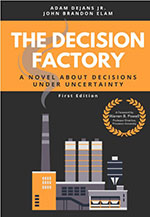
This is the intellectual frustration at the heart of The Decision Factory, published in 2026 by Adam DeJans Jr. and John Elam. The book is a business novel about a logistics company, Fulcrum Logistics, whose beautifully formulated optimization models keep collapsing under the weight of reality. The book’s central argument is simple, incisive, and more than a little uncomfortable for those in the optimization business. Rather, they are in the business of making operational plans that are based on assumptions that are almost always stale by the time those plans are implemented, often leading to poor business outcomes.
The difference matters. A plan is a solution to a stated problem based on the information available at the time it was created. In contrast, decision policies are built to respond to the problem as reality unfolds. A plan optimizes against the forecast. Policies, on the other hand, specify how decisions should be made over time based on the state of the system rather than on outdated assumptions.
The book’s plot takes place in the context of a third-party logistics business, but the same structural errors are found in many different operational settings. Hospital staffing plans built around yesterday’s census lead to nursing shortages and/or excessive overtime when admissions spike. Supply chain plans based on unrealistically precise assumptions create real-time havoc for operations managers. Retail labor schedules driven by forecasted store traffic produce high labor cost ratios during slow sales weeks. And all too often, making ad-hoc adjustments to an operational plan can be stressful, expensive, and decidedly non-optimal.
"A plan is a solution to a stated problem based on the information available at the time it was created. In contrast, decision policies are built to respond to the problem as reality unfolds."
The analytics team at Fulcrum Logistics learns this the hard way. Their optimal plan keeps failing due to factors such as demand spikes, unexpected traffic, employee absenteeism, and late arrivals. Over time, the team realizes that it has been delivering the right solution to the wrong problem. Real operational decisions, the book argues, “... are not solved once. They are decided again and again, under uncertainty, with imperfect information and real consequences.”
The challenges faced by the book’s protagonists include various sources of uncertainty, the asymmetric costs associated with different types of errors, and the impact of immediate decisions on downstream options. The book takes much of its inspiration from both the lived industry experience of its authors and from the Sequential Decision Analysis methodology championed by Warren Powell, and it provides a modicum of technical detail in its appendix, along with references to Powell’s source materials.
Despite my technical background, I am partial to good stories, both for entertainment and for teaching. As Rudyard Kipling famously said, “If history were taught in the form of stories, it would never be forgotten.” As a student, I surely learned more about supply chain management by reading The Goal (Eliyahu Goldratt, 1984) than I did from my classes in dynamic programming and inventory theory. And as a professor, I am quite confident that my MBA students will learn more valuable lessons from The Decision Factory than from any textbook on optimization or decision intelligence – and I am looking forward to introducing it to them in the classroom this fall. Stay tuned.
VIJAY MEHROTRA is a professor of business analytics and the director of the Customer Success Management Initiative at the University of San Francisco School of Management.
Vijay Mehrotra is a professor in the Department of Business Analytics and Information Systems at the University of San Francisco’s School of Management and a longtime member of INFORMS.
([email protected])