June 17, 2026 in Cyber Resilience in the Age of Intelligent Systems
The Cryptographic Reckoning
Why Quantum Readiness Begins with Agility, Not Algorithms
SHARE: PRINT ARTICLE: https://doi.org/10.1287/LYTX.2026.02.06

Enterprises rushing to adopt post-quantum algorithms may be solving the wrong problem. The deeper challenge—one already costing organizations today—is the organizational and architectural inability to change cryptographic systems at all.
As the National Institute of Standards and Technology (NIST) finalizes its post-quantum cryptographic standards, a new urgency has swept through enterprise security programs. The most dangerous assumption in this transition is that selecting the right post-quantum algorithm will, by itself, protect an organization. In practice, most enterprises cannot change cryptographic systems quickly – or at all. Expired certificates crash critical services. Library patches break production systems. Algorithm migrations take years, not weeks. The post-quantum transition has not created this fragility; it has merely illuminated it as AI-accelerated threats and regulatory deadlines now race toward an infrastructure that was never designed to be changed.
“Quantum computing is a digital storm that’s on the horizon.” —David Close, Chief Solutions Architect, Futurex, Episode 83, Cybersecurity Readiness Podcast Series
The Core Problem
The current industry conversation about post-quantum cryptography is framed as a selection problem. Security teams attend conferences, read NIST bulletins, and debate the merits of CRYSTALS-Kyber versus alternative key-encapsulation mechanisms. That conversation, while technically valid, is asking the wrong first question.
The more urgent question is not which algorithm to use, but whether an organization can swap one algorithm for another – across its entire enterprise, across vendor-supplied systems, across embedded hardware and long-lived data pipelines – within a response window measured in weeks rather than years.
Quantum computing did not create this challenge; it exposed it. The fragility was always there, but we simply did not have a forcing function severe enough to notice. Expired TLS certificates have taken down payment systems and hospital portals. Hardcoded cryptographic dependencies have caused months-long remediation efforts after library vulnerabilities. Organizations routinely discover, but only after an incident, that they lack a complete inventory of where cryptography is deployed.
Harvest Now, Decrypt Later Threat
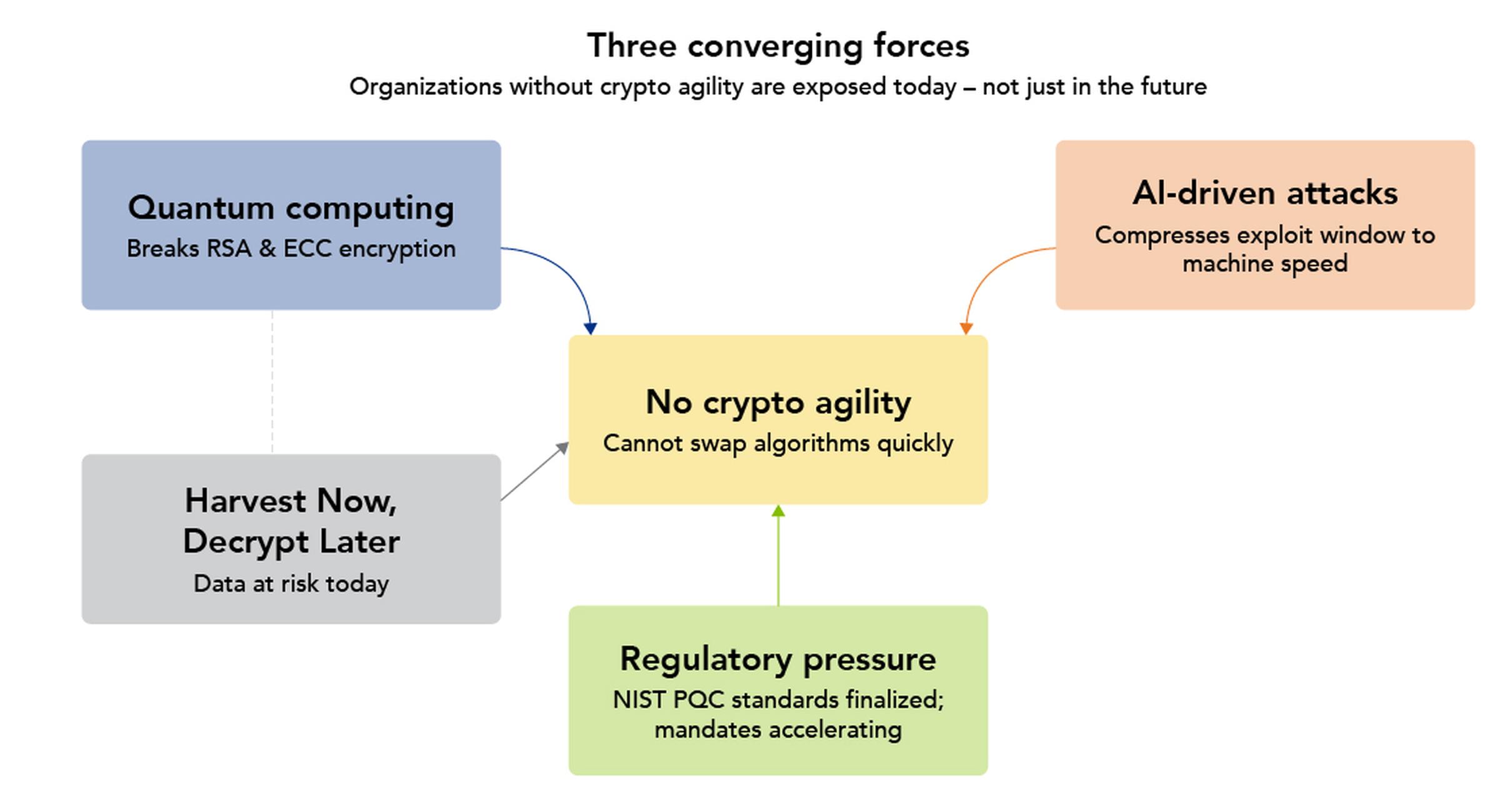
Adversaries do not need quantum computers today to exploit post-quantum vulnerabilities. “Harvest Now, Decrypt Later” (HNDL) attacks are already operational. Sophisticated threat actors are systematically collecting encrypted network traffic now, with the explicit intent to decrypt it when quantum capability matures. Data with a sensitive lifespan measured in years (financial records, health data, classified communications, intellectual property) is already at risk. Three distinct forces are converging to make cryptographic agility an urgent enterprise priority:
- Quantum Computing. Quantum computing threatens RSA and ECC encryption. The timeline is uncertain, but the certainty of impact is not. The HNDL threat means organizations whose data has a long shelf life are already exposed, even before a practical quantum computer exists.
- AI-Driven Attack Acceleration. AI automates vulnerability discovery and scales exploitation at machine speed. It dramatically compresses the window between discovery and compromise, producing adaptive, globally coordinated adversaries.
- Regulatory Pressure. NIST has finalized its first post-quantum cryptographic standards. NSA and global regulators are increasing mandates. Compliance timelines will likely lag behind the real threat landscape, meaning organizations that wait for regulatory deadlines before acting will already be behind.
“If we wait till quantum computers are fully here, it will be too late. Build crypto agile systems now, deploy quantum-safe algorithms now, and make sure your vendors are ready to protect your most valuable keys. PQC is here, and HSMs are ready. Now it’s time to build those levees.” — David Close, Chief Solutions Architect, Futurex, Episode 83, Cybersecurity Readiness Podcast Series
What Crypto Agility Actually Means
Crypto agility is not a product category or a compliance checkbox. It is an organizational capability: the demonstrable ability to discover, inventory, monitor, and replace cryptographic implementations rapidly and at scale, with minimal disruption to dependent systems.
In architectural terms, crypto agility rests on five interdependent capabilities:
- Crypto abstraction layers decouple application logic from specific algorithm implementations, enabling plug-and-play replacement.
- Centralized crypto visibility gives security teams an enterprise-wide live map of every algorithm, certificate, and key.
- Automated lifecycle management handles key rotation and certificate renewal with minimal human involvement.
- Policy-driven cryptography governs algorithm selection through rule engines, removing hardcoded logic that is both brittle and opaque.
- Hybrid readiness enables systems to run classical and post-quantum algorithms simultaneously, allowing a graceful transition rather than a forced cutover.
Most organizations are not one post-quantum algorithm away from safety; they are years of architectural discipline away from being able to change algorithms at all. Each of these capabilities is independently valuable today, regardless of quantum computing’s ultimate timeline. An organization with centralized crypto visibility and automated lifecycle management is more resilient to certificate expiration incidents than one without. The quantum transition accelerates the urgency; it does not manufacture it.
“Q Day is on the horizon, and the long-term goal should be crypto agility – abstracting encryption from code and being able to quickly adapt to the changing environment within cryptography.” – Peterson Gutierrez, VP, Information Security, Barracuda Networks, Episode 103, Cybersecurity Readiness Podcast SerieA Leadership and Organizational Challenge
Perhaps the most important reframing this moment demands of senior leaders is recognizing that cryptographic agility is not a technical problem delegated to a security engineering team. It is a leadership, architecture, and operational discipline challenge that begins at the board level and cascades through every function that owns systems, manages vendors, or handles long-lived data.
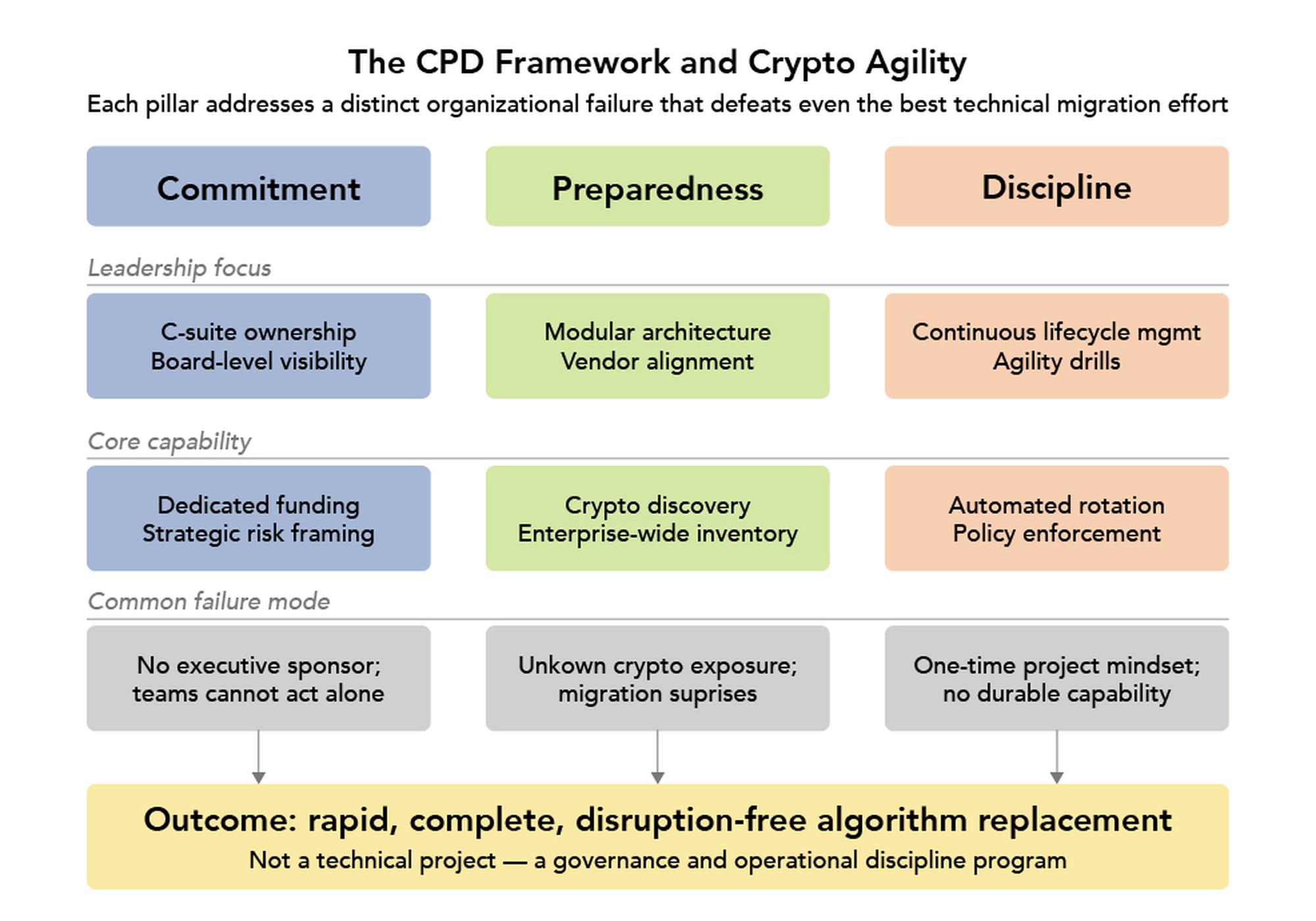
The Commitment-Preparedness-Discipline (CPD) framework, developed as a model for building enduring cyber-operational resilience, maps cleanly onto the structural requirements of crypto agility. Each pillar surfaces a distinct class of organizational failure that, left unaddressed, will defeat even the most technically sophisticated migration effort. The CPD framework breaks down as follows:
- Commitment: Leadership and Intent – Executive ownership and accountability for crypto risk cannot be delegated to IT or security. The C-suite must sponsor dedicated funding and a mandate for crypto agility initiatives. Board-level visibility into quantum and AI-driven threat exposure is essential, and must be communicated in business risk terms, not technical jargon. Outdated cryptography must be recognized as a strategic business risk, not just a technical one.
- Preparedness: Building the Capability – Organizations must know where every instance of cryptography exists before they can manage it. Preparedness requires modular architectures that enable plug-and-play algorithm replacement, automation readiness to update cryptography at enterprise scale, and vendor and supply chain alignment on crypto agility standards.
- Discipline: Consistent Execution – Crypto agility is not a project with a finish line; it is a continuously managed program. Discipline means continuous lifecycle management of keys, certificates, and algorithms; automated rotation with minimal human intervention; enterprise-wide policy enforcement; and regular crypto agility drills with rehearsed playbooks.
The commitment pillar surfaces the most common failure: the absence of executive ownership. When post-quantum migration requires renegotiating vendor contracts or replacing embedded hardware, technical teams cannot act alone. Executive ownership is not a courtesy – it is an operational requirement.
The preparedness pillar highlights the most common starting failure: organizations do not know where their cryptography is. Cryptographic inventory is the prerequisite for every subsequent migration step. Without it, organizations will encounter surprises that delay or derail the effort entirely.
The discipline pillar reflects the difference between completing a migration and maintaining a durable crypto agility capability. The post-quantum transition is not an event with a finish line. Organizations that institutionalize continuous lifecycle management and regular agility drills will find subsequent transitions dramatically cheaper and faster.
“You shouldn’t be standing up a project. You should be standing up a program for crypto agility – because it is continuous.” —Peterson Gutierrez, VP, Information Security, Barracuda Networks, Episode 103, Cybersecurity Readiness Podcast Series
First Steps Toward Crypto Agility
The scale of a cryptographic transition can at first feel paralyzing. The following six steps offer a practical, sequenced path that minimizes disruption while also building durable agility over time.
- Conduct Cryptographic Discovery and Inventory. You cannot manage what you cannot see. Identify where cryptography exists, what algorithms are in use, which systems are most critical, and who owns each instance. This is foundational; every subsequent action depends on it.
- Prioritize High-Risk Areas. Focus first on long-lived data, internet-facing systems, and critical infrastructure where a compromise would cause the most damage and where cryptographic shelf life is longest.
- Introduce Crypto Abstraction in New Systems. Do not attempt to retrofit everything at once. Build crypto agility into new systems from the start. Each new deployment that incorporates abstraction layers reduces the long-term migration burden.
- Establish Crypto Governance. Define clear ownership, accountability, and decision rights across teams. Fragmented ownership – where every team manages its own cryptography independently – is one of the root structural causes of cryptographic fragility.
- Run Crypto Agility Drills. Simulate certificate compromise and algorithm deprecation events. Measure your actual response time. Most organizations discover, in their first drill, that the real migration timeline is far longer than their planning assumptions.
- Engage Vendors Early. Ask every vendor: how quickly can your system support a new cryptographic standard? Their answer is a proxy for how much cryptographic risk they are carrying into your environment on your behalf.
NIST Selected Post-Quantum Algorithms
After an eight-year standardization process, NIST has finalized its first post-quantum cryptographic standards. Organizations planning their cryptographic transitions should treat these as primary candidates while building the architectural flexibility to adopt successors as the field matures. They are:
• CRYSTALS-Kyber: Key encapsulation mechanism (KEM) for securing key exchange and encryption. Recommended for TLS, VPN, and data-at-rest use cases where key exchange is required.
• CRYSTALS-Dilithium: Digital signature algorithm. Recommended for code signing, certificate authorities, and authentication systems. Offers a strong balance between signature size, verification speed, and security level.
Five Years From Now: Who Succeeds, Who Struggles
The organizations that navigate the post-quantum transition successfully will not be distinguished primarily by their choice of algorithms. They will be distinguished by whether they treated cryptography as a dynamic, continuously managed capability, or as a compliance checkbox reviewed annually and otherwise ignored.
Organizations that succeed will treat cryptography as a dynamically managed capability, not a configuration set at deployment and left unchanged. They will maintain real-time crypto visibility and automated rotation. They will transition to new algorithms in weeks, not years. They will align cybersecurity strategy with enterprise architecture and engage vendors on crypto agility as a procurement criterion.
Organizations that struggle will treat crypto as a compliance checkbox: set and forget. They will rely on hardcoded implementations and fully manual processes. They will discover too late how deeply crypto is embedded in their systems. They will scramble reactively under regulatory time pressure with no vendor leverage, locked into inflexible systems.
This distinction maps precisely onto the preparedness gap that has defined a generation of cybersecurity underperformance. Organizations do not fail because they lack the right technology. They fail because they lack the organizational structure, visibility, and rehearsed processes to respond quickly under pressure.
Conclusion
Quantum computing and AI-driven threat acceleration are not merely accelerating the urgency of cryptographic modernization; they are exposing a fragility in enterprise cryptographic posture that was always present. The organizations that will weather this transition are those that recognize, now, that the problem is not which algorithm to select. The problem is building the organizational and architectural capability to change anything at all, quickly, completely, and without operational disruption.
That capability requires sustained commitment from senior leadership, deliberate investment in discovery and modular architecture, and the disciplined execution of continuous lifecycle management. It is, in that sense, less a technical project than a governance one. It is available to organizations willing to treat cryptography as what it has always been: not a configuration setting, but rather a load-bearing pillar of digital trust.
Quantum computing did not create this challenge. It exposed it. AI is accelerating it. Regulation is formalizing it. The window to act is now.
Dave Chatterjee, PhD, is an adjunct associate professor at Duke University and the creator of the commitment-preparedness-discipline framework. His research and advisory work focus on cybersecurity leadership, AI-driven risk and operational resilience under real-world stress. He is the author of Cybersecurity Readiness: A Holistic and High-Performance Approach and The DeepFake Conspiracy.