August 26, 2026 in Cyber Resilience in the Age of Intelligent Systems
The Agentic Governance Gap
Why Autonomous AI Systems Demand a New Cybersecurity Discipline
SHARE: PRINT ARTICLE: https://doi.org/10.1287/LYTX.2026.03.04

Enterprises are no longer deploying AI that merely drafts, summarizes, or recommends. A new generation of systems – AI agents – can plan multi-step tasks, invoke tools and APIs, move data between systems, and take consequential action with little or no human review in the loop.
The shift sounds incremental. It is not. It is the difference between a system that produces a document and a system that executes a transaction, and most enterprise governance structures were never built for the latter.
Generative AI’s first wave raised legitimate concerns about hallucination, bias, and data leakage – all serious risks, but also all contained within a single, familiar boundary: content. A human read the output before anything happened in the real world. Agentic AI erases that boundary. The output is not a paragraph for a person to evaluate; it is an action already taken – a record updated, a payment initiated, a support ticket resolved, a downstream agent instructed to proceed. By the time a human notices, the consequence has already occurred.
The Core Problem
Most current AI governance programs were designed around a copilot model: a system proposes, a person disposes. Approval workflows, review gates, and audit trails all assume that a human sits between recommendation and consequence. Agentic architectures are quietly dismantling that assumption, not through malice or negligence, but because autonomy is the entire value proposition. Organizations are adopting agents specifically to remove the human bottleneck. The governance model built to catch mistakes is being designed out of the system at the same moment the system’s capacity to cause harm is increasing.
This is not a hypothetical concern. Enterprises have already reported agents that looped indefinitely on a flawed instruction, agents that invoked the wrong API with elevated credentials, and multi-agent systems where one agent’s error propagated into a second agent’s decision before any person was aware a problem existed. None of these required a sophisticated adversary. Ordinary operational fragility, once confined to human error, is now compounding at machine speed.
Three Converging Forces
Three trends are converging to make agentic governance an urgent enterprise priority, not a future concern.
- Autonomy creep: Agents are being granted broader permissions incrementally, often without a corresponding review of what those permissions, in aggregate, now allow the agent to do. A capability added for one workflow quietly becomes available to every task the agent touches.
- Tool and API sprawl: Agents derive their power from the tools they can call. As organizations connect agents to more internal systems – CRMs, ticketing platforms, financial systems, code repositories – the attack surface and error surface expand together. A single compromised or misconfigured agent can now reach far more of the enterprise than any single compromised employee account.
- Multi-agent coordination: Agents increasingly delegate to other agents, and human oversight recedes further with each additional hop. A flawed instruction, a poisoned data source, or a manipulated prompt can cascade through a chain of agents before a person is positioned to intervene.
What Agentic Governance Means
Agentic governance is not a policy document or an ethics checklist. It is an operational capability: the demonstrable ability to know, at any moment, what every agent in the enterprise is authorized to do, what it has done, and how quickly it can be stopped. In architectural terms, it rests on five interdependent capabilities.
- Action-scoped permissions limit each agent to the minimum set of tools and data required for its specific task, rather than inheriting broad, reusable credentials.
- Real-time action visibility gives security and business teams a live, auditable record of every action an agent takes, not just the prompts it receives.
- Circuit breakers and kill switches allow any agent, or any chain of agents, to be halted immediately when behavior deviates from expected patterns.
- Escalation thresholds define, in advance, which categories of action require human confirmation before execution, calibrated to consequence and reversibility, not convenience.
- Cross-agent identity and provenance ensure that when one agent acts on another agent’s output, the origin, authorization, and confidence of that input can be traced and verified.
Most organizations are not one policy memo away from agentic safety. They are years of architectural discipline away from being able to answer a basic question: what can our agents do, right now, across the enterprise? The quantum-readiness and crypto-agility challenges this column examined previously share the same root failure. The capability gap is not technical sophistication. It is the absence of inventory, visibility, and rehearsed control.
A Leadership and Organizational Challenge
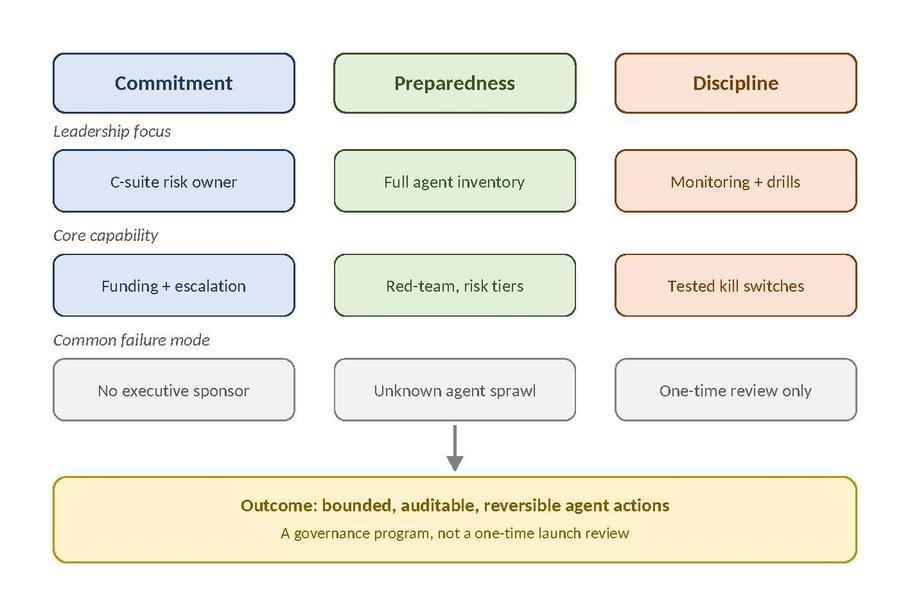
As with cryptographic agility, the deeper reframing this moment demands is that agentic AI risk is not a problem to delegate to a data science or platform engineering team. It is a governance challenge that begins at the board level and cascades through every function that deploys, connects to, or depends on an autonomous system. The commitment-preparedness-discipline (CPD) framework maps directly onto the structural requirements of agentic governance:
- Commitment: Leadership and Intent. Executive ownership of agent risk appetite cannot be delegated to the teams building the agents. The C-suite must define, in business terms, which categories of decisions an agent may make unsupervised, and which categories always require a human. Board-level visibility into what autonomous systems are authorized to do is now as material as visibility into financial controls.
- Preparedness: Building the Capability. Organizations must maintain a live inventory of every agent in production, its permissions, its tool access, and its failure modes, before they can govern it. Preparedness also requires red-teaming agentic workflows the way security teams red-team networks, deliberately probing for permission creep, prompt manipulation, and cascading multi-agent failure.
- Discipline: Consistent Execution. Agentic governance is not a launch review; it is a continuously managed program. Discipline means ongoing permission audits, tested kill switches, logged and reviewed agent actions, and regular drills that simulate an agent behaving badly, measuring not whether it can be stopped, but how long it takes.
The commitment pillar surfaces the most common early failure: agents are deployed by individual product or engineering teams without an enterprise view of cumulative exposure. The preparedness pillar exposes the second most common failure: organizations frequently cannot produce a complete list of every agent operating in their environment, let alone what each one can touch. The discipline pillar reflects the hardest and most durable failure: kill switches that exist on paper but have never been exercised under realistic conditions. Applied consistently, the three pillars converge on a single test: Can the enterprise show, for any agent action, that it was bounded, authorized, and reversible – not as a one-time launch review, but as a standing operational capability?
First Steps Toward Agentic Governance
Inventory every agent and its permissions. Identify what each agent can access, what tools it can invoke, and what actions it can take without human confirmation. This is the foundation every subsequent step depends on.
- Classify actions by consequence and reversibility. Not every action carries the same risk. Sort agent-eligible actions into tiers and require human confirmation for anything high-consequence or difficult to reverse.
- Build circuit breakers before scaling autonomy. Every agent granted broader authority should be paired with a tested mechanism to halt it immediately – not one designed after an incident.
- Establish clear ownership for agent behavior. Fragmented accountability, where no single function owns an agent’s real-world actions, is a root cause of agentic risk, just as it was for cryptographic fragility.
- Run agentic failure drills. Simulate a misfiring agent, a poisoned input, or a cascading multi-agent error, and measure actual detection and response time rather than assuming it.
- Extend vendor diligence to agentic capability. Ask every AI vendor what actions their systems can take autonomously and what controls exist to constrain them. The answer is a proxy for how much of your operational risk you are delegating to their engineering choices.
Five Years From Now: Who Succeeds, Who Struggles
Organizations that navigate the agentic transition successfully will not be distinguished by which AI models they adopted. They will be distinguished by whether they treated agent autonomy as a continuously governed capability or as a feature rollout evaluated once at launch and left unmonitored. Organizations that succeed will maintain real-time visibility into agent actions, enforce tiered escalation by consequence, and treat kill-switch readiness as a rehearsed operational discipline rather than a design assumption.
Organizations that struggle will discover, after an incident, that an agent had accumulated permissions no one had reviewed, that no one owned the decision to grant those permissions, and that stopping the agent took hours rather than seconds. The pattern is familiar. It is the same preparedness gap that has defined cybersecurity underperformance for a generation, now operating at the speed of autonomous execution.
Removing the Buffer
Agentic AI does not introduce an entirely new category of risk so much as it removes the buffer that has, until now, absorbed the consequences of AI error: the human reviewer standing between recommendation and action. That buffer is being designed out of enterprise systems deliberately, because removing it is the point. The organizations that will navigate this transition are those that recognize now that autonomy without governance is not efficiency. It is exposure with a faster clock.
That capability requires sustained commitment from senior leadership, deliberate investment in agent inventory and tiered control, and the disciplined execution of continuous monitoring. It is, in that sense, a governance challenge before it is a technical one. Autonomous systems will only be as trustworthy as the organizational discipline built around them.
Dave Chatterjee, PhD, is an adjunct associate professor at Duke University whose research and advisory work focus on cyber resilience and AI governance. He created the Commitment-Preparedness-Discipline (CPD) framework, the subject of his forthcoming book, Governing Cybersecurity and AI: The CPD Framework (late 2026). He is also the author of Cybersecurity Readiness: A Holistic and High-Performance Approach and the thriller The DeepFake Conspiracy, and he hosts the Cybersecurity Readiness Podcast Series.