

September 29, 2026 in Academia
From Strategy to Execution
Designing Scalable Industry/Academic Collaboration
SHARE: PRINT ARTICLE: https://doi.org/10.1287/LYTX.2026.03.08

Collaboration between industry and academia is widely encouraged in operations research and management science circles. But it is often unevenly executed across professional societies, universities, workforce-development organizations, and practitioner communities. Although many organizations share common goals across their fields of analytics, including workforce relevance, leadership development, and knowledge transfer, collaboration efforts often stall due to unclear ownership, misaligned incentives, volunteer fatigue, or loss of institutional memory – even though they are recognized as valuable.
A collaboration operating model developed by The Institute of Electrical and Electronics Engineers (IEEE) Pikes Peak Section in Colorado, a member-driven professional community, set out to create recurring STEM outreach and mentoring activities to raise awareness among students of professional opportunities in engineering. The project was a collaborative effort that incorporated professional engineers, educators, students, and community volunteers.
Although informed by experience in a technical professional society, the mechanisms uncovered by the exercise described here can apply broadly because they are organization-agnostic and transferable to other communities, including analytics and operations research organizations. The focus is not on institutional structure, but rather on collaboration design choices that reduce friction, increase volunteer activation, improve continuity, and enable scale.
Collaboration as a Designed System
A recurring reason for the failure of industry/academic partnerships is treating collaboration as a series of goodwill gestures rather than as a system explicitly created to achieve long-term benefits. In practice, collaboration succeeds only when roles, cadence, artifacts, and accountability are made clear up front.
The model described here was intentionally designed as an infrastructure rather than a single program or one-time event. It connected participants through specific role definitions, structured mentorship pathways, modular participation, reusable collaboration assets, and documented feedback loops. In this case, the work centered on engineering and STEM education, but the operating mechanisms are not discipline-specific.
Figure 1 depicts collaboration as an intentionally designed system to emphasize how the structured design used in this effort enables continuity, scalability, and sustained volunteer engagement. These elements are applicable to any member-driven organization that depends on volunteer engagement and cross-sector coordination.
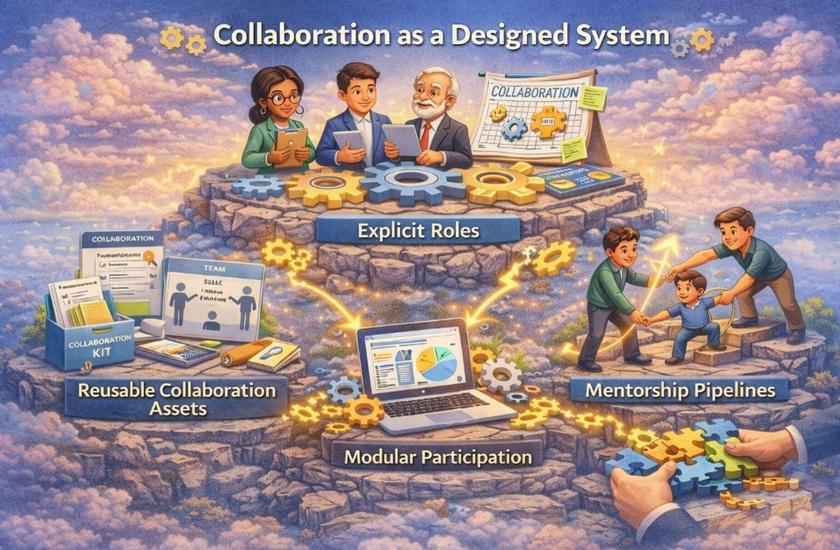
Figure 1. Collaboration as a Designed System
Rather than relying on a single partnership mechanism, this collaboration employed multiple complementary forms, as depicted in Figure 2. Practitioners contributed applied insight and feasibility constraints, whereas educators ensured conceptual integrity and learning coherence. This division of responsibility reduced re-work and prevented content from drifting toward abstraction or oversimplification.
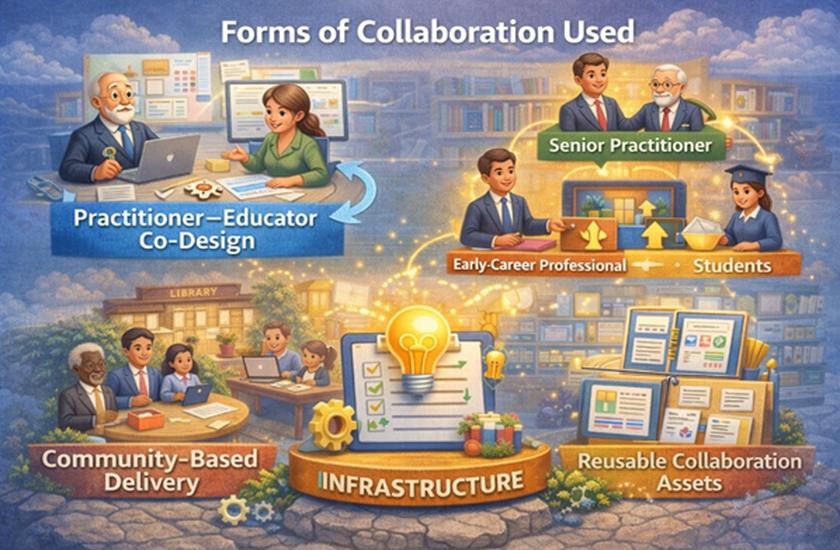
Figure 2. Forms of Collaboration Used
Mentorship Pipelines
Mentorship was designed as a cascading pipeline rather than an ad hoc activity. Senior practitioners mentored early-career professionals, who mentored students, who in turn engaged pre-college learners. This structure distributed leadership load and preserved continuity across cohorts.
Engagement extended beyond academic campuses. Community partners such as libraries, cultural organizations, and public forums served as delivery venues, expanding reach and trust while reducing access barriers. Activities were packaged as reusable “kits” rather than one-off events. Each kit included facilitator guidance, learning objectives, logistics notes, and reflection prompts, enabling replication without heroic effort.
Challenges and Responses
Despite intentional design, several recurring challenges emerged during implementation. They did not stem from a lack of goodwill or technical competence; rather, they reflected systemic friction points common to volunteer-driven, cross-sector collaborations.
A persistent challenge was aligning incentives across stakeholders operating on different temporal and professional cycles. Academic participants were constrained by semester calendars and teaching loads, industry and engineering managerial practitioners balanced project deadlines and travel, and volunteers from various STEM disciplines contributed during limited discretionary time.
In practice, this misalignment meant that moments of high enthusiasm did not always coincide with windows of availability. Successful collaboration therefore required flexible engagement models, short, modular activities, and clearly scoped commitments rather than assuming sustained, synchronized participation across all groups. For example, a public STEM activity could involve a university student available between classes, an industry practitioner available after work hours, and a retired professional with daytime flexibility. Breaking the work into setup, facilitation, mentoring, and follow-up roles allowed each person to contribute when they were available.
The collaboration model addressed incentive misalignment by favoring flexible, low-commitment participation units over synchronized long-term engagement. Activities were intentionally scoped so meaningful contributions could be made within short time windows, allowing participants to engage when availability aligned rather than forcing that alignment. This design reduced dependency on perfect timing and increased overall participation resilience.
Coordination Overhead
As collaboration expanded, coordination costs grew faster than technical complexity. Although the substantive work – content development, mentoring, or outreach – remained manageable, the overhead associated with scheduling, communication, documentation, and follow-up increased disproportionately.
This revealed an important insight: collaboration does not fail because the work is too hard, but because coordination is too expensive. Without deliberate infrastructure, shared templates, standardized artifacts, and lightweight reporting mechanisms, volunteer energy was diverted from value creation toward administrative friction. This dynamic is common in analytics and OR/MS communities where interdisciplinary participation is high, but coordination mechanisms are informal. In practice, a one-hour outreach session could require substantially more time to arrange volunteers, facilities, equipment, communications, registration, and follow-up. Reusable activity descriptions, shared web resources, and automated event calendar updates reduced how much coordination had to be recreated for each event.
To counter overhead, the collaboration introduced lightweight coordination infrastructure: standardized templates, reusable artifacts, and simple reporting formats. By externalizing coordination into shared structures, participants were freed to focus on value creation rather than administrative effort. The key design choice was to treat coordination as a system problem, not an individual burden.
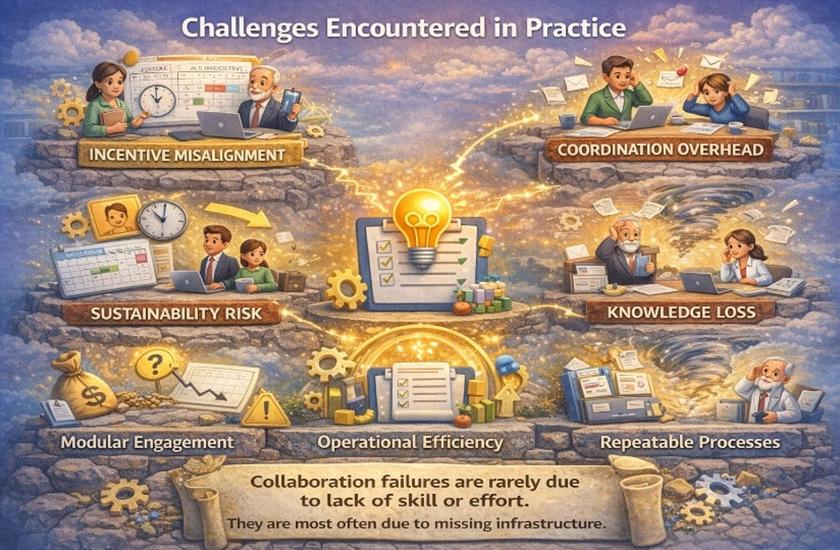
Figure 3. Challenges Encountered in Practice
Sustainability Beyond Initial Funding
Several initiatives launched successfully with external funding or institutional sponsorship, but early momentum did not automatically translate into long-term continuity. Once initial resources were exhausted, activities risked reverting to ad hoc efforts dependent on a small number of highly committed individuals. Small STEM grants helped purchase materials and launch activities, but continuity still depended on people, reusable materials, and recurring engagement after the grant period ended.
This highlighted a critical distinction between project success and system sustainability. Long-term viability depended less on initial funding and more on embedding collaboration into repeatable processes: mentorship cascades, reusable assets, and predictable engagement rhythms that could persist independent of new grants. This challenge is familiar across professional organizations that rely on episodic funding to catalyze innovation but struggle to institutionalize outcomes.
Sustainability was addressed by shifting emphasis from project outputs to repeatable processes. Mentorship cascades, reusable collaboration assets, and predictable engagement rhythms were designed to persist independently of funding cycles. This approach reframed funding as a catalyst rather than a dependency, allowing collaboration momentum to continue after initial resources were exhausted.
Knowledge Loss and Leadership Turnover
Volunteer and leadership turnover posed a significant risk to institutional memory. As experienced contributors rotated out of roles, undocumented decisions, informal practices, and lessons learned were easily lost, forcing new leaders to relearn prior constraints and rediscover effective approaches.
In response, documentation was reframed as a first-class deliverable, not an afterthought. Short summaries, reusable guides, and shared repositories became essential tools for preserving continuity across cohorts. This issue is not unique to any one organization; it is endemic to volunteer-led systems where leadership renewal is both a strength and a vulnerability. Facilitator guides, shared web pages, event notes, and backup ownership for key functions helped move knowledge out of one person’s memory and into reusable organizational assets.
Knowledge loss was mitigated in this case by elevating documentation to a core system function. Short, structured summaries, shared repositories, and role-based guides were embedded into normal workflows. The intent was not comprehensive archival, but continuity: enabling incoming participants to build on prior learning rather than restart from scratch. In addition, a strategic goal can be framed as follows to help mitigate this challenge.
One practical extension is a one-person-per-year mentorship rule: each active participant recruits or welcomes one new participant and mentors that person toward meaningful contribution during the following year. The objective is not immediate leadership succession, but another capable contributor who can eventually repeat the process.
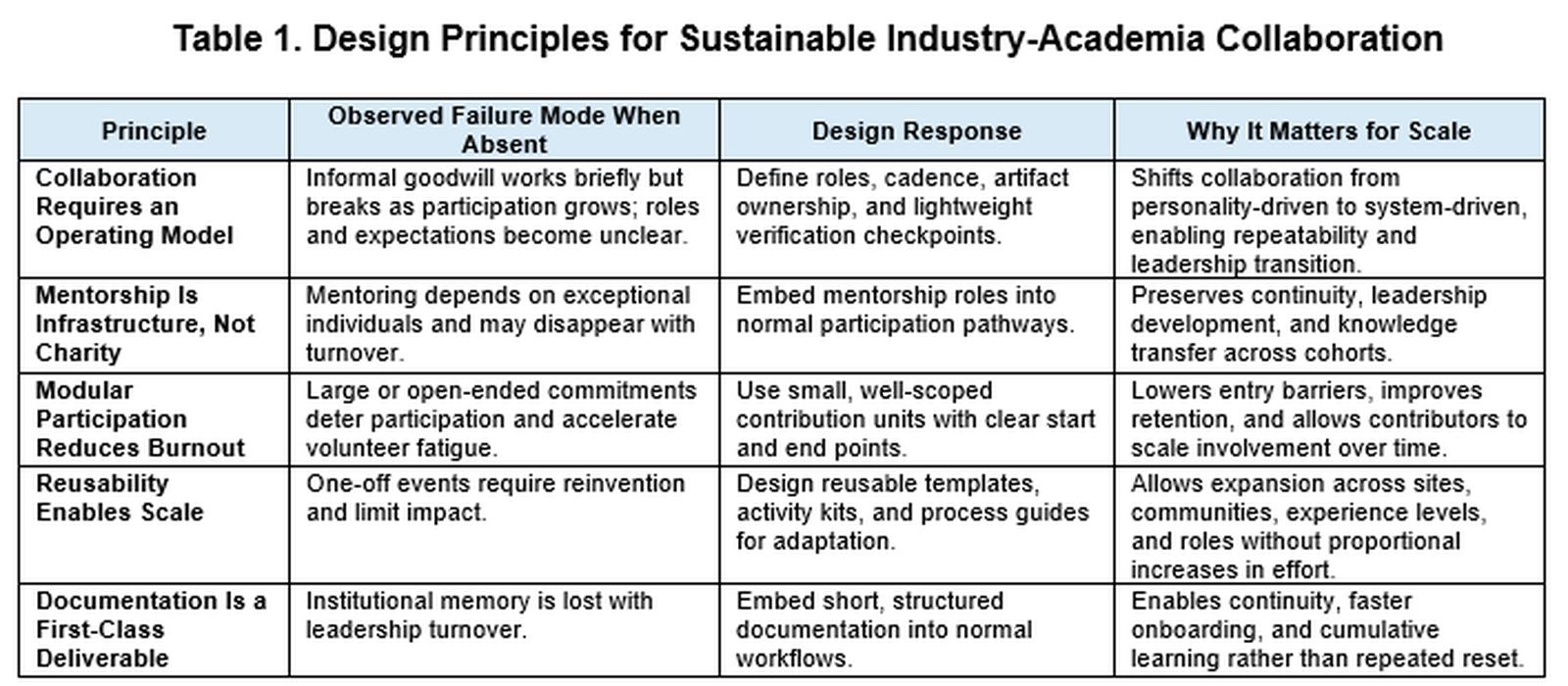
Taken together, these experiences led to five practical principles for designing collaboration that can survive changes in funding, participation, and leadership. Across multiple collaboration efforts, five design principles repeatedly emerged as determinants of sustained success. Although the specific contexts varied, these principles proved durable because they addressed structural, rather than motivational, constraints.
1. Collaboration Requires an Operating Model
Informal goodwill may initiate collaboration, but it does not scale. In practice, sustained collaboration requires an explicit operating model that defines how work is initiated, executed, reviewed, and transferred over time.
Successful efforts made roles, cadence, and artifact ownership unambiguous. Participants understood not only what they were contributing, but how their contribution fit into a broader system. Verification checkpoints such as reviews, reflections, or simple acceptance criteria, helped ensure alignment without introducing excessive bureaucracy.
This operating-model mindset shifted collaboration from a personality-driven activity to a repeatable system that could survive leadership changes and growth. For example, documenting activity ownership and maintaining a backup for recurring functions allowed work to continue when a volunteer changed roles or became unavailable.
2. Mentorship Is Infrastructure, Not Charity
Mentorship was most effective when treated as structural infrastructure rather than an optional or altruistic activity. When embedded into the operating model, mentorship became a stabilizing mechanism that supported continuity, leadership development, and knowledge transfer.
Rather than relying on informal or ad hoc mentoring relationships, successful collaborations defined mentorship roles explicitly and integrated them into normal workflows. This approach normalized mentorship as part of participation, reducing dependence on exceptional individuals and ensuring that learning and leadership propagation occurred continuously.
In this framing, mentorship functioned less as personal generosity and more as a system-level reinforcement mechanism.
3. Modular Participation Reduces Burnout
Volunteer fatigue emerged as a significant risk when participation required large, ambiguous, or open-ended commitments. In contrast, collaborations that emphasized modular participation – small, clearly scoped units of contribution – saw higher engagement and retention.
By breaking work into discrete modules with defined boundaries, participants could contribute meaningfully without overcommitting. This design respected limited availability while still enabling cumulative progress. Over time, modularity allowed individuals to scale their involvement up or down based on capacity, reducing burnout and improving sustainability. This principle proved especially important in communities where contributors balanced professional, academic, and personal obligations.
4. Reusability Enables Scale
Collaboration efforts scaled only when outputs were designed for reuse. One-off events, bespoke materials, or context-specific processes limited impact and required repeated reinvention.
Successful models intentionally produced reusable collaboration assets, including templates, guides, activity kits, and documented processes, that could be adapted with minimal effort. Reusability shifted the focus from repeated setup to incremental improvement, allowing each cycle to build on prior work rather than restart it. This principle enabled both horizontal scaling (across sites or communities) and vertical scaling (across experience levels and roles).
5. Documentation Is a First-Class Deliverable
Institutional memory did not persist without deliberate effort. When documentation was treated as optional or secondary, knowledge loss accompanied leadership turnover, forcing repeated relearning.
In contrast, successful collaborations elevated documentation to a first-class deliverable. Short, structured summaries, role guides, and artifact repositories were produced as part of the collaboration itself, not as an after-action task. The goal was not exhaustive reporting, but continuity: ensuring that new participants could quickly understand context, decisions, and lessons learned. This principle transformed documentation from administrative overhead into a strategic asset. By treating collaboration as an operating system supported by mentorship, modularity, reuse, and documentation, organizations can move beyond episodic success toward enduring impact. Table 1 displays a summary of the design principles for sustainable industry-academia collaboration.
The most important lesson was not that every collaboration needs the same structure. It was that collaboration improves when organizations design for the realities of the people doing the work. Schedules will conflict, volunteers will come and go, funding will fluctuate, and leaders will move on. A resilient model assumes those conditions from the beginning and makes it easier for the next participant to continue, and improve, the work.
Dr. John Santiago is a retired U.S. Air Force officer with 26 years of experience in research, development, and acquisition, including precision-guided munitions and high-energy laser systems. After military service, John spent more than 20 years as a university professor teaching electrical engineering, systems engineering, computer engineering, physics, and mathematics. John is a Life Senior Member of IEEE and has held multiple leadership roles, including IEEE Pikes Peak Section Chair, Region 5 Educational Activities Coordinator, and faculty advisor to IEEE student branches. His current work focuses on scalable collaboration models that connect academia, industry practitioners, and community partners through mentorship pipelines, AI-enabled multimedia learning assets, and repeatable outreach "kits." His frameworks include STEAM-TEAMS and PyramidX-OS, emphasizing ethical leadership, workforce readiness, and sustainable impact.