September 21, 2026 in Data Science
The Hidden Story Inside Data
How Statistics and Analytics Work Together to Reveal Hidden Truths
SHARE: PRINT ARTICLE: https://doi.org/10.1287/LYTX.2026.03.10

Imagine walking into a crime scene.
A broken window. Muddy footprints. A half-finished cup of coffee. A mobile phone lying on the floor.
To an untrained observer, these are simply unrelated objects. To a detective, they are pieces of a story waiting to be uncovered.
The detective’s task is not to collect more evidence. The evidence is already there. The challenge is to determine what it means. Which clues matter? Which are merely distractions? How do they fit together? Through careful observation, logical reasoning, and the elimination of unlikely explanations, a seemingly random collection of clues gradually reveals the truth.
The evidence never changes. Only our understanding does.
Data are much the same.
Every day, hospitals record patient admissions, banks process financial transactions, governments conduct censuses, and businesses monitor customer behavior. Satellites observe the Earth while sensors continuously capture information about the world around us. Never before have we generated so much data. Yet despite this abundance, one challenge remains unchanged.
Data Rarely Explain Themselves
A spreadsheet containing thousands of records is no more informative than a detective’s notebook full of clues. The facts are all there, but the story is hidden. Meaningful patterns are obscured by variation, and important relationships are buried beneath complexity. Simply collecting more data does not automatically lead to greater understanding. Discovering that hidden story is the common purpose of both statistics and data science.
Although these two disciplines are often discussed as though they compete with one another, they are driven by the same fundamental objective: transforming data into reliable information that supports better decisions. Whether the goal is improving healthcare, detecting financial fraud, understanding climate change, or designing more efficient public services, success depends on one essential question: What is the evidence really telling us?
For more than a century, statistics has provided the framework for answering that question. More than a collection of mathematical techniques, it is a way of thinking about evidence. Statistical reasoning helps us distinguish meaningful patterns from coincidence, measure uncertainty, and draw conclusions that extend beyond the data we happen to observe.
But if statistical thinking has served us so well for generations, why has data science emerged as a distinct discipline?
Why Data Science Emerged
The answer is not that statistics has become less important. Quite the opposite. As the world has become increasingly digital, the amount of data available to us has grown beyond anything previous generations could have imagined. The challenge is no longer finding data; it is making sense of them quickly, responsibly, and at scale.
To understand why this matters, it is worth returning to our detective. The detective’s mission has not changed; the goal is still to uncover the truth hidden within the evidence. What has changed is the amount of evidence.
A century ago, detectives relied on eyewitness accounts, fingerprints, and handwritten reports. Today, an investigation may involve CCTV footage, DNA profiles, mobile phone records, GPS locations, financial transactions, and millions of digital messages. The challenge is no longer finding clues. It is making sense of an overwhelming volume of them. The same transformation has taken place across almost every discipline.
A hospital no longer stores only admission records and discharge summaries. It manages electronic health records, laboratory results, medical images, wearable device data, and continuous patient monitoring. Banks analyze millions of transactions every hour to detect fraud. Retailers monitor purchasing behavior across stores and online platforms. Scientists receive an uninterrupted stream of observations from satellites and sensors around the world.
The question has become remarkably simple: How do we turn this flood of data into reliable decisions?
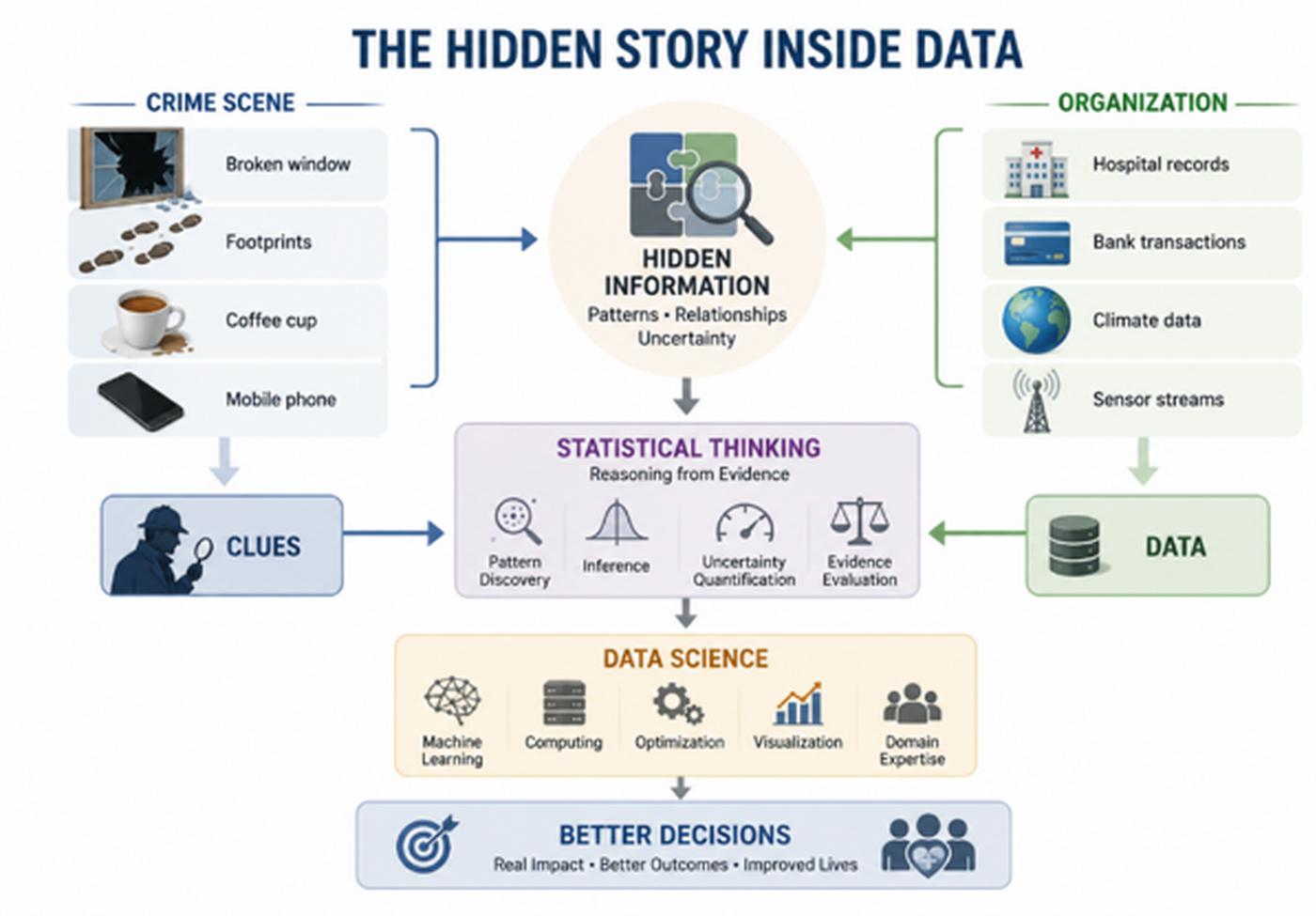
Graphic created with the assistance of ChatGPT (AI).
Figure 1. From Clues to Decisions: Statistical Thinking Connects Data and Better Decisions
The Challenge of Scale
For decades, statistics has provided the foundation for answering that question. It helps us design studies, uncover meaningful patterns, measure uncertainty, and distinguish genuine relationships from coincidence. Those principles remain as important today as they were a hundred years ago. What has changed is the scale of the problem.
Modern analytical challenges require more than statistical reasoning alone. Data must often be collected, cleaned, integrated, stored, and processed before any meaningful analysis can begin. The volume of information often exceeds what traditional analytical methods can handle efficiently.
This is where data science enters the story.
Rather than replacing statistics, data science extends it. It combines statistical reasoning with modern computing, machine learning, data engineering, visualization, and domain expertise to tackle problems that were once beyond reach. Each discipline contributes something different, but all share the same objective: transforming data into evidence that supports better decisions.
So, statistics remains the reasoning engine, data science provides the vehicle that carries that reasoning into practice, computing provides the scale, machine learning uncovers complex patterns, and domain expertise ensures that those patterns make sense in the real world.
Together, they form a modern analytical toolkit capable of addressing problems that no single discipline could solve alone. But the true value of this collaboration is best understood through a decision that affects people every day.
From Data to Decisions
Consider a public hospital preparing for a long holiday weekend. Hospital managers know that emergency departments are likely to become busier, but they do not know exactly how busy. Scheduling too many doctors and nurses wastes scarce resources. Scheduling too few can lead to overcrowded waiting rooms, exhausted healthcare workers, delayed treatment, and poorer patient outcomes. Making the right staffing decision is far from simple.
The hospital already possesses years of historical data: patient admissions, waiting times, laboratory requests, staffing records, bed occupancy, ambulance arrivals, and treatment outcomes. Individually, these records appear to be little more than numbers stored in a database. Together, they contain valuable clues about how demand changes over time.
Statistical analysis uncovers those patterns, revealing, for example, that emergency admissions consistently rise during holiday periods or that certain illnesses follow predictable seasonal trends. Machine learning builds on these insights to forecast the number of patients likely to arrive over the coming days, and optimization methods then identify staffing plans that balance patient care, staff well-being, and limited financial resources. Finally, hospital managers and clinicians combine these analytical insights with professional judgement before making decisions.
Data become evidence, evidence becomes insight, and insight becomes action. This illustrates the real purpose of data science. It is not a collection of fashionable technologies or sophisticated algorithms. It is a disciplined process of transforming data into decisions. Statistics provide the reasoning, computing provides the scale, machine learning provides predictive capability, and domain expertise ensures that analytical results make sense in the real world. None of these components are sufficient on their own. Their greatest strength lies in working together.
The Role of Artificial Intelligence
Artificial intelligence is the latest chapter in this evolution. Today’s AI systems can analyze documents, generate computer code, recognize images, and answer complex questions with remarkable speed. These capabilities are changing the way organizations use data, but they do not change the fundamental principles of evidence-based decision-making. Although artificial intelligence can generate answers, it cannot determine whether those answers are trustworthy. That responsibility still belongs to us.
We must ask where the data came from, whether they are representative, how much uncertainty surrounds a prediction, and whether an apparent pattern reflects genuine evidence or mere coincidence. As analytical tools become more powerful, the importance of statistical thinking does not diminish; it becomes even more critical.
Now return to the crime scene. The broken window remains broken. The muddy footprints have not moved. The coffee cup is still sitting on the table. Nothing about the evidence has changed – only our understanding of it. The same is true of data.
Hidden within every dataset is a story waiting to be discovered. While statistics provide the reasoning that allows us to uncover that story, data science extends that reasoning with modern computational tools, enabling us to tackle problems of unprecedented scale and complexity. Together, they transform observations into evidence, evidence into knowledge, and knowledge into better decisions.
In an age defined by data, our greatest advantage will not come from collecting more information or building increasingly sophisticated algorithms. It will come from asking better questions, interpreting evidence wisely, and making decisions that improve lives.
That is the hidden story inside data.
Dr. A. W. L. Pubudu Thilan, B.Sc., BIT (Dip.), M.Sc. (USA), M.Phil. (Sri Lanka), Ph.D. (Australia), is a Senior Lecturer in the Department of Mathematics at the University of Ruhuna, Sri Lanka. His research interests include statistics, data science, optimization, Bayesian modelling, and healthcare analytics. He is passionate about promoting statistical thinking and demonstrating how data-driven decision-making can address real-world challenges through interdisciplinary collaboration.