


January 31, 2010 in Forum
As Analytics Subsumes O.R., will INFORMS Subsume Analytics?
SHARE: PRINT ARTICLE: https://doi.org/10.1287/orms.2010.01.09
The title of this article asks a provocative question. There is an increasing amount of coverage of the term “analytics”in the media, and there are some significant developments:
- On April 28, 2009, the news broke that “IBM today announced a significant expansion of its capabilities around business analytics with plans to open a network of Analytics Solution Centers around the world, beginning with five in the second quarter of 2009. These initial centers will be located in Tokyo, London, New York City, Beijing and Washington, D.C. As part of this initiative, IBM will retrain or hire as many as 4,000 new analytics consultants and professionals” [1].
- Tom Davenport’s article on analytics is listed as one of the 10 must-read articles in the Harvard Business Review [2].
- INFORMS has started publishing a new digital magazine Analytics. A Google search for “analytics” picks up the link to it (http://analytics-magazine.org) on the first page of results.
- Analytics is being covered in the mainstream press, such as Forbes magazine [3].
The coverage and scope of analytics is widespread, with interest from business, defense, government, education and the general public reflected in the coverage of the subject in the press. Students have developed a keen interest to learn about analytics and venture capital firms are keen to fund analytics startups.
Analytics Delivers Value Beyond OR/MS
So what constitutes analytics? Here are three definitions:
- “By analytics we mean the extensive use of data, statistical and quantitative analysis, explanatory and predictive models, and factbased management to drive decisions and actions” [4] – Tom Davenport, co-author of “Competing in Analytics”
- “How an entity (i.e., business) arrives at an optimal or realistic decision based on existing data … unless there are data involved in the process, it would not be considered analytics” [5] – Wikipedia
- “Recurring points in these definitions appear to segment analytics into three skill sets. One is the grunt work that O.R. people have to do before they can apply O.R. methods and models. This includes data gathering, data cleaning and organizing, distribution fitting, descriptive statistics, ‘trend spotting’ and developing performance metrics. I will call this body of knowledge and skills ‘pre-O.R.’ The second piece of analytics is the O.R. skill-set itself, which would include building some form of mathematical or spreadsheet model to add value to the data in helping understand and resolve a decision. The third segment of analytics consists of a set of more advanced analytical skills and methodologies that would not normally be taught in an O.R. course. These include data mining, predictive modeling and advanced statistical techniques such as logit, cluster analysis and some tools from artificial intelligence, as well as methodologies such as Six Sigma and lean manufacturing. I will call this set of skills non-O.R. analytics” [6]. – Peter Bell
When we assess the organizations involved in analytics as featured in Analytics Magazine, we find that these organizations define analytics functions that extend beyond the use of core OR/MS techniques and practitioners. They build analytics teams with people from the fields of statistics, industrial engineering, computer science, data analysis, finance and OR/MS and leverage generalists with industry knowledge. For example:
- At Schneider Logistics’ Engineering and Research Department, “The group’s academic backgrounds range across not only operations research, but also industrial engineering, mathematics, computer science, finance and business administration, with a combination of bachelor’s master’s and Ph.D. degrees. A number of team members bring significant prior transportation operations experience” [7].
- In the Strategic Planning and Modeling team at Hewlett Packard, “While there will always be niche roles for technical specialists with deep expertise in a particular methodology like optimization or data-mining, there is a growing need for generalist problem solvers to support managers who want to drive better, data-driven business decisions … Their bread-and-butter analytics tools are spreadsheet modeling and data analysis skills” [8].
- At McDonalds Restaurant Innovation organization, “Over the past few years we have built a team with talents in the area of video analytics, data mining/predictive analytics, predictive modeling and experimental design. These are the core competencies needed for our business right now” [9].
So if you are an INFORMS member and practitioner, you are probably either in an analytics team or complement the analytics team. The world of analytics, therefore, has already enveloped many OR/MS practitioners; in general, we rely on the analytics organizations to get the data needed to do our work and then we use the operations reporting and control mechanisms provided by the analytics team to get results from OR/MS recommendations.
This close affiliation to analytics is reflected in the skills needed for in OR/MS jobs. ManMohan S. Sodhi and Byung-Gak Son analyzed O.R. job postings and found that “employers of O.R. graduates consistently require modeling, statistics, programming and general analytical skills in an operations management context” [10]. This listing, however, places O.R. graduates in just a part of the overall analytics landscape.
To delineate the landscape for analytics, here is a proposed list of skills:
- Framing the problem and getting to the solution
- Understanding the business issues and business/organizational concerns using formal modeling processes that address purpose and environment and end-to-end capabilities and processes. This allows the analyst to understand the domain to frame problems and identify solutions.
- Frame and structure problems in terms of objectives, constraints, risks and courses of action to set the stage for meaningful results. Effective selection of a problem statement sets up the solution to align with the organizational structure, systems and culture; poor problem structures often lead to blind alleys during analysis or execution.
- Project management and exposure to the foundational principles of managing people, politics, products and processes.
- Communication skills, methods and technologies that enable effective collaboration throughout the project cycle, from effective informationgathering to collaborative decision support and change management
- Data preparation. We need to teach people how to assess data quality, improve its fitness for use in decision-making, and enable effective sharing of data without getting entangled in its semantic richness.
- Data presentation in dashboards and reports, to communicate the situation and prompt decision-making and action by the target audiences.
- Control of operations using planning, scheduling, dispatching, managing exceptions and disruptions; project and program planning and execution.
- Statistics, probability, forecasting, etc. that are now being termed “predictive analytics” in the industry.
- Optimization, simulation, queuing models, decision analysis, etc.
- Enabling organizations to act intelligently.
-
- Design and governance of metrics portfolios to drive system-wide performance improvements; this addresses the problem of figuring out which metrics are important and how to set targets and thresholds that address business needs.
- Driving decisions from analysis: helping decision-makers to use data-driven analyses effectively, often in conjunction with gut-feel or anecdotal methods.
- Design and operation of analytics teams and organizations in the context of business and IT functions.
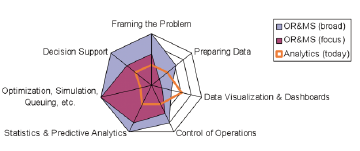
This list is not intended to fully define either OR/MS or analytics – I do not intend to bind and carve up these sprawling and evolving bodies of knowledge. This listing method, instead, is intended to spark discussion and understanding. We can use this list, for instance, to map the practice of analytics today versus where practitioners may place the OR/MS domain:
Based on the Figure 1 diagram, we can project the trajectory of analytics from its current footprint to more mature stages. At present, analytics already leverages many practitioners for their OR/MS talents and combines this with a bunch of dashboard and report-making techniques to deliver value beyond core OR/MS.
What Analytics Can do for INFORMS
INFORMS declares that “when you see terms like ‘operations research’ (O.R.), think analytics” [11], so INFORMS has staked a claim to become the core institution for analytics and intends to benefit from the trend … or fade into irrelevance as analytics practitioners subsume the domain.
INFORMS, therefore, has a unique opportunity to use the analytics trend to gain size, scope and relevance as a professional society. INFORMS members are already engaged in high-impact work to improve the performance of diverse healthcare, financial, industrial, military and government operations. Tom Davenport says that if INFORMS reorients itself, it can ride the analytics trend: “Organizations like INFORMS can be very helpful in facilitating this rise. But rather than the old narrow focus on operations research, the current analytics environment requires combining multiple analytical tools and perspectives, effective framing of decisions, a strong focus on telling compelling stories with data and analysis, and extensive familiarity with current IT architectures” [12].
Analytics has the characteristics of a profession because it:
- Requires knowledge of a specialized and high-impact domain that takes years to learn and is not commonly understood;
- Includes classroom learning as well as on-the-job learning and social skills that make the analytics provider increasingly effective (this distinguishes analytics from being merely an artisan skill that can be taught in a contained process with no value from additional experience or talent);
- The field is evolving and growing in depth and scope, so analytics providers need to keep up with developments in this domain by reading, attending seminars and conferences, and studying; and
- People who use the services of analytics providers often do not fully understand the underlying concepts and so have to trust in the skill, talent, judgment and ethics of the providers.
Yet, for most analytics practitioners, there is no dominant professional institution for analytics at present as evidenced by:
- Google searches for “professional institution for analytics” or “analytics profession” both point to the Institute of Analytics Professionals of Australia [13] as the top result.
- SAS is a leading analytics software and services company, with more than 45,000 customer sites. Its online community (sascommunity.org) has more than 5,400 user IDs, and the SAS Global Forum conference gets more than 3,000 attendees.
- People in the IT side of analytics look to the TDWI (The Data Warehousing Institute) for its ITcentric training on analytics, data analysis and design, data integration, etc. or to the PMI (Project Management Institute) to earn project management certifications. Most business practitioners of analytics do not realize they are in a nascent profession, are not members of INFORMS and do not see the relevance of INFORMS to their work, although the Analytics magazine is chipping away at this demographic.
The analytics consulting business is worth $45 billion annually [14], so analytics provides fertile ground for being organized by a professional body. INFORMS has a natural advantage for leading the effort to define this profession, because it embodies some of the most complex and effective parts of the analytics domain. If INFORMS does not lead this effort, it is likely that another society will.
What INFORMS Needs to do for Analytics
INFORMS can use its size and scope to make analytics work better. By doing so, it will leverage its existing strength as “the largest membership society in the world dedicated to the analytics profession” [15] to become the institution that people consult when they need analytics services.
To establish its value for analytics, INFORMS will need to define and defend its value proposition, such as:
- create and publicize a clear definition of analytics;
- establish INFORMS as the highest quality provider of the methods, tools and techniques, as well as the institutional support needed for organizations to use analytics successfully;
- promote academic research and teaching, along with continuing education, and establish credentialing to provide a service for organizations to find and nurture the analytics talent;
- create the best forum for analytics academics and practitioners to learn, grow and evolve the analytics profession; and
- align its communications and channels to support the analytics strategy.
The opportunity is clear as is the potential downside. Analytics will subsume OR/MS and many of our practitioners will work in analytics teams. We do not need to change our name or redefine our profession, but we do have to make an effort to reach out more broadly to the analytics community and address their professional needs. Will INFORMS reorient and scale to meet this challenge and subsume analytics, or will we be subsumed and rendered irrelevant by it?
Acknowledgment
The author thanks the following people who provided feedback and input to this article: John Milne, Rene Seguin, Randall Robinson, Jennifer Leong, Irv Lustig and Michael S. McCoy.
References
- www-03.ibm.com/press/us/en/pressrelease/ 27357.wss
- http://harvardbusiness.org/product/10-must-readarticles-from-hbr/an/13292-PDF-ENG
- www.forbes.com/2009/11/12/ibm-analyticsoptimization-technology-cio-network-klaber.html
- Davenport, Thomas H., and Harris Jeanne, 2007, “Competing on Analytics: The New Science of Winning,” Harvard Business School Press.
- http://en.wikipedia.org/wiki/Analytics
- Bell, Peter C., 2008, “Riding the Analytics Wave,” OR/MS Today, Vol. 35, No. 4, pp. 28-32.
- Gifford, Ted, 2008, “The Schneider Enterprise,” Analytics, Spring 2008, p. 46.
- Olavson, Thomas, and Cargille, Brian, 2008, “Inside HP,” Analytics, Winter 2008, pp. 21-22.
- Cramer, Mike, “McDonald’s Corp.,” Analytics, Fall 2009, p. 40.
- Sodhi, Mohan, and Son, B.-G., 2008, “ASP, The Art and Science of Practice: Skills Employers Want from Operations Research Graduates,” Interfaces, Vol. 38, No. 2, pp.140-146.
- Horner, Peter, 2008, “Data-Driven Decision-Making,” Analytics, Spring 2008, p 1.
- Davenport, Thomas H., 2009, “The Rise of Strategic Analytics,” Analytics, Fall 2009, p. 4.
- www.iapa.org.au/
- www.businessweek.com/technology/content/ apr2009/tc20090414_322525.htm
- Bennett, Gary 2008, “Welcome to Analytics,” Analytics, Spring 2008, p. 1.
Rahul Saxena is a director at Cisco Systems in Bangalore and a member of the INFORMS Credentialing Committee that initiated this article. Other members of the committee include: Hossam Zaki (Zilliant Inc.), Irv Lustig (IBM), Jennifer Leong (Booz Allen Hamilton), Michael S. McCoy (Boeing Company), René Séguin (Defence Research and Development Canada), Robert L. Simons (Boeing), Roberto F Lu (Boeing), Col. (Ret.) Rocky Gay (Decision Strategies Inc.), Lt. Col. Scott Nestler (U.S. Army, West Point), Cmdr. Walt DeGrange (U.S. Navy), Col. (Ret.) William K. Klimack (Decision Strategies Inc.) and Yupo Chan (University of Arkansas at Little Rock).
([email protected])