


December 7, 2021 in Interview
Positivity, gratitude and humor coming in 2022
Q&A: Analytics leader Radhika Kulkarni fills retirement with INFORMS President role and responsibility
SHARE: PRINT ARTICLE: https://doi.org/10.1287/orms.2021.06.11

Name a more iconic industry-academia duo than incoming INFORMS President Radhika Kulkarni and her husband Vidyadhar. I’ll wait. Married 42 years to an O.R. professor and having served the analytics industry for 35+ years, most recently as the VP of Advanced Analytics R&D at SAS, Kulkarni is well-suited to take the reins in 2022 to lead the largest international society for O.R. and analytics professionals.
Kulkarni is no stranger to volunteering and INFORMS, joining first as a student member in the 1980s and ending up on the Board of Directors after being asked to simply co-chair an ad hoc committee on AI initiatives in 2019. Flash forward two years – a retirement, a pandemic and a successful AI-OR Workshop – and Kulkarni is ready to take on the challenges and opportunities that come with an INFORMS leadership position. Her term goals include turning the corner after the pandemic left INFORMS’ finances in a less-than-ideal place, and making a difference to the practice community by ensuring they see value in being a part of INFORMS. She also plans to nurture initiatives and programs that came before her, including AI, advocacy and DEI efforts.
I interviewed Kulkarni via Zoom on Nov. 11 to get her take on a wide range of topics, including the state of INFORMS, the continued financial impact of the COVID-19 pandemic, her highly regarded 35+ year industry career as the “voice of analytics” at SAS, the importance of a multidisciplinary approach, and how she thinks INFORMS can bridge the gap between industry and academia – using her personal experience, of course. Following are excerpts from the interview, edited for clarity and length. This is an extended version.
Your predecessor Steve Graves wrote at length about INFORMS’ finances in 2021. How will INFORMS continue its financial recovery and growth during your presidency?
For many years, until the pandemic turned the tide, INFORMS enjoyed continued growth in terms of revenue, which enabled us to start 2020 in excellent financial health with substantial reserves. As Steve wrote in his column in the June issue of OR/MS Today [1], the INFORMS Board of Directors committed to deficit spending through the pandemic to continue to both serve our membership and promote and advance our profession. Our healthy financial reserves enabled us to take this stand. Now we are at the end of 2021 and the pandemic is slowly abating but its consequences still linger, leaving us with uncertainties with respect to future sources of revenues and potential increases in expenses. We must acknowledge that the financial situation is not ideal.
The three main sources of revenue for INFORMS remain membership, meetings and publications, and all three have been affected by the pandemic. I am glad that the Board did not react to the short-term outlook but rather believes in investing for the future. We are taking a balanced view: We need to take our deficit seriously but recognize that our field is growing and that INFORMS’ impact must grow with it. This is not a time to cut the budget for key aspects of our organization. We need to continue to serve our members and the wider community.
All indications are that the pandemic is receding and some of our metrics seem to be headed in a positive direction. INFORMS membership has grown compared to 2020 and the 2021 Annual Meeting attendance was better than expected. This gives us hope that we may see some revenue gains in the next year in both these areas compared to 2021. As we enter 2022, I am glad that I will be partnering with Elena Gerstmann, David Hunt (treasurer) and Darda Duncan (INFORMS CFO) to steer our financial ship through these uncertain waters. We are committed to seeking ways to increase revenues through increased efforts in all departments while keeping a close look at the expenses.
Can you give us a brief state of INFORMS from your viewpoint in terms of its major activities?
Two major INFORMS activities are publications and meetings. Both require a large group of folks working throughout the year to accomplish their goals. INFORMS’ publications team manages the editorial, production and distribution of 17 peer-reviewed journals, two magazines and other content collections. The journals continue to expand in terms of their impact, size and reach, posing challenges on how to meet the demand for increased numbers of articles, pages, etc.
The Meetings department engages in year-round activity required to develop, manage and lead all aspects of INFORMS’ annual meetings and conferences, in addition to many INFORMS community meetings. It is surprising to see the level of activity needed throughout the year even though the total number of conference days each year may encompass only a few weeks’ time.
There is a plethora of other activities related to memberships, advocacy, marketing, sales, professional recognition, etc. Elena had a recent column about all these activities, titled “Behind the Scenes at INFORMS” [2]. I continue to be amazed at everything that gets accomplished at INFORMS to keep the ship running!
The new INFORMS Executive Director, Elena Gerstmann, came to INFORMS in July 2020. You’ve been working with Elena in her first year and for your entire President-elect year. What impresses you most about Elena and what do you most look forward to working on with her during your presidency?
I have had the opportunity to work with Elena since late last year and through this year as president-elect and have developed a great working relationship with her. We understand each other and feel comfortable discussing any topics that may be of concern to either of us. Elena is eager to receive feedback from others and views it as a “gift.” I am impressed by her vast experience working with other societies and she is always ready to reach out to her former colleagues and friends to seek input and advice. Most importantly, I am impressed with her deep sense of empathy toward others and her commitment to do everything possible to ensure INFORMS’ continued growth and success. Her enthusiasm to look for new ways to expand INFORMS’ membership and strengthen its impact on our profession inspires me and will be valuable for our society. We have many challenges as well as opportunities in the coming year, and together we are committed to addressing the former and taking advantage of the latter.
What are INFORMS’ greatest strengths?
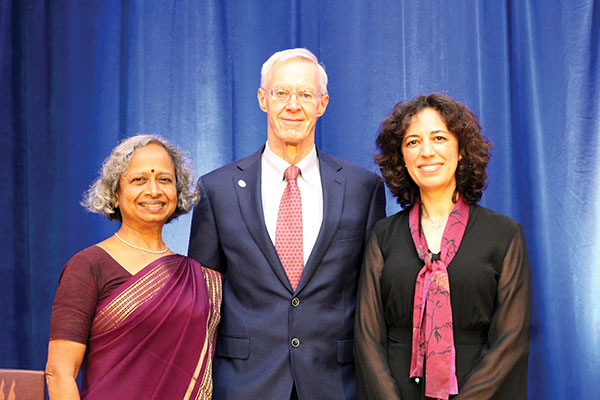
INFORMS has many strengths: Our world-class journals, meetings, our members and the communities they represent, the incredible staff and the many volunteer members who devote their time to serve INFORMS. As a regular member of INFORMS through the years, my closest touchpoint with the organization had always been the Analytics Conference and Annual Meeting where I witnessed the incredible work that is involved in successfully pulling off these meetings. It requires tremendous coordination between so many groups of enthusiastic folks including the organizing committees, meetings committee, many volunteer members, and the amazing staff members who silently work to make it all happen. Now that I am on the Board, I have seen the level of commitment and enthusiasm it takes for each of INFORMS’ activities. I think the cooperative energy behind every operation of INFORMS is one of the greatest strengths of our association. I am also very proud of the diversity in the disciplines represented by the members within INFORMS and the various communities and societies, and broad range of the leading journals in many fields.
You indicated in your candidate statement that you will draw upon your experience as the “voice of analytics” at SAS and “enhance INFORMS’ related activities to broadcast the value of O.R. and analytics to external stakeholders.” Can you elaborate?
During the early part of my career at SAS I was the leader of the Operations Research Department, which was relatively small with about 10 researchers. Over time, my voice elevated the importance of O.R. as a key discipline required for building complex business solutions, which in turn led to a significant expansion of the O.R. group. We then combined all analytical disciplines into a single division because we recognized the value of a multidisciplinary approach in creating advanced algorithms, both in the core analytical products as well as the specific targeted solutions in retail, marketing, finance, etc. In the process, I became the voice of analytics both within SAS, with our customers, and at analytical conferences. My championing of O.R. led to its growth within SAS and the evangelization of analytics contributed to the growth of our overall analytics portfolio as well. I believe that the key message is to ensure that O.R. and analytics are recognized as critical components in INFORMS’ mission to save lives, save money and solve problems.
Within INFORMS, a large part of the advocacy efforts described in Jeff Cohen’s columns, including the latest one in the October issue of OR/MS Today [3], stem from the need to deliver a similar message: O.R. and analytics and the related disciplines play a very important role in countless areas requiring innovative data-driven decision-making methodologies and frameworks. In the past year, I have worked closely with Jeff and his team and the SIGNAL group on many activities to promote the excellent work of INFORMS members to various constituencies.
Can you briefly discuss your role in INFORMS’ Artificial Intelligence (AI) initiative and the AI-OR Research Workshop series?
My role in INFORMS’ Artificial Intelligence (AI) initiative goes back to early 2019 when then-president of INFORMS, Ramayya Krishnan, asked me to co-chair an AI Initiative ad hoc committee along with Pascal Van Hentenryck. One of the key goals of this initiative was to advance and promote O.R. and analytics within AI and work closely with the AI community to exploit the synergies of the AI and O.R. communities to transform highly scalable, actionable, automated data-driven decision-making. Several key outcomes resulted from that initiative in 2019, continuing into 2020. For example, the publication of an INFORMS Whitepaper on AI [4], creation of a Vision document submitted to the CCC (Computing Community Consortium), and the launch of the new INFORMS Journal on Data Science [5], to name a few. This was the beginning of my serious involvement with INFORMS activities post-retirement, and was the key reason I got pulled into putting my hat in for a position on the Board!
This year, Steve Graves asked me to lead an informal AI Strategy Workgroup to continue and expand these earlier efforts. Fortuitously, this initiative coincided with the increased emphasis on AI at the federal level with the establishment of the National AI initiative.
INFORMS’ goals with this initiative maps very well to at least three of the strategic goals of INFORMS [6].
One of the key activities that we undertook this fall is an AI-OR workshop jointly organized with INFORMS, ACM SIGAI and the CCC. This workshop took place virtually on Sept. 23-24, and included eminent speakers from both the O.R. and AI communities. There were more than 60 participants with equal representation from the AI and O.R. communities with a mix of academia, industry and government. A report out from this first workshop was completed just in time to be shared at the 2021 INFORMS Annual Meeting. More details about the initiative and the workshop are included in an accompanying column [7].
Are there any other new goals or in-the-works INFORMS initiatives that you could share with the membership?
Through various communications with the many INFORMS committees, we are seeking input from the membership on ways in which INFORMS can provide value to the members and make progress on implementing the newly-approved strategic plan.
We would love member input regarding demographics, products and services available to practice members, and how we can encourage more O.R. and analytics professionals to become INFORMS members and contribute to our profession.
A few highlights of in-the-works initiatives include:
- The membership committee and others have supported the staff in outreach and engagement efforts, including sending personal welcomes to new members, connecting with members on LinkedIn, producing videos explaining INFORMS products and services and creating content to use in online marketing efforts. We have instituted renewal, win-back and recruitment campaigns.
- The INFORMS Academic Program Database is a free resource that students can use to narrow their search and find the best academic programs for their needs. Colleges and universities enter and maintain their information for free, ensuring all programs are on a level playing field to attract candidates that are a good fit for their respective programs. The best way to ensure this database is complete and stays current is for all universities with an analytics program to enter their information in it. I can see this becoming a valuable source of information for any student and for companies seeking to employ graduates from one of the programs listed in this database [8].
How do you plan to continue the ongoing work with the INFORMS DEI community?
One of the five strategic goals for INFORMS is: “advance diversity, equity and inclusion in all we do.” This is not the responsibility of any special group within INFORMS. It must be an important goal in every activity, initiative and outreach communication that we are involved in. For any organization, its minority members do not have the sole responsibility for identifying and implementing the changes that it needs; this is an institutional responsibility that involves all its members. This is not something we can delegate to the DEI Committee, Minority Issues Forum or WORMS. Every one of us on the Board, on the many committees and in our membership needs to acknowledge the importance of this goal and ensure that our actions are in support of it.
As a member of the DEI Committee I’ve witnessed the enthusiasm and energy of all the members in pursuing various initiatives to advance DEI within INFORMS. Steve recently highlighted some of these activities [6]. The DEI initiative has led to several efforts that promote our DEI goal. I am especially excited by the projects that have launched under the DEI Ambassadors Program, which is in its second year and provides seed funding to INFORMS members to conduct DEI-related projects, webinars and workshops that contribute to advancing DEI across our community.
I would like to continue the DEI Ambassador Program and ensure diversity in the selection of committees, editorial boards, etc. I believe that we need to put more emphasis in creating a pipeline of underrepresented groups starting with K-12 education programs through undergraduate programs to graduate level education. I would love to see recommendations for how we can encourage underrepresented minorities to enter STEM areas as they pursue their studies.
Tell us a little bit about yourself. What drew you to O.R.?
I inherited my love for mathematics from my father who encouraged me from my early days in elementary school. In high school, I was the only girl in my math class but it never bothered me because I knew that it made my father proud. After completing my master’s in mathematics in India, I came to Cornell for a Ph.D. in math. During my first semester at Cornell, I took a linear programming course, which drew me to operations research – to me it seemed like math with a purpose. I was thankful to Cornell’s math department as well as the ORIE department for their flexibility in enabling me to switch to a Ph.D. program in O.R.
I met my husband at Cornell (also in O.R.) and we got married in 1979 while still in graduate school. He graduated in 1980 and got a visiting position at Georgia Tech but I still had a year or so left to finish my thesis. Once again, I was lucky that Georgie Tech offered me a teaching assistantship in the ISyE department while I continued my dissertation work with Prof. Bechhofer remotely. Remember, this was in 1980 without the benefit of email or other electronic communication. I am ever grateful to Prof. Bechhofer for his mentorship throughout my Ph.D. and after.
In 1981, we moved to North Carolina because my husband got a tenure-track offer at UNC Chapel Hill. I got a visiting position for two years and then ended up in industry, given the geographical constraints and the unavailability of another tenure-track position at the local universities. I joined SAS Institute as an O.R. analyst in 1981. Through the years, I gained increasing responsibility, ending my career in 2018 as the vice president of Advanced Analytics R&D.
What did INFORMS offer that compelled you to become a member?
I became a member of INFORMS as a student and found value in meeting others in my field and learning from their experiences. I enjoyed the networking opportunities and meeting successful leaders of analytics teams. As an analytics leader at SAS, belonging to a professional organization such as INFORMS was seen as an important component of professional growth, both from technical skills as well as leadership skills. As a member from industry, it gave me an opportunity to interact with academic members to explore potential research problems, hire their graduates and provide interesting problems that we encountered in our customer engagements.
What mentors or others played significant roles in your early education and career?
My earliest mentor was my father – he recognized my interest in mathematics and encouraged me to pursue it. He supported me leaving India to pursue a Ph.D. – I was the first person in my extended family to leave India, so that was a big deal! I couldn’t have done that without the support and guidance of my parents. Throughout my life I have been lucky to have mentors, well-wishers who have supported me. And my husband is my biggest cheerleader and always reminds me of my strengths! I regard him as my life-long mentor.
My advisor played a significant role in my education as he guided me through my career choice and supported me in a long-distance advisor-student relationship that was challenging with limited communication in those days. At work, my manager was a great mentor as he pushed me to take a seat at the table – advice that is very valuable to any young professional, but especially for young women entering the field.
Overall, I believe that it is very important to have a mentor or cheerleader in your camp to celebrate your accomplishments and encourage you. My advice: Find a trusted mentor, seek advice as needed, use them to brainstorm and as a sounding board to talk through issues and options. A benefit available to INFORMS members is the Mentor Match Program [9], an online tool that connects mentors and mentees, and provides a suggested program to follow.
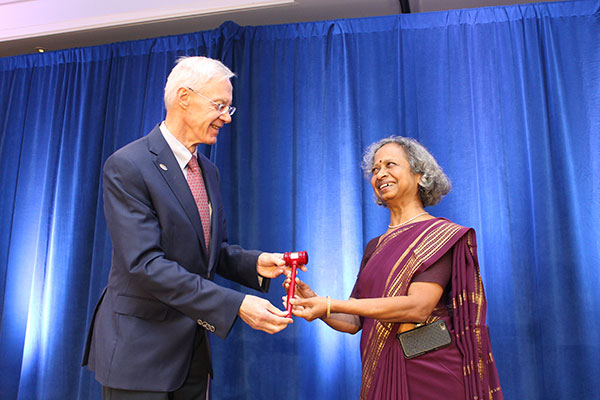
during the 2021 INFORMS Annual Meeting in Anaheim, Calif.
You are an industry leader with strong academic connections, bringing to INFORMS a wealth of experience bridging the two communities. You noted in your candidate statement that you are committed to this critical partnership and will strengthen it in several ways. Can you name one or two?
I draw from my own experience in looking at ways to strengthen the relationship. Throughout my career, there have been various touchpoints with academia: interacting with faculty members to discuss problems of interest, mentoring and guiding students who held internship positions at SAS, supporting universities in grant applications and funding for specific research, etc.
I understand well the importance of collaboration between the two groups. Of course, being married to an O.R. professor, you can say that I have had to fine-tune this collaboration for the past four decades!
I would like to work with members of both groups to determine ways to enhance opportunities for collaboration and propose new ways to increase it. As an R&D executive at a software company, I recognized the value of fostering close collaborations with universities and supporting the partnership, which is crucial for many reasons:
- The practice community has a wealth of unsolved problems to inspire innovative theoretical as well as applied research for a
- The academic community’s cutting-edge research is very valuable for the development of innovative new products in industry.
- Universities train the future labor force for both communities. The partnership can strengthen the curriculum and training to serve both the producers and consumers of analytics.
Given your professional background in O.R. practice and your spouse’s professional background in academia, what are your dinner conversations like? In the case of O.R. and related fields, what has to happen for practitioners and academics to see eye-to-eye and advance their respective goals for the betterment of all?
Our language at home tends to be O.R. related. My husband claims that I always get my way because I put enough constraints so that my preferred option is the only feasible and hence optimal solution! He also likes to joke about our career choices saying he “preaches” and I “practice.” Jokes aside, our different career paths turned out to be a good partnership: His department (as well as the other local O.R. and analytics-related departments) were the beneficiaries of our hiring outreach at SAS: He produced students that I employed!
The two groups appear to have conflicting goals, but if you go far enough up the chain of goals for each party, there’s sure to be a common goal that everyone wants to achieve. At the end of the day we belong to the same profession, and we want the best outcomes for that profession, no matter where we work.
The practice community is important to the overall strength INFORMS and our profession, and we are committed to figuring out how we can provide value to those members. A few practice members on the Board (Allen Butler, David Hunt and myself) wrote an OR/MS Today article on some of the opportunities for fruitful engagement with the practice community [10]. Robin Lougee, as incoming VP of Practice, is passionate about this as well and we are teeing up a mega discussion at the Business Analytics Conference to explore the different constituencies and how INFORMS can support them.
You also noted that INFORMS must foster stronger ties with the sister societies of AI, statistics, data mining and others. What would that look like?
As global problems grow increasingly complex, I believe that we will always need a multidisciplinary approach to solving them. We see evidence of this in the finalists of the Edelman Award and Wagner Prize and many of the other innovative award competitions at INFORMS. These projects employ an array of data access and manipulation techniques coupled with innovative methods and algorithms from a variety of disciplines and often need experts in social and behavioral sciences to help find a solution that is accepted and implemented in practice.
As leaders in analytics, we must recognize the importance of the ecosystem that includes all these disciplines to nurture innovation and collaboration. The recent AI-OR workshop was one such example of a collaborative effort to bring two different communities together. We need to do more of this across other communities as well. We can indeed start such an effort within INFORMS and its many different communities.
What is the best advice you can give to early career professionals today?
This is a great time to be in the field of mathematical modeling – operations research, analytics, AI, etc. It is important to realize that a multidisciplinary approach is very valuable to solving most business problems. From understanding the business problem to gathering data and modeling the problem, to addressing the challenging complexities of the model and implementing a solution. This entire process requires you to be open to input from others, understand the value of the varied expertise that others bring to the table, recognize that there are many practical obstacles to implementing the solution and that there are many social and ethical issues to address.
You will most probably be part of a team working on different aspects of a project, with different skills and training: you will need to be able to explain your work to them and understand their perspective.
To be successful: keep an open mind, look for learning opportunities, seek advice from the successful leaders in business and academia, understand the business domain and keep an eye on the big picture.
You served on many INFORMS committees throughout the years and as a representative on the INFORMS Roundtable. Tell us about it.
Some of my memorable volunteering activities within INFORMS are my participation in an ad hoc committee when INFORMS was evaluating the analytics direction, and on some strategic planning committees. My most recent and significant activity (before joining the Board) was co-chairing the INFORMS AI Initiative under the leadership of Krishnan. While at SAS, I also served as the SAS representative on the INFORMS Roundtable. It serves as a good forum for senior leaders of organizations to exchange experiences about the challenges and opportunities in leading O.R. and analytics teams.
You’re retired following a busy 35-plus-year professional career. What does your typical day look like now? What, if anything, do you miss the most from your “working days”?
I never really planned how my life would be in retirement. I knew I would like to do something related to O.R. and analytics – perhaps be involved at a local university or write a book on “Succeeding in an Analytics Career” or find leisure activities to fill my life, including a lot of travel to visit grandkids and to other interesting places around the world. I never expected to end up on the INFORMS Board! As mentioned, it started when I co-chaired the AI ad hoc committee for INFORMS. Then one thing led to another until I found myself on the Board. I am excited to give back to the community that has been my professional home throughout my career. And, I have put a great deal of energy into it – I am busier than I expected to be, but glad that I have been engaged in important initiatives for our profession.
My retired life is only a little bit “less busy” than I was while at SAS. However, no regrets!
The main thing I miss the most from my “working days” is the company of my colleagues. I had a great team at SAS, and I enjoyed interacting with all of them.
With the worst of the COVID-19 pandemic (hopefully) behind us, what “normalcy” are you most looking forward to or have enjoyed lately?
We always had a very social life with friends. The pandemic put an end to all that socializing. Now that things are slowly returning to normal, we are beginning some of these activities, including eating out at restaurants.
Most importantly, we have been traveling a bit, attending a couple of weddings, and visiting our kids and grandkids. I have enjoyed that very much. And, of course, being able to attend the INFORMS Annual Meeting in Anaheim in person was wonderful. Meeting other Board members and many of the INFORMS staff was exciting and I hope that next year will bring us more of these in-person meetings.
What do you like to do for fun?
I am happiest when our immediate family of three sons, one daughter-in-law, and two grandkids are all together. I look for every opportunity to spend time with at least a subset of them whenever possible.
I have always loved to travel. Both for work and for fun! While my kids were growing up, I planned many vacations with our family and often the trips included members of my extended family or friends. I must have been a vacation planner in my previous life because I usually end up being the one who plans all the details of the trips. My most challenging vacation planning was a trip to Florida with 23 family members ranging from a 4-month-old niece to an almost 70-year-old dad!
The highlight of our travels was our round-the-world trip in fall 2019, after my retirement, when my husband took a sabbatical and we spent a few weeks in the Netherlands and India, a couple of weeks in Singapore at various universities, and finally rounded the trip with a two-week visit to Australia and New Zealand.
My husband and I both love music and we have had music nights at our house every Tuesday evening for more than 25 years! We continued this through the pandemic via Zoom and have now transitioned to hybrid sessions. Since retirement, I have joined a book club, started learning Spanish on Duolingo and have re-started Veena lessons (an ancient Indian string instrument).
Is there one particular area or initiative that you really want to move the dial on during 2022?
Two areas are top of my mind:
- I want to work with Elena, the Board and INFORMS staff to ensure that we can turn the corner on finances as we come out of the pandemic.
- I would like to make a difference to the practice community by ensuring they see value in being a part of INFORMS.
In addition, I would like to keep making progress on some of the initiatives that have had a strong start and continue to nurture them: AI, advocacy, membership outreach and DEI efforts.
Looking further ahead, what’s your vision for INFORMS and the profession five or 10 years out?
Every few years we ask ourselves whether we need to change our name to conform to the latest trend. I don’t believe it is important to adopt the shiniest name. We, as O.R. and analytics professionals, bring unique strengths to the table and play an important role in solving critical problems that require an interdisciplinary approach encompassing a wide range of disciplines. It is important for all of us to show that we are critically important and relevant in the race to solve the world’s most complex problems.
Hence, I was very pleased that our strategic plan clearly identifies an all-encompassing SCOPE along with our Vision and Mission statements. Recall that our mission states that INFORMS advances and promotes the science and technology of decision-making to save lives, save money and solve problems. We clearly articulate that the scope of our strategic plan covers and embraces the full breadth of disciplines in the INFORMS community that are relevant to the vision and mission. In other words, we have adopted a big-tent approach to include a diverse set of disciplines and I am positive and hopeful that this will serve us well in the long run.
References
- Steve Graves, 2021, “Financial impact of COVID-19,” OR/MS Today, June, https://doi.org/10.1287/orms.2021.03.11.
- Elena Gerstmann, 2021, “Behind the scenes at INFORMS,” OR/MS Today, October, https://doi.org/10.1287/orms.2021.05.28.
- Jeff Cohen, 2021, “Join INFORMS advocacy efforts as a trusted decision-making resource,” OR/MS Today, October, https://doi.org/10.1287/orms.2021.05.11.
- https://cdn2.hubspot.net/hubfs/3449182/INFORMS_AI_Whitepaper.pdf
- https://pubsonline.informs.org/journal/ijds
- Steve Graves, 2021, “Update on INFORMS initiatives: Advocacy, AI and DEI initiatives align with strategic goals,” OR/MS Today, October, https://doi.org/10.1287/orms.2021.05.09.
- https://doi.org/10.1287/orms.2021.06.17
- https://pubsonline.informs.org/do/10.1287/orms.2021.04.04/full/
- https://www.informs.org/Professional-Development/Mentoring
- https://doi.org/10.1287/orms.2021.03.15
