
March 3, 2025 in Smarter Decisions
A Prominent Role for INFORMS in the Age of AI
Bringing Together AI and OR/MS for Better Organizational and Societal Decision-Making
SHARE: PRINT ARTICLE: https://doi.org/10.1287/orms.2025.01.04

OR/MS, AI and Decision-making
Operations research and management science (OR/MS) are disciplines grounded in robust theoretical principles that rigorously create and apply mathematical and computational models to solve complex organizational and societal decision-making problems using data, models and a scientific systems-thinking approach. OR/MS also includes techniques to handle complex requirements in decision-making, such as techniques for multiobjective optimization for incorporating multiple – possibly conflicting – objectives, and robust and stochastic optimization to directly and rigorously incorporate uncertainty into decision-making scenarios.
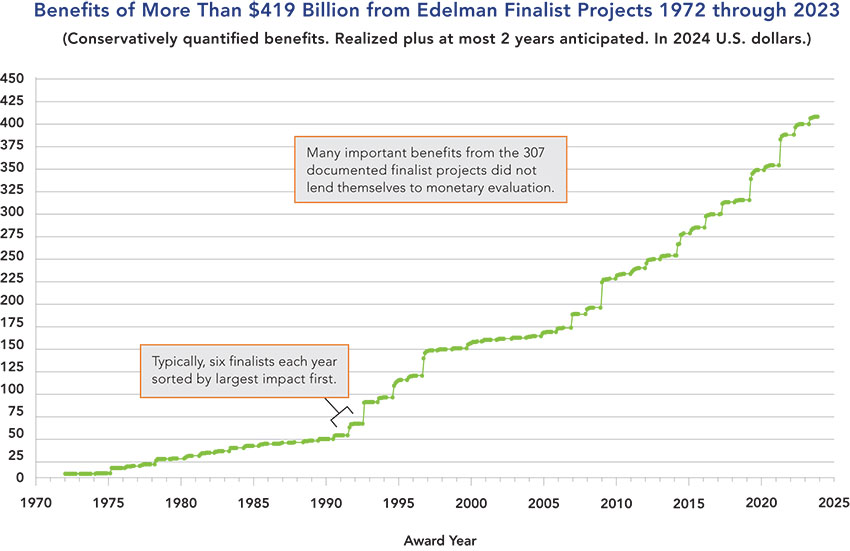
Many real-world scenarios involving consequential decisions and competing objectives can therefore benefit from the application of OR/MS in areas as varied as agriculture, education, energy, entertainment, finance, healthcare, humanitarian operations, logistics, marketing, military, national security, policy analysis, supply chain management, sustainability and transportation, among others. Indeed, there are numerous documented cases in which applying OR/MS in such organizational decision-making scenarios resulted in significant financial and other quantifiable benefits to decision-makers and their organizations (see Figure 1). In addition, OR/MS can bring societal benefits that are harder to quantify (one such example is the Chilean government’s use of innovative O.R. methodologies and tools during the first stages of the COVID-19 pandemic to allocate limited healthcare resources and testing capabilities, ultimately saving thousands of lives [1]).
Artificial intelligence (AI) is a field concerned with “understanding and building intelligent entities – machines that can compute how to act effectively and safely in a wide variety of novel situations” [2], in which intelligence is broadly defined, ranging from matching or exceeding human performance in tasks such as game playing and natural language understanding, enabling a robot or a self-driving car to achieve some goal or complete a task, to acting rationally to optimize some utility or target function. To address the creation of entities that are intelligent, according to this broad definition, AI tools and technologies include both model- and data-oriented capabilities and have built upon and enhanced ideas, viewpoints and techniques from a variety of disciplines, including philosophy, formal logic, probability, statistics, computer science, decision theory, economics, linguistics and OR/MS. AI also includes techniques such as planning, constraint programming, reinforcement learning, causal modeling and inference, and machine learning-based forecasting – techniques that are also applicable to organizational decision-making scenarios.
The Role of OR/MS in Organizational Decision-Making in the Age of AI – and the Risks
In recent decades, much of the emphasis on AI has been on machine learning, which, in large part because of the availability of copious amounts of data and increasing computational power, has led to significant successes in tasks such as natural language processing, image recognition, game playing, robotics and self-driving cars. As a result, AI has gained prominence in the public eye as a foremost set of advanced analytical techniques that can bring practical value. The public visibility and impact of AI continues to accelerate because of the advent of large language models (LLMs) such as Llama [3] and GPT-4o [4].
As a result of its successes and prominence, AI is transforming industries, leading to a paradigm shift in how people approach problems and attempt to apply analytics to solve them. These promising AI developments run the risk of overshadowing OR/MS, including in the very organizational and societal decision-making scenarios in which OR/MS has been focused and typically extremely impactful and effective. Moreover, the prominence of AI can lead OR/MS research to be overlooked, causing it to trail AI in public and private investment and acceptance. This overshadowing of OR/MS in both research and practice could result in its stagnation as a discipline.
It is important to emphasize that, despite the successes of AI (and its aforementioned capabilities relevant to organizational decision-making), there are many organizational decision-making scenarios in which techniques from OR/MS are more suitable than an AI approach, yielding significantly better (often provably optimal) solutions. Moreover, despite continuing advances in AI, there are many decision-making scenarios in which today’s AI cannot be successfully applied, whereas OR/MS can provide significant benefits. Finally, because of its system-thinking mindset and origins in applications, OR/MS is extremely well suited to providing an end-to-end solution to support organizational decision-making and increase the chances of successful deployments of such solutions, even in cases where the analytic components of such solutions include (or are even entirely composed of) AI capabilities.
Hence, OR/MS still provides huge financial and other wide-ranging benefits in organizational and societal decision-making scenarios, even in this new AI era. OR/MS should therefore continue to maintain and even increase its historical central role in such decision-making.
The Need to Apply and Combine OR/MS and AI for Better Organizational Decision-making
With the challenges faced today, organizations and society need to make decisions that are becoming more and more complex. Indeed, in a 2020 report, Gartner estimated that “65% of decisions made are more complex than two years ago” because of the need for decisions to take more context into account, the fact that such decisions must continuously be updated and that different decisions are more interconnected than before [5].
However, despite the existence of both OR/MS and AI techniques that can be applied to such decision-making, many of these decisions are still being made in an ad hoc manner, often based on rules of thumb. Therefore, there is an increasing need to apply at scale structured techniques from OR/MS and AI for better decision-making.
It is also important to note that in today’s world, applying both OR/MS and AI techniques can provide even more value in many decision-making scenarios. For example, many consequential decision-making scenarios require a combination of data-based prediction or estimation, optimal production and resource allocation, and causal reasoning and inference – needs that can be addressed by combining AI and OR/MS. For example, machine learning/deep learning models can be used to estimate quantities such as customer preferences or demand forecasts, which can then be fed as input into an optimization model that can recommend the best decision. Similarly, there are real-world production or resource allocation problems that can be better addressed by combining constraint programing and mixed-integer linear optimization.
AI can also contribute to decisions driven by OR/MS; AI techniques can help mitigate undesirable biases in decisions (biases that typically have a greater impact on those who have been historically underserved or marginalized) by augmenting traditional OR/MS criteria such as maximizing benefits or minimizing costs with new constraints or a weighted objective to include fairness criteria [6, 7], thereby incorporating various forms of fairness and facilitating fairness trade-offs. LLMs can be used to provide a natural language interface to an optimization model [8], thereby making the model more understandable and customizable by the decision-maker, significantly contributing to its explainability and usability. Machine learning can be used to automatically tune a solver for specific optimization models [9], thereby enabling solutions to larger and more complex optimization problems.
Therefore, in today’s world, applying OR/MS and AI at scale to organizational and societal decision-making is more important than ever before, and it is also necessary to combine and tightly integrate OR/MS and AI in such decision-making scenarios. Indeed, these needs have been recognized by public bodies such as the National Science Foundation in the U.S., which have funded institutes such as the AI Institute for Advances in Optimization to drive forward such integration of OR/MS and AI, and by analysts such as Gartner, which stated that there is a need to “rethink the decisions” and are advocating for “Decision Intelligence” solutions and platforms that bring together advanced analytics capabilities, spanning both OR/MS and AI, to enable better data- and model-driven decisions.
A Prominent Role for INFORMS in the World of AI
INFORMS is the world’s leading professional organization for OR/MS and analytics professionals and has a long and proud history of providing significant value to its members and the OR/MS and analytics profession. INFORMS has managed to maintain its leadership position and continuously provide value to its members by adapting and evolving its mission and scope, a prominent example being broadening its scope beyond people with OR/MS backgrounds to include all analytics professionals. INFORMS has also recognized the potential transformative impact of AI and has already, over the course of several years, been forming an AI viewpoint and strategy (see [10]).
INFORMS’ vision is “Better decision-making for a just, prosperous, and sustainable world.” Given its OR/MS roots and history, and the central role OR/MS should continue to play in organizational decision-making in the age of AI, INFORMS can and should continue to play a prominent leadership role in a world in which both the importance of better organizational decision-making and the need to bring together OR/MS and AI for such improved decision-making are recognized.
It is important to note that applying a combination of OR/MS and AI to decision-making in today’s increasingly complex environment requires not only continuing research to drive the scientific advancement of OR/MS but also research into new analytical approaches that combine algorithms and methods from both OR/MS and AI. Indeed, there are already quite a few members in the INFORMS community who are revisiting traditional OR/MS problems through a new lens with AI, developing novel approaches that advance both fields. Examples of such works include: embedding a neural network used to learn constraints into integer programming optimization models [11]; using theory from O.R. to understand neural networks and improving how optimization problems with learned constraints are solved [12]; and using machine learning to help solve combinatorial optimization problems more efficiently, with the goal of enabling far more complex large-scale problems to be solved in practice [13].
We therefore believe that INFORMS should take upon itself the role of spearheading the integration of OR/MS and AI for better organizational and societal decision-making. In this role, INFORMS and its members should:
- Lead the theory and practice of bringing together OR/MS and AI for data- and model-driven decision-making. This should include utilizing a systems thinking-based approach and applying, in an end-to-end fashion, both OR/MS and AI to decision-making scenarios and the rigorous integration and scientific advancement of OR/MS and AI techniques and algorithms for such scenarios based on deep mathematical foundations.
- Continue driving forward OR/MS for decision-making as a scientific discipline, providing theoretically grounded decision-making algorithms and techniques with rigorous scientific and mathematical foundations based on OR/MS, resulting in measurable improvements in the quality of decisions.
To fulfill this role, INFORMS and its members must, among other things, embrace the value of AI tools; understand the distinct mindset, culture and scientific underpinning of the AI community; and invest in educating themselves about AI for effective collaboration. Recognizing the significance of AI also entails acknowledging that its successful application demands deep, though different, expertise and experience. Bringing together OR/MS and AI for organizational decision-making will also require close collaboration with the AI community, including engagement with professional organizations such as the Association for the Advancement of Artificial Intelligence (AAAI) and Association for Computing Machinery’s Special Interest Group on Artificial Intelligence (ACM SIGAI).
Summary
Today, it is more important than ever to bring together and advance OR/MS and AI for improved organizational and societal decision-making. We therefore propose that, amid the ongoing AI boom, INFORMS is uniquely positioned to take upon itself spearheading this integration of OR/MS and AI to improve such decision-making through both practical applications and fundamental research. By embracing this role, INFORMS will not only remain relevant in this world of AI and provide great benefits to its members but will also maintain and cultivate the vital OR/MS discipline and make significant advancements in continuing to fulfill its vision for “Better decision-making for a just, prosperous, and sustainable world” through its goal to “Advance the science and technology of decision-making and elevate its impact.” Thus, INFORMS will both continue to provide value to organizations and society and potentially significantly expand this value, reaffirming that the organization and its members are crucial contributors to our world.
References
- INFORMS, 2022, “Using Operations Research to Enhance Pandemic Response Strategies: Chile Awarded the 2022 INFORMS Edelman Award,” April 4, https://www.informs.org/News-Room/INFORMS-Releases/News-Releases/Using-Operations-Research-to-Enhance-Pandemic-Response-Strategies-Chile-Awarded-the-2022-INFORMS-Edelman-Award.
- Norvig and S. Russell, 2021, “Artificial Intelligence: A Modern Approach, Global Edition,” 4th edition, Boston: Pearson.
- Llama, https://www.llama.com/.
- OpenAI, 2024, “Hello GPT-4o,” May 13, https://openai.com/index/hello-gpt-4o/.
- Gartner Research, 2020, “The Future of Data and Analytics: Reengineering the Decision, 2025,” Gartner, November 16, https://www.gartner.com/en/documents/3993169.
- Kim, O. Reingold and G. Rothblum, 2018, “Fairness Through Computationally-Bounded Awareness,” Advances in Neural Information Processing Systems, Vol. 31, https://proceedings.neurips.cc/paper_files/paper/2018/hash/c8dfece5cc68249206e4690fc4737a8d-Abstract.html.
- Xinying Chen and J. N. Hooker, 2023, “A Guide to Formulating Fairness in an Optimization Model,” Annals of Operations Research, Vol. 326, No. 1, pp. 581-619.
- Li, K. Mellou, B. Zhang, J. Pathuri and I. Menache, 2023, “Large Language Models for Supply Chain Optimization,” July 23, https://doi.org/10.48550/arXiv.2307.03875.
- Gupta, M. Gasse, E. Khalil, P. Mudigonda, A. Lodi and Y. Bengio, 2020, “Hybrid Models for Learning to Branch,” Advances in Neural Information Processing Systems, Vol. 33, pp. 18087-18097, https://proceedings.neurips.cc/paper/2020/hash/d1e946f4e67db4b362ad23818a6fb78a-Abstract.html.
- Krishnan, 2019, “O.R., analytics and AI woven into fabric of INFORMS,” OR/MS Today, December 10, https://pubsonline.informs.org/do/10.1287/orms.2019.06.14/full/.
- Maragno, H. Wiberg, D. Bertsimas, Ş. İ. Birbil, D. den Hertog and A. O. Fajemisin, 2023, “Mixed-Integer Optimization with Constraint Learning,” Operations Research, https://doi.org/10.1287/opre.2021.0707.
- Huchette, G. Munoz, T. Serra and C. Tsay, 2023, “When Deep Learning Meets Polyhedral Theory: A Survey,” August 31, doi: 10.48550/arXiv.2305.00241.
- Y. Bengio, A. Lodi and A. Prouvost, 2021, “Machine Learning for Combinatorial Optimization: A Methodological Tour d’horizon,” European Journal of Operational Research, Vol. 290, No. 2, pp. 405-421.
Segev Wasserkrug, Ph.D., is a senior researcher at IBM Research – Israel and a Research Fellow at the Technion – Israel Institute of Technology. Segev has more than 23 years of experience in the application and research of using operations research and AI to make better decisions and was a finalist of the INFORMS Innovative Applications in Analytics Award and three-time finalist of the Daniel H. Wagner Prize. A large part of Segev’s current work involves bringing together large language models and operations research toward widespread better decision-making. Vinod Cheriyan, Ph.D., is a machine learning data scientist at Stitch Fix. He works in the intersection of AI/ML and OR. He also serves as the Vice President of Chapters and Forums at INFORMS. Tinglong Dai is the Bernard T. Ferrari Professor in the Carey Business School at Johns Hopkins University. He is the Vice President of Marketing, Communication and Outreach at INFORMS. At Johns Hopkins, he co-chairs the Workgroup on AI and Healthcare, which is part of the Hopkins Business of Health Initiative. Juan R. Jaramillo is an associate professor of data analytics and Applied AI in the Department of Innovation and Entrepreneurship at the Long Island University School of Business. He is the 2026 INFORMS Analytics Society President and Innovative Applications in Analytics Award Co-chair. Sven Koenig is Chancellor’s Professor and Bren Chair at the University of California, Irvine. He is a fellow of the Association for the Advancement of Artificial Intelligence (AAAI), Association for Computing Machinery (ACM), Institute of Electrical and Electronics Engineers (IEEE) and American Association for the Advancement of Science (AAAS). See idm-lab.org for additional information. Ramayya Krishnan is the Cooper Professor of Management Science and Information Systems at Carnegie Mellon University. He is dean of the Heinz College of Information Systems and Public Policy and served as 2019 president of INFORMS. Radhika Kulkarni, Ph.D., is an advanced analytics professional, active in the areas of operations research, artificial intelligence and machine learning. She retired as Vice President of Advanced Analytics R&D at SAS Institute Inc., overseeing software development in many analytical areas including statistics, operations research, econometrics, forecasting and data mining. Kulkarni served as the 2022 president of INFORMS. Henry Lam is an associate professor in the Department of Industrial Engineering and Operations Research at Columbia University. He also serves as the chair of the INFORMS Applied Probability Society. Fred Oswald, Ph.D., is a professor in the Department of Psychological Sciences at Rice University, where he directs the Organization and Workforce Laboratory and researches the influence of AI on workers and the workforce. He is chair of the Board on Human Systems Integration (BOHSI) at the National Academies, and a member of the National AI Advisory Committee (NAIAC), which advises the White House on AI matters of national importance. Thiago Serra recently joined the University of Iowa’s Tippie College Business as an assistant professor of business analytics, following five years as an assistant professor of analytics and operations management at Bucknell University’s Freeman College of Management. Previously, he was a visiting research scientist at Mitsubishi Electric Research Labs from 2018 to 2019, and operations research analyst at Petrobras from 2009 to 2013. He has a Ph.D. in operations research from Carnegie Mellon University’s Tepper School of Business, from which he received the Gerald L. Thompson Doctoral Dissertation Award in Management Science in 2018. During his Ph.D., he was also awarded the INFORMS Judith Liebman Award. His research at the intersection of discrete optimization and machine learning is supported by the National Science Foundation. He served as an INFORMS NavigatOR for the 2024 INFORMS Annual Meeting in Seattle. Mark S. Squillante is a Distinguished Research Scientist and manager in the Mathematical Sciences Department of IBM Research, a fellow of INFORMS, ACM, IEEE, SIAM, AAIA and AIIA, serves as editor-in-chief of Stochastic Models and on the Board of Directors of AACC, and served as chair of IFIP Working Group 7.3 (2014-2024) and INFORMS Vice President of Sections and Societies (2023-2024). His research interests broadly concern the mathematical foundations of the analysis, modeling and optimization of systems under uncertainty. Anjana Susarla is the Omura-Saxena Professor of Responsible AI at the Eli Broad College of Business at Michigan State University. Pascal Van Hentenryck is the director of AI4OPT. He also leads the high school initiative, including the Seth Bonder summer camps and high school classes in collaboration with high school faculty. Pascal is the A. Russell Chandler III chair and professor in industrial and systems engineering at Georgia Tech and the recipient of several teaching awards at Brown University and Georgia Tech. Holly Wiberg is an assistant professor at Carnegie Mellon University’s Heinz College of Information Systems and Public Policy.

([email protected])

([email protected])