
June 17, 2025 in Baseball Analytics
Reshaping Baseball: The Impact of Analytics and Technology
SHARE: PRINT ARTICLE: https://doi.org/10.1287/orms.2025.02.07

Since the publication of the book “Moneyball” in 2002 (and subsequently, the 2011 movie adaptation), baseball has shifted from an era of intuition – relying on gut feelings and traditional knowledge – to a scientific era defined by data-driven decision-making. By 2021, analytics had evolved beyond basic statistics into multidimensional systems powered by advanced technology, as detailed in the article “From Moneyball to Betterball” [1].
This transformation accelerated further with innovations like the pitch clock, Automated Ball-Strike System (ABS) and biomechanical tracking platforms. This article explores two key questions: What groundbreaking innovations have revolutionized baseball analytics since 2021? How have these changes reshaped the essence of the game?
Recent Technological Innovations and Rule Changes
In 2023, the ABS underwent two significant modifications at the Triple-A level. The first three games of a series implemented a fully automated strike zone to determine balls and strikes, whereas the subsequent three games employed a “challenge” system. In this format, the umpire made the initial call. However, the hitter, pitcher or catcher could challenge the decision up to three times, retaining each challenge if correct, with the ABS providing the final verification. This challenge system was piloted in select stadiums during the 2022 season and was well received, prompting Major League Baseball (MLB) to expand its use in 2023 to determine the optimal format preferred by players and coaches.
High-speed cameras and 3D video tracking have revolutionized player biomechanics by providing real-time motion analysis [3]. Teams now use advanced techniques to optimize pitching mechanics, manage limb loading and refine pitch trajectory. They also closely monitor recovery and precisely mitigate injury risks, providing a significant competitive edge. For example, Donna Moxley Scarborough, a biomechanics expert for the Boston Red Sox, has leveraged 3D video technology to evaluate prospective pitchers, refine pitching mechanics and design personalized rehabilitation programs for players [4].
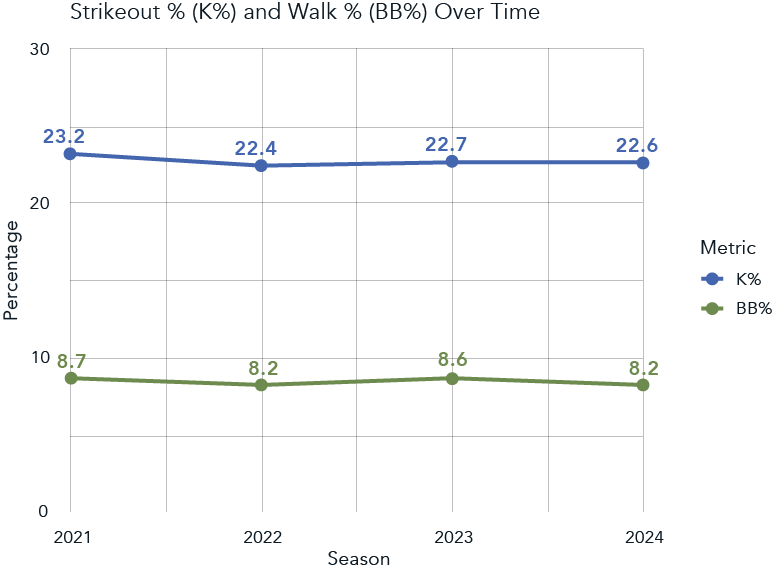
The 15-second pitch clock reduced average game length by over 30 minutes in 2023, enhancing the pace of play without significantly changing the walk and strikeout rates, as shown in Figure 1. Pitchers were able to maintain effective control, even with reduced preparation time.
Shift restrictions in 2022 restored traditional defensive alignments by prohibiting infielders from clustering entirely on one side of the field [5]. Data pulled from FanGraphs “Splits Leaderboard” shows that this policy significantly improved offensive performance for left-handed hitters [6], as presented in Figure 2. Notably, high-shifted players such as Corey Seager and Shohei Ohtani experienced the most substantial gains, with their OPS (on-base plus slugging) increasing by as much as 271 points and their weighted on-base average (wOBA) rising by over 100 points.

However, teams quickly devised countermeasures. Some elite teams adjusted outfield positioning, adopting a “shallow right field + deep left field” hybrid alignment to partially offset the effects of the rule change. The Houston Astros, for example, leveraged StatCast-generated heat maps of batted-ball distribution to optimize defensive alignments. In the 2023 season, they successfully reduced right-handed hitters’ opposite-field hit rate to a league-low 9%, demonstrating how defensive strategies rapidly adapt in the era of data-driven baseball.
Meanwhile, MLB’s introduction of an automated challenge system has also profoundly altered the competitive landscape. This system, which relies on the Hawk-Eye optical tracking system for real-time officiating, has significantly improved the accuracy of umpiring decisions. Although these two reforms target different aspects of the game, both exemplify how data-driven decision-making is reshaping modern baseball.
Shift restrictions have altered the balance between offense and defense through rule adjustments, and the pitch clock has urged pitchers to make quicker, more effective decisions. Notably, the ability for teams to quickly adapt – such as the Houston Astros’ innovative defensive adjustments – reinforces a crucial insight: The evaluation of any policy’s effectiveness must consider not only the direct rule change but also the behavioral adaptations and tactical evolutions it triggers. From a broader perspective, these reforms are not merely altering the mechanics of individual games; they are driving baseball toward greater fairness and precision.
Emerging Data Sources: From Laboratory to the Field
Fan Interaction Analysis [7]
Technological innovation is transforming fan experiences in baseball, making them more personalized and immersive. Teams use sentiment analysis of social media to gauge fan reactions to key game events, such as no-hitters or hitting for the cycle, enabling rapid content generation. Machine learning models analyze data such as ticket purchases and merchandise preferences to tailor fan engagement strategies.
Augmented reality enhances live broadcasts by overlaying real-time data, such as pitch velocity and launch angle on top of the live game, catering to analytically inclined fans. Interactive features like prediction polls further engage audiences. Looking ahead, advancements in edge computing and cognitive science – such as eye-tracking technology – promise to optimize in-stadium experiences by aligning content delivery with fan attention patterns.
Expansion of Collegiate Baseball Analytics [8]
Rapsodo’s sensor technology is revolutionizing talent development in NCAA baseball. Its partnership with ESPN for the 2024 MLB draft marked the first formal integration of collegiate training data into professional scouting processes. Using advanced flight tracking systems, programs at the University of Florida and Wake Forest University provide hitters and pitchers with real-time feedback on metrics such as exit velocity (accuracy: ±0.3 mph), launch angle (resolution: 0.1°), spin direction, seam displacement (horizontal/vertical deviation error: <0.5 cm) and spin axis deviation angle.
This data-driven approach has transformed player evaluation and development. For example, former University of Tennessee slugger Blake Burke improved his slugging percentage by 0.081 by optimizing his launch angle based on Rapsodo’s insights into the “golden launch zone” (25°-35°). Similarly, pitcher Brody Brecht’s anomalous slider movement (7.2 cm lateral at 1,850 rpm) propelled him from a second-round projection to first-round contention.
Rapsodo’s affordable systems have democratized access to advanced analytics for mid-tier programs while bridging gaps between collegiate and professional levels. This shift suggests MLB scouting is evolving from an experience-driven model to one powered by algorithms.
Challenges and Controversies
AI Umpires vs. Human Umpires
Umpire errors introduce randomness into crucial moments, potentially undermining competitive fairness. Data pulled from Umpire Scorecards, and portrayed in Figure 3, shows there is a weak but positive correlation (r = 0.383) between MLB team winning percentages in 2024 and the net run impact caused by incorrect calls by umpires. Although this statistical relationship is not significant, the revealed trend remains noteworthy because it suggests that even small advantages gained from incorrect umpiring decisions could possibly influence game outcomes.
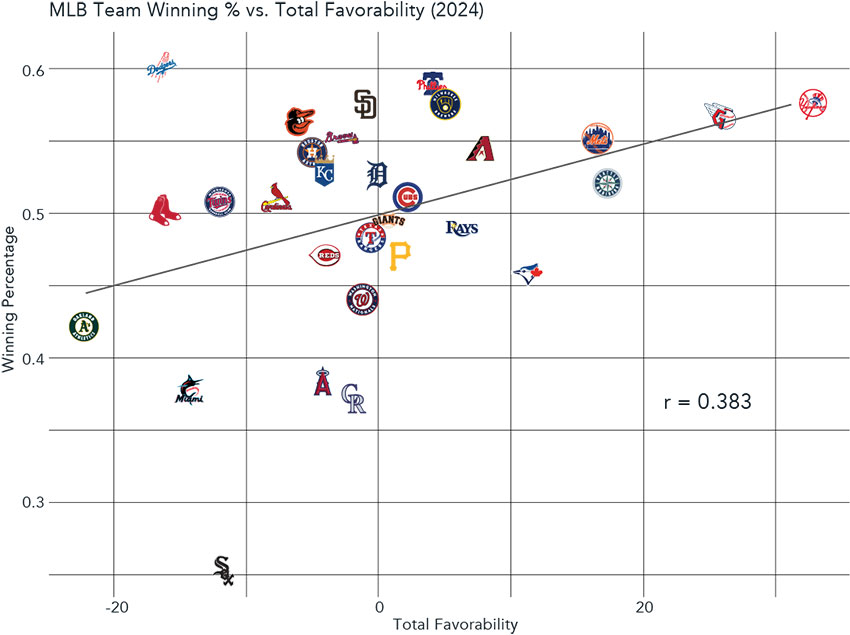
Although not a decisive factor in most games, incorrect calls can subtly influence outcomes over a season. The ABS has reduced human umpire error rate from 14% to less than 2%, significantly improving accuracy and mitigating biases.
However, concerns about the “human element” remain. A hybrid approach, such as the limited challenge system trialed in minor leagues, combines technology with tradition. Teams are allowed three manual reviews per game, ensuring over 95% accuracy while maintaining tactical opportunities for players. A 2023 minor league trial of this system saw a 41% increase in live-game approval ratings.
Ultimately, artificial intelligence (AI) umpires aim to restore fairness by ensuring that game outcomes are determined by player skills – with bats and on the pitching mound – rather than subjective calls, striking a balance between technological precision and the emotional appeal of human judgment.
Traditional Scouting vs. Data Analytics
Traditional scouting methods, based on subjective assessments like natural instincts or “mechanical potential,” are increasingly challenged by advanced analytics. Wearable tracking systems and computer vision now quantify player attributes – such as release point displacement and spin efficiency – with precision, transforming vague talent projections into measurable metrics.
The democratization of data is reshaping scouting roles. Affordable tracking systems now allow mid-tier programs to uncover hidden attributes such as seam-shifted wake effects, forcing scouts to evolve from observers into data interpreters. Machine learning models highlight weak correlations (r < 0.35) between traditional scouting terms and performance indicators, pushing talent evaluation toward predictive science.
Baseball Ecosystem Transformation
AI and Machine Learning to Enhance Coaching and Team Management
AI-driven training systems leverage wearable devices to collect real-time physiological data, such as heart rate, muscle load and motion trajectory. Machine learning algorithms analyze this data to create personalized training programs that optimize performance while reducing injury risk. For instance, a Yankees minor league pitcher improved his slider mechanics based on AI recommendations, increasing horizontal movement while minimizing elbow strain.
Deep learning models are transforming game preparation by decoding opponents’ strategies. AI simulations analyze pitchers’ tendencies, batters’ weak zones and even umpires’ strike zone patterns to help coaching staff rehearse scenarios and develop targeted tactics. Teams gain a competitive edge by integrating these insights into pregame planning.
AI is reshaping scouting by replacing subjective evaluations with predictive models that integrate data on metrics including exit velocity, base-running efficiency and defensive reaction time. Generative AI tools simulate long-term player performance trajectories, assisting teams in draft decisions and contract negotiations. This shift toward data-driven scouting enhances accuracy in identifying high-potential talent.
Breaking Physical Boundaries for Athletes and Fans
Virtual reality (VR) technology allows players to train in realistic virtual environments, regardless of weather or field availability. Batters can practice against simulated high-velocity virtual pitches, and fielders can rehearse catching scenarios under varying stadium lighting conditions. For example, the Los Angeles Dodgers conducted a study showing that VR training reduced rookies’ batting reaction times, highlighting its potential to enhance player performance.
Augmented reality (AR) is transforming how fans experience baseball. Spectators can use smart glasses or mobile apps to view real-time visuals, such as exit velocity, pitch trajectories and defensive alignments, during gameplay. MLB’s Edge-AR system overlays real-time biomechanical data – such as pitcher elbow valgus torque and batter bat-head acceleration – onto live broadcasts, providing an interactive and analytically rich viewing experience.
Injury Prevention and Load Management
Subdermal nano-sensors now track microdamage in tendons, alerting teams when a pitcher’s rotator cuff strain exceeds a safe threshold. Additionally, smart protective gear can restrict throwing motions to prevent further injury. These advancements mark baseball’s evolution into a “super laboratory” where computing power, data science and biotechnology converge to enhance player safety.
Dynamic load management integrates real-time biometric sensor data (e.g., heart rate variability, muscle fatigue index) with external factors like weather and travel schedules to generate individualized game participation strategies. For example, if a pitcher experienced reduced sleep because of cross-time-zone travel, the system adjusts their workload by altering pitch types or recovery protocols such as cold therapy. Similarly, in extreme heat or humidity, outfielders’ defensive strategies are modified to conserve energy and reduce injury risk. This adaptive model balances injury prevention and peak performance.
Technological Democratization
Low-budget teams can use open-source algorithms to identify a prospect with a “low-spin, high-movement” breaking ball. This fundamentally disrupts the traditional scouting model – once reliant on expensive tracking systems.
MLB’s release of the Statcast Lite dataset and open-source toolchains (OpenPitch, Sabermetrics.py) is breaking resource barriers in dynamic load management. Minor league teams collect pitcher joint torque data using consumer-grade wearables. Data is then analyzed with federated learning models shared on GitHub, enabling cost-effective load evaluation comparable to elite sports labs. Even high school coaches can analyze the correlation between launch angles and weather conditions, designing seasonal-specific training regimens – such as adjusting swing balance for wet-field conditions – to stabilize slugging percentage fluctuations.
Similarly, small-market teams can leverage a shared Amazon Web Services cloud-based database containing more than 200,000 hours of motion analysis to obtain training insights comparable to elite franchises at just 1/50th of the cost. This access shifts dynamic load management from an “elite privilege” to a universal tool, propelling the entire industry toward an era of data-driven accessibility.
The Future of Baseball in a Data-Driven Era
Baseball has always been a sport rooted in tradition, but its evolution over the past two decades underscores the transformative power of data and technology. From automated strike zones to dynamic load management systems, these innovations are redefining how the game is played, coached and experienced by fans. The democratization of analytics has leveled the playing field, empowering teams at all levels to compete in this new era of precision-driven baseball.
However, as the sport becomes increasingly reliant on technology, it must navigate challenges such as preserving the human element and balancing fairness with tradition. The integration of AI umpires and algorithmic scouting reflects this delicate balancing act – one that seeks to enhance the game without losing its soul.
Baseball stands at the intersection of science and sport, where breakthroughs in biomechanics, machine learning and immersive technologies promise to push boundaries even further. Yet, amidst these advancements, one thing remains constant: baseball’s ability to captivate players and fans alike with its timeless appeal. As the game continues to evolve, its essence endures – a celebration of skill, strategy and passion that no algorithm can replicate.
References
- Kenta Sachen, Jordan Lazowski, Luke Vandertie and Scott Nestler, 2021, “From Moneyball to Betterball,” Analytics, February 17, https://doi.org/10.1287/LYTX.2021.02.08.
- Kyle Glaser, 2023, “The Automated Strike Zone is Slightly Different at Triple-A in 2023,” Baseball America, May 5, https://www.baseballamerica.com/stories/the-automated-strike-zone-is-slightly-different-at-triple-a-in-2023/.
- Dylan Drummey, 2024, “Utilizing Single-Angle Broadcast Feeds and Computer Vision to Extract 3D MLB Biomechanical Data,” Baseball Prospectus, September 17, https://www.baseballprospectus.com/news/article/93823/prospectus-feature-utilizing-single-angle-broadcast-feeds-and-computer-vision-to-extract-3d-mlb-biomechanical-data/.
- Sean Hennessey, 2023, “Pitching Biomechanics for the Red Sox,” MGH Institute of Health Professionals, June 20, https://www.mghihp.edu/news-and-more/stories/pitching-biomechanics-red-sox.
- Lee Kennedy-Shaffer, 2024, “Effects of Major League Baseball’s Ban on Infield Shifts: A Quasi-experimental Analysis,” arXiv preprint,
https://doi.org/10.48550/arXiv.2411.15075. - https://www.fangraphs.com/leaders/major-league?season1=2021&season=2025&team=0%2Css&hand=L&sortcol=0&sortdir=default&pagenum=1
- Ogugua Chimezie Obi, Samuel Onimisi Dawodu, Shedrack Onwusinkwue, Femi Osasona, Akoh Atadoga and Andrew Ifesinachi Daraojimba, 2024, “Data Science in Sports Analytics: A Review of Performance Optimization and Fan Engagement,” World Journal of Advanced Research and Reviews, Vol. 21, No. 1, pp. 2663-2670.
- Rapsodo, 2024, “Rapsodo Collaborates with ESPN to Provide Player Data for MLB Draft Coverage,” July 11, https://rapsodo.com/blogs/baseball/rapsodo-and-espn-collaberate-on-2024-mlb-draft.
Ziyu (Jack) Chen is an M.S. student in sport management at the University of Florida (UF). Tristan Robbins is an undergraduate student studying sport management, statistics and economics at UF. Warner Gephardt is an undergraduate student studying statistics and sport management at UF and leads the UF Sports Analytics Club. Scott Nestler, PhD, CAP-X, PStat, is professor of practice and sport management at the University of Florida and director of the UF Sports Analytics Lab.