


December 22, 2025 in Inside Story
Phases, Patterns and the Signals We Choose to See
SHARE: PRINT ARTICLE: https://doi.org/10.1287/orms.2025.04.10
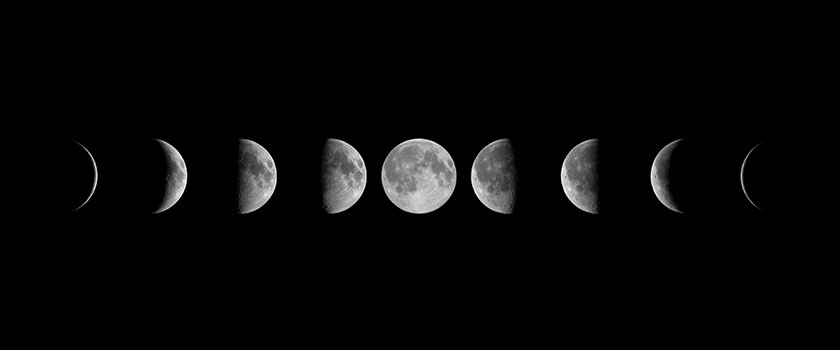
Lately, I’ve found myself paying more attention to the moon. Not in a “this explains my personality” kind of way (although sometimes it’s eerily close), but in the quieter sense of noticing where we are in the lunar cycle. I started tracking the phases (new, waxing, full, waning) almost accidentally, mostly because I liked the visual rhythm of lunar maps. (Full moons almost always coincided when technology was wonky or all three of my children were in a “mood.”) But the more I looked up, the more I felt a shift in how I was looking around.
What surprised me wasn’t any mystical insight. It was how simply observing a cycle – even one as predictable as the moon – trained my attention. I started catching patterns earlier and noticed transition points. I saw when something was beginning, when it was building pressure, when it was bright enough to mislead and when it was time to reassess.
Maybe that’s why this issue feels especially resonant: every feature is, in its own way, about how we read signals. What we trust. What we test. And how we find meaning and insight without slipping into magical thinking.
The moon might not tell me anything about 2026 yet, but this year, it taught me how much clarity comes from simply knowing which phase I’m in.
New Moon: Clearing the Slate
The New Moon is a trickster – it’s there, but invisible. You have to trust it’s coming back even when you see nothing at all. It’s a moment of blankness, and therefore a perfect moment to question assumptions.
That’s exactly where the author of our Major League Baseball win/loss metric article begins. What if the system we’ve used for decades doesn’t measure what we think it measures? What if pitcher performance has been obscured by something as arbitrary as run support? A New Moon mindset invites us to let go of what’s familiar and rebuild a better model from first principles.
It’s not about prediction. It’s about reconsideration.
First Quarter: Tension and Testing
When the moon reaches its First Quarter, it appears split – half in shadow, half in light. It’s a phase of friction and forward pressure. Something is taking shape, but it’s not effortless.
That tension is right at the heart of the article on the NFL’s controversial “tush push” play. For all the brute force it showcases, the real story lies in the analytical tug-of-war: What actually makes this play successful? Which quarterbacks can effectively execute it? What variables matter more than conventional wisdom suggests?
Insight often emerges from this phase of resistance, when data pushes back against intuition and both sides reveal something new.
Full Moon: Illumination
The Full Moon is dramatic. Everything looks clearer, but sometimes too clear. Light can illuminate; it can also distort. It’s the phase that most tempts us toward overconfidence.
This is the dynamic explored by Joseph Cazier, CAP-X, on “Aristotle’s Insight Loop,” his framework for using generative AI not as an oracle but as a thinking partner. When a tool can produce endless possibilities, it’s easy to mistake visibility for truth, reflection for insight or light for understanding.
Artificial intelligence can brighten a landscape, but only human judgment can determine which features actually matter. The moon may glow, but it’s still up to us to interpret the shadows.
Last Quarter: Reassessment and Trust
In the Last Quarter, the moon begins to wane. It’s a quieter, more introspective phase – the moment for releasing what no longer serves and reinforcing what remains true.
This aligns closely with the analysis of U.S. election systems and voter confidence article. Trust in these systems doesn’t emerge fully illuminated; it’s built through continuous evaluation, correction and transparency. You don’t wait for a crisis to test integrity. You must constantly test, especially when the light is fading.
It’s also a fitting lens for my conversation with 2026 INFORMS President Mark Lewis, who reflects on leading a welcoming and trustworthy community. Belonging isn’t a Full Moon burst of brilliance – it’s a sustained cycle of checking in, adjusting, listening and tending. Leadership has phases, too.
What Patterns Reveal
Some people turn to astrology because they want stories that make sense of the unknown. I get it. Humans have always looked for meaning in the sky. But the older I get, the more I appreciate the discipline of choosing what meaning to trust, and why.
Analytics, at its best, is not about imposing a narrative. It’s about noticing the signals that are actually there, then deciding what they imply. It’s the work of distinguishing pattern from projection.
I’ll still probably keep tracking the moon – not to predict anything, but to remind myself that everything moves in cycles, including our work. Insights wax and wane; models improve and are replaced. Every phase has something to teach us, as long as we stay curious enough to look up, or look closer.
As we turn toward 2026, may we keep navigating with both humility and attention. The skies won’t give us answers, but they offer a beautiful reminder that clarity often comes from knowing where we are.
The Framework That Keeps Us Oriented
It turns out that lunar phases aren’t such a strange companion to analytical practice after all. The INFORMS Analytics Framework offers its own cyclical structure – a repeatable progression that guides organizations from defining problems to implementing and sustaining solutions. Just like tracking moon phases helps us understand where we are in a natural cycle, the Framework clarifies where we are in a decision-making cycle. Are we exploring? Building? Deploying? Evaluating? No phase is permanent, and each prepares the way for the next. When used well, the Framework doesn’t dictate outcomes, but helps analytics professionals and teams stay grounded even when the landscape shifts. In that sense, it’s a lot like looking up at the same moon each month: a steady, familiar reference point in a sky that’s always changing.
