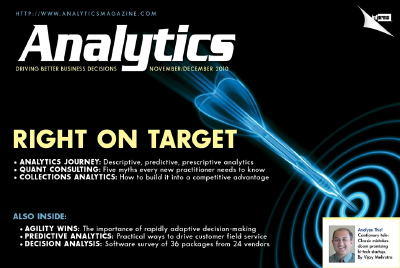
Nov/Dec 2010

FEATURED ARTICLES

DIGITAL EDITION

Nov/Dec 2010 Analytics

DEPARTMENTS

Inside Story

open book icon
Eat, Edit, Learn

In their 2007 book, “Competing on Analytics: The New Science of Winning,” Tom Davenport and Jeanne Harris captured for many the powerful potential of analytics to provide organizations with a competitive advantage. The book’s title called analytics a “new” science, but concepts and terms such as “business analytics” and “business intelligence” date back decades. They’ve recently risen to household word status in corporate boardrooms because of the emergence of the massive and easily mined mountains of data needed to feed them. Today, thanks to all that data and sophisticated means to make sense of it, BA, BI and other permeations of “analytics” in its broadest sense are potentially at the fingertips of any decision-maker with a computer keyboard.

Profit Center

Keeping analytics professionals

In the last “Profit Center” I took a look at the process of hiring analytics professionals, either for the purpose of starting or expanding an analytics team. The process of hiring is important, but it’s only part of the equation. Once good people are on the team, people who have demonstrated both their technical and personal skills, it’s important to keep them. While this is true of all professions, there are some special considerations that arise in the case of analytics professionals.

Analyze This!

head with ekg line icon
Classic mistakes doom promising startup

About 10 days ago, I got word that a good friend (I’ll call him “Hiram”) had been laid off for the first time in his life. I was shocked.

Forum

heart with ekg line icon
Expanding your organization’s analytic bandwidth

Analytic talent can become your high-performance secret weapon. When taking a strategic approach to analytics, executives are finding new ways to attract and retain analytic talent, which is in scarce supply. More and more, organizations are forming competency centers and centers of excellence to achieve best practices for analytics and increase the bandwidth of existing analytic talent.

Conference Preview

newspaper icon
INFORMS introduces health care conference

The Institute for Operations Research and the Management Sciences (INFORMS, www.informs.org) will introduce a new, highly focused brand of conference next year with a three-day meeting on the health sector, aimed at bringing health care researchers and stakeholders together. INFORMS Healthcare 2011 will be held June 20-22 at the Hilton Bonaventure Hotel in Montreal, Canada. The conference will combine the deep research focus of a traditional INFORMS meeting with an emphasis on real-world application that distinguishes the INFORMS practitioner conference.

Thinking Analytically

brain and gears
Bridges to Somewhere

The five residents of Hometown live in houses represented by the letters “A” through “E” as shown on the left side of Figure 1. The offices where they will be working are represented by their matching letters on the island of Worktown.

Last Word

arrow up
Did Nobel Prize work wreck financial markets?

On Oct. 14, 1997, the famous Black-Scholes-Merton option-pricing model was awarded what is typically known as the Nobel Prize in Economics. This was quite a puzzling development, for that date marked, almost to the day, the 10th anniversary of an event that had openly illustrated how flawed the model actually is and how drastically it can break down when applied to the real financial world. Option traders, the very ones who were supposed to have fallen irremediably in love with BSM, responded to the event by publicly rejecting the model´s main tenets. That is, by the time that the Royal Swedish Academy of Sciences decided to honor the model, BSM had, for 10 years, been widely discredited and amply shown not to work. Many may naturally wonder why such underperforming constructs should be worthy of such a coveted award. Plenty may marvel what those Swedes are up to.

INFORMS site uses cookies to store information on your computer. Some are essential to make our site work; Others help us improve the user experience. By using this site, you consent to the placement of these cookies. Please read our Privacy Statement to learn more.