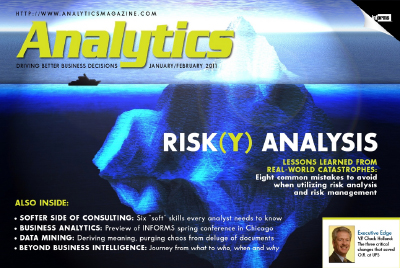
Jan/Feb 2011

FEATURED ARTICLES

DIGITAL EDITION

Jan/Feb 2011 Analytics

DEPARTMENTS

Inside Story

open book icon
A ‘home’ for analysts

When the Institute for Operations Research and the Management Sciences (INFORMS) and partner Lionheart Publishing first discussed publishing the online magazine you’re now reading, it took about 10 seconds to come up with a name: Analytics. It was toward the end of 2007, and Tom Davenport and Jeanne Harris’ book, “Competing on Analytics: The New Science of Winning,” had seemingly convinced every CEO in the world that their organization needed “analytics” in order to gain a competitive advantage. Organizations were swimming in data, but most of them didn’t know what to do with it. “Analytics” promised to turn data into profits, and quickly the concept in its various forms (“Business Analytics,” “Advanced Analytics,” etc.) showed up at or near the top of every business publication’s or business consulting group’s “Top 10 Business Trends/Strategic Technologies/etc. of the Year.”

Executive Edge

organization chart icon
A near-death experience

Many of us have heard stories about near-death experiences. A person involved in a serious accident or a person gravely ill recovers and tells their account of leaving this Earth and walking toward the bright light, outstretched arms awaiting them. Miraculously, they come back to life – functioning, contributing and taking advantage of a second chance – and eager to tell their story.

Profit Center

An analytics education

A young man recently contacted me about finding a good graduate program in analytics. I was happy to oblige, but couldn’t immediately answer him. Had he asked about graduate programs in economics, mathematics or some other well-defined, well-established discipline, I could have responded without pause. Analytics, however, is neither well defined nor well established as a stand-alone university discipline. This isn’t to say universities aren’t busy training students in the tools of analytics. Schools simply haven’t offered degrees bearing the name “analytics.”

Analyze This!

head with ekg line icon
When geeks and jocks collide

During my first week as a professor, I received an e-mail from a San Francisco State undergraduate named Kevin Mello. “I have just completed a summer internship with the Oakland A’s,” he wrote, “and though I’ve taken a course in statistics, I’m interested in learning more.” In the world of sports, the Oakland A’s are viewed as one of its first analytics success stories, thanks in large part to Michael Lewis’ 2003 book, “Moneyball: The Art of Winning an Unfair Game” [1]. I wrote back enthusiastically, offering to do an independent study course with him. Our semester studying Jim Albert’s book, “Teaching Statistics Through Baseball,” [2] ultimately led to a research paper [3], while also helping Kevin earn some statistical credibility with the Oakland A’s. He has since embarked on a career with the A’s as a professional scout.

Conference Preview

newspaper icon
Spring conference broadens scope

The Institute for Operations Research and the Management Sciences’ (INFORMS) spring “Practice Conference” has been re-branded and re-configured to encompass the emerging field of business analytics while keeping the core competencies of operations research (O.R.) intact. Renamed the “INFORMS Conference on Business Analytics and Operations Research,” the 2011 meeting will take place April 10-12 at the Marriott Downtown, located in the heart of Chicago’s Magnificent Mile.

Professional Colloquium

The INFORMS Professional Colloquium (IPC) offers a unique opportunity to select graduate-level analytics and operations research/management science (OR/MS) students. Held in conjunction with the INFORMS Conference on Business Analytics and Operations Research Conference in Chicago in April, the IPC is a one-day program that provides insight from the leading practitioners in the field on how to manage the transition from academia to industry.

INFORMS site uses cookies to store information on your computer. Some are essential to make our site work; Others help us improve the user experience. By using this site, you consent to the placement of these cookies. Please read our Privacy Statement to learn more.