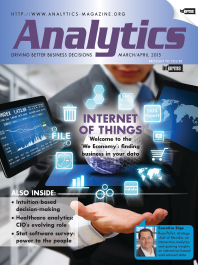
Mar/Apr 2015

FEATURED ARTICLES

Mar/Apr 2015 Analytics

DEPARTMENTS

Inside Story

open book icon
Method to March Madness

If it’s March, it must be time for March Madness, the annual college basketball lollapalooza that compels untold millions of people across the country to try and predict the outcome of a 64-team tournament (not including play-in games) in hopes of winning the office or online pool and all the glory and money that goes with it. The beauty (and perhaps irony) of March Madness is that no one – not the college basketball junkie, not the office nerd, not even the analytics guru well-versed in predictive analytics who studies “bracketology” – knows the outcome in advance, so anyone has an equal chance of winning . . . or do they?

Analyze This!

head with ekg line icon
Many moving parts in analytics parade

Sometime back in the last century, when I was a disgruntled graduate student, I managed to wangle a part-time job at a semiconductor fabrication facility. My job was to gather data, build simulation models and conduct analyses to help management understand capacity, bottlenecks and cycle times. Along the way I managed to write a few conference papers [1] with some of my colleagues at HP before returning to school full time to pursue a dissertation on queueing networks that was inspired by my work in the fab. I will be forever grateful to Dr. Barclay Tullis for making that opportunity possible for me.

Newsmakers

The economics of terrorism and counterterrorism

“How many good guys are needed to catch the bad guys? That is the staffing question faced by counterterrorism agencies the world over. While government officials are quick to proclaim ‘zero tolerance’ for terrorism, unlimited resources are not made available to prevent terror attacks, nor should that be the case. Indeed, as with most public policy decisions, the appropriate staffing level depends upon both the benefits and costs of fielding counterterrorism agents.”

Healthcare Analytics

heart with ekg line icon
Evolving role of the CIO in data-driven healthcare

The landscape of healthcare analytics continues to change, the opportunities for analytic professionals continue to grow in this arena, and the potential for start-ups persists. Before addressing the leadership transformation within healthcare organizations that these changes and opportunities demand, let’s first examine what is happening within various healthcare stakeholders.

INFORMS Initiatives

logo
Continuing ed, executive forum, CAP webinars, maturity model

INFORMS’ continuing education program is designed specifically for those in the field of analytics and operations research. INFORMS, the world’s largest organization for advanced analytics professionals, produces and disseminates data analytics and operations research information, training courses, certification, and best-in-class resources for our members and the industry at large.

Conference Previews

newspaper icon
INFORMS Conference on Business Analytics & O.R.

Looking for a great opportunity to network, engage, integrate and learn? If so, the 15th Annual INFORMS Conference on Business Analytics & O.R. is the conference for you. Set for April 12-14 in Huntington Beach, Calif., the conference will include more than 150 invited, selected and poster presentations that cover a wide range of topics in analytics and operations research. The conference has consistently been the largest analytics-focused event in the world (about 850 attendees expected).

INFORMS Healthcare 2015 set for Nashville

While many think of Nashville, Tenn., as Music City, Time Magazine calls it the South’s “Red-Hot Town” – sparked by a booming cultural scene and world-class healthcare. This year’s INFORMS Healthcare Conference, set for July 29-31 in Nashville, will provide a glimpse of the transforming U.S. healthcare industry. Over the past two decades, Nashville spawned more than 500 healthcare companies, many of them spun off from Hospital Corporation of America (HCA), Vanderbilt University Medical Center and HealthTrust. Today those companies, including 13 publicly traded companies, generate more than $70 billion in annual revenue and more than 400,000 jobs globally.

Five-Minute Analyst

stopwatch icon
Travel documents

I was recently asked the following question: Is it better for a couple traveling together to pool their valuables and documents, or should they carry them separately? This is a great Five-Minute Analyst topic not only because it is about relationships – mathematical and interpersonal – in equal measure, but also because it’s a practical problem. For example, Albert Einstein was well known for being forgetful during his life [1].

Thinking Analytically

brain with gears
Coins add up

Rearrange the coins so that the sums of the coins across the rows and down the columns match the dollar amounts shown.

INFORMS site uses cookies to store information on your computer. Some are essential to make our site work; Others help us improve the user experience. By using this site, you consent to the placement of these cookies. Please read our Privacy Statement to learn more.