

February 22, 2023 in Inside Story
Am I better at my job than a machine?
SHARE: PRINT ARTICLE: https://doi.org/10.1287/LYTX.2023.01.11
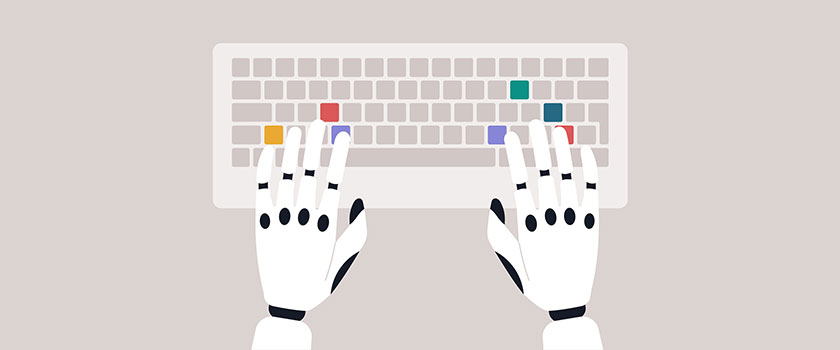
While preparing the first Analytics magazine issue of the year, I had what I thought was a pretty brilliant idea. I was going to compile and create the issue, then ask ChatGPT to summarize it for me by sending it the table of contents page. Then, I was going to use that summary in my Inside Story and ask readers to decide whether the column was written by me or artificial intelligence (AI). Genius (and tricky), right?
I know OpenAI and its ChatGPT are no longer breaking news. It was launched in November 2022 and instantly took the entire world by storm, quickly rising in popularity everywhere – not just in the analytics and data science communities. People began by asking it benign questions and random facts and trivia. But as word got out about this powerful tool, questions about college essays and plagiarism, among other ethical matters, started to arise. An impressive tool indeed, but is it too powerful? Is it that simple to plug in a query/problem and get a well-written, comprehensive answer?
That said, ChatGPT is not without its limitations. OpenAI notes that it sometimes writes plausible-sounding but incorrect or nonsensical answers. I wouldn’t want to put that into a term paper.
Nevertheless, its language is being used in many different ways. I’ve received promotional emails written by ChatGPT. It’s even come up with poems and jingles. The AI content tool is now so popular that it will be switching to a freemium model, with a new paid tier priced at $20 per month, which will give users better access to the tool. And Google had to answer with its own version!
This all certainly explains why when I took my brilliant idea to ChatGPT, I received nothing but the message, “ChatGPT is at capacity right now. Get notified when we’re back.” You bet I put my email address in to be notified and have yet to hear a word from this trendy AI. (Maybe I should try “Bard.”)
Call Me When AI Gets a Brain
Although I was unable to use artificial intelligence in this column, Vijay Mehrotra was successful in his Analyze This! column. See if you can figure out who wrote which parts. You can also bet there’s still plenty of other AI coverage within this issue. Artificial general intelligence (AGI), to be exact. Read more about AGI versus the human brain here. You can also find “Seven Ways to Get the Most out of Supply Chain Analytics in the Age of AI.”
For readers who might still be wary of an AI takeover, you should probably take a look at the article on deploying high-quality and trustworthy AI – insights from leading AI practitioners in Europe, the Middle East and Africa.
Readers can also take a look inside an engineer’s toolbox and how to solve engineering challenges with the intersection of simulation and AI.
For Analytics readers who are simply tired of reading about AI (sorry!), we’ve got something for you, too. Read about how data gathered from end-of-line inspection technology on the production line can tell a valuable story; how to innovate with Silicon Valley startups; answer the question, “Are cryptocurrencies Ponzi schemes?”; and more!
And if you’re looking for an even bigger distraction away from all the AI chatter, dive into a little exploration of data on Lego sets in the latest installment of Five-Minute Analyst. (Plus even more!)
In the end, I’ve decided I don’t need ChatGPT to help with my editorials. (Although writer’s block is real.) I hope readers feel the same and would still prefer to read thoughts and words from a real human being rather than from a very impressive AI.
Editor’s note. I’d also like to take a moment to acknowledge a very real human who has been contributing to Analytics magazine for 10 years now. Rajib Ghosh has steered the “Healthcare Analytics” column flawlessly for a decade. Thank you for your storied contributions, Rajib. Looking forward to more thoughts on where the healthcare and analytics industry will be in the next 10. AI doctors? We’ll see.
