

March 13, 2026 in Analyze This!
Analyze This!
SHARE: PRINT ARTICLE: https://doi.org/10.1287/LYTX.2026.01.07
Scene 1: March 1982
The door is open, the light is on, and Professor Ted Vessey invites me into his office. I am a 17-year-old high school senior vaguely thinking about studying mathematics in college. Two months earlier, a family friend has told me that “you must talk to Ted Vessey at St. Olaf College.” Now, here I am at St. Olaf for the last of my college visits, still with no real idea about where to go to school or what to do when I get there. After visiting the admissions office and taking a tour of the campus, I have managed to find this tall red-haired professor with a twinkle in his eyes. Though I have shown up without an appointment, he graciously spends an hour talking with me that day, telling me all about the growing math department at St. Olaf, the contract math major and the many different types of things that St. Olaf math graduates go on to do after graduation. “Math is fun here,” he says, and I can’t help but believe him. I am so energized by our conversation that I commit to attend St. Olaf the next day.
Ted Vessey would ultimately become my freshman calculus professor, undergraduate advisor, mentor and lifelong friend. Somewhere along the way, he gently suggested that I might be interested in going to graduate school to study operations research.
Scene 2: March 1986
I am in my last semester of college, still with no clear idea about what comes next. I return home one night to find a note from my roommate: “Professor Fred Hillier has called from Stanford University. He says he has some good news for you, and that you can call him back collect.” My hands are trembling as I dial the rotary phone. A quiet voice answers, and when I tell him my name, he informs me that I have been accepted into the PhD program in operations research at Stanford University and that this acceptance comes with four years of guaranteed funding. Three days later, I am on a plane to the Bay Area to visit the stunning Stanford campus.
Fred Hillier would ultimately become my dissertation advisor. It is unlikely that I would have made it through graduate school without him.
Ted Vessey passed away on August 28, 2025 at the age of 87.
Fred Hillier passed away on January 9, 2026 at the age of 89.
Together, these deaths have hit me hard, unlocking a deep sadness that still feels immediate and pervasive. Upon reflection, however, I am also incredibly grateful for how these two men helped shape me and how their influence continues to impact my professional work.
As an undergraduate, I took a class with Ted every semester that I was at St. Olaf (we used to joke that he left on a sabbatical just to get away from me). He was a truly gifted and inspiring teacher. Every class meeting was filled with energy, excitement and optimism. Ted always sold us on the problem to motivate us and then, helped us find our way to the solution.
He was once infamously quoted in a Minneapolis Star and Tribune article as saying that he “taught class in English.” Many readers incorrectly read this as a comment on nonnative English speakers. What he really meant was that his goal was to make math approachable, even to people who were less comfortable with Greek letters and mathematical notation. In particular, he excelled at breaking down complex ideas into pieces, seeking to demystify, telling stories (“about 100 years ago, there was this German kid, Gauss …”) and having fun along the way (“When you see a matrix like that one, you should be salivating like Pavlov’s dogs!”).
Beyond the mathematics itself, he also told a broader story that resonated strongly with students, with colleagues and with many parents. I remember him telling us one day in class about research showing that “75% of jobs that you will be working 20 years from now have not been invented yet.” His view was that math and liberal arts provided a great foundation for navigating through a rapidly changing world of work, and in this (as in so many other things), he was wise and prescient. Today, in the age of AI, a rigorous education that creates a curious and adaptive mindset is more important than ever. Thanks in large part to Ted’s vision and leadership, St. Olaf and its math department have understood this clearly for more than 50 years.
Ted’s influence extended beyond teaching and advising. As department chair for more than a decade, he also played a huge role in creating a culture that valued people as much as proofs. Faculty knew students by name, and conversations regularly continued outside the classroom. Over time, the results were remarkable. From 1980 to 1989, St. Olaf graduated more than 500 students with mathematics majors, and more than 50 of us from those graduating classes ultimately completed PhDs in the mathematical sciences. This strong tradition continues; mathematics remains one of the most popular departments on campus, with about 10% of each graduating class majoring in mathematics.
Approaching the end of my time at St. Olaf and still not knowing what I wanted to do with my life, I applied to 12 different graduate programs in three different fields. Ted made sure that Stanford’s operations research department was one of them, though I had little confidence that I would be accepted. The head of the Stanford O.R. PhD Student Admissions Committee that year was Fred Hillier. My relationship with Fred Hillier developed in a very different setting. Stanford’s operations research department was one of the most influential in the world and played a huge role in defining the field. Fred’s contributions to operations research were very significant. His research was extensive as discussed in this interview, which was done as part of the INFORMS Oral History project (his biography is also available through INFORMS here).
But his most notable contributions were probably through his textbooks. In particular, Introduction to Operations Research (initially coauthored with his advisor, colleague and close friend Gerald Lieberman and later with his son Mark) became the standard introduction to the field. Fred cared deeply about clarity. He believed that ideas mattered only if they could be communicated well. He was a tireless worker, with an incredibly attention to detail. All of this along with excellent historical timing led to astonishing success and reach; overall, Fred’s books have sold over 1.5 million copies and have been translated into many languages.
I was at the bottom of my class when Fred agreed to take me on as a PhD student, with low self-esteem and little self-confidence. He encouraged me to pursue my ideas about queueing networks, even though they were somewhat outside his traditional areas of interest, and he worked with me steadily and seriously. He asked clear questions. He set expectations and trusted me to meet them. He read my work carefully. His steadiness and belief in me (along with some vital validation from Ward Whitt at Bell Labs) helped motivate me to get across the finish line.
Over the years, I have heard similar stories from several of Fred’s other students and colleagues. Just after Fred had passed away, I received a thoughtful email from Kut C. “Ricky” So, Professor Emeritus at the University of California, Irvine.
When I think of Fred, his gentle and calm demeanor always comes to my mind. He always took time to listen to you and always spoke to you in a gentle and caring manner. As his PhD student, I met with him on a regular basis to discuss my research progress. He always listened to my recent progress updates patiently and then offered his opinion in a humble and supportive manner.
J. Michael Harrison, Professor Emeritus at Stanford’s Graduate School of Business, was also Fred’s advisee. Upon hearing of Fred’s passing, he noted both Fred’s influence on his own career and his role as a founding faculty member in the operations research department at Stanford.
I came to Stanford for a master’s degree in industrial engineering, with no thought of an academic career and no concept of academic research … Fred strongly encouraged me to continue my graduate study beyond that first year, specifically in Stanford’s newly minted Department of Operations Research … Without doubt, it was Fred Hillier, with his unfailing kindness and consideration, who set my feet on the career path that I have found so satisfying.
Launched in 1967, Stanford’s Department of Operations Research later went through a series of mergers and since 2000, has been part of the Department of Management Science and Engineering (MS&E). Peter Glynn, a faculty member in MS&E and a former colleague of Fred’s in the operations research department, reminded me about another of Fred’s significant professional contributions.
Fred and Pete Veinott were the two leads on the fundraising efforts that led to the creation of the Dantzig–Lieberman Fellowships in MS&E at Stanford. These fellowships have been a great asset to the operations research activity within MS&E over the years, especially as research-based student support has become more and more challenging.
As for me, I feel the influence of these two men on both my career and my life every single day. In particular, so much of how I interact with my students is simply me mimicking Ted’s unique combination of energy, encouragement, curiosity and caring. In addition, Fred’s success in impacting the world through his writing has been part of the inspiration for this column and for my current book project, which will be dedicated to the memory of these two mentors. I could not be more grateful.
Vijay Mehrotra is a professor in the Department of Business Analytics and Information Systems at the University of San Francisco’s School of Management and a longtime member of INFORMS.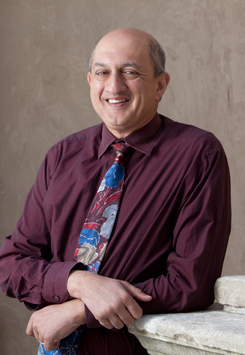
([email protected])