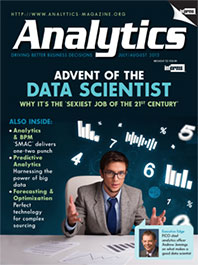
July/Aug 2013

FEATURED ARTICLES

July/August 2013 Analytics

DEPARTMENTS

Inside Story

open book icon
Big bang theory of analytics

FICO recently published an eye-popping infographic called “The Analytics Big Bang” that, according to an accompanying press release, “traces predictive analytics from the dawn of the computer age in the 1940s through the present day, and cites compelling evidence indicating that the analytics industry is at an inflection point.”

Executive Edge

organization chart icon
What makes a good data scientist?

Companies in every industry from retail to banking are leveraging big data to improve the customer experience and enhance their bottom lines. Big data – high volume, high velocity (real time) and high variety (structured and unstructured) data – is transforming the way we live and conduct business across all industries and all aspects of daily life.

Analyze This!

head with ekg line icon
Silicon Valley’s ‘serial entrepreneurs’

A dozen or so years after the bursting of the Internet bubble, Silicon Valley is once again in the spotlight as a symbol of its times. The press coverage of Napster founder and former Facebook President Sean Parker’s $10 million wedding has brought cheers from some, jeers from others, and a series of spirited rejoinders from its perpetrator [1]. George Packer’s recent article in the New Yorker [2] shines a somewhat harsh light on the region (the money quote: “… after decades in which the country has become less and less equal, Silicon Valley is one of the most unequal places in America”). And as Somini Sengupta recently reported in the New York Times [3], despite the best efforts of various governments around the world to lure technically talented young people to their shores with visas and funding opportunities, the Silicon Valley dream of quick wealth and enduring fame continues to exert an extremely powerful pull on their imaginations (one aspiring Indian entrepreneur describes the region as “the N.B.A. of the start-up world”).

Viewpoint

stopwatch icon
Did Nate Silver beat the tortoise?

In making election forecasts for the FiveThirtyEight blog (538) at the New York Times, Nate Silver uses a statistical model that is subtle, sophisticated and comprehensive. Real Clear Politics uses a shallow approach to forecasting that could have been devised by a statistical Forrest Gump. But which forecaster better predicted the results in the 2012 presidential election? Did the intellectual tortoise hold its own against the hare?

Forum

heart with ekg line icon
Oil & gas producers need to tame the gusher … of data

Throughout the century-and-a-half since the dawn of the commercial petroleum industry, oilmen have always hoped for the gusher – the big find that would spew enough oil to make them rich. There have always been far more “dry holes” than gushers, however, and the proportion only gets worse as oil and gas become harder to find and more difficult to produce. One thing the industry has in abundance today, however, is data. And just like some of the biggest oil discoveries, the data gusher offers huge promise if it can be tamed. However, the exploration and production (E&P) industry, and the IT companies that support it, have a lot of work ahead to derive maximum value from their growing troves of data.

INFORMS’ Library of Audio and Video Presentations

heart with ekg line icon
INFORMS’ Library of Audio and Video Presentations

Gain insights from experts on how math, analytics, and operations research affect organizations like yours in these 20-30 minute podcasts conducted by INFORMS Director of Communications Barry List. Visit www.scienceofbetter.org/podcast.

Five-Minute Analyst

newspaper icon
Carnival Game

I was captivated by this recent headline: “Man loses life savings, wins giant banana” [1]. After disbelief subsided, I wondered – as is my habit – what five minutes of analysis might tell us

Analytics Activities

Self-driving car

Self-driving cars are cars that can drive themselves without a human behind the wheel. This technology should be available in the not-too-distant future. New algorithms will need to be developed to help route these cars to get their passengers to their desired destinations efficiently.

INFORMS site uses cookies to store information on your computer. Some are essential to make our site work; Others help us improve the user experience. By using this site, you consent to the placement of these cookies. Please read our Privacy Statement to learn more.