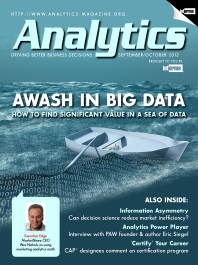
Sep/Oct 2013

FEATURED ARTICLES

Sept 2013 Analytics

DEPARTMENTS

Inside Story

open book icon
Key skills for analytics pros

Patrick Noonan earned an MBA from the Yale School of Management, but it wasn’t until he went to work for management consulting firm McKinsey & Company that he really began to learn and appreciate the “essential skills” for analytics professionals. Thirty years later, Noonan, now a professor of Practice of Decision & Information Analysis at the Goizueta Business School at Emory University, has packed all of the “best practices” of consulting he has garnered over the last three decades into one of the first courses offered by the Institute for Operations Research and the Management Sciences’ (INFORMS) continuing education program. The course, “Essential Skills for Analytics Professionals,” will be offered Sept. 26-27 in Redwood City, Calif., and Nov. 7-8 in Washington, D.C.

Executive Edge

organization chart icon
Good quant, bad quant

Recently, a long-time MarketShare client joined a new Fortune 50 company as its CMO. When he inquired how the “marketing mix” models it was using were factoring in digital data, the answer shocked him: “Digital is out of scope.” Dumbfounded, he probed further and found that the model builders were unable to include online/offline effects, so simply left digital out. But that seems tenuous considering the company spends some 30 percent of its marketing budget on digital, and its products involve highly considered purchases with much digital activity.

Analyze This!

head with ekg line icon
A tale of two books on decision-making

Daniel Kahneman is a psychologist who was awarded the 2002 Nobel Prize for his influence on the burgeoning field of behavioral economics. I recently read his bestselling 2011 book “Thinking Fast and Slow” [1]. The book begins with a set of chapters collectively entitled “Two Systems.” This is where the book’s title comes from: System 1 [the “Thinking Fast” from the book’s title] “operates automatically and quickly, with little or no effort and no sense of voluntary control,” while System 2 [“Thinking Slow”] is engaged in “the effortful mental activities that demand it, including complex computations …” [2].

INFORMS Initiatives

INFORMS launches continuing education program

Know anyone in the high-end analytics profession who says they learned everything they needed to know in kindergarten? Not likely. In fact, with technology changing, few analytics professionals can even say they learned everything there was to learn in grad school.

Forum

newspaper icon
How to land that top analytics job

Big Data and how its use is reshaping everything from marketing, customer service, sales and even national security, fills today’s headlines. According to a McKinsey Global Institute study (2011) the explosion of analytical work is creating a shortage of available workers in the field, and the search is on for the next generation of top analytic talent. McKinsey states that by 2018, the U.S. alone could face a shortage of up to 190,000 workers with deep analytical skills, as well as 1.5 million managers and analysts with the know-how to use the analysis of big data to make effective decisions.

Analytics & Healthcare

heart with ekg line icon
Opportunities, barriers & champions

The value of analytics in healthcare has never been questioned. But pundits agree that healthcare is behind the curve when it comes to using analytics for unleashing powerful insights that can improve quality of care, lower cost and engage patients. They also agree that analytics can unlock tremendous value for all stakeholders in the healthcare value chain. But the key question remains: Who will champion that in the healthcare industry? Who has the best motivation? But before I try to get to that question let’s consider a few possible use cases in healthcare that can benefit from the implementation of analytics. This is not the exhaustive list.

Conference Preview

Winter Simulation Conference 2013

The Winter Simulation Conference (WSC) has been the premier international forum for disseminating recent advances in the field of system simulation for more than 40 years, with the principal focus being discrete-event simulation and combined discrete-continuous simulation. In addition to a technical program of unsurpassed scope and high quality, WSC provides the central meeting place for simulation researchers, practitioners and vendors working in all disciplines and in industrial, governmental, military, service and academic sectors. WSC 2013 will be held Dec. 8-11 at the JW Marriott Hotel in the heart of Washington, D.C.

Five-Minute Analyst

stopwatch icon
Modeling zombies

On general principle, I do my best to avoid zombies. However, the increasing number of zombie games, movies, and even an academic paper [1] have convinced me that zombies are worth five minutes of effort.

Thinking Analytically

brain and gears
Urban planning

Urban planning requires careful placement and distribution of commercial and residential lots. Too many commercial lots in one area leave no room for residential shoppers. Conversely, too many residential lots in one area leave no room for shops or restaurants.

INFORMS site uses cookies to store information on your computer. Some are essential to make our site work; Others help us improve the user experience. By using this site, you consent to the placement of these cookies. Please read our Privacy Statement to learn more.