

February 21, 2020 in Five-Minute Analyst
Virtual Servants
SHARE: PRINT ARTICLE: https://doi.org/10.1287/LYTX.2020.02.08
Over the past few years, I’ve been more in tune with the past – both via popular television shows that run on PBS (see recent episodes of PBS’ most dangerous cities, as well as thinking about how large households are run like you see on “Victoria” or “Downton Abbey”).
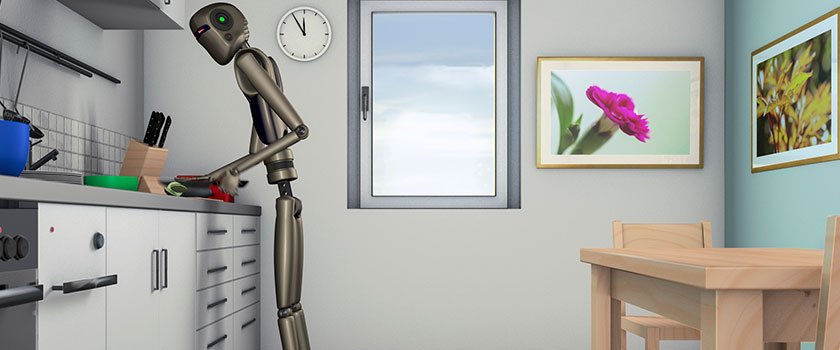
When we look at our households today, they have little or nothing in common with these “great houses” of the past. Some people I know like to reminisce about how nice it would be to live in a house with “lots of servants.” We don’t live like this anymore because of industrialization, changing social conditions after World War I and World War II, etc. However, many of the things people used to do as manual labor, full-time jobs in a house – washing dishes, heating the house and cleaning clothes – have now been “outsourced” to what we will now call “virtual servants,” i.e., machines. So, while I live in a nice home in California, I do have, in a sense, an army of servants who do things that otherwise would have to be done by hand.
How to equate power to work?
It’s hard to know how much “work” is done in a home from a task sense, but it’s easy to measure the energy spent. So, if we had a way to compare electrical power to human power, we would be set. Here’s where an unexpected linkage that goes through cycling comes in. I (like many other cyclists) ride with a power meter, which measures effort versus time in watts, as shown in Figures 1(a) and 1(b).
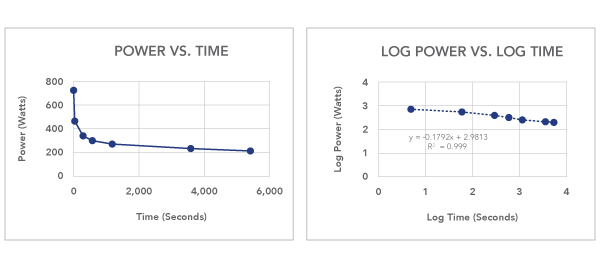
Extrapolating the curve in 1(b), we extrapolate that for a 10-hour work day (36,000 seconds), a person will generate approximately 1.4 kilowatt hours of work (140 watts for 10 hours), and in a standard work year (2,000 hours), a single “servant-equivalent” will produce 280 kWh.
How much energy do Americans use?
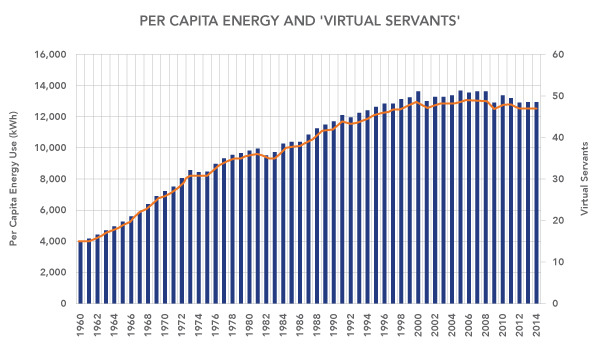
Using data from the World Bank, we find that American’s per capita electricity use has varied since 1960 from approximately 4,000 kWh per year to over 13,000 kWh per year. Using the above, we can convert (roughly) to staff equivalents. The bottom line – you need a lot of “virtual servants” to run even average households!
Conclusion
We are nearly certain that others will disagree with some of the choices we have made in computing virtual servants; for example, in the case of electrical heating compared to building a fire, we have included the power generated by the heat (fire) to be part of the “servant’s duties.” However, we believe that this is an interesting and potentially useful way to think about how we use energy.
An open question is how our computers should be measured; a word processor is in a sense a “virtual secretary,” although they do not use nearly the same power as a dishwasher, etc. Even if you think this estimate is overinflated by an order of magnitude [2], average homes in the United States would still have five servants. You’ll be happy to know that at an estimated total of 1,000 servants [3], the Queen of England still has you beat!
Notes and References
- Keen readers will note the absurdly good R-square value on the power curve. It is so good that had I not collected the data myself, I would have found it suspect.
- It might be!
- https://www.forbes.com/sites/ceciliarodriguez/2016/10/25/buckingham-palace-101-a-commoners-guide-to-working-for-queen-elizabeth/
Harrison Schramm, CAP, PStat, is a senior lecturer at Naval Postgraduate School, splitting his time between Defense Management and Operations Research where, in addition to teaching, he runs the Contested At-Sea Logistics Lab (CASLL). He served as the inaugural chair of the INFORMS Security Conference and is a past president of the INFORMS Analytics Society.
([email protected])