


Combating Excessive Overtime in Global Supply Chains: The Workforce Perspective
Abstract
Suppliers operating in developing economies may resort to compelling their workforce to engage in excessive overtime, resulting in severe physical and mental health issues for workers and the potential for significant damage to the brand image of multinational enterprises (MNEs) if these practices are exposed to the public. In this paper, we develop a game-theoretic model of a dyadic supply chain to analyze a manufacturer’s operational strategies to combat the use of excessive overtime by a supplier. These strategies encompass a stick strategy of auditing the supplier’s practice (i.e., the auditing strategy) and carrot supplier development strategies of subsidizing the supplier’s workforce retention initiative (i.e., the workforce retention subsidy strategy) and upskilling the supplier’s workers to increase their versatility (i.e., the cross-training strategy). When auditing stands as the sole viable strategy, it can effectively mitigate the supplier’s violation behavior only when the auditing accuracy is significant. In the scenario where both workforce retention subsidy and auditing are viable, interestingly, workforce retention subsidy may be a complement for auditing, contrary to the naive belief that the strategies are always substitutes in combating excessive overtime. Compared with the case when auditing is the sole viable strategy, we find that workforce retention subsidy may increase the manufacturer’s profit and reduce the supplier’s overtime simultaneously. However, the subsidy may also backfire, increasing the expected degree of excessive overtime and decreasing social welfare, when workforce retention subsidy and auditing are substitutes. Furthermore, the workforce retention subsidy could lead to a social welfare level that is even higher than that in a centralized supply chain benchmark without the workforce retention subsidy. In situations where both cross-training and auditing are viable, cross-training may also be a complement for auditing, driven by the enhanced flexibility of the workforce. However, similar to the workforce retention subsidy, cross-training may lead to a win-win outcome or backfire.
This paper was accepted by Jayashankar Swaminathan, operations management.
Funding: C. Jiao was partially supported by the National Natural Science Foundation of China [Grants 72301261, 72531009, 72188101, 72471218] and the China Scholarship Council.
Supplemental Material: The online appendix and data files are available at https://doi.org/10.1287/mnsc.2023.03852.
1. Introduction
Global supply chains of multinational enterprises (MNEs) have faced heightened scrutiny from organizations such as the International Labour Organization (ILO) and various labor-focused nongovernment organizations (NGOs). These organizations have shed light on the widespread issue of excessive working hours in developing economies, especially prevalent within the electronics and fast fashion industries (SACOM 2016, Errighi and Bodwell 2017). According to Messenger (2018), a striking 47.2% of workers in the Asia-Pacific region labor for more than 48 hours per week. In October 2015, a staggering 71.1% of Pegatron’s workforce exceeded Apple’s 60-hour workweek limit, with 64% of them pushed beyond 90 hours of overtime in a single month (China Labor Watch 2016). In Malaysia, workers of suppliers for Samsung and Panasonic reported being compelled to endure 14-hour workdays with limited breaks (Pattisson 2016). SACOM, a labor-focused NGO, conducted investigations in 2015 and 2016, exposing the harsh working conditions at four suppliers of Zara, H&M, and GAP. The report revealed that some workers were forced to toil for up to 14 or even 17 hours per day (SACOM 2016).
Such excessive and prolonged working hours exact a heavy toll on the physical and mental well-being of employees. In a joint report by the World Health Organization (WHO) and the ILO in May 2021, compelling evidence emerged that indicated a heightened risk of ischemic heart disease and stroke among individuals working extended hours, defined as more than 55 hours per week, in comparison with those adhering to standard working hours, which typically range from 35 to 40 hours per week. Shockingly, it was estimated that long work hours contributed to 745,000 deaths worldwide in 2016 (Pega et al. 2021). The consequences of extended working hours are not solely confined to physical health. In a harrowing incident in 2010, 14 employees of Foxconn, a prominent supplier for tech giants such as Apple and Microsoft, tragically took their own lives. These suicides were attributed to the intense emotional pressures stemming from excessively long work hours and inadequate compensation (Berg 2018).
With the growing attention from consumers, NGOs, and government agencies, the exposure of excessively long working hours within the global supply chains of the MNEs can have a significant detrimental impact on their brand image (Summers 2010, Plambeck and Taylor 2016, Kalkanci et al. 2019, Zhang et al. 2025). Consequently, the working hours at the upstream suppliers’ factories have become a pivotal element of MNEs’ corporate social responsibility (CSR) performance. Major MNEs such as Apple, Nike, and Samsung have responded to these concerns by incorporating a 60-hour-per-week limit into their codes of conduct for suppliers (Nike 2021, Samsung 2021, Apple 2022b). When the working hours exceed the standards outlined in these codes of conduct, such as the 60-hour-per-week limit, it is considered as excessive overtime. We provide a more detailed discussion on the definition of excessive overtime in Remark B.1 in Appendix B.
There are several driving forces leading to the persistent phenomenon of excessive overtime in suppliers’ factories despite the codes of conduct. The ILO provides a case study to analyze the root causes of the overtime issue (ILO 2019b). The study lists five categories of drivers: workforce, management, measurement, machinery, and method. The workforce category is further refined to identify root causes such as high turnover, incomplete headcount, recruitment challenges, and low degree of skills. These root causes are inherent to the workforce itself, which suffers directly from the excessive overtime. The management category is classified into causes such as last-minute orders, low production efficiency, and late delivery of raw materials, which are related to the buyer-supplier interaction in a supply chain. The other three categories, measurement, machinery, and method, encompass other factors such as poor sales forecasts, machine breakdowns, and lack of integration in production plants. In this paper, as a first attempt to analytically investigate the issue of excessive overtime in a global supply chain, we primarily focus on the root causes within the workforce and management categories, including high employee turnover and incomplete headcount, low degree of skills, as well as last-minute orders. We next elaborate on these factors.
First, we observe that the turnover rate of workers in labor-intensive industries is high for reasons such as low salaries, unsafe workplaces, and the repetitive and boring nature of work (ILO 2020), resulting in significant randomness of suppliers’ workforce and compromising workflow productivity (DMC 2023, Moon et al. 2023). For example, the average quarterly labor turnover rate in the apparel sector of Myanmar is about 21%, with some factories witnessing rates as high as 36% (Bernhardt et al. 2017, ILO 2019a). For another example, according to Moon et al. (2023), who study manufacturing productivity with worker turnover in a representative supplier in the electronics industry, the quarterly turnover rate of workers can be as high as 76%. The high turnover rate and the incomplete headcount issues are further exacerbated because in practice, although the supplier’s initial nominal workforce may be observable to the MNE through due diligence processes, the realized workforce often remains hidden (Wilshaw et al. 2013). Therefore, MNEs are not aware of whether suppliers’ realized workforce is inadequate or not. To meet delivery deadlines, suppliers often resort to requiring the workforce to work excessive overtime (Wilshaw et al. 2013, ILO 2017b).
Second, a low degree of skills among suppliers’ workforce makes it difficult for suppliers to meet MNEs’ high-volume demands for a wide variety of product offerings, which is often the case in industries such as electronics and apparel. There are two main implications of this low skill level. First, it may indicate low productivity among workers, making it challenging to meet high demand volumes. Second, it may suggest a limited skill set among workers. Nowadays, different products often require workers with specialized skills (Goyal and Netessine 2007, Boyabatlı and Toktay 2011, Dong et al. 2022b). In this context, a low degree of skills implies that workers with expertise in producing one product may be incapable of producing other products.
Third, MNEs often place orders in the last minute when they have a better sense of their fluctuating demands. In a global survey conducted by the ILO,1 59% of suppliers who responded identified additional overtime as a direct consequence of insufficient lead times (ILO 2017b). Suppliers’ uncertain and unobservable workforce and MNEs’ unpredictable last-minute orders for a high variety of product offerings make it difficult for the suppliers to forecast the workforce for each product in need and preemptively prepare for it. Therefore, suppliers often lack sufficient incentives to expand their base workforce and, instead, rely on excessive overtime of existing workers to fulfill the orders (Wilshaw et al. 2013, ILO 2017b).2
Coercing labor into working excessive overtime is a type of process violation that cannot be detected by inspecting the final product (Chen and Lee 2017). It is also difficult for the MNEs to observe such violations because the suppliers’ realized workforce is their private information. To address this issue, many MNEs, as well as third-party entities such as NGOs and government agencies, adopt on-site audits, which are usually costly and resource intensive, offering investigators a potential avenue to uncover such violations (Caro et al. 2018, 2021; Cho et al. 2019). During the audits, investigators engage in various activities, including reviews of production schedules, direct observations of production practices, and conducting anonymous interviews with a substantial number of workers (Verité 2004, Fair Labor Association 2012, SACOM 2016). If the violation of a supplier is identified in an internal audit of the MNEs, the supplier usually incurs a penalty and is given an opportunity to rectify and conduct normal production. If the violation of the supplier is identified in an external audit by the NGOs or government agencies and exposed to the public, both the supplier and the MNEs will suffer from significant goodwill loss (Zhang et al. 2022).
In addition to the practice of conducting audits, MNEs also employ supplier development strategies to combat excessive overtime by improving the supplier’s capability to fulfill orders with normal production. There are two major supplier development strategies. The first one is a workforce retention subsidy strategy under which the manufacturer provides direct subsidies for the supplier’s workforce retention initiatives in order to reduce the labor turnover rate. For instance, Apple has taken measures such as offering direct financial bonuses to workers at Foxconn and collaborating with a Chinese supplier to enhance workers’ satisfaction and retention rates by expanding food offerings and providing additional bonuses (Foremski 2010, Apple 2022a). The other one is a cross-training strategy under which the manufacturer provides learning and upskilling opportunities for the supplier’s workers to increase the versatility of the workforce to reduce the mismatch between workforce and demands in the presence of multiple products.3 For example, Apple also offers educational and upskilling opportunities to its suppliers’ workers to make the workforce versatile (Apple 2022a). Nike has implemented a supplier capability-building program, which includes increased investment in worker training, as workers are expected to perform multiple production tasks (Distelhorst et al. 2017, ILO 2017a). SHEIN has announced a $70 million investment over the next five years to empower its ecosystem of third-party manufacturing suppliers and the workers within. One objective of SHEIN’s investment is to provide training and upskilling opportunities for the workers (SHEIN 2023).
Motivated by these observations, we attempt to study operational strategies to combat the phenomenon of excessive overtime in global supply chains from an analytical perspective. Specifically, we investigate the following research questions. When do suppliers have incentives to violate their codes of conduct and force their workers to work excessive overtime? How should the MNEs employ the stick strategy of auditing and/or the carrot strategy of supplier development to combat such violations by their suppliers? How will these strategies interact with each other if employed jointly?
To investigate these research questions, we build a game-theoretic model of a dyadic supply chain in which one manufacturer sources two products from one supplier and then sells them in a downstream market motivated by the high variety of products of the MNEs. The manufacturer’s demands for the two products are random. The supplier’s workforce for each product is random and is determined by the normal work hours of a group of dedicated workers. The manufacturer orders according to the realized demands, reflecting the last-minute orders of the MNEs in practice. The supplier then determines production quantities based on the received orders and the realized (normal) workforce, which is observable to the supplier only.
On the one hand, if the supplier fulfills the orders using normal workforce only, the manufacturer will pay the wholesale price and sell the products in the market. In this case, if the supplier delivers a lower quantity than the order, an underdelivery penalty will be incurred by the supplier. On the other hand, if the supplier decides to produce more than its normal workforce, the supplier can do so by coercing the workers to work excessive overtime. Such a violation may be detected by the manufacturer’s costly and imperfect audit (the probability of detecting a violation corresponds to the audit accuracy) or a third party’s (an NGO or a government agency) exogenous audit. If the violation is detected by the manufacturer, the supplier will be charged a penalty and required to rectify and conduct normal production. However, if such a violation is not detected by the manufacturer (either because the manufacturer does not conduct an audit or the manufacturer conducts an audit but does not detect it), but it is detected and exposed to the public by the third party, both the manufacturer and the supplier incur goodwill losses, respectively. If neither the manufacturer nor the third party detects the violation, the outcome is the same as if the supplier had fulfilled orders with normal workforce. That is, the manufacturer will pay the wholesale price and sell the products in the market without incurring any damages. We refer to the base model as the model with auditing only.
Analyzing the model with auditing only, we find that the supplier forces excessive overtime if the realized workforce is lower than the order and the audit accuracy of the manufacturer is low. In this case, the supplier’s expected cost to commit the violation is small relative to the benefit from increased order fulfillment with overtime production. As the manufacturer’s audit accuracy increases, the supplier’s violation is more likely to be detected, and therefore, the supplier is likely to incur a higher violation cost and is less likely to commit a violation. We also find that the manufacturer decides to audit if its audit cost is smaller than an audit cost threshold.
To better investigate the impact of the manufacturer’s auditing strategy on excessive overtime and social welfare, we introduce two benchmarks—a no-audit benchmark and a centralized supply chain benchmark. In the no-audit benchmark, the auditing strategy is not viable to the manufacturer, and the supplier forces overtime under workforce shortages and always produces according to the orders in equilibrium. In the centralized supply chain benchmark, the supplier and the manufacturer act as an integrated firm that does not force overtime and always conducts normal production. We find that auditing can partially mitigate excessive overtime and improve social welfare relative to the no-audit benchmark, but it may not completely eliminate excessive overtime or improve social welfare to the level under the centralized supply chain benchmark.
Motivated by the practices of Apple, Nike, and SHEIN, we next analyze how the MNE should employ the “stick” (i.e., auditing) together with the “carrot” (i.e., a supplier development strategy) to combat the use of excessive overtime by the supplier. In particular, we consider two supplier development strategies—a workforce retention subsidy strategy and a cross-training strategy, respectively. With the workforce retention subsidy strategy, the manufacturer can directly subsidize the supplier’s workforce retention initiative so as to decrease the workers’ turnover rate and increase the probability of the supplier’s workforce being high. We refer to this model as the model with both workforce retention subsidy and auditing. With the cross-training strategy, the MNE can invest in educating a proportion of the supplier’s single-skilled workers to be multiskilled to improve the flexibility of the workforce. We refer to this model as the model with both cross-training and auditing.
Comparing the model with both workforce retention subsidy and auditing to the model with auditing only, contrary to the naive intuition that workforce retention subsidy and auditing should always be substitutes, that is, the manufacturer should have a lower willingness to audit after workforce retention subsidy, we find that workforce retention subsidy and auditing can be complements, that is, the manufacturer may have a higher willingness to audit after workforce retention subsidy. The main intuition is that as the workforce retention subsidy improves the supplier’s workforce, whereas the overall probability of the supplier meeting demands with normal workforce is improved, there could be a higher chance that the supplier is in a scenario where only one product experiences workforce shortage relative to the setting with auditing only. In such a case, if the supplier’s violation behavior is identified, the opportunity cost of the manufacturer from auditing (i.e., the reduced supply quantity because the supplier needs to rectify such behavior and not use overtime labor) is lower compared with the scenario where both products experience workforce shortage. Therefore, the manufacturer may have a higher willingness to audit.
In addition, we characterize conditions under which the manufacturer can achieve a win-win outcome by both subsidizing and auditing the supplier. We find that the supplier development strategies have two effects: a direct order-fulfillment-improvement effect because the supplier’s subsidy directly increases the available workforce to produce for the order and an indirect audit-willingness-adjustment effect because the subsidy and auditing can be substitutes or complements. When subsidizing the supplier does not reduce the manufacturer’s willingness to audit the supplier or when the audit accuracy is low such that even if the manufacturer audits less of the supplier, the negative effect is dominated by the positive order-fulfillment-improvement effect, the manufacturer can earn a higher profit and reduce the supplier’s overtime at the same time. Compared with the no-audit and centralized supply chain benchmarks, we also find that the combination of workforce retention subsidy and auditing may not only mitigate overtime but also improve social welfare, sometimes, to a level that is even higher than that in the centralized supply chain benchmark (without workforce retention subsidy) as a consequence of supplier development.
However, when these conditions are not satisfied, the workforce retention subsidy may backfire and result in a higher level of excessive overtime by the supplier. Specifically, when the workforce retention subsidy and auditing are substitutes, the manufacturer has a lower willingness to audit after the workforce retention subsidy, which leads to a lower cost for the supplier to force overtime.
Comparing the model with both cross-training and auditing to the model with auditing only, we also find that cross-training and auditing can be complements. This counterintuitive result is driven by the fact that the improved flexibility of the supplier’s workforce reduces the manufacturer’s opportunity cost because of the identification of the supplier’s violation. Therefore, the manufacturer could have a higher willingness to audit the supplier. Similar to the workforce retention subsidy above, we also identify conditions under which cross-training could lead to a win-win outcome where the manufacturer earns a higher profit and the supplier uses less of overtime, and conditions under which cross-training may backfire and result in a higher level of excessive overtime by the supplier. In addition, cross-training and auditing could lead to a higher social welfare level than that under the centralized supply chain benchmark (without cross-training).
Our analysis yields the following managerial insights for practitioners. First of all, supplier development activities such as workforce retention subsidy or cross-training can be either a substitute or complement for auditing in mitigating the supplier’s excessive overtime issue. Therefore, the MNEs should be careful when simultaneously adopting the carrot-and-stick strategies because they might not have synergies. That is, these strategies may not always be substitutes, and reducing audit under the mistaken belief that carrots can replace the stick may not only fail to curb excessive overtime but could also diminish the MNE’s overall profitability when the two strategies are, in fact, complements. Second, supplier development activities may increase the manufacturer’s profit and reduce excessive overtime, leading to a win-win outcome, but they may also backfire and lead to increased excessive overtime. As a result, the MNEs who intrinsically care about excessive overtime issues should not have a slack mind on the violation behaviors even after providing resources to develop the suppliers’ capability.
2. Literature Review
Our work relates to the literature on socially responsible operations, capacity management, and supply risk management. Below, we review the literature in each of the three streams and explain the contributions of our work.
Within socially responsible operations (Kalkanci et al. 2019, Sunar and Swaminathan 2022), our work relates to the literature that analyzes how manufacturers can use audit/inspection as a strategy for monitoring their suppliers’ compliance with codes of conduct (Dawande and Qi 2021). Plambeck and Taylor (2016) study the effectiveness of audits in a dyadic supply chain under the possibility that the supplier can hide its unsafe practices from the buyer’s audit. Cho et al. (2019) examine a firm’s auditing policy and wholesale price decisions to combat a supplier’s use of child labor. Kraft et al. (2020) study a firm’s investment in a supplier’s SR capabilities. Kalkanci and Plambeck (2020) study CSR problems involving a supplier’s potentially inadequate capacity. Ha et al. (2023) examine the incentive for competing manufacturers to share supplier audit information, based on which the manufacturers determine their sourcing strategies. Several other papers also examine the auditing strategy in a one-buyer/regulator-one-supplier setting, focusing on issues including product adulteration (Rui and Lai 2015, Lee and Li 2018, Mu et al. 2019, Levi et al. 2020, Dong et al. 2022a), contracting (Chen and Lee 2017), voluntary disclosure of self-noncompliance (Lu and Tomlin 2022), and supplier-auditor collusion (Chen et al. 2020b). Other papers study the impact of the auditing strategy in supply networks, including Caro et al. (2018), Chen et al. (2020a), Fang and Cho (2020), Feng et al. (2022), Huang et al. (2022), and Zhang et al. (2022). Our paper complements the works above in several respects. We model the unique feature of the excessive overtime problem reflected by the uncertain base workforce and the mismatch between demands and workforce for multiple products. We also consider supplier development strategies, including workforce retention subsidy and cross-training, to improve the supplier’s capability to match supply with demand.
Our work also relates to the literature on capacity management with volume or product flexibility and supply risk management with uncertain demand because workforce is an important component of the supplier’s capacity. Previous work on capacity management has focused on issues such as the choice of flexible or dedicated technology (Goyal and Netessine 2007, Boyabatlı et al. 2016) and capacity reservation (Qi et al. 2019). For supply risk management, prior works have analyzed the value of mix-flexibility and dual sourcing (Tomlin and Wang 2005), optimal design of flexibility under dynamic disruption risks (Saghafian and Van Oyen 2016), diversification under correlated random yields (Dong et al. 2022c), optimal multiple-sourcing strategies when facing reliable and unreliable suppliers (Hu and Kostamis 2015), and optimal flexibility configuration of a supply network (Wang and Webster 2022), among others. Our work complements these streams of literature by incorporating endogenous risk because of excessive overtime in capacity and supply risk management problems.
3. Model Framework
Consider a dyadic supply chain with one manufacturer and one supplier. The manufacturer sources two products (labeled by 1 and 2) from the supplier and then sells them in the downstream market. Following Plambeck and Taylor (2016) and Chen et al. (2020a), we consider the wholesale price and the retail price for each product to be w and p, respectively.
The demand of products 1 and 2 is , where and are correlated discrete random variables. The marginal distribution of , , is a “boom-bust” distribution (Taylor and Plambeck 2007), where the realized value is H with probability (w.p.) and L w.p. , where . Let denote the conditional probability of product i’s demand being H given that product ’s demand is also H. Fixing the probability of the marginal distribution , the correlation between and changes linearly in . We consider to avoid trivial cases. The joint distribution of is as follows: , , and . The correlation between the two demands is . This distribution has been used in the literature, for example, Qi et al. (2019), to characterize correlated random demands for analytical tractability. After observing the realized demands , the manufacturer orders from the supplier.
Following the discussions about the uncertain workforce in the introduction, the supplier’s workforce , determined by the normal work hours of dedicated workers for each product, are correlated discrete random variables. Similar to the demands, the marginal distribution of workforce , is also a “boom-bust” distribution, with and . Let denote the conditional probability of product i’s workforce being H given that product ’s workforce is also H. We consider to avoid trivial cases. It follows that the probabilities of the joint distribution of the supplier’s workforce are , , and . The correlation between the two groups within the supplier’s workforce is . Given the linear relationship between and , for expositional convenience, we utilize as a proxy for correlation in subsequent analyses, referring to it as the (proxy) workforce correlation. In our analysis, we consider the range of parameters such that the probabilities are well defined. The uncertainty is resolved when the supplier receives the order quantities from the manufacturer. In addition, the realized workforce are observable to the supplier only. Therefore, the manufacturer cannot simply infer whether excessive overtime has been forced from the production quantity.
Given the manufacturer’s order quantities and the realized workforce , the supplier determines the production quantities , which may be different from the manufacturer’s order. Specifically, for product i, the supplier can produce and deliver without using excessive overtime if the order , which is referred to as the normal production. However, if the order , the supplier may conduct a normal production and deliver a quantity equal to only and incur an underdelivery cost, or force excessive overtime to stretch its workforce and deliver the quantity . Let denote the degree of excessive overtime for product i, the ratio of the nonnegative difference between the supplier’s production quantity and the realized normal workforce to the workforce; that is, , where . The degree of excessive overtime is bounded from above by reflecting the physical constraint of human workers; that is, . The unit underdelivery cost is u for both products and is transferred to the manufacturer as a part of the manufacturer’s profit. The unit production cost is c for both products, regardless of whether they are produced in normal production or with excessive overtime. Our results continue to hold qualitatively if we consider the setting in which firms pay a wage premium for overtime. The unit production cost c also denotes the unit salary paid to workers, and other costs are normalized to zero.
If the supplier conducts normal production only, the supplier is considered to be in a safe state. In the safe state, the manufacturer pays the total amount to the supplier and earns from the downstream market, and no damages because of the violation of social responsibility should incur to either the manufacturer or the supplier.
However, if the supplier forces excessive overtime, that is, , the supplier is considered to be in an unsafe state. Let , where is an indicator function that equals one if condition C is true, and zero otherwise. The supplier is in the unsafe state when and in the safe state when . The binary state of the supplier being unsafe is a common assumption in socially responsible operations literature (e.g., Babich and Tang 2012, Cho et al. 2019) for analytical tractability. The manufacturer may incur a cost to audit the supplier to detect the supplier’s violation behavior with an audit decision e, which corresponds to the probability of the manufacturer detecting the violation behavior of the supplier conditional on the supplier being unsafe.
Following Cho et al. (2019), we consider a binary audit decision , where and denote the high and low audit accuracy, respectively; ; and is normalized to zero. The corresponding auditing costs are and . We consider the setting in which the manufacturer makes its audit decision e before the realization of demands. That is, the manufacturer’s audit decision is public information that can be observed by the supplier, corresponding to the practice where measures to combat excessive overtime were disclosed by companies such as Apple and Nike in their annual social responsibility reports (Nike 2021, Apple 2022a), and large retailers and manufacturers in California are required by the government to publicly disclose their efforts on combating forced labor, including excessive overtime (Aiken et al. 2017, Cho et al. 2019). In Appendix D, we examine a setting in which the manufacturer makes its audit decision after observing the realized demands and show that our main insights continue to hold qualitatively. Throughout this paper, we define and for ease of exposition.
If the supplier’s violation behavior is detected by the manufacturer, the supplier is charged a penalty , which is transferred to the manufacturer as a part of the manufacturer’s profit, and is required to rectify the violation behavior.4 In this case, the supplier produces for each product, the manufacturer pays the total payment to the supplier and earns from the downstream market, and no damages because of the violation of social responsibility should incur to either the manufacturer or the supplier.
The supplier’s violation behavior, if not detected by the manufacturer’s audit, may be detected and exposed to the public through external audits conducted by third parties (such as NGOs). The external audit accuracy is exogenous and denoted by . That is, conditional on the supplier’s violation behavior, if any, not being detected by the manufacturer’s audit, it can be detected and exposed by NGOs with probability . In this case, the manufacturer and the supplier incur a goodwill loss l and , respectively. If the supplier is unsafe but the violation behaviors were detected by neither the manufacturer nor the NGOs, the outcome is the same as when the supplier is safe.
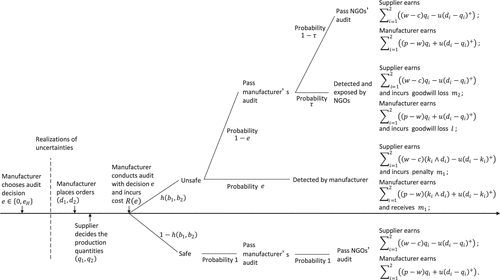
The sequence of events is summarized in Figure 1. We use backward induction to derive the equilibrium decisions. The subscripts S and M indicate the supplier and the manufacturer, respectively. First, given the manufacturer’s audit decision e and the realized demands and workforce , the supplier decides its production quantities to maximize its profit as follows, where the degree of excessive overtime :
Let denote the supplier’s best-response production quantity. When the supplier is indifferent between forcing overtime production and conducting normal production, we assume that the supplier conducts normal production as a tie-breaking rule. Anticipating the supplier’s best response , the manufacturer decides the audit decision to maximize the manufacturer’s expected profit , where is the manufacturer’s realized profit:
To avoid trivial and less relevant cases, we assume that , , and . The first assumption indicates that the manufacturer’s margin from selling the product is larger than the unit underdelivery cost paid by the supplier. The second assumption guarantees that the supplier’s profit is positive when conducting normal production, and the third assumption ensures that the manufacturer’s profit is positive when the manufacturer does not audit the supplier. We also assume that , which means the supplier may satisfy an order of size H with excessive overtime; otherwise, the manufacturer can trivially infer from a delivered quantity between L and H that excessive overtime is used. In addition, we assume that so that the supplier may have incentives to use excessive overtime when its realized normal workforce is inadequate; relaxing the assumption will necessitate discussions for more cases without generating new insights, as the supplier will have weaker incentives to commit violations under certain demand and workforce scenarios when this assumption does not hold. Finally, we assume that , indicating that from the supply chain perspective, the total expected goodwill loss is larger than the maximum gain from overtime production.
4. Base Model: Auditing Only
In this section, we examine a setting in which auditing is the sole viable tool for the manufacturer to combat excessive overtime. In what follows, we first analyze the supplier’s production decision for a given audit decision, order quantities, and realized workforce in Section 4.1 and then characterize the manufacturer’s equilibrium audit decision in Section 4.2. In Section 4.3, we first introduce two benchmarks—a no-audit benchmark and a centralized supply chain benchmark— and then examine the impact of audit on excessive overtime and social welfare.
4.1. Supplier’s Production Decision
In our setting, there are four scenarios in which the supplier may stretch its workforce using excessive overtime. In each of the scenarios, the normal workforce is not enough to meet the demand for at least one of the two products. We denote such a scenario by notation , where the subscript and the superscript indicate the realized demands and the realized workforce , respectively, and the four scenarios are denoted by , , , and . For example, indicates the demand for one product is less than the corresponding workforce, whereas the demand for the other product is more than the corresponding workforce. Note that scenario is a cross-mismatching scenario in the sense that there is redundant workforce for one product and insufficient workforce for the other. In the other three scenarios , , and , there is no redundant workforce for either product, and only insufficient workforce is observed for at least one product.
After observing the audit decision e, the realized workforce , and demands , the supplier decides on the production quantities as shown in the following proposition. All proofs of results in Section 4 are relegated to Online Appendix B.
(
When there is enough workforce for both products, that is, for , the supplier conducts normal production with quantities and accrues the profit
When there is not enough workforce for at least one of the two products, that is, for and/or 2, there exists a scenario-dependent audit threshold
(2)such that the supplier forces excessive overtime with production quantities and accrues the profit if the manufacturer’s audit decision . Otherwise, the supplier conducts normal production with quantities and accrues the profit
The proposition shows that when the workforce is sufficient to satisfy the demands, the supplier fulfills the orders with normal production. However, when the workforce for at least one product is insufficient to satisfy the demand, the supplier may force overtime production to fulfill the order if the manufacturer’s audit decision e is small. That is, the chance to discover the supplier’s violation behavior is low. If the supplier uses excessive overtime for product i, it will produce the ordered quantity . Otherwise, the manufacturer may infer that overtime production is used if the delivered quantity is strictly between L and . It follows that units of products will be produced with the overtime workforce in scenario , and units of products will be produced with the overtime workforce in scenarios , , or .
The condition to force excessive overtime, that is, , is derived from comparing the supplier’s profit of forcing excessive overtime, , with its profit of conducting normal production only, , in part 2 of Proposition 1. Note that the condition is equivalent to
In (3), the left-hand and right-hand sides are the benefit and cost of using overtime, respectively. Specifically, compared with when the supplier does not force overtime, if the supplier forces overtime and its violation behavior is not detected by the manufacturer, then the supplier can obtain the margin and also save the unit underdelivery cost u for each additional unit of product fulfilled with overtime production. It follows that the benefit from using overtime is . On the other hand, if the supplier forces overtime and its violation behavior is detected by either the manufacturer or external NGOs, then the supplier incurs penalty or goodwill loss , respectively. It follows that the cost of using overtime is .
We next show in Corollary 1 that the manufacturer’s audit becomes more effective in combating the supplier’s overtime violation as the audit becomes more efficient (that is, the chance to discover the violation, if any, increases). For ease of exposition, we label the scenario-dependent audit threshold as for , and , and for in the sequel. For example, for scenario by (2).
(
if , the supplier forces overtime in scenarios , , , and ;
if , the supplier forces overtime in scenario ;
if , the supplier does not force overtime in any of the four scenarios.
The relationship characterized in Corollary 1 implies that the supplier has a smaller and equal incentive to force overtime in scenarios , , and and a larger incentive in scenario . To understand the driving forces, let us consider the supplier’s benefit and cost from using overtime production specified in (3). On the one hand, the costs of using overtime production in all of these four scenarios , , , and are the same. On the other hand, the benefits from forcing overtime in scenarios , , and are smaller than that in because the supplier benefits from increased production quantity for both products in the latter case. Therefore, the supplier has a smaller and equal overtime incentive in , , and and a larger one in .
4.2. Manufacturer’s Audit Decision
Anticipating the supplier’s best-response production decision, the manufacturer makes its audit decision before the realization of demands and workforce as follows. We use the superscript to denote the model with auditing only.
(
Furthermore, increases in with
Proposition 2 shows that the manufacturer audits the supplier only when the audit cost R is not too large (Figure 2). Moreover, the manufacturer’s willingness to audit increases in the audit accuracy ; that is, the audit cost threshold increases in . To understand the result, recall from Corollary 1 that is the threshold above which the supplier does not force overtime in scenarios , , and , and is the threshold above which the supplier does not force overtime in scenario . Because the manufacturer prefers the supplier not to force overtime, the manufacturer’s willingness to audit discontinuously increases at the two thresholds and , as shown in Figure 2. We next explain the reason why the manufacturer’s willingness to audit increases when , , and , respectively.
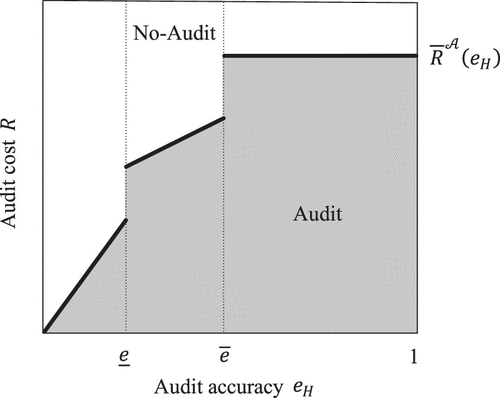
Note. The manufacturer audits the supplier when the audit cost R is smaller than the audit cost threshold , corresponding to the gray region in the figure.
When , the supplier has incentives to force overtime in all four scenarios , , , and . (When the manufacturer does not audit (i.e., ), the supplier also forces overtime in all four scenarios.) In scenarios , , and , the supplier forces overtime for one product only. Therefore, by auditing the supplier, the manufacturer could avoid the goodwill loss, receive a penalty imposed on the misbehaving supplier, and incur an opportunity cost of lost sales because of underdelivered quantity for the one product. That is, the net benefit from auditing in these scenarios is . In scenario , the supplier forces overtime for both products. Compared with the previous three scenarios, the opportunity cost to identify the misbehaving supplier is higher because the cost is due to the underdelivered quantity for both products. That is, the net benefit from auditing in this scenario is . It follows that the expected net benefit from auditing in all four scenarios (from weighting the net benefit in each scenario by the corresponding probability) increases in , leading to the manufacturer’s willingness to audit increasing in the audit accuracy .
When , the supplier only forces overtime in scenario . It follows that the manufacturer’s net benefit from auditing in scenario is the same as that in the previous case. However, in scenarios , , and , the supplier will not force overtime if the manufacturer audits, leading to the manufacturer’s net benefit from auditing increasing to a higher value of . It follows that the expected net benefit from auditing in all four scenarios and the resulting manufacturer’s willingness to audit increase in the audit accuracy .
When , the supplier does not force overtime in any of the four scenarios. Therefore, the manufacturer’s net benefit from auditing in scenario is increased to , whereas the net benefit remains as in scenarios , , and . In this case, it is easy to see that the expected net benefit from auditing in all four scenarios and the resulting manufacturer’s willingness to audit remain constant as the audit accuracy increases.
(
4.3. Impact of Auditing
We first respectively analyze two benchmarks in Section 4.3.1: one is a no-audit benchmark in which the manufacturer cannot audit the supplier, and the other is a centralized supply chain benchmark. We then study the impact of auditing on excessive overtime and social welfare in Section 4.3.2. We use the superscripts and to denote the no-audit benchmark and the centralized supply chain benchmark, respectively.
4.3.1. Two Benchmarks.
No-audit benchmark: The no-audit benchmark is a special case of the model with auditing only (when ). From Proposition 1 and Corollary 1, we have that the supplier always fulfills the orders when . It follows that the supplier forces overtime whenever it has a workforce shortage. We have the supplier’s production decision in the no-audit benchmark summarized in the following proposition, where denotes the supplier’s equilibrium production quantity of product i.
(
Although the manufacturer can anticipate the supplier’s best-response production quantity and is aware that the supplier may force overtime, the manufacturer does not know whether there is violation for sure because the realized workforce is unobservable to the manufacturer.
Centralized supply chain benchmark: In the centralized supply chain benchmark, the manufacturer and the supplier integrate as one firm that observes both the realized demands and workforce. It follows that the integrated firm is aware of any violation behavior without auditing, and there is no need to consider auditing in the centralized supply chain benchmark. Given the realized workforce and demands , the integrated firm determines the production quantities to maximize the profit as follows:
The integrated firm’s production decision is characterized in the following proposition, in which denotes the firm’s optimal production quantity of product i.
(
Recall that . That is, from the supply chain perspective, the total expected goodwill loss of using overtime production, , is larger than the maximum gain (which is achieved in scenario ) from using overtime production, . Therefore, the integrated firm will never force overtime.
4.3.2. Impact of Auditing on Excessive Overtime and Social Welfare.
Having analyzed the equilibrium decisions in the two benchmarks, we next characterize the impact of auditing on two performance metrics, (i) the expected degree of excessive overtime, and (ii) social welfare, by comparing the results in the model with auditing only to those in the two benchmarks. We define the expected degree of excessive overtime and social welfare in (4) and (5), respectively:
(
Recall from Propositions 3 and 4 that the supplier always fulfills the orders and forces overtime whenever there is a workforce shortage in the no-audit benchmark, and the integrated firm will not force overtime in the centralized supply chain benchmark. In contrast to these two benchmarks, Corollary 1 shows that in the model with auditing only, the number of scenarios in which the supplier forces overtime production decreases with the manufacturer’s audit decision e. It follows that the expected degree of excessive overtime is the highest in the no-audit benchmark, intermediate in the model with auditing only, and the lowest (equal to zero) in the centralized supply chain benchmark.
(
On the one hand, Theorem 2 shows that auditing can improve social welfare compared with the no-audit benchmark because auditing reduces the supplier’s violation incentive and the resulting expected degree of excessive overtime ( in Theorem 1), and the workers suffer less from excessive overtime. On the other hand, auditing alone cannot improve social welfare to a level higher than that in the centralized supply chain benchmark because the integrated firm does not force overtime.
Although auditing is commonly used by manufacturers as a stick strategy to mitigate excessive overtime issues, it cannot help suppliers improve the matching between their workforce and the orders. To better mitigate excessive overtime, manufacturers may need to employ carrot (i.e., supplier development) strategies in addition to auditing. Therefore, it is worth investigating how the manufacturer should use these stick-and-carrot strategies jointly. In what follows, we first examine a setting in which the manufacturer employs auditing together with directly subsidizing the supplier’s workforce retention initiative in Section 5 and then examine another setting in which the manufacturer employs auditing together with cross-training the supplier’s workers to enhance their skillsets in Section 6.
5. Model: Workforce Retention Subsidy and Auditing
In addition to auditing, MNEs often implement supplier development strategies such as subsidizing suppliers to retain workers. For example, Apple offered direct financial bonuses to workers at Foxconn (Foremski 2010). Apple also worked with a supplier located in Dongguan, China, to improve workers’ satisfaction by offering additional bonuses and improved food choices and, consequently, improved workers’ retention rate (Apple 2022a).
Motivated by these observations, we analyze a workforce retention subsidy strategy under which the manufacturer subsidizes the supplier’s workforce retention initiative. Compared with the base model with auditing only, the manufacturer must decide whether to subsidize the supplier at the beginning of the time horizon. Let the decision variable denote the manufacturer’s workforce retention subsidy decision, where corresponds to the scenario where the manufacturer subsidizes the supplier’s workforce retention initiative at a fixed cost , and otherwise. Motivated by the direct subsidy example of Apple, we consider the manufacturer’s workforce retention subsidy cost to be directly added to the total payoff of the workers at the supplier; our results continue to hold qualitatively if a part of the workforce retention subsidy cost is considered as efficiency loss in the workforce retention process.
If the manufacturer subsidizes the supplier’s workforce retention initiative (i.e., ), then the supplier’s workforce is improved in the first-order stochastic dominance sense. In particular, in this section, we consider the marginal probability of the supplier’s workforce being H is improved from to with . It follows that the probabilities of the joint distribution of the supplier’s workforce are , , and . Following a similar analysis, we can also consider an alternate setting where both and increase after the workforce retention subsidy. The details are omitted for brevity.
Except for the workforce retention subsidy decision, the sequence of events remains the same as that under the model with auditing only, and the details are omitted for brevity. We use backward induction to derive the equilibrium decisions of the supplier and the manufacturer. We next focus on analyzing the equilibrium decisions given that the manufacturer subsidizes the supplier; that is, . If the manufacturer does not subsidize the supplier’s workforce retention initiative, that is, , then all results remain the same as those under the base model with auditing only. Finally, we derive the manufacturer’s optimal workforce retention subsidy decision by comparing the subgame perfect equilibrium profits of the manufacturer given with that given .
5.1. Subgame Perfect Equilibrium When Manufacturer Subsidizes (y = 1)
Because the supplier decides the production quantity after observing the realized workforce, the workforce retention subsidy does not affect the supplier’s best-response production decision (see Proposition 1). Anticipating the supplier’s best-response production decision, the manufacturer makes its audit decision as follows. We use the superscript to denote the model with both auditing and workforce retention subsidy. All proofs of results in Section 5 are relegated to Online Appendix C.
(
Furthermore, the audit cost threshold increases in , with .
Similar to the result when auditing is the sole viable strategy (see Proposition 2), Proposition 5 shows that the manufacturer audits the supplier only when the audit cost R is small enough. In addition, the audit cost threshold is increasing in , indicating that the manufacturer has more willingness to audit the supplier if the audit becomes more effective.
5.2. Manufacturer’s Workforce Retention Subsidy Decision
Having characterized the supplier’s production and manufacturer’s auditing decisions in Propositions 1 and 2 given the workforce retention subsidy decision of , and those in Propositions 1 and 5 given the workforce retention subsidy decision of , we would like to examine the interaction between the manufacturer’s auditing and workforce retention subsidy decisions before analyzing the manufacturer’s equilibrium workforce retention subsidy decision. In particular, we first explore whether the manufacturer has more or less willingness to audit in the presence of workforce retention subsidy in the following theorem. We consider workforce retention subsidy and auditing to be substitutes when the manufacturer has (in a weak sense) less willingness to audit in the presence of workforce retention subsidy, and they are complements otherwise.
(
when the workforce correlation is large, that is, , the audit cost threshold with both workforce retention subsidy and auditing, , is smaller than the audit cost threshold with auditing only, . That is, workforce retention subsidy and auditing are substitutes in combating excessive overtime.
when the workforce correlation is small, that is, , the audit cost threshold with both workforce retention subsidy and auditing, , is strictly larger than the audit cost threshold with auditing only, . That is, workforce retention subsidy and auditing are complements in combating excessive overtime.
Contrary to the naive intuition that workforce retention subsidy and auditing should always be substitutes, interestingly, Theorem 3 shows that workforce retention subsidy can be a substitute or complement for auditing, depending on the correlation between the two groups within the supplier’s workforce measured by . We illustrate the result in Figure 3.

Notes. For the regions AA, AN, NA, and NN, the first letter indicates the manufacturer’s audit decision when the manufacturer does not subsidize the supplier’s workforce retention initiative, and the second letter indicates the manufacturer’s audit decision when the manufacturer subsidizes the supplier’s workforce retention initiative.
To understand the result, recall that there are four scenarios, , , , and , in which the supplier may force overtime. Whereas the manufacturer’s workforce retention subsidy decreases the total probability of these four scenarios, the impact on scenario (where the supplier may force overtime for both products) and that on scenarios , , and (where the supplier may force overtime on one product only) are different. As the probability of high workforce increases because of subsidy, the probability of scenario decreases. Interestingly, when is small, such reduced probability may be spilled over to the scenarios where the supplier may force overtime on one product only, leading to an increased probability of such scenarios (i.e., , , and ). Recall from Remark 1 that the manufacturer’s net benefit from auditing in scenarios , , and is higher than that in scenario . It follows that when is small, the manufacturer has a higher willingness to audit the supplier with workforce retention subsidy; that is, workforce retention subsidy and auditing are complements. When is large, the manufacturer has a lower willingness to audit the supplier; that is, workforce retention subsidy and auditing are substitutes.6
The correlation between the two workforce groups—as captured by the proxy parameter —may arise from common external factors such as macroeconomic shocks (e.g., economic downturns, regulatory changes) and regional labor market conditions (e.g., wage competition, employment opportunities) and/or from common internal factors, such as supplier-wide management policies (e.g., common human resource practices, standardized compensation schemes) and facility-/group-level operations and management approaches (e.g., similar operational environments and management styles that affect turnover risks). In practice, tends to be larger when both groups share similar external conditions, centralized management, or consistent supervisory practices—such as producing both product lines in the same facility under common policies—resulting in correlated turnover risks and the substitutive relationship between auditing and supplier development strategies. By contrast, tends to be smaller when the groups face distinct conditions—such as operating in different regions, under varied operational setups, or with divergent management approaches, leading to more independent turnover dynamics and the complement relationship between auditing and supplier development strategies.
We next discuss the manufacturer’s equilibrium workforce retention subsidy decision. Intuitively, the manufacturer has more willingness to subsidize the supplier’s workforce retention initiative when the workforce retention subsidy cost is lower than a subsidy cost threshold.
(
Finally, we explore how the manufacturer’s willingness to subsidize the supplier’s workforce varies with the initial turnover rate of the supplier’s workers. Recall that the workforce uncertainty is primarily driven by the turnover rate, and a higher value of the probability indicates a lower turnover rate. Intuitively, one may expect that the manufacturer should have a lower willingness to subsidize the supplier if the supplier’s initial turnover rate is lower (or equivalently, the initial retention rate is higher). We formally establish this result in the following corollary.
The subsidy cost threshold decreases as the probability increases.
5.3. Impact of Workforce Retention Subsidy on Excessive Overtime and Social Welfare
Having analyzed the equilibrium decisions of the supplier and the manufacturer, we next characterize the impact of mitigation strategies on the degree of excessive overtime and social welfare; these two performance metrics are defined in (4) and (5), respectively. Also, recall that the manufacturer’s workforce retention subsidy cost is directly added to the total payoff of the workers at the supplier motivated by the direct subsidy example of Apple. Note from Proposition 6 that the manufacturer subsidizes the supplier’s workforce retention initiative (i.e., ) when .
(
The expected degree of excessive overtime in the model with both workforce retention subsidy and auditing is larger than that in the centralized supply chain benchmark and smaller than that in the no-audit benchmark. That is, .
Compared with the model with auditing only, there exists an audit threshold such that workforce retention subsidy strategy simultaneously increases the manufacturer’s profit and decreases the expected degree of excess overtime if and only if one of the following four conditions is satisfied: the workforce correlation is relatively small , the audit cost is small , the audit cost is large , or the audit accuracy is relatively small .
Similar to the results of auditing only (see Theorem 1), part 1 of Theorem 4 shows that workforce retention subsidy and auditing can also reduce excessive overtime compared with the no-audit benchmark, but may not eliminate overtime. Therefore, the expected degree of excessive overtime under both subsidy and auditing is between the no-audit and centralized supply chain benchmarks.
Part 2 of Theorem 4 characterizes conditions under which a win-win outcome is achieved: not only is the manufacturer’s profit improved, but also the expected excessive overtime of the supplier’s workforce is reduced. Recall from Proposition 6 that the manufacturer subsidizes the supplier’s workforce retention initiatives when the workforce retention subsidy cost is small (i.e., ), indicating workforce retention subsidy improves the manufacturer’s profit in this case. We next explain why the excessive overtime is also reduced under the conditions specified in the theorem. On a high level, the workforce retention subsidy affects excessive overtime through two effects: (i) an order-fulfillment-improvement effect under which the subsidy improves the supplier’s overall order fulfillment capability with an increased workforce and, therefore, directly reduces the excessive overtime enforced by the supplier, ceteris paribus; and (ii) an audit-willingness-adjustment effect under which offering the subsidy may increase or decrease the manufacturer’s auditing willingness, depending on whether the two levers are complements or substitutes, respectively, and may correspondingly reduce or increase the use of excessive overtime by the supplier, ceteris paribus. Whether workforce retention subsidy reduces excessive overtime depends on the interplay of these two effects.
When the workforce correlation is small (i.e., ), workforce retention subsidy and auditing are complements; that is, workforce retention subsidy increases the manufacturer’s audit willingness, and the audit-willingness-adjustment effect works in the same direction as the order-fulfillment-improvement effect to reduce excessive overtime. When the audit cost is either small or large (i.e., or ), the manufacturer either audits the supplier with subsidy () or does not audit the supplier without subsidy (). In either case, offering a workforce retention subsidy does not decrease the manufacturer’s willingness to audit, and the audit-willingness-adjustment effect joins force with the order-fulfillment-improvement effect in reducing excessive overtime. Finally, when the audit accuracy is relatively small (i.e., ), auditing is not effective in combating excessive overtime. Therefore, although a workforce retention subsidy may decrease the manufacturer’s willingness to audit, the resulting negative impact is dominated by the positive order-fulfillment-improvement effect, and the excessive overtime is reduced.
In the following corollary of Theorem 4, we emphasize that in sharp contrast with the naive intuition that workforce retention subsidy always reduces excessive overtime, when the subsidy and auditing are substitutes and the negative audit-willingness-adjustment effect dominates the positive order-fulfillment-improvement effect, workforce retention subsidy may backfire and increase the expected degree of excessive overtime.
(
We then investigate the impact of workforce retention subsidy on social welfare.
(
The social welfare in the model with both workforce retention subsidy and auditing is larger than that in the no-audit benchmark. That is, . Moreover, there exists an audit threshold such that the social welfare in the model with both workforce retention subsidy and auditing is larger than that in the centralized supply chain benchmark if and only if the audit accuracy is large .
Compared with the model with auditing only, there exists an audit threshold such that workforce retention subsidy increases the social welfare if and only if one of the following four conditions is satisfied: the workforce correlation is relatively small , the audit cost is small , the audit cost is large , or the audit accuracy is relatively small .
Intuitively, part 1 of Theorem 5 shows that workforce retention subsidy and auditing improve social welfare compared with the no-audit benchmark. More importantly, the combined strategies may improve social welfare to a level higher than that in the centralized supply chain benchmark (without workforce retention subsidy). To understand the result, on the one hand, workforce retention subsidy increases the supplier’s overall efficiency of matching workforce with demands, which tends to improve social welfare, compared with the centralized supply chain benchmark. On the other hand, note from Proposition 4 that the supplier does not force overtime in the centralized supply chain benchmark, whereas Corollary 1 shows that the supplier may still force overtime under both workforce retention subsidy and auditing. However, the supplier’s violation incentive and the resulting suffering of workers decrease with the manufacturer’s audit decision e. When the manufacturer’s audit accuracy is large enough (i.e., ), the effect that workforce retention subsidy increases the overall matching efficiency dominates the effect that workers suffer more in the model with both workforce retention subsidy and auditing, and social welfare under both workforce retention subsidy and auditing is larger than that in the centralized supply chain benchmark.
Part 2 of Theorem 5 characterizes the conditions under which the workforce retention subsidy increases social welfare compared with the model with auditing only. The rationale behind the potential of the workforce retention subsidy to enhance social welfare is analogous to its potential to reduce excessive overtime (see part 2 of Theorem 4 and the corresponding discussions). Also, similar to the observation in Corollary 3, workforce retention subsidy may backfire and reduce social welfare when the conditions in part 2 of Theorem 5 are not satisfied. The details are omitted for brevity.
5.4. Numerical Analysis
In this section, we first collected data of representative manufacturers and suppliers in the electronics industry from practical open sources such as firms’ financial reports, business news, and academic literature, for example, Kölbel et al. (2017) and Moon et al. (2023), to construct a practical testing bed.7 We then numerically analyze the interaction between workforce retention subsidy and audit, as shown in Figure 4. In addition, we numerically decompose social welfare into two components: worker welfare (including the worker wage and damage because of overtime, if any) and firms’ profits (i.e., the sum of the manufacturer’s and the supplier’s profits). We primarily focus on comparing social welfare, worker welfare, and firms’ profits under to those under , as shown in Figure 5.
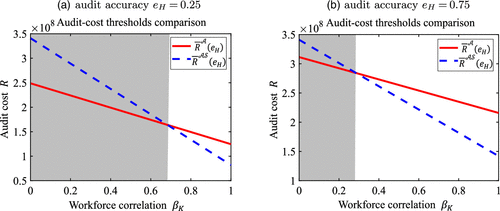
Note. We use the following parameters in our testing bed: , , , , million, million, million, million, million, , , , , and .
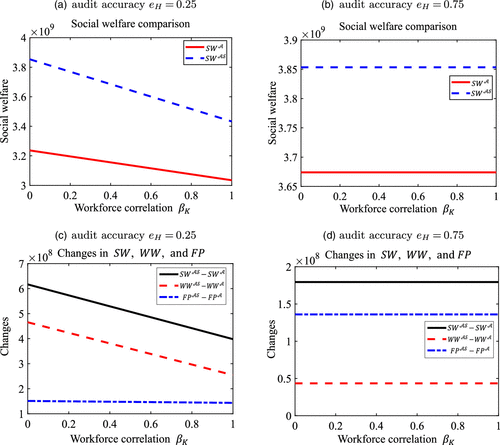
Notes. We use the following parameters in our testing bed: , , , , million, million, million, million, million, , , , million, million, , , and . The abbreviations SW, WW, and FP denote social welfare, worker welfare, and firms’ profits, respectively. For example, indicates social welfare in the setting with both auditing and workforce retention subsidy, and represents worker welfare in the setting with auditing only.
The parameters are listed below Figures 4 and 5. As an example, we include in the footnote a detailed explanation of how the parameters l and , representing the MNEs’ and the supplier’s goodwill loss because of the public exposure of the supplier’s violations, respectively, are obtained.8 In the interests of space, the detailed choices of the other parameters are relegated to Online Appendix D, in which we include a more detailed explanation regarding how we obtained data supporting the parameter choices and conduct robustness checks for a few parameters that are difficult to obtain.
The main observations from Figure 4 are that workforce retention subsidy may be a complement for audit when the workforce correlation is small; see the gray regions in Figure 4. Specifically, workforce retention subsidy and audit are complements in combating excessive overtime if the workforce correlation is smaller than a threshold (around 0.67 in Figure 4(a) and 0.28 in Figure 4(b)), and they are substitutes otherwise. We note that the observation follows from the intuition of part 2 of Theorem 3. The managerial insight is that the manufacturer in the electronics setting should be careful when simultaneously adopting audit and workforce retention subsidy because they may not always have synergy in combating excessive overtime. That is, these strategies may not always be substitutes, and reducing audit under the mistaken belief that carrots can replace the stick may not only fail to curb excessive overtime but could also diminish the MNE’s overall profitability when the two strategies are complements.
Figure 5 reveals that the improvement in social welfare can be driven by both enhanced worker welfare and firm profitability. The numerical results in Figure 5 correspond to a case in which the manufacturer audits the supplier with or without subsidy. That is, subsidy improves the supplier’s overall fulfillment capability without diminishing the manufacturer’s auditing willingness. Consequently, the social welfare, worker welfare, and firms’ total profits in the model with both auditing and subsidy are higher than those in the model with auditing only, respectively.
To understand why social welfare and the changes in social welfare, worker welfare, and firms’ profits decrease with the workforce correlation when —see Figure 5, (a) and (c)—while remaining unchanged when —see Figure 5, (b) and (d)—we note from Corollary 1 that there exists an audit decision threshold above which the supplier does not force overtime in scenarios , , and , and a threshold above which the supplier does not force overtime in scenario . In our testing bed, , and . It follows that the supplier forces overtime in when and does not force overtime when . Consequently, social welfare and those changes decrease with when because a larger indicates a larger probability of being in scenario in which the supplier forces overtime, and they remain unchanged when because the supplier does not force overtime in these cases.
6. Model: Cross-Training and Auditing
MNEs often provide learning opportunities to upskill the suppliers’ workers as another form of supplier development, which can enhance workforce flexibility and productivity, thereby helping to mitigate the issue of excessive overtime (Distelhorst et al. 2017, ILO 2017a, Apple 2022a, SHEIN 2023). Motivated by these observations, we analyze the cross-training strategy under which the manufacturer makes a decision on training a proportion of the supplier’s single-skilled workers to become multiskilled, enabling them to produce both products. In the interests of space, we relegate the model and analysis to Appendix A.
By analyzing the model, we find that cross-training and auditing can be either complements or substitutes. The counterintuitive result regarding the complements arises from the fact that enhanced workforce flexibility at the supplier level lowers the manufacturer’s opportunity cost associated with identifying the supplier’s violations. As a result, the manufacturer could exhibit a greater willingness to conduct audits. We also identify conditions under which cross-training could lead to a win-win outcome where the manufacturer earns a higher profit and the supplier uses less of overtime, and conditions under which cross-training may backfire and result in a higher level of excessive overtime by the supplier. In addition, cross-training and auditing could lead to a higher social welfare level than that under the centralized supply chain benchmark (without cross-training).
Finally, we also include an extension on the productivity enhancement effect of the upskilling programs. In this case, the workers’ productivity is improved as a result of the training. We relegate this extension to Appendix E.
7. Concluding Remarks
Numerous reports highlight instances where suppliers in developing economies coerce workers into excessive overtime within the global supply chains of MNEs. Such practices not only pose serious threats to the well-being of workers but also contravene the labor-related codes of conduct established by MNEs, potentially tarnishing their brand image. In this paper, by modeling a supplier’s violation behavior that the supplier may force overtime when its realized normal workforce cannot meet a manufacturer’s orders, we explore how the manufacturer can effectively utilize a stick strategy, that is, auditing, and two carrot strategies, that is, workforce retention subsidy and cross-training, to combat such violation behavior on the part of the supplier.
Our research yields several managerial insights for MNEs aiming to address the issue of excessive overtime in their global supply chains. Firstly, in scenarios where auditing is the sole viable strategy, it is imperative for MNEs to deploy this strategy only when the accuracy of auditing is sufficiently high. However, it is essential to recognize that whereas auditing serves as a deterrent, it alone cannot facilitate improvements in suppliers’ normal workforce to meet order requirements. In addition, because auditing is imperfect, suppliers may still resort to enforcing overtime.
Secondly, when MNEs opt for a combined approach involving the stick strategy alongside one of the carrot strategies (i.e., workforce retention subsidy or cross-training), these strategies may act as either complements or substitutes. This finding challenges a naive belief that these strategies are always substitutes. It underscores the need for MNEs to carefully evaluate the simultaneous adoption of stick-and-carrot strategies to combat excessive overtime, as synergies may not always be present. That is, these strategies may not always be substitutes, and reducing audit under the mistaken belief that carrots can replace the stick may not only fail to curb excessive overtime but could also diminish the MNE’s overall profitability when the two strategies are, in fact, complements. For instance, our numerical study, calibrated using data from the electronics industry, reveals that workforce retention subsidy and auditing are complements when workforce correlation is small. This observation suggests that manufacturers should audit more after implementing a workforce retention subsidy.
Third, we characterize conditions under which the manufacturer can achieve a win-win outcome by employing both the supplier development strategies and auditing. In short, employing the supplier development strategies has a direct order-fulfillment-improvement effect and an indirect auditing-willingness-adjustment effect. When developing the supplier does not reduce the MNE’s auditing willingness, or the auditing accuracy is low, the MNE can earn a higher profit and reduce the overtime of the supplier at the same time. On the contrary, when these conditions are not satisfied, the MNEs must exercise caution, as these carrot strategies may inadvertently lead to adverse outcomes by intensifying the problem of excessive overtime and diminishing overall social welfare. This insight arises from the observation that the implementation of a carrot strategy may diminish the manufacturer’s willingness to audit. Consequently, suppliers may be more inclined toward violation behavior, resulting in an escalation of excessive overtime and a subsequent reduction in social welfare. Therefore, MNEs committed to mitigating excessive overtime and enhancing social welfare should remain vigilant, maintaining ongoing scrutiny of their suppliers’ behavior even after investing resources in developing supplier capabilities to fulfill orders.
Which of the supplier development strategies should be prioritized for adoption depends on a careful benefit-cost analysis. For example, consider the supplier maturity, which reflects a supplier’s systemic capability to (i) uphold fundamental labor compliance (e.g., minimum wage adherence, overtime premiums), and (ii) maintain organizational infrastructure for ongoing workforce development (e.g., skill-based wage adjustments and internal promotion pathways to retain a cross-trained/upskilled workforce). Low-maturity suppliers, such as newly engaged factories in underdeveloped regions, often lack coherent labor systems and structured human resource mechanisms, making it difficult and costly for MNEs to implement capability-building programs in the early stages of the partnership. These suppliers tend to be more responsive to workforce retention subsidy, which help address immediate labor shortages or compliance risks. In contrast, high-maturity suppliers, such as established factories in developed regions, possess institutionalized human resource systems and integrated mechanisms for workforce retention after training and upskilling. They are better equipped to absorb workforce training and upskilling. As a result, MNEs’ structural investments in these suppliers are easier and more likely to generate sustainable and lasting impact.
Our study unveils several promising avenues for future research. Firstly, whereas our focus has been on assessing the efficacy of auditing and supplier development strategies in tackling excessive overtime within a dyadic supply chain, it would be both intriguing and important to extend this inquiry to scenarios where competing MNEs share a common supplier. An exploration of such competitive settings could enhance our comprehension of strategies aimed at improving labor welfare, particularly considering potential spillover effects. Another compelling avenue for future research involves delving into a strategic supplier’s decision-making process regarding unauthorized subcontracting and other illicit means to fulfill orders and how MNEs can deploy operational levers to counteract such behaviors. Moreover, because MNEs’ inflated orders often pressure suppliers into enforcing excessive overtime, exploring strategies to address MNEs’ strategic ordering behavior could be a promising direction for future research. Additionally, as some MNEs may want to cultivate long-term relationships with their suppliers, it would be worthwhile to investigate how manufacturers can address the issue of excessive overtime in a multiperiod setting. Exploring the role of trust and trustworthiness in such contexts could provide valuable insights into fostering sustainable and mutually beneficial relationships. We hope that our paper can serve as a stepping stone for future research on labor welfare in global supply chains.
The authors are grateful to the department editor, the associate editor, and three anonymous reviewers for their many sharp comments and constructive suggestions that significantly improved the paper, both in content and exposition. The authors thank seminar attendees at Georgia Institute of Technology, Temple University, the University of Connecticut, Tsinghua University, and the University of Science and Technology of China for helpful comments.
Appendix A. Model: Cross-Training and Auditing
As another form of supplier development activities, MNEs often provide learning opportunities to upskill the suppliers’ workers, and the improved flexibility as well as the productivity of the workforce can help mitigate the issue of excessive overtime. In this appendix, we analyze the cross-training strategy in this section and relegate the discussion on the productivity enhancement effect of the upskilling programs to Appendix E for brevity. Under the cross-training strategy, the manufacturer trains a proportion of the supplier’s single-skilled workers to become multiskilled, enabling them to produce both products. Compared with the model with auditing only, the manufacturer must decide whether to train a proportion of the supplier’s workers at the beginning of the time horizon. Let the decision variable denote the manufacturer’s cross-training decision. Here, indicates that the manufacturer does not train the supplier’s workers, and indicates that the manufacturer trains a proportion of the supplier’s workers of each product to be multiskilled at a fixed cost , where is the cross-training level. The normal workforce of multiskilled workers (trained from the single-skilled workers of product ) is if the realized workforce is and if the realized workforce is . Except for the cross-training decision, the sequence of events remains the same as that in the base model.
If the manufacturer decides to train the workers, the supplier will have the flexibility to use underutilized labor for one product to help produce the other product with insufficient workforce. Thus, among the four scenarios (, , , and ) where the supplier may force overtime, only the cross-mismatching scenario, , will be affected by the cross-trained workforce. In this scenario, the available workforce for the product with the workforce shortage is the sum of the normal workforce and the multiskilled workers of the other product , and the degree of excessive overtime for product i is . In the other three scenarios, neither product has underutilized workforce. Therefore, the existence of the multiskilled workers will not change the production decision (or the violation behavior) of the supplier, and the degree of excessive overtime for product i is . If the manufacturer decides not to train the workers, the degree of excessive overtime remains the same as that in the model with auditing only. We use the superscript to denote the model with both auditing and cross-training.
Similar to the analysis in the workforce retention subsidy and auditing section, we use backward induction to derive the equilibrium, starting from the supplier’s best-response production decision and the manufacturer’s auditing decision. Because the equilibrium decisions are similar to those in the base setting, the detailed analyses are relegated to Propositions E.1 and E.2 in Online Appendix E in the interest of space. In the following discussions, we use to denote the equilibrium audit cost threshold such that the manufacturer audits the supplier when the audit cost is below the threshold. In addition, the cross-training-level threshold is defined in Proposition E.1. We next examine the interaction between the manufacturer’s auditing and cross-training decisions. In particular, we would like to explore whether the manufacturer has more or less willingness to audit in the presence of cross-training in the following theorem.
(
When cross-training is more effective, that is, , the audit cost threshold under cross-training, , is strictly smaller than the audit cost threshold without cross-training, . That is, cross-training and auditing are substitutes in combating excessive overtime.
When cross-training is less effective, that is, , the audit cost threshold under cross-training, , is strictly larger than the audit cost threshold without cross-training, . That is, cross-training and auditing are complements in combating excessive overtime.
We illustrate the result in Figure A.1. Whereas Theorem A.1 shows that cross-training can be a substitute or complement for auditing depending on the effectiveness of the cross-training, that is, the cross-training level t, similar to the observation under both workforce retention subsidy and auditing, the underlying mechanism is different.
When cross-training is more effective (i.e., ), a cross-trained supplier has enough normal labor supply and should not force overtime in the cross-mismatching scenario and, therefore, the manufacturer’s expected goodwill loss because of the supplier’s violation behavior is small. It follows that the manufacturer has less willingness to audit. To summarize, cross-training and auditing are substitutes when .
When cross-training is less effective (i.e., ), a cross-trained supplier still has incentives to force overtime in the cross-mismatching scenario if not audited. If the manufacturer audits the supplier, the supplier either forces overtime and may rectify such behavior if the violation is uncovered in the manufacturer’s audit (when the audit accuracy is low), or does not force overtime (when the accuracy is high) in the cross-mismatching scenario. In either case, the cross-trained supplier produces more than what it would, had it not been trained, because of its improved order fulfillment capability from the multiskilled workers. This improved fulfillment capability reduces the manufacturer’s opportunity cost to fulfill orders because of auditing, which, in turn, increases the manufacturer’s willingness to audit. Therefore, cross-training and auditing are complements when .
We next characterize the manufacturer’s cross-training decision. Intuitively, the manufacturer trains the supplier’s workers when the training cost is lower than a cross-training cost threshold.
(
We then explore how the manufacturer’s willingness to train is affected by the initial turnover rate. Recall that we have shown in Corollary 2 that the manufacturer should have a lower willingness to subsidize the supplier if the supplier’s initial turnover rate is lower. One may expect that the opposite result should hold for cross-training. That is, the supplier should have a higher willingness to train the supplier’s workforce if the supplier’s initial turnover rate is lower (namely that the probability increases), as reduced turnover among trained employees enhances the effectiveness of such training. Interestingly, we characterize conditions under which this intuition does not hold in the following corollary. The complete characterization of how changes with respect to is relegated to Corollary E.1 in Online Appendix E.
There exist a demand-correlation threshold and a workforce correlation threshold such that
if , , and , then decreases in ;
if , , , and , then decreases in .
Corollary A.1 show that may decrease in if the manufacturer’s auditing decision is different without and with cross-training. We next elaborate on these counterintuitive cases in detail. When cross-training is less effective (i.e., ) so that cross-training and auditing are complements, there are three regions—AA, NA, and NN—of the manufacturer’s audit decision (see Figure A.1(b)). Case 1 in Corollary A.1 shows that if the workforce correlation is relatively large (i.e., ), then the cross-training cost threshold decreases in in the region NA corresponding to , implying that a higher turnover rate among the supplier’s workforce (i.e., a lower ) increases the manufacturer’s cross-training willingness.

Note. For the regions AA, AN, NA, and NN, the first letter indicates the manufacturer’s audit decision when the manufacturer does not cross-train the supplier’s workers, and the second letter indicates the manufacturer’s audit decision when the manufacturer cross-trains the supplier’s workers.
To understand the result, note that cross-training changes the manufacturer’s decision from not auditing the supplier to auditing in the region NA. When cross-training the supplier’s workforce, the manufacturer not only benefits from the improved workforce flexibility in the cross-mismatching scenario enabled by multiskilled workers but also benefits from auditing in the four scenarios , , , and , where the supplier may force overtime (depending on the auditing accuracy, the supplier may not force overtime in some or all of these scenarios under auditing). That is, cross-training generates benefits for the manufacturer in each of these four scenarios, compared with that without cross-training. As the turnover rate decreases (that is, increases), the probabilities of scenarios and (in which the workforce is realized as LL) decrease, whereas the probabilities of scenarios and (in which the workforce is realized as LH) increase. As the workforce correlation increases, the realized workforce is less likely to be different, and therefore, the former effect dominates. That is, the threshold decreases in when .
Case 2 in this corollary follows a similar intuition except that the corresponding region is AN (that is, the manufacturer switches from auditing to not auditing if the manufacturer trains the supplier). Therefore, cross-training results in losses (or negative benefits) in three scenarios—, , and —because of lack of auditing. The detailed discussions are omitted for brevity.
Having analyzed the equilibrium decisions of the supplier and the manufacturer, we next characterize the impact of cross-training and auditing on the degree of excessive overtime and social welfare. The expected degree of excessive overtime and social welfare can be directly obtained by replacing in (4) and (5) with , where in scenario and otherwise, and is the supplier’s equilibrium production quantity of product i in the model with both cross-training and auditing.9 In addition, if the manufacturer trains the supplier’s workers, the training cost is subtracted from the social welfare.
(
The expected degree of excessive overtime under the model with both cross-training and auditing is smaller than that under the no-audit benchmark and larger than that under the centralized supply chain benchmark. That is, .
Compared with the model with auditing only, there exists an audit threshold such that cross-training strategy simultaneously increases the manufacturer’s profit and decreases the expected degree of excess overtime if and only if one of the following four conditions is satisfied: the cross-training is less effective , the audit cost is small , the audit cost is large , or the audit accuracy is relatively small .
Part 1 of Theorem A.2 shows that cross-training and auditing can reduce excessive overtime compared with the no-audit benchmark, but they may not eliminate overtime as in the centralized supply chain benchmark. Part 2 of Theorem A.2 characterizes conditions under which a win-win outcome with both the manufacturer’s profit and the supplier’s excessive overtime improved can be achieved by cross-training. Recall from Proposition A.1 that the manufacturer cross-trains the supplier’s workers in equilibrium when , indicating the manufacturer is more profitable in this case. Regarding the impact of cross-training on excessive overtime, similar to the impact of workforce subsidy, cross-training also has an order-fulfillment-improvement effect and an audit-willingness-adjustment effect. With the difference that the order-fulfillment-improvement effect is driven by the improved flexibility of the workforce. The audit-willingness-adjustment effect, similar to that under workforce subsidy, is driven by the complement or substitute relationship between cross-training and auditing. Whether cross-training reduces excessive overtime depends on the interplay of these two effects. Because the intuition regarding why cross-training reduces excessive overtime under these conditions in part 2 of Theorem A.2 is similar to that for the workforce retention subsidy (see part 2 of Theorem 4), the details are omitted for brevity. We finally highlight the conditions under which cross-training backfires, which are the complement of the conditions in part 2 of Theorem A.2, in the following corollary.
(
We then compare social welfare under both cross-training and auditing to the two benchmarks under auditing only as well as that in the base model in the following theorem. The result in this theorem is similar to Theorem 5, where we consider workforce retention subsidy, except that cross-training increases the supplier’s efficiency of matching workforce with demands only in the cross-mismatching scenario , whereas workforce retention subsidy increases the supplier’s overall efficiency of matching workforce with demands. The detailed discussion is omitted for brevity.
(
The social welfare under the model with both cross-training and auditing is larger than that under the no-audit benchmark. That is, . Moreover, there exists an audit threshold such that the social welfare under the model with both cross-training and auditing is larger than that under the centralized supply chain benchmark if and only if the audit accuracy is large .
Compared with the model with auditing only, there exists an audit threshold such that cross-training increases the social welfare if and only if one of the following four conditions is satisfied: the cross-training is less effective , the audit cost is small , the audit cost is large , or the audit accuracy is relatively small .
Appendix B. Remarks
(
(
When the manufacturer does not audit the supplier, there exists a threshold such that if the expected goodwill loss of the manufacturer , the manufacturer orders according to the realized demands in any scenario.
When the manufacturer audits the supplier,
if , there exists a threshold such that if the expected goodwill loss of the manufacturer , the manufacturer orders according to the realized demands in any scenario.
if , the manufacturer orders according to the realized demands in any scenario.
When the manufacturer does not audit or it audits with a lower audit accuracy, the supplier may force overtime. Intuitively, if is sufficiently small, then the manufacturer’s expected goodwill loss because of the supplier’s violation behavior is small, and the manufacturer always orders according to the realized demands. In addition, when the manufacturer audits with a high audit accuracy, the supplier does not force overtime, and the manufacturer also always orders according to the realized demands. The proof to verify the sufficient condition is provided in Online Appendix F.
Appendix C. Notation Tables
In this appendix, we provide a notation table of decision variables (Table C.1), a notation table of model parameters and variables (Table C.2), and a notation table of superscripts (Table C.3).
|

Table C.1. Notation Table: Decision Variables
| Variable | Definition |
|---|---|
| Supplier’s production quantity of product | |
| e | Manufacturer’s audit decision; and |
| y | Manufacturer’s workforce retention subsidy decision; if the manufacturer subsidizes, and if not |
| z | Manufacturer’s cross-training decision; if the manufacturer cross-trains, and if not |
|
Table C.2. Notation Table: Model Parameters and Variables
| Variable | Definition |
|---|---|
| Parameters and variables in all model settings | |
| Vector of the manufacturer’s random demands; , or L, | |
| Vector of the manufacturer’s realized demands; , or L, | |
| Probability of the realized demand being high; , , | |
| Conditional probability of the realized demands of two products; , | |
| Correlation between the demands of products 1 and 2; | |
| Vector of the supplier’s random workforce; , or L, | |
| Vector of the supplier’s realized workforce; , or L, | |
| Probability of the realized workforce being high; , , | |
| Conditional probability of the realized workforce of two products; , | |
| Correlation between the workforce of products 1 and 2; | |
| p | Retail price of each product |
| w | Wholesale price of each product paid by the manufacturer to the supplier |
| c | Unit production cost of each product paid by the supplier to workers |
| u | Unit underdelivery cost of each product paid by the supplier to the manufacturer |
| Degree of excessive overtime for product | |
| Upper bound of the degree of excessive overtime for product ; | |
| Indicator function with ; if condition C is true, and zero otherwise | |
| g | Workers’ disutility from excessive overtime |
| Audit cost incurred by the manufacturer; | |
| Penalty paid by the supplier to the manufacturer if the violation is detected by the manufacturer | |
| External audit accuracy of NGOs; | |
| l | Goodwill loss incurred by the manufacturer if the violation is exposed to the public by NGOs |
| Goodwill loss incurred by the supplier if the violation is exposed to the public by NGOs | |
| Total salary paid to the supplier’s workers | |
| Expected profit of the manufacturer; is the realized profit of the manufacturer | |
| Expected profit of the supplier; is the realized profit of the supplier | |
| OT | Expected degree of excessive overtime; |
| SW | Social welfare; |
| Parameters and variables in workforce retention subsidy | |
| Workforce retention subsidy cost incurred by the manufacturer when it subsidizes; | |
| Probability of the realized workforce being high after the manufacturer subsidizes; | |
| Parameters and variables in cross-training | |
| Cross-training cost incurred by the manufacturer when it cross-trains; | |
| t | Cross-training level after the manufacturer cross-trains; |
| s | Productivity enhancement level after the manufacturer trains; |
|
Table C.3. Notation Table: Superscripts
| Superscript | Definition |
|---|---|
| Superscript denotes the no-audit benchmark | |
| Superscript denotes the centralized supply chain benchmark | |
| Superscript denotes the model with auditing only | |
| Superscript denotes the model with both workforce retention subsidy and auditing | |
| Superscript denotes the model with both cross-training and auditing | |
| Superscript denotes the productivity enhancement model |
Appendix D. Analysis for Ex Post Auditing
In the main paper, we consider the setting in which the manufacturer makes the audit decision before the demand realization, referred to as the ex ante auditing. In this extension, we consider an alternate setting in which the manufacturer makes its audit decision after observing the realized demands, referred to as the ex post auditing. Recall that we use superscripts , , and to denote the model with auditing only, with both workforce retention subsidy and auditing and with both cross-training and auditing, respectively.
Similar to the analysis with ex ante auditing, we use backward induction to derive the equilibrium. We first derive the supplier’s best-response production decision and the manufacturer’s auditing decision in settings with auditing only, with both workforce retention subsidy and auditing, and with both cross-training and auditing, respectively. Because the supplier decides the production quantity after observing the manufacturer’s audit decision, the supplier’s best-response production decision remains the same as that under the ex ante auditing setting; see the supplier’s best-response production decision in Proposition 1 for the setting with auditing only and the setting with both workforce retention subsidy and auditing, and that in Proposition E.1 in Online Appendix E for the setting with both cross-training and auditing, respectively.
The main difference between the ex post and ex ante auditing is that the manufacturer’s auditing decision in the ex post auditing is contingent upon the realized demands. Recall that the supplier may force overtime when either one of the realized demands is H and the other is L, or both of the realized demands are H. In the former and latter cases, we use and , respectively, to denote the equilibrium audit cost threshold in model such that the manufacturer audits the supplier when the audit cost is below the threshold. The detailed analyses of equilibrium audit decisions in these settings are relegated to Proposition G.1 in Online Appendix G in the interest of space.
We next investigate the interaction between the manufacturer’s auditing and workforce retention subsidy decisions and the interaction between the manufacturer’s auditing and cross-training decisions in the following two theorems.
(
Given the realized demands or , the audit cost thresholds . That is, workforce retention subsidy and auditing are substitutes in combating excessive overtime.
Given the realized demands , there exists a threshold such that
(i) When , the audit cost thresholds . That is, workforce retention subsidy and auditing are substitutes in combating excessive overtime.
(ii) When , the audit cost thresholds . That is, workforce retention subsidy and auditing are complements in combating excessive overtime.
Part 1 of Theorem D.1 shows that given the realized demands of these two products being H and L, respectively, workforce retention subsidy decreases the manufacturer’s willingness to audit compared with the model with auditing only. To understand the result, note that workforce retention subsidy decreases the total probability of being in scenarios and (i.e., ), and the net benefits of the manufacturer from auditing the supplier in the two scenarios are the same (see Remark 1). Therefore, workforce retention subsidy decreases the manufacturer’s willingness to audit when the realized demands of these two products are H and L, respectively.
Part 2 of Theorem D.1 shows that the interaction between workforce retention subsidy and ex ante auditing (Theorem 3) is robust under ex post auditing. Specifically, given the realized demands of these two products being H, workforce retention subsidy may be a substitute or complement for the ex post auditing. The reason is similar to that in Theorem 3 except that, given the realized demands , the supplier may force overtime only in scenarios and under ex post auditing. The detailed explanation is omitted for brevity.
In addition, we note that given the manufacturer subsidizes the supplier’s workforce, workforce retention subsidy may simultaneously increase the manufacturer’s profit and decrease the excessive overtime when it does not reduce the manufacturer’s auditing willingness. On the other hand, workforce retention subsidy may also backfire and increase excessive overtime when it reduces the manufacturer’s auditing willingness. These results can be obtained by following a similar analysis in Section 5. In the interest of space, the detailed analysis is omitted.
(
Given the realized demands or ,
(i) when , the audit cost thresholds . That is, cross-training and auditing are substitutes in combating excessive overtime.
(ii) when , the audit cost thresholds . That is, cross-training and auditing are complements in combating excessive overtime.
Given the realized demands , the audit cost thresholds .
Recall that cross-training may be helpful in combating excessive overtime only in the cross-mismatching scenario . Part 1 of Theorem D.2 shows that the interaction between cross-training and the ex ante auditing is robust with the ex post auditing. Specifically, given the realized demands of these two products being H and L (so that the supplier may force overtime in scenarios and ), cross-training can be a substitute for the ex post auditing when the training is more effective, and they are complements when the training is less effective. The reason is similar to that of Theorem A.1 except that the supplier may force overtime only in scenarios and under both cross-training and the ex post auditing given the demand realization. The detailed explanation is also omitted for brevity. Part 2 of Theorem D.2 shows that cross-training does not change the audit cost threshold when the realized demands of these two products are H because cross-training is not helpful in combating excessive overtime in scenarios other than .
We also note that given the manufacturer cross-trains the supplier’s workforce, cross-training may simultaneously increase the manufacturer’s profit and decrease the excessive overtime when it does not reduce the manufacturer’s auditing willingness. On the other hand, cross-training may also backfire and increase excessive overtime when it reduces the manufacturer’s auditing willingness. These results can be obtained by following a similar analysis in Appendix A. In the interest of space, the detailed analysis is omitted.
Appendix E. Analysis for Productivity Enhancement Model
In Appendix A, we consider the manufacturer cross-trains the supplier’s workers to improve the versatility of their skill set. In the current section, we study a productivity enhancement setting in which the manufacturer trains the supplier’s workforce at a cost , which helps improve the workforce productivity, as another strategy of upskilling the workforce. To isolate the impact of the improved versatility of the workers’ skill set, we consider all workers remain as single-skilled workers in this extension. Specifically, we consider the supplier’s realized workforce is increased from to after the manufacturer trains the supplier’s workforce to enhance their productivity. Here, we have that , , and , where s is the productivity enhancement level. The probabilities remain as , , and . We use superscript to denote the productivity enhancement model.
We use backward induction and start from the supplier’s best-response production decision and the manufacturer’s auditing decision. Similar to that in the base setting, the supplier may force overtime in four scenarios, , , , and . Because the equilibrium decisions are similar to those in the setting with cross-training and auditing examined in Appendix A, the detailed analyses are relegated to Propositions H.1 and H.2 in Online Appendix H in the interest of space. In the following discussions, we use to denote the equilibrium audit cost threshold such that the manufacturer audits the supplier when the audit cost is below the threshold. We next examine the interaction between the manufacturer’s auditing and productivity enhancement decisions.
(
when , the audit cost thresholds . That is, productivity enhancement and auditing are substitutes in combating excessive overtime.
when ,
(i) the audit cost threshold if . That is, productivity enhancement and auditing are complements in combating excessive overtime.
(ii) the audit cost threshold if . That is, productivity enhancement and auditing are substitutes in combating excessive overtime.
when , the audit cost thresholds . That is, productivity enhancement and auditing are complements in combating excessive overtime.
Theorem E.1 confirms that the productivity enhancement can also be a substitute or complement for auditing, depending on the effectiveness of the productivity enhancement, that is, the productivity enhancement level s (see Figure E.1). This is similar to the result in Theorem A.1 under cross-training, which shows that cross-training and auditing are substitutes when the effectiveness of cross-training is large (i.e., ) and complements when it is small (i.e., ). The difference is that the complement and substitute relationship switches under productivity enhancement when the effectiveness of the productivity enhancement is intermediate (i.e., ). This difference comes from the fact that productivity enhancement helps improve workforce productivity and the resulting order fulfillment capability of the supplier in all four scenarios where the supplier may force overtime (i.e., , , , and ), whereas cross-training is only useful to increase the supplier’s order fulfillment capability in the cross-mismatching scenario (i.e., ).
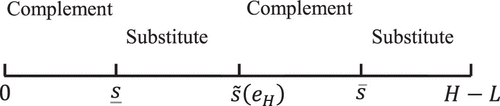
Notes. Although the threshold is drawn between and in this figure, it may be smaller than or larger than . In these cases, productivity enhancement and auditing can be either complements or substitutes when
To understand Theorem E.1, note that productivity enhancement helps improve the supplier’s order fulfillment capability in the four scenarios where the supplier may force overtime. On the one hand, this improved order fulfillment capability increases the supplier’s overall efficiency of matching workforce with demands, which decreases the manufacturer’s willingness to audit. On the other hand, this improved fulfillment capability reduces the manufacturer’s opportunity cost to fulfill orders because of auditing, which increases the manufacturer’s willingness to audit. Which one of the two effects dominates depends on the productivity enhancement level s.
When s is large (i.e., ), the productivity enhancement increases the supplier’s overall efficiency of matching workforce with demands significantly and, in turn, eliminates the supplier’s violation behavior in all scenarios. In this case, the manufacturer has no willingness to audit, and productivity enhancement and auditing are substitutes. When s is intermediate (i.e., ), the supplier may still force overtime in scenario . In this case, productivity enhancement and auditing are complements when s is relatively large (i.e., ) and substitutes when s is relatively small (i.e., ). This is because the opportunistic cost associated with auditing in scenario under productivity enhancement decreases in s, and the manufacturer has more willingness to audit when s is relatively large. When s is small (i.e., ), the supplier may still force overtime in all the four scenarios , , , and under productivity enhancement, indicating the effect that productivity enhancement increases the supplier’s overall matching efficiency is limited. In this case, productivity enhancement reduces the manufacturer’s opportunity cost to fulfill orders because of auditing, the manufacturer has more willingness to audit, and productivity enhancement and auditing are complements.
We note that given the manufacturer trains the supplier’s workforce to enhance their productivity, productivity enhancement may simultaneously increase the manufacturer’s profit and decrease the excessive overtime when it does not reduce the manufacturer’s auditing willingness. On the other hand, productivity enhancement may also backfire and increase excessive overtime when it reduces the manufacturer’s auditing willingness. These results can be obtained by following a similar analysis in Appendix A. In the interest of space, the detailed analysis is omitted.
1 The survey was sent to a pool of 41,387 suppliers, and 1,454 suppliers from 87 countries responded to the questionnaire.
2 The suppliers stretch their workforce using excessive overtime of existing workers instead of hiring new ones because of the significant setup cost of recruiting and training (Mayhew 2018). Moreover, the suppliers may use temporary labor to meet the fluctuating demand, which is also included as a part of the normal workforce of the supplier. On a side note, the use of temporary workers is often regulated because employers usually pay temporary workers a lower salary and do not cover their workers’ compensation insurance. For example, in China, the total number of temporary workers cannot exceed of the total number of employees (Liu 2014) .
3 Besides training the workers to be versatile, manufacturers may also provide upskilling opportunities to improve the productivity of their suppliers’ workforce. We analyze the impact of such a strategy in Appendix E.
4 Note that rectifying suppliers or dropping suppliers when detecting the suppliers’ violations are two common punishing actions employed in practice and explored in literature (e.g., Apple 2018, Cho et al. 2019, Inter IKEA Group 2019, Zhang et al. 2022). Although we adopt the rectifying assumption in this paper, our results qualitatively hold if the manufacturer drops the original supplier and then switches to source from a backup supplier after detecting the violation.
5 Note that there are no audit decisions in benchmarks and . For ease of exposition, we define .
6 We have verified numerically that the insights remain robust for other distributions such as the bivariate normal distribution. The details are omitted for brevity.
7 We choose Apple and Foxconn as the representative manufacturer and supplier and consider different models of iPhones as the products. Foxconn is known as the largest assembler of Apple’s iPhone series and is reported to be responsible for assembling about 70% of iPhones made globally (Horwitz 2022). Although the test bed is partially calibrated using publicly available data on Apple and Foxconn, it is a stylized and hypothetical construct and should not be interpreted as reflecting the actual decision-making of either firm.
8 In this footnote, we explain how we have obtained the goodwill loss of manufacturer l and that of supplier as an example of generating the testing bed of the numerical study. Kölbel et al. (2017) study how media coverage of corporate social irresponsibility (CSI) increases the financial risk and conclude that the marginal effect of one additional article in corporate social irresponsibility coverage corresponds to a relative change of in financial risk. Given that the financial risk is operationalized as a credit risk, they conclude that for a corporate paying interest on $13.39 billion outstanding debt, it would pay $1.3 million per year to serve its debt for each additional negative article. We next approximate the goodwill loss of manufacturer l and supplier inspired by Kölbel et al. (2017).
According to the World Bank, during 2017–2021, the annual average bank loan interest rate in the United States fluctuated from 3.3% to 5.3% (we take the average 4.3% as the interest rate in the United States), and the interest rate in China is flat and is about 4.3% as well (The World Bank 2023). During 2017–2021, the average liabilities of Apple and Foxconn are $260.17 billion (SEC 2023) and $73.83 billion (Companies Market Cap 2025), respectively. We thus quantify that Apple and Foxconn would respectively incur an additional goodwill loss of $105.16 million and $29.84 million per year for one additional article in corporate social irresponsibility coverage. We assume that there are five articles and the negative effect of such media coverage of CSI lasts for four years in the numerical study. We then have that million and million. The average total assets of Apple and Foxconn from 2017–2021 are $350.90 billion (SEC 2023) and $121.64 billion (Companies Market Cap 2025), respectively, indicating that the goodwill loss is reasonable in the sense that incurring the cost should not lead to major bankruptcy of these two companies.
9 Note that in the cross-mismatching scenario , the available workforce for the product with the workforce shortage is the sum of the normal workforce and the multiskilled workers of the other product , and thus, when deriving the social welfare , the term in (5) should be replaced by in this scenario, where is the manufacturer’s equilibrium audit decision in the model with both cross-training and auditing.
References
- (2017) What retailers need to know about the California Transparency in Supply Chains Act. Faegre Drinker (February 27), https://www.faegredrinker.com/en/insights/publications/2017/2/what-retailers-need-to-know-about-the-california-transparency-in-supply-chains-act.Google Scholar
Apple (2018) Conflict minerals report. Report, Securities and Exchange Commission, Washington, DC.Google ScholarApple (2022a) Apple SR 2022 progress report. Report, Apple, Cupertino, CA.Google ScholarApple (2022b) Apple supplier code of conduct. Retrieved November 10, https://www.apple.com/hk/en/supplier-responsibility/pdf/Apple-Supplier-Code-of-Conduct-and-Supplier-Responsibility-Standards.pdf.Google Scholar- (2012) Managing opportunistic supplier product adulteration: Deferred payments, inspection, and combined mechanisms. Manufacturing Service Oper. Management 14(2):301–314.Link, Google Scholar
- (2018) The human cost of an iPhone. Washington Post (March 2), https://www.washingtonpost.com/outlook/the-human-cost-of-an-iphone/2018/03/02/5d76555e-0b7e-11e8-8890-372e2047c935_story.html.Google Scholar
- (2017) Myanmar labour issues from the perspective of enterprises: Findings from a survey of food processing and garment manufacturing enterprises. Report, International Labour Organization, Myanmar Center for Economic and Social Development, Yangon, https://www.ilo.org/yangon/publications/WCMS_546641/lang--en/index.htm.Google Scholar
- (2011) Stochastic capacity investment and flexible vs. dedicated technology choice in imperfect capital markets. Management Sci. 57(12):2163–2179.Link, Google Scholar
- (2016) The impact of budget constraints on flexible vs. dedicated technology choice. Management Sci. 62(1):225–244.Link, Google Scholar
- (2021) Can brands claim ignorance? Unauthorized subcontracting in apparel supply chains. Management Sci. 67(4):2010–2028.Link, Google Scholar
- (2018) Improving supplier compliance through joint and shared audits with collective penalty. Manufacturing Service Oper. Management 20(2):363–380.Link, Google Scholar
- (2017) Sourcing under supplier responsibility risk: The effects of certification, audit, and contingency payment. Management Sci. 63(9):2795–2812.Link, Google Scholar
- (2020a) Supplier centrality and auditing priority in socially responsible supply chains. Manufacturing Service Oper. Management 22(6):1199–1214.Link, Google Scholar
- (2020b) Responsible sourcing under supplier-auditor collusion. Manufacturing Service Oper. Management 22(6):1234–1250.Link, Google Scholar
China Labor Watch (2016) China: Labor group says workers at Apple’s supplier, Pegatron are working longer hours for less pay amid release of new iPhone 7. Bus. Human Rights Centre (September 13), https://www.business-humanrights.org/en/latest-news/china-labor-group-says-workers-at-apples-supplier-pegatron-are-working-longer-hours-for-less-pay-amid-release-of-new-iphone-7/.Google Scholar- (2019) Combating child labor: Incentives and information disclosure in global supply chains. Manufacturing Service Oper. Management 21(3):692–711.Link, Google Scholar
Companies Market Cap (2025) Foxconn total assets and liabilities. Retrieved August 10, https://companiesmarketcap.com/foxconn/marketcap/.Google Scholar- (2021)
Auditing, inspections, and testing for social responsibility in supply networks . Swaminathan JM, Deshpande V, eds. Responsible Business Operations, Springer Series in Supply Chain Management, vol. 10 (Springer, Cham, Switzerland), 243–259.Crossref, Google Scholar - (2017) Does lean improve labor standards? Management and social performance in the Nike supply chain. Management Sci. 63(3):707–728.Link, Google Scholar
DMC (2023) How employee turnover affects productivity. Retrieved March 10, https://dynamicmanagement.org/how-employee-turnover-affects-productivity/.Google Scholar- (2022a) Food safety audits in developing economies: Decentralization vs. centralization. Manufacturing Service Oper. Management 24(6):2863–2881.Link, Google Scholar
- (2022b) 3D printing and product assortment strategy. Management Sci. 68(8):5724–5744.Link, Google Scholar
- (2022c) Procurement strategies with unreliable suppliers under correlated random yields. Manufacturing Service Oper. Management 24(1):179–195.Link, Google Scholar
- (2017) Electrical and electronics manufacturing in Thailand: Exploring challenges and good practices in the workplace. ILO Asia-Pacific Working Paper Series, International Labor Organization, Geneva, https://researchrepository.ilo.org/esploro/outputs/encyclopediaEntry/Electrical-and-electronics-manufacturing-in-Thailand/995218971302676.Google Scholar
Fair Labor Association (2012) Independent investigation of Apple supplier, Foxconn report highlights. Report, Fair Labor Association, Washington, DC.Google Scholar- (2020) Cooperative approaches to managing social responsibility in a market with externalities. Manufacturing Service Oper. Management 22(6):1215–1233.Link, Google Scholar
- (2022) Implementing environmental and social responsibility programs in supply networks through multiunit bilateral negotiation. Management Sci. 68(4):2579–2599.Link, Google Scholar
- (2010) Foxconn worker subsidies: Is Apple on track to be the 1st Fair Trade tech company? ZDNET (May 30), https://www.zdnet.com/article/foxconn-worker-subsidies-is-apple-on-track-to-be-the-1st-fair-trade-tech-company/.Google Scholar
- (2007) Strategic technology choice and capacity investment under demand uncertainty. Management Sci. 53(2):192–207.Link, Google Scholar
- (2023) Supplier audit information sharing and responsible sourcing. Management Sci. 69(1):308–324.Link, Google Scholar
- (2022) Apple supply chain data shows receding exposure to China as risks mount. Reuters (November 29), https://www.reuters.com/technology/apple-supply-chain-data-shows-receding-exposure-china-risks-mount-2022-11-30/.Google Scholar
- (2015) Managing supply disruptions when sourcing from reliable and unreliable suppliers. Production Oper. Management 24(5):808–820.Crossref, Google Scholar
- (2022) Managing social responsibility in multitier supply chains. Manufacturing Service Oper. Management 24(6):2843–2862.Link, Google Scholar
ILO (2017a) Case study (Nike): Smart lessons on designing enterprise level interventions promoting productivity and working conditions in SMEs. Retrieved November 10, https://www.ilo.org/jakarta/WCMS_565091/lang--en/index.htm.Google ScholarILO (2017b) Purchasing practices and working conditions in global supply chains: Global survey results. Report, International Labour Organization, Geneva.Google ScholarILO (2019a) Impact of labour turnover and absenteeism on labour productivity in the garment sector in Myanmar. Retrieved November 10, https://www.ilo.org/wcmsp5/groups/public/---asia/---ro-bangkok/---ilo-yangon/documents/vacancynotice/wcms_664542.pdf.Google ScholarILO (2019b) Labour standards in global supply chains. Report, International Labour Organization, Geneva.Google ScholarILO (2020) Skilled workers matter: The business case for addressing absenteeism and turnover in Myanmar’s garment sector. Report, International Labour Organization, Geneva.Google ScholarInter IKEA Group (2019) IKEA sustainability report FY18. Report, IKEA, Almhult, Sweden.Google Scholar- (2020) Reveal the supplier list? A trade-off in capacity vs. responsibility. Manufacturing Service Oper. Management 22(6):1251–1267.Link, Google Scholar
- (2019) The role of inclusive innovation in promoting social sustainability. Production Oper. Management 28(12):2960–2982.Crossref, Google Scholar
- (2017) How media coverage of corporate social irresponsibility increases financial risk. Strategic Management J. 38(11):2266–2284.Crossref, Google Scholar
- (2020) Motivating supplier social responsibility under incomplete visibility. Manufacturing Service Oper. Management 22(6):1268–1286.Link, Google Scholar
- (2018) Supplier quality management: Investment, inspection, and incentives. Production Oper. Management 27(2):304–322.Crossref, Google Scholar
- (2020) Economically motivated adulteration in farming supply chains. Management Sci. 66(1):209–226.Link, Google Scholar
- Liu G (2014) Private employment agencies and labour dispatch in China. International Labour Office, Sectoral Activities Department, Geneva, https://www.ilo.org/publications/private-employment-agencies-and-labour-dispatch-china.Google Scholar
- (2022) Sourcing from a self-reporting supplier: Strategic communication of social responsibility in a supply chain. Manufacturing Service Oper. Management 24(2):902–920.Link, Google Scholar
- (2018) Utilization of overtime versus hiring additional personnel. Retrieved November 10, https://bizfluent.com/utilization-of-overtime-vs-hiring-additional-personnel.html.Google Scholar
- (2018) Working time and the future of work. ILO Future Work Res. Paper Ser. 6(8):33–37.Google Scholar
- (2023) Manufacturing productivity with worker turnover. Management Sci. 69(4):1995–2015.Link, Google Scholar
- (2019) Shaping the values of a milk cooperative: Theoretical and practical considerations. Production Oper. Management 28(9):2259–2278.Crossref, Google Scholar
Nike (2021) Nike supplier code of conduct. Report, Nike, Beaverton, OR.Google Scholar- (2016) Samsung and Panasonic accused over supply chain labour abuses in Malaysia. Guardian (November 20), https://www.theguardian.com/global-development/2016/nov/21/samsung-panasonic-accused-over-supply-chain-labour-abuses-malaysia.Google Scholar
- (2021) Global, regional, and national burdens of ischemic heart disease and stroke attributable to exposure to long working hours for 194 countries, 2000–2016: A systematic analysis from the WHO/ILO joint estimates of the work-related burden of disease and injury. Environ. Internat. 154:106595.Crossref, Google Scholar
- (2016) Supplier evasion of a buyer’s audit: Implications for motivating supplier social and environmental responsibility. Manufacturing Service Oper. Management 18(2):184–197.Link, Google Scholar
- (2019) To share or not to share? Capacity reservation in a shared supplier. Production Oper. Management 28(11):2823–2840.Crossref, Google Scholar
- (2015) Sourcing with deferred payment and inspection under supplier product adulteration risk. Production Oper. Management 24(6):934–946.Crossref, Google Scholar
SACOM (2016) Reality behind brands’ CSR hypocrisy: An investigative report on China suppliers of ZARA, H&M, and GAP. Investigative report, Students and Scholars Against Corporate Misbehaviour (SACOM), Hong Kong.Google Scholar- (2016) Compensating for dynamic supply disruptions: Backup flexibility design. Oper. Res. 64(2):390–405.Link, Google Scholar
Samsung (2021) Samsung Electronics supplier code of conduct. Samsung Electronics, Suwon, South Korea.Google ScholarSEC (2023) U.S. Securities and Exchange Commission. Retrieved November 10, https://www.sec.gov/edgar.Google ScholarSHEIN (2023) SHEIN increases supply chain empowerment investments to US $70Mil in 5-year plan. SHEIN (April 26), https://www.sheingroup.com/newsroom/shein-increases-supply-chain-empowerment-investments-to-ususd70mil-in-5-year-plan.Google Scholar- (2010) Could China suicides hurt Apple’s image? Newsweek (May 27), https://www.newsweek.com/could-china-suicides-hurt-apples-image-72795.Google Scholar
- (2022) Socially relevant and inclusive operations management. Production Oper. Management 31(12):4379–4392.Crossref, Google Scholar
- (2007) Supply chain relationships and contracts: The impact of repeated interaction on capacity investment and procurement. Management Sci. 53(10):1577–1593.Link, Google Scholar
The World Bank (2023) Lending interest rate. Retrieved November 10, https://data.worldbank.org/indicator/FR.INR.LEND.Google Scholar- (2005) On the value of mix flexibility and dual sourcing in unreliable newsvendor networks. Manufacturing Service Oper. Management 7(1):37–57.Link, Google Scholar
Verité (2004) Excessive overtime in Chinese supplier factories: Causes, impacts, and recommendations for action. Research paper, Verité, Amherst, MA.Google Scholar- (2020) A more sustainable supply chain. Harvard Bus. Rev. 98(2):84–93.Google Scholar
- (2022) Product flexibility strategy under supply and demand risk. Manufacturing Service Oper. Management 24(3):1779–1795.Link, Google Scholar
- (2013) Labour rights in Unilever’s supply chain: From compliance towards good practice—An Oxfam study of labour issues in Unilever’s Viet Nam operations and supply chain. Report, Oxfam, Oxford, UK.Google Scholar
- (2022) Social responsibility auditing in supply chain networks. Management Sci. 68(2):1058–1077.Link, Google Scholar
- (2025) Beyond substitution: Voluntary supplier code and buyer auditing in responsible sourcing. Preprint, submitted February 10, https://dx.doi.org/10.2139/ssrn.5130251.Google Scholar

