


Harvesting Ratings
Abstract
Ratings play a crucial role in online marketplaces, shaping consumer decisions and firm strategies. We investigate how firms strategically use pricing to influence ratings, and how this undermines ratings as signals of product quality. We develop a two-period model of price competition between an established firm and a potentially high- or low-quality entrant, capturing the challenge high-quality newcomers face in building reputation. Consumers rate based on value-for-money, but cannot distinguish whether positive ratings result from genuine quality or discounted prices. Low-quality entrants take advantage of this and may offer low prices to harvest good ratings in the future, or mimic high prices to signal high quality. We show that ratings harvesting inflates positive ratings, reducing their informativeness. This exacerbates the cold-start problem and discourages high-quality entry. Our results mirror empirical patterns and generate implications for how rating design affects market outcomes: reducing effort costs to rate induces more but less-informative ratings, and discourages entry. Thus, actions by major marketplaces to encourage ratings could backfire and induce less precise ratings that discourage entry. To mitigate these effects, policymakers can consider balancing rating effort costs to preserve informativeness, discouraging excessive discounts for new sellers, and incorporating price paid into rating displays. Although the effects of individual entrants’ harvesting may appear temporary, harvesting hinders high-quality entrants from building reputation, discouraging entry and causing lasting distortions.
This paper was accepted by Maria Guadalupe, business strategy.
Funding: This work was supported by Fédération Wallonie-Bruxelles [Grant 19/24-101 PROSEco], Fonds De La Recherche Scientifique - FNRS [Grant FC46885], and Deutsche Forschungsgemeinschaft (CRC TR 224 (Project B05), SSRC-SMU Graduate Research Fellowship).
Supplemental Material: The online appendix is available at https://doi.org/10.1287/mnsc.2024.06335.
1. Introduction
Ratings are central to decision making on online marketplaces. Consumers rely on ratings when choosing products, hiring freelancers, or booking accommodation because ratings are meant to summarize past consumers’ experiences and signal product quality. But ratings may also reflect prices: consumers tend to rate products more favorably when they perceive better value-for-money. This creates scope for firms to strategically manipulate ratings through pricing. By temporarily lowering prices, even low-quality firms may obtain favorable ratings and subsequently benefit from an inflated reputation.
This paper studies how firms strategically use prices to shape ratings, and how this affects the informativeness of rating systems, market entry, and competition. We develop a model in which firms can engage in “ratings harvesting”: pricing aggressively to generate favorable ratings that do not necessarily reflect product quality. We show that ratings harvesting inflates reputations, reduces the ability of ratings to distinguish high- from low-quality firms, and worsens the cold-start problem faced by newcomers.
Empirical evidence suggests a two-way relationship between ratings and prices. Higher-rated firms charge higher prices, consistent with ratings conveying information about quality (Jin and Kato 2006, Cabral and Hortaçsu 2010, Reimers and Waldfogel 2021). At the same time, lower prices improve ratings (Li and Hitt 2010, Luca and Reshef 2021, Carnehl et al. 2025), indicating that consumers evaluate products relative to value-for-money. If ratings depend partly on prices, firms may strategically manipulate ratings through pricing decisions.
To capture how prices affect ratings, we assume consumers leave positive (negative) ratings when realized value-for-money is sufficiently above (below) their outside option. This formulation is consistent with evidence that prices shape evaluations and with mechanisms such as reciprocity (Rabin 1993, Fradkin et al. 2021), and with evidence that consumers are more inclined to rate when they experience more extreme outcomes.
We analyze a two-period model of entry and price competition between an incumbent and a newcomer with privately known quality. Consumers observe current prices and past ratings, but cannot infer whether favorable ratings reflect high quality or low prices. After consumption, consumers learn realized quality and may leave a rating. Importantly, leaving a rating is costly: consumers incur an effort cost, so only some consumers find it worthwhile to rate. As a result, ratings can be informative, but they are endogenous to both realized value-for-money and the decision to incur rating effort. This friction plays a central role in shaping how prices translate into observed ratings.
The model captures online marketplaces such as Amazon, Airbnb, and freelance platforms, where entry and reputation formation are central market features. Entry is quantitatively important in these settings: platforms regularly experience substantial turnover, with frequent entry of new sellers and providers alongside exit of existing ones (Farronato and Fradkin 2022, Dendorfer and Seibel 2024). At the same time, entrants face a well-documented cold-start problem, as they must build reputation from scratch in environments where ratings are both highly influential and potentially noisy in early stages (Pallais 2014, Dendorfer and Seibel 2024, Hui et al. 2024). Our framework formalizes how strategic pricing distorts this early reputation formation and thereby affects entry incentives.
Our key mechanism is a trade-off faced by low-quality newcomers. They can either (i) engage in “ratings harvesting” by setting low prices to induce favorable ratings, or (ii) engage in “price mimicking” by charging prices similar to high-quality newcomers.
Ratings harvesting improves future ratings through better value-for-money, but also reduces the informativeness of the rating system because favorable ratings increasingly reflect low prices rather than high quality. By contrast, price mimicking generates worse consumer experiences and less favorable ratings, allowing consumers to better distinguish quality over time.
Our key trade-off generates a central equilibrium implication: ratings harvesting reduces the informativeness of ratings, and this distortion in turn shapes entry and competition.
When low-quality firms engage in more ratings harvesting, favorable ratings increasingly reflect low prices rather than high underlying quality. As a result, ratings become less reliable signals of quality differences between newcomers. This reduces the informativeness of the rating system in equilibrium.
A major implication is that ratings harvesting worsens the cold-start problem—the difficulty newcomers face in building reputation. We show that entry occurs only when ratings remain sufficiently informative. Harvesting erodes the informational value of ratings so much that consumers become reluctant to buy from newcomers, even when they receive a good rating. This discourages entry, including by high-quality firms that cannot credibly distinguish themselves from low-quality firms. Thus, ratings harvesting simultaneously inflates reputations and discourages entry.
These results have important implications for platform design. Because ratings harvesting reduces the informativeness of ratings, platform policies that unintentionally encourage harvesting may worsen the cold-start problem and distort entry.
We then study how platform design affects incentives for ratings harvesting. Many platforms actively try to increase the number of ratings by reducing the effort required to leave feedback. For example, Amazon replaced its earlier written-review requirement with a one-click rating system, arguing that more ratings would “more accurately […] reflect the experience of all purchasers.”1 We show that this reasoning overlooks firms’ strategic responses. When ratings become easier to leave, low-quality firms benefit more from ratings harvesting because favorable experiences induced by temporary discounts are more likely to translate into positive ratings. As a result, lowering rating effort costs can increase the quantity of ratings while reducing their informativeness.
Evidence supports that this mechanism is relevant. Cabral and Li (2015) show that paying eBay buyers $1 to leave a rating—compensating them for rating effort—lowers negative ratings by 22%.
Taken together with broader evidence that platforms have increasingly facilitated the rating process over time, these results suggest that platforms may be engaged in a race toward less-informative ratings that discourage entry. Hence, platforms seeking to preserve the quality of their rating systems and encourage entry may need to rebalance efforts that indiscriminately encourage rating.
Increasing rating effort is not the only way platforms can discourage harvesting. Incorporating paid prices into rating systems can mitigate ratings harvesting by helping consumers distinguish whether favorable ratings stem from high quality or low prices. By making the source of positive ratings more transparent, such systems improve rating informativeness without discouraging ratings for high-quality firms.
Finally, we study implications for competition and welfare. More informative ratings encourage entry and intensify competition by helping high-quality newcomers build reputation. At the same time, conditional on entry, informative ratings soften price competition by increasing product differentiation. When designing rating systems, platforms therefore face a trade-off between encouraging entry and relaxing competition.
A key implication of our results is that ratings harvesting can generate persistent and economically meaningful distortions. By impeding early reputation building, it creates a reputational bottleneck that affects entry and market outcomes even if ratings eventually become informative. Given high entry and exit rates on major platforms, these early distortions can have substantial and persistent effects.
Section 2 connects our results to the literature. We introduce the basic model in Section 3, and discuss the equilibrium in Section 4. Section 5 shows how various features in the rating system influence how well ratings reflect quality. We then discuss implications on surplus in Section 6. We discuss extensions and robustness in Section 7. In particular, we extend our results to a three-period model to illustrate how results extend to longer time horizons. We show that harvesting induces low-quality newcomers to stay longer in the market, reinforcing the cold-start problem. In Section 8, we discuss the implications for rating management. Section 9 concludes. All proofs and extensions are in the Online Appendix.
2. Related Literature
Our key novelty, which we have not seen elsewhere, is that we endogenize if and how consumers rate based on value-for-money to study how firms price to free-ride on the reputation of others. Based on this mechanism, we derive novel predictions for how informative ratings are, entry and the cold-start problem, competition and surplus allocation, and the design of rating systems.
We connect to the wider theoretical literature on trust and information transmission in the digital economy. Platforms may recommend products (Hagiu and Jullien 2011, Peitz and Sobolev 2022, Benkert and Schmutzler 2024, Ng 2025) and shroud additional fees and features of third-party sellers (Johnen and Somogyi 2024), and marketplaces may have fake reviews (He et al. 2022). We contribute by studying information transmission via ratings, and how firms can use prices to affect their own ratings.
A growing literature studies the cold-start problem (Bergemann and Välimäki 1997, 2000; Kremer et al. 2014; Che and Hörner 2018; Vellodi 2018). In existing models, newcomers and their consumers have symmetric information. So, newcomers may offer discounts to encourage experimentation, but they cannot distort the type of signal that is generated. Our key contribution here is that newcomers have private information about quality, which seems a reasonable feature in many markets. This induces rating harvesting and its various novel implications, that is, that harvesting makes ratings less precise, discourages entry also of high-quality newcomers, and makes it harder to build a reputation.
We contribute to the theoretical literature on reputation (Holmström 1999, Tadelis 1999, Cabral 2000, Hörner 2002, Bar-Isaac and Tadelis 2008, Jullien and Park 2014, Martin and Shelegia 2021, Kovbasyuk and Spagnolo 2024, etc.), and word-of-mouth (Chakraborty et al. 2023). In existing work, usually (i) buyers do not endogenously choose if and how to rate, and (ii) ratings mostly reflect quality, and prices do not affect how consumers rate. Although some papers relax some of these assumptions (e.g., Martin and Shelegia (2021) and Chakraborty et al. (2023) relax (i), and Sobolev et al. (2021) and Carnehl et al. (2023) relax (ii)), no article seems to feature both that buyers choose strategically if and how to rate and sellers price to free-ride on the ratings of others. So, our results on rating harvesting and its various implications are new.
Our model features an extensive and an intensive margin for ratings. How consumers rate (intensive margin) depends on whether their value-for-money is positive or negative—that is, whether low-quality firms mimic prices or harvest ratings—and if they rate (extensive margin) depends on whether it is sufficiently extreme relative to their effort cost of rating. Many existing articles focus on either of the two. For example, Aleksenko and Kohlhepp (2023), Hui et al. (2024), and Sobolev et al. (2021) focus on the extensive margin. As in Hui et al. (2024), our extensive margin results from continuously distributed effort costs to leave a rating. However, because we have endogenous prices, we also have an intensive margin. Martin and Shelegia (2021) focus on the intensive margin. Because we feature both, we can make novel predictions about how lowering the rating effort leads to more ratings but also less-informative ratings.
Recent models incorporate different drivers for ratings. According to the surprise hypothesis, the difference between expected and actual quality drives ratings (Martin and Shelegia 2021). In Hui et al. (2024), users rate more if they learn more from the experience. Our model follows other recent articles (Carnehl et al. 2023) and focuses on value-for-money. But because the purchase decision depends on expected quality, our equilibrium captures aspects of the other two hypotheses: in equilibrium, high-quality products induce a better-than-expected experience and the highest value-for-money, so they get the best ratings more often. Conversely, a low-quality product induces a (weakly) worse-than-expected experience and lower value-for-money, and therefore worse ratings.
Maybe the first theoretical article on how value-for-money affects ratings is Carnehl et al. (2023). They focus on prices in long-run equilibria where ratings transmit precise information about quality. Instead, we focus on the shorter-run challenge of newcomers to establish reputation after entry, so both approaches are highly complementary. In particular, we study how firms can harvest ratings to free-ride on the reputation of other sellers, biasing ratings also on the path of play. Also, in Sobolev et al. (2021) ratings may be a noisy signal of quality on the path of play. But their mechanism is very different: they start with the premise that more sales can lead to more- or less-precise ratings, for example, because the additional raters might know the products better or worse than existing raters. Aleksenko and Kohlhepp (2023) study the situation when a high-quality monopolist underprices to build reputation, so that ratings are always good news. In contrast to these papers, we study how firms price their products to free-ride on the reputation of others, and we provide novel insights about how the design of rating environments leads to more informative ratings.
Some researchers argue that consumers should get paid to rate. One argument is that sellers should be allowed to pay for feedback: because high-quality firms are more inclined to pay for feedback, feedback is a credible signal for quality (Nelson 1974, Kihlstrom and Riordan 1984, Milgrom and Roberts 1986, Halliday and Lafky 2019). Others argue that feedback is like a public good that is underprovided (Avery et al. 1999, Bolton et al. 2004, Chen et al. 2010). In contrast, we show that encouraging feedback via ratings encourages low-quality firms to harvest ratings, leading possibly to more ratings, but also less-informative ratings, and discouraging entry. This result is in line with evidence by Cabral and Li (2015), which we discuss above.
We provide a theoretical explanation for why identical products may get different ratings across platforms (Chevalier and Mayzlin 2006). Some evidence suggests that this is due to user self-selection onto marketplaces (Granados et al. 2012, Raval 2020). We provide a complementary explanation and show that differences in features of the rating system can lead to different ratings for identical products. Our results align with experimental evidence on how the design of rating systems can influence ratings (Schneider et al. 2021, Lafky and Ng 2024).
We contribute to the literature on consumer information about differentiated products. Prior work shows that firms benefit from well-informed consumers, as this strengthens product differentiation and relaxes competition (Anderson and Renault 2006, Armstrong and Zhou 2022, Hefti et al. 2022, Johnen and Leung 2025). By contrast, we show that with entry and rating harvesting, firms may prefer less-informative ratings than consumers to deter entry.
3. Basic Model
We set up a two-period model of incomplete information where a newcomer competes with an established firm over a consumer in each period.
3.1. Firms
The established firm A has quality , which is common knowledge. The newcomer B has type with qualities , where and . This distribution is common knowledge. The newcomer privately observes its realized quality, which remains constant across periods. To simplify illustration and focus on the striking case in which the low-quality newcomer may sell despite producing no value, we assume .
After firms learn their quality and before setting prices, the newcomer chooses whether to enter. To model entry parsimoniously, we assume the newcomer enters if and only if it would attract strictly positive demand.
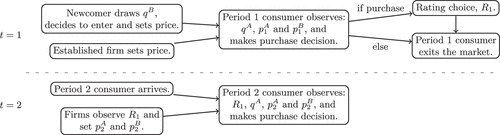
In each period , firm sets price to maximize lifetime profit , where denotes demand in period t. We assume zero marginal cost for both firms regardless of quality.2 After a sale in period 1, the seller may receive a consumer rating . This rating becomes common knowledge in all subsequent periods.
3.2. Consumers
Each consumer participates in exactly one period, and a new consumer arrives in each period. In period t, consumers observe current prices, past ratings, and , but not the newcomer’s quality nor the price paid by previous buyers. They choose whether to buy; if they purchase, they observe realized quality and then decide whether to leave a rating.
Consumers choose if and how to rate, that is, . The informational content of a rating is determined in equilibrium, but we say a rating is positive if and negative if , and when , consumers choose not to rate. Without loss of generality, a newcomer starts with no prior rating. For brevity, we sometimes drop the subscript and write R for .
Throughout, we focus on ratings for the newcomer. Because the established firm’s quality is common knowledge, ratings do not affect beliefs about it. This captures evidence that an additional positive rating boosts sales for newcomers with few ratings but has little effect on established firms’ sales (Livingston 2005, Resnick et al. 2006, Luca and Zervas 2016, Hollenbeck 2018, Dendorfer and Seibel 2024, Hui et al. 2024).
We distinguish consumption utility from rating utility for two reasons. First, this captures evidence that consumers do not incorporate the intention to rate into their purchase decision.3 Second, it simplifies the presentation of results. Consumption utility from buying from firm j in period is , and we normalize the utility of the outside option to zero.
Rating utility captures consumers’ incentives to rate. In period t,
We provide two foundations for this mechanism. First, the rating utility is a parsimonious reduced form of intrinsic reciprocity (Rabin 1993, Dufwenberg and Kirchsteiger 2004): consumers reciprocate sufficiently high (low) value-for-money with a positive (negative) rating. Second, ratings can reflect self-expression: consumers rate when they feel good or bad about a purchase, and firms can induce these feelings through the value-for-money they offer.
Figure 1 summarizes the timing of the game.
3.3. Equilibrium and Restrictions
To simplify exposition, we restrict attention to , so newcomers do not sell absent a rating system.4
We study perfect Bayesian equilibria and impose the following restrictions. We impose selection assumptions to rule out equilibria sustained by pessimistic off-path beliefs that deter entry.
(
This rules out no-entry equilibria sustained by pessimistic off-path beliefs, for example, that any entrant has quality , and therefore would not attract demand. Because our focus is entry and competition, we select a no-entry equilibrium only when no equilibrium with entry exists. Relaxing this assumption can only reduce entry, so any conclusions that high-quality newcomers do not enter enough are strengthened if the assumption is dropped.
The next selection assumption rules out equilibria where firms are not competing in the spirit of Bertrand competition with vertical differentiation.
(
(a) If entry occurs, consumers are indifferent between the newcomer and the established firm, and they purchase from the firm that earns strictly larger marginal profits from that sale.
(b) If entry occurs, offers with zero demand are optimal also if a negligible share of indifferent consumers would purchase them.
This assumption selects equilibria with effective postentry competition. Part (a) ensures firms can undercut a rival’s prices when profitable. In particular, it excludes equilibria in which pessimistic off-path beliefs prevent newcomers from profitably undercutting the incumbent.5 Similarly, it excludes equilibria in which consumers strictly prefer the newcomer, but the newcomer does not raise its price because pessimistic off-path beliefs would destroy demand at higher prices.6 Part (b) rules out noncredible offers by firms with zero demand, that is, offers that would strictly reduce profits if even a negligible mass of indifferent consumers accepted them.
The next restriction also ensures effective Bertrand competition with vertical differentiation. We assume the probability density function (p.d.f.) of the rating effort distribution F is sufficiently flat.7 This ensures that firms that sell choose the highest price that still wins demand. Otherwise, the period 1 consumer could strictly prefer the newcomer at the equilibrium price, meaning that firms would not be competing.
3.4. Discussion of Modeling Assumptions
Our model applies to platforms such as Airbnb, Amazon, Taobao, eBay, Yelp, and Google Reviews, where consumers heavily rely on ratings to form expectations about product quality.
First, our rating utility captures growing evidence that ratings are driven by value-for-money rather than quality alone. The effect can be substantial: in digital camera markets, a 1% price increase reduces ratings by 0.36 stars (on a 5-star scale) and by 0.71 stars (on a 10-star scale) (Li and Hitt 2010). On Airbnb, higher prices reduce ratings (Gutt and Kundisch 2016, Neumann et al. 2018); on Yelp, a 1% price increase lowers average ratings by 3%–5% (Luca and Reshef 2021); and in hotels, a 1% price increase reduces ratings by roughly one star (on a 10-star scale) (Abrate et al. 2021). Because these studies control for product quality, they suggest that value-for-money—not quality alone—is a key driver of consumer ratings.
Second, ratings are coarse: because consumers rarely observe the exact price paid by the rater, consumers typically cannot infer whether a high rating reflects high quality or a low past price.8
Third, our two-period entry model captures, in reduced form, why ratings are especially important—and arguably less informative—for newcomers. Reimers and Waldfogel (2021) find that book ratings affect consumer surplus about 10 times more than New York Times reviews, largely because many genres and titles have few reviews, so even a small number of ratings can influence demand. Ratings are therefore central to early reputation building. Consistent with this, the marginal effect of a positive rating on sales is large for the first 20–30 reviews but diminishes thereafter (Dendorfer and Seibel 2024, Hui et al. 2024). Even if ratings eventually reveal quality, this creates an early-stage asymmetry: entrants with few or no reviews face an uphill battle against established sellers. Our model targets this critical phase in which newcomers struggle to build a reputation.
Finally, online job platforms such as Freelancer.com and Upwork provide another natural application for our framework. Workers compete directly for jobs, public reputation systems shape hiring and visibility, and entrants face a cold-start problem relative to established workers.9 A growing literature shows that reputation affects hiring and pricing in online freelance markets (Yoganarasimhan 2013, Moreno and Terwiesch 2014, Lin et al. 2018), and that early public feedback improves workers’ later employment outcomes (Pallais 2014).
4. Equilibrium
We now characterize equilibrium and summarize the main results in three steps. First, we introduce notation and impose parameter restrictions to focus on the equilibrium of interest. Second, we characterize equilibrium conditional on entry by both newcomer types. Third, we present the main results, including the newcomer’s entry decision.
We now introduce notation. The key driver of our mechanism is the low-quality newcomer’s period 1 pricing: in equilibrium it chooses one of two prices. Let denote the equilibrium probability that a low-quality newcomer mimics the high price charged by high-quality newcomers. With probability it sets a lower “harvesting” price to increase value-for-money and hence the likelihood of a positive rating.
Equilibrium is unique up to off-path beliefs. To simplify the exposition, we impose two conditions on parameters to focus on the equilibrium of interest. Both require that a positive rating is sufficiently valuable, which holds for large enough . Online Appendix A characterizes equilibrium when they do not hold.
First, we focus on parameter regions where the low-quality newcomer mixes, that is, . Otherwise, it mimics with probability one. But when reputation is sufficiently valuable (“large” ), the low type also harvests ratings, yielding the mixed-strategy equilibrium.10
Second, we focus on the “silence is bad news” region: empirically, newcomers with no reviews struggle to attract demand (Resnick et al. 2006, Dellarocas and Wood 2008, Cabral and Hortaçsu 2010, Bolton et al. 2013, Nosko and Tadelis 2015, Luca and Zervas 2016, Tadelis 2016, Hollenbeck 2018, Dendorfer and Seibel 2024, Hui et al. 2024). Accordingly, we impose a sufficient condition under which a newcomer who receives no rating in period 1 does not attract demand in period 2.11 This condition holds for sufficiently large : high-quality entrants receive positive ratings so often that “no rating” carries too little reputation to induce a sale.
We now characterize equilibrium. First, we show how ratings shape beliefs and period 2 competition: conditional on entry, a positive rating creates a reputation premium that lets the newcomer win the period 2 market, whereas a nonpositive rating does not. Second, we characterize period 1 pricing.
4.1. Period 2: Reputation Premium
Suppose both types of newcomer enter. The following lemma characterizes period 2 competition.
There exists an equilibrium that is unique up to off-path beliefs. Suppose both types of newcomer enter. Then in period 2:
Ratings build reputation: .
Ratings are valuable: . Firm A sells in period 2 if and only if .12
Good ratings help newcomers build reputation and earn higher profits in period 2, because high-quality entrants deliver better value-for-money and therefore receive good ratings more often. The intuition has two steps. First, Bertrand-type competition implies that in period 1, customers of the newcomer must ex ante expect the same utility from the newcomer as from the incumbent who prices at marginal cost, that is, a utility of . Second, in period 1 the low-quality newcomer mimics the high price , so both types of newcomer charge with strictly positive probability. But because , high-quality newcomers deliver higher ex post utility and thus obtain better ratings (). Consumers therefore infer that positive ratings signal quality, enabling positively rated newcomers to earn higher profits in period 2. Moreover, under our “silence is bad news” condition, a positive rating is required for the newcomer to sell in period 2.
4.2. Period 1: Price Mimicking vs. Rating Harvesting
Lemma 1 implies that the newcomer’s continuation value hinges on obtaining a positive rating, so period 1 pricing trades off current profits against the probability of generating . The next lemma characterizes period 1 pricing.
Suppose both types of newcomer enter. There exists a unique , such that in period 1:
Firm Asets and gets no demand. Firm hsets and gets .
Firm l randomizes over prices:
(a) It charges with probability and receives .
(b) It charges with probability and receives .
If a newcomer enters, it must sell in period 1; otherwise, it cannot obtain a positive rating and, by Lemma 1, will not sell in period 2 either. Hence, conditional on entry, Bertrand competition drives the incumbent to price at cost and make no sale in period 1.
Entrants choose between two pricing strategies. The high-quality entrant always charges the high price , that is, the highest price at which consumers weakly prefer the entrant to the incumbent. If types were observable, this price would equal the entrant’s quality advantage . However, because the low type can mimic by charging the same price, consumers anticipate pooling with positive probability, which lowers . The low price instead makes even a low-quality entrant attractive when consumers correctly expect quality : it incurs a loss in period 1 but raises the chance of a positive rating and thus increases period 2 profits.
This sets up the key trade-off faced by low-quality newcomers in period 1:
Price Mimicking: Charging the high price to imitate high-quality firms. However, because this yields lower value-for-money, the firm obtains worse ratings and thus earns lower profits in the next period (Lemma 2, Point 2a).
Rating Harvesting: Charging the low price to induce a positive rating. A good rating allows the firm to free-ride on the reputation of high-quality entrants and charge a higher price in period 2 (Lemma 2, Point 2b).
The probability that a low-quality firm chooses price mimicking over rating harvesting—denoted —captures how firms resolve this trade-off in equilibrium. Why do low-quality firms mix prices? Intuitively, they harvest ratings to free-ride on the reputation of high-quality entrants. For this to be profitable, reputation must be sufficiently valuable, which is the case we focus on here in the main text. However, as more low-quality firms engage in rating harvesting, the equilibrium beliefs associated with a positive rating deteriorate. This weakens the incentive to harvest, until firms are indifferent between harvesting and mimicking—hence the emergence of a mixed strategy.
The fact that low-quality newcomers may charge a negative price is only an artifact of normalizing marginal cost and to zero. In general, the results do not predict negative prices, but negative margins to build reputation.
For tractability, we assume that consumers have homogeneous preferences, which leads to fierce competition. With (vertically or horizontally) differentiated preferences, competition would be less intense in period 1. This could also induce sales of incumbents in period 1 despite entry.
4.3. Pricing, Informative Ratings, and Entry
Our equilibrium illustrates the two-way relationship of prices and ratings highlighted in the introduction: lower prices allow firms to build a reputation, enabling them to charge higher prices in the future. In equilibrium, all firms that receive a good rating raise their prices in period 2.
We begin with baseline comparative statics of . First, : higher quality leads to more harvesting. Intuitively, an increase in raises both the value of price mimicking and of harvesting, but the latter effect is stronger. Higher quality increases and the value of a good rating directly, but it also induces high-quality entrants to offer greater value-for-money (), further increasing the returns to a good rating. As a result, harvesting becomes relatively more attractive, and low-quality entrants engage in it more. Second, the effect of on is ambiguous. Although a higher increases the likelihood of a high-quality entrant, it also reduces the value-for-money they offer (), making the net effect on harvesting unclear.
In the remainder of the paper, we often study how outcomes vary with . Although is endogenously determined in equilibrium, we analyze its variation directly as a shortcut. The reason is that primitives such as and affect outcomes of interest not only through , but, as the above comparative statics show, also directly (i.e., consumer expectations or the probability to get a rating), so their comparative statics do not isolate the effect of informativeness on these outcomes of interest. In principle, one could introduce additional primitives that shift first-period profits—and hence —without directly affecting other objects of interest. For brevity, we instead vary directly.13
4.3.1. Pricing and Informativeness of Ratings.
The equilibrium links firms’ pricing strategies with the informativeness of ratings. Specifically, for larger , low-quality firms more frequently mimic high-quality newcomers’ pricing, making them less likely to receive positive ratings. After consumers adjust their expectations, ratings become more indicative of quality. Thus, changes in the firms’ pricing strategy affect how much information ratings convey. This yields a key insight: rating harvesting reduces the informativeness of ratings. The proposition formalizes this:
Suppose both types of newcomer enter. If increases, then increases strictly.
This result implies that rating harvesting leads to rating inflation—the phenomenon where most ratings cluster at the top of the scale, for example, five out of five stars (Nosko and Tadelis 2015, Zervas et al. 2021, Filippas and Horton 2022, Filippas et al. 2022). A central concern with rating inflation is that it weakens ratings’ ability to distinguish quality. Our model reinforces this concern: rating harvesting increases the number of positive ratings, thereby diluting their informational content.14
4.3.2. Entry and the Cold-Start Problem.
Entry and exit are major features of online platforms. On Airbnb, for instance, Dendorfer and Seibel (2024) report monthly entry and exit rates of hosts of 3%–4%. Farronato and Fradkin (2022) find substantial supply elasticities in this market, suggesting entry responds to changing market conditions. Amazon also experiences significant seller turnover.15
To understand implications of rating harvesting on entry, we now characterize the entry decision of newcomers.
There exists a unique such that both types of newcomers enter if and only if . Otherwise, neither enters.
Proposition 2 provides new insight into how ratings influence entry decisions. Rating harvesting discourages entry: newcomers enter if and only if there is not too much harvesting, that is, if . In other words, newcomers enter if and only if positive ratings are sufficiently informative to induce future sales. Clearly, if they enter, they must get positive ratings sometimes. Otherwise, if they do not sell with a positive rating in period 2—that is, the best reputation they could have—they will also not sell with any lower reputation. But then they never sell and do not enter. In turn, if newcomers get positive ratings, they must enter. In the above mixed-strategy equilibrium this is immediate, as newcomers sell at weakly positive prices with strictly positive probability in each period. Thus, informative ratings foster entry and help high-quality newcomers gain traction.
Empirical evidence supports this mechanism. Luca (2016) and Hollenbeck (2018) show that Yelp ratings spur entry by small, independent restaurants, intensifying competition for large chains. Similarly, Leyden (2025) shows that when Apple stopped resetting average App Store ratings after product updates, developers released more upgrades—suggesting that more informative ratings encouraged participation.
Our analysis reveals that it is difficult to deter entry only of low-quality sellers. That is, there is no equilibrium in which only high-quality firms enter. If that were the case, consumers would expect high quality from all newcomers, encouraging low-quality firms to enter and exploit those expectations.16 Free-riding is thus a robust feature of equilibrium.
These results are closely related to the cold-start problem on product platforms (Li et al. 2020, Dendorfer and Seibel 2024) and online job platforms (Pallais 2014), in which newcomers struggle to build reputation—even when they offer higher quality than incumbents.
A key takeaway is that rating harvesting exacerbates the cold-start problem in two ways. First, when , a good rating is no longer a strong-enough signal of quality to induce sales in period 2. Consumers prefer to buy from incumbents, and high-quality newcomers are discouraged from entering. Second, even when entry occurs, increased rating harvesting lowers the value of a good rating, reducing period 2 profits for high-quality firms (by Proposition 1).
Platforms are acutely aware of the cold-start problem and often encourage sellers to offer steep discounts to build a reputation. Airbnb, for example, recommends that new hosts offer a 20% discount to their first guests (Dendorfer and Seibel 2024). Amazon permits sellers to offer discounted products in exchange for ratings and reviews.17 Our model suggests that low-quality entrants are especially likely to pursue this strategy—further undermining the informativeness of ratings.
Instead, our findings suggest that platforms should discourage rating harvesting if they aim to promote entry. Although this will not fully prevent low-quality entry, it ensures that such firms are sorted out more quickly. In the next section, we discuss how platform design can reduce rating harvesting and improve the informativeness of ratings.
5. Designing Ratings Environments
In this section, we examine how the rating environment influences the informativeness of ratings. We identify two strategies to discourage rating harvesting: (i) linking ratings to the prices raters paid, and (ii) increasing the cost of leaving a rating.
5.1. Linking Ratings with Paid Prices
Although platforms typically provide easy access to past ratings, they do not connect these ratings to the prices that raters actually paid.18 We show that this is a key driver of rating harvesting: consumers cannot tell whether a rating reflects high product quality or simply a low purchase price. If consumers in period 2 knew what raters paid, they could distinguish genuine high-quality firms from those using steep discounts to harvest ratings. This would eliminate the incentive to harvest ratings. In equilibrium, low-quality firms would then mimic high-quality pricing with probability one, and ratings would become more informative.
5.2. Facilitating Ratings
Platforms can encourage ratings by adjusting the effort required to leave them. Verification steps, multidimensional evaluations, rewards or rebates, and reminders all affect the cognitive and time costs associated with rating. These design choices directly influence the “cost of rating,” which we model via the upper bound of the effort cost distribution. Changes in induce first-order stochastic dominant shifts in the cost distribution.
At first glance, making ratings easier seems desirable. Holding firm behavior fixed, lower rating effort costs yield more ratings. However, this intuition is misleading, as it ignores how firms adjust their pricing in response.
In our setting, lower rating costs induce more ratings but reduce their informativeness. When falls, the rating utility increases, leading to more positive ratings. Anticipating this, low-quality firms find it more attractive to harvest ratings, increasing the likelihood of rating harvesting in equilibrium. As a result, positive ratings become more likely to stem from low-quality firms, making ratings less informative about quality. The proposition formalizes this relationship:
If , then .
The key takeaway is that—conditional on entry—lowering increases the number of ratings but reduces their informativeness.
Empirical evidence supports this mechanism. Cabral and Li (2015) use shipping speed as a proxy for quality and show that offering rebates for ratings reduces negative reviews especially for low-quality products. Because rebates lower the cost of leaving a rating, their findings are consistent with our model: reducing rating costs can make ratings less informative.
We use this result to explore how rating effort costs affect entry.
There exists a constant such that newcomers enter if and only if .
Encouraging consumers to rate, via lower rating effort costs, discourages entry. Encouraging consumers to rate encourages rating harvesting (Proposition 3), which makes ratings less informative (Proposition 1). But if ratings are less informative, newcomers with positive ratings may no longer sell, so they will no longer enter (by Proposition 2).
These insights cast a new light on platform efforts to encourage ratings. Many platforms have worked to encourage ratings over time. Yelp and Google offer perks such as invitations to exclusive events or discounts to active raters.19 Google also prompts users to leave quick feedback, allowing for one-tap reviews. Amazon similarly simplified its rating system: prior to 2020, users had to write a review alongside their rating; now, one-click ratings are allowed. They justified the shift by claiming that it would increase the accuracy of ratings through higher volume.20
However, our results suggest that these changes may have unintended consequences. First, although these measures increase rating volume, they also encourage rating harvesting, leading to a greater number of ratings that are less informative. Second, less-informative ratings make it harder for newcomers to sell after a positive rating, discouraging entry. Ultimately, both effects weaken the ability of high-quality newcomers to build a reputation and exacerbate the cold-start problem.
Rather than simply increasing the quantity of ratings, platforms may want to consider how to preserve or enhance their informational value. One way to do this is by increasing the cost of leaving a rating (raising ), which discourages rating harvesting. Although this would reduce the overall number of ratings, it would increase their informativeness and encourage entry.
5.3. Comparing Policies
Raising the cost of leaving a rating induces fewer ratings, but also discourages rating harvesting. This may not discourage entry of low-quality sellers, but it helps to weed them out more quickly. However, the effect on high-quality sellers is ambiguous: more informative ratings increase their profits after a good rating, but larger rating costs lower the probability they get one (we show this formally in the next section). Instead, linking ratings to the prices raters paid does not directly harm high-quality newcomers and might therefore fight the cold-start problem more effectively.
6. Surplus Analysis
We now study how rating harvesting shapes surplus. We proceed in two steps. First, we vary rating informativeness (the intensive margin). Second, we vary rating effort costs, which changes both informativeness and the likelihood of leaving a review (the extensive margin).
6.1. More Informative Ratings
Recall that a higher means less rating harvesting and thus more informative ratings. Varying therefore captures changes along the intensive margin of the rating system.
The comparative statics reflect two forces. Without entry (), the incumbent is a monopolist. With entry (), competition increases consumer surplus relative to monopoly. However, conditional on entry, more informative ratings better differentiate products: positively rated entrants are more clearly identified as high quality and can charge more. In turn, entrants with nonpositive ratings are perceived as worse competitors, allowing the incumbent who faces such an entrant to raise prices. This relaxes competition and reduces consumer surplus.
Let , , and denote expected total profits of the average newcomer, the high-quality newcomer, and the low-quality newcomer, respectively. denotes the incumbent’s profits, and CS the expected consumer surplus, which we equate with consumption utility.21
If , then , , and . If , then , , and ; conditional on entry, , , and .
Corollary 2 summarizes the trade-off: sufficiently informative ratings induce entry and competition, but overly informative ratings (high ) soften postentry competition by increasing effective differentiation. Thus, consumers prefer somewhat, but never fully, informative ratings.
In line with this mechanism, evidence suggests that less precise quality signals intensify competition. Gandhi et al. (2024) show that when firms are exposed to more fake reviews of their rivals—which makes them less informative—firms that do not purchase fake reviews lower their prices.
6.2. Rating Costs
We study how increasing the rating effort cost affects equilibrium outcomes. A higher increases and thus makes ratings more informative (intensive margin), but it also reduces the frequency of reviews (extensive margin). Because these forces work in opposite directions, the effect of on incumbents, high-quality entrants, average entrant profits, and consumer surplus is generally ambiguous. The exception is low-quality entrants, who are hurt by both fewer reviews and greater informativeness.
Suppose . Then , and an increase in can increase or decrease , , , and CS.
The same trade-off shapes consumer surplus: more reviews improve matches, whereas more informative reviews soften postentry competition. Despite these ambiguous effects, consumer-optimal rating costs must be high enough to induce entry.
Consumer-optimal rating effort satisfies .
The corollary suggests that a marketplace that wants to attract consumers should ensure that ratings encourage entry. More broadly, by encouraging or discouraging ratings, marketplaces affect not only the information content of ratings, but also how surplus is split between buyers, incumbents, and entrants.
7. Extensions and Robustness
7.1. Negative Ratings
If our “silence is bad news” condition is violated, low-quality newcomers also sell in period 2 after no rating. First, newcomers always enter: low-quality newcomers sell in period 2 with strictly positive probability, making entry profitable. Second, also here, lower rating effort costs induce more rating harvesting. Details are in Online Appendix B.
More generally, our results extend to rating systems with even more messages like five-star ratings. Intuitively, in our framework, the value of ratings is determined endogenously in equilibrium. Thus, also with more complex rating systems, there exist equilibria where one rating has the same informational content as our good rating, other ratings have the same informational content as our bad rating, and the others are uninformative or not used in equilibrium. This equilibrium is plausible because it reflects the common finding that ratings are strongly bimodal and raters leave either five stars or one star (Dellarocas and Wood 2008, Hu et al. 2009, Nosko and Tadelis 2015, Filippas and Horton 2022, Filippas et al. 2022).
7.2. Longer-Horizon Model
Our model focuses on the short-run challenge of newcomers to establish a reputation, and its effects on entry. In this extension we indicate how our results extend to longer postentry time horizons by studying a three-period model. In this model, newcomers who enter in period 1 can also choose to exit in period 2. First, we establish equilibria that are similar to our main model. In particular, there are equilibria where newcomers enter (and do not exit in period 2) if and only if low-quality newcomers do not harvest too much. In equilibrium, low-quality firms play mixed strategies as in our main model’s period 1 in every nonterminal period. Thus, harvesting is not just driven by endgame effects: low prices in period 1 pay off already in period 2, because low-quality newcomers with a good rating charge a large price with positive probability. Second, low-quality firms who enter get a positive rating in every nonterminal period with strictly positive probability. Intuitively, if they only received a good rating in period 1, but not in period 2, then the value of reputation would skyrocket in period 3, but that induces strong incentives to also receive a good rating in period 2. Third, a lower rating effort encourages rating harvesting in periods 1 and 2. Thus, low-quality firms that harvest more ratings may also stay longer in the market. This suggests another dimension through which rating harvesting reinforces the cold-start problem: low-quality firms that harvest ratings stay longer, making it harder for high-quality newcomers to establish a reputation. Details are in Online Appendix B.
8. Implications for Platform Management
Our results carry important implications for the design and management of platform rating systems, summarized as follows:
First, as discussed, many major platforms have made concerted efforts to increase consumer participation in ratings. However, we show that overly incentivizing ratings can be counterproductive. When rating becomes too easy, low-quality firms are more likely to harvest ratings, reducing the informativeness of ratings. Eventually, this also discourages entry and reinforces dominant positions of established firms. Both effects exacerbate the cold-start problem. Thus, encouraging entry and maintaining an informative rating system may require not encouraging ratings too much.
Second, the ideal solution to eliminate the cold-start problem is preventing entry of low-quality sellers. Our results highlight the difficulty of doing so in practice. Free-riding is a robust feature of equilibrium: if only high-quality firms enter, reputation skyrockets, which encourages free-riding. Similarly, encouraging newcomers to offer steep discounts in order to build reputation can inadvertently promote rating harvesting. A more effective approach is to discourage harvesting—even if this does not prevent entry of low-quality entrants, it helps weed them out quicker. This can be done by increasing the relative profitability of price mimicking—for example, by making ratings more costly, by tying ratings to the price paid, or by implementing penalties that target deteriorating ratings.
Third, although platforms typically provide easy access to past ratings, they rarely link them to the prices paid by raters. This disconnect enables rating harvesting: consumers cannot distinguish whether a high rating reflects genuine product quality or simply a low price. Platforms seeking to discourage harvesting could design rating systems that better account for the price raters paid. One current practice that may be effective in doing so is asking consumers to specifically rate “value-for-money” in addition to an overall rating.22 Alternatively, a more direct intervention by platforms would be to assign lower weights to ratings from buyers who paid lower prices. Such policies could make ratings more reflective of true quality, which could help high-quality sellers build reputation and alleviate the cold-start problem. A key advantage is that it discourages harvesting without directly discouraging ratings for high-quality newcomers. However, these adjustments must be implemented carefully, as they may also reduce sellers’ incentives to lower prices. For example, one may apply such adjustments only to sellers with few ratings, where the risk of harvesting is most acute.
Fourth, even though more informative ratings stimulate entry, they differentiate products and relax competition. Conditional on entry, more informative ratings enhance surplus extraction particularly for established firms, because consumers’ outside option—purchasing from a newcomer with nonpositive ratings—becomes less attractive.
Fifth, our results offer a broader insight for two-sided platforms: rating systems can be used to shift surplus between buyers and sellers. In our model, consumers may prefer more informative ratings than established sellers, primarily because these ratings facilitate entry and intensify competition. As such, platforms can influence the distribution of surplus—and ultimately platform participation—by shaping the informativeness of their rating systems.
9. Conclusion
We study how firms use prices to influence their own ratings. We highlight a qualitatively novel trade-off between rating harvesting and price mimicking, which connects closely to empirical evidence on the dynamic interplay between prices and ratings. We identify the drivers of rating harvesting and show that it can lead to less-informative ratings. We also examine implications for entry and the cold-start problem, as well as for buyer and seller surplus.
In practice, consumers may also read product reviews to form expectations about quality. In principle, such reviews could help consumers disentangle the effects of quality and price on observed ratings. However, we argue that reviews are unlikely to fully resolve this ambiguity. First, even diligent consumers read only a small, selective sample of reviews. Second, even when reviews mention value-for-money or price-quality ratio, they rarely state the exact price paid—making it impossible to assess whether the value was good relative to that price. Third, empirical evidence supports the disproportionate influence of ratings relative to reviews: Liu and Reimers (2025) estimate that, on Airbnb, ratings alone increase consumer surplus four times as much as reviews alone.
Our model focuses on consumers who rate based on the value-for-money they receive. Consumers may also rate for other reasons—for example, to help others by signaling product quality or out of an intrinsic motivation to report the truth. Importantly, such motivations would lead consumers to rate based on quality alone, especially as prices fluctuate over time. Still, as long as a subset of consumers rates based on value-for-money, we would expect price dynamics consistent with rating harvesting. Our results are therefore robust to a range of consumer motivations, provided value-for-money-sensitive raters remain active.
In practice, another factor that undermines the informativeness of ratings is the presence of fake reviews (He et al. 2022). If low-quality firms are more likely to acquire fake reviews, this also reduces the ability of review systems to signal true quality. In contrast, in our setting, firms use pricing strategies—rather than overt manipulation—to boost their ratings. This distinction is crucial: whereas fake reviews distort consumer beliefs about reviews, rating harvesting directly affects prices of raters, which has a range of implications we study above.
The authors thank Yair Antler, Paul Belleflamme, Maren Hahnen, Paul Heidhues, Botond Kőszegi, Xavier Lambin, François Maniquet, Simon Martin, Martin Peitz, Andrew Rhodes, Robert Somogyi, Clément Staner, Nikhil Vellodi, Julian Wright, and many seminar participants for helpful comments. This paper was previously titled “Ratings and Reciprocity.”
1 Quote from Rey (2020). Prior to 2020, Amazon required at least 20 written words per review; see Amazon Customer (2012) and crebel (2017).
2 We assume zero marginal cost to focus on information transmission via ratings. With sufficiently different marginal costs, cost-based signaling may arise as in Bagwell and Riordan (1991).
3 Cabral and Li (2015) find that incentivizing consumers to rate does not change their willingness to pay.
4 Without this assumption, newcomers may always enter in equilibrium.
5 In such equilibria, consumers may buy from both the incumbent and the newcomer with positive probability, even though only the newcomer earns profits. In competitive markets à la Bertrand, this cannot occur, as the profitable firm would undercut its rival. Here, however, such outcomes can be sustained by beliefs that any lower off-path price is set by newcomer L.
6 Because, in such equilibria, consumers strictly prefer the newcomer over the incumbent, they are also not in the spirit of Bertrand competition with vertical differentiation, where such price increases would occur.
7 A sufficient condition is for all x, where denotes period 2 profit conditional on a positive rating. This condition holds if is sufficiently large. The weaker conditions used in the proofs are (1), (2), and (3) (see the Online Appendix).
8 Raters may comment on price (e.g., “good product for that price”), but rarely report the exact amount paid. Consumers may consult external databases for historical prices, yet it is difficult to map those to the specific prices past raters paid.
9 For current platform documentation, see Freelancer.com’s pages on ratings and Upwork’s documentation on Job Success Scores; these sources illustrate how reputation metrics are displayed and used on major platforms (Freelancer.com 2026, Upwork 2026).
10 The precise condition is Condition (6) in Online Appendix A, Proposition 4.
11 The precise condition is Condition (5) in Online Appendix A, Proposition 4. If the condition does not hold, a qualitatively similar equilibrium exists but the newcomer may also sell after ; we treat this case in Online Appendix A.
12 The exact expressions for these expectations and period 2 prices can be found in Online Appendix A, Lemma 11.
13 Examples include (i) an exogenous probability that dissatisfied consumers receive a refund, (ii) capital costs for charging negative prices, or (iii) a discount factor governing the relative weight of the two periods.
14 Note that our result also holds when we allow for a wider parameter range such that we can have pure-strategy equilibria with . Then induces the most informative ratings.
15 https://www.marketplacepulse.com/, accessed June 5, 2025, reports four million new sellers on Amazon from 2020 to 2024.
16 Indeed, even in the pure-strategy equilibrium, firm h enters if and only if firm l enters with strictly positive probability.
17 See https://sell.amazon.com/tools/vine, accessed June 5, 2025.
18 Amazon does not reveal historical prices in product listings, nor do they disclose the price a reviewer or rater paid. Third-party sites like https://camelcamelcamel.com/ and https://keepa.com/ track price histories, but they do not link prices to individual ratings, and thus cannot reveal whether price influenced a given rating.
19 See the Yelp Elite Squad and Google Local Guides programs, as described by Yelp (2022) and Donaker et al. (2019).
20 See reporting in Forbes (Masters 2021) and TechCrunch (Perez 2019).
21 Results are qualitatively robust if rating utility is included, provided it gets a lower weight than consumption utility such that consumer surplus increases in .
22 Using experiments and data from Yelp and Airbnb, Schneider et al. (2021), Chen et al. (2018), and Gutt and Kundisch (2016) show multidimensional ratings affect overall rating. Thus, separate value-for-money ratings could induce raters to focus more on quality in their overall rating.
References
- (2021) The relationship between price paid and hotel review ratings: Expectancy-disconfirmation or placebo effect? Tourism Management 85:1–10. Crossref, Google Scholar
- (2023) Reputational underpricing. Preprint, submitted February 12, https://doi.org/10.2139/ssrn.4380756.Google Scholar
Amazon Customer (2012) Reviews must contain at least 20 words. Accessed April 21, 2021, https://www.amazon.com/review/R22R8P0JT7GHWN.Google Scholar- (2006) Advertising content. Amer. Econom. Rev. 96(1):93–113.Crossref, Google Scholar
- (2022) Consumer information and the limits to competition. Amer. Econom. Rev. 112(2):534–577.Crossref, Google Scholar
- (1999) The market for evaluations. Amer. Econom. Rev. 89(3):564–584.Crossref, Google Scholar
- (1991) High and declining prices signal product quality. Amer. Econom. Rev. 81(1):224–239.Google Scholar
- (2008) Seller reputation. Foundations Trends Microeconomics 4(4):273–351.Crossref, Google Scholar
- (2024) A theory of recommendations. ECON Working Paper 448, University of Zurich, Zurich.Google Scholar
- (1997) Market diffusion with two-sided learning. RAND J. Econom. 28(4):773–795.Crossref, Google Scholar
- (2000) Experimentation in markets. Rev. Econom. Stud. 67(2):213–234.Crossref, Google Scholar
- (2013) Engineering trust: Reciprocity in the production of reputation information. Management Sci. 59(2):265–285.Link, Google Scholar
- (2004) How effective are electronic reputation mechanisms? An experimental investigation. Management Sci. 50(11):1587–1602.Link, Google Scholar
- (2000) Stretching firm and brand reputation. RAND J. Econom. 31(4):658–673.Crossref, Google Scholar
- (2010) The dynamics of seller reputation: Evidence from eBay. J. Indust. Econom. 58(1):54–78.Crossref, Google Scholar
- (2015) A dollar for your thoughts: Feedback-conditional rebates on eBay. Management Sci. 61(9):2052–2063.Link, Google Scholar
- (2023) Pricing for the stars: Dynamic pricing in the presence of rating systems. Management Sci. 70(3):1755–1772.Link, Google Scholar
- (2025) Value for money and selection: How pricing affects Airbnb ratings. IGIER Working Papers 684, Bocconi University, Milan.Google Scholar
- (2023) When do consumers talk? Cowles Foundation Discussion Papers 2714, Yale University, New Haven, CT.Google Scholar
- (2018) Recommender systems as mechanisms for social learning. Quart. J. Econom. 133(2):871–925.Crossref, Google Scholar
- (2018) The value of multidimensional rating systems: Evidence from a natural experiment and randomized experiments. Management Sci. 64(10):4629–4647.Link, Google Scholar
- (2010) Social comparisons and contributions to online communities: A field experiment on MovieLens. Amer. Econom. Rev. 100(4):1358–1398.Crossref, Google Scholar
- (2006) The effect of word of mouth on sales: Online book reviews. J. Marketing Res. 43(3):345–354.Crossref, Google Scholar
crebel (2017) Woohoo! The 20-word minimum review requirement is back. Accessed April 21, 2021, https://www.kboards.com/threads/woohoo-the-20-word-minimum-review-requirement-is-back.250908/.Google Scholar- (2008) The sound of silence in online feedback: Estimating trading risks in the presence of reporting bias. Management Sci. 54(3):460–476.Link, Google Scholar
- (2024) The cost of the cold-start problem on Airbnb. Working paper, University of Toronto, Toronto, Ontario.Google Scholar
- (2019) Designing better online review systems. Harvard Bus. Rev. Accessed June 29, 2021, https://hbr.org/2019/11/designing-better-online-review-systems.Google Scholar
- (2004) A theory of sequential reciprocity. Games Econom. Behav. 47(2):268–298.Crossref, Google Scholar
- (2022) The welfare effects of peer entry: The case of Airbnb and the accommodation industry. Amer. Econom. Rev. 112(6):1782–1817.Crossref, Google Scholar
- (2022) Altruism can ruin reputation systems. Working paper, Fordham University, New York.Google Scholar
- (2022) Reputation inflation. Marketing Sci. 41(4):733–745.Link, Google Scholar
- (2021) Reciprocity and unveiling in two-sided reputation systems: Evidence from an experiment on Airbnb. Marketing Sci. 40(6):1013–1029.Link, Google Scholar
Freelancer.com (2026) Freelancer ratings. Accessed April 15, 2026, https://www.freelancer.com/support/general/freelancer-ratings.Google Scholar- (2024) Misinformation and mistrust: The equilibrium effects of fake reviews on Amazon.com. NBER Working Paper No. 34161, National Bureau of Economic Research, Cambridge, MA.Google Scholar
- (2012) Online and offline demand and price elasticities: Evidence from the air travel industry. Inform. Systems Res. 23(1):164–181.Link, Google Scholar
- (2016) Money talks (even) in the sharing economy: Empirical evidence for price effects in online ratings as quality signals. Proc. 37th Internat. Conf. Inform. Systems (ICIS) (Association for Information Systems, Atlanta), 199–208.Google Scholar
- (2011) Why do intermediaries divert search? RAND J. Econom. 42(2):337–362.Crossref, Google Scholar
- (2019) Reciprocity through ratings: An experimental study of bias in evaluations. J. Behav. Experiment. Econom. 83:1–9.Google Scholar
- (2022) The market for fake reviews. Marketing Sci. 41(5):896–921.Link, Google Scholar
- (2022) Preferences, confusion and competition. Econom. J. 132(645):1852–1881.Google Scholar
- (2018) Online reputation mechanisms and the decreasing value of chain affiliation. J. Marketing Res. 55(5):636–654.Crossref, Google Scholar
- (1999) Managerial incentive problems: A dynamic perspective. Rev. Econom. Stud. 66(1):169–182.Crossref, Google Scholar
- (2002) Reputation and competition. Amer. Econom. Rev. 92(3):644–663.Crossref, Google Scholar
- (2009) Overcoming the j-shaped distribution of product reviews. Comm. ACM 52(10):144–147.Crossref, Google Scholar
- (2024) Learning from online ratings. CESifo Working Paper No. 11171, CESifo, Munich, Germany.Google Scholar
- (2006) Price, quality, and reputation: Evidence from an online field experiment. RAND J. Econom. 37(4):983–1005.Crossref, Google Scholar
- (2025) Distracted from comparison: Product design and advertisement with limited attention. LIDAM Discussion Paper CORE No. 2022/17, UCLouvain, Louvain, Belgium.Google Scholar
- (2024) Deceptive features on platforms. Econom. J. 134(662):2470–2493.Google Scholar
- (2014) New, like new, or very good? Reputation and credibility. Rev. Econom. Stud. 81(4):1543–1574.Crossref, Google Scholar
- (1984) Advertising as a signal. J. Political Econom. 92(3):427–450.Crossref, Google Scholar
- (2024) Memory and markets. Rev. Econom. Stud. 91(3):1775–1806.Crossref, Google Scholar
- (2014) Implementing the “wisdom of the crowd.” J. Political Econom. 122(5):988–1012.Crossref, Google Scholar
- (2024) Ratings with heterogeneous preferences. CRC TR 224 Discussion Paper No. 594, University of Bonn, Bonn, Germany, and University of Mannheim, Mannheim, Germany.Google Scholar
- (2025) Platform design and innovation incentives: Evidence from the product rating system on Apple’s App Store. Internat. J. Indust. Organ. 99:1–25.Crossref, Google Scholar
- (2010) Price effects in online product reviews: An analytical model and empirical analysis. MIS Quart. 34(4):809–831.Crossref, Google Scholar
- (2020) Buying reputation as a signal of quality: Evidence from an online marketplace. RAND J. Econom. 51(4):965–988.Crossref, Google Scholar
- (2018) Effectiveness of reputation in contracting for customized production: Evidence from online labor markets. Management Sci. 64(1):345–359.Link, Google Scholar
- (2025) The relative welfare impacts of text reviews and numerical ratings: Evidence from Airbnb. Working paper, Towson University, Towson, MD.Google Scholar
- (2005) How valuable is a good reputation? A sample selection model of internet auctions. Rev. Econom. Statist. 87(3):453–465.Crossref, Google Scholar
- (2016) Reviews, reputation, and revenue: The case of Yelp.com. Harvard Business School Working Papers 12-016, Harvard Business School, Boston.Google Scholar
- (2021) The effect of price on firm reputation. Management Sci. 67(7):4408–4419.Link, Google Scholar
- (2016) Fake it till you make it: Reputation, competition, and Yelp review fraud. Management Sci. 62(12):3412–3427.Link, Google Scholar
- (2021) Underpromise and overdeliver? - Online product reviews and firm pricing. Internat. J. Indust. Organ. 79:1–17.Crossref, Google Scholar
- (2021) A short history of Amazon’s product review ecosystem. Forbes. Accessed April 21, 2021, https://www.forbes.com/sites/kirimasters/2021/03/22/a-short-history-of-amazons-product-review-ecosystem/.Google Scholar
- (1986) Price and advertising signals of product quality. J. Political Econom. 94(4):796–821.Crossref, Google Scholar
- (2014) Doing business with strangers: Reputation in online service marketplaces. Inform. Systems Res. 25(4):865–886.Link, Google Scholar
- (1974) Advertising as information. J. Political Econom. 82(4):729–754.Crossref, Google Scholar
- (2018) A homeowner’s guide to Airbnb: Theory and empirical evidence for optimal pricing conditional on online ratings. Working Papers Dissertations 43, Paderborn University, Paderborn, Germany.Google Scholar
- (2025) Competition through recommendations. CRC TR 224 Discussion Paper No. 718, University of Bonn, Bonn, Germany, and University of Mannheim, Mannheim, Germany.Google Scholar
- (2015) The limits of reputation in platform markets: An empirical analysis and field experiment. NBER Working Paper No. 20830, National Bureau of Economic Research, Cambridge, MA.Google Scholar
- (2014) Inefficient hiring in entry-level labor markets. Amer. Econom. Rev. 104(11):3565–3599.Crossref, Google Scholar
- (2022) Inflated recommendations. Preprint, submitted April 1, https://doi.org/10.2139/ssrn.4121443.Google Scholar
- (2019) Amazon tests a one-tap review system for product feedback. TechCrunch. Accessed April 21, 2021, https://techcrunch.com/2019/09/13/amazon-tests-a-one-tapreview-system-for-product-feedback/.Google Scholar
- (1993) Incorporating fairness into game theory and economics. Amer. Econom. Rev. 83(5):1281–1302.Google Scholar
- (2020) Whose voice do we hear in the marketplace? Evidence from consumer complaining behavior. Marketing Sci. 39(1):168–187.Link, Google Scholar
- (2021) Digitization and pre-purchase information: The causal and welfare impacts of reviews and crowd ratings. Amer. Econom. Rev. 111(6):1944–1971.Crossref, Google Scholar
- (2006) The value of reputation on eBay: A controlled experiment. Experiment. Econom. 9(2):79–101.Crossref, Google Scholar
- (2020) Amazon can’t end fake reviews, but its new system might drown them out. Vox. Accessed April 21, https://www.vox.com/recode/2020/2/14/21121209/amazonfake-reviews-one-tap-star-ratings-seller-feedback.Google Scholar
- (2021) When the stars shine too bright: The influence of multidimensional ratings on online consumer ratings. Management Sci. 67(6):3871–3898.Link, Google Scholar
- (2021) Strategic pricing and ratings. CRC TR 224 Discussion Paper No. 303, University of Bonn, Bonn, Germany, and University of Mannheim, Mannheim, Germany.Google Scholar
- (1999) What’s in a name? Reputation as a tradeable asset. Amer. Econom. Rev. 89(3):548–563.Crossref, Google Scholar
- (2016) Reputation and feedback systems in online platform markets. Annual Rev. Econom. 8(1):321–340.Crossref, Google Scholar
Upwork (2026) Job success score. Accessed April 15, https://support.upwork.com/hc/enus/articles/211063558-Job-Success-Score.Google Scholar- (2018) Ratings design and barriers to entry. Preprint, submitted October 1, https://doi.org/10.2139/ssrn.3267061.Google Scholar
Yelp (2022) Yelp elite squad. Accessed July 12, 2022, https://www.yelp.com/elite.Google Scholar- (2013) The value of reputation in an online freelance marketplace. Marketing Sci. 32(6):860–891.Link, Google Scholar
- (2021) A first look at online reputation on Airbnb, where every stay is above average. Marketing Lett. 32(1):1–16.Crossref, Google Scholar

