


Decentralized Autonomous Organization Governance
Abstract
Decentralized autonomous organizations (DAOs) are entities without central leadership and operate based on a set of decision-making rules encoded into smart contracts using blockchain technology. In this study, we develop a theoretical model of DAO governance featuring strategic token trading under token-based voting to investigate potential conflicts of interest between a large participant (a “whale”) and many small participants. Our results show that ownership concentration has a negative effect on platform growth, but platform size, token illiquidity, and long-term incentives can mitigate this negative effect. We confirm these predictions using novel voting data on major DAOs from 2020 and 2024.
This paper has been accepted by Lin William Cong for the Virtual Special Issue on Digital Finance.
Funding: J. Han and J. Lee received financial support from the Institute of Management Research at Seoul National University.
Supplemental Material: The data files are available at https://doi.org/10.1287/mnsc.2024.07033.
1. Introduction
Blockchain technology has popularized decentralized autonomous organizations (DAOs) as a new kind of organizational structure that runs as “smart contracts” on the blockchain. DAOs have experienced rapid growth in recent years, with the number of DAOs increasing by 300% in 2022 alone (Pixelplex 2023). Unlike traditional corporations, which are governed by a board and a management team and rely on legal enforcement and centralized intermediaries, DAOs are entities without central leadership and are instead collectively owned and managed by their members through decision-making and economic rights provided by tokens (Han et al. 2025).1 In the traditional corporate governance paradigm, the key conflict is the principal-agent problem between dispersed shareholders and managers, and governance mechanisms such as boards, large blockholders, and activist investors are designed to mitigate this conflict. In contrast, DAOs generally rely on smart contracts and governance tokens instead of centralized managers, with many rules embedded directly in code. This structure introduces new governance challenges, particularly when ownership of governance tokens is highly concentrated, allowing a small number of large holders to capture control and impose their preferences on the system (Makarov and Schoar 2022).
We focus on the resulting conflict between large token holders, commonly referred to as “whales,” and dispersed small token holders, whom we call “users.” Whales are the DAO analogue of large blockholders in public corporations, but their power is exercised more directly through token-based voting on protocol-level decisions (e.g., fee schedules, reward allocations, and treasury management), and their positions can be rapidly adjusted through on-chain trading. This setting provides a useful laboratory for corporate governance: it isolates a horizontal conflict among investors (large versus small token holders) in the absence of a central manager and allows us to study how ownership concentration, token trading, and voting rules jointly shape value creation and expropriation in a pure, code-based governance environment. We show that these features generate new insights for the broader corporate governance literature about when large investors discipline or, instead, amplify governance risk and how trading frictions and lock-up policies can mitigate such risk.2
On the one hand, DAOs can offer benefits through increased transparency and democratic decision making. For example, Uniswap, a decentralized exchange (DEX), employs a two-step governance structure that involves off-chain discussions (“temperature checks”) before voting on proposals via the Ethereum blockchain to decide on new liquidity pools and fee structures. This bottom-up governance structure harnesses collective wisdom to allow the platform to evolve and grow. On the other hand, despite their potential benefits, there is also been evidence against the effectiveness of DAOs in practice. For example, there have been instances of governance failure on DEXs, notably “rug pulls,” where large holders (e.g., developers) make unfavorable changes to seek private benefits and subsequently dump tokens, harming minority token holders (Li et al. 2022). Notorious cases of such rug pulls include the YAM Finance and SushiSwap incidents. In the YAM Finance incident, the developers behind the project created a bug in the smart contract that caused the entire project to collapse, resulting in significant losses for investors. The SushiSwap incident involved the original developer of the project, known as “Chef Nomi,” abruptly leaving and selling all of their SUSHI tokens, causing the price to plummet and leading to investor losses.
These rug-pull incidents highlight an important but understudied issue in DAO governance: the conflict of interest between large token holders (whales) and small token holders (users). Whales can swing vote outcomes with their large holdings, whereas dispersed users cannot do so individually. Open-market trading of governance tokens with voting rights may therefore enable whales to accumulate sufficient voting power to manipulate votes, generating short-term private gains at the expense of minority token holders. This governance risk can impede platform growth and erode the platform’s intrinsic value, which we define as the discounted value of future service flows that the platform generates for users.3 Using a token-based voting framework, our paper studies the triangular relationship between the value of a DAO platform, its ownership concentration, and token trading. In the empirical analysis, we proxy changes in intrinsic value using the growth rate of the platform’s total value locked (TVL), the dollar value of assets deposited in the protocol, or the growth rate of its user base. Our paper is the first to investigate, both theoretically and empirically, the conflicts of interest between whales and small token holders in DAOs, their negative consequences for platform value and growth, and governance mechanisms that can mitigate these effects.
To formally study the aforementioned problem, we develop an equilibrium model of a DAO platform featuring token-based voting and dynamic token trading. Initially, one unit of tokens is issued upon the establishment of the platform, and voting rights are equally distributed across all token units (i.e., “one token, one vote”). The platform uses a token-based voting system to decide whether to implement a proposal based on the vote outcome.
The model features a continuum of small participants, referred to as users, and a large participant, referred to as the whale. The platform generates utility flows for participants based on their token ownership. If the incentives between users and the whale are misaligned, the whale may benefit privately from implementing a value-destroying proposal for users. The whale must acquire enough tokens to win the vote (e.g., half of the tokens under majority rule), despite users’ opposition to the proposal. Yet, acquiring tokens may incur significant costs due to price impact. The platform’s intrinsic value will be undermined if the whale’s self-serving proposal is expected to be implemented in equilibrium. Consequently, platforms with more severe governance problems will generate lower growth in value.
The whale faces a trade-off between its private benefit and the cost of implementing a value-destroying proposal. This cost arises from two sources: the loss in the platform’s intrinsic value caused by the whale’s own stake in the platform and the transaction costs incurred by acquiring tokens to pass the proposal. Given convex trading costs, it becomes more advantageous for the whale if it needs to acquire fewer tokens to influence the vote outcome. Therefore, ownership concentration can significantly lower the cost of acquiring voting rights, implying that platform growth should be negatively associated with ownership concentration (Prediction 1). In other words, the more concentrated the whale’s voting power is, the more likely it is to destroy the platform’s value.
We further examine how other key DAO characteristics shape the negative relation between whale ownership concentration and platform growth. Our second main result is that higher service value—the per-period value of services generated for users—attenuates this negative association (Prediction 2). Because the whale already holds a substantial stake in the platform, it is less willing to support value-destroying proposals that would reduce the platform’s intrinsic value and, in turn, its own payoff.
Our third finding is that higher token illiquidity mitigates DAO governance risk (Prediction 3). When tokens are illiquid, it is more expensive for the whale to acquire extra tokens to implement self-serving proposals. Therefore, illiquidity can shield users against the negative effects of bad governance. This insight aligns with the purpose of quadratic voting schemes, which discourage a single participant from achieving dominant voting power. Therefore, token illiquidity serves as a natural quadratic voting scheme that does not have disadvantages such as a Sybil attack under token-based voting schemes.4 However, the beneficial effect of illiquidity on governance wears off rapidly as ownership concentration increases.
This seemingly paradoxical result, where illiquidity can benefit the governance of a DAO, hinges on the fact that active monitoring of management is absent due to DAOs’ autonomous nature. As noted in our literature review, liquidity is known to have a beneficial effect on the governance of traditional corporations by facilitating active monitoring in the presence of principal-agent problems between management and shareholders (e.g., Bolton and Von Thadden 1998, Maug 1998, and Pagano and Röell 1998). The beneficial effect of token illiquidity on DAO governance aligns with important recent theoretical developments, notably Levit et al. (2024), who demonstrate that trading frictions can enhance shareholder welfare by preventing the shareholder base from becoming too extreme in a traditional corporate governance framework (see our literature section for further details).
In addition, our model suggests that if a whale also pursues a platform’s long-term growth, the platform may expand more swiftly and increase in value. Therefore, an alternative governance model that rewards the whale for making long-term commitments, such as one that imposes a lock-in period, can mitigate potential governance concerns in DAOs (Prediction 4). Imposing a lock-in period affects only whales (or other strategic traders) seeking to manipulate vote outcomes by making their exit more expensive. In this sense, a lock-in period can be understood as “targeted illiquidity” for whales, which does not generate the side effects of general illiquidity but has positive multiplier effects through user participation.
We further illustrate a feedback channel between governance and user participation. Increased user participation enhances the platform’s service value, thereby discouraging whales from implementing value-destroying proposals by reducing their incentives to do so. Conversely, enhanced governance induces more users to participate by improving the platform’s service value. This feedback mechanism results in multiple equilibria: one characterized by high participation, value, and good governance, and the other marked by low participation, value, and poor governance. However, we also demonstrate that extending lock-in periods can eliminate the equilibrium with lower user participation by enhancing governance through the channel of token illiquidity. Therefore, the concept of targeted illiquidity through lock-in periods not only serves to safeguard against malicious actors but also fosters genuine participation, ultimately strengthening the overall health of platforms.
We bring these predictions to the data, uncovering consistent evidence that largely supports our theory. We begin with the largest DAOs that sponsored proposals through Snapshot, a dominant off-chain voting platform, during the period running from July 20, 2020, through September 1, 2024. Our final sample includes 570 DAOs with price and volume data for their governance tokens, as well as information on TVL and user counts, which proxy for platform size. Importantly, we manually collect data on the various governance mechanisms used by these decentralized platforms, such as governance tokens and staking models, the latter of which include vote-escrow/locking strategies that reward investors with greater voting power and yields for locking their governance tokens. Our sample includes most major DAO platforms and is more comprehensive than those used in earlier studies. For example, Fritsch et al. (2024) feature only three platforms.
We perform weekly panel regressions to examine the relationship between platform growth and voting power concentration. Because proposals are typically not made every day, we convert the voting data to weekly series. If multiple proposals are sponsored in a given week, we use weekly averages of voting power concentration. Our main dependent variable is the weekly growth rate of TVL, and our independent variable of interest is the Herfindahl-Hirschman Index (HHI) of voting power for each DAO, which is lagged by one week. We control for DAO and time fixed effects, with standard errors clustered at the DAO level.
We find a negative and significant correlation between TVL growth and the HHI of voting power. A one-standard-deviation increase in HHI is associated with a 3.9-percentage-point decrease in weekly TVL growth. In addition, we find a convex relationship between platform growth and ownership concentration: growth is lowest when a whale holds an intermediate share of tokens—large enough to reduce the trading costs of influencing governance, but not large enough to fully internalize the resulting loss in the platform’s intrinsic value, making value-destroying actions most likely in this region. Our results are robust to using user-base growth as an alternative dependent variable or using predicted HHI based on airdrops as a shock to voting power distribution. These findings are consistent with our first theoretical prediction, which states that platform growth accelerates when voting power is more decentralized.
We further test and confirm our second prediction that the negative effect of the HHI of voting power on TVL growth is reduced when a platform has a larger user base and, hence, a higher network value. We also find that token illiquidity, proxied by the Amihud (2002) illiquidity measure, is positively correlated with platform growth, but the positive correlation weakens as ownership concentration increases (Prediction 3). A whale may accumulate significant voting power to pass a proposal that generates private benefits (e.g., a proposal that drains the funds of a liquidity pool), hurting other investors. Such actions are ex ante more costly when tokens are illiquid, prompting whales to align their incentives with minority token holders.
Finally, we test our last prediction by examining DAOs that have shifted from the one-token, one-vote model, which is used by most DAOs such as Lido and Uniswap, to a staking model. Pioneered by Curve Finance, a DEX launched in 2020, a growing number of protocols have adopted a staking model, which assigns vote weights and yields that are generally proportional to a lock-in period. That is, investors can lock their governance tokens to gain more voting power and enhance their investment yields. We find that DAOs using a staking model, including vote escrow, for token voting generate an average TVL growth rate that is about 5.6–7.2 percentage points higher than growth for DAOs without using a staking model. This is an economically significant effect, given that our sample DAOs, on average, generate a slightly negative weekly growth rate. We obtain larger effects, 8.4- to 9.0-percentage-point higher TVL growth rates for DAOs using a staking model, when using a matched sample of control DAOs based on major DAO characteristics.
1.1. Related Literature
Our study contributes to three strands of literature: DAO governance and token-based platforms; blockchain economics and digital governance; and the broader literature on corporate governance, shareholder voting, and blockholder control. To the best of our knowledge, we are the first to theoretically examine DAOs’ governance issues and derive equilibrium implications in a setting with token-based voting and dynamic token trading. Existing work on DAO voting primarily provides empirical descriptions of the distribution of votes (Appel and Grennan 2023a, b; Fritsch et al. 2024); a contemporaneous theory paper by Aoyagi and Ito (2022) is a notable exception, but it focuses on competition among DAOs rather than conflicts of interest among DAO investors, which we analyze in this paper. More recently, Fan et al. (2025) analyze the functioning of vote delegation in MakerDAO, and Cong et al. (2025) document governance centralization in DAOs—low participation, highly concentrated voting power, and abnormal (often insider) trading around governance proposals. We are also the first to provide empirical evidence linking decentralization to platform growth and token valuation, expanding the theoretical intuitions proposed by Cong et al. (2021) and Sockin and Xiong (2023b). Using novel voting data on DAOs, we show how minority token investors can endogenize their participation decision to avoid being harmed by whales, how costly token acquisition by whales can improve governance, and how alternative governance mechanisms such as staking and vote-escrow models can increase long-term incentives of whales and, in turn, platform growth. Overall, our study provides a comprehensive analysis of DAO governance issues and their potential solutions, both theoretically and empirically, thus filling an important gap in the literature.
Our work is broadly related to the literature on the wisdom of crowds, information cascades, and decentralization in cryptocurrency markets.5 Notable theoretical contributions to token-based platforms include Goldstein et al. (2024), Li and Mann (2025), Chod and Lyandres (2021), Gan et al. (2021), Lee and Parlour (2022), and Cong et al. (2022). A string of empirical studies in this area also contributes to our understanding of the issues at play during and after platforms’ fundraising (Howell et al. 2020, Bourveau et al. 2022, Lee et al. 2022, Lyandres et al. 2022, Davydiuk et al. 2023).6 Within this strand, our paper is the first to combine an equilibrium model of token-based voting with detailed DAO-level voting and TVL data to study how ownership concentration and token trading shape platform value and growth.
Our paper also contributes to the burgeoning literature on blockchain economics and its governance implications in the new digital era (Harvey 2014, Malinova and Park 2016, Yermack 2017, Cong and He 2019, Tsoukalas and Falk 2020, Saleh 2021, Makarov and Schoar 2022). Bena and Zhang (2022) analyze the trade-off between user adoption and technology advancement in the optimal design of a governance token. Ferreira et al. (2023) show that the proof-of-work system in a blockchain ecosystem allows large firms that produce equipment and manage mining pools to capture blockchain governance by leveraging their advantage in operating these pools to influence votes. Benhaim et al. (2023) find that committee-based consensus using approval voting converges to optimality quickly and has the potential to address issues raised by commonly employed mechanisms. Sockin and Xiong (2023b) show that tokenization through utility tokens can be a commitment device that prevents the owner of a platform from exploiting its users. Cong et al. (2025) find in proof-of-stake protocols that token concentration and staking-induced lockups can stabilize token prices, consistent with our findings on the mitigating role of lock-in. Our paper complements this strand of literature by studying DAO governance, which operates without a central authority to govern the organization, and by documenting how staking and lock-in mechanisms affect platform growth in practice.
Our theory also draws on key insights from the extensive literature on organizational economics, corporate governance, shareholder voting, and blockholder governance (e.g., Shleifer and Vishny 1986; Harris and Raviv 1989, 2008; Holmstrom and Tirole 1989; Burkart and Lee 2008). Specifically, our paper is related to the literature that examines the interplay between corporate control and the trading of ownership shares, as seen in works such as Maug (1998), Bolton and Von Thadden (1998), and Pagano and Röell (1998). Previous studies in this line of literature emphasize the monitoring role of large shareholders in correcting managerial failures.7 Our paper is closely related to the recent literature that studies the effect of pivotality on voting in connection with trading of voting rights (e.g., Posner and Weyl 2014 and Lalley and Weyl 2018). In particular, two recent papers, Levit et al. (2023, 2024), have made significant contributions to the literature on governance outcomes related to voting and trading in traditional corporate setups.8 Our paper complements this literature by studying governance problems related to token-based voting and token trading that arise in DAO setups. DAO governance differs from traditional governance models along several important dimensions. First, the autonomous nature of DAOs means that no overseeing agent manages these organizations, implying that principal-agent conflicts are less central. Second, in DAO governance, the traditional distinction between users and shareholders is blurred, which, combined with the network externality of user participation, has significant implications for the value of DAOs. Third, we explore the impact of targeted illiquidity on DAO governance—particularly through the adoption of lock-in periods, a trend gaining traction across various platforms (see the discussion in Section 6). These stark differences necessitate a new approach to governance in DAOs, which our theoretical and empirical analysis aims to provide.
2. Institutional Background
A corporation is a legal structure that separates its owners (shareholders) from its managers (agents). It operates on a top-down governance model where agents are given authority to manage the company on behalf of shareholders, who expect to receive earnings based on their ownership in the business. However, under this centralized governance structure, agents may prioritize their own interests over those of shareholders if proper monitoring mechanisms and incentives are not in place. This is known as the managerial agency problem. Several approaches have been proposed to address it, such as blockholder ownership, managerial stock options, board independence, and markets for control and competition (Adams et al. 2010, Bebchuk and Weisbach 2010).
An alternative to this structure is a DAO. Unlike a corporation, a DAO is not managed by a single person or team, but rather, governed by all its members through a token-based voting system. Members discuss and make decisions online and implement changes using smart contracts on a decentralized ledger. This allows for immediate implementation of new policies once consensus is reached among members who hold tokens issued by the platform. DAOs are fundamentally different from corporations in terms of control and decision making. As emphasized in Han et al. (2025), many prominent protocols adopt hybrid organizational structures that pair a DAO with foundations, core development teams, or other legal entities (e.g., the Uniswap Foundation and Labs). Below, we delve deeper into the key distinctions between these two organizational structures.
2.1. Automation and Decentralization-Based Economies of Scale
DAOs can leverage automation and decentralization to achieve economies of scale. Their decentralized governance structure allows participation from anyone who owns tokens and has an interest in the organization, giving DAOs the potential to reach a broader user base more efficiently and respond to user needs more quickly than centralized organizations. Decisions are made through online voting and recorded on a public blockchain, enabling collective management of resources. Smart contracts are used to implement agreements reached through voting, while blockchain technology ensures transparency and immutability of a platform’s policies, contributing to the efficiency and scalability of DAOs. However, network congestion and the resulting excessive gas fees, especially on the Ethereum blockchain, have recently popularized voting through off-chain platforms that connect to participants’ digital wallets or layer-2 blockchains.9
2.2. Direct Token-Holder Democracy
In a DAO, decisions are made through direct token-holder democracy, where token holders have a vote proportionate to their token ownership. This allows small token holders to have a say in the organization’s management. In a corporation, the board, on behalf of shareholders, selects managers, who are the agents, to run the company. In a DAO, however, there are generally no agents. This lack of intermediaries raises questions about how to define agency problems and what governance mechanisms are required to address them.
An important issue is the potential conflicts of interest between a DAO’s minority token holders and large token holders, the latter of whom are known as whales. These conflicts may arise if whales prioritize short-term capital gains over long-term development of the platform’s services, potentially harming the interests of minority holders. This concern is reinforced by the prevalence of fraud and manipulation by platform insiders and whales in the cryptocurrency industry (Li et al. 2018, 2022; Xia et al. 2021; Phua et al. 2024). Therefore, to achieve efficiency, DAOs need governance measures that align whales’ interests with those of minority token holders.
2.3. The Absence of Regulations
Initial coin offerings (ICOs) and initial DEX offerings are commonly used by DAOs to raise capital, but they lack sufficient regulatory oversight and intermediaries to safeguard the interests of minority token investors. In the absence of these safeguards, it is crucial for DAO members to share information and collaborate to improve the organization’s operations. The literature suggests that the crowd’s wisdom can help overcome information asymmetry and associated governance issues in ICOs (Bourveau et al. 2022, Lee et al. 2022). Because DAOs operate under a bottom-up control structure, the larger the token-holder base is, the more wisdom the crowd can generate, potentially leading to sustainable long-term value.
The following section theoretically explores the potential conflicts of interest between whales and minority token holders in a DAO and offers potential solutions to align the incentives of these two groups. In Section 5, we empirically test the resulting predictions using novel data.
3. Model
3.1. Setup
We consider an infinite-horizon, discrete-time model with a platform that provides services, such as bilateral or multilateral transactions among users. An archetypal example of such a platform is a decentralized exchange, where cryptocurrencies are traded in a peer-to-peer manner. To use the platform’s services, one must obtain tokens (or coins). The platform operates as a DAO, which does not have any central authority, but is instead collectively managed by its community of token holders. Through the use of smart contracts, these token holders can participate in voting on proposals to implement changes to the platform.
Consider a situation where a proposal is brought up for the platform to make changes to its services. However, because of potential conflicts of interest arising from the varying benefits and costs of the proposed changes, participants are not in unanimous agreement. The platform’s final decision will be determined by the outcome of a vote, according to a prespecified rule.
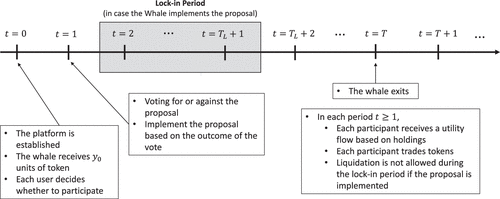
The timeline is as follows. In , the platform is established and issues a unit mass of tokens, which are distributed among the participants (a whale and users, defined in the next subsection). In , participants vote for or against a proposal using their tokens; if the proposal passes, it is automatically implemented by a smart contract. From onward, the platform provides utility flows to participants based on their token holdings. Figure 1 illustrates the timeline and summarizes the key elements of the setup discussed below.
3.1.1. Participants.
In this model, there are two types of participants: small participants, whom we will refer to as users, and a large participant, whom we will refer to as the whale. All participants are assumed to be risk-neutral, and their discount factor is denoted by . The risk-free rate is given by .10
Upon the establishment of the platform, the whale receives units of tokens. The whale represents an individual or institution with vested interests in the platform (e.g., founders, developers, and financiers such as venture capitalists). Because participants other than the whale are dispersed, the whale’s initial holdings, represented by , reflect the level of ownership concentration within the platform. We denote by the units of tokens the whale holds in period t.
We assume that there is a continuum of users in one-unit mass who derive utility from using the platform’s services. They are dispersed and competitive. To participate, a user indexed by i must pay a one-time participation cost of in and purchase an equal fraction of units of tokens at an exogenously given initial offering price of without incurring any other transaction costs. The cost is individual-specific and has a continuous cumulative distribution function defined on the interval [0, 1].11 We assume that there is a positive mass of users with zero cost— that is, . This ensures that there are users who will always participate in the platform. We denote by the set of participating users, and by N the total number of participating users:
We also denote by the units of tokens held by user i in period t.
3.1.2. Technology.
A participant, whether a user or the whale, holding tokens in period derives utility from the platform during that period according to the following equation:12
The technology component is determined by the action , where means that the proposal is implemented (i.e., the proposal passes), and means it is rejected. In , the platform implements the proposal () if the total mass of votes in favor of its implementation exceeds a minimum threshold of :
To explore potential conflicts between users and the whale, we assume that implementing the proposal would destroy value for users if , where is a positive parameter that captures the loss in efficiency due to the implementation of the proposal.13 The whale obtains some private benefit if the proposal is implemented. We assume that the whale’s benefit from implementing the proposal is given by a random variable B, which has a cumulative distribution function defined on the interval . The value of B is initially unknown, but becomes public in . For tractability, we assume that (or the probability density function is positive on the support) to ensure a well-behaved equilibrium solution.
Once the realization of the whale’s private benefit B becomes public in , users correctly infer the equilibrium outcome. That is, users have rational expectations about the outcome of the voting event and the corresponding price path. Users take the implementation of the proposal and the path of token prices under the action a as given.
We denote by the intrinsic token value to users given the status of the proposal implementation a and the mass of participating users N. It is given by the present value of utility flows per unit of tokens:
In the absence of the whale, the price would converge to this intrinsic value.
3.1.3. Token Lock-in.
DAOs often utilize governance mechanisms that lock in token positions for voting participants, such as vote-escrowed tokens. For example, in the case of Curve Finance, a DEX, token holders lock their Curve DAO tokens (CRV) and receive vote-escrowed CRV (veCRV) that are used for voting.14 The longer holders lock their CRV, the more veCRV they receive. To incorporate this feature into the model, we introduce a lock-in period, denoted by , which represents the duration during which voters cannot liquidate their holdings. This lock-in period delays liquidation by an additional period of time only when the proposal is implemented (). Specifically, the whale cannot liquidate its tokens from through but it can start liquidation from period . When the proposal is not implemented, however, the whale can liquidate its tokens immediately from .15
Finally, we assume that the whale needs to liquidate its position within a finite horizon of T, where . For instance, the whale can be an institutional investor with a specific investment horizon. In other words, the horizon T represents the time frame within which the whale must divest its position to ultimately realize profits and meet its financial obligations to investors.16
The window from through T represents the period during which the whale can liquidate its position after casting its vote. As we demonstrate later, this difference reflects the whale’s flexibility in its trading decisions. Therefore, when the whale has reduced flexibility in liquidating tokens due to a longer lock-in period or a tighter liquidating schedule, it becomes more sensitive to token illiquidity.
3.1.4. Trading.
The platform’s tokens are traded on exchanges. We assume that trading costs are an increasing convex function of trading volume. Although convex trading costs may arise from various sources, one major source is token illiquidity (e.g., Kyle 1985). For tractability, we assume that trading costs are a quadratic function of the amount of tokens traded, :
For mathematical tractability, we impose restrictions on the model’s parameter values. Specifically, we assume that the platform is valuable enough; the parameter , which represents the lower bound of the value of utility flows to users, is large enough. As shown later, this ensures that user participation in the platform is primarily driven by utility flows rather than considerations such as speculation. Although users’ speculation does influence their decisions, it assumes a secondary role in our model.
3.2. Optimal Choices
3.2.1. Users’ Problem.
In periods , each participating user maximizes her expected utility of enjoying the platform’s services, as well as trading gains. Because users are symmetric once they participate in the market, from now on we suppress the index i for notational convenience.
Given the platform’s action a in , a user’s value in period can be represented in a recursive form as:
The first term in Equation (5) represents the utility flow associated with the token holdings, the second term is the cost of acquiring units of tokens (or the proceeds from selling these tokens), the third term is trading costs defined in Equation (4), and the fourth term is the user’s continuation value given her choice. Equation (7) represents short sale constraints for token trading, which are always satisfied in equilibrium.
By solving the optimization problem in Equation (5), we can represent the value function of a user as an affine function of her token holdings at the beginning of the period.
The value function of a user in period with token holdings at the beginning of period t is given by
The optimal trading strategy in period t given price is
See the appendix. □
3.2.2. Token Prices.
The market clearing condition states that the sum of all the trading volumes should be net zero:
Equation (12), together with Equation (11), implies that the inverse demand function of users is given by
Therefore, when the whale trades units of tokens, Equation (12) implies that given a, the equilibrium price of tokens is a function of :
Equation (14) shows that the price has to increase above the intrinsic value whenever the whale buys additional tokens and decrease below the intrinsic value whenever the whale sells these tokens. In the absence of the whale’s trading, the price equals the intrinsic value.17
3.2.3. The Whale’s Problem.
In , the whale receives units of tokens from the platform. From onward, the whale participates in trading tokens. At the end of period , the whale may vote on the proposal.
On the one hand, the whale can strategically accumulate more tokens to influence the vote outcome. On the other, the whale needs to unwind its position, completely liquidating it by period T. Therefore, the whale will begin unwinding its position starting from in case the whale does not pursue the implementation of the proposal. However, if the whale wants to implement the proposal, it will accumulate enough units to change the vote outcome, but those holdings used for voting in will be locked for periods. After the lock-in period is over, the whale can begin liquidating those holdings starting from .
The whale trades tokens in a manner similar to users in Equation (5) but incorporates its own price impact into its optimization problem. We can represent the whale’s value, given , in a recursive form as:
The interpretation of Equation (15) is identical to that of a user in Equation (5) except that the price of tokens is a function of the whale’s own trading volume (see Equation (14)). The boundary condition in Equation (19) ensures that the holdings are completely liquidated by period T. By optimally reducing its position over the investment horizon, the whale can maximize its expected utility, considering the trade-off between token payoffs and trading costs. Equation (17) represents short sale constraints for token trading, which are always satisfied in equilibrium. Equation (18) represents the fact that the whale cannot liquidate its holdings used for voting until the end of the lock-in period after implementing the proposal.18
Substituting the price function Equation (14) into Equation (15), we can represent the objective function as follows:
The interpretation of Equation (20) is that the whale trades tokens at their intrinsic value, denoted as , and incurs the effective trading cost , which reflects both the quadratic transaction cost in Equation (4) and the extra price impact in Equation (14).
We obtain the following result by solving the whale’s problem in which the whale needs only to liquidate its current position, denoted as . This arises when the constraint in Equation (18) is nonexistent, either because the lock-in period has ended () or because there is no lock-in period due to the rejection of the proposal ().
Given initial token holdings and the absence of the constraint in Equation (18), the whale’s optimal trading strategy in period is given by
Furthermore, the value function in period t under is given by
See the appendix. □
The optimal trading strategy in Equation (22) reflects the schedule of liquidating the initial holdings over the remaining periods, considering the impact of the discount factor.19 The value in Equation (24) reflects the intrinsic value of the whale’s current token holdings less the cost of liquidating them under the optimal trading strategy.
3.3. Equilibrium
3.3.1. The Whale’s Strategic Trading Under Different Vote Outcomes.
In , the value of private benefit B realizes. Given B, the whale decides whether to implement the proposal jointly with trading of tokens. To solve the whale’s optimization problem in , we first analyze the value given the implementation of the proposal a and trading volume under a realized value of B.
To implement the proposal, it is optimal for the whale to purchase the minimum amount of tokens that are just enough to pass the proposal—that is, . Given the realized value of B, the whale’s value when implementing the proposal in is given by
and the whale’s value when choosing not to implement the proposal is
See the appendix. □
Because the proposed changes do not benefit users, they do not support the implementation of the proposal. Because trading is costly, the whale purchases only the minimum amount necessary to gain just enough voting power, which is , to ensure a desired outcome in the vote. This is evident from the observation that the whale’s value is decreasing in , as shown in Equation (26).
From Equation (26), we also observe that the whale’s value reflects its private benefit plus the intrinsic value from implementing the proposal less the trading costs. Note that the intrinsic value is lowered to due to the implementation of the proposal. The trading costs involve the cost of acquiring additional tokens to influence the vote and the cost of liquidating the increased amount of tokens in subsequent periods. The whale’s behavior can be viewed as a form of rug pull scheme in this context.
In contrast, the whale’s value when choosing not to implement the proposal (Equation (27)) is determined by the intrinsic value under the status quo minus the trading costs associated with liquidating the initial holdings. In this scenario, the whale does not obtain the private benefit but benefits from a higher valuation of tokens as a result of rejecting the value-destroying proposal. Additionally, trading costs are reduced because the whale does not need to accumulate more tokens to influence the vote outcome.
3.3.2. The Whale’s Voting Decision.
The whale implements the proposal if and only if the value of implementation, , exceeds the value of rejection, . By Lemma 3, this is equivalent to
The dependence of on the whale’s initial holdings reflects a simple trade-off. A larger stake increases the intrinsic value at risk, which discourages implementation, but reduces the additional tokens needed to reach the voting threshold , which lowers trading costs. For empirically relevant parameter values—such as when is small relative to or when illiquidity is high—this implies that first decreases and then increases in (see Equation (A.28) in the appendix). Hence, the likelihood of implementing a value-destroying proposal is highest at intermediate ownership concentration. Figure 2 illustrates this hump-shaped relationship.
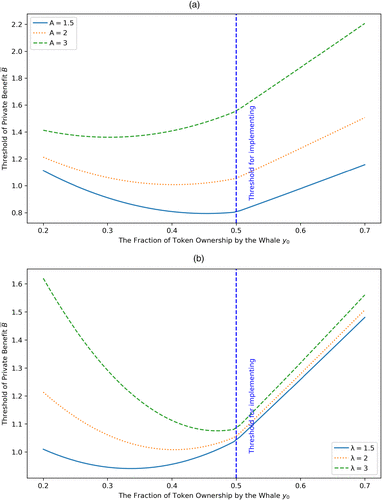
Notes. Parameter values: ). (a) Under different service values. (b) Under different illiquidity levels.
Under sufficiently high token illiquidity, greater ownership concentration can have adverse effects on governance by increasing the likelihood of value-destroying vote outcomes. In particular, there is a hump-shaped relationship between ownership concentration and the likelihood that a value-destroying proposal is implemented.
See the appendix. □
The platform’s service value further shapes this relationship. A higher baseline service value strengthens the disciplining effect of ownership concentration: when the whale holds a larger stake, the higher intrinsic value at risk makes value-destroying actions less attractive. Figure 2(a) shows this interaction.
Token illiquidity plays a complementary role. Higher illiquidity raises the cost of acquiring and unwinding the additional tokens used to influence the vote, so the private benefit required to justify a value-destroying proposal increases. When the whale starts from a relatively small position, illiquidity has a strong governance benefit by making vote manipulation expensive; as approaches and exceeds , this marginal benefit weakens. Figure 2(b) depicts these comparative statics.
Increased ownership concentration amplifies the positive effect of high service value on governance but weakens the positive governance effect of illiquidity.
See the appendix. □
It is worth noting that this pattern is consistent with the spirit of quadratic voting schemes, which seek to prevent a single participant from amassing overwhelming voting power. In our setting, illiquidity can improve DAO governance because governance is exercised directly by tokenholders: frictions discourage manipulative trading rather than impeding monitoring. By contrast, in traditional firms, liquidity can facilitate governance by enabling blockholders who actively monitor management.
Finally, the lock-in period operates through a similar channel. A longer lock-in increases the private-benefit threshold required to justify implementation by shortening the effective liquidation window after voting. In this sense, lock-in acts as targeted illiquidity for the whale. Moreover, the effect of extending the lock-in period is stronger when illiquidity is higher. As approaches zero, the impact of vanishes, consistent with lock-in operating through trading frictions. Figure 3 illustrates these effects.
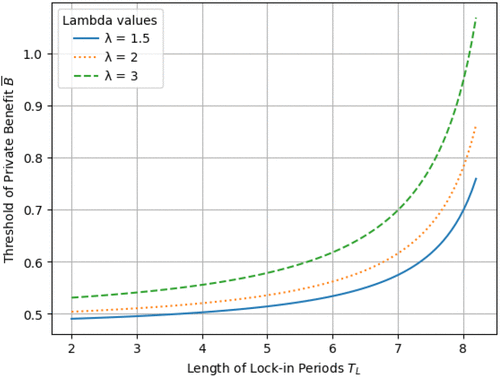
Note. Parameter values: ).
The likelihood of implementing a value-destroying proposal decreases with the length of the lock-in period, and this effect is more pronounced in the presence of greater illiquidity.
See the appendix. □
3.4. Equilibrium User Participation in the Platform
We now close the model by solving for the equilibrium participation of users, which, in turn, determines the ex ante value of the DAO platform. Suppose that N users participate and that units of tokens are available for the ICO after allocating units to the whale. The ICO price per token is exogenously given by . By symmetry, each participating user acquires an equal share . In what follows, we endogenize N by equating the benefits and costs of participation.
Using the equilibrium price process under the two possible outcomes (implementation or rejection of the proposal), we obtain the value for a representative user in , conditional on a and N.
Given N, the value for each individual user in when is given by
See the appendix. □
Recall that the whale implements the proposal if and only if there is a strong enough incentive misalignment between the whale and users (). It is then clear that the probability of implementing a value-destroying proposal is equal to . Therefore, a user’s expected value for participating in the DAO platform in equals
The following lemma decomposes the expected value in Equation (28) into two components: the present value of utility flows (“intrinsic value”) and the present value of trading profits.
For a given N, a user’s expected value for participating in the DAO platform can be decomposed into two separate components as follows:
where represents the intrinsic value, which increases in N, and represents the value generated from trading profits, which decreases in N, such that
When the platform’s value is significantly greater than transaction costs (conditions in Equations (A.36) and (A.37)), the value of participating in the platform, denoted as , increases as the number of participating users, N, grows.
See the appendix. □
Given our result in Lemma 5, the expected value of a participating user in Equation (29) shows two opposing effects with respect to the number of participating users, N. First, user participation exhibits strategic complementarity because it increases the value of participation through heightened utility flows resulting from network effects; hence, increases in N. Second, user participation demonstrates strategic substitutability because it diminishes the profit associated with market making; hence, decreases in N. However, the lemma further shows that the latter effect becomes of second order when the platform value significantly outweighs transaction costs. Under this condition, the expected value of participation increases with greater user participation, N.
Finally, we solve the following equation for the equilibrium mass of participating users:
We establish the existence of at least one fixed point for Equation (30) and characterize conditions under which multiple equilibria can arise.
(
See the appendix. □
Theorem 1 demonstrates the existence of an equilibrium and, notably, that any improvement in DAO governance results in a multiplier effect. There is a feedback channel between governance and user participation. More user participation prevents the whale from implementing a value-destroying proposal, thereby enhancing governance. Conversely, enhanced governance induces more users to participate by improving the platform value. In particular, illiquidity for the whale, whether due to trading costs or a lock-in period, is likely to prevent the whale from making a value-destroying proposal (Proposition 3). This, in turn, encourages more users to participate in the platform, further enhancing its value.
When the feedback effect between participation and governance is strong enough, multiple equilibria can occur.21 Increased user participation enhances the platform’s value, preventing the whale from implementing value-destroying proposals. Conversely, decreased user participation diminishes the platform’s value, encouraging the whale to exploit private benefits by proposing value-decreasing changes. Therefore, there can be two separate stable equilibria: one equilibrium where there is a larger number of participating users with high platform value and good governance, and the other equilibrium where there is a smaller number of participating users with low platform value and poor governance. Figures 4 and 5 illustrate these equilibria.
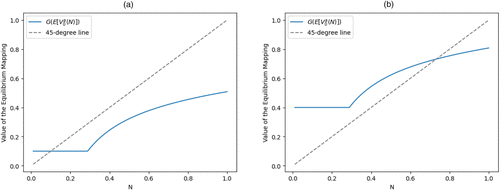
Notes. Parameter values: , , . (a) Single fixed point (low initial participation: N0 = 0.1). (b) Single fixed point (high initial participation: N0 = 0.4).
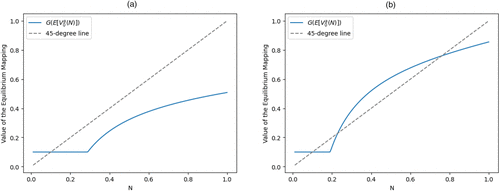
Notes. Parameter values: , , . (a) Single fixed point (low efficiency: A(R) = 4). (b) Multiple fixed points (high efficiency: A(R) = 6).
According to Theorem 1(i), increasing the lock-in period enhances governance by raising the threshold . Consequently, a sufficiently long lock-in period can eliminate the equilibrium with low user participation, as stated in Theorem 1(ii).
This finding shows that the illiquidity created by a longer lock-in period can eliminate the “bad” equilibrium when governance–participation feedback is strong. Unlike general trading frictions, lock-in mainly constrains whales (or other strategic traders), so targeted illiquidity can curb manipulation and mitigate the downsides of concentrated ownership. Figure 6 illustrates this mechanism.
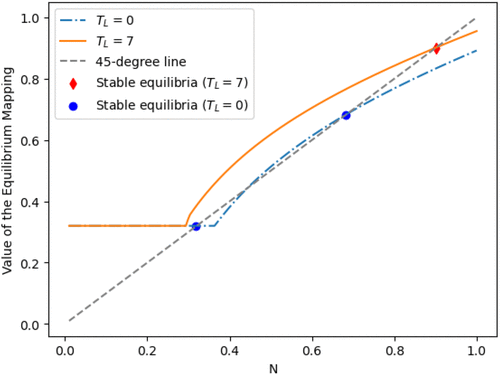
Note. Parameter values: , , .
In summary, by incentivizing user engagement and providing safeguards against value-detrimental proposals, DAOs can foster more inclusive and sustainable ecosystems. The concept of targeted illiquidity through lock-in periods not only protects against malicious actors, but also encourages honest participation, reinforcing platforms’ overall health.
3.5. Theoretical Predictions
We now summarize the model’s main predictions that guide our empirical analyses. These predictions follow directly from Propositions 1–3 and the related discussions in Sections 3.3 and 3.4. Accordingly, we test the model’s comparative statics by examining how the platform’s intrinsic value—and, equivalently, its growth—varies with ownership concentration and liquidity/lock-in.22
There exists a convex relationship between platform growth and ownership concentration, with the former decreasing in ownership concentration at low levels of concentration.
A higher service value mitigates the negative correlation between higher ownership concentration and platform growth.
Higher token illiquidity is positively correlated with platform growth when ownership concentration is low, and the positive correlation weakens when concentration increases.23
The provision of long-term incentives to large token holders is positively associated with platform growth.
4. Data Description
Our empirical analyses draw on data from various sources. Individual DAO investors’ voting records come from Snapshot, a widely used voting platform that enables DAOs and other blockchain protocols, such as decentralized finance (DeFi) protocols, to create proposals and manage votes.24 Unlike traditional on-chain voting systems that levy gas fees on voters for processing cryptocurrency movements between wallets, this off-chain platform allows gas-free voting. We select the Snapshot sample because it is the primary voting platform for the majority of DAOs (DeXe Protocol 2023).
We download all votes cast on proposals that were active from July 20, 2020, through September 1, 2024. The data set includes a DAO’s name, symbol, and contract address of its voting token, proposal name and text, start date and deadline of voting, voter address, vote date, and number of votes cast.25 Because anyone can create a DAO and feature it on the voting platform, most of the DAOs on the platform are small and do not appear to have any underlying business. Hence, we begin with a subsample of DAOs that are more likely to possess underlying businesses: specifically, 705 DAOs that had received at least 10 proposals by the end of our sample period.
For most DAOs, participants use the underlying governance tokens to cast votes. However, an increasing number of DAOs have shifted to a staking model, including the vote-escrow/locking mechanism that rewards investors with greater voting power and yields for locking their governance tokens. For each DAO, we locate the contract details of its voting token by manually searching its contract address on the corresponding blockchain explorer (e.g., etherscan.io, bscscan.com, or polygonscan.com). These contract details are used to determine a DAO’s voting strategy. That is, whether investors of the DAO cast votes using its governance token or a staked token, including a vote-escrowed/locked token.
We then manually search these DAO names on CoinMarketCap, a website that is a top source of cryptocurrency market data and that covers most major cryptocurrencies. This step yields 570 cryptocurrencies that are associated with the DAOs. We then download their daily price and volume data.
Because a number of DAOs adopt staking, including vote-escrow/locking, strategies, ownership of the underlying native governance token is unlikely to capture a voter’s economic ownership represented by her votes cast. Therefore, we use the number of votes cast to proxy for a DAO member’s ownership. Because many DAOs do not feature proposals on a daily basis, we convert the voting data into weekly series. Specifically, for each proposal, we compute the Herfindahl-Hirschman Index of voting power, which is calculated by squaring the share of each individual’s votes before summing the resulting numbers, the fraction of votes cast by the top three voters, and the number of voters.26 We then average each of the three variables for each DAO-week pair using proposal deadlines.
To capture the size and growth of DAOs, we obtain daily total value (TVL) locked for each DAO from DefiLlama, which is a TVL aggregator and analytics dashboard for DeFi protocols. TVL measures the total value of assets deposited in a DeFi protocol, with the locked assets being associated with activities such as lending, staking, and liquidity provision.27 TVL is an important metric for assessing the potential of a protocol. An increase in the TVL of a DeFi platform is typically followed by an increase in liquidity and usability.
DefiLlama tracks protocols from over 80 blockchains, including major ones such as Ethereum, BNB Chain (formerly known as Binance Smart Chain), Polygon, Avalanche, and Fantom. We manually search the name of each DAO on DeFiLlama and download the aggregate daily TVL series when available. In addition, we obtain the number of daily users from Moralis, a development platform that provides APIs and infrastructure for blockchain-based applications. We merge week-end price, volume, TVL, and user data into our weekly voting data set using name and symbol.
4.1. Descriptive Statistics
Before reporting the summary statistics for the key variables in our study, we plot the aggregate TVL for our sample DAOs. As shown in Figure 7, during the week of July 20, 2020, our platforms’ combined TVL was around $1.3 billion, a relatively low starting point. However, TVL grew quickly when the DeFi and cryptocurrency spaces boomed as the COVID-19 pandemic dragged on, likely attributed to easy monetary policy and increased interest from retail investors. Total valuation surpassed $145 billion in November and December 2021 before declining in January 2022. By July 31, 2022, aggregate TVL was only $45.8 billion, a drop of more than 68% from its peak. Total valuation continued to decline, reaching roughly $28 billion in mid-October 2023 before sharply rebounding. As of August 2024, however, aggregate TVL remained less than 50% of its late-2021 peak. We note that this boom-and-bust pattern is consistent with the valuation cycle for the broader DeFi industry—the peak TVL of $181 billion was reached in December 2021 before dropping precipitously. This comparison also shows that our data set captures most major DeFi platforms.
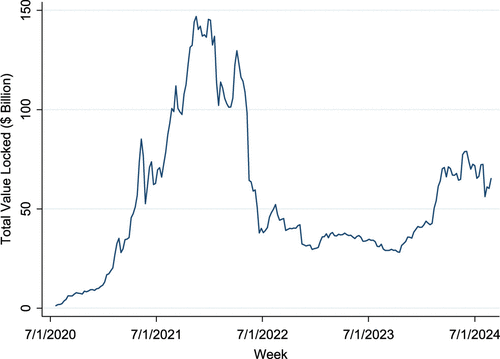
Notes. This figure plots the weekly combined total value locked for our sample DAOs. The sample period runs from July 20, 2020 (the week beginning July 20, 2020) to September 1, 2024 (the week beginning August 26, 2024).
We then report the geographic distribution of our sample DAOs and their major types. As shown in Table 1, Panel A, nearly 48% of the DAOs have no physical headquarters. The United States hosts the second largest group of DAOs (16.3%), followed by Asia (12.1%) and the European Union (10.7%). Panel B reports that 46.7% of the DAOs feature Web3 functionality, including asset management, gaming, (social) media and community, and public goods, among others. DeFi platforms, including lending protocols, decentralized exchanges, yield protocols, and stablecoins, are a close second (43%), followed by infrastructure DAOs, which create or manage tools to scale the cryptocurrency industry.
|

Table 1. Descriptive Statistics: Geographical Distribution and Types of DAOs
| Number | Percent (%) | |
|---|---|---|
| Panel A: Geographical distribution | ||
| Region | ||
| Africa | 6 | 1.1 |
| Americas ex U.S. | 28 | 4.9 |
| Asia | 69 | 12.1 |
| EU | 61 | 10.7 |
| Europe ex EU | 27 | 4.7 |
| Global | 271 | 47.5 |
| Oceania | 15 | 2.6 |
| U.S. | 93 | 16.3 |
| Total | 570 | 100 |
| Panel B: Types of DAOs | ||
| Type | ||
| DeFi | 245 | 43.0 |
| Infrastructure | 59 | 10.4 |
| Web3 | 266 | 46.7 |
| Total | 570 | 100 |
Notes. In this table and Table 2, we report descriptive statistics on the DAOs in our sample. The sample period runs from July 20, 2020, to September 1, 2024. DeFi platforms include lending protocols, decentralized exchanges, yield protocols, and stablecoins. Infrastructure DAOs create or manage tools to scale the cryptocurrency industry. Web3 functionality includes asset management, gaming, (social) media and community, and public goods, among others. Ex, excluding.
As shown in Table 2, during our sample period, the average platform has a TVL of $915 million, whereas the median is only $51 million, suggesting that the distribution of DeFi valuations is highly skewed. The average and median weekly TVL growth rates are −0.9% and −0.5%, respectively, with an interquartile range of −6.9% to 5.9%. The weekly returns on the associated (governance) tokens are more negative, with the average and median being −1.9% and −2.3%, respectively.
|
Table 2. Descriptive Statistics: DAO-Level Characteristics
| Average | 25th percentile | Median | 75th percentile | Std. Dev. | Obs. | |
|---|---|---|---|---|---|---|
| Variable | (1) | (2) | (3) | (4) | (5) | (6) |
| TVL ($billion) | 0.915 | 0.006 | 0.051 | 0.401 | 2.708 | 5,899 |
| TVL growth | −0.009 | −0.069 | −0.005 | 0.059 | 0.204 | 5,840 |
| #Users (thousand) | 40.3 | 2.1 | 5.7 | 20.8 | 124.4 | 8,328 |
| User growth | 0.017 | −0.001 | 0.001 | 0.008 | 0.167 | 8,160 |
| Token return | −0.019 | −0.116 | −0.023 | 0.060 | 0.246 | 8,433 |
| HHI | 0.322 | 0.119 | 0.237 | 0.455 | 0.273 | 9,828 |
| Top 3 ownership | 0.676 | 0.476 | 0.716 | 0.922 | 0.266 | 9,718 |
| #Participants | 363.1 | 8 | 28 | 90 | 1,934.7 | 9,828 |
| Staking | 0.328 | 0 | 0 | 1 | 0.469 | 9,828 |
| Amihud illiquidity | 0.218 | 0.006 | 0.027 | 0.128 | 2.548 | 8,450 |
| Return volatility | 0.116 | 0.032 | 0.051 | 0.084 | 3.704 | 8,592 |
Notes. In this table and Table 1, we report descriptive statistics on the DAOs in our sample. The sample period runs from July 20, 2020, to September 1, 2024. TVL is total value locked in billions of dollars, reported by DefiLlama. TVL growth is the weekly growth rate of TVL. #Users is the number of users in thousands, reported by Moralis. User growth is the weekly growth rate of the number of users. Token return is the weekly return of the native token associated with each DAO. For each DAO, HHI is the average Herfindahl–Hirschman Index of the number of votes cast for proposals that end in a given week; Top 3 ownership is the average fraction of votes cast by the top three voters for proposals that end in a given week; and #Participants is the average number of voters voting on proposals that end in a given week. Staking is an indicator equal to 1 if a platform uses staking, including vote escrow, as part of its voting strategy and zero otherwise. Amihud illiquidity is the Amihud (2002) illiquidity measure, defined as the weekly average of using daily data. Return volatility is the volatility of daily token returns in a given week. Obs., observations; Std. Dev., standard deviation.
During our sample period, the average protocol has about 40,300 users, compared with a median of 5,700, again highlighting the skewed nature of the DeFi space. The average and median weekly user growth rates are 1.7% and 0.1%, respectively. Moreover, the average weekly HHI of voting power is 0.32 (equivalent to 3,200 points based on a maximum of 10,000 points), suggesting that the market is highly concentrated.28 The largest three whales, on average, command more than two-thirds of the voting power. Remarkably, even at the 25th percentile, the top three whales still dictate 47.6% of the votes.
The average (median) number of platform participants is 363 (28). In a given week, nearly a third of the platforms use staking, including vote escrow, as part of their voting strategy. The average Amihud illiquidity measure and return volatility are 0.22 and 11.6%, respectively.
5. Empirical Analyses
5.1. Ownership Concentration and Platform Growth
To test whether there exists a convex relationship between platform growth and ownership concentration, as outlined in Prediction 1, we estimate the following specification:
In Table 3, we focus on the relationship between weekly TVL growth and past week’s HHI of voting power and its square term. In column (1), we control for region and DAO-type fixed effects, instead of DAO fixed effects. These factors may simultaneously influence both TVL growth and ownership concentration. For example, DAOs in different jurisdictions may be subject to varying legal requirements, which could influence governance outcomes. As shown, the estimated coefficient for is positive, indicating that the relation between platform growth and ownership concentration is indeed convex. The estimate remains largely unchanged after controlling for DAO fixed effects, which subsume region and DAO-type fixed effects, as reported in column (2). As shown in column (3), we also obtain consistent results when further controlling for platform size (the logarithm of past week’s TVL) and the price of the native token (the logarithm of past week’s native token price).
|
Table 3. Ownership Concentration and TVL Growth
| Variable | Dependent variable: TVL growth | |||
|---|---|---|---|---|
| (1) | (2) | (3) | (4) | |
| HHI | −0.122*** | −0.140*** | −0.143** | |
| (−3.030) | (−2.891) | (−2.546) | ||
| 0.098*** | 0.121*** | 0.107** | ||
| (2.610) | (2.652) | (2.035) | ||
| −0.135*** | ||||
| (−2.952) | ||||
| 0.394** | ||||
| (2.129) | ||||
| log(Lagged TVL) | −0.035*** | −0.035*** | ||
| (−5.219) | (−5.206) | |||
| log(Lagged token price) | 0.021*** | 0.021*** | ||
| (4.087) | (4.181) | |||
| Region FEs | Y | N | N | N |
| DAO-type FEs | Y | N | N | N |
| DAO FEs | N | Y | Y | Y |
| Time FEs | Y | Y | Y | Y |
| Observations | 5,839 | 5,834 | 4,982 | 4,982 |
| R2 | 0.016 | 0.057 | 0.098 | 0.098 |
Notes. In this table and Table 4, we report results on the relationship between ownership concentration and platform growth. The sample period runs from July 20, 2020, to September 1, 2024. All regressions are performed at the weekly frequency. is the predicted value of HHI when regressing on , which equals one for periods after an airdrop launch for DAO i and zero otherwise, and lagged platform size (either log(Lagged TVL) or log(Lagged #users)) and log(Lagged token price). Log(Lagged TVL) is the logarithm of total value locked in billions of dollars as of the end of the past week. Log(Lagged #users) is the logarithm of the number of DAO users as of the end of the past week. Log(Lagged token price) is the logarithm of the native token price as of the end of the past week. All other variables are as defined in Tables 1 and 2. Time FEs refer to year-month fixed effects, and standard errors are clustered at the DAO level. In each column, we report estimated coefficients and their associated t-statistics. Singleton observations are dropped from each fixed-effects model.
*Statistical significance at the 10% level; **statistical significance at the 5% level; ***statistical significance at the 1% level.
We use the estimates in column (3) to illustrate the economic significance of the results. A one-standard-deviation increase in HHI is associated with a 3.9-percentage-point decrease in weekly TVL growth. The marginal effect of HHI equals . The turning point, therefore, occurs at , suggesting that increases in concentration reduce TVL growth throughout the vast majority of the observed distribution, with the negative effect gradually attenuating as ownership becomes extremely concentrated. This aligns with our theoretical prediction of a hump-shaped relationship between ownership concentration and the likelihood of value-destroying vote outcomes (Proposition 1).
Although we have controlled for DAO fixed effects and major DAO characteristics, including platform size and native token price, there may still be omitted variables that jointly influence both ownership concentration and platform growth. We further sharpen the identification by using airdrop events hosted by our sample DAOs as shocks to governance token distribution, which helps to establish causality. An airdrop is an initiative to distribute tokens to current or potential users for free, which helps establish an equitable governance mechanism by decentralizing the token holdings of a platform. Governance token airdrops have been adopted by major DeFi platforms, such as Uniswap, Curve, and 1inch.
For each DAO in our sample, we collect airdrop data from Airdrops.io, CoinMarketCap, the DAO’s website, and internet searches. This step yields 138 DAOs that launched airdrop events during our sample period. We then regress on , which equals one for periods after an airdrop launch for DAO i and zero otherwise, and lagged platform size and native token price. The coefficient on equals −0.071, with a t-statistic of −2.40. This evidence suggests that token ownership indeed becomes more decentralized after airdrops. We then replace in column (3) with the predicted value of HHI and rerun the regression. As shown in column (4), the results are qualitatively similar to those reported in columns (1)–(3).
To the extent that some proposals involve deploying assets locked in the protocol, a reduction in TVL does not necessarily indicate value destruction. As a robustness check, we use user adoption growth instead of TVL growth as an alternative dependent variable to assess whether a proposal is value-enhancing or detrimental.29 As shown in Table 4, the results are qualitatively consistent with those reported in Table 3. Overall, our evidence supports a convex relationship between DAO platform growth and ownership concentration.
|
Table 4. Ownership Concentration and User Growth
| Variable | Dependent variable: user growth | |||
|---|---|---|---|---|
| (1) | (2) | (3) | (4) | |
| HHI | −0.149*** | −0.176*** | −0.123*** | |
| (−5.440) | (−5.132) | (−2.656) | ||
| 0.102*** | 0.132*** | 0.100** | ||
| (4.055) | (4.324) | (2.457) | ||
| −0.064*** | ||||
| (−2.735) | ||||
| 0.112** | ||||
| (2.445) | ||||
| log(Lagged #users) | −0.070*** | −0.070*** | ||
| (−4.181) | (−4.193) | |||
| log(Lagged token price) | −0.002 | −0.002 | ||
| (−1.376) | (−1.219) | |||
| Region FEs | Y | N | N | N |
| DAO-type FEs | Y | N | N | N |
| DAO FEs | N | Y | Y | Y |
| Time FEs | Y | Y | Y | Y |
| Observations | 8,160 | 8,157 | 7,397 | 7,397 |
| R2 | 0.022 | 0.080 | 0.168 | 0.168 |
Notes. In this table and Table 3, we report results on the relationship between ownership concentration and platform growth. The sample period runs from July 20, 2020, to September 1, 2024. All regressions are performed at the weekly frequency. is the predicted value of HHI when regressing on , which equals one for periods after an airdrop launch for DAO i and zero otherwise, and lagged platform size (either log(Lagged TVL) or log(Lagged #users)) and log(Lagged token price). Log(Lagged TVL) is the logarithm of total value locked in billions of dollars as of the end of the past week. Log(Lagged #users) is the logarithm of the number of DAO users as of the end of the past week. Log(Lagged token price) is the logarithm of the native token price as of the end of the past week. All other variables are as defined in Tables 1 and 2. Time FEs refer to year-month fixed effects, and standard errors are clustered at the DAO level. In each column, we report estimated coefficients and their associated t-statistics. Singleton observations are dropped from each fixed-effects model.
*Statistical significance at the 10% level; **statistical significance at the 5% level; ***statistical significance at the 1% level.
5.1.1. Service Value, Ownership Concentration, and Platform Growth.
To test whether a higher platform valuation reduces the negative relationship between platform growth and ownership concentration (Prediction 2), we replace in Equation (32) with an interaction term of HHI and the logarithm of lagged TVL and re-estimate the equation. A positive coefficient for the interaction term implies that ownership concentration has a less negative effect on TVL growth for more established platforms, which provide a greater service value. Indeed, Table 5, column (1) shows that the estimated coefficient on HHI log(Lagged TVL) is positive and statistically significant at the 1% level, lending support to Prediction 2. Interestingly, platform size itself has a negative effect on TVL growth. This is intuitive because larger and more mature platforms tend to grow more slowly (Cong et al. 2021).
|
Table 5. Service Value, Ownership Concentration, and Platform Growth
| Dependent variable: | TVL growth | User growth | ||
|---|---|---|---|---|
| (1) | (2) | (3) | (4) | |
| HHI | −0.845*** | −0.269*** | ||
| (−6.079) | (−3.260) | |||
| HHI log(Lagged TVL) | 0.046*** | |||
| (5.902) | ||||
| −0.426* | −0.298* | |||
| (−1.923) | (−1.660) | |||
| log(Lagged TVL) | 0.031** | |||
| (2.407) | ||||
| log(Lagged TVL) | −0.056*** | −0.036*** | ||
| (−6.836) | (−5.206) | |||
| HHI log(Lagged #users) | 0.027*** | |||
| (2.909) | ||||
| log(Lagged #users) | 0.040** | |||
| (2.036) | ||||
| log(Lagged #users) | −0.077*** | −0.079*** | ||
| (−4.339) | (−3.622) | |||
| log(Lagged token price) | 0.023*** | 0.022*** | −0.002 | −0.002 |
| (4.142) | (4.160) | (−1.354) | (−1.305) | |
| DAO FEs | Y | Y | Y | Y |
| Time FEs | Y | Y | Y | Y |
| Observations | 4,982 | 4,982 | 7,397 | 7,397 |
| R2 | 0.120 | 0.097 | 0.172 | 0.184 |
Notes. In this table, we report results on the relationship between platforms’ service value, ownership concentration, and platform growth. The sample period runs from July 20, 2020, to September 1, 2024. All regressions are performed at the weekly frequency. is the predicted value of HHI when regressing on , which equals one for periods after an airdrop launch for DAO i and zero otherwise, and lagged platform size (either log(Lagged TVL) or log(Lagged #users)) and log(Lagged token price). log(Lagged TVL) is the logarithm of total value locked in billions of dollars as of the end of the past week. log(Lagged #users) is the logarithm of the number of DAO users as of the end of the past week. log(Lagged token price) is the logarithm of the native token price as of the end of the past week. All other variables are as defined in Tables 1 and 2. Time FEs refer to year-month fixed effects, and standard errors are clustered at the platform level. In each column, we report estimated coefficients and their associated t-statistics. Singleton observations are dropped from each fixed-effects model.
*Statistical significance at the 10% level; **statistical significance at the 5% level; ***statistical significance at the 1% level.
As a robustness analysis, we also replace HHI with the predicted value of HHI, obtained in the previous subsection, and rerun the regression. As shown in column (2), consistent with our main results in column (1), the coefficient on log(Lagged TVL) is positive and significant at the 5% level. In columns (3) and (4), we use user growth to proxy for platform growth and obtain qualitatively similar results.
5.2. Whales’ Ownership, Concentration, and Platform Growth
To test whether higher ownership concentration weakens the positive correlation between token illiquidity and platform growth at low levels of concentration (Prediction 3), we estimate the following specification, conditional on whether the top three voters control less than 50% of the votes, a common passing threshold for DAOs:
Table 6, Panel A, column (1) reports results for the subsample where the top three voters control less than 50% of the votes. As shown, the estimated coefficient on the interaction term is negative and significant, supporting our prediction that the initial beneficial effect of illiquidity on governance diminishes rapidly as concentration increases (see Proposition 2). Indeed, consistent with Proposition 2, token illiquidity under low ownership concentration positively predicts TVL growth, with an effect of 2.4 percentage points when the illiquidity measure increases by one standard deviation. We note that the aforementioned effect disappears as ownership becomes highly concentrated, as predicted. As reported in column (2), the coefficient on the interaction term between HHI and Amihud illiquidity turns positive when whales control the vote. In columns (3) and (4), we re-estimate Equation (33) by replacing the dependent variable with user growth and obtain consistent results.
|
Table 6. Whales’ Ownership, Concentration, and Platform Growth
| Dependent variable: | TVL growth | User growth | ||
|---|---|---|---|---|
| Top 3 ownership | ||||
| <50% | 50% | <50% | 50% | |
| (1) | (2) | (3) | (4) | |
| Panel A: Concentration, illiquidity, and platform growth | ||||
| HHI | −0.647** | 0.035 | −0.275* | 0.003 |
| (−2.341) | (0.974) | (−1.906) | (0.025) | |
| HHI Amihud illiquidity | −2.446** | 0.150 | −2.877** | 1.222 |
| (−2.119) | (0.128) | (−2.007) | (0.288) | |
| Amihud illiquidity | 0.198** | −0.300 | 0.685* | −0.253 |
| (1.988) | (−0.607) | (1.826) | (−0.389) | |
| log(Lagged TVL) | −0.039*** | −0.076* | ||
| (−3.081) | (−1.827) | |||
| log(Lagged #users) | −0.077** | −0.070** | ||
| (−2.250) | (−2.477) | |||
| log(Lagged token price) | 0.020** | 0.009 | −0.001 | −0.008 |
| (2.045) | (0.861) | (−0.257) | (−0.935) | |
| DAO FEs | Y | Y | Y | Y |
| Time FEs | Y | Y | Y | Y |
| Observations | 1,000 | 3,767 | 1,828 | 5,200 |
| R2 | 0.455 | 0.238 | 0.215 | 0.152 |
| Panel B: Predicted concentration, illiquidity, and growth | ||||
| −0.625** | −0.005 | −0.330** | −0.026 | |
| (−2.048) | (−0.697) | (−2.051) | (−0.225) | |
| Amihud illiquidity | −3.557** | 0.130 | −4.668** | 0.574 |
| (−2.322) | (0.767) | (−2.167) | (0.199) | |
| Amihud illiquidity | 0.265* | 0.055 | 0.761** | −0.107 |
| (1.813) | (0.864) | (2.348) | (−0.420) | |
| log(Lagged TVL) | −0.040*** | −0.037*** | ||
| (−3.120) | (−4.210) | |||
| log(Lagged #users) | −0.095** | −0.081** | ||
| (−2.179) | (−2.484) | |||
| log(Lagged token price) | 0.019* | 0.010** | 0.003 | −0.007 |
| (1.926) | (2.522) | (1.009) | (−0.754) | |
| DAO FEs | Y | Y | Y | Y |
| Time FEs | Y | Y | Y | Y |
| Observations | 1,000 | 3,767 | 1,828 | 5,200 |
| R2 | 0.455 | 0.312 | 0.284 | 0.203 |
| Panel C: Concentration, return volatility, and growth | ||||
| HHI | −0.660** | −0.020 | −0.548** | 0.017 |
| (−2.160) | (−1.149) | (−2.068) | (1.416) | |
| HHI Return volatility | −7.488** | 0.084 | −4.909** | 0.003 |
| (−2.206) | (0.898) | (−2.242) | (0.077) | |
| Return volatility | 0.617** | −0.016 | 0.413** | −0.001 |
| (2.166) | (−0.974) | (2.226) | (−0.073) | |
| log(Lagged TVL) | −0.051*** | −0.036*** | ||
| (−5.308) | (−4.480) | |||
| log(Lagged #users) | −0.075** | −0.061** | ||
| (−2.487) | (−2.231) | |||
| log(Lagged token price) | 0.030*** | 0.019*** | −0.009 | −0.001 |
| (3.348) | (3.503) | (−0.932) | (−0.091) | |
| DAO FEs | Y | Y | Y | Y |
| Time FEs | Y | Y | Y | Y |
| Observations | 1,006 | 3,845 | 1,880 | 5,345 |
| R2 | 0.276 | 0.100 | 0.266 | 0.125 |
Notes. In this table, we report results on the relationship between ownership concentration and platform growth, conditional on the top three whales’ ownership. The sample period runs from July 20, 2020, to September 1, 2024. All regressions are performed at the weekly frequency. Columns (1) and (3) feature a sample where the weekly average fraction of votes cast by the top three voters is less than 50%, whereas the sample for columns (2) and (4) includes weekly observations where the average fraction of votes cast by the top three voters is no less than 50%. is the predicted value of HHI when regressing on , which equals one for periods after an airdrop launch for DAO i and zero otherwise, and lagged platform size (either log(Lagged TVL) or log(Lagged #users)) and log(Lagged token price). Amihud illiquidity is the Amihud (2002) illiquidity measure as of the end of the past week. Return volatility is the volatility of daily token returns during the past week. Log(Lagged TVL) is the logarithm of total value locked in billions of dollars as of the end of the past week. Log(Lagged #users) is the logarithm of the number of DAO users as of the end of the past week. Log(Lagged token price) is the logarithm of the native token price as of the end of the past week. All other variables are as defined in Tables 1 and 2. Time FEs refer to year-month fixed effects, and standard errors are clustered at the platform level. In each column, we report estimated coefficients and their associated t-statistics. Singleton observations are dropped from each fixed-effects model.
*Statistical significance at the 10% level; **statistical significance at the 5% level; ***statistical significance at the 1% level.
As in Section 5.1, we regress on , lagged platform size, and native token price for each subsample, defined by whether the top three voters collectively own either less than or more than 50% of the votes. We then replace HHI with its predicted value and re-estimate Equation (33). As shown in Panel B, the results are qualitatively similar to those reported in Panel A.
Token price volatility may play a similar role as illiquidity because increased price volatility may make it more expensive for whales to acquire tokens. Therefore, as a robustness analysis, we replace illiquidity with token price volatility in the past week. Table 6, Panel C reports results that are largely consistent with those in Panel A.
Overall, our results reported in Sections 5.1 and 5.2 support the theoretical prediction that ownership concentration is negatively associated with platform growth (under the condition when whales do not control the vote outcome). Both high platform value and illiquidity can contribute to platform growth by incentivizing large token holders to refrain from engaging in value-destroying activities. However, these two effects diverge as ownership concentration increases, as our theory predicts. The positive effect of high platform value is amplified with a larger stake (greater token ownership), whereas the influence of illiquidity weakens as the threshold for achieving complete control draws nearer.
5.3. Platforms’ Long-Term Incentives and Growth
On most DeFi platforms, such as Lido and Uniswap, voters use native governance tokens to vote on proposals. They use the one-token, one-vote model. However, in recent years, a growing number of DeFi protocols have shifted to a staking model, the vote-escrow model in particular, which was pioneered by Curve Finance, a DEX launched in 2020. Investors would lock their governance tokens for up to four years. Vote weights and shares of rewards are generally proportional to the preset time periods, which means that those who lock governance tokens for a longer period will accrue greater voting power and enhanced yields. This mechanism potentially provides stronger long-term incentives to whales, making them more patient. Such a mechanism would boost platform growth, as outlined in Prediction 4.
Table 7, columns (1) and (2) report that DAOs using a staking model, including vote escrow, for token voting generate an average TVL growth rate that is about 5.6–7.2 percentage points higher than that of platforms that do not use a staking model. The control sample includes all platform-week observations where a platform does not use a staking model.
|
Table 7. Platforms’ Long-Term Incentives and Growth
| Dependent variable: | TVL growth | User growth | ||||||
|---|---|---|---|---|---|---|---|---|
| Full sample | Matched sample | Full sample | Matched sample | |||||
| (1) | (2) | (3) | (4) | (5) | (6) | (7) | (8) | |
| Staking | 0.072*** | 0.056*** | 0.084*** | 0.090*** | 0.045*** | 0.035** | 0.057*** | 0.046* |
| (5.058) | (3.820) | (3.389) | (3.582) | (3.163) | (2.348) | (2.831) | (1.964) | |
| log(Lagged TVL) | −0.033*** | −0.027*** | ||||||
| (−4.747) | (−3.137) | |||||||
| log(Lagged #users) | −0.002 | −0.003 | ||||||
| (−1.185) | (−1.187) | |||||||
| log(Lagged token price) | 0.022*** | 0.024*** | −0.069*** | −0.099*** | ||||
| (4.250) | (3.351) | (−4.153) | (−4.209) | |||||
| DAO FEs | Y | Y | Y | Y | Y | Y | Y | Y |
| Time FEs | Y | Y | Y | Y | Y | Y | Y | Y |
| Observations | 5,834 | 4,982 | 3,956 | 3,288 | 8,157 | 7,397 | 5,289 | 4,659 |
| R2 | 0.067 | 0.103 | 0.105 | 0.150 | 0.077 | 0.164 | 0.131 | 0.225 |
Notes. In this table, we report results on whether long-term incentives of a platform are associated with platform growth. The sample period runs from July 20, 2020, to September 1, 2024. To create the matched sample, for each DAO using a staking model (treated DAO), we select a control DAO from the same region and of the same type with the closest size, measured by TVL. Log(Lagged TVL) is the logarithm of total value locked in billions of dollars as of the end of the past week. Log(Lagged #users) is the logarithm of the number of DAO users as of the end of the past week. Log(Lagged token price) is the logarithm of the native token price as of the end of the past week. All other variables are as defined in Tables 1 and 2. Time FEs refer to year-month fixed effects, and standard errors are clustered at the DAO level. In each column, we report estimated coefficients and their associated t-statistics. Singleton observations are dropped from each fixed-effects model.
*Statistical significance at the 10% level; **statistical significance at the 5% level; ***statistical significance at the 1% level.
A potential concern is that the positive relationship between TVL growth and staking may be mechanical because staking naturally increases the number of tokens locked in the protocol, thereby boosting TVL. To address this concern, we conduct a matched sample analysis and match the control group based on platform characteristics. Specifically, for each DAO using a staking model (treated DAO), we select a control DAO from the same region and type with the closest size, measured by TVL. We find that 91.4% of the treated DAOs have a valid match. We obtain somewhat larger coefficient estimates when estimating the regression using the matched sample, as shown in columns (3) and (4).
We repeat the analysis by replacing TVL growth with user growth as the dependent variable. As shown in columns (5)–(8), DAOs using a staking model for token voting experience average user growth rates that are 3.5–5.7 percentage points higher than those of platforms that do not use a staking model. All estimates are significant at the 5% level.
6. Discussion
Before we conclude, we briefly discuss how DAO governance practices in the field relate to our theoretical and empirical findings. Governance mechanisms for DAOs have evolved rapidly and increasingly aim to navigate potential conflicts of interest between whales and small users in an environment without intermediaries or blockholder oversight.
As shown in Section 3, although token illiquidity can deter whales from exploiting a platform, sacrificing general token liquidity can be costly, leading to market inefficiency and high transaction costs for users. This trade-off motivates what we call targeted illiquidity: mechanisms that raise the cost of opportunistic behavior by large, strategic token holders while preserving liquidity for ordinary users. In our framework, lock-in periods and similar restrictions on exit for whales increase the cost of passing value-destroying proposals and generate positive multiplier effects through user participation.
Recent DAO designs can be viewed through this lens (see Han et al. 2025 for further discussion). Beyond the vote-escrow model pioneered by Curve, many platforms have adopted staking and voting protocols (e.g., KyberDAO), conviction voting systems (e.g., Aragon), and quadratic voting models (e.g., Gitcoin), as well as architectures that separate governance tokens from utility tokens (e.g., Maker governance tokens versus DAI). Although these mechanisms differ in implementation, a common theme is that they either (i) tie voting power and rewards to long-term commitment, or (ii) dampen the ability of a single large holder to exert dominant influence at low cost, thereby raising the effective threshold for whales’ private benefits ( in our model).30
7. Conclusion
In this paper, we explore conflicts of interest among token holders in DAOs, which are powered by open-source smart contracts. We develop a new theory that can explain why whales, defined as large token holders in a DAO, may disrupt the long-term growth of a platform through rug pulls, in which they inflate token prices before they start unwinding their positions. Our theoretical model features a whale who enjoys private benefits from controlling the platform. The whale weighs these private benefits against the cost of manipulating vote outcomes, the latter of which includes a loss in public value and trading costs due to token illiquidity.
Our model predicts four major results: (1) a negative correlation between whales’ voting power concentration and DAO growth; (2) a mitigation of such a negative correlation as platforms become larger and more widely adopted; (3) similar dampening effects for platforms with illiquid tokens; and (4) the alleviation of these DAO governance issues by shifting toward staking models that encourage long-term commitment among whales.
Our empirical evidence strongly supports these theoretical predictions. Using proposal-level vote outcomes and token-trading information from 570 DAOs operating between July 2020 and September 2024, we confirm a negative correlation between voting power concentration and platform growth, which is mitigated by platform size, token illiquidity, and alternative voting mechanisms, such as staking models, that create targeted illiquidity.
Overall, our research fills a significant gap in the literature on DAO governance by incorporating microfoundations for conflicts of interest among different token holders and providing insights into alternative voting mechanisms to improve the effectiveness of this new type of digital organization. The effectiveness of DAOs is an important economic issue in the digital age, and thus, our research contributes to innovation in organizational economics and offers practical implications for corporate finance and governance policies. Further questions remain to be explored in this research area. We hope to return to these questions in subsequent research.
The authors are grateful to Jaewan Bae, Patrick Bolton, Will Cong, Zhiguo He, Huisu Jang, Roman Kozhan, Alfred Lehar, Doron Levit, Ye Li, Yukun Liu, Nadya Malenko, Radoslawa Nikolowa, Andreas Park, David Skeie, Kevin Tseng, Ganesh Viswanath-Natraj, Neng Wang, and seminar participants at the Crypto and Blockchain Economics Research Symposium: DAOs and DEXs, the 28th Finance Theory Group Meeting, the Warwick Business School Gillmore Centre Conference on DeFi & Digital Currencies, the National University of Singapore–Sungkyunkwan University FinTech Seminar Series, the Korea Finance Association–Taiwan Finance Association Joint Conference, Korea’s Allied Economic Associations Annual Meeting, the 2024 Conference on Asia-Pacific Financial Markets, Seoul National University (Economics), and Tsinghua University for their helpful comments and suggestions. The authors also thank Yuri An, Jason Gomes, Chunghyun Han, Doyeon Kim, Yoonseok Park, and Qishu Wang for their excellent research assistance.
Appendix
We conjecture that the value function of the user in is an affine function of as follows:
Then, the first-order condition is31
Therefore, substituting the solution in Equation (A.4) into the objective function in Equation (A.2) yields the indirect value function as follows:
Equation (A.5) together with the initial conjecture in Equation (A.1) implies that
Solving for and yields
By recursive substitution, we obtain the following from Equation (A.9):
Therefore, this verifies that our initial conjecture in Equation (A.1) is indeed true. Furthermore, substituting Equation (A.8) into Equation (A.4) yields Equation (11), which finishes the proof. □
Assume that either the lock-in period is over () or the proposal is rejected (). Then, the constraint in Equation (18) is nonexistent. Using the objective function Equation (20) and the constraints in Equations (16), (17), and (19), the whale’s optimization problem in Equation (15) can be rewritten as follows:
Then, we can maximize the objective function Equation (A.11) subject to the constraints Equations (16), (17), and (19).32 Because the short sale constraint is always satisfied, we can use the Lagrangian of the problem, defined as:
The second-order condition is always satisfied. Then, the optimal solution for given is given by
Using the constraint Equation (A.12), summing across the first-order conditions Equation (A.15) for all ’s yields
Then, the Lagrangian multiplier is given by
Using Equations (A.16) and (A.19), we derive the closed-form solution for :
Because of Equation (3), we have
Finally, substituting Equation (A.21) into Equation (A.11) yields the indirect value in Equation (24). □
In the case where the whale does not implement the proposal, there is no private benefit. Therefore, the value function in , represented in Equation (27), is immediate from Lemma 2.
We now consider the case where the whale implements the proposal. Referring to Equation (24) in Lemma 2, the value in , immediately following the lock-in period’s end, is given as:
Note that, during the lock-in period , the whale cannot liquidate. Then, substituting Equations (3) and (A.22) into the recursive formulation of the value in Equation (20) shows that the value in the preceding period can be expressed as:
From Equation (A.23), it’s clear that the optimal value for should be zero. The derivative of the objective function with respect to it is strictly negative, indicating that increasing the holding incurs trading costs without additional benefit. Decreasing it is not feasible due to the lock-in constraint. Therefore, we can conclude that:
Applying the same reasoning to the preceding periods, up to , which marks the start of the lock-in period, leads to the formulation for the value at as follows:
Using Equations (20) and (A.25), we can represent the whale’s value with the choice of in , given and B, as follows:
Using the same logic that led to the derivation of Equation (A.24) from Equation (A.23), we conclude that the whale should purchase only the amount required for the proposal to be implemented. Purchasing more than that would result in trading costs without any benefit; if , and if . Therefore, the value of the whale in when implementing the proposal is expressed as:
The first-order derivative of the threshold for the private benefit with respect to token concentration is given by
Equation (A.28) shows that, if , the first-order derivative of with respect to is negative if and only if
This condition is likely to occur when (i) is relatively small compared with because (Lemma 2), and (ii) when there is higher illiquidity ( is higher). Higher illiquidity makes it more difficult for the whale to accumulate additional tokens to manipulate vote outcomes.
It is easy to check that the second-order derivative of with respect to is positive. From Equation (A.28), we can obtain
The derivative of with respect to reveals that the threshold for the private benefit to implement the proposal increases in illiquidity:
The cross-derivative of with respect to and is
The derivative of with respect to reveals that the threshold for the private benefit to implement the proposal increases in the length of the lock-in period:33
In other words, a longer lock-in period will provide the whale a shorter time frame to liquidate its position. One can also observe that the impact of a longer lock-in period is amplified in the presence of greater illiquidity:
Note that the last inequality is positive because for . □
The equilibrium price process can be obtained from the inverse demand function Equation (14) and the optimal trading schedule of the whale. If the whale chooses to implement the proposal, it purchases unit of tokens (Lemma 3) when . Therefore, the price in is given by
The whale’s holdings at the beginning of period become , but the whale cannot liquidate them until due to the lock-in period. This condition, together with the optimal trading schedule in Equation (22) for , implies that the price process should be governed by
This price process reflects the whale’s optimal trading strategy of liquidating its increased holdings of over the whale’s liquidation horizon. Because of the risk neutrality of users, the price reverts to the intrinsic value (the value users place on the platform) whenever the whale is not actively trading.
More specifically, initially at , the price surpasses the intrinsic value () due to the whale’s accumulation of tokens for manipulating the vote outcome. However, once the whale exploits the private benefit, the price drops below the intrinsic value during the whale’s liquidation period.34 In the absence of a lock-in period, this drop occurs immediately at so that . With a lock-in period, the decline is delayed because the whale cannot sell right away, but the same downward pressure emerges once liquidation begins.
If the whale chooses not to implement the proposal, it starts liquidating the tokens immediately from . Then, Equation (14), together with the optimal trading schedule in Equation (22), implies that the price process is governed by
This price process reflects the whale’s optimal trading strategy of liquidating its initial holdings of over the horizon from through T. Note that the price impact of the whale’s selling in Equation (A.32) is smaller than that in Equation (A.31) due to a smaller trading volume.
When the whale implements the proposal (), the value function of a participating user in Lemma 1 together with the equilibrium price process in Equation (A.31) implies that the intercept in the value function in is given by
Therefore, the value of the user in is
Finally, the user’s value with holdings in , given N, is determined by:
When the whale does not implement the proposal (), the value function of a participating user in Lemma 1, together with the equilibrium price process in Equation (A.32), implies that the intercept in the value function at , given N, is represented by:
Then, the value of the user in is
Therefore, we can obtain the user’s value with holdings in , given N, as follows:
To investigate the effect of user participation on the value of participation, we first evaluate the derivative of with respect to N. The following equation reveals two forces that affect the threshold for the private benefit:
The first element reflects the bolstered platform value driven by increased user participation. With more users participating, the platform’s value rises due to increased utility flows as a result of network effects. The second element stems from improved token liquidity due to greater user participation. When more users participate, token transaction costs decrease, thanks to increased market-making activities provided by an expanded pool of users.
However, the latter effect is of second order compared with the former effect when the platform is valuable enough—that is, is sufficiently large relative to . That is, Equation (A.34) reveals that the derivative of with respect to N can be positive with sufficiently large or sufficiently small .
From Equation (28), the expected value of a participating user is
Let us consider the following set of parameter values that satisfy
Now, we prove that the value of participation increases in N under the condition in Equations (A.36) and (A.37). First, we find that increases in N:
The inequality is due to the maintained assumption that and because the derivative of with respect to N is positive under the given condition.
Second, we find that the derivative of with respect to N is given by
Equation (A.36) implies that
Likewise, Equation (A.37) implies that
Hence, we conclude that (implying that increases in N) under the conditions specified in Equations (A.36) and (A.37). □
Under the condition in Equation (31), the ex ante value of participation, denoted by , is positive by Equation (29) for any value of . To see this, note that is the worst state for users because , and is increasing in N. Hence, Equation (31) implies
Note that the right-hand side of Equation (30) is continuous in N due to the continuity of both , given in Equation (29), and . Then, the right-hand side of Equation (30) is a continuous mapping from to . Hence, by the Intermediate Value Theorem, there exists a solution to Equation (30).
Furthermore, there exists a unique solution whenever the right-hand side of Equation (30) is nonincreasing in N. Then, it is necessary that the right-hand side of Equation (30) should be increasing at least in some region to have multiple equilibria. From Lemma 5, the ex ante value is increasing in N when . Therefore, there are multiple equilibria only if the impact of increased participation on the intrinsic value outweighs that on the speculative value . □
1 As emphasized in Han et al. (2025), many prominent protocols in practice adopt hybrid organizational structures that combine a DAO with foundations, core development teams, or other legal entities (e.g., Uniswap’s Foundation and Labs). These hybrids reintroduce familiar principal-agent relationships at the corporate layer while still relying on token-based voting over key parameters of the deployed smart contracts. Our model is best interpreted as capturing the “pure” DAO layer in which token holders directly govern the protocol. The horizontal governance conflict we study between large and small token holders remains present in such hybrid arrangements, on top of any additional principal-agent frictions.
2 DAOs can exhibit a range of conflicts of interest—between users and developers/foundations, short-term activists and long-term community members, different token classes (e.g., stakers versus liquid holders), and even attackers and honest participants in governance attacks (Han et al. 2025). Among these, the conflict between whales and dispersed users is first order for most major DeFi DAOs because (i) token ownership is highly concentrated in practice, (ii) whales can credibly assemble sufficient voting power to implement value-destroying proposals, and (iii) their trading and voting behavior directly shapes platform growth, which is precisely what our theoretical framework and empirical analysis are designed to capture.
3 Throughout the paper, we use “DAO” and “platform” interchangeably.
4 A Sybil attack is a situation where an attacker exploits a network system by creating a large number of pseudonymous identities and uses them to gain a disproportionately large influence.
5 There is a growing literature on cryptocurrency markets that examines arbitrage and market integration (Makarov and Schoar 2020), user adoption and service value (Sockin and Xiong 2023a), and the portfolio implications of including cryptoassets (Han and Wang 2025). In parallel, a strand in cryptocurrency asset pricing studies the time-series and cross-sectional determinants of cryptocurrency returns; see, for example, Liu and Tsyvinksi (2021), Liu et al. (2022), and Borri and Shakhnov (2022). Our work is complementary to this strand and sheds light on cryptocurrency markets and pricing through the lens of DeFi and DAO governance.
6 Our work is also related to the emerging literature on decentralized finance (e.g., Barbon and Ranaldo 2021, Capponi and Jia 2021, Harvey et al. 2021, Makarov and Schoar 2021, Park 2021, Augustin et al. 2022, Cong et al. 2023, Lehar and Parlour 2025).
7 In models featuring monitoring by blockholders, Maug (1998) demonstrates that a more liquid stock market increases monitoring activities by allowing investors to cover monitoring costs through informed trades. Bolton and Von Thadden (1998) demonstrate that a firm is more likely to adopt a dispersed ownership structure if there is greater active trading in the secondary market and if regulations enable takeovers as a means of gaining control.
8 In Levit et al. (2024), multiplicity of vote outcomes can arise because of the reinforcement between voting and trading, as the shareholder base changes in a self-fulfilling manner. Levit et al. (2023) show that a voting premium can emerge due to the price impact of blockholders who want to accumulate more shares to control vote outcomes.
9 For more information on specialized off-chain voting platforms, see Snapshot (https://docs.snapshot.org/).
10 We assume risk-neutral participants for tractability, but our qualitative results extend to risk-averse agents. One can reinterpret the intrinsic value as a risk-adjusted fundamental that already reflects any ex ante discount for governance risk. Introducing risk aversion and explicit risk premia then scales the level of token values in each governance state without changing the comparative statics that are central to our analysis. This is analogous to much of the market microstructure literature, where risk aversion modifies quantitative magnitudes but leaves the structure of equilibrium behavior largely intact. For example, the informed trader’s strategy in Kyle (1985) closely parallels that of a risk-averse trader in Holden and Subrahmanyam (1994). Likewise, risk aversion of marginal investors influences pricing through risk premia—Vives (1995) exclude risk premia because marginal investors are risk-neutral, whereas Grossman and Stiglitz (1980) include them because marginal investors are risk-averse—without overturning the core economic mechanisms.
11 The individual-specific cost can be considered as the aggregation of various types of costs that arise when initially participating in the platform. They may include costs related to information acquisition, effort exertion, commissions, and so on. The level of these costs may vary among individuals due to differences in their connection to the platform, knowledge, or wealth, among other factors.
12 The tokens provide access to services for the current period immediately after trading. For instance, if a participant begins period t with a holding of and purchases an additional units of tokens during the period, their holdings in period t generating utility flows will be .
13 In reality, the situation is far more intricate. Consider, for instance, a scenario where a whale’s interests align with those of users. The whale can benefit users by generating value-increasing proposals. This possibility is exemplified by cases with low private benefits in our model, where would represent the potential value achievable due to the presence of a benevolent whale. Sometimes, however, multiple whales may harbor different objectives—one aligns with users, whereas the others do not. In these scenarios, the competition between these whales shapes the governance outcome. Our paper deliberately sidesteps delving into further complexities, such as those tied to varying preferences. Instead, we concentrate solely on the tension between large and small token holders—an issue prevalent in recent DAO governance, exemplified by rug pull incidents discussed in the introduction.
14 Other examples of vote-escrowed tokens include Frax Finance (FXS) and Dopex (DPX).
15 We assume that the whale will not vote at all if it does not support the proposal, and, as a result, its holdings are not locked in.
16 See, for example, Dow et al. (2021, 2024) and van Binsbergen et al. (2024, 2026) for related discussions.
17 Because users share the same intrinsic valuation , they only trade in order to absorb the whale’s orders. When the whale buys (), users sell at a price above ; when the whale sells (), users buy at a price below . Hence, users earn expected trading gains at the whale’s expense that are proportional to . This is captured by the future trading gains term in Equation (9), which is therefore always nonnegative (and equal to zero only when the whale does not trade)
18 Note that when there is no lock-in period (i.e., ), this constraint never binds.
19 In the case where the discount factor is one, this term simplifies to the total trading volume divided by the remaining number of days before the liquidation:
20 We denote as .
21 This aligns with findings in the literature on the multiplicity of equilibria in the presence of self-fulfilling forces in financial markets (e.g., Ozdenoren and Yuan 2008, Ganguli and Yang 2009, Bebchuk and Goldstein 2011, Goldstein et al. 2014, Goldstein and Yang 2015, Levit et al. 2024). In particular, Levit et al. (2024) show that multiplicity arises due to the feedback between the composition of the shareholder base and the expected vote outcome through the trading of shares (see our literature section). In their model, the likelihood of multiplicity increases with greater disagreement or reduced trading frictions. The multiplicity in our model occurs through the channel of user participation, which generates network externality in the platform’s value.
22 We use platform growth as a proxy for a higher —that is, a lower likelihood of value-destroying outcomes. Although is not directly observable, the model implies that a higher increases participation and the platform’s intrinsic value, which should be reflected in higher subsequent TVL growth, as shown in Section 3.4.
23 In our theoretical and empirical analyses, we focus on economically meaningful cases where whales’ holdings are below the critical threshold .
24 To use the voting platform, a DAO needs to claim a domain on the Ethereum Name Service, a blockchain equivalent of the internet naming convention known as the Domain Name System. This voting platform automates key aspects of investor voting, including selecting the voting mechanism, validating proposals and votes, and providing real-time vote tallies.
25 Information on voting strategies is being manually collected because the original data from Snapshot is incomplete.
26 Some DAOs allow token holders to delegate their votes to a third-party delegate, who will be responsible for voting on proposals. In our data, an individual or voter refers to a delegate, implying that the HHI of voting power captures the concentration of delegates’ voting power.
27 In certain situations, double counting may take place when one protocol facilitates operations with another protocol. Starting August 2022, DefiLlama reports TVL figures by removing double counting among protocols.
28 Regulators generally consider markets in which the HHI is in excess of 2,500 points to be highly concentrated. See the Horizontal Merger Guidelines (2010) issued by the U.S. Department of Justice and the Federal Trade Commission.
29 We thank an anonymous referee for making this suggestion.
30 For details on specific mechanisms, see Posner and Weyl (2014), Lalley and Weyl (2018), and the design documents of platforms such as Curve, Kyber, Aragon, and Gitcoin.
31 The second-order condition is always satisfied because is positive.
32 Our model generalizes the approach used in van Binsbergen et al. (2024) by further including strategic trading under price impact (i.e., endogenous prices) and utility flows of the investment opportunity.
33 The lock-in length is an integer. We write by treating as a real variable to simplify notation. The underlying comparative static is discrete and can be stated as the forward difference for integer ; the sign conclusion is unchanged.
34 The price pattern observed when a value-destroying proposal is implemented is reminiscent of pump-and-dump schemes, where prices are artificially inflated and subsequently experience significant declines (Li et al. 2018).
References
- (2010) The role of boards of directors in corporate governance: A conceptual framework and survey. J. Econom. Literature 48(1):58–107. Crossref, Google Scholar
- (2002) Illiquidity and stock returns: Cross-section and time-series effects. J. Financial Markets 5(1):31–56.Crossref, Google Scholar
- (2022) Competing DAOs. Preprint, submitted December 19, https://doi.org/10.2139/ssrn.4293846.Google Scholar
- Control of decentralized autonomous organizations. AEA Papers Proc. 113:182–185.Crossref, Google Scholar
- (2023b)
Decentralized governance and digital asset prices . Preprint, submitted February 28, https://doi.org/10.2139/ssrn.4367209.Google Scholar - (2022) Reaching for yield in decentralized financial markets. Preprint, submitted March 21, https://doi.org/10.2139/ssrn.4063228.Google Scholar
- (2021) On the quality of cryptocurrency markets: Centralized versus decentralized exchanges. Preprint, submitted December 14, https://arxiv.org/abs/2112.07386v1.Google Scholar
- (2011) Self-fulfilling credit market freezes. Rev. Financial Stud. 24(11):3519–3555.Crossref, Google Scholar
- (2010) The state of corporate governance research. Rev. Financial Stud. 23(3):939–961.Crossref, Google Scholar
- (2022) Token-based decentralized governance, data economy and platform business model. Preprint, submitted October 19, http://dx.doi.org/10.2139/ssrn.4248492.Google Scholar
- (2023) Scaling blockchains: Can committee-based consensus help? Management Sci. 69(11):6525–6539.Google Scholar
- (1998) Blocks, liquidity, and corporate control. J. Finance 53(1):1–25.Crossref, Google Scholar
- (2022) The cross-section of cryptocurrency returns. Rev. Asset Pricing Stud. 12(3):667–705.Crossref, Google Scholar
- (2022) The role of disclosure and information intermediaries in an unregulated capital market: Evidence from initial coin offerings. J. Accounting Res. 60(1):129–167.Crossref, Google Scholar
- (2008) One share – One vote: The theory. Rev. Finance 12(1):1–49.Crossref, Google Scholar
- (2021) The adoption of blockchain-based decentralized exchanges. Preprint, submitted July 21, https://arxiv.org/abs/2103.08842.Google Scholar
- (2021) A theory of ICOs: Diversification, agency, and information asymmetry. Management Sci. 67(10):5969–5989.Link, Google Scholar
- (2019) Blockchain disruption and smart contracts. Rev. Financial Stud. 32(5):1754–1797.Crossref, Google Scholar
- (2025) The tokenomics of staking. NBER Working Paper No. 33640, National Bureau of Economic Research, Cambridge, MA.Google Scholar
- (2021) Tokenomics: Dynamic adoption and valuation. Rev. Financial Stud. 34(3):1105–1155.Crossref, Google Scholar
- (2022) Token-based platform finance. J. Financial Econom. 144(3):972–991.Crossref, Google Scholar
- (2025) Centralized governance in decentralized organizations. Preprint, submitted March 1, https://doi.org/10.2139/ssrn.5168660.Google Scholar
- (2023) Inclusion and democratization through Web3 and DeFi? Initial evidence from the Ethereum ecosystem. NBER Working Paper No. 30949, National Bureau of Economic Research, Cambridge, MA.Google Scholar
- (2023) De-crypto-ing signals in initial coin offerings: Evidence of rational token retention. Management Sci. 69(11):6584–6624.Link, Google Scholar
DeXe Protocol (2023) DAO on-chain voting: Myth or reality? Accessed https://dexenetwork.medium.com/dao-on-chain-voting-myth-or-reality-ee8cbe49bf69.Google Scholar- (2021) Hysteresis in price efficiency and the economics of slow-moving capital. Rev. Financial Stud. 34(6):2857–2909.Crossref, Google Scholar
- (2024) The short-termism trap: Catering to informed investors with limited horizons. J. Financial Econom. 159:103884.Crossref, Google Scholar
- (2025) Is there wisdom among the DAO crowd? Evidence from vote delegation. Preprint, submitted March 17, https://doi.org/10.2139/ssrn.5066656.Google Scholar
- (2023) Corporate capture of blockchain governance. Rev. Financial Stud. 36(4):1364–1407.Crossref, Google Scholar
- (2024) Analyzing voting power in decentralized governance: Who controls DAOs? Blockchain Res. Appl. 5:100208.Google Scholar
- (2021) Initial coin offerings, speculation, and asset tokenization. Management Sci. 67(2):914–931.Link, Google Scholar
- (2009) Complementarities, multiplicity, and supply information. J. Eur. Econom. Assoc. 7(1):90–115.Crossref, Google Scholar
- (2015) Information diversity and complementarities in trading and information acquisition. J. Finance 70(4):1723–1765.Crossref, Google Scholar
- Utility tokens as a commitment to competition. J. Finance 79(6):4197–4246.Crossref, Google Scholar
- (2014) Speculation and hedging in segmented markets. Rev. Financial Stud. 27(3):881–922.Crossref, Google Scholar
- (1980) On the impossibility of informationally efficient markets. Amer. Econom. Rev. 70(3):393–408. Google Scholar
- (2025) All that glitters: A theory of multiple bubbles with implications for cryptocurrencies. J. Monetary Econom. 152:103764.Crossref, Google Scholar
- (2025) A review of DAO governance: Recent literature and emerging trends. J. Corporate Finance 91:102734.Crossref, Google Scholar
- (1989) The design of securities. J. Financial Econom. 24(2):255–287.Crossref, Google Scholar
- (2008) A theory of board control and size. Rev. Finance Stud. 21(4):1797–1832. Crossref, Google Scholar
- (2014) Cryptofinance. Preprint, submitted May 19, http://dx.doi.org/10.2139/ssrn.2438299.Google Scholar
- (2021) DeFi and the Future of Finance (John Wiley & Sons, Hoboken, NJ).Google Scholar
- (1994) Risk aversion, imperfect competition, and long-lived information. Econom. Lett. 44(1–2):181–190.Crossref, Google Scholar
- (1989)
The theory of the firm . Schmalensee R, Willig R, eds. Handbook of Industrial Organization, vol. 1 (Elsevier, Amsterdam), 61–133.Google Scholar - (2020) Initial coin offerings: Financing growth with cryptocurrency token sales. Rev. Financial Stud. 33(9):3925–3974.Crossref, Google Scholar
- (1985) Continuous auctions and insider trading. Econometrica 53(6):1315–1336.Crossref, Google Scholar
- (2018) Quadratic voting: How mechanism design can radicalize democracy. AEA Papers Proc. 108:33–37.Crossref, Google Scholar
- (2022) Consumers as financiers: Consumer surplus, crowdfunding, and initial coin offerings. Rev. Financial Stud. 35(3):1105–1140.Crossref, Google Scholar
- (2022) The wisdom of crowds in FinTech: Evidence from initial coin offerings. Rev. Corporate Financial Stud. 11(1):1–46.Crossref, Google Scholar
- (2025) Decentralized exchange: The Uniswap automated market maker. J. Finance 80(1):321–374.Google Scholar
- (2023) The voting premium. NBER Working Paper No. 31892, National Bureau of Economic Research, Cambridge, MA.Google Scholar
- (2024) Trading and shareholder democracy. J. Finance 79(1):257–304.Crossref, Google Scholar
- (2025) Digital tokens and platform building. Rev. Financial Stud. 38(7):1921–1954.Google Scholar
- (2018) Cryptocurrency pump-and-dump schemes. Preprint, submitted October 23, https://doi.org/10.2139/ssrn.3267041.Google Scholar
- (2022) The dark side of decentralized finance: Evidence from meme tokens. Preprint, submitted September 25, https://ssrn.com/abstract=4228920.Google Scholar
- (2021) Risks and returns of cryptocurrency. Rev. Financial Stud. 34(6):2689–2727.Crossref, Google Scholar
- (2022) Common risk factors in cryptocurrency. J. Finance 77(2):1133–1177.Crossref, Google Scholar
- (2022) Initial coin offering (ICO) success and post-ICO performance. Management Sci. 68(12):8658–8679.Link, Google Scholar
- (2020) Trading and arbitrage in cryptocurrency markets. J. Financial Econom. 135(2):293–319.Crossref, Google Scholar
- (2021) Blockchain analysis of the bitcoin market. NBER Working Paper No. 29396, National Bureau of Economic Research, Cambridge, MA.Google Scholar
- (2022) Cryptocurrencies and decentralized finance (DeFi). NBER Working Paper No. 30006, National Bureau of Economic Research, Cambridge, MA.Google Scholar
- (2016) Market design with blockchain technology. Preprint, submitted May 30, http://dx.doi.org/10.2139/ssrn.2785626.Google Scholar
- (1998) Large shareholders as monitors: Is there a trade-off between liquidity and control? J. Finance 53:65–98.Crossref, Google Scholar
- (2008) Feedback effects and asset prices. J. Finance 63(4):1939–1975.Crossref, Google Scholar
- (1998) The choice of stock ownership structure: Agency costs, monitoring, and the decision to go public. Quart. J. Econom. 113(1):187–225.Crossref, Google Scholar
- (2021) Conceptual flaws of decentralized automated market making. Preprint, submitted March 18, http://dx.doi.org/10.2139/ssrn.3805750.Google Scholar
- (2024) The economics of financial scams: Evidence from initial coin offerings*. Preprint, submitted January 16, http://dx.doi.org/10.2139/ssrn.4064453.Google Scholar
Pixelplex (2023) How to create a DAO in 8 steps. Accessed January 31, 2023, https://pixelplex.io/blog/how-to-create-a-dao.Google Scholar- (2014) Quadratic voting as efficient corporate governance. Univ. Chicago Law Rev. 81:251–272.Google Scholar
- (2021) Blockchain without waste: Proof-of-stake. Rev. Financial Stud. 34(3):1156–1190.Crossref, Google Scholar
- (1986) Large shareholders and corporate control. J. Political Econom. 94(3):461–488.Crossref, Google Scholar
- (2023a) A model of cryptocurrencies. Management Sci. 69(11):6684–6707.Link, Google Scholar
- (2023b) Decentralization through tokenization. J. Finance 78(1):247–299.Crossref, Google Scholar
- (2020) Token-weighted crowdsourcing. Management Sci. 66(9):3843–3859.Link, Google Scholar
- (2024) A horizon-based decomposition of mutual fund value added using transactions. J. Finance 79(3):1831–1882.Crossref, Google Scholar
- (2026) Career concerns, short-termism, and real options: The case of delegated money management. J. Finance. Forthcoming.Google Scholar
- (1995) The speed of information revelation in a financial market mechanism. J. Econom. Theory 67(1):178–204.Crossref, Google Scholar
- (2021) Demystifying scam tokens on Uniswap decentralized exchange. Preprint, submitted September 1, https://arxiv.org/abs/2109.00229v1.Google Scholar
- (2017) Corporate governance and blockchains. Rev. Finance 21(1):7–31.Crossref, Google Scholar

