


Collective Activism
Abstract
Can investor stewardship codes that call for coordinated activism be satisfied by an Investor Collective Action Organization (ICAO)? In an ICAO, investors work collectively, like a large shareholder, to monitor management and increase value. We analyze the endogenous formation of an ICAO and its equilibrium size, considering free-rider problems and coordination costs. While the ICAO overcomes free-rider problems among its members, it exacerbates them between the ICAO and solo activists. The benefit of joining an ICAO is hump-shaped in size. With moderate coordination costs, ICAO formation features multiple equilibria. Small changes in coordination costs significantly influence ICAO formation and activism.
This paper was accepted by Will Cong, finance.
Funding: L. Yang thanks the support from the Social Sciences and Humanities Research Council of Canada [Grants 435-2021-0040, 435-2026-0060] and the Bank of Canada [Fellowship].
Supplemental Material: The online appendix is available at https://doi.org/10.1287/mnsc.2025.02975.
… small shareholders do not have a big enough stake in the firm to absorb the costs of watching the management. The basic question then is: In a world in which search for improvements is a public good, how can its provision be ensured? (Shleifer and Vishny 1986, p. 462)
1. Introduction
Shleifer and Vishny (1986) show that one way to provide the public good of monitoring managers is to have a large shareholder who, “[a]s the largest consumers of the public good, they may pay for it themselves.” What monitoring solutions are available for firms that do not have a large shareholder? One possibility is for institutional investors, that hold large portfolios but own small stakes in any given firm, to work collectively to monitor management, acting “as-if” they are a large shareholder. This approach allows institutional investors to improve firms’ governance without giving up the benefits of holding a diversified portfolio.
Since 2010 more than 20 countries have adopted stewardship codes that encourage institutional investors to engage portfolio companies to reduce agency costs and to “maintain or enhance the value of assets” (Financial Reporting Council 2020). Consistent with the Organisation for Economic Co-operation and Development (2023), stewardship codes generally recommend that institutional investors engage collectively and many governments provide safe harbor provisions to facilitate such engagements. One mechanism that investors use for collective engagement is a formal investor collective action organization (ICAO). ICAOs serve their members by providing a forum to share ideas for governance improvements to increase firm value and by sharing costs to discuss these ideas and communicate them to firms through direct engagements. Examples of ICAOs include the Canadian Coalition for Good Governance (CCGG), Eumedion (Netherlands), the Investor Forum (UK), the Japan Institutional Collective Engagement Forum, Assogestioni (Italy), and global organizations such as the UNPRI.
In this paper, we develop a parsimonious theoretical model to examine the scope for value creation through ICAO activism. We address the following questions: What is the maximum potential for value creation via an ICAO? What obstacles constrain ICAO formation? What limits ICAO size, and thus the potential to increase value? We use the model to analyze trends in ICAO activity and discuss potential pathways to overcome barriers to collective action by institutional investors.
In the model, investors can choose to join an ICAO or work alone as a “solo activist.” In an ICAO, members act as a coalition to jointly determine their activism effort, that is, they engage firms collectively. The defining features of an ICAO are that members coordinate to share information about activism opportunities and the associated costs. The ICAO’s activism includes direct engagements with firms to encourage adoption of these governance changes. The ICAOs described above incorporate these features.
To identify the potential for activism via an ICAO, we model a single firm with multiple investors, each endowed with an initial stake. An investor can exert costly effort to engage in a dialogue with the firm to increase value by correcting agency problems or other suboptimal policies. As in Back, et al. (2018), each investor has private information about their share position, and thus their activism intentions. Investors that join the ICAO can enforce agreements among themselves. They share activism costs and information about their shareholdings with other ICAO members, but do not cooperate with solo activists.
In the model, we analyze the endogenous formation of an ICAO and its equilibrium size (number of members), the implications for activism, and the interactions between the ICAO and solo activists. The model highlights how free-rider problems and coordination costs influence investor collective action.
Free-rider problems arise because investor activism is a public good and is not excludable. Prior literature on collective action (e.g., Olson 1965) focuses on the free-rider problem at the group formation stage. For example, investors do not want to incur activism costs if they can free-ride on the activism efforts of other investors. As long as investors can share costs and information within the ICAO, investors that join the ICAO overcome the free-rider problem at the formation stage. Doidge et al. (2019) and Dimson et al. (2026) discuss examples of such practices in specific ICAOs. To provide new insights, we identify and analyze the implications of three additional free-rider problems that arise in the ICAO context: (1) free riding among activists that join the ICAO, (2) free riding between the ICAO and solo activists, and (3) free riding among solo activists.
We assume that ICAO members can share costs and information so that activism is more efficient via an ICAO. This assumption resolves the free-rider problem that would otherwise prevent ICAO formation and overcomes free riding among ICAO members. Absent other costs, an ICAO will always form. One might further conjecture that all activists will join the ICAO, but this is not the case. The reason is that the ICAO cannot resolve the other free-rider problems, the “unresolvable” free-rider problems. As the ICAO becomes larger, the free-rider problem between solo activists and the ICAO worsens. Together, the resolvable and unresolvable free-rider problems imply that the net benefit of joining the ICAO is hump-shaped in relation to the size of the ICAO, that is, the number of activists that join the ICAO. The ability to resolve the free-rider problem among ICAO activists makes the net benefit function slope upward. The inability to resolve the other free-rider problems eventually causes the net benefit function to slope downward. An ICAO’s potential to create value increases with its size. Because the unresolvable free-rider problems limit ICAO size, they also limit its potential to create value.
The second primary obstacle to ICAO formation is coordination costs for activists that join the ICAO. ICAO members share information and act jointly. These joint activities involve costs such as communication costs, costs from revealing competitively valuable information, and costs incurred to mitigate regulatory concerns. To address regulatory concerns that ICAO members are “acting jointly or in concert,” we assume that ICAO activism does not result in a change of control and that members do not cede the power to vote their shares to the ICAO. Safe harbor for such coordinated investor activism is provided in many, but not all, markets. These assumptions capture recent stewardship code recommendations that investors should cooperate and coordinate their activism efforts, to the extent allowed by the law.
We assume that coordination costs increase with ICAO size and are shared equally among members. If coordination costs are small, an ICAO always forms. With sufficiently high coordination costs, no ICAO forms. The case with moderate coordination costs is the most interesting, as multiple equilibria can exist. Either no ICAO forms, or activists endogenously divide into two groups: one group of activists forms an ICAO, while the other activists stay solo. With multiple equilibria, equilibrium selection becomes relevant. Under both the stability and Pareto efficiency criteria, the equilibrium with a larger ICAO is selected. This equilibrium features a higher firm value compared with the equilibrium with a smaller ICAO.
This equilibrium multiplicity feature has two implications. First, once an ICAO is formed, its size is large. Similar to the large shareholder solution of Shleifer and Vishny (1986), the ICAO serves as the largest consumer of the public good and pays for it. Thus, ICAOs offer an alternative mechanism to monitor managers. Second, a small change in coordination costs can lead to a significant change in economic activity. That is, a small reduction in coordination costs can result not only in ICAO formation but also in the formation of a large ICAO. In short, the road to value creation is not continuous but rather one characterized by jumps in activism that depend on coordination costs.
We have also analyzed four variations and extensions, and shown that our results are robust. First, we consider a setting with partial enforcement of effort coordination. Second, we allow activists to have private information about their activism technologies. Third, we permit activists to trade in financial markets. Fourth, we allow coordination costs to vary with the size of the ICAO during its formation process.
Finally, we conclude with a discussion section to draw additional insights from the model. We first consider which types of institutional investors join an ICAO and the expected value impact of ICAO activism. We then analyze the model’s predictions and relate them to observed ICAO activity. We focus on five specific issues. First, how does ICAO activism compare with that of a large shareholder? Second, how does ICAO activism compare with other investor coordination mechanisms such as proxy advisors and hedge fund wolf packs? Third, how do changes in the asset management industry in recent years influence the formation and impact of an ICAO? Fourth, how does a change in coordination costs affect ICAO formation and impact? Fifth, we discuss the potential for ICAO activism in the United States, including the impact of changes in SEC staff guidance on compliance and disclosure rules in 2025.
1.1. Related Literature
Our paper first contributes to research on investor activism. The model builds on Back et al. (2018) who focus on a single strategic activist, whereas our model features multiple activists and an endogenous ICAO. Our focus on an ICAO to coordinate investor activism via cost and information sharing is related to, but is distinct from other coordination mechanisms such as proxy advisors and hedge fund wolf packs. Proxy advisors conduct research and provide voting recommendations on shareholder proposals and director elections (e.g., Malenko and Malenko 2019). This mechanism can effectively coordinate investors and is similar to ICAO activism if there are a significant number of shareholder proposals and these proposals overlap with the activism technologies utilized by ICAOs. However, we argue that proxy advisors are imperfect substitutes for ICAO activism. For example, in many countries there are few, if any, shareholder proposals (e.g., Cziraki et al. 2010). In addition, ICAOs often propose different activism technologies in their engagements (Doidge et al. 2019). With hedge fund wolf packs, a lead activist identifies a target, conducts research, acquires a stake, and other hedge funds congregate around the target (e.g., Brav et al. 2022). Wolf pack activism is often associated with the threat of a change in control (Greenwood and Schor 2009) whereas for regulatory reasons, ICAO activism focuses on technologies not associated with a change in control (Balp and Strampelli 2020). Because wolf packs and ICAOs employ distinct activism technologies, the two forms of activism are independent.
Second, we contribute to the literature on the impact of free-rider problems. This literature generally focuses on a single free-rider problem, and excludes the possibility of value creation by smaller investors (e.g., Berle and Means 1932, Olson 1965, Grossman and Hart 1980). We provide new insights by considering multiple free-rider problems and show that small investors can create value through an ICAO if the free-rider problem at the formation stage can be resolved. At the same time, the potential for value creation is limited by unresolvable free rider problems. Admati et al. (1994) develop a model featuring a large shareholder that contributes to value creation through monitoring, at the cost of a loss of diversification. Their model examines how a fringe of small shareholders’ free-riding on the large shareholder’s value-creation efforts interacts with their risk-sharing activities in financial markets. While the free-rider problem in Admati et al. (1994) bears some similarity to the ICAO free-rider issue in our setting, our analysis focuses on multiple free-rider problems, abstracts from risk-sharing considerations, and features multiple activists. For hedge fund wolf packs, Brav et al. (2022) propose a different mechanism to overcome the free-rider problem. In their model, the free-rider problem is mitigated by hedge fund activists competing for order flow, who have incentives to monitor management to demonstrate their skill.
With our focus on an ICAO acting “as if” it is a large investor, and on the role of unresolvable free-rider problems in endogenously limiting the size of the ICAO, our work is related to the literature on the role of blockholders in corporate governance. Winton (1993), Noe (2002), and Edmans and Manso (2011) study a firm with multiple investors (blockholders) but are interested in different questions. To keep our analysis tractable, we abstract from other ways in which blockholders can affect governance, such as through trading and exit, for example, Kahn and Winton (1998), Maug (1998), Admati and Pfleiderer (2009), Edmans (2009). We show that trading prior to the activism choice introduces additional complexity but does not alter the key insights.
Third, we contribute to the literature that analyzes ICAOs. Previous empirical work shows that institutional investors join ICAOs and participate in direct engagements that improve disclosure, governance, material ESG policies, and firm value (Doidge et al. 2019, Dimson et al. 2026). Balp and Strampelli (2020) discuss the activities of ICAOs globally and specific changes in regulations that provide safe harbor for ICAO activism that does not involve a change in control, particularly in Europe. Our paper provides the first theoretical model to analyze the scope for ICAO governance activism. We show the potential for value creation, if regulatory costs were significantly reduced, but also highlight the limitations that arise from the unresolvable free-rider problems.
2. A Model of Collective Activism
We develop a parsimonious model in which investors engage with firms to increase value, but without demanding a change in control. Examples of engagement activity include meaningful dialogue through letters and emails to firms, phone calls, and direct meetings between investors and firms. Heath et al. (2022) provide examples of engagement activities of 11 large institutional investors while Doidge et al. (2019) provide specific examples of engagements by an investor collective action organization, or ICAO. Our model allows for the possibility that some investors, possibly all, engage collectively through an ICAO. Investors that join the ICAO share private information about their share positions and the costs of engagement. In terms of economics, the ICAO can be formally understood as a “coalition” whose defining idea is “that of a group which can enforce agreements among its members, while it interacts noncooperatively with other nonmember individuals and the outside world in general” (Ray and Vohra 2015, p. 240). Our model analyzes the endogenous formation of the ICAO, as well as interactions between the ICAO and other activists that do not join the ICAO. Our approach builds on a static setting of Back et al. (2018) to allow for multiple activists and an ICAO.
There is one firm, whose value can be affected by activist investors. There are K activist investors, where K is a positive integer. To consider collective activism, we assume . There are three dates, , and 2. We describe the order of events in Figure 1. At , the K activists are identical and simultaneously decide whether to join the ICAO. In equilibrium, I activists join the ICAO and act collectively. Without loss of generality, we label these activists as . The remaining J activists act independently, where , and we label them as “solo activists.” At , all activists, both ICAO members and solo activists, receive their share positions and simultaneously choose their activism effort. At , the payoff is realized and all agents consume. We next describe the details of the model.

2.1. Investor Activism and Firm Value
To capture the fact that the ICAO can coordinate information sharing across its members, we introduce valuable private information.1 In the baseline model described in this section, we follow Back et al. (2018) and model private information as activists’ share positions (in Section 4.2, we extend the model to allow activists to also have private information about their activism technologies). Specifically, at the beginning of date 1, activist k—either an ICAO member or a solo activist—receives an initial position, (with and ), where is independent and identically distributed.2 Knowledge of a solo activist’s share position reveals their level of activism effort. A solo activist j keeps its initial position, , secret until the end of the economy.3 By contrast, each ICAO member i immediately reports its initial position, , to the ICAO and thus, the ICAO’s information set is . We note that sharing information about ownership positions would not trigger regulatory concerns about acting in concert. We also note that outside the United States, such private information is particularly valuable because public disclosure requirements are often limited to large positions in individual securities, rather than portfolio-wide holdings of the kind reported in 13F filings (Ferreira and Matos 2008).
We start with a firm that has agency costs that can be reduced, and thus firm value enhanced. Each activist k has access to an independent activism technology, that is, an idea that leads to an increase in firm value through effort. For example, one activist might seek to improve the firm’s governance, while another might seek to change the firm’s production technology in light of expected regulatory costs. To implement the activism technology, an activist can exert effort at date 1 which affects the firm’s final value at date 2 by . The firm’s final value at date 2 is thus
We could introduce asset-in-place values without qualitatively changing the analysis. We assume that activism effort is a continuous variable.
In some contexts, it may appear better to model activism effort as a discrete choice (e.g., replacing the CEO of the firm). In fact, our setting qualitatively captures such a situation, with the following interpretation: Variable represents the amount of evidence that activists need to collect to convince the board of directors to replace the CEO; with more evidence, the replacement request is more likely to be approved, which is approximately captured by the linear firm value function (1).
Activist k can exert effort , paying a variable cost. We follow Admati et al. (1994) and specify a quadratic cost function,
This level of activism changes the firm’s date-2 per-share value by an amount . The term controls the cost of activism technologies.
Direct costs for an activist include the costs of gathering information to convince management and others that its activism technology will increase the firm’s value. This often involves collecting information on the firm’s current practice, benchmarking it against others, providing evidence that correcting its current practice would add value, and so on. Indirect costs can be equally meaningful. Activists that have a business relationship with a firm might fear some form of retribution from their activism and are “pressure-sensitive” (Brickley et al. 1988). For example, investment firms “fear that their firm will lose business—either of the specific firm whose management they have opposed or of the corporate community generally if the investor is perceived as an ‘activist.”‘ (Coffee 1991, p. 1321)
Each solo activist maximizes its own profits. Given that solo activist j has number of shares, it chooses effort to maximize conditional expected profits, , taking as given the effort choices of other solo activists and the ICAO. In principle, activist j needs to forecast other activists’ effort levels. Given that V is linear in in Equation (1), the solo activist’s effort choice problem is equivalent to the following:
If an activist investor joins the ICAO, each member contributes one activism technology and the ICAO has I activism technologies. The application of each activism technology incurs costs as in (2). The total cost is the sum of the costs across all I technologies. The ICAO fully coordinates its members’ behavior to maximize the joint profits of its members. As a result, the optimal activism value to the ICAO is
Intuitively, each member has an average position , which is used to scale the activism benefit in the first term. The second term says that each member equally shares the total activism costs. From (5), the ICAO’s activism effort for each activism technology, , is determined by
Equation (6) shows that ICAO members share activism costs. That is, with the ICAO, activism costs are shared and can be done at a cost of per member. In effect, each member pays a fraction of the costs of its own activism technology and a fraction of the costs of the activism technology of other ICAO members. Such cost sharing is valuable in general as joining the ICAO effectively enhances the activist’s productivity. Doidge et al. (2019) describe this process for the CCGG. Members’ ideas are developed, analyzed, and communicated by the ICAO, with the costs shared across members. Indirect costs can also be shared, which decreases the cost per unit of activism for ICAO members. For example, if an engaged firm seeks to punish a pressure-sensitive activist by withholding business, the punishment cost is spread across all ICAO members.
A potential concern with ICAO activism is that regulators may perceive that members are acting in concert. We note that ICAOs can take steps to mitigate such concerns. One such example is provided in Doidge et al. (2019). When the ICAO engages a firm, it proposes opportunities for value creation to the firm’s directors. To mitigate potential regulatory concerns, the ICAO does not make explicit voting recommendations to its members and each member votes its own shares. The lack of formal voting coordination will not change outcomes to the extent that the firm believes all ICAO members agree with the proposal.
2.2. ICAO Formation with Costly Coordination
The activists’ date-0 decisions on whether to join the ICAO endogenously determine the size of the ICAO, I. In the process of forming the ICAO, activists that join the ICAO incur coordination costs. We denote this cost by a positive constant . This treatment essentially assumes that the total coordination cost of forming the ICAO is linear in the number of ICAO members. Similar to the date-1 activism stage, this total coordination cost is shared equally among ICAO members. Intuitively, we abstract away from the specific process of forming the ICAO. Instead, we assume there is a hypothetical organization (the ICAO) that can take members and mandate that coordination costs are shared across all members. In this sense, our abstraction captures the essence that one key function of the ICAO is coordination and overcoming the free-rider problem among its members.
In addition, we assume that the decision to join the ICAO is made at date 0, before the activists receive their shares at date 1. We make this assumption mainly for tractability. Otherwise, the joining decisions will signal activists’ share positions, which can partially communicate private information to other activists. This signaling mechanism will significantly complicate the analysis. For example, suppose we conjecture that activists with larger shareholdings are more likely to join the ICAO. In that case, when determining the equilibrium size, I, of the ICAO, we would need to solve for both I and a corresponding threshold value for share positions. Additionally, we would need to verify the validity of this conjecture, which may or may not hold true.
2.3. Free-Rider Problems with Investor Activism and an ICAO
When investors hold long positions on average, investor activism increases firm value and thus benefits all owners, regardless of which activist exerts effort. An activist thus has an incentive to free ride on the activism of others. We identify four free-rider problems that arise in the ICAO context. Figure 2 demonstrates these free-rider problems and highlights the potential for the ICAO to both internalize and exaggerate different free-rider problems. The free-rider problem at is well-known in the literature (see e.g., Olson 1965). The three free-rider problems at , and their interactions, have not been previously analyzed.
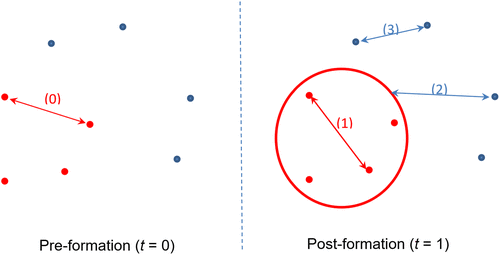
Notes. This figure plots the four types of free-rider problems in the ICAO context. Each dot represents an activist investor. The circle represents ICAO. Each arrow represents a type of free-rider problem.
In Figure 2, there are eight activists in total, each represented by a dot. At , on the right side of the figure, the four activists inside the circle belong to the ICAO and the other four activists are solo. At this activism stage, there are three types of free-rider problems in activism engagement: (1) free riding among ICAO members; (2) free riding between the ICAO and solo activists; and (3) free riding among solo activists. The presence of the ICAO can overcome the free-rider problem among ICAO members (1), but it cannot overcome, or might even strengthen, the other two types of free-rider problems (2) and (3).
At , on the left side of the figure, all eight activists are identical. When forming an ICAO, there is a free-rider problem associated with the coordination cost (labeled (0) in Figure 2). As mentioned above, we assume this free-rider problem is overcome through cost sharing among those activists that decide to join the ICAO.
In summary, the ICAO can coordinate among its members which allows it to overcome the two types of free-rider problems represented by (0) and (1) (“resolvable” free-rider problems) in Figure 2. It cannot resolve the free-rider problems represented by (2) and (3) (“unresolvable” free-rider problems). In the next section, we demonstrate how the interactions among these various free-rider problems—in particular, the interactions between free-rider problems (1) and (2)—determine the equilibrium ICAO size.
3. Equilibrium and Properties
The equilibrium in our setting is defined by two subequilibria at dates 0 and 1, respectively. At date 1, the ICAO and solo activists simultaneously choose their activism effort based on private information about their own share positions. Their optimal activism strategies form a Bayesian Nash equilibrium. At date 0, activists simultaneously decide whether to join the ICAO, in anticipation of the date-1 Bayesian Nash equilibrium, and their optimal decisions form a Nash equilibrium. As usual, we compute the equilibrium backward.
3.1. Equilibrium Activism Effort
The date-1 Bayesian Nash equilibrium is straightforward. Using Equations (3) and (6), we can compute the optimal activism strategies of solo activists and the ICAO, which are summarized in the following proposition (The proof is straightforward and thus omitted).
At date 1, there exists a unique Bayesian Nash equilibrium in the activism game, with activism policies of the ICAO and solo activist j respectively given by
Using Proposition 1, we can compute the average levels of activism effort and the average firm value :
Analyzing these expressions, we obtain the following proposition:
Under additive activism technology (1), collective activism does not affect the average activism effort of solo activists (i.e., for ). As long as activists have long positions on average, activists that join the ICAO, on average increase their effort. The more activists that join the ICAO the greater the increase in firm valuation (i.e., for fixed K, if , then for and ).
There are three points to note from these results. First, if an ICAO forms, solo activists engage in less activism than activists that join the ICAO. Due to the additive activism technology specified in Equation (1), the average activism level of solo activists is unaffected by the size of the ICAO, I. Second, as long as activists are endowed with long positions on average (i.e., ), the average activism level of each ICAO member increases with I. In Section 5 we discuss that in practice, ICAO members on average hold long positions and their activity increases firm value. Third, firm value increases with I. Given that is convex in I, there is an increasing benefit of a larger ICAO. As the ICAO becomes larger, all members increase their activism effort. Overall, when activists are endowed with long positions on average, the presence of an ICAO improves economic efficiency, consistent with Doidge et al. (2019) who find that the creation of an ICAO improves governance outcomes and firm valuation. The increase in value is larger when more activists join the ICAO and when the average stake of activists is larger.
3.2. Equilibrium ICAO Formation
We now go back to date 0 to consider formation of the ICAO, which is determined by the Nash equilibrium of the activists’ ICAO joining game.4 Formally, at date 0, each activist simultaneously decides whether to be an ICAO member or a solo activist. The equilibrium number of activists that choose to become an ICAO member endogenously pins down the size of the ICAO, I. The unconditional expected profits evaluated at the date-1 Bayesian Nash equilibrium serve as the activists’ payoffs in the date-0 ICAO joining game. The Nash equilibrium of the date-0 game is a state described by no-deviation conditions by those that choose to become an ICAO member and by those that decide to stay solo. We consider only a pure-strategy equilibrium at date 0.
3.2.1. Activism Payoffs.
We insert the equilibrium activism policies in Proposition 1 into the objective functions of solo activists and the ICAO in (3) and (6) and take expectations to compute the unconditional expected profits for a representative solo activist and for an ICAO member. The unconditional expected profit of a representative solo activist j is
The first term captures the direct effect of solo activist j’s own activism effort on its payoff. The second and third terms represent the payoffs from free riding on the ICAO’s activism effort and on other solo activists’ activism efforts (i.e., free-rider problems (2) and (3) in Figure 2). We can show that increases with I. Specifically, increasing I has two effects on . First, it strengthens the benefit from free riding on the ICAO’s efforts via the second term in Equation (7). Second, an increase in I implies a decrease in the number of solo activists, J, which in turn weakens the benefit from free riding on the other solo activists’ efforts via the third term in (7). Overall, the positive effect dominates the negative effect because the ICAO can better coordinate its members’ activism efforts.
Similarly, we can compute the unconditional expected profit of the ICAO as follows:
The first and third terms indicate that the ICAO can overcome the free-rider problems within its members in terms of activism engagement and ICAO formation (i.e., free-rider problems (1) and (0) in Figure 2), and thus fully coordinates the activism actions and cost sharing across its members. The second term indicates that the ICAO free rides on solo activists’ activism efforts (i.e., free-rider problem (2) in Figure 2). The payoff of a representative ICAO member is
A representative ICAO member’s payoff also increases with I. Again, an increase in I affects in two ways. First, by admitting more members, the ICAO has access to more activism technologies and more private information, which benefits all its members (i.e., the first term in (9)). Second, an increase in the size of the ICAO implies a decrease in the number of solo activists, which reduces the payoffs from free riding on solo activists’ efforts (i.e., the second term in (9)). Again, because ICAO members act collectively, the first positive effect dominates.
3.2.2. Equilibrium Conditions.
The equilibrium ICAO size, , is determined by the Nash equilibrium of the activists’ ICAO joining game at date 0, which requires that each activist’s ICAO joining decision is optimal given the other activists’ equilibrium ICAO joining decisions. Consider an interior ICAO size . An existing ICAO member receives a payoff of . If it withdraws from the ICAO, the size of the ICAO shrinks by one. The deviating ICAO member becomes a solo activist and receives a payoff of . Thus, the nondeviation condition of an ICAO activist is:
An existing solo activist receives a payoff of . If it deviates and decides to join the ICAO, the size of the ICAO becomes and the deviating activist receives a payoff of . This implies the following nondeviation condition of a solo activist:
An interior equilibrium requires that both condition (10) and condition (11) hold simultaneously.
For corner equilibria in which all activists are either solo activists or all activists join the ICAO, only one of the above two conditions need to hold. Specifically, all activists join the ICAO, that is, , if and only if condition (10) holds at . No ICAO is formed, that is, , if and only if condition (11) holds at . That is,
Conditions (10) and (11) essentially compare payoff functions and . The left panel of Figure 3 plots these two payoff functions for a specific parameter configuration. We can express these two conditions by defining the benefit of a solo activist switching to an ICAO member as follows:
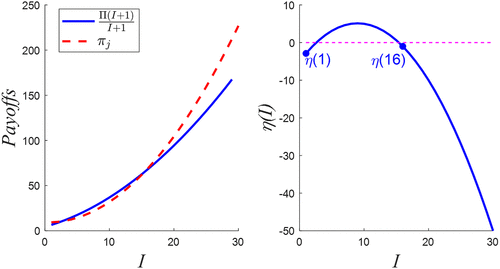
Notes. The left panel plots the payoff functions and for an ICAO member and a solo activist. The right panel plots the benefit function of joining the ICAO. The parameter values are: , , , , and .
With this benefit function , the conditions (10) and (11) that characterize an interior ICAO size are equivalent to the following:
The two corner equilibria are defined similarly. That is, if and only if ; if and only if . Of particular interest is when the benefit function is equal to zero, as this crossing-zero point determines an equilibrium.
Using the expressions of and in Equations (7) and (9), we can compute
Since the equilibrium ICAO size is pinned down by the benefit function , Equation (17) suggests that is determined by four variables: the average stake of activists, , the activism cost, , the degree of information asymmetry in the economy, , and coordination costs . We note that the payoff function, and hence the determination of equilibrium size of the ICAO, does not depend on the sign of since affects the benefit function through .
The right panel of Figure 3 plots the benefit function . We can see that is hump-shaped, and crosses the zero line twice. Two equilibrium ICAO sizes arise because (1) (and hence ) and (2) and (and hence ). Specifically, implies that . That is, the expected profit for a solo activist to join the ICAO is negative. Therefore, it would not join and one equilibrium is no ICAO formation (i.e., ). Next consider conditions and , which correspond respectively to the two no-deviation conditions at the other equilibrium . The first condition implies that . With 16 members, each ICAO member receives a greater profit than it would as a solo activist. The second condition implies that . Therefore, at 16 members the solo activist would be better off remaining as a solo activist and free riding off of the activism of the ICAO. Taken together, is also an equilibrium.
The hump-shape of the benefit function is driven by the interactions among the four free-rider problems discussed in Subsection 2.3. This hump shape leads to equilibrium multiplicity because it determines how the benefit function crosses zero, which in turn determines the equilibrium. We further examine these two connected features in the next subsection, after we analytically characterize the equilibrium size of the ICAO.
3.3. Properties of Equilibrium ICAO Size
We now characterize the equilibrium ICAO size, , and discuss its properties. Intuitively, depends negatively on the coordination cost associated with working in the ICAO which we capture with the parameter : A high coordination cost directly reduces the payoff to an ICAO member and hence leads to a low value of . The specific pattern of how varies with is determined by the ratio , which is a measure of information asymmetry in the economy at date 0. When is higher, there is greater uncertainty about the shareholding of any activist. Therefore, with higher information asymmetry, an activist has a greater incentive to join the ICAO as it benefits more from information sharing among ICAO members.
We first characterize the equilibrium ICAO size when information asymmetry is limited. Specifically, when , is given by the following lemma.
When , the equilibrium ICAO size is
While we can compute the expression of when , it becomes sufficiently messy that we prefer to graphically demonstrate the patterns in Figure 4. Each panel in the Figure presents the equilibrium ICAO size on the y-axis and coordination costs on the x-axis. The top left panel has limited information asymmetry, with greater information asymmetry in each subsequent panel, as indicated. In each panel, is lower when coordination costs are higher. For a given level of coordination costs, as information asymmetry increases, also increases. We can see this result by comparing results across panels. We formally state these results in the following proposition.
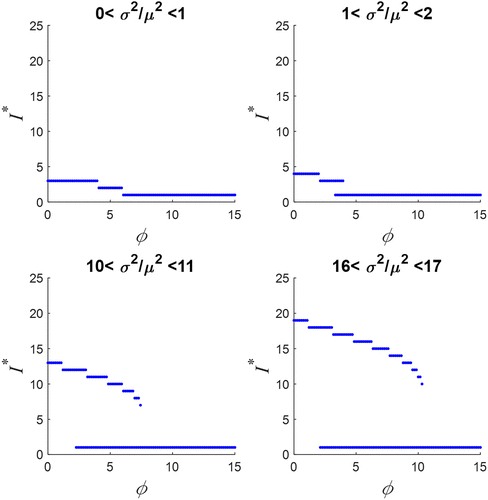
Notes. This figure plots the equilibrium ICAO size . The parameter values are: , , and .
When an ICAO is formed, equilibrium ICAO size, , is a downward-sloping step function of the coordination cost . The number of line segments of the step function is determined by the ratio . The ending points of each segment are proportional to and depend on and .
In the next two subsections, we discuss two key properties of the equilibrium ICAO size, .
3.3.1. Free-Rider Problems and ICAO Size.
Obviously, when the coordination cost is high, an ICAO is not formed. To demonstrate the roles of the different types of free-rider problems in determining ICAO formation, we next focus on the case with a sufficiently small coordination cost.
For sufficiently small coordination cost , the equilibrium ICAO size is
(Lower bound) When there are at least two activists, an ICAO always forms. In addition, if there are more than two activists, the ICAO includes at least three members.
(Upper bound) When there are many activists, they endogenously divide into two groups: one group of activists form an ICAO, while the other group of activists stay solo. That is, when K is large, we have .
Proposition 4 demonstrates that linearly depends on the ratio when the coordination cost is small. This proposition delivers two implications. First, when the coordination cost is sufficiently low, an ICAO will always form (i.e., when ). Or in other words, the absence of an ICAO suggests that the coordination cost must be high. Second, there is an upper bound for ICAO size. In an economy with many activists, in equilibrium, the ICAO does not take all activists as members even when the coordination cost is low. Instead, activists are endogenously divided into two types, ICAO members and solo activists, that is, when K is large, we have .
These two implications are driven by the interaction among the four free-rider problems discussed in Subsection 2.3. In our setting, the ICAO can resolve two of the free-rider problems by specifying that its members equally share the coordination cost (i.e., resolving the free-rider problem in ICAO formation), and to fully share information and coordinate in engaging activism effort (i.e., resolving the free-rider problem among ICAO members in activism engagement). However, by its coalition feature, the ICAO can only interact noncooperatively with other solo activists. It cannot resolve the free riding between the ICAO and solo activists and the free riding among solo activists. The resolution of the first two types of free-rider problems enhances the payoff of ICAO members and helps ICAO formation, which explains the first implication. The presence of a large ICAO exaggerates the free-rider problem between the ICAO and solo activists, which benefits solo activists and limits ICAO size, which explains the second implication.
Graphically, these implications are captured by the hump shape of the benefit function in the right panel of Figure 3. The benefit function, , of a solo activist that switches to become an ICAO member is increasing in I when I is low and is decreasing in I when I is high. The upward sloping segment comes from the benefit of the ICAO coordinating across its members. When the ICAO admits more members, it coordinates across more members, and thus its joint activism effort delivers a higher payoff to its members. This higher payoff increases the incentive of an activist to join the ICAO. The downward sloping segment is due to the fact that a solo activist free rides on the ICAO’s activism effort. When the ICAO becomes larger, the free riding benefit to a solo activist also becomes higher, which decreases the incentive to join the ICAO.
3.3.2. Multiplicity of Equilibrium ICAO Size.
In addition to implications for the lower and upper bounds of , the hump shape of the benefit function, , also implies another key property of : multiplicity of equilibrium ICAO size. As illustrated in the right panel of Figure 3, two equilibrium values of arise for the parameter configuration considered in the figure: and .
This multiplicity result is generic. Specifically, in Figure 4, when , there are multiple equilibrium ICAO sizes. The figure plots the equilibrium ICAO size, , against the coordination cost, . If the coordination cost is sufficiently large, no ICAO forms. If there are almost no coordination costs, an ICAO always forms (see Proposition 4). Perhaps of most interest is the situation in which the coordination costs are moderate as there are multiple equilibria. For instance, in the bottom right panel of Figure 4, when , no ICAO forms. When , there is a unique equilibrium with or . When , there are two equilibria.
When there are multiple equilibria, equilibrium selection becomes relevant. The usual ways to select equilibrium are based on either stability or Pareto efficiency. Under the stability criterion, activists will coordinate on a stable equilibrium. In a stable equilibrium, when there is a perturbation disrupting the equilibrium, there exist forces restoring the economy to its initial equilibrium. In our context, a stable equilibrium corresponds to the equilibrium ICAO size that lies on the downward sloping segment of which corresponds to the equilibrium with a larger . To see this, the right panel of Figure 3 shows two equilibrium , 1 and 16. Consider a perturbation to , for example, suppose ICAO size increases to . From the figure, we observe that , which implies that (recall that ). That is, with 20 members, an ICAO member is worse off relative to staying solo and hence ICAO members want to become a solo activist, which reduces the size of the ICAO. Similarly, suppose that ICAO size perturbs to a smaller number, . Again, from the figure, we observe that and thus, so that solo activists want to join the ICAO, which increases the size of the ICAO. By contrast, the equilibrium with a smaller is unstable, because a perturbation causes ICAO size to become even larger.
Under the Pareto efficiency criterion, activists will also coordinate on the equilibrium with a larger . This is because both an ICAO member and a solo activist are better off with a larger ICAO (see the left panel of Figure 3). Thus, in our setting, under both stability and Pareto efficiency criteria, the equilibrium with a larger will be selected. This equilibrium also features a higher firm value relative to the equilibrium with a smaller .
In addition, the Pareto efficiency criterion can be justified through the following sequential-move game. We randomly select one activist, say activist 1, to act as the leader. This leader decides how many activist investors to include in forming an ICAO. The contacted followers, aware of the number of activists invited, then simultaneously decide whether to join the proposed ICAO. The unique subgame perfect equilibrium in this sequential-move game corresponds to the Pareto efficient equilibrium in our original simultaneous-move game.
Equipped with the stability or Pareto efficiency criterion, we are able to select a unique equilibrium. Nonetheless, the selected unique equilibrium from the multiple equilibria implies a discontinuous jump in the equilibrium outcomes as we change primitive model parameters. For instance, a small change in coordination costs can lead to a large change in the equilibrium ICAO size. Again, we use the bottom right panel of Figure 4 to illustrate this point. Suppose that activists always coordinate on the equilibrium with a larger . Then, as decreases slightly below 10 from above, the equilibrium changes from no ICAO to an ICAO with members. Note that this jump result actually does not depend on which equilibrium the activists coordinate upon. Alternatively suppose that activists always coordinate on the equilibrium with a smaller . A similar result obtains: As decreases from above toward 2, no ICAO is formed, but as decreases slightly below 2, the equilibrium features an ICAO with members. Overall, our analysis shows that even if there is no ICAO in a particular market, a relatively small change in coordination costs can lead to a large group of investors acting collectively.
We summarize this result in Proposition 5.
If , there exists a unique ICAO size . If , there can exist multiple equilibrium ICAO sizes. When this multiplicity arises, a small change in parameter values can lead to a large change in the equilibrium ICAO size.
This multiplicity result has two implications. First, once an ICAO is formed, its size must be large. Hence, similar to the large shareholder solution of Shleifer and Vishny (1986), ICAOs can serve as a mechanism to provide the public good of monitoring managers, as the ICAO is the largest consumer of the public good and pays for it. Second, the road to value creation is not a continuous one, but one with jumps in activism that depend on coordination costs, which we will explore further in Section 5.
4. Variations and Extensions
In this section, we consider four variations and extensions of the model to examine the robustness of our results: (1) partial enforcement of effort coordination across ICAO members; (2) private information about activism technologies; (3) trading in financial markets; and (4) coordination costs that vary with ICAO size.
4.1. Partial Enforcement of Effort Coordination
In our baseline model presented in Section 2, the ICAO fully overcomes the free-rider problem across its members by coordinating information and effort. We implement this coordination by specifying the ICAO as a single decision maker that possesses all of its members’ information and chooses the optimal activism effort on their behalf. That is, information coordination is captured by the fact that ICAO members share their private information with the ICAO. Coordination of effort is captured by the fact that when choosing its activism effort, the ICAO’s objective is to maximize its members’ joint profits. What matters is the shared objective among ICAO members, regardless of whether the effort is chosen by the ICAO, or separately by its members. Even if each member chooses its own activism effort, the optimal effort level remains the same as long as each member maximizes the joint profits.
In practice, the ICAO may not have full enforcement power. This is particularly true for coordination of effort because it may be difficult for the ICAO to completely dictate its members’ actions. However, cooperative outcomes do not require full enforcement by a central authority. Experimental and field evidence suggests that groups can often sustain cooperation through communication, reciprocity, and self-governance, even without a central enforcer. Consistent with this view, Ostrom et al. (1992) show that communication alone can increase cooperation and that self-governance can emerge without external authority. Ostrom (1998) further emphasizes that face-to-face communication is especially effective in promoting cooperation in social dilemmas.
To capture partial enforcement of effort coordination, we consider the following extension to the model. We interpret the ICAO as a platform that engages in full information sharing (thereby fully coordinating private information) and partial profit sharing (thereby partially coordinating effort). Specifically, ICAO members fully communicate their private information to other members, but each ICAO member i chooses its own activism effort to maximize a linear combination of its own profit and the joint profit: . Here, is the member’s own profit, is the total joint profit of the ICAO, and is a constant fraction. Implementation-wise, one can think of a situation in which each ICAO member contributes a fraction f of its own profit to the ICAO, which in turn pools all the contributions and then equally redistributes across its members. Under this profit-sharing arrangement, each member keeps the remaining fraction of its own profit (i.e., ) and receives an additional allocation from the ICAO (i.e., ). Parameter f can also be considered a fee for participating in the ICAO. For example, in practice, the CCGG charges fees to its members based on their AUM.
Parameter f controls the enforcement level of the ICAO’s action dictation: a higher f represents a higher level of effort coordination. In particular, when , the setting degenerates to our baseline model with full effort coordination. Since the derivation is similar to that in the main model, we relegate the details to Online Appendix A.
Our results are generally robust to this extension. Specifically, we show that as long as the ICAO has a certain level of enforcement (i.e., ), Proposition 2 continues to hold: Collective activism increases firm value, as long as activists have long positions on average. In addition, at the ICAO formation stage, the benefit function of joining the ICAO is still hump-shaped, and thus the equilibrium ICAO size still features multiplicity.
4.2. Private Information About Activism Technologies
In the baseline model, we model valuable private information as activists’ share positions and allow investors that join the ICAO to share private information about these positions. Beyond share positions, ICAO members may also have better knowledge of other members’ governance expertise, their impact on firm value, or, more generally, private information about members’ activism technologies within the organization. In this subsection, we extend our analysis to further consider the sharing of information about activism technologies within the ICAO.
In particular, we introduce private information about activism technologies and modify Equation (1) as follows:
In Online Appendix B, we show that accounting for private information about activism technologies does not change the equilibrium structure, and our results therefore continue to hold in this extended setting. That is, at the stage of activism, increasing ICAO size improves firm value as long as activists have long positions on average. At the ICAO formation stage, there exists strategic complementarity in activists’ decisions to join the ICAO, and thus multiple equilibria can exist.
4.3. Trading in Financial Markets
In our baseline model, we focus on shareholder engagement and shut down the possibility of activist gains from trading activity. In Online Appendix C, we analyze an extended setting where we allow activists to trade to exploit the increased information from joining the ICAO. We follow Back et al. (2018) and model the financial market as a Kyle (1985) trading game in which activists and noise traders submit market orders to a risk-neutral market maker who sets the price as the conditional expectation of firm value, given total order flows. Our results are robust to this extended setting with trading in a financial market.
First, at the stage of activism, increasing ICAO size still improves firm value as long as activists have long positions on average. With trading, this extension can speak to market quality metrics such as liquidity, modeled as the inverse of Kyle’s lambda (Kyle 1985). We show that increasing ICAO size worsens market liquidity because the market maker faces a more severe adverse selection problem in the presence of a large informed trader, the ICAO.
Second, at the ICAO formation stage, the benefit function of joining the ICAO remains hump-shaped, and thus the equilibrium ICAO size continues to feature multiplicity. This is because the hump shape of is determined by the interactions among the four free-rider problems. We also find that allowing trading increases the benefit of joining the ICAO due to the combined effects of shared information and coordinated trading.
4.4. Coordination Costs That Vary with ICAO Size
The baseline model assumes that an activist incurs a constant coordination cost if it joins the ICAO. The total coordination cost for the ICAO is simply the sum of the costs for each of its members. We choose this simple assumption to transparently illustrate that the driving forces at the activism stage are the interactions among the different free-rider problems. In particular, the hump shape of is driven by the facts that the ICAO coordinates its members’ activism efforts and that solo activists free ride on the ICAO’s activism effort. The constant coordination cost of joining the ICAO does not affect the shape of , but rather shifts it downward.
In practice, the coordination cost can change with the number of ICAO members. For instance, there might be a fixed cost to form the ICAO so that admitting more members implies that each members’ share of the fixed cost is lower. Adding this feature will not qualitatively change our results. In fact, fixed cost sharing strengthens the hump shape of because it adds an additional force to increase the benefit of joining the ICAO, which contributes to the upward-sloping segment of .5 This force becomes more limited when the ICAO becomes large, so that is still downward-sloping for large I. Alternatively, coordination costs could increase with the number of members (e.g., Olson (1965) makes this conjecture). If this is the case, this force will weaken the upward-sloping segment, but as long as this force is not strong, our results will go through.
5. Discussion and Implications
In our model, investors have different initial share positions but otherwise are assumed to be homogeneous. These investors have long positions on average and thus their activism is expected to create value. Investors that join an ICAO choose to share information and costs and the ICAO engages in activism directly with firms. In this section we connect these model features to practice and draw additional insights.
5.1. What Types of Activists Join an ICAO?
Examples of ICAOs with a national focus include the CCGG (Canada, formed in 2003), Eumedion (Netherlands, 2006), the UK Investor Forum (2014), and the Japan Institutional Collective Engagement Forum (2017). ICAOs with a global membership include the UNPRI (2006), the International Investors Group on Climate Change (2012), and the Asia Investor Group on Climate Change (2016). The investors that join ICAOs differ not only in their ownership stakes but also in their investment horizons and place different importance on strategic concerns and risks of activism.
We reviewed the membership of the ICAOs listed above. Full membership in national ICAOs is reserved for institutional investors that own shares in domestic listed companies. ICAO members are large on average (i.e., they have the most to gain from value improvements) and are on average long investors. We find that there are multiple types of investors in an ICAO. Together, active asset managers and pension funds account for over 80% of membership in both national and global ICAOs. Passive asset managers also join ICAOs. They account for 5% (7%) of the membership in national (global) ICAOs. While passive managers have weaker incentives to engage in activism (e.g., Lewellen and Lewellen 2022), the cost sharing feature of ICAO activism may appeal to passive asset managers, as well as the risk mitigation provided by group activism not attributed to a specific member. Hedge funds do not join ICAOs, perhaps as a result of limited overlap in activism technologies. Hedge funds also likely have more significant strategic concerns about sharing information about shareholdings and activism strategies with other activists.6
5.2. Expected Value Impact of ICAO Activism
The literature on shareholder activism provides context for the expected value impact of ICAO activism. The survey paper by Denes et al. (2017) concludes that activism that adopts some characteristics of corporate takeovers, for example, significant shareholdings and potential to threaten a change in control, is associated with a significant increase in firm value, whereas the returns to other types of activism are smaller. For example, they report that abnormal returns to hedge fund activism range from 3%–7%. Greenwood and Schor (2009) find that such activism is commonly associated with a subsequent change of control. ICAOs benefit from the ability to concentrate shareholdings, but ICAO activism does not involve a change in control for regulatory reasons. This suggests that the expected impact on value from a specific ICAO engagement is moderate. Denes et al. (2017) also discuss evidence that shows activism is not always value enhancing. For example, activism initiated by investors that have conflicting goals and private objectives are associated with a stock price decline at target companies. However, value destroying activism by an ICAO is unlikely as ICAO membership always includes investors of different types which provides incentives to focus on common value rather than private values.
Direct evidence on the value impact of ICAOs is provided in Doidge et al. (2019) and Dimson et al. (2026). In an event study around the announcement of the CCGG’s formation, Doidge et al. (2019) find a positive impact on value, with a 1.3% higher abnormal return for firms in which prospective ICAO members had higher ownership stakes. Dimson et al. (2026) focus on collaborative engagements on ESG policies via the UNPRI and find that engagements that include a lead investor are associated with a 4.7% abnormal return in the first two years following the initiation of an engagement.
Previous research provides additional evidence on the potential value of ICAO activism. ICAO engagements focus on firm-specific issues, as well as general governance principles that investors can pursue through shareholder proposals and other activism efforts. For example, Cuñat et al. (2012) exploit the discontinuity created by close shareholder votes on governance proposals and find that proposals that narrowly pass generate abnormal returns of 1.3% relative to those that narrowly fail. Other studies of shareholder activism that correspond to specific governance themes in ICAO engagements also find a positive impact on value.7 Studies of environmental and social proposals provide mixed evidence, but, importantly, Dimson et al. (2026) find that ICAO engagements on these issues can improve the common value of all investors and go beyond an effort to increase members’ private values.
5.3. ICAO vs. a Large Shareholder
Both an ICAO and a large shareholder have the potential to address the public good problem of monitoring managers. We next ask how they compare. A large shareholder has two principal comparative advantages. First, a large shareholder does not incur coordination costs. Second, the set of activism technologies that a large shareholder chooses from is distinct from those available to an ICAO. Shleifer and Vishny (1986), for example, argue that large shareholders can force a change in control. Thus, they have the power to change management to implement their ideas, which can have a significant impact on value. ICAO technologies, because of regulatory concerns, are different and do not involve a change of control. Activism without a change of control is described as “jawboning” and as noted above has a smaller impact on value. In our setting the only distinct advantage of ICAO activism is that ICAOs have access to more activism technologies.
We can extend our framework to capture this trade-off. Formally, we assume that once an activist joins the ICAO, its activism productivity parameter drops from to (with ). We compare the equilibrium ICAO activism with that of a hypothetical large shareholder with the same share position . The trade-off is clear—the ICAO has more activism technologies than the large shareholder, but each technology is less effective (i.e., and ).8
5.4. ICAOs vs. Coordination by Hedge Fund Wolf Packs or Proxy Advisors
One alternative coordination mechanism to ICAOs is hedge fund activism via wolf packs. A hedge fund wolf pack is an informal coalition of hedge funds that engage a target in parallel. A lead activist identifies a target, conducts research, and acquires a stake. Other hedge funds acquire stakes and congregate around the target. Wolf pack activism is similar to activism by a large shareholder in that it utilizes a distinct set of activism technologies that has a high expected value because it is often associated with a change in control (Greenwood and Schor 2009). In contrast, ICAO activism involves a larger number of technologies, each of which has lower expected value. As such, ICAO activism is independent from wolf pack activism.
Proxy advisors conduct research and provide voting recommendations on director elections and shareholder proposals filed by other activists. If clients follow these recommendations, proxy advisors can also act as a coordination mechanism. This mechanism is similar to ICAO activism if there are a significant number of shareholder proposals and these proposals overlap with the activism technologies advocated by ICAOs.
We argue that proxy advisor coordination is a partial, but imperfect, substitute for ICAO activism. First, outside the United States there are very few shareholder proposals (Cziraki et al. 2010). Second, ICAOs propose different activism technologies in their engagements. In an private engagement, ICAOs propose multiple technologies to the firm.9 Proxy advisors provide voting recommendations on public shareholder proposals, each of which addresses a single issue. Moreover, shareholder proposals often follow a failed private engagement, and may address more contentious issues (McCahery et al. 2016, He et al. 2023). Third, proxy advisors do not have a financial interest in the outcome of a vote and may provide biased recommendations (e.g., Ma and Xiong 2021, Malenko et al. 2025). As such, proxy advisors will coordinate fewer votes as investors are less likely to follow their recommendations.
If there are few shareholder proposals and the overlap in activism technologies between ICAOs and proxy advisors is minimal, they are effectively independent. In this case, ICAO activism will continue to create value in the presence of a proxy advisor. In contrast, if there is more overlap and there are fewer unique activism technologies for ICAOs to introduce, the incremental value of ICAO activism is lower. This can be modeled as a decrease in the productivity of activists, , which results in a decrease in ICAO size and its expected impact. However, because proxy advisors are only imperfect substitutes, ICAOs remain productive and the impact on is not so large that it stops ICAO formation.
5.5. Asset Management Industry Changes and ICAOs
We next consider how changes in the asset management industry in the last few decades, from the perspective of our model, are predicted to impact ICAO formation. Equation (17) shows that four variables impact the shape of the benefit function of an ICAO. These are the average stake of activists, , the productivity of activists, , the degree of information asymmetry in the economy, , and coordination costs . The first two of these, activist stakes and productivity, have arguably changed the most.
Mergers of mutual funds and the growth of passive asset managers, which, on average, are large (Dasgupta et al. 2021), have contributed to an increase in the average stakes of activist investors. In Equation (17) the average stakes of activist investors, , shows up in the first term with both a positive and negative sign. With a higher , there are greater activism incentives for each ICAO member. However, a higher also has a cost, as the unresolvable free-rider problems become more severe. Fewer solo investors choose to join the ICAO. This negative effect dominates, such that in almost all cases a higher average stake reduces the size of the ICAO.
The shift to passive asset managers, which are generally considered less effective monitors than active investors (see e.g., Heath et al. 2022), suggests a decrease in average activist productivity. Equation (17) clearly shows that a decrease in productivity reduces the benefit of joining the ICAO, resulting in a lower ICAO size and potentially stopping ICAO formation.
Thus, the two most important changes in the asset management industry, an increase in activist stakes and a decrease in activist productivity, both predict less ICAO formation and more limited ICAO size. These predictions are inconsistent with patterns in ICAO formation and activity, which show ICAO formation taking place in the 2000s and 2010s.
5.6. Coordination Costs
One variable in the model that could explain why we observe an increase in ICAO formation, and ICAOs that include many activists, is a reduction in coordination costs. There are two ways that coordination costs associated with ICAO formation can be reduced: (1) legal and regulatory reforms that provide investors comfort that working in concert will not invite regulatory actions or mandatory offers; and (2) changes in the funding model for ICAOs to subsidize coordination costs. There are indications of changes to both.
Regulations almost always include language that seeks to impose costly obligations on those “acting jointly or in concert.” These costs include enhanced disclosure requirements, restrictions on trading around takeover events, and mandatory bid requirements. The phrase acting in concert is intentionally vague and seeks to capture both overt and covert efforts to coordinate. McCahery et al. (2016) find that investors’ legal concerns about coordinated engagement are important. The survey results in Mazars (2010) further illustrate investor concerns: “During interviews, several institutional investors have expressed difficulties they have experienced and highlighted the legal uncertainty in defining the legitimate boundaries within which they can discuss or take actions collectively, and engage with these with companies collaboratively without running the risk of seeing this collaboration qualify as ‘acting in concert’.”
Regulatory reforms that provide safe harbor for some forms of investor collective action can lower coordination costs and lead to new ICAO formation. Doidge et al. (2019) provide a specific example of a change in proxy rules in Canada that lowered coordination costs and led to the formation of the CCGG. Balp and Strampelli (2020) describe expanded safe harbor provisions for investors to work collectively, from both the introduction of European-wide legislation and country-specific reforms, that facilitated collective action in Europe.
Clarification of existing regulations also helps. For example, the Collective Engagement Working Group (2013) Report recommended the formation of the Investor Forum in the UK. The Report discusses acting in concert concerns as an impediment to collective engagement and notes that The Takeover Panel (2009) Practice Statement No. 26 “is very helpful and clarifies that the risk that collective action would trigger a mandatory offer requirement is negligible.” Starting in 2010, the UNPRI worked with law firms to provide guidance on collaborative engagement and acting in concert rules in key jurisdictions (Principles for Responsible Investment 2021).
Subsidization can also lower coordination costs. The typical funding model of an ICAO involves members paying for the service of the ICAO through membership dues, which can depend on the assets controlled by each member (see e.g., Doidge et al. 2019). Another source of funding for ICAOs is through donations. The UN PRI’s Collaboration Platform is designed to address the collective action problem by serving as a third-party coordinator to share information, facilitate coordinated engagements, and reduce costs. We note that its funding model includes grants from governments, foundations, and other philanthropic partners. For example, in 2020/2021, the category “grants, donations, other” accounted for 15% of its annual budget. Similar subsidy mechanisms are evident on the web pages of other investor collective action organizations (e.g., “donate here” buttons). These subsidies can be easily rationalized, as NGOs and philanthropists correctly see that investor activism to improve a firm’s material environmental (E) or social (S) performance also serves their interests in making a broader societal impact.
5.7. ICAO Activism in the United States?
ICAO activism is limited in the United States. This can partially be explained by the prevalence of shareholder proposals, which can make coordination by proxy advisors a closer substitute to ICAO activism. A second factor is regulatory costs, that is, safe harbor provisions for investors that engage collectively are limited. Moreover, these costs will increase following a change in SEC staff guidance on February 11, 2025. The new guidance indicates that a shareholder, or group of shareholders, that ask for specific measures or governance changes could be viewed as attempting to influence control. Such investors could no longer report their beneficial ownership on a short-form Schedule 13G as a passive investor, but rather would have to file a long-form Schedule 13D, which is a more onerous and costly filing intended for investors that seek to influence control.10 Therefore, a shareholder that engages firms on corporate governance issues such as staggered boards, majority voting, poison pills, executive compensation, etc., may now have to comply with the more costly and onerous reporting requirements of a long-form Schedule 13D. This change effectively raises the costs of activism for large investors.
To understand how this change in guidance impacts ICAO formation in our model, we capture the associated increase in activism costs as a decrease in the activist productivity parameter in Equation (2). A decrease in is isomorphic to an increase in the coordination cost in our setting. To formally understand this point, note that the equilibrium ICAO size is determined by the benefit function . Importantly, what matters is when crosses zero, and thus the sign of . By examining the expression of in Equation (17), we observe that
Since what matters for pinning down is the sign, not the magnitude, of the function , we can treat the ratio as a single parameter in determining . Therefore, a decrease in has the same implications as an increase in . As such, the model predicts that this change in guidance could influence ICAO formation and impact, leading to a decrease in ICAO size or an equilibrium with no ICAOs.
In summary, the model identifies activist investor characteristics, coordination costs, and activism costs as key potential determinants of the formation and size of the ICAO. The discussion in this section suggests that observed reductions in coordination costs, rather than changes in activist characteristics, are more likely to explain recent instances of ICAO formation. The recent change in SEC guidance could also have implications for ICAO formation. In the future, further changes in coordination costs or activism costs—either through regulatory reforms or subsidization—are likely to have the most significant impact on ICAO formation and activity.
6. Conclusion
We develop a framework to study the implications of collective activism of institutional investors through an ICAO. We analyze the endogenous formation of an ICAO and its equilibrium size. In our setting, ICAO members can effectively share their private information and coordinate their activities to pursue a common goal. When activists have long positions on average, collective activism improves activism effort and firm value. Our analysis of ICAO formation highlights that an ICAO can overcome the free-rider problems across its members but exacerbates the free-rider problem between the ICAO and solo activists. This implies that the net benefit of joining the ICAO is hump-shaped in ICAO size. As a result, two key properties of the equilibrium ICAO size emerge. First, when there are many activists in the economy and the coordination cost is low, they endogenously divide into two groups: one group of activists form an ICAO, while the other group of activists stay solo. Second, ICAO formation can feature multiple equilibria. This implies that a small reduction in coordination costs can spur significant ICAO formation. We show that our results are robust to various variations and extensions, such as partial enforcement of effort coordination and private information about activism technologies. We draw insights from the model and connect these insights to recent changes that affect regulations, investor activism, and ICAO activity.
The authors thank the editor (Will Cong), an associate editor, and two anonymous referees for constructive comments that have significantly improved the paper. The authors also thank Kerry Back, Vyacheslav (Slava) Fos, Itay Goldstein, Xuewen Liu, Zhiyang Luo, Dermot Murphy, Marzena J. Rostek, Eyub Yegen and Yizhou Xiao, and seminar participants at University of Zurich, the 2021 Northern Finance Association (NFA) Annual Meeting, the 2022 Midwest Finance Association (MFA) Annual Meeting, and the 2023 University of Alberta Frontiers of Finance Conference for insightful comments and suggestions. The authors thank Eyub Yegen for sharing data on institutional ownership.
1 Doidge et al. (2019) document that information sharing is an important aspect of the activities of the CCGG.
2 We normalize the total number of shares to 1, with the remaining shares held by non-activist investors. Our analysis focuses exclusively on active investors’ behavior. Non-activist investors play no substantive role in our framework. In Subsection 4.3, we allow activists to adjust their initial positions through trading. Our key results remain robust.
3 Recall that we label ICAO activists by . So, the solo activist refers to activist , and hence its initial position is . In the following, we continue to use to respectively denote an ICAO member, a solo activist, and a generic activist.
4 The way we model ICAO formation follows closely the way the micro-structure literature models information acquisition in strategic trading settings with large traders (e.g., Admati and Pfleiderer 1988, Fishman and Hagerty 1992).
5 Veldkamp (2006) relies on fixed cost sharing to generate strategic complementarities in information acquisition in financial markets. Intuitively, as more investors acquire information, the cost each investor bears becomes lower, and so each investor has a higher incentive to acquire information. This force leads to an upward-sloping segment of the benefit function for information acquisition.
6 The median (mean) number of members in the national ICAOs is 38 (47), with representation from active asset managers (47%), pension funds (36%), insurers and banks (12%), passive asset managers (5%) and other (1%). Global ICAOs have more members, with representation from active asset managers (40%), pension funds (40%), insurers and banks (10%), passive asset managers (7%) and other (5%). Using AUM weights increases the representation of passive asset managers. All data are from ICAO web pages based on 2025 data, except for UNPRI which is based on members who participate in engagements reported by Dimson et al. (2026).
7 Doidge et al. (2019) report that three themes are common in CCGG engagements (adopting majority voting for directors, adopting say on pay, and improved compensation alignment through clawbacks and other policies). Evidence shows that these governance changes matter for firm value (e.g., Ferri and Maber 2013, Iskandar-Datta and Jia 2013, Ertimur et al. 2015, Cuñat et al. 2016).
8 This discussion does not consider additional costs that minority shareholders face when a firm is controlled by a large shareholder, such as private benefit consumption by the large shareholder. See, for example, Shleifer and Vishny (1997).
9 The Investor Forum (2024), for example, reports that each engagement is bespoke and raises multiple topics categorized into one of six categories (strategy, leadership, and succession; capital allocation; corporate governance; corporate action; operational performance; and management information, reporting, and communication). Doidge et al. (2019) report that CCGG engagements raise an average of seven governance topics, including firm-specific topics and overarching themes.
10 See the revisions to Question 103.11 and new Question 103.12 under “Exchange Act Sections 13(d) and 13(g) and Regulation 13D-G Beneficial Ownership Reporting,” available at: https://www.sec.gov/rules-regulations/staff-guidance/compliance-disclosure-interpretations/exchange-act-sections-13d-13g-regulation-13d-g-beneficial-ownership-reporting.
References
- (1988) A theory of intraday patterns: Volume and price variability. Rev. Financial Stud. 1(1):3–40.Crossref, Google Scholar
- (2009) The “Wall Street Walk” and shareholder activism: Exit as a form of voice. Rev. Financial Stud. 22(7):2645–2685.Crossref, Google Scholar
- (1994) Large shareholder activism, risk sharing, and financial market equilibrium. J. Political Econom. 102(6):1097–1130.Crossref, Google Scholar
- (2018) Activism, strategic trading, and liquidity. Econometrica 86(4):1431–1463.Crossref, Google Scholar
- (2020) Institutional investor collective engagements: Non-activist cooperation vs activist wolf packs. Ohio State Bus. 136 Law J. 14(2):135–211.Google Scholar
- (1932) The Modern Corporation and Private Property (Macmillan, New York).Google Scholar
- (2022) Wolf pack activism. Management Sci. 68(8):5557–5568.Link, Google Scholar
- (1988) Ownership structure and voting on antitakeover amendments. J. Financial Econom. 20:267–291.Crossref, Google Scholar
- (1991) Liquidity versus control: The institutional investor as corporate monitor. Columbia Law Rev. 91(6):1277–1368.Crossref, Google Scholar
Collective Engagement Working Group (2013) Report of the collective engagement working group. Technical report, Collective Engagement Working Group, London.Google Scholar- (2012) The vote is cast: The effect of corporate governance on shareholder value. J. Finance 67(5):1943–1977.Crossref, Google Scholar
- (2016) Say pays! Shareholder voice and firm performance. Rev. Finance 20(5):1799–1834.Crossref, Google Scholar
- (2010) Shareholder activism through proxy proposals: The European perspective. Eur. Financial Management 16(5):738–777.Crossref, Google Scholar
- (2021) Institutional investors and corporate governance. Foundations Trends Finance 12(4):276–394.Crossref, Google Scholar
- (2017) Thirty years of shareholder activism: A survey of empirical research. J. Corporate Finance 44:405–424.Crossref, Google Scholar
- (2026) Coordinated engagements. J. Finance. Forthcoming.Google Scholar
- (2019) Collective action and governance activism. Rev. Finance 23(5):893–933.Crossref, Google Scholar
- (2009) Blockholder trading, market efficiency, and managerial myopia. J. Finance 64(6):2481–2513.Crossref, Google Scholar
- (2011) Governance through trading and intervention: A theory of multiple blockholders. Rev. Financial Stud. 24(7):2395–2428.Crossref, Google Scholar
- (2015) Does the director election system matter? Evidence from majority voting. Rev. Accounting Stud. 20(1):1–41.Crossref, Google Scholar
- (2008) The colors of investors’ money: The role of institutional investors around the world. J. Financial Econom. 88(3):499–533.Crossref, Google Scholar
- (2013) Say on pay votes and CEO compensation: Evidence from the UK. Rev. Finance 17(2):527–563.Crossref, Google Scholar
Financial Reporting Council (2020) The UK stewardship code 2020. Report, Financial Reporting Council, London.Google Scholar- (1992) Insider trading and the efficiency of stock prices. RAND J. Econom. 23(1):106–122.Crossref, Google Scholar
- (2009) Investor activism and takeovers. J. Financial Econom. 92(3):362–375.Crossref, Google Scholar
- (1980) Takeover bids, the free-rider problem, and the theory of the corporation. Bell J. Econom. 11(1):42–64.Crossref, Google Scholar
- (2023) ES risks and shareholder voice. Rev. Financial Stud. 36(12):4824–4863.Crossref, Google Scholar
- (2022) Do index funds monitor? Rev. Financial Stud. 35(1):91–131.Crossref, Google Scholar
- (2013) Valuation consequences of clawback provisions. Accounting Rev. 88(1):171–198.Crossref, Google Scholar
- (1998) Ownership structure, speculation, and shareholder intervention. J. Finance 53(1):99–129.Crossref, Google Scholar
- (1985) Continuous auctions and insider trading. Econometrica 53(6):1315–1335.Crossref, Google Scholar
- (2022) Institutional investors and corporate governance: The incentive to be engaged. J. Finance 77(1):213–264.Crossref, Google Scholar
- (2021) Information bias in the proxy advisory market. Rev. Corporate Finance Stud. 10(1):72–135.Crossref, Google Scholar
- (2019) Proxy advisory firms: The economics of selling information to voters. J. Finance 74(5):2441–2490.Crossref, Google Scholar
- (2025) Creating controversy in proxy voting advice. J. Finance 80(4):2303–2354.Crossref, Google Scholar
- (1998) Large shareholders as monitors: Is there a trade-off between liquidity and control? J. Finance 53(1):65–98.Crossref, Google Scholar
Mazars (2010) Transparency directive assessment report. Technical report, Mazars.Google Scholar- (2016) Behind the scenes: The corporate governance preferences of institutional investors. J. Finance 71(6):2905–2932.Crossref, Google Scholar
- (2002) Investor activism and financial market structure. Rev. Financial Stud. 15(1):289–318.Crossref, Google Scholar
- (1965) The Logic of Collective Action (Harvard University Press, Cambridge, MA).Crossref, Google Scholar
Organisation for Economic Co-operation and Development (2023) G20/OECD Principles of Corporate Governance 2023 (OECD Publishing, Paris).Google Scholar- (1998) A behavioral approach to the rational choice theory of collective action: Presidential address, American Political Science Association, 1997. Amer. Political Sci. Rev. 92(1):1–22.Crossref, Google Scholar
- (1992) Covenants with and without a sword: Self-governance is possible. Amer. Political Sci. Rev. 86(2):404–417.Crossref, Google Scholar
Principles for Responsible Investment (2021) Annual report 2021. Technical report, PRI Association, London.Google Scholar- (2015)
Coalition formation . Young HP, Zamir S, eds. Handbook of Game Theory with Economic Applications, vol. 4 (North-Holland (an imprint of Elsevier), Amsterdam), 239–326.Google Scholar - (1986) Large shareholders and corporate control. J. Political Econom. 94(3):461–488.Crossref, Google Scholar
- (1997) A survey of corporate governance. J. Finance 52(2):737–783.Crossref, Google Scholar
The Investor Forum (2024) Annual review 2024. Report, The Investor Forum, London, UK.Google ScholarThe Takeover Panel (2009) Practice statement no. 26: Shareholder activism. Report, The Panel on Takeovers and Mergers, London.Google Scholar- (2006) Media frenzies in markets for financial information. Amer. Econom. Rev. 96(3):577–601.Crossref, Google Scholar
- (1993) Limitation of liability and the ownership structure of the firm. J. Finance 48(2):487–512.Crossref, Google Scholar

