Extending Nonmarket Strategy: Political Economy and the Radical Flank Effect in Private Politics
Abstract
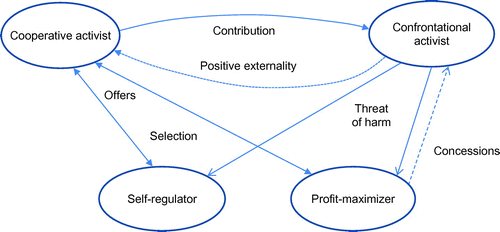
This paper examines a private politics environment in which a confrontational activist and a cooperative activist face a profit-maximizing firm and a self-regulating firm. The environment is studied from a perspective that combines the radical flank effect from sociology and the political economy approach to private politics and nonmarket strategy. We present a formal model in which behavior depends upon favoritism, awareness of a positive externality, and own or aggregate objectives of the activists, and we calibrate these factors through an online experiment. From the experiment, the greater the harm from the confrontational activist, the higher are the offers to work with the cooperative activist and avoid targeting by the confrontational activist. The self-regulator is favored by the activists and offers less than the profit-maximizer. The confrontational activist also favors the self-regulator by threatening a less aggressive campaign. The intensity of the threat results in a positive externality, and to exploit the externality, donors shift resources from the cooperative activist to the confrontational activist. The transfer is greater if the activists’ objectives are the accomplishments of both activists rather than their own accomplishments. Strategy implications are drawn from the model and the results of the experiment.
1. Introduction
In contrast to traditional competitive strategy that studies how firms gain and sustain advantage in an exogenously given environment, nonmarket strategy views the environment of business as endogenous and focuses on how firms defend against rivals and politicians and seek advantage by influencing legislatures, courts, regulatory agencies, the media, and social activists, thereby altering the rules of the competitive game (Baron 1995, de Figueiredo 2009, Henisz and Zelner 2012). Activists are demanders of policy changes (Hillman and Keim 1995), but instead of relying on public strategies such as lobbying legislatures or seeking the intervention of courts, some activists attempt to change the behavior of individual firms (Lenox and Eesley 2009) through private politics (Baron 2003). Research has emphasized the effect of the confrontational tactics used by activists (King and Pearce 2010). Activists target firms with name and shame campaigns (Hiatt et al. 2009), organize community protests (Yue et al. 2013), or threaten boycotts (Eesley and Lenox 2006). In response, firms offer concessions to activists (King and Soule 2007), counter campaigns by pointing to their corporate social actions (McDonnell and King 2013), and resort to regulatory arbitrage (Rao et al. 2011). Farsighted firms anticipate activist-led private politics and self-regulate in an attempt to forestall activist campaigns (Baron 2014).
Not all activists seek confrontation. Some cooperate with firms, providing expertise and in some cases endorsements (O’Mahony and Bechky 2008, Fischer and Lyon 2013). Such engagements may also shield firms from campaigns by more extreme activists (Baron 2012, Friedman and Miles 2002). A cooperative activist has bargaining power if it has expertise. For instance, in its Climate Savers program, the World Wildlife Fund selects a single firm in an industry with which to work, and the selected firm gains from its expertise and experience. A cooperative activist also has bargaining power to the extent that it provides a shield against confrontational activists. In 2005, Wal-Mart began working with the Environmental Defense Fund (EDF) to reduce its environmental footprint, and in 2007 the EDF opened an office in Bentonville, Arkansas to deepen the cooperative engagement. Wal-Mart benefitted from the expertise of the EDF and from an improved reputation, and the engagement provided a partial shield against confrontational environmental activists. Similarly, the EDF and McDonald’s have conducted 48 projects to reduce the company’s environmental footprint.
Cooperative activists also have bargaining power if they can select their partners, and they may favor firms with particular modes of operation or practices. The bargaining power is strengthened when firms are threatened by confrontational activists and the cooperative activists can provide their partners with a shield. The stronger the threat, the more cooperative activists can extract from the firms. That is, the greater the threat from confrontational activists, the harder the threatened firms compete to win engagements with cooperative activists to obtain a shield. A positive externality is thus present in private politics: the stronger the threat from confrontational activists, the more the cooperative activist can accomplish with the firms they engage. This externality can be exploited by the activists because their objectives are aligned; e.g., they all seek improvements in environmental performance. Moreover, their bargaining power can be strengthened through support, either in-kind or through funding, provided to the confrontational activists by cooperative activists or their donors. This paper focuses on a private politics environment with confrontational and cooperative activists and threatened firms, and develops a theory that takes into account the externality, the objectives of the activists, and the funding of campaigns threatening the firms.
Private politics involving activists and firms has been studied in two parallel lines of research: one from a sociological perspective on social movements and the other from the political economy approach to private politics and nonmarket strategy. A cardinal premise in the sociological literature on social movements is the radical flank effect, which has two forms. The first is that the presence of a radical activist allows a moderate activist to extract more from a firm than it otherwise could. This is the same effect predicted by the political economy perspective. The second is that the more extreme the radical activist is perceived to be, the more appealing the moderate activist (Freeman 1975, Haines 1988, Snow and Cross 2011). The radical flank effect has largely been studied in the context of activists targeting the government (Downey and Rohlinger 2008, McAdam 1992) and has received less attention in private politics, where radicals organize harmful campaigns and moderates cooperate with firms. Consider Staples, the office supplies chain that buys paper from Asian Paper and Pulp (APP)—a firm that has been accused of deforestation in Indonesia. Staples halted purchases from APP but has recently resumed a commercial relationship after APP agreed to abide by a forest preservation pledge. Staples agreed to work with Greenpeace to monitor the implementation of its pledge. However, a confrontational activist, the Rainforest Action Network (RAN), has criticized Staples, urged consumers to write to the Staples CEO, and has staged protests at Staples stores (Shankelman 2014). The presence and pressure from RAN makes Greenpeace a more appealing partner, which strengthens Greenpeace in its relationship with Staples.
Theoretical research on private politics focusing on activist pressure has been conducted by Baron and Diermeier (2007), Baron (2012, 2014), Innes (2006), Lyon and Salant (2014), and Krautheim and Verdier (2012). Empirical studies on the challenges by social activists have been conducted by Eesley and Lenox (2006), Lenox and Eesley (2009), Harrison and Scorse (2010), and Gupta and Innes (2013) from the political economy and nonmarket strategy perspective, and by King and Soule (2007), Soule and King (2008), Ingram et al. (2010), among others from the sociological perspective.
Missing from the theoretical and empirical research are three potentially important aspects of the strategic environment of private politics. First, the firms threatened by a confrontational activist can differ, and the activists may treat them differently. At the simplest level, target firms fall into two categories: profit maximizers and self-regulators, and activists may favor one firm over another. For example, a cooperative activist could favor one type of firm, and similarly, the confrontational activist could threaten a more aggressive campaign against another type of firm. Second, sociological accounts of the radical flank effect and the political economy-nonmarket strategy literature say little about whether cooperative and confrontational activists are aware of the externality. Do cooperative activists recognize their dependence on the confrontational activists, and do cooperative activists or their donors provide resources to the confrontational activists? Third, neither approach has examined the behavior of activists with aligned preferences. Activists could seek to maximize their own accomplishments or they could maximize the aggregate accomplishments of their activism. Their objectives affect the extent to which they internalize and exploit the externality.
The theory presented here provides predictions about the effects of favoritism, awareness of the externality, and the objectives of the activists. An experiment is then presented that provides evidence about and calibration of these three factors. The experiment also permits analysis of the perceptions of subjects about the other players in the private politics game, and hence, about the second form of the radical flank effect. The purpose of the experiment is not to test the theory. Instead, the purpose is to identify and calibrate the three behaviors of interest. A test of the theory is impossible because the predicted behavior is based on assumptions about favoritism, awareness, and objectives, and it is these assumptions that are the focus of the experiment. That is, the experiment is intended to assess the plausibility of the assumptions, detect the presence or absence of these effects, identify the direction of effects such as favoritism, and estimate or calibrate any observed effects. The theory provides the framework for the calibration. Rather than have the subjects play a generic game, the experiment places subjects in roles as cooperative and confrontational activists and as target firms, a self-regulator, and a profit-maximizer; and elicits their behavior in those roles. That is, the experiment is intended to allow measurement of the effects of favoritism, awareness, and objectives from the behavior of subjects in their assigned roles.
The theory is developed through a model simple enough to be taken to the (online) laboratory, and hence it includes a number of simplifying assumptions. An example of the setting represented by the model and experiment is the relationship between animal rights activists and fast food firms. People for the Ethical Treatment of Animals (PETA) purchases stock in firms such as McDonald’s, Burger King, and Ruby Tuesday to increase the social pressure on the firms to strengthen their ability to negotiate animal welfare policies behind closed doors. Being a shareholder provides PETA with the threat that a shareholder resolution could be used to pressure the firms in a naming and shaming campaign should negotiations fail. One component of PETA’s strategy is to attempt to influence the boardroom through expertise rather than influence the public through demonstrations. Thus, Burger King said in a statement that it is committed to “maintaining open-dialogue with PETA and various other animal welfare experts” (Los Angeles Times, May 24, 2010). Burger King and Hardees agreed under PETA guidance to give preference to suppliers who use gas to kill the chickens before they are slaughtered (otherwise known as Controlled Atmosphere Killing). When such cooperative efforts fail, PETA resorts to public shaming. PETA worked with McDonald’s for nine years to develop animal welfare policies, but ended the “truce” in 2009 over differences on how to slaughter chickens. PETA felt that McDonald’s was lagging behind rivals such as Burger King, and Wendy’s and launched a “McCruelty” campaign targeted at McDonald’s image.
PETA’s tactics are in sharp contrast to the Animal Rights Militia (ARM)—the extremist arm of the Animal Liberation Front (ALF). ARM attacked two McDonald’s outlets in California in 2004 and caused considerable property damage. As long as PETA worked with McDonald’s, it shielded the company from public disapproval but did not insulate it from more radical confrontational activists such as the ARM. As the radical flank effect predicts, the mere existence of ARM makes PETA a more attractive partner.
The effects studied do not have to emanate from pairs of activists playing bad cop/good cop. The theory is about two classes of activists in the presence of a natural positive externality. To exploit the positive externality, the cooperative activist is assumed to provide funding to the confrontational activist to enable it to mount a more aggressive campaign. In practice, cooperative activists can provide resources to confrontational activists in the form of funding, the loan of personnel, and complementary actions including joint press conferences, letter writing, endorsements, etc. The links between the groups need not be direct, but instead can be indirect as coordinated by donors.1 Private donors provide much of the funding for activist nongovernmental organizations (NGOs), and those donors can be thought of as allocating their funds among the activists to obtain the greatest impact from their funding. For example, the Tides Foundation collects donations and strategically allocates funds among NGOs. In 2013 the Tides Foundation made over $90 million in grants, including $97,000 to RAN and over $100,000 each to the Dogwood Initiative, EDF, Earth Justice, Forest Ethics, Friends of the Earth, Greenpeace, the National Resources Defense Council (NRDC), and $451,700 to the Sierra Club. More broadly, private foundations ranging from the Ford Foundation to the Ben and Jerry’s Foundation are major sources of funding for NGOs. Manheim (2013) details the contributions of private foundations to the NGOs conducting the Fast Food Campaign. These donors are strategic and can be thought of not only as funders but also as exploiters of the positive externality to achieve the greatest impact of their donations. The experiment provides evidence about whether and the extent to which subjects exploit the externality.
The array of activists sort themselves into the roles of confrontational and cooperative activists through their actions. GreenBiz conducted a survey of the 3200 firms in its GreenBiz Intelligence Panel to assess businesses’ perceptions of activist NGOs (Davies 2014). The NGOs were rated in terms of their influence on firms and their credibility. Given the ratings, the NGOs were grouped into four categories: Trusted Partner, Useful Resource, Brand Challenged, and The Uninvited. Trusted Partners are high on both influence and credibility, and included three NGOs: EDF, The Nature Conservancy, and the World Wildlife Fund. The Useful Resources group includes the World Resources Institute and the NRDC, which were rated as high on the credibility dimension as those in the Trusted Partner group, but were somewhat lower on the influence dimension. They are joined by Greenpeace and the Sierra Club, rated above the median on influence and near the median on credibility. Because of “its effective and aggressive campaigns against business,” RAN was placed in The Uninvited group despite its median credibility rating. Some activists, such as Greenpeace, attempt to both confront and cooperate, but it is not clear that doing so has any advantage over separate confrontational and cooperative activists.
The theory and experiment view the threatened firms as acting independently, but if collective action issues can be resolved, firms could work together to address an activist challenge. They could jointly self-regulate to forestall the activists or to reduce the intensity of their campaigns. When pressured by the activists supporting the Forest Stewardship Council, the U.S. timber industry, led by its industry association and in conjunction with several NGOs, established the Sustainable Forestry Initiative to implement its own sustainability standards. Similarly, the Fair Labor Association was established in conjunction with moderate NGOs in response to the anti-sweatshop campaign against apparel and footwear companies led by union-backed, more radical confrontational activists. The unions have incentives to fund the more radical activists not only because of what they can accomplish through their campaign, but also through the induced self-regulation with moderate activists.
As another example, RAN targeted Citigroup because of the project finance it provided for infrastructure projects that threatened ecosystems and indigenous peoples (Baron and Yurday 2004). Citigroup eventually self-regulated by joining with three other project finance banks to establish the Equator Principles, which imposes standards on the projects the banks finance. A decade later, 80 banks in 34 countries self-regulate under the Equator Principles.
The social issue in the experiment is Internet privacy, and the players are in the roles of a confrontational activist, a cooperative activist, a self-regulating firm, and a profit-maximizing firm. The two firms have developed digital fingerprinting technologies that are valuable to advertisers but pose privacy concerns. Adcom has a basic Internet privacy policy and hence is a self-regulator, and Tracker is a profit-maximizer with no privacy policy. The activists want the firms to put in place strong privacy protections, but the protections are costly to the firms because of foregone advertising revenue. The cooperative activist PrivacyPlus offers an endorsement to a firm that institutes privacy protections, and its endorsement shields the firms from a potential attack by the confrontational activist Stryker. Stryker threatens each firm with a harmful hacking campaign if it does not institute strong privacy safeguards. Thus, the cooperative activist uses incentives and provides a shield, and the confrontational activist uses threats. PrivacyPlus has the capacity to work with only one firm, and the firm not selected to work with PrivacyPlus is targeted by Stryker. Both firms thus compete to be selected by PrivacyPlus. The firm targeted by Stryker is forced to concede to the campaign and enhance its privacy protections, sacrificing advertising revenue equal to the threatened harm. Stryker’s goal is to maximize the privacy enhancements, which also equal the foregone advertising revenue. PrivacyPlus seeks to extract a strong privacy policy from the firm it selects, and the stronger the threat, the stronger is the externality and the more it can extract. To strengthen the externality, PrivacyPlus (or its donors) can transfer resources to Stryker to fund a stronger campaign. The experiment results indicate that perceptions and attitudinal factors have little effect on the competition for the engagement with the cooperative activist or on funding. Activism in the experiment thus is strategic and driven by explicit payoffs rather than perceptions. The structure of the game is illustrated in Figure 1.
The theory provides a framework for detecting and calibrating possible favoritism in encounters between activists and firms and in the provision of resources to strengthen the pressure from activism. The experiment allows calibration and is not intended to be a test of theory. The theory is developed from a general model incorporating possible favoritism on the part of the cooperative and confrontational activists but does not indicate which firm is favored by each activist. The experiment is used to identify the direction of favoritism and its magnitude. The experiment reveals that both activists favor the self-regulating firm, and the magnitudes result in the self-regulator being more likely to be selected by the cooperative activist. This is consistent with King and McDonnell (2015) and provides an explanation for their findings.
As with favoritism, awareness and objectives are assumptions in political economy theories, and the theory presented here provides predictions about their effects, thereby providing a basis for assessing whether participants make choices revealing awareness and aggregate versus own objectives. Some of these effects are evident in the raw data and from answers to questions asked of participants, but the calibration and detection can come only from the outcomes of the play of the game. This is accomplished through simulated play in which participants in each role are selected at random and their choices are combined to play the game. The experiment elicits the choices of participants in five panels, one for each of the four roles of activists and firms and a fifth to study Stryker’s possible favoritism. The individual panels are used to assess awareness of the externality and identify the objectives of the activists.
The self-regulator (Adcom) anticipates the favoritism of the cooperative activist (PrivacyPlus) and offers less to the cooperative activist than the profit maximizer (Tracker), yet because of the favoritism, is more likely to be selected by the cooperative activist. Favoritism by the confrontational activist (Stryker) results in lower campaign spending against the self-regulator, whereas campaign spending against the profit-maximizing firm is the same as when the confrontational activist is constrained to have the same campaign spending against each firm. The different campaign spending levels increase the likelihood that the cooperative activist selects the profit-maximizing firm, but in the simulated play the self-regulator is still selected with a probability greater than one-half due to the favoritism of the cooperative activist. Awareness of the externality leads the cooperative activist to contribute more resources to the campaign of the confrontational activist, and the confrontational activist to request more resources from the cooperative activist. Objectives are both self-reported and revealed through the contributions made or requested by the activists. Cooperative activists make greater contributions when they have aggregate objectives than own objectives, whereas confrontational activists request a greater contribution if they are aware of the externality but not when they take the opportunity cost of the contribution into account.
Section 2 presents the theory, and Section 3 presents the design of the experiment. Section 4 presents the experiment results, and the concluding section identifies implications of the theory and experiment findings for nonmarket strategy.
2. The Formal Model
The formal analysis of private politics was initiated by Baron (2003), and Maxwell (2010) assesses the strategies of NGOs. Dal Bo et al. (2006) and Baron and Diermeier (2007) consider an organization that can both threaten a target and offer a reward to induce a desired action. Many social activists specialize, however, and theories of confrontation have been provided by Innes (2006)Egorov and Harstad (2015), and Baron (2014). However, cooperation, as Ruta (2010) notes, has become the preferred approach of some NGOs and social activists.
We use Baron (2012) as a point of departure. That model involves two activists, one confrontational and one cooperative; and two firms, one of which is a profit maximizer and the other a self-regulator. We extend the model in three principal ways. First, activists can exhibit favoritism: the cooperative activist could favor one of the firms in its selection of a partner, and the confrontational activist could conduct a more aggressive campaign against one firm than against the other. Second, the model includes awareness of the externality between the aggressiveness of the campaign and the offers received by the cooperative activist and how the activists fund a campaign based on that awareness. Third, the model examines the implications of own and aggregate objectives of the activists and how those objectives affect the exploitation of the externality.
2.1. The Game
As implemented in the experiment, the model includes four players: two firms (Adcom [A] and Tracker [T]), and two activists (PrivacyPlus [P] and Stryker [S]). The objective of the activists is to cause the firms to adopt strong Internet privacy policies, so the activists have aligned interests. PrivacyPlus is the cooperative activist that selects one of the two firms with which to partner to develop a privacy policy, and Stryker is the confrontational activist that campaigns with a harmful campaign against the firm not selected by PrivacyPlus. The profits of the firms are decreasing in the privacy they provide. Tracker is a profit-maximizer, and Adcom is a self-regulator with a mission statement including both profits and privacy protection. Adcom’s basic privacy policy is already in place, so its equilibrium strategy is unaffected by that policy. The two firms thus are strategically equivalent, and both maximize their profits in the private politics game. Adcom’s (sunk) privacy policy could, however, give rise to favoritism on the part of the activists for one of the firms. Similarly, the confrontational activist could favor one of the firms in its choice of the aggressiveness of its campaign.
Favoritism could have two forms. First, it could be a parameter of the preferences of a player, which is the formulation in the model. Second, it could reflect beliefs about instrumental characteristics of a firm that affect payoffs. The data from the experiment reflect both, and the empirical analysis identifies the instrumental effects on the selection of a partner by the cooperative activist. The participants were asked, “How likely is it that you will achieve a strong privacy policy for the firm you select?,” which should reflect beliefs about whether the firm will implement its agreement. In the selection of a partner by the cooperative activist in the simulated play, an estimated logistic function is used that accounts for the outcome effects, allowing estimation of preference favoritism.
The firms compete for the engagement with the cooperative activist that shields the selected firm from a harmful campaign by the confrontational activist. The competition is represented as a one-shot bidding game, where the firms make offers to the cooperative activist, which then selects one of the firms. The offers represent the strength of the privacy policies the firms will adopt if selected by the cooperative activist, and thus can be thought of as endogenous self-regulation. The cooperative activist uses the competition to extract as much as possible from the firm it selects.
The threat from the confrontational activist depends on its campaign spending, and the stronger the threat, the higher are the offers by the firms for the engagement with the cooperative activist. This positive externality provides incentives for the cooperative activist to make a contribution to fund a more aggressive campaign by the confrontational activist. The confrontational activist can also request a contribution.
The timing of the game in the theory is as follows. In one treatment the cooperative activist moves first, choosing its contribution to the campaign of the confrontational activist. In another treatment the confrontational activist moves first and makes a request to the cooperative activist for a contribution to the campaign. Given the threatened campaigns, the two firms simultaneously make offers to the cooperative activist. The cooperative activist selects one of the firms, and the selected firm adopts a privacy policy with strength equal to its offer. The confrontational activist then campaigns against the firm not selected, and that firm concedes to the campaign by adopting a privacy policy with strength equal to the campaign harm. The solution concept is subgame-perfect Nash equilibrium. A specific, tractable model is used to facilitate calibration and the analysis of the experiment results, and the propositions characterizing the equilibrium provide hypotheses evaluated in the experiment.
The model is presented in stages to facilitate the discussion of the experiment results. The engagement in which the firms make offers and the cooperative activist selects a partner is presented first, and then the campaign threat from the confrontational activist is characterized. Awareness and the objectives along with the positive externality are then considered.
2.2. Favoritism
2.2.1. The Cooperative EngagementThe firms compete for selection by the cooperative activist, and they are assumed to believe that the cooperative activist could favor one of them. Uncertainty about possible favoritism is natural, since the firms and the activist have only infrequent encounters. Let the uncertainty about the favoritism for Adcom on the part of the cooperative activist be represented by a uniformly distributed random variable with support , where, for example, could be negative and positive, so that either of the two firms could be favored. Adcom is favored ex ante if , where E denotes expectation.
Adcom and Tracker make self-regulation offers xA and xT, which are to be interpreted as the strengths of the privacy policies each would implement if selected by the cooperative activist. A cooperative activist with preference favoritism b has utility UP = xA + b if it selects A, and UP = xT if it selects T. It selects A if and only if xA + b≥xT, and if xA + b = xT, the selection is at random. From the perspective of the two firms, A is selected with probability Pr(A) given by
The firms make their offers in anticipation of the selection by the cooperative activist and the campaign harm hi, i = A, T, each firm incurs if it is not selected. The cooperative activist also is assumed to provide a reward r for the firm it selects. The expected profit EπA of firm A in the activist challenge is
The pure strategy Nash equilibrium offers are, for ,2
The offers are strictly increasing in the reward, so the more beneficial is the cooperative engagement, the higher are the offers. The offers are also strictly increasing in the harm from a confrontational campaign, so the accomplishments of the cooperative activist depend directly on the threat from confrontation.
The offers in (2) and (3) reflect both ex ante favoritism and uncertainty. If and the harm is the same for both firms, i.e., hT = hA = h, the optimal offers are , which equal the offers in an ascending auction in which firms offer the reward plus the harm avoided when selected by the cooperative activist. To identify the effect of uncertainty, suppose that the distribution of is symmetric around 0, so ex ante favoritism is . The offers in (2) and (3) are then lower by than the auction levels, which is the effect of uncertainty.
Favoritism on the part of the cooperative activist can be measured in a variety of ways. The offers are strictly decreasing in and increasing in , both of which represent a stochastically dominant change in the distribution of . The measure of favoritism used here is a shift in the support of by δ≥ 0, which represents an unambiguous increase in the favoritism for Adcom. If so , the offers are equal, and as δ increases, decreases and increases. Greater favoritism for Adcom allows it to offer less and Tracker adjusts by proposing to offer more, so the difference is increasing in δ.
The probability that A is selected by the cooperative activist is given by
Despite the higher offer by the disfavored firm, the probability that the favored firm is selected by the cooperative activist is greater than one-half in (4) if the expected favoritism satisfies . Consequently, if Tracker faces a stronger threat than Adcom, Tracker could have the higher probability of being selected. When the firms face the same threats, the ex ante favored firm is the one more likely to be selected by the cooperative activist.
The expected profit of the firms is determined by substituting the equilibrium offers into the expected profit function Eπi, i = A, T, which yields
Which firm has greater net expected profit from the challenge by the activists depends on the favoritism. A shift (δ > 0) in the support of the distribution of favoritism by the confrontational activist results in higher profits for Adcom and lower profits for Tracker, since Adcom decreases its offer and Tracker increases its offer. If and δ = 0 so there is no ex ante favoritism on the part of the cooperative activist, the expected profit of the firm favored by the confrontational activist is greater, i.e., . In the absence of favoritism by either activist, the firms have equal expected profits, since in equilibrium the cooperative activist extracts from the firm it engages as much as does the confrontational activist. The difference in the expected profit is
The following proposition summarizes the qualitative features of the results from the model.
(i) The equilibrium offers are strictly increasing in the threats and the reward. (ii) With uncertainty about the favoritism of the confrontational activist, (a) both firms offer less than the auction levels, (b) the ex ante favored firm offers less than the other firm, and (c) the ex ante favored firm is selected with probability greater than one-half unless the difference between the threats is greater than the ex ante favoritism. (iii) The expected profit of the self-regulator is greater than the expected profit of the profit maximizer if and only if.
The expressions for the equilibrium offers and the probability Adcom is selected can be used with the experiment results to estimate the favoritism of PrivacyPlus. The experiment yields offers by the Adcom and Tracker participants, and the simulated play of the game yields the probability that Adcom is selected given the offers. The offers in (2) and (3) and Pr(A) in (1) are linear functions, so the estimates can be obtained using the means from the experiment. Suppose for the purpose of illustration that hA = hT = h, as in the first two treatments in the experiment. The difference in the mean offers , i = A, T, is
For example, if the mean offer by Tracker participants is greater by 2 than the mean offer by Adcom participants and the simulated play reveals that Adcom is selected in 60% of the trials, the expressions in (6) and (7) yield estimates = 8 and . The ex ante favoritism of Adcom is then . Using the values = 8 and , the effect of favoritism on the offers of the two firms can be determined using (2) and (3), yielding estimates and . Firm T offers less than the ascending auction offer by , and A offers less by .
A second estimate of the favoritism can be obtained directly from (2) and (3), which yield estimates
The confrontational activist targets the firm not selected by the cooperative activist, and the aggressiveness of its campaign depends on its preferences for a target. For example, it could favor Adcom and conduct a more aggressive campaign against Tracker, despite the fact that the two firms are strategically equivalent. To represent different campaign intensities, let the campaign spending against firm i be denoted by si, i = A, T, and let the harm hi be given by hi = Hi(si), i = A, T, where Hi(·) is assumed to be strictly increasing and strictly concave with .
The target concedes and changes its practices by an amount equal to the harm hi, so the objective of the confrontational activist is to maximize the harm from its campaign less the campaign spending. The optimal campaign spending is
As an example, let Hi(si) = (γβisi)ρ, γ, βi > 0, ρ ∈ (0, 1), so
In two of the treatments in the experiment, the harm is the same for both firms, and in the third treatment, the Stryker5 panel, the harm can differ. For that panel the offers by A and by T are obtained by substituting from (11), and the probability that Adcom is selected is obtained by substituting the offers into (1) or equivalently, evaluating (4) at and . Firm A is selected with greater than one-half if . The probability is lower than the probability Pr(A) in the absence of favoritism of A in Stryker5, since Tracker makes a higher offer when it faces greater harm. That is, favoritism of Adcom in Stryker5 affects the probability of winning the cooperative engagement in the opposite direction of favoritism of Adcom by PrivacyPlus. The difference in the expected profits of the firms evaluated at the equilibrium offers and is given by (5), so Adcom benefits from favoritism both by the cooperative activist and favoritism by the confrontational activist.
The results for the confrontational activist are summarized in the following proposition.
Favoritism of A by the confrontational activist results in greater campaign spending against T than against A. The differencein the offers is less than the difference (with hA = hT), and the probabilitythat A is selected is less than Pr(A) (with hT = hA) in the absence of favoritism by the confrontational activist. The probabilityis greater than one-half if.
An estimate of the favoritism of the confrontational activist can be obtained from the mean harms from the Stryker5 panel; i.e., = − , where , i = A, T, denotes the mean harm. Then, (2) and (3) can be used to obtain estimates and , and from (4) an estimate . These estimates are reported in Section 4.6.
2.3. Awareness
Greater campaign spending on the part of the confrontational activist increases the threats to the firms, resulting in higher offers to the cooperative activist, as indicated in (2) and (3). If the cooperative activist is aware of this positive externality, it (or donors) can contribute to the confrontational activist’s campaign. To represent this contribution, suppose the cooperative activist contributes σisi for the campaign targeting firm i = A, T. That is, the cooperative activist contributes a σi ∈ [0, 1) share of the campaign spending. The confrontational activist then chooses campaign spending satisfying (10) with the cost (1 − σi)si replacing si. For the example, the optimal campaign spending is
Awareness of the externality results in higher campaign spending than in its absence.
To assess awareness in the experiment, the participants in the roles of the activists were asked how “dependent” the success of the cooperative activist was on the campaign of the confrontational activist. The greater the perceived dependence, the greater should be the contribution by the cooperative activist and the request by the confrontational activist. The contribution also depends on the objectives of the activists.
2.4. Objectives
2.4.1. Cooperative ActivistIf an activist is aware of the positive externality, its contribution depends on its objective. An activist could maximize its own accomplishments; i.e., the offer of the firm selected by the cooperative activist or the harm from the campaign by the confrontational activist. The activists, however, have aligned interests, so each could maximize the aggregate accomplishments of both activists. With the latter objective the campaign spending should, because of the externality, be greater than when each maximizes its own accomplishments. This section summarizes the predictions, and the formal analysis is presented in Appendix A. After their choices the experiment participants in the roles of the activists were asked whether their objective was own or aggregate accomplishments. Their contributions and requests are then regressed on their responses and on their responses to that and the other questions asked.
A cooperative activist with the objective of maximizing the accomplishments of both activists takes into account not only the effect of a more aggressive campaign on the offers it receives, but also the greater accomplishments of the confrontational activist from the firm it targets. The following proposition summarizes the result.
When aware of the positive externality, the cooperative activist contributes half the campaign cost of the confrontational activist when it maximizes aggregate accomplishments and contributesof the cost when it maximizes its own accomplishments.
In the experiment participants in the role of the confrontational activist were told that there was an opportunity cost borne by the cooperative activist of any contribution requested so that participants would not view the contribution as costless. The opportunity cost exceeds the gains from a more aggressive campaign, so if the activist is constrained to choose the same aggressiveness for both firms, the confrontational activist requests no contribution if its objective is to maximize its own accomplishments. If its objective is aggregate accomplishments, it requests the same contribution as the cooperative activist makes with that objective.
When the campaign spending is the same for both firms, the confrontational activist requests no contribution if it maximizes its own accomplishments and requests the same contribution as the cooperative activist makes when each maximizes aggregate accomplishments.
In the experiment treatment in which the activist can choose different campaign spending for the two firms, favoritism can be expressed. Spending then is given by in (12), and the confrontational activist chooses requests and . The expected utility of the confrontational activist with an own objective is
If the confrontational activist can choose different levels of campaign spending for the two firms, it chooses no spending for one firm and positive spending for the other, regardless of its objective.
With an objective of own or aggregate accomplishments, campaign spending against one firm is positive and the other is zero. If it has an objective of own accomplishments and (A8) inAppendix Ais satisfied, the confrontational activist requests no contribution for the campaign against A and a positive contribution for the campaign against T.
The condition in (A8) in Appendix A is satisfied in the experiment using the mean requests and ρ = 0.5 in Hi(si), which approximates the function used in the experiment. As discussed in Section 5.2.3, participants in the Stryker5 panel chose the same campaign spending against Tracker as did participants in the Stryker panel, but they chose significantly lower campaign spending against Adcom than did Stryker participants. These results are consistent with the proposition.
3. The Experiment
Implementation of the experiment on the Internet with a large number of participants available only for a relatively short time prohibits training in playing the game. Participants were given a briefing memorandum providing information on the context, the available choices, and the payoffs. The five briefing memoranda contained the same basic content tailored to the four individual roles as cooperative activist, confrontational activist, self-regulating firm, and profit-maximizing firm. The briefing memorandum for PrivacyPlus is presented in Appendix B, and the other memoranda are available in an electronic companion (available as supplemental material at http://dx.doi.org/10.1287/stsc.2016.0011).
The briefing memoranda were designed to be neutral with respect to favoritism, awareness of the externality, and objectives. The memoranda make no mention of an externality, mention only once that Adcom has a dual-objective mission statement and a “basic” privacy policy, and describe objectives and payment functions only in terms of own accomplishments. The memoranda do not describe Stryker as confrontational and PrivacyPlus as cooperative, and although each was said to have an objective of accomplishing as much Internet privacy as possible, there was no suggestion that the two had common objectives. The PrivacyPlus memo did not indicate that a contribution would increase the offers it would receive. Instead, it simply stated that the contribution would allow Stryker to increase its campaign spending.
After the participants had made their choices, they were asked about their assigned roles and their perceptions of the strategic situation described in the briefing memoranda. The questions were intended to be informative about favoritism, awareness, and objectives. For example, to assess favoritism, Adcom and Tracker participants were asked whether they perceived that they would be advantaged or disadvantaged in the competition for the cooperative engagement. To assess awareness of the externality, PrivacyPlus and Stryker participants were asked how dependent on Stryker’s campaign they perceived PrivacyPlus to be. PrivacyPlus and Stryker participants were also asked whether their objective was what they accomplished or what both activists accomplished. The questions for PrivacyPlus are presented in Appendix B.
We draw participants from the Mechanical Turk (MTurk) community. This allows us to obtain a larger sample than possible with a student pool. Additionally, as Berinsky et al. (2011) point out, the subject pools obtained from the MTurk population are more diverse and more representative than a student pool, and problems such as subject attentiveness and the presence of habitual survey takers are not large. Moreover, Berinsky et al. (2011) show that several studies conducted using nationally representative samples have been replicated in the MTurk community with similar estimates of treatment effects.
In the briefing memoranda, Adcom and Tracker were described as two firms that had developed different “fingerprinting” technologies for identifying Internet users for the purpose of tailoring advertisements to individual users. The technologies were described as posing possible privacy risks to users. Each firm could earn $100 with its technology, and the strength of a privacy policy was identified by the profits that would be lost if the policy was implemented. Adcom already had a basic privacy policy that had reduced its profits by $10, so its offers were in the interval [0, $90] and in [0, $100] for Tracker. The activists’ objectives were to obtain the largest possible increase in privacy protection, so the firms were strategically equivalent. Selection by PrivacyPlus yielded a reward r = $20 from its endorsement of the firm it selected.
The figure in Appendix C presents the strategic structure of the game and was included in all the briefing memoranda. The participants were given numerical examples to illustrate the effects of their choices, and Adcom and Tracker were presented with a payoff table for each of the three possible levels of campaign spending. The payoffs were a function of the possible offers by both firms and the assumed selection of the higher offer by PrivacyPlus. The payoff table corresponding to h = $30 is presented in Appendix D. The payoff table reflects the sunk $10 cost of Adcom’s basic privacy policy and the strategic equivalence of the two firms. In the absence of uncertainty and favoritism the equilibrium offers are (50, 50), which is a focal point in the table. For harm levels of h = $45 and h = $52, however, the corresponding equilibria are not found in the tables. Adcom and Tracker participants were given, sequentially, the three harm levels of $30, $45, and $52 along with the corresponding payoff table, and chose offers for each.
In the briefing memoranda, Adcom and Tracker participants were not told the payoff structure for the other firm, but they could determine it from the payoff table presented in Appendix D. Adcom and Tracker participants also were not told the harm faced by the other firm, but the payoff table stated “Stryker’s Campaign Produces Harm of $30,” as indicated in Appendix D. All the strategically relevant information was available to the participants.
Stryker was said to be budget constrained with only $10 available for campaign spending, and any spending above $10 would have to come from PrivacyPlus. In one treatment, PrivacyPlus participants chose the amount to contribute to Stryker’s campaign, and in a second treatment Stryker participants requested funds from PrivacyPlus. In a third treatment Stryker5 participants chose a different spending level for each firm with the understanding that PrivacyPlus would provide the needed funding.
A discrete specification was used in the experiment with allowable contributions of $0, $10, or $20 with the corresponding harms of $30, $45, and $52. A table giving the relationship between contributions and harm was included in the briefing memoranda. With an objective of maximizing own accomplishments, contributing $10 yields an increase in harm of $15, which exceeds the cost of the contribution; but contributing a second $10 increases the harm by $7, which is less than the incremental cost of $10. Therefore, contributing $10 is optimal. With an objective of maximizing aggregate accomplishments, increasing the contribution from $10 to $20 increases the offers to the cooperative activist by $7, and the confrontational activist also gains greater concessions of $7 from its target. With awareness of the externality and an objective of aggregate accomplishments, PrivacyPlus thus should contribute, and Stryker should request $20.
The experiment was designed to conform to the null hypothesis of no favoritism on the part of PrivacyPlus or Stryker. The payoff tables included in the briefing memoranda are based on this hypothesis. Since the participants did not interact online, the offers received by PrivacyPlus participants were generated randomly from a uniform distribution that, consistent with the null hypothesis, was the same for both firms.
The play of the game was simulated by randomly drawing a participant from each of the four roles, and their choices were used to determine the outcome of the game with one modification. Because, in the experiment, PrivacyPlus participants selected one of the firms based on randomly generated Adcom and Tracker offers, a logit selection function was estimated from the PrivacyPlus participants’ selections and used to make the selection in the simulated play using the actual offers by the Adcom and Tracker participants.
The briefing memoranda were as truthful as possible. PrivacyPlus participants were told in the briefing memorandum that their compensation was based on the offer of the firm it selected, less its contribution. Stryker participants were told that their compensation was based on the harm it imposed on its target, less the campaign spending. In addition, Stryker participants were told that every $10 of contributions by PrivacyPlus had an opportunity cost of $12 in terms of future privacy achievements foregone by PrivacyPlus. This was necessary so that Stryker participants would not view the contribution by PrivacyPlus as costless. Participants were told that their choices would be combined with those of other participants to play the game, which occurred in the simulated play.
Participants received a small fixed payment ($0.25 or $0.50) plus a payment based on the payoffs they achieved in their roles. Participants earned between $1.00 and $1.50 for 6–12 minutes of play. Where necessary, the payments were generated by randomly drawing “choices” for the other players. For example, Adcom and Tracker made offers, and the “selection” by PrivacyPlus was determined randomly. This was only for the purpose of determining the payments to the participants and was necessary because MTurk participants had to be paid at the time of their participation and the simulated play of the game could not occur until all the panels had been completed. The behavior elicited in the experiment is a close approximation to the full-information behavior had the participants been able to play interactively.
4. Experiment Results
4.1. The Data
Five panels were obtained for PrivacyPlus, Adcom, Tracker, Stryker, and Stryker5. After making their choices, participants were asked two questions about the game, and those who failed to answer both questions correctly were dropped from the study for failure to understand the setting.3 In addition, Adcom and Tracker participants made offers for three levels of harm presented in ascending order. Participants should have made offers that were increasing in harm, and hence participants who decreased an offer when the harm increased were dropped because they may have made a mistake or failed to understand the game. Seventy-two percent of the participants in the five panels satisfied the screens yielding 837 usable responses. The five panels were posted sequentially on MTurk, so participants did not choose their roles, and each participant was asked to participate only once.
The demographic profiles of the participants are quite similar across the five panels. Between 66% and 78% of the participants were at least 26 years of age and 90% were 60 or younger. More than half had a college degree, and between 10% and 20% had an advanced degree. Women constituted between 50% and 60% of the participants in the five panels. The demographic variables have little explanatory power in the estimations.
4.2. PrivacyPlus
PrivacyPlus participants both chose a contribution to Stryker’s campaign and selected a firm for the cooperative engagement. Since the experiment was not interactive, PrivacyPlus participants chose between randomly generated Adcom and Tracker offers drawn from identical distributions, so the average offers by Adcom and Tracker were the same. This is consistent with a null hypothesis of no favoritism.
As reported in Panel A of Table 1, 32% of the PrivacyPlus participants made no contribution to Stryker’s campaign, indicating that they were unaware of the externality. Half the participants contributed $10, which is consistent with awareness of the externality and an objective confined to own accomplishments; 17% of the participants contributed $20, which is consistent with both awareness and an objective of aggregate accomplishments; 58% of the participants, however, said their objective was aggregate accomplishments, so either a substantial proportion was unaware of the externality or misreported their objectives when they realized that it was possible to have aggregate objectives. PrivacyPlus participants with aggregate objectives made greater contributions than participants that sought to maximize their own accomplishments, whereas the opposite was true for Stryker participants. This difference is consistent with the results in (A2) and (A3) for PrivacyPlus and (A5) for Stryker.
|

Table 1: PrivacyPlus Contributions and Stryker Requests for Own Accomplishments vs. Aggregate Accomplishments
| Contribution | Panel A | Panel B | ||||
|---|---|---|---|---|---|---|
| PrivacyPlus | Stryker | |||||
| Own | Aggregate | Total | Own | Aggregate | Total | |
| 0 | 41 | 11 | 52 | 8 | 26 | 34 |
| 10 | 22 | 59 | 81 | 20 | 73 | 93 |
| 20 | 5 | 23 | 28 | 14 | 17 | 31 |
| N | 68 | 93 | 161 | 42 | 116 | 158 |
| Mean (std dev) | 4.7 (0.77) | 11.2 (0.62) | 8.6 (0.54) | 11.4 (1.11) | 9.2 (0.56) | 9.8 (0.51) |
To examine the contribution choices, an ordered logit estimation with contribution levels as the dependent variables is presented in column 1 of Table 2. Participants contributed more the more they were aware of their dependence (q199) on Stryker’s campaign and if they had an objective of aggregate accomplishments (q197), and the coefficients are significant at the 0.01 level. That is, participants who were aware of the externality from Stryker’s campaign contributed more to Stryker, and participants who reported an objective of aggregate accomplishments also contributed more. These estimates confirm the effects in Panel A of Table 1 of awareness and aggregate objectives among the PrivacyPlus participants.
|
Table 2: PrivacyPlus Contribution and Choice of Partner
| Variable | Contribution (ordered logit) | Choice of partner (logit) | Choice of partner (logit) |
|---|---|---|---|
| Diff offersxA − xT | 0.076∗∗∗ (3.214) | ||
| Adcom offerxA | 0.059 ∗∗ (2.146) | ||
| Tracker offerxT | −0.092∗∗∗ (−3.518) | ||
| q195 Perceived PP extremeness | −0.047 (−0.363) | −0.010 (−0.067) | −0.024 (−0.156) |
| q196 Perceived S extremeness | −0.213 (−1.186) | 0.197 (0.879) | 0.161 (0.711) |
| q197 Objective aggregate | 1.926∗∗∗ (4.795) | 0.680 (1.445) | 0.874∗ (1.736) |
| q198 PP likely success | 0.148 (0.761) | 0.497∗∗ (2.038) | 0.515∗∗ (2.104) |
| q199 Perceived PP dependence | 0.472∗∗∗ (3.167) | −0.382∗ (−1.912) | −0.372∗ (−1.828) |
| q200 Perceived S dependence | 0.171 (1.348) | −0.353∗∗ (−2.184) | −0.364∗∗ (−2.211) |
| q201 Track record | 0.089 (0.457) | 0.577∗∗ (2.372) | 0.571∗∗ (2.339) |
| q202 Volunteer | −0.042 (−0.391) | 0.092 (0.708) | 0.104 (0.787) |
| q203 Donate $ | 0.183∗ (1.769) | −0.143 (−1.142) | −0.117 (−0.912) |
| q204 Privacy importance | 0.011 (0.063) | −0.228 (−0.896) | −0.216 (−0.848) |
| q205 Female | 0.448 (1.136) | 1.011∗∗ (2.119) | 1.048∗∗ (2.172) |
| q207 Education | 0.340 (1.636) | 0.198 (0.786) | 0.205 (0.810) |
| q208 Age | −0.123 (−0.693) | 0.240 (1.124) | 0.271 (1.245) |
| q209 # studies | −0.227 (−1.443) | −0.086 (−0.466) | −0.115 (−0.609) |
| q280 Game theory | 0.218∗ (1.650) | −0.107 (−0.706) | −0.106 (−0.698) |
| Constant | −4.376∗ (−1.706) | 2.946 (−1.039) | |
| cut1 Constant | 6.517∗∗∗ (3.001) | ||
| cut2 Constant | 9.806∗∗∗ (4.330) | ||
| Observations | 156 | 156 | 156 |
| LR chi2(15) | 65.73 | ||
| LR chi2(16) | 45.79 | 47.11 | |
| Prob > chi2 | 0.0000 | 0.0001 | 0.0001 |
| Log likelihood | −123.55361 | −74.958273 | −74.295471 |
| Pseudo R2 | 0.2101 | 0.2340 | 0.2407 |
∗p < 0.1, ∗∗p < 0.05, ∗∗∗p < 0.01.
Sixty-nine percent of the PrivacyPlus participants selected Adcom for the cooperative engagement. To examine PrivacyPlus’s selection, column 2 of Table 2 presents a logit estimation of the selection. Adcom is more likely to be selected the greater is the difference xA − xT between the offers as in (1), and the coefficient is significant at the 0.01 level. The probability of selecting Adcom is also greater the more the participants perceive that they are likely to be successful (q198) in achieving a strong privacy policy with the selected firm and the more they perceive their track record (q201) as advantageous in obtaining a strong policy. These two coefficients reflect instrumental effects of favoritism in that they pertain to beliefs about outcomes. One interpretation of these estimates is that Adcom may be perceived as “soft” because of its basic privacy policy and its mission statement, and hence be more willing to adopt a stronger privacy policy.
The probability of selecting Adcom is decreasing in participants’ beliefs that Stryker is dependent (q200) on PrivacyPlus’ effectiveness, which can be interpreted as participants choosing Tracker more frequently when Stryker is perceived to be less independently effective in achieving a strong privacy policy. Column 3 of Table 2 presents a logit estimation using the offers by the two firms rather than the difference in the offers, and the findings are essentially the same as those reported in column 2.
4.3. Stryker
Table 1 indicates that on average, Stryker participants requested greater contributions than those offered by PrivacyPlus, although the means are not significantly different. Stryker participants who had an objective of maximizing their own accomplishments requested higher contributions than those who reported having aggregate preferences. This may be due to those participants with aggregate preferences focusing on the effect on PrivacyPlus but not recognizing the externality. That is, they could request increments of $10, but the opportunity cost was stated as $12 for each $10 received. This suggests low awareness of the externality among Stryker participants but an objective of aggregate accomplishments for both activists.
With regard to objectives, Propositions 4 and 5 indicate that when the activists have aggregate accomplishment objectives, the contribution equals half the campaign spending from (A3). From Table 1, the contributions by PrivacyPlus participants with aggregate accomplishments represent 53% of spending, and for Stryker participants the corresponding share is 48%.
An ordered logit estimation, available in the electronic companion, for the contribution requests by Stryker participants, indicates that those who viewed PrivacyPlus as dependent (q181) on Stryker’s campaign requested greater contributions in contrast to the impression from Table 1. This finding indicates that those who were aware of the externality contributed more and is analogous to that for PrivacyPlus reported in Table 2. As noted earlier, participants that had as their objective aggregate accomplishments (q179) requested less, although the coefficient is significant at only the 0.1 level. This is consistent with the observation above that some participants were either unaware of the externality or they were aware but viewed the opportunity cost as too high to warrant a higher contribution.
4.4. Stryker5
In the Stryker5 panel, participants could choose different campaign spending against Adcom and Tracker, so their spending choices can reflect favoritism. Table 3 presents the campaign spending differentiated by whether the Stryker5 participant reported own or aggregate objectives. Stryker5 participants conducted more intense campaigns against Tracker than against Adcom, and campaign spending against both targets was greater with an aggregate objective, although the differences in the means are not statistically significant. Only 30% of the Stryker5 participants chose a campaign spending level against Adcom that required a contribution by PrivacyPlus, which is consistent with the analysis in (A6) and (A7) in Appendix A. Participants exhibited favoritism for Adcom.
|
Table 3: Stryker5 Spending and Objectives
| Target | Adcom | Tracker | Adcom | Tracker | ||||
|---|---|---|---|---|---|---|---|---|
| Spending | Own q179 = 1 | Own q179 = 1 | Aggregate q179 = 2 | Aggregate q179 = 2 | ||||
| 0 | 13 | (14.8%) | 1 | (1.1%) | 16 | (16.8%) | 2 | (2.1%) |
| 10 | 54 | (61.4) | 25 | (28.4) | 42 | (44.2) | 19 | (20.0) |
| 20 | 13 | (14.8) | 35 | (39.8) | 31 | (32.6) | 38 | (40.0) |
| 30 | 8 | (9.1) | 27 | (30.7) | 6 | (6.3) | 36 | (37.9) |
| n | 88 | 88 | 95 | 95 | ||||
| Mean (std dev) | 11.82 (0.85) | 20.00 (0.86) | 12.84 (0.84) | 21.37 (0.83) | ||||
Notes. (1) For each q179 = 1 and q179 = 2, the distribution of spending on Tracker stochastically dominates the distribution of spending on Adcom. Mean spending on Tracker is statistically significantly higher than for Adcom.
(2) The mean spending levels on Adcom for q179 = 1 and q179 = 2 are not statistically different, nor are the corresponding mean spending levels for Tracker.
Table 4 presents seemingly unrelated regressions of the spending by Stryker5 participants on campaigns against Adcom and Tracker. The estimates reveal a sharp difference between the perceptions of the two firms. Adcom is targeted with a less intense campaign than Tracker, and consistent with the theory the campaign spending targeting Adcom is increasing in the recognition of the dependence (q181) of PrivacyPlus on Stryker’s campaign and the coefficient is statistically significant. In contrast, campaign spending targeting Tracker does not depend significantly on the perceived dependence of PrivacyPlus on Stryker, but it does depend on how extreme (q177) PrivacyPlus is perceived to be. The more moderate PrivacyPlus is perceived to be the greater is the spending on a campaign targeting the disfavored Tracker. The objective of the participants has no statistically significant effect on campaign spending.
|
Table 4: Stryker5 Spending
| Variable | Adcom spending | Tracker spending |
|---|---|---|
| q177 Perceived PP extremeness | 0.082 (0.176) | −1.431∗∗∗ (−3.062) |
| q178 Perceived S extremeness | −0.358 (−0.632) | −0.889 (−1.560) |
| q179 Objective aggregate | −0.758 (−0.608) | −0.641 (−0.512) |
| q180 Confidence in PP success | 0.207 (0.420) | 0.961∗ (1.937) |
| q181 Perceived PP dependence | 1.074∗∗ (2.382) | −0.388 (−0.855) |
| q182 Perceived S dependence | 0.575 (1.424) | 0.740∗ (1.821) |
| q183 A likely bid less | −0.493 (−1.129) | 0.110 (0.250) |
| q184 T likely bid more | 0.131 (0.318) | −0.070 (−0.169) |
| q185 Volunteer | 0.745∗ (1.798) | −0.156 (−0.375) |
| q186 Donate $ | −0.369 (−1.000) | 0.265 (0.713) |
| q187 Privacy import | −2.157∗∗∗ (−3.356) | −0.319 (−0.494) |
| q188 Female | 1.069 (0.847) | 1.578 (1.243) |
| q190 Education | −0.667 (−0.868) | −0.201 (−0.261) |
| q191 Age | −1.546∗∗ (−2.394) | 1.341∗∗ (2.064) |
| q192 # studies | −0.185 (−0.371) | −0.269 (−0.535) |
| q283 Game theory | −0.841∗ (−1.867) | 0.058 (0.127) |
| Constant | 38.385∗∗∗ (5.177) | 30.256∗∗∗ (4.056) |
| Obervations | 171 | 171 |
| RMSE | 7.290 | 7.334 |
| R2 | 0.183 | 0.117 |
| Chi2 | 38.19 | 22.55 |
| p | 0.0014 | 0.1263 |
Notes. Seemingly unrelated regressions dependent variable is {0, 10, 20, 30}.
∗p < 0.1, ∗∗p < 0.05, ∗∗∗p < 0.01.
The strikingly different perceptions of the two firms by the Stryker5 participants have a consistent interpretation. The significantly negative coefficient for the perceived extremeness of PrivacyPlus means that participants increase campaign spending the more they perceive PrivacyPlus as moderate. Stryker5 participants could be reasoning that a more moderate cooperative activist would extract a less stringent privacy policy from Tracker, and to achieve a stronger policy, participants increase their campaign spending. That is, Stryker must do more as PrivacyPlus becomes more moderate. Table 4 indicates that this is not the case when Adcom is the target, presumably because Adcom already has a privacy policy. Similar reasoning provides an interpretation of the positive and significant coefficient for the dependence of PrivacyPlus on Stryker. Consistent with the findings for PrivacyPlus in Table 2, the more participants perceive PrivacyPlus as dependent on Stryker for its success, the greater is the campaign spending on Adcom.
4.5. The Firms
When campaign spending is required to be the same for both firms, the equilibrium offers in the absence of favoritism for the three harm levels are $50, $65, and $72. The mean offers in the experiment are below the equilibrium offers by $8–$14, which is consistent with uncertainty about favoritism. Moreover, the mean offers were lower for Adcom than for Tracker, which is consistent with the participants perceiving Adcom to be ex ante favored by PrivacyPlus. The offers are increasing in the harm as in the political economy theory and the radical flank effect.
To explore the offers in more detail, seemingly unrelated regressions for the offers by Adcom and Tracker, respectively, are presented in Baron et al. (2015). Adcom participants were asked if they believe that “I will be treated preferentially…”, and the estimated coefficients are negative as predicted by the theory and are statistically significant but only at the 0.1 level. The coefficients for Tracker not treated preferentially are positive as predicted but not statistically significant. These estimates provide support for the hypothesis of favoritism by PrivacyPlus as perceived by Adcom participants.
Tracker participants who believed that Adcom had an advantage because of its privacy policy or that Tracker would be treated “less preferentially” should have increased their offers, and the coefficients for Adcom’s advantage are positive, but only one is statistically significant. The coefficients for Tracker treated less preferentially are negative and significant at the 0.1 level, which is contrary to the theory. The responses to the two questions are correlated, however. To investigate this finding in more detail, an interaction term between the importance of winning and Tracker treated less preferentially was used. The coefficients for Tracker treated less preferentially are strongly negative and highly significant, and the coefficients for the interaction term are positive and also highly significant. One interpretation of these results is that Tracker participants were discouraged by Adcom’s advantage which caused them to offer less, but those who believed that winning was important, and who were perhaps not discouraged, offered more as predicted by the theory. These estimates reflect both uncertainty and favoritism and separating the two effects is not possible using only the Tracker panel data. These two effects are identified in the simulated play discussed next.
4.6. Simulated Play of the Game
The simulated play of the game provides insight into whether the participants played in a manner consistent with the theory and allows calibration of favoritism. The play of the game is determined by randomly drawing a participant for each of the four roles and then playing their choices. The first move in the game is that of a PrivacyPlus or a Stryker participant, depending on the treatment. That choice determines the harm faced by the Adcom and Tracker participants, and their offers are determined by their best responses to the harm. Given the offers, PrivacyPlus selects either Adcom or Tracker, using as its choice rule the estimated logistic equation in Table 2. The simulated play was run with the logistic function both from column 2 that uses the difference in the offers (referred to as “Difference”), and the logistic function in column 3 of Table 3 that uses the offers (referred to as “Offers,” as in (2) and (3)). The logistic function controls for the participants’ characteristics and perceptions of the game, so the estimates obtained should reflect the preference favoritism of the cooperative activist. The play of the game was run 120,000 times for each treatment.
The means of the harm levels, the probability that Adcom is selected, and the offers from the simulated play are presented in the first five rows of Tables 5 and 6 for the Stryker and Stryker5 panels, respectively. The first two columns use the difference logistic function, and the third and fourth columns use the offers logistic function. The first and third columns are for the treatment in which PrivacyPlus contributes to the campaign spending, and columns 2 and 4 are for Stryker requesting contributions.
|
Table 5: Simulated Play: Which Player Controls Campaign Spending
| Variable | Difference | Offers | ||
|---|---|---|---|---|
| PrivacyPlus | Stryker | PrivacyPlus | Stryker | |
| Harm Adcom | 41.26 | 43.21 | 41.17 | 43.18 |
| Harm Tracker | 41.26 | 43.21 | 41.17 | 43.18 |
| A selected Pr(A) | 0.674 | 0.676 | 0.699 | 0.693 |
| Mean Adcom offer | 48.75 | 50.05 | 48.24 | 49.97 |
| Mean Tracker offer | 50.71 | 52.39 | 50.65 | 52.20 |
| Ex ante favoritism | 2.94 | 3.51 | 3.62 | 3.35 |
| Estimation I: | ||||
| Upper bound | 5.76 | 6.83 | 6.64 | 6.23 |
| Lower bound if | 0.12 | 0.19 | 0.59 | 0.46 |
| Est. Adcom offer | 57.46 | 58.72 | 56.94 | 59.18 |
| Est. Tracker offer | 59.42 | 61.06 | 59.35 | 61.41 |
| Estimation II: | ||||
| Upper bound | 14.47 | 15.50 | 15.34 | 15.00 |
| Lower bound | −8.59 | −8.48 | −8.11 | −8.75 |
| Estimated Pr(A)e | 0.542 | 0.549 | 0.551 | 0.546 |
Note. Maintained hypothesis: hA = hT.
|
Table 6: Simulated Play: Which Stryker5 Controls Campaign Spending
| Variable | Difference | Offers | ||
|---|---|---|---|---|
| Stryker5 10, 20, 30 | Stryker5 0, 10, 20, 30 | Stryker5 10, 20, 30 | Stryker5 0, 10, 20, 30 | |
| Harm Adcom | 36.34 | 30.39 | 36.37 | 30.50 |
| Harm Tracker | 43.98 | 42.89 | 43.90 | 42.83 |
| A selected Pr(A) | 0.633 | 0.513 | 0.617 | 0.562 |
| Mean Adcom offer | 44.81 | 38.86 | 44.60 | 39.03 |
| Mean Tracker offer | 53.08 | 51.82 | 52.90 | 51.85 |
| Ex ante PP favoritism | 8.58 | 13.16 | 8.69 | 13.12 |
| Stryker Favoritism | 7.64 | 12.50 | 7.53 | 12.33 |
| Upper bound | 19.80 | 24.49 | 20.07 | 24.29 |
| Lower bound | −2.63 | 1.89 | −2.70 | 1.84 |
| Est. Pr(A)° | 0.514 | 0.510 | 0.517 | 0.511 |
With the Stryker panel the harm is the same for both firms, and the mean harm is greater with Stryker’s requests than with PrivacyPlus’s contributions by approximately $2. The offers by Tracker participants are greater than the offers by Adcom participants by slightly more than $2 when PrivacyPlus makes a contribution, and by $1.3–$1.75 when Stryker requests a contribution, both of which are consistent with favoritism of PrivacyPlus for Adcom. The frequency with which Adcom is chosen in the simulated play is slightly lower than that in the raw data where PrivacyPlus participants choose among randomly generated offers. Adcom and Tracker participants responded to uncertainty about favoritism by offering substantially less than the auction levels, and the lower mean offers by Adcom than by Tracker indicate favoritism. The favoritism evident in the raw data thus is also evident in the simulated play.
Row 6 of Table 5 presents the ex ante favoritism for Adcom, which ranges between 2.94 and 3.62 for the four simulations. The differences in the offers and the frequency with which PrivacyPlus chooses Adcom yield estimates of the bounds and on the preference favoritism of PrivacyPlus participants. Using (6) and (7), the estimates and are presented in rows 8 and 9. The estimated bound ranges between $5.76 and $6.83, and the estimated bound ranges between 0.12 and 0.59. The harm and the estimated favoritism can be used to predict the offers in (2) and (3), and those predictions are reported in rows 10 and 11 of Table 5. The predicted offers are consistently higher than the mean offers of participants but are below the auction levels. This suggests that Adcom and Tracker participants may have perceived favoritism by Stryker. Rows 12 and 13 of Table 5 present the estimates e and from (8) and (9), respectively, and row 14 presents from (7) the corresponding probability Pr(A)e that Adcom is selected. The estimated bounds e and of the support of the favoritism are larger in magnitude than that estimated from (6) and (7), and the probability that Adcom is selected is below the probability in row 3 from the simulated play. These results also suggest perceived favoritism by Stryker.
Table 6 presents the results of the simulated play using the Styker5 panel, where participants could choose spending of $0, $10, $20, and $30 for each campaign. Columns 1 and 3 are restricted to spending of $10, $20, and $30 to provide comparability with Table 5, whereas columns 2 and 4 of Table 6 use the full range of contributions.4 The mean harm for campaigns against Adcom is much lower than for Tracker, indicating favoritism for Adcom. The difference in the mean harm for the two campaigns is considerably greater with the full range of campaign spending primarily because some participants spent $0 on Adcom. The offers by the two firms reflect the difference in campaign spending. The offers by Adcom participants are substantially lower in columns 2 and 4 than in columns 1 and 3, whereas the offers by Tracker participants are approximately the same in all four columns. Because of the difference in the offers, Adcom was chosen with a frequency of 0.633 and 0.513, and of 0.617 and 0.562 with the Difference and Offers logistic functions, respectively. The uncertainty and preference favoritism by PrivacyPlus sufficiently offsets the difference in the offers due to the difference in campaign spending, resulting in Adcom being chosen for the cooperative engagement more frequently than was Tracker.
To understand the favoritism exhibited by Stryker participants, compare the harm against Tracker in Table 5 for Stryker and Table 6 for Stryker5. The average of the two means from Table 5 is $43.50, and the average in Table 6 is $43.94 when spending of $0 is excluded, and $42.81 when $0 is included. In contrast, the harm in Table 6 against Adcom is sharply lower than against Tracker, reflecting favoritism for Adcom rather than for Tracker. The favoritism is reflected in the offers, with the mean offers by Tracker essentially the same in Tables 5 and 6; however, the mean offers by Adcom are much lower in Table 6 than in Table 5, particularly when campaign spending of $0 is included. Because of the lower offers, Adcom is less likely to be selected than when the campaign spending is the same for both firms.
The ex ante favoritism of PrivacyPlus for Adcom is presented in row 6 of Table 6 and is approximately $8.6 for columns 1 and 3 and $13.1 for columns 2 and 4, when spending of $0 is included. The larger ex ante favoritism in columns 2 and 4 results from the larger set of spending alternatives, which allow a broader expression of favoritism for Adcom by Stryker. The ex ante favoritism of Stryker5 participants for Adcom is presented in row 7 and equals the difference in the mean campaign harms with averages of $7.6 for columns 1 and 3, and $12.4 for columns 2 and 4. Both activists favor Adcom.
4.7. Alternative Explanations
The offers of Adcom and Tracker could be below the auction levels for reasons other than uncertainty and the anticipation of favoritism by PrivacyPlus. An alternative explanation is that the firms face an upside risk but no downside risk. That is, if a firm is not selected, its payoff is −h, regardless of how low its offer is. If it offers too much, however, its payoff r − xi decreases in how much it overbids, as illustrated in Appendix D. This could lead the firms to offer less than r + h. This explanation, however, fails to explain why Adcom offers are lower than Tracker’s offers. It also fails to explain why PrivacyPlus participants select Adcom with high probability.
Another possible explanation is that each firm is uncertain about what the other firm will offer. For example, Adcom may believe that there is uncertainty about xT, and Tracker may believe that there is uncertainty about xA. If Adcom’s beliefs about Tracker’s offer are , where is a uniform random variable with support [−γ, γ]; and Tracker’s beliefs about Adcom’s offer are where is a uniform random variable with support [−τ, τ], the equilibrium offers and have the same form as in (2) and (3) and are, for hT = hA = h,
Another possible explanation of the experiment results is that the activists give Adcom a credit y for its pre-existing privacy policy. PrivacyPlus participants were told that their objective was the privacy they could accomplish in their engagement with the firm they select, and they received offers from the two firms that did not reflect the prior privacy policy. Nevertheless, participants could be taking y into account in their choices. Consider the hypothesis that the cooperative activist has as its objective the privacy of the firm it engages, so if it selects A, the privacy is achieved as xA + y. Firm A then offers y/3 less than that in (2), and firm T offers y/3 more than in (3). The cooperative activist then chooses A if xA is in the interval [xT − y, xT) and chooses T if xA < xT − y. The data do not support this prediction, since 53% of the PrivacyPlus participants chose A both for xA ∈ [xT − y, xT) and xA < xT − y. Moreover, the offers should differ by , so if there is no ex ante favoritism (i.e., ) the offers should differ by −$6.33; yet the offers differ by −$1.96. For the difference in the offers to be explained under the hypothesis, the estimated favoritism would have to be have , which is inconsistent with the model of favoritism. Moreover, in the theory in Section 2.2.2 for a confrontational activist with the objective hA + y, campaign spending should be unaffected, yet for the Stryker5 panel the participants chose substantially lower campaign spending against Adcom than against Tracker. The evidence fails to support the alternative explanation.
5. Discussion
Students of strategic management have paid more attention to how businesses influence legislatures, regulatory agencies, courts, the media, and activists (Lenox and Eesley 2009, de Figueiredo 2009). Yet, as Henisz and Zellner (2012, p. 40) note, “the diversity of researches employed, together with the infrequency of cross-citations by scholars working in different traditions, has hindered the field’s coalescence.”
This paper speaks to this issue by bringing together the political economy perspective on private politics and the social movements concept of a radical flank effect. We extend a formal model from private politics by identifying the roles of favoritism by activists, awareness of the positive externality, and aggregate versus own objectives. We enrich both literatures by using an online experiment to validate and calibrate the model. The theory provides predictions of the equilibrium responses of firms to threats from a confrontational activist; the competition for an engagement with a cooperative activist; and the collaboration between the two activists in exploiting the positive externality from the confrontational activist’s campaign to the offers to the cooperative activist. The theory identifies the externality, and the experiment quantifies the effects of the externality. The internal validity of the experiment has been examined through the empirical analysis and the consideration of alternative explanations. With regard to external validity if the phenomena of favoritism, awareness, and objectives are present in an experiment, they might also be present in a world in which full-time professionals are making the choices. This should be particularly true with regard to awareness and objectives where experience should be a good teacher.
Favoritism seems natural in the setting studied here, but empirical evidence is not yet available. In such cases an experiment can be useful. The theory identifies an incentive to become favored, and the experiment shows that participants exhibit favoritism to an extent that differences in behavior and outcomes are significant. To the extent that the MTurk participants are representative of those who lead firms and nongovernmental organizations, favoritism may affect the behavior of firms and NGOs. To the extent that activists are outcome-oriented, the incentives in the model and experiment, along with subjective factors such as favoritism, would be expected to guide behavior.
A number of implications for nonmarket strategy follow from the theory and the experiment. These implications can be thought of in two categories: the environment of activist challenges, and the choices of firms to address the challenges. With respect to the former, the threat from activism comes from confrontational activists, which makes cooperative activists attractive partners if they can provide a shield against the confrontational activists. Even though the cooperative activist does not threaten the firms, in equilibrium it extracts concessions from the firm it engages to the full extent of the harm threatened by the confrontational activist. That is, in the absence of favoritism, the cooperative activist obtains the same concessions from its selected partner as does the confrontational activist from its target. Once threatened by activism, firms have no means of escaping its effects. This suggests the importance of proactive nonmarket strategies that make a firm a less attractive target for activism.
If a firm is favored by the cooperative activist, it can use the favoritism to its advantage by offering less in the competition for the engagement, and in the theory and experiment, it is more likely than not to be selected. In addition, if a firm is favored by a confrontational activist, it can face a dampened threat. A dampened threat is valuable if targeted by a confrontational activist, and it can also allow the firm to offer less in the competition for the engagement with the cooperative activist.
In the experiment and the simulated play, when spending on campaigns against the two firms is allowed to differ, the spending against the self-regulating firm is reduced substantially. This suggests that responsibility to shareholders may be insufficient to protect against aggressive activists and that proactive measures to become favored may be required. In the context of the model the experiment identifies self-regulation as a potentially effective proactive strategy.
This leaves the question of what gives rise to favoritism. In the experiment the only factor is self-regulation, which could be interpreted as reputation or corporate social responsibility, suggesting that prior actions can give rise to favoritism. This could be a rationale for a strategy of reputation building or engaging in activities viewed as socially responsible. The purpose, however, is to provide insurance in the event the firm is targeted by a confrontational activist. Reputation building and corporate social responsibility could help a firm avoid the glare of activism.
Cooperation can be valuable if the activist has expertise that can help the firm accomplish a task more efficiently that it otherwise could. Wal-Mart’s collaboration with EDF likely resulted in more efficacious environmental practices for the company, but collaboration can also provide a shield against confrontational activists. That is, some confrontational activists could have backed off because of the engagement with EDF. Shields, however, are likely to be issue-specific, so whereas confrontational environmental activists may back off, union-backed activists continue to target Wal-Mart for its anti-union stance. Shields are also subject to a hold-up problem because although moderate confrontational activists may back off, more radical activists may not. Thus, collaboration with a cooperative activist may not fully resolve the issue.
The theory and experiment also indicate that activists should not be underestimated. That is, a confrontational activist with limited resources may appear to pose little threat, but activists have aligned preferences and if they recognize the externality, they would be expected to collaborate to increase their threat even if they are cooperative. Moreover, if the activists and their donors have the objective of maximizing the aggregate accomplishments of activism rather than their individual accomplishments, donors should contribute even more to the confrontational activist. Small activists thus may have a greater impact than they might initially appear to have. Moreover, the public trusts activists much more than it does firms, making contesting a campaign a challenge for firms.
Supplemental Material
Supplemental material to this paper is available at http://dx.doi.org/10.1287/stsc.2016.0011.
1 The relationship between PETA and ALF has provoked controversy. Critics such as the Center for Consumer Freedom have suggested in Congressional hearings that PETA supports “No Compromise,” a periodical affiliated with the ALF, and has also paid for the legal fees of Rodney Coronado, a bomber linked to the ALF. The PETA website describes itself as “a legal activist organization, but we realize that other groups have different methods and we try not to condemn any efforts on behalf of animals in which no one is harmed.”
2 If , firm T prefers not to offer , so there is no pure strategy equilibrium. The experiment yields estimates of and , and those estimates satisfy .
3 For Adcom and Stryker participants the first question was: “The mission statement of Tracker includes a focus: primarily on profit maximization, combination of profit maximization and social responsibility, primarily social responsibility.” The second question was the same, with “Adcom” replacing “Tracker.” The questions for PrivacyPlus and Stryker were: “The approach of PrivacyPlus in achieving privacy protection was: confrontational, cooperative,” and the second question was the same, with “Stryker” replacing “PrivacyPlus.
4 Adcom and Tracker participants did not have an opportunity to make offers for h = $0, so their offers are not known. For the purpose of the simulated play, estimates of their offers were used. For the spending level of $0, the offer by Adcom is set at the auction offer of less the average difference between the auction offer and the actual mean offer in row 4, where the auction offer is $56.36; i.e., the offer used is $20 − $11.5 = $8.5. For Tracker the corresponding offer is $9.0. These offers are used for spending of $0 in the play reported in columns 2 and 4.
5 The contribution is assumed to be made privately, so it is not observed by the firms.
Appendix A
Analysis for Proposition 4
For the purposes of exposition, suppose that the cooperative activist will not realize its favoritism until it is faced with the actual offers from the two firms. If the cooperative activist has the objective of maximizing its own accomplishments from its engagement, it chooses its contribution σ∗ to maximize its expected utility . This is the expectation of the offers less its spending on the campaign or
If the cooperative activist has the objective of maximizing aggregate accomplishments, including the effect of its contribution on the accomplishments of the confrontational activist, its contribution σ∗∗ satisfies
The optimal contribution is
If the cooperative activist knows its favoritism b at the time it makes its contribution and there is no favoritism on the part of the confrontational activist, it selects Adcom if and only if .5 The cooperative activist maximizes the offer by the firm it will select, and hence its optimal contribution is that in (A2). If the harms for the two firms are different because of favoritism on the part of the confrontational activist, the cooperative activist chooses Adcom if and only if . Then, if it has the aggregate objective, it chooses its contribution σ to maximize if it will choose Adcom, and if it will choose Tracker. Its contribution then is that in (A3).
Analysis for Proposition 5
Suppose the confrontational activist bases its campaign spending on the subsidized cost (1 − σS)s, and takes the cost of the contribution by the cooperative activist into account when making its request at the beginning of the game. In the experiment treatment in which the campaign spending by the confrontational activist is restricted to be the same for both firms, the campaign harm is given in (11) with βA = βT. The optimal request then maximizes the expected utility given by
Analysis for Proposition 6
Own AccomplishmentsDifferentiating (13) yields
These derivatives indicate that the optimal requests are 0 for one campaign and positive for the other. Consider the case in which
Then (A6) implies that the optimal request is , and from (A7) satisfies
The confrontational activist thus requests no contribution for a campaign against Adcom and a positive contribution for a campaign against Tracker.
Aggregate Accomplishments
The derivatives of the expected utility with aggregate objectives include the first terms in the brackets in (A6) and (A7), and the second terms in brackets include the difference in the offers. The derivatives are
As with (A6) and (A7) one of the requests is 0 and the other is positive.
Appendix B
PrivacyPlus Briefing Memo
You are participating in a Stanford University research project focusing on the interactions between social activists and companies in the context of an Internet privacy issue. Please give us your undivided attention and thoughtful responses for about 10 minutes.
Your role is one of four, each of which is assumed by a participant in the experiment. Your decisions will be combined with the responses of the participants in the other roles to complete the play of the game.
A briefing memo on your role follows. After reading the memo, you will be asked to make a decision and to answer several diagnostic questions. Your payment will be a flat participation fee of $0.25 plus a payment based on your decision and the decisions of other participants as described below.
You are the leader of the activist organization PrivacyPlus. You are concerned about new technologies that digitally “fingerprint” computers, sell user information to advertisers, and possibly violate the privacy of computer users. Two new companies, Adcom and Tracker.com, have developed rival fingerprinting technologies. The mission statement of Tracker.com is solely to maximize profits, and it expects to generate $100 of advertising revenue with its technology. The mission statement of Adcom focuses on both maximizing profits and protecting the privacy of computer users, and Adcom has announced a basic privacy policy that protects privacy to some extent by limiting the use by advertisers of information obtained through fingerprinting, so it expects to generate $90 in advertising revenue.
As PrivacyPlus your goal is to improve privacy protection of computer users through a cooperative engagement with either Adcom or Tracker.com, where the company you select adopts a privacy policy to protect computer users. The stronger the policy the more advertising revenue that company will forego in providing privacy protection. You will give your privacy seal to the company you engage, which will increase that company’s advertising revenue by $20. This increase will, to some extent, mitigate the loss of advertising revenue due to the privacy policy you develop with the company you select.
Another activist organization called Stryker conducts confrontational campaigns against companies that fail to protect the privacy of computer users. Stryker’s campaigns harm its target by using social media to drive advertisers away from its target. When targeted by Stryker, the company’s best action is to adopt a privacy policy equivalent to the amount of harm the campaign generates. Stryker will then halt its campaign.
Both Adcom and Tracker.com prefer an engagement with you to being targeted by Stryker. Your attractiveness to them depends on how much harm Stryker can cause, and that depends on how much Stryker spends on its campaign. Its resources are limited with only $10 available to spend. You are willing to contribute funds to expand Stryker’s campaign, but any contribution you make to Stryker will reduce your ability to provide privacy protection in future engagements with other companies. Specifically, each contribution of $10 you make to Stryker will reduce your future privacy protection accomplishments by an equivalent of $12. The table below tells you how much harm Stryker’s campaigns have generated on average at various levels of spending.
Your objective is to maximize privacy protection, and your task is to decide whether to contribute $0, $10, or $20 to Stryker. The harm that a campaign does as a function of the spending on the campaign is given in the following table.
|
| Contribution by PP ($) | Spending by Stryker ($) | Campaign harm ($) |
| 0 | 10 + 0 = 10 | 30 |
| 10 | 10 + 10 = 20 | 45 |
| 20 | 10 + 20 = 30 | 52 |
Once you have decided on your contribution and the amount Stryker can spend is known to Adcom and Tracker.com, they will make offers, between $0 and $100, in terms of the extent of the privacy protection they will adopt in a cooperative engagement with you. After you have answered a set of diagnostic questions, you will receive the offers from Adcom and Tracker.com and select one of them. Your earnings will be equal to the participation fee of $0.25 plus the privacy level offered by your selection minus your contribution converted to dollars at an exchange rate of US$1 per $67 of experiment payoffs.
I contribute $— to Stryker.
0 (1)
10 (2)
20 (3)
The offers by Adcom and Tracker.com corresponding to Stryker’s spending (including your contribution) are presented in the following table. Click the name of the company you choose for your cooperative engagement in the following table.
|
| Campaign Spending | Adcom Offer | Tracker.com offer |
| ---------- | ---------- | ---------- |
Which company do you choose to partner with?
Adcom (1)
Tracker.com (2)
While we wait for the other players to make their decisions, please answer the following questions.
Questions for PrivacyPlus Participants
Q195: How extreme are the tactics of PrivacyPlus?
Q196: How extreme are the tactics of Stryker?
Q197: Which of these objectives did you have in making your contribution decision?
Q198: How likely is it that you will achieve a strong privacy policy for the firm you select?
Q199: How dependent is PrivacyPlus on Stryker’s campaign spending for PrivacyPlus’ effectiveness in getting companies to increase its privacy protection of consumers?
Q200: How dependent is Stryker on PrivacyPlus’ strategy of cooperating for Stryker’s effectiveness in getting companies to increase its privacy protection of consumers?
Q201: I believe that my track record of cooperation gives me an advantage in negotiations with the company I select.
Q202: Do you participate in volunteer activities for nonprofit organizations (such as an orphanage, Habitat for Humanity, and Food Banks, etc.)?
Q203: Do you contribute money to nonprofit organizations?
Q204: How important to you is maintaining your Internet privacy?
Q205: I am [gender]
Q206: My primary racial affiliation is
Q207: I have completed (check your highest educational attainment):
Q208: My age is
Q209: How many studies have you participated in (including this one) during the last 12 months?
Q280: How much experience do you have with game theory or economics?
Appendix C
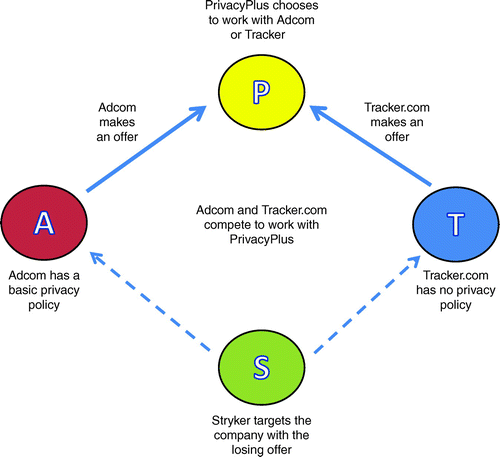
Appendix D
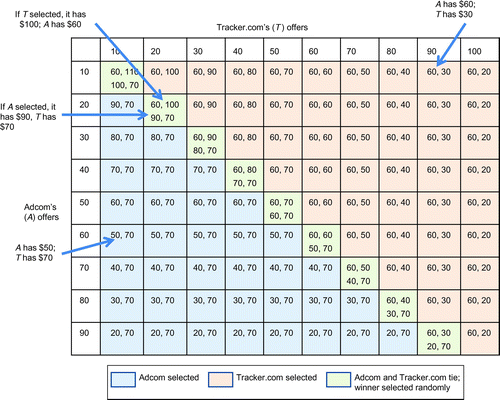
References
- (1995) Integrated strategy: Market and nonmarket components. California Management Rev. 37:47–65.Crossref, Google Scholar
- (2003) Private politics. J. Econom. Management Strategy 12:31–66.Crossref, Google Scholar
- (2012) The industrial organization of private politics. Quart. J. Political Sci. 7:135–174.Crossref, Google Scholar
- (2014) Self-regulation in private and public politics. Quart. J. Political Sci. 9:231–267.Crossref, Google Scholar
- (2007) Strategic activism and nonmarket strategy. J. Econom. Management Strategy 16:599–634.Crossref, Google Scholar
- (2004) Anatomy of a corporate campaign: Rainforest Action Network and Citigroup (A) (B). Case P42 A, B. Graduate School of Business, Stanford University, Stanford, CA.Google Scholar
- (2015) Extending nonmarket strategy: Political economy and the radical flank effect in private politics. Working paper, Stanford University.Google Scholar
- (2011) Using Mechanical Turk as a subject recruitment tool in experimental research. Working paper, Massachusetts Institute of Technology.Google Scholar
- (2006) Plata o plomo?: Bribes and punishment in a theory of political influence. Amer. Political Sci. Rev. 100:41–53.Crossref, Google Scholar
- (2014) The 2014 GreenBiz NGO Report: How Companies Rate Activists as Partners. Accessed May 19, 2016, http://info.greenbiz.com/rs/greenbizgroup/images/greenbiz-ngo-report.pdf.Google Scholar
- (2009) Integrated political strategy. Adv. Strategic Management 26:459–486.Crossref, Google Scholar
- (2008) Linking strategic choice with macro-organizational dynamics: Strategy and social movement articulation. McCoy P, ed. Research in Social Movements, Conflicts and Change (Emerald Group, Basingstoke, UK), 3–38.Crossref, Google Scholar
- (2006) Firm responses to secondary stakeholder action. Strategic Management J. 27:765–781.Crossref, Google Scholar
- (2015) Private politics and public regulation. Working paper, Northwestern University, Evanston, IL.Google Scholar
- (2013) Competing environmental labels. Working paper, University of Michigan, Ann Arbor, MI.Google Scholar
- (1975) The Politics of Women’s Liberation (Longman, New York).Google Scholar
- (2002) Developing stakeholder theory. J. Management Stud. 24:195–212.Google Scholar
- (2013) Private politics and environmental management. Working paper, University of Florida, Gainesville, FL.Google Scholar
- (1988) Black Radicals and the Civil Rights Mainstream, 1954–1970 (The University of Tennessee Press, Knoxville, TN).Google Scholar
- (2010) Multinationals and anti-sweatshop activism. Amer. Econom. Rev. 100:247–273.Crossref, Google Scholar
- (2012) Strategy and competition in market and nonmarket arenas. Acad. Management Perspect. 26:40–49.Crossref, Google Scholar
- (2009) From Pabst to Pepsi: The deinstitutionalization of social practices and the creation of entrepreneurial opportunities. Admin. Sci. Quart. 54:635–667.Crossref, Google Scholar
- (1995) International variation in the business-government interface: Institutional and organizational considerations. Acad. Management Rev. 20:193–214.Crossref, Google Scholar
- (2010) Trouble in store: The emergence and success of protests against WalMart store openings in America. Amer. J. Sociology 116:53–92.Crossref, Google Scholar
- (2006) A theory of consumer boycotts under symmetric information and imperfect competition. Econom. J. 116:355–381.Google Scholar
- (2010) The contentiousness of markets: Politics, social movements, and institutional change in markets. Ann. Rev. Sociology 36:249–67.Crossref, Google Scholar
- (2015) Good firms, good targets: The relationship between corporate social responsibility, reputation, and activist targeting. Lim A, Tsutsui K, eds. Corporate Social Responsibility in a Globalizing World (Cambridge University Press, Cambridge, UK), 430–454.Crossref, Google Scholar
- (2007) Social movements as extra-institutional entrepreneurs: The effect of protest on stock price returns. Admin. Sci. Quart. 52:413–442.Crossref, Google Scholar
- (2012) Globalization, credence goods and international civil society. Working paper, Centre for Economic Policy Research, London.Google Scholar
- (2009) Private environmental activism and the selection and response of firm targets. J. Econom. Management Strategy 18:45–73.Crossref, Google Scholar
- (2014) Linking public and private politics: Activist strategy for industry transformation. Working paper, University of Michigan, Ann Arbor, MI.Google Scholar
- (2013) The emerging role of worker centers in union organizing: A strategic assessment. Report, U.S. Chamber of Commerce: Workforce Freedom Initiative, November.Google Scholar
- (2010) An economic perspective on NGO strategies and objectives. Lyon TP, ed. Good Cop, Bad Cop: Environmental NGOs and Their Strategies Toward Business (RFF Press, Washington, DC), 136–163.Google Scholar
- (1992) Studying social movements: A conceptual tour of the field. Program on Nonviolent Sanctions and Cultural Survival, Weatherhead Center for International Affairs, Harvard University, Cambridge, MA.Google Scholar
- (2013) Keeping up appearances: Reputation threat and prosocial responses to social movement boycotts. Admin. Sci. Quart. 58:387–419.Crossref, Google Scholar
- (2008) Boundary organizations: Enabling collaboration among unexpected allies. Admin. Sci. Quart. 53: 422–459.Crossref, Google Scholar
- (2011) Laws of attraction: Regulatory arbitrage in the face of activism in right-to-work states. Amer. Sociol. Rev. 76:365–385.Crossref, Google Scholar
- (2010) Environmental Defense Fund. Lyon TP, ed., Good Cop, Bad Cop: Environmental NGOs and Their Strategies Toward Business (RFF Press, Washington, DC), 184–194.Google Scholar
- (2014) Is Staples right to reward Asia Pulp and Paper’s forest pledge? Accessed May 19, 2016, http://www.greenbiz.com/blog/2014/03/06/staples-right-reward-asia-pulp-and-papers-forest-pledge.Google Scholar
- (2011) Radicalism within the context of social movements: Processes and types. J. Strategic Security 4:115–130.Crossref, Google Scholar
- (2008) Competition and resource partitioning in three social movement industries. Amer. J. Sociology 113:1568–1610.Crossref, Google Scholar
- (2013) Information spillovers from protests against corporations: A tale of Walmart and Target. Admin. Sci. Quart. 58:669–701.Crossref, Google Scholar
David Baron is the David S. and Ann M. Barlow Professor of Political Economy and Strategy, Emeritus at the Graduate School of Business, Stanford University.
Margaret Neale is the Adams Distinguished Professor of Management at the Graduate School of Business, Stanford University.
Hayagreeva Rao is the Atholl McBean Professor of Organizational Behavior and Human Resources Management at the Graduate School of Business, Stanford University.