Introduction to the Special Issue on Decision Analysis and Social Media
As data collection and storage capabilities expand, organizations are increasingly relying on large data sets for major decisions. In recent years, social media platforms have emerged as a valuable data source. Decision analysis is well-positioned to serve as a link between the availability of social media information and improvements in real-world outcomes.
Social networks have the potential to aid decision makers with many elements of a decision besides the information element, such as the frame of the decision, the alternatives, and the preferences (for more details on the elements of a decision, see Howard and Abbas 2015, Spetzler et al. 2017). For example, as demonstrated by Bond et al. (2010), decision makers exhibit significant shortcomings in the generation of objectives for decisions that they face. When presented with aids and changes in the assessment process, the identification of the important objectives becomes easier. Social media platforms can help crowdsource the inputs to the decision to augment some of our cognitive shortcomings. Figure 1 demonstrates the objectives listed by new graduates when making a job decision.
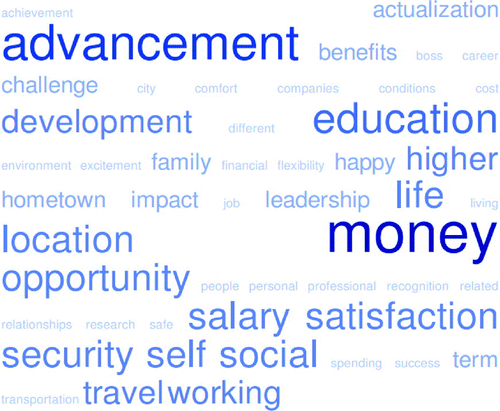
Source. Courtesy of Ahoona Corp (www.ahoona.com).
Social media platforms have also been used in teaching decision analysis (Abbas 2013). They can provide opportunities for students to help each other determine the appropriate inputs to a decision, and to apply the proper tools to improve decision quality.
This special issue aims to promote the use of social media platforms to support better decision making. It contains four excellent papers that bridge decision analysis concepts and social media analytics. First, Rathore et al. (2017) provide a valuable overview and survey of a wide range of prior work in social media analytics. This paper is an extremely useful resource for researchers and practitioners interested in the existing methods and applications that rely on social media data.
Allen et al. (2017) develop a method called K-means latent Dirichlet allocation that allows decision models to update their inputs quickly and efficiently when new information is produced via social media. This approach is valuable for relatively routine decisions that must be made frequently and incorporate recent data. They demonstrate the use of their approach with a cybersecurity example, showing how it can improve decisions of when to patch vulnerabilities.
In the realm of college football recruiting, Bigsby et al. (2017) demonstrate a novel approach to predicting decisions that combines both traditional preference estimation and information gleaned from social media. They find that by considering traits of an athlete and schools along with publicly available Twitter data, it is possible to obtain better estimates of the likelihood of the athlete attending any given school. This allows schools to improve their allocations of recruiting resources.
Continuing in the context of sports, Bogaert et al. (2017) apply several predictive analytics methods to Facebook user data to predict whether a given user is a soccer player or not. They develop a fusion model to obtain predictions more accurate than individual predictive methods, and provide sensitivity analysis showing the impact on marketing decisions. Their approach is not limited to the prediction made in this paper; it could be applied to any effort to predict whether or not a Facebook user satisfies a given characteristic, and used to improve decisions associated with the predictions.
References
- (2013) Teaching decision making with social networks. ORMS Today 40(6):26–29.Google Scholar
- (2017) Timely decision analysis enabled by efficient social media modeling. Decision Anal. 14(4):250–260.Link, Google Scholar
- (2017). Online and off the field: Predicting school choice in college football recruiting from social media data. Decision Anal. 14(4):261–273.Link, Google Scholar
- (2017) Identifying soccer players on Facebook through predictive analytics. Decision Anal. 14(4):274–297.Link, Google Scholar
- (2010) Improving the generation of decision objectives. Decision Anal. 7(3):238–255.Link, Google Scholar
- (2015) Foundations of Decision Analysis (Pearson, New York).Google Scholar
- (2017) Social media analytics: Literature review and direction of future research. Decision Anal. 14(4):229–249.Link, Google Scholar
- (2017) Decision Quality: Value Creation from Better Business Decisions (John Wiley & Sons, New York).Google Scholar