Balancing Tradeoffs in Climate-Smart Agriculture: Will Selling Carbon Credits Offset Potential Losses in the Net Yield Income of Small-Scale Soybean (Glycine max L.) Producers in the Mid-Southern United States?
Abstract
There is a need to achieve sustainable agricultural production to secure food, fiber, and fuel for a growing global population. Climate-smart (CS) actions (no-till and cover crops) can reduce carbon emissions and promote soil organic carbon (SOC) storage. Contemporary voluntary carbon markets provide producers with a monetary incentive to adopt CS actions. However, SOC–yield dynamics under CS actions are not well known, making it difficult for producers to judge whether additional income from carbon credits will offset potential losses to yield income. We designed a SOC–yield framework that captures SOC–yield–income dynamics under traditional (reduced tillage, no cover crops) and CS actions. Using a modified structured decision-making approach, we applied the framework to a case study in which producers aim to increase income by selling carbon credits after adopting CS actions. Specifically, we demonstrated how to balance tradeoffs between yield and carbon credit income that arise from tillage and winter cover crop actions (cereal rye, Secale cereale L. and crimson clover, Trifolium incarnatum L.) in a soybean (Glycine max L.) production system in Mississippi. Results indicated that a producer could minimize losses to net yield income by adopting no-till if already using cover crops. There was also evidence that carbon credit income could offset losses to yield income when adopting CS in place of traditional actions. Identifying risks to yield income and SOC storage can help design carbon neutrality policies that have minimum impact on a producer’s income.
History: This paper has been accepted for the Decision Analysis Special Issue on Decision Analysis to Advance Environmental Sustainability.
Funding: This work was supported by the USDA-ARS [Grants 58-0200-0-002 (Advancing Agricultural Research) and 58-6001-8-003] and the USDA National Institute of Food and Agriculture [McIntire Stennis Project 1020959].
Supplemental Material: The online appendix is available at https://doi.org/10.1287/deca.2023.0478.
Introduction
Covering roughly 40% of the earth’s terrestrial landscape, agricultural production is a $3.5 trillion industry that has vastly altered the structure and function of natural landscapes (Gordon et al. 2010, FAO 2021). Converting land into agricultural production can reduce soil carbon I (C) by as much as 20–80 tons C/ha in some areas. Lost soil C is mostly emitted into the atmosphere (Arias et al. 2021), contributing to rising global temperatures. Therefore, managing agricultural production sites with methods that promote soil C storage has the potential to mitigate major climate concerns.
Under the 2015 Paris Agreement, nations pledged to limit global temperature rise to 1.5°C (Masson-Delmotte et al. 2018) by implementing policy and management changes that reduce climate emissions. This reignited decades of effort in the public and private sectors to find innovative ways to meet C neutrality goals (Bellassen and Leguet 2007, Ramanathan and Xu 2010, McLaren et al. 2019). Soil is the largest terrestrial C sink (Batjes 1996, Geyer et al. 2020), but it can quickly become a C emission source under poor or specific management actions (Paustian et al. 2019). Global attention to soil C has given rise to voluntary C markets, which financially incentivize landowners to adopt at least one climate-smart (CS) action (e.g., no-till, cover crops) (McNunn et al. 2020) to offset C emissions (Jackson Hammond et al. 2021). The subsequent increase in C market options encouraged the development of the U.S. Department of Agriculture (USDA) 2021 Climate Adaption Plan to promote participation in C market programs that dually meet climate change mitigation goals and build resiliency in rural communities (USDA 2021).
Producers generally support C neutrality and welcome the financial benefits acquired from their enrollment in C credit programs (Bellassen and Leguet 2007, Schulte-Moore and Jordahl 2021). However, there is reasonable skepticism around meeting the entry requirements (Corteva 2022) by adopting CS actions without a proper assessment of the risk to their net income gained using traditional, non-CS actions (Willock et al. 1999, Carlisle 2016, Tong et al. 2019). Research on CS actions has shown that two common CS management strategies, no-till and cover crops, can promote C storage by improving soil health (Blanco-Canqui et al. 2022) compared with traditional actions (here, reduced-tillage (RT) and no cover crops (NC)), therein providing essential ecosystem services and climate change mitigation. Conversely, studies have also shown that the integration of these practices can complicate planting regimes and lower crop yield, potentially resulting in income loss (Bergtold et al. 2017). However, the successful integration of CS practices for both soil C (and soil health) and economic return is variable, depending on the timing and methodology of field application, as well as abiotic factors (Daryanto et al. 2018).
The apparent dependency on sites-specific nuances (management history, climate, soil type, abiotic and biotic factors, production goals) for successful integration of CS actions can complicate producer decision-making when considering latent tradeoffs between crop yield and soil C, which depend on several soil health indicators (Gil et al. 2018, McGuire et al. 2022). There is sufficient experimental evidence documenting the effects of CS actions on soil C (Wolf et al. 2017, Das et al. 2022) and C emissions (de Pinto et al. 2020, Rahman et al. 2021). However, producers lack a formal decision-making tool that clearly demonstrates the potential economic outcomes of CS actions in terms of yield and carbon credit income. Therefore, there is an immediate need for an empirical method for assessing the tradeoffs between traditional and CS actions so that producers can make informed decisions that promote climate change mitigation while maintaining their income.
To address this need, we used a structured decision-making (SDM) framework (Gregory et al. 2012) based on Bayesian decision theory to inform producers who are considering enrollment in voluntary C markets. The framework uses a dynamic Bayesian decision network (BDN) based on a conceptual model that links on-farm decisions to current soil conditions and downstream gains (or losses) in yield and soil organic carbon (SOC) over the growing season. Producers who seek to maximize their annual income by selling carbon credits can use the framework to identify income tradeoffs that might arise between SOC and yield after deciding to replace traditional actions with CS actions while accounting for expenses. Our innovative approach of combining structured decision making and Bayesian decision theory can be applied to any sustainability issue whose solution requires balancing tradeoffs among economic and biophysical system components while accounting for risk and uncertainty (Dorazio and Johnson 2003, Keren et al. 2015, Whitney et al. 2018).
We used the framework to identify tradeoffs between SOC storage and net yield income that arise from tillage and winter cover crop actions (Secale cereale L., Trifolium incarnatum L.) in a soybean (Glycine max L.) production system in Mississippi (MS). Our objective was to demonstrate how the framework can be used to identify the potential for C credits to offset potential losses in yield income by calculating the probability of storing different levels of SOC when using traditional and CS actions considering uncertainties in system dynamics related to several soil health indicators. We also demonstrate how to calculate expected income after expenses plus potential income from carbon credits for each action and how to rank actions in terms of these values.
Methods
We completed this analysis in seven steps as described in the following sections:
In “Decision Framing,” we follow the decision-framing steps suggested by Gregory et al. (2012) and provide information on the decision problem, decision-makers, alternative decision actions, assumptions, and consequences.
In “Designing a Global BDN Structure,” we describe the general features and construction of BDNs and how they apply to our study.
In “Designing a Conceptual Model,” we describe how the conceptual model of our system was developed. The conceptual model links decisions to SOC dynamics and income and acted as the precursor to the BDN subnetworks that were used for statistical analyses.
In “Data Collection and Preprocessing,” we describe the study site and experimental design, the soil variables, and the data preprocessing required to construct the BDNs.
In “Constructing the BDNs, Diagnostics, and Parameterization,” we describe the multistep process of identifying the BDN structure for each subnetwork, the diagnostics used to identify the best-fitting structure, and the conditional probability table parameterization.
In “Implementing the BDNs,” we describe how the BDN subnetworks were used to calculate the conditional probability relationships among soil variables and the effect of tillage and cover crop actions on soil conditions.
In “Utility (Income) Calculations,” we describe how the budgets for each tillage and cover crop action were created, how net yield was calculated, how the potential C credit values were obtained, and how monetary values were assigned to results of the BDN subnetworks to identify tradeoffs among tillage and cover crop decisions.
All BDN subnetwork analyses were completed in R (R Core Team 2021) using the package bnlearn (Scutari 2010). Data discretization was completed in R (R Core Team 2021) using the package infotheo (Meyer 2014), and we also used R for the utility (income) calculations. Results are presented as probabilities with 95% credible intervals. Monetary values are presented in the U.S. dollar (USD).
Decision Framing
Following the SDM steps of Gregory et al. (2012), we designed this analysis as follows:
Decision context, problem, and uncertainties.
As stated in the Introduction, compared with CS-NT actions, traditional RT actions are thought to release more C from the soil (de Pinto et al. 2020, Arias et al. 2021, Rahman et al. 2021). In addition, traditional NC actions do not add/maintain organic C to/in the soil (Wolf et al. 2017, Das et al. 2022). Many countries are considering enacting environmental policies that reduce C emissions including the use of CS actions (Masson-Delmotte et al. 2018, USDA 2021). The concurrent emergence of voluntary C markets has provided producers with monetary incentive to adopt CS actions in place of traditional actions, but the outcome of this decision has uncertain risks to farm-level net income (yield minus expenses). An empirical assessment of farm-level income under CS and traditional actions is required so that producers and policymakers can make informed decisions.
Decision objectives, assumptions, and performance measures
Here, we focus only on the objective of producers. Producers aim to maximize their net income after expenses. Before entering the voluntary C market and selling C credits, producers must adopt CS NT actions in place of their current traditional RT actions and/or adopt CS cover crop actions in place of their current traditional NC action. The decision to adopt new cover crop actions is made the year before entering the voluntary C market as these crops must be planted before the prior winter. The decision to adopt NT can be made in the current year.
For producers using traditional RT and NC actions, we assume they would decide to adopt any combination of CS actions and enter the voluntary C market if their net income under CS actions is greater than that under traditional actions.
For producers using any combination of CS actions, we assume they would decide to (1) enter the voluntary C market if the net income under their current CS actions is greater than that under traditional actions; (2) adopt a different combination of CS actions (e.g., change the type of cover crop planted) depending on which combination results in the highest income after entering the voluntary C market; and (3) adopt one or all traditional action(s) in place of their current CS actions and not enter the voluntary C market if the net income under traditional action(s) is greater than that under any combination of CS actions.
For producers using a combination of traditional and CS actions, we assume they would replace the traditional action with a CS action and enter the voluntary C market if the net income under two CS actions is greater than that under the combination of traditional and CS actions. However, we also assume that these producers would replace their CS action with a traditional action and not enter the voluntary C market if the net income under the combination of traditional actions is greater than under the combination of traditional and CS actions.
Producers base their decision on three performance measures: SOC, yield, and expenses. Producers are interested in maximizing SOC because (1) it is related to soil health and yield and (2) high levels equate to more C credits. Producers are interested in maximizing income to achieve an enjoyable livelihood. At the same time, producers are also interested in minimizing expenses to reduce income lost. It should be noted that we also assume producers have access to both RT and NT equipment at no additional cost. Therefore, our calculations do not include the cost of purchasing or renting new equipment. Although these additional costs can be prohibitory, our objective was to provide producers with information on sustained differences in income under CS and traditional actions that they might enjoy after any initial investment in equipment. In addition, the cost of renting equipment is variable and unknown for the current system. Finally, it is possible for producers to borrow, modify, or trade equipment at no additional cost.
Alternative actions
We consider all combinations of the following CS and traditional tillage and winter cover crop actions:
• Tillage: RT (traditional); NT (CS)
• Winter cover crops: NC (traditional); rye only (RY) (CS); rye + clover (RC) (CS)
Expected consequences of actions
Each combination of tillage and cover crop action is expected to have direct effects on SOC, yield, and expenses. Based on the literature, we expect that CS actions will result in higher SOC storage and thus greater income generated from C credits compared with those resulting from traditional actions. However, previous studies have not established a clear difference in the effects of traditional and CS actions on yield, so we conservatively expect no differences in the yield produced under RT and NT actions.
Tradeoffs among decisions and consequences
The main tradeoffs among the consequences of the decision to use different combinations of CS and traditional actions arise between net yield income (dependent on yield and expenses) and potential C credit income (dependent on SOC storage). Producers will base their decision on which combination of tillage and winter cover crops results in the highest net income (i.e., yield income minus expenses plus C credit income).
Designing a Global BDN Structure
BDNs are extended from traditional BNs that use causal relationships to model complex systems (Nyberg et al. 2006, Tong and Tien 2017, Mattsson et al. 2019). The network is a directed acyclic graph (DAG) (Scutari 2010) made of nodes (system components) linked by conditional dependencies using one-way arcs (Figure 1). Cycles are not allowed in the DAG. Here, we define systems components as soil biotic and abiotic conditions. Arcs start at a “parent” node and end at a “child” node and indicate that the state of the child depends on the state of the parent (parent nodes can have multiple children and children can have multiple parents).
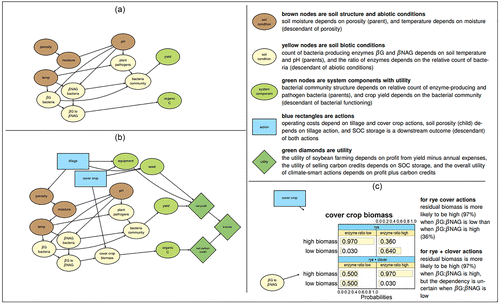
Notes. A BN (a) is first designed based on conditional dependencies among system components (dependencies link parent and child nodes with one-way arcs) and is then extended to a BDN (b) by adding decisions and utilities (i.e., actions and income, respectively). Each node is parameterized by a conditional probability table (c) showing the node’s (i.e., system component) most likely state given the state of its parents. The legend describes the different node types used to construct the conceptual model and BDNs in our analysis. Note that the colors are maintained in all subsequent figures.
The most likely state of each node is calculated as a conditional probability table (Figure 1). Conditional dependencies between parent, child, and descendent (i.e., a node connected to a parent through a child) nodes assume that the state of a child is independent of the state of all nondescendent nodes given the state of its parent(s) (Korb and Nicholson 2010). Variable states can be discrete or continuous. Discrete BNs use only discrete variables, continuous BNs use only continuous Gaussian variables, and hybrid BNs use a combination of both.
A BDN (Figure 1) is created by adding nodes for one or more decisions and utilities to the BN (Khosravi-Farmad and Ghaemi-Bafghi 2020). Here, we define decisions as traditional and CS tillage and cover crop actions and utilities as net yield income and C credit income. The utility of a decision is calculated using exact inference as the probability that each system component takes one of its possible states (Tong and Tien 2017). Decisions can have direct and indirect effects on system components. For direct effects, a decision is the parent node, and the system component is the child node. For indirect effects, a decision is linked to one or more system components through their children (i.e., decisions become “ancestors”). Uncertainties are propagated through the causal links and are incorporated into the system state and utilities (Lee and Hong 2017). The best decision is identified by ranking the utility outcomes in terms of risk for a decision maker’s objective (Smith 2010). Hereafter, to maintain consistency with our case study, we refer to “utility” as “income” (i.e., yield income, net yield income, and C credit income) and to “decisions” as “actions” (traditional and CS tillage and cover crop actions).
Designing a Conceptual Model
Designing a conceptual model for a BDN is an important first step in all decision analyses (Chen and Pollino 2012). The conceptual model is a precursor to the final BDN structure that contains all plausible causal links among system components. This reduces the chances of including spurious links that are based on statistical correlations only. In this analysis, the conceptual model is tested empirically, and those links that are not supported are dropped to establish the final BDN structure.
Our conceptual model contained only those links between decisions, actions, and SOC dynamics that were biologically and financially meaningful in terms of yield, SOC, and income. Our group, composed of system modelers, ecologists, soil scientists, and agronomists, designed the conceptual model in a series of steps including brainstorming sessions, a literature review for network structure, and revision. Briefly, we met for two brainstorming sessions to discuss SOC dynamics under traditional and CS actions. Then, the system modeler completed a literature review and constructed the conceptual model. The whole group then met again to review the model, during which time the soil experts made final revisions to the links within the model. See the online appendix for a detailed explanation of the conceptual model with justifications for links within the system.
The conceptual model was constructed from several submodels that represent known pathways for soil SOC storage under traditional and CS actions. It was challenging to model C flow through the soil system using a network that does not allow cycles. Thus, we extended the BDN over five samples (t = 1 to 5) taken throughout the growing season. The BDN for each sample had the same nodes and links, but we added arcs between consecutive samples to represent cyclic dynamics including organic matter decomposition, enzyme activity, carbon fixation, microbe respiration, and microbe community dynamics. We also assumed that cycles started at a baseline system state (Moorhead et al. 2013) at t = 0 for which we did not have sample values. The baseline system state was assumed to represent the state of dynamic cycles immediately following cover crop termination (when used) and tillage (when used) in the given year. Thus, our first sample (t = 1) represents the starting state for each submodel. We refer to arcs linking nodes within samples as interarcs and arcs linking nodes between samples as intra-arcs following Lugo-Martinez et al. (2019). For brevity, we report results for the samples taken at the beginning (t = 1) and end (t = 5) of the growing season.
The submodels included the following: (1) the direct effects of actions on soil structure and abiotic conditions (soil health indicators), (2) the indirect effects of actions on organic matter decomposition and eventual SOC, (3) the indirect effects of actions on bacterial carbon fixation potential of soils, (4) the indirect effects of actions on microbial community dynamics and function (enzyme production, gene expression, respiration, death, and turnover), and (5) the indirect effects of actions on microbial pathogens and their effects on yield. To demonstrate our framework, we report methods and results for submodels 1 and 2 (Figure 1(b)). These submodels are important for SOC dynamics as they show the direct effects of tillage and cover crop actions on soil structure and abiotic conditions that indirectly affect organic matter decomposition (via changes in soil structure and abiotic conditions only). Although data were available for all submodels, we chose to focus on submodels 1 and 2 for brevity and simplicity of presentation. Thus, although our results do not capture all the aspects of C cycling through the system, they do show how decision analyses can be used to meet sustainability objectives.
In the conceptual model for submodel (1), showing the direct effects of actions on soil structure and abiotic conditions, tillage actions were predicted to have direct effects on soil structure (porosity) and indirect effects on abiotic conditions (moisture, temperature, and pH) via changes in soil structure. The direct effects of tillage on soil structure were expected to be constant over the growing season. Cover crop actions were predicted to have direct effects on cover crop biomass and indirect effects on soil moisture, temperature, and pH.
In the conceptual model for submodel (2), showing the indirect effects of actions on organic matter decomposition and eventual SOC, tillage and cover crop actions were predicted to have indirect effects on bacteria enzyme activity and SOC via their direct effects on soil temperature, pH, and moisture. Soil bacteria produce extracellular enzymes that decompose cellulose (βG) and chitin (βNAG). These enzymes function in optimal temperature, pH, and moisture conditions, which are affected by tillage and cover crop actions. We predicted that cover crop actions would add organic matter biomass to the soil and thus show different decomposition dynamics than the NC action that does not add organic matter to the soil. Given that cover crop biomass decomposes over the growing season as it cycles through the system, we also predicted that the amount of biomass remaining at the end of the growing season would be less than that during the early growing season across all treatments. Finally, we predicted that enzyme activity would have direct effects on SOC.
Data Collection and Preprocessing
Study Site and Experimental Design
The field methods are detailed in Firth et al. (2022, 2023). Briefly, experimental production plots were established at the United States Department of Agriculture-Agricultural Research Service (USDA-ARS) Crop Productions Systems Research Unit farm near Stoneville, MS, in 2000. The plots included an NT and RT (tillage once in the fall, postharvest) treatment. From 2017 onward, the following cover crop treatments were established under a split-block design: elbon rye (RY), elbon rye–crimson clover mix (RC), and NC. Tillage treatments did not change after 2000. We used the following treatments to represent different combinations of actions (24 plots, 6 plots in each block): NT–RY; NT–RC; NT–NC; RT–RY; RT–RC; and RT–NC. We collected experimental data from May to September 2019.
Cover crops were terminated with herbicide in late-April 2019 when the cover crops reached peak growth. Twenty-four hours after cover crop termination, 150 g of cover crop biomass was harvested and placed in litterbags, under which all soil samples were taken. The NC treatment litter bags contained volunteer vegetation (not purposely planted, e.g., weeds) from the plot. Two litter bags containing cover crop biomass (or volunteer vegetation) from their respective plots were stapled closed and then secured to the soil surface.
It should be noted that tillage and cover crop actions are known to affect biogeochemical properties with eventual consequences for on-farm decision making regarding fertilizer use. However, this was a controlled experiment that did not vary fertilizer application across treatments (Firth et al. 2022, 2023). Thus, we did not consider the indirect impact of tillage decisions on soil dynamics and subsequent fertilizer use for each time step of the model.
Soil Variables
The conceptual model included soil variables from known pathways of SOC storage under traditional and CS actions. The abiotic variables included soil porosity, pH, temperature, and gravimetric moisture (hereafter, moisture). The biotic variables included bacterial abundance and fungal abundance. The functional variables included the activity of bacterial enzymes (β-glucosidase (βG) and β-N-glucosaminidase (βNAG)), and carbon dioxide flux (i.e., microbial respiration). All soil variables were collected by Firth et al. (2022, 2023). Please see the online appendix for details on field methods and calculations.
Soil conditions that are known to influence SOC include pH (Andresson and Nilsson 2001, Reisser et al. 2016), temperature (Andresson and Nilsson 2001), bulk density and porosity (Meurer et al. 2020), moisture (Doetterl et al. 2015), texture (Cates et al. 2022), humidity (Thapa et al. 2022), cation exchange capacity (Solly et al. 2020), biomass quantity and quality (Thapa et al. 2022), and biological activity (Kallenbach et al. 2015). Here, we use only those variables related to soil structure and abiotic conditions, organic matter decomposition, and SOC that showed the most variation within and between our experimental plots. Our choice to not include all the physiochemical variables in our modeling framework stemmed from direct relationships between properties or a lack of variability between field study plots. Thus, the included variables were representative of soybean production under the conditions of our local system.
Data Preprocessing
We fit discrete BDNs because our data were not Gaussian (Scutari 2010). We did not fit hybrid BDNs because we aimed to produce results that could be used by individuals who might not have expertise in traditional statistics. Therefore, we assumed that discretizing variables would support fast, inclusive decision making for all regardless of their expertise. Before fitting the models, we discretized all continuous soil variables into bins using an unsupervised discretization algorithm (Beuzen et al. 2018). The algorithm separates data into intervals of equal width (EW) or equal frequency (EF) based on the empirical data distribution.
Following general recommendations for tractability in data discretization (Marcot et al. 2006, Chen and Pollino 2012), we used a maximum of four bins for most variables unless the data range was large enough to support six bins. We used EW or EF for different variables depending on how well the categories described the variability in the data (reviewed using empirical data plots; not shown). For example, to discretize soil porosity (this was the only variable that did not differ between time samples), which ranged from 48.11 to 65.81 g/cm2, we used the EW and EF algorithms to divide data into two to six bins and then constructed a histogram to review the distribution of data points among the bins. The results for EF and six bins showed that some bins did not contain data points, whereas the results of EW and two bins had more than one data point within each. Thus, we used the EW method with a maximum of two bins to discretize soil porosity. The empirical data ranges and discretization methods, categories, and ranges are provided in Table 1 for the early growing season and the end of the growing season (for brevity, we list values for the variables that were included in the final BDNs). Actions were discretized into categories based on the treatments used in Firth et al. (2022, 2023) and as described in the “Study Site and Experimental Design” (i.e., NT–RY; NT–RC; NT–NC; RT–RY; RT–RC; and RT–NC).
|

Table 1. Yield and Soil Variable Discretization Based on the Empirical Data Range of Variables that were Included in the Final BDNs
| Variable | Season | Empirical range | Discretization | ||||
|---|---|---|---|---|---|---|---|
| Minimum | Maximum | Algorithm | Bins | Range | |||
| Yield (kg/ha) | End | 2070.46 | 3560.68 | EW | Low | 2,070.46 | 2,673.74 |
| High | 2,770.04 | 3,560.68 | |||||
| Cover crop biomass (g/m2) | Early | 81.05 | 823.75 | EW | Minimum | 81.05 | 165.65 |
| Low | 352.95 | 372.6 | |||||
| Moderate | 470.3 | 554.8 | |||||
| High | 602.35 | 668.7 | |||||
| Maximum | 753.65 | 823.75 | |||||
| End | 21.61 | 304 | EW | Minimum | 21.61 | 64.84 | |
| Low | 69.74 | 75.24 | |||||
| Moderate-low | 160.86 | ||||||
| Moderate-high | 169.51 | 201.08 | |||||
| High | 219.28 | 255.91 | |||||
| Maximum | 270.15 | 304 | |||||
| Porosity (g/cm2) | Early | 48.11 | 65.81 | EW | Low | 48.11 | 56.53 |
| High | 57.74 | 65.81 | |||||
| End | 48.11 | 65.81 | EW | Low | 48.11 | 56.53 | |
| High | 57.74 | 65.81 | |||||
| pH | Early | 6.08 | 6.8 | EW | Low | 6.08 | 6.31 |
| Moderate | 6.47 | 6.53 | |||||
| High | 6.58 | 6.80 | |||||
| End | 5.96 | 6.79 | EW | Low | 5.95 | 6.22 | |
| Moderate | 6.24 | 6.48 | |||||
| High | 6.53 | 6.79 | |||||
| Temperature (°C) | Early | 27.46 | 30.56 | EW | Low | 27.46 | 27.97 |
| High | 29.87 | 30.56 | |||||
| End | 27.41 | 30.35 | EW | Low | 27.41 | 28.31 | |
| High | 30.35 | ||||||
| Moisture (%) | Early | 0.25 | 0.35 | EF | Drier | 0.25 | 0.30 |
| Wetter | 0.31 | 0.35 | |||||
| End | 0.05 | 0.18 | EF | Drier | 0.05 | 0.10 | |
| Wetter | 0.10 | 0.18 | |||||
| SOC (g/kg) | Early | 11.89 | 21.65 | EW | Low | 11.89 | 13.94 |
| Moderate-low | 14.63 | 16.75 | |||||
| Moderate-high | 17.13 | 18.68 | |||||
| High | 19.88 | 21.65 | |||||
| Early | 10.30 | 22.59 | EW | Low | 10.30 | 13.19 | |
| Moderate-low | 14.40 | 15.84 | |||||
| Moderate-high | 16.46 | 19.20 | |||||
| High | 22.59 | ||||||
| Enzyme activity (βG:βNAG) (µmol/kg/h:µmol/kg/h) | Early | 0.91 | 8.05 | EF | Minimum | 0.91 | 1.62 |
| Low | 1.87 | 2.21 | |||||
| Moderate-low | 2.67 | 2.76 | |||||
| Moderate-high | 2.80 | 3.50 | |||||
| High | 2.50 | 3.96 | |||||
| Maximum | 4.18 | 8.05 | |||||
| Late | 0.9 | 30.68 | EF | Minimum | 0.90 | 2.02 | |
| Low | 2.66 | 2.81 | |||||
| Moderate-low | 3.05 | 3.62 | |||||
| Moderate-high | 3.96 | 4.67 | |||||
| High | 5.55 | 6.77 | |||||
| Maximum | 9.81 | 30.68 | |||||
| Enzyme activity (βNAG) (µmol/kg/h:µmol/kg/h) | Early | 82.68 | 264 | EF | Minimum | 82.68 | 109.76 |
| Low | 110.60 | 127.20 | |||||
| Moderate-low | 128.92 | 140.98 | |||||
| Moderate-high | 157.65 | 197.54 | |||||
| High | 201.87 | 264.00 | |||||
| Maximum | 368.84 | 608.78 | |||||
Note. The number of bins and ranges are provided for the early- and end-growing season.
Constructing the BDNs, Diagnostics, and Parameterization
A BDN subnetwork was constructed for each conceptual submodels for the early growing season and the end of the growing season. These included (1) the direct effects of tillage and cover crop actions on soil structure and abiotic conditions and (2) the indirect effects of tillage and cover crop actions on organic matter decomposition and eventual SOC. To construct subnetwork (2), we extended the BDN for subnetwork (1) to include organic matter decomposition dynamics.
Before using diagnostics to identify the best-fitting subnetwork structure, we completed a preliminary screening using the algorithm for the reconstruction of accurate cellular networks (Margolin et al. 2006) network structure learning algorithm to identify arcs between actions and soil conditions based only on the empirical data. This preliminary screening was considered an empirical test of our conceptual submodels; however, the final subnetwork structures were based on the diagnostics described later, which were designed to identify and remove arcs that were based only on statistical correlations.
Each subnetwork was evaluated using the following diagnostics: (1) Bayes factors (calculated as arc strength), (2) leave-one-out (LOO) cross-validation, and (3) prior sensitivity analysis. Based on the diagnostic results, we removed arcs between variables and arrived at the best-fitting subnetwork structure. We then parameterized the best-fitting subnetworks and used the conditional probabilities for further analyses.
The strength diagnostic was used to measure the strength of each arc within a subnetwork. Arc strength was calculated as the probability that an arc between a node (parent) and all other nodes (children) belongs in the subnetwork, given the remaining network structure (Scutari 2010). We set a threshold for inclusion by reviewing the arc strengths calculated for the subnetworks identified in the preliminary screening (described previously). That is, we dropped all arcs between parent and child nodes with arc strength < 0.75 for both fitted subnetworks.
The LOO diagnostic was used to determine how well a subnetwork can predict one missing observation that is removed from the data set (Gronau and Wagenmakers 2019). We calculated the percentage of correct specifications and considered a good fitting model to have >45% correct for all variables of interest. The prior sensitivity analysis was used to determine how much weight should be assigned to the Dirichlet (uniform) prior (Korb and Nicholson 2010) when fitting the BDNs. The prior influence was checked using an imaginary sample size (iss) and network score analysis (Scutari 2010). Arcs parent and child nodes are easier to fit as iss increases. We fit each BDN twice—once assigning more weight to the prior (iss > 1) and once assigning more weight to the data (iss = 1)—and compared the network scores calculated with the Bayesian Dirichlet method (Scutari 2010). The best-fitting network had the higher score.
Implementing the BDN Subnetworks
We used exact inference analysis (Tong and Tien 2017), modified logic sampling (Amstrup et al. 2008), and bootstrap resampling (Bae et al. 2017) techniques to estimate the conditional probability of each soil variable state given the state of its parents (considering soil conditions only) for each of the best-fitting BDN subnetworks. We also estimated the posterior probability for each soil variable state given different tillage and cover crop actions (considering direct and indirect links) using conditional probability queries (Scutari 2010). We applied bootstrap resampling to estimate 95% credible intervals from 5,000 replications of the resampling function (which returns an average of 5,000 replicates). Credible intervals were therefore estimated from 25 million queries of each BDN.
Income (i.e., Utility) Calculations and Tradeoffs
Income Calculations
In our system, producers qualify to sell carbon credits if they decide to adopt NT in place of RT and/or adopt RY or RC in place of NC. These decisions must be implemented at the beginning of the growing season when a producer enters the C market. In addition to the decision to adopt NT, we consider the following cover crop decisions provided on the IndigoAg website (Corteva 2022) change from: (1) NC to single species nonlegume (RY), (2) NC to multispecies cover crops containing legume (RC), (3) single species nonlegume (RY) to multispecies containing legume (RC), or (4) multispecies containing legume (RC) to single species nonlegume (RY). Producers can access online calculators to estimate potential income gains from selling C credits. These values represent the best-case scenario based on storing maximum SOC. The actual income gained by selling C credits depends on the probability that actions store maximum SOC.
To decide if adopting CS actions will maximize income, producers need to know the following:
Annual expected income from yield after expenses when using RT–NC.
Annual expected yield income after expenses from NT–NC, NT–RY, and NT–RC.
Annual expected income gained from selling C credits considering the risks to SOC storage.
For 1 and 2, we estimated annual expected income as follows: expected income = (yield income) minus (equipment + labor + chemicals). For 3, we used the IndigoAg and Corteva Agriscience (Corteva 2022) online calculator to obtain estimates of potential income from selling C credits after adopting the abovementioned CS actions and estimated annual expected income for each as follows: expected income = (yield income) minus (equipment + labor + chemicals) plus (carbon credits).
We completed the expected income calculations using the Mississippi State University Extension 2019 (MSU-ES 2019) budgets for soybean field operations (Table 2). The annual estimated costs for field operations, per acre soybeans, were for the full-season, long-line, May planted, 12R 30′′ in the non-Delta area of MS. The budgets were adjusted to reflect experimental conditions for all treatments including potash fertilizer applied by air, three herbicide applications per year including water conditioners and surfactants, and cover crop rolling before planting. Equipment use was different for RT and NT and for NC, RY, and RC actions. Fungicides and insecticides were not used in the experiment and were not included in the budgets. See Table S2.1 in the online appendix for annual budgets and expenses before income (net losses) from yield for RT and Table S2.2 for NT.
|
Table 2. Expenses from Tillage and Cover Crop Actions for a Soybean Production System in Mississippi in 2019 (USD)
| Actions | Total costs | |
|---|---|---|
| Tillage | Cover crops | |
| Reduced-till | None | 316.75 |
| No-till | None | 280.36 |
| Reduced-till | Rye | 353.89 |
| Rye + clover | 352.89 | |
| No-till | Rye | 317.82 |
| Rye + clover | 316.82 | |
Note. See the online appendix for detailed breakdowns.
We calculated the additional income lost from planting RY and RC cover crops using the USDA Cover Crop Mix, Seed Cost, and Seeding Rate Calculator for the Mid-South (USDA-NRCS 2021). See Table S2.3 in the online appendix for a detailed breakdown of income lost from planting RY and RC cover crops.
We used the IndigoAg and Corteva Agriscience (Corteva 2022) online carbon credit calculator to determine the potential income gained from selling C credits in MS (Table 3). One C credit is sold for each ton of carbon dioxide equivalent stored as SOC. The potential earnings are based on USD 20 per credit and are given as credits or earnings per acre. We acknowledge that IndigoAg is not the only carbon trading platform available and that estimates of potential earnings will change depending on the chosen platform.
|
Table 3. Potential Income from Selling Carbon Credits with Indigo Agriculture (IndigoAg) Expressed as USD per Acre per Year
| Actions | Indigoag estimates | ||||
|---|---|---|---|---|---|
| Current | New | Credits | Income | ||
| Tillage | Cover crop | Tillage | Cover crop | Acres/yr | Acres/yr |
| Not already using cover crops | |||||
| Reduced | None | None | Rye | 0.64 | 12.8 |
| Rye + clover | 0.84 | 16.8 | |||
| None | 0.25 | 5 | |||
| Already using cover crops | |||||
| Reduced | Rye | None | Rye | 0.25 | 5 |
| Rye + clover | 0.44 | 8 | |||
| Rye + clover | None | Rye | 0.1 | 2 | |
| Rye + clover | 0.25 | 5 | |||
Notes. Producers qualify to sell credits at a given rate when they decide to adopt new actions for their current actions. One credit = USD 20. Values from Corteva Agriscience (Corteva 2022) online calculator.
Identifying Tradeoffs
The expected incomes calculated above are subject to risk associated with yield production and SOC storage. We identified tradeoffs arising from these risks by estimating the probability of producing low and high yields (1 kg/ha = 0.0149 bushels/acre) (Johanns 2013) (using Bayes rule) and estimating the probability of storing different levels of SOC (using the BDN subnetworks) for each tillage and cover crop action. We present results as the probability of producing high yield and storing maximum SOC after deciding to adopt at least one CS action as required to enter the voluntary C market.
To assist with making the decision to adopt NT in place of RT, we discuss risks to the annual expected income gained from selling C credits in terms of the probability of storing different SOC levels. We considered that a decision was high-risk when RT had a higher probability of producing soils that stored a given level of SOC than NT. Low-risk decisions were identified as those where NT was equally or more likely to produce soils that stored a given level of SOC compared with RT. Although, we acknowledge that a reduced probability of producing soils that stored minimum SOC can also reduce risk to C credit income if moderate-high SOC is stored in both RT- and NT-treated soils. To assist with making the decision to adopt either RY or RC in place of NC, we also discuss risks to the annual expected income gained from selling C credits in terms of the probability of producing soils that stored different SOC levels. Results are presented in the tables designed as modified impact matrices (Hoag et al. 2002) showing the change in net yield income and risks to potential C credit income after adopting CS actions.
Results
Model Fit and Diagnostics
BDN Subnetwork for Soil Structure.
The BDN subnetwork that was fitted to the conceptual submodel for the effect of tillage and cover crop actions on soil structure and abiotic conditions (Figure 2) passed LOO (>0.35 correct specifications) and arc strength (all arcs were >0.75) diagnostics. We report values from the model fitted with the iss value.
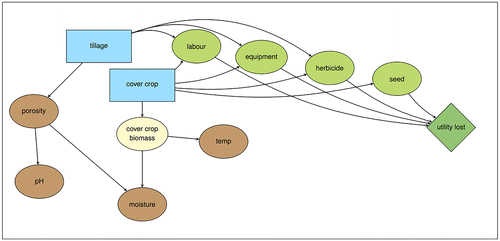
Note. Blue rectangles represent actions; brown nodes represent soil structure and abiotic conditions; yellow nodes represent soil biotic conditions; green nodes represent expenses; green diamonds represent utility (i.e., income).
BDN Subnetworks for Decomposition.
The BDN subnetwork fitted to the conceptual submodel for the outcome of tillage and cover crop actions on decomposition dynamics during the early growing season (Figure 3) passed all diagnostics with values comparable to the soil structure subnetwork. For the subnetwork representing decomposition at the end of the growing season, the diagnostics provided little support for an arc between βG and βNAG and βG:βNAG. Model fit improved after removing the separate βG and βNAG activity values and including only βG:βNAG.
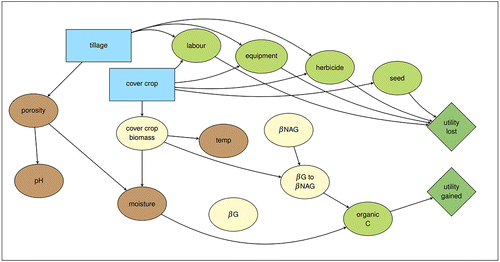
Notes. Utility loss is associated with income lost due to on-farm expenses. Utility gained is due to potential C credits. Blue rectangles represent actions; brown nodes represent soil structure and abiotic conditions; yellow nodes represent soil biotic conditions; green nodes represent expenses; green diamonds represent utility (i.e., income).
Yield Income Under Different Actions
Yield ranged from low (2070.46–2673.74 kg/ha) to high (2770.04–3560.68 kg/ha). There was evidence of an interactive effect of tillage and cover crop actions on total yield (Table 4). Producers using RT–NC actions were more likely to produce high yield (0.6848 [0.6530–0.7155]) than those using RT–RY (0.4074 [0.3729–0.4401]) or RT–RC (0.3158 [0.2843–0.3472]) actions, which were more likely to produce minimum yield. There was some uncertainty in the outcome of NT, where the NT–NC and NT–RC actions were most likely to produce low and high yields, whereas the NT–RY action was most likely to produce a high yield (0.5926 [0.5581–0.6263]).
|
Table 4. Tradeoffs Between Yield (kg/ha) and Net Yield Income (USD) Arising from Different Tillage and Cover Crop Actions
| Cover crop | Yield | Tillage action | |||||
|---|---|---|---|---|---|---|---|
| Reduced till | No till | ||||||
| Probability | CI | Net income | Probability | CI | Net income | ||
| No cover | Low | 0.3159 | 0.2845–0.3475 | (−46.81)–31.84 | 0.5000 | 0.4667–0.5340 | (−10.42)–68.23 |
| High | 0.6848 | 0.6530–0.7155 | 44.34–147.47 | 0.4998 | 0.4663–0.5341 | 80.78–183.86 | |
| Rye | Low | 0.5924 | 0.5589–0.6261 | (−83.95)–(−5.30) | 0.4077 | 0.3747–0.4409 | (−47.88)–30.77 |
| High | 0.4074 | 0.3729–0.4401 | 7.25–110.33 | 0.5926 | 0.5581–0.6263 | 43.34–146.40 | |
| Rye + clover | Low | 0.6847 | 0.6522–0.7165 | (−82.95)–(−4.30) | 0.5002 | 0.4667–0.5345 | (−46.88)–31.77 |
| High | 0.3158 | 0.2843–0.3472 | 8.25–111.33 | 0.5002 | 0.4662–0.5341 | 44.32–147.40 | |
Notes. Only shown are the most likely outcome of each action for a given SOC level calculated as the average of 25 million conditional probability queries with bootstrap resampling, so conditional probabilities do not sum to one. Tradeoffs are expressed as conditional probabilities (with 95% credible intervals). Net income is presented as the values on the extreme ends of the 95% credible intervals. Bold font indicates the most likely outcome for each combination of actions.
The 2019 price of soybeans (bushel/acre) was USD 8.75. Before expenses, a low yield returned an income between USD 269.94 and USD 348.59, whereas a high yield returned an income between USD 361.14 and USD 464.22. Income reduced considerably when adjusted for the costs associated with each action (i.e., expenses; net income column in Table 4). For RT, there was a net loss in income when using either RT–RY or RT–RC if a low yield was produced (the most likely outcome). All other combinations of actions that were more likely to produce a low yield were expected to return positive net income when the yield was at the upper end of the low range (corresponding to the 97% CI).
Uncertainties in Soil Organic Carbon
Soil organic carbon storage depended on the direct effects of RT and NT on soil structure and abiotic conditions and their indirect effects on decomposition dynamics (Tables 5–8). During the early growing season, RT and NT had immediate direct and indirect effects (Figure 3, Table 5) on soil porosity, moisture (via porosity), and SOC (via moisture). By the end of the growing season (Figure 4; Table 7), there were lasting direct effects on soil porosity and indirect effects on moisture (via porosity), the activity of decomposition enzymes βG:βNAG (via moisture), and SOC (via βG:βNAG).
|
Table 5. Downstream Tradeoffs in SOC Storage During the Early Growing Season That Arise from the Direct Effects of Tillage Actions on Soil Conditions
| Tillage | Soil condition | Tradeoffs | |||
|---|---|---|---|---|---|
| Porosity | Moisture | Soc | Probability | CI | |
| Reduced-till | Low | Drier | Low | 0.106 | 0.0977–0.1143 |
| Moderate-low | 0.0849 | 0.0771–0.0924 | |||
| Moderate-high | 0.0724 | 0.0653–0.0797 | |||
| Wetter | Moderate-low | 0.0793 | 0.0718–0.0870 | ||
| Moderate-high | 0.0756 | 0.0683–0.0831 | |||
| High | 0.1253 | 0.1161–0.1342 | |||
| No-till | Low | Drier | Moderate-low | 0.066 | 0.0592–0.0729 |
| High | Drier | Low | 0.0951 | 0.0870–0.1035 | |
| Moderate-low | 0.0781 | 0.0707–0.0856 | |||
| Moderate-high | 0.0625 | 0.056–0.0692 | |||
Notes. Only shown are the most likely outcome of each action for a given SOC level calculated as the average of 25 million conditional probability queries with bootstrap resampling, so conditional probabilities do not sum to one; only shown are the most likely outcome for each combination of actions and soil conditions Tradeoffs are expressed as conditional probabilities (with 95% credible intervals, CI). Bold font indicates significant reductions in the probability of storing a given level of SOC when adopting no-till in place of reduced-till actions.
|
Table 6. Downstream Tradeoffs in SOC Storage During the Early Growing Season that Arise from the Direct Effects of Cover Crop Actions on Soil Conditions
| Soil condition | SOC tradeoffs | ||||||||
|---|---|---|---|---|---|---|---|---|---|
| SOC | No cover | Rye | Rye + clover | ||||||
| cc Biomass | Moisture | βG:βNAG | Probability | CI | Probability | CI | Probability | CI | |
| min | Drier | min | mod-high | 0.0358 | 0.0295–0.0423 | 0.0047 | 0.0024–0.0072 | 0.0047 | 0.0026–0.0072 |
| Low | min | 0.0657 | 0.0575–0.0743 | 0.0085 | 0.0056–0.0117 | 0.0086 | 0.0056–0.0118 | ||
| max | mod-high | 0.0270 | 0.0216–0.3270 | 0.0035 | 0.0018–0.0057 | 0.0035 | 0.0018–0.0057 | ||
| Wetter | min | mod-low | 0.0541 | 0.0466–0.0619 | 0.0070 | 0.0044–0.0100 | 0.0071 | 0.0042–0.0100 | |
| Low | high | 0.0574 | 0.0495–0.0655 | 0.0075 | 0.0047–0.1040 | 0.0075 | 0.0048–0.0106 | ||
| mod | drier | mod-low | mod-low | 0.0042 | 0.0021–0.0066 | 0.0148 | 0.0108–0.0191 | 0.0113 | 0.0079–0.0150 |
| high | 0.0042 | 0.0021–0.0066 | 0.0147 | 0.0108–0.0191 | 0.0112 | 0.0080–0.0149 | |||
| mod–high | mod-low | 0.0033 | 0.0015–0.0054 | 0.0150 | 0.0080–0.0152 | 0.0087 | 0.0057–0.0120 | ||
| high | low | 0.0097 | 0.0064–0.0132 | 0.0338 | 0.0278–0.0401 | 0.0256 | 0.0204–0.0312 | ||
| max | mod-low | 0.0034 | 0.0015–0.0054 | 0.0117 | 0.0083–0.0155 | 0.0089 | 0.0060–0.0123 | ||
| high | drier | mod-low | mod-low | 0.0042 | 0.0021–0.0066 | 0.0148 | 0.0107–0.0191 | 0.0012 | 0.0078–0.0149 |
| high | 0.0042 | 0.0021–0.0065 | 0.0148 | 0.0109–0.0190 | 0.0012 | 0.0079–0.0149 | |||
| wetter | min | mod-low | 0.0028 | 0.0012–0.0048 | 0.0099 | 0.0068–0.0134 | 0.0075 | 0.0047–0.0106 | |
| low | high | 0.0060 | 0.0035–0.0087 | 0.0210 | 0.0162–0.0260 | 0.0159 | 0.0018–0.0202 | ||
| mod-low | mod-high | 0.0079 | 0.0051–0.0111 | 0.0279 | 0.0223–0.0333 | 0.0212 | 0.0164–0.0262 | ||
| max | drier | low | low | 0.0040 | 0.0021–0.0063 | 0.0040 | 0.0021–0.0063 | 0.0175 | 0.0133–0.0221 |
| wetter | min | mod-low | 0.0061 | 0.0036–0.0090 | 0.0061 | 0.0036–0.0089 | 0.0265 | 0.0214–0.0320 | |
| low | high | 0.0062 | 0.0036–0.0089 | 0.0061 | 0.0036–0.0088 | 0.0265 | 0.0212–0.0320 | ||
| mod-low | mod-high | 0.0075 | 0.0048–0.0105 | 0.0075 | 0.0047–0.0106 | 0.0325 | 0.0268–0.0385 | ||
| mod-high | high | 0.0061 | 0.0036–0.0089 | 0.0061 | 0.0036–0.0089 | 0.0265 | 0.0213–0.0321 | ||
Notes. Only shown are the most likely outcome of each action for a given SOC level calculated as the average of 25 million conditional probability queries with bootstrap resampling, so conditional probabilities do not sum to one; cc, cover crop; prob, probability; min, minimum; mod, moderate; max, maximum. Bold indicates most likely outcome.
|
Table 7. Downstream Tradeoffs in SOC at the End of the Growing Season that Arise from the Direct and Indirect Effects of Tillage Actions on Soil Conditions and Decomposition Dynamics
| Soil conditions | SOC tradeoffs | ||||||
|---|---|---|---|---|---|---|---|
| SOC | Reduced-till | No-till | |||||
| Porosity | Moisture | βG:βNAG | Probability | CI | Probability | CI | |
| Low | Drier | min | Low | 0.0253 | 0.0210–0.0298 | 0.0200 | 0.0161–0.0239 |
| High | 0.0077 | 0.0054–0.0103 | 0.0061 | 0.0040–0.0083 | |||
| Low | mod-low | 0.0251 | 0.0207–0.0295 | 0.0198 | 0.0161–0.0237 | ||
| mod-high | 0.0519 | 0.0458–0.0584 | 0.041 | 0.0355–0.0466 | |||
| High | 0.0117 | 0.0088–0.0147 | 0.0092 | 0.0065–0.0120 | |||
| mod-low | Low | 0.0179 | 0.0142–0.0216 | 0.0141 | 0.0109–0.0175 | ||
| max | 0.0117 | 0.0089–0.0147 | 0.0092 | 0.0068–0.0120 | |||
| mod-high | mod-low | 0.0236 | 0.0195–0.0279 | 0.0186 | 0.0150–0.0224 | ||
| max | Low | 0.0228 | 0.0188–0.0269 | 0.0179 | 0.0144–0.0217 | ||
| Wetter | mod-low | Low | 0.0202 | 0.0165–0.0420 | 0.0159 | 0.0126–0.0195 | |
| high | 0.0131 | 0.0101–0.0165 | 0.0104 | 0.0076–0.0132 | |||
| mod-high | mod-low | 0.0165 | 0.0131–0.0201 | 0.0131 | 0.0101–0.0163 | ||
| High | Wetter | Low | Low | 0.0143 | 0.0111–0.0177 | 0.0195 | 0.0157–0.0235 |
| mod-low | Low | 0.0183 | 0.0144–0.0220 | 0.0249 | 0.0206–0.0293 | ||
| mod-low | 0.0119 | 0.0090–0.0149 | 0.0162 | 0.0129–0.0199 | |||
| High | 0.0119 | 0.0089–0.0150 | 0.0162 | 0.0128–0.0197 | |||
| mod-high | mod-low | 0.0149 | 0.0118–0.0183 | 0.0203 | 0.0165–0.0243 | ||
| High | mod-high | 0.033 | 0.0282–0.0379 | 0.0451 | 0.0395–0.0508 | ||
| max | Low | 0.0144 | 0.0111–0.0177 | 0.0194 | 0.0158–0.0233 | ||
Notes. Only shown are the most likely outcome of each action for a given SOC level calculated as the average of 25 million conditional probability queries with bootstrap resampling, so conditional probabilities do not sum to one; prob, probability; min, minimum; mod, moderate; max, maximum. Bold indicates most likely outcome.
|
Table 8. Downstream Tradeoffs in SOC Storage at the End of the Growing Season that Arise from the Indirect Effect of Cover Crop Actions on Decomposition Enzyme Activity (βG:βNAG)
| Soil condition | SOC tradeoffs | ||||||
|---|---|---|---|---|---|---|---|
| SOC | No cover | Rye | Rye + clover | ||||
| βG:βNAG | Probability | CI | Probability | CI | Probability | CI | |
| min | Low | 0.081 | 0.0719–0.0904 | 0.0304 | 0.0245–0.0363 | 0.0823 | 0.0731–0.0915 |
| mod-high | 0.0809 | 0.0715–0.0906 | 0.0304 | 0.0248–0.0365 | 0.0824 | 0.0732–0.0917 | |
| High | 0.0246 | 0.0194–0.0301 | 0.0092 | 0.0061–0.0125 | 0.0251 | 0.0199–0.0307 | |
| Low | mod-low | 0.0361 | 0.0300–0.0426 | 0.0344 | 0.0282–0.0408 | 0.0582 | 0.0504–0.0665 |
| mod-high | 0.0748 | 0.0660–0.0836 | 0.0712 | 0.0625–0.0800 | 0.1205 | 0.1097–0.1312 | |
| High | 0.0168 | 0.0126–0.0214 | 0.0161 | 0.0119–0.0204 | 0.0272 | 0.0219–0.0327 | |
| mod-low | Low | 0.1065 | 0.0960–0.1171 | 0.0304 | 0.0245–0.0363 | 0.0530 | 0.0455–0.0605 |
| mod-low | 0.0694 | 0.0607–0.0781 | 0.0198 | 0.0151–0.0246 | 0.0345 | 0.0285–0.0409 | |
| High | 0.0694 | 0.0609–0.0781 | 0.0198 | 0.0152–0.0247 | 0.0345 | 0.0286–0.0407 | |
| mod-high | mod-low | 0.0554 | 0.0476–0.0633 | 0.0824 | 0.0732–0.0917 | 0.0529 | 0.0454–0.0605 |
| High | 0.0169 | 0.0127–0.0215 | 0.0251 | 0.0199–0.304 | 0.0161 | 0.0121–0.0204 | |
| High | mod-high | 0.0505 | 0.0432–0.0582 | 0.1897 | 0.1766–0.2029 | 0.0897 | 0.0801–0.0997 |
| High | 0.009 | 0.0059–0.0124 | 0.0340 | 0.0281–0.0403 | 0.0161 | 0.0120–0.0206 | |
| max | Low | 0.0554 | 0.0477–0.0633 | 0.0755 | 0.0667–0.0845 | 0.0528 | 0.0454–0.0605 |
| High | 0.0168 | 0.0125–0.0214 | 0.0229 | 0.0180–0.0281 | 0.0161 | 0.0119–0.0203 | |
Notes. Only shown are the most likely outcome of each action for a given SOC level calculated as the average of 25 million conditional probability queries with bootstrap resampling, so conditional probabilities do not sum to one; prob, probability; min, minimum; mod, moderate; max, maximum. Bold indicates most likely outcome.
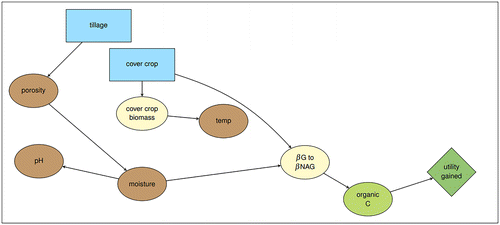
Notes. Utility gained is due to potential C credits. Not that utility (i.e., income) lost due to expenses are not shown as these are only incurred during the early growing season. Blue rectangles represent actions; brown nodes represent soil structure and abiotic conditions; yellow nodes represent soil biotic conditions; green nodes represent expenses; green diamonds represent utility (i.e., income).
The NC, RY, and RC cover crop actions had immediate direct and indirect effects (Figure 3; Table 6) on residual cover crop biomass, moisture (via cover crop biomass), βG:βNAG (via cover crop biomass), and SOC (via moisture and βG:βNAG). During the early growing season, NC-treated soils were most likely to store low, moderate-low, and high SOC. At the end of the growing season, cover crop actions had lasting indirect effects on the activity of decomposition enzymes βG:βNAG and on SOC via changes in βG:βNAG (Figure 4; Table 8). There was evidence that the residual cover crop biomass at the end of the season varied among the different actions. However, there was no evidence to suggest a dependency between biomass and soil structure, abiotic conditions, or decomposition dynamics.
See the online appendix for a detailed account of the state of each soil condition and SOC storage for each combination of tillage and cover crop action.
Tradeoffs in Net Yield Income and Possible Offsets from C Credit Income When Adopting NT Actions but Maintaining Current Cover Crop Actions
Tradeoffs in Net Yield Income.
Producers who are considering adopting NT in place of RT without changing their current cover crop action can expect a gain from net yield income only if they are currently planting RY or RC (Table 9). For NC, net yield income was only positive when NT–NC produced a high yield (USD 36.39 gain over the range of high yield). However, the NT–NC action was more likely to produce low yield, resulting in a net loss in yield income (−USD 54.82 to −USD 79.25)
|
Table 9. Tradeoffs in Expected Net Yield Income and Risks to Potential Carbon Credit Income for the Decision to (1) Adopt No-Till in Place of Reduced-Till While Maintaining Current Cover Crop Actions and (2) Adopt No-Till and Rye or Rye + Clover Actions in Place of Reduced-Till and No Cover Actions
| Cover crop | Yield | Expected yield income | Potential carbon credit income | ||||||
|---|---|---|---|---|---|---|---|---|---|
| Expected gain | SOC | Risk to SOC | |||||||
| Reduced till | No till | Early growing season | End of growing season | ||||||
| Expected | Change | Tillage | Cover crops | Tillage | Cover crops | ||||
| (1) Adopt no-till in place of reduced-till while maintaining cover crop actions | |||||||||
| No cover | Low | – | (−54.82)–(−79.25) | 5.00 | Low | – | Low | – | Low |
| High | 44.39–147.47 | 36.39 | mod-low | High | – | – | Low | ||
| mod-high | – | Low | Low | Low | |||||
| High | High | Low | – | Low | |||||
| Rye | Low | (−83.95)–(−5.30) | – | 5.00 | Low | – | Low | – | – |
| High | – | 127.28–151.71 | mod-low | High | – | – | – | ||
| mod-high | – | Low | Low | Low | |||||
| High | High | – | – | – | |||||
| Rye + | Low | (−82.95)–(−4.30) | 36.07 | 5.00 | Low | – | Low | – | – |
| Clover | High | – | 127.28–151.71 | mod-low | High | Low | – | – | |
| mod-high | – | Low | Low | Low | |||||
| High | High | Low | – | – | |||||
| (2) Adopt no-till and rye or rye + clover actions in place of reduced-till, no cover actions | |||||||||
| No cover | Low | – | |||||||
| High | 44.39–147.47 | ||||||||
| Rye | Low | – | – | 12.80 | Low | – | High | – | Low |
| High | – | −1.07 | mod-low | High | – | – | Low | ||
| mod-high | – | Low | Low | Low | |||||
| High | High | – | – | High | |||||
| Rye + | Low | – | (−91.28)–(−115.71) | 16.80 | Low | – | High | – | Low |
| Clover | High | – | −0.07 | mod-low | High | High | – | Low | |
| mod-high | – | Low | Low | Low | |||||
| High | High | High | – | High | |||||
Notes. For (1), values are compared within cover crop actions and across yield income cells for tillage actions. For (2), values are compared across cover crop actions and down yield income cells for tillage actions. Income is expressed in USD and given as values corresponding to 95% credible intervals from previous analyses. Risk is based on conditional probabilities (see Methods for interpretation). Blue cells indicate most likely outcome for SOC storage; – indicates outcomes with very low probabilities (i.e., unlikely).
The RY action resulted in a high yield more reliably than RC, which showed no difference in the probability of low and high yields. Adopting NT in place of RT while maintaining RY (i.e., NT–RY) resulted in a net gain in yield income between USD 127.28 and USD 151.71 (before considering offsets from C credits; Table 9). Nevertheless, adopting NT in place of RT while maintaining RC (i.e., NT–RC) also resulted in a net gain in yield income regardless of the resulting yield (Table 9). However, the net gain in utility for maximum yield (USD 127.28 to USD 151.71) was much higher than for minimum yield (USD 36.07 gain over the range of minimum yield).
Offsets from C Credit Income.
The maximum expected income gained from selling C credits across NC, RY, and RC cover actions when adopting NT in place of RT is USD 5.00 per acre (i.e., NT–NC, NT–RY, and NT–RC; Table 9). For those producers who adopt NT and maintain NC (i.e., NT–NC), C credit income would not offset losses to net yield income in the likely event that NT–NC results in a low yield (Table 4). However, all other NT–RY and NT–RC were expected to return net increases in yield income, so the extra income from C credits would only serve to improve the income gains from adopting NT.
Risks to SOC Storage and C Credit Income.
Before considering the effect of cover crop actions, there was considerable variation in the outcome of SOC storage for RT and NT depending on soil conditions (Tables 5 and 7). There was evidence that adopting NT in place of RT significantly reduced the probability of producing soils that stored moderate-low SOC (RT: 0.0849 [0.0771–0.0924] versus NT: 0.0660 [0.0592–0.0729]) during the early growing season. The RT action was much more likely to produce soils that stored high SOC (0.1253 [0.1161–0.1342]) than NT, which was very unlikely to produce soils that stored high SOC. However, the risks of these outcomes on C credit income were only evident during the early growing season as there was no evidence of a lasting negative effect of NT-treated soils on SOC storage (Table 7). By the end of the growing season, adopting NT became a low-risk decision because NT-treated soils were significantly more likely to store moderate-high SOC (0.0451 [0.0395–0.0508]) than RT-treated soils (0.0330 [0.0282–0.0379]) for the same soil conditions.
During the early growing season, before considering the effect of tillage actions, there was high uncertainty in the risk of cover crop actions on downstream SOC storage (Table 6). For NC, there was no difference in the probability of producing soils that stored low (0.0657 [0.0575–0.0743]), moderate-low (0.0541 [0.0466–0.0619]), and high (0.0574 [0.0495–0.0655]) SOC. For RC, there was no difference in the probability of producing soils that stored low (0.0256 [0.0204–0.0312]), moderate-low (0.0265 [0.0214–0.0320]), moderate-high (0.0325 [0.0268–0.0385]), and high (0.0265 [0.0213–0.0321]) SOC. The RY action was comparably riskier than NC and RC because this action was likely to produce soils that stored only minimum (0.0338 [0.0278–0.0401]) and moderate-high (0.0279 [0.0223–0.0333]) SOC.
At the end of the growing season, there was an uncertain risk to SOC storage using the NC action, which was likely to produce soils that stored low (0.1065 [0.0960–0.1171]), moderate-low (0.06.94 [0.0607–0.0781]), moderate-high (0.0809 [0.0715–0.0906]), and high (0.0694 [0.0609–0.0781]) SOC. However, the decision to use RY or RC became lower risk because both were most likely to produce soils that stored moderate-high (RY: 0.1897 [0.1766–0.2029]; RC: 0.1205 [0.1097–0.1312]) SOC.
Tradeoffs in Net Yield Income and Possible Offsets from C Credit Income When Adopting CS Actions in Place of Traditional Actions
Tradeoffs in Net Yield Income.
The combination of NT–RY was most likely to produce a high yield (Table 4). Before considering offsets from C credit income, the loss in yield income when adopting NT–RY in place of RT–NC was low (−USD 1.07/acre) across all values of the high yield range. There was more risk when adopting NT–RC because this combination of actions was likely to produce low and high yields (Table 4). The loss to yield income when NT–RC actions produce a high yield is almost zero (−USD 0.07/acre across all values of the high yield range). However, the loss was much greater (−USD 91.28 to −USD 115.71/acre) when a low yield was produced.
Offsets from C Credit Income.
The expected income gained from C credits when adopting NT–RY in place of RT–NC actions was USD 12.80 per acre and when adopting NT–RC actions was USD 16.80 per acre (Table 9). This increase would not offset losses to net yield income when NT–RC actions produce a low yield. However, C credit income would offset lost yield income, and lead to net gains, when NT–RY and NT–RC actions produce high yield.
Risks to SOC Storage and C Credit Income.
Adopting NT–RY and NT–RC actions in place of RT–NC significantly reduced the probability of producing soils that stored low (NC: 0.0657 [0.0575–0.0743]; RY: 0.0338 [0.0278–0.0401]; RC: 0.0256 [0.0204–0.0312]), moderate-low (NC: 0.0541 [0.0466–0.0619]; RY: 0.0148 [0.0108–0.0191]; RC: 0.0265 [0.0214–0.0320]), and high (NC: 0.0574 [0.0495–0.0655]; RY: not likely; RC: 0.0265 [0.0213–0.0321]) SOC during the early growing season. However, there was no difference in the probability of producing soils that stored moderate-high SOC between NC, RY, and RC actions (NC: 0.0270 [0.0216–0.0327]; RY: 0.0279 [0.0223–0.0333]; RC: 0.0325 [0.0268–0.0385]). At the end of the growing season, RY and RC were more likely to produce soils that stored moderate-high SOC than NC (NC: 0.0809 [0.0715–0.0906]; RY: 0.1897 [0.1766–0.2029]; RC: 0.1205 [0.1097–0.1312]).
Discussion
Decision Analytic Approach for C Neutrality in Agriculture
With the expansion of voluntary C markets, there is a growing incentive for producers to adopt climate-smart tillage and cover crop actions with the objective of maximizing the economic return from net yield by selling carbon credits (Jackson Hammond et al. 2021). Several previous studies found that uncertainty and risk to net yield income were the primary barriers to producer adoption of climate-smart practices (Tong et al. 2019, Demenois et al. 2020). To address this, our decision analytical approach identified several uncertainties in yield and SOC that should be considered before a producer adopts climate-smart NT and cover crop actions required to enter the voluntary C market. Our analysis demonstrates a viable pathway for using systems data to support on-farm decision-making for producers who are interested in, yet skeptical of, C neutrality policies in agriculture such as voluntary carbon markets. To our knowledge, our study represents one of the first field-based, proof-of-concept, SDM-based analyses of the socioeconomic–biophysical tradeoffs resulting from the adoption of CS actions in small-scale production systems. However, given regional variability in factors influencing SOC storage, our results are representative of probable outcomes for production systems in the midsouthern United States.
Decision to Adopt NT Actions but Maintain Current Cover Crop Actions
Tradeoffs in Net Yield Income Before Offsets from C Credits.
The results from this case study demonstrate that producers who are already using RY or RC can adopt NT in place of RT with a relatively low risk to yield income. They could expect a net gain in yield income of up to USD 151.71 if the crop was high yielding. Other studies have shown that NT can increase yield, particularly when combined with an organic input (mulch, cover crop, etc.; Hashimi et al. 2019), and similar downstream increases in yield income are further supported by endogenous switching regression models (Issahaku and Abdulai 2020, Si et al. 2022). In the event that NT–RY or NT–RC resulted in a low yield, there was still a net increase in income of USD 36.07, making it a low-risk on-farm decision. We attribute this to the reduction in physical management actions when using NT. In contrast, adopting NT in place of RT while maintaining NC actions (i.e., NT–NC) was a high-risk decision as this combination was most likely to produce a low yield and result in a net loss of up to −USD 79.25. These results are supported by a global meta-analysis comparing RT to NT, which found that NT resulted in an average 5.1% decrease in yield for a total of 50 different crops compared with RT (Pittelkow et al. 2015). Furthermore, an assessment of potential C credit income for a winter wheat production system in eastern Washington state (Zaher et al. 2013) found that RT was more profitable than NT in drier conditions (see “Soil Conditions and SOC Dynamics” for a further discussion of similar environmental effects in our study system).
Offsets from C Credit Income.
Our C credit analysis further supported the high-risk nature of the decision to adopt NT in place of RT while maintaining the NC (i.e., NT–NC) action in the context of agricultural systems in the midsouthern region of the U.S. In the likely event that the NT–NC action results in a low yield, we found that the potential income gain of USD 5.00 from C credits would not offset net losses. In contrast, those producers who are already using NT–RY or NT–RC could expect an additional USD 5.00 per acre in addition to the income gained from adopting NT in place of RT, as discussed above. These results are in line with a controlled study from Ontario, Canada (Chahal et al. 2020), which found that C credits could offset potential losses when cover crops are used in grain and oilseed systems.
However, the predicted increase in net income from selling C credits depends on high levels of SOC, and we identified some risks to SOC storage when adopting NT in place of RT when using different cover crop actions that producers should also consider. During the early growing season, NT actions were riskier than RT in terms of SOC storage as NT was more likely to store lower levels of SOC across all cover crop actions. Although, there was little risk of NT–RY or NT–RC producing soils that stored low SOC when by the end of the growing season. The change in SOC over the season is important to consider because of the C credit verification process. For example, IndigoAg indicates a third-party verification (Corteva 2022), but it does not specify the timing of soil sampling. Although our case study provided sufficient data to demonstrate the efficacy of applying SDM tradeoffs when making decisions regarding CS actions for SOC storage, we recommend standardized annual sampling at the same seasonal time point to further verify SOC dynamics.
Decision to Adopt CS Actions in Place of Traditional Actions
Tradeoffs in Net Yield Income Before Offsets from C Credits.
Overall, we found that there was a risk in the decision to adopt the CS NT–RY or NT–RC actions in place of traditional RT–NC actions. A risk-averse producer would likely decide to not adopt any CS actions because both combinations resulted in a net loss in income regardless of the amount of yield produced. Although the net loss of −USD 1.07/acre was small for NT–RY, the net loss could reach up to −USD 115.71/acre when NT–RC resulted in a low yield. If a producer is not presented with the option to offset these losses by selling carbon credits or an alternative incentive mechanism, then our results suggest that the most economical decision to maximize income would be to maintain traditional RT–NC actions.
Offsets from C Credit Income.
We found that potential income from selling C credits after adopting any combination of CS actions could offset losses in yield income when adopting these actions in place of RT–NC actions. When NT–RY and NT–RC actions resulted in a high yield, the net loss in income of −USD 1.07/acre and −USD 0.07/acre, respectively, could be offset by selling C credits priced at USD 12.80 and USD 16.80 per acre, respectively. These results are again in-line with Chahal et al. (2020), as described above.
However, the predicted increase in income from selling C credits depends on storing high levels of SOC. We identified some risks to SOC storage when adopting CS actions in place of traditional actions that should be considered. The NT–RY and NT–RC actions posed an overall low risk to C credit income during the early growing season because both actions had a lower probability of storing low and moderate-low SOC compared with RT–NC. Despite uncertain risk during the early growing season, our results indicate that RY and RC were more likely to store moderate-high SOC at the end of the growing season, resulting in lower risk.
Soil Conditions and SOC Dynamics
Our decision analytical approach assumed that motivations for adopting CS actions were connected to potential financial gain, with yield and C credit income driving on-farm decisions. However, the emphasis on increasing SOC as a climate change strategy is a narrow view of sustainable agriculture. Climate smart actions additionally provide many opportunities to improve soil health and maintain environmental integrity, including increasing moisture retention (Villamil et al. 2006), building organic matter (Feng et al. 2003, Daryanto et al. 2018, Sanchez et al. 2019), improving nutrient cycling, improving water quality (Reddy et al. 1995, Krutz et al. 2009), and increasing biodiversity (Venter et al. 2016)—all which support producers in maintaining long-term productivity and resiliency on their farms. Therefore, the mechanistic soil abiotic and biotic relationships identified in our approach are equally important to discuss in a decision-making process because producers may opt to use CS actions based on their long-term benefits to soil conditions while considering a C credit payment a cobenefit, rather than an end goal.
RT and NT had immediate direct and indirect effects on soil porosity, moisture (via porosity), and SOC (via moisture). By the end of the growing season, there were lasting direct effects on soil porosity and indirect effects on moisture (via porosity). NT environments had a higher probability of promoting high moisture conditions (online appendix and Firth et al. 2022), which in turn increased the activity of decomposition enzymes βG:βNAG (via moisture), and the promotion of SOC (via βG:βNAG). NT minimizes disturbance and allows root systems to remain in place, creating unique porous microhabitat development and supporting greater moisture retention (Carson et al. 2010, Firth et al. 2023). Holding water in a plant-available water range can make an economic difference to a producer in terms of irrigation frequency, as well as decrease concentrations of nutrient runoff (Aryal et al. 2018) and promote the abundance and diversity of microbial life (Greaves and Carter 1920). In support of this, Firth et al. (2023) found a significantly different bacterial community composition in NT and RT in these same soils, which can lead to differences in decomposition activity, depending on cover crop actions and the quantity of plant biomass.
The greatest probability of SOC storage was associated with high RC cover crop biomass, under wet conditions and moderate to low βG:βNAG at the end of the season. The low βG:βNAG is connected to a legume’s C:N ratio (∼10 to 20), which is more readily decomposable by microbial communities. In this CS scenario, a producer would likely see a soil health benefit (increase in soil N; Firth 2022) in the next year’s cropping cycle. In terms of sustainability, a producer may choose to adopt RC practices, even if there is a decrease in yield, because the gradual increase in soil nutrients from decomposing RC biomass can reduce fertilizer application rates in the future (Restovich et al. 2019, Mahama et al. 2020). This, in combination with C credit income, could result in a greater increase in net income over time.
Considerations and Limitations
It is important to consider that annual yield outcomes are dependent on several management and abiotic conditions. For example, in 2019 there was high rainfall at the beginning of the season when the soybeans were planted (Firth et al. 2023). NT, cover crop actions were more likely to have lower moisture conditions compared with RT actions at this time point (online appendix), which, when experiencing high rainfall, would be beneficial for seed germination (lower probability of disease incidence; Ahmed et al. 2013). However, if there was low rainfall at the time of planting, any decrease in moisture resulting from cover crop actions would be detrimental to seed germination, and potentially result in a lower yield (Krstić et al. 2018). Because we only considered one year of outcomes, the risk associated with CS actions on yield income may be greater than reported in this analysis. This highlights the importance of considering abiotic conditions when making decisions about on-farm actions.
Additionally, there was uncertainty in the risk associated with SOC storage during the early growing season compared with the end of the season, which made it difficult to identify potential income gain from C credits. Under both CS adoption scenarios, there was a lower risk associated with SOC storage at the end of the season than during the early growing season, although this outcome was less reliable when using RC rather than RY actions. The observed trend is likely connected to the changes in enzyme activity over the season and the resulting decomposition of cover crop biomass (online appendix). Because other factors impact SOC levels (temperature, moisture, and biological characteristics), and because the accumulation of SOC can take several years, the uncertainty in risk associated with the adoption of CS actions over the course of a season does not fully capture the SOC dynamics from year to year, and therefore gives an incomplete picture of income gained or lost.
We also did not consider market risk in this analysis. The voluntary carbon market is dynamic, and the potential payouts for C credits vary within and across years both within and between different companies. A market value sensitivity analysis was not within the scope of this project and thus caution should be taken when extrapolating our results over years and farming systems. However, our objective was to design a comprehensive decision framework that could be transferred to different agricultural production systems by simply updating the data used to fit the networks. By extension, the results of our case study system can also be updated to reflect real-time C market prices, should they change within or between years, which will still serve to assist with on-farm decision making. For future work, we recommend completing a sensitivity analysis using changing C credit prices to support our finding that the voluntary carbon market can indeed support a shift to CS actions.
Conclusions and Future Prospects
Our framework uncovered multiple pathways and uncertainties in yield and SOC storage under different tillage and cover crop actions. There was some evidence that a producer can minimize losses in net yield income by adopting NT in place of RT if they are already using RY or RC cover actions (i.e., NT–RY and NT–RC). Both actions were expected to return a higher yield compared with RT actions, albeit with important risks that should be considered before adopting NT. We also found evidence that the losses in yield could be offset by C credits when switching to CS from traditional actions. The additional income from C credits would, therefore, serve to improve the financial gains related to using NT actions. Overall, we found that C credits, or alternative incentive payments, would be required to offset potential income losses that would be a primary barrier to the adoption of CS practices. Considering that SOC is linked to soil health, our results also support the notion that these financial gains from selling C credits can guide even risk-averse producers into adopting CS actions with minimal risk, and even gains, to net income. This is a valuable contribution to discussions on C neutrality policies as our results indicate that environmental integrity and economic prosperity can be maximized by CS agriculture in combination with voluntary C markets.
Although we focused only on tradeoffs between expenses, yield, and SOC in a specific context, our BDN framework is flexible enough to model other cyclic pathways in agricultural production. For example, an additional subnetwork could be added to the model that links input decisions, such as fertilizer, to changes in soil conditions and crop health within and between growing seasons (i.e., in each time-step sample). Overall, here we have presented one of the first rigorous examples of how SDM can be modified to support-decision making for many pressing sustainability issues.
Adrienne L. Contasti thanks M. K. McAllister for past guidance. The authors thank three anonymous reviewers for thorough reading and insightful and constructive comments that considerably improved the quality of this work and the editorial staff at Decision Analysis.
References
- (2013) Waterlogging tolerance of crops: Breeding, mechanism of tolerance, molecular approaches, and future prospects. BioMed Res. Internat. 2013. https://doi.org/10.1155/2013/963525.Crossref, Google Scholar
- (2008)
A Bayesian network modeling approach to forecasting the 21st Century worldwide status of polar bears . DeWeaver ET, Bitz CM, Tremblay LB, eds. Arctic Sea Ice Decline: Observations, Projections, Mechanisms, and Implications. Geophysical Monograph 180 (American Geophysical Union), 213–268.Crossref, Google Scholar - (2001) Influence of pH and temperature on microbial activity, substrate availability of soil-solution bacteria and leaching of dissolved organic carbon in a mor humus. Soil Biol. Biochemistry 33:1181–1191.Crossref, Google Scholar
- (2021)
Technical summary . Masson-Delmotte V, Zhai P, Pirani A, Connors SL, Péan C, Berger S, Caud N, , eds. Climate Change 2021: The Physical Science Basis. Contribution of Working Group I to the Sixth Assessment Report of the Intergovernmental Panel on Climate Change (Cambridge University Press, New York), 33–144.Google Scholar - (2018) Impact of cover crop and season on nutrients and sediment in runoff water measured at the edge of fields in the Mississippi Delta of Arkansas. J. Soil Water Conservation 73(1):24–34.Crossref, Google Scholar
- (2017) Confidence interval of Bayesian network and global sensitivity analysis. AIAA J. 55(11):3916–3924.Crossref, Google Scholar
- (1996) Total carbon and nitrogen in the soils of the world. Eur. J. Soil Sci. 47(2):151–163.Crossref, Google Scholar
- (2007) The emergence of voluntary carbon offsetting. Technical Report 11, Auto-Saisine, 36.Google Scholar
- (2017) A review of economic considerations for cover crops as a conservation practice. Renewable Agriculture Food Systems 34(1):1–15.Google Scholar
- (2018) A comparison of methods for discretizing continuous variables in Bayesian Networks. Environment Modeling Software 108:61–66.Crossref, Google Scholar
- (2022) Can cover crops improve soil ecosystem services in water-limited environments? A review. Soil Sci. Soc. Amer. J. 86:1–18.Crossref, Google Scholar
- (2016) Factors influencing farmer adoption of soil health practices in the United States: A narrative review. Agroecology Sustainability Food Systems 40(6):583–613.Crossref, Google Scholar
- (2010) Low pore connectivity increase bacterial diversity in soil. Appl. Environment. Microbiology 76(12):3936–3942.Crossref, Google Scholar
- (2022) Temperature and moisture alter organic matter composition across soil fractions. Geoderma 409:115628.Crossref, Google Scholar
- (2020) Cumulative impact of cover crops on soil carbon sequestration and profitability in a temperate humid climate. Sci. Rep. 10:13381.Crossref, Google Scholar
- (2012) Good practice in Bayesian network modelling. Environment. Modelling Software 37:134–245.Crossref, Google Scholar
Corteva (2022) Carbon payment calculator. Accessed March 24, 2022, https://granular.ag/carbon/calculator/#getStarted.Google Scholar- (2018) Quantitative synthesis on the ecosystem services of cover crops. Earth Sci. Rev. 185:357–373.Crossref, Google Scholar
- (2022) Response of soil organic carbon to conservation practices including climate-smart agriculture in tropical and subtropical regions: A meta-analysis. Sci. Total Environment 805:150428.Crossref, Google Scholar
- (2020) Climate smart agriculture and global food-crop production. PLoS One 15(4):e0231764.Crossref, Google Scholar
- (2020) Barriers and strategies to boost soil carbon sequestration in agriculture. Frontiers Sustainable Food Systems 4:37.Crossref, Google Scholar
- (2003) Bayesian inference and decision theory: A framework for decision making in natural resource management. Ecology Appl. 13(2):556–563.Crossref, Google Scholar
- (2015) Soil carbon storage controlled by interactions between geochemistry and climate. Natuare Geosci. 8:780–783.Crossref, Google Scholar
- (2003) Soil microbial communities under conventional-till and no-till continuous cotton systems. Soil Biology Biochemistry 35:1693–1703.Crossref, Google Scholar
- (2022) Evaluating soil health changes following cover crop and no-till integration into a soybean (Glycine max) cropping system in the Mississippi Alluvial Valley. PhD dissertation, Mississippi State University, Starkville.Google Scholar
- (2022) Dynamics of soil organic carbon and CO2 flux under cover crop and no-till management in soybean cropping systems of the mid-south (USA). Environments 9:109.Crossref, Google Scholar
- (2023) Soil bacterial community dynamics in plots managed with cover crops and no-till farming in the Lower Mississippi Alluvial Valley, USA. J. Appl. Microbiol. 134(2). https://doi.org/10.1093/jambio/lxac051.Crossref, Google Scholar
Food and Agriculture Organization of the United Nations (2021) World Food and Agriculture–Statistical Yearbook 2021 (FAO).Google Scholar- (2020) Assessing microbial residues in soil as a potential carbon sink and moderator of carbon use efficiency. Biogeochemistry 151:237–249.Crossref, Google Scholar
- (2018) Trade-offs in the quest for climate smart agricultural intensification in Mato Grosso, Brazil. Environment. Res. Lett. 13(6):064025.Crossref, Google Scholar
- (2010) Managing water in agriculture for food production and other ecosystem services. Agriculture Water Management 97(4):512–519.Crossref, Google Scholar
- (1920) Influence of moisture on the bacterial activities of the soil. Soil Sci. 10(5):388.Crossref, Google Scholar
- (2012) Structured Decision Making: A Practical Guide to Environmental Management Choices (Wiley-Blackwell, West Sussex, UK).Crossref, Google Scholar
- (2019) Limitations of Bayesian leave-one-out cross-validation for model selection. Comput. Brain Behav. 2:1–11.Crossref, Google Scholar
- (2019) Potential for no-tillage and clipped-weed mulching to improve soil quality and yield in organic eggplant production. Biology Agriculture Horticulture 35(3):158–171.Crossref, Google Scholar
- (2002) The impact matrix approach and decision rules to enhance index dimensionality, flexibility and representation. Ecological Indicators 2:161–168.Crossref, Google Scholar
- (2020) Adoption of climate-smart practices and its impact on farm performance and risk exposure among smallholder farmers in Ghana. Australian J. Agriculture Resource Econom. 64(2):396–420.Crossref, Google Scholar
- (2021) Implementing the soil enrichment protocol at scale: Opportunities for an agricultural carbon market. Frontiers Climate 3:686440.Crossref, Google Scholar
- (2013) Ag Decision Maker Metric Conversions (Iowa State University Extension and Outreach, Ames, IA).Google Scholar
- (2015) Microbial physiology and necromass regulate agricultural soil carbon accumulation. Soil Biology Biochemistry 91:279–290.Crossref, Google Scholar
- (2015) Interacting agricultural pests and their effect on crop yield: Application of a Bayesian decision theory approach to the joint management of Bromus tectorum and Cephus cinctus. PLoS One 10(2):e0118111.Crossref, Google Scholar
- (2020) Bayesian decision network-based security risk management framework. J. Network Systems Management 28(4):1794–1819.Crossref, Google Scholar
- (2010) Bayesian Artificial Intelligence Second (CRC Press, New York).Crossref, Google Scholar
- (2018) The effect of cover crops on soil water balance in rain-fed conditions. Atmosphere 9(12):492–510.Crossref, Google Scholar
- (2009) Interactions of tillage and cover crop on water, sediment, and pre-emergence herbicide loss in glyphosate-resistant cotton: Implications for the control of glyphosate-resistant weed biotypes. J. Environment. Qual. 38:1240.Crossref, Google Scholar
- (2017) Bayesian network approach to change propagation analysis. Res. Engrg. Design 28:437–455.Crossref, Google Scholar
- (2019) Dynamic interaction network inference from longitudinal microbiome data. Microbiome 7(54):1–14.Google Scholar
- (2020) Reduction of nitroge fertilizer requirements and nitrous oxide emissions using legume cover crops in a no-tillage sorghum production system. Sustainability 12(11):4403.Crossref, Google Scholar
- Marcot BG, JD Steventon, GD Sutherland, RK McCann (2006) Guidelines for developing and updating Bayesian belief networks applied to ecological modeling and conservation. Canadian J. Forest Res. 36(12):3063–3074.Google Scholar
- (2006) ARACNE: An algorithm for the reconstruction of gene regulatory networks in mammalian cellular context. BMC Bioinform. 7(S7).Crossref, Google Scholar
- Masson-Delmotte V, Zhai P, Pörtner H-O, Roberts D, Skea J, Shukla PR, Pirani A, Moufouma-Okia W, Péan C, Pidcock R, Connors S, Matthews JBR, Chen Y, Zhou X, Gomis MI, Lonnoy E, Maycock T, Tignor M, Waterfield T, eds. (2018) Global Warming of 1.5°C. An IPCC Special Report on the impacts of global warming of 1.5°C above preindustrial levels and related global greenhouse gas emission pathways, in the context of strengthening the global response to the threat of climate change, sustainable development, and efforts to eradicate poverty. Technical report, Intergovernmental Panel on Climate Change.Google Scholar
- (2019) Evaluating a collaborative decision-analytic approach to inform conservation decision-making in transboundary regions. Land Use Policy 83:282–296.Crossref, Google Scholar
- (2022) Potential co-benefits and tradeoffs between improved soil management, climate change mitigation and agri-food productivity. Food Energy Security 11(2):e352.Crossref, Google Scholar
- (2019) Beyond “net-zero”: A case for separate targets for emissions reduction and negative emissions. Frontiers Climate 1:4.Crossref, Google Scholar
- (2020) Climate smart agriculture opportunities for mitigating soil greenhouse gas emissions across the U.S. Corn-Belt. J. Clean Production 122240:268.Google Scholar
- (2020) A framework for modelling soil structure dynamics induced by biological activity. Global Change Biology 26(10):5382–5403.Crossref, Google Scholar
- (2014) infotheo: Information-theoretic measures. R package version 1.2.0.1.Google Scholar
- (2013) Dynamic relationships between microbial biomass, respiration, inorganic nutrients and enzyme activities: Informing enzyme-based decomposition models. Frontiers Microbiology 4:223.Crossref, Google Scholar
MSU-ES (2019) Soybeans 2019 Planning Budgets (MSU-ES, Starkville, MI).Google Scholar- (2006) Using Bayesian belief networks in adaptive management. Canadian J. Forest Res. 36(12):3104–3116.Crossref, Google Scholar
- (2019) Soil C sequestration as a biological negative emission strategy. Frontiers Climate 1:8.Crossref, Google Scholar
- (2015) When does no-till yield more? A global meta-analysis. Field Crops Res. 183:156–168.Crossref, Google Scholar
R Core Team (2021) R: A Language and Environment for Statistical Computing (R Core Team, Vienna, Austria).Google Scholar- (2021) Conservation tillage (CT) for climate-smart sustainable intensification: Assessing the impact of CT on soil organic carbon accumulation, greenhouse gas emission and water footprint of wheat cultivation in Bangladesh. Environment. Sustainability Indicators 10:100106.Crossref, Google Scholar
- (2010) The Copenhagen Accord for limiting global warming: Criteria, constraints, and available avenues. Proc. National Acad. Sci. USA 107(18):8055–8062.Crossref, Google Scholar
- (1995) Chlorimuron ethyl sorption and desorption kinetics in soils and herbicide-desiccated cover crop residues. J. Agric. Food Chem. 43:2752–2757.Crossref, Google Scholar
- (2016) Pyrogenic carbon in soils: A literature-based inventory and a global estimation of its content in soil organic carbon and stocks. Frontiers Earth Sci. 4:80.Crossref, Google Scholar
- (2019) Combining cover crops and low nitrogen fertilization improves soil supporting functions. Plant Soil 442:401–417.Crossref, Google Scholar
- (2019) Cover crops impacts on Louisiana corn production and soil properties. Agrosystems Geosci Environment 2:1–8.Google Scholar
- (2021) Carbon science for carbon markets: Emerging opportunities in Iowa. CROP 3175, Technical Report, Iowa State University Extension and Outreach, Ames, IA, 281.Google Scholar
- (2010) Learning Bayesian Networks with the bnlearn R package. J. Statist. Software 35(2):1–22.Google Scholar
- (2022) Exploring the role of contiguous farmland cultivation and adoption of no-tillage technology in improving transferees’ income structure: Evidence from China. Land (Basel) 11(4):570.Google Scholar
- (2010) Bayesian Decision Analysis Principles and Practice (Cambridge University Press, New York).Crossref, Google Scholar
- (2020) A critical evaluation of the relationship between the effective cation exchange capacity and soil organic carbon content in Swiss forest soils. Frontiers Forests Global Change 3:98.Crossref, Google Scholar
- (2022) Cover crop residue decomposition in no-till cropping systems: Insights from multi-scale on-farm litter bag studies. Agriculture Ecosystems Environment 326:107823.Crossref, Google Scholar
- (2019) The roles of risk aversion and climate-smart agriculture in climate risk management: Evidence from rice production in the Jianghan Plain, China. Climate Risk Management 26:100199.Crossref, Google Scholar
- (2017) Algorithms for Bayesian Network modeling, inference, and reliability assessment for multistate flow networks. J. Comput. Civil Engrg. 31(5):04017051.Crossref, Google Scholar
USDA (2021) Action Plan for Climate Adaptation and Resilience (USDA, Washington, DC).Google ScholarUSDA-NRCS (2021) Cover Crop Mix, Seed Cost, and Seeding Rate Calculator for the Mid-South (Plant Materials Technical Note No. 103) (USDA-NRCS, Coffeeville, MS).Google Scholar- (2006) No-till corn/soybean systems including winter cover crops. Soil Sci. Soc. Amer. J. 70:1936.Crossref, Google Scholar
- (2016) The impact of crop rotation on soil microbial diversity: A meta-analysis. Pedobiologia (Jena) 59:215–223.Crossref, Google Scholar
- (2018) Probabilistic decision tools for determining impacts of agricultural development policy on household nutrition. Earths Future 6:359–372.Crossref, Google Scholar
- (1999) The role of attributes and objectives in farmer decision making: Business and environmentally-oriented behavior in Scotland. J. Agriculture Econom. 50(2):286–303.Crossref, Google Scholar
- (2017) Long-term agricultural experiments inform the development of climate-smart agricultural practices. California Agriculture 71(3):120–124.Crossref, Google Scholar
- (2013) Life cycle assessment of the potential carbon credit from no- and reduced-tillage winter wheat-based cropping systems in Eastern Washington State. Agricultural Systems 122:73–78.Crossref, Google Scholar
Adrienne L. Contasti is a creator and editor. She has a BSc (Hons.) in biology (behavioral ecology) from Dalhousie University, an MSc in biology (population ecology) from the University of Saskatchewan, and a PhD in zoology (tropical forest conservation) from the University of British Columbia.
Alexandra G. Firth is a postdoctoral research associate in the Department of Wildlife, Fisheries, and Aquaculture at Mississippi State University. She completed her BS in ecology at Cal Poly Humboldt in California. Her MS and PhD were completed at Mississippi State University. Her research focuses on soil microbiology, agroecosystems, and natural resource conservation.
Beth H. Baker is an associate extension professor in the Department of Wildlife, Fisheries, and Aquaculture at Mississippi State University. She completed her BS in biomedical science and MS in cell and molecular biology at St. Cloud State University in Minnesota. She completed her PhD in forest resources at Mississippi State University. Her role in Extension is focused on natural resource conservation in agroecosystems throughout the Mississippi River Basin.
John P. Brooks is a research microbiologist focusing on environmental microbiology at the USDA-ARS Genetics and Sustainable Agriculture Unit located at Mississippi State University. He obtained his PhD from the University of Arizona and has been focused on environmental microbiology for more than 20 years. His research has focused on aerobiology, quantitative microbial risk assessment, pathogen fate and transport, antimicrobial resistance, and soil microbial ecology.
Martin A. Locke is director of the USDA-ARS, National Sedimentation Laboratory, Oxford, Mississippi. He has been with USDA-ARS since 1987, receiving a BS from Missouri State University, an MS from the University of Missouri-Columbia, and a PhD from Texas A&M University. He is internationally recognized as an authority on processes and factors determining the effectiveness of conservation management in protecting and enhancing soil and water resources.
Dana J. Morin is an assistant professor of wildlife ecology in the Department of Wildlife, Fisheries, and Aquaculture at Mississippi State University. She is an applied quantitative and population ecologist. Her research is focused on the scaling of spatial ecology, population processes, and community dynamics, and using population data and projections to inform conservation and management decisions.