


Price Formation in Markets with Trading Delays
Abstract
We develop a parsimonious price formation model to study information aggregation and information acquisition in the presence of trading delays. If delays apply uniformly to uninformed and informed traders, the level of delays does not affect information aggregation. Traders’ information acquisition incentives are, however, weaker in a market with longer delays. Therefore, the equilibrium fraction of informed traders is lower if delays are longer, establishing an inverse relationship between trading delays and price informativeness. We also show that risk premia and price dispersion tend to be nonmonotonic functions of the level of delays when information acquisition is endogenous. We document novel empirical evidence from the UK corporate bond market, which largely corroborates the implications of our theory.
This paper was accepted by Bruno Biais, finance.
Supplemental Material: The data files are available at https://doi.org/10.1287/mnsc.2020.01400.
1. Introduction
Execution quality is important to traders in financial markets. A key dimension of execution quality is the speed at which their orders are executed. This speed varies widely across markets. Pagnotta and Philippon (2018) state that more than half of the U.S. equity orders take five seconds to 10 minutes to fully execute. On the other hand, the same number was identified to be one to three days in the corporate bond market (Duffie et al. 2007, Pagnotta and Philippon 2018, Kargar et al. 2022) and five days in the municipal bond market (Hugonnier et al. 2020). How do these trading delays, small or drastic, affect price discovery? This is the main question we analyze in our paper.
We develop a competitive asset trading model that nests Grossman and Stiglitz (1980) as a special case. By trading in a market without trading delays, traders in Grossman and Stiglitz (1980) fully benefit from any private information they possess, whereas traders in our model trade in a market with trading delays, in which private information progressively becomes public. In two special cases, the trading environment of our model coincides with the Grossman and Stiglitz (1980) environment: if private information is infinitely lived (i.e., the noise of public information revelation goes to infinity) or if trading delays disappear (i.e., if trading speed goes to infinity). Hence, apart from these two special cases, trading delays and the lifespan of private information are expected to affect all the equilibrium outcomes such as risk premia, price dispersion, and measures of price informativeness.
To capture trading delays in a meaningful way, we set up a dynamic trading game. Two types of traders, informed and uninformed, gain one-time access to a competitive market at independent and identically distributed (i.i.d.) stochastic times. Importantly, we assume that trading delays apply uniformly to uninformed and informed traders. Conditional on market access, a trader trades to obtain her optimal position given all the information available to her at the time of her market access. Interestingly, although the market price becomes a better forecast of the asset value as time passes because private information progressively becomes public, we show that the measure of unique information the market price contains, which we term revelatory price efficiency (RPE), is stationary and coincides with what obtains in the equilibrium of Grossman and Stiglitz (1980) model. This leads to a conditional irrelevance result: By taking as given the fraction of informed traders, RPE is independent of the level of trading delays.
When traders are allowed to make ex ante investment in private information by anticipating the outcome of the dynamic trading game, however, the irrelevance breaks down. More specifically, traders’ information acquisition incentives are weaker if trading delays are longer (or if private information is shorter lived). Therefore, the equilibrium fraction of informed traders is lower if trading delays are longer, establishing an inverse relationship between trading delays and RPE. This inverse relationship between trading delays and price informativeness is the first implication of our theoretical model that we test in the empirical part of this paper.
Second, our theory has novel implications for price dispersion, which refers to the second moment of transaction prices that arise during the trading session. In our baseline model without endogenous information acquisition, we show that price dispersion is nonmonotonic in trading delays. The key determinant behind this result is how trading delays affect the distribution of traders’ trading times. If trading delays are small, both type of traders, uninformed and informed, can trade very early on. Like in the original Grossman and Stiglitz (1980) model, the distribution of information that traders possess is close to bimodal. As trading delays get more severe, traders access the market later and in more dispersed times, which means the distribution of information that (uninformed) traders possess is more dispersed. This, in turn, leads to larger price dispersion. As trading delays get even more severe, however, the market access of this uninformed crowd of traders gets extremely delayed, making their valuations closer together because of a high level of information revelation by then. This reduces price dispersion. Overall, price dispersion turns out to be a hump-shaped function of trading delays.
Using parametric examples, we also confirm that this nonmonotonicity is preserved when information acquisition is endogenous. More specifically, we find that price dispersion and average risk premium tend to reach their maximum when trading delays are just severe enough to preclude all information acquisition in equilibrium. At this level of trading delays, delays are severe enough to keep all traders uninformed, but also moderate enough to allow these uninformed traders to trade before a meaningful revelation of public information. Thus, the transaction prices resulting from these uninformed trades exhibit a large risk premia. Similarly, prices exhibit high dispersion because of the high flow of uninformed orders getting executed. Shorter trading delays would reduce the fraction of uninformed traders, and so reduce the sensitivity of the market price to the fluctuations in the public information process, thereby reducing price dispersion. Longer trading delays would delay the market access of this entirely uninformed crowd of traders, making their valuations closer together when they access the market and, in turn, reducing price dispersion.
Third, we discuss how to view the stylized facts regarding price informativeness in the existing empirical literature through the lens of our model. To offer theoretical insights into the growth of “big data” financial technology over the last decade, we ask how RPE changes in response to traders’ easier access to better data technologies. We contrast two possible scenarios: a decline in the information acquisition cost versus an increase in the rate of information depreciation due to the technology allowing traders to extract others’ information. Our model predicts that whereas RPE increases in the former scenario, it decreases in the latter. Because both effects are, in principle, present for any asset albeit with different strengths, our model implies that RPE will increase for some assets and decrease for others. Bai et al. (2016) find a secular decline in stock price informativeness for the universe of all firms, whereas they find a secular increase for the Standard and Poor’s (S&P) 500 firms. Our model rationalizes their findings if the improvement in RPE from the decline in the information acquisition cost dominates (respectively, is dominated by) the decline in RPE from the increase in the rate of information depreciation for the S&P 500 firms (respectively, the universe of all firms).1
In the last part of this paper, we provide novel empirical evidence for some of the theoretical implications unique to our model. To this end, we use a transaction-level data set that covers close to the universe of all secondary market trades in the UK corporate bond market. With its over-the-counter (OTC) structure, the corporate bond market is a textbook example of markets with trading delays.2 We proxy (the inverse of) a bond’s trading delay with its trade frequency measured in the data. We then utilize the cross-sectional variation in bonds’ trade frequency to test two empirical hypotheses generated by our theoretical model: (i) ceteris paribus, price efficiency is decreasing in trading delays, and (ii) ceteris paribus, the dispersion of transaction prices is nonmonotonic in trading delays. Overall, our results from empirical tests are consistent with the implications of the theoretical model. We interpret this as pointing to the importance of taking trading delays into account when analyzing the informational inefficiency and liquidity costs in asset trading.
Next, we briefly review the related literature and our paper’s contribution. Section 2 lays out the main model environment, whereas Section 3 defines and characterizes a noisy rational expectations equilibrium (REE) for this environment. Section 4 endogenizes the traders’ information acquisition decisions and the informativeness of the market price. Section 5 analyzes the extent to which our theoretical findings are consistent with the corporate bond trading patterns in practice. Section 6 concludes.
1.1. Related literature
The first strand of literature to which our paper contributes is the voluminous literature on information acquisition with papers by Grossman and Stiglitz (1980), Verrecchia (1982), Admati and Pfleiderer (1986), Veldkamp (2006a, b), Cespa (2008), Lee (2013), and Dugast and Foucault (2018), among others. See Veldkamp (2011) for a survey of this literature. These papers abstract away from trading frictions and trading delays and focus on the details of assets’ payoff and information structures. We keep the payoff and information structure simple while allowing for rich dynamics in the equilibrium price process, and model explicitly the trading delays that are characteristic of many real-world financial markets, especially the illiquid ones like the markets for corporate and municipal bonds.
The second strand of literature to which our paper contributes is the fast-growing literature on trading delays, with papers by Duffie et al. (2005), Weill (2007), Gârleanu (2009), Lagos and Rocheteau (2009), Afonso and Lagos (2015), Pagnotta and Philippon (2018), Üslü (2019), Hugonnier et al. (2020), and Farboodi et al. (2023), among others. See Weill (2020) for a recent survey. These papers abstract away from private information and focus exclusively on trading frictions and delays. We borrow the details of trading delays from this literature. In particular, traders in our model gain access to a market with Walrasian pricing mechanism at idiosyncratic random times as in Gârleanu (2009) and Pagnotta and Philippon (2018). The same mechanism obtains in Lagos and Rocheteau (2009) as well, when dealers’ bargaining power is set to be zero. Models in this literature typically obtain that illiquidity premium and price dispersion are monotone increasing in trading delays. The novelty of our model is to introduce private information about common asset value to these papers’ trading environment with delays, and we show that illiquidity premium and price dispersion can be nonmonotonic functions of the delay.
The combination of trading delays and private information about common asset value is also present in a relatively limited set of papers by Wolinsky (1990), Blouin and Serrano (2001), Duffie et al. (2014), Golosov et al. (2014), Dang and Morath (2015), Lauermann and Wolinsky (2016), Lauermann et al. (2017), and Lester et al. (2023). With the exception of Duffie et al. (2014) and Dang and Morath (2015), these papers do not study information acquisition. What distinguishes our model from Duffie et al. (2014) and Dang and Morath (2015) is mainly the trading protocol (and implicitly the price setting mechanism). Whereas prices that aggregate information are privately negotiated prices in bilateral meetings in Duffie et al. (2014) and Dang and Morath (2015), the Walrasian price in our model acts as a public signal as in the extant literature on information acquisition following Grossman and Stiglitz (1980).
Traders’ desire to take advantage of short-lived private information in our model is in common with the recent literature that analyzes high-frequency trading. Examples include Biais et al. (2015), Budish et al. (2015), Foucault et al. (2016), Li (2021), and Aït-Sahalia and Sağlam (2024). Whereas our paper’s main focus is on trading delays in illiquid markets, these papers model high-speed trading in liquid markets. Accordingly, they end up using very different sets of modeling assumptions than our model’s assumptions. Information aggregation or revelation by market prices is also analyzed together with different types of frictions, for example, with technological trading costs by Subrahmanyam (1988), Dow and Rahi (2000), Vives (2017), and Dávila and Parlatore (2021); with sticky relationships by Babus and Kondor (2018) and Li and Song (2022); and with long intermediation chains by Glode and Opp (2016) and Glode et al. (2019).
Our empirical analysis in Section 5 relates to two main strands of the empirical literature. First, we draw on previous studies on the determinants of various trade cost measures in OTC markets including price dispersion. See Garbade and Silber (1976), Edwards et al. (2007), Jankowitsch et al. (2011), Di Maggio et al. (2017), O’Hara et al. (2018), Li and Schürhoff (2019), Üslü and Velioğlu (2019), Pintér and Üslü (2022), and Dick-Nielsen et al. (2023), among others. To our knowledge, we are the first to show that price dispersion is nonmonotonic in trading delays in the empirical literature as well as in the theoretical literature. Second, we draw on previous studies on the determinants of price efficiency. See Hotchkiss and Ronen (2002), Hendershott and Jones (2005), Hou and Moskowitz (2005), Bai et al. (2016), Lee et al. (2018), and Indriawan et al. (2020), among others. To our knowledge, we are the first to analyze trading delays as a determinant of price efficiency in the cross section of corporate bonds.
2. The Model Economy
We build a continuous-time model economy with an infinite time horizon: . We fix a filtered probability space on which is defined a standard Brownian motion, B. The economy is populated by a unit-mass continuum of traders, who have constant-absolute-risk-aversion preferences over horizon wealth with a common risk-aversion coefficient of . Traders are infinitely patient (i.e., their discount rate is zero) and are endowed with a technology that instantly produces cash at unit marginal cost in order to make side payments.3 We normalize the traders’ initial wealth to zero, , because their initial wealth will not affect decision making, provided that they can produce cash at unit marginal cost.
A fraction of the traders are informed and the remaining uninformed. There is one risky asset with payoff realized at date . The payoff of this asset, denoted by v, consists of two parts,
In addition to being informed or uninformed, traders are heterogeneous with respect to their initial endowment of the asset. Immediately prior to time , half of traders are each endowed with shares of the risky asset, and the other half , where and are identically and normally distributed with mean zero and variance . All these random variables, , , , and , are pairwise independent.
We denote with the cumulative distribution function (cdf) of traders’ asset positions at time t conditional on their information type un. Thus, at ,
At date 0, informed traders obtain a private signal which reveals the true value of . For , there is a “flow” of public signals , progressively reducing the informational edge of informed traders:
In the spirit of Gârleanu (2009), traders have infrequent access to a continuous competitive market in which they can trade as price takers and without any friction. More specifically, we assume that trader gains a one-time access to the competitive market at date , where is an exponentially distributed random variable with mean . That is, trader i can rebalance her asset position only at the instant . We also assume the market access times, s, are i.i.d. across traders. Conditional on market access at date t, a trader with endowment a and information type j buys units of the asset at the market-clearing price . Naturally, if , it means the trader sells units.
3. Equilibrium
In illiquid market models with homogeneous information sets, such as those of Gârleanu (2009), Lagos and Rocheteau (2009), and Pagnotta and Philippon (2018), the market price has only the role of clearing the market. Differently from these papers, in our model, traders have different information sets about the common asset value, which gives the equilibrium price two simultaneous roles, clearing the market and revealing information, as in Grossman and Stiglitz (1980).
3.1. Definition
Because the trading horizon is infinite, all traders eventually end up trading with probability one. However, there is uncertainty as to when a trader will gain access to the market. A trader of type j with endowment a who gains access to the market at time t buys
Because is a conditional cdf, it satisfies
These traders gain access to the market at the Poisson rate , which implies a rate of (gross) outflow . The second term means any j-type trader can contribute to the (gross) inflow to the mass , if she gains access to the market, which happens at rate , and if her posttrade asset holding is less than or equal to a.
Finally, the market-clearing condition must ensure that the traders’ aggregated demand nets out to zero, at each date :
We have specified all requirements to define the equilibrium. We only have to bring those ingredients together. Formally, an REE is defined as follows.
A rational expectations equilibrium is a list composed of (i) a trade size function , (ii) a market-clearing price , (iii) a perceived price function , and (iv) a set of distributions for traders’ asset positions such that
3.2. Characterization
Let and , where denotes the variance operator.4 Assuming that v is conditionally normally distributed,5 (2) can be rewritten as
Using the first- and second-order conditions of this unconstrained optimization problem, we obtain the following lemma.
Fix a market price and a collection for the traders’ information sets. Assume that v is normally distributed conditional on each of the given information sets. Then, a type j trader with endowment who gains access to the market at time t chooses her optimal trade quantity as
where and .
Next, we endogenize the traders’ information sets and the market price to complete the characterization of the general equilibrium of the trading game. For uninformed traders, there are two sources of public information to gauge the value of the risky asset: the market price and the public signal process . First, we derive the mean and variance of conditional on observing the public signal process up to time . This mean and variance will be later used in determining the posterior mean and variance of the asset payoff v when an uninformed trader gains access to the market.
An application of Kalman–Bucy filter to (1) implies that
The second source of public signal for uninformed traders is the market price, . As is standard in the literature, we restrict our attention to linear pricing functions:
For uninformed traders, we use (7), (8), and the Bayesian updating formula for normal variables to determine and . The signal from the price is , where . Then,
Substituting these posterior means and precisions into (6), we obtain the individual demand of any trader given the market price . Substituting these individual demands into (5),
After cancellations, rearranging, and letting ,
The last step is to substitute the posterior means and precisions in (10). The resulting expression is linear in , , , and . Each shows up in only one place and is additive. Everything else is just constant coefficients. This confirms the guess of a linear pricing rule. The functions, , , and , can be solved for by matching coefficients, which takes us to the following proposition.
Given a share of informed traders , the unique linear price process that clears the market is
where
and
We use the results of Proposition 1 to calculate forecasting price efficiency (FPE) and RPE in the spirit of Bond et al. (2012) and Bai et al. (2016), where
The FPE measures how well the market price reflects the forecastable part, , of the asset value . However, uninformed traders do not rely only on the market price when making their own forecasts. They use any other public information they possess and the information contained in their asset endowment realization. Thus, there is a need for a measure that reflects the unique information from the market price that is not captured by other information sources. RPE is such a measure. Whereas FPE is only a forecasting concept, RPE measures the precision gain from observing the market price.
The forecasting price efficiency and the revelatory price efficiency are, respectively,
and
where is given by (12). Thus, given a share of informed traders, trading delays () and how long lived the private information is () are irrelevant to RPE.
Corollary 1 shows that whereas FPE is a function of time, RPE is constant over time. That FPE is time varying is intuitive because the private information of the informed traders becomes progressively public as everyone observes the stochastic process Z and then the “representative” trader (i.e., the fictitious trader who shows up in the market-clearing condition (10) and has the same marginal valuation as the trading price) has a more precise information about . That RPE is constant is a less obvious result. One way to understand this RPE result above is that for uninformed traders, price is observationally equivalent to a signal of the form with the precision
Because the unique information from observing the price after eliminating its parts relating to and a is independent of t, its precision that we show is equal to RPE is independent of t as well.
Perhaps an even more surprising implication of Corollary 1 is that, given a share of informed traders, trading delays () and how long lived the private information is () are irrelevant to the precision of the price signal. Similar to the case where the effective market clearing (10) is independent of and that we explain above, this again arises because the frictions apply uniformly to all traders. Thus, at any date, a subset of traders that is representative of the entire pool of traders gain market access, which leaves RPE unaffected by the friction parameters and . It is important to note, however, this irrelevance result is a conditional irrelevance result because the fraction of informed traders is taken exogenously. In Section 4, we endogenize the fraction of informed traders by studying the traders’ endogenous information acquisition decision. We show that because trading delays lead to a possibility of not being able to benefit from private information, traders have a reduced incentive to become informed when there are trading delays. This insight encapsulates the main difference between our model and Grossman and Stiglitz’s (1980).
As a preview of the results in Section 4, consider the left panel of Figure 1, which depicts two sample paths for the equilibrium price under different assumptions for the expected lifespan of the private information. Over time, the informational edge of informed traders reduces as uninformed traders observe for longer. If the degree, , of noise in this public signal process is lower, the equilibrium price quickly approaches the informed traders’ signal, which, in turn, reduces the profitability of informed trading. In the figure, the blue path for the equilibrium price () approaches the informed traders’ signal, , a lot quicker than the red path () approaches. This means that given a level, , of trading delays, traders are more likely to acquire costly private signals if they anticipate a sample path like the red path rather than the blue one. Moreover, given , a trader is more likely to acquire costly private signals if trading delays are less severe because less severe trading delays mean, in expectation, an informed trader can trade when the difference between the equilibrium price and the informed trader’s signal is larger.
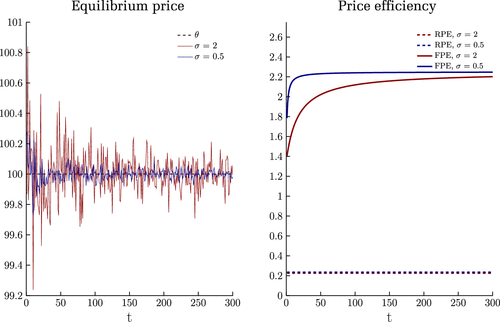
Notes. Parameter choices are , , , and . Realized values for random variables are and .
3.3. Equilibrium Price Dynamics
Because different traders who gain access to the market at different points in time face different market-clearing prices, they end up trading at different prices. This leads to economic questions: How does the average transaction price compare with the informed traders’ signal, ? How variable are the transaction prices across traders who trade at different points in time? The following proposition offers answers to these questions.
Assume . Let , and let and denote, respectively, the average and the variance of the transaction prices conditional on , , and . Then, the deviation of the average transaction price from the informed traders’ signal per unit of supply is
and the variance of transaction prices is
where is the upper incomplete gamma function.
Let us refer to the deviation of the average transaction price from the informed traders’ signal per unit of supply as average price discount, in short. Proposition 2 provides us with closed-form formulas for the average price discount and a first-order approximation of the price variance. One can use these formulas to understand how various factors influence average price discount and price variance. For example, the following corollary establishes results for trading delays.
Assume . Average price discount is monotone decreasing in for all . Price variance is increasing in and decreasing in for all .
Figure 2 illustrates the results in Corollary 2 for a particular set of parameters. When , trading delays are infinite, and none of the traders can trade until , at which point the public signal process reveals the informed traders’ signal . This means that everyone trades at the same price, and so price variance is zero. Also, when , price discount is the smallest in terms of its absolute value, two (because ). As gets larger, trading delays decline, and traders gain access to the market earlier than . Because informed traders know , trading early does not change their willingness to pay. However, uninformed traders’ willingness to pay is smaller because they trade when the public signal is less informative about . As a result, average price discount increases in its absolute value as trading delays get smaller.

Note. Parameter choices are , , , , , and .
The right panel of Figure 2 shows that price variance is hump shaped in . As starts increasing from zero, traders start trading at random times earlier than , and this increases price variance at first. But once reaches some high value, a further increase in starts depressing price variance because then traders starts trading at times very close to and this makes their willingness to pay closer together because they trade before a meaningful precision has been obtained from the public signal process. Consistent with Corollary 2, this implies that the maximum level of price variance obtains for some intermediate value of .
To our knowledge, the nonmonotonic relationship between trading delays and price variance is a novel result in the literature. The existing models of equilibrium price variance utilizing random trading times find that mitigating trading delays lead to a monotone decline in price variance. See, for example, Afonso and Lagos (2015), Üslü and Velioğlu (2019), Hugonnier et al. (2022), and Wong and Zhang (2024). These models feature symmetric information, and the reason behind price variance is traders’ bilateral negotiation. As trading delays are mitigated, traders’ outside options become closer to each other, in turn making transaction prices closer together. In our model, instead, trade is multilateral with price-taking traders, but information is asymmetric. Because the dispersion level of information that traders possess at their respective times of trading is maximized at an intermediate level of trading delays, a nonmonotonic relationship between trading delays and price variance arises.
Again, in this analysis, the exogeneity of is key to obtain the patterns discussed above. However, as trading delays change, naturally traders’ incentive to acquire information changes, and so the equilibrium would change, potentially changing the patterns above. Indeed, in Section 4, we show that once is endogenized, the pattern regarding average price discount changes altogether, becoming nonmonotone. The pattern regarding price variance stays qualitatively the same but the magnitude of the association, that is, the slopes, changes at different regions, becoming stronger on certain regions and weaker on others.
3.3.1. A Discussion of the Variance of the Equilibrium Transaction Prices: Price Dispersion or Price Volatility?
Because of our assumption that all traders have access to the market exactly once during the trading session, in their strict interpretation, price dispersion and price volatility are the same in our model. Thus, how the variance of the equilibrium transaction prices maps to price dispersion and price volatility will depend on how one maps our model’s trading session to trading in practice. Our leading mapping is as follows.
We consider the asset payoff as the sum of a learnable () and an unlearnable news (). The learnable news is apparent to informed investors at the beginning of the trading session (). The unlearnable news will be apparent the everyone at the end of the trading session (). No news arrive at the market during the trading session. Thus, our model’s (infinite) time horizon maps in practice to a (finite) trading session during which no news about the asset’s fundamentals arrive at the market. In the empirical literature, the variance (or standard deviation) of prices observed during a trading session without any news arrival is named price dispersion. See Jankowitsch et al. (2011, 2014) and Pintér and Üslü (2022), among others.
Differently from the search-based models of price dispersion, the “representative” trader has different information at different points during the trading session in our model. Thus, our model generates price dispersion even in the absence of bilateral negotiations. Then, a natural question is why the representative trader’s information state evolves in the absence of news. This question relates to how the diffusion process (1) for is interpreted. In the spirit of Amador and Weill (2012), we interpret the process (1) as progressively revealing the news at to broader sets of traders over time, rather than being the additional arrival of “new” information.
4. Information Acquisition
So far, we have studied the equilibrium of the trading game by taking as given the fraction of informed traders. In this section, we study the traders’ endogenous information acquisition decisions. Assume that a trader becomes an informed trader if she pays a cost of C at time before her initial endowment realizes. She becomes an uninformed trader otherwise. Using Lemma 1, a trader decides to be informed if
Emphasizing its dependence on through and , let
denote a measure of expected benefit of accessing the market at time t as an uninformed trader when the fraction of informed traders is . Then, a trader finds it weakly optimal to be informed if
and strictly optimal if the inequality is strict.
This optimality condition (17) reveals how traders will make their information acquisition decisions. The left-hand side (LHS) is the utility cost of acquiring information, whereas the RHS is its utility benefit. Because of the exponential utility assumption, the latter (RHS) is the ratio of the expected (gross) utility of trading as an informed trader to the expected utility of trading as an uninformed trader.7 If the LHS of (17) is strictly larger than its RHS, no one will acquire information, and the equilibrium fraction of informed traders will be zero, . If the LHS is strictly smaller, however, everyone will acquire information and, then, . As in Grossman and Stiglitz (1980), the only possibility to obtain an equilibrium with the coexistence of informed and uninformed traders is that the LHS and the RHS are equal to each other and every trader has a mixed strategy, that is, they choose to be informed with probability such that
When or , we are at the Grossman and Stiglitz (1980) case and does not affect the indifference condition (18). As a result, the RHS in this special case is obviously strictly decreasing in , which guarantees a unique equilibrium :
Intuitively, if information is not short lived or if there are no trading delays, the utility benefit of acquiring information is not affected by the time of trading. If information is not short lived, the economy and, hence, the resulting market price are stationary, as the “representative” trader has the same information at any point in time. If there are no trading delays, everyone trades immediately at at the same price before any information dispersion arises among uninformed traders. Thus, in both cases, the integrals in the numerator and the denominator of (18) are “degenerate,” and so ’s cancel each other out, which leads to (19). However, in our model with short-lived information and trading delays, and , and so traders face a nondegenerate distribution of trading times over an infinite horizon when making their information acquisition decisions at .
Suppose . Then, there exists a unique equilibrium fraction of informed traders. It satisfies the following comparative statics:
These inequalities are strict for .
Proposition 3 states that if traders’ risk aversion is not too high, there exists a unique equilibrium fraction of informed traders.8 As C increases, naturally, a lower fraction of traders become informed, as in Grossman and Stiglitz (1980). The novel comparative statics implied by our model are with respect to how long lived the informational advantage is () and liquidity (). Intuitively, if the informational advantage is shorter lived, a lower fraction traders choose to be informed because of their worry that their private information may become effectively public before they are able to benefit from it, because trading is not instantaneous in this illiquid market. Relatedly, keeping the expected lifespan of the information constant, if market liquidity improves, the proposition implies that a larger fraction of traders will become informed.
Figure 3 offers a graphical portrayal of Proposition 3. Given the effective cost of acquiring information, one can use the benefit functions depicted in Figure 3 to determine the equilibrium fraction of informed traders for varying levels of and . For example, if and , the left panel implies a large , which coincides with the fraction of informed traders that would obtain in the Grossman and Stiglitz (1980) environment. If is reduced to 60 by keeping , now a smaller fraction of traders become informed, . If is further reduced to 20 or below, none of the traders become informed, . Similarly, by inspecting the right panel of Figure 3, one sees that the Grossman and Stiglitz (1980) result obtains when in this case, and the equilibrium fraction of informed traders decreases as decreases, consistent with Proposition 3.
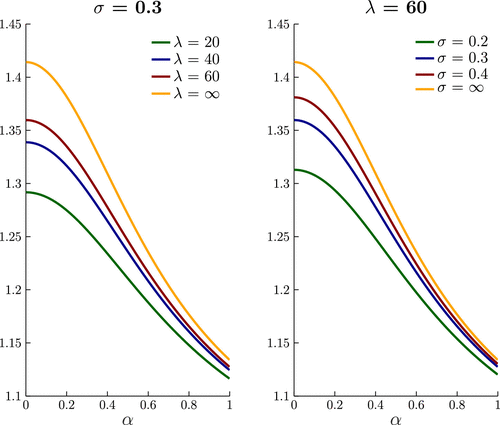
Note. Parameter choices are , , and .
4.1. Market Efficiency
Corollary 1 of Section 3.2 offers intuitive comparative statics about the market efficiency (RPE). The market is informationally more efficient if the fraction of informed traders () is higher, the variability of payoff after purchasing information is lower (i.e., is higher), uncertainty regarding the asset endowment of other traders is lower (i.e., is higher), and traders are less risk averse. We argued in Section 3.2 that it was striking that trading delays and the short-lived nature of the private information do not matter for the price informativeness. Now, the new results with endogenous information acquisition imply that the market efficiency is affected by trading delays and the short-lived nature of the private information through the equilibrium level of informed trading, .
Bai et al. (2016) find that RPE increased for S&P 500 firms between 1960 to 2014. They further analyze the factors behind this increase and find that (i) it is not caused by changes in return predictability because the predictable component of returns is quite stable, and (ii) it is likely caused by information production. Through the lens of our model, the findings of Bai et al. (2016) indicate that what is behind the increase in RPE is an increase in , and not an increase in . Our model offers theoretical insights into these findings because is endogenous in our model. An important determinant of in our model is as shown by Proposition 3. It can be argued that increased during 1960–2014 because “[t]rading costs have fallen, and liquidity has increased by orders of magnitude” (Bai et al. 2016, p. 625). Accordingly, our model implies that increased during the same period (keeping everything else constant).
In addition to the time-series evidence highlighted above, Bai et al. (2016) have indirect cross-sectional evidence for the positive relationship between and informational efficiency implied by our model. They show that FPE is higher for high-turnover firms compared with low-turnover firms. Because FPE is a measure that subsumes RPE, FPE tends to increase as increases as well. Thus, this can be considered an indirect evidence for higher being the reason behind higher RPE.9 In Section 5 of our paper, we, instead, provide direct cross-sectional evidence for this channel of our model by using transaction-level data from the UK corporate bond market. We use two proxies for RPE that are commonly employed in the market microstructure literature. We show that bonds with a larger average number of daily transactions, which is the direct counterpart of in our model, exhibit higher informational efficiency implied by both proxies.10
Although trading technologies and liquidity have improved substantially, which reduced trading delays during 1960–2014, these are not the only big changes happening in the financial sector. Indeed, the last decade has witnessed a substantial growth of “big data” financial technology. Thus, it is natural to ask how the market efficiency changes in response to traders’ easier access to useful information. We contrast two possible scenarios: a decline in the information acquisition cost, C, representing traders’ access to better data sets and more sophisticated data analysis technologies, and a decline in the noise of information revelation, , representing the shorter-lived nature of private information due to the technology allowing traders to extract others’ information, which is a common concern about big data financial technologies as stated by Farboodi and Veldkamp (2020).
Proposition 3 and Corollary 1 indicate that whereas market efficiency improves in response to a decline in the information acquisition cost, it worsens in response to private information becoming shorter lived. Hence, the impact of the growth of financial technology on market efficiency is ambiguous because both effects are, in principle, present for any asset, albeit with different strengths. Bai et al. (2016) present evidence consistent with this ambiguity: stock market efficiency exhibits a secular decline for the universe of all firms, whereas it exhibits a secular increase for the S&P 500 firms. Our model rationalizes their findings if the improvement in market efficiency from the decline in C is dominated by (respectively, dominates) the decline in market efficiency from the decline in for the universe of all firms (respectively, the S&P 500 firms). Table C.2 of Bai et al. (2016, p. 653) shows that the magnitude of the decline in market efficiency for the universe of all firms is highest for the three-year horizon during the 2010–2014 period of their data set, when the big data arguably plays the most prominent role in their data set.
4.2. Equilibrium Price Dynamics with Information Acquisition
In Section 3.3, we studied how the average price discount and the price variance depend on trading delays by taking as given the fraction of informed traders. However, the theoretical and empirical discussions above indicate that the level of trading delays is a first-order determinant of equilibrium information acquisition incentives, and so, as trading delays vary, the equilibrium fraction of informed traders vary as well, at least in the medium or long run. Thus, an important question is whether the patterns in Figure 2 are qualitatively robust to endogenous information acquisition. To this end, we reproduce below the results of Figure 2 with equilibrium information acquisition, presented along with the fixed exogenous as earlier.
For the same parametrization in Figure 2, Figure 4 reveals that the effect of trading delay on price dynamics is very different when trading delays are severe enough to prohibit all information acquisition (, ) and when trading delays are moderate so that there are some informed traders (, , and is increasing in ). Similar to Figure 2, when trading delays are very severe, a mitigation of delays increases average price discount in its absolute value but this time the effect is even stronger. This is because, in Figure 4, the entire population of traders is uninformed. Whereas only a fraction 0.7 of traders start trading early with worse precision in Figure 2, now the entire population (fraction one) of traders start trading with worse precision, and so, the price discount deepens very quickly. The worst discount is reached around , when trading delays are severe enough to still prohibit information acquisition, but moderate enough to allow uninformed traders to trade early on average when their signal precision is weak. The right panel of Figure 4 also shows that the price variance reaches its maximum around the same level because this large population of uninformed traders gain access to the market at dispersed times.

Notes. Parameter choices are , , , , , and . end., endogenous.
Once exceeds a certain threshold, both the average price discount and the price variance change direction very quickly. As increases further from this threshold, the average price discount gets smaller and smaller because informed traders with higher information precision start trading. This also increases the informativeness of the equilibrium price process, which increases the precision of uninformed trading as well. Similarly, price variance exhibits a sharp decline because traders’ valuations become closer together thanks to the information that informed traders bring to the market.
One can decompose the average price discount (13) as the negative of the sum of a payoff risk premium () and a liquidity risk premium, because the former is independent of and the latter depends on . Then, a broader message of the example in Figure 4 is that illiquidity premium and price dispersion can be nonmonotonic functions of in a model with endogenous information acquisition. To our knowledge, this is a novel result and in sharp contrast with the existing illiquid market models with exogenous information, which predict that illiquidity premium11 and price dispersion12 are monotone increasing in trading delays. In Section 5, we provide novel empirical evidence for the nonmonotonic relationship between trading delays and price dispersion by using transaction-level data from the UK corporate bond market. We leave the empirical analysis of illiquidity premium for future work because disentangling payoff risk premium and illiquidity premium requires a structural approach, which goes beyond the scope of the reduced-form empirical analysis we provide in Section 5.13
5. Novel Empirical Evidence
The theory developed in previous sections yields two testable predictions, summarized as follows.
(
(
5.1. Data and Measurement
To test these two predictions, we use a transaction-level data set from the UK corporate bond market, sourced by the UK Financial Conduct Authority. The data set contains information on the identities of counterparties, the transaction time, the transaction price and quantity, the International Securities Identification Number, and buyer–seller flags.14 Our sample covers the period between August 2011 and December 2017. We include all available transactions (i.e., including client–dealer as well as interdealer trades). We follow Czech and Pintér (2020) in matching our transaction-level data with information on time to maturity as well as bond ratings from Thomson Reuters Eikon, covering the three major rating agencies, Moody’s, Standard & Poor’s, and Fitch.15 For each bond, we take the modal value of the rating during the lifetime of the given bond in our sample.
To measure trading delays at the bond-day level, we use the trade-level data to compute the number of daily transactions in the given bond. For each bond, we compute the average number of daily transactions across the trading days in order to measure trading frequency (the inverse of trading delays) at the bond level. Moreover, we compute measures of price dispersion in the spirit of Jankowitsch et al. (2011). Specifically, we compute, for each transaction k in bond i, the following measure:
In Table 1, we present summary statistics for the variables used in the regression analyses below. Panel A shows the results at the bond level. Across the 2,776 bonds, average trading frequency amounts to about four to five daily transactions. The median and mean of price dispersion are around 16–17 bps and 19–20 bps, respectively, with weighted and unweighted measures yielding similar values. The mean of years to maturity (9.4 years) is above the median (5.6 years), which is due to some corporate bonds in the sample having very long (more than 50 years) maturity. The median bond has a credit rating of BBB−.
|

Table 1. Summary Statistics
| (1) | (2) | (3) | (4) | (5) | (6) | |
|---|---|---|---|---|---|---|
| Mean | p25 | p50 | p75 | SD | N | |
| Panel A. Bond level | ||||||
| Trading frequency | 4.90 | 3.28 | 4.05 | 5.30 | 3.90 | 2,776 |
| Price dispersion (W) | 20.65 | 6.88 | 16.97 | 29.04 | 18.84 | 2,776 |
| Price dispersion (U) | 19.01 | 7.13 | 16.32 | 27.14 | 16.42 | 2,776 |
| Maturity | 9.38 | 2.82 | 5.56 | 12.61 | 10.23 | 2,776 |
| Credit rating | 12.48 | 6.00 | 10.00 | 23.00 | 8.24 | 2,776 |
| Panel B. Bond-day level | ||||||
| Trading frequency | 5.22 | 2.00 | 4.00 | 6.00 | 7.89 | 625,925 |
| Price dispersion (W) | 12.18 | 0.00 | 3.35 | 16.18 | 19.94 | 625,925 |
| Price dispersion (U) | 12.11 | 0.00 | 3.47 | 16.46 | 19.41 | 625,925 |
| Maturity | 9.40 | 3.45 | 6.35 | 12.22 | 10.98 | 625,925 |
| Credit rating | 9.74 | 6.00 | 8.00 | 11.00 | 6.66 | 625,925 |
Notes. This table reports summary statistics at the bond level and the bond-day level. Trading frequency is measured as the number of daily transactions in the given bond. Price dispersion is the square root of either the trade-size weighted (W) or unweighted (U) mean of squared price deviations (see Equation (20)) in basis points. Maturity is measured by years to maturity. Credit ratings take 24 numerical values (1 = AAA, 2 = AA+, 3 = AA, 4 = AA-, 5 = A+, 6 = A, 7 = A−, 8 = BBB+, 9 = BBB, 10 = BBB−, 11 = BB+, 12 = BB, 13 = BB-, 14 = B+, 15 = B, 16 = B-, 17 = C, 18 = C+, 19 = CC, 20 = CC+, 21 = CC−, 22 = CCC, 23 = CCC+, 24 = DDD). p25, p50, and p75 represent the 25th percentile (first quartile), 50th percentile (median), and 75th percentile (third quartile) of the data, respectively. SD, standard deviation.
Panel B of Table 1 presents the results at the bond-day level. Trading frequencies continue to average around for to five daily observations (though they have a larger standard deviation compared with the bond level, i.e., 7.9 versus 3.9 transactions). The mean (12 bps) and median (16 bps) of price dispersion are smaller than at the bond level, which is driven by the fact that bonds with low price dispersion tend to trade on more days than bonds with higher dispersion. Similarly, the median credit rating is 8 (corresponding to BBB+ rating) at the bond-day level, which is higher than the median (BBB−) at the bond level. This is due to investment-grade bonds being traded on more trading days than high-yield bonds.
5.1.1. Discussion: Trade Frequency as a Proxy for (the Inverse of) Trading Delays.
As is widely recognized in the market microstructure literature, an asset can trade more frequently because either investors want to trade it more frequently (higher investor demand) or investors can trade it more frequently (shorter trading delays).16 Our theoretical model with one shot trade per investor captures the former with the total mass of investors and the latter with the parameter . Because we normalize the mass of investors to one, the only free parameter to capture trade frequency is , which naturally coincides with the inverse of trading delays. Therefore, in what follows, we associate a bond’s trading frequency with the parameter when we test the model’s comparative-statics implications in the cross section of bonds.
In light of the discussion above, our empirical approach appears to assume that bonds’ empirical trade frequencies are heterogeneous only because of heterogeneity in trading delays but bonds are homogeneous in terms of investor demand. We address such concerns regarding our empirical analyses as follows. Existing empirical literature argues that heterogeneous investor demand in the cross section of bonds can be explained, in part, by main bond characteristics such as credit rating, time to maturity, and bond age.17 In our regression analyses below, we include these main bond characteristics as controls so as to attenuate any confounding or unobserved bias from demand-side effects, as well as using bond and time fixed effects whenever possible.
5.2. Testing Prediction 1
To test the theoretical prediction regarding informational efficiency, we follow Indriawan et al. (2020) in measuring price efficiency with two standard metrics: return autocorrelation as in Hendershott and Jones (2005) and price delay as in Hou and Moskowitz (2005). Both measures build on the notion that time-variation in expected returns is negligible at high frequency, so returns should be unpredictable over a short time horizon if markets are informationally efficient. Deviations from return unpredictability could therefore be used as a proxy for informational inefficiency.
To compute the first measure, we estimate the following time-series regression separately for each bond i:
As a preliminary step for the construction of the second measure, we estimate the following time-series regression separately for each bond i:
Given our two measures of price efficiency, we then run the following cross-sectional regression at the bond level:
Results from regression (23) are presented in Table 2. Panel A shows the results for the regression without control variables. We find strong supporting evidence for the first prediction of the theoretical model: corporate bonds feature lower informational efficiency when they are traded less frequently. Specifically, columns (1)–(3) of the table shows that a one-log-point increase in the average number of daily transactions in a bond decreases the absolute value of autocorrelation by about 0.15–0.19 points. The effect is larger among less liquid bonds, that is, those bonds that are on average traded less frequently. Columns (4)–(6) of Table 2 show that a one-log-point increase in trading frequency decreases price delays by about 0.06–0.13 points, with the effect being statistically and economically more significant among less liquid bonds.
|
Table 2. Informational Efficiency and Trading Delays
| (1) | (2) | (3) | (4) | (5) | (6) | |
|---|---|---|---|---|---|---|
| Return autocorrelation | Price delay | |||||
| All bonds | Less liquid | More liquid | All bonds | Less liquid | More liquid | |
| Panel A. No controls | ||||||
| −0.175*** | −0.186*** | −0.149*** | −0.128*** | −0.080** | −0.058* | |
| (0.02) | (0.03) | (0.03) | (0.02) | (0.03) | (0.03) | |
| Constant | 0.516*** | 0.538*** | 0.465*** | 0.630*** | 0.602*** | 0.471*** |
| (0.03) | (0.05) | (0.05) | (0.03) | (0.05) | (0.06) | |
| N | 1,080 | 541 | 539 | 1,419 | 711 | 708 |
| 0.073 | 0.059 | 0.058 | 0.024 | 0.008 | 0.003 | |
| Panel B. With controls | ||||||
| −0.148*** | −0.152*** | −0.124*** | −0.125*** | −0.066** | −0.076** | |
| (0.02) | (0.03) | (0.02) | (0.02) | (0.03) | (0.03) | |
| Investment grade | −0.006 | 0.024 | −0.037** | −0.146*** | −0.135*** | −0.132*** |
| (0.01) | (0.02) | (0.02) | (0.01) | (0.02) | (0.02) | |
| Maturity = Q2 | −0.087*** | −0.054** | −0.119*** | −0.058*** | −0.070*** | −0.051** |
| (0.02) | (0.03) | (0.02) | (0.02) | (0.02) | (0.02) | |
| Maturity = Q3 | −0.105*** | −0.074*** | −0.142*** | −0.100*** | −0.120*** | −0.093*** |
| (0.02) | (0.02) | (0.02) | (0.02) | (0.02) | (0.02) | |
| Maturity = Q4 | −0.156*** | −0.147*** | −0.169*** | −0.143*** | −0.165*** | −0.138*** |
| (0.01) | (0.02) | (0.02) | (0.02) | (0.02) | (0.02) | |
| Constant | 0.563*** | 0.542*** | 0.556*** | 0.802*** | 0.759*** | 0.668*** |
| (0.03) | (0.05) | (0.05) | (0.03) | (0.05) | (0.06) | |
| N | 1,080 | 541 | 539 | 1,419 | 711 | 708 |
| 0.174 | 0.126 | 0.246 | 0.176 | 0.166 | 0.144 | |
Notes. This table presents results from cross-sectional regressions whereby measures of price efficiency are regressed on the trading frequency of corporate bonds. Panel A presents the results without controls, and panel B presents the results with controls. Columns (1)–(3) show the results where the absolute value of return autocorrelation (computed by (21)) is used as the left-hand-side variable. Columns (4)–(6) show the results where price delay (computed by (22)) is used as the regressand. Trading frequency (the regressor) is measured as the natural logarithm of the average daily number of transactions in bond i. For a bond to be included in the time-series regressions ((21) or (22)), it has to have at least 20 daily observations. Less (more) liquid bonds are defined as those that have approximately less (more) than the median number of daily transactions. The sample covers the period from August 2011 to December 2017. The trade-level data set covers about 3.8 million transactions, including both client–dealer and interdealer trades. The t-statistics (in parentheses) are based on robust standard errors. Q, quarter.
Asterisks denote significance levels (*p < 0.1; **p < 0.05; ***p < 0.01).
Panel B of Table 2 presents the results when we control for credit rating as well as maturity. We find that bonds with better rating and higher time to maturity tend to be more informationally efficient. Importantly, although the inclusion of these controls somewhat diminishes the estimated effect of trading frequency, the coefficients continue to be statistically significant, (with some increase in the statistical significance of trading frequency in the price delay regressions).
5.3. Testing Prediction 2
To test for the theoretical prediction regarding nonmonotonic relationship between price dispersion and trading delays, we compute average price dispersion and trading delays at the bond-day level. Then, we estimate the following panel regression:
Positive estimates of and negative estimates of would be consistent with a hump-shaped nonmonotonic relation, predicted by our theoretical model. Table 3 presents the results from the panel regressions using about 0.63 million bond-day observations. We find strong support for this second empirical prediction of our theoretical model. In all the regression specifications, the linear effect of trading frequency is estimated to be positive, whereas the quadratic effect is negative. The negative coefficient estimate on the time trend in column (3) suggests that price dispersion tends to fall as the bond ages.24 Overall, our results indicate a robust relationship between trading frequency and dispersion, which is positive up to a certain level of trading frequency, after which the relationship turns negative.
|
Table 3. Price Dispersion and Trading Delays
| (1) | (2) | (3) | (4) | (5) | |
|---|---|---|---|---|---|
| Panel A. Weighted dispersion | |||||
| 16.550*** | 15.568*** | 15.488*** | 15.854*** | 14.642*** | |
| (0.57) | (0.42) | (0.42) | (0.42) | (0.41) | |
| −2.154*** | −2.123*** | −2.189*** | −2.255*** | −1.972*** | |
| (0.18) | (0.11) | (0.11) | (0.11) | (0.12) | |
| Trend | −0.006*** | — | — | ||
| (0.00) | — | — | |||
| Past frequency | 6.601*** | ||||
| (0.84) | |||||
| N | 625,927 | 625,665 | 625,665 | 625,662 | 594,437 |
| 0.102 | 0.240 | 0.252 | 0.275 | 0.276 | |
| Panel B. Unweighted dispersion | |||||
| 17.044*** | 15.836*** | 15.756*** | 16.139*** | 14.888*** | |
| (0.61) | (0.43) | (0.44) | (0.43) | (0.42) | |
| −2.281*** | −2.204*** | −2.270*** | −2.339*** | −2.053*** | |
| (0.19) | (0.11) | (0.12) | (0.12) | (0.12) | |
| Trend | −0.006*** | — | — | ||
| (0.00) | — | — | |||
| Past frequency | 7.070*** | ||||
| (0.87) | |||||
| N | 625,927 | 625,665 | 625,665 | 625,662 | 594,437 |
| 0.107 | 0.254 | 0.267 | 0.291 | 0.291 | |
| Bond FEs | No | Yes | Yes | Yes | Yes |
| Day FEs | No | No | No | Yes | Yes |
Notes. This table presents results from panel regressions whereby measures of price dispersions are regressed on the trading frequency of corporate bonds. The regressor is included in a linear and a quadratic way. The sample covers the period from August 2011 to December 2017. The trade-level data set covers about 3.8 million transactions, including both client–dealer and interdealer trades. The t-statistics (in parentheses) are based on robust standard errors, where we also apply two-way clustering at the bond and day levels. FEs, fixed effects.
Asterisks denote the significance level (***p < 0.01).
The price dispersion literature recognizes that dispersion is (statistically) better estimated when there are many transactions versus few.25 One concern is, then, whether the hump-shaped trade frequency–price dispersion relationship is economically meaningful or an artifact of statistical bias. As a robustness check, Tables B.3 and B.4 in Appendix B estimate regression (24) on a subsample of the most and least frequently traded bonds and show that the hump-shaped relationship continues to hold in both samples.26 Therefore, we conclude that the hump-shaped relationship is present regardless of the level of statistical bias in price dispersion measurement.
To provide a visual illustration of the nonmonotonic relationship, we use the most conservative specification (with bond and day fixed effects) to construct a scatter plot as follows. We purge our bond and day fixed effects from unweighted price dispersion and trading frequency, and use the obtained 625,662 residuals to draw a scatter plot, as shown by Figure 5. The figure shows a visibly nonmonotonic relation: bond-day observations with intermediate trading delays tend to have higher dispersion compared with bond-day observations with very high or very low delays.27
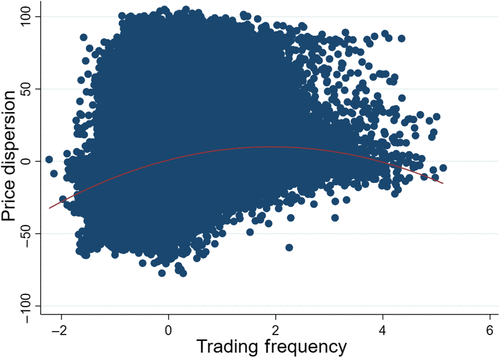
Notes. The scatter plot is constructed using the 625,662 residuals corresponding to column (4) of panel B in Table 3. That is, to obtain the residuals, we estimate and . The line is a fitted quadratic regression line.
6. Conclusion
We present an asset market model that aims at bridging the gap between the information acquisition literature and the trading delays literature and provide empirical evidence for its novel implications. Our model establishes an inverse relationship between trading delays and price informativeness in equilibrium. Consistent with this implication of our model, we show that the prices of corporate bonds that are easier (respectively, more difficult) to trade are informationally more (respectively, less) efficient in the UK market. Our model also establishes that equilibrium price dispersion is nonmonotonic in trading delays. We, again, empirically confirm this relationship in the cross section of bonds traded in the UK corporate bond market.
Another novel implication of our model is that equilibrium illiquidity premium is nonmonotonic in trading delays. Thus, one avenue for future research that our model leads to is to investigate the empirical relationship between illiquidity premium and trading delays. This would require a structural approach because of the necessity of decomposing risk premia into a payoff risk premium and an illiquidity risk premium.
Theoretical introspection leads to further avenues for future research. Because our model focuses on studying market-wide trading delays, it makes the assumption that uninformed and informed traders are subject to the same level of trading delays. One potential extension is to allow for heterogeneity in trading delays across traders. With endogenous information acquisition, this would allow one to study how different traders sort into different information types in equilibrium. Second, because trading delays are an important determinant of traders’ information acquisition incentives and implicitly of their trading activity, it is natural to think that, at least in the long run, market makers would adjust their trade execution speed as a strategic response to traders’ optimal information acquisition and trading activity. In order to analyze this (long-run) relationship, one could study the market makers’ endogenous investment in execution speed.
An earlier version of this paper was circulated under the title “Informed Trading in Markets with Trading Delays” (Üslü 2020). The authors thank, for helpful comments and suggestions, the editor Bruno Biais, one anonymous associate editor, and two anonymous referees, as well as Daniel Andrei, Simon Board, Will Cong, Adrien d’Avernas, Nicolae Gârleanu, Ben Lester, Wei Li, David McAdams, Tomasz Sadzik, Zhaogang Song, Aleh Tsyvinski, Laura Veldkamp, Güner Velioğlu, Pierre-Olivier Weill, and the participants at the UCLA Theory Proseminar. The empirical analyses in this paper were completed when Gábor Pintér was at the Bank of England. The views expressed in this paper are those of the authors, and not necessarily those of the Bank for International Settlements, the Bank of England, or their committees.
Appendix A. Proofs
A.1. Proof of Corollary 1
Using (7), (8), (11), and the posterior variance formula for normally distributed random variables (Veldkamp 2011, equation (2.4), p. 12),
Then, using the definitions
A.2. Proof of Proposition 2
The conditional expectation can be derived as follows:
which implies (13) because and
The first line above follows from the law of iterated expectations, the second line from (11), the third and fourth lines from (7), the fifth line because t is exponentially distributed with parameter , the sixth line by rearranging, and the last line using and with the change of variable .
Following similar steps,
A.3. Proof of Corollary 2
Define and . Then,
Rewrite (14):
Then,
Then, one can verify that
A.4. Proof of Lemma 2
Using the fact that is normally distributed, one can show that28
Then, applying the law of iterated expectations,
Substituting into (15) and further applying the law of iterated expectations, (15) becomes
Because the sum of normally distributed random variables is normally distributed as well, is normally distributed conditional on t. Using the fact that is conditionally normally distributed and using the law of iterated expectations,
Because t is exponentially distributed with parameter , the inequality stated in the lemma obtains.
A.5. Proof of Proposition 3
Let
To prove that there exists a unique equilibrium , it suffices to show that H is a strictly decreasing function of . To begin with, we calculate the first derivative of H with respect to , applying the Lebesgue dominated convergence theorem29 whenever necessary:
Using (16) and Proposition 1,
In turn, it suffices to show that
Because we want that this inequality is satisfied for all , via continuity, a necessary condition emerges when :
To obtain the comparative statics in the proposition, we make use of the implicit function theorem:
We have already established that . To complete the comparative statics, we calculate the remaining derivatives, applying Lebesgue dominated convergence theorem whenever necessary:
Appendix B. Additional Tables and Figures
This appendix presents additional tables and figures, which serve as robustness checks to our baseline empirical analyses in Section 5. Tables B.1 and B.2 present results by using trade volume as an alternative measure of the (inverse of) trading delays. Tables B.3 and B.4 and Figure B.1 present results by conducting subsample analyses based on the most liquid and the less liquid bonds in our full sample.
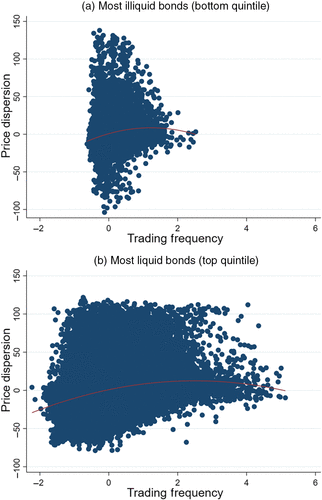
Notes. The scatter plots in panels (a) and (b) are constructed using the 15,749 and 175,385 residuals corresponding to column (4) of panel B in Tables B.3 and B.4, respectively. That is, to obtain the residuals, we estimate and . The curved line in each panel is a fitted quadratic regression line.
|
Table B.1. Informational Efficiency and Trade Volume
| (1) | (2) | (3) | (4) | (5) | (6) | |
|---|---|---|---|---|---|---|
| Return autocorrelation | Price delay | |||||
| All bonds | Less liquid | More liquid | All bonds | Less liquid | More liquid | |
| Panel A. No controls | ||||||
| −0.035*** | −0.046*** | −0.034*** | −0.048*** | −0.035*** | −0.073*** | |
| (0.01) | (0.01) | (0.01) | (0.01) | (0.01) | (0.01) | |
| Constant | 0.757*** | 0.948*** | 0.724*** | 1.154*** | 1.025*** | 1.471*** |
| (0.08) | (0.16) | (0.10) | (0.09) | (0.15) | (0.12) | |
| N | 1,080 | 541 | 539 | 1,419 | 711 | 708 |
| 0.037 | 0.035 | 0.061 | 0.040 | 0.016 | 0.125 | |
| Panel B. With controls | ||||||
| −0.033*** | −0.046*** | −0.033*** | −0.032*** | −0.024** | −0.059*** | |
| (0.01) | (0.01) | (0.01) | (0.01) | (0.01) | (0.01) | |
| Investment grade | 0.012 | 0.041** | −0.005 | −0.131*** | −0.124*** | −0.097*** |
| (0.01) | (0.02) | (0.02) | (0.01) | (0.02) | (0.02) | |
| Maturity = Q2 | −0.111*** | −0.078*** | −0.138*** | −0.082*** | −0.082*** | −0.074*** |
| (0.02) | (0.03) | (0.02) | (0.02) | (0.02) | (0.02) | |
| Maturity = Q3 | −0.129*** | −0.104*** | −0.160*** | −0.122*** | −0.137*** | −0.104*** |
| (0.01) | (0.02) | (0.02) | (0.02) | (0.02) | (0.02) | |
| Maturity = Q4 | −0.163*** | −0.165*** | −0.169*** | −0.146*** | −0.174*** | −0.124*** |
| (0.01) | (0.02) | (0.02) | (0.02) | (0.02) | (0.02) | |
| Constant | 0.826*** | 1.024*** | 0.828*** | 1.098*** | 1.027*** | 1.409*** |
| (0.08) | (0.15) | (0.09) | (0.10) | (0.15) | (0.12) | |
| N | 1,080 | 541 | 539 | 1,419 | 711 | 708 |
| 0.156 | 0.125 | 0.258 | 0.170 | 0.167 | 0.211 | |
Notes. This table presents results from cross-sectional regressions whereby measures of price efficiency are regressed on the trade volume of corporate bonds. Panel A presents the results without controls, and panel B presents the results with controls. Columns (1)–(3) show the results where the absolute value of return autocorrelation (computed by (21)) is used as the left-hand-side variable. Columns (4)–(6) show the results where price delay (computed by (22)) is used as the regressand. Trade volume (the regressor) is measured as the natural logarithm of the daily sum of nominal value of transactions in bond i. For a bond to be included in the time-series regressions ((21) or (22)), it has to have at least 20 daily observations. Less (more) liquid bonds are defined as those that have approximately less (more) than the median number of daily transactions. The sample covers the period from August 2011 to December 2017. The trade-level data set covers about 3.8 million transactions, including both client–dealer and interdealer trades. The t-statistics (in parentheses) are based on robust standard errors. Q, Quarter.
Asterisks denote significance levels (**p < 0.05; ***p < 0.01).
|
Table B.2. Price Dispersion and Trade Volume
| (1) | (2) | (3) | (4) | (5) | |
|---|---|---|---|---|---|
| Panel A. Weighted dispersion | |||||
| 0.688*** | 1.992*** | 1.960*** | 1.986*** | 1.962*** | |
| (0.10) | (0.07) | (0.07) | (0.07) | (0.07) | |
| −0.000*** | −0.000*** | −0.000*** | −0.000*** | −0.000*** | |
| (0.00) | (0.00) | (0.00) | (0.00) | (0.00) | |
| Trend | −0.007*** | — | — | ||
| (0.00) | — | — | |||
| Past frequency | 8.177*** | ||||
| (0.89) | |||||
| N | 625,927 | 625,665 | 625,665 | 625,662 | 594,437 |
| 0.004 | 0.192 | 0.209 | 0.231 | 0.233 | |
| Panel B. Unweighted dispersion | |||||
| 0.652*** | 2.022*** | 1.991*** | 2.018*** | 1.989*** | |
| (0.10) | (0.06) | (0.06) | (0.06) | (0.06) | |
| −0.000*** | −0.000*** | −0.000*** | −0.000*** | −0.000*** | |
| (0.00) | (0.00) | (0.00) | (0.00) | (0.00) | |
| Trend | −0.007*** | — | — | ||
| (0.00) | — | — | |||
| Past frequency | 8.718*** | ||||
| (0.92) | |||||
| N | 625,927 | 625,665 | 625,665 | 625,662 | 594,437 |
| 0.004 | 0.206 | 0.223 | 0.246 | 0.248 | |
| Bond FEs | No | Yes | Yes | Yes | Yes |
| Day FEs | No | No | No | Yes | Yes |
Notes. This table presents results from panel regressions whereby measures of price dispersions are regressed on the trade volume of corporate bonds. Trade volume (the regressor) is measured as the natural logarithm of the daily sum of nominal value of transactions in bond i. The regressor is included in a linear and a quadratic way. The sample covers the period from August 2011 to December 2017. The trade-level data set covers about 3.8 million transactions, including both client–dealer and interdealer trades. The t-statistics (in parentheses) are based on robust standard errors, where we also apply two-way clustering at the bond and day levels. FEs, Fixed effects.
Asterisks denote the significance level (***p < 0.01).
|
Table B.3. Price Dispersion and Trading Delays: Illiquid Bonds
| (1) | (2) | (3) | (4) | (5) | |
|---|---|---|---|---|---|
| Panel A. Weighted dispersion | |||||
| 34.047*** | 33.415*** | 33.571*** | 33.927*** | 32.630*** | |
| (4.21) | (3.33) | (3.32) | (3.24) | (3.32) | |
| −9.295*** | −8.397*** | −8.471*** | −8.597*** | −8.115*** | |
| (1.34) | (1.08) | (1.08) | (1.08) | (1.11) | |
| Trend | −0.004*** | — | — | ||
| (0.00) | — | — | |||
| Past frequency | −0.476 | ||||
| (3.27) | |||||
| N | 15,901 | 15,763 | 15,763 | 15,749 | 14,568 |
| 0.032 | 0.342 | 0.346 | 0.351 | 0.357 | |
| Panel B. Unweighted dispersion | |||||
| 31.833*** | 31.359*** | 31.512*** | 31.750*** | 30.512*** | |
| (4.01) | (3.30) | (3.29) | (3.24) | (3.31) | |
| −8.652*** | −7.835*** | −7.908*** | −8.002*** | −7.558*** | |
| (1.26) | (1.08) | (1.07) | (1.08) | (1.12) | |
| Trend | −0.004*** | — | — | ||
| (0.00) | — | — | |||
| Past frequency | 1.086 | ||||
| (3.25) | |||||
| N | 15,901 | 15,763 | 15,763 | 15,749 | 14,568 |
| 0.030 | 0.336 | 0.340 | 0.344 | 0.351 | |
| Bond FEs | No | Yes | Yes | Yes | Yes |
| Day FEs | No | No | No | Yes | Yes |
Notes. This table presents results from panel regressions whereby measures of price dispersions are regressed on the trading frequency of corporate bonds. The regressor is included in a linear and a quadratic way. The sample covers the period from August 2011 to December 2017. The trade-level data set covers about 3.8 million transactions, including both client–dealer and interdealer trades. The t-statistics (in parentheses) are based on two-way clustering at the bond and day levels in columns (2)–(4). FEs, Fixed effects.
Asterisks denote the significance level (***p < 0.01).
|
Table B.4. Price Dispersion and Trading Delays: Liquid Bonds
| (1) | (2) | (3) | (4) | (5) | |
|---|---|---|---|---|---|
| Panel A. Weighted dispersion | |||||
| 16.547*** | 15.444*** | 15.194*** | 15.371*** | 14.009*** | |
| (1.14) | (0.81) | (0.83) | (0.81) | (0.75) | |
| −1.942*** | −1.722*** | −1.739*** | −1.786*** | −1.435*** | |
| (0.29) | (0.18) | (0.18) | (0.18) | (0.19) | |
| Trend | −0.004*** | — | — | ||
| (0.00) | — | — | |||
| Past frequency | 9.930*** | ||||
| (1.81) | |||||
| N | 175,460 | 175,390 | 175,390 | 175,385 | 168,470 |
| 0.088 | 0.268 | 0.272 | 0.306 | 0.307 | |
| Panel B. Unweighted dispersion | |||||
| 17.464*** | 15.981*** | 15.737*** | 15.935*** | 14.512*** | |
| (1.19) | (0.84) | (0.86) | (0.84) | (0.76) | |
| −2.162*** | −1.860*** | −1.877*** | −1.929*** | −1.569*** | |
| (0.30) | (0.18) | (0.18) | (0.18) | (0.19) | |
| Trend | −0.004*** | — | — | ||
| (0.00) | — | — | |||
| Past frequency | 10.351*** | ||||
| (1.83) | |||||
| N | 175,460 | 175,390 | 175,390 | 175,385 | 168,470 |
| 0.094 | 0.285 | 0.289 | 0.326 | 0.328 | |
| Bond FEs | No | Yes | Yes | Yes | Yes |
| Day FEs | No | No | No | Yes | Yes |
Notes. This table presents results from panel regressions whereby measures of price dispersions are regressed on the trading frequency of corporate bonds. The regressor is included in a linear and a quadratic way. The sample covers the period from August 2011 to December 2017. The trade-level data set covers about 3.8 million transactions, including both client–dealer and interdealer trades. The t-statistics (in parentheses) are based on robust standard errors for column (1), whereas we apply two-way clustering at the bond and day levels in columns (2)–(4). FEs, Fixed effects.
Asterisks denote the significance level (***p < 0.01).
1 Bai et al. (2016) find that the decline in market efficiency for the universe of all firms is highest during the very last period (2010–2014) of their data set, when the big data arguably plays the most prominent role.
2 Pintér and Üslü (2022) propose a structural estimation of a model of OTC asset markets by using the same data set. Their estimation implies that the median client faces a trading delay of around three quarters of a trading day in the most liquid segment of the UK corporate bond market with 57 bonds.
3 Postponing all payoffs and consumption to an infinitely far horizon and assuming that traders are infinitely patient are modeling tricks to obtain simple formulas by eliminating the pure time cost of trading delays. These are not essential for our analysis because we want to study the effect of trading delays on price discovery in a model with common valuations. The fast-growing search literature, instead, studies the effect of the time cost of delaying trade on welfare when traders have private valuations. Thus, assuming proper discounting is essential for those models because in the limit as the discount rate approaches zero, the competitive outcomes typically obtain in those models. See Duffie et al. (2005), Weill (2020), and Pintér and Üslü (2022), among others.
4 We have that follows because and are i.i.d. random variables. This will become clearer shortly when we endogenize the traders’ information sets and derive these posterior variances in closed form.
5 This assumption is verified ex post. The verification follows because (i) all signals are Gaussian and (ii) the market price, which is the endogenous public signal in the model, is a linear function of Gaussian random variables, as is typically assumed in the literature.
6 See Øksendal (2003, p. 104) for a similar derivation.
7 Proving Lemma 2 amounts to moving the expectation on the LHS of (15) to the RHS and multiplying both sides with −1, which yields the optimality condition (17).
8 This condition on risk aversion is a sufficient condition for unique because it guarantees that the net benefit of becoming informed is monotone for all . Numerical examples suggest that even if this condition is severely violated (e.g., for a hundred times larger than the stated upper bound), the net benefit of becoming informed is monotone for a large spectrum of ’s, apart from the very small , which means that the proposition holds for a larger spectrum of parameters than implied by the sufficient condition in its statement.
9 Bai et al. (2016) do not use turnover in their formal analysis of RPE. Instead, they conduct their formal analysis of turnover by looking at FPE, and make an indirect inference for RPE: “These results show that higher liquidity is associated with higher price informativeness. As liquidity has risen significantly over time, this finding supports the view that rising liquidity has contributed to the observed rise in price informativeness and an increase in RPE” (Bai et al. 2016, p. 644).
10 The two proxies are the return autocorrelation measure of Hendershott and Jones (2005) and the price delay measure of Hou and Moskowitz (2005), which are both inversely related with RPE. See Section 5.2 for more information.
11 See, for example, Duffie et al. (2005, 2007) and He and Milbradt (2014).
12 See, for example, Afonso and Lagos (2015), Üslü and Velioğlu (2019), and Hugonnier et al. (2022).
13 Among others, see d’Avernas (2017) and Chen et al. (2018) for such structural work.
14 All transaction prices are clean prices (so they do not include accrued interest). For further details on the Zen data set, see the Transaction Reporting User Pack: https://www.fca.org.uk/publication/finalised-guidance/fg15-03.pdf. Recent applications of the data set can be found in Czech and Roberts-Sklar (2019), Czech et al. (2021), and Pintér and Üslü (2022) among others.
15 Our default option is to use ratings from Moody’s because of the firm’s vast market coverage, and to use S&P ratings if ratings from Moody’s are unavailable for a certain bond. Fitch ratings are used as a third option if necessary. Credit ratings in our data set take 24 numerical values (1 = AAA, 2 = AA+, 3 = AA, 4 = AA−, 5 = A+, 6 = A, 7 = A−, 8 = BBB+, 9 = BBB, 10 = BBB−, 11 = BB+, 12 = BB, 13 = BB−, 14 = B+, 15 = B, 16 = B−, 17 = C, 18 = C+, 19 = CC, 20 = CC+, 21 = CC−, 22 = CCC, 23 = CCC+, 24 = DDD).
16 See Kargar et al. (2022) and Pintér and Üslü (2022) for more detailed discussions.
17 See Alexander et al. (2000) and Hotchkiss and Jostova (2017), among others.
18 We use data on zero-coupon bond yields (with maturity of 1–25 years), as constructed by the Bank of England. The data can be downloaded from the Bank of England’s website.
19 We also experiment with alternative ways of measuring trading delays. Appendix B reestimates regression (23) after we replace the regressor with the natural logarithm of trading volume—defined as the nominal value of transactions—at the bond-day level. As we can see in Tables B.1 and B.2, all the results are qualitatively the same as our baseline.
20 The four maturity buckets correspond to 0–3, 4–6, 6–11, and 11+ years to maturity.
21 Table B.2 of Appendix B reestimates regression (24) after we replace the regressor with the natural logarithm of trading volume—defined as the nominal value of transactions—at the bond-day level. As we can see, all the results are qualitatively the same as our baseline.
22 Note that the combination of a linear trend and bond fixed effects controls for the linear effect of deterministic factors such as the age of the bond or time to maturity.
23 It is important to note that bonds with zero or one trade in a day are unsuitable for generating reliable price dispersion estimates. Consequently, such instances are excluded from our bond-day observations, potentially raising concerns about statistical bias. We use the past frequency variable as a control so as to attenuate a statistical bias from dropping the zero and one transaction days. Specifically, a low value for a bond’s past frequency variable on a given day, which increases susceptibility to bias, is accounted for in our analysis, partially offsetting the impact of this exclusion.
24 Once we include day fixed effects (columns (4) and (5)), the linear trend is absorbed.
25 See Jankowitsch et al. (2011), among others.
26 The two subsamples are based on the top quintile and bottom quintile of bonds in terms of average number of daily transactions.
27 Figure B.1 in Appendix B shows that the hump-shaped relationship continues to hold in a subsample of the most and least frequently traded bonds.
28 See Veldkamp (2011, p. 90) for a similar derivation.
29 See, for a reference, Hutson et al. (2005, p. 55).
References
- (1986) A monopolistic market for information. J. Econom. Theory 39(2):400–438.Crossref, Google Scholar
- (2015) Trade dynamics in the market for federal funds. Econometrica 83(1):263–313.Crossref, Google Scholar
- (2024) High frequency market making: The role of speed. J. Econometrics 239(2):105421.Google Scholar
- (2000) The determinants of trading volume of high-yield corporate bonds. J. Financial Marketing 3(2):177–204.Crossref, Google Scholar
- (2012) Learning from private and public observations of others’ actions. J. Econom. Theory 147(3):910–940.Crossref, Google Scholar
- (2018) Trading and information diffusion in over-the-counter markets. Econometrica 86(5):1727–1769.Crossref, Google Scholar
- (2016) Have financial markets become more informative? J. Financial Econom. 122(3):625–654.Crossref, Google Scholar
- (2015) Equilibrium fast trading. J. Financial Econom. 116(2):292–313.Crossref, Google Scholar
- (2001) A decentralized market with common values uncertainty: Non-steady states. Rev. Econom. Stud. 68(2):323–346.Crossref, Google Scholar
- (2012) The real effects of financial markets. Annual Rev. Financial Econom. 4:339–360.Crossref, Google Scholar
- (2015) The high-frequency trading arms race: Frequent batch auctions as a market design response. Quart. J. Econom. 130(4):1547–1621.Crossref, Google Scholar
- (2008) Information sales and insider trading with long-lived information. J. Finance 63(2):639–672.Crossref, Google Scholar
- (2018) Quantifying liquidity and default risks of corporate bonds over the business cycle. Rev. Financial Stud. 31(3):852–897.Crossref, Google Scholar
- (2020) Informed trading and the dynamics of client-dealer connections in corporate bond markets. Bank of England Working Paper No. 895, Bank of England, London.Google Scholar
- (2019) Investor behaviour and reaching for yield: Evidence from the sterling corporate bond market. Financial Markets Institutions Instruments 28(5):347–379Crossref, Google Scholar
- (2021) Informed trading in government bond markets. J. Financial Econom. 142(3):1253–1274.Crossref, Google Scholar
- (2017) Disentangling credit spreads and equity volatility. Working paper, Stockholm School of Economics, Stockholm.Google Scholar
- (2015) The taxation of bilateral trade with endogenous information. Working paper, Columbia University, New York.Google Scholar
- (2021) Trading costs and informational efficiency. J. Finance 76(3):1471–1539.Crossref, Google Scholar
- (2017) The value of trading relations in turbulent times. J. Financial Econom. 124(2):266–284.Crossref, Google Scholar
- (2023) Dealer networks andthe cost of immediacy. Working paper, Copenhagen Business School, Copenhagen.Google Scholar
- (2000) Should speculators be taxed? J. Bus. 73(1):89–107.Crossref, Google Scholar
- (2005) Over-the-counter markets. Econometrica 73(6):1815–1847.Crossref, Google Scholar
- (2007) Valuation in over-the-counter markets. Rev. Financial Stud. 20(6):1865–1900.Crossref, Google Scholar
- (2014) Information percolation in segmented markets. J. Econom. Theory 153:1–32.Crossref, Google Scholar
- (2018) Data abundance and asset price informativeness. J. Financial Econom. 130(2):367–391.Crossref, Google Scholar
- (2007) Corporate bond market transaction costs and transparency. J. Finance 63(2):1421–1451.Crossref, Google Scholar
- (2020) Long run growth of financial data technology. Amer. Econom. Rev. 110(8):2485–2523.Crossref, Google Scholar
- (2023) The emergence of market structure. Rev. Econom. Stud. 90(1):261–292.Crossref, Google Scholar
- (2016) News trading and speed. J. Finance 71(1):335–382.Crossref, Google Scholar
- (1976) Price dispersion in the government securities market. J. Political Econom. 84(4):721–740.Crossref, Google Scholar
- (2009) Portfolio choice and pricing in illiquid markets. J. Econom. Theory 144(2):532–564.Crossref, Google Scholar
- (2016) Asymmetric information and intermediation chains. Amer. Econom. Rev. 106(9):2699–2721.Crossref, Google Scholar
- (2019) On the efficiency of long intermediation chains. J. Financial Intermediation 38:11–18.Crossref, Google Scholar
- (2014) Decentralized trading with private information. Econometrica 82(3):1055–1091.Crossref, Google Scholar
- (1980) On the impossibility of informationally efficient markets. Amer. Econom. Rev. 70(3):393–408.Google Scholar
- (2014) Endogenous liquidity and defaultable bonds. Econometrica 82(4):1443–1508.Crossref, Google Scholar
- (2005) Island goes dark: Transparency, fragmentation, and regulation. Rev. Financial Stud. 18(3):743–793.Crossref, Google Scholar
- (2017) Determinants of corporate bond trading: A comprehensive analysis. Quart. J. Finance 7(2):1750003.Crossref, Google Scholar
- (2002) The informational efficiency of the corporate bond market: An intraday analysis. Rev. Financial Stud. 15(5):1325–1354.Crossref, Google Scholar
- (2005) Market frictions, price delay, and the cross-section of expected returns. Rev. Financial Stud. 18(3):981–1020.Google Scholar
- (2020) Frictional intermediation in over-the-counter markets. Rev. Econom. Stud. 87(3):1432–1469.Crossref, Google Scholar
- (2022) Heterogeneity in decentralized asset markets. Theoret. Econom. 17(3):1313–1356.Google Scholar
- (2005) Applications of Functional Analysis and Operator Theory, 2nd ed. (Elsevier, Amsterdam).Google Scholar
- (2020) On the effects of continuous trading. Preprint, submitted December 1, http://dx.doi.org/10.2139/ssrn.3707154.Google Scholar
- (2014) The determinants of recovery rates in the US corporate bond market. J. Financial. Econom. 114(1):155–177.Crossref, Google Scholar
- (2011) Price dispersion in OTC markets: A new measure of liquidity. J. Banking Finance 35(2):343–357.Crossref, Google Scholar
- (2022) Sequential search for corporate bonds. Working paper, University of Illinois Urbana-Champaign, Champaign.Google Scholar
- (2009) Liquidity in asset markets with search frictions. Econometrica 77(2):403–426.Crossref, Google Scholar
- (2016) Search with adverse selection. Econometrica 84(1):243–315.Crossref, Google Scholar
- (2017) Learning and price discovery in a search market. Rev. Econom. Stud. 85(2):1159–1192.Crossref, Google Scholar
- (2013) Active investment, liquidity externalities, and markets for information. Working paper, Santa Clara University, Santa Clara, CA.Google Scholar
- (2018) When do CDS spreads lead? Rating events, private entities, and firm-specific information flows. J. Financial Econom. 130(3):556–578.Crossref, Google Scholar
- (2023) Market-making with search and information frictions. J. Econom. Theory 212:105714.Crossref, Google Scholar
- (2021) High frequency trading with speed hierarchies. Working paper, CUNY Baruch College, New York.Google Scholar
- (2019) Dealer networks. J. Finance 74(1):91–144.Crossref, Google Scholar
- (2022) Dealers as information intermediaries in over-the-counter markets. Working paper, CUNY Baruch College, New York.Google Scholar
- (A) (2018) The execution quality of corporate bonds. J. Financial Econom. 130(2):308–326.Crossref, Google Scholar
- (2003) Stochastic Differential Equations: An Introduction with Applications, 6th ed. (Springer, Berlin).Google Scholar
- (2018) Competing on speed. Econometrica 86(3):1067–1115.Crossref, Google Scholar
- (2022) Comparing search and intermediation frictions across markets. Bank of England Working Paper 974, Bank of England, London.Google Scholar
- (1988) Transaction taxes and financial market equilibrium. J. Bus. 71(1):81–118.Crossref, Google Scholar
- (2019) Pricing and liquidity in decentralized asset markets. Econometrica 87(6):2079–2140.Crossref, Google Scholar
- Üslü S (2020) Informed trading in markets with trading delays. Working paper, Johns Hopkins University, Baltimore.Google Scholar
- (2019) Liquidity in the cross section of OTC assets. Working paper, Johns Hopkins University, Baltimore.Google Scholar
- (2006a) Media frenzies in markets for financial information. Amer. Econom. Rev. 96(3):577–601.Crossref, Google Scholar
- (2006b) Information markets and comovements of asset prices. Rev. Econom. Stud. 73(3):823–845.Crossref, Google Scholar
- (2011) Information Choice in Macroeconomics and Finance (Princeton University Press, Princeton, NJ).Crossref, Google Scholar
- (1982) Information acquisition in a noisy rational expectations economy. Econometrica 50(6):1415–1430.Crossref, Google Scholar
- (2017) Endogenous public information and welfare in market games. Rev. Econom. Stud. 84(2):935–963.Crossref, Google Scholar
- (2007) Leaning against the wind. Rev. Econom. Stud. 74(4):1329–1354.Crossref, Google Scholar
- (2020) The search theory of over-the-counter markets. Annual Rev. Econom. 12:747–773.Crossref, Google Scholar
- (1990) Information revelation in a market with pairwise meetings. Econometrica 58(1):1–23.Crossref, Google Scholar
- (2024) Disintermediating the federal funds market. Working paper, Federal Reserve Bank of Richmond, Richmond, VA.Google Scholar

