


Media Attention and Event-Based Grouping of Stocks: An Examination of Stocks Hyped by Media Outlets as Benefiting from the Olympics
Abstract
We examine five summer Olympics and identify stocks that media outlets hype as benefiting from the Olympics (Olympic stocks). There is a seven-year period from the time that a country first learns it has won the Olympic bid to the start of the games (Olympic time period). We predict that the excitement of the Olympics along with the greater media attention impacts the valuation and risk of Olympic stocks. Consistent with this prediction, we show that Olympic stocks earn higher returns than their matched counterparts and comove more strongly with each other over the Olympic time period. Olympic stocks also exhibit increases in trading volume and stock volatility on days when media outlets have stories linking the firm to the Olympic Games. However, we find no evidence that the Olympic Games translate into stronger fundamentals for Olympic firms or stronger fundamental comovements. These findings suggest that investors are not purchasing the stocks based on an analysis of fundamentals, but are purchasing them based on their Olympic attribute. To confirm that event-based groupings occur in other settings, we show that comovement increases for stocks classified by the media as “stay-at-home” stocks at the start of the COVID-19 pandemic.
This paper was accepted by Eric So, accounting.
Supplemental Material: The online appendix is available at https://doi.org/10.1287/mnsc.2021.02218.
When Beijing holds its Olympic Games, foreign visitors will fly “Air China” to Beijing, go to “Bank of China” to get cash, take the taxi run by “Beijing Bus,” stay at hotels of “China World Trade Center,” buy the Olympic toy produced by “HaiXin,” eat Peking duck at “QuanJuDe,” drink “YanJing Beer,” watch TV cable programs from “Beijing Gehua CATV Network,” go shopping at “WangFuJing,” and return home with Chinese medicines from “Beijing TongRenTang” (Lawtime 2010).
1. Introduction
The Olympics are one of the most exciting media events in the world. The number of people estimated to watch the Olympics is more than 4.6 billion, representing approximately 70% of the world’s population (Hui 2008). Given the global attention, hosting nations often experience significant national pride as the world’s focus shifts to that country in the lead-up to the Olympics. We investigate whether the excitement and visibility of the Olympics impact the equity valuation of host-country firms that are predicted by the media to benefit from the Olympics (hereafter, “Olympic stocks”). Olympic stocks include those in the airline, construction, hospitality, media, and service industries that either directly or indirectly contribute to the broader Olympic experience.
We investigate the pricing of Olympic stocks in five Olympic-hosting countries: Australia (Sydney, 2000), Greece (Athens, 2004), China (Beijing, 2008), the United Kingdom (London, 2012), and Brazil (Rio de Janeiro, 2016). We start with the Sydney 2000 Olympics because access to information via the internet and online trading became more common in the 2000s.1 We focus on the Summer Olympic Games because the summer games are more publicized and have a wider appeal, and consequently, investor awareness of the Olympic stocks is expected to be greater for the summer than the Winter Olympics. We classify a stock as an Olympic stock using a variety of methods. We use national and local media, depending on the country, to identify mentions of stocks expected to be involved in or benefit from the Olympic Games. We searched investing and social media sites for lists of Olympic-themed stocks. We identify all official Olympic sponsors and partners that were publicly traded in the host country. The main sample across the five Olympics consists of 200 Olympic stocks that were publicly traded as of the Olympic winning bid announcement with 30 Sydney, 34 Athens, 63 Beijing, 59 London, and 14 Rio Olympic stocks.
There is a seven-year period between the time that a country first learns that it has successfully won a bid to host the Olympics and the start of the Olympic Games (we term this the Olympic period). We predict that investors use the Olympics as a basis for investment during this time period. There are several reasons why this could occur. First, when a country wins a bid, it is common for government officials to discuss the expected economic benefits to the hosting city or country from the Olympics.2 If investors then infer from this good economic news provided by experts that certain stocks are likely to disproportionately benefit (those the media claims are involved in the Olympics), then this news can create new demand for such stocks irrespective of how much the firms actually benefit from the Olympics. Second, the Olympics are an interesting news story for people in the hosting countries. Prior to the Olympic Games, the media gives frequent updates on the construction progress being made toward the Olympics, gives estimates on the number of tourists that will visit, and discusses other benefits of the games. The media also frequently combines news of the Olympics with the performance of the stock market, discussing which companies are likely to benefit, including the creation of lists of Olympic-themed stocks. This greater media focus is likely to increase investor attention on Olympic stocks and potentially bias them toward selecting these stocks as a basis for investment.
We first investigate investor reaction to the announcement that the country will host the Olympics. Consistent with investors viewing the Olympics as having a positive economic benefit to the hosting country, we document that local stock market indices rise at the time that the winning bid is announced. We next investigate the valuation consequences for stocks that the media classify as being involved in the Olympics. We find that during the seven-year Olympic time period, the stocks that media outlets classify as being involved in the Olympics have positive cumulative returns and outperform their matched counterparts by approximately 117%. The valuation benefits appear to be long-lived because we do not observe them dissipating after the Olympic Games are played.
We predict that, if investors use the Olympics as a basis for investment, then the stock returns of Olympic stocks exhibit increases in comovement. Comovement increases because investors are no longer purchasing Olympic stocks based on fundamental news, but instead are purchasing them based on their Olympic attribute. We predict increases in comovement after the winning bid is announced and declines in comovement after the games are played. Our main measure of comovement is the average R2 from firm-specific regressions of Olympic firm returns on an index comprising all Olympic firms. For the industry-matched control firms, we regress non-Olympic firm returns on an index comprising all of the non-Olympic control firms. We find that across the five Olympics, the average R2 increases from 20% to 36% from the preannouncement period to the year of the Olympic Games with a quick increase in comovement around and after the winning bid announcement, which is largely sustained until the Olympic Games. In addition, consistent with the Olympic grouping being temporary, we find a complete reversal in the increase in R2 after the games are played. We obtain similar inferences using a measure of synchronicity that reflects the degree to which Olympic stocks move in the same direction. We also examine whether betas increase for Olympic firms relative to non-Olympic firms and find positive but insignificant differences.
We investigate whether Olympic stocks exhibit increases in profitability and in fundamental comovement during the Olympic time period. This occurs if the Olympic Games create abnormal revenues for Olympic firms, and the economic performance of Olympic firms becomes more strongly tied to the same macroeconomic event being the Olympics. We find no evidence of abnormal profitability or growth for Olympic firms during the Olympic period. Earnings, cash flows, and revenues of Olympic stocks are similar to those of matched firms in all periods leading up to and during the Olympic year. In addition, we find little to no evidence that the fundamentals (earnings or revenues) of Olympic stocks comove with each other more strongly during the Olympic period. Thus, our evidence is not consistent with the stock market effects being driven by changes in the underlying fundamentals of Olympic firms and is more consistent with investors buying these stocks because of their Olympic attribute.
The results suggesting that there is no major impact on underlying fundamentals for Olympic stocks may seem surprising. However, there are several reasons why this result could occur. First, the incremental money earned from the Olympic Games is likely to be small for many of the Olympic stocks. The Olympic Games only last 16 days, and so the profitability impact for hotels, entertainment, airlines, and food is likely to only affect one financial quarter. Second, with respect to comovement effects, it is important to recognize that Olympic firms come from a variety of industries and so differ in the timing of benefits and risks associated with the Olympics (e.g., construction firms’ profits depend on the negotiated contract earned before the games, whereas hotels’ and restaurants’ profits are dependent on tourism and are earned around the time of the games). Therefore, the fundamentals of Olympic stocks should not necessarily comove with each other. Third, the press or social media outlets creating the list of Olympic-themed firms do not necessarily know which stocks will benefit from the Olympics. Therefore, the lists are likely to include stocks that do not benefit from the Olympics.
We provide two tests to provide additional insights into whether the investment in Olympic stocks is driven by media hype rather than a detailed analysis of fundamentals. First, we document that there are abnormal increases in stock volatility and trading volume on days when the media has a story linking the firm to the Olympics. Second, we show that the comovement results are stronger in Olympic firms that have proportionally more retail investors. These results suggest that less sophisticated investors buy Olympic stocks because they believe the story that a major sporting event (the Olympics) will create value for these stocks.
Our main hypothesis is that events such as the Olympics can create new demand for certain groups of stocks which will have implications for valuation and risk. To confirm that event-based grouping of stocks occurs in other settings, we provide two out-of-sample tests. Our first test examines the Olympics in Japan. Japan held the Olympics after we wrote the paper, and therefore, the results for Japan have no lookahead bias. Our results for Japan are consistent with our findings for the earlier five Olympics. Second, we investigate an entirely different setting by examining “stay-at-home” stocks at the onset of the COVID-19 pandemic. At the start of the pandemic, media outlets created lists of stocks that were expected to benefit from the pandemic because of employees being able to work from home. We show increases in comovement for stocks that are classified by media outlets as stay-at-home stocks. These out-of-sample results provide additional support for our hypothesis that media attention about certain groups of stocks relating to an event (the Olympics, COVID-19) can capture retail investor attention, which has implications for valuation and comovement risk irrespective of the impact on the underlying fundamentals.
Our paper makes two contributions to the literature. First, we contribute to the literature investigating the impact of the media on price formation in financial markets. As pointed out by Miller and Skinner (2015), the media can improve information flow and, hence, improve market efficiency, or it can reduce market efficiency by exacerbating investor sentiment biases in prices. Evidence consistent with improved market efficiency includes Engelberg and Parsons (2011) and Peress (2014); evidence consistent with the media exacerbating biases includes Solomon et al. (2014).3 Our study builds on these lines of literature by showing that a major country-wide event can capture the attention of local investors, who then use stories provided by the media to identify stocks for investment. Thus, a major news event can bias investors toward buying event-themed stocks, irrespective of the fundamental benefits of the event. However, as we note, we find that the valuation benefits of being classified as an Olympic-themed stock is long-lived. This evidence suggests that the greater media attention on Olympic stocks increases investor awareness or recognition of these stocks, which has long-lasting benefits. For example, after the media makes investors aware of these stocks, investors could continue to invest in and follow these firms after the event, which improves liquidity. In addition, the greater media attention could also result in greater stakeholder recognition (suppliers, customers, and employees) that has long-run contracting benefits for these firms.
Second, our study contributes to the idea of “style investing” in which investors trade baskets of stocks without scrutinizing the underlying securities (e.g., Barberis and Shleifer 2003, Barberis et al. 2005). Prior research finds evidence consistent with groupings for stocks moving in and out of indices (e.g., S&P 500), for stocks in a specific industry (e.g., internet stocks), and for firms switching the geographic location of their headquarters.4 Our tests of the Olympics provide evidence of an alternative way that investors can potentially group stocks for investment: by a nationwide event. Our event-based approach allows us to develop more powerful tests because we can rule out many competing explanations for comovement changes. Overall, our findings suggest that, if retail investors continue to group certain stocks together, we will continue to observe valuation changes that do not necessarily reflect fundamental-driven comovements risk or profitability.
2. Related Research and Predictions
2.1. Media Attention and Olympic Stocks
Prior research suggests that the valuation of individual stocks is impacted by investor awareness (e.g., Merton 1987, Bloomfield 2002, Hirshleifer and Teoh 2003, Barber and Odean 2008). There are many companies that investors can potentially buy, and as a consequence, investors only know about a subset of available securities. Institutional investors and hedge funds can increase their knowledge of firms by screening companies using financial reporting information and other metrics. However, many investors (both retail and institutional investors) are likely to identify potential investments based on their familiarity with the company’s products (e.g., Apple’s iPhone), specific causes (e.g., solar energy, social responsibility), or firms with more media coverage and press dissemination (e.g., Kalay 2015). Consequently, increasing firm visibility can impact market attributes of firms, such as institutional holdings, trading volume, bid–ask spreads, stock price volatility, and valuation. Lehavy and Sloan (2008), for example, find that firm visibility measures appear to be more important in explaining prices than firm fundamentals.
Related to the benefits of visibility, a growing body of literature suggests that the media plays a key role in identifying and rebroadcasting firm-specific financial information, which, in turn, can affect investor trading and stock prices (e.g., Antweiler and Frank 2004, Barber and Odean 2008, Birz and Lott 2011, Engelberg and Parsons 2011, Li et al. 2011, Lawrence et al. 2018), reduce information asymmetry (e.g., Bushee et al. 2010), and shed light on accounting frauds (e.g., Miller 2006, Dyck et al. 2010). However, greater media attention also has the potential of amplifying problems with pricing. For example, using over-the-counter Nasdaq market maker data from 2003 to 2007, Tetlock (2011) finds evidence suggesting that short-term weekly return reversals are partly explained by individual investors overreacting to stale news. Barberis et al. (1998) and Li and Yu (2012) find that investors appear to overreact to consistent patterns of news. Solomon et al. (2014) find that media coverage can exacerbate investor bias toward allocating money to funds with high past returns. These research findings suggest that the media can increase investor awareness of stocks, but such awareness can also result in an overreaction to information.
The Olympics is a sporting event that has strong public interest and is the focus of much media attention. We predict that business media outlets are likely to discuss and publicize companies that could potentially benefit from the Olympics. Indeed, in China, there were dedicated websites and chatrooms that focused on the Olympics and stocks that could benefit from the Olympics. If a sufficient number of investors focus on the story of the financial benefits of the Olympics discussed by the media rather than carefully analyzing the potential cash flow benefits of the Olympics to individual firms, then circumstances are created in which potential event-based grouping can occur.
Barberis and Shleifer (2003) and Barberis et al. (2005) suggest that, to simplify portfolio decisions, investors group stocks into categories or “styles” and then allocate funds at the level of the category rather than at the individual asset level. We suggest that, if investors use the Olympics as a way to identify stocks for investment and if investors have correlated sentiment and have a level of trading activity sufficient to affect prices, then, as investors move funds into and out of Olympic stocks, their demand induces a common factor in the return of firms that are classified as Olympic. Consequently, we expect to observe an increase in comovement among Olympic stocks after the winning bid is announced. This leads to the following prediction
(P1): after a host country announces a winning bid for the Olympics, investors classify firms that are expected to benefit from the Olympics into a group for investment.
P1 assumes that, after the Olympics are announced, there is greater investor awareness of stocks involved in the Olympics via the media or social media, which, in turn, affects investment decisions. Additionally, after the Olympic Games are played and the Olympic event-based grouping is no longer relevant, we expect to see declines in return comovement. This leads to our second prediction
(P2): after the Olympic Games are played, investors in the host country no longer classify firms that are expected to benefit from the Olympics into a group for investment.
We operationalize event-based grouping by analyzing comovements in returns. We provide several measures of comovement. The first and main measure is the average R2 from Olympic firm–specific regressions of stock returns on an index of Olympic stocks. This measure of comovement is similar in spirit to the approach adopted by Barberis et al. (2005) that examine firms entering or leaving the S&P500 Index. An increase in R2 is consistent with Olympic stocks moving more together and with investors using the Olympics as a basis for investment. Our second measure of comovement is the betas from the foregoing regressions, which capture changes in magnitude of Olympic stocks’ movements relative to those of all Olympic stocks. As the R2 measure better reflects the spirit of comovement—the degree to which the stocks move together—we put more emphasis on this measure in our analyses. Our third measure of comovement is a measure of synchronicity (Morck et al. 2000), which is the maximum percentage of Olympic stock returns that are the same sign (positive, negative, or zero) in a given month. We provide this measure in some of our figures as a complement to our first and main measure of comovement.
2.2. The Fundamental Benefits of the Olympics
It is an empirical question how much companies and countries economically benefit from holding the Olympics. It is highly likely that certain firms benefit from being involved in the Olympics. For example, hotels benefit from increased tourism occurring at the time of the games, whereas construction companies benefit from government contracts before the games. The anticipated number of tourists and athletes could vary over time as news is released about wars, disease, political disagreements, oil prices, etc., but the games only last for two weeks, and the hotels, airplanes, restaurants, and shops have capacity constraints. Thus, although there is a good story for why Olympic stocks benefit from the Olympics, the actual impact on fundamentals could be small and transitory relative to a firm’s entire year’s earnings or revenues. We, therefore, investigate whether Olympic stocks earn abnormal/unusual earnings, cash flows, and revenues during the seven-year Olympic period and whether their fundamentals appear to comove with each other. Our predictions in alternative form follow:
(P3) firms that are classified into the Olympic group by investors exhibit improvements in fundamentals over the Olympic time period, and
(P4) firms that are classified into the Olympic group by investors exhibit positive comovements of fundamentals over the Olympic time period.
3. Data and Sample
3.1. Identifying Olympic Stocks
We identify those stocks that the media has classified as an Olympic stock using the following procedures. First, for all Olympics except for the Beijing Olympics, we categorized Olympic stocks by hiring research assistants in each country to search local and national media in the host country to identify media mentions of stocks expected to be involved in or benefit from the Olympic games. For the Sydney Olympics, we used Factiva; for the Athens Olympics, we used local media sources such as https://www.kathimerini.gr/, https://www.tanea.gr/, and https://www.naftemporiki.gr/. For the London Olympics, we used the Financial Times, and for the Rio De Janeiro 2016 Olympics, we used Bloomberg and local media sources such as https://www.infomoney.com.br/. Second, for the Beijing Olympics, we identify Olympic stocks using two major social media websites: Sina.com.cn and jrj.com.cn, which created lists of Olympic theme stocks that were expected to be directly or indirectly involved in the Olympics. The event-based grouping is done by the websites and the media and not by the firms. In other words, the involvement of firms in the Olympics and the economic benefits from their involvement could vary widely across the firms placed in the Olympic category. Third, we identify all official Olympic sponsors and, when possible, partners that were publicly traded in the host country. All stocks identified in these three procedures are classified as Olympic stocks.
We require both Olympic and non-Olympic stocks to be listed at the time of the Olympic bid announcement and have financial data available immediately prior to the bid announcement. This requirement allows us to examine whether the financial performance of these firms appears to have improved following the Olympic bid win announcement. It also allows us to compare market valuations more easily over time. We require the availability of monthly stock returns, annual earnings, cash flows, and revenues following the bid announcement until three years after the Olympics. We obtain stock return and financial data from Factset. After applying the foregoing selection criteria, the main sample across these five Olympics consists of 200 Olympic stocks that were publicly traded as of the Olympic winning bid announcement with 30 Sydney, 34 Athens, 63 Beijing, 59 London, and 14 Rio Olympic stocks. Appendix A provides examples of firms classified as Olympic stocks. To facilitate a difference-in-difference identification strategy, we match each Olympic stock to a non-Olympic stock within the same industry using 1:1 propensity score matching.5 We match on firm characteristics one year before the Olympics announcement: total assets, market capitalization, book-to-market, earnings-to-price, return on assets (ROA), and cash from operations scaled by assets (CFO). We require that both the Olympic stock and its non-Olympic stock peer are publicly traded for the entire Olympic period. This requirement mitigates concerns that our results are driven by survival biases of Olympic firms.6
3.2. Olympics Covered, Industry Classifications, and Descriptive Statistics
Table 1, panel A, provides information on the five Olympics covered, including the key Olympic dates and the major stock market indices used for each respective Olympic analysis. Our main sample includes the following five summer Olympics since 2000: Sydney (2000), Athens (2004), Beijing (2008), London (2012), and Rio (2016). Panel B provides the industry composition of Olympic and non-Olympic stocks. We use the Factset variable “industryname” to classify firms into different industries. The table indicates that Olympic stocks are most represented in the financial (i.e., real estate development), construction, and hospitality (i.e., recreation) industries, which is consistent with the types of services required to support the Olympics. Panel C of Table 1 provides the descriptive statistics for Olympic and non-Olympic stocks and illustrates that the 1:1 propensity score matching was effective at balancing Olympic and non-Olympic stocks given there are no statistically significant differences between mean and median values of all firm-level characteristics. The mean Olympic stock has total assets and a market capitalization of US$7.9 billion and US$4.0 billion, respectively, and a book-to-market and earnings-to-price multiples of 0.90 and 0.02, respectively. Additionally, it is profitable and has positive cash flow from operations. Panel D reports the Pearson and Spearman correlations for the variables used in the main analyses and illustrates that our main comovement variable is most correlated with valuation multiples.
|

Table 1. Olympics Covered, Industry Classifications, and Descriptive Statistics
| Panel A: Summer Olympics between 2000 and 2016 used to identify Olympic stocks | |||||
|---|---|---|---|---|---|
| Winning bid announced | Olympics start | Olympics end | Hosting city | Hosting country | Market indices |
| 09/24/1993 | 09/15/2000 | 10/01/2000 | Sydney | Australia | ASX All Ordinaries |
| 09/05/1997 | 08/13/2004 | 08/29/2004 | Athens | Greece | ATHEX Composite |
| 07/13/2001 | 08/08/2008 | 08/24/2008 | Beijing | China | Shanghai A Share and Shenzhen Index |
| 07/06/2005 | 07/27/2012 | 08/12/2012 | London | United Kingdom | FTSE 100, FTSE All Shares, and AIM index |
| 10/02/2009 | 08/05/2016 | 08/21/2016 | Rio de Janeiro | Brazil | Bovespa |
| Panel B: Industry distribution of Olympic and Non-Olympic stocks by country | ||||||
|---|---|---|---|---|---|---|
| Industry name | Australia | Greece | China | United Kingdom | Brazil | Total |
| Financial | 6 | 4 | 17 | 7 | 7 | 41 |
| Construction | 2 | 13 | 4 | 14 | 0 | 33 |
| Miscellaneous | 5 | 6 | 8 | 8 | 3 | 30 |
| Recreation | 6 | 0 | 2 | 7 | 0 | 15 |
| Utilities | 2 | 3 | 4 | 2 | 1 | 12 |
| Electronics | 0 | 1 | 4 | 3 | 0 | 8 |
| Transportation | 1 | 0 | 2 | 3 | 1 | 7 |
| Beverages | 1 | 0 | 4 | 1 | 0 | 6 |
| Drugs, cosmetics & healthcare | 1 | 0 | 4 | 1 | 0 | 6 |
| Metal Producers | 1 | 0 | 1 | 3 | 1 | 6 |
| Retailers | 1 | 0 | 3 | 2 | 0 | 6 |
| Other | 4 | 7 | 10 | 8 | 1 | 30 |
| Total | 30 | 34 | 63 | 59 | 14 | 200 |
| Panel C: Characteristics of Olympic and non-Olympic stocks | ||||||||
|---|---|---|---|---|---|---|---|---|
| Unique Olympic firms (n = 200) | Unique non-Olympic firms (n = 200) | |||||||
| Mean | Median | Q1 | Q3 | Mean | Median | Q1 | Q3 | |
| Total assets, million USD | 7,894 | 321 | 117 | 1,601 | 9,071 | 226 | 101 | 1,278 |
| Market cap., million USD | 3,990 | 523 | 165 | 1,434 | 4,115 | 469 | 183 | 1,005 |
| Book-to-market | 0.90 | 0.65 | 0.38 | 1.07 | 1.03 | 0.69 | 0.41 | 1.22 |
| Earnings-to-price | 0.02 | 0.08 | 0.04 | 0.14 | 0.04 | 0.08 | 0.04 | 0.15 |
| ROA | 4.03 | 4.15 | 0.20 | 7.44 | 4.28 | 5.00 | 0.20 | 8.21 |
| CFO | 0.06 | 0.07 | 0.02 | 0.11 | 0.05 | 0.06 | 0.01 | 0.12 |
| Sales growth | 0.19 | 0.00 | −0.06 | 0.09 | 0.05 | 0.00 | −0.08 | 0.09 |
| Cumulative return | 1.38 | 0.58 | −0.16 | 1.88 | 1.65 | 0.49 | −0.31 | 2.08 |
| Assets_E | 3.03 | 2.04 | 1.49 | 3.18 | 2.12 | 1.61 | 2.83 | 2.12 |
| ROE | 0.12 | 0.10 | 0.06 | 0.19 | 0.11 | 0.06 | 0.20 | 0.11 |
| Revenue_E | 2.84 | 1.52 | 0.70 | 3.02 | 1.57 | 0.71 | 2.76 | 1.57 |
| Panel D: Correlation table: Pearson (above the diagonal) and Spearman (below the diagonal) | ||||||||||||
|---|---|---|---|---|---|---|---|---|---|---|---|---|
| (1) | (2) | (3) | (4) | (5) | (6) | (7) | (8) | (9) | (10) | (11) | (12) | |
| Olympic | 1* | 0.04* | 0.04* | 0.00 | 0.09* | 0.01 | 0.02 | −0.01 | 0.05* | −0.01 | 0.00 | 0.02 |
| Comovement (R2Model1) | 0.03 | 1* | 0.66* | 0.2* | −0.02 | 0.00 | −0.01 | 0.47* | 0.19* | 0.12* | −0.11* | 0.01 |
| Comovement (BetaModel1) | 0.01 | 0.73* | 1* | 0.07* | 0.07* | 0.12* | 0.11* | 0.18* | 0.00 | 0.01 | −0.11* | 0.01 |
| Middle years and Olympic years | 0.00 | 0.22* | 0.1* | 1* | 0.05* | −0.05* | −0.06* | 0.16* | 0.03* | 0.12* | −0.02 | 0.01 |
| Factiva mentions | 0.19* | −0.1* | 0.05* | 0.01 | 1* | 0.24* | 0.25* | −0.12* | 0.00 | −0.02 | 0.09* | −0.02 |
| Total assets, million USD | 0.08* | 0.07* | 0.19* | −0.12* | 0.5* | 1* | 0.85* | −0.17* | 0.01 | −0.07* | 0.06* | −0.05* |
| Market cap., million USD | 0.05* | 0.15* | 0.21* | −0.11* | 0.48* | 0.9* | 1* | −0.21* | 0.02 | −0.06* | 0.17* | −0.04* |
| Book-to-market | 0.01 | 0.49* | 0.23* | 0.16* | −0.35* | −0.3* | −0.38* | 1* | 0.21* | −0.13* | −0.14* | 0.02 |
| Earnings-to-price | 0.02 | 0.37* | 0.09* | 0.12* | −0.14* | −0.03 | −0.02 | 0.48* | 1* | 0.05* | 0.15* | 0.07* |
| ROA | −0.01 | −0.06* | −0.13* | 0.02 | 0.14* | 0.12* | 0.27* | −0.34* | 0.37* | 1* | 0.09* | 0.00 |
| CFO | 0.00 | −0.13* | −0.15* | −0.05* | 0.15* | 0.14* | 0.26* | −0.29* | 0.08* | 0.47* | 1* | 0.03 |
| Sales growth | 0.01 | 0.02 | 0.04* | 0.04* | 0.00 | −0.07* | −0.03 | 0.03 | 0.08* | 0.04* | 0.12* | 1* |
| Annual return | 0.03 | −0.12* | −0.07* | −0.14* | 0.05* | 0.08* | 0.03 | −0.04* | 0.03* | 0.01 | 0.08* | 0.02 |
Notes. This table presents information on the five summer Olympics used in our main analyses and descriptive statistics for all Olympic and propensity score matched non-Olympic stocks as of the Olympic announcement year. The sample consists of 200 Olympic stocks and 200 non-Olympic stocks that were publicly traded during the Olympic winning bid announcement. We match Olympic stocks to their comparable non-Olympic stocks using 1:1 propensity score matching within industry. We match on firm characteristics one year before the Olympics announcement: total assets, market capitalization, book-to-market, earnings-to-price, ROA, and CFO. Olympic and non-Olympic firms are required to have data for the complete Olympic time period. Total assets is the total assets in U.S. dollars reported as of the fiscal year-end. Market Cap is the market capitalization in U.S. dollars as of the fiscal year-end. Book-to-market is the book value of equity as of the fiscal year-end scaled by the market value of equity as of the fiscal year-end. Earnings-to-price is net income as of the fiscal year-end scaled by the market value of equity as of the fiscal year-end. Return on assets is computed as fiscal year earnings scaled by average assets. Cash flow from operations is computed as fiscal year cash flows from operations scaled by average assets. Sales growth is computed as a one-year sales growth for a company. Cumulative return is the cumulative return from the year of the announcement of the Olympics to the year of the end of the Olympic games. Assets_E is the annual assets divided by average book value of equity. ROE is annual net income divided by average book value of equity. Revenue_E is annual revenues divided by average book value of equity. Annual return is computed as the fiscal year-end annual return. Panel A presents the key dates and respective market indices used for each of the five summer Olympics. Panel B illustrates the distributions of Olympic and non-Olympic stocks, respectively, for each industry and each country. Panel C summarizes the individual characteristics of Olympic and non-Olympic firms one year before the announcement of the Olympics. Panel D represents the correlation table with Pearson correlation above the diagonal and Spearman correlation below the diagonal.
* denotes the statistical significance of the correlation coefficients at the 5% level.
4. Empirical Results
4.1. Stock Markets and the Olympic Games
We first provide a broad perspective on the timing of the Olympic Games and the state of the stock markets around the world. Figure 1 plots the Morgan Stanley Composite Index (MSCI) World Index from 1988 until 2022. This index represents large and midcap equity performance across 23 developed market countries. We include the winning bid announcement dates for nine summer Olympics (Atlanta, Sydney, Athens, Beijing, London, Rio, Tokyo, Paris, and Los Angeles) along with the dates of the games for the six most recent games. Our main sample consists of the five most recent summer Olympics (Sydney September/October 2000, Athens August 2004, Beijing August 2008, London July/August 2012, and Rio August 2016), and in Section 5, in which we do additional analysis, we provide preliminary evidence on the Tokyo Olympics, which was postponed until the summer of 2021.
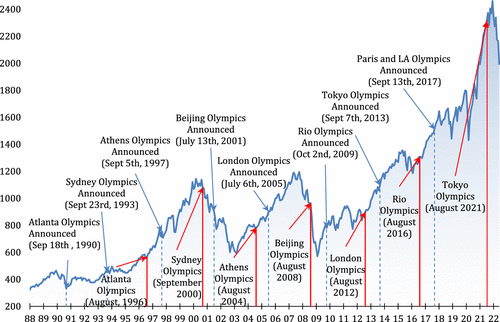
Notes. This figure presents the MSCI World Index, which captures large and midcap equity performance across 23 developed markets countries from January 1, 1988, until June 30, 2022. We include the winning bid announcement dates for nine summer Olympics (Atlanta, Sydney, Athens, Beijing, London, Rio, Tokyo, Paris, and Los Angeles) and the date of the games for the seven most recent games (Atlanta, August 1996; Sydney, September/October 2000; Athens, August 2004; Beijing, August 2008; London, July/August 2012; Rio, August 2016; and Tokyo, August 2021). The following five summer Olympics are included in our main sample: Australia (Sydney, 2000), Greece (Athens, 2004), China (Beijing, 2008), United Kingdom (London, 2012), and Brazil (Rio de Janeiro, 2016).
Figure 1 highlights that there are three major stock market expansions over this time period. The first peak is in mid-2000 and reflects the dot.com bubble. This bubble peaks around the time of the Sydney Olympic Games. When China learns it has won the Olympic bid in July 2001, markets are in a contraction period. The games in Athens are played as markets are rising, and by the time London learns of its winning bid (July 2005), markets have been rising for several years. The second peak in the MSCI is in mid-2007 and reflects the real estate boom. The Olympic Games are played in Beijing as markets are rapidly declining as the financial crisis begins to unfold.7 Markets have generally been rising since 2009 and were increasing at the time that the London games were held (July 2012). Markets have continued to rise after 2012. This figure highlights that the stock market situation during the Olympic period and at the time of the winning bid announcements are quite different for the five Olympics, mitigating the likelihood that any common results we document across the five countries are due to other market-wide trends.
Figure 2 provides descriptive evidence of the market response to the Olympic games for our main sample of the five most recent Summer Olympics. Panel (a) provides the average return for the Olympic stocks, propensity score matched non-Olympic stocks, and the market index in the host country to the announcement of the winning bid. Panel (a) indicates that the news of the winning bid is viewed positively by market participants. The firms that are expected to benefit from the Olympics have stronger 10-day returns (471 basis points) than the matched non-Olympic firms (287 basis points) or the market index (442 basis points).
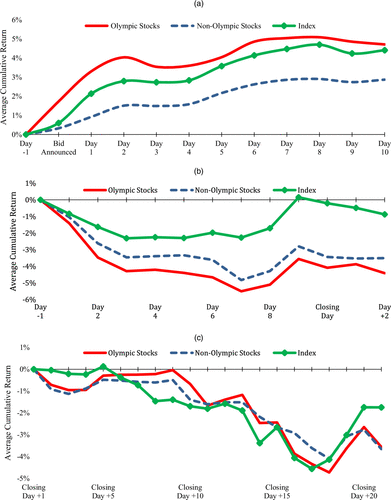
Notes. This figure presents the average cumulative raw returns for Olympic stocks, propensity score matched non-Olympic stocks, and market index for the five host countries included in our main Olympic sample during the three key Olympic event windows: (i) following the winning bid announcement (panel (a)), (ii) during the Olympic games (panel (b)), and (iii) following the Olympic games (panel (c)). We calculate the cumulative stock or index return for each event day for each host country and then report the average cumulative return across the host countries. The following five host countries (summer Olympics) included in the figure are Australia (Sydney, 2000), Greece (Athens, 2004), China (Beijing, 2008), the United Kingdom (London, 2012), and Brazil (Rio de Janeiro, 2016). The market indices for each Olympics are the ASX All Ordinaries (Sydney, 2000), ATHEX Composite (Athens, 2004), Shanghai A Share (Beijing, 2008), FTSE 100 (London, 2012), and BOVESPA (Rio, 2016). Details of the propensity score matching are provided in Table 1. See Appendix B for detailed variable definitions.
Panel (b) of Figure 2 provides the average stock market response during the two-week period when the games are played. There are negative returns of −442 basis points for the Olympic stocks, −351 basis points for the matched non-Olympic stocks, and −88 basis points for the stock market over the two-week window. For the market index, there is generally a slight negative return over the first week of the Olympic games, but the returns recover in the second week and end flat by the closing day of the Olympics. Panel (c) of Figure 2 provides the stock market response in the month after the games are played. The completion of the games is associated with negative returns for Olympic stocks (−356 basis points), non-Olympic stocks (−277 basis points), and the stock market (−175 basis points).
Figure 3(a) provides descriptive evidence on the differences in cumulative raw returns between Olympic and non-Olympic stocks across the five summer Olympics from three years before the winning bid announcement through to three years after the Olympics. Panel (b) represents the return results separately for each of the five summer Olympic Games plus preliminary results for the Tokyo Olympic Games. The cumulative returns for both Olympic and non-Olympic stocks are calculated as the monthly compounded raw returns. Panel (a) highlights that returns between Olympic and non-Olympic stocks are similar in the years leading up to the official winning bid announcement. After the Olympic bid announcement, Olympic stocks start to dramatically outperform their non-Olympic counterparts and continue to do so over the entire Olympic period despite a pullback in returns between years four and seven. The outperformance reaches a high of approximately 202% during the buildup to the Olympic Games but tails off to approximately a 117% by the time of the Olympics.8Figure 3 shows little evidence to suggest that this Olympic premium dissipates in the years following the Olympics, and whereas the returns continue to increase in the years after the Olympics for Olympic stocks relative to non-Olympic stocks, these increases are statistically insignificant. Additionally, the requirement that both the Olympic stock and its non-Olympic stock peer are publicly traded for the entire Olympic period mitigates concerns that the increases in returns for Olympic stocks are a consequence of survivorship bias.

Notes. This figure presents the difference in average cumulative raw returns between all Olympic and non-Olympic propensity score matched stocks. Cumulative returns for each stock are computed as the monthly compounded raw returns, starting in January three years before the Olympic announcements and ending three years after the Olympic Games. The cumulative returns are then averaged for all Olympic and non-Olympic stocks. Year 1 is the year of the winning bid announcement, and year 8 is the year of the Olympic games. The vertical line “Olympic Announcements” indicates the average month for the announcement of the Olympics (month 8 of year 1), and the vertical line “Olympic Games” shows the average month of the end of the Olympic games (month 8 of year 8). Panel (a) presents the combined results for the five most recent Olympics: Australia (Sydney, 2000), Greece (Athens, 2004), China (Beijing, 2008), the United Kingdom (London, 2012), and Brazil (Rio de Janeiro, 2016). The combined sample in panel (a) consists of 200 Olympic stocks and 200 non-Olympic stocks that were publicly traded during the Olympic winning bid announcement. Stars in panel (a) reflect statistically significant differences in cumulative returns (p < 0.10) between Olympic and non-Olympic cumulative stock returns using a two-tailed test on the means starting in January in the year of the bid announcement and ending three years after the Olympic games. Panel (b) presents the results separately for each country. The sample consists of Olympic stocks for each country and their non-Olympic propensity score matched stocks. Olympic stocks are the 30 Australian Olympic stocks (Sydney, 2000), the 34 Greek Olympic stocks (Athens, 2004), the 63 Chinese Olympic stocks (Beijing, 2008), the 59 British stocks (London, 2012), the 14 Brazilian stocks (Rio de Janeiro, 2016), and the 86 Japanese Olympic stocks (Tokyo 2020). We do not include the 86 Japanese Olympic stocks in panel (a) because we do not have data for three years after the games are played. See Appendix B for detailed variable definitions.
In Figure 3(b), we find that the outperformance of Olympic stocks during the Olympic period holds separately for four out of the five summer Olympic Games in our main sample. The London Olympics are the only games for which Olympic stock returns underperformed (by 103%) those of non-Olympic stocks.9 Panel (b) also includes preliminary return differences for the Tokyo Olympics that also illustrates the return outperformance of Olympic stocks during the Olympic period until just before it was announced that the games would be postponed because of the pandemic.
Table 2 provides a multivariate analysis of the differences in cumulative returns between Olympic and non-Olympic stocks during the Olympic period. We divide the Olympic window into the following subperiods: preannouncement years: a three-year window prior to the announcement of the winning bid; middle years: the years after the announcement of the winning bid until the year of the Olympic Games (approximately a seven-year window); Olympic years: the year of the Olympic Games; postgame years: a three-year window after the games are played. Table 2 confirms the inferences from Figures 2 and 3 and specifically illustrates that returns of Olympic stocks outperform those of non-Olympic stocks by 8% (p < 0.10) during the middle years and Olympic years, increasing to 14.6% (p < 0.10) when including the postgame years. In summary, the return findings highlight that investors are aware of the Olympics and appear to view the announcement of the Olympics as good news for the hosting country but then bad news once the Olympics is taking place and has passed. Additionally, these findings illustrate that our matched sample approach used in our main analyses could be dampening the economic magnitude of our main Olympic event–based grouping findings as it appears that the entire market, including the non-Olympic stocks, experience broader market effects from the anticipated benefits of the Olympics and that the effects are not just limited to Olympic stocks. The results further suggest that the valuation benefits to Olympic stocks do not reverse after the Olympic Games are played.
|
Table 2. Multivariate Analysis of Cumulative Returns During Olympic Periods
| Dependent variable | Predicted sign | Cumulative returns (1) | Cumulative returns (2) |
|---|---|---|---|
| Olympic | −0.135 | 0.020 | |
| (−1.33) | (0.29) | ||
| Middle, Olympic, and postgame years | 0.272** | ||
| (2.38) | |||
| Olympic × middle, Olympic, and postgame years | (+) | 0.146* | |
| (1.92) | |||
| Middle years and Olympic years | −0.051 | ||
| (−0.43) | |||
| Olympic × middle years and Olympic years | (+) | 0.080* | |
| (1.76) | |||
| Log of total assets average | 0.005 | −0.048 | |
| (0.07) | (−0.86) | ||
| Log of market cap average | −0.015 | 0.079 | |
| (−0.19) | (1.42) | ||
| Book-to-market average | −0.088** | −0.111*** | |
| (−2.07) | (−4.77) | ||
| Earnings-to-price average | 1.206*** | 0.768*** | |
| (6.19) | (6.28) | ||
| Return on assets average | 0.004 | 0.056 | |
| (0.07) | (1.12) | ||
| Cash flow from operations average | 2.026** | 1.101** | |
| (2.33) | (2.44) | ||
| Sales growth average | 0.218 | 0.200 | |
| (1.03) | (1.46) | ||
| Observations | 471 | 627 | |
| Unique firms | 400 | 400 | |
| R2 | 0.191 | 0.258 | |
| Country fixed effects | Yes | Yes | |
| Industry fixed effects | Yes | Yes |
Notes. This table presents the results of regressing cumulative returns for each period on indicators for the middle, Olympic, and postgame years and controls. The base period in column (1) is the three years prior to the winning bid announcement (preannouncement years). Middle, Olympic, and postgame years in column (1) are the 11 years after the Olympic announcement. Preannouncement years are the three years prior to the Olympic announcement. Middle years are the seven years after the Olympic announcement. Olympic year is the year of the Olympic Games. Postgame years are the three years after the Olympic games. The base period in column (2) is the three years prior to the winning bid announcement (preannouncement years) and the three years following the Olympics (postgame years). Middle years and Olympic years in column (2) are the eight years from the Olympic announcement to the end of the Olympic games. All controls are the average value per period. The two periods in column (1) are (1) the preannouncement years and (2) the middle, Olympic, and postgame years. The two periods in column (2) are (1) the preannouncement and postgame years and (2) the middle years and Olympic years. Log of total assets is the average value per period of the natural logarithm of total assets. Log of market cap. is the average value per period of the natural logarithm of market capitalization. Book-to-market is the average value per period of the book value of equity scaled by market value of equity. Earnings-to-price is net income as of the fiscal year-end scaled by the market value of equity as of the fiscal year-end. Return on assets is the average value per period of net income scaled by average assets. Cash flow from operations is the average value per period of cash flow from operations scaled by average assets. Sales growth is the average value per period of one-year change in sales. T-statistics in parenthesis and stars denote statistical significance from two-tailed tests. The sample consists of 200 Olympic and 200 non-Olympic stocks that were publicly traded during the Olympic winning bid announcement.
***, **, and * denote statistical significance at the 1%, 5%, and 10% levels, respectively.
4.2. Comovement of Returns During the Olympic Period
This section provides our tests examining whether Olympic stocks experience changes in comovement during the Olympic time period. Our first and main measure of comovement is the R2 from a regression of an individual Olympic firm i’s daily stock return on an index comprising the returns of all Olympic stocks (OlympicIndex) in each country k (except stock i):
If the greater media coverage of the Olympics and potential Olympic-benefiting stocks increases investor awareness of these stocks and this leads a subset of investors to group Olympic stocks together, then, for Olympic stocks, we expect to observe (i) an increase in R2 in the middle years and Olympic years relative to the preannouncement years and (ii) declines in the R2 in the postgame years relative to the Olympic years. This approach to evaluating event-based grouping is similar to Barberis et al. (2005), who evaluate changes in R2 for stocks entering and leaving the S&P500 index. We repeat this procedure with non-Olympic stocks in Model (1b) to serve as a benchmark and facilitate the difference-in-differences multivariate analyses:
Our second measure of comovement is based on the foregoing two regressions but analyzes changes in the magnitude of beta coefficients rather than the R2. We expect to observe (i) a positive increase in the coefficient on the Olympic firm betas relative to those of non-Olympic betas after the winning Olympic bid if Olympic stocks become more sensitive to price movements of the Olympic index. Note again, the R2 measure better reflects the spirit of comovement—the degree to which the stocks move together—rather than the magnitude of Olympic stocks’ movements relative to the Olympic index. In turn, we put more emphasis on the R2 than the betas from the foregoing regressions in our analyses.
The final comovement measure, Synchronicity, which we use in figures to complement our first comovement measure follows the procedure adopted by Morck et al. (2000), and it measures the maximum fraction of Olympic (or non-Olympic) stocks that move in the same direction over a given month in country k and is calculated as follows:
Table 3 provides multivariate analysis using the betas and R2 from Models (1a) and (1b) as the dependent variables in columns (1) and (2), respectively. The comovement regressions are estimate by firm on a daily basis for each year. These yearly comovement variables are then included in the annual multivariate regressions. In the spirit of Drake et al. (2017), the firm-specific betas and adjusted R2 for Olympic and non-Olympic stocks obtained for each of the Olympic time periods are regressed on an indicator (Olympic) equal to one for Olympic stocks and indicators for the different Olympic periods: middle, Olympic, and postgame years. We also include controls for firm characteristics (total assets, market capitalization, book-to-market, earnings-to-price, ROA, CFO, and sales growth) and fixed effects (country, year, and industry). The key variables of interest are the interactions between Olympic and the different time periods.
|
Table 3. Multivariate Analysis of Comovement During Olympic Periods
| Dependent variable | Predicted sign | Comovement | |
|---|---|---|---|
| BetaModel1 (1) | R2Model1 (2) | ||
| Olympic | −0.029 | 0.011 | |
| (−0.44) | (1.03) | ||
| Middle years | −0.022 | 0.123*** | |
| (−0.37) | (8.82) | ||
| Olympic years | −0.076 | 0.135*** | |
| (−0.93) | (6.53) | ||
| Postgame years | −0.118 | 0.151*** | |
| (−1.34) | (6.33) | ||
| Olympic × middle years | (+) | 0.023 | 0.005* |
| (0.35) | (1.67) | ||
| Olympic × Olympic years | (+) | 0.051 | 0.029** |
| (0.69) | (2.01) | ||
| Olympic × postgame years | (−) | 0.040 | 0.001 |
| (0.58) | (0.08) | ||
| Log of total assets | 0.021 | 0.004 | |
| (1.31) | (0.92) | ||
| Log of market cap | 0.098*** | 0.036*** | |
| (5.34) | (6.61) | ||
| Book-to-market | 0.027*** | 0.019*** | |
| (3.83) | (8.33) | ||
| Earnings-to-price | −0.116*** | −0.003 | |
| (−5.14) | (−0.51) | ||
| Return on assets | −0.059*** | −0.009** | |
| (−4.47) | (−2.03) | ||
| Cash flow from operations | −0.411*** | −0.114*** | |
| (−4.07) | (−3.44) | ||
| Sales growth | 0.075*** | 0.004 | |
| (3.53) | (0.84) | ||
| Observations | 3,187 | 3,491 | |
| Unique firms | 400 | 400 | |
| R2 | 0.352 | 0.702 | |
| Country fixed effects | Yes | Yes | |
| Year fixed effects | Yes | Yes | |
| Industry fixed effects | Yes | Yes | |
Notes. This table presents the results of regressing the betas (column (1)) and adjusted R2 (column (2)) from Models (1a) and (1b) on an indicator for Olympic or non-Olympic stocks (Olympic) and indicators for the different Olympic periods: middle years (middle years), Olympic years (Olympic years), and postgame (postgame years). Olympic is equal to one if firm i is an Olympic sponsor or is mentioned in the local media that will benefit from the Olympics and zero otherwise. The base period in columns (1) and (2) is the preannouncement period (the three years before the announcement of the Olympic Games). Preannouncement years are the three years prior to the Olympic announcement. Middle years are the seven years after the Olympic announcement. Olympic year is the year of the Olympic Games. Postgame years are the three years after the Olympic games. The betas and adjusted R2 for the Olympic stocks are obtained from the model: Olympic Stock Returni,t,k = α0 + βiOlympic Indext,k + εi,t,k (1a). Olympic Stock Returni,t,k is the daily return for each Olympic stock in country k. Olympic Indext,k is the average of the daily returns of all Olympic firms in each country k excluding firm i. The betas and adjusted R2 for the non-Olympic stocks are obtained from the model: Non-Olympic Stock Returni,t,k = α0 + βiNon-Olympic Indext,k + εi,t,k (1b). Non-Olympic Stock Returni,t,k is the daily return for each non-Olympic stock in country k. Non-Olympic Indext,k is the average of the daily returns of all non-Olympic firms in each country k excluding firm i. Log of total assets is the natural logarithm of total assets. Log of market cap is the natural logarithm of market capitalization. Book-to-market is the book value of equity scaled by market value of equity. Earnings-to-price is net income as of the fiscal year-end scaled by the market value of equity as of the fiscal year-end. Return on assets is net income scaled by average assets. Cash flow from operations is the cash flow from operations scaled by average assets. Sales growth is the one-year change in sales. The sample consists of 200 Olympic stocks and 200 non-Olympic stocks that were publicly traded during the Olympic winning bid announcement. All continuous variables are winsorized at 1% and 99%. T-statistics in parenthesis and stars denote statistical significance from two-tailed tests. See Appendix B for detailed variable definitions.
***, **, and * denote statistical significance at the 1%, 5%, and 10% levels, respectively.
In column (1), all of the interactions between Olympic and the different time periods are insignificant at conventional levels when the betas from Models (1a) and (1b) are used as the dependent variables. Hence, we do not find evidence suggesting that the betas of Olympic firms increase relative to the respective betas of non-Olympic firms, suggesting that the relative magnitudes of the movements within each group do not differ during the Olympic windows. In column (2), there are positive and significant coefficients on Olympic × Middle Years and Olympic × Olympic Years of 0.005 (p < 0.10) and 0.029 (p < 0.05), respectively. This result confirms that Olympic firms have significant increases in comovement relative to non-Olympic firms between the winning bid announcement and the year-end of the Olympic year. Column (2) also illustrates that the heightened comovement among Olympic stocks decline in the postgame years as the coefficient on Olympic × Post-Game Years is insignificant.
Figure 4 provides graphic representations of the changes in comovement of Olympic stocks. For each firm, for each month, we perform Regression (1) using daily stock returns for the prior year; we then calculate the average R2 and move forward one month and repeat the procedure. This methodology gives us monthly average measures of comovement, and we then plot these averages on the graph. We follow the same procedure with the Synchronicity measure described. Both the R2 and synchronicity measures in Figure 4 reiterate Table 3’s inferences, illustrating a clear increase in comovement for Olympic stocks after the winning bid is announced, which is largely sustained despite some oscillation until the Olympic Games. However, consistent with the event-based grouping hypothesis, we find a complete reversal in the R2 measure and a slight reversal in the synchronicity measure. Hence, we document that Olympic stocks have increases in comovement after the winning bid is announced and declines in comovement after the games are played. These results are consistent with P1 and P2 and suggest that investors use the Olympics as a temporary event-based grouping for investment.
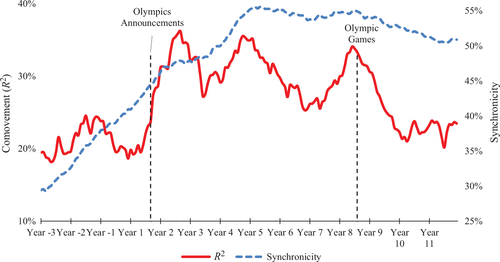
Notes. The figure presents monthly rolling comovement (measured as adjusted R2) and synchronicity of Olympic stocks from three years before the winning bid announcement to three years after the Olympic Games. This figure present results for all five Olympics: Australia (Sydney, 2000), Greece (Athens, 2004), China (Beijing, 2008), United Kingdom (London, 2012), and Brazil (Rio de Janeiro, 2016). At the end of each month, we calculate the average adjusted R2 of Olympic firm–specific regressions of daily returns on an Olympic index: Model (1a): Olympic Stock Returni,tk = α0 + βiOlympic Indext,k + εi,t,k, using daily returns over the preceding year. The daily Olympic stock index returns are the average of the daily returns of all Olympic firms excluding firm i. Each day, we calculate the percentage of Olympic stocks with returns that are positive, negative, or zero, and we determine the maximum percentage for the day. Synchronicity is calculated as the average maximum percentage over the month. The graph reports the one-year monthly moving average of Synchronicity. Year 1 is the year of the winning bid announcement, and year 8 is the year of the Olympic Games. The vertical line “Olympic Announcements” indicates the average month for the announcement of the Olympics (month 8 of year 1), and the vertical line “Olympic Games” shows the average month of the end of the Olympic games (month 8 of year 8). The combined sample consists of 200 Olympic stocks and 200 non-Olympic stocks that were publicly traded during the Olympic winning bid announcement. Details of the propensity score matching are provided in Table 1. See Appendix B for detailed variable definitions.
4.3. Media Stories and Investor Responsiveness
We predict that investors use media outlets to identify and buy Olympic stocks, and this has comovement and valuation implications. In this section, we directly investigate whether news stories that link the Olympics to a firm result in an investor response for that firm. Such evidence provides corroborative evidence in support of our hypotheses. For ease of exposition and to reduce the number of tests reported, we provide results using comovements measured using the R2 from Model (1). In Table 4, we first report multivariate evidence of the average number of local media mentions containing the words “Olympic” or “Olympics” for both Olympic and non-Olympic stocks for each of the four main Olympic windows. Following the structure of Table 3, Table 4 regresses firm-specific Olympic media mentions on an indicator (Olympic) equal to one for Olympic stocks and indicators for the different Olympic periods: middle, Olympic, and postgame years. Again, the key variables of interest are the interactions between Olympic and the different time periods. Table 4, column (1), shows that both Olympic and non-Olympic firms have significant increases in Olympic media mentions following the winning bid announcement with a higher level of media coverage for Olympic firms given the positive coefficients of 0.296 (p < 0.01) and 0.086 (p < 0.10) on Middle Years and Olympic Years and Olympic × Middle Years, Olympic Years, respectively. Column (2) confirms that the media peak for Olympic stocks occurs in the Olympic year, but abnormal media coverage continues even after the Olympic Games relative to non-Olympic firms as evidenced by the coefficients of 0.228 (p < 0.05), 0.265 (p < 0.10), and 0.245 (p < 0.10) on Olympic × Middle Years, Olympic × Olympic Years, and Olympic × Post-Game Years, respectively. Figure 5 illustrates the same pattern of the run-up in Olympic media articles in the buildup to the Olympics and then the significant fall after the games are complete.
|
Table 4. Multivariate Analysis of Olympic Media Mentions During Olympic Periods
| Dependent variable | Predicted sign | Media mentions | |
|---|---|---|---|
| Log media mentions (1) | Log media mentions (2) | ||
| Olympic | 0.333*** | 0.184 | |
| (3.51) | (1.60) | ||
| Middle years and Olympic years | 0.296*** | ||
| (6.25) | |||
| Olympic × middle years and Olympic years | (+) | 0.086* | |
| (1.72) | |||
| Middle years | 0.062 | ||
| (0.69) | |||
| Olympic years | −0.139 | ||
| (−0.94) | |||
| Postgame years | −0.496*** | ||
| (−2.88) | |||
| Olympic × middle years | (+) | 0.228** | |
| (2.23) | |||
| Olympic × Olympic years | (+) | 0.265* | |
| (1.86) | |||
| Olympic × postgame years | (−) | 0.245* | |
| (1.87) | |||
| Log of total assets | 0.183*** | 0.175*** | |
| (3.68) | (3.42) | ||
| Log of market cap | 0.098* | 0.107** | |
| (1.90) | (2.01) | ||
| Book-to-market | −0.000 | −0.008 | |
| (−0.03) | (−0.56) | ||
| Earnings-to-price | −0.116*** | −0.113*** | |
| (−3.56) | (−3.50) | ||
| Return on assets | 0.047* | 0.042 | |
| (1.82) | (1.60) | ||
| Cash flow from operations | −0.007 | −0.017 | |
| (−0.02) | (−0.05) | ||
| Sales growth | 0.076** | 0.074** | |
| (2.18) | (2.14) | ||
| Observations | 3,433 | 3,433 | |
| Unique firms | 388 | 388 | |
| R2 | 0.518 | 0.541 | |
| Country fixed effects | Yes | Yes | |
| Year fixed effects | Yes | Yes | |
| Industry fixed effects | Yes | Yes | |
Notes. This table reports the results of regressing the log of the number of media mentions on an indicator for Olympic or non-Olympic stocks (Olympic) and indicators for the different Olympic periods: middle years (middle years), Olympic years (Olympic years), and postgame (postgame years). Media mentions for each firm are obtained from Factiva and are the number of media articles during the calendar year in the local news sources for each firm that include the words “Olympic” or “Olympics.” Olympic is equal to one if firm i is an Olympic sponsor or is mentioned in the local media that will benefit from the Olympics and zero otherwise. The base period in column (1) is the preannouncement period (the three years before the announcement of the Olympic Games) and the postgame years (the three years after the announcement of the Olympic Games). Middle years and Olympic years in column (1) are the eight years from the Olympic announcement to the end of the Olympic games. The base period in column (2) is the preannouncement period (the three years before the announcement of the Olympic Games). Preannouncement years are the three years prior to the Olympic announcement. Middle years are the seven years after the Olympic announcement. Olympic year is the year of the Olympic games. Postgame years are the three years after the Olympic Games. Log media mentions is the natural log of (1 + the number of Factiva media mentions). Log of total assets is the natural logarithm of total assets. Log of market cap is the natural logarithm of market capitalization. Book-to-market is the book value of equity scaled by market value of equity. Earnings-to-price is net income as of the fiscal year-end scaled by the market value of equity as of the fiscal year-end. Return on assets is net income scaled by average assets. Cash flow from operations is the cash flow from operations scaled by average assets. Sales growth is the one-year change in sales. The sample consists of 194 Olympic stocks and 194 non-Olympic stocks that were publicly traded during the Olympic winning bid announcement. All continuous variables are winsorized at 1% and 99%. T-statistics in parenthesis and stars denote statistical significance from two-tailed tests. Six Olympic and their corresponding six non-Olympic stocks dropped from the full sample because of Factiva data restrictions. See Appendix B for detailed variable definitions.
***, **, and * denote statistical significance at the 1%, 5%, and 10% levels, respectively.
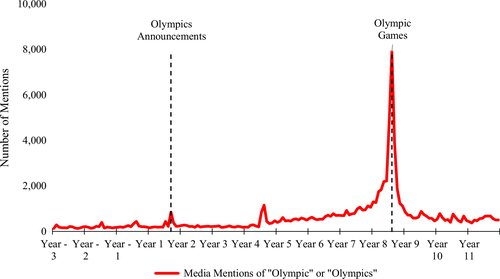
Notes. This figure presents monthly results for the number of media mentions for the words “Olympic” or “Olympics” in the main media source for each country from three years before the winning bid announcement to three years after the Olympic Games. (see Table 1, panel A, for the Olympics start and end dates). We count the number of mentions of the words “Olympic” or “Olympics” in the most popular local media in each country hosting the Olympics using Factiva. We include the Australian in English for the Sydney 2000 Olympics, Athens News Agency in English for the Athens 2004 Olympics, China News Service in Chinese for the Beijing 2008 Olympics, The Times in English for the London 2012 Olympics, and O Globo in Portuguese for the Rio 2016 Olympics. Year 1 is the year of the announcement and year 8 is the year of the Olympic Games. The vertical line “Olympic Announcements” indicates the average month for the announcement of the Olympics (month 8 of year 1), and the vertical line “Olympic Games” shows the average month of the end of the Olympic games (month 8 of year 8).
Table 5 reports multivariate regressions of abnormal volumes and abnormal return volatility at the winning bid announcement dates, initial Olympic stock classification dates by media, and during the Olympic Games. It illustrates that, relative to non-Olympic firms, Olympic firms have significant increases in volume and return volatility of 42.7% (p < 0.01) and 56.2% (p < 0.10), respectively, on the winning bid announcement days in panel A and of 16.7 (p < 0.01) and 70.3 (p < 0.10), respectively, on days on which firms are first categorized as an Olympic stock by the media or social media in panel B. The coefficients on Olympic are insignificant in panel C, suggesting that Olympic firms do not experience an increase in volume or return volatility during the actual Olympic Games. The lack of volume and volatility movements during the actual Olympic Games could be driven by the fact that the Olympic hype for investors has potentially passed. Together, these findings support the notion that media attention at the bid announcement as well as firm-specific Olympic media event–based groupings have significant pricing and valuation effects.
|
Table 5. Abnormal Volume and Abnormal Returns
| Dependent variable | Predicted sign | Abnormal volume and abnormal return volatility | |
|---|---|---|---|
| Abnormal volume (1) | U-statistic (2) | ||
| Panel A: Abnormal volume and abnormal return volatility at the Olympic winning bid announcement dates | |||
| Olympic | (+) | 0.427*** | 0.562* |
| (4.58) | (1.76) | ||
| Log of total assets | 0.165** | −0.115 | |
| (2.39) | (−0.30) | ||
| Return on assets | −0.010 | 0.088* | |
| (−1.29) | (1.93) | ||
| Log of market cap | −0.057 | −0.435 | |
| (−0.71) | (−0.99) | ||
| Observations | 960 | 978 | |
| Unique firms | 320 | 326 | |
| R2 | 0.088 | 0.052 | |
| Country fixed effects | Yes | Yes | |
| Industry fixed effects | Yes | Yes | |
| Panel B: Abnormal volume and abnormal return volatility at the initial Olympic stock classification dates by media | |||
| Olympic | (+) | 0.167*** | 0.703* |
| (3.26) | (1.74) | ||
| Log of total assets | 0.155*** | 0.109 | |
| (4.18) | (0.38) | ||
| Return on assets | 0.012** | −0.001 | |
| (2.52) | (−0.04) | ||
| Log of market cap | −0.179*** | −0.245 | |
| (−4.28) | (−0.76) | ||
| Observations | 910 | 946 | |
| Unique firms | 308 | 320 | |
| R2 | 0.146 | 0.031 | |
| Country fixed effects | Yes | Yes | |
| Industry fixed effects | Yes | Yes | |
| Panel C: Abnormal volume and abnormal return volatility during the Olympic games | |||
| Olympic | (+) | −0.061 | 0.213 |
| (−1.39) | (0.81) | ||
| Log of total assets | −0.051* | 0.071 | |
| (−1.82) | (0.43) | ||
| Return on assets | −0.003 | −0.002 | |
| (−0.61) | (−0.06) | ||
| Log of market cap | 0.076** | 0.072 | |
| (2.58) | (0.41) | ||
| Observations | 846 | 872 | |
| Unique firms | 282 | 290 | |
| R2 | 0.141 | 0.085 | |
| Country fixed effects | Yes | Yes | |
| Industry fixed effects | Yes | Yes | |
Notes. This table presents descriptive results for abnormal volume and abnormal returns at the winning bid announcement dates, initial Olympic stock classification dates by the media, and during the Olympic Games. Panel A presents the results for abnormal volume and abnormal volatility at the Olympic bid announcement dates. Panel B presents the results for abnormal volume and abnormal volatility at the initial Olympic stock classification dates by media. Panel C presents the results for abnormal volume and abnormal volatility during the Olympic games. Abnormal volume is defined as the average volume at the event period (day −1, day +1) minus the average volume in the nonevent period and divided by standard deviation of volume in the nonevent period. The event periods are either the Olympics announcement date, the media mention date, or the Olympic Games dates. The nonevent or estimation period is defined as the period from 130 to 10 days prior to the event and days 10 to 130 days after the event. U-statistic is calculated by dividing the squared residual returns by the variance of the residual returns following Beaver (1968). We estimate the market model with daily stock returns in the nonevent or estimation period, obtain estimates of the intercept and slope coefficient, ai and bi, and calculate the residual returns and variance. Log of total assets is the natural logarithm of total assets. Return on assets is net income scaled by average assets. Log of market cap is the natural logarithm of market capitalization. T-statistics in parenthesis and stars denote statistical significance from two-tailed tests when we do not have directional predictions and one-tailed tests for directional predictions. See Appendix B for detailed variable definitions.
***, **, and * denote statistical significance at the 1%, 5%, and 10% levels, respectively.
Table 6 provides multivariate analysis to investigate whether comovements increase with media mentions. Note that we have firm-specific R2 for both Olympic and non-Olympic firms for two periods. Therefore, each firm has two R2 observations. The first period is the middle and Olympic years. The base period is the three years prior to the winning bid announcement (preannouncement years) and the three years following the Olympics (postgame years). Column (1) regresses the comovement measure from Model (1) on Log Media Mentions and control variables. We find a positive and significant coefficient on Log Media Mentions indicating that overall firm-specific Olympic media mentions increases comovements within Olympic and non-Olympic stocks. Column (2) investigates whether there is a stronger relation during the Olympic time period (Middle Years and Olympic Years) and for Olympic firms (Olympic). We find a positive and significant coefficient (p < 0.05) on the three-way interaction (Olympic × Middle Years and Olympic Years × Log Media Mentions), consistent with our expectations. Overall, the findings in Tables 4–6 support the idea that investors are purchasing Olympic stocks based on the media coverage and the associated Olympic-valuation benefit story and media is a key mechanism driving the event-based grouping of Olympic stocks.
|
Table 6. Multivariate Analysis of Comovement and Media Mentions
| Dependent variable | Predicted sign | Comovement | |
|---|---|---|---|
| R2Model1 (1) | R2Model1 (2) | ||
| Olympic | 0.023** | ||
| (2.39) | |||
| Middle years and Olympic years | 0.061*** | ||
| (6.83) | |||
| Olympic × middle years and Olympic years | −0.009 | ||
| (−0.85) | |||
| Log media mentions | (+) | 0.002** | 0.004** |
| (1.98) | (1.79) | ||
| Olympic × log media mentions | −0.010 | ||
| (1.22) | |||
| Olympic years × log media mentions | −0.012 | ||
| (1.17) | |||
| Olympic × middle years and Olympic years × Log media mentions | (+) | 0.017** | |
| (2.53) | |||
| Log of total assets | 0.001 | 0.001 | |
| (0.18) | (0.11) | ||
| Log of market cap | 0.040*** | 0.042*** | |
| (7.59) | (7.65) | ||
| Book-to-market | 0.018*** | 0.017*** | |
| (7.90) | (7.65) | ||
| Earnings-to-price | −0.001 | −0.002 | |
| (−0.19) | (−0.41) | ||
| Return on assets | −0.010** | −0.009** | |
| (−2.33) | (−2.11) | ||
| Cash flow from operations | −0.129*** | −0.132*** | |
| (−3.82) | (−3.94) | ||
| Sales growth | 0.002 | 0.002 | |
| (0.39) | (0.41) | ||
| Observations | 3,433 | 3,433 | |
| Unique firms | 388 | 388 | |
| R2 | 0.685 | 0.696 | |
| Country fixed effects | Yes | Yes | |
| Year fixed effects | Yes | Yes | |
| Industry fixed effects | Yes | Yes | |
Notes. This table reports the results of regressing adjusted R2 from Model (1) on the number of media mentions and indicators for the middle years and Olympic years. Middle years and Olympic years are the eight years from the Olympic announcement to the end of the Olympic games. The base period is the three years prior to the winning bid announcement (preannouncement years) and the three years following the Olympics (postgame years). Preannouncement years are the three years prior to the Olympic announcement. Middle years are the seven years after the Olympic announcement. Olympic year is the year of the Olympic Games. Postgame years are the three years after the Olympic Games. Adjusted R2 for the Olympic stocks are obtained from Model (1a): Olympic Stock Returni,t,k = α0 + βiOlympic Indext,k + εi,t,k (1a). Olympic Stock Returni,t,k is the daily return for each Olympic stock in country k. Olympic Indext,k is the average of the daily returns of all Olympic firms in each country k excluding firm i. Adjusted R2 for the non-Olympic stocks are obtained from Model (1b): Non-Olympic Stock Returni,t,k = α0 + βiNon-Olympic Indext,k + εi,t,k (1b). Non-Olympic Stock Returni,t,k is the daily return for each non-Olympic stock in country k. Non-Olympic Indext,k is the average of the daily returns of all non-Olympic firms in each country k excluding firm i. Media mentions are the number of media articles in Factiva during the calendar year in the local news sources for each firm that include the words “Olympic” or “Olympics.” We search only local news sources and in the local language to increase the likelihood that these media outlets are read by domestic investors. Log media mentions is the natural log of (1 + the number of Factiva media mentions). Log of total assets is the natural logarithm of total assets. Log of market cap is the natural logarithm of market capitalization. Book-to-market is the book value of equity scaled by market value of equity. Earnings-to-price is net income as of the fiscal year-end scaled by the market value of equity as of the fiscal year-end. Return on assets is net income scaled by average assets. Cash flow from operations is the cash flow from operations scaled by average assets. Sales growth is the one-year change in sales. The sample consists of 194 Olympic stocks and 194 non-Olympic stocks that were publicly traded during the Olympic winning bid announcement. All continuous variables are winsorized at 1% and 99%. T-statistics in parenthesis and stars denote statistical significance from two-tailed tests when we do not have directional predictions and one-tailed tests for directional predictions. See Appendix B for detailed variable definitions.
***, **, and * denote statistical significance at the 1%, 5%, and 10% levels, respectively.
4.4. Fundamental Performance of Olympic Stocks
The Olympic Games last for two weeks, and so tourist flow is likely to be abnormally high in the months surrounding the Olympics. This increased tourist flow suggests that firms in the hospitality industries exhibit a transitory boost to revenues or cash flows for one or two quarters around the Olympic Games. In contrast, firms in the construction industry could exhibit more general increases in profits as construction income and revenues are earned over the middle years. In this section, we investigate whether the Olympic event–based grouping is justified by changes in fundamentals. Specifically, we ask two questions: Are fundamental benefits of the Olympics sufficiently large to be detectable in the data? And do we observe increases in comovements of fundamentals among Olympic stocks?
4.4.1. Fundamental Benefits of the Olympics.
Table 7 examines whether fundamentals are unusual for Olympic stocks over the Olympic time period. In Table 7, we regress annual return on equity (column (1)), revenues scaled by equity (column (2)), and cash flow from operations scaled by equity (column (3)) on indicators for Olympic and non-Olympic stocks and different Olympic time periods (Middle and Olympic Years and Post-Game Years) plus controls and fixed effects. As Table 7 combines middle and Olympic years into one indicator, the base periods are the preannouncement years and the postgame years. We use annual data because quarterly or semiannual data are not readily available in the preannouncement years and some middle years for the Sydney 2000, Athens 2004, and Beijing 2008 Olympics.10
|
Table 7. Difference in Annual Fundamentals Between Olympic and Non-Olympic Stocks
| Dependent variable | Predicted sign | Annual fundamentals | ||
|---|---|---|---|---|
| ROE (1) | Revenue_E (2) | CFO_E (3) | ||
| Olympic | −0.024 | 0.170 | 0.007 | |
| (−0.86) | (0.81) | (0.23) | ||
| Middle years and Olympic years | −0.003 | −0.117 | −0.024 | |
| (−0.09) | (−0.86) | (−0.72) | ||
| Olympic × middle years and Olympic years | (+) | 0.016 | −0.066 | −0.015 |
| (0.53) | (−0.42) | (−0.55) | ||
| Assets_E | −0.008 | 0.310*** | 0.016* | |
| (−1.35) | (4.11) | (1.79) | ||
| Log of market cap. | 0.033*** | −0.329*** | −0.000 | |
| (3.32) | (−3.83) | (−0.03) | ||
| Book-to-market | −0.018** | 0.008 | 0.012** | |
| (−2.41) | (0.39) | (2.01) | ||
| ROE | 0.977** | 0.525*** | ||
| (2.07) | (5.09) | |||
| ROE lag | 0.139*** | |||
| (3.28) | ||||
| CFO_E | 0.332*** | 1.288** | ||
| (3.81) | (2.55) | |||
| CFO_E lag | 0.180** | |||
| (2.04) | ||||
| Revenue_E | 0.024*** | 0.029*** | ||
| (3.79) | (2.85) | |||
| Revenue_E lag | 0.464*** | |||
| (4.55) | ||||
| Observations | 3,052 | 3,052 | 3,052 | |
| Unique firms | 400 | 400 | 400 | |
| R2 | 0.395 | 0.655 | 0.453 | |
| Country fixed effects | Yes | Yes | Yes | |
| Year fixed effects | Yes | Yes | Yes | |
| Industry fixed effects | Yes | Yes | Yes | |
Notes. This table reports the results of regressing the annual ROE, Revenue_E, and CFO_E on indicators for the middle years and Olympic years and postgame years and controls. Middle years and Olympic years are the eight years from the Olympic announcement to the end of the Olympic Games. The base period is the three years prior to the winning bid announcement (preannouncement years) and the three years following the Olympics (postgame years). Postgame years are the three years after the Olympic Games. Assets_E is the one-year of annual assets divided by book value of equity. ROE is the annual net income divided by average book value of equity. Revenue_E is the annual revenue divided by average book value of equity. CFO_E is the cash flow from operations scaled by equity. Log of market cap. is the natural logarithm of market capitalization. Book-to-market is the book value of equity scaled by market value of equity. The sample consists of 200 Olympic stocks and 200 non-Olympic stocks that were publicly traded during the Olympic winning bid announcement. All continuous variables are winsorized at 1% and 99%. T-statistics in parenthesis and stars denote statistical significance from two-tailed tests when we do not have directional predictions and one-tailed tests for directional predictions. See Appendix B for detailed variable definitions.
***, **, and * denote statistical significance at the 1%, 5%, and 10% levels, respectively.
P3 predicts that Olympic firms have positive fundamentals during the middle and/or Olympic years. However, we do not find evidence that Olympic stocks experience abnormal performance during the run-up to the Olympics or in the Olympic years relative to non-Olympic stocks as the coefficients on Olympic × Middle Years and Olympic Years are not significant in any of the specifications. In untabulated analyses, we document that Olympic sponsors also do not appear to have unusual increases in fundamental performance when we run the analyses separately for Olympic sponsors. The lack of abnormal profitability suggests that there may be other motivations driving the sponsorship, such as maintaining brand recognition, or nonpecuniary benefits to employees or top executives. In summary, the results in Table 7 do not support P3 because we do not identify unusual improvements in fundamentals for Olympic firms over the Olympic time period.
It is possible that Olympic stocks experience boosts to earnings and revenues at different points in time during the Olympic time period, and the longer windows used in Table 7 are not strong enough to isolate any differences in performance. In untabulated analyses for the London and Rio Olympics, for which we have interim financial data for the entire Olympic window, we examine whether Olympic stocks relative to non-Olympic stocks have abnormal earnings, revenues, and cash flow from operations in interim periods from the winning bid announcement up until the Olympic year. We find no evidence of abnormal performance for Olympic stocks, even for the discrete interim periods in the buildup to the Olympics. In summary, we are unable to reject the null for P3 of no abnormal profitability for Olympic stocks. This lack of results is relevant because it casts doubt on the story presented by the media that Olympic stocks earn unusual profits in the country hosting the Olympics.
4.4.2. Comovement of Fundamentals.
Our next test examines whether Olympic stocks have fundamentals that comove with each other and whether this could explain the increases in the return comovement that we document. Table 8 provides regressions of fundamental comovements, calculated in Models (3a) and (3b) on indicators for Olympic stocks, middle years, and Olympic years and interactions between the two variables:
|
Table 8. Comovements of Fundamentals for London and Rio
| Panel A: Comovements of fundamentals for the London 2012 Olympics | ||||
|---|---|---|---|---|
| Dependent variable | Predicted sign | London 2012 Olympics | ||
| R2ROA (1) | R2Revenue (2) | R2CFO (3) | ||
| Olympic | −0.045 | 0.155*** | −0.068 | |
| (−1.07) | (3.02) | (−1.54) | ||
| Middle years and Olympic years | 0.084* | −0.138*** | 0.037 | |
| (1.69) | (−2.87) | (1.08) | ||
| Olympic × middle years and Olympic years | (+) | 0.070 | −0.077 | −0.093 |
| (0.96) | (−1.15) | (−1.26) | ||
| Log of total assets average | −0.003 | 0.024 | 0.008 | |
| (−0.12) | (0.76) | (0.30) | ||
| Log of market cap average | 0.013 | −0.000 | 0.001 | |
| (0.51) | (−0.00) | (0.03) | ||
| Return on assets average | −0.037 | −0.125 | −0.350 | |
| (−0.08) | (−0.30) | (−0.77) | ||
| Cash flow from operations average | −0.751 | −0.454 | 0.443 | |
| (−1.10) | (−0.70) | (0.56) | ||
| Revenue average | −0.130* | 0.127* | 0.004 | |
| (−1.97) | (1.71) | (0.04) | ||
| Observations | 224 | 224 | 56 | |
| Unique firms | 116 | 116 | 116 | |
| R2 | 0.158 | 0.251 | 0.340 | |
| Industry fixed effects | Yes | Yes | Yes | |
| Panel B: Comovements of fundamentals for the Rio de Janeiro 2016 Olympics | ||||
|---|---|---|---|---|
| Dependent variable | Predicted sign | Rio 2016 Olympics | ||
| R2ROA (1) | R2Revenue (2) | R2CFO (3) | ||
| Olympic | 0.234* | 0.009 | −0.027 | |
| (1.75) | (0.08) | (−0.35) | ||
| Middle and Olympic years | 0.111 | −0.084 | −0.089 | |
| (0.97) | (−0.54) | (−1.35) | ||
| Olympic × middle and Olympic years | (+) | −0.157 | −0.031 | 0.067 |
| (−0.77) | (−0.15) | (0.64) | ||
| Log of total assets average | 0.021 | −0.006 | −0.005 | |
| (0.30) | (−0.10) | (−0.10) | ||
| Log of market cap average | −0.007 | 0.030 | −0.015 | |
| (−0.09) | (0.35) | (−0.31) | ||
| Return on assets average | −0.174 | −0.901 | 0.059 | |
| (−0.21) | (−1.26) | (0.12) | ||
| Cash flow from operations average | 1.477 | 2.846 | 2.559 | |
| (0.36) | (1.02) | (1.59) | ||
| Revenue average | −1.004** | 0.459 | −0.312 | |
| (−2.20) | (1.51) | (−1.27) | ||
| Observations | 56 | 56 | 56 | |
| Unique firms | 28 | 28 | 28 | |
| R2 | 0.344 | 0.231 | 0.196 | |
| Industry fixed effects | Yes | Yes | Yes | |
Notes. This table presents regressions of fundamental comovement (R2ROA, R2Revenue, and R2CFO for each period) for the London and Rio Olympics on indicators for the middle and Olympic years, postgame years, and controls. Panel A presents results for the London 2012 Olympics using semiannual data. Panel B presents results for the Rio 2016 Olympics using quarterly data. The base period is the six semiannual periods (12 quarters) prior to the winning bid announcement (preannouncement years). Middle years and Olympic years are the 16 semiannual periods (32 quarters) from the Olympic announcement to the end of the Olympic Games. Postgame years are the six semiannual periods (12 quarters) after the Olympic Games. Log of total assets is the average value per period of the natural logarithm of the semiannual (quarterly) total assets. Log of market cap. is the average value per period of the natural logarithm of semiannual (quarterly) market capitalization. Return on assets is the average value per period of the semiannual (quarterly) net income scaled by the semiannual (quarterly) average assets. Cash flow from operations is the average value per period of the semiannual (quarterly) cash flow from operations scaled by the semiannual (quarterly) average assets. Revenue is the average value per period of the semiannual (quarterly) sales scaled by the semiannual (quarterly) average assets. The measures of fundamental comovement for panels A and B are the adjusted R2 obtained from Models (3a) and (3b) in which we regress the Olympic (non-Olympic) fundamental return (ROA, revenue, and CFO) on an Olympic (non-Olympic) fundamental index. Adjusted R2 for the Olympic stocks are obtained from the model: Olympic Fundamental Returni,t,k = α0 + βiOlympic Fundamental Indext,k + εi,t,k (3a). Olympic Fundamental Returni,t,k is either the semiannual (quarterly) return on assets, or revenues scaled by average assets, or cash flow from operations scaled by average assets in country k for each Olympic stock in country k. Olympic Fundamental Indext,k is either the average of the semiannual (quarterly) return on assets, or revenues scaled by average assets, or cash flow from operations scaled by average assets of all Olympic firms in each country k excluding firm i. Adjusted R2 for the non-Olympic stocks are obtained from the model: Non-Olympic Fundamental Returni,t,k = α0 + βiNon-Olympic Fundamental Indext,k + εi,t,k (3b). Non-Olympic Fundamental Returni,t,k is the daily return for each non-Olympic stock in country k. Non-Olympic Fundamental Indext, is either the average of the semiannual (quarterly) return on assets, or revenues scaled by average assets, or cash flow from operations scaled by average assets of all non-Olympic firms in each country k excluding firm i. The London sample in panel A consists of 58 Olympic and 58 non-Olympic stocks that were publicly traded during the Olympic winning bid announcement and have at least 10 nonmissing ROA, revenue, and CFO per period. The Rio sample in panel B consists of 14 Olympic and 14 non-Olympic stocks that were publicly traded during the Olympic winning bid announcement and have at least 10 nonmissing ROA, revenue, and CFO per period. We do not include results for Sydney 2000, Athens 2004, and Beijing 2008 Olympics because of missing interim data for some of the Olympic periods. See Appendix B for detailed variable definitions.
***, **, and * denote statistical significance at the 1%, 5%, and 10% levels, respectively.
For the analysis in Table 8, we use only the London and Rio Olympics as we were unable to obtain the interim financial data for the preannouncement windows for the other Olympics as mentioned in Section 4.4.1. Fundamental Return is either return on equity (ROE) (columns (1) and (3)) or revenues scaled by equity (columns (2) and (4)). In Model (3a), for each Olympic firm i, we then regress its quarterly (Rio Olympics) or semiannual (London Olympics) return on assets, revenues, and cash flow from operations on an index composed of all Olympic stocks’ related measures for the respective periods. We take the R2 from these regressions as a measure of fundamental comovement. In Model (3b), we do the same for non-Olympic firms but regress their return on assets, revenues, and cash flow from operations on a non-Olympic fundamental index. Table 8 reports the regressions of these fundamental comovement measures on indicators for the Middle and Olympic years, postgame years, and controls. Panel A reports the results for the London Olympics, and panel B reports the results for the Rio Olympics. We find insignificant coefficients on the Olympic × Middle Years and Olympic Years interaction terms for all specifications. Therefore, we are unable to reject the null for P4 of no difference in comovements of fundamentals for Olympic stocks.
The findings reported in Table 8 suggest that the increase in stock return comovement after the winning bid announcement is not due to Olympic stocks becoming more sensitive to the same Olympic related macroeconomic news that affects underlying fundamentals. In turn, these results support the conjecture that investors are purchasing these stocks based on their Olympic characteristic rather than on their fundamentals. However, caveats to note are that these inferences are based on only two of the five Olympics, and we do not have many observations for each firm because financial information is measured only two or four times a year, and so our tests are likely to have low power.
4.5. Event-Based Grouping by Retail Investors
The results so far suggest that Olympic firms experience increases in valuations and stock comovements over the Olympic period; the comovement effects are stronger for firms with greater media attention, but the fundamentals of Olympic firms are not unusual relative to non-Olympic firms over the Olympic period. To build on our hypothesis that the greater media attention on Olympic stocks is the cause of the valuation effects that we observe, we next investigate retail ownership. If retail investors are less sophisticated than institutional investors, then they are more likely to make investment decisions based on factors other than fundamentals. If this is the case, then retail investors are more likely to buy stocks based on investment stories provided by media outlets.
In Table 9, we create an indicator variable High Retail that is equal to one if retail investors hold more than 50% of the shares outstanding at the end of the fiscal year and create two independent variables Olympic × Middle Years × High Retail and Olympic × Olympic Years × High Retail. We find positive and significant coefficients on Olympic × Middle Years × High Retail. This result indicates that comovement increases in the middle Olympic years for Olympic firms are driven by firms that have a high retail investor base.
|
Table 9. Comovement and Retail Ownership
| Panel A: Multivariate analysis of comovement and retail ownership | ||
|---|---|---|
| Dependent variable | Predicted sign | R2Model1 |
| Olympic | 0.021 | |
| (1.51) | ||
| Middle years | 0.118*** | |
| (7.70) | ||
| Olympic years | 0.125*** | |
| (5.41) | ||
| Post-game years | 0.154*** | |
| (6.31) | ||
| Olympic × Middle years | 0.012 | |
| (0.66) | ||
| Olympic × Olympic years | 0.011 | |
| (0.46) | ||
| Olympic × Post-game years | −0.006 | |
| (−0.37) | ||
| High retail | 0.001* | |
| (1.83) | ||
| Olympic × middle years × high retail | (+) | 0.011** |
| (1.99) | ||
| Olympic × Olympic years × high retail | (+) | 0.017 |
| (0.63) | ||
| Olympic × postgame years × high retail | (n.a.) | −0.003 |
| (−0.17) | ||
| Control variables | ||
| Observations | 3,491 | |
| Unique firms | 400 | |
| R2 | 0.703 | |
| Country fixed effects | Yes | |
| Year fixed effects | Yes | |
| Industry fixed effects | Yes | |
Notes. This table reports cross-sectional results of regression of adjusted R2 from Model (1) on an indicator for high retail ownership and indicators for the different Olympic periods: middle years (middle years), Olympic years (Olympic years), and postgame (postgame years). The base period is the three years prior to the winning bid announcement (preannouncement years). Preannouncement years are the three years prior to the Olympic announcement. Middle years are the seven years after the Olympic announcement. Olympic year is the year of the Olympic Games. Postgame years are the three years after the Olympic Games. Adjusted R2 for the Olympic stocks are obtained from Model (1a): Olympic Stock Returni,t,k = α0 + βiOlympic Indext,k + εi,t,k (1a). Olympic Stock Returni,t,k is the daily return for each Olympic stock in country k. Olympic Indext,k is the average of the daily returns of all Olympic firms in each country k excluding firm i. Adjusted R2 for the non-Olympic stocks are obtained from Model (1b): Non-Olympic Stock Returni,t,k = α0 + βiNon-Olympic Indext,k + εi,t,k (1b). Non-Olympic Stock Returni,t,k is the daily return for each non-Olympic stock in country k. Non-Olympic Indext,k is the average of the daily returns of all non-Olympic firms in each country k excluding firm i. High retail is equal to one if retail investors hold more than 50% of the shares outstanding in the year. Retail investors are assumed to be the remaining shares outstanding after excluding institutional investor ownership and insider ownership from FactSet. However, if the sum of institutional and insider ownership exceeds 100% because of the effects of significant short-sale positions on the stock, then we assign the retail investor as 0%. Log of total assets is the natural logarithm of total assets. Log of market cap is the natural logarithm of market capitalization. Book-to-market is the book value of equity scaled by market value of equity. Return on assets is net income scaled by average assets. Earnings-to-price is net income as of the fiscal year-end scaled by the market value of equity as of the fiscal year-end. Cash flow from operations is the cash flow from operations scaled by average assets. Sales growth is the one-year change in sales. The sample consists of 200 Olympic stocks and 200 non-Olympic stocks that were publicly traded during the Olympic winning bid announcement. All continuous variables are winsorized at 1% and 99%. T-statistics in parenthesis and stars denote statistical significance from two-tailed tests when we do not have directional predictions and one-tailed tests for directional predictions. See Appendix B for detailed variable definitions.
***, **, and * denote statistical significance at the 1%, 5%, and 10% levels, respectively.
5. Additional Analyses: Application to Other Event-Based Settings
A key takeaway from the main analyses is that event-based or social media hype over certain stocks combined with a significant retail investor base leads to event-based groupings that have implications for stock valuations and risk. In this section, we explore whether our results are applicable to other settings.
5.1. Olympics in Japan
Our results are based on five past summer Olympics. Do our findings extend to Japan, the country that won the bid to hold the 2020 Olympics? Figure 6 provides a similar graph to Figure 4 for stocks we identified in Japanese media as likely to benefit from the Olympics. Note that Japan offers an interesting setting because Japan had to defer the games because of concerns over the spread of the coronavirus. Figure 6 illustrates a clear and sharp rise in the comovement of Japanese Olympic stocks following the bid announcement. The comovement peaks during the 2016 Rio Olympics. The bad news regarding the pandemic and Olympic postponement appears to cause temporary declines in comovements for Olympic stocks in March 2020. However, after March 2020, comovement increases as the probability that the games would be held in August 2021 increased.11
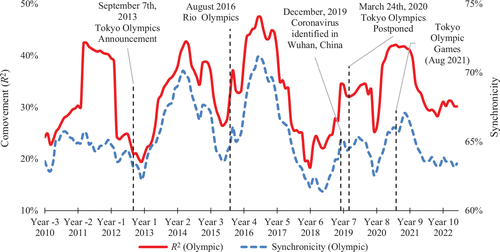
Notes. The figure presents monthly rolling comovement (measured as adjusted R2) and synchronicity of Olympic stocks for the 2020 Tokyo Olympics from three years before the announcement of the winning bid in 2013 (year 1) to June 30, 2022. On March 24, 2020, it was announced that the Tokyo 2020 Olympics were delayed from the summer of 2020 to summer 2021 because of the Covid epidemic. At the end of each month, we calculate the average adjusted R2 of Olympic firm-specific regressions of daily returns on an Olympic index: Model (1a): Olympic Stock Returni,t,k = α0 + βiOlympic Indext,k + εi,t,k, using daily returns over the preceding year. The daily Olympic stock index returns are the average of the daily returns of all Olympic firms excluding firm i. Each day, we calculate the percentage of Olympic stocks with returns that are positive, negative, or zero, and we determine the maximum percentage for the day. Synchronicity is calculated as the average maximum percentage over the month. The graph reports the one-year monthly moving average of Synchronicity. Year 1 is the year of the winning bid announcement, and year 8 is the announcement of the delay of the Olympics until summer 2021. The vertical line “Tokyo Olympics Announcement” indicates the date for the announcement of the Tokyo Olympics (September 7, 2013), and the vertical line “Tokyo Olympics Postponed” shows the date of the Olympic games postponement (March 24, 2020). The Tokyo sample consists of 86 Olympic stocks and 86 non-Olympic stocks that were publicly traded during the Tokyo Olympic winning bid announcement. See Appendix B for details on variable definitions.
In untabulated analysis, we investigated the fundamental comovements for Tokyo Olympic stocks (although, as of the time of writing, we do not have a complete three-year postgame time period). We find some evidence of fundamental comovements for Tokyo stocks in the middle years, but generally the results are consistent with those reported for the main Olympic sample.
5.2. Stay-at-Home Stocks
Figure 7 investigates stocks that are classified by analysts and the media as stay-at-home. In 2020, many governments attempted to slow the spread of the coronavirus by mandating lockdowns, which encouraged people to limit their interactions with others and work from home. Stay-at-home stocks were promoted as stocks that were likely to benefit from lockdowns. Analysts and the media first began creating lists of stay-at-home stocks in late February 2020 (see notes to Figure 7 for more details of the sample selection), and it quickly became clear which firms were classified as those expected to benefit from the shift to remote working and from the majority of the populations being confined to their dwellings.
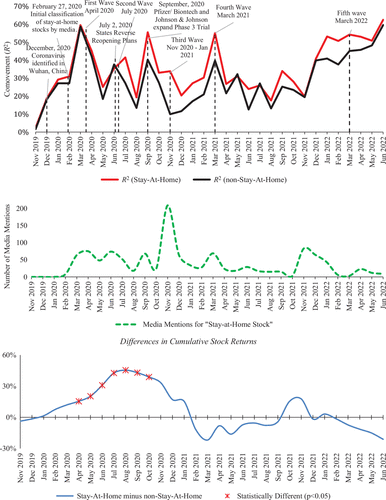
Notes. The figure presents monthly rolling comovement (measured as adjusted R2) of stay-at-home (SAH) and propensity score matched non–stay-at-home stocks (non-SAH), media mentions of the term “stay-at-home,” and differences in cumulative raw returns between SAH and non-SAH stocks of from November 1, 2019, to June 30, 2022. The SAH sample consists of 52 SAH and 52 non-SAH stocks that were publicly traded during November 1, 2019. We identify the SAH stocks from media mentions in https://realmoney.thestreet.com/jim-cramer, https://www.kiplinger.com/, and https://www.cnbc.com. The first figure presents results for the comovement. At the end of each calendar month, we calculate the average adjusted R2 of SAH firm-specific regressions of daily returns on a SAH index using Model (1a): SAH Stock Returni,tk = α0 + βiSAH Indext,k + εi,t,k, using daily returns over the preceding month. The daily SAH stock index returns are the average of the daily returns of all SAH firms excluding firm i. Similarly, at the end of each month, we calculate the average adjusted R2 of non-SAH firm-specific regressions of daily returns on a non-SAH index using Model (1b): Non-SAH Stock Returni,tk = α0 + βiNon-SAH Indext,k + εi,t,k, using daily returns over the preceding month. The daily non-SAH stock index returns are the average of the daily returns of all propensity score matched non-SAH firms excluding firm i. We match SAH stocks to their comparable non-SAH stocks using 1:1 propensity score matching within industry. We match on firm characteristics one year before the 2020 SAH stock movement: total assets, market capitalization, book-to-market, earnings-to-price, ROA and CFO. The second figure presents results for the number of media mentions, which is the number of Factiva mentions in the United States for the word combinations “stay-at-home stock,” “stay-at-home stocks,” “work-from-home stock,” and “work-from-home stocks.” The third figure presents results for the differences in cumulative returns between SAH and non-SAH stocks. Stars in the third figure reflect statistically significant differences in cumulative returns (p < 0.10) between SAH and non-SAH cumulative stock returns using a two-tailed test on the means. See Appendix B for details on variable definitions and https://www.aarp.org/health/conditions-treatments/info-2021/covid-4th-wave.html for the source used for identifying the COVID-19 waves.
Figure 7 plots return comovement changes, stay-at-home media mentions, and abnormal stock returns for stay-at-home stocks. The return comovement of the 52 stay-at-home stocks, relative to their matched peers, began to increase once the second COVID-19 wave hit in July 2020. This was the time when U.S. states began reversing their reopening plans and is likely to be the point when the public realized that COVID shutdowns were going to continue at least until the end of the year. The comovement of stay-at-home stocks has continued to climb as each new wave commenced and remained elevated as of June 2022, whereas stay-at-home media mentions peaked at the time of the third wave and have leveled off considerably over 2021 and 2022. In terms of returns, stay-at-home stocks earned positive returns relative to their matched peers in 2020, but these excess returns have since dissipated in 2021 and 2022. In fact, as of June 2022, stay-at-home stocks have underperformed their matched peers.
In untabulated analysis, we investigated the fundamental comovements for stay-at-home stocks over the 2020–2022 time period. We found little evidence of fundamental comovements for these stocks. Thus, similar to our results for the Olympics, the return comovement effects for stay-at-home stocks appear to be more based on investor event-based grouping than on macroeconomic factors related to COVID-19 changing underlying fundamentals.
5.3. Other Robustness Analyses
Given that Olympic sponsors self-select to be involved with the Olympics relative to stocks categorized by the media as Olympic stocks, we separately repeat the main analyses for Olympic sponsors. In untabulated analysis, we do not find significant comovement changes for the 38 Olympic sponsors. We also examine whether there are cross-sectional differences for 30 international Olympic stocks (firms with more than 50% of their revenues coming from foreign sales) and again do not find significant comovement changes for these firms. The lack of comovement results for sponsors and international firms could be due to these firms being larger and so the value impact of the Olympics is viewed as smaller by investors, or it could be due to these firms being held predominantly by more sophisticated institutional investors or that the small sample sizes reduce power.
We repeat the return comovement findings for each separate Olympics to examine if any patterns emerge. We find (in untabulated analysis) that the comovement results are evident in the countries with the more developed capital markets (Australia, China, and the United Kingdom) and are not evident in the countries with the less developed capital markets. Finally, we examine whether the comovement of Olympic stocks decreases with non-Olympic stocks during the Olympic periods. Untabulated analyses show that the comovement of Olympic stocks with non-Olympic stocks actually increases despite the comovement among Olympic stocks increasing as well. This result is not overly surprising given that Figure 2 illustrates that the Olympics have market-wide effects on all stocks and not just Olympic stocks. Such findings would be expected if the Olympic event-based grouping was assessed by investors at the complete local economy level or if the Olympic event-based grouping spilled over to the industry peers of the Olympic stocks.
6. Conclusion
The purpose of this study is to examine whether investors use the Olympics as a basis for investment after the host country announces the winning Olympic bid. We hypothesize that the combination of good fundamental news about the Olympics along with the strong media attention on the Olympics increases investor recognition of stocks that could potentially benefit from the Olympics. Based on theories of style investing, we make several predictions. First, we predict that the heightened media attention on the Olympics encourages retail investors to identify Olympic stocks as a grouping for investment. Second, based on event-based grouping theories, we predict that, after the Olympics are announced, the stock returns for Olympic firms covary more strongly with each other and are driven more by market-wide movements. Third, we predict that the impact of the Olympics on fundamentals is small, and the comovement of fundamentals is not large enough to justify the changes in comovements in stock returns that we observe.
In our main analyses, we examine the past five summer Olympic hosting countries. First, we find that returns of Olympic stocks are up to 202% higher than those of non-Olympic stocks in the run-up to the Olympic Games, but approximately half of these higher returns reverse prior to the start of the games. Second, we show that the covariation of returns increases among Olympic stocks after the winning bid is announced and increases again in the period immediately before the games are played and declines afterward. Third, we show that Olympic firms do not appear to generate abnormal cumulative profits or revenues over the Olympic period. Thus, the valuation effects that we document do not appear to be driven by changes in fundamentals or strong comovements in underlying fundamentals.
The study’s findings illustrate that media or social media attention on certain stocks combined with significant retail attention can lead to investor event-based groupings. Consistent with this premise, the results extend and generalize to other settings in which the media or social media sell an event-based grouping story to retail investors. We provide preliminary evidence showing similar increases in comovement for the Tokyo Olympic stocks and stay-at-home stocks. Our results highlight that firms can benefit from these types of event-based groupings because we observe positive stock returns after the grouping begins. We leave it to future research to identify future events and settings in which these forces continue to impact firm valuations.
The authors received valuable comments from Ted Christensen, Feng Li, Paul Healy, Trevor Harris, James Ohlson, Shiva Rajgopal (editor), Ivy Feng (discussant), T. Clifton Green (discussant), Richard Sloan, Eric So (editor), an associate editor, and two referees. The authors also appreciate the helpful comments from workshop participants at the 2019 Barton Conference held at Columbia University and the 2016 and 2022 Annual Conference on Financial Economics and Accounting.
Appendix A. Examples of Olympic Stocks
|
Appendix A. Examples of Olympic Stocks
| Factset identifier | Country | Firm name | Industry name | Reason for classification as an Olympic stock |
|---|---|---|---|---|
| BDG0N4 | Australia | Event Hospitality & Entertainment | Recreation | Provides hotels and resort services related to the Olympics |
| 694943 | Australia | Seven West Media Limited | Recreation | Provides television broadcasting services related to the Olympics |
| 606558 | Australia | Australia and New Zealand Banking Group | Financial | Provides lending services to firms benefiting from the Olympics |
| 605414 | Australia | Westfield Holdings Ltd. | Construction | Property and infrastructure development for the Olympics |
| BX17Q1 | Australia | CIMIC Group Limited | Construction | Construction projects for the Olympics |
| 614469 | Australia | BHP Group Ltd | Metal producers | Production of building materials for the Olympics |
| 403796 | Greece | ATTI-KAT S.A. | Construction | Construction and infrastructure services for the Olympics |
| 505160 | Greece | Hellenic Telecommunications Organization | Utilities | Fixed-line television and mobile telecommunication services related to the Olympics |
| 568427 | Greece | Delta Ice Cream Sa | Food | Production milk products for the Olympics |
| 577717 | Greece | Attica Publications | Printing and publishing | Publication and distribution of magazines that benefit from Olympic advertising |
| 588141 | Greece | Byte Computer ABEE | Miscellaneous | Provision of information technology and communications solutions for the Olympics |
| 465873 | Greece | DROMEAS | Machinery and Equipment | Office furniture, kitchen and home furniture, and die-cast aluminum equipment for the Olympics |
| 000402 | China | Financial Street Holdings | Financial | Owns commercial rental properties in Beijing that benefit from Olympics |
| 000938 | China | Unisplendour Co. | Electronics | Provision of information technology infrastructure product services for the Olympics |
| 000969 | China | Advanced Technology & Materials | Metal product manufacturers | Provides construction materials to Olympic venues |
| 000802 | China | Beijing Jingxi Culture and Tourism | Recreation | Owns main tourism resources in Beijing that benefit from Olympic tourism |
| 000860 | China | Beijing Shunxin Agriculture | Beverages | Main provider of meat and vegetables in Beijing that support Olympic tourism |
| 000839 | China | CITIC Guoan Information Industry | Utilities | Information transmission, cable television, and mobile communications for the Olympics |
| 009616 | United Kingdom | Balfour Beatty | Construction | Construction projects for the Olympics |
| 310221 | United Kingdom | Telford Homes Plc | Construction | East London housebuilder—Olympics expected to bring regeneration |
| 006532 | United Kingdom | Avesco Group | Miscellaneous | Leases audio visual equipment, including large-scale displays and audio equipment, which was expected to be employed at Olympic venues |
| B460T3 | United Kingdom | Tandem Group | Recreation | Licensed to sell branded products (e.g., Olympic bicycles) |
| B7KR2P | United Kingdom | easyJet | Aerospace | Transportation services for the Olympics |
| B1YPC3 | United Kingdom | Fuller, Smith & Turner | Recreation | Pubs owner and brewer of London Pride which directly benefit from Olympic tourism |
| B1VYRW | Brazil | CR2 Empreendimentos Imobiliarios | Financial | Development and sale of real estate properties that benefit from the Olympics |
| 284097 | Brazil | CCR S.A. | Transportation | Provision of transportation services for the Olympics |
| B019KX | Brazil | Companhia Siderurgica Nacional | Metal producers | Production and exportation of iron, steel, and cement for the Olympics |
| B06YX2 | Brazil | Iochpe Maxion S.A. | Automotive | Production, distribution, and sale of steel and aluminum wheels for vehicles for the Olympics |
| B23CS0 | Brazil | BHG SA - Brazil Hospitality Group | Miscellaneous | Hotel services related to the Olympics |
| 247961 | Brazil | Gafisa SA | Financial | Construction, development, and selling of residential properties which benefit from Olympic tourism |
Notes. Appendix A provides examples of firms designated as Olympic stocks for the five summer Olympics included in our main sample: Australia (Sydney, 2000), Greece (Athens, 2004), China (Beijing, 2008), United Kingdom (London, 2012), and Brazil (Rio de Janeiro, 2016). The main sample consists of 200 Olympic stocks that were publicly traded as of the Olympic winning bid announcement. For the Sydney 2000 Olympics, we used Factiva as the news source to identify stocks that benefit from the Olympics. For the Athens 2004 Olympics, we used websites of local media sources, such as https://www.kathimerini.gr/, https://www.tanea.gr/, and https://www.naftemporiki.gr/. For the Beijing 2008 Olympics, we used social media sites Sina.com.cn and jrj.com.cn as they made lists and categorized Olympic stocks. For the London 2012 Olympics, we searched all news articles from the Financial Times for mentions of stocks expected to be involved in or benefit from the London Olympics. For the Rio 2016 Olympics, we used Bloomberg and local media sources, such as https://www.infomoney.com.br/ for mentions of stocks that benefit from the Olympics. The 200 Olympic stocks also include all of the official sponsors and partners for each country that were publicly traded as of the Olympic winning bid announcement.
Appendix B. Variable Definitions
|
Appendix B. Variable Definitions
| Variable | Definition |
|---|---|
| Abnormal Volume | The average daily volume at the event period (day −1, day +1) minus the average volume in the nonevent period divided by standard deviation of volume in the nonevent period. The event periods are either the Olympics announcement date, the initial Olympic stock classification date by the media, or the Olympic Game dates. The nonevent or estimation period is defined as the period from 130 to 10 days prior to the event and from 10 to 130 days after the event. |
| Annual Return | Fiscal year-end annual return |
| Assets_E | Total annual assets divided by average annual book value of equity as of the fiscal year-end |
| Book-to-Market | Book value of equity as of the fiscal year-end scaled by the market value of equity as of the fiscal year-end |
| CFO | Annual cash flows from operations scaled by average annual assets |
| CFO_E | Cash flow from operations scaled by equity |
| Comovement | Average beta or average adjusted R2 for each period (preannouncement years, middle years, Olympic years, and postgame years) of Olympic (non-Olympic) firm-specific regressions of daily returns on an Olympic (non-Olympic) index (Models (1a) and (1b)), using daily returns over the preceding year. The daily Olympic (non-Olympic) stock index returns are the average of the daily returns of all Olympic (non-Olympic) firms excluding firm i. |
| Comovement of Fundamentals | Average adjusted R2 for each period (preannouncement years, middle years and Olympic years, and postgame years) of Olympic (non-Olympic) firm-specific regressions of quarterly or semiannual fundamental returns on an Olympic (non-Olympic) index of fundamental returns (Models (3a) and (3b)), using quarterly or semiannual returns over the period. The Olympic (non-Olympic) stock index of fundamental returns are the average of the quarterly or semiannual returns of all Olympic (non-Olympic) firms excluding firm i. |
| Cumulative Returns from the Bid Announcement Year to the Respective Month-End after the Bid Announcement (%) | Calculated as the monthly compounded returns, starting in January of the year of the Olympics announcement (see Table 1, panel A, for announcement dates) and ending at the respective period month-end |
| Earnings-to-Price | Annual net income scaled by the market value of equity as of the fiscal year-end |
| Fundamental Return | The individual firm’s quarterly or semiannual ROE or Revenue_E |
| High Retail | Equal to one if retail investors hold more than 50% of the shares outstanding in the year |
| Insider Investors | The portion of total shares outstanding held by insiders as of the fiscal year-end |
| Institutional Investors | The percentage of total shares outstanding held by institutions as of the fiscal year-end |
| Log Media Mentions | The natural logarithm of (1 + Media Mentions) |
| Log of Total Assets | The natural logarithm of total assets as of the fiscal year-end |
| Market Cap | Market capitalization in U.S. dollars as of the fiscal year-end |
| Market Index Returns (%) | The daily market index returns for each period (preannouncement years, middle years, Olympic years, and postgame years), calculated as the daily returns of the Olympic country’s respective market index, which is one of the following: ASX All Ordinaries (Sydney 2000), ATHEX Composite (Athens 2004), Shanghai A Share or Shenzhen Index (Beijing 2008), FTSE All Shares or AIM index (London 2012), and BOVESPA (Rio 2016). |
| Media Mentions | Media mentions for each firm calculated as the number of Factiva media articles from local news sources that include the words “Olympic” or “Olympics” during the calendar year |
| Middle Years | = 1 for the seven years after the Olympics announcement and 0 otherwise |
| Middle Years and Olympic Years | = 1 for the seven years after the Olympics announcement and the year of the Olympics and 0 for the three years prior to the announcement and for the three years after the announcement |
| Non-Olympic Firm | We match Olympic stocks to their comparable non-Olympic stocks using 1:1 propensity score matching within industry and country. We match on firm characteristics one year before the Olympics announcement: total assets, market capitalization, book-to-market, earnings-to-price, ROA, and CFO. Olympic and non-Olympic firms are required to have data for the complete time period. |
| Non-Olympic Index (%) | The daily non-Olympic stock index returns, calculated as the average of the daily returns of all non-Olympic firms excluding firm i for each period (preannouncement years, middle years, Olympic years, and postgame years) |
| Olympic | = 1 if the firm is classified as Olympic and 0 otherwise |
| Olympic Fundamental Index | The average quarterly (semiannual) ROE or Revenue_E of all Olympic firms excluding firm i for each period (preannouncement years, middle years and Olympic years, and postgame years) |
| Olympic Index (%) | The daily Olympic stock index returns, calculated as the average of the daily returns of all Olympic firms excluding firm i for each period (preannouncement years, middle years, Olympic years, and postgame years) |
| Olympic Stock Return (%) | Daily stock return of individual Olympic stocks for each period (preannouncement, middle years, Olympic years, and postgame years) |
| Olympic Years | = 1 for the year of the Olympic Games and 0 otherwise |
| Post-Game Years | = 1 for the three years after the Olympic Games and 0 otherwise |
| Pre-Announcement Years | = 1 for the three years prior to the announcement of the Olympics and 0 otherwise |
| R2CFO | The adjusted R2 coefficients from firm-specific regressions of quarterly or semiannual CFO on an Olympic index of quarterly or semiannual CFO for each period (preannouncement years, middle years and Olympic years, and postgame years) |
| R2REVENUE | The adjusted R2 coefficients from firm-specific regressions of quarterly or semiannual Revenue on an Olympic index of quarterly or semiannual Revenue for each period (preannouncement years, middle years and Olympic years, and postgame years) |
| R2ROA | The adjusted R2 coefficients from firm-specific regressions of quarterly or semiannual ROA on an Olympic index of quarterly or semiannual ROA for each period (preannouncement years, middle years and Olympic years, and postgame years) |
| Retail Investors | The remaining shares outstanding after excluding institutional investor ownership and insider ownership from FactSet. However, if the sum of institutional and insider ownership exceeds 100% because of the effects of significant short-sale positions on the stock, then we assign the retail investor as 0%. Additionally, for the earlier Olympics in the sample, if the ownership data are missing in order to save observations, we assume that the ownership data are the same as of the earliest fiscal year-end available in FactSet. |
| Revenue | Computed as revenues scaled by average assets for each period (preannouncement years, middle years and Olympic years, and postgame years). |
| Revenue_E | Computed as revenues scaled by average book value of equity for each period (preannouncement years, middle years and Olympic years, and postgame years) |
| ROA | Computed as annual net income scaled by average assets |
| ROE | Computed as annual net income scaled by average book value of equity for each period (preannouncement years, middle years and Olympic years, and postgame years) |
| Sales Growth | One-year sales growth for a company |
| Synchronicity | Twelve-month rolling moving average of the percentage of Olympic stocks that are up, down, or unchanged for each day. The fraction of stocks that move in the same direction in country k are calculated as Synchronicityt,k = 1/T Σtmax[ηktup, ηktdown, ηktsame]/[ηktup + ηktdown + ηktsame]. ηktup is the number of Olympic (non-Olympic) stocks whose prices rise in period t in country k, ηktdown is the number of Olympic (non-Olympic) stocks whose prices fall, ηktsame is the number of Olympic (non-Olympic) stocks whose prices stay the same, and T is the number of periods used (Morck et al. 2000). |
| Total Assets | Total annual assets in U.S. dollars reported as of the fiscal year-end |
| U-statistic | Calculated by dividing the squared residual returns by the variance of the residual returns following Beaver (1968). We estimate the market model with daily stock returns in the nonevent or estimation period, obtain estimates of the intercept and slope coefficients, ai and bi, and calculate the residual returns and variance. |
1 TD Ameritrade, Charles Schwab, and Scottrade all started online trading businesses in the late 1990s with approximately 12 online brokerage firms in 1994 and 140 firms by 2001. By the year 2000, almost half of the U.S. population was accessing information on the internet (see https://ourworldindata.org/internet). The rise of social media also began in the early 2000s with Myspace having a million monthly active users by 2004.
2 Prior research documents that, at the country level, the benefits of hosting the Olympics are often overstated and the costs are understated, and generally, host countries go substantially over budget (e.g., Owen 2005, Whitson and Horne 2006, Barclay 2009). This trend appears to be continuing. The 2016 Summer Olympics in Rio de Janeiro went over the initial budget by 14.5 billion reais (US$3.59 billion) and the 2021 Summer Olympics in Tokyo went over the initial budget by US$6 billion four years before the Olympics (see Downie 2017, Nikkei Staff Writers 2019).
3 Engelberg and Parsons (2011) document that local media coverage of earnings announcements predicts the timing of local investor trading in 19 mutually exclusive trading regions in the United States. Peress (2014) examines local newspaper strikes in several countries and shows that trading volume and volatility decline for stocks during the strike. Peress (2014) suggests that retail investors rely more heavily on local media because results are stronger among smaller firms. Solomon et al. (2014) show that media coverage of funds with high past returns influences investors to buy these funds even though these funds do not outperform in the future, consistent with the media exacerbating the bias of investors to chase past winners.
4 Vijh (1994) and Barberis et al. (2005) analyze stocks moving in and out of the S&P 500 Index. Cooper et al. (2001) analyze firms that change their name to dot.com but do not change their business models. Pirinsky and Wang (2006) examine changes in a firm’s geographic location. Other researchers examine market efficiency questions using the comovement of stock returns with the discounts of closed end funds (e.g., Lee et al. 1991), comovement of returns and trading volumes with book-to-market peers (Choi et al. 2021), and the comovement of investor attention based on measures such as business press articles, EDGAR downloads, and Google searches (Drake et al. 2017).
5 The main Olympic comovement inferences are robust to using coarsened exact matching (CEM) rather than propensity score matching. We did not replicate all tests using CEM because this would require additional hand-collection of data for peer firms.
6 Requiring both Olympic and non-Olympic firms to be listed for the entire period allows us to better test changes in comovement. However, the lookahead bias likely results in our selection of better performing Olympic and Non-Olympic firms. In addition, we obtain our international financial data from Factset, and Factset does not maintain information about companies that delist (Factset records the key identifier as expired). In untabulated tests, we investigated whether including Olympic firms that are delisted impacts our valuation findings for Olympic firms. We obtain data for the UK and Beijing Olympics from a different source, and we analyze all Olympic firms (including those that are delisted). We find that including the delisting returns does not overly impact the valuation effects that we report and the tenor of the results is similar. In addition, we find similar results for the Tokyo Olympics (for which there is less lookahead bias because of the Olympic time period not being over at the time of writing) and for stay-at-home stocks, for which there are no lookahead biases.
7 On June 22, 2007, Bear Stearns revealed that two of its subprime mortgage funds needed collateral and that it was pledging a collateralized loan of up to $3.2 billion to “bail out” one fund and negotiating with other banks to loan money for another fund (for more details, see, for example, http://www.nytimes.com/2007/06/23/business/23bond.html). This revelation is generally viewed as the starting point for revisions in expectations about real estate values and the value of mortgage-backed securities.
8 Despite the large difference in cumulative returns between Olympic and non-Olympic stocks, the statistical difference in returns is not pronounced during the whole Olympic period as the standard errors in returns are ballooning at the same time the return differences increase.
9 We investigated the large outperformance of Olympic stocks relative to non-Olympic stocks for the Sydney and Athens Olympic Games. We found that the returns were, in part, skewed by a handful of Olympic stocks with extreme returns. For example, in Australia, the Australian medical diagnostic company Sonic Healthcare Limited, which was categorized as an Olympic stock, experienced a return of 2,302% during the Olympic period. In Greece, the holding company Lamda Development SA, which was also categorized as an Olympic stock, experienced a return of 3,758% during the Olympic period.
10 The interim Factset data for ROA, CFO, and Revenue for Australia starts in 1998. The announcement of the Sydney Olympics was in 1993, so we do not have data for the preannouncement years (1988–1992) and much of the middle years (1993–1999). The interim Factset data for ROA, CFO, and Revenue for Greece starts in 2001. The announcement of the Athens Olympics was in 1997, so we do not have data for the preannouncement years (1994–1996) and much of the middle years (1997–2003). The interim Factset data for ROA, CFO, and Revenue for China starts in 2002. The announcement of the Beijing Olympics was in 2001, so we do not have data for the preannouncement years (1998–2000) and some of the middle years (2001–2007). We have quarterly data for the Rio and semiannual data for the London Olympics that span the entire Olympic period.
11 We also examined comovement for 43 Olympic stocks that we identify for the 1996 Atlanta Olympics. We do not view the Atlanta Olympics as a powerful setting to investigate comovements effects because of stock event-based grouping because (i) retail investors were less able to trade in and out of stocks because of higher fees and the lack of cheap brokerage options over the Olympic time period (Atlanta’s winning bid was announced on September 18, 1990); (ii) the media was not hyping Olympic stocks as a category for investment; and (iii) fewer people in the United States had access to the internet during the Olympic time period, and there were no social media sites on which retail investors could communicate with each other about Olympic stocks. Consistent with our expectations, in untabulated results, we do not observe evidence that the Atlanta Olympics comove more strongly with each other after the Olympics are announced. Thus, investor event-based grouping is likely to be a more pronounced phenomenon in a postinternet world.
References
- (2004) Is all that talk just noise? The information content of internet stock message boards. J. Finance 59(3):1259–1294.Crossref, Google Scholar
- (2008) All that glitters: The effect of attention and news on the buying behavior of individual and institutional investors. Rev. Financial Stud. 21(2):785–818.Crossref, Google Scholar
- (2003) Style investing. J. Financial Econom. 68(2):161–199.Crossref, Google Scholar
- (1998) A model of investor sentiment. J. Financial Econom. 49(3):307–343.Crossref, Google Scholar
- (2005) Comovement. J. Financial Econom. 75(2):283–317.Crossref, Google Scholar
- (2009) Predicting the costs and benefits of mega-sporting events: Misjudgment of Olympic proportions? Econom. Affairs 29(2):62–66.Crossref, Google Scholar
- (1968) The information content of annual earnings announcements. J. Accounting Res. 6:67–92.Crossref, Google Scholar
- (2011) The effect of macroeconomic news on stock returns: New evidence from newspaper coverage. J. Banking Finance 35(11):2791–2800.Crossref, Google Scholar
- (2002) The incomplete revelation hypothesis and financial reporting. Accounting Horizons 16(3):233–243.Crossref, Google Scholar
- (2010) The role of the business press as an information intermediary. J. Accounting Res. 48(1):1–19.Crossref, Google Scholar
- (2021) Going by the book: Valuation ratios and stock returns. Preprint, submitted September 27, https://dx.doi.org/10.2139/ssrn.3854022.Google Scholar
- (2001) A rose.com by any other name. J. Finance 56(6):2371–2388.Crossref, Google Scholar
Downie A (2017) Rio 2016 price tag rises to $13.2 billion. Reuters (June 14), https://www.reuters.com/article/idUSKBN19538E/#:~:text=RIO%20DE%20JANEIRO%20(Reuters)%20-,legacy%20(AGLO)%20on%20Wednesday .Google Scholar- (2017) The comovement of investor attention. Management Sci. 63(9):2847–2867.Link, Google Scholar
- (2010) Who blows the whistle on corporate fraud? J. Finance 65(6):2213–2253.Crossref, Google Scholar
- (2011) The causal impact of media in financial markets. J. Finance 66(1):67–97.Crossref, Google Scholar
- (2003) Limited attention, information disclosure, and financial reporting. J. Accounting Econom. 36(1–3):337–386.Crossref, Google Scholar
Hui A (2008) Beijing Olympics draw largest ever global TV audience. Nielsen (September 5), https://www.nielsen.com/wp-content/uploads/sites/2/2019/04/press_release3-3.pdf .Google Scholar- (2015) Investor sophistication and disclosure clienteles. Rev. Accounting Stud. 20(2):976–1011.Crossref, Google Scholar
- (2018) Earnings announcement promotions: A Yahoo Finance field experiment. J. Accounting Econom. 66(2–3):399–414.Crossref, Google Scholar
Lawtime (2010) Investment roadmap of Beijing Olympic-theme stocks. Lawtime (December 20), https://www.lawtime.cn/info/xiaofeizhe/dongtai/2010122014537.html.Google Scholar- (1991) Investor sentiment and the closed-end fund puzzle. J. Finance 46(1):75–109.Crossref, Google Scholar
- (2008) Investor recognition and stock returns. Rev. Accounting Stud. 13(2–3):327–361.Crossref, Google Scholar
- (2011) The role of newswires in screening and disseminating value-relevant information in periodic SEC reports. Accounting Rev. 86(2):669–701.Crossref, Google Scholar
- (2012) Investor attention, psychological anchors, and stock return predictability. J. Financial Econom. 104(2):401–419.Crossref, Google Scholar
- (1987) A simple model of capital market equilibrium with incomplete information. J. Finance 42(3):483–510.Crossref, Google Scholar
- (2006) The press as a watchdog for accounting fraud. J. Accounting Res. 44(5):1001–1033.Crossref, Google Scholar
- (2015) The evolving disclosure landscape: How changes in technology, the media, and capital markets are affecting disclosure. J. Accounting Res. 53(2):221–239.Crossref, Google Scholar
- (2000) The information content of stock markets: Why do emerging markets have synchronous stock price movements? J. Financial Econom. 58(1–2):215–260.Crossref, Google Scholar
Nikkei Staff Writers (2019) Tokyo Olympics budget swells to $12BN a year before games. Nikkei Asia (July 24), https://asia.nikkei.com/Spotlight/Tokyo-2020-Olympics/Tokyo-Olympics-budget-swells-to-12bn-a-year-before-games.Google Scholar- (2005) Estimating the cost and benefit of hosting the Olympic Games. Indust. Geographer 3(1):1–18.Google Scholar
- (2014) The media and the diffusion of information in financial markets: Evidence from newspaper strikes. J. Finance 69(5):2007–2043.Crossref, Google Scholar
- (2006) Does corporate headquarters location matter for stock returns? J. Finance 61(4):1991–2015.Crossref, Google Scholar
- (2014) Winners in the spotlight: Media coverage of fund holdings as a driver of flows. J. Financial Econom. 113(1):53–72.Crossref, Google Scholar
- (2011) All the news that’s fit to reprint: Do investors react to stale information? Rev. Financial Stud. 24(5):1481–1512.Crossref, Google Scholar
- (1994) S&P trading strategies and stock betas. Rev. Financial Stud. 7(1):215–251.Crossref, Google Scholar
- (2006) Underestimated costs and overestimated benefits? Comparing the outcomes of sports mega-events in Canada and Japan. Sociol. Rev. 54(2):73–89.Crossref, Google Scholar

