


The Economics of Capital Allocation in Firms: Evidence from Internal Capital Markets
Abstract
We analyze a unique chief financial officer (CFO) survey data set to examine capital allocation in firms. Top management is aware of agency and information problems at the divisional level and organizes the budgeting process to counteract managerial opportunism, employing systems of interconnected measures, including layers of approval, divisional budgets, reporting requirements, and compensation schemes. When making funding decisions, top management relies heavily on top-level nonfinancial information, such as the assessment of divisional managers’ abilities. However, substantial parts of the capital budget do not require top management approval as firms trade off the benefits and costs of decentralization, thereby deviating from the traditional paradigm of decentralized project initiation but centralized project approval. Even firms with active internal capital markets tilt capital allocation toward relatively even distributions, reflecting the use of capital allocation as a credible communication device. We also find that within-firm agency problems may result in capital rationing, that is, divisions’ restricted access to internal capital. CFOs also believe that integrating multiple businesses into an internal capital market results in tangible financial benefits, predominantly lower costs of capital and higher debt capacities. Thus, our findings also support coinsurance arguments suggesting that internal capital markets may improve access to external financing.
This paper was accepted by Victoria Ivashina, finance.
Funding: This work was supported by the BBBank Karlsruhe, Wissenschaftsförderung der Sparkassen-Finanzgruppe, and Karlsruher Institut für Technologie (Karlsruhe House of Young Scientists). Publishing fees were supported by the “Funding Programme Open Access Publishing” of the University of Hohenheim.
Supplemental Material: The online appendices and data files are available at https://doi.org/10.1287/mnsc.2021.02755.
1. Introduction
A central goal in corporate finance is to understand how capital is allocated in the economy: both across and within firms. Most research focuses on across-firm allocation, that is, the process through which external capital is allocated to individual firms via financial markets and financial institutions. However, a critical part of the capital allocation process in the economy occurs within the organization itself: Firms allocate (internally and externally raised) capital within and across different lines of business. Despite its relevance, the level of direct knowledge of the workings of internal capital allocation and how it relates to the organization of the firm is rather limited. Relevant data are typically unobservable, as they remain largely undisclosed to outsiders. Therefore, most research has either focused on the derivation of theoretical results (which are often inherently difficult to test) or on empirically analyzing investment outcomes rather than the budgeting process itself.1 This paper provides new empirical evidence on internal capital allocation and its process, overcoming some of the typical data limitations by using a unique survey data set of chief financial officers (CFOs).
With our survey, we get inside the “black box” and analyze the structure and organization of capital allocation of a broad set of 115 firms. Our objective is to seek answers to central but to date insufficiently understood questions of internal capital allocation. The first is to seek evidence for central frictions influencing the efficiency of corporate investment. Although theory postulates that agency and information issues inside firms are responsible for distortions of corporate investment, there is little direct evidence about the extent to which they are perceived inside firms. Our survey directly asks CFOs about these frictions, and we use the survey data to construct a novel measure of within-firm agency problems. Second, we aim to uncover the mechanisms firms apply to curtail the consequences of those frictions in the capital allocation process. The finance and accounting literature suggests many curative mechanisms, yet we lack detailed knowledge about both their importance and their prevalence. Third, we examine deviations from the traditional paradigm of capital allocation, which is characterized by decentralized bottom-up project initiation of lower-level management but centralized project selection at the level of headquarters. More specifically, we study aspects of the delegation of investment authority from higher levels in the organization to lower levels and the involvement of divisions in the capital allocation process. We also reveal how top management uses its own expertise and other soft nonfinancial information in the decision to allocate capital. These aspects have been largely ignored in the literature but have recently been recognized as important facets of capital allocation. Fourth, we examine within-firm capital reallocations, a key feature of internal capital markets. Top management’s ownership rights allow the reallocation of resources at will within the firm. However, top management’s hands may (effectively) be tied because the implied stripping of resources of some divisions may have high costs. Finally, we look at the interaction of capital allocation and financing. A growing literature suggests several ways how replacing the external capital market with an internal one may affect corporate financing. However, what has remained largely unexplored is which of these effects are considered most important by financial executives.
The following key findings emerge from our analysis. First, when asked directly, financial executives acknowledge the prevalence of within-firm agency problems and confirm their effect on capital budgeting. Empire-building tendencies at the divisional level and wasteful influencing activities to attract more capital are particularly common manifestations of agency problems. To mitigate the effects of agency problems on investment outcomes, headquarters implements a variety of mechanisms: layers of approval, division budgets, and mechanisms for mitigating information biases. Each of these organizational measures represents one part of a larger corporate system to counteract agency problems when allocating capital. For instance, headquarters requires central approval for major investments in nearly all firms. However, many CFOs report that investment plans and financial projections that divisional managers provide are biased toward attracting a larger share of the overall capital budget. Therefore, headquarters implements certain budgeting procedures that elicit the revelation of managers’ private information when divisional managers submit proposals. Firms report the use of many instruments that previous (normative) works in finance and accounting suggest. Among the most important instruments are inflated hurdle rates that correct for misrepresentation of private information, compensation schemes that tie division managers’ pay to overall firm performance, and reliance on hard easy-to-verify information. Despite the distortions that lower-level agency problems can cause, and perhaps surprisingly, top management gives divisions considerable discretion over capital expenditures. On average, approximately 40% of overall capital expenditures do not require explicit investment approval by headquarters. This number is surprisingly high. When we examine the factors that influence this fraction of overall capital expenditures, we find evidence consistent with a tradeoff: When establishing divisional budgets, headquarters balances the benefits of the efficient use of local information (e.g., lower information acquisition and processing cost) and its costs of agency (e.g., loss of control/empire-building, monitoring cost). These findings tie our results to the larger agenda of the delegation of authority and decentralization in organizations in the literature.
Second, when we turn to the analysis of budgeting methods for individual projects, we find several deviations from the assumptions of most of the theoretical literature. The capital allocation process contains not only bottom-up but also top-down components. Although firms’ headquarters must somehow rely on financial projections and other hard information provided by divisions when allocating capital, they extensively use their own (mostly soft) information that resides exclusively at headquarters: Strategic information held by headquarters influences capital allocation as much as the assessment of divisional managers’ abilities does. These factors turn out to be particularly relevant in the presence of severe agency issues. CFOs also point out the importance of the availability of nonfinancial (implementation) resources, which implies that such noncapital constraints, such as manpower, are overlooked in the literature but are highly important from the perspective of financial executives.
The third set of findings relates to the workings of internal markets for capital and their effects on financing. Our evidence confirms that divisions typically have no access to external capital. Instead, they seek funds in the internal capital market through the capital allocation process. CFOs indicate that they frequently move capital from divisions that generate strong cash flow to divisions with little cash flow but favorable investment opportunities to achieve the highest capital productivity. However, our evidence also suggests that firms even restrict divisions’ access to internal capital markets under some circumstances: If agency problems are perceived to be large, firms tend to quantity-ration a division’s investment by limiting capital allocation to the division’s cash flow. Many executives also recognize that capital allocation decisions frequently lead to a more evenly distributed allocation than financial criteria suggest. This irregularity has stimulated previous theoretical work on the motives for cross-subsidies (or socialism) in internal markets. When we examine the relative importance of these motives, one reason stands out: headquarters strategically distorts investment because capital allocation conveys information to internal and external stakeholders. The finding confirms the role of capital allocation as an important device for credible communication. Finally, CFOs have strong opinions about the financial benefits of internal capital markets. They perceive such benefits predominantly in higher debt capacities and lower costs of capital. These findings support coinsurance arguments suggesting that internal capital markets may improve access to external financing but challenge the conventional portfolio view of the firm.
A number of other papers present survey evidence on capital investment (e.g., Gitman and Forrester 1977, Stanley and Block 1984, Ross 1986, Graham and Harvey 2001). The work closest to ours is Graham et al. (2015), who examine aspects of the delegation of financial decision-making authority within firms (e.g., concerning capital structure, payout, investment, or merger and acquisition (M&A) decisions) and budgeting rules associated with capital allocation. They conclude that the degree to which headquarters retains authority varies both across financial policies and with chief executive officers’ (CEOs’) personal characteristics. In contrast to their work, we focus on the delegation of investment authority and link our results to the tradeoff between the benefits and cost of decentralization. Graham et al. (2015) also study intuitive (but somewhat ad hoc) decision rules associated with capital allocation. In contrast, our choice of decision rules is guided by previous theoretical work, and we investigate the cross-sectional variation induced by firm-specific factors rather than international differences or differences between CEO and CFO responses. Most other surveys of capital allocation focus on the techniques of how firms evaluate individual investment projects. None of the aforementioned studies examine the mechanisms for truthful reporting and the aspects of capital reallocation in internal capital markets that we cover, and none of them directs attention to the fundamental question how capital allocation is influenced by the agency relationship between top management and division managers (see Stein 2003). Finally, our objective is to understand the (micro)foundations of capital allocation within firms—this is why we put emphasis on a survey instrument that is closely guided by economic theory and previous empirical evidence. Wherever appropriate, we relate or contrast our findings to the results of these studies and other related work.
The paper is organized as follows. In Section 2, we explain and discuss the methodology, describe the data set, and provide summary statistics. Section 3 analyzes the organization of internal capital allocation, and Section 4 focuses on corporate investment in internal capital markets. In both sections, we present short summaries of the main findings, which we also present in Table A.1 for quick reference. Section 5 concludes.
2. Methodology
2.1. Survey Development and Sample Selection
In preparing the questionnaire, we reviewed the economics, finance, and accounting literature on capital allocation and extracted predictions and arguments to develop a draft survey.2 We mailed the draft survey to a group of academic researchers and survey experts for review and feedback. We also pretested the questionnaire with a group of CEOs and CFOs through personal interviews. These interviews took 60–90 minutes. We designed these pretests to ensure the consistent meaning of survey questions and minimize potential biases caused by measurement error (Bertrand and Mullainathan 2001; see Section 2.4 for more details). The final four-page questionnaire was structured into five sections that contained 88 questions. One of these sections also collected demographic characteristics of the surveyed firms and their CFOs. The final questionnaire took an average of 25 minutes to answer in our beta testing group.
The focus of our research is on Western European companies from 11 major economies: the United Kingdom, Germany, France, Belgium, the Netherlands, Switzerland, Austria, Sweden, Finland, Norway, and Denmark. For sample selection, we obtain data from Thomson Reuters Worldscope for the 2008 fiscal year, and we restrict the sample to firms with sales of €10 million or more. Smaller firms are unlikely to meet the requirements for the types of firms we have in mind for large parts of the questionnaire: Firms that organize business activities in distinct operating segments overseen by a corporate headquarters. Because one major interest of our study is how divisions obtain funds for capital investment through internal capital markets, we focus on diversified firms. Diversified firms operate internal capital markets, in which corporate headquarters pools cash flows from diverse sources and divisions seek funds through the capital allocation process (rather than through financial markets).3 Following standard practice, we define diversified firms as those firms that report segments in at least two different three-digit Standard Industrial Classification (SIC) codes and generate less than 90% of sales in one three-digit SIC code industry (Lang and Stulz 1994, Berger and Ofek 1995, Rajan et al. 2000, Maksimovic and Phillips 2007). This relatively narrow industry definition allows for distinguishing between firms with related and unrelated lines of business in subsequent sections. Additionally, we exclude companies if the sum of reported segment revenues differs from total revenue. Because many of the hypotheses are not applicable to pure financial firms, we exclude firms that generate the majority (more than 50%) of their revenues in SIC codes starting with 6.
2.2. Delivery and Response
We identified 992 firms that matched the selection criteria and mailed the questionnaire along with a personalized and signed cover letter. We obtained firm and CFO contact information from several sources, primarily Thomson Reuters Worldscope, but also Bloomberg, Compustat, and Capital IQ. The questionnaire was sent on April 26, 2010. To increase the response rate, we offered participating financial executives an advanced report of the results. Additionally, we employed a team of graduate students to make follow-up calls and remail a second copy of the questionnaire if requested. The survey design followed the principles proposed by Dillman (1978), Bradburn et al. (2004), Bednar and Westphal (2006), and Baruch and Holtom (2008). We requested that the survey be returned via fax, mail, or email by May 7, 2010.
Overall, 115 CFOs returned fully completed surveys, for a response rate of 11.6%. Given the length of the survey, the response rate compares favorably to those of most similar studies, such as Graham and Harvey (2001) with 8.9%, Brounen et al. (2004) with 4.8%, Graham et al. (2005) with 10.4%, Lins et al. (2010) with 8.9%, Graham et al. (2015) with 8.7%, Dichev et al. (2013) with 5.4%, or McCahery et al. (2016) with 4.3%.
2.3. Respondent Characteristics
Table 1 presents self-reported summary statistics of both the firms in our sample and the CFOs who returned usable surveys. The sample is balanced between small firms (42%, firms with €1 billion in sales or less) and large firms (58%, firms with more than €1 billion in sales). All the firms in our sample operate at least two divisions. These divisions are active in several industries, including manufacturing (26%), construction (11%), retail and wholesale (9%), high-tech (9%), energy (8%), and transportation (7%), among others. We also asked for personal characteristics of the financial executives. Nearly all the financial executives are male (98%), more than half (55%) are 50 or younger, and 67% have an MBA or a doctoral degree. Consistent with previous studies (e.g., Graham and Harvey 2001), our sample indicates that financial executives change jobs frequently: nearly 60% have been in their job for a maximum of five years.
|

Table 1. Summary Statistics Based on the Survey Responses
| Variables | Percent | Count | Variables | Percent | Count |
|---|---|---|---|---|---|
| Annual sales revenue (€ millions) | CAPEX (€ millions) | ||||
| 10–25 | 3.5% | 4 | <1 | 1.7% | 2 |
| 25–100 | 7.8% | 9 | 1–10 | 18.3% | 21 |
| 100–500 | 16.5% | 19 | 10–50 | 26.1% | 30 |
| 500–1,000 | 13.9% | 16 | 50–100 | 14.8% | 17 |
| 1,000–5,000 | 29.6% | 34 | 100–500 | 14.8% | 17 |
| 5,000–10,000 | 7.0% | 8 | 500–1,000 | 10.4% | 12 |
| >10,000 | 21.7% | 25 | >1,000 | 13.9% | 16 |
| 100.0% | 115 | 100.0% | 115 | ||
| No. lines of business | Debt-to-asset ratio (%) | ||||
| 2 | 26.1% | 30 | ≤15 | 21.7% | 25 |
| 3 | 28.7% | 33 | >15–30 | 34.8% | 40 |
| 4 | 23.5% | 27 | >30–50 | 24.3% | 28 |
| >4 | 21.7% | 25 | >50 | 19.1% | 22 |
| 100.0% | 115 | 100.0% | 115 | ||
| Industry | Country | ||||
| Manufacturing | 25.9% | 51 | Germany | 35.7% | 41 |
| Construction | 11.2% | 22 | United Kingdom | 10.4% | 12 |
| Retail and Wholesale | 9.1% | 18 | Switzerland | 10.4% | 12 |
| Tech (Software, Biotech) | 9.1% | 18 | France | 8.7% | 10 |
| Energy | 7.6% | 15 | Austria | 8.7% | 10 |
| Transport | 6.6% | 13 | Sweden | 8.7% | 10 |
| Consulting, Service | 6.6% | 13 | Netherlands | 5.2% | 6 |
| Pharma, Healthcare | 5.6% | 11 | Norway | 4.3% | 5 |
| Communication, Media | 3.6% | 7 | Belgium | 3.5% | 4 |
| Mining | 1.0% | 2 | Denmark | 2.6% | 3 |
| Bank, Finance, Insurance | 1.0% | 2 | Finland | 1.7% | 2 |
| Other | 12.7% | 25 | 100.0% | 115 | |
| Credit rating | CFO tenure (yr) | ||||
| AAA, AA | 7.8% | 9 | ≤2 | 25.2% | 29 |
| A | 11.3% | 13 | 3–4 | 25.2% | 29 |
| BBB | 18.3% | 21 | 5–6 | 15.7% | 18 |
| BB, B | 8.7% | 10 | 7–8 | 11.3% | 13 |
| No rating | 53.9% | 62 | ≥9 | 22.6% | 26 |
| 100.0% | 115 | 100.0% | 115 | ||
| Ownership | CFO age (yr) | ||||
| Public | 82.6% | 95 | <40 | 8.7% | 10 |
| Private | 17.4% | 20 | 40–50 | 46.1% | 53 |
| 100.0% | 115 | 51–59 | 34.8% | 40 | |
| >59 | 10.4% | 12 | |||
| Managerial ownership (%) | 100.0% | 115 | |||
| 0–1 | 67.8% | 78 | |||
| >1 | 32.2% | 37 | Gender of CFO | ||
| 100.0% | 115 | Male | 98.3% | 113 | |
| Female | 1.7% | 2 | |||
| Single investor owns more than 10% of company’s equity | 100.0% | 115 | |||
| Yes | 74.8% | 86 | CFO education | ||
| No | 25.2% | 29 | College degree | 4.3% | 5 |
| 100.0% | 115 | Non-MBA MS | 28.7% | 33 | |
| MBA | 49.6% | 57 | |||
| Dr./PhD | 17.4% | 20 | |||
| 100.0% | 115 |
Notes. Table 1 reports summary statistics of responding firms and their CFOs. The data are drawn from 115 completed questionnaires. Variables and their categories are defined in Table A.1 of the Online Appendix. Because firms can operate in several industries, observations for Industry sum up to more than 115.
We use several control variables to analyze survey responses conditional on firm characteristics that may affect internal capital allocation. We selected these variables based on the review of the literature to exploit heterogeneity across certain subsamples of the responding firms. Except for nominal variables, we use medians as the cutoff points to categorize firms (see Table A.1 in the Online Appendix for the full set of variable definitions and their categories). For instance, the median firm in our sample operates three lines of business. Therefore, we define firms as having “few” lines of business (55%) when they report two or three different lines of business and as having “many” lines of business (45%) if they run four or more different lines of business. We also investigate whether the degree of relatedness in diversification has an impact on survey results. As a proxy for relatedness, we asked CFOs to indicate the major industries in which their firm operates (retail and wholesale, mining, manufacturing, construction, transportation, energy, communication and media, banking and insurance, high-tech, healthcare and pharmaceuticals, and services/consulting).4 We define firms as “unrelated diversified” firms (43%) if they operate in more than one major industry and as “related diversified” firms (57%) if they run business lines within one industry only. Because the firm’s ability to secure external financing has a direct impact on corporate investment, we asked CFOs if they perceive their companies as facing capital constraints when capital markets are operating normally. We thus can build subsamples of “capital-constrained” (30%) and “capital-unconstrained” firms (70%). Furthermore, we refer to firms as “high leverage” firms if their debt-to-asset ratio is larger than the sample median (44%) and as “low leverage” firms if their debt ratio is below (56%). Moreover, we consider the effect of long-term credit ratings. We classify firms into “high rating” firms (41%; ratings of A- and better) and “low rating” firms (59%; BBB+ and worse). Finally, we build subsamples for CFO characteristics distinguishing between “young” (55%; age ≤ 50) and “mature” CFOs (45%; age > 50), as well as between “short” tenure (50%; four years and less in the CFO position) and “long” tenure CFOs (50%; five and more years). Throughout our study, we perform univariate analyses on survey questions conditional on each of these variables. Because some firm characteristics are correlated (see Online Appendix A.2), we also run multivariate (mostly logistic) regressions using these characteristics as independent variables. To simplify the exposition and for brevity, we present the full set of univariate results in the tables (see, e.g., Graham and Harvey 2001, Brau and Fawcett 2006) but relegate multivariate regressions and alternative statistical tests to the Online Appendix. We generally only report conclusions if they are robust to the full set of specifications and tests (that we also describe at the appropriate places below). In additional robustness tests (available upon request), we run alternative multivariate specifications that include either country fixed effects or, consecutively and separately, a set of country-specific institutional features instead of country fixed effects. Our conclusions are not sensitive to adding these controls.5
2.4. Limitations of the Survey Method
Although the use of survey data is standard in the social sciences and has, in recent years, become prominent in economics and finance (see, e.g., the literatures on expectations and individual behavior in macroeconomics and household finance as well as the executive surveys by Graham and Harvey), the survey method may be subject to potential limitations.
2.4.1. Measurement Error.
One concern is that survey data may introduce errors-in-variables problems, similar to measurement error in standard empirical work (see, e.g., Bertrand and Mullainathan 2001). We address these possible sources of measurement error by following standard practice from the survey method literature. First, we set up a series of pre/pilot tests, which we designed to ensure the consistent meaning of survey questions. For instance, survey questions can be misunderstood and, thus, introduce noise or bias into the surveyed measures of interest. As previously described (see Section 2.1), we consulted extensively with leading academic, method, and practice experts and refined our survey questions based on their feedback. Subsequently, we pretested the questionnaire with a group of CEOs and CFOs through personal interviews. The survey questions were crafted with great care according to the standard principles suggested in Dillman (1978) and Bradburn et al. (2004), for example, with respect to wording, neutral framing, response options, or visual design. Second, our survey is anonymous and self-administered. Anonymity not only motivates participation but is also known to reduce survey demand effects and social desirability bias (see, e.g., Nederhof 1985). Because we assured the CFOs that responses are confidential and would be aggregated, the incentives to report inaccurate responses are arguably low (although we cannot fully rule out that some CFOs responded strategically to affect the outcome of the study).6 Unfortunately, anonymity also comes with costs. As the survey responses represent beliefs, we are not able to verify if they correspond to actions (e.g., for the variables that have a representation in firms’ accounting numbers).
2.4.2. Sample Selection.
Another concern that can threaten the validity of the survey method is sample bias, for example, if respondents systematically differ from nonrespondents (see, e.g., Armstrong and Overton 1977, Wallace and Mellor 1988). Therefore, as suggested by Moore and Reichert (1983), we compare the characteristics of “surveyed” firms and “invited” firms (see Online Appendix A.3). Of our 115 responses, more than half (55%) were from German-speaking countries (Germany, Austria, and Switzerland), which is relatively more than the proportion of firms from German-speaking countries among the overall selected sample (31%). Compared with the invited companies from Worldscope, the firms in our sample also have somewhat higher sales. This size disparity is not surprising given that survey response rates from large firms are frequently higher than those from small firms (Dennis 2003).7 Although our sample may not fully represent the distribution of firms with respect to size, it may do well in capturing the behavior of the major firms in the economy. We also check variables with metric scales other than size (operating segments, debt ratio) and find no significant difference between sample and population averages. Finally, we compare responses from early (the first 50%) and late respondents (the last 50%) and find no meaningful differences in responses across these groups.8
2.4.3. Scope and Interpretation.
Studies using the survey method typically differ in form and scope from (traditional) large-sample empirical studies; specifically, survey studies are more descriptive in nature and focus on creating data that are not available in (otherwise comprehensive) commercial archival databases. The value of such descriptive research lies in providing detailed descriptions of how institutions operate in reality: facts that offer opportunity for theory building and that are extremely difficult to arrive at from the intuition of the researcher alone. At the same time, challenges to statistically explore and, ideally, identify relationships within a single cross section of a survey (and with a limited set of covariates) can make (causal) interpretations difficult.
From an empirical point of view, we provide three different types of insights: (i) insights regarding the specific levels of variables, (ii) insights regarding the relative importance of various motivations or measures, and (iii) insights based on correlations of responses with firm characteristics. We believe that the most novel (and statistically least vulnerable) insights of our study are those from categories (i) and (ii). Specifically, the insights from (i) characterize, in detail and based on simple summary statistics, the mechanisms and structures that form the basis of much research in the area; the insights from (ii) allow to rank order motivations that are otherwise difficult, if not impossible, to analyze. Many of these analyses also provide evidence on relationships that executives believe to be causal (e.g., why capital is allocated more evenly than financial criteria suggest), although they are not suitable to establish statistical causality. Regarding (iii), the scope of our paper is broader compared with “standard” empirical work that aims at providing identification, typically for one single main variable of interest. However, at the same time, this breadth comes with the cost of difficulties to attribute correlations between variables to the causal relationships between them. Therefore, we carefully map our results to the existing theoretical literature as closely as possible to guide the interpretation of our results.
3. The Organization of Internal Capital Allocation
Most of the firm’s financial policy decisions—such as capital structure or payout decisions—are centralized at the level of headquarters with limited involvement of lower-level divisional management (Jennergren 1981, Graham et al. 2015). Capital allocation and investment decisions are very different, however. Divisional managers possess private information that is not readily available to top management but that is crucial to the efficient allocation of capital. The importance of local information at the level of divisions favors the delegation of investment authority from higher levels to lower ones and the involvement of divisions in the capital allocation process. But the benefits of the use of local information come with agency costs. Divisional managers may have preferences different from those of top management, which likely results in opportunistic behavior and the distortion of capital allocation at the divisional level.
Firms have substantial flexibility in how to organize the process of capital allocation and the careful design of the allocation process can potentially mitigate the consequences of these frictions while largely incorporating divisional management’s private information (see also Stein 2003): Firms typically balance between centralization and decentralization of investment decisions, frequently assign budget limits, establish different layers of approval, and implement mechanisms to mitigate information biases. We examine these mechanisms in the following sections but begin with the analysis of problems of agency and information inside firms. Although these frictions are fundamental problems of corporate investment (and the central postulate of most capital allocation theories), little is known about the extent to which they are perceived inside firms. We provide evidence by posing direct questions to CFOs.
3.1. Asymmetric Information and Agency Problems Inside the Firm
Capital allocation theories typically suggest that divisional management has private information about their businesses (e.g., Harris et al. 1982, Antle and Eppen 1985). Indeed, 71% of CFOs agree or strongly agree that divisional management is better informed about their divisions’ businesses than headquarters (Table 2), confirming the need for a bottom-up component in the capital allocation process. Interestingly, the informational disadvantage of headquarters relative to divisional management is significantly larger if diversification is unrelated (80.0% of unrelated diversified firms agree or strongly agree versus 63.9% of related diversified firms), which supports the view that informational asymmetries inside the firm increase as the firm grows in scope (Chandler 1962, Aghion and Tirole 1997).
|
Table 2. Asymmetric Information and Agency Problems Inside the Firm: Survey Responses to the Question “If Another Corporate Manager Made the Following Statements, How Strongly Would You Agree or Disagree With Each of Them When You Think About the Divisional Management in Your Company?”
| Panel A | ||||||
|---|---|---|---|---|---|---|
| Questions | Observations | Mean | Percentage agree or strongly agree | Percentage disagree or strongly disagree | Statistical differences of proportions in rows | |
| — | Divisional managers have superior information / knowledge about their businesses compared with the information that headquarters has. | 106 | 3.72 | 70.8 | 11.3 | — |
| (1) | If divisional management were running their divisions as stand-alone companies, they would feel more committed to raising the firm’s attractiveness to capital markets. | 106 | 3.58 | 62.3 | 15.1 | 4–5 |
| (2) | Divisional managers try to influence the capital allocation decisions of headquarters. | 106 | 3.52 | 55.7 | 14.2 | 5 |
| (3) | Divisional managers prefer running large divisions with more capital under their control over running small divisions with less capital under their control. | 106 | 3.48 | 55.7 | 22.6 | 5 |
| (4) | If divisional management were running their divisions as stand-alone companies, they would act more entrepreneurial. | 106 | 3.11 | 42.5 | 30.2 | 1, 5 |
| (5) | If divisional management were running their divisions as stand-alone companies, they would work harder. | 106 | 2.27 | 11.3 | 63.2 | 1–4 |
| Panel B | |||||||||||||
|---|---|---|---|---|---|---|---|---|---|---|---|---|---|
| Percentage agree or strongly agree | Size | Lines of business | Diversification | Capital constrained | Debt ratio | Empire building | |||||||
| Small | Large | Few | Many | Related | Unrelated | No | Yes | Low | High | Low | High | ||
| — | 70.8 | 65.1 | 74.6 | 69.0 | 72.9 | 63.9 | 80.0* | 74.3 | 62.5 | 68.3 | 73.9 | 74.5 | 67.8 |
| (1) | 62.3 | 58.1 | 65.1 | 67.2 | 56.2 | 70.5 | 51.1** | 58.1 | 71.9 | 61.7 | 63.0 | 57.4 | 66.1 |
| (2) | 55.7 | 58.1 | 54.0 | 60.3 | 50.0 | 47.5 | 66.7* | 51.4 | 65.6 | 55.0 | 56.5 | 40.4 | 67.8*** |
| (3) | 55.7 | 55.8 | 55.6 | 48.3 | 64.6* | 54.1 | 57.8 | 51.4 | 65.6 | 48.3 | 65.2* | 0.0 | 100.0 |
| (4) | 42.5 | 44.2 | 41.3 | 48.3 | 35.4 | 39.3 | 46.7 | 33.8 | 62.5*** | 41.7 | 43.5 | 38.3 | 45.8 |
| (5) | 11.3 | 11.6 | 11.1 | 12.1 | 10.4 | 11.5 | 11.1 | 12.2 | 9.4 | 8.3 | 15.2 | 12.8 | 10.2 |
| Panel B (continued) | |||||||||||||
|---|---|---|---|---|---|---|---|---|---|---|---|---|---|
| Percentage agree or strongly agree | Equity | Managerial ownership | Rating | Age | Tenure | Education | |||||||
| Public | Private | Low | High | High | Low | Young | Mature | Short | Long | MBA, Dr. | Others | ||
| — | 70.8 | 69.3 | 77.8 | 72.2 | 67.6 | 75.0 | 85.2 | 69.5 | 72.3 | 74.5 | 66.7 | 71.8 | 68.6 |
| (1) | 62.3 | 59.1 | 77.8 | 62.5 | 61.8 | 60.0 | 77.8 | 57.6 | 68.1 | 61.8 | 62.7 | 57.7 | 71.4 |
| (2) | 55.7 | 53.4 | 66.7 | 54.2 | 58.8 | 60.0 | 74.1 | 54.2 | 57.4 | 63.6 | 47.1* | 53.5 | 60.0 |
| (3) | 55.7 | 55.7 | 55.6 | 54.2 | 58.8 | 65.0 | 70.4 | 55.9 | 55.3 | 56.4 | 54.9 | 47.9 | 71.4** |
| (4) | 42.5 | 44.3 | 33.3 | 37.5 | 52.9 | 45.0 | 37.0 | 42.4 | 42.6 | 52.7 | 31.4** | 39.4 | 48.6 |
| (5) | 11.3 | 12.5 | 5.6 | 12.5 | 8.8 | 10.0 | 7.4 | 11.9 | 10.6 | 16.4 | 5.9* | 14.1 | 5.7 |
Notes. Ratings are based on a five-point Likert scale from one (strongly disagree) to five (strongly agree). Panel A reports summary statistics for the responses from all responding firms. We report the mean score, the percentage of respondents that agree (four) or strongly agree (five) with a statement, and the percentage of respondents that disagree (two) or strongly disagree (one) with a statement. The last column reports results from McNemar tests (for the analysis of multiple proportions drawn from a single sample) to examine whether ratings of each pair of subquestions are statistically different. For instance, the rating in row 1 (“If divisional management were running their divisions as stand-alone companies, they would feel more committed to raising the firm’s attractiveness to capital markets.”; % very or highly important) is statistically different from the ratings in rows 4 and 5. Panel B splits the sample by various characteristics and compares the proportion of respondents that answered four (agree) and five (strongly agree) across subsamples. See Table A.1 of the Online Appendix for column/variable definitions and data sources.
***, **, and * statistical significance of differences in proportions across groups at the 1%, 5%, and 10% levels, respectively.
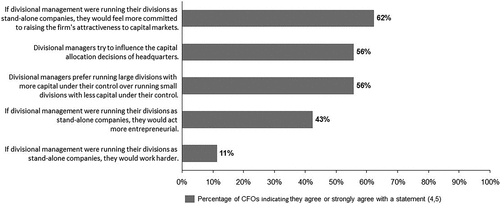
Divisional management’s superior information alone is not sufficient for inefficiencies. If incentives between headquarters and divisional management were aligned, divisional managers would act in the best interests of headquarters. Personal objectives of divisional management frequently lead to weak incentives to maximize firm value, manifesting themselves in, for example, empire building, influencing activities and lobbying, lack of effort, entrenchment, or perk consumption. Our survey examines the types of within-firm conflicts of interest frequently associated with affecting capital allocation and directly asks how CFOs assess the divergence of objectives between headquarters and divisional management. CFOs were asked to score on a scale from one (“strongly disagree”) to five (“strongly agree”) how strongly they agree with a set of statements about moral hazard at the divisional level. Understanding the various types of moral hazard inside firms is important for researchers trying to model capital allocation in firms and offer solutions for minimizing agency costs. Figure 1 and Table 2 summarize the results.
Note. We ask executives to indicate their level of agreement with these arguments on a scale from one to five, with one denoting “strongly disagree” and five denoting “strongly agree.”
Overall, our results imply (and confirm) that different forms of agency problems have a legitimate role in theoretical models of internal capital allocation. There is no single, dominant moral hazard problem at the level of divisions that executives perceive as more relevant than all others.9 For instance, we ask CFOs whether divisional management would feel more committed to raising the firm’s attractiveness to capital markets if they were running a standalone firm (De Motta 2003). Almost two thirds of CFOs (62%) agree or strongly agree, which supports the view of misaligned preferences between top management and divisional management with respect to increasing firm value.10 Divisional managers may also have preferences for building large empires (Jensen 1986, 1993; Hart and Moore 1995) or may engage in wasteful influencing activities and lobbying as a result of intrafirm bargaining for resources (Milgrom 1988, Milgrom and Roberts 1988, Meyer et al. 1992, Scharfstein and Stein 2000). A majority of financial executives confirm the empire-building tendencies of divisional managers and their attempts to influence headquarters’ decisions in their favor (56% each). Interestingly, influencing activities by divisional management are more severe if empire-building tendencies are high (67.8% versus 40.4%). This complementarity result supports the theoretical foundations of influencing models of capital allocation. For instance, in the model of Scharfstein and Stein (2000), empire-building preferences lead to influencing activities of divisional management to attract more capital to the own division.
Capital allocation models also hypothesize that the capital allocation process diminishes entrepreneurial incentives (Gertner et al. 1994, Aghion and Tirole 1997, Brusco and Panunzi 2005, Seru 2014) because headquarters can reallocate funds across divisions, which may decrease incentives to generate these funds ex ante. Forty-three percent of financial executives agree or strongly agree that divisions would behave more entrepreneurial if divisional management were running their divisions as standalone companies. Surprisingly, only 11% of CFOs believe that insufficient provision of effort at the divisional level is prevalent in their firm. Thus, withholding effort, for example, in the form of working hours, seems to be of second-order importance relative to other forms of moral hazard at the level of divisional management.
When further examining the interrelation between agency problems and capital budgeting below, we employ a composite measure of the perceived level of within-firm agency problems. We average the score of the above five ratings and use the median score as the cutoff point to classify firms into high- and low-agency cost firms. Details on the construction of the agency measure are set forth in Table A.1 of the Online Appendix. As we document below, agency problems have a profound influence on the organization of capital allocation.
Key Findings (Asymmetric Information and Within-Firm Agency Problems)
Agency and information problems between headquarters (HQ) and divisional management (DM) are acknowledged to be prevalent in the budgeting process.
Seventy-one percent of firms acknowledge an information disadvantage of HQ relative to divisions; in the cross section, informational asymmetries are more prevalent in unrelated diversified firms (80% versus 64%).
With respect to agency problems, firms acknowledge the presence of many agency motives postulated by theory, such as (i) misaligned preferences between HQ and DM with respect to increasing firm value (62%), (ii) influencing activities (56%), and (iii) empire-building preferences at the divisional level (56%).
3.2. Project Authorization and the Delegation of Authority
We begin our analysis of capital allocation by examining the allocation of investment authority between headquarters and divisions. The allocation of investment authority consists of a set of instruments and corporate policies that abstract from the individual investment project but hold for investment in general. Specifically, we examine the allocation of investment authority to lower levels of the organization (or delegation) via budget limits and layers of approval. Subsequently, we study whether and how firms implement curative mechanisms proposed by the theoretical literature to mitigate information biases or to reduce informational asymmetry.
3.2.1. Major Investments: Decision-Making Authority and Approval Thresholds.
Investments typically require top management approval if they materially affect the business as a whole, which may be determined by the size (Gitman and Forrester 1977, Malenko 2019) or nature (Marshuetz 1985) of a single project. We ask CFOs whether decision-making authority for major investments resides at headquarters. CFOs consistently report that major investment decisions are not delegated to lower-level management. Headquarters retains decision-making authority over major investments in nearly all firms (97%, shown in the Online Appendix,11 Table D.1, row 1).
Previous literature also documents that firms use approval procedures that include formal investment thresholds (see also Bower 1970; Ross 1986; Brealey and Myers 2003, p. 312). Within budgets (see below), divisions are authorized to make investment decisions for smaller projects without headquarters’ consent, but headquarter approval is required if capital expenditures are above a specified threshold level. Nearly all firms (97%) report that they use such threshold levels. We also ask CFOs to report the threshold levels that trigger central approval (Table 3).12 The mean (median) threshold level is €5 million (€0.5 million); threshold levels range from €0.001 million to €65 million. The median threshold level in the group of small firms is €100,000, whereas it is €2 million in the group of large firms.
|
Table 3. The Organization of Internal Capital Allocation: Headquarters and Investment Decisions
| Panel A | |||||
|---|---|---|---|---|---|
| Questions | Observations | Mean | Median | Minimum/maximum | |
| (1) | If approval from headquarters is required beyond a certain size of investment, from which project size (threshold amount) on does the authority to make decisions reside with headquarters? (Mio €) | 80 | 5.15 | 0.5 | 0.001/65 |
| (2) | In an average year, how many investment proposals are submitted to headquarters for approval? (n) | 105 | 78.8 | 20.0 | 2/4,500 |
| (2a) | In an average year, how many investment proposals are submitted to headquarters for approval? (outlier-adjusted) (n) | 104 | 36.3 | 20.0 | 2/300 |
| (3) | Investment proposals submitted to headquarters per division in average year (calculated: item 2a of Table 3 divided by number of operating segments) | 104 | 11.3 | 5.0 | 0.7/125 |
| Panel B | |||||||||||||
|---|---|---|---|---|---|---|---|---|---|---|---|---|---|
| Median | Size | Lines of business | Diversification | Capital constrained | Debt ratio | Agency cost | |||||||
| Small | Large | Few | Many | Related | Unrelated | No | Yes | Low | High | Low | High | ||
| (1) | 0.5 | 0.1 | 2*** | 0.4 | 1.0 | 0.6 | 0.5 | 1.0 | 0.15* | 1.0 | 0.2** | 0.6 | 0.5 |
| (2) | 20.0 | 17.5 | 25** | 18.8 | 25.0 | 20.0 | 20.0 | 20.0 | 32.5** | 17.5 | 25** | 20.0 | 25.0 |
| (2a) | 20.0 | 17.5 | 25** | 17.5 | 25.0 | 20.0 | 20.0 | 18.8 | 32.5** | 17.5 | 25** | 20.0 | 25.0 |
| (3) | 5.0 | 5.0 | 6.2 | 6.7 | 5.0 | 6.7 | 5.0* | 5.0 | 8.1** | 4.2 | 6.7** | 5.0 | 5.0 |
| Panel B (continued) | |||||||||||||||
|---|---|---|---|---|---|---|---|---|---|---|---|---|---|---|---|
| Median | Equity | Managerial ownership | Rating | Age | Tenure | Education | Winner-picking | ||||||||
| Public | Private | Low | High | High | Low | Young | Mature | Short | Long | MBA, Dr. | Others | No | Yes | ||
| (1) | 0.5 | 0.5 | 3.8 | 1.0 | 0.1*** | 5.0 | 1.2 | 0.5 | 0.6 | 1.0 | 0.5 | 1.0 | 0.5 | 0.2 | 0.6 |
| (2) | 20.0 | 20.0 | 20.0 | 22.5 | 17.5 | 25.0 | 18.8 | 20.0 | 20.0 | 20.0 | 20.0 | 20.0 | 20.0 | 10.0 | 25.0** |
| (2a) | 20.0 | 20.0 | 20.0 | 20.0 | 17.5 | 22.5 | 18.8 | 20.0 | 20.0 | 20.0 | 20.0 | 20.0 | 20.0 | 10.0 | 25.0** |
| (3) | 5.0 | 5.0 | 5.0 | 5.0 | 4.4 | 6.6 | 5.0 | 5.0 | 5.0 | 6.7 | 5.0 | 5.0 | 5.0 | 3.3 | 6.2*** |
Notes. Respondents were asked to enter a threshold amount and the number of investment proposals in an average year. Panel A reports summary statistics for the responses from all responding firms. We report the mean score, the median, the minimum, and the maximum. Panel B splits the sample by various characteristics and compares the medians across subsamples. See Table A.1 of the Online Appendix for column/variable definitions and data sources.
***, **, and * statistical significance of differences in proportions across groups at the 1%, 5%, and 10% levels, respectively.
To examine the distribution of investment threshold levels in more detail, we display boxplots of investment threshold levels for different size categories of capital expenditures in Figure 2. Each box presents the middle 50% of the distribution of threshold levels, that is, middle half of the distribution between the first and third quartile, by size group. The solid line within each box represents the median, the cross symbol is the mean, and the whiskers represent the range of data points. From the boxplots, we can discern that there is a clear tendency for threshold levels to increase with the size of capital expenditures. Median threshold levels rise from €100,000 to €10 million as we move from the bottom to the top group of firms. A similar tendency is also given with respect to firm size (shown in the Online Appendix, Figure E.1). Threshold levels also tend to cluster at salient reference points, such as €100,000, €500,000, €1,000,000, or €10,000,000, which is most evident for firms with low capital expenditures. For instance, the box plots for the two bottom groups of firms (the subsamples of firms with capital expenditures smaller than €10 million and €10–50 million) display that threshold levels cluster at €100,000 and €500,000, respectively, as the entire probability mass between the median and 75th percentile of these groups’ distributions concentrate at or around these threshold levels.
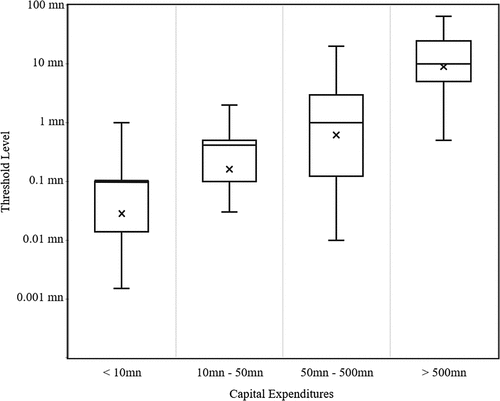
Notes. This figure summarizes the distribution of investment threshold levels for different size categories of firm capital expenditures (in box plot form). The horizontal axis displays four size categories of annual firm capital expenditures (in Euro, ‘mn’ = million) in increasing order. The vertical axis displays the threshold level (on a logarithmic scale) above which an investment requires approval by headquarters. Each box presents the middle 50% of the distribution of threshold levels, that is, the middle half of the distribution between the first and third quartile, by size group. The middle line of the box represents the median, and the cross symbol is the mean. The whiskers that extend above and below each box represent the range of data points.
3.2.2. Division Budgets.
Despite the importance of headquarters for major corporate investment decisions, firms partially delegate investment authority to their divisional managers in the capital budgeting process. For instance, Graham et al. (2015) recently show that the delegation of authority varies across the five major financial policies of the firm (M&A, capital structure, payout, capital allocation, investment), with capital allocation and investment decisions being delegated most frequently to lower levels in the hierarchy. Although their study provides novel insights about financial policies, it is not concerned with the main instrument of investment autonomy: the size of divisions’ budgets for capital investments. Headquarters typically assigns budgets for its divisions; within budget limits division managers have capital investment autonomy for projects below the threshold level. We exploit the cross-sectional variation in the data to test predictions suggested by theories of delegation. As described in Section 2.3, we perform univariate tests in subsequent tables but only report findings in the paper if they are robust to the multivariate specifications and tests. To simplify exposition, we provide all additional analyses in the Online Appendix.
CFOs report that a noteworthy average of 39% of annual capital expenditures do not require higher-level investment approval by headquarters (Table 4, row 1). This result is surprisingly high, indicating that firms provide divisions with considerable discretion about how to spend the firm’s capital; firms delegate a large portion of their overall investments to divisional management.13 This finding also demonstrates that capital allocation involves more than bottom-up project initiation and top-down capital allocation, as many finance textbooks suggest (see, e.g., Brealey and Myers 2003): Substantial investment authority resides decentralized at lower levels of the organization.14
|
Table 4. The Organization of Internal Capital Allocation: Headquarters and Investment Decisions
| Panel A | |||||
|---|---|---|---|---|---|
| Questions | Observations | Mean | Median | Minimum/maximum | |
| (1) | What percentage of the total amount of capital expenditures of your company in an average year does not require explicit approval by the headquarters (e.g., because it is part of an initial divisional budget)? (%) | 105 | 38.8 | 40.0 | 0/95 |
| (2) | On average, how many of these (= investment proposals, see Table 3) obtain approval? (%) | 105 | 77.7 | 80.0 | 17/100 |
| (3) | On average, how many proposals receive close scrutiny by headquarters? (%) | 92 | 68.6 | 72.5 | 0/100 |
| Panel B | |||||||||||||
|---|---|---|---|---|---|---|---|---|---|---|---|---|---|
| Mean | Size | Lines of business | Diversification | Capital constrained | Debt ratio | Agency cost | |||||||
| Small | Large | Few | Many | Related | Unrelated | No | Yes | Low | High | Low | High | ||
| (1) | 38.8 | 28.9 | 45.7*** | 38.8 | 38.9 | 40.6 | 36.4 | 42.0 | 32.1* | 44.5 | 31.3** | 44.2 | 31.6** |
| (2) | 77.7 | 76.3 | 78.8 | 77.0 | 78.7 | 76.9 | 78.8 | 79.1 | 75.0 | 78.6 | 76.6 | 79.9 | 73.9 |
| (3) | 68.6 | 74.5 | 65.0 | 69.6 | 67.5 | 64.8 | 73.6 | 70.0 | 65.6 | 70.0 | 67.0 | 68.6 | 66.9 |
| Panel B (continued) | |||||||||||||
|---|---|---|---|---|---|---|---|---|---|---|---|---|---|
| Mean | Equity | Managerial ownership | Rating | Age | Tenure | Education | |||||||
| Public | Private | Low | High | High | Low | Young | Mature | Short | Long | MBA, Dr. | Others | ||
| (1) | 38.8 | 38.2 | 41.9 | 41.8 | 32.8 | 43.8 | 40.1 | 37.7 | 40.0 | 38.2 | 39.3 | 41.0 | 34.3 |
| (2) | 77.7 | 76.8 | 82.1 | 78.8 | 75.6 | 76.8 | 73.4 | 77.7 | 77.8 | 76.8 | 78.6 | 76.2 | 80.9 |
| (3) | 68.6 | 68.6 | 68.7 | 66.2 | 73.7 | 65.1 | 66.3 | 70.2 | 66.8 | 71.1 | 66.0 | 66.3 | 73.5 |
Notes. Respondents were asked to enter percentages. Panel A reports summary statistics for the responses from all responding firms. We report the mean score, the median, the minimum, and the maximum. Panel B splits the sample by various characteristics and compares the mean score across subsamples using standard differences in means tests. See Table A.1 of the Online Appendix for column/variable definitions and data sources.
***, **, and * statistical significance of differences in proportions across groups at the 1%, 5%, and 10% levels, respectively.
When we examine firm characteristics that are associated with the fraction of overall capital expenditures that divisions can make without explicit signoff (i.e., the degree or extent of delegation/decentralization), we find this number is significantly higher for large firms than for small firms (45.7% versus 28.9%). Theories of firm size and scope can explain this result. As firm size expands, local information becomes more costly to aggregate and transmit through the hierarchy (Garicano 2000, Bloom et al. 2010). Top management is also time constrained over the investment decisions they can make (Penrose 1959, Chandler 1962), which favors the decentralization of the investment decision to divisional management if firms are large. We also find that divisional budgets are significantly smaller for firms whose CFOs report substantial agency conflicts between headquarters and divisional management (31.6% versus 44.2%). This difference between the two groups is economically significant and supports the central prediction of theories of decentralization: Agency problems reduce the level of delegation, and hence, headquarters seeks to retain decision-making control (see, e.g., Dessein 2002). Finally, the CFOs of high debt-ratio firms report significantly lower levels of decentralization than CFOs of low debt-ratio firms do (31.3% versus 44.5%). To the extent that debt disciplines top management (Jensen 1986), this result supports the view of a negative relation between high-powered incentives at the level of headquarters and the level of decentralization inside the firm (Hart and Holmström 2010).15
Overall, our results support inferences made by theories of decentralization (see, e.g., Bloom et al. 2012) that suggest a tradeoff between the benefits of the efficient use of local information (e.g., lower information acquisition and processing cost) and its costs of agency (e.g., loss of control/empire-building, monitoring cost). Our conditioning analysis provides evidence that firms balance these benefits and costs of decentralization (or delegation) when allocating capital. The on-average results also demonstrate that the extent to which firms delegate investment authority via divisional budgets is relatively high: A large fraction of overall capital investments does not require explicit investment approval by headquarters.
Key Findings (Project Authorization and the Delegation of Authority)
Ninety-seven percent of firms report that HQ has decision-making authority over major investments.
Nearly all firms use project authorization levels for major investments (“Thresholds”). (i) The mean (median) threshold level is €5 million (€0.5 million). (ii) Threshold levels increase with overall capital expenditures and firm size.
Nevertheless, firms give divisions considerable discretion over capital expenditures; 39% of capital expenditures do not require explicit investment approval.
Consistent with theories of decentralization this fraction is (i) higher for large firms than for small firms (46% versus 29%), (ii) lower for firms that report substantial agency conflicts between HQ and DM (32% versus 44%), and (iii) lower for firms with high financial leverage/debt ratios (31% versus 45%).
3.3. Information Aggregation and Information Production
To reach high-quality investment decisions for major investments, firms use local private information provided via investments proposals and aggregate this information at the level of corporate headquarters (e.g., Radner 1992, 1993; Bolton and Dewatripont 1994). Investment proposals typically contain cash flow projections, financial analyses, and backup information; they are frequently initiated bottom-up by the divisions. We are interested in examining the extent to which headquarters relies on these reports of divisions’ private information or whether headquarters relies instead, at least in part, on other methods to elicit private information from divisional managers. Before examining such organizational responses, we provide some basic facts about the information aggregation process through investment proposals.
3.3.1. Information Aggregation via Investment Proposals.
Table 3 displays the number of investment proposals that operating divisions submit to headquarters in an average year. The number of proposals ranges between 2 and 300 projects,16 with 20 proposals per year for the median firm and 36 proposals on average. Small firms have a median of 18 investment proposals compared with 25 proposals in large firms. The seemingly low number of proposals for the median firm could be both a result of supply and demand effects in the capital budgeting process. For instance, top management time constraints and CEO overload may limit the number of proposals that top management can screen and approve (see, e.g., Levy and Sarnat 1994, p. 96). Alternatively, division managers may choose to constrain themselves to submitting only the most promising proposals due to, for instance, possible concerns about their reputation for identifying profitable investment opportunities. Table 3 also displays the number of proposals divided by the number of operating segments; the mean (median) number of proposals is 11 (5) per division and year. We also ask executives which percentage of these proposals receives final approval (Table 4, row 2). The average acceptance rate for investment proposals is 78%, which does not vary conditionally on different firm characteristics.
However, constraints on management time are not the only frictions that top management face when processing information provided by divisional management. It is well known that managers have incentives to manipulate financial projections to achieve larger-than-efficient resource allocations or more favorable evaluation benchmarks (Antle and Fellingham 1997, Stein 1997, Bernardo et al. 2001). Managerial overconfidence may also lead divisional management to systematically overestimate the returns on their investment projects (Malmendier and Tate 2005). The financial executives in our study are aware of these distortions and know that information from divisional management is likely to be biased. Nearly all executives (98.2%) report that divisions provide detailed financial information (such as cash flow forecasts or net present value (NPV) calculations) as part of their investment proposals (see Online Appendix D.2). However, only approximately one third of these executives consider forecasts to be relatively reliable (see Online Appendix D.3). More than half the executives (50.9%) indicate that cash flow and NPV forecasts are biased upward—that is, higher or substantially higher—than actual outcomes.
Because investment distortions from misrepresentation of information can be significant, potential remedies for such distortions have been a matter of long-standing interest in the literature.17 In the following section, we examine the practices that firms use to alleviate this problem of control.
3.3.2. Capital Budgeting Mechanisms for Eliciting Truthful Reporting of Private Information.
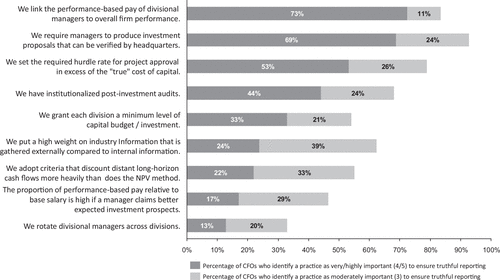
Scholars in management accounting and finance have proposed a variety of curative mechanisms that can ensure that divisional managers provide truthful information (see Stein (2003, p. 143), or Haka (2006) for an overview). Yet it has remained largely unclear whether and to what extent these schemes are employed in practice; to the best of our knowledge, these questions have not been studied elsewhere. We examine the relative importance of various mechanisms proposed by previous research and ask CFOs to rate them on a scale from one (not important) to five (highly important).18 Figure 3 and Table 5 summarize the results.
|
Table 5. The Organization of Internal Capital Allocation: Headquarters and Investment Decisions: Survey Responses to the Question “How Important are the Following Business Practices in Your Company to Ensure That Divisional Managers Provide Truthful Forecasts and Do Not Overstate the Attractiveness of Investment Projects? If You Use These Practices for Other Reasons and Not for Truthful Reporting, Please Check ‘Not Important’”
| Panel A | ||||||
|---|---|---|---|---|---|---|
| Question | Observations | Mean | Percentage very or highly important | Percentage somewhat or not important | Statistical differences of proportions in rows | |
| (1) | We link the performance-based pay of divisional managers to overall firm performance. | 109 | 3.70 | 72.5 | 16.5 | 3–9 |
| (2) | We require divisional managers to produce investment proposals with information that can be verified by headquarters. | 109 | 3.83 | 68.8 | 7.3 | 3–9 |
| (3) | We set the required hurdle rate for project approval in excess of the “true” cost of capital. | 109 | 3.27 | 53.2 | 21.1 | 1–2, 5–9 |
| (4) | We have institutionalized postinvestment audits. | 109 | 3.11 | 44.0 | 32.1 | 1–2, 6–9 |
| (5) | We grant each division a minimum level of capital budget / investment. | 109 | 2.72 | 33.0 | 45.9 | 1–3, 8–9 |
| (6) | We put a relatively high weight on industry information that is gathered externally compare to internal information. | 109 | 2.67 | 23.9 | 37.6 | 1–4, 9 |
| (7) | We adopt criteria (e.g., payback rules) that discount distant long-horizon cash flows more heavily than does the NPV method. | 109 | 2.51 | 22.0 | 45.0 | 1–4 |
| (8) | The proportion of performance-based pay relative to base salary is high if a divisional manager claims better expected investment prospects. | 109 | 2.33 | 17.4 | 53.2 | 1–5 |
| (9) | We rotate divisional managers across divisions. | 109 | 2.03 | 12.8 | 67.0 | 1–6 |
| Panel B | |||||||||||||
|---|---|---|---|---|---|---|---|---|---|---|---|---|---|
| Percentage very or highly important | Size | Lines of business | Diversification | Capital constrained | Debt ratio | Agency cost | |||||||
| Small | Large | Few | Many | Related | Unrelated | No | Yes | Low | High | Low | High | ||
| (1) | 72.5 | 70.5 | 73.8 | 78.0 | 66.0 | 70.5 | 75.0 | 73.3 | 70.6 | 70.5 | 75.0 | 62.1 | 83.7** |
| (2) | 68.8 | 70.5 | 67.7 | 64.4 | 74.0 | 72.1 | 64.6 | 72.0 | 61.8 | 67.2 | 70.8 | 63.8 | 76.7 |
| (3) | 53.2 | 36.4 | 64.6*** | 49.2 | 58.0 | 55.7 | 50.0 | 61.3 | 35.3** | 54.1 | 52.1 | 62.1 | 44.2* |
| (4) | 44.0 | 36.4 | 49.2 | 28.8 | 62.0*** | 41.0 | 47.9 | 48.0 | 35.3 | 41.0 | 47.9 | 41.4 | 46.5 |
| (5) | 33.0 | 25.0 | 38.5 | 35.6 | 30.0 | 36.1 | 29.2 | 38.7 | 20.6* | 36.1 | 29.2 | 27.6 | 37.2 |
| (6) | 23.9 | 25.0 | 23.1 | 20.3 | 28.0 | 24.6 | 22.9 | 25.3 | 20.6 | 23.0 | 25.0 | 22.4 | 25.6 |
| (7) | 22.0 | 25.0 | 20.0 | 18.6 | 26.0 | 21.3 | 22.9 | 26.7 | 11.8* | 24.6 | 18.8 | 24.1 | 18.6 |
| (8) | 17.4 | 20.5 | 15.4 | 15.3 | 20.0 | 16.4 | 18.8 | 20.0 | 11.8 | 18.0 | 16.7 | 13.8 | 23.3 |
| (9) | 12.8 | 13.6 | 12.3 | 10.2 | 16.0 | 16.4 | 8.3 | 12.0 | 14.7 | 11.5 | 14.6 | 12.1 | 16.3 |
| Panel B (continued) | |||||||||||||
|---|---|---|---|---|---|---|---|---|---|---|---|---|---|
| Percentage very or highly important | Equity | Managerial ownership | Rating | Age | Tenure | Education | |||||||
| Public | Private | Low | High | High | Low | Young | Mature | Short | Long | MBA, Dr. | Others | ||
| (1) | 72.5 | 74.7 | 61.1 | 71.2 | 75.0 | 71.4 | 70.0 | 71.2 | 74.0 | 83.3 | 61.8** | 72.2 | 73.0 |
| (2) | 68.8 | 69.2 | 66.7 | 64.4 | 77.8 | 71.4 | 50.0 | 67.8 | 70.0 | 77.8 | 60.0** | 70.8 | 64.9 |
| (3) | 53.2 | 52.7 | 55.6 | 56.2 | 47.2 | 38.1 | 63.3* | 52.5 | 54.0 | 51.9 | 54.5 | 55.6 | 48.6 |
| (4) | 44.0 | 44.0 | 44.4 | 47.9 | 36.1 | 52.4 | 43.3 | 42.4 | 46.0 | 46.3 | 41.8 | 45.8 | 40.5 |
| (5) | 33.0 | 31.9 | 38.9 | 32.9 | 33.3 | 38.1 | 30.0 | 37.3 | 28.0 | 37.0 | 29.1 | 29.2 | 40.5 |
| (6) | 23.9 | 25.3 | 16.7 | 19.2 | 33.3 | 23.8 | 20.0 | 20.3 | 28.0 | 22.2 | 25.5 | 29.2 | 13.5* |
| (7) | 22.0 | 22.0 | 22.2 | 20.5 | 25.0 | 14.3 | 20.0 | 16.9 | 28.0 | 16.7 | 27.3 | 22.2 | 21.6 |
| (8) | 17.4 | 17.6 | 16.7 | 15.1 | 22.2 | 19.0 | 6.7 | 16.9 | 18.0 | 16.7 | 18.2 | 20.8 | 10.8 |
| (9) | 12.8 | 13.2 | 11.1 | 13.7 | 11.1 | 9.5 | 16.7 | 15.3 | 10.0 | 18.5 | 7.3* | 12.5 | 13.5 |
Notes. Ratings are based on a five-point Likert scale from one (not important) to five (highly important). Panel A reports summary statistics for the responses from all responding firms. We report the mean score, the percentage of respondents that find a business practice very (four) or highly important (five), and the percentage of respondents that find a business practice somewhat (two) or not important (one). The last column reports results from McNemar tests (for the analysis of multiple proportions drawn from a single sample) to examine whether ratings of each pair of subquestions are statistically different. For instance, the rating in row 1 (“We link the performance-based pay of divisional managers to overall firm performance.”; % very or highly important) is statistically different from the ratings in rows 3–9. Panel B splits the sample by various characteristics and compares the proportion of respondents that answered four (very important) and five (highly important). See Table A.1 of the Online Appendix for column/variable definitions and data sources.
***, **, and * statistical significance of differences in proportions across groups at the 1%, 5%, and 10% levels, respectively.
The financial executives in our sample state that the most important control mechanism for motivating truthful representation in the budgeting process is making divisional managers’ compensation a function of overall firm performance. Seventy-three percent of CFOs find this mechanism very or highly important. For instance, Loeb and Magat (1978), Groves and Loeb (1979), Cohen and Loeb (1984), Antle and Fellingham (1997), and Bernardo et al. (2004) posit that sharing the entire firm’s profit with divisional management provides the appropriate incentives to achieve truthful forecasts. Such compensation tied to the firm’s overall performance puts the divisional manager in an owner-like position. Interestingly, the scheme is relatively less important for firms with many lines of business (66.0% versus 78.0%, see also Online Appendix E.4, column 1), which is consistent with the arguments that free-rider problems make profit sharing less effective (see, e.g., Baker et al. 1988) or that cooperation among divisional managers (e.g., Lazear 1989) decreases with an increasing number of projects.19
Another highly rated measure to curb misrepresentation is to require investment proposals with information that is verifiable by headquarters (68.8%) (see Stein 2002). Such hard easy-to-verify information is important because headquarters can then audit investment proposals to discover the true productivities of capital (Harris and Raviv 1996, 1998). Interestingly, firms find this measure relatively more important if they report high agency problems (76.7% versus 63.8%), which suggests that requiring verifiable information is particularly effective at inducing truthful reporting when division managers’ preferences to follow personal agendas are strong.
We also examine whether firms use inflated hurdle rates to correct for the misrepresentation of private information. This argument is related to the literature on capital rationing. Firms trade off foregone profits of marginally profitable projects with the costs of eliciting private information (informational rents) that must be paid to divisional managers (Antle and Eppen 1985, Antle and Fellingham 1997). More than half (53.2%) of executives use inflated hurdle rates in excess of the “true” cost of capital to avoid misrepresentation of private information. Large hierarchically more complex firms find this “rule-based” measure relatively more important (64.6% versus 36.4%), which perhaps indicates that a simple, universal rule is relatively less costly for these firms to counteract misrepresentation of information than more complex procedures that require, for example, case-by-case assessments.
Other methods of eliminating managers’ misrepresentation of private information include ex post control mechanisms such as institutionalized postinvestment audits. Ex post information production may be less costly than capital rationing to mitigate ex ante information problems (Antle and Eppen 1985). Our results indicate that postaudits of investment projects are less common than intuition may suggest. Only 44% of firms report using postaudits to motivate truthful representations. The result is interesting because previous research indicates that postaudits can outperform other mechanisms at inducing truth-telling (Magee (1980) for an analytical approach; Chow et al. (2000) in an experimental setting). One possible explanation for this reluctance to employ postaudits is that firms are frequently unwilling to abandon capital projects (Jensen 1993), for instance, because of top managers’ career concerns (Staw 1976, Kanodia et al. 1989). Alternatively, although postaudits may be considered effective to achieve truthful representation ex ante, they may be inefficient ex post. For instance, disentangling biases in forecasts from good or bad luck may prove challenging. Such time-consistency problems may make it difficult for firms to uphold the consistent use of postaudits over time. The auditing of capital projects is significantly more important for firms with many lines of business (62.0% versus 28.8%), which is consistent with the view that an audited, abandoned project is less (more) detrimental to top management’s reputation in the executive labor market if the project is carried out within one of many (few) divisions. It is also in line with the notion that providing firm-level compensation incentives for truthful reporting (positive incentives, “carrot”) is less cost-effective in firms with many lines of business (see above) and those firms tend to apply measures of direct oversight (negative incentives, “stick”).
Other practices that may help firms address information problems are less frequently important. For instance, Ozbas (2005) argues that rigid divisional capital budgets and job rotation programs can improve divisional managers’ incentives for truthful communication with headquarters. Indeed, 33.0% and 12.8% of firms find these arguments very or highly important. Bernardo et al. (2001, 2004) propose explicit incentives for divisional managers. In the authors’ optimal compensation contract, the proportion of performance-based pay relative to base salary is high if divisional managers claim better expected investment prospects. Such flexible and information-sensitive contract designs at the divisional level are important for approximately one sixth (17.4%) of firms.
Key Findings (Information Aggregation and Information Production)
The number of investment proposals submitted to headquarters is surprisingly low with a median of 20 per firm and 5 per division and year.
Divisional managers provide biased forecasts. Only approximately one third of executives consider forecasts to be relatively reliable.
To motivate truthful reporting, firms use instruments that (normative) research in finance and accounting posits. The most relevant are (i) linking performance-based pay of divisional managers to total firm performance (73%), (ii) investment proposals with hard easy-to-verify information (69%), (iii) hurdle rates exceeding the “true” cost of capital (53%), and (iv) institutionalized postinvestment audits (44%).
4. Capital Investment in Internal Capital Markets
4.1. Decision Rules of Capital Allocation
In the next section, we examine capital budgeting methods and decision rules: both formal and informal ones. Our analysis differs from previous studies on formal decision rules to evaluate projects (Bierman 1993, Trahan and Gitman 1995, Graham and Harvey 2001) in that it examines, to the best of our knowledge for the first time, cross-sectional dimensions that are specific to firms whose divisions seek funds through internal capital markets. Subsequently, we examine the importance of informal budgeting measures that have been proposed by previous research. Among these measures are the assessment of managerial abilities and strategic information of top management when allocating capital to certain businesses, and there is considerable anecdotal evidence that the use of these rules is common. As we show, their relative importance is strongly associated with our measure of agency problems between top management and divisional management and other firm characteristics.
4.1.1. Financial Analysis, Formal Decision Rules, and Bottom-up Measures.
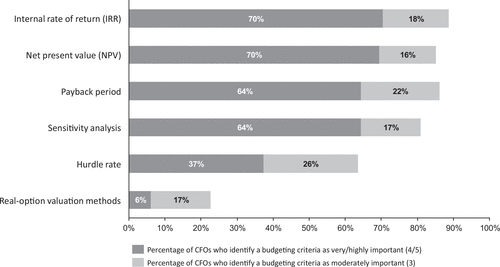
We first asked CFOs to indicate the relative importance of the standard capital budgeting decision rules recommended by finance textbooks, including NPV, IRR, hurdle rate, payback period, sensitivity analysis, and real-option valuation methods. CFOs were asked to score the importance that they attribute to the different budgeting techniques on a scale of one to five, with one denoting “not important” and five denoting “very important.” Our sample results are summarized in Figure 4 and Table 6.
|
Table 6. Headquarters and Allocation of Capital: Survey Responses to the Question “How Important Are the Following Financial Criteria for Your Capital Allocation Decision?”
| Panel A | ||||||
|---|---|---|---|---|---|---|
| Question | Observations | Mean | Percentage very or highly important | Percentage somewhat or not important | Statistical differences of proportions in rows | |
| (1) | Internal rate of return (IRR) | 115 | 3.84 | 70.4 | 11.3 | 5–6 |
| (2) | Net present value (NPV) | 115 | 3.82 | 69.6 | 14.8 | 5–6 |
| (3) | Payback period | 115 | 3.77 | 64.3 | 13.9 | 5–6 |
| (4) | Sensitivity analysis | 115 | 3.60 | 64.3 | 19.1 | 5–6 |
| (5) | Hurdle rate | 115 | 2.93 | 37.4 | 36.5 | 1–4, 6 |
| (6) | Real-option valuation methods | 115 | 1.77 | 6.1 | 77.4 | 1–5 |
| Panel B | |||||||||||||
|---|---|---|---|---|---|---|---|---|---|---|---|---|---|
| Percentage very or highly important | Size | Lines of business | Diversification | Capital constrained | Debt ratio | Agency cost | |||||||
| Small | Large | Few | Many | Related | Unrelated | No | Yes | Low | High | Low | High | ||
| (1) | 70.4 | 70.8 | 70.1 | 73.0 | 67.3 | 78.5 | 60.0** | 71.2 | 68.6 | 69.2 | 72.0 | 69.4 | 75.0 |
| (2) | 69.6 | 60.4 | 76.1* | 66.7 | 73.1 | 72.3 | 66.0 | 70.0 | 68.6 | 72.3 | 66.0 | 66.1 | 75.0 |
| (3) | 64.3 | 72.9 | 58.2 | 66.7 | 61.5 | 52.3 | 80.0*** | 65.0 | 62.9 | 67.7 | 60.0 | 61.3 | 63.6 |
| (4) | 64.3 | 54.2 | 71.6* | 58.7 | 71.2 | 69.2 | 58.0 | 66.2 | 60.0 | 67.7 | 60.0 | 64.5 | 68.2 |
| (5) | 37.4 | 22.9 | 47.8*** | 30.2 | 46.2* | 40.0 | 34.0 | 45.0 | 20.0** | 38.5 | 36.0 | 40.3 | 29.5 |
| (6) | 6.1 | 4.2 | 7.5 | 4.8 | 7.7 | 6.2 | 6.0 | 6.2 | 5.7 | 6.2 | 6.0 | 4.8 | 9.1 |
| Panel B (continued) | |||||||||||||||
|---|---|---|---|---|---|---|---|---|---|---|---|---|---|---|---|
| Percentage very or highly important | Equity | Managerial ownership | Rating | Age | Tenure | Education | Information asymmetries | ||||||||
| Public | Private | Low | High | High | Low | Young | Mature | Short | Long | MBA, Dr. | Others | Low | High | ||
| (1) | 70.4 | 68.4 | 80.0 | 71.8 | 67.6 | 63.6 | 67.7 | 74.6 | 65.4 | 74.1 | 66.7 | 71.4 | 68.4 | 80.6 | 68.0 |
| (2) | 69.6 | 70.5 | 65.0 | 73.1 | 62.2 | 68.2 | 67.7 | 73.0 | 65.4 | 79.3 | 59.6** | 70.1 | 68.4 | 80.6 | 65.3 |
| (3) | 64.3 | 64.2 | 65.0 | 62.8 | 67.6 | 31.8 | 74.2*** | 69.8 | 57.7 | 65.5 | 63.2 | 62.3 | 68.4 | 48.4 | 68.0* |
| (4) | 64.3 | 65.3 | 60.0 | 65.4 | 62.2 | 72.7 | 61.3 | 61.9 | 67.3 | 74.1 | 54.4** | 62.3 | 68.4 | 67.7 | 65.3 |
| (5) | 37.4 | 38.9 | 30.0 | 37.2 | 37.8 | 59.1 | 41.9 | 30.2 | 46.2* | 31.0 | 43.9 | 39.0 | 34.2 | 29.0 | 38.7 |
| (6) | 6.1 | 6.3 | 5.0 | 7.7 | 2.7 | 9.1 | 9.7 | 4.8 | 7.7 | 5.2 | 7.0 | 5.2 | 7.9 | 3.2 | 8.0 |
Notes. Ratings are based on a five-point Likert scale from one (not important) to five (highly important). Panel A reports summary statistics for the responses from all responding firms. We report the mean score, the percentage of respondents that find a budgeting method very (four) or highly important (five), and the percentage of respondents that find a budgeting method somewhat (two) or not important (one). The last column reports results from McNemar tests (for the analysis of multiple proportions drawn from a single sample) to examine whether ratings of each pair of subquestions are statistically different. For instance, the rating in row 1 (“Internal rate of return (IRR)”; % very or highly important) is statistically different from the ratings in rows 5 and 6. Panel B splits the sample by various characteristics and compares the proportion of respondents that answered four (very important) and five (highly important) across subsamples. See Table A.1 of the Online Appendix for column/variable definitions and data sources.
***, **, and * statistical significance of differences in proportions across groups at the 1%, 5%, and 10% levels, respectively.
IRR, NPV, payback period, and sensitivity analyses are the CFOs’ most widely used techniques to allocate funds. Approximately two thirds of our respondents rate this cluster of factors as very or highly important in their decisions to provide divisions with capital. Only 37% of firms find hurdle rates very or highly important. Interestingly, very few firms—only seven in the sample (6%)—find real-option methods very or highly important in evaluating investment projects. The overall results about the budgeting techniques employed are in line with the survey of Graham and Harvey (2001) of U.S. firms. Our study also confirms the authors’ findings on the importance of the payback period despite its shortcomings (e.g., no discounting of cash flows, bias toward short-lived projects).
However, the relative importance of individual budgeting techniques is different in the cross-section of firms. The analysis puts forth a set of novel results, particularly with respect to firms that operate unrelated businesses. Unrelated diversifiers rank payback period as the most important budgeting technique (80.0%), with NPV as the next closest at 66.0%. IRR is relatively less important (60.0%) for these firms. One possible explanation for the prominence of the payback technique for firms with unrelated businesses is related to the degree of information problems between the corporate center and its business divisions. If divisions operate in unrelated businesses, informational asymmetries are likely more pronounced because headquarters is frequently less knowledgeable about the foundations of divisional investment proposals. Therefore, headquarters may want to adopt payback rules to place more weight on near-term cash flows that can signal the true project quality in the short run and thus contradict a divisional manager’s ex ante evaluation of a capital project at an early stage (see also Bernardo et al. 2001). If cash flows are below forecasts, the firm can force corrective actions, such as abandoning poorly performing investments. Thus, our findings may suggest that the payback criterion can protect especially firms with unrelated businesses against problems of informational asymmetry. We find further evidence for this postulate in unreported analysis. The payback period is rated as the most important technique among firms that indicate a strong informational advantage in favor of divisional managers (68.0% versus 48.4%).
We also look at the importance of IRR and control for the relatedness of divisions. The relatively low prominence of IRR for unrelated diversified firms relative to related diversified firms (60.0% versus 78.5%) may stem from the incompleteness of the criterion when comparing unrelated businesses whose systematic risks differ significantly. Whereas the use of IRR can be acceptable if systematic risks of competing projects are similar, its application may be particularly costly if businesses differ significantly, which is likely in the case of diversified firms with unrelated businesses.20 In this regard, our result is related to the findings in Krüger et al. (2015), who show that failure to account for risk differences in multidivision firms is less likely if the economic costs of doing so are high.
Furthermore, our survey reveals that firms with low credit ratings are significantly more likely to find payback periods important (74.2% versus 31.8%). To the extent that ratings proxy for financial capacity, our result suggests that capital-constrained firms may emphasize liquidity in their budgeting decision and rank projects according to their ability to generate cash quickly (see Pike 1983; Weston and Brigham 1993, p. 69).
Conditional analysis further reveals that hurdle rates are relatively less important for firms that report capital constraints (45.0% versus 20.0%).21 This result is intuitive. When resources are limited, projects compete for their share of a fixed amount of capital. Therefore, firms are not able to undertake all NPV-positive projects, and the approval decision should be based on the relative profitability of the projects. However, because a firm commits itself to fund projects that meet or exceed its hurdle rate, it may be less useful for capital-constrained firms; the firm would have to employ an iterative process of determining the hurdle rate that matches capital supply and demand.
Finally, CFO characteristics are important for the budgeting measure of choice. CFOs with short tenures find NPV (79.3% versus 59.6%) and sensitivity analyses (74.1% versus 54.4%) relatively more important than their peers with long tenures, which may result from short-tenured CFO’s stronger incentives to protect their more vulnerable reputations by using “objective” measures for value creation. Alternatively, the stronger emphasis on these more advanced textbook methods may be due to the possibility that relatively new CFOs having received education more recently compared with their more seasoned peers.
4.1.2. Informal Decision Rules and Top-Down Measures.
We also asked CFOs explicitly about the informal decision rules that they apply in their capital allocation decisions and find surprising results (Figure 5; Table 7). Remarkably, CFOs rate the three most important “soft” measures affecting capital allocation larger in absolute magnitude than all the financial measures mentioned above. Overall, these three rules are perceived as nearly similar in relevance, namely, “strategic information of headquarters” (82.6%), the “assessment of divisional managers’ abilities” (79.1%), and the firm’s “ability to execute projects (e.g., manpower, knowledge)” (79.1%). When including these soft factors, IRR (70.4%) and NPV (69.6%), the most prominent financial measures, rank only fourth and fifth.
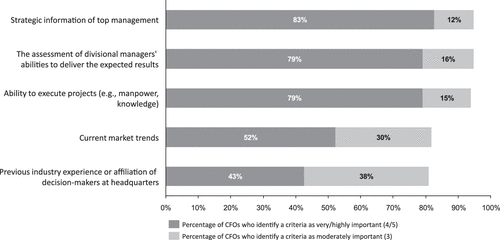
|
Table 7. Headquarters and Allocation of Capital: Survey Responses to the Question “How Important Are the Following Factors That Go Beyond Pure Financial Criteria for Your Capital Allocation Decision?”
| Panel A | ||||||
|---|---|---|---|---|---|---|
| Question | Observations | Mean | Percentage very or highly important | Percentage somewhat or not important | Statistical differences of proportions in rows | |
| (1) | Strategic information of top management | 115 | 4.0 | 82.6 | 5.2 | 4–5 |
| (2) | The assessment of divisional managers’ abilities to deliver the expected results | 115 | 4.0 | 79.1 | 5.2 | 4–5 |
| (3) | Ability to execute projects (e.g., manpower, knowledge) | 115 | 4.1 | 79.1 | 6.1 | 4–5 |
| (4) | Current market trends | 115 | 3.5 | 52.2 | 18.3 | 1–3 |
| (5) | Previous industry experience or affiliation of decision-makers at headquarters | 115 | 3.3 | 42.6 | 19.1 | 1–3 |
| Panel B | |||||||||||||
|---|---|---|---|---|---|---|---|---|---|---|---|---|---|
| Percentage very or highly important | Size | Lines of business | Diversification | Capital constrained | Debt ratio | Agency cost | |||||||
| Small | Large | Few | Many | Related | Unrelated | No | Yes | Low | High | Low | High | ||
| (1) | 82.6 | 75.0 | 88.1* | 82.5 | 82.7 | 84.6 | 80.0 | 85.0 | 77.1 | 84.6 | 80.0 | 75.8 | 88.6* |
| (2) | 79.1 | 83.3 | 76.1 | 85.7 | 71.2* | 72.3 | 88.0** | 82.5 | 71.4 | 80.0 | 78.0 | 74.2 | 86.4 |
| (3) | 79.1 | 83.3 | 76.1 | 79.4 | 78.8 | 81.5 | 76.0 | 83.8 | 68.6* | 81.5 | 76.0 | 79.0 | 77.3 |
| (4) | 52.2 | 47.9 | 55.2 | 54.0 | 50.0 | 61.5 | 40.0** | 53.8 | 48.6 | 49.2 | 56.0 | 53.2 | 50.0 |
| (5) | 42.6 | 45.8 | 40.3 | 42.9 | 42.3 | 47.7 | 36.0 | 45.0 | 37.1 | 44.6 | 40.0 | 32.3 | 56.8** |
| Panel B (continued) | |||||||||||||
|---|---|---|---|---|---|---|---|---|---|---|---|---|---|
| Percentage very or highly important | Equity | Managerial ownership | Rating | Age | Tenure | Education | |||||||
| Public | Private | Low | High | High | Low | Young | Mature | Short | Long | MBA, Dr. | Others | ||
| (1) | 82.6 | 83.2 | 80.0 | 84.6 | 78.4 | 86.4 | 87.1 | 79.4 | 86.5 | 84.5 | 80.7 | 81.8 | 84.2 |
| (2) | 79.1 | 80.0 | 75.0 | 78.2 | 81.1 | 54.5 | 90.3*** | 77.8 | 80.8 | 81.0 | 77.2 | 81.8 | 73.7 |
| (3) | 79.1 | 82.1 | 65.0* | 76.9 | 83.8 | 77.3 | 83.9 | 76.2 | 82.7 | 77.6 | 80.7 | 81.8 | 73.7 |
| (4) | 52.2 | 54.7 | 40.0 | 52.6 | 51.4 | 45.5 | 48.4 | 58.7 | 44.2 | 53.4 | 50.9 | 57.1 | 42.1 |
| (5) | 42.6 | 43.2 | 40.0 | 41.0 | 45.9 | 36.4 | 45.2 | 42.9 | 42.3 | 48.3 | 36.8 | 42.9 | 42.1 |
Notes. Ratings are based on a five-point Likert scale from one (not important) to five (highly important). Panel A reports summary statistics for the responses from all responding firms. We report the mean score, the percentage of respondents that find a factor very (four) or highly important (five), and the percentage of respondents that find a factor somewhat (two) or not important (one). The last column reports results from McNemar tests (for the analysis of multiple proportions drawn from a single sample) to examine whether ratings of each pair of subquestions are statistically different. For instance, the rating in row 1 (“Strategic information of top management”; % very or highly important) is statistically different from the ratings in rows 4 and 5. Panel B splits the sample by various characteristics and compares the proportion of respondents that answered four (very important) and five (highly important) across subsamples. See Table A.1 of the Online Appendix for column/variable definitions and data sources.
***, **, and * statistical significance of differences in proportions across groups at the 1%, 5%, and 10% levels, respectively.
Whereas the absolute magnitude of these scores may seem surprising at first sight, it likely captures the notion that the capital investment process reflects not only the bottom-up view of divisional management (through investment proposals) but also the top-down perspective of a firm’s corporate center (see also Brealey and Myers 2003, p. 314).22 The finance literature has focused on this notion only recently. There is extensive literature on how information and agency problems influence the bottom-up budgeting process because division managers have better information about their businesses than their superiors, but it is also headquarters that uses its own “strategic information” in the investment process (Hoang and Ruckes 2015, Almazan et al. 2017). Such informational advantages of headquarters may result from top management’s activities beyond the realm of the firm (Mintzberg 1975) and/or from its ability to see the “big picture” across all its divisions. This ability implies better information on such issues as potential spillovers, strategic intentions, or implications for the corporation as a whole. Regardless of the source of strategic information, top management uses this information extensively in the budgeting process. Our analysis further reveals that relying on headquarters’ strategic information in the budgeting process is more important if agency problems at the level of divisional management are high (88.6% versus 75.8%). This result suggests that the informational input provided by divisions may be less relevant for allocation decisions if incentives between top management and division management are misaligned.
Another important factor is the firm’s “assessment of divisional managers’ abilities” to deliver expected results. Seventy-nine percent of CFOs find this argument very or highly important. This finding is interesting. Although there is anecdotal evidence that headquarters’ opinion of divisional managers’ ability (to successfully implement an approved project or to cautiously compile proposals) is crucial in the investment process (Ross 1986, Bower 2005, pp. 26–37),23 relatively little is known about its role in the budgeting process.24 Additionally, Hoang and Ruckes (2015) suggest that top management holds a private assessment of its divisional managers’ level of ability to successfully implement new projects. We further find that in diversified firms with unrelated divisions, the proportion of CFOs perceiving such assessments as very or highly important is significantly higher than in firms with related divisions (88.0% versus 72.3%). Therefore, headquarters appears to rely strongly on additional human capital–related signals if lines of business are relatively diverse, and therefore informational asymmetries between divisions and the corporate center can be high. Finally, the assessment of divisional managers’ abilities is relatively more important if within-firm agency problems are perceived to be large (86.4% versus 74.2%; see also Online Appendix E.7, column 1). Hence, analogous to the conditional use of its strategic information (see previous paragraph), headquarters puts more weight on its own high-level judgment the more severe agency problems are.
Another 79% of survey participants state that the “ability to execute projects (e.g., manpower, knowledge)” is very or highly important, indicating that operative and noncapital constraints are equally relevant to corporate investment. This result is consistent with both the arguments made by Levy and Sarnat (1994, p. 96) and Pike (1983) and the field evidence of Bromiley (1986, p. 129). These studies argue that the supply of profitable investments can exceed a company’s ability to implement them due to, for instance, the limited supply of skilled labor or senior management’s capacity to approve and review projects. Therefore, both capital access and the availability of implementation resources can significantly influence investment. In this respect, (good) projects compete not only for their share of a potentially limited capital budget but also for scarce noncapital resources that are potentially devoted to other projects.25
Furthermore, more than half (52%) of the respondents consider following “current market trends” as very or highly important. This evidence is moderately strong, and the finding is consistent with “herding” arguments. Decision makers look at the decisions previously made by other decision makers either because of reputational concerns (Scharfstein and Stein 1990) or because previous movers have relevant information (Banerjee 1992, Bikhchandani et al. 1992).26 Following market trends is significantly less important for pure conglomerates, that is, firms with unrelated diversification (40.0% versus 61.5%). This result may reflect that ignoring market trends is relatively more costly for related diversified firms (whose market opportunities are positively correlated across divisions) if market opportunities positively realize and competitors succeed.
Finally, 43% of CFOs indicate that “previous industry experience or affiliation of decision makers at headquarters” plays an important role in capital allocation. Even though we cannot pinpoint its directional effect (i.e., favoritism versus reverse favoritism), this finding is consistent with the discussion in Xuan (2009) in the sense that decision makers’ job histories are important determinants of internal capital allocation. The result is particularly interesting given that executives confess potentially undesirable behavior during the budgeting process.
Key Findings (4.1.1: Financial Analysis, Formal Decision Rules, and Bottom-up Measures)
Overall frequencies: (i) Most widely used traditional budgeting methods (IRR, NPV, payback, sensitivity analysis) cluster; 64%–70% of firms find them very/highly important for budgeting; (ii) Real option methods are rarely applied (6%).
In the cross-section, payback period is (i) more important for firms with unrelated lines of businesses (80% versus 52%), which is consistent with theories of informational asymmetry, and (ii) more important for capital constrained firms (74% versus 32%), which likely reflects these firms’ need to generate cash quickly.
Key Findings (4.1.2: Informal Capital Budgeting Criteria)
The three most important informal measures of capital allocation are rated larger in absolute magnitude than the traditional formal budgeting measures.
Overall frequencies: (i) Headquarters’ own strategic information (83%), (ii) assessment of divisional managers’ abilities (79%), and (iii) ability to execute projects (e.g., manpower, knowledge) (79%).
The intensive use of informal measures challenges the traditional bottom-up view of capital allocation.
When information and agency problems are severe, HQ tends to rely most heavily on informal top-down measures.
4.2. Capital Reallocation Policies in Internal Capital Markets and the Interaction with Corporate Financing
We devote the final part of our paper to within-firm capital reallocation, a key feature of internal capital markets. A considerable body of research points out that internal capital markets can be more or less efficient in allocating capital than external capital markets (see the literature surveys Stein (2003) and Gertner and Scharfstein (2013)), but the measurement of capital reallocation activities with accounting data generally represents an empirical challenge (see Maksimovic and Phillips 2007, 2013).27 Our survey aims to circumvent these measurement issues by asking decision makers directly about the reallocation of capital in internal capital markets. Our main area of interest is the study of “corporate socialism,” the much-discussed hypothesis of a potential bias in capital allocation in internal capital markets (Rajan et al. 2000, Scharfstein and Stein 2000, Matvos and Seru 2014). We analyze the prevalence of possible distortions in capital allocation and the importance of several alternative hypotheses that aim to explain such firm policies.
We conclude with examining the interaction between internal capital allocation and financing. A growing amount of empirical literature suggests several channels through which replacing the external capital market by an internal capital market may affect corporate financing. However, what has remained largely unexplored is which of these factors are considered most important by financial executives.
4.2.1. Winner-Picking and Corporate Socialism
4.2.1.1. Winner-Picking.
To examine the (re)allocative efficiency of internal capital markets, we directly ask how frequently firms engage in so-called “winner-picking” (Gertner et al. 1994, Stein 1997) by moving financial resources from divisions that are generating strong cash flow to divisions with less cash flow but strong investment opportunities to achieve the highest capital productivity (Table 8, row 1; 1 = never, 2 = rarely, 3 = sometimes, 4 = often, 5 = always). The survey evidence provides strong support for such winner-picking (Stein 1997) across divisions. Indeed, 84% of CFOs report that they sometimes, often, or always use the ability to redeploy cash flows toward divisions with relatively favorable investment opportunities. Furthermore, 52% of firms always or often winner-pick, and only 1.7% of firms say they never do so. Thus, our evidence indicates that top management utilizes its decision authority to pursue value-enhancing reallocations across divisions (Khanna and Tice 2001, Guedj and Scharfstein 2004). Firms that frequently (i.e., sometimes, often, or always) engage in winner-picking also generate a higher number of investment proposals in the investment process (see Section 3.3.1), suggesting that active internal capital markets may provide incentives to produce investment proposals in a competition for resources. In the group of firms that generate many proposals, 94% engage in winner-picking compared with 75% in the group of firms that generate few (untabulated). In addition, large firms (89.6% versus 77.1% for firms), financially constrained firms (91.4% versus 81.3% for unconstrained firms; see also Online Appendix E.8), and firms with low levels of agency problems (90.3% versus 79.5% for firms with high levels of agency problems; see also Online Appendix E.8) tend to engage in winner-picking more frequently. These cross-sectional results support the view that internal capital markets balance the benefits and costs of actively shifting funds from one project to another.
|
Table 8. Headquarters and Allocation of Capital
| Panel A | |||||||
|---|---|---|---|---|---|---|---|
| Question | Observations | Mean | Percentage often or always | Percentage sometimes | Percentage rarely | Percentage never | |
| (1) | Diversified firms may use the ability to move funds from divisions that are generating strong cash flow to divisions with less cash flow but strong investment opportunities. How frequently do you use this ability in order to achieve the highest capital productivity? | 115 | 3.55 | 52.2 | 32.2 | 13.9 | 1.7 |
| (2) | How frequently do you allocate financial resources more evenly across divisions than pure financial criteria (e.g., NPV) suggest? | 115 | 2.37 | 12.2 | 34.8 | 29.6 | 23.5 |
| Panel B | |||||||||||||
|---|---|---|---|---|---|---|---|---|---|---|---|---|---|
| Percentage sometimes to always | Size | Lines of business | Diversification | Capital constrained | Debt ratio | Agency cost | |||||||
| Small | Large | Few | Many | Related | Unrelated | No | Yes | Low | High | Low | High | ||
| (1) | 84.3 | 77.1 | 89.6* | 82.5 | 86.5 | 81.5 | 88.0 | 81.2 | 91.4 | 86.2 | 82.0 | 90.3 | 79.5 |
| (2) | 47.0 | 47.9 | 46.3 | 44.4 | 50.0 | 46.2 | 48.0 | 47.5 | 45.7 | 40.0 | 56.0* | 45.2 | 47.7 |
| Panel B (continued) | |||||||||||||||
|---|---|---|---|---|---|---|---|---|---|---|---|---|---|---|---|
| Percentage sometimes to always | Equity | Managerial ownership | Rating | Age | Tenure | Education | Winner-picking | ||||||||
| Public | Private | Low | High | High | Low | Young | Mature | Short | Long | MBA, Dr. | Others | No | Yes | ||
| (1) | 84.3 | 81.1 | 100** | 84.6 | 83.8 | 81.8 | 87.1 | 82.5 | 86.5 | 84.5 | 84.2 | 83.1 | 86.8 | 0.0 | 100.0 |
| (2) | 47.0 | 44.2 | 60.0 | 47.4 | 45.9 | 54.5 | 51.6 | 47.6 | 46.2 | 48.3 | 45.6 | 46.8 | 47.4 | 22.2 | 51.5** |
Notes. Ratings are based on a five-point Likert scale from one (never) to five (always). Panel A reports summary statistics for the responses from all responding firms. We report the mean score, the percentage of respondents that engage in winner-picking (Section D, Q4)/corporate socialism (Section D, Q7) often (four) or always (five), sometimes (three), rarely (two), or never (one). Panel B splits the sample by various characteristics and compares the proportion of respondents that answered four (often) and five (always) across subsamples. See Table A.1 of the Online Appendix for column/variable definitions and data sources.
***, **, and * statistical significance of differences in proportions across groups at the 1%, 5%, and 10% levels, respectively.
4.2.1.2. Corporate Socialism.
Despite these apparent benefits of internal capital markets, some studies posit that multidivisional firms allocate capital inefficiently among business units. For instance, Rajan et al. (2000), Ozbas and Scharfstein (2010), and Matvos and Seru (2014) argue that firms frequently favor divisions with poor growth opportunities at the expense of those with good opportunities and therefore seem to knowingly move capital allocation toward an even distribution across divisions (“corporate socialism”). However, because these empirical studies are not free of measurement and endogeneity issues,28 the debate about whether and why firms potentially engage in such investment behavior has not been resolved. With our survey instrument, we are able to bypass some of these issues.
We first examine the existence (and prevalence) of socialism in internal capital markets. We ask CFOs on a scale of one to five about how frequently they allocate financial resources more evenly than pure financial criteria suggest (1 = never, 2 = rarely, 3 = sometimes, 4 = often, 5 = always). According to our study, a large proportion of firms acknowledges and practices corporate socialism. Nearly half (47%) of the financial executives surveyed sometimes, often, or always cross-subsidize with a balanced capital allocation across divisions. Furthermore, 24% of the respondents indicate that they never engage in corporate socialism.29 Therefore, our findings suggest that socialism is not a mere statistical artifact but relatively common in practice. Additionally, our results are relatively homogeneous across firms, and there is no difference in the prevalence of socialism conditional on firm or executive characteristics.
We further examine the pervasiveness of socialism conditional on firms engaging frequently in winner-picking. We distinguish between “infrequent” winner-pickers (Table 8, row 1; 1 = never, 2 = rarely) and “frequent” winner-pickers (3 = sometimes, 4 = often, 5 = always), as well as between “light” balancers (Table 8, row 2; 1 = never, 2 = rarely) and “strong” balancers (3 = sometimes, 4 = often, 5 = always). Whereas 47% of firms in the overall sample engage in strong balancing, frequent winner-pickers are more likely to do so relative to infrequent winner-pickers (52% versus 22%). This result is interesting because it sheds light on the deeper connection of both investments policies. Instead of viewing reallocations and cross-subsidization as mutually exclusive, they may better be seen as interconnected. Firms that frequently transfer funds to more productive divisions are also more likely to engage in cross-subsidization. Overall, our results suggest that firms operate active internal capital markets to improve investment productivity of the firm. However, there may be less capital reallocation than would be optimal for investors.
Second, to further investigate the causes of cross-subsidization, we examine the previously discussed subsample of “strong” balancers and inquire about the intentions for their investment behavior.
Several studies have attempted to explain biases in capital allocation. Most of them view these biases as evidence of agency problems or rent-seeking at the level of divisional or corporate managers. Some of these studies argue that managers of divisions with weak investment opportunities have power over headquarters to achieve larger-than-efficient capital allocations because of either lower opportunity costs to improve their outside options (Scharfstein and Stein 2000) or their ability to act opportunistically by investing in inefficient projects that protect the division from subsequent expropriation (Rajan et al. 2000). Bernardo et al. (2006) offer the alternative theoretical explanation that capital misallocation can be part of an incentive mechanism to elicit private information from divisional managers about investment proposals in the budgeting process. Other studies find that capital misallocation can result from factors related to agency considerations at the CEO level. Goel et al. (2004) argue that because of career concerns, CEOs have incentives to invest in divisions in mature industries whose cash flows are likely more precise and thus better signals of the CEO’s abilities. To the extent that informativeness and divisional productivity are negatively correlated, the theory predicts a capital allocation bias in favor of lower-productivity divisions. Finally, Hoang and Ruckes (2015) posit a more optimistic (and potentially value-enhancing) story of socialism in the sense that “informational effects” of capital allocation cause firms to allocate capital more evenly than pure financial criteria would suggest. The authors argue that capital allocation conveys headquarters’ private information about long-term capital productivity to managers of a multidivisional firm. If such information weakens incentives of managers, headquarters has a strong interest in limiting its information transmission with a relatively even capital allocation. Almazan et al. (2017) provide a related model in which corporate socialism may arise due to the informational effect of capital allocation on division managers’ incentives. They also extend the argument to other firm stakeholders such as customers and suppliers. We ask the subsample of “strong” balancers how important these motives are in their decisions to cross-subsidize. Figure 6 and Table 9 summarize the results.
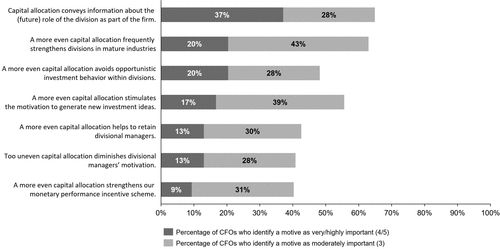
|
Table 9. Headquarters and Allocation of Capital: Survey Responses to the Question “Please Think About Situations Where You Have Decided to Allocate Capital More Evenly Than Pure Financial Criteria Suggested. How Important Were the Following Factors for Your Allocation?”
| Panel A: Answers filtered by “sometimes to always” of question “How frequently do you allocate financial resources more evenly across divisions than pure financial criteria (e.g., NPV) suggest?” (see Table 8) | ||||||
|---|---|---|---|---|---|---|
| Question | Observations | Mean | Percentage very or highly important | Percentage somewhat or not important | Statistical differences of proportions in rows | |
| (1) | Capital allocation conveys information about the (future) role of the division as part of the firm. | 54 | 2.80 | 37.0 | 35.2 | 3–7 |
| (2) | A more even capital allocation avoids opportunistic investment behavior within divisions. | 54 | 2.50 | 20.4 | 51.9 | — |
| (3) | A more even capital allocation frequently strengthens divisions in mature industries. | 54 | 2.74 | 20.4 | 37.0 | 1 |
| (4) | A more even capital allocation stimulates divisional managers’ motivation to generate new investment ideas. | 54 | 2.54 | 16.7 | 46.3 | 1 |
| (6) | A more even capital allocation helps to retain divisional managers. | 54 | 2.26 | 13.0 | 57.4 | 1 |
| (5) | Too uneven capital allocation diminishes divisional managers’ motivation. | 54 | 2.15 | 13.0 | 59.3 | 1 |
| (7) | A more even capital allocation strengthens our monetary performance incentive scheme. | 54 | 2.20 | 9.3 | 59.3 | 1 |
| Panel B | |||||||||||||
|---|---|---|---|---|---|---|---|---|---|---|---|---|---|
| Percentage very or highly important | Size | Lines of business | Diversification | Capital constrained | Debt ratio | Agency cost | |||||||
| Small | Large | Few | Many | Related | Unrelated | No | Yes | Low | High | Low | High | ||
| (1) | 37.0 | 34.8 | 38.7 | 28.6 | 46.2 | 40.0 | 33.3 | 28.9 | 56.2* | 42.3 | 32.1 | 32.1 | 42.9 |
| (2) | 20.4 | 13.0 | 25.8 | 10.7 | 30.8* | 20.0 | 20.8 | 23.7 | 12.5 | 23.1 | 17.9 | 25.0 | 14.3 |
| (3) | 20.4 | 21.7 | 19.4 | 14.3 | 26.9 | 20.0 | 20.8 | 23.7 | 12.5 | 23.1 | 17.9 | 17.9 | 23.8 |
| (4) | 16.7 | 13.0 | 19.4 | 17.9 | 15.4 | 10.0 | 25.0 | 15.8 | 18.8 | 15.4 | 17.9 | 10.7 | 19.0 |
| (6) | 13.0 | 13.0 | 12.9 | 10.7 | 15.4 | 16.7 | 8.3 | 7.9 | 25.0* | 11.5 | 14.3 | 7.1 | 23.8 |
| (5) | 13.0 | 13.0 | 12.9 | 10.7 | 15.4 | 13.3 | 12.5 | 10.5 | 18.8 | 7.7 | 17.9 | 7.1 | 19.0 |
| (7) | 9.3 | 13.0 | 6.5 | 7.1 | 11.5 | 3.3 | 16.67* | 5.3 | 18.8 | 15.4 | 3.6 | 7.1 | 4.8 |
| Panel B (continued) | |||||||||||||||
|---|---|---|---|---|---|---|---|---|---|---|---|---|---|---|---|
| Percentage very or highly important | Equity | Managerial ownership | Rating | Age | Tenure | Education | Discretionary budgets | ||||||||
| Public | Private | Low | High | High | Low | Young | Mature | Short | Long | MBA, Dr. | Others | Low | High | ||
| (1) | 37.0 | 35.7 | 41.7 | 35.1 | 41.2 | 50.0 | 25.0 | 30.0 | 45.8 | 35.7 | 38.5 | 41.7 | 27.8 | 37.0 | 33.3 |
| (2) | 20.4 | 19.0 | 25.0 | 21.6 | 17.6 | 16.7 | 25.0 | 20.0 | 20.8 | 21.4 | 19.2 | 25.0 | 11.1 | 3.7 | 42.9*** |
| (3) | 20.4 | 16.7 | 33.3 | 18.9 | 23.5 | 8.3 | 25.0 | 20.0 | 20.8 | 17.9 | 23.1 | 16.7 | 27.8 | 14.8 | 19.0 |
| (4) | 16.7 | 14.3 | 25.0 | 13.5 | 23.5 | 16.7 | 25.0 | 20.0 | 12.5 | 25.0 | 7.7* | 22.2 | 5.6 | 22.2 | 14.3 |
| (6) | 13.0 | 11.9 | 16.7 | 10.8 | 17.6 | 25.0 | 12.5 | 13.3 | 12.5 | 17.9 | 7.7 | 11.1 | 16.7 | 18.5 | 9.5 |
| (5) | 13.0 | 16.7 | 0.0 | 5.4 | 29.4** | 16.7 | 18.8 | 16.7 | 8.3 | 7.1 | 19.2 | 5.6 | 27.8** | 14.8 | 9.5 |
| (7) | 9.3 | 4.8 | 25.0** | 5.4 | 17.6 | 8.3 | 18.8 | 6.7 | 12.5 | 3.6 | 15.4 | 8.3 | 11.1 | 7.4 | 9.5 |
Notes. Ratings are based on a five-point Likert scale from one (not important) to five (highly important). Panel A reports summary statistics for the responses from the firms that indicate that they frequently engage in socialism (Section D, Q4; 3 = sometimes, 4 = rarely, 5 = always) following the definition in Section 4.2.1. We report the mean score, the percentage of respondents that find a factor very (four) or highly important (five), and the percentage of respondents that find a factor somewhat (two) or not important (one). The last column reports results from McNemar tests (for the analysis of multiple proportions drawn from a single sample) to examine whether ratings of each pair of subquestions are statistically different. For instance, the rating in row 1 (“Capital allocation conveys information about the (future) role of the division as part of the firm.”; % very or highly important) is statistically different from the ratings in rows 3–7. Panel B splits the sample by various characteristics and compares the proportion of respondents that answered four (very important) and five (highly important) across subsamples. See Table A.1 of the Online Appendix for column/variable definitions and data sources.
***, **, and * statistical significance of differences in proportions across groups at the 1%, 5%, and 10% levels, respectively.
Overall, our findings suggest that for the average firm, the explanatory power of the existing theories is moderate to low. In unreported analyses, we find that 30% (n = 16) of the firms in the subsample do not find any of the current theories very or highly important in explaining their investment behavior. Thirty-two percent of firms indicate the importance of one explanation, and 26% of firms indicate the importance of two explanations. These results also suggest a broad heterogeneity of causes for socialism; therefore, multiple and different theories should be considered to understand socialism.
Of the 47% of firms that engage in cross-subsidization across divisions, more than one third state that “capital allocation conveys information about the (future) role of the division as part of the firm” (37.0%), suggesting that financial executives acknowledge the communication aspect of capital budgets. Relatively even (or avoiding extreme) capital allocations disclose the least about the relative prospects of divisions and improve stakeholders’ incentives (Hoang and Ruckes 2015, Almazan et al. 2017). All other arguments follow in their relative importance. We do emphasize that their ratings cluster, and ratings are not statistically different from each other. The argument of Rajan et al. (2000) that an even capital allocation can prevent opportunistic investment behavior is important for 20% of executives, and this argument is relatively more important for firms with many business lines (30.8% versus 10.7%). Interestingly, firms with high discretionary budgets at the division level are more likely to find this argument important (42.9% versus 3.7%). In fact, it is the most important rationale for socialism at these firms.30 Because they ensure a high minimum level of funds to divisions, high divisional budgets are complementary to socialistic capital allocation and may protect firms against the implementation of inefficient projects that protect divisions from the redistribution of surplus to other divisions (Rajan et al. 2000). A similar proportion of 20% of CFOs state that a relatively even capital allocation strengthens divisions in mature industries, as suggested by Goel et al. (2004). In addition, 13% of firms use a more even capital allocation to “retain divisional managers” (one of several implications of Scharfstein and Stein 2000). Finally, at 9% of firms, the notion of Bernardo et al. (2006) that “a more even capital allocation strengthens a firm’s monetary performance incentive scheme” is reported to cause corporate socialism.
4.2.1.3. Rationing of Divisional Capital.
Finally, we examine if firms restrict access of divisions to internal capital markets under some circumstances. The rationing of divisional capital for investments may limit internal capital market activity but has been proposed as a mechanism to counter misaligned incentives (see Holmström and Ricart i Costa 1986, Shleifer and Vishny 1989, Marino and Matsusaka 2005). Specifically, we ask whether firms limit capital allocation to the division’s own generated cash flow. On average, 26% of executives report the use of such a rationing policy at the division level, indicating that firms apply this instrument selectively. Consistent with theoretical predictions, firms are relatively more likely to impose such divisional spending limits if agency problems at the divisional level are perceived to be large (40.9% versus 17.7%; see Online Appendix D.4, row 3).
Key Findings (Winner-Picking and Corporate Socialism)
Eighty-four percent of firms report they engage in active capital reallocation (winner-picking).
Forty-seven percent at least sometimes cross-subsidize with a balanced capital allocation across divisions; only 24% never do.
Winner-picking and socialism are positively associated: Firms with active internal capital markets (winner-picking) are more likely to frequently engage in cross-subsidization (52% versus 22%).
In the cross section, socialism is not associated with specific firm characteristics but relatively more prevalent in common law countries.
Firm responses suggest a broad heterogeneity of motives for cross-subsidization. However, the explanatory power of existing individual theories on corporate socialism is unsatisfactory.
Twenty-six percent of firms engage in capital rationing of divisional capital. Such capital rationing policy is more likely if agency problems at the divisional level are perceived to be large (41% versus 18%).
4.2.2. The Financing Effects of Internal Capital Markets.
One important characteristic of internal capital markets is that corporate headquarters centrally raises external financing and pools capital that individual projects generate. This “single-lender property” of headquarters coupled with ownership rights over the use of project assets affects not only investments but also the firm’s environment for financing. In particular, the internal capital market insulates individual projects from costs associated with relying on external capital markets that would otherwise occur if divisions were standalone firms.31 The arguments underlying these “financing benefits” typically rely on the internal capital market’s ability to transfer funds between projects and the less-than-perfect correlation of divisions with respect to cash generation or cash requirements to finance capital investments. In the final section of our paper, we focus on these financing implications of internal capital markets. We exploit the multisegment nature of our sample of diversified firms and ask how executives rate the relative importance of different financing benefits of integrating multiple businesses into an internal capital market compared with a situation in which their divisions were standalone firms.
Our findings support recent literature that suggests how replacing the external capital market with an internal one may affect corporate financing. Figure 7 and Table 10 display the results. First, more than two thirds (70%) of CFOs believe that the most important financial benefit of integrating multiple businesses under the roof of the internal capital market is “lower cost of capital” (Hann et al. 2013). The authors argue that the internal capital markets’ ability to transfer resources to cash-poor divisions may reduce a firm’s systematic risk by avoiding countercyclical costs of financial distress.32 Our result provides confirming evidence of this argument that explicitly rejects the conventional textbook view that diversification cannot affect the firm’s cost of capital (see Ross et al. 2006). Coinsurance may enable the diversified firm to reduce distress risks that standalone firms cannot avoid on their own. Second, coinsurance can increase debt capacity, as first noted by Lewellen (1971). This argument is important to a large proportion of the respondents (60%).33 Therefore, our result supports recent empirical evidence in favor of the “more-money” hypothesis (Kuppuswamy and Villalonga 2015, Benz and Hoang 2021), even though Berger and Ofek (1995) and Comment and Jarrell (1995) find either no or weak associations between diversification and actual leverage. Firms with higher debt ratios (71.7% versus 51.7%) and firms with many lines of business (68.8% versus 53.4%; see also Online Appendix E.1, column 2) find this effect significantly more important.
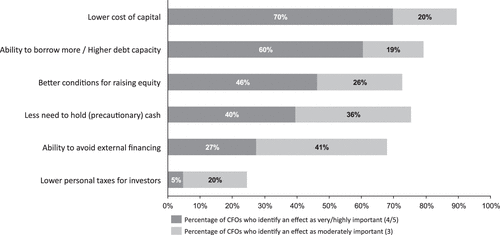
|
Table 10. Financing Effects of Diversification: Survey Responses to the Question “How Important Are the Following Effects of Diversification for Your Company? Please Answer Compared with the Situation Where Your Divisions Were Stand-Alone Companies and Had to Raise Funds by Themselves”
| Panel A | ||||||
|---|---|---|---|---|---|---|
| Question | Observations | Mean | Percentage very or highly important | Percentage somewhat or not important | Statistical differences of proportions in rows | |
| (1) | Lower cost of capital | 106 | 3.81 | 69.8 | 10.4 | 3–6 |
| (2) | Ability to borrow more / Higher debt capacity | 106 | 3.51 | 60.4 | 20.8 | 3–6 |
| (3) | Better conditions for raising equity | 106 | 3.26 | 46.2 | 27.4 | 1–2, 5–6 |
| (4) | Less need to hold (precautionary) cash | 106 | 3.16 | 39.6 | 24.5 | 1–2, 5–6 |
| (5) | Ability to avoid external financing | 106 | 2.87 | 27.4 | 32.1 | 1–4, 6 |
| (6) | Lower personal taxes for investors | 106 | 1.82 | 4.7 | 75.5 | 1–5 |
| Panel B | |||||||||||||
|---|---|---|---|---|---|---|---|---|---|---|---|---|---|
| Percentage very or highly important | Size | Lines of business | Diversification | Capital constrained | Debt ratio | Agency cost | |||||||
| Small | Large | Few | Many | Related | Unrelated | No | Yes | Low | High | Low | High | ||
| (1) | 69.8 | 65.1 | 73.0 | 69.0 | 70.8 | 72.1 | 66.7 | 73.0 | 62.5 | 66.7 | 73.9 | 72.6 | 65.9 |
| (2) | 60.4 | 62.8 | 58.7 | 53.4 | 68.8 | 57.4 | 64.4 | 62.2 | 56.2 | 51.7 | 71.7** | 58.1 | 63.6 |
| (3) | 46.2 | 46.5 | 46.0 | 41.4 | 52.1 | 47.5 | 44.4 | 48.6 | 40.6 | 41.7 | 52.2 | 46.8 | 45.5 |
| (4) | 39.6 | 44.2 | 36.5 | 39.7 | 39.6 | 36.1 | 44.4 | 40.5 | 37.5 | 38.3 | 41.3 | 38.7 | 40.9 |
| (5) | 27.4 | 16.3 | 34.9** | 19.0 | 37.5** | 21.3 | 35.6 | 33.8 | 12.5** | 33.3 | 19.6 | 30.6 | 22.7 |
| (6) | 4.7 | 4.7 | 4.8 | 3.4 | 6.2 | 6.6 | 2.2 | 5.4 | 3.1 | 5.0 | 4.3 | 6.5 | 2.3 |
| Panel B (continued) | |||||||||||||
|---|---|---|---|---|---|---|---|---|---|---|---|---|---|
| Percentage very or highly important | Equity | Managerial ownership | Rating | Age | Tenure | Education | |||||||
| Public | Private | Low | High | High | Low | Young | Mature | Short | Long | MBA, Dr. | Others | ||
| (1) | 69.8 | 71.6 | 61.1 | 68.1 | 73.5 | 70.0 | 66.7 | 71.2 | 68.1 | 74.5 | 64.7 | 69.0 | 71.4 |
| (2) | 60.4 | 63.6 | 44.4 | 59.7 | 61.8 | 60.0 | 51.9 | 61.0 | 59.6 | 63.6 | 56.9 | 60.6 | 60.0 |
| (3) | 46.2 | 47.7 | 38.9 | 48.6 | 41.2 | 20.0 | 51.9** | 52.5 | 38.3 | 52.7 | 39.2 | 46.5 | 45.7 |
| (4) | 39.6 | 36.4 | 55.6 | 41.7 | 35.3 | 50.0 | 33.3 | 40.7 | 38.3 | 45.5 | 33.3 | 39.4 | 40.0 |
| (5) | 27.4 | 26.1 | 33.3 | 26.4 | 29.4 | 35.0 | 25.9 | 32.2 | 21.3 | 29.1 | 25.5 | 29.6 | 22.9 |
| (6) | 4.7 | 5.7 | 0.0 | 5.6 | 2.9 | 10.0 | 0.0* | 1.7 | 8.5 | 3.6 | 5.9 | 7.0 | 0.0 |
Notes. Ratings are based on a five-point Likert scale from one (not important) to five (highly important). Panel A reports summary statistics for the responses from all responding firms. We report the mean score, the percentage of respondents that find a factor very (four) or highly important (five), and the percentage of respondents that find a factor somewhat (two) or not important (one). The last column reports results from McNemar tests (for the analysis of multiple proportions drawn from a single sample) to examine whether ratings of each pair of subquestions are statistically different. For instance, the rating in row 1 (“lower cost of capital”; % very or highly important) is statistically different from the ratings in rows 3–6. Panel B splits the sample by various characteristics and compares the proportion of respondents that answered four (very important) and five (highly important) across subsamples. See Table A.1 of the Online Appendix column/variable definitions and data sources.
***, **, and * statistical significance of differences in proportions across groups at the 1%, 5%, and 10% levels, respectively.
Third, previous research also argues that similar risk-pooling mechanisms can affect the conditions for raising equity (e.g., Hadlock et al. 2001).34 Forty-six percent of the surveyed CFOs believe that operating a division as part of a diversified firm provides better conditions for raising equity compared with a situation in which the divisions were standalones. Interestingly, firms with less access to debt place greater value on this benefit for equity issuers (very or highly important for 51.9% of firms with a low rating and 20.0% of firms with a high debt rating). Fourth, 40% of the CFOs find the effect that diversified firms have “less need to hold (precautionary) cash” very or highly important for their firm. This cash-holding argument is consistent with precautionary savings arguments and has recently gained attention in the context of corporate liquidity and diversification. Duchin (2010) finds that diversified firms carry significantly less cash than their standalone peers because of their ability to smooth investment opportunities and cash flows. Although statistically insignificant, unrelated diversified firms (44.4%) find this effect more important than related diversified firms (36.1%). Fifth and perhaps somewhat surprisingly, CFOs rate the relative importance of diversified firms’ “ability to avoid external financing” relatively low, on average. The argument, which relates to the reliability of capital supply in internal capital markets (Henderson 1970, Liebeskind 2000) and the propensity to raise external financing, is more important for firms that find “less need to hold (precautionary) cash” an important benefit (40.5% versus 18.9%, untabulated), consistent with the argument of Duchin (2010) that internal capital markets insulate firms from the rationing and costs of external capital markets. Finally, tax benefits of investors, as suggested by Bhide (1990), do not appear to be a significant benefit of operating multiple lines of business.
Our survey results document that financial executives have strong opinions about the financing benefits of internal capital markets and reject the widely held notion that combining multiple lines of business does not have positive effects on a firm’s financing environment. Our findings particularly support arguments suggesting that internal capital markets may decrease cost of capital and improve access to external financing.
Key Findings (The Financing Effects of Internal Capital Markets)
Firms report overwhelmingly that internal capital markets are associated with financing benefits.
Firms perceive such benefits primarily in lower costs of capital (70%) and higher debt capacities (60%).
Our findings support coinsurance arguments suggesting that internal capital markets may improve access to external financing (“more-money effect”).
5. Conclusion
Despite an unabated interest in better understanding corporate investment, empirical research in corporate finance has usually stopped halfway. Although there is considerable evidence about how capital is allocated from investors to firms, our knowledge about how firms allocate financial resources to projects has not kept pace with theories of allocation processes and internal capital markets. We attempt to fill part of this gap by presenting an analysis of unique data from a CFO survey. Our emphasis is on the most relevant aspects of the internal capital allocation process and the capital markets within firms. The survey questions were designed to exploit the in-depth knowledge of top financial executives about this process (e.g., importance of agency problems inside firms, biases in proposals, choosing “socialistic” capital allocations, or implications for corporate financing). Our survey instrument itself is closely guided by economic theory and previous empirical evidence, allowing it to match theoretical predictions with practice.
The results of our analysis allow us to corroborate some theories and question others. Reassuringly, our analysis confirms that agency issues are crucial for understanding capital allocation within firms and ultimately, corporate investment in the economy. Firms employ instruments to limit agency costs that are both organizational (e.g., layers of approval) and personal (e.g., compensation schemes) in nature, and their use is largely consistent with theoretical models of capital budgeting. Our findings confirm that firms actively reallocate financial resources across divisions via internal capital markets to take advantage of more profitable investment opportunities. The tendency to distribute capital relatively evenly exists even though CFOs by and large reject explanations offered by existing work, leaving open questions regarding the causes and value effects of such “socialistic” allocations. Despite the success of existing theories of capital allocation, the findings call for a renewed investigation of the central elements of internal capital markets. The strong emphasis given to bottom-up components in the allocation process—although undoubtedly important—may be overstated. Top management’s role is only partly to evaluate project proposals. Our results show that using private knowledge and expertise, top management actively shapes the firm’s investment policy, often beyond financial projections and other hard information provided by division management—especially if agency problems are severe. This suggests that its private information may lead top management to extend its involvement even further than identified in our study. This active involvement likely varies with the specific environment of the individual division beyond what can typically be observed from standard archival data sources, such as its legal structure (see, e.g., Bethel and Liebeskind 1998), (short-term) limits of nonfinancial resources, or competitive position (see, e.g., Sengul et al. 2019). Investigating these issues may be a fruitful area for future research.
Finally, we hope that our findings will motivate future theories and help guide the design of large-sample archival work on corporate investment. Practitioners also may find our study valuable because the findings allow executives to convert conjectures and anecdotal evidence into stylized or even hard facts.
The authors thank Christian Homburg, Oguzhan Ozbas, Jeremy Stein, Timotheus Höttges (CEO Deutsche Telekom), and Richard Lutz (CEO Deutsche Bahn) for insightful comments on the survey instrument; Andreas Benz, who provided highly valuable input and support during many stages of the paper; the associate editor, two anonymous referees, Renée Adams, Tobias Berg, Demian Berchtold, Jim Brau, Philip Bromiley, Dirk Brounen, Ralf Ewert, Stan Fawcett, John Graham, Stefan Hirth, Christian Laux, Alberto Moel, Christine Parlour, Gordon Phillips, Ryan Riordan, Zacharias Sautner, Michael Troege, Marliese Uhrig-Homburg, David Young, and Michael Weber for their support and their detailed and insightful comments; the financial executives who pretested the survey instrument; and all the CFOs who took the time to fill out the survey and shared their insights into capital allocation. Parts of the study were conducted while D. Hoang was visiting the Haas School of Business at University of California, Berkeley, under a grant from the Karlsruhe House of Young Scientists. Parts of the results in this paper have previously circulated under the title “Internal Capital Markets and Diversified Firms: Theory and Practice” (Gatzer et al. 2014).
Appendix
|
Table. A.1. Key Findings and Takeaways
| Asymmetric Information and Within-Firm Agency Problems (Section 3.1) |
|
|
|
| Project Authorization and the Delegation of Authority (Section 3.2) |
|
|
|
| Information Aggregation and Information Production (Section 3.3) |
|
|
|
| Financial Analysis, Formal Decision Rules, and Bottom-Up Measures (Section 4.1.1) |
|
|
| Informal Decision Rules and Top-Down Measures (Section 4.1.2) |
|
|
| Winner-Picking and Corporate Socialism (Section 4.2.1) |
|
|
|
| The Financing Effects of Internal Capital Markets (Section 4.2.2) |
|
1 For a review of the literature with an emphasis on theoretical work, see, for example, Stein (2003) and Gertner and Scharfstein (2013). Empirical work typically relies on (aggregated) segment data and studies mainly investment outcomes (for literature reviews, see Maksimovic and Phillips 2007, 2013). Recently, some empirical studies examined individual mechanisms of internal capital allocation and capital flows between companies under common ownership (see, e.g., Buchuk et al. 2014, 2020; Niehaus 2018; Ge 2022).
2 The final questionnaire and a comprehensive overview of the theories that guided its design are in the Online Appendix. Therein, we provide brief summaries of theories and link these to the corresponding questions.
3 Standalone firms may or may not employ an internal capital market (see Gertner and Scharfstein 2013, Maksimovic and Phillips 2013). See also Bower (1970), who describes the distinct roles of corporate headquarters and divisions in the resource allocation process relative to resource allocation in undiversified or vertically integrated firms.
4 The industry classification is from Graham and Harvey (2001) and their subsequent CFO surveys.
5 Specifically, we repeat our multivariate analyses using country controls, as well as indicators for a country’s (i) legal origin (“civil law” versus “common law”; see, e.g., La Porta et al. 1998), (ii) board system (“one tier” versus “two tier” versus “mixed/choice”; see, e.g., Davies et al. 2013, Gelter and Siems 2021), and (iii) financial system (“bank based” versus “market based”; see, e.g., Demirgüç-Kunt and Levine 2001). For brevity, we refrain from presenting this comprehensive set of additional analyses but mention the (very few) country-level results in the respective sections.
6 See also Online Appendix F.1, which provides an additional, section-by-section discussion of the potential (and arguably small) impact that incentives for biased or inaccurate answers may have on our survey results.
7 This tendency is also present in comparable surveys targeting financial executives (Graham et al. 2005, Dichev et al. 2013).
8 We perform chi-square tests of differences in responses for both groups and each of the 68 questions not related to demographics. Three of them are statistically different across the two groups of firms at the 5% level.
9 We perform McNemar tests for the analysis of paired dichotomous variables to examine whether ratings of subquestions are statistically different or whether differences arise by chance (Table 2, Panel A, last column). For instance, the ratings of the three most common types of moral hazard (Figure 1) are not statistically different, but each of the ratings differs statistically from the least common rating (11%, “work harder”). We conduct these pairwise tests throughout for all survey questions with answers that allow a rank-order interpretation (see the survey questions in Tables 2, 5, 6, 7, 9, and 10) to avoid misinterpretation of their relative importance if ratings are statistically similar. See McCahery et al. (2016) and Dichev et al. (2013) for related tests.
10 Interestingly, this type of problem is perceived to play a larger role in bank-based economies, such as Germany, France, or Belgium, than in market-based economies (71.2% versus 47.5%, untabulated; Demirgüç-Kunt and Levine 2001), perhaps reflecting the arguably weaker shareholder orientation in bank-based economies.
11 For brevity, we relegate tables to the Online Appendix whenever there is relatively little heterogeneity in our subsamples based on firm and CFO characteristics.
12 Only 80 of 115 firms provided data on threshold levels, perhaps because of confidentiality concerns.
13 A back-of-the-envelope calculation suggests that for S&P 500 firms (2000–2015), 39% of annual capital expenditures imply an interquartile range from $25mn to $250mn in absolute terms.
14 See also Seru (2014), who examines the relationship between decentralized R&D budgets and innovation using survey data.
15 As previously noted, we also perform multivariate regression models with the percentage of expenditures that managers spend without approval as the dependent variable and the conditioning variables as controls. These regression models confirm the results from the univariate tests in terms of both their statistical and their economic significance. The Online Appendix, Table E.3, reports the full results.
16 We omit one outlier firm that reported an average of 4,500 investment proposals per year.
17 Compared with the problem of misrepresentation of private information, managerial overconfidence is relatively impervious to potential measures that mitigate its consequences (see, e.g., Stein 2003, p. 123).
18 For firms that employ a particular scheme for truthful reporting, the survey questions isolate from the possibility that firms employ it for reasons other than for truthful reporting. For instance, firms use hurdle rates in excess of the firm’s real cost of capital to induce divisional managers to report truthfully (see, e.g., Antle and Eppen 1985), but they impose them also, for example, to account for real option–like characteristics of investments (Dixit and Pindyck (1994, p. 7); Jagannathan et al. (2016) for other motives). The survey question requests: “If you use these practices for other reasons and not for truthful reporting, please check ‘Not important’.”
19 Mechanisms for eliciting truthful reporting of private information may also have economic costs, which can reduce their importance for truthful reporting. Linking pay to total firm rather than to individual/divisional performance may imply suboptimal effort incentives. We are grateful to an anonymous referee for drawing our attention to this aspect.
20 See Gup and Norwood (1982), Fuller and Kerr (1981), or Weston (1973) for the use of divisional costs of capital in multidivision firms.
21 IRR and hurdle rate are related, but both rules do not quantify absolute dollar contributions to firm value. The IRR is the discount rate at which the project NPV is equal to zero. The hurdle rate, on the other hand, is the minimum rate (communicated ex ante) that the firm mandates to earn when investing in a project.
22 As Brealey and Myers (2003, p. 314) note, “A firm’s capital investment choices should reflect both bottom-up and top-down processes. (...) Plant and division managers, who do most of the work in bottom-up capital budgeting, may not see the forest for the trees. Strategic planners may have a mistaken view of the forest because they do not look at the trees one by one” (see also Bower (1970), pp. 334–338 and Roberts (2005), p. 397).
23 Bower (2005, p. 31) writes, “It is the track record of the general manager in the middle who signs the proposal that determines the way the projections and calculations it contains are regarded. In fact, when they pick up a proposal, top managers usually look first for the name on the signature line before reading anything else. […].” Bower (2005, pp. 31–32) further notes that “particularly in multi-business or high-technology companies, […] top management may have little basis […] of the detailed foundations of the proposal. […] Top corporate officers behave like bankers who provide funds based on the reliability of the borrowers.” See also Carter (1971, p. 426).
24 The role of divisional managers’ characteristics in the budgeting process was studied only recently. Duchin and Sosyura (2013) and Gaspar and Massa (2011) examine the effect of divisional managers’ (social) connections to the CEO on capital allocations. See also Glaser et al. (2013), who show that the political power of divisional managers influences the distribution of cash windfalls across divisions. In a recent paper, Benz et al. (2023) directly test the relationship between division managers’ abilities and internal capital allocation using hand-collected data of divisional managers at S&P 1,500 firms.
25 The examination of nonfinancial resources in the context of capital allocation, such as manpower constraints, is remarkably understudied in the finance literature and has only been taken up recently (see, e.g., D’Acunto et al. 2020). Traditionally, the importance of nonfinancial resources has had more traction in the literature on strategy and management (see, e.g., Sengul et al. 2019).
26 Several financial executives in our pretesting group stress the importance of following long-term industry trends.
27 Results based on the classic investment-cash flow sensitivity regressions should be interpreted with caution given that results based on them may be artefacts of measurement error in Tobin’s q (see Whited critique, e.g., in Erickson and Whited 2000, Whited 2001, Çolak and Whited 2007).
28 See Maksimovic and Phillips (2007, 2013) for a comprehensive discussion of these issues in the literature on internal capital markets.
29 At first glance, these numbers may appear larger than those in Graham et al. (2015), who find that 6%–18% of CFOs consider “a balanced capital allocation” an important/very important capital allocation principle. However, their findings cannot be compared with those presented here. Unlike our study, they do not examine the prevalence/frequency of socialism and do not study capital reallocation and their motives. They investigate the relative importance of explicit or understood capital budgeting principles that generally govern capital allocation. In their study (and perhaps not surprisingly), only 7% (6%) of U.S. CEOs (CFOs) and 14% (18%) of non-U.S. CEOs (CFOs) say that “moving (capital) toward an even balance” is an important or very important general allocation principle.
30 In unreported analysis, we find that a large fraction of 58% of total capital expenditures is part of an initial divisional budget at these firms (compared with 32% in firms with low discretionary budgets).
31 In the long term, firms may respond to financing constraints by expanding the scope of internal capital market activity (Matvos et al. 2018).
32 In general, financial distress tends to occur during downturns (see, e.g., Almeida and Philippon 2007).
33 In addition, all the CFOs in our pretesting group emphasized the importance of this potential benefit of coinsurance.
34 The mechanism in Hadlock et al. (2001) is somewhat subtler than the coinsurance argument in Lewellen (1971) and others. In their theoretical model, pooling risks of imperfectly correlated divisions helps reduce adverse selection cost when issuing equity, resulting in a less negative market reaction to an equity issue.
References
- (1997) Formal and real authority in organizations. J. Political Econom. 105(1):1–29.Crossref, Google Scholar
- (2017) Firm investment and stakeholder choices: A top-down theory of capital budgeting. J. Finance 72(5):2179–2228.Crossref, Google Scholar
- (2007) The risk-adjusted cost of financial distress. J. Finance 62(6):2557–2586.Crossref, Google Scholar
- (1985) Capital rationing and organizational slack in capital budgeting. Management Sci. 31(2):163–174.Link, Google Scholar
- (1997) Models of capital investments with private information and incentives: A selective review. J. Bus. Finance Accounting 24(7–8):887–908.Crossref, Google Scholar
- (1977) Estimating nonresponse bias in mail surveys. J. Marketing Res. 14(3):396–402.Crossref, Google Scholar
- (1988) Compensation and incentives: Practice vs. theory. J. Finance 43(3):593–616.Crossref, Google Scholar
- (1992) A simple model of herd behavior. Quart. J. Econom. 107(3):797–817.Crossref, Google Scholar
- (2008) Survey response rate levels and trends in organizational research. Human Relations 61(8):1139–1160.Crossref, Google Scholar
- (2006) Surveying the corporate elite: Theoretical and practical guidance on improving response rates and response quality in top management survey questionnaires. Res. Methodology Strategy Management 3:37–55.Crossref, Google Scholar
- (2021) Corporate diversification and capital structure. Preprint, submitted 15 Nov 2019, updated 8 Apr 2021, https://dx.doi.org/10.2139/ssrn.3478132.Google Scholar
- (2023) Picking winners: Managerial ability and capital allocation. Preprint, submitted November 9, updated November 28, https://dx.doi.org/10.2139/ssrn.4601628.Google Scholar
- (1995) Diversification’s effect on firm value. J. Financial Econom. 37(1):39–65.Crossref, Google Scholar
- (2001) Do people mean what they say? Implications for subjective survey data. Amer. Econom. Rev. 91(2):67–72.Crossref, Google Scholar
- (2001) Capital budgeting and compensation with asymmetric information and moral hazard. J. Financial Econom. 61(3):311–344.Crossref, Google Scholar
- (2004) Capital budgeting in multidivision firms: Information, agency, and incentives. Rev. Financial Stud. 17(3):739–767.Crossref, Google Scholar
- (2006) A theory of socialistic internal capital markets. J. Financial Econom. 80(3):485–509.Crossref, Google Scholar
- (1998) Diversification and the legal organization of the firm. Organ. Sci. 9(1):49–67.Link, Google Scholar
- (1990) Reversing corporate diversification. J. Appl. Corporate Finance 3(2):70–81.Crossref, Google Scholar
- (1993) Capital budgeting in 1992: A survey. Financial Management 22(3):24.Crossref, Google Scholar
- (1992) A theory of fads, fashion, custom, and cultural change as informational cascades. J. Polit. Econ. 100(5):992–1026.Crossref, Google Scholar
- (2010) Recent advances in the empirics of organizational economics. Annu. Rev. Econom. 2(1):105–137.Crossref, Google Scholar
- (2012) The organization of firms across countries. Quart. J. Econom. 127(4):1663–1705.Crossref, Google Scholar
- (1994) The firm as a communication network. Quart. J. Econom. 109(4):809–839.Crossref, Google Scholar
- (1970) Managing the Resource Allocation Process: A Study of Corporate Planning and Investment (Harvard Business School Press, Boston).Google Scholar
- (2005)
Modeling the resource allocation process . Bower JL, Gilbert CG, eds. From Resource Allocation to Strategy (Oxford University Press, Oxford, UK).Crossref, Google Scholar - (2004) Asking Questions: The Definitive Guide to Questionnaire Design–For Market Research, Political Polls, and Social and Health Questionnaires (Jossey Bass, San Francisco, CA).Google Scholar
- (2006) Initial public offerings: An analysis of theory and practice. J. Finance 61(1):399–436.Crossref, Google Scholar
- (2003) Principles of Corporate Finance (McGraw-Hill/Irwin, New York).Google Scholar
- (1986) Corporate Capital Investment (Cambridge University Press, Cambridge, UK).Google Scholar
- (2004) Corporate finance in Europe: Confronting theory with practice. Financial Management 33(4):71–101.Google Scholar
- (2005) Reallocation of corporate resources and managerial incentives in internal capital markets. Eur. Econom. Rev. 49(3):659–681.Crossref, Google Scholar
- (2014) The internal capital markets of business groups: Evidence from intra-group loans. J. Financial Econom. 112(2):190–212.Crossref, Google Scholar
- (2020) How do internal capital markets work? Evidence from the great recession. Rev. Finance 24(4):847–889.Crossref, Google Scholar
- (1971) The behavioral theory of the firm and top-level corporate decisions. Admin. Sci. Quart. 16(4):413–429.Crossref, Google Scholar
- (1962) Strategy and Structure: Chapters in the History of the Industrial Enterprise (MIT Press, Cambridge, MA).Google Scholar
- (2000) Motivating truthful upward communication of private information: An experimental study of mechanisms from theory and practice. Abacus 36(2):160–179.Crossref, Google Scholar
- (1984) The groves scheme, profit sharing and moral hazard. Management Sci. 30(1):20–24.Link, Google Scholar
- (2007) Spin-offs, divestitures, and conglomerate investment. Rev. Financial Stud. 20(3):557–595.Crossref, Google Scholar
- (1995) Corporate focus and stock returns. J. Financial Econom. 37(1):67–87.Crossref, Google Scholar
- (2020) Manpower constraints and corporate policies. Working paper, CESifo, Munich, Germany.Google Scholar
- (2013)
Corporate boards . Law and Practice: A Comparative Analysis In Europe (Oxford University Press, Oxford, UK).Google Scholar - (2001)
Bank-based and market-based financial systems: Cross-country comparisons . Demirgüç-Kunt A, Levine R, eds. Financial Structure and Economic Growth–A Cross-Country Comparison of Banks, Markets, and Development (MIT Press, Cambridge, MA), 81–140.Crossref, Google Scholar - (2003) Managerial incentives and internal capital markets. J. Finance 58(3):1193–1220.Crossref, Google Scholar
- (2003) Raising response rates in mail surveys of small business owners: Results of an experiment. J. Small Bus. Management 41(3):278–295.Crossref, Google Scholar
- (2002) Authority and communication in organizations. Rev. Econom. Stud. 69(4):811–838.Crossref, Google Scholar
- (2013) Earnings quality: Evidence from the field. J. Accounting Econom. 56(2–3):1–33.Crossref, Google Scholar
- (1978) Mail and Telephone Surveys: The Total Design Method (John Wiley & Sons, New York).Google Scholar
- (1994) Investment Under Uncertainty (University Press, Princeton, NJ).Crossref, Google Scholar
- (2010) Cash holdings and corporate diversification. J. Finance 65(3):955–992.Crossref, Google Scholar
- (2013) Divisional managers and internal capital markets. J. Finance 68(2):387–429.Crossref, Google Scholar
- (2000) Measurement error and the relationship between investment and q. J. Political Econom. 108(5):1027–1057.Crossref, Google Scholar
- (1981) Estimating the divisional cost of capital: An analysis of the pure-play technique. J. Finance 36(5):997–1009.Google Scholar
- (2011) The role of commonality between CEO and divisional managers in internal capital markets. J. Financial Quant. Anal. 46(3):841–869.Crossref, Google Scholar
- (2000) Hierarchies and the organization of knowledge in production. J. Political Econom. 108(3):874–904.Crossref, Google Scholar
- (2014) Internal capital markets and diversified firms: Theory and practice. Working paper, Karlsruher Institut für Technologie, Karlsru, Germany.Google Scholar
- (2022) How do financial constraints affect product pricing? Evidence from weather and life insurance premiums. J. Finance 77(1):449–503.Crossref, Google Scholar
- (2021) Letting companies choose between board models: An empirical analysis of country variations. Working paper, European University Institute, Florence, Italy.Google Scholar
- (2013)
Internal capital markets . Gibbons R, Roberts J, eds. Handbook of Organizational Economics (Princeton University Press, Princeton, NJ), 655–697.Crossref, Google Scholar - (1994) Internal vs. external capital markets. Quart. J. Econom. 109(4):1211–1230.Crossref, Google Scholar
- (2013) Opening the black box: Internal capital markets and managerial power. J. Finance 68(4):1577–1631.Crossref, Google Scholar
- (1977) A survey of capital budgeting techniques used by major U.S. firms. Financial Management 6(3):66–71.Crossref, Google Scholar
- (2004) Career concerns and resource allocation in conglomerates. Rev. Financial Stud. 17(1):99–128.Crossref, Google Scholar
- (2001) The theory and practice of corporate finance: Evidence from the field. J. Financial Econom. 60(2–3):187–243.Crossref, Google Scholar
- (2015) Capital allocation and delegation of decision-making authority within firms. J. Financial Econom. 115(3):449–470.Crossref, Google Scholar
- (2005) The economic implications of corporate financial reporting. J. Accounting Econom. 40(1–3):3–73.Crossref, Google Scholar
- (1979) Incentives in a divisionalized firm. Management Sci. 25(3):221–230.Link, Google Scholar
- (2004) Organizational scope and investment: Evidence from the drug development strategies and performance of biopharmaceutical firms. NBER Working Paper No. 10933, National Bureau of Economic Research, Cambridge, MA.Google Scholar
- (1982) Divisional cost of capital: A practical approach. Financial Management 11(1):20–24.Crossref, Google Scholar
- (2001) Corporate structure and equity offerings: Are there benefits to diversification? J. Bus. 74(4):613–635.Crossref, Google Scholar
- (2006)
A review of the literature on capital budgeting and investment appraisal: Past, present, and future musings . Chapman CS, Hopwood AG, Shields MD, eds. Handbooks of Management Accounting Research (Elsevier, Amsterdam), 697–728.Google Scholar - (2013) Corporate diversification and the cost of capital. J. Finance 68(5):1961–1999.Crossref, Google Scholar
- (1996) The capital budgeting process: Incentives and information. J. Finance 51(4):1139–1174.Crossref, Google Scholar
- (1998) Capital budgeting and delegation. J. Financial Econom. 50(3):259–289.Crossref, Google Scholar
- (1982) Asymmetric information, incentives and intrafirm resource allocation. Management Sci. 28(6):604–620.Link, Google Scholar
- (2010) A theory of firm scope. Quart. J. Econom. 125(2):483–513.Crossref, Google Scholar
- (1995) Debt and seniority: An analysis of the role of hard claims in constraining management. Amer. Econom. Rev. 85(3):567–585.Google Scholar
- (1970) The Product Portfolio (Boston Consulting Group, Boston).Google Scholar
- (2015) Informed headquarters and socialistic internal capital markets. Rev. Finance 19(3):1105–1141.Crossref, Google Scholar
- (1986) Managerial incentives and capital management. Quart. J. Econom. 101(4):835–860.Crossref, Google Scholar
- (2016) Why do firms use high discount rates? J. Financial Econom. 120(3):445–463.Crossref, Google Scholar
- (1981)
Decentralization in organizations . Nystrom P, Starbuck W, eds. Handbook of Organizational Design, vol. 2 (Oxford University Press, Oxford, UK), 39–57.Google Scholar - (1986) Agency costs of free cash flow, corporate finance, and takeovers. Amer. Econom. Rev. 76(2):323–329.Google Scholar
- (1993) The modern industrial revolution, exit, and the failure of internal control systems. J. Finance 48(3):831–880.Crossref, Google Scholar
- (1989) Escalation errors and the sunk cost effect: An explanation based on reputation and information asymmetries. J. Accounting Res. 27(1):59–77.Crossref, Google Scholar
- (2001) The bright side of internal capital markets. J. Finance 56(4):1489–1528.Crossref, Google Scholar
- (2015) The WACC fallacy: The real effects of using a unique discount rate. J. Finance 70(3):1253–1285.Crossref, Google Scholar
- (2015) Does diversification create value in the presence of external financing constraints? Evidence from the 2007–2009 financial crisis. Management Sci. 62(4):905–923.Link, Google Scholar
- (1994) Tobin’s Q, corporate diversification, and firm performance. J. Political Econom. 102(6):1248–1280.Crossref, Google Scholar
- (1998) Law and finance. J. Political Econom. 106(6):1113–1155.Crossref, Google Scholar
- (1989) Pay equality and industrial politics. J. Political Econom. 97(3):561–580.Crossref, Google Scholar
- (1994) Capital Investment and Financial Decisions (Pearson Education, Harlow, UK).Google Scholar
- (1971) A pure financial rationale for the conglomerate merger. J. Finance 26(2):521–537.Crossref, Google Scholar
- (2000) Internal capital markets: Benefits, costs, and organizational arrangements. Organ. Sci. 11(1):58–76.Link, Google Scholar
- (2010) What drives corporate liquidity? An international survey of cash holdings and lines of credit. J. Financial Econom. 98(1):160–176.Crossref, Google Scholar
- (1978) Soviet success indicators and the evaluation of divisional management. J. Accounting Res. 16(1):103–121.Crossref, Google Scholar
- (1980) Equilibria in budget participation. J. Accounting Res. 18(2):551–573.Crossref, Google Scholar
- (2007)
Conglomerate firms and internal capital markets . Eckbo BE, ed. Handbook of Corporate Finance: Empirical Corporate Finance (Elsevier, Amsterdam), 423–477.Crossref, Google Scholar - (2013) Conglomerate firms, internal capital markets, and the theory of the firm. Annu. Rev. Financial Econom. 5(1):225–244.Crossref, Google Scholar
- (2019) Optimal dynamic capital budgeting. Rev. Econom. Stud. 86(4):1747–1778.Crossref, Google Scholar
- (2005) CEO overconfidence and corporate investment. J. Finance 60(6):2661–2700.Crossref, Google Scholar
- (2005) Decision processes, agency problems, and information: An economic analysis of capital budgeting procedures. Rev. Financial Stud. 18(1):301–325.Crossref, Google Scholar
- (1985) How American can allocates capital. Harvard Bus. Rev. 63(1):82–91.Google Scholar
- (2014) Resource allocation within firms and financial market dislocation: Evidence from diversified conglomerates. Rev. Financial Stud. 27(4):1143–1189.Crossref, Google Scholar
- (2018) Financial market frictions and diversification. J. Financial Econom. 127(1):21–50.Crossref, Google Scholar
- (2016) Behind the scenes: The corporate governance preferences of institutional investors. J. Finance 71(6):2905–2932.Crossref, Google Scholar
- (1992) Organizational prospects, influence costs, and ownership changes. J. Econom. Management Strategy 1(1):9–35.Crossref, Google Scholar
- (1988) Employment contracts, influence activities, and efficient organization design. J. Political Econom. 96(1):42–60.Crossref, Google Scholar
- (1988) An economic approach to influence activities in organizations. Amer. J. Sociol. 94:S154–S179.Crossref, Google Scholar
- (1975) The manager’s job: Folklore and fact. Harvard Bus. Rev. 53(4):49–61.Google Scholar
- (1983) An analysis of the financial management techniques currently employed by large U.S. corporations. J. Bus. Finance Accounting 10(4):623–645.Crossref, Google Scholar
- (1985) Methods of coping with social desirability bias: A review. Eur. J. Soc. Psych. 15(3):263–280.Crossref, Google Scholar
- (2018) Managing capital via internal capital market transactions: The case of life insurers. J. Risk Insurance 85(1):69–106.Crossref, Google Scholar
- (2005) Integration, organizational processes, and allocation of resources. J. Financial Econom. 75(1):201–242.Crossref, Google Scholar
- (2010) Evidence on the dark side of internal capital markets. Rev. Financial Stud. 23(2):581–599.Crossref, Google Scholar
- (1959) The Theory of the Growth of the Firm (Oxford University Press, Oxford, UK).Google Scholar
- (1983) The capital budgeting behaviour and corporate characteristics of capital-constrained firms. J. Bus. Finance Accounting 10(4):663–671.Crossref, Google Scholar
- (1992) Hierarchy: The economics of managing. J. Econom. Literature 30(3):1382–1415.Google Scholar
- (1993) The organization of decentralized information processing. Econometrica 61(5):1109–1146.Crossref, Google Scholar
- (2000) The cost of diversity: The diversification discount and inefficient investment. J. Finance 55(1):35–80.Crossref, Google Scholar
- (2005)
Resource allocation, strategy, and organization: An economist’s thoughts . Bower JL, Gilbert CG, eds. From Resource Allocation to Strategy (Oxford University Press, Oxford, UK), 395–402.Crossref, Google Scholar - (1986) Capital budgeting practices of twelve large manufacturers. Financial Management 15(4):15–22.Crossref, Google Scholar
- (2006) Corporate Finance (McGraw-Hill/Irwin, New York).Google Scholar
- (1990) Herd behavior and investment. Amer. Econom. Rev. 80(3):465–479.Google Scholar
- (2000) The dark side of internal capital markets: Divisional rent-seeking and inefficient investment. J. Finance 55(6):2537–2564.Crossref, Google Scholar
- (2019) The allocation of capital within firms. Acad. Management Ann. 13(1):43–83.Crossref, Google Scholar
- (2014) Firm boundaries matter: Evidence from conglomerates and R&D activity. J. Financial Econom. 111(2):381–405.Crossref, Google Scholar
- (1989) Management entrenchment: The case of manager-specific investments. J. Financial Econom. 25(1):123–139.Crossref, Google Scholar
- (1984) A survey of multinational capital budgeting. Financial Rev. 19(1):36–54.Crossref, Google Scholar
- (1976) Knee-deep in the Big Muddy: A study of escalating commitment to a chosen course of action. Organ. Behav. Human Performance 16(1):27–44.Crossref, Google Scholar
- (1997) Internal capital markets and the competition for corporate resources. J. Finance 52(1):111–133.Crossref, Google Scholar
- (2002) Information production and capital allocation: Decentralized vs. hierarchical firms. J. Finance 57(5):1891–1921.Crossref, Google Scholar
- (2003)
Agency, information and corporate investment . Constantinides G, Harris M, Stulz R, eds. Handbook of the Economics of Finance (Elsevier, Amsterdam), 109–163.Crossref, Google Scholar - (1995) Bridging the theory-practice gap in corporate finance: A survey of chief financial officers. Quart. Rev. Econom. Finance 35(1):73–87.Crossref, Google Scholar
- (1988) Nonresponse bias in mail accounting surveys: A pedagogical note. British Accounting Rev. 20(2):131–139.Crossref, Google Scholar
- (1973) Investment decisions using the capital asset pricing model. Financial Management 2(1):25–33.Crossref, Google Scholar
- (1993) Essentials of Managerial Finance (Dryden Press, New York).Google Scholar
- (2001)
Is it inefficient investment that causes the diversification discount ? J. Finance 56(5):1667–1691.Crossref, Google Scholar - (2009) Empire-building or bridge-building? Evidence from new CEOs’ internal capital allocation decisions. Rev. Financial Stud. 22(12):4919–4948.Crossref, Google Scholar

