


Building Careers in Project-Based Organizations: Breadth, Fit, and the Path to Advancement
Abstract
Project-based organizations allow employees in ostensibly similar roles to acquire very different experiences by working on different kinds of projects. We study how people build careers in these contexts, examining when employees choose to diversify their experience—both in terms of project content and collaborators—and how the resulting diversification affects their career advancement. Using longitudinal project data from a services organization, our results suggest that employees initially explore different kinds of work by moving across project types, but then go on to find their fit in a particular area. This process is quicker for high-performing employees and for those with longer tenure and more diverse collaborator networks. We also find that promotion rates and compensation are lower for employees who worked on a broader portfolio of content types and collaborators in the most recent year, but higher for employees who had worked on broader project portfolios in prior years.
This paper was accepted by Lamar Pierce, organizations.
Supplemental Material: The online appendix and data files are available at https://doi.org/10.1287/mnsc.2022.02622.
1. Introduction
Research on careers often focuses on movement across jobs as a way of understanding how people’s work experience evolves over time (e.g., Spilerman 1977, Kleinbaum 2012, Ferguson and Hasan 2013). Jobs provide a useful unit of analysis because of the way that they define the tasks that employees engage in and the people that they work with (Cohen 2013, Hasan et al. 2015, Burton et al. 2016). Studies have accordingly found that jobs powerfully influence pay, attitudes, and performance (Baker et al. 1994, Kristof-Brown et al. 2005) and shape opportunities for future advancement (Ferguson and Hasan 2013, Merluzzi and Phillips 2016, Chattopadhyay and Choudhury 2017).
In many modern organizations, though, the work that people do is often defined less by the job that they occupy than the projects that they perform (Hobday 2000, Colicev et al. 2023). Such project-based organizations, defined as organizations “in which the project is the primary unit for production organization, innovation, and competition,” are common in a number of sectors including the “legal profession, consultancy firms, marketing” (Hobday 2000, p. 874). Many project-based organizations will use a single, broad job title such as “associate” or “vice president” to describe all employees at the same hierarchical level. These similarities in titles do not mean that everybody is doing the same kind of work though; employees with the same job title will often end up working on very different kinds of projects, learning different skills, and collaborating with different people. Because everyone at the same level has the same job title, examining the jobs that people move across is not always a sufficient means of understanding differences in work experiences in such project-based organizations. Instead, we are more likely to understand differences in people’s career experiences by exploring the sets of projects that they work on (Li et al. 2024).
Such project-based careers are likely to differ from more traditional, job-based careers because of the ease with which people can change the kinds of work that they perform and the people that they work with. Compared with the average job, projects tend to have relatively short duration and bounded scope. Employees can therefore work on several different projects in the time that they might work in a single job. This ability to gain experience in a broad range of different areas and with a variety of collaborators enables employees to diversify their experience with less discontinuous transitions than they would experience when changing jobs. Project portfolios therefore have the capacity to be more granular and varied than job histories, allowing people to craft very different sets of trajectories as they build their careers.
This paper explores how people engage in such varied experience and how these diverse paths shape their career outcomes to develop an understanding of careers in project-based organizations. To this end, we address two main questions. First, when are employees more likely to build a more varied project portfolio, working across different project areas and with different people? And second, what is the relationship between building a more varied project portfolio and subsequent career advancements within the organization?
Prior research on project-work—often focused on external project markets (Leung 2014)—has tended to examine how variety in project experience affects workers’ identity and skills. Important studies have argued that people should work on more focused sets of projects in order to project a clearer identity to potential employers (Zuckerman et al. 2003, Leung 2014). Other research, often looking at the careers of scientists, has examined the trade-offs of building broad versus deep skills through project work (Leahey 2007, Nagle and Teodoridis 2020), arguing that working on a focused set of projects helps people to be more productive but may impair their creativity. Such perspectives suggest that project-based careers should be shaped by attempts to build an optimal project portfolio, fine-tuning the breadth of skills and identity over time.
In this paper, we explore the effects of a different dynamic on the way that people build experience within project-based organizations—their search for the kinds of work and colleagues that fit them best. The search for fit plays an important role in broader theories of work and careers, which emphasize the importance of person–job fit for performance and satisfaction (Edwards 1991, Kristof-Brown et al. 2005) and the challenges that people frequently face in assessing ex ante how well a given role might fit them (Chatterji et al. 2016, Jiang et al. 2019). A canonical model suggests that people often establish the kinds of work that fit them best through experimentation, and that this process of trial and error drives mobility across jobs (Jovanovic 1979, Cappelli and Hamori 2014, Pastorino 2024).
We argue that such experimentation also shapes the way that employees build experience within project-based organizations, where smoother transitions and reduced information asymmetries compared with external project markets mitigate concerns about productivity disruptions and fragmented identity. As employees will differ in their fit for different tasks and different colleagues, they may try different kinds of projects over time as they explore where they are more likely to thrive. We use an empirical study of a services organization to explore how such search processes shape the way that people move across projects as they build their careers, and how the resulting project portfolios affect their subsequent career advancement.
We first examine how people move across projects as they build their careers, examining decisions to work on a new kind of project or with different colleagues. Search theories imply that employees will initially benefit from moving across different kinds of work, allowing them to learn about their abilities and preferences and identify areas in which they fit best (Jovanovic 1979, Chatterji et al. 2016). The theories also predict diminishing returns from continued experimentation, though; as employees find work and colleagues that fit them well, they do best by continuing to work in the same areas.
We find results consistent with such behavior. Employees are more likely to move across different project types and different collaborators when they are new at the firm, before focusing more on project types that they have worked on before. We also find that employees become less likely to work on new projects or with new collaborators when they have worked on a more diverse set of projects in the past, or when strong performance indicates that they have already achieved a good project fit.
We go on to examine when prior experimentation is more likely to lead employees to focus on particular kinds of projects and colleagues. We find that employees who have experience in more diverse projects are less likely to take on new project types or work with new collaborators when they are also performing well (indicating that prior search was successful), or when they have a more diverse set of collaborators or longer tenure at the organization providing them with other information about opportunities. These results highlight the way that experimentation operates alongside other sources of information to shape project portfolios.
Our third set of analyses then explore how the resulting project portfolios relate to subsequent advancement—notably, the rate at which employees are promoted. We find that recent variety in project types and collaborators is associated with a lower probability of promotion. This pattern is consistent with employees continuing to seek out new kinds of projects when their fit with their current work is poor. Holding constant such recent exploration, though, we find that employees who have more varied project portfolios from prior years are promoted faster. Such an effect suggests that broader search brings higher long-term payoffs, either because it allows employees to find stronger fit, or because of the broader skills and social capital it creates.
This paper makes four key contributions to the literature on careers. First, we advance our understanding of careers in project-based organizations by presenting one of the first longitudinal studies of how individuals navigate internal opportunities in such settings. We show how studying careers as a sequence of projects rather than jobs can shed new light on how people advance in their careers. Second, we highlight the role of experimentation in shaping career mobility, demonstrating how project moves allow individuals to search for fit—and how that search can be accelerated when experimentation is complemented by other sources of information. Third, we contribute to research on the trade-offs between breadth and specialization by uncovering how project portfolios influence advancement within organizations. Whereas prior work suggests that specialization is beneficial in external project-based labor markets—likely because of information asymmetries (Zuckerman et al. 2003, Leung 2014)—we find that broader project portfolios are associated with faster long-term advancement inside organizations, where such asymmetries are less pronounced. Finally, we contribute to the broader literature on specialization by disentangling the distinct effects of diversifying human and social capital on career advancement. Together, these contributions deepen our understanding of how the structure of work shapes career development and search for fit within organizations. They also offer practical implications for how managers staff projects and support employee development in project-based settings.
2. Research Context
2.1. Research Setting
We study careers in project-based organizations using personnel data from the U.S. workforce of a services organization, which we call Nexus. The work at Nexus was largely organized into different projects, each of which involved employees from varying hierarchical levels collaborating to provide a particular service to a specific client across different business and functional domains. Those projects were often substantial, typically lasting several months and involving between 20 and 50 employees. Projects varied in the types of service provided to different clients, or even to the same client. To preserve anonymity, we cannot provide specific examples of the types of services offered on our site, but they might be thought of as the kinds of work that employees might perform in a typical information technology (IT) company or an event planning company.
The research site allowed us to interview a number of employees to learn about project staffing and careers. We interviewed five people who were specifically responsible for staffing projects and managing the promotion process, and six employees of varying seniority who were directly involved in service delivery. The focus of those interviews was to understand how people got onto projects and how career advancement worked within the organization. We draw on these interviews to explain the details of how project-based careers unfolded at this organization.
2.1.1. Project Staffing.
Our interviews highlighted that projects were staffed through a decentralized, two-sided matching process. Employees who were coming to the end of one project would start searching for their next project, whereas managers looked for people to fill vacancies on new or existing projects. Nexus had searchable databases of employees and projects, and staffing specialists were available to help employees find projects. In practice though, both employees and managers emphasized that they usually relied on their networks for project staffing.
Managers staffing projects would reach out to their networks to let them know of opportunities and ask for recommendations of good candidates. Hence, one senior manager described relying on their peers to identify available employees with relevant experience, rather than using formal allocation systems. Employees, in turn, took a proactive role in getting staffed. As one midcareer professional explained, maintaining visibility with leadership—through informal conversations, relationship building, and periodic check-ins—was seen as essential to being considered for desirable projects.
Once they had identified candidates, managers would then hold interviews to select team members for the project. Although the organization took development seriously, the decentralized nature of staffing meant that individual managers were focused on finding people who could help them deliver the project effectively, rather than meeting employees’ development needs. First, the managers looked for people whom they could trust. One senior manager described this first step as identifying “an exceptional individual, the ‘Sun’ [of the project].” Those that they had worked with before, or who came highly recommended by a colleague, were highly valued. Second, they looked for people who had relevant experience, having done similar work in the past. Such priorities undoubtedly made it easier for employees to keep being staffed to projects in the same area rather than trying something different.
Employees also had a great deal of influence on how they were staffed to projects. They emphasized that they had complete autonomy in deciding whether to take the project role that they were offered. That said, they were also conscious of being evaluated on their utilization rate, which created pressures to remain staffed. Some employees also highlighted the importance of avoiding a reputation for being “picky” and always saying no.
In explaining how they chose projects, employees described a wide variety of factors, such as particular industries that they were curious to work in or preferences for particular geographies. Many people focused more on the specific role that they would take on a given project—whether, for example, they would get a chance to manage others—rather than the broader area that the project was in. Often, though, our interviewees had a clear sense of what type of project they wanted to work on. Many of them were aiming to continue working within a particular type of service. They also tended to want to continue to work with people that they knew they liked based on prior collaborations.
A number of our interviewees also brought up (unprompted) the idea that experimentation should play an important role in how people developed their careers at Nexus. People talked about taking on projects in new areas to learn whether they would like that kind of work. Hence, one interviewee described how her coach recommended taking one project to “see whether she liked the industry without being committed for too long.” Another junior employee even described turning down one project because it was “what I’ve always done. I would like something new, I want something out of my comfort zone.”
Consistent with search theories, we also heard that such experimentation was encouraged early on in the career. One manager recommended that people try various things early on in their careers as they worked out “what to major in” before specializing later on. Employees also described the value of using projects to learn whether they liked particular industries or areas, whereas other interviewees explained that employees were expected to focus once they became more senior. Similarly, managers suggested that it could be valuable to continue to work with the same people over time, as building a relationship with a focused group of leaders could help to ensure that they would actively invest in the employees’ skills and support them for promotion. We did talk to one interviewee who was interested in building out her network and building broader experience, but most of our conversations stressed the value of focus.
Nexus’s project-based organization therefore gave employees significant opportunities to experiment with different areas of work and collaborators by diversifying their project portfolios. Our interviews suggested that this flexibility allowed employees to actively search for the right fit based on their unique skills, preferences, and career goals. We go on to explore how those processes played out in the way that people built project portfolios in practice.
2.2. Data
We study how people moved across different kinds of projects using anonymized billing data for the years 2010 to 2018. The data covered the hours that each employee billed to different projects as well as information on the employees’ positions (i.e., job title, geographical location, business unit), compensation, and promotions.
We made a number of restrictions to the data to support the rigor of our analyses. First, we included only employees who entered the organization during our observation window, to ensure that we had measures of their entire project history. We also restricted our analyses to employees who were working on client-facing projects, as employees in “back office” functions such as internal finance, human resources, or IT did not engage in project work in the same way. We also excluded employees located outside the United States, who may have very different experiences. We further restricted our analyses to only include person-year observations with complete monthly project-level activity data, to avoid confusing specialization with inactivity.
We used these data to measure how people built project portfolios over time, focusing on the extent to which they sought out greater variety both in the kinds of work that they did and the collaborators that they worked with.
3. How Employees Build Project Portfolios
3.1. Empirical Approach
We begin by exploring how employees’ project portfolios evolve over time. Our analyses focus on understanding when employees work on a new kind of project, diversifying their experience, versus working on a type of project that they have worked on before. We measure project diversification along two dimensions: the content of the project and the collaborators involved.
3.2. Measures
3.2.1. Outcomes.
Our analyses focus on two dependent variables measuring diversification in content and collaborators, respectively.
Project Content.
We explore differences in the kinds of projects that people work on based on their “service types,” an internal project classification that distinguishes projects in terms of the kind of work performed for the client. Each project in our data corresponds to a given service type. Different service types would involve addressing different kinds of client problems, often working with different functional areas within the same client organizations or even in different industries. Different service types would also therefore require knowledge of different kinds of technologies, business processes, and external stakeholders.1 For example, an employee in an IT company could be staffed on two different projects in the single service type of cybersecurity, or work on two projects in two different service types, such as one project on cybersecurity and one project on mainframe maintenance. The service type is the closest measure we have to the kind of work that the project entailed, and hence of the kinds of knowledge and skills likely to be utilized and developed during the project. (Differences in the specific roles that people held within a project would also lead to the development of different skills. Unfortunately, our data are not granular enough to track those role-level differences).
The data contain over 300 distinct service types, and the median employee worked on one service type in a given month and three in a given year. Principal components analysis indicated that, although some correlations existed among the service types, they did not form strong or consistent patterns that would justify grouping them into interpretable, broader categories (see Online Appendix 1).2 The high number of available service types in this setting ensures that employees can continuously diversify their project content without encountering a ceiling effect, as there is a vast supply of new types of work to explore.
We define a new service type dummy to be one when a given project is the first that the employee has performed in that service type and zero otherwise.
Project Collaborators.
We also examine how people move across projects with different collaborators. We define an employee’s collaborators as all the other people who work in the same month on the same project, as defined by its billing code. The median employee works on projects involving 23 employees on average, although there was substantial variation around this number. We cannot be sure that a given employee would come into contact with each of these collaborators, but their shared project involvement means they are much more likely to work together than any other employee pair.
For each new project that an employee works on, we create the variable proportion of new collaborators, calculated as the proportion of collaborators in the first month of the new project that the focal employee had not worked with previously.3
3.2.2. Predictors.
We develop a number of predictor variables based on prior work on search and experimentation.
Search theories (Posen and Levinthal 2012, Chatterji et al. 2016) suggest that working on different kinds of projects can benefit employees by allowing them to learn about the kinds of work and colleagues that will best fit their preferences and aptitude. That search is also costly, though. Often, the new project type will turn out to be a poorer fit than prior project types, leading the employee to enjoy the project less or perform worse than they would have on a familiar project that (ex post) would have been a better fit. As employees learn more about different kinds of projects, the expected returns from working on an unknown type of project should therefore fall below the benefits of working on a known project type. These theoretical arguments have several implications for how project diversification should evolve over time.
Effects of Prior Search.
First, search theories suggest that employees should become less likely to work on new service types or with new colleagues the broader their prior experience of working with different kinds of projects and different collaborators (in other words, the more diversified their prior search). We assess the extent of prior search using two variables: cumulative content variety and cumulative collaborator variety, which measure the extent to which employees have already worked across different kinds of projects.
Cumulative content variety of an employee’s project experiences was measured using Teachman’s (1980) entropy index. This index, like the Blau’s index, is a common method for operationalizing diversity in terms of variety in “kind or category, primarily of information, knowledge, or experience” (Harrison and Klein 2007, p. 1200). We calculated the measure using the following formula:
Cumulative collaborator variety was measured in a similar way, but based on the variety of collaborators they worked with rather than service types worked on. We measure the extent of collaboration with each collaborator using the overlap of hours that an individual and the collaborator billed to the same project billing code in a given month (these collaborations were measured using the full data set rather than just the employees in our restricted analysis sample). Hence, if person A billed 10 hours to a given billing code in a given month and person B billed five hours to that same code within that month, the overlap of hours would be defined as five hours. We then summed across months to estimate the time spent collaborating with each other employee from the time of hire until the focal time, and calculated cumulative collaborator variety (again using the Teachman entropy index) as the diversity of time spent working with each collaborator over the employee’s career until the focal time.
We also include two variables that measure employees’ prior opportunities to engage in search. First, we include employee tenure at the organization. The longer that employees have been at Nexus, the more chances that they would have had to work on different kinds of projects. We measure tenure as the time since the employee joined Nexus, in months. Second, we measured the cumulative number of prior projects as the cumulative number of projects worked on prior to the focal month.
Effects of Feedback.
Theory on experimentation also suggests that search decisions are shaped by feedback on prior experiments (Posen and Levinthal 2012). People who receive poor feedback may surmise that their project fit is poor and that a different project type would fit them better. They are therefore likely to continue to search. Those who receive good feedback will have less to gain from trying a different kind of work.
We assess the effects of this feedback using the employee’s past performance. We measure past performance as the employee performance assessment in the previous year, rated by the leaders of their projects on a one-to-five numeric scale. These scores were then aggregated to provide an annual evaluation. The aggregation system was subject to change over our period of observation, moving from a global score to a weighted average of multiple project-based evaluations. We standardized the aggregate scores by year to address cross-year differences in the details of the evaluations.
Control Variables.
We also account for other characteristics of prior project types and collaborators that may shape employees’ opportunities and incentives to explore different kinds of projects.
We calculated a measure of service type promotion premium to account for the possibility that working in certain service types could be more likely to lead to promotion. Preliminary analyses (described in Online Appendix 2) found that service types varied significantly in predicting subsequent promotions. We created a measure of the tendency of different service types to contribute to promotions by first predicting individual promotions using fixed effects for the service type on which the person spent the most hours that year (main service type) and then extracting the values of those fixed effects as indicators of how each service type affected promotion rates. More details of this procedure can be found in Online Appendix 3. We also included dummy variables for each service type the employee worked on in the past to account for the possibility that some service types facilitate greater mobility than others. On the collaborators’ side, we include log project team size (logarithm of the number of people on the project), as this is likely to affect the opportunity to engage with new collaborators.
As employees’ opportunities to diversify may also vary based on structural aspects of their jobs, we include a set of variables to capture these differences. We measure the employee’s hierarchical position with the categorical variable rank (from 1 = bottom rank to 5 = top rank). Our models also include fixed effects for the employee’s business line and region to control for differences in opportunities to diversify, as well as year-month fixed effects to account for differences across periods. Finally, some specifications include individual fixed effects to account for unobservable time-invariant differences across individuals. Table 1 reports means, standard deviations, and correlations for the main dependent and independent variables in our analyses, with employee-project-month-year as the unit of analysis.
|

Table 1. Descriptive Statistics
| Mean | SD | 1 | 2 | 3 | 4 | 5 | 6 | 7 | 8 | 9 | 10 | 11 | 12 | 13 | 14 | |
|---|---|---|---|---|---|---|---|---|---|---|---|---|---|---|---|---|
| 0.19 | 0.39 | 1.00 | |||||||||||||
| 0.13 | 0.21 | 0.48 | 1.00 | ||||||||||||
| 0.03 | 0.16 | 0.34 | 0.31 | 1.00 | |||||||||||
| 1.00 | 0.68 | 0.03 | 0.03 | 0.06 | 1.00 | ||||||||||
| 6.08 | 0.87 | 0.04 | 0.02 | −0.01 | 0.30 | 1.00 | |||||||||
| 3.06 | 1.40 | −0.13 | 0.10 | −0.05 | −0.14 | 0.09 | 1.00 | ||||||||
| 75.78 | 133.95 | 0.07 | −0.06 | −0.04 | 0.16 | 0.15 | −0.17 | 1.00 | |||||||
| 36.81 | 16.68 | −0.02 | −0.01 | −0.01 | 0.16 | 0.20 | −0.02 | 0.21 | 1.00 | ||||||
| 0.01 | 0.06 | 0.04 | 0.01 | −0.05 | −0.15 | 0.04 | −0.06 | 0.11 | −0.02 | 1.00 | |||||
| 0.10 | 0.91 | −0.01 | −0.02 | −0.00 | 0.05 | 0.09 | −0.02 | 0.05 | 0.24 | −0.02 | 1.00 | ||||
| 3.23 | 0.93 | −0.00 | −0.00 | −0.01 | 0.13 | 0.04 | −0.11 | 0.11 | 0.40 | 0.05 | 0.18 | 1.00 | |||
| 0.01 | 0.10 | 0.09 | 0.11 | 0.25 | 0.04 | −0.00 | 0.01 | −0.04 | −0.02 | −0.05 | −0.01 | −0.02 | 1.00 | ||
| 0.01 | 0.07 | 0.06 | 0.06 | −0.06 | −0.11 | 0.04 | −0.07 | 0.07 | −0.02 | 0.80 | −0.01 | 0.05 | −0.03 | 1.00 | |
| 0.08 | 0.10 | 0.04 | 0.16 | −0.13 | −0.42 | 0.13 | 0.16 | −0.03 | −0.02 | 0.37 | −0.08 | 0.01 | −0.05 | 0.34 | 1.00 |
Notes. The unit of analysis is employee-project-month-year, and n = 3,900,910. SD, standard deviation.
3.3. Sample
Our data include 3,900,910 observations for 40,155 employees (employee-project-month-year level of analysis). Nineteen percent of the observations in the sample correspond to employees working on a new billing code (744,443 observations for 38,076 employees). Although our main analyses on the characteristics of the new projects use this subsample, we also examine the determinants of starting a new project using the whole sample. These analyses are detailed in Online Appendix 4.
3.4. Results
3.4.1. Descriptive Analysis.
In order to gain a preliminary understanding of how moves to a new service type and new collaborators evolve over time, we conduct a visual exploration of our data. Figures 1 and 2 present binned scatter plots depicting new service type and proportion of new collaborators as tenure increases. The figures demonstrate that people become less likely to add new project types and new collaborators as they increase in tenure. Figures 3 and 4 then plot out the broader evolution of project portfolios, presenting scatter plots of cumulative content variety and cumulative collaborator variety against tenure. Consistent with the trends in new project types and collaborators, we find that project variety increases sharply early in employees’ career (between 0 and 20 months of tenure) but then levels off over time.
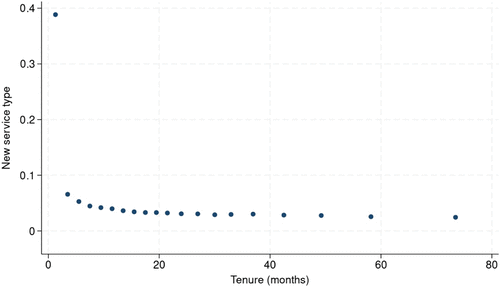
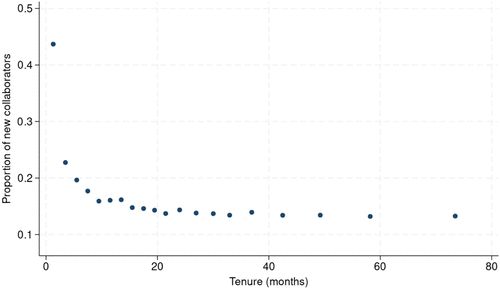
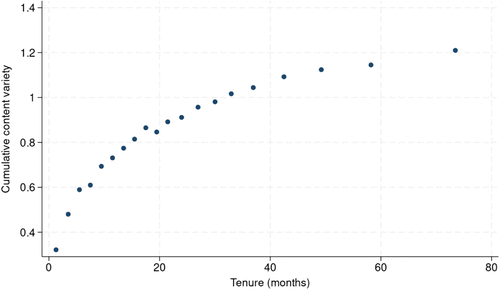
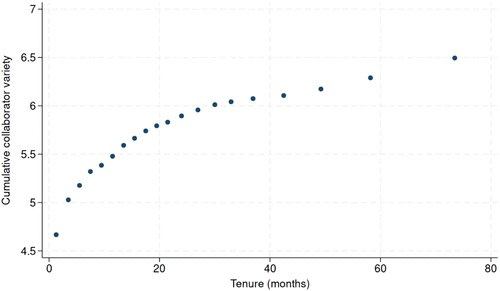
Figure 5 then plots the overall distribution of project portfolios at Nexus, portraying the joint distribution of cumulative content variety and cumulative collaborator variety. It reveals substantial variation in the variety of project portfolios assembled by Nexus employees, although the relatively continuous distribution of content and collaborator variety suggests that there are not clear clusters of different kinds of profiles.
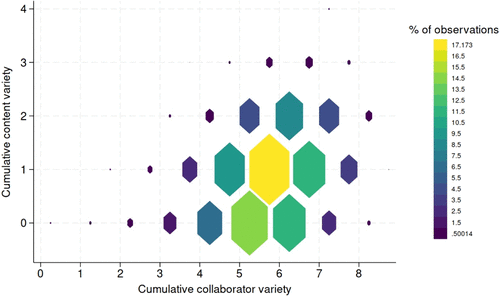
Note. The size of the hexagon corresponds to the relative percentage of observations (over the total sample).
Together, these descriptive figures suggest that employees assemble a wide variety of project portfolios at Nexus early on in their careers before converging on a more stable set of project types and collaborators. This pattern is largely consistent with employees engaging in an initial search for fit until they find the right match. In the following section, we seek confirmation for this intuition by analyzing the determinants of project portfolio variety.
3.4.2. Determinants of Project Portfolio Variety.
Table 2 presents analyses of the characteristics of each new project that an employee takes on. Our unit of analysis is therefore the employee-project, with each observation representing the beginning of a new project, which we define as an employee being assigned to a billing code that they have not previously worked on.
|
Table 2. Determinants of Project Portfolio
| (1) | (2) | (3) | (4) | |
|---|---|---|---|---|
| New service type | New service type | Proportion of new collaborators | Proportion of new collaborators | |
| Cumulative content variety | −0.0229*** | −0.2616*** | 0.0242*** | −0.0481*** |
| (0.0023) | (0.0065) | (0.0021) | (0.0039) | |
| Cumulative collaborator variety | −0.0128*** | −0.0102*** | −0.0236*** | −0.0557*** |
| (0.0011) | (0.0025) | (0.0012) | (0.0022) | |
| Log project team size | −0.0108*** | −0.0124*** | 0.0843*** | 0.087*** |
| (3.8e-04) | (3.9e-04) | (4.6e-04) | (4.9e-04) | |
| Cumulative number of prior projects | −2.2e-04*** | −1.5e-04* | −1.9e-04*** | −1.2e-04** |
| (3.5e-05) | (6.4e-05) | (2.7e-05) | (4.5e-05) | |
| Tenure | −5.6e-04*** | −7.6e-04*** | −6.6e-04*** | −4.5e-04*** |
| (5.3e-05) | (1.6e-04) | (5.4e-05) | (1.2e-04) | |
| Service type promotion premium | −0.0874*** | −0.0343+ | 0.0195 | −0.0019 |
| (0.0162) | (0.0187) | (0.016) | (0.0143) | |
| Past performance | −0.0025*** | 0.0011 | −0.0063*** | 0.0011 |
| (6.1e-04) | (9.0e-04) | (6.7e-04) | (7.2e-04) | |
| Rank 2 | 0.0044 | −0.0212** | 0.0218*** | 0.004 |
| (0.0052) | (0.0081) | (0.0046) | (0.0068) | |
| Rank 3 | −0.0016 | −0.0203* | 0.0166*** | 0.0021 |
| (0.0053) | (0.0086) | (0.0046) | (0.0072) | |
| Rank 4 | −0.0124* | −0.0249** | 0.0238*** | −5.4e-05 |
| (0.0054) | (0.0093) | (0.0047) | (0.0077) | |
| Rank 5 | −0.0222*** | −0.0404*** | 0.0235*** | −0.0084 |
| (0.0057) | (0.011) | (0.0053) | (0.0089) | |
| Year-month FE | Yes | Yes | Yes | Yes |
| Business line FE | Yes | Yes | Yes | Yes |
| Region FE | Yes | Yes | Yes | Yes |
| Service type FE | Yes | Yes | Yes | Yes |
| Individual FE | No | Yes | No | Yes |
| N | 744,443 | 742,249 | 744,443 | 742,249 |
| Adjusted R2 | 0.108 | 0.154 | 0.232 | 0.292 |
Notes. Standard errors are in parentheses (clustered at the employee-level unit of analysis, employee-project-month-year). Models (1) to (4) are estimated only for employees who move to a new project. Samples in Models (2) and (4) are smaller than those in Models (1) and (3) because of omitted observations due to collinearity for the inclusion of individual fixed effects (FEs).
+p < 0.10; *p < 0.05; **p < 0.01; ***p < 0.001.
Determinants of New Service Types.
Model (1) estimates whether each new project involves a new service type for that employee. We use a linear probability model for this analysis for ease of interpretation.
Our analyses are consistent with employees diversifying their project portfolios in search of fit. First, we find that employees become less likely to work on a new project the more that they have already engaged in search. We find that those who have been more diversified in the past—that is, have higher cumulative content variety—are less likely to move into a new service type. It is unlikely that the result is merely due to ceiling effects, because the average employee staffed on a new project has cumulative experience with just 9 out of 300 service types. Similarly, those with higher cumulative collaborator variety are less likely to take on new project types. A one-standard-deviation increase in content variety is associated with a 1.56% decrease in the probability of working on a new service type, whereas a one-standard-deviation increase in collaborator variety is associated with a 1.1% decrease.
We also find that the more opportunities that people have had to engage in search, the less likely they are to work on a new kind of project. The probability of working on a new kind of project declines as tenure grows, with a one-standard-deviation increase in months of tenure associated with a 1% decrease in the probability of working on a new service type.5 Similarly, we find that employees become less likely to work on a new kind of service type when they have a higher cumulative number of prior projects. A one-standard-deviation increase in the cumulated number of project corresponds to a decrease in the probability of working on a new service type by 2.95%. This result is again consistent with employees being less likely to search as they accumulate experience.
Third, we find that people are less likely to move to a new service type when their past performance in the previous year is higher, although a one-standard-deviation increase in past performance is associated with only a 0.23% decrease in the probability of taking on a new service type.
Finally, other variables in our analyses also provide interesting insights on other dynamics driving project diversification. We find that employees are less likely to move to a new service type if they are already working in a service type that has a higher service type promotion premium. A one-standard-deviation increase in the project premium of the previously held portfolio is associated with a 0.5% decrease in the probability of diversifying in the current month. Such an effect is consistent with people wanting to move out of less advantaged service types and remain within more advantaged service types. We also find evidence that those in the most senior levels become less likely to enter new service types, perhaps because of greater demands for expertise at those levels. We also find that people in larger teams are less likely to move to new service types.
Model (2) reestimates Model (1) including employee fixed effects. The results are largely consistent with those in Model (1), although coefficient for past performance loses significance. This change suggests that the performance effects were mostly driven by between-employee differences. In Model (2), we observe a notable increase in the magnitude of the coefficient for cumulative content variety relative to Model (1): a one-standard-deviation increase in cumulative content variety is associated with a 17.78% decrease in the probability of moving to a new service type, compared with just a 1.56% decrease in Model (1). One possible explanation for this difference in magnitude is the presence of stable individual differences in preference for content variety.
Determinants of New Collaborators.
Model (3) then explores the determinants of proportion of new collaborators. The results are similar to those for working on a new service type. We find that those who have already gained higher cumulative collaborator variety are less likely to add new collaborators subsequently (0.021 decline in new collaborators for a one-standard-deviation increase), as are those who have already worked on more projects (0.025 decline in new collaborators for a one-standard-deviation increase), have higher tenure (0.011 decline in new collaborators for a one-standard-deviation increase), and have higher past performance (0.006 decline in new collaborators for a one-standard-deviation increase). Interestingly, those with higher cumulative content variety are more likely to add new collaborators (0.017 increase for a one-standard-deviation increase).
Model (4) includes employee fixed effects. Again, the results are consistent with Model (3) except for the coefficient for past performance not being statistically significant and for the coefficient on cumulative content variety changing sign. This pattern indicates that the effects of performance and content variety are largely driven by cross-person differences.
Overall, these results suggest that employees construct careers at Nexus according to a search logic, with decisions about the kinds of projects to work on driven by attempts to achieve fit. In particular, our analyses emphasize the role of prior search, tenure, collaborator variety, and past performance in shaping the diversity of employees’ project portfolio. These findings are consistent with predictions that these factors enable the discovery of fit—reducing the need for further diversification—by providing information on the expected returns from working on an unknown versus a known project type.
Our findings raise a further question: under what circumstances will employees engage in shorter or more extended search? We turn to this question next.
3.4.3. When Does Experimentation Lead to Project Focus?
In this section, we examine when employees’ search is more likely to lead them to focus their subsequent projects, reducing the need for prolonged exploration. We explore two sets of influences.
First, we examine the effects of alternative sources of information. Search theories suggest that employees should become less likely to try new kinds of projects and colleagues as they learn more about different project types through experimentation. But employees can also learn about the rewards of different kinds of projects in other ways, such as through talking to colleagues or absorbing information about the organization over time.
Those other sources of information are likely to complement the effects of search. When employees have both tried different kinds of projects themselves and learned about projects through their broader interactions, they are more likely to believe that they have learned enough to stop searching. If, on the other hand, they have only engaged in experimentation, they may be less likely to believe that they know enough to focus on a particular kind of work. We therefore expect the negative relationship between prior search across different service types and further diversification to be stronger when employees have higher tenure and more diversified collaborators.
Another important influence on employees’ learning is performance feedback on the project types that they have already explored (Posen and Levinthal 2012, Chatterji et al. 2016). When search has resulted in high performance, employees are more likely to stop searching. When, however, performance is low, employees will be more likely to continue searching regardless of the extent of prior search. We would therefore also expect the negative relationship between prior search across different service types and further diversification to be stronger when performance is high.
Table 3 presents our interaction analyses. All models have the same control structure as those in Table 2 and include individual fixed effects.
|
Table 3. Determinants of Project Portfolio: Interaction Analyses
| (1) | (2) | (3) | (4) | (5) | (6) | (7) | (8) | |
|---|---|---|---|---|---|---|---|---|
| New service type | Proportion of new collaborators | New service type | Proportion of new collaborators | New service type | Proportion of new collaborators | New service type | Proportion of new collaborators | |
| Cumulative content variety | −0.1557*** | −0.0499*** | 0.1333*** | 0.0629*** | −0.261*** | −0.0482*** | −0.0371+ | 0.0397** |
| (0.007) | (0.0038) | (0.02) | (0.0142) | (0.0065) | (0.0038) | (0.0212) | (0.0151) | |
| Cumulative collaborator variety | −0.0155*** | −0.0462*** | 0.0562*** | −0.037*** | −0.0109*** | −0.0557*** | 0.0073 | −0.0339*** |
| (0.0027) | (0.0026) | (0.0042) | (0.0032) | (0.0025) | (0.0022) | (0.0047) | (0.0033) | |
| Cumulative content variety × Tenure | −0.0031*** | −0.0027*** | ||||||
| (1.2e-04) | (1.3e-04) | |||||||
| Cumulative collaborator variety × Tenure | −4.0e-04*** | −2.8e-04*** | ||||||
| (5.9e-05) | (6.5e-05) | |||||||
| Cumulative content variety × Cumulative collaborator variety | −0.0665*** | −0.0187*** | −0.0223*** | −0.015*** | ||||
| (0.0034) | (0.0023) | (0.0038) | (0.0025) | |||||
| Cumulative content variety × Past performance | −0.016*** | −0.005*** | ||||||
| (0.0015) | (0.0015) | |||||||
| Cumulative collaborator variety × Past performance | −0.0018* | −8.1e-05 | ||||||
| (8.0e-04) | (8.1e-04) | |||||||
| Tenure | 0.003*** | 0.0021*** | −9.4e-04*** | −5.0e-04*** | −8.0e-04*** | −4.6e-04*** | 0.0025*** | 0.0013** |
| (2.2e-04) | (3.9e-04) | (1.7e-04) | (1.1e-04) | (1.6e-04) | (1.2e-04) | (2.2e-04) | (4.2e-04) | |
| Log project team size | −0.0124*** | 0.0869*** | −0.0126*** | 0.087*** | −0.0124*** | 0.087*** | −0.0124*** | 0.0869*** |
| (3.9e-04) | (4.9e-04) | (3.9e-04) | (4.9e-04) | (3.9e-04) | (4.9e-04) | (3.9e-04) | (4.9e-04) | |
| Cumulative number of prior projects | −1.2e-04+ | −1.0e-04** | −1.2e-04+ | −1.1e-04* | −1.4e-04* | −1.2e-04** | −1.2e-04+ | −1.0e-04* |
| (6.8e-05) | (3.9e-05) | (6.2e-05) | (4.5e-05) | (6.4e-05) | (4.5e-05) | (6.7e-05) | (4.1e-05) | |
| Service type promotion premium | −0.0375* | −0.002 | −0.038* | −0.0029 | −0.035+ | −0.002 | −0.0385* | −0.0028 |
| (0.019) | (0.0143) | (0.0188) | (0.0143) | (0.0187) | (0.0143) | (0.019) | (0.0143) | |
| Past performance | −7.7e-04 | 6.1e-04 | 8.3e-04 | 0.0011 | 0.0184*** | 0.0123* | 0.0049** | 0.0012 |
| (9.3e-04) | (7.2e-04) | (9.1e-04) | (7.2e-04) | (0.0016) | (0.0049) | (0.0016) | (0.005) | |
| Rank 2 | −0.0259** | 0.0036 | −0.0207* | 0.0041 | −0.0236** | 0.0038 | −0.0259** | 0.0038 |
| (0.0082) | (0.0068) | (0.008) | (0.0068) | (0.008) | (0.0068) | (0.0081) | (0.0068) | |
| Rank 3 | −0.0246** | 0.0011 | −0.0178* | 0.0028 | −0.0218* | 0.0018 | −0.0237** | 0.0019 |
| (0.0088) | (0.0072) | (0.0086) | (0.0072) | (0.0086) | (0.0072) | (0.0087) | (0.0072) | |
| Rank 4 | −0.0322*** | −5.5e-04 | −0.0238* | 2.6e-04 | −0.0255** | −2.1e-04 | −0.031*** | −1.7e-04 |
| (0.0095) | (0.0077) | (0.0093) | (0.0077) | (0.0093) | (0.0077) | (0.0094) | (0.0077) | |
| Rank 5 | −0.0397*** | −0.0078 | −0.0381*** | −0.0077 | −0.0375*** | −0.0082 | −0.0381*** | −0.0074 |
| (0.0113) | (0.0089) | (0.011) | (0.0089) | (0.011) | (0.0089) | (0.0112) | (0.0089) | |
| Year-month FE | Yes | Yes | Yes | Yes | Yes | Yes | Yes | Yes |
| Business line FE | Yes | Yes | Yes | Yes | Yes | Yes | Yes | Yes |
| Region FE | Yes | Yes | Yes | Yes | Yes | Yes | Yes | Yes |
| Service type FE | Yes | Yes | Yes | Yes | Yes | Yes | Yes | Yes |
| Individual FE | Yes | Yes | Yes | Yes | Yes | Yes | Yes | Yes |
| N | 742,249 | 742,249 | 742,249 | 742,249 | 742,249 | 742,249 | 742,249 | 742,249 |
| Adjusted R2 | 0.157 | 0.292 | 0.155 | 0.292 | 0.154 | 0.292 | 0.157 | 0.292 |
Notes. Standard errors are in parentheses (clustered at the employee-level unit of analysis, employee-project-month-year). Models (1) to (8) are estimated only for employees who move to a new project and include individual fixed effects (FEs).
+p < 0.10; *p < 0.05; **p < 0.01; ***p < 0.001.
Tenure.
Model (1) in Table 3 estimates the probability of moving to a new service type (as in Model (2) of Table 2), including the interaction between cumulative content variety and tenure. This interaction is negative and statistically significant. Specifically, a one-standard-deviation increase in cumulative content variety is associated with a 14.9% decrease in the probability of working on a new service type when tenure is low (one standard deviation below the mean) and with a 22% decrease when tenure is high (one standard deviation above the mean). Model (2) in Table 3 estimates the proportion of new collaborators in the new project (as in Model (4) of Table 2), including the interaction between cumulative collaborator variety and tenure. We again find a negative and statistically significant interaction between tenure and cumulative collaborator variety. A one-standard-deviation increase in cumulative collaborator variety is associated with a decrease in the proportion of new collaborators by 0.05 when tenure is low and 0.06 when tenure is high.
Overall, these results are consistent with diversified experience—both in terms of work content and collaborators—being more effective at identifying fit when employees have been in the organization for longer. Longer tenure complements prior exploration as it enhances vicarious learning by providing more opportunities to observe patterns, understand workplace dynamics, and gather insights from others’ experiences.
Collaborator Variety.
Model (3) in Table 3 adds the interaction between cumulative content variety and cumulative collaborator variety to our models predicting the probability of moving to a new service type. Model (4) in Table 3 adds the same interaction term to our estimates of the proportion of new collaborators in the new project. In both models, we find a negative and statistically significant interaction between cumulative content and collaborator variety. A one-standard-deviation increase in cumulative content variety is associated with a 14.3% decrease in the likelihood to move to a new service type and a decrease of 0.02 in the proportion of new collaborators when employees have low levels of cumulative collaborator variety (one standard deviation below the mean). When collaborator variety is high, the decreases are 22.4% and 0.05, respectively.
These results suggest that diversification in terms of project types and collaborators complement one another in making the search for fit more efficient—that is, employees are less likely to search further for the right type of project and team when they have more collaborators.
Past Performance.
Model (5) in Table 3 then adds the interaction between cumulative content variety and past performance to our models estimating the probability of moving to a new service type (as in Model (2) of Table 2). We find a negative and statistically significant interaction between past performance and cumulative content variety, suggesting that the negative relationship between prior search and the probability of working on a new type of project is stronger for high performers. Specifically, when past performance is low (i.e., one standard deviation below the mean), a one-standard-deviation increase in cumulative content variety decreases the probability of working on a new service type by 17.7%. This negative effect goes to 19% when past performance is high (i.e., one standard deviation above the mean).
Model (6) in Table 3 adds the interaction between cumulative collaborator variety and past performance to a model predicting the proportion of new collaborators in the new project. Again, we find the interaction to be negative and statistically significant. For low past performance, a one-standard-deviation increase in cumulative collaborator variety is associated with a decrease in the proportion of new collaborators by 0.049. The decrease is 0.05 when past performance is high.
Findings in Models (5) and (6) suggest that prior experimentation and positive performance signals complement one another in reinforcing employees’ learning about their fit with different types of content and collaborators. As a result, employees search less extensively and more quickly when their performance is high.
Finally, Models (7) and (8) include all interactions terms simultaneously. Model (7) estimates the probability of moving to a new service type, including interactions between cumulative content variety and, respectively, tenure, past performance, and cumulative collaborator variety. Consistent with Models (1), (3), and (5), the interaction terms are negative and statistically significant. Model (8) estimates the proportion of new collaborators including interactions between cumulative collaborator variety and, respectively, tenure, past performance, and cumulative content variety. The results align with Models (2) and (4), showing negative and statistically significant interactions with tenure and cumulative content variety. The interaction with past performance is also negative but not statistically significant.
Overall, our interaction analyses suggest that employees’ search is quicker when prior experimentation is complemented by alternative sources of information—that is, when employees have higher tenure, more diversified collaborators, and better past performance. Online Appendix 5 presents graphical representations of these interactions.
4. Determinants of Career Advancement
Our analyses suggest that employees at Nexus build their project portfolios through a process of search, initially experimenting with different kinds of work and colleagues before working on a more focused set of projects. The resulting search process gives rise to a varied set of project portfolios, with some people working on a more diverse set of projects than others. This variation raises the question of how differences in those portfolios might affect employees’ subsequent career outcomes. We therefore move on to examine the relationship between project portfolios and subsequent promotion.
Promotions represented a central marker of career success at Nexus, as at many other organizations. The promotion process was highly structured, with promotions overwhelmingly resulting from an annual process where managers gathered data on each employee and discussed their performance with an assigned mentor. The final decision about who to promote would then be taken by the head of each business. The process sought to identify employees who were expected to be successful at the next level within the organization, and particular attention was paid to performance evaluations during the year, the specific roles that the employees played within each project, and the skills that they demonstrated. Decision makers also considered utilization rates (the amount of time that was billed to projects) as well as current and potential sales for more senior employees.
Although our interviewees did not suggest that the particular type of project that employees had worked on played a role in promotion decisions, there are a number of reasons to believe that the breadth of an employee’s project portfolio might shape their subsequent advancement.
First, the diversity of projects that an employee has worked on indicates the extent of experimentation that they have engaged in. The extent of such experimentation is likely endogenous, with those who rapidly find a good match engaging in less search than those whose initial trials are less successful. Nonetheless, it is possible that some employees engage in insufficient experimentation, leading them to end up in projects that are a worse fit for them compared with people who experimented more. In such cases, we might expect people who have accumulated a more diverse project portfolio to be more likely to be promoted.
Second, working on a more diverse set of projects and with a greater breadth of collaborators may accelerate career advancement because of its effects on employees’ human and social capital. Prior research has suggested that people with a greater breadth of experience have more flexibility in deployment (Byun and Raffiee 2023), and are better able to coordinate across different kinds of work (Ching et al. 2021) and think strategically (Dragoni et al. 2011). At the job level, studies have found that people who have worked in a broader set of roles are more likely to be hired into executive positions (Won and Bidwell 2023) and are better paid once they are hired (Custódio et al. 2013). Similarly, research on networks often finds that people with more diverse social capital receive more rapid promotions (Podolny and Baron 1997, Seibert et al. 2001, Sparrowe et al. 2001). People who explored a greater variety of kinds of projects will have built broader knowledge and networks during the process. It is possible that this breadth would also contribute to their career advancement.
At the same time, there are good reasons to believe that people who are still in the process of search are less likely to get promoted. Our above analysis found that lower performers are more likely to continue to try new kinds of projects. Even controlling for measured performance, it is therefore likely that people who are still engaging in project diversification will be those who are a worse fit for their current work. Hence, there are also grounds to believe that recent diversification may be negatively related to career advancement. We address this challenge by separately examining the effects of recent versus prior project diversity in our analyses.
4.1. Measures
4.1.1. Outcomes.
Our primary measure of career advancement is employees’ rate of promotion into a higher-level job. Nexus had six hierarchical levels, and promotions took people from one level to the next one. We created a promotion variable that takes the value one if the employee is promoted to a higher hierarchical level during year t + 1 and zero otherwise.
4.1.2. Predictors.
Effects of Prior Search.
Our main independent variables are based on the cumulative content variety and cumulative collaborator variety variables described in Effects of Prior Search in Section 3.2.2. As described above, we divide these variety variables into two components. Year content variety and year collaborator variety measure variety in the projects carried out during year t. These components track the effects of recent search.
Prior cumulative content variety and prior cumulative collaborator variety then measure the variety experienced by the employees over all projects performed prior to the beginning of year t. Once we hold year content variety and year collaborator variety constant, these metrics help us assess how having built a broad portfolio of experiences shapes advancement, net of any effects of being a poor fit with current project types—or indeed of short-term challenges of adjusting to a new kind of project or new collaborators.
Control Variables.
We mitigate the effects of heterogeneity in promotion opportunities by comparing advancement among people in similar positions. In each year, we group together observations that have the same job title and are in the same region and business line, to identify the group of people who are most similar in terms of the broad opportunities open to them. We then include a fixed effect for each of these unique competitive sets (matching indicator fixed effects), ensuring that our analyses explicitly compare people who are eligible for the same promotion. Additionally, we include fixed effects for job title, region, and business line at the time of hire to account for the employee’s initial position at Nexus.
We control for differences in the opportunities that people will have had to build diverse portfolios by including controls for the number of projects that people have worked on. In addition to controlling for the absolute value, we also account for possible nonlinearities by including a binned variable for each quartile of prior projects. We also control for year of hire and include dummy variables for each possible value of time in level in years (i.e., either time since last promotion or time since hire for those that have not been promoted) to flexibly account for time dependence in promotion rates.
Other important control variables reflect the work done in year t, prior to the promotion decision. First, we control for the number of hours billed to billable work, internal work, continuing education, professional development, and other hours to avoid conflating overall billing with project diversity. Observations exceeding 3,600 hours per year (75 hours per week) were winsorized. Second, we control for the number of clients that the employee worked for during year t on the basis that variety in project portfolios might partly reflect familiarity with different clients. Third, we control for log average team size during year t, defined as the average number of employees staffed on the same billing codes at the same time as the focal employee, to avoid conflating effects of collaborator variety with size of overall project teams. We also include year fixed effects to account for fluctuating economic opportunities that could affect promotion rates.
Note that we do not control for performance in our main analysis. Our arguments suggest that prior project variety should affect performance, making it a mediating variable and “bad control” (Angrist and Pischke 2009, p. 47). We do include additional models with this variable, though.
4.2. Sample
As career advancement decisions at Nexus are made on a yearly basis, our sample for this set of analyses includes 88,274 employee-year observations for 41,206 employees.6
4.3. Results
4.3.1. Descriptive Analysis.
Table 4 presents means, standard deviations, and correlations for the sample. Thirty-three percent of the people in our sample got promoted in a given year, on average. Most of those promotions occurred when people had been in their level for between one and two years (although those at higher levels take significantly longer to be promoted).
|
Table 4. Descriptive Statistics
| Mean | SD | 1 | 2 | 3 | 4 | 5 | 6 | 7 | 8 | 9 | 10 | 11 | 12 | 13 | 14 | 15 | 16 | 17 | 18 | 19 | 20 | 21 | 22 | 23 | |
|---|---|---|---|---|---|---|---|---|---|---|---|---|---|---|---|---|---|---|---|---|---|---|---|---|---|
| 0.33 | 0.47 | 1.00 | ||||||||||||||||||||||
| 0.65 | 0.61 | −0.09 | 1.00 | |||||||||||||||||||||
| 5.44 | 1.00 | −0.00 | 0.36 | 1.00 | ||||||||||||||||||||
| 0.58 | 0.53 | −0.04 | 0.48 | 0.10 | 1.00 | |||||||||||||||||||
| 5.23 | 0.92 | 0.09 | 0.05 | 0.45 | 0.26 | 1.00 | ||||||||||||||||||
| 1,827.38 | 396.79 | 0.15 | −0.15 | −0.01 | −0.23 | −0.08 | 1.00 | |||||||||||||||||
| 169.16 | 243.64 | −0.02 | 0.19 | 0.09 | 0.27 | 0.16 | −0.55 | 1.00 | ||||||||||||||||
| 76.71 | 85.65 | −0.04 | −0.12 | −0.01 | 0.01 | 0.21 | −0.20 | −0.03 | 1.00 | |||||||||||||||
| 116.50 | 228.67 | −0.08 | 0.24 | 0.01 | 0.34 | 0.02 | −0.49 | 0.13 | −0.05 | 1.00 | ||||||||||||||
| 0.18 | 14.83 | −0.00 | −0.01 | −0.01 | 0.00 | −0.01 | −0.01 | 0.01 | 0.01 | 0.00 | 1.00 | |||||||||||||
| 3.33 | 0.83 | 0.01 | −0.14 | 0.10 | −0.18 | 0.20 | 0.24 | −0.15 | −0.08 | −0.20 | −0.00 | 1.00 | ||||||||||||
| 1.45 | 1.04 | −0.18 | 0.31 | 0.14 | 0.08 | −0.15 | −0.10 | 0.04 | −0.14 | 0.12 | 0.00 | 0.03 | 1.00 | |||||||||||
| 6.38 | 10.41 | 0.04 | 0.16 | 0.02 | 0.30 | 0.22 | −0.13 | 0.11 | 0.16 | 0.08 | −0.01 | −0.23 | −0.06 | 1.00 | ||||||||||
| 10.04 | 16.58 | 0.03 | 0.17 | 0.01 | 0.30 | 0.21 | −0.10 | 0.10 | 0.14 | 0.05 | −0.01 | −0.26 | −0.05 | 0.90 | 1.00 | |||||||||
| 0.56 | 0.31 | −0.07 | 0.70 | 0.23 | 0.73 | 0.12 | −0.21 | 0.29 | −0.10 | 0.30 | 0.00 | −0.12 | 0.26 | 0.16 | 0.16 | 1.00 | ||||||||
| 0.03 | 0.91 | −0.04 | 0.13 | 0.14 | 0.02 | 0.00 | 0.04 | 0.04 | −0.11 | 0.04 | −0.01 | −0.03 | 0.13 | −0.02 | 0.00 | 0.09 | 1.00 | |||||||
| 4.75 | 1.13 | −0.14 | 0.40 | 0.91 | 0.13 | 0.34 | −0.07 | 0.11 | −0.07 | 0.11 | −0.01 | 0.10 | 0.32 | −0.03 | −0.03 | 0.28 | 0.17 | 1.00 | ||||||
| 4.59 | 1.16 | 0.15 | 0.22 | 0.82 | 0.04 | 0.43 | 0.10 | 0.02 | 0.05 | −0.14 | −0.01 | 0.07 | −0.11 | 0.05 | 0.04 | 0.09 | 0.10 | 0.55 | 1.00 | |||||
| 4.14 | 1.14 | 0.30 | −0.08 | 0.30 | 0.19 | 0.81 | 0.02 | 0.10 | 0.22 | −0.11 | −0.01 | 0.10 | −0.32 | 0.22 | 0.21 | 0.02 | −0.09 | 0.05 | 0.55 | 1.00 | ||||
| 4.69 | 0.98 | −0.08 | 0.12 | 0.47 | 0.24 | 0.92 | −0.12 | 0.16 | 0.17 | 0.08 | −0.02 | 0.19 | −0.02 | 0.18 | 0.17 | 0.15 | 0.07 | 0.48 | 0.31 | 0.56 | 1.00 | |||
| 0.22 | 0.42 | −0.13 | 0.02 | 0.03 | 0.01 | 0.01 | −0.02 | 0.02 | 0.02 | −0.02 | 0.00 | 0.01 | −0.03 | −0.01 | −0.02 | 0.00 | −0.05 | 0.02 | 0.05 | 0.02 | 0.00 | 1.00 | ||
| 0.07 | 0.09 | 0.13 | −0.43 | 0.02 | −0.41 | 0.17 | 0.12 | −0.19 | 0.27 | −0.22 | −0.01 | −0.00 | −0.33 | 0.09 | 0.06 | −0.64 | −0.10 | −0.12 | 0.18 | 0.25 | 0.11 | 0.02 | 1.00 | |
| 0.44 | 0.16 | −0.02 | −0.21 | −0.07 | −0.37 | −0.06 | 0.13 | −0.18 | −0.08 | −0.19 | −0.00 | −0.04 | −0.02 | −0.23 | −0.19 | −0.30 | −0.01 | −0.07 | −0.04 | −0.06 | −0.04 | 0.02 | 0.01 | 1.00 |
Notes. The unit of analysis is the employee-year, and n = 88,274. SD, standard deviation.
4.3.2. Regression Analyses.
We structure our analyses as discrete time survival analyses (Allison 1984). Each observation in our analysis is an employee-year (we defined each year as ending just before the annual promotion cycle took place, rather than by calendar definitions, to match timing of prior projects to future promotions). We then use a linear probability model to estimate the probability that the employee will be promoted in t + 1. We present our results in Table 5.7
|
Table 5. Determinants of Promotion (Linear Probability Model Estimation)
| (1) | (2) | (3) | (4) | (5) | (6) | (7) | (8) | |
|---|---|---|---|---|---|---|---|---|
| Promotion t + 1 | Promotion t + 1 | Promotion t + 1 | Promotion t + 1 | Promotion t + 1 | Promotion t + 1 | Promotion t + 1 | Promotion t + 1 | |
| Prior cumulative content varietyt | 0.0155*** | 0.0224*** | 0.0175*** | 0.0184*** | 0.0162*** | 0.02*** | ||
| (0.003) | (0.0031) | (0.0032) | (0.0032) | (0.0033) | (0.0033) | |||
| Year content varietyt | −0.0464*** | −0.0451*** | −0.0452*** | −0.0458*** | −0.0402*** | |||
| (0.0037) | (0.0037) | (0.0037) | (0.0039) | (0.0039) | ||||
| Prior cumulative collaborator varietyt | 0.0111*** | 0.0132*** | 0.0087*** | 0.0056** | 0.0052* | 0.0041+ | ||
| (0.0017) | (0.0018) | (0.0019) | (0.002) | (0.0021) | (0.0021) | |||
| Year collaborator varietyt | −0.007** | −0.0017 | −0.0018 | −0.0035 | −0.0045* | |||
| (0.0021) | (0.0022) | (0.0022) | (0.0022) | (0.0022) | ||||
| Billable workt | 1.8e-04*** | 1.8e-04*** | 1.8e-04*** | 1.8e-04*** | 1.8e-04*** | 1.8e-04*** | 1.8e-04*** | 1.5e-04*** |
| (5.4e-06) | (5.4e-06) | (5.4e-06) | (5.4e-06) | (5.4e-06) | (5.4e-06) | (5.4e-06) | (5.5e-06) | |
| Internal workt | 9.8e-05*** | 1.1e-04*** | 9.6e-05*** | 1.0e-04*** | 1.1e-04*** | 1.1e-04*** | 1.1e-04*** | 9.0e-05*** |
| (7.7e-06) | (7.7e-06) | (7.7e-06) | (7.8e-06) | (7.8e-06) | (7.8e-06) | (7.8e-06) | (7.9e-06) | |
| Continuing Educationt | −3.5e-04*** | −3.3e-04*** | −3.5e-04*** | −3.4e-04*** | −3.3e-04*** | −3.3e-04*** | −3.3e-04*** | −3.2e-04*** |
| (1.8e-05) | (1.8e-05) | (1.8e-05) | (1.8e-05) | (1.8e-05) | (1.8e-05) | (1.8e-05) | (1.9e-05) | |
| Professional developmentt | 1.6e-04*** | 1.7e-04*** | 1.6e-04*** | 1.6e-04*** | 1.7e-04*** | 1.7e-04*** | 1.9e-04*** | 1.7e-04*** |
| (8.0e-06) | (8.1e-06) | (8.0e-06) | (8.0e-06) | (8.1e-06) | (8.1e-06) | (8.5e-06) | (8.6e-06) | |
| Other hourst | −4.5e-05 | −4.1e-05 | −4.4e-05 | −4.6e-05 | −4.0e-05 | −3.9e-05 | −4.8e-05 | −3.6e-05 |
| (5.7e-05) | (5.8e-05) | (5.6e-05) | (5.6e-05) | (5.7e-05) | (5.7e-05) | (5.6e-05) | (5.5e-05) | |
| Log average team sizet | −0.0152*** | −0.0144*** | −0.0174*** | −0.0147*** | −0.0153*** | −0.0152*** | −0.0151*** | −0.0124*** |
| (0.0018) | (0.0018) | (0.0019) | (0.002) | (0.002) | (0.002) | (0.0021) | (0.0021) | |
| Number of clientst | −8.9e-04** | −6.9e-04* | −8.9e-04** | −8.5e-04* | −7.1e-04* | −7.0e-04* | −0.0011** | −6.5e-04+ |
| (3.3e-04) | (3.4e-04) | (3.3e-04) | (3.3e-04) | (3.4e-04) | (3.4e-04) | (3.6e-04) | (3.5e-04) | |
| Number of projectst | 5.6e-04* | 5.9e-04** | 5.4e-04* | 5.6e-04* | 5.8e-04** | 5.8e-04** | 9.0e-04*** | 6.2e-04* |
| (2.2e-04) | (2.2e-04) | (2.2e-04) | (2.2e-04) | (2.2e-04) | (2.2e-04) | (2.5e-04) | (2.4e-04) | |
| Cum. cont. varietyt × Cum. coll. varietyt | −0.0108*** | −0.0117*** | −0.0089*** | |||||
| (0.0024) | (0.0024) | (0.0025) | ||||||
| Performancet | 0.0627*** | |||||||
| (0.0015) | ||||||||
| Year FE | Yes | Yes | Yes | Yes | Yes | Yes | Yes | Yes |
| Time in level FE | Yes | Yes | Yes | Yes | Yes | Yes | Yes | Yes |
| Matching indicator FE | Yes | Yes | Yes | Yes | Yes | Yes | Yes | Yes |
| Year of hire FE | Yes | Yes | Yes | Yes | Yes | Yes | Yes | Yes |
| Title at hire FE | Yes | Yes | Yes | Yes | Yes | Yes | Yes | Yes |
| Region at hire FE | Yes | Yes | Yes | Yes | Yes | Yes | Yes | Yes |
| Business line at hire FE | Yes | Yes | Yes | Yes | Yes | Yes | Yes | Yes |
| Number of projects binned FE | Yes | Yes | Yes | Yes | Yes | Yes | Yes | Yes |
| Service type FE | No | No | No | No | No | No | Yes | Yes |
| N | 88,274 | 88,274 | 88,274 | 88,274 | 88,274 | 88,274 | 88,240 | 85,552 |
| Adjusted R2 | 0.399 | 0.400 | 0.399 | 0.399 | 0.400 | 0.400 | 0.403 | 0.417 |
Notes. Standard errors are in parentheses (clustered at the employee-level unit of analysis, employee-year). The sample for Model (8) is smaller than for the previous models because of missing values in the performance appraisals data. Prior cumulative content varietyt and Prior cumulative collaborator varietyt refer to the variety up to the beginning of year t. Cum. cont., cumulative content; Cum coll., collaborator variety; FE, fixed effect.
+p < 0.10; *p < 0.05; **p < 0.01; ***p < 0.001.
Model (1) shows the effects of prior cumulative content variety. We find that higher content variety is associated with higher subsequent promotion rates. Model (2) adds year content variety, which has a strongly negative effect. Controlling for year content variety, a one-standard-deviation increase in prior cumulative content variety is associated with a 1.4% increase in the probability of promotion (versus a 33% baseline level). A one-standard-deviation increase in year content variety is instead associated with a 2.5% decrease in the probability of promotion. Project variety is therefore associated with very different outcomes in the short term versus the long term.
Model (3) then explores the effects of prior cumulative collaborator variety. We find a positive and statistically significant relationship between prior cumulative collaborator variety and promotion. Model (4) then adds a control for year collaborator variety to again distinguish short-term versus long-term effects. We find a negative and statistically significant coefficient for recent collaborator variety (0.6% decrease in probability for a one-standard-deviation increase in year collaborator variety), but longer-term collaborator variety is associated with significantly increased probability of promotion (1.3% increase in probability for a one-standard-deviation increase in prior cumulative collaborator variety). Model (5) then includes all variety variables together. The effects are similar to the prior models, although the coefficient on year collaborator variety loses statistical significance.8
In Model (6), we also explored whether there is any interaction between prior cumulative collaborator variety and prior cumulative content variety, testing whether diverse human capital and social capital are complements or substitutes. We “center” the interaction (subtracting the global mean from each of the interacted variables), allowing us to interpret the coefficients as the effect of variety when it takes its mean value (Aiken and West 1991). We find a significant and negative interaction effect, suggesting that content and collaborator variety are partial substitutes. Figure 6 graphically represents this interaction.9
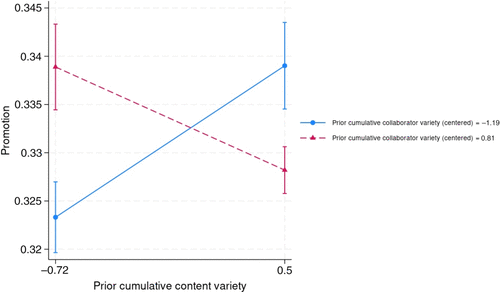
Notes. The centered interaction was created by subtracting the global mean from each of the interacted variables. The figure reports prior cumulative content variety–centered values one standard deviation below the mean (−0.72) and one standard deviation above the mean (0.5), and prior cumulative collaborator variety–centered values one standard deviation below the mean (−1.19) and 1 standard deviation above the mean (0.81).
We also conducted two robustness checks. Model (7) includes dummy variables for the service type to which the employee billed the most time in year t, to see whether the effects of content variety reflect moving into service types with greater advancement opportunities. Our estimates are little changed. Although increased project variety may help people to move to more advantaged project types, this is not the main route by which portfolio variety benefits promotion rates.10 Model (8) then includes a control for the employee’s performance appraisal for the focal year. The sample for Model (8) is smaller than for the previous models because of missing performance data. We find that performance significantly predicts promotions as we would expect, but that it leads to only modest attenuation of our main coefficients for collaborator variety.11
We conducted a further robustness check where we replicated our analyses on the subsample of employees in the two most junior ranks. These employees may have less control over their assignments than their more senior colleagues. The results, presented in Online Appendix 7, are consistent with those in Table 5. Interestingly, the coefficients for prior cumulative and collaborator variety in those analyses are meaningfully larger than those in the full sample.
5. Supplementary Analyses
We conducted a number of supplementary analyses to further probe our results.
5.1. Project Distance
First, we explored alternative approaches to assessing the breadth of project portfolios. In our main analyses, we treated all service types as equally different from one another, focusing on the extent to which people have worked across many service types compared with just a few. Yet it is likely that service types differ in their similarity to one another. Within legal organizations, for example, there may be more similarity between family law and divorce law than there is between family law and intellectual property law. The distance between these different service types is potentially important because combining service types that are more distant may accentuate the effects of diversity, increasing both the potential learning and the costs of that learning. We therefore conducted additional analyses exploring the determinants and consequences of distance between service types.
We calculated the distance between service types using the frequency with which they co-occurred within project portfolios, on the basis that people were more likely to move between more similar project types (Leung 2014). Distance is calculated as the inverse of the Jaccard similarity:
For each new service type that an employee engaged in during the focal month, we then calculated the minimum distance between that service type and all of the other service types that they had worked on up to that month, using the formula (Leung 2014)
We explored the determinants of minimum distance as an alternative means of exploring employees’ tendency to try different kinds of projects (see Table 1 of Online Appendix 8). Specifically, we analyzed the determinants of minimum distance in any month when an employee works on a new service type. The results of this analysis are consistent with our analyses of new service type in Table 2, although the effects are generally weaker. We find that lower performance and lower cumulative number of projects are associated with taking on a more dissimilar kind of service type, but these effects are not robust to the inclusion of individual fixed effects.
Interestingly some of the effects change sign compared with our results in Table 2. Rank is positively associated with minimum distance. It appears that those who are in higher hierarchical levels at Nexus are less likely to seek out new service types, but that when they do, they may look for projects that are very different from their previous work. More established employees may be seeking new project types because of a deliberate desire to try something very new, rather than because of a failure to establish themselves in an existing project type.
We also explored how distance affects promotions. We calculate the average distance between each service type an employee works on in each month of the year and the service types they have worked on up to that month. Online Appendix 9 presents our analyses estimating Model (5) of Table 5 including our measure of average distance. Consistent with the positive relationship between variety and promotions, we also find a positive albeit marginally significant relationship between the average distance of the projects in the portfolio and promotion. Our estimates of prior cumulative content variety and prior cumulative collaborator variety are also robust to accounting for the distance of the projects within the portfolio. Overall, these results suggest that the accumulation of diversified portfolio experience is positively associated with promotions, even when accounting for the similarity of the combinations in the portfolio.12
5.2. Effects on Compensation
In addition to exploring how project portfolios shape promotion, we also explored the relationship between project portfolios and pay (specifically log salary and log bonus). Because compensation decisions are not made until late Summer, we constructed a slightly different data set to analyze compensation. Compensation in August of year t + 1 was regressed on project variety measured from August of year t to July of t + 1. Our analyses span August 2011 (complete compensation data are not available for 2010) to July 2017 and contain 72,615 observations of 24,033 employees (our sample size is also reduced by some missing data on the compensation variables). Twenty-six percent of observations that contained salary data were missing a bonus. Although this may in part reflect poor individual performance, it could also be a consequence of poor business performance or roles being ineligible for a bonus. We therefore dropped observations without bonus from our analyses. Means, standard deviations, and correlations for these analyses are presented in Table 1 of Online Appendix 10 (the compensation variables have been multiplied by an unknown constant for privacy reasons).
We analyze the determinants of pay using individual fixed effects regressions. This specification allows us to examine how changes in individual project portfolios correlate with subsequent pay, controlling for fixed between-person differences that might correlate with project variety and pay. We include dummies for the job title the employee holds in t + 1 to account for the relationship between position and compensation in that year. The models have the same control structure as the promotion regressions and are presented in Table 6.13
|
Table 6. Determinants of Compensation (Individual Fixed Effect (FE) Estimation)
| (1) | (2) | (3) | (4) | |
|---|---|---|---|---|
| Log salary t + 1 | Log salary t + 1 | Log bonus t + 1 | Log bonus t + 1 | |
| Prior cumulative content varietyt | 0.0321* | 0.032* | 0.0242** | 0.0122+ |
| (0.0134) | (0.0134) | (0.0084) | (0.0072) | |
| Year content varietyt | 0.0118 | 0.012 | −0.0375*** | −0.0147** |
| (0.0089) | (0.009) | (0.0066) | (0.0057) | |
| Prior cumulative collaborator varietyt | −0.0306*** | −0.0308*** | 0.0323*** | 0.0089* |
| (0.0056) | (0.0057) | (0.0053) | (0.0044) | |
| Year collaborator varietyt | 6.8e-04 | 6.8e-04 | 0.0038 | 1.7e-04 |
| (0.0038) | (0.0038) | (0.0039) | (0.0034) | |
| Billable workt | −3.4e-06 | −4.6e-06 | 1.4e-04*** | 7.9e-05*** |
| (1.6e-05) | (1.7e-05) | (9.8e-06) | (8.6e-06) | |
| Internal workt | −4.5e-05 | −4.7e-05 | 4.7e-05** | 1.6e-05 |
| (2.8e-05) | (2.9e-05) | (1.4e-05) | (1.2e-05) | |
| Continuing Educationt | −1.4e-04* | −1.4e-04* | 1.9e-05 | 9.2e-05** |
| (6.2e-05) | (6.3e-05) | (3.6e-05) | (3.2e-05) | |
| Professional developmentt | −3.4e-05 | −3.3e-05 | 5.7e-05*** | 3.2e-05* |
| (2.8e-05) | (2.8e-05) | (1.6e-05) | (1.4e-05) | |
| Other hourst | −1.4e-04 | −1.4e-04 | −2.6e-04*** | −9.8e-05 |
| (1.2e-04) | (1.2e-04) | (5.8e-05) | (7.9e-05) | |
| Log average team sizet | −0.003 | −0.003 | −0.0047 | 0.0016 |
| (0.0069) | (0.007) | (0.0045) | (0.0039) | |
| Number of clientst | −8.5e-04 | −8.4e-04 | −0.0012 | −4.2e-04 |
| (8.7e-04) | (8.7e-04) | (9.3e-04) | (8.2e-04) | |
| Number of projectst | 3.4e-04 | 3.3e-04 | 1.6e-04 | −4.2e-04 |
| (4.5e-04) | (4.5e-04) | (6.7e-04) | (5.9e-04) | |
| Performancet | 0.0017 | 0.2351*** | ||
| (0.0038) | (0.0028) | |||
| Year FE | Yes | Yes | Yes | Yes |
| Time in level FE | Yes | Yes | Yes | Yes |
| Matching indicator FE | Yes | Yes | Yes | Yes |
| Number of projects binned FE | Yes | Yes | Yes | Yes |
| Individual FE | Yes | Yes | Yes | Yes |
| Title t + 1 FE | Yes | Yes | Yes | Yes |
| Service type FE | Yes | Yes | Yes | Yes |
| N | 72,615 | 72,205 | 48,284 | 47,993 |
| Adjusted R2 | 0.455 | 0.453 | 0.838 | 0.876 |
Notes. Standard errors are in parentheses (clustered at the employee-level unit of analysis, employee-year). Prior cumulative content varietyt and Prior cumulative collaborator varietyt refer to the variety up to the beginning of year t.
+p < 0.10; *p < 0.05; **p < 0.01; ***p < 0.001.
Models (1) and (2) examine the effects of project portfolios on log salary. Consistent with our promotion results, we find a positive and statistically significant relationship with prior cumulative content variety. However, there is a negative relationship between salary and prior cumulative collaborator variety.
Models (3) and (4) then examine the determinants of log bonus. Generally, the control variables have much more significant effects for log bonus, reflecting the greater variability of bonuses relative to salaries. Similar to the results on promotions, we find the coefficients for prior cumulative content and collaborator variety on bonus to be positive and statistically significant. We continue to find a negative effect of year content variety. The effects for year collaborator variety are not statistically significant.
Overall, these results are largely consistent with our promotion results, demonstrating that bonuses in particular are associated with greater diversity in prior experience and collaborators.
5.3. Additional Analyses
We also conducted a number of additional analyses, whose results are reported in our online appendices. These include assessing the determinants of service type rarity and value (Online Appendix 11), how the effects on promotion of collaborators depend on their hierarchical position (Online Appendix 12), and how clustering among collaborators affects advancement (Online Appendix 13). We also examined how differential attrition by employees might affect our analyses (Online Appendix 14). None of these analyses substantially changed our interpretation of our main results.
6. Discussion
Project-based organizations often provide very different opportunities for constructing careers compared with more traditional, job-oriented organizations. The discrete, limited-duration nature of projects allows employees the flexibility to assemble very different portfolios over time, so that people within the same job can pursue very different experiences. Our analyses provide new evidence on how people build project portfolios in such organizations, and how those portfolios shape their subsequent advancement.
We suggested that project-based work allows people to explore different kinds of work, helping them to discover the kinds of projects that fit them best. Our analyses of when people work on novel versus familiar project types support this perspective. We found that people were more likely to try new kinds of projects when they knew less about the different alternatives—notably, when they were newer in the organization, had worked on fewer projects, had fewer prior collaborators, and had worked on a less diverse set of projects. Employees were also more likely to explore new kinds of projects when they had received worse feedback on their prior choices, as indicated by a lower performance rating. Our analyses of when employees worked with new collaborators yielded similar results. As employees learned more about the alternatives and received better feedback, they became less likely to diversify their portfolio by seeking out new kinds of work and colleagues.
We also explored when prior experimentation was more likely to lead employees to settle on a particular kind of work by examining the factors moderating the relationship between prior project diversity and working on a new kind of project. Our results suggested that different kinds of information were complements in determining search decisions, as prior experimentation was more likely to reduce subsequent search among employees with more tenure and a broader set of collaborators, as well as those whose performance was more highly rated.
These analyses highlight a key advantage of project-based organizations more generally, as the low barriers to movement across project types help employees to experiment with different kinds of work in search of the best fit. This ability to help people find fit is likely to be particularly important when employing more junior people, who have had less opportunity to experiment with different kinds of work and therefore to learn about their strengths and preferences (Jovanovic 1979, Topel and Ward 1992). Anecdotally, people will often work in the kinds of professional services organizations where project-based work is very common early in their careers before moving on to more traditional, job-based organizations. It is possible that the project-based structure of these industries creates particular advantages in employing younger workers, offering employees the opportunity to experiment with different kinds of work without having to change jobs.
A further set of analyses examined how the portfolios that emerged from this search process predicted subsequent advancement. We found that the extent of project-type and collaborator diversity in the most recent year was associated with slower promotion and (for project type) lower bonuses. These results are consistent with the idea that people were more likely to try new kinds of work when they had not found a project type that fit them well. They may also reflect the disruption associated with learning new skills and developing new relationships.
By contrast, we found that project diversity prior to the most recent year was associated with faster promotion and higher bonuses, even holding constant the specific service types that people had worked on. Given that it tends to be lower performers who change project types and collaborators more frequently, these long-term effects are unlikely to reflect selection effects. Instead, these results may reflect long-term benefits from conducting a broader search that allows people to find work that suits them better. It is also possible that these results point to the long-term benefits of building broader human and social capital. Studies of job mobility point to advantages of building broader experience, particularly in more senior positions (Custódio et al. 2013, Byun and Raffiee 2023, Won and Bidwell 2023). Similarly, prior research highlights the value of building broader social capital (Podolny and Baron 1997, Seibert et al. 2001, Sparrowe et al. 2001). The positive effects of building a broader project portfolio may therefore reflect the long-term advantages of building broader human and social capital in enabling flexibility and access to career opportunities.
This overall pattern of results raises an interesting conundrum, in that high performers are less likely to work on a variety of different projects, but that having worked on more varied projects contributes to faster eventual advancement. Future work could explore the reasons for this apparent conflict. One possibility is that high-performing employees struggle to achieve project breadth as their managers prefer to keep them working in the same areas. It may, ironically, be easier for lower performers to build an advantageous portfolio as they face less pressure from managers to remain in the same area. A second possibility is that high performers tend to focus disproportionately on the short-term disruption of changing project types without fully appreciating the longer-term benefits of building breadth. Given that the benefits of project breadth emerge only over time, it is plausible that they would be little appreciated by employees.
6.1. Limitations and Future Research
There are a number of limitations to this study. First, our results are correlational and unable to demonstrate a causal relationship between project portfolios and advancement. Second, the single-organization nature of our study raises questions about the generalizability of our results. Although the characteristics of the organization that we studied are similar to those of other large project-based organizations in the services industry, future work could examine how project variety interacts with organization characteristics in shaping careers.
Third, we lack detailed data on employees’ characteristics. Our findings are therefore silent on how portfolio diversification varies across people with different demographic characteristics or educational backgrounds. We also lack data on social ties other than project staffing patterns, preventing more detailed analysis of how political and social capital shapes careers. Nor do we have information on the specific role that employees play within each project. We believe that collecting granular data to examine how employees accumulate experience by moving across roles within the same type of project would be an important extension of our work.
6.2. Theoretical Implications
This study aims to make a number of contributions to research on careers. First, we contribute to understanding careers in project-based organizations by providing one of the first longitudinal explorations of how careers evolve within such organizations. Whereas prior research on experience accumulation within careers has largely focused on job-based organizational settings (Ferguson and Hasan 2013) or on the external labor market for project work (Leung 2014), we shift attention to project-based careers within organizations. We argue that such organizations afford individuals greater flexibility to engage in a wide variety of fields and domains than traditional job-based structures typically allow. We then show how individuals use this flexibility in practice—navigating diverse project opportunities to diversify their skills and networks as a form of experimentation and discovery within the firm. In doing so, we extend existing conceptions of careers by highlighting how projects can serve as a granular unit of analysis for understanding how individuals accumulate and diversify experience over time. This perspective advances our understanding of how alternative ways of organizing work shape employees’ skills, networks, and, ultimately, their career trajectories.
Second, we contribute to research on discovery and experimentation in careers. We show how the search for fit drives moves across projects in the early stages of careers. Importantly, we show that this search concludes earlier for those who have more access to information through other channels beyond project experimentation, such as longer tenure within the organization, positive performance feedback on past assignments, and a broader network of collaborators. Our findings address long-standing calls in the person–job fit literature (Kristof-Brown et al. 2005) for longitudinal explorations of how and when fit is achieved. Moreover, by analyzing the dynamics and contingencies of experimentation, we also complement prior work on within-job learning and external mobility (Chatterji et al. 2016), showing how project-based work structures also facilitate the discovery of internal opportunities for growth and advancement.
Third, we contribute to the literature on how the breadth and depth of experience shape career advancement. Where prior research has largely measured experience breadth using moves across different kinds of jobs (e.g., Ferguson and Hasan 2013), we show that the variety of projects individuals engage in within a single job title can also meaningfully shape promotion outcomes. Our results also add to the debate on the benefits of specialization versus breadth. Whereas prior work on internal labor markets (Ferguson and Hasan 2013) and external project markets (Zuckerman et al. 2003, Leung 2014) has emphasized the value of specialization, we find that advancement is most closely associated with a broader repertoire of experience. These results underscore the importance of organizational context—particularly the frictions to diversifying experience, such as information asymmetries and discontinuity of transitions—in shaping the relative value of breadth versus depth in career development.
We also contribute to the literature on specialization and careers by separating out the effects of specialization on human and social capital. Those who pursue a more varied career not only learn a different set of skills, but also develop a different set of contacts and collaborators (Kleinbaum 2012). Thus far, though, the rich literature on specialization (Leahey 2007, Merluzzi and Phillips 2016, Teodoridis et al. 2018, Nagle and Teodoridis 2020) has ignored the role that these social capital effects might play on career advancement. Exploiting rich personnel data on project assignments, we are able to demonstrate separate effects on careers of diversity in the kinds of projects that people work on and the collaborators that they work with, as well as to demonstrate the way that variety in human and social capital interact with one another, providing new avenues for considering how these different dimensions of career experience shape advancement in project-based organizations and beyond.
6.3. Managerial Implications
Our study offers several implications for staffing and career development in project-based organizations. First, our findings highlight that staffing decisions should be viewed not only as a way to match skills to immediate project needs, but also as a strategic lever for talent development and retention. Employees—especially early in their tenure—benefit from opportunities to explore a variety of project types and collaborators, which helps them discover where they thrive. Managers can support this process by creating systems that enable rotation, experimentation, and exposure to diverse work contexts. Whether through formalized programs—such as stretch assignments, cross-functional roles, or temporary rotations—or more intentional early staffing choices, encouraging exploration can improve person–project fit, with positive implications for productivity and retention.
Second, our results have important implications for staffing and development decisions related to high-performing employees. We find that these individuals are less likely to diversify their project experience—often because they have identified areas where they thrive and are repeatedly staffed on similar projects. This pattern is reinforced by managers who seek to allocate proven performers to familiar domains where they can deliver reliably. Although such alignment can reflect a strong fit and support short-term efficiency, it may also limit the growth and development of top talent over time, with potential negative consequences for motivation, incentives, and retention. Managers should be mindful of these risks and create opportunities for high performers to diversify their experience.
Finally, our results emphasize the importance of information access in helping employees navigate their careers more effectively. As individuals gain experience, receive feedback, and expand their networks, they become better equipped to identify roles and projects that align with their abilities and preferences. These sources of insight complement experimentation via trial and error, enabling more effective career moves. Managers can facilitate this process by increasing transparency around internal opportunities—such as upcoming projects, team needs, and valued skills—through tools like internal talent marketplaces, transparent staffing systems, or mentoring relationships. Providing employees with these informational resources supports talent development and can improve the alignment between individual aspirations and organizational needs.
The authors are grateful to Lamar Pierce and the entire editorial team for their thoughtful guidance and constructive comments throughout the review process. The authors also thank Rocio Bonet, Roxana Barbulescu, Tracy Anderson, and John Mawdsley for their valuable feedback. The authors appreciate the insightful comments from seminar participants at London Business School, IE Madrid, and our home institutions. Finally, the authors are grateful to the team at the Wharton People Analytics Initiative for their support.
1 Unfortunately, as described above, we are not able to give the exact labels of different service types to protect the confidentiality of our research site.
2 To assess the suitability of aggregating the variables into underlying factors, we conducted both Bartlett’s test of sphericity and the Kaiser–Meyer–Olkin (KMO) measure of sampling adequacy. Bartlett’s test was highly significant (p < 0.001), indicating that the correlation matrix is not an identity matrix and that at least some systematic relationships exist among the variables. However, the KMO value was notably low (0.4), well below the commonly accepted threshold of 0.5, suggesting that the correlations are not sufficiently strong or consistent to support factor extraction. Taken together, these results indicate that although some intercorrelation is present, the overall pattern of associations is too weak and diffuse to justify aggregating the variables into latent factors. Thus, dimensionality reduction through factor analysis or principal component analysis would likely be inappropriate for this data set in its current form. Nevertheless, we also confirmed the robustness of our results to retaining only a subset of components. Online Appendix 1 provides a detailed discussion of our analyses.
3 We also use an alternative dependent variable: proportion of hours with new collaborators. As noted above, we define the hours spent collaborating with a colleague as the minimum of hours that either one of them spent working on the same billing code in the same month. Based on this calculation, we calculate the proportion of all collaborative hours on a new project with collaborators that the focal employee had not worked with previously. The results are largely consistent with those of the analyses using proportion of new collaborators.
4 As detailed in Endnote 1, we are unable to provide the labels of service types provided by the research site. The examples here reported are a generalization for explanatory purposes.
5 Our results are robust to the inclusion of tenure squared to account for potential nonlinearities.
6 One thousand and fifty-one employees from this sample were not included in the analyses presented in Section 3 because of missing data on previous year’s performance.
7 Table 5 presents a test of linear relationships between our key independent variables and promotion. Additional regression-based tests failed to find evidence of a curvilinear relationship. Results are available from the authors.
8 One concern with including both year variety and cumulative variety in the same model is multicollinearity (Kalnins 2018). To gain further confidence in our results, we note that the sign of the coefficients when the variables are included one by one are consistent with the year and cumulative variables being included at the same time. Moreover, the correlations between year content variety and cumulative content variety and between year collaborator variety and cumulative collaborator variety are below 0.5 (with 0.7 being a typical cutoff rule). Finally, the variance inflation factor for our models is below 3.5 (with 5 being a typical cutoff).
9 To further explore the substitution effect between content and collaborator variety, we analyzed the distribution of promoted employees across the tails of these two dimensions. Specifically, 0.096% of promoted individuals are characterized by highly specialized collaborations (bottom 10th percentile of collaborator variety) paired with broad content experience (top 10th percentile of content variety). Conversely, 0.12% of promoted employees display the opposite pattern—broad collaborations (top 10th percentile) coupled with specialized content expertise (bottom 10th percentile). The similarity in these proportions suggests that no single configuration of content and collaborator variety is disproportionately associated with promotion. Rather, this pattern supports the idea—also reflected in our qualitative interviews and visualized in Figure 5—that employees can reach advancement through a variety of pathways, rather than following a dominant or uniform profile.
10 We also estimate Model (7) including both service type fixed effects and senior manager fixed effects, including a dummy variable for the senior manager with whom the employee bills most of his or her hours. Because of missing values in leader identifiers, the sample drops by 35%. Consistent with Model (7), we find a negative and statistically significant interaction between cumulative content variety and cumulative collaborator variety, whereas the main effects are positive but not statistically significant. We also confirm the negative and statistically significant effects of year content variety, whereas year collaborator variety is not statistically significant.
11 Additional analyses examine the relationship between project portfolio variety and performance. The effects of content and collaborator variety on performance are consistent with our results on promotions. Consistent with performance appraisals reflecting in-project performance for the prior year, year content variety is negatively associated with performance, whereas cumulative content and collaborator variety are positively related to it. Online Appendix 6 presents these analyses in detail.
12 Additional analyses examine the distinct career implications of a diverse versus uncommon portfolio of project experience. In Online Appendix 9, we examine the relationship between our measure of rarity and promotion. Consistent with prior results, we find a positive but only marginally significant relationship between rarity and promotion. Our estimates of prior cumulative content variety and prior cumulative collaborator variety are robust to the inclusion of rarity in the model. In additional analyses (available from the authors), we measure atypicality as in the work by Goldberg et al. (2016) on variety versus atypicality as a function of Jaccard similarity (inverse of average distance which equals to one minus average similarity). Consistent with our results on rarity, we find a positive and statistically significant relationship between atypicality and likelihood of promotion. We note that our measure diverges from those of career atypicality based on sequence analysis (Kleinbaum 2012). Because we have over 300 service types in our data, it is very difficult to identify interpretable clusters (see Online Appendix 1).
13 Our analyses include prior cumulative content variety and prior cumulative collaborator variety, controlling for year content variety and year collaborator variety to account for shorter-term effects. We control for the number of hours billed to different kinds of work including billable work, internal work, continuing education, professional development, and other hours. We also control for time in level, log average team size, number of projects (absolute values and binned variable for each quartile), and number of clients during year t. We also include a fixed effect for each set of job title, region, and business line in the focal year, as well as the year and service type fixed effects. We present results with and without controls for performance in year t, because performance is an important influence on compensation, but may also mediate the effects of prior project experiences.
References
- (1991) Multiple Regression: Testing and Interpreting Interactions (Sage Publications, Newbury Park, CA).Google Scholar
- (1984) Event History Analysis: Regression for Longitudinal Event Data (Sage Publications, Thousand Oaks, CA).Crossref, Google Scholar
- (2009) Mostly Harmless Econometrics: An Empiricist’s Companion (Princeton University Press, Princeton, NJ).Crossref, Google Scholar
- (1994) The wage policy of a firm. Quart. J. Econom. 109(4):921–955.Crossref, Google Scholar
- (2016)
Introduction: Bringing jobs back in: Toward a new multi-level approach to the study of work and organizations . Cohen LE, Burton MD, Lounsbury M, eds. The Structuring of Work in Organizations, Research in the Sociology of Organizations, vol. 47 (Emerald Group Publishing Limited, Leeds, UK), 1–22.Crossref, Google Scholar - (2023) Career specialization, involuntary worker–firm separations, and employment outcomes: Why generalists outperform specialists when their jobs are displaced. Admin. Sci. Quart. 68(1):270–316.Crossref, Google Scholar
- (2014) Understanding executive job search. Organ. Sci. 25(5):1511–1529.Link, Google Scholar
- (2016) Learning on the job? Employee mobility in the asset management industry. Management Sci. 62(10):2804–2819.Link, Google Scholar
- (2017) Sink or swim: The role of workplace context in shaping career advancement and human-capital development. Organ. Sci. 28(2):211–227.Link, Google Scholar
- (2021) Extemporaneous coordination in specialist teams: The familiarity complementarity. Organ. Sci. 32(1):1–17.Link, Google Scholar
- (2013) Assembling jobs: A model of how tasks are bundled into and across jobs. Organ. Sci. 24(2):432–454. Link, Google Scholar
- (2023) Multi‐project work and project performance: Friends or foes? Strategic Management J. 44(2):610–636.Crossref, Google Scholar
- (2013) Generalists versus specialists: Lifetime work experience and chief executive officer pay. J. Financial Econom. 108(2):471–492.Crossref, Google Scholar
- (2011) Developing executive leaders: The relative contribution of cognitive ability, personality and the accumulation of work experience in predicting strategic thinking competency. Personnel Psych. 64(4):829–864.Crossref, Google Scholar
- (1991) Person-Job Fit: A Conceptual Integration, Literature Review, and Methodological Critique (John Wiley & Sons, Hoboken, NJ).Google Scholar
- (2013) Specialization and career dynamics: Evidence from the Indian Administrative Service. Admin. Sci. Quart. 58(2):233–256.Crossref, Google Scholar
- (2016) What does it mean to span cultural boundaries? Variety and atypicality in cultural consumption. Amer. Sociol. Rev. 81(2):215–241.Crossref, Google Scholar
- (2007) What’s the difference? Diversity constructs as separation, variety, or disparity in organizations. Acad. Management Rev. 32(4):1199–1228.Crossref, Google Scholar
- (2015) The lives and deaths of jobs: Technical interdependence and survival in a job structure. Organ. Sci. 26(6):1665–1681.Link, Google Scholar
- (2000) The project-based organisation: An ideal form for managing complex products and systems? Res. Policy 29(7–8):871–893.Crossref, Google Scholar
- (2019) Career exploration: A review and future research agenda. J. Vocational Behav. 110:338–356.Crossref, Google Scholar
- (1979) Job matching and the theory of turnover. J. Political Econom. 87(5, Part 1):972–990.Crossref, Google Scholar
- (2018) Multicollinearity: How common factors cause type 1 errors in multivariate regression. Strategic Management J. 39(8):2362–2385.Crossref, Google Scholar
- (2012) Organizational misfits and the origins of brokerage in intrafirm networks. Admin. Sci. Quart. 57(3):407–452.Crossref, Google Scholar
- (2005) Consequences of individuals’ fit at work: A meta-analysis of person-job, person-organization, person-group and person-supervisor fit. Personnel Psych. 58(2):281–342.Crossref, Google Scholar
- (2007) Not by productivity alone: How visibility and specialization contribute to academic earnings. Amer. Sociol. Rev. 72(4):533–561.Crossref, Google Scholar
- (2014) Dilettante or renaissance person? How the order of job experiences affects hiring in an external labor market. Amer. Sociol. Rev. 79(1):136–158.Crossref, Google Scholar
- (2024) The importance of project status for career success: A network perspective. J. Management 52(2):453–483. Google Scholar
- (2016) The specialist discount: Negative returns for MBAs with focused profiles in investment banking. Admin. Sci. Quart. 61(1):87–124.Crossref, Google Scholar
- (2020) Jack of all trades and master of knowledge: The role of diversification in new distant knowledge integration. Strategic Management J. 41(1):55–85.Crossref, Google Scholar
- (2024) Careers in firms: The role of learning about ability and human capital acquisition. J. Political Econom. 132(6):1994–2073.Crossref, Google Scholar
- (1997) Resources and relationships: Social networks and mobility in the workplace. Amer. Sociol. Rev. 62(5):673–693.Crossref, Google Scholar
- (2012) Chasing a moving target: Exploitation and exploration in dynamic environments. Management Sci. 58(3):587–601.Link, Google Scholar
- (2001) A social capital theory of career success. Acad. Management J. 44(2):219–237.Crossref, Google Scholar
- (2001) Social networks and the performance of individuals and groups. Acad. Management J. 44(2):316–325.Crossref, Google Scholar
- (1977) Careers, labor market structure, and socioeconomic achievement. Amer. J. Sociol. 83(3):551–593.Crossref, Google Scholar
- (1980) Analysis of population diversity: Measures of qualitative variation. Sociol. Methods Res. 8(3):341–362.Crossref, Google Scholar
- (2018) Creativity at the knowledge frontier: The impact of specialization in fast- and slow-paced domains. Admin. Sci. Quart. 64(4):894–927. Crossref, Google Scholar
- (1992) Job mobility and the careers of young men. Quart. J. Econom. 107(2):439–479.Crossref, Google Scholar
- (2023) Finding the right path to the top: How past interorganizational moves impact executive selection outcomes. Strategic Management J. 44(10):2341–2376.Crossref, Google Scholar
- (2003) Robust identities or nonentities? Typecasting in the feature-film labor market. Amer. J. Sociol. 108(5):1018–1074.Crossref, Google Scholar

