Cut to the Curve: Underrecognition and Talent Loss from Forced Ranking in a Multinational Firm
Abstract
This paper examines unintended consequences of enforcing a curve on performance rankings. I examine a multinational company where some employees are downgraded from the top levels of rankings due to a strict recognition cutoff. I show that downgraded employees are at least 34% more likely to voluntarily exit, and that attempts by the organization to manage employee concerns, particularly regarding concerns of fairness, envy, and self-image, do not have the intended retention effect. Underrecognized employees leave even though the organization avoids calibration bias, offers reassurance about their career prospects, and compensates them with larger bonuses than their top-ranked peers. In robustness checks, I show that under these conditions even high-performing employees not nominated to the top ranks are more likely to voluntarily depart despite receiving the largest bonuses. These findings suggest that, where underrecognition occurs due to the restriction of top rankings, the mechanisms producing demotivation are more powerful than the management strategies meant to combat them.
This paper was accepted by Lamar Pierce, organizations.
Supplemental Material: The online appendices and data files are available at https://doi.org/10.1287/mnsc.2023.01204.
“At the end of the day, I had to give [the top ranking] to Blair1 [and not to Chris]. But I gave them the exact same bonus. I took from Blair’s pot. I took from Jerry, who I knew was leaving.
Chris was irate. Visibly shook. Saying ‘I can’t believe you rated me solid! Everyone is going to look at me this year and know I was solid. I’ve never been solid at anything in my whole life.’ This conversation was mid-February. He left April 28th.”—senior vice president, finance, Pharma Co.
1. Introduction
Many organizations use a forced distribution ranking system (FDRS) in their performance evaluation process. The most familiar example of using such a ranking scheme in a large organization is that of General Electric (GE) in the 1980s. Under the leadership of Jack Welch, 20% of GE employees were ranked as GE’s top performers each year; 70% were average and 10% were identified as poor performers, who were then fired (Welch 2001, Welch and Welch 2005). The stated goals of this system were to avoid inflated performance rankings and motivate higher performance (Welch 2001). GE’s impressive performance during this period helped popularize strict FDRS at other firms (Grote 2005). Since then, some form of forced ranking has remained a feature in many large organizations such as Amazon, Goldman Sachs, Google, and McDonald’s (Handley 2023).
When high performance rankings are scarce and hard to obtain, they are perceived as more valuable, allowing them to function as prized recognition (Hirsch 1976). In turn, this prized recognition becomes a cost-effective way for organizations to encourage more of the rewarded behavior from their employees (Lazear and Rosen 1981, Prendergast 1999, Besley and Ghatak 2008). Recognition schemes have the potential to reinforce prosocial behavior such as good citizenship and to “crowd in” intrinsically motivated work by making rewards more closely aligned with the act of the work itself (Frey and Jegen 2001, Frey and Neckermann 2008, Bowles and Polania-Reyes 2012). This makes recognition schemes an attractive complement to traditional monetary compensation. From competing chief executive officers (CEOs) to data entry workers, evidence demonstrates that nonrecognized actors work harder in reaction to seeing others’ awards (Ammann et al. 2016, Bradler et al. 2016).
However, using rankings to motivate is inherently risky, particularly around the cutoffs for top performance recognition. If high performers do not make the cutoff, they are likely to be dissatisfied, and if they depart, it can represent a major loss for firms (Groysberg et al. 2008, Younge and Marx 2016). For instance, David Cote, who quit GE and became CEO of Honeywell, attributes his decision to GE’s ranking system (Cohan 2012). Former Starbucks CEO Howard Schultz, elaborating on why he left Xerox, likewise explained that in their ranking system from one to five, “(a)s soon as I got the three, I swear, at that moment, I knew I’ve got to get out of here. And that’s when I started putting myself in a position for other opportunities” (Schultz 2024). Furthermore, functions that are especially team dependent are more likely to experience more intensive consequences of resignations (Siegel 2008). This point is underscored by how drastically Microsoft’s copying of GE’s stacked ranking model backfired when applied to operating system engineers who were building one of the largest collaborative consumer products (Impraise.com 2016). Settings where cooperation or collaboration are fundamental to basic organizational operations are likely to be especially vulnerable to the downsides of exclusionary reward systems (Chambers and Baker 2020, Chambers 2024).
Early on, there was understanding that such a strict approach to performance ranks may cause demotivation, as well as motivation, and companies adjusted their approaches accordingly, incorporating more transparency into the process of ranking to address concerns about bias (Bol 2011, Castilla 2015) and in response to legal disputes (Lawler 2002). Companies saw they could also positively adjust employees’ compensation and could work to ensure that employees’ reputations remain intact even when they do not receive a top rank. Organizations base such strategies on the reasonable assumption that they can manage the negative consequences of ranking systems. To date, however, this assumption has received little study.
The present paper therefore examines two research questions. First, I examine whether, in practice, recognition cutoffs in forced distribution ranking systems can be observed to negatively affect motivation. Second, I study the extent to which management strategies deployed with the conscious intent of mitigating any negative effects in fact succeed in doing so. In particular, I test whether monetary compensation in the form of larger bonuses makes up for missing out on recognition. If the motivational downsides of recognition cutoffs can be managed, they may not be of great concern. But if such management strategies, however sympathetically and systematically executed, are ineffective, then the downsides are powerful indeed.
I collect and analyze data from a multinational corporation that uses forced ranking to establish a company-wide cutoff for the percentage of employees earning a top performance ranking. Several features of this large company make it particularly valuable. First, managers frequently nominate more employees to top rankings than their ranking system allows, despite knowing that this forces executives to later downgrade some of the nominees. Second, managers at this firm have significant discretion for distributing monetary performance rewards, constrained only loosely by the rankings, and they consistently reallocate the highest bonuses to those who are acknowledged as being underrecognized by the ranking they receive. Third, human resources (HR) representatives help to keep the rankings from being biased due to demographics or nonperformance reasons. Fourth, HR keeps ranking processes separate from promotion processes, which offers credible assurances to the downgraded that not earning a top ranking has no bearing on career prospects. These circumstances generate a set of underrecognized employees whose performance is not appreciably different from that of the top-ranked performers, thus illuminating the raw demotivational effects of underrecognition in a forced ranking system net of other related concerns.
This study makes several contributions. It addresses an understudied yet ubiquitous issue: the impact of stringently constrained recognition schemes on employee outcomes. The quota system at the firm in this study produces a quasi-exogeneity by placing very similar individuals on either side of a recognition cutoff. By exploiting this quasi-natural experiment thus created in regard to perceived status, the present paper uniquely contributes to our understanding of the impact of those constraints. Furthermore, I also examine the effectiveness of managerial strategies aimed at mitigating potential talent loss under these conditions. Finally, by combining quantitative data and qualitative insights, this study provides an enhanced depth of analysis in showing how such constraints can lead to the unnecessary departure of top talent.
The paper proceeds as follows. In Section 2, I discuss the likely theoretical explanations, based on fairness, envy, and self-image concerns, for why underrecognized top performers would become demotivated and disengaged as a result of forced distribution rankings. In Section 3, I describe in greater detail how my empirical setting is well suited for this study. Section 4 specifies methods and variables used in the analysis, and Section 5 shows the results. Analyses demonstrate that those who are underrecognized are more likely to exit the organization even when receiving the highest performance bonuses in the company. Additional robustness checks rule out ranking strategy, differences in ability and performance, and threat to career concerns as causes for lowered retention. Even the highest-performing employees not nominated to the top ranks (designated herein as high solid employees) are more likely to voluntarily depart despite receiving larger bonuses. Section 6 concludes with a discussion of theoretical and managerial implications, as well as limitations and directions for future research.
2. Potential Downsides to Strict Recognition Cutoffs
2.1. Power of Recognition
When recognition is a scarce resource, people perceive it to be more valuable and they work harder to obtain it. If everyone earned recognition, it would be meaningless (Best 2011). This makes the use of recognition schemes a potentially powerful motivational device for organizations (Bowles and Polania-Reyes 2012). From the employee perspective, recognition systems provide feedback about performance (Bannister and Balkin 1990); validation of professional ability (Cappelli and Conyon 2018); confirmation of the value that one brings to the organization (Goode 1978); and information about one’s position relative to others (Hirsch 1976).
Recognition cutoffs in performance appraisals can help organizations accurately differentiate between top, average, and low performers, reducing leniency and compression in ratings (Bretz et al. 1992, Schleicher et al. 2009, Moon et al. 2016). They can attract and retain top talent, induce greater effort, streamline decision making, and enhance overall performance (Lawler 1971, Landau and Leventhal 1976, Leventhal 1988, Rynes et al. 2005). Recognition cutoffs thus promise a variety of desirable management outcomes. At the same time, however, they create some potential threats to organizational attachment and individual motivation. To understand this, we need to look at how individuals understand and measure recognition in their professional lives.
People are motivated to earn recognition for its own sake, apart from any instrumental motives (Moldovanu et al. 2007). For instance, informal but highly selective performance awards for collaborative editing can significantly improve performance among the winners (Restivo and van de Rijt 2012). However, disappointment in the search for recognition leads frequently to dismay and even bitterness (Goode 1978).
Furthermore, people view recognition through a powerful framework of comparison between performers in which relative position, and relative deprivation, are based on the sense that one’s status compared with others is at least as important as an absolute state based on standard criteria (Stouffer et al. 1949, Merton 1968, Gurr 1970). This is the case even where performance levels can be objectively measured. An oft-cited example is that of Olympic silver medalists, who are likely to appear the most dissatisfied athletes on the podium (Medvec et al. 1995). The silver medalists have performed better than the bronze (and all nonmedaling athletes), but this does little to assuage the disappointment of not quite reaching gold. People in general look at others performing better than themselves and focus on counterfactuals where their relative standing is reversed (Medvec et al. 1995). Furthermore, when marginal material advantages cease to sate the need for distinction, relative position becomes increasingly sought after, such that being at the top of any hierarchy is valuable only for the position’s relative elevation over others (Hirsch 1976, p. 113).
Because professionals are continuously in the process of gauging their relative standing (Burt 1982), it is not surprising that they become sensitized to even the slightest perturbations in relative peer comparisons. Even retail workers exit companies after receiving raises if they see that the raises of equivalent peers are marginally higher (Dube et al. 2019). Similar negative peer comparisons also increase absenteeism and foregone wages among Indian manufacturing workers (Breza et al. 2018) and cause decreased job satisfaction, leading to job search, among university professors (Card et al. 2012). At the margin, and across a wide range of work, individuals may often be more sensitive to their relative status among their professional peers than to their material situation. Employees therefore want to earn preeminent recognition, net of other considerations such as overall monetary gain (Larkin 2011).
Ranking systems that use recognition cutoffs organized through forced distribution schemes, however, inherently leave some top performers underrecognized relative to their contributions. A famous situation of this kind is the classic example of Merton (1968) of the 40 seats in the French Academy. The idea of a hypothetical 41st member illustrates how those who just barely miss being elected often have similar potential to those who are so recognized. Although the many eligible candidates for that imagined 41st chair frequently go on to outperform their 40 elected counterparts, they never receive the same kind of “immortal” status bestowed on members of the Academy. The same problem can emerge in any organization where a strict cutoff is used, because human performance distributions do not always sort themselves into conveniently distinct bands that would make it easy to separate the best performers from the good ones (O’Boyle and Aguinis 2012). With a large pool of excellent candidates, a cutoff is bound to exclude some excellent and eligible people. This is likely to leave some employees dissatisfied and lead to invidious upward comparisons where individuals look at their standing relative to persons of higher rather than of equal or lower rank (Festinger 1954).
Ranking schemes may therefore inadvertently result in demotivation and disengagement, especially at the top margins of recognition and especially where a cutoff is defined and applied in a strict way. Three interrelated mechanisms help to explain why. First, lesser recognition outcomes among employees exhibiting equal performance will feel like an unfair loss (Adams 1965) even if the assignment process is unbiased (Lind and Tyler 1988). Second, seeing others awarded top ranking can generate pernicious envy (Cohen-Charash 2009), which naturally arises when similar others receive recognition not granted equally (Smith and Kim 2007). Third, a positive self-image is dearly valued (Goffman 1955) and is difficult to reconcile with receiving a lower rank than expected (Festinger 1957). Underrecognition can compromise an employee’s self-image as a recognized top contributor, disrupting their attachment to the organization (Goffman 1955).
These three social and psychological mechanisms pose a significant threat to organizational engagement. Organizations may be aware of this threat and act accordingly. When we see a system of recognition cutoffs used in the ranking of top performers, we can expect also to see efforts to mitigate the system’s negative effects and must therefore consider the anticipated social and psychological mechanisms in tandem with specific strategies used in the firm studied here. The dynamics of these three mechanisms will be discussed in detail below.
2.2. Fairness
People assess whether an outcome is fair, relative to contributions they have made, by comparing these to the contributions and outcomes of others (Adams 1965). However, such assessments are seldom conducted in a completely objective way even when participants make objectivity their intended goal. Perceptions of fairness are inherently biased: A given situation will be construed quite differently by different parties depending on their vantage (Ross and Ward 1996, Diekmann et al. 1997). Organizational participants are thus predisposed to perceive unfairness even in the best of circumstances. Moreover, people are particularly attuned to noticing instances when their recognition drops below a certain minimum threshold of what they believe they deserve; at which point, if the situation does not change, their departure is a likely outcome (Thibaut and Kelley 1959).
Perceived unfairness leads to profound decline in morale and wide-ranging negative behavior by employees. Research consistently finds evidence of employees responding to perceived organizational injustice by behaving counterproductively, such as through theft (Greenberg 1990), retaliation (Skarlicki and Folger 1997), or reduced organizational commitment and higher intentions to quit (Masterson et al. 2000).
Note that fairness encompasses both distributive justice, which focuses on the fairness of outcome distributions (Homans 1961, Adams 1965, Leventhal 1976, and procedural justice, which pertains to the fairness of the procedures used to determine these outcomes (Thibaut and Walker 1975, Leventhal 1980). Fairness in the administration of a process, net of the resulting allocation itself, is an important part of achieving a sense of fairness generally (Thibaut and Walker 1975). According to Leventhal and colleagues, a process is fair if it (1) is consistent, (2) is free of bias, (3) uses accurate information, (4) entails corrective mechanisms, (5) conforms to ethics/morality, and (6) accounts for opinions of affected groups (Leventhal 1980, Leventhal et al. 1980). It would seem that by following the precepts of procedural justice, managers should be able to control the effects of reward allocation, such that, even under a forced cutoff, final outcomes could feel justified to all persons involved (Lind and Tyler 1988).
Yet even when organizations can successfully execute these precepts of procedural justice, there is a counterintuitive relationship between how fair an evaluative process is perceived to be and how people respond to it when the outcomes are not entirely in their favor. In fact, the more equitable the process seems to be, the more intense the inward counterproductive work responses can become (Brockner et al. 2003). This is explained by the insight that a procedurally fair process makes it harder to externalize blame, thus making it more likely that individuals will focus on themselves as the source of the unequal outcome. This can, therefore, trigger difficult self-evaluations (Khan et al. 2014) and anxiety (Cohen-Charash 2009).
2.3. Envy
A person who did not receive a top ranking may also feel envy for those who did. Envy, caused by a painful longing for something enjoyed by others, is characterized by feelings of inferiority, hostility, and resentment (Smith and Kim 2007). When strict cutoffs in forced ranking stymie an employee’s desire for recognition, that desire could be displaced into negative thoughts toward the similar others who made the cutoff.
Given the pain caused by envy, employees will seek to eliminate it, typically by reducing the status discrepancy between envier and envy target (Duffy et al. 2021). In theory, this could lead to constructive behavior such as advice-seeking (Yu et al. 2018) or observational learning (Lee and Duffy 2019). However, most research on envy in the workplace underscores its destructive consequences (Duffy et al. 2008). This can be directed toward trying to lower others’ enviable status, for example, by interfering with their performance or sabotaging their reputations (Cohen-Charash and Mueller 2007, Eissa and Wyland 2016). Envy has also been found in individualized responses such as resume fraud (Dineen et al. 2017) and unethical behaviors (Thiel et al. 2021). Moreover, in order to lower the payments of others earning more, people are even willing to give up their own, especially when fairness concerns are present (Zizzo and Oswald 2001).
Successfully managing a system of recognition and rewards might therefore logically entail redistributing monetary rewards to remove the sting of envy. Doing so compensates the unfairness of the nominal underrecognition, signals the managers’ recognition of the nominally underrecognized top performance status, and reduces a key potential source of envy. In practice, however, more money may not be able to compensate for underrecognition, especially when there is potential damage to a top performer’s self-image.
2.4. Self-Image
Self-image is the perception that an individual has of themselves, shaped by their interpretation of their social attributes and the feedback they receive from others. Self-image is dynamic and emotionally charged, influenced by the approval or disapproval encountered in social situations. A person’s self-image is maintained when the image they project aligns with the expectations and evidence provided by others, which means that self-image is not fixed but is continuously shaped by social interactions and an individual’s interpretations thereof (Goffman 1955). When social interactions reveal a gap in that alignment, a person’s self-image is threatened, and dissonance arises. In the aforementioned case of the unhappy silver medalist, they begin the competition with an image of themselves and then find that image unfulfilled (McGraw et al. 2005). Faced with this challenge, individuals will often attempt to reevaluate and reinterpret events in ways that relieve the dissonance by rectifying and reaffirming their self-image (Festinger 1957).
In an organization with no formal ranking structures, there is less threat to self-image; employees can more easily hold whatever beliefs about their relative status they see fit. But rankings determined by others create fixed labels that cannot be changed at will (Tannenbaum 1925). If an employee had pictured themselves as a top performer, underrecognition, particularly when it comes from being sorted out of the highest category, may present a discrepancy that is particularly hard to reconcile. Managers may reassure individuals that their original self-image was accurate and that there are no downstream career concerns such as future bonuses, promotion potential, or chances for a top ranking later. Even when these reassurances are validated by evidence, however, they may be insufficient to cushion the shock to the individual’s self-image of themselves as a top performer in the organization.
A damaged self-image caused by being downgraded can lead individuals to improve their self-perception by comparing themselves with others who are less fortunate, as suggested by the theory of downward comparison (Wills 1981). More forceful responses to a threatened self-image can include scapegoating (Miller and Bugelski 1948) or aggressively releasing pent-up frustration (Dollard et al. 1939, Bond and Poskanzer 2024). There is, however, an even greater risk: Particularly if there are no clear targets to blame such as observable bias on the part of a particular manager or a flaw in the ranking system, preserving one’s positive self-image entails negatively updating one’s perception of the organization (Elster 1985), which may lead to a desire to separate from it.
All three of these related mechanisms of dissatisfaction, threats to self-image, envy of top-ranked individuals, and perceptions of unfairness, are likely to demotivate and disengage (Elster 1985, Lind and Tyler 1988, Dineen et al. 2017). In fact, these detrimental mechanisms were a topic of managers’ informal observation and concern at Pharma Co., although without systematic analysis, even before the beginning of the present study (see Online Appendix A, quotes 8–12). It was precisely as a response to these threats that Pharma Co. intentionally pursued countermeasures in the form of specific management strategies for reducing the intuited damage potential of recognition cutoffs. This strategy was based on the reasonable premise that if the anticipated concerns were addressed deliberately and systematically, they could be effectively managed. This context therefore provides a valuable opportunity to evaluate the effectiveness of management strategies in mitigating the risks associated with recognition cutoffs, specifically addressing concerns that may arise related to fairness, envy, and self-image. The following section turns to the specifics of the setting in which those efforts were pursued.
3. Empirical Setting
I study a multinational pharmaceutical company, which I refer to as “Pharma Co.,” in order to test both whether underrecognition from using strict performance ranking cutoffs may inadvertently lead to top performer exits and whether plausible management strategies can mitigate this potentiality. The intention and rigor that Pharma Co. places on its recognition scheme makes this organization an opportune setting to demonstrate any negative effects of downgrading on top performers. Several features of Pharma Co.’s approach to managing their strict ranking cutoffs help me rule out important empirical factors that typically confound the study of recognition on outcomes. Moreover, they also allow me to evaluate pertinent strategies that managers can and do use to mitigate the potential downsides to strict ranking cutoffs, particularly in response to expected concerns related to fairness, envy, and self-image.
One key feature that distinguishes Pharma Co. is that past success enables it to pay above market wages, thereby attracting highly skilled, top-performing employees (Stiglitz 1974). The use of strict ranking cutoffs is intended to complement this approach to compensation. A senior director of human resources (HR) shared this explanation of their ranking philosophy:
“Everyone who comes here to work is the best. They’ve been the best wherever they are coming from…. And so to keep motivating all these type-A, high performers to continue being the best, Pharma Co. takes seriously its performance related pay. But this sets up a huge perception problem. Pharma Co. pays well above market. Same from a bonus perspective <gives examples of big bonuses> No one is going out and making more…But <drawing a distribution curve> this is the distribution. Everyone here is exceptional, but we are calling out those on the tail end. So where things get much crisper, where there is crowd control is who gets rewarded and who gets cut to the curve.”
The attempted cap on top rankings referred to here is 20%, where 3% of employees may earn the highest ranking of “Outstanding” and the remainder of 20% may earn a ranking of “Exceptional.” Most other employees (75% in the focal year of study) are rated as “Solid,” because the company does not strictly enforce lower rankings. Once nominated to either Outstanding” or Exceptional rankings, employees are equally likely to be underrecognized through downgrading to Solid. This, coupled with Pharma Co.’s much more lenient approach to lower rankings, means that Pharma Co. has effectively removed the bronze category from the podium, leaving downgraded employees with no option to bolster their self-image by telling themselves they have at least excelled beyond some of their peers (see qualitative support in Online Appendix A, particularly quotes 8, 9, and 11). The underrecognition I focus on is where an employee is downgraded to the prevalent Solid ranking despite their performance being effectively indistinguishable from those receiving a top performer ranking of either Outstanding or Exceptional. Later, I relax this identification strategy to explore a broader definition of employees underrecognized by this forced ranking system.
During the performance ranking period studied here (year 2016), roughly 26% of all Pharma Co. employees were nominated to receive a top ranking from their manager. By the end of the ranking process, the company ultimately awarded top rankings to 22.2% of employees, with 2.4% ranked Outstanding and 19.8% receiving Exceptional (see Table B1 in Online Appendix B). Of all Pharma Co. employees whose managers nominated them to be either Outstanding or Exceptional, 14% ended up receiving only a ranking of Solid. I refer to these employees as downgraded. Employees whose rankings are not downgraded and so keep their Exceptional or Outstanding ranking, I refer to as the top-ranked population. This share of nominated top performers who were downgraded in 2016 is similar to the share in 2015, indicating that Pharma Co. managers are following a familiar pattern of calibration and downgrading in my focus study period.
3.1. Calibrating Pharma Co.’s Forced Ranking Curve for Procedural Fairness
To manage expected concerns about the fairness of ranking outcomes, Pharma Co. attempts to make the calibration process as fair as possible. In fact, Pharma Co.’s method largely addresses the six parameters that Leventhal and colleagues stipulate as foundational for procedural fairness (Leventhal 1980, Leventhal et al. 1980). First, calibration is conducted consistently across the organization by HR representatives who are charged with facilitating the process. Each year, all managers and all HR representatives go through their respective year-end performance evaluation/calibration training. The purpose is to refamiliarize themselves with the policies and procedures around ranking and calibrating, thus facilitating consistent execution of calibration across Pharma Co. As one HR rep said repeatedly, “calibration is the enabler of standardization” (see Online Appendix A, quote 4).
Second, during the calibration discussion, the HR reps rigorously exclude bias connected to demographic prejudice or preferential treatment by persistently monitoring for both and by reminding managers of the calibration standards. Further, potential for preferential treatment is reduced by the fact that managers are rarely present when their employees are downgraded. Instead, each level of management commonly lets more senior personnel determine who to calibrate down (a common managerial inclination; Pfeffer and Sutton 2006), resulting in downgrading most often happening at the most-distant executive level. As one HR representative described it, “when managers calibrate their decisions, they’ll just decide to abdicate their responsibility to the system” (see Online Appendix B for description and depiction of the process).
Note that this distance also helps managers protect downgraded employees’ self-image and attempt to avoid envy by attesting that an eventual ranking of Solid is no reflection of how the manager sees them. In my conversations with Pharma Co. managers, they emphasized that they stressed to employees that the downgrading did not reflect any perception of the employee’s performance. Rather, managers underscored to the downgraded employee that they were initially ranked Exceptional or Outstanding that their downgrading was only an unfortunate residual of Pharma Co.’s leadership needing to cull nominees from the top ranks, and that the Solid ranking is meaningless given their known top performance (see Online Appendix A, quote 6).
Third, the process ensures accuracy of information: managers’ initial rankings and performance review reports are assessed across peer groups and continuously reviewed as calibration progresses up higher levels of management. These initial reports are very thorough, because direct managers know these data persist up the ladder of calibration when they themselves are no longer present to make the case for their nominated top performers. HR representatives further make extensive notes during each calibration session of the discussion around nominated employees’ performance to use them in later sessions. Each employee’s self-review is also available and referred to throughout the process as well. In the case of functions such as Pharma Co.’s Sales division, there is also objective performance data available for review by calibrators (see Online Appendix A, quote 19).
Fourth, as a corrective mechanism for downgrading, Pharma Co. allows managers wide discretion to allocate bonuses across their team members; top rankings are formally tied to higher but significantly overlapping bonus ranges relative to Solid rankings. With this latitude in mind, when managers have both underrecognized and top-ranked employees on their teams, managers frequently use the higher bonus pool allotment from the top-ranked employees to compensate their underrecognized employees. To underscore the compensatory value of this bonus and thus reduce envy, managers explain that the high amount came from reallocating bonus money from top-ranked peers. Likewise, managers explain to their top-ranked employees that their bonuses fall on the lower end of their range to compensate the underrecognized peers. As one top-ranked employee relayed, “Even the 20% good ratings—the convo isn’t positive. It’s you got a rating. And you have to own that…” (that is, having to be party to compensating the downgraded; see rest of longer quote in Online Appendix A, quote 11, as well as quote 12).
Fifth, Pharma Co.’s calibration process is intense and lasts more than two months (see Online Appendix B), in large part to ensure that treatment of all nominated top performers’ rankings are dealt with respectfully. For instance, one midlevel manager explained why he gave a top ranking to someone he knew would likely be leaving the company soon: “This is her first [top-ranking]. She probably won’t be here next year but it’s a good thing to do” (see also quote 7). Acknowledging that scarce recognition may be given to someone who is likely leaving Pharma Co. demonstrates that managers prioritize the proper rewarding of their top performers over more instrumental motivations of extracting more from them and is an example of how intentions to proceed ethically are operative at the various stages of the process.
Leventhal’s sixth criterion for a fair process involves accounting for the opinions of the affected groups. Although calibration meetings do not include the employees under evaluation, they do include HR representatives and multiple levels of senior management, with an eye to ensuring careful and detailed consideration of each individual employee’s interests, as well as the interests of employees as a group. Therefore, although not explicitly incorporating the opinion of every individual who is potentially impacted by the calibration process at every stage, Pharma Co. attempts to account for and balance their interests throughout the process. Given these efforts to calibrate their forced ranking system fairly, Pharma Co. presents a unique opportunity to study the effectiveness of management strategies in implementing strict recognition cutoffs.
3.2. Data
My data track all 6,740 Pharma Co. personnel employed through the focal performance evaluation process, which ran from November through February. I observed the daily evolution of employee rankings over the course of the appraisal period through Pharma Co.’s administrative performance evaluation system. I link these data to personnel records that track departures, including a code for 1 of 34 reasons an employee departs the organization, in addition to a binary classification of whether an employee departs voluntarily or involuntarily (see Online Appendix B, Table B3, for a collapsed report). In addition to these administrative data, I attended and transcribed detailed notes for 18 calibration sessions over the focal annual performance evaluation process at progressive stages of the calibration as they ascended higher up the organizational hierarchy. These calibration sessions ranged from two hours at the lowest managerial levels to full workdays at the highest levels of the company. In total, I collected 48 hours of in-person calibration session data.
Further, I transcribed notes from 24 meetings focused on the calibration process and Pharma Co.’s approach to performance management. Of these, 15 meetings involved senior and midlevel personnel, ranging from the c-suite to senior managers. In addition, nine meetings were with the four HR representatives whom I shadowed while they facilitated the calibration process and who shared formal reports from the prior year’s focus groups concerning Pharma Co.’s performance ranking process. This qualitative evidence (see Online Appendix A) lends support to my interpretations of the quantitative findings.
3.3. Focus on Employees Who Are Downgraded from Top Rank Nominations
This paper focuses on employees who go from receiving a top ranking of Exceptional or Outstanding from their manager to a lower Solid ranking through the calibration process. Comparing only those whom managers nominated to a top ranking helps me rule out many unobservable explanations for nomination to the top-ranked category in the first place and possible downgrading after, because managers are deciding there are no differences that would warrant their making the distinctions themselves. For this reason, I restrict my first analyses to employees whose managers nominated them to a top ranking for 2016. Robustness checks on looser definitions show similar results.
Table 1 shows that there are several demographic differences within the nominated top performer population (Panel A), broken out by those who received the top ranking compared with those who were downgraded in the focal year (Panel B presents the demographic comparisons for the rest of the employees in Pharma Co.). Downgraded employees are older by a year and a half on average than their counterparts who kept their top ranking, and they tend to have a year less in tenure2 with Pharma Co. In addition, Asian employees appear slightly overrepresented among the downgraded. However, in models using such demographic characteristics to predict which nominated top performers become underrecognized, most differences appear insignificant (see Online Appendix B, Table B2). Importantly, there are no statistically significant differences in employee performance and general quality, as measured by their ranking in the prior year (Table 1; additional robustness checks are included in Section 4.2.5). See Table 2 for correlations between all main variables.
|

Table 1. Descriptive Statistics
| Top performer population (n = 1,774) | Other employees (n = 4,966) | |||||||||||
|---|---|---|---|---|---|---|---|---|---|---|---|---|
| Top ranked (n = 1,523) | Downgraded (n = 251) | High solid (n = 1,360) | Solid (n = 3,385) | Low performer (n = 221) | Sample size, whole company | |||||||
| Mean | |Difference| | p-value | Mean | Standard deviation | Mean | Standard deviation | Mean | Standard deviation | ||||
| Age (yr) | 41.20 | 42.81 | 1.61 | 0.002 | *** | 45.70 | (7.17) | 41.678 | (9.25) | 44.1 | (9.11) | 6,464 |
| Team size (n) | 6.35 | 6.04 | 0.30 | 0.195 | 6.15 | (4.04) | 5.95 | (3.54) | 6.08 | (3.91) | 3,619 | |
| Tenure (yr) | 5.41 | 4.38 | 1.03 | 0.000 | *** | 5.65 | (4.90) | 5.59 | (4.87) | 5.31 | (4.77) | 6,464 |
| Female | 0.50 | 0.44 | 0.06 | 0.031 | * | 0.46 | (0.50) | 0.50 | (0.50) | 0.49 | (0.50) | 6,463 |
| Female manager | 0.37 | 0.38 | 0.01 | 0.329 | 0.35 | (0.48) | 0.40 | (0.49) | 0.38 | (0.49) | 6,436 | |
| Asian | 0.09 | 0.11 | 0.02 | 0.101 | + | 0.07 | (0.26) | 0.10 | (0.30) | 0.08 | (0.27) | 4,096 |
| Black | 0.04 | 0.02 | 0.02 | 0.045 | * | 0.03 | (0.16) | 0.08 | (0.27) | 0.07 | (0.26) | 4,096 |
| Hispanic/Latino | 0.02 | 0.03 | 0.01 | 0.294 | 0.03 | (0.17) | 0.02 | (0.14) | 0.01 | (0.12) | 4,096 | |
| Other race/ 2+ races | 0.01 | 0.00 | 0.01 | 0.037 | * | 0.01 | (0.10) | 0.01 | (0.10) | 0.01 | (0.12) | 4,096 |
| Race missing | 0.40 | 0.45 | 0.05 | 0.063 | + | 0.39 | (0.49) | 0.41 | (0.49) | 0.57 | (0.50) | 4,096 |
| White | 0.47 | 0.43 | 0.05 | 0.077 | + | 0.48 | (0.50) | 0.38 | (0.48) | 0.25 | (0.44) | 4,096 |
| Number of top ranked on team | 1.93 | 2.22 | 0.29 | 0.000 | *** | 1.96 | (1.12) | 1.74 | (0.91) | 1.57 | (0.89) | 5,628 |
| Bonus amount, $USD | 29,414.46 | 40,502.05 | 11,087.59 | 0.001 | *** | 52,278.89 | (59,343.61) | 11,174.5 | (7,530.30) | 17,007.20 | (15,055.73) | 3,937 |
| Prior rank | ||||||||||||
| Outstanding | 0.05 | 0.03 | 0.02 | 0.106 | 0.03 | (0.16) | 0.02 | (0.12) | 0.00 | (----) | 5,847 | |
| Exceptional | 0.29 | 0.28 | 0.02 | 0.320 | 0.18 | (0.39) | 0.18 | (0.38) | 0.04 | (0.20) | 5,847 | |
| Solid | 0.63 | 0.66 | 0.03 | 0.200 | 0.76 | (0.43) | 0.76 | (0.43) | 0.87 | (0.33) | 5,465 | |
| Partially met | 0.003 | 0.005 | 0.001 | 0.403 | 0.01 | (0.12) | 0.02 | (0.12) | 0.08 | (0.27) | 5,844 | |
| New | 0.03 | 0.04 | 0.01 | 0.281 | 0.01 | (0.12) | 0.02 | (0.15) | 0.04 | (0.19) | 5,847 | |
Note. Total company (n = 6,740).
+p < 0.1; *p < 0.05; **p < 0.01; ***p < 0.001.
|
Table 2. Correlation Matrix of Main Variables
| Variables | (1) | (2) | (3) | (4) | (5) | (6) | (7) | (8) | (9) | (10) | (11) | (12) | (13) | (14) | (15) | (16) | (17) | (18) | (19) |
|---|---|---|---|---|---|---|---|---|---|---|---|---|---|---|---|---|---|---|---|
| (1) Downgraded | 1.00 | ||||||||||||||||||
| (2) # Nominated to Top Rank on Team | 0.08*** | 1.00 | |||||||||||||||||
| (3) Prior Rank: Outstanding | 0.00 | 0.01 | 1.00 | ||||||||||||||||
| (4) Prior Rank: Exceptional | 0.03** | 0.04*** | −0.08*** | 1.00 | |||||||||||||||
| (5) Prior Rank: Low | −0.02 | −0.02 | −0.02 | −0.06*** | 1.00 | ||||||||||||||
| (6) Prior Rank: New | 0.02 | 0.04** | −0.02* | −0.08*** | −0.02 | 1.00 | |||||||||||||
| (7) Prior Rank: Solid | −0.03** | −0.04*** | −0.26*** | −0.85*** | −0.18*** | −0.26*** | 1.00 | ||||||||||||
| (8) Tenure | −0.04*** | 0.00 | −0.02 | −0.00 | 0.01 | −0.08*** | 0.03** | 1.00 | |||||||||||
| (9) Age | 0.01 | 0.05*** | −0.07*** | −0.06*** | 0.02 | −0.00 | 0.07*** | 0.32*** | 1.00 | ||||||||||
| (10) Female | −0.02* | −0.02 | 0.00 | 0.01 | −0.01 | −0.03** | 0.00 | 0.01 | −0.06*** | 1.00 | |||||||||
| (11) Asian | 0.01 | 0.03*** | −0.00 | 0.01 | −0.01 | −0.00 | −0.00 | −0.05*** | −0.09*** | −0.01 | 1.00 | ||||||||
| (12) Hispanic | 0.01 | 0.03** | −0.01 | 0.00 | −0.02 | 0.03** | −0.01 | −0.00 | 0.00 | −0.01 | −0.04*** | 1.00 | |||||||
| (13) Black | −0.03*** | 0.06*** | −0.01 | −0.05*** | 0.04*** | 0.08*** | 0.01 | 0.07*** | −0.02 | 0.05*** | −0.06*** | −0.03*** | 1.00 | ||||||
| (14) Other Race | −0.02* | 0.02* | 0.01 | −0.01 | 0.03** | 0.02 | −0.01 | −0.01 | −0.03** | 0.00 | −0.03** | −0.01 | −0.02* | 1.00 | |||||
| (15) Race Missing | 0.01 | −0.18*** | −0.02 | −0.02* | 0.03* | −0.04*** | 0.03** | −0.12*** | 0.08*** | 0.02 | −0.29*** | −0.14*** | −0.22*** | −0.09*** | 1.00 | ||||
| (16) White | 0.00 | 0.14*** | 0.03** | 0.04*** | −0.04*** | −0.01 | −0.03** | 0.12*** | −0.02 | −0.03*** | −0.21*** | −0.10*** | −0.16*** | −0.07*** | −0.74*** | 1.00 | |||
| (17) Female manager | 0.00 | −0.05*** | −0.01 | −0.0 | −0.01 | −0.01 | 0.01 | −0.02* | −0.06*** | 0.17*** | −0.01 | 0.01 | 0.06*** | 0.03** | −0.05*** | 0.02 | 1.00 | ||
| (18) Team size (n) | −0.05*** | 0.17*** | −0.0 | 0.01 | 0.03** | 0.04*** | −0.03** | 0.05*** | 0.07*** | −0.02* | −0.09*** | −0.03** | 0.17*** | 0.04*** | 0.03** | −0.06*** | 0.00 | 1.00 | |
| (19) Bonus Amount, 2016 | 0.00 | 0.02* | 0.02 | 0.00 | 0.04*** | 0.01 | −0.020 | −0.04*** | 0.08*** | −0.07*** | −0.04*** | −0.02 | −0.04*** | −0.01 | 0.14*** | −0.09*** | −0.05*** | −0.00 | 1.00 |
***p < 0.01; **p < 0.05; *p < 0.1.
In their struggle to downgrade employees to rankings of Solid, high-level executives do turn to one non–demographic and non–performance-based heuristic: They downgrade more among managers with more than one nominee to the top rankings. More than two-thirds of nominated top performers are not the only top performer their manager nominates. Observations and transcripts from the calibration sessions show that downgrading more among this set is based on an attempt to provide equity at the manager level. This approach evens out the costs of downgrading across teams by attempting to ensure that nominating managers have at least one nominee who retains a top ranking. It also facilitates the practice of managing underrecognized employees by giving them the high bonuses enabled by having a top-ranked employee on the team (see Section 4.2.1 and Online Appendix A, quote 15). For this reason, the total number of employees nominated to a top ranking by an employee’s manager is a key control throughout my empirical models below.
4. Empirical Specification
To test whether constraints on top performance rankings can lead to top performer turnover, I use survival analysis. This is a semiparametric model of the expected time it takes for an event to occur (Hosmer et al. 2008), which I apply as the time taken to voluntarily exit Pharma Co. by downgraded employees compared with top-ranked ones. Specifically, I use Cox proportional hazard models to show the relative risk of voluntary turnover from performance ranking downgrading. The assumption underlying all proportional hazard models is that the hazard rate is a function of independent variables and covariates and that hazard functions are proportional over time across the groups of interest (Cox 1972). To validate this assumption, I performed a series of assessments including plotting the proportionality hazard plots, comparing predicted hazards of Cox and the Kaplan Meier hazard estimates, and testing the proportional-hazards assumption based on Schoenfeld residuals (see Online Appendix C). Across the various modeling assumption checks, there was no evidence that justified rejecting the proportional hazards assumption.
The hazard function has the following form:
4.1. Event Outcome of Interest
Voluntary turnover is the main outcome of interest to exclude possible turnover for cause, poor behavior, or poor performance. Voluntary turnover of top performers represents a costly loss for the organization, often requiring near immediate replacement and contingency planning. In Cox proportional hazard models, the event outcome of interest, which here is voluntary turnover intensity (a rate), can vary over time rather than remain fixed. Such survival models deal well with temporal information (i.e., tenure) and account for right-censored data (e.g., cases that do not experience a voluntary turnover event, such as employees who leave involuntarily or who remain at the end of the observation window). Results remain consistent when using alternative model specifications such as Ordinary Least Squares (OLS), as well as logistic regressions run using different time windows (results available upon request).
4.2. Explanatory Variables
My key explanatory variable of interest, Downgraded, is a dummy variable equal to one if the employee went from a top rating to Solid in calibration and zero otherwise (was nominated and received a top ranking). Given that the most important deviation from random assignment to Downgraded is the number of employees a manager has nominated, I also enter the number of employees nominated on the focal employee’s team (reporting to the same manager) as # Nominated to top rank on team in all subsequent models. Similarly, I subsequently include the interaction between Downgraded × # Nominated to top rank on team to account for the sensitivity that Downgraded employees may have to others receiving the top rank nominations.3
Differences in employee performance and general quality is measured by their ranking in the prior year, entered separately in the models (base category being Solid). I include total Tenure, in months, as a further Pharma Co.–specific employee control. Additional employee-level controls include demographic characteristics such as age (in years); a dummy for reported Female gender; and self-reported racial categories, namely whether an employee self-identified as Asian, Hispanic or Latin origin, Black, “Other Race,” or their race identification was missing (Race Missing). The last group of employee-level controls are for team characteristics and include whether they have a female manager and the total number of employees reporting to their manager (team size).
5. Results
5.1. Turnover Following Forced Ranking Downgrading
I begin my analysis by estimating the differential propensity to voluntarily depart Pharma Co. after being downgraded in the performance ranking scheme. Table 3 presents the results (in the form of hazard ratios) of Cox proportional hazard regressions of voluntary turnover 18 months following the ranking assignment. First, with no controls, model (a) shows that downgraded employees are 34% more likely to voluntarily depart Pharma Co. than those who receive the top performer ranking (p < 0.10). Controlling for the number of employees nominated for a top ranking on the focal employee’s team (reporting to the same manager; # Nominated to top-rank on team), as reported in model (b), does not materially change this estimate but does increase statistical significance (p < 0.05). Including the interaction term Downgraded × # Nominated to top-rank on team in model (c) loses some statistical significance of the estimated main effect of Downgraded on the risk of voluntary departure. However, the magnitude of estimated risk increases to that of a roughly 64% higher risk of departing voluntarily among the downgraded compared with top-ranked peers (p < 0.10). Based on model (c), if the baseline turnover rate for top performers were 10%, the corresponding turnover rate for downgraded employees would be 16.4%. This means there are more than three underrecognized employees leaving for every two top ranked.
|
Table 3. Cox Proportional Hazard Models of Voluntary Departure, Downgraded Compared with Top Ranked Only
| (a) | (b) | (c) | (d) | (e) | (f) | |
|---|---|---|---|---|---|---|
| Downgraded | 1.337+ | 1.378* | 1.639+ | 1.669+ | 2.054* | 2.060** |
| (0.219) | (0.221) | (0.487) | (0.513) | (0.604) | (0.581) | |
| # Nominated to Top Rank on team | 0.938 | 0.969 | 0.954 | 1.027 | 1.037 | |
| (0.0488) | (0.0557) | (0.0572) | (0.0635) | (0.0654) | ||
| Downgraded × # Nominated to Top Rank on team | 0.920 | 0.902 | 0.831+ | 0.829+ | ||
| (0.102) | (0.0996) | (0.0939) | (0.0925) | |||
| Prior Rank: Outstanding | 0.828 | 0.835 | 1.194 | |||
| (0.285) | (0.295) | (0.543) | ||||
| Prior Rank: Exceptional | 1.224+ | 1.222 | 1.293+ | |||
| (0.156) | (0.164) | (0.185) | ||||
| Prior Rank: Low | 1.259* | 0.668+ | 0.806 | |||
| (0.140) | (0.156) | (0.233) | ||||
| Prior Rank: New | 1.054 | 1.144 | 1.361 | |||
| (0.251) | (0.324) | (0.417) | ||||
| [Base: Prior rank: Solid] | ||||||
| Tenure | 0.990 | 0.989 | ||||
| (0.0241) | (0.0234) | |||||
| Age (years) | 1.006 | 0.976 | ||||
| (0.0726) | (0.0688) | |||||
| Age, squared | 1.000 | 1.000 | ||||
| (0.000872) | (0.000855) | |||||
| Female | 1.300+ | 1.346* | ||||
| (0.180) | (0.194) | |||||
| Asian | 0.999 | 1.056 | ||||
| (0.177) | (0.188) | |||||
| Hispanic | 0.537+ | 0.635 | ||||
| (0.192) | (0.206) | |||||
| Black | 1.587 | 1.627 | ||||
| (0.557) | (0.594) | |||||
| Other Race | 1.980*** | 2.136*** | ||||
| (0.325) | (0.412) | |||||
| Race Missing | 0.678* | 0.673* | ||||
| (0.120) | (0.118) | |||||
| [Base: White] | ||||||
| Female Manager | 0.967 | |||||
| (0.148) | ||||||
| Team size (n) | 0.966 | |||||
| (0.0217) | ||||||
| N | 283 | 283 | 283 | 264 | 240 | 236 |
| Log likelihood | −1,319.5 | −1,318.8 | −1,318.5 | −1,209.9 | −1,073.2 | −1,049.4 |
| χ2 | 3.422 | 5.487 | 5.573 | 10.16 | 50.54 | 44.81 |
Notes. Hazard ratio (exponentiated) coefficients. Robust standard errors in parentheses, clustered by manager. Percentage difference in the likelihood of an event occurring equals the hazard ratio – 1 × 100. Therefore, a hazard ratio of 1.337 indicates the event is 34% more likely to occur (calculated as (1.337 − 1) × 100%). If hazard ratio is less than one, the event is (1 − hazard ratio) × 100% less likely.
+p < 0.1; *p < 0.05; **p < 0.01; ***p < 0.001.
Adding additional controls for prior performance (model (d)) does not materially change the results. This helps address concerns that marginal performance differences are confounding the greater turnover likelihood among the underrecognized (Lynn et al. 2009) and suggests that these differences are not sensitive to the rankings earned in the prior year’s ranking cycle. Adding additional controls for tenure at Pharma Co. and racial categorization increases the effect size and improves statistical significance (p < 0.01, model (e)), as does entering team characteristics of whether the manager is female and team size (model (f)). From this fuller model (f), the predicted risk of underrecognized employees voluntarily departing is roughly 206% higher than top-ranked employees, amounting to a doubling of the rate.
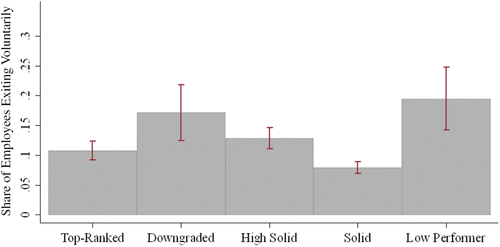
For a graphic illustration, Figure 1 shows the realized rate of voluntary turnover within 18 months following employees’ ranking in each category at Pharma Co. By this point, 16% of employees who were underrecognized by being downgraded from top-ranked to Solid voluntarily departed Pharma Co. compared with 10% of their top-ranked counterparts (p < 0.01). With this difference, downgraded employees departed almost as much as Pharma Co.’s lowest performers and almost twice as often as employees originally ranked Solid (p < 0.05). Especially because the downgraded are still more likely to leave compared with those ranked Solid, these comparisons suggest that results are not driven by induced retention among the top-ranked population. Importantly, the overall correlation between downgrading and increased voluntary turnover is consistent across Pharma Co.’s divisions, including the Plant and Equipment division, which consists of many blue collar roles.4
5.2. Robustness Checks Using Pharma Co.’s Strategies for Mitigating Fairness, Envy, and Self-Image Concerns
Pharma Co.’s approach to distributing rankings allows me to rule out important potential confounds in tying underrecognition in the system to voluntary departure from Pharma Co. Importantly, studying these approaches also sheds light on the potential difficulties companies have in attempting to manage the downside risks of its strict restrictions. In the following, I first describe the analyses I conduct to address key potential confounds behind the finding that downgrading leads to voluntary turnover. After describing how I address these concerns, I further discuss how the same evidence speaks to Pharma Co.’s limited ability to manage the tendency of recognition cutoffs to increase underrecognized employees’ urge to exit.
5.2.1. Material Concerns.
One of the main empirical confounds for studying downgrading in ranking schemes is that rankings typically predicate financial rewards as well (Mizruchi et al. 2011, Frey and Gallus 2017). As mentioned in my description of Pharma Co., managers attempt to mitigate the fairness and envy concerns regarding their strict ranking cutoff by compensating downgraded employees with higher bonuses than those who earn the top rankings. To check that monetary recompense is not driving the difference in likelihood of exit, I control for the bonus amount received by each nominated employee, Bonus Amount, as well as include an interaction term, Downgraded × Bonus Amount (Table 4). Here again, I use Cox proportional hazard modeling because the timing of the bonus allocation may play an important role in the effect of underrecognition on voluntary turnover likelihood. Controlling for the size of the bonus that managers award to both the downgraded and top-ranked employees (Bonus Amount), results remain relatively consistent with the comparative Cox proportional hazard models that do not have controls for bonuses (comparing models (c)–(f) in Table 3 with models (a)–(d) in Table 4).5
|
Table 4. Cox Proportional Hazard Models of Voluntary Departure Controlling for Bonus Amount, Downgraded Compared with Top Ranked Only
| (a) | (b) | (c) | (d) | |
|---|---|---|---|---|
| Downgraded | 1.738+ | 1.588 | 2.135* | 2.135* |
| (0.547) | (0.545) | (0.717) | (0.678) | |
| # Nominated to Top Rank on team | 1.060 | 1.023 | 1.042 | 1.051 |
| (0.0715) | (0.0748) | (0.0767) | (0.0797) | |
| Downgraded × # Nominated to Top Rank on team | 0.875 | 0.896 | 0.818 | 0.821 |
| (0.107) | (0.112) | (0.106) | (0.103) | |
| Bonus Amount | 1.000*** | 1.000*** | 1.000** | 1.000** |
| (0.0000000482) | (0.0000000328) | (0.0000000898) | (0.0000000874) | |
| Bonus Amount × Downgraded | 1.000*** | 1.000*** | 1.000*** | 1.000*** |
| (0.0000000767) | (0.0000000762) | (0.0000000775) | (0.0000000736) | |
| Prior Rank: Outstanding | 0.594+ | 0.618 | 0.811 | |
| (0.187) | (0.193) | (0.360) | ||
| Prior Rank: Exceptional | 1.277+ | 1.362* | 1.427* | |
| (0.174) | (0.197) | (0.227) | ||
| Prior Rank: Low | 1.663*** | 0.479* | 0.620 | |
| (0.230) | (0.155) | (0.236) | ||
| Prior Rank: New | 1.386 | 1.571 | 1.895+ | |
| (0.422) | (0.543) | (0.711) | ||
| [Base: Prior rank: Solid] | ||||
| Tenure | 0.989 | 0.989 | ||
| (0.0281) | (0.0279) | |||
| Age (years) | 0.969 | 0.943 | ||
| (0.0767) | (0.0719) | |||
| Age, squared | 1.000 | 1.001 | ||
| (0.000951) | (0.000922) | |||
| Female | 1.283 | 1.338+ | ||
| (0.198) | (0.225) | |||
| Asian | 1.114 | 1.150 | ||
| (0.214) | (0.230) | |||
| Hispanic | 0.607 | 0.746 | ||
| (0.257) | (0.288) | |||
| Black | 1.136 | 1.115 | ||
| (0.405) | (0.449) | |||
| Other Race | 3.374*** | 3.709*** | ||
| (0.864) | (1.065) | |||
| Race Missing | 0.710+ | 0.710+ | ||
| (0.138) | (0.134) | |||
| [Base: White] | ||||
| Female Manager | 0.897 | |||
| (0.157) | ||||
| Team size (n) | 0.963 | |||
| (0.0248) | ||||
| N | 218 | 202 | 200 | 197 |
| Log likelihood | −959.7 | −871.9 | −855.5 | −838.5 |
| χ2 | 43.06 | 127.4 | 159.0 | 156.5 |
Notes. Hazard ratio (exponentiated) coefficients. Robust standard errors in parentheses, clustered by manager.
+p < 0.10; *p < 0.05; **p < 0.01; ***p < 0.001.
Notably, although statistically significant across most models, the coefficients for bonus size and its interaction with downgrading in Table 4 do not materially affect retention. This is somewhat surprising because downgraded employees receive some of the largest performance bonuses in the company (Table 5, model (a), and Figure 2). To rule out the potential impact of outliers for bonus amounts driving these results, I replicate this table winsorizing these data at the 95 percentile. Results remain consistent, although the significance of bonus size and its interaction with downgraded employees is lost (see Online Appendix B, Table B7).
|
Table 5. Linear Regressions Predicting Future Bonuses, Downgraded Compared with Top Ranked Only
| (a) | (b) | (c) | |
|---|---|---|---|
| 2016 Bonus Amt, USD | 2017 Bonus Amt, USD | 2018 Bonus Amt, USD | |
| Downgraded | 11,605.1*** | −407.6 | −1,023.9+ |
| (3,156.9) | (580.5) | (592.2) | |
| # Nominated to Top Rank on team | −334.1 | −614.5*** | 103.7 |
| (1,685.9) | (163.5) | (215.9) | |
| Tenure | −192.8 | −49.91 | 25.55 |
| (344.4) | (38.89) | (48.45) | |
| Age (years) | 756.6 | 140.4 | 49.84 |
| (1,905.2) | (168.4) | (203.7) | |
| Age, squared | 8.933 | −2.523 | −1.958 |
| (24.34) | (2.052) | (2.367) | |
| Female | 1,048.7 | 7.963 | 370.1 |
| (1,843.8) | (400.7) | (440.4) | |
| Asian | −3,248.8 | 8.953 | −395.0 |
| (2,121.8) | (535.8) | (596.9) | |
| Hispanic | 722.2 | −1,098.0+ | −1,048.3 |
| (4,338.1) | (604.2) | (735.8) | |
| Black | −22,965.8*** | −400.7 | −1,192.4+ |
| (5,423.8) | (387.2) | (625.9) | |
| Other Race | −2,548.9 | −381.1 | −225.9 |
| (6,729.5) | (939.4) | (1,948.6) | |
| Race Missing | 37,557.2** | 4,179.1 | 12,923.7 |
| (13,759.1) | (4,138.6) | (9,019.7) | |
| [Base: White] | |||
| Female Manager | −5,181.4* | 15.86 | 695.2 |
| (2,589.4) | (391.3) | (427.8) | |
| Team size (n) | 2,087.7** | 16.95 | −114.3* |
| (778.7) | (37.49) | (49.77) | |
| Bonus Amt, 2016 | 1.047*** | 0.0807* | |
| (0.00642) | (0.0378) | ||
| Downgraded, 2017 | 1,024.7 | 838.6 | |
| (814.0) | (862.5) | ||
| Downgraded, 2016 + 2017 | −1,403.6 | −421.9 | |
| (1,825.6) | (1,842.4) | ||
| Bonus Amt, 2017 | 0.969*** | ||
| (0.0342) | |||
| Prior year performance ranking controls | Yes | Yes | Yes |
| Current year performance ranking controls | Yes | Yes | Yes |
| Following year performance ranking controls | Yes | Yes | |
| Second following year performance ranking controls | Yes | ||
| Constant | −26,333.0 | 1,305.0 | 2,930.2 |
| (34,456.6) | (3,348.8) | (4,295.5) | |
| N | 995 | 868 | 716 |
| r2 | 0.2196 | 0.9788 | 0.9770 |
Note. Robust standard errors in parentheses, clustered by manager.
+p < 0.10; *p < 0.05; **p < 0.01; ***p < 0.001.
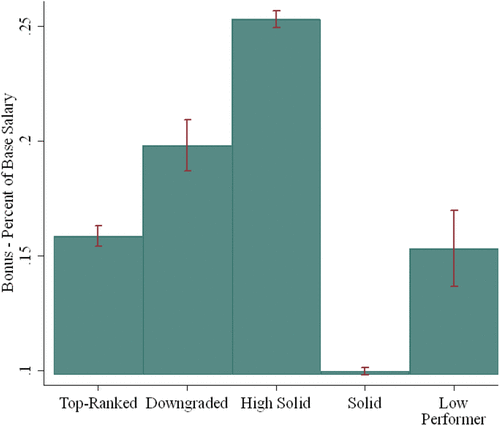
Downgraded employees could still have validated fairness concerns if higher bonuses as recompense for underrecognition this year also might mean that managers will adjust down their future bonuses. If that was the case, then the argument could be made that there is no real monetary compensation at play, as managers would instead be borrowing from the employee’s future allotment and giving them no net gain over time. However, there is little evidence of reversion in future bonuses (Table 5, models (b) and (c)). Although the slight correlation is negative for future bonuses, the magnitude of the greater negative coefficient for bonuses two years out is only 8.8% of the positive coefficient for the focal year of downgrading.
In addition to helping rule out monetary confounds as an explanation for reactions to downgrading, that fact that downgraded employees receive more money in bonus pay than their top-ranked peers also offers a negative assessment of Pharma Co.’s ability to manage expected employee envy. In fact, the downgraded employees who voluntarily left Pharma Co. made more in bonuses than the downgraded employees who stayed (coefficient = $16,151.43, p < 0.05). These results suggest that one of Pharma Co. managers’ strongest tools for addressing envy, making downgraded employees materially better off than their top-ranked peers, has little impact despite managers’ valid assurances that they are trying to be as equitable as possible.
5.2.2. Adjusting for Selection into Top Ranking Nomination Set.
A potential confound and concern for fairness in downgrading is whether there is something systematic about the way managers select certain employees for nomination that both underlies their risk of downgrading and drives their exit likelihood. To address this concern, I first test the sensitivity of my main results to the incorporation of employees whom managers would likely have nominated to a top ranking if more relaxed top ranking distribution allowances were in place. Specifically, I expand the key explanatory variable to include the set of employees who were never nominated to a top ranking but whose managers compensated them with greater bonuses than their top-ranked counterparts.
This additional group is referred to as High Solid, the term Pharma Co. managers use to refer to those that deserve a top ranking but who are never nominated. It is reasonable to assume that high-performing employees who are never nominated for top ranking will experience emotions related to fairness, envy, and self-image in ways similar to those who are downgraded. To classify these employees, I designate as High Solid any employee who received a bonus that was greater than 18.7% of their base salary, because this is greater than the low end of the 95% confidence interval range for the bonuses received by the Downgraded (see Online Appendix B, Table B4). Results are robust to a range of alternative designative approaches, such as using 16.3% of their base salary, which is greater than the high end of the 95% confidence interval range for the bonuses received by those receiving a top ranking. Thus, as seen from Figure 1, this High Solid population receives bonuses that surpass those of the Downgraded population, as measured by percent of base salary.
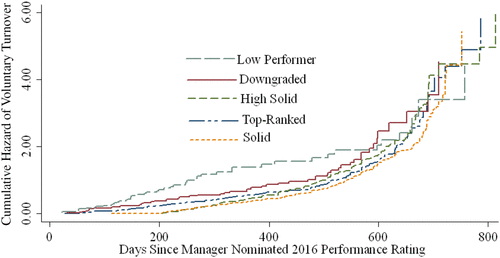
The comparison set for these models include not just those who received top rankings but the rest of the company as well. This means that the difference in likelihood for voluntary turnover is also contrasted against those marked as low performers and those receiving the common ranking of Solid. All categories in this comparison set make less in performance bonuses than the Downgraded and High Solid. Despite such high bonuses from their managers, the voluntary turnover exhibited by High Solid is greater than that exhibited by the Top Ranked and other Solid (Figures 1–3).
As seen in Table 6, when replicating the main models above, results persist when expanding the group defined as missing out on Pharma Co.’s top rankings by combining the Downgraded and High Solid groups. For instance, the risk of this more broadly defined group of underrecognized employees (Downgraded + High Solid) voluntarily departing is roughly 22% higher than it is for the rest of the company when including only the bonus controls (p < 0.10; Table 6, model (a)). Including all controls, this higher likelihood of voluntary departure relative to the rest of the company slightly strengthens in magnitude and significance (to 27%; Table 6, model (d); p < 0.05). Such patterns persist when replicating the main robustness checks above using this expanded definition of underrecognized employees (see Online Appendix D, Tables D1–D3). Main results further persist when entering both underrecognized groups (Downgraded and High Solid) into the models separately in contrast with the rest of the company (see Online Appendix D, Tables D4–D6).
|
Table 6. Cox Proportional Hazard Models of Voluntary Departure, Downgraded + High Solid Combined
| (a) | (b) | (c) | (d) | |
|---|---|---|---|---|
| Underrecognized (Downgraded + High Solid) | 1.223+ | 1.289* | 1.283* | 1.274* |
| (0.127) | (0.148) | (0.154) | (0.151) | |
| # Nominated to Top Rank on team | 1.007 | 0.959 | 0.955 | 0.976 |
| (0.0389) | (0.0434) | (0.0421) | (0.0440) | |
| Underrecognized x # Nominated to Top Rank on team | 0.882 | 0.894 | 0.882 | 0.862 |
| (0.0922) | (0.102) | (0.0971) | (0.111) | |
| Bonus Amount, 2016 | 1.000** | 1.000** | 1.000*** | 1.000*** |
| (0.00000121) | (0.00000121) | (0.00000102) | (0.00000110) | |
| Bonus Amount, 2016 × Underrecognized | 1.000 | 1.000 | 1.000 | 1.000 |
| (0.00000446) | (0.00000491) | (0.00000468) | (0.00000516) | |
| Prior Rank: Outstanding | 0.812 | 0.761 | 0.942 | |
| (0.242) | (0.228) | (0.361) | ||
| Prior Rank: Exceptional | 0.916 | 0.872 | 0.894 | |
| (0.0973) | (0.0965) | (0.0990) | ||
| Prior Rank: Low | 1.197 | 1.236 | 1.209 | |
| (0.284) | (0.437) | (0.422) | ||
| Prior Rank: New | 0.918 | 1.123 | 1.121 | |
| (0.235) | (0.287) | (0.287) | ||
| [Base: Prior rank: Solid] | ||||
| Tenure | 1.008 | 1.009 | ||
| (0.0127) | (0.0125) | |||
| Age (years) | 1.047 | 1.034 | ||
| (0.0483) | (0.0430) | |||
| Age, squared | 0.999 | 1.000 | ||
| (0.000516) | (0.000457) | |||
| Female | 1.339** | 1.307** | ||
| (0.125) | (0.125) | |||
| Asian | 0.996 | 1.027 | ||
| (0.126) | (0.128) | |||
| Hispanic | 0.981 | 1.003 | ||
| (0.200) | (0.200) | |||
| Black | 1.088 | 1.160 | ||
| (0.261) | (0.271) | |||
| Other Race | 0.817 | 0.757 | ||
| (0.381) | (0.380) | |||
| Race Missing | 0.607 | 0.628 | ||
| (0.226) | (0.248) | |||
| [Base: White] | ||||
| Female Manager | 1.243* | |||
| (0.127) | ||||
| Team size (n) | 0.984 | |||
| (0.0146) | ||||
| N | 482 | 414 | 412 | 409 |
| Log likelihood | −2,499.6 | −2,083.0 | −2,063.6 | −2,043.5 |
| χ2 | 16.65 | 19.03 | 59.08 | 64.39 |
Notes. Hazard ratio (exponentiated) coefficients. Robust standard errors in parentheses, clustered by manager.
+p < 0.10; *p < 0.05; **p < 0.01; ***p < 0.001.
These High Solid analyses are additional suggestive evidence that efforts to mitigate envy by granting larger bonuses to underrecognized employees than to the top ranked are ineffectual.
5.2.3. Sensitivity to Potential Manager Nominating Strategy.
I further explore additional potential reverse causality concerns that managers may nominate multiple top performers to the top rankings to prevent the departure of top performers who may already be predisposed to leaving. If the main results are driven by managers nominating employees to top rankings because they were already at risk for voluntary departure, then my findings may be driven by that baseline risk and not due to the underrecognition itself. To check for this reverse causality explanation, I run a sensitivity analysis to test the robustness of my results by restricting the sample only to teams where the manager nominated just one top performer from their team to the top ranking nomination set (see Online Appendix B, Table B5). The reverse causality story would be more likely to drive my results among teams with more than one nominee as, on the margin, managers may nominate more than one employee to a top ranking based on the intention of preventing turnover. As seen in Table B5, when restricting the analysis set to only those teams in which managers nominated just one employee to the top ranking set, the main patterns persist although the reduced sample size means loss of statistical significance in early models.
Results also remain consistent when replacing the control variable of the number of employees that a manager nominated for top ranking from their team with the number of employees from that team who end up receiving the top ranking. Here, however, the predictive value of downgrading becomes evident only when combined with the number of those who receive the top ranking (see Online Appendix B, Table B6). Indeed this evidence supports the idea that envy may be a key mechanism driving underrecognized employees to leave.
5.2.4. Sensitivity to Endogeneity of Underlying Performance Differences.
To rule out possible endogeneity relating to underlying ability and performance between top ranking recipients and downgraded employees, I investigate the robustness of my analyses on Sales division employees only (defined as all employees under the purview of Pharma Co.’s Chief Commercial Officer). Of all the divisions of Pharma Co.’s business, those in Sales have the most objective performance markers with which managers can use to define the top performer population (see Online Appendix A, quotes 5 and 19). Therefore, if the main results were found not to replicate when we use only this population, it might be the case that downgrading in the company’s employee population as a whole is influenced by underlying objective performance differences.
First, using the Sales Division to test against concerns about marginal performance differences confounding my results, Table E1 in Online Appendix E shows that those downgraded within Sales in the focal year had received similar performance rankings in the year prior compared with those receiving a top ranking in the focal year. This suggests that the downgraded are not being denied the top ranking because they are worse performers than the top ranked. When replicating all the main models above using only the Sales employees, results remain consistent (Table E2). This continues when controlling for bonus amount (Table E3) and predicting future promotions (Table E4). However, given the reduced sample size, results do lose significance in the latter models with full sets of controls. Nonetheless, even though Sales managers are equipped with more objective performance data that underscores employees’ value to the company, they are unable to retain their downgraded employees. The main results are therefore replicated in this more controlled population.
5.2.5. Career and Other Material Concerns.
A final question, particularly with regard to the three proposed theoretical mechanisms, is whether these results may potentially be confounded by future material, financial, and career concerns (Holmström 1982). Such evidence would potentially justify departure based on validated concerns among the underrecognized, particularly regarding the correspondence of their self-image to actual career outcomes. To investigate this, I conduct a set of robustness checks using logit models on likelihood of promotion to see whether employees may be reacting to future career trajectory concerns. In these robustness checks, I do find that there is a higher incidence of promotions among the top-ranked population than among the downgraded the following year. With no controls, the percentage of top-ranked employees who receive a promotion the following year (10%) is greater than that among those who are downgraded (5%; t-test: 2.25; p < 0.05). Investigating further, however, the statistical difference disappears once the controls are introduced into the logit models estimating the odds of promotion (Table 7). However, it does stay significant for the High Solid population when they are separated out from the downgraded in tests of the effects of their underrecognition relative to the top ranked and other solids (see Online Appendix D, Table D3).
|
Table 7. Logistic Regression Predicting Future Promotion Among Those Nominated as Top-Ranked
| Promoted following year | |
|---|---|
| Downgraded | 0.633 |
| (0.319) | |
| # Nominated to Top-Rank on team | 0.889 |
| (0.0834) | |
| Bonus Amount, 2016 | 1.000 |
| (0.00000106) | |
| Bonus Amount, 2016 × Downgraded | 1.000 |
| (0.0000115) | |
| Prior Rank: Outstanding | 2.483* |
| (0.900) | |
| Prior Rank: Exceptional | 1.832** |
| (0.365) | |
| Prior Rank: Low | 1 |
| (.) | |
| Prior Rank: New | 0.802 |
| (0.505) | |
| [Base: Prior rank: Solid] | |
| Tenure | 0.983 |
| (0.0250) | |
| Age (years) | 0.816* |
| (0.0758) | |
| Age, squared | 1.002+ |
| (0.00111) | |
| Female | 1.469* |
| (0.284) | |
| Asian | 0.858 |
| (0.310) | |
| Hispanic | 1.333 |
| (0.742) | |
| Black | 1.229 |
| (0.576) | |
| Other Race | 0.672 |
| (0.708) | |
| Race Missing | 0.865 |
| (0.186) | |
| [Base: White] | |
| Female Manager | 1.146 |
| (0.220) | |
| Team size (n) | 1.009 |
| (0.0233) | |
| N | 1,404 |
| Log likelihood | −421.6 |
| χ2 | 45.66 |
Notes. Odds ratio coefficients. Robust standard errors in parentheses, clustered by manager.
+p < 0.10; *p < 0.05; **p < 0.01; ***p < 0.001.
Excluding employees in the Sales Division, for whom there are more objective performance metrics on which to base rankings, bonuses, and promotions (see Section 4.2.4), I find a higher incidence of promotions among the downgraded population than among the top-ranked employees the following year (not significant; see Online Appendix E, Table E5). Therefore, although I cannot fully rule out the influence of promotion concerns on the voluntary turnover likelihood under Pharma Co.’s forced ranking scheme, particularly among High Solid employees, substantiated career concerns do not seem to be driving downgraded employees exits.
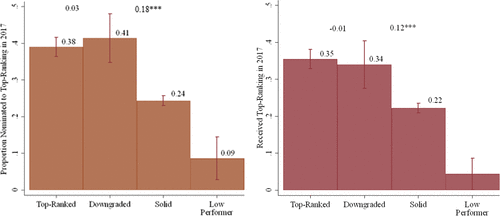
In addition to investigating promotion concerns, I further test whether being downgraded means employees will be more likely than their peers who receive the top ranking to be ranked Solid and not nominated to top ranking at all by their manager the following year. As seen in Figure 4, those who received the top ranking and those who were downgraded were equally likely to be nominated by their manager to the top ranking again the following year and were equally likely to receive a top ranking. This evidence further suggests there is little consequence organizationally to being downgraded in any given year, that bias in the system is a low concern, and that managers are objectively correct in assuring downgraded employees that their reputation is intact.
5.3. Mitigating Fairness, Envy, and Self-Image Concerns: Summary
These results underscore the raw demotivational effects of underrecognition from forced ranking. First and foremost, Pharma Co. executes its calibration process to adhere to the tenets of procedural fairness. Furthermore, managers attempt to prevent envy by reallocating the top bonuses from the top ranked to the underrecognized. On top of this, managers assure the underrecognized that concerns regarding self-image are unwarranted because the Solid ranking will not affect promotion prospects, future bonuses, or the chance of earning top rankings in future.
Nevertheless, these deliberate and well-meaning efforts do not prevent the negative effect of recognition cutoffs on retention rates. Exploratory analyses found support for the idea that envy may play a role in exit decisions when downgraded employees have peers on their own teams who receive the top ranking. Most significant, however, is the threat to self-image, which seems difficult to repair. Recall Chris, the irate employee quoted at the opening of this paper: He could not shake the discrepancy between his ranking and how he had always viewed himself. Despite the manager’s attempts to ameliorate Chris’s concerns, in less than three months he was gone.
6. Concluding Discussion
In its effort to incentivize performance through a strict cutoff on recognition, Pharma Co. set in motion unintended consequences that were detrimental to top performer morale and then hoped to heal those consequences with management strategies including efforts at procedural fairness, compensatory bonus increases, and reputational reassurance. Although these management strategies were implemented consistently and thoroughly, they did not succeed in their intended goal. Underrecognized top performers in all functions, from Sales to Plant & Equipment, left the organization at some of the highest rates despite receiving some of the highest bonuses.
The selection of Pharma Co. as the focal organization for study allows me to analyze the effects of underrecognition in an environment where leaders exert special effort to mitigate those effects. Furthermore, unlike other possible scenarios in which the outcome of being underrecognized might be measured simply as increased negative emotional affect expressed through changes in routine behavior, at Pharma Co., we see underrecognition driving consequential life decisions. In regard to the specific cognitive processes affecting those decisions, I have found that, unlike concerns about fairness, which the company works diligently to forestall through rigorous calibration protocols, the analysis supports envy as a decision mechanism and especially supports self-image. Indeed, given prior studies such as Brockner et al. (2003), the more the process is perceived to be fair, the more emphatically we may expect a combination of envy and lowered self-image to drive employees’ choices in leaving the organization.
These findings come with limitations. First, the observational design of this study limits causal inferences because the lack of random assignment into performance categories results in endogeneity. Related to this is the possibility of reverse causality in which employees were downgraded because it was known that they intended to leave anyway; this possibility may be slim, however, given that the downgrading is decided by higher company officers who would be less likely than unit managers to be aware of employees’ career intentions. Future studies could enhance our understanding by using longitudinal designs or controlled experiments to examine how recognition schemes impact employee motivation. Second, it is possible that some employees do not fully accept managers’ reassurances and choose to exit based entirely on career concerns. Given the attested clarity of the reassurance messaging, however, testing for instances of low message acceptance is challenging. Third, the theoretical arguments rest on the underlying mechanisms of fairness, envy, and self-image, which are grounded in existing literature. Although my findings are strongly consistent with this theoretical rationale, the mechanisms were not directly observable and could not be studied in quantitative detail given the available data. The supporting qualitative evidence from key actors in the process of calibrating nominees goes some way toward addressing this limitation: Senior managers and HR representatives continuously underscore their intention to be procedurally fair, reduce the potential for envy, and assure the downgraded that they need not question their own reputation at Pharma Co.
In addition, these results pertain to a firm that has higher wages and bonuses than most of its industry competitors. Although this helps rule out the idea that employee exits are motivated by expectations of financial advancement, it could be that in other settings compensatory strategies such as higher bonuses would have a greater impact on retention. On the other hand, at Pharma Co. managers had significant discretion in the allocation of bonuses. In organizations where managers have less discretionary control, we could expect the detrimental effects of recognition cutoffs to be more rather than less.
As we confront the difficulty of managing the harmful aspects of strict recognition cutoffs, we are obliged to turn the spotlight back onto the cutoffs themselves. If neither assurances nor financial advantages succeed in softening the symbolic and practical impact of cutoffs, even under conditions of organization-wide consensus that the cutoff results do not reflect employee quality, then that impact must be powerful indeed. Future research might fruitfully investigate the potential benefits of employing a wider cutoff band. For at least two years in a row, Pharma Co. managers overnominated employees by the same percentage, suggesting the possibility of finding a more representative cutoff point.
Beyond this, there are even more fundamental questions about when recognition cutoffs are worth implementing and how we would know, that is, what internal features of an organization and what external conditions call for or contraindicate recognition cutoffs, and how such specific features should influence the setting of cutoff levels. In order to recommend whether cutoffs should be used and how to tune the parameters, it is important to assess the potential benefits generated for the organization together with the costs. This study does not measure the potential motivational benefits of downgrading. It is certainly possible that top performers perform better in the presence of recognition cutoffs than otherwise. But the fact that the downgraded and the top-ranked are equally likely next time around to be nominated and to receive top ranking strongly suggests that the top-ranked are not becoming appreciably more productive as a result of having been favored by calibration in this setting. Conversely, there are indications in the interview data (see Online Appendix A) that such ranking systems may be both excessively time-consuming and detrimental to organizational culture.
All things considered, an organization using recognition cutoffs must be prepared for negative consequences and should refrain from overconfidence about the extent to which those consequences can be kept in check. Employees care about how they are perceived by others and how they perceive themselves, and it is on those social perceptions that recognition cutoffs place what can be a breaking strain.
The author is grateful for the thoughtful guidance of Lamar Pierce, the anonymous associate editor, and three reviewers. The author also thanks Roberto Fernandez, Ezra Zuckerman and Lisa Sivan, Ray Reagans, Erin Kelly, Susan Silbey, Emilio Castilla, Adina Sterling, Matt Marx, Jared Curhan, Jenna Myers, Jonathan Caulkins, Carolyn Fu, Heather Yang, Chris Yenkey, as well as Ben Rissing, Daniela Scur, and the Macro OB/Strategy group at Cornell for their helpful feedback. Darrin McGraw provided editorial assistance. The author also thanks participants at the University of Toronto Rotman School of Management Strategic Management Seminar, Washington University in St. Louis Olin Business School Strategy Seminar, 2018 People and Organizations Conference at Wharton and the 2019 INFORMS/Organization Science Dissertation Proposal Competition, at which the author presented this paper alongside two other dissertation papers on overrecognition and status recognition mismatch.
1 Names changed throughout the paper.
2 Such a difference in tenure could suggest that networking or politicking may play a role here or in bonus recompense (Mizruchi et al. 2011). Although this would suggest that the two potential top-ranked groups are not perfectly randomized across downgrading, the potential endogeneity would not heavily factor into the key selection of concern: differences in underlying performance. Further, my robustness analyses using the “high solid” population, who have longer average tenure than the top-ranked group, help demonstrate that this is not driving the outcome of interest, voluntary turnover. I thank the associate editor for pointing this out.
3 Results remain consistent when replacing the number of employees nominated to a top ranking with those receiving a top ranking on the team (see Section 4.2.4).
4 Sample size limits the incorporation of division controls into the main models. For some of the small divisions, downgrading is perfectly collinear with voluntary turnover.
5 Sample size in these models is reduced because I do not include bonus amounts that are impossible to convert to U.S. dollar equivalency due to absence of currency markers.
References
- (1965) Inequity in social exchange. Adv. Experiment. Soc. Psych. 2(1965):267–299.Crossref, Google Scholar
- (2016) Competing with superstars. Management Sci. 62(10):2842–2858.Link, Google Scholar
- (1990) Performance evaluation and compensation feedback messages: An integrated model. J. Occupational Psych. 63(2):97–111.Crossref, Google Scholar
- (2008) Status incentives. Amer. Econom. Rev. 98(2):206–211.Crossref, Google Scholar
- (2011) Everyone’s a Winner: Life in Our Congratulatory Culture (University of California Press, Oakland, CA).Crossref, Google Scholar
- (2011) The determinants and performance effects of managers’ performance evaluation biases. Accounting Rev. 86(5):1549–1575.Crossref, Google Scholar
- (2024) Striking out swinging: Specialist success following forced task inferiority. Organ. Sci. 35(2):698–718.Link, Google Scholar
- (2012) Economic incentives and social preferences: Substitutes or complements? J. Econom. Literature 50(2):368–425.Crossref, Google Scholar
- (2016) Employee recognition and performance: A field experiment. Management Sci. 62(11):3085–3099.Link, Google Scholar
- (1992) The current state of performance appraisal research and practice: Concerns, directions, and implications. J. Management 18(2):321–352.Crossref, Google Scholar
- Breza E, Kaur S, Shamdasani Y (2018) The morale effects of pay inequality. Quart. J. Econom. 133(2):611–663.Google Scholar
- (2003) High procedural fairness heightens the effect of outcome favorability on self-evaluations: An attributional analysis. Organ. Behav. Human Decision Processes 91(1):51–68.Crossref, Google Scholar
- (1982) Toward a Structural Theory of Action (Academic Press, New York).Crossref, Google Scholar
- (2018) What do performance appraisals do? ILR Rev. 71(1):88–116.Crossref, Google Scholar
- Saez E (2012) Inequality at work: The effect of peer salarieson job satisfaction. Amer. Econom. Rev. 102(6):2981–3003.Google Scholar
- (2015) Accounting for the gap: A firm study manipulating organizational accountability and transparency in pay decisions. Organ. Sci. 26(2):311–333.Link, Google Scholar
- (2024) Nonmonetary reward systems, counterproductive behavior, and responses to sanctions in open collaboration environments. Organ. Sci. 35(3):928–947.Link, Google Scholar
- (2020) Robust systems of cooperation in the presence of rankings: How displaying prosocial contributions can offset the disruptive effects of performance rankings. Organ. Sci. 31(2):287–307.Link, Google Scholar
- (2012) Why stack ranking worked better at GE than Microsoft. Forbes (June 24), https://www.forbes.com/sites/petercohan/2012/07/13/why-stack-ranking-worked-better-at-ge-than-microsoft/.Google Scholar
- (2009) Episodic envy. J. Appl. Soc. Psych. 39(9):2128–2173.Crossref, Google Scholar
- (2007) Does perceived unfairness exacerbate or mitigate interpersonal counterproductive work behaviors related to envy? J. Appl. Soc. Psych. 92(3):666.Crossref, Google Scholar
- (1972) Regression models and life‐tables. J. Roy. Statist. Soc. Ser. B Methodological 34(2):187–202.Crossref, Google Scholar
- (1997) Self-interest and fairness in problems of resource allocation: Allocators versus recipients. J. Personality Soc. Psych. 72(5):1061–1074. Crossref, Google Scholar
- (2017) Green by comparison: Deviant and normative transmutations of job search envy in a temporal context. Acad. Management J. 60(1):295–320.Crossref, Google Scholar
- (1939) Frustration and Aggression (Yale University Press, New Haven, CT).Crossref, Google Scholar
- (2019) Fairness and frictions: The impact of unequal raises on quit behavior. Amer. Econom. Rev. 109(2):620–663. Crossref, Google Scholar
- (2021) Workplace envy. Ann. Rev. Organ. Psych. Organ. Behav. 8(1):19–44.Crossref, Google Scholar
- Duffy MK, Shaw JD, Schaubroeck JM (2008) Envy in organizational life. Smith RH, ed. Envy: Theory and Research (Oxford University Press, Oxford, UK), 167–189.Google Scholar
- (2016) Keeping up with the Joneses: The role of envy, relationship conflict, and job performance in social undermining. J Leadership Organ. Stud. 23(1):55–65.Crossref, Google Scholar
- (1985) Sour Grapes: Studies in the Subversion of Rationality (Cambridge University Press, Cambridge, MA).Google Scholar
- (1954) A theory of social comparison processes. Human Relations 7(2):117–140.Crossref, Google Scholar
- (1957) A Theory of Cognitive Dissonance (Stanford University Press, Standford, CA).Crossref, Google Scholar
- (2017) Honours versus Money: The Economics of Awards (Oxford University Press, Oxford, UK).Crossref, Google Scholar
- (2001) Motivation crowding theory. J. Econom. Surveys 15(5):589–611.Crossref, Google Scholar
- (2008) Awards: A view from psychological economics. Zeitschrift Psych. 216(4):198–208.Google Scholar
- (1955) On face-work: An analysis of ritual elements in social interaction. Psychiatry 18(3):213–231.Crossref, Google Scholar
- (1978) The Celebration of Heroes: Prestige as a Social Control System (University of California Press, Berkeley, CA).Crossref, Google Scholar
- (1990) Employee theft as a reaction to underpayment inequity: The hidden cost of pay cuts. J. Appl. Psych. 75(5):561–568.Crossref, Google Scholar
- (2005) Forced Ranking: Making Performance Management Work (Harvard Business School Press, Boston).Google Scholar
- (2008) Can they take it with them? The portability of star knowledge workers’ performance. Management Sci. 54(7):1213–1230.Link, Google Scholar
- (1970) Why Men Rebel (Routledge, New York).Google Scholar
- (2023) Should a company rate its staff? Accessed August 14, 2024, https://www.cnbc.com/2023/12/05/stack-ranking-ex-amazon-exec-explains-the-performance-review-system.html.Google Scholar
- (1976) Social Limits to Growth (Harvard University Press, Cambridge, MA).Crossref, Google Scholar
- (1982) Managerial incentive problems: A dynamic perspective. Rev. Econom. Stud. 66(1):169–182.Crossref, Google Scholar
- Social Behavior Its Elementary Forms (Harcourt, Brace, and World, New York).Google Scholar
- (2008) Applied Survival Analysis: Regression Modeling of Time-to-Event Data, vol. 618 (John Wiley & Sons, Hoboken, NJ).Crossref, Google Scholar
Impraise .com (2016) Microsoft throws stack ranking out the window. https://blog.impraise.com/360-feedback/microsoft-throws-stack-ranking-out-the-window.Google Scholar- (2014) Episodic envy and counterproductive work behaviors: Is more justice always good? J. Organ. Behav. 35(1):128–144.Crossref, Google Scholar
- (1976) A simulation study of administrators’ behavior toward employees who receive job offers 1. J. Appl. Soc. Psych. 6(4):291–306.Crossref, Google Scholar
- (2011) Paying $30,000 for a gold star: An empirical investigation into the value of peer recognition to software salespeople. Working paper, University of California, Los Angeles.Google Scholar
- Pay and Organizational Effectiveness: A Psychological View (McGraw-Hill, New York).Google Scholar
- (2002) The folly of forced ranking. Strategy and Business (July 15), https://www.strategy-business.com/article/20290.Google Scholar
- (1981) Rank-order tournaments as optimum labor contracts. J. Political Econom. 89(5):841–864.Crossref, Google Scholar
- (2019) A functional model of workplace envy and job performance: When do employees capitalize on envy by learning from envied targets? Acad Management J. 62(4):1085–1110.Crossref, Google Scholar
- Leventhal GS (1976) What should be done with equity theory? New approaches to the study of fairness in social relationships. Berkowitz L, Walster E, eds. Equity Theory: Toward a General Theory of Social Interactions (Academic Press, New York).Google Scholar
- (1980)
What should be done with equity theory? New approaches to the study of fairness in social relationships . Social Exchange: Advances in Theory and Research (Springer, New York), 27–55.Crossref, Google Scholar - (1988) A survey of agency models of organization. J. Econom. Behav. Organ. 9:153–186.Crossref, Google Scholar
- (1980)
Beyond fairness: A theory of allocation preferences. Mikula G, ed. Justice and Social Interaction (Springer-Verlag, New York), 167–218.Google Scholar - (1988) The Social Psychology of Procedural Justice (Springer Science & Business Media).Crossref, Google Scholar
- (2009) A sociological (de) construction of the relationship between status and quality. Amer. J. Sociol. 115(3):755–804.Crossref, Google Scholar
- (2000) Integrating justice and social exchange: The differing effects of fair procedures and treatment on work relationships. Acad. Management J. 43(4):738–748.Crossref, Google Scholar
- (2005) Expectations and emotions of Olympic athletes. J. Experiment. Soc. Psych. 41(4):438–446. Crossref, Google Scholar
- (1995) When less is more: Counterfactual thinking and satisfaction among Olympic medalists. J. Personality Soc. Psych. 69(4):603.Crossref, Google Scholar
- (1968) The Matthew effect in science: The reward and communication systems of science are considered. Science 159(3810):56–63.Crossref, Google Scholar
- (1948) Minor studies of aggression: II. The influence of frustrations imposed by the in-group on attitudes expressed toward out-groups. J. Psych. 25(2):437–442.Crossref, Google Scholar
- (2011) Getting a bonus: Social networks, performance, and reward among commercial bankers. Organ. Sci. 22(1):42–59.Link, Google Scholar
- (2007) Contests for status. J. Political Econom. 115(2):338–363.Crossref, Google Scholar
- (2016) Precarious curve ahead: The effects of forced distribution rating systems on job performance. Human Resource Management Rev. 26(2):166–179.Crossref, Google Scholar
- (2012) The best and the rest: Revisiting the norm of normality of individual performance. Personnel Psych. 65(1):79–119.Crossref, Google Scholar
- (2006) Hard Facts, Dangerous Half-Truths, and Total Nonsense: Profiting from Evidence-Based Management (Harvard Business Press, Boston).Google Scholar
- (1999) The provision of incentives in firms. J. Econom. Literature 37(1):7–63.Crossref, Google Scholar
- (2012) Experimental study of informal rewards in peer production. PLoS One 7(3):e34358.Crossref, Google Scholar
- (1996) Naive realism in everyday life: Implications for social conflict and misunderstanding. Values Knowledge 103:135.Google Scholar
- (2005) Personnel psychology: Performance evaluation and pay for performance. Ann. Rev. Psych. 56:571–600.Crossref, Google Scholar
- (2009) Rater reactions to forced distribution rating systems. J. Management 35(4):899–927.Crossref, Google Scholar
- H (2024) Starbucks (with Howard Schultz), Acquired podcast, https://podcasts.apple.com/us/podcast/starbucks-with-howard-schultz/id1050462261?i=1000657758174.Google Scholar
- (2008) Global Talent Management at Novartis (Harvard Business Review Press, Boston).Google Scholar
- (1997) Retaliation in the workplace: The roles of distributive, procedural, and interactional justice. J. Appl. Psych. 82(3):434.Crossref, Google Scholar
- (2007) Comprehending envy. Psych. Bull. 133(1):46–64.Crossref, Google Scholar
- (1974) Alternative theories of wage determination and unemployment in LDC’s: The labor turnover model. Quart. J. Econom. 88(2):194–227.Crossref, Google Scholar
- (1949) The American Soldier: Adjustment During Army Life, Studies in Social Psychology in World War II (Princeton University Press, Princeton, NJ).Google Scholar
- (1925)
The professional criminal: An inquiry into the making of criminals . The Balance of Power in Society and Other Essays (Macmillan, London).Google Scholar - Kelley HH (1959) The Social Psychology of Groups (John Wiley & Sons, New York).Google Scholar
- (1975) Procedural Justice: A Psychological Analysis (Erlbaum, Hillsdale, NJ).Google Scholar
- (2021) Rationalize or reappraise? How envy and cognitive reappraisal shape unethical contagion. Personnel Psych. 74(2):237–263.Crossref, Google Scholar
- (2001) Jack: Straight From the Gut (John F. Welch, Jr. Foundation, New York).Google Scholar
- (2005) Winning (Harper Business Publishers, New York).Google Scholar
- (1981) Downward comparison principles in social psychology. Psych. Bull. 90(2):245.Crossref, Google Scholar
- (2016) The value of employee retention: Evidence from a natural experiment. J. Econom. Management Strategy 25(3):652–677.Crossref, Google Scholar
- (2018) Consequences of downward envy: A model of self-esteem threat, abusive supervision, and supervisory leader self-improvement. Acad. Management J. 61(6):2296–2318.Crossref, Google Scholar
- (2001) Are people willing to pay to reduce others’ incomes? Ann. Econom. Statist. 63(2):39–65.Google Scholar