Long-Run Returns to Private Equity in Emerging Markets
Abstract
We provide the first evidence on the long-run returns to private equity in emerging and frontier markets using the cash flows from every equity investment made by the International Finance Corporation across 130 countries over 58 years. Risk-adjusted returns are comparable to the S&P 500, at least from 1961 until 2010. Returns improve with economic growth but decline as banking systems deepen and countries relax capital controls. These results are consistent with the thesis that financial frictions have prevented the flow of capital from rich to poor countries and that the persistence of impact investors’ performance may rely on identifying or creating new markets that lack access to capital.
This paper was accepted by Agostino Capponi, finance.
Conflict of Interest Statement: Shawn Cole served five days as a “Short Term Consultant” to the IFC in 2018–19 and in a non-compensated advisory role for Y Analytics, a subsidiary of impact investor TPG/Rise. Martin Melecky, Florian Mölders, and Tristan Reed are employees of the World Bank Group.
Supplemental Material: The online appendix and data files are available at https://doi.org/10.1287/mnsc.2023.03313.
1. Introduction
This paper provides the first evidence on returns to private equity investment in emerging markets using consistent data for a long period of time. Specifically, we analyze the cash flows associated with every equity investment made by the International Finance Corporation (IFC), a member of the World Bank Group, which invests across 130 emerging markets, including the poorest and most neglected ones by private investors. Founded in 1956 with a mandate to “further economic development by encouraging the growth of productive private enterprise in member countries, particularly in less developed areas,” the IFC’s charter includes the goal of achieving market rate returns in markets “where sufficient private capital is not available on reasonable terms.” The portfolio is free of sampling problems, such as survivorship bias, and is much more diversified across emerging market economies than either foreign direct investment (FDI) inflows or the MSCI Emerging Market (MSCI EM) index of publicly listed equities, both of which are highly concentrated on larger economies like China and Brazil. This unique data set enables us to address long-standing questions relevant to international finance and development economics.
First, what is the performance of a diversified investment strategy focused on emerging markets? There is broad divergence in priors over whether this strategy can achieve returns comparable to those in advanced economies. Because we observe the timing of cash flows, we are able to measure returns in terms of a public market equivalent (PME) that accounts for both the absolute level of return and correlation of return with a global risk factor, as in the capital asset pricing model (Kaplan and Schoar 2005, Sorensen and Jagannathan 2015, Korteweg and Nagel 2016). Benchmarking the IFC’s complete equity investment portfolio to the S&P 500 index (available for our entire sample period of six decades), we calculate that the complete portfolio has obtained a PME of 1.15, indicating that it has returned 15% more over its life than an equivalently timed investment in the public index.
Given that these data represent the portfolio of a single investor, we do not claim the reported performance to be representative of the universe of emerging market private equity investments. Nor is it clear that any other asset owner could replicate the IFC’s strategy and returns. Although its charter prohibits it from taking government guarantees, it is possible that when making direct investments the IFC’s status as part of the World Bank Group provides additional protection from expropriation and that the IFC is able to leverage expertise from the World Bank Group that outside investors could not. Nonetheless, our results may offer an upper bound estimate for what diversified investors can achieve in emerging markets.
The IFC makes equity investments primarily through the direct purchase of a minority stake in a company but also through participation as a limited partner in a fund. Direct investments predominate in the sample, in terms of both observations (2,029 of 2,509) and capital invested ($32.5 billion of $41.0 billion in 2023 dollars, adjusted for inflation using the U.S. GDP deflator). The academic literature on private equity focuses almost exclusively on returns to limited partners (LPs) after general partners (GPs) charge management fees—typically 1% to 2% of assets per year and 20% of profit known as “carry.”1 Our finding of a PME of 0.96 for investments in funds indicates that LP returns to investors in private equity funds in the IFC portfolio, net of management fees, have performed almost as well as the S&P 500. Although less than 1.00, a PME of 0.96 implies only a 4% difference in long-run returns, which is quite small in annualized terms. This return is within the range of those reported by Harris et al. (2014) for venture capital and leveraged buyout funds in the U.S. market. In contrast, the PME of the IFC’s portfolio of direct investments, which are gross of fees, is 1.19. After subtracting a hypothetical management fee and carry, the PME of this portfolio is 0.97. Our interpretation of this result is that over the long run the IFC’s portfolio of emerging market private equity has done about as well as the S&P 500 index.2
Second, to what extent can country conditions predict future returns, particularly from private investments? International capital markets may be segmented, restricting access to finance for firms in certain economies. Consistent with this hypothesis, we find that returns are lower when economies relax capital controls and deepen the banking sector. These results are inconsistent with the hypothesis of a perfectly integrated international capital market in which expected financial returns are equalized across economies and suggest that the greatest returns are available in economies transitioning from closed to open. These findings constitute the most comprehensive microeconomic evidence available on this long-standing question (see Feldstein and Horioka 1980, Lucas 1990, Caselli and Feyrer 2007, Alfaro et al. 2008, Gourinchas and Jeanne 2013, Chari and Rhee 2020).
We also measure the relationship between realized returns and macroeconomic conditions more generally. One percent greater cumulative annualized real GDP growth over the life of the average investment (eight years) is associated with an additional 6.62 percentage points of return. Local currency depreciation, on the other hand, worsens performance, whereas local inflation (controlling for the depreciation) is associated with higher returns. There is some evidence that returns improve with reductions in sovereign risk during the investment period. These results are consistent with the intuition that strong macroeconomic fundamentals are important for countries seeking to attract capital investment (Mauro 2003), although this effect could diminish over time as incomes converge (Kremer et al. 2021, Patel et al. 2021). Quantitatively, however, less integrated markets appear to be more important than economic growth, especially for the highest return or “home run” investments. For instance, for the 90th percentile of direct investments, a decrease in financial openness by one standard deviation within a country is associated with a larger increase in returns (a change in PME of 0.60) than a one percent rise in average annual real GDP growth over the investment period (a change in PME of 0.072).
Third, how does private equity performance vary with other investment characteristics not related to the economy? Returns are higher for direct investments that are held for a longer period of time as well as for smaller investments. We are also able to investigate differences in returns across sectors, including those considered especially conducive to economic development, such as financial institutions (Levine 2005) and infrastructure (Aschauer 1989, Roller and Waverman 2001). Ultimately, although sector explains much less variation in performance than geography, we find that investments in financial institutions, infrastructure, and mining have higher returns than manufacturing, agribusiness, and services. Although we lack data on regulatory exposure of specific investments, this result is consistent with higher performance in regulated sectors, such as financial institutions, infrastructure, and mining, relative to sectors more exposed to competition from international trade, such as manufacturing, agribusiness, and services.
Beyond private equity specifically, our work contributes to a smaller, more recent literature examining the return and risk of impact investing strategies. The IFC, created to advance economic development, was one of the first investors to measure social outcomes associated with its investments. Its charter, which requires that investments be made with the intent to promote economic development alongside financial profit, aligns closely with the standard industry definition of impact investing.3 There is little evidence regarding the financial and social performance of impact investment strategies. Brest et al. (2018) argued that impact investors, because their deployment of capital in pursuit of social or environmental goals leads them to invest in projects that would not have been financed otherwise, earn lower risk-adjusted returns than traditional investors. Barber et al. (2021), comparing data for a similar set of nonimpact funds to data obtained from PreQin on 159 impact funds between 1995 and 2014, found the latter to achieve, on average, a 4.7-percentage-point lower IRR. Jeffers et al. (2024), independently assessing the performance of venture capital impact investment funds that target market returns, found that although such funds underperform the market, they also incur less risk than traditional venture capital funds. Cole et al. (2022) studied whether impact investors deploy capital in different industries and locations compared with traditional investors, finding that impact investors are more likely to invest in poorer areas and nascent industries. Our paper provides the first estimate of the long-run return to an impact investing strategy that seeks to achieve market returns by providing capital to projects that would otherwise not have received sufficient funding because of imperfectly integrated financial markets. We evaluate differences in risk across investments within the impact investing strategy by demonstrating how the top and bottom tails of returns vary across multiple international markets, a proxy for the risk in those markets.
2. Evidence on Private Equity Returns and Capital Market Integration
Whether a significant number of commercially viable investments fail to receive financing is a fundamental question in economics and business and is especially pertinent to emerging markets. Lucas (1990) observed that under the assumptions of the neoclassical growth model, returns to capital should be higher where the capital stock is lower. If true, the absence of significant investment in countries with less capital suggests that money is being left on the table. Frictions like government regulation and limited banking sector development could yield an equilibrium whereby only the largest (and potentially politically favored) firms in an economy receive funding. Foreign investors’ perceptions of risk could also play a role.
Private equity fund managers have long been seen as agents that might fill the gap with respect to companies overlooked by capital markets (Leeds and Satyamurthy 2015). The fall of the Soviet Union and liberalization in Brazil, China, and India led private equity investors to expand into these once-frontier markets. After some initial disappointment and retrenchment during the 1990s, emerging market fundraising reached about 20% of global private equity fundraising in 2011 before leveling off at around 10% (Lerner et al. 2015). Lerner et al. (2009) found investment approaches to be tailored to regions, with country characteristics influencing whether funds pursue strategies of financial engineering, governance engineering, and/or operational engineering. But because fund returns are typically not public and emerging markets are a small share of most investors’ portfolios, little is known about whether private equity has, indeed, obtained competitive returns. This is the hypothesis we test in this paper.
2.1. Empirical Framework
Like most work exploring cross-country variation, without a source of exogenous variation in country characteristics, we too are unable to provide causal tests of mechanisms that may explain variation in investment results. However, we are interested in how returns and country characteristics comove over time. These are not causal tests, and they may still be subject to concerns that omitted variables drive measured relationships; we address these to the extent that we are able.
In the language of international macroeconomics, an investment gap exists if the international capital market is imperfectly integrated or segmented.4 In the opposite case of a perfectly integrated international capital market, geography has no systematic effect on investor returns because there are no frictions (e.g., regulation, banking system underdevelopment, risk perceptions) impeding the flow of capital across markets. Investors will direct capital to markets with high long-run private returns until such returns are no longer available because of either competition that bids up entry multiples or a decline in the marginal product of capital. An empirical test of this hypothesis is available in the regression
A key requirement to estimate Equation (1) is a long time series of returns. Even if international capital markets are perfectly integrated, idiosyncratic risk could, over a short time horizon, lead to an estimate of . A key strength of the IFC data is thus the long length (58 years) of the time series. The existing literature on international capital market integration tests for differences in returns across much shorter time periods, studying, for instance, the covariance of international public equity indices (Campbell and Hamao 1992, Harvey 1995). Caselli and Feyrer (2007) calculated the marginal product of capital (which is equal to its price in equilibrium) using data from a cross-section of national accounts. They found that it did not vary substantially across countries (i.e., that ), and concluded that “there is no prima facie support for the view that international credit frictions play a major role in preventing capital flows from rich to poor countries.” Chari and Rhee (2020) used Worldscope data to construct a sample of publicly traded companies in 44 emerging stock markets between 1997 and 2004. They found financial returns for publicly traded firms to be equalized across countries and drew a similar conclusion. With 58 years of data and coverage of many more countries than most data sets, the IFC data provide a stronger test of the capital market integration hypothesis than all of these data sets would.
Studying returns to private equity specifically, rather than returns in the national accounts or public indices, also provides a more demanding test of the market integration hypothesis. As fund managers have argued, it is not the listed or largest firms whose capital shows up in national accounts that are most likely to have high-return projects that go unfunded but rather firms on the margins, precisely those targeted by private equity investors.
2.2. Measurement of Risk
Investors care about risk-adjusted returns, and risk may vary across countries. The cash flow data enable us to account for some risk in two ways. First, we measure returns using the public market equivalent (PME). This measure is described in detail in Section 3.2 and expresses investment performance relative to a benchmark index such as the S&P 500. As a result, our measure of returns is risk-adjusted for correlation with the benchmark index of a global investor, as in CAPM. Second, we investigate whether the tails of the returns distribution (e.g., 10th percentile, 90th percentile) vary with country characteristics by estimating Equation (1) as a quantile regression. The quantile regressions allow us to make statements about whether country characteristics make certain markets riskier in the sense that tail outcomes are worse in those markets compared with markets with different characteristics. An additional advantage of the quantile regressions is that they are not sensitive to the positive outliers and right-skew that characterize returns data.
3. Data
3.1. Background on the International Finance Corporation
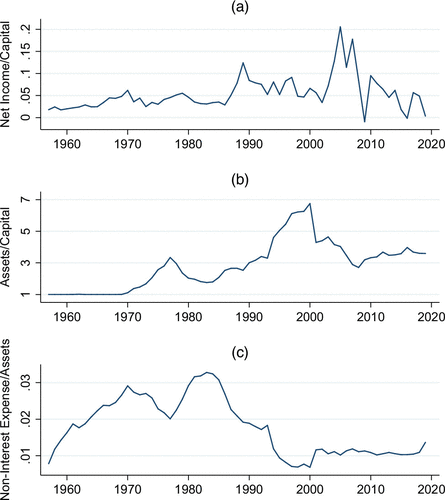
The source of the data is the International Finance Corporation (IFC). The IFC seeks through its investments to contribute to improvements in social and environmental outcomes aligned with the United Nations’ Sustainable Development Goals (International Finance Corporation 2019b). Historically, before the elaboration of these goals, it sought to provide capital to economies in which it was scarce. The institution is owned and governed, its policy determined, and its equity capital is provided by 185 member countries. Development-related investments account for $43 billion of its approximately $99 billion balance sheet, the remainder being liquid securities (International Finance Corporation 2019c). The carrying value of its equity investment portfolio is 30% of development-related investments. Figure 1 charts the institution’s financial history in three ratios: return on equity (net income/total capital), leverage (total assets/total capital), and administrative expense (noninterest expense/total assets). Values used in calculating these ratios were transcribed from the annual reports and are reported in Table A.1 in Online Appendix (to our knowledge, this series does not exist elsewhere).
Source. The IFC annual reports.
Notes. Values of assets prior to 2001 are not directly comparable with those after because of a change in accounting standards requiring derivatives to be held at fair rather than book value (FAS No. 133). Source data are reported in Table A.1 in Online Appendix.
The IFC’s first loan, made in 1957, provided $2 million to Siemens’ Brazilian affiliate (International Finance Corporation 2018). A 1961 amendment to the charter allowing the holding of equity led to a surge in equity investment during 1963–1964 to about 50% of total investment (Kapur et al. 1997). Since the 1960s, this share has fluctuated between 15% and 35%. Equity investment in private markets has been the basis for growth in the capital base through retained earnings, with realized gains from these investments leading, as seen in Figure 1, Panel a, to high points in return on equity in 1989 (RoE = 12.4%) and 2005 (20.5%).
Funds for the IFC’s operations are raised in international capital markets. Its leverage ratio, as shown in Figure 1, panel b, was 3.6 in 2019. The extent of borrowing varies substantially across institutions owned by governments seeking to promote economic development through investment in private firms.5
A small literature examines the role of the IFC as an investor and development institution. Dreher et al. (2019), investigating the link between IFC loan allocation and board membership in the institution, found a positive relationship between political influence and lending decisions, and Taussig and Delios (2015), using data from the IFC’s investment in private equity funds to examine the role of local expertise and performance, found local expertise to improve performance more in countries with weak contract enforcement institutions. Kenny et al. (2018), analyzing the countries targeted by IFC investment between 2001 and 2016, noted a shift in allocation from low- to middle-income countries. Although none of these papers reported on returns obtained by the IFC, Desai et al. (2017) studied the relationship between IFC project returns and ESG risk factors since 2005, finding no evidence that better ESG performance is linked to improved financial performance.
3.1.1. Potential Selection Bias.
The IFC equity portfolio data enable us to avoid two forms of selection bias that typically hamper analysis of the performance of an asset class. A first source of selection bias is survivorship bias, that is, when successful investments or funds are more likely than failures to appear in a data set (Carhart et al. 2002 discussed this in the context of the mutual fund industry). Because the data include all of the IFC’s equity investments, including write-offs, comparisons of investments within the portfolio will not be affected by such bias. Another version of survivorship bias would be if its performance influenced the probability of the IFC disclosing its returns. The IFC, however, has had a longstanding policy of disclosing performance in annual reports.
A second potential source of bias is infrequent valuation, such as when an investor values an investment only upon a successful initial public offering (IPO) or after a company completes a successive round of fundraising (Cochrane 2005 discussed this in the context of venture capital). Because valuations may be positively correlated with these events, ignoring investments that have not gone public or raised further funds could lead to an upward bias in average performance. Our estimates are not subject to such bias because (i) the majority have already exited, and (ii) we include the mark-to-market net asset values of all unrealized investments on the same date (Gompers and Lerner 1997). Nonetheless, because mark-to-market valuations are themselves challenging to do correctly (Jenkinson et al. 2013, Brown et al. 2019), in our regression specifications we restrict the sample to mature investments by excluding the 10 most recent vintage years (2010–2019). This ensures that our results are not driven by mark-to-market valuations that are more difficult to determine given the youth of the investment. For robustness, we also report results restricted to the sample of realized investments (Tables A.6 and A.9 in Online Appendix).
3.1.2. External Validity.
The IFC’s long history and broad geographical diversification enable us to paint an unusually rich picture of emerging market private equity investment. But we acknowledge several caveats.
First, the IFC, although it is a single investor, generally coinvests with private sector investors, rarely taking more than 25% of the value of a project. Therefore, we view its portfolio as informative about the returns available to private investors in the markets in which it operates. Moreover, over the past three decades, the IFC has increasingly invested indirectly through private equity funds, which are also marketed to institutional investors. Although IFC’s direct investments may not be available to all investors, the returns to the IFC’s fund investments provide a credible benchmark of what could be obtained by a diversified investor in emerging market private equity funds.
Second, although its charter prohibits it from taking government guarantees, it is possible that the IFC’s status as part of the World Bank Group provides additional protection from expropriation. Therefore, realized returns may not always be representative of what is available to independent investors.
Third, if the IFC had special immunity to capital controls, its returns would be less representative of the private investment market. Our understanding is that the IFC does not have special status vis-à-vis capital controls, nor do its co-investors. From this perspective, the relationship between capital controls and investment performance we observe in the data set is representative of the opportunity set available to other foreign investors.
Fourth, as can be seen in Figure 1, panel c, the IFC’s operating expenses have declined from approximately 2% of assets from 1964 to 1988 to 1.4% of assets at present. These costs include public policy work and technical assistance for investments as well as investment costs associated with the debt portfolio, which may be lower than for the equity portfolio. Because it is not possible to accurately apportion fixed costs to each investment, and because the IFC engages in significant noninvestment activities like research, we assess individual investment performance on a gross basis without subtracting operating expenses. When assessing the performance of the complete portfolio, we report additional results that reduce returns by subtracting a hypothetical “two and twenty” management fee to direct investments.
3.2. Private Equity Investment Data
3.2.1. Cash Flows.
Our primary data are the complete set of cash flows to and from all 2,509 equity investments (in companies or funds) from the IFC’s founding in 1956 until June 30, 2019.6 The data include the month of each cash flow, the exact value in U.S. dollars, and the most recent mark-to-market valuation of investments still held in the portfolio. Each investment’s “vintage year” is defined as the year of first cash flow to the company. The first equity investment was made in 1961 and the last in 2019, so the data span 59 vintage years. Table A.2 in Online Appendix reports investment frequencies by decade, geographic region, and sector.
The average holding duration of an investment, measured by the years between first and last cash flow or positive valuation, is eight years, more than the five years targeted by private equity funds but less than the 10 years a venture capital fund might hold investments for, reflecting investments of both types. Table A.3 in Online Appendix reports the average holding duration and percent of investments that have been realized, that is, the share with zero holding valuation as of June 30, 2019. Except where otherwise specified, we restrict the analysis to investments with vintage years prior to 2009, which will have had at least 10 years to realize their value. Among investments with vintage years 2010–2019, only 33% of direct investments have been realized, and 7% of fund investments have been realized. Newer investments may be held with the expectation that their market valuations will increase. In contrast, among investments with vintage years 2000–2009, the shares of investments realized are 83% and 46%, respectively. We include in the analysis the most recent decade of investments only when we report on the returns to the complete portfolio.
3.2.2. Direct vs. Fund Investments.
The IFC makes equity investments primarily through the direct purchase of a minority stake in a company but also through participation as a limited partner in a fund. Cash flows between portfolio companies of third-party funds in which the IFC is a limited partner are not observed; 480 of 2,509 investments are investments in funds, and the remaining 2,029 are direct investments. Except when considering the allocation and performance of the entire portfolio (Tables 1 and 2), we analyze separately the performance of direct and fund investments. The key distinction between direct and fund investments is that the performance of fund investments is measured net of fees charged by general partners, whereas the direct investments are gross, excluding the IFC’s operating costs. Private equity performance reported in the finance literature (see, e.g., Harris et al. 2014) is typically net of management fees paid to fund managers, and so it is directly comparable to the IFC’s fund investments.
|

Table 1. Geographic Distribution of IFC Equity Investment Compared with Foreign Direct Investment
| Geography | IFC equity investment since 1956 | FDI inflows since 1970 | IFC/FDI | |||
|---|---|---|---|---|---|---|
| Billions ($) | Share of subtotal | Trillions ($) | Share of subtotal | Share of total | ||
| Countries with IFC cash deployed | ||||||
| Emerging Market and Developing Economies | 39.99 | 97.7% | 13.41 | 85.8% | 29.0% | 0.30% |
| Latin America and the Caribbean | 9.51 | 23.2% | 4.10 | 26.2% | 8.9% | 0.23% |
| Brazil | 2.65 | 6.5% | 1.42 | 9.1% | 3.1% | 0.19% |
| East Asia and the Pacific | 7.46 | 18.2% | 4.36 | 27.9% | 9.4% | 0.17% |
| China | 3.82 | 9.3% | 3.06 | 19.6% | 6.6% | 0.13% |
| Europe and Central Asia | 7.56 | 18.5% | 2.40 | 15.4% | 5.2% | 0.32% |
| Russian Federation | 2.20 | 5.4% | 0.73 | 4.7% | 1.6% | 0.3% |
| Sub-Saharan Africa | 4.55 | 11.1% | 0.8 | 5.1% | 1.7% | 0.57% |
| Nigeria | 0.42 | 1.0% | 0.17 | 1.1% | 0.4% | 0.24% |
| South Asia | 5.25 | 12.8% | 0.67 | 5.1% | 1.7% | 0.66% |
| India | 3.90 | 9.5% | 0.67 | 4.3% | 1.5% | 0.58% |
| Middle East and North Africa | 3.83 | 9.4% | 0.96 | 6.1% | 2.1% | 0.4% |
| Saudi Arabia | 0.10 | 0.2% | 0.37 | 2.3% | 0.8% | 0.03% |
| World region | 1.83 | 4.5% | — | — | — | — |
| Advanced economies | 0.93 | 2.3% | 2.22 | 14.2% | 4.8% | 0.04% |
| Korea, Rep. | 0.35 | 0.9% | 0.34 | 2.2% | 2.2% | 0.10% |
| Greece | 0.24 | 0.6% | 0.1 | 0.6% | 0.6% | 0.25% |
| Czech Republic | 0.21 | 0.5% | 0.2 | 1.3% | 1.3% | 0.11% |
| Subtotal | 40.92 | 100.0% | 15.63 | 100.0% | 33.8% | 0.26% |
| Countries without IFC cash deployed | ||||||
| Emerging market and developing economies | 2.26 | 4.9% | ||||
| British Virgin Islands | 1.00 | 2.2% | ||||
| Cayman Islands | 0.70 | 1.5% | ||||
| United Arab Emirates | 0.20 | 0.4% | ||||
| Advanced economies | 28.33 | 61.3% | ||||
| United States | 8.34 | 18.0% | ||||
| United Kingdom | 3.18 | 6.9% | ||||
| Hong Kong SAR (China) | 1.99 | 4.3% | ||||
| Total | 46.2 | 100.0% | 0.09% | |||
Notes. This table presents IFC equity investment and global FDI inflows by the IFC regional classification. Emerging market and developing economies (EMDEs) and advanced economies are as classified by the IMF as of 2019. Brazil, China, Russian Federation, Nigeria, India, and Saudi Arabia are the largest FDI destinations in their regions. The United States, United Kingdom, and Hong Kong SAR (China) are the world’s three largest FDI destinations among advanced economies. The British Virgin Islands, Cayman Islands, and United Arab Emirates are the three largest EMDE FDI destinations without IFC cash deployed. Advanced economies with IFC equity investments are, in descending order of real cash deployed, the Republic of Korea, Greece, Czech Republic, Slovak Republic, Latvia, Singapore, Estonia, Slovenia, Lithuania, and Taiwan (China). Regional IFC projects are grouped under their region. FDI inflows from UNCTAD up to 2018. Values are 2023 dollars, converted from nominal dollars using the U.S. GDP deflator.
|
Table 2. Financial Performance of the IFC Private Equity Portfolio as of June 30, 2019
| Performance measure | Financial performance of equity investments with year of first cash flow, including and since… | |||||
|---|---|---|---|---|---|---|
| 1961 | 1970 | 1980 | 1990 | 2000 | 2010 | |
| Panel A: Complete portfolio | ||||||
| PME vs. S&P 500 | 1.15 | 1.12 | 1.16 | 1.14 | 1.07 | 0.70 |
| PME vs. MSCI World | 1.21 | 1.26 | 1.23 | 1.12 | 0.78 | |
| PME vs. MSCI Emerging Markets | 1.3 | 1.18 | 0.98 | |||
| IRR (%) | 13.4 | 13.8 | 14.5 | 13.4 | 12.9 | 3.6 |
| TVPI | 1.71 | 1.70 | 1.69 | 1.61 | 1.47 | 1.15 |
| GPME vs. S&P 500 | 2.04 | 2.13 | 2.20 | 2.17 | 2.69 | −0.09 |
| p-value for GPME = 0 | [0.17] | [0.18] | [0.18] | [0.20] | [0.32] | [0.98] |
| Number of investments | 2,509 | 2,429 | 2,304 | 2,053 | 1,433 | 803 |
| Panel B: Separating direct and fund investments | ||||||
| PME vs. S&P 500, direct investments only | 1.19 | 1.16 | 1.20 | 1.21 | 1.10 | 0.69 |
| PME vs. S&P 500, fund investments only | 0.96 | 0.96 | 0.96 | 0.89 | 0.92 | 0.76 |
| PME vs. S&P 500, realized direct investments only | 1.24 | 1.22 | 1.31 | 1.34 | 1.37 | 0.64 |
| PME vs. S&P 500, realized fund investments only | 1.11 | 1.11 | 1.12 | 1.01 | 1.43 | 0.71 |
| Panel C: Less hypothetical fee equal to 2% of assets each year and 20% of realized profit over 8% hurdle | ||||||
| PME vs. S&P 500, direct investments only | 0.97 | 0.92 | 0.96 | 0.97 | 0.86 | 0.43 |
Notes. The public market equivalent (PME) is measured following Kaplan and Schoar (2005) as the ratio of cash in (disbursements) to cash out (client capital calls), where each series is discounted according to a public market index. The discount rate is given by the total return of the index, including dividends and price appreciation. IRR is internal rate of return. TVPI is total value to paid-in capital. GPME is measured following Korteweg and Nagel (2016), where cash flows are discounted according to a stochastic discount factor , and is the log market return at time t + 1. For the full sample of investments since 1961, the terms are estimated as (standard error = 0.005) and (0.697). Investment-level cash flows for each month and market index values are observed on the last date of each month. For investments with nonzero holding valuation, the fair value is treated as a positive cash flow on June 30, 2019, as if the investment is sold on that date. An investment is realized if it has zero holding valuation.
3.2.3. Sector.
Investments are classified by one of 195 tertiary sectors, which comprise 26 primary sectors (e.g., electric power, food and beverage). Investments in funds are classified as investments in a distinct primary sector (“fund investments”) because funds have mandates that span multiple sectors. We report performance by broad sector groups: financial institutions, infrastructure; manufacturing, agribusiness, and services; mining, oil and gas; and fund investments.
3.2.4. Geography.
All investments are categorized by “country of risk” being the country in which the investment project is located.7 Most investments are located in a single country. Some investments are located in multiple countries (384 of 2,509). In the data, these are tagged at the region level (e.g., Eastern Europe Region, Western Africa Region, World Region) rather than at the country level. When we conduct country-level analysis in Tables 5–11, we omit these observations.
We briefly describe the unique geographic allocation of the equity portfolio by comparing the IFC’s portfolio cash deployed (i.e., contributions, as defined above) to FDI inflows reported by the United Nations Conference on Trade and Development (UNCTAD). FDI inflows, defined as the acquisition of an equity capital stake of 10% or more by investors residing in a country other than the one in which the enterprise is located, include most cross-border private equity investment, whether by funds or through mergers and acquisitions.
Table 1 reports the country allocation of IFC investment and FDI in constant dollars broken down by whether countries were classified by the IMF in 2019 as “advanced economies” or “emerging market and developing economies” (EMDEs).8 Overall, IFC equity investment accounts for 0.09% of global FDI. Unlike FDI, the IFC has focused entirely on EMDEs, with 97.7% of its cash deployed in current EMDEs and 2.3% in countries that have since transitioned to advanced economy status, including the Czech Republic, Greece, and the Republic of Korea. In contrast, 61.3% of FDI has gone to advanced economies in which the IFC has never deployed cash, such as the United States (which has received 18% of total FDI), United Kingdom (6.9%), and Hong Kong SAR, China (4.3%). Nor has the IFC deployed equity investment in certain jurisdictions through which some FDI into EMDEs is indirectly channeled (Coppola et al. 2021), namely, the British Virgin Islands (2.2% of total FDI), Cayman Islands (1.5%), and United Arab Emirates (0.4%). In terms of geographic diversification within EMDEs, the IFC’s portfolio is more diversified than FDI and public equity investment references.9
3.2.5. Performance Measurement Using the Public Market Equivalent (PME).
Cash flows are used to calculate the financial performance of the entire portfolio as well as the investment in each company (or fund). The cash flow stream is divided into positive and negative parts respectively termed distributions () and contributions (). Distributions are the cash flows returned to the IFC through dividend payments or the sale of a company’s shares. For investments still held in the portfolio, we treat the net asset value on June 30, 2019, as a positive distribution, that is, as if the investment is liquidated on that date at its fair value. Contributions are the IFC’s investments in a company, including the payment of management fees in the event that the company is a fund.
Our measure of financial return is the public market equivalent, defined by Kaplan and Schoar (2005) as
Given this choice, the question naturally arises as to whether we should instead use an alternative benchmark that better matches a portfolio’s risk characteristics, such as an index of emerging market public equity or of private equity, for our preferred measure. There are several reasons that we do not. First, the S&P 500 is the only index for which the time series is complete back to our first cash flow in 1961. When reporting portfolio performance, we do use the MSCI World index and the MSCI Emerging Markets index as alternatives, although these start later, in 1970 and 1988, respectively, and are much less diversified than the IFC portfolio. Index values are value-weighted, including dividends, as reported by Bloomberg. Second, although consultancies like Cambridge Associates produce international private equity indices for the most recent period after 2000, the returns in these indices do not reflect the same country and sector allocations as the IFC. Moreover, they include only funds whose investors elect to report their performance to the consultancy. Our purpose in using the PME is not to assess whether the IFC portfolio outperforms an investor trying to replicate the same strategy—given the available data, it would be impossible to measure this counterfactual—but rather to correct for the time value of money and to compare performance to a public benchmark broadly agreed to provide a reasonable absolute return over the long run in a way that accounts for the irregular timing of payoffs in private equity transactions.
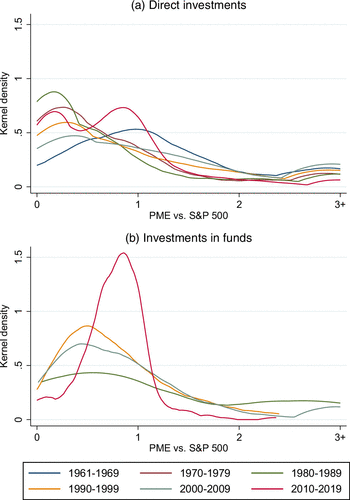
To summarize individual investment performance, Figure 2 plots, by decade of initial investment, the density of PME for direct investments (panel a) and fund investments (panel b). For purposes of the graph only, values above 3 were recorded as 3. Table A.4 in Online Appendix reports average and median values of the PME by decade, for direct and fund investments, along with the standard errors of the averages. Decade refers to the vintage year, so even though an investment is classified under the decade in which it originated, its return may be based on an exit in a different decade or the current net asset value.
Source. IFC equity cash flows.
Notes. For the graph, values above 3 were recorded as 3. In panel B, the line for 1980–1989 includes one investment with the vintage year 1978.
One way to assess the relative risk and reward of each decade is to compare mass to the right of the center under each distribution. By this measure, the greatest mass of high-return projects (measured by PME) is found in 1961–1969, followed by 2000–2009, followed by 1990–1999. The variance of the distribution appears smallest (not accounting for outliers) for the most recent decade, 2010–2019. This is expected given the large share of unrealized investments valued at close to their cost. Investments that originated in 1980–1989 exhibit the worst performance (measured by PME); the density function for that decade compared with investments made in 2010–2019 is skewed further to the left.
3.2.6. Alternative Performance Measures.
Although most of our analysis focuses on the PME versus the S&P 500, we report for comparison portfolio performance measured in three other ways.
First, we report the total value to paid-in capital (TVPI), or the sum of all distributions divided by the sum of all contributions, which is known as the multiple on invested capital (MOIC) or multiple of money when considering a realized investment.11 Unlike the PME, this measure does not account for the time value of money.
Second, we report the internal rate of return (IRR).12 Given the common use of IRR by private equity professionals to evaluate investment performance, for robustness we present key regression results using the investment-level IRR as a dependent variable. There are issues with this approach. The IRR is much more right-skewed compared with the PME, making the OLS regressions, albeit not the quantile regressions, less reliable. Additionally, the IRR is undefined for 138 investments that were written off and have zero or trivial positive cash flows. To retain these observations in the analysis and avoid selection bias, for these investments we code the IRR as −100%. Table A.4 in Online Appendix reports summary statistics for the IRR by decade for direct and fund investments.
Third, we report the generalized public market equivalent (GPME) proposed by Korteweg and Nagel (2016), who observed that the PME can be affected by the performance of the market during the sample period. For instance, using the vocabulary of the CAPM framework, the PME will be greater than one if alpha is zero, but the portfolio has a beta greater than one, and the PME is observed at a time when the market is performing well. Because it adjusts for the risk-free rates and returns of public equity markets during the sample period, the GPME will indicate less outperformance than the PME for high beta investments if the public market is doing well during the sample period. For the risk-free return, we use the one-month U.S. treasury rate reported by CRSP. Similarly, the GPME will report more outperformance than the PME for low beta investments if the public market is doing well during the sample period. This issue is of particular concern in the literature because many papers have used data on private equity returns from the 1990s, when the public market was doing quite well. This issue is of less concern in the present paper because our sample period is 1961 to 2019.
3.3. Other Data
We relate the PME to a variety of country-level covariates. Real GDP per capita, inflation, and local currency depreciation are taken from the World Development Indicators (World Bank 2019a). Legal origins (i.e., English, French, or Socialist) are measured using the classification of La Porta et al. (1999). A measure of political risk comes from the PRS Group, a measure of corruption perception from Transparency International, and a measure of economic freedom from the Heritage Foundation. Financial openness is measured by the index of Chinn and Ito (2006, 2008), which is the first principal component of dummy variables codifying capital controls reported in the IMF’s Annual Report on Exchange Arrangements and Exchange Restrictions. Financial development is measured by the ratio of private sector credit by deposit money banks to GDP, as reported in the Global Financial Development Database (World Bank 2019b).
4. Results
4.1. Performance of a Diversified Emerging Market Private Equity Portfolio
As a first look, Table 2 reports the performance of the IFC portfolio, pooling cash flows from direct investments and fund investments. The evolution of portfolio returns over time is documented in the table’s columns, which report performance calculated on subsets of investments grouped by earliest vintage year beginning with all investments since the first in 1961 and then all investments since 1970, since 1980, and so forth.
Table 2, panel A reports the performance of the complete portfolio. The bottom row of this panel reports the number of investments in each vintage year group. Relative to the S&P 500, the complete portfolio has achieved a PME = 1.15 since 1961. Over the long run, the portfolio has delivered 15% more than a counterfactual investment in the U.S. public equity market. Looking at indices available only in later decades, the PME, relative to the MSCI EM and World indices, is systematically higher, consistent with the superior average performance of the S&P 500 over the sample period. For instance, looking at all projects with vintage years after 1990, shortly after the initiation of the MSCI EM index, the IFC achieved a PME = 1.30 relative to MSCI EM, a PME = 1.23 relative to MSCI World, and a PME = 1.14 relative to the S&P 500.
As expected, returns are positive according to the IRR and TVPI. The long-run IRR is 13.4%, and the long-run TVPI is 1.71. We also estimate the GPME, as proposed by Korteweg and Nagel (2016), which adjusts for the beta of the assets of the underlying portfolio. The GPME is scaled such that performance equivalent to the market equals zero instead of one and a GPME above zero indicates outperformance (see the discussion in Jeffers et al. 2024).13 The point estimates of the GPME are above 2 for all periods, except for investments post-2010; these point estimates suggest that the portfolios perform well, but the p-values, reported below, indicate that we cannot reject the hypothesis that the GPME = 0 at standard levels of statistical significance. The GPME, unlike the PME, relies on an estimate of a stochastic discount factor, and is measured with statistical error (we use code from Korteweg and Nagel (2025) to estimate this). Korteweg and Nagel (2025) noted that lower statistical precision is a drawback of the GPME measure.
4.1.1. Recent Investments.
Restricting the portfolio to only investments with vintage years, including 2010 and after, the PME dipped below parity with all three public indices, although it still achieved returns comparable to MSCI EM, with a PME = 0.98 relative to that index. Relative to the S&P 500, the most recent decade of investments delivered a PME = 0.70. Two factors other than the short holding period for recent investments could explain the decline in returns. First, the significant rally in U.S. equities since the global financial crisis could explain underperformance relative to the S&P 500. Second, the IFC scaled up investment in the recent decade primarily in more developed middle-income markets, as described by Kenny et al. (2018). Figure A.1 in Online Appendix shows that global FDI plateaued in this decade, whereas IFC investment expanded sharply, suggesting perhaps that fewer profitable investment opportunities were available at that time. Consistent with this view, emerging markets have underperformed advanced economies in the most recent decade in other portfolios as well, for instance, in the MSCI index (see https://perma.cc/HW2D-3VYS) and the Cambridge Associates index (see https://perma.cc/4QZ8-QN5E) of private equity and venture capital performance. Our results on financial openness and development, which have increased over time, provide further evidence on this hypothesis.
4.1.2. Portfolios of Direct and Fund Investments and Comparison with Existing Literature.
Table 2, panel B reports returns to the IFC’s portfolio of direct investments and, separately, its portfolio of fund investments.
The literature on private equity returns has focused almost exclusively on the U.S. private equity industry and specifically on the returns to limited partners (LPs) in private equity funds professionally managed by general partners (GPs). Kaplan and Sensoy’s (2015) comprehensive review of this literature reveals that, overall, leveraged buyout funds have outperformed the S&P 500, whereas the performance of venture capital funds, which employ less leverage and focus on smaller deals in early-stage companies, has been more variable relative to this index. For the IFC, the long-run PME of fund investments (480 of 2,509 investments) is 0.96. This performance is slightly less than the median performance of advanced economy venture capital funds (PME = 1.02) and leveraged buyout funds (PME = 1.16) during the 1980s, 1990s, and 2000s, according to Harris et al. (2014).
The long-run PME of the IFC’s direct investments (2,029 of 2,509 investments) is 1.19. Outperformance relative to the S&P 500 was obtained for all decades, except for the decade 2010–2019. This performance is better than the gross of fees sample of 170 impact investments made between 2000 and 2014 that was examined by Gray et al. (2016), which achieved a PME = 1.00 relative to the S&P 500.
Also reported in Table 2, panel B, are the performance of portfolios of only realized investments, excluding those with positive fair holding values. For both direct and fund investments, these are higher than the complete portfolios, as expected if investments are held with the expectation that their value will increase. Notably, unlike prior decades, for investments with the vintage years 2010–2019, the PME is less than one for both realized fund investments and realized direct investments. This is suggestive, albeit not conclusive, that available performance relative to the S&P 500 may have changed in this recent decade.
4.1.3. Subtracting Hypothetical Management Fees from Direct Investments.
To render the IFC’s direct investment performance more comparable to those that might be obtained by a private equity investor, Table 2, panel C, presents results after subtracting a hypothetical management fee of 2% of assets and 20% of returns above an eight percent hurdle rate, similar to what private equity funds charge.14 After accounting for these fees, the long-run PME equals 0.97, slightly above the performance of the IFC’s fund investments. This indicates that even after accounting for private equity-like fees, the IFC’s long-term performance achieves returns nearly equal to those of public equity markets.
4.2. Private Equity Performance Differences by Holding Duration and Investment Size
4.2.1. Holding Duration.
A liquidity premium, namely higher returns in exchange for longer holding durations, may explain the outperformance of private equity investments relative to public markets. In Table 3, we use regressions of PME on duration measured in years to examine the association between investment financial performance and holding duration, where duration is measured as the number of years between the first and last cash flow. In this and all subsequent analysis, the sample is restricted to investments with vintage years prior to 2010 to exclude investments with very short duration. To capture potential nonlinearity, this relationship is estimated using a spline function that allows the slope between PME and duration to differ between three intervals: less than 10 years, between 10 and less than 20 years, and 20 years or more.15 Column (1) reports an OLS specification of the regression. Columns (2)−(6) report the results of a quantile regression at the 10th, 25th, 50th, 75th, and 90th percentiles.
|
Table 3. Financial Performance and Holding Duration
| Variable | (1) | (2) | (3) | (4) | (5) | (6) |
|---|---|---|---|---|---|---|
| Quantile regression | ||||||
| OLS | 0.1 | 0.25 | 0.5 | 0.75 | 0.9 | |
| PME | PME | PME | PME | PME | PME | |
| Panel A: Direct investments, vintage pre-2010 | ||||||
| Duration × 1(duration < 10) | 0.46*** | 0.00 | 0.03*** | 0.06*** | 0.07*** | 0.23*** |
| (0.16) | (0.00) | (0.01) | (0.02) | (0.02) | (0.06) | |
| Duration × 1(10 duration < 20) | 0.16* | 0.00** | 0.02*** | 0.02** | 0.06*** | 0.17*** |
| (0.09) | (0.00) | (0.00) | (0.01) | (0.02) | (0.04) | |
| Duration × 1(20 duration) | 0.09 | 0.00 | 0.01** | 0.01** | 0.02 | 0.08*** |
| (0.06) | (0.00) | (0.00) | (0.01) | (0.02) | (0.02) | |
| Constant | −0.08 | −0.00 | 0.00 | 0.34** | 1.04*** | 1.47*** |
| (1.00) | (0.02) | (0.03) | (0.14) | (0.12) | (0.29) | |
| R2 | 0.0058 | 0.0006 | 0.0044 | 0.0058 | 0.0021 | 0.0028 |
| No. of observations | 1,452 | 1,452 | 1,452 | 1,452 | 1,452 | 1,452 |
| Panel B: Fund investments, vintage pre-2010 | ||||||
| Duration × 1(duration < 10) | −0.52*** | −0.03 | −0.03 | −0.04* | −0.02 | −0.07 |
| (0.16) | (0.02) | (0.02) | (0.02) | (0.03) | (0.13) | |
| Duration × 1(10 duration < 20) | −0.31*** | −0.01 | −0.01 | −0.01 | −0.00 | −0.03 |
| (0.09) | (0.01) | (0.01) | (0.01) | (0.02) | (0.07) | |
| Duration × 1(20 duration) | −0.22** | −0.02 | −0.01 | −0.02** | −0.04*** | −0.08* |
| (0.10) | (0.02) | (0.01) | (0.01) | (0.01) | (0.05) | |
| Constant | 5.30*** | 0.35*** | 0.56*** | 0.94*** | 1.23*** | 2.38** |
| (1.20) | (0.12) | (0.15) | (0.16) | (0.23) | (1.09) | |
| R2 | 0.0463 | 0.0200 | 0.0187 | 0.0194 | 0.0025 | 0.0160 |
| No. of observations | 254 | 254 | 254 | 254 | 254 | 254 |
Notes. Sample includes only investments with first cash flow prior to 2010. Duration is measured as the number of years between the first and last cash flow. Standard errors are robust to heteroskedasticity.
***p < 0.01; **p < 0.05; *p < 0.1.
In Table 3, panel A, the results for direct investments are reported.16 In the OLS specification, an additional year of duration when duration is less than 10 years is associated with a 0.46 higher PME, statistically significant at 1%. Between 10 and 20 years, the slope is less steep, and an additional year of duration is associated with only a 0.16 higher PME, statistically significant at 10%. After 20 years, the slope is even less steep, but it is not statistically significant. In the quantile regressions, the same qualitative pattern remains, although the magnitudes vary considerably by quantile. At the 10th percentile, there is no perceptible effect of duration on returns. At the 50th percentile, an additional year of duration of less than 10 years is associated with a 0.06 higher PME, whereas an additional year of duration between 10 and 20 years is associated with a 0.02 higher PME. At the 90th percentile, these numbers are 0.23 and 0.17, respectively. This pattern indicates that holding duration is especially important for generating the highest-performing investments. Overall, these results are consistent with the existence of a liquidity premium as well as with the idea of private returns to “patient” capital, a theme among impact investors.
Interestingly, in Table 3, panel B, which reports the results for the smaller sample of fund investments, there is no evidence of a liquidity premium. If anything, longer holding duration is associated with lower returns to investments in funds. This is consistent with funds that wait longer to return capital to limited partners having lower returns.
4.2.2. Investment Size.
One distinction between private equity and venture capital investments is the size of the amount committed. Table 4 reports the size distribution of the IFC’s investments, which are again split between direct and fund investments, and the performance of portfolios constructed by grouping together investments of the same size. Each company is classified into investment size quartiles by decade, and size is defined as the nominal value of total cash deployed in the investment. Table 4, panel A, reports the cutoffs for each quartile in each decade. For direct investments, prior to 1990, size quartiles were relatively stable across decades, with the cutoff for the bottom quartile ranging from $0.29 million to $0.35 million and for the top quartile from $2.00 million to $2.34 million. Average direct investment size rose considerably in subsequent decades, with the bottom quartile cutoff rising to $0.47 million in 1990–1999, $1.56 million in 2000–2009, and $3.91 million in 2010–2019. This growth in average investment size is much more than could be explained by inflation. The share of large investments also increased substantially, with the top quartile cutoff rising to $5.48 million in 1990–1999, $14.56 million in 2000–2009, and $24.00 million in 2010–2019. Therefore, the IFC’s portfolio reflects a combination of different investment sizes, some on the scale of those executed by large private equity funds and others more on the scale of venture capital investments. For fund investments, investments in the bottom and top quartile are generally larger than for direct investments but with a similar pattern of increasing investment size over time.
|
Table 4. Investment Financial Performance and Investment Size
| Panel A: Investment size cutoffs (nominal $millions) | ||||
|---|---|---|---|---|
| Time period | Smallest quartile | Median | Largest quartile | Average |
| Direct investments | ||||
| 1961–1969 | 0.33 | 0.72 | 2.02 | 1.31 |
| 1970–1979 | 0.35 | 0.87 | 2.00 | 1.86 |
| 1980–1989 | 0.29 | 0.78 | 2.34 | 2.83 |
| 1990–1999 | 0.47 | 1.80 | 5.48 | 4.76 |
| 2000–2009 | 1.56 | 5.00 | 14.56 | 12.79 |
| 2010–2019 | 3.91 | 9.80 | 24.00 | 21.36 |
| Fund investments | ||||
| 1978–1989 | 0.80 | 1.64 | 7.53 | 4.85 |
| 1990–1999 | 2.26 | 4.97 | 10.00 | 7.84 |
| 2000–2009 | 5.31 | 11.99 | 19.81 | 14.65 |
| 2010–2019 | 4.84 | 10.61 | 19.79 | 14.72 |
| Panel B: PME vs. S&P 500 by size quartile, vintage pre-2010 only | |||||
|---|---|---|---|---|---|
| Investment size | Total | Median | Average | Standard error | Standard deviation |
| Direct investments | |||||
| 1st quartile (smallest) | 1.41 | 0.64 | 4.52 | (1.46) | 27.73 |
| 2nd quartile | 1.48 | 0.62 | 2.61 | (0.67) | 12.72 |
| 3rd quartile | 1.05 | 0.71 | 1.09 | (0.07) | 1.40 |
| 4th quartile (largest) | 1.39 | 0.84 | 1.46 | (0.12) | 2.38 |
| Fund investments | |||||
| 1st quartile (smallest) | 0.80 | 0.54 | 2.03 | (1.17) | 9.29 |
| 2nd quartile | 0.92 | 0.66 | 0.94 | (0.17) | 1.32 |
| 3rd quartile | 1.02 | 0.62 | 1.00 | (0.13) | 1.02 |
| 4th quartile (largest) | 1.09 | 0.83 | 1.05 | (0.10) | 0.80 |
Notes. Cash deployed is classified into investment size quartiles by decade. Panel A reports the investment amounts at each quartile by decade. Panel B reports returns for each quartile. Total refers to the performance measure when pooling cash flows from all investments in the relevant quartile.
Table 4, panel B, reports the PME for direct and fund investment portfolios constructed by pooling cash flows from all investments in the same size quartile, with the quartiles as defined by the cutoffs in panel A.17 This ensures that whether an investment is classified as “small” or “large” is defined relative to the time period. The first column of data reports the total PME, pooling all cash flows. Subsequent columns report the median, average, standard error of the average, and standard deviation. For direct investments, looking at the total PME, there is no clear pattern in returns across size quartiles; the portfolio of the smallest (1st quartile) investments has a PME = 1.41, higher than for the overall portfolio; the largest (4th quartile) investments perform similarly, with a PME = 1.39. Looking at averages, however, there is a pattern, albeit nonmonotonic, that smaller investments do better. The average PME of the 1st quartile is 4.52, the 2nd quartile 2.61, the 3rd quartile 1.09, and the 4th quartile 1.46. Using the standard errors, Welch’s test rejects at the 1% significance level that the 1st and 4th quartile have equal average returns. These results contrast somewhat with the findings of Harris et al. (2014), who found that in advanced economies, leveraged buyout funds, which typically do larger deals, have higher average returns than venture capital funds, which do smaller deals. However, Harris et al. (2014) did not report information that would enable us to evaluate differences in sector compositions between our sample and theirs.
Looking at fund investments, there is a similar pattern that the smallest investments yield larger average returns than the largest investments; this difference is not statistically significant at standard levels. This may reflect the lack of a strong relationship between the IFC’s interest in a fund and the size of deals that the fund does, although the data do not include information on fund size (or the size of investees receiving direct investment), so we cannot verify this hypothesis directly.
4.3. Private Equity Performance Differences Across Markets
4.3.1. Analysis of Variance from Country, Sector, and Vintage.
We now turn to testing for potential segmentation of international capital markets by estimating Equation (1). As a first look, we estimate a modified version, which accounts for the long time series of investments and potential differences in ex ante systematic, country, and sector risk across investments, as follows:
Table 5 reports the share of variance explained by each set of fixed effects, with direct and fund investments analyzed separately. Table 5, panel A, reports the R2 for both the full model in Equation (2) and models with only one set of fixed effects. For direct investments, the R2 of Equation (2) is 0.273, indicating that 27.3% of the variation in returns is explained by the model, and the remaining 72.7% is unexplained. The R2 of the model with only country or region fixed effects is 0.171, indicating that 17.1% of the variation is explained by country or region. In contrast, the R2 of the model with only tertiary sector fixed effects is just 0.056, and the R2 of the models with only vintage or exit years is less than that, indicating that these factors explain much less of the variation. The majority of explained variation is explained by geography. Table 5, panel B, reports the partial R2 for each set of fixed effects in the full model and paints a similar picture.
|
Table 5. Analysis of Variance in Investment Financial Performance by Geography, Sector, and Year
| Model | Direct investments only | Fund investments only |
|---|---|---|
| Panel A: R2 of alternative models | ||
| Full model with all fixed effects | 0.273 | 0.464 |
| Country or region only | 0.171 | 0.236 |
| Tertiary sector only | 0.056 | — |
| Vintage year only | 0.032 | 0.204 |
| Exit year only | 0.022 | 0.102 |
| Panel B: Partial R2 vs. full model | ||
| Country or region | 0.159 | 0.186 |
| Tertiary sector | 0.047 | — |
| Vintage year | 0.034 | 0.131 |
| Exit year | 0.026 | 0.061 |
| No. of observations | 1,452 | 253 |
Notes. The sample includes only investments with first cash flow prior to 2010. Measures of fit are reported for a regression of investment-level PME vs. S&P 500 on fixed effects for country or region (when an investment spans multiple countries), tertiary sector, year of first cash flow, and year of last cash flow. The number of categories for each set of fixed effects is as follows: country or region, 139; tertiary sector, 195; vintage year, or year of first cash flow, 49; and exit year, or year of last cash flow, 53. Fund investments are classified together in a single tertiary sector. The fund investment sample excludes one outlier observation with a very high return that caused an excessively high R2 from the model with exit year only. The R2 values indicate the proportion of variance explained by the full model with all fixed effects. The partial R2 values indicate the proportion of variance explained by each set of fixed effects after controlling for the others.
These results are consistent with international capital market segmentation at the country level because country fixed effects have substantial predictive power over returns. In contrast, the sector has much less explanatory power, suggesting that technology has much less of an effect on returns; similarly, vintage year and exit year are even less important, suggesting that there is limited residual variation in time-varying systemic risk after adjusting for correlation with the S&P 500.
For fund investments, the results are quite similar. In this regression, there is no sector fixed effect because fund investments are classified as being in the same sector. The R2 of the full model is 0.464, indicating that just under half of the variation is explained by the model. The R2 of the model with only country or region fixed effects is 0.236, with only vintage year 0.204 and with exit year 0.102. By this measure, country and vintage year explain more return variation than exit year.
4.3.2. Differences from Income and Institutions.
To better characterize the variation in returns across countries, we estimate the coefficients in Equation (1), including several country characteristics, beginning with (the log of) real GDP per capita and indicators for British and Socialist legal origins.18 Because sector, vintage year, and exit year explain relatively little residual variation in Table 5, we exclude their fixed effects from subsequent analysis. The inclusion of real GDP per capita allows us to test the hypothesis from the neoclassical growth model that returns are higher in lower-income economies if markets are segmented (Lucas 1990). The inclusion of indicators of legal origins tests the hypothesis that the protection of property rights leads to higher returns. Protection of property rights is presumed to be greater in countries with British legal origins and worse in countries with Socialist legal origins (La Porta et al. 1999). The omitted category is French or German legal origins (only one country in the sample, the Republic of Korea, is classified as having German legal origins, so we pool it with French origins). The results of this regression are reported in Table 6, which presents OLS estimates in column (1) and quantile regression estimates at the 10th, 25th, 50th, 75th, and 90th percentiles in columns (2)−(6). Panel A reports the specification for direct investments, and panel B reports the specification for fund investments.
|
Table 6. Investment Financial Performance, GDP Per Capita, and Legal Origins
| Variable | (1) | (2) | (3) | (4) | (5) | (6) |
|---|---|---|---|---|---|---|
| Quantile regression | ||||||
| OLS | 0.1 | 0.25 | 0.5 | 0.75 | 0.9 | |
| PME | PME | PME | PME | PME | PME | |
| Panel A: Direct investments, vintage pre-2010 | ||||||
| Ln(GDP per capita) | 0.44 | 0.00 | 0.05** | 0.00 | 0.00 | −0.20 |
| (0.34) | (0.02) | (0.02) | (0.04) | (0.07) | (0.31) | |
| British legal origins (=1) | −0.41 | 0.00 | 0.02 | −0.11 | −0.02 | 0.04 |
| (0.46) | (0.04) | (0.04) | (0.08) | (0.19) | (0.64) | |
| Socialist legal origins (=1) | 1.52 | 0.02 | 0.21*** | 0.28** | 0.30** | 0.38 |
| (1.87) | (0.05) | (0.07) | (0.11) | (0.13) | (1.09) | |
| Constant | 2.17*** | 0.00 | 0.16*** | 0.69*** | 1.44*** | 2.93*** |
| (0.45) | (0.02) | (0.02) | (0.05) | (0.09) | (0.28) | |
| R2 | 0.0034 | 0.0024 | 0.0032 | 0.0029 | 0.0026 | 0.0000 |
| No. of observations | 1,316 | 1,316 | 1,316 | 1,316 | 1,316 | 1,316 |
| Panel B: Fund investments, vintage pre-2010 | ||||||
| Ln(GDP per capita) | 0.56 | 0.06 | 0.11* | 0.19*** | 0.20 | 0.65*** |
| (0.36) | (0.05) | (0.06) | (0.07) | (0.12) | (0.15) | |
| British legal origins (=1) | 1.95 | 0.13 | 0.08 | 0.15 | 0.18 | 0.15 |
| (1.73) | (0.10) | (0.12) | (0.14) | (0.26) | (0.31) | |
| Socialist legal origins (=1) | 0.71* | 0.10 | 0.07 | 0.20 | 0.47* | 2.14*** |
| (0.41) | (0.10) | (0.13) | (0.21) | (0.27) | (0.74) | |
| Constant | 0.56*** | 0.12* | 0.29*** | 0.55*** | 0.87*** | 1.78*** |
| (0.20) | (0.07) | (0.07) | (0.09) | (0.12) | (0.25) | |
| R2 | 0.0138 | 0.0087 | 0.0018 | 0.0019 | 0.0012 | 0.0001 |
| No. of observations | 153 | 153 | 153 | 153 | 153 | 153 |
| Country fixed effects | No | No | No | No | No | No |
Notes. The dependent variable is the investment-level PME vs. S&P 500. The natural log of GDP per capita is measured as a difference from the sample mean of the natural log of GDP per capita on the year of the first cash flow associated with the investment. Country legal origins are as classified by La Porta et al. (1999). The omitted category is French or German legal origins. Standard errors are clustered at the country-year.
***p < 0.01; **p < 0.05; *p < 0.1.
For GDP per capita, a nuanced pattern emerges. For direct investments in Table 6, panel A, the OLS specification yields a positive association between GDP per capita and performance, although the standard error is large, such that the confidence interval includes a zero or negative association as well. The quantile regressions reveal that the average positive association is driven by investments at the 25th percentile, where a one-percentage-point increase in GDP per capita is associated with a PME increase of 0.05, an effect that is statistically significant at the 5% level. But in contrast, at the 90th percentile, there is a larger negative association of GDP per capita on PME that was obscured by the average, although it is not statistically significant. Richer countries apparently have higher returns at the lower end of the distribution but also potentially fewer “home runs,” or investments at the top of the distribution. For fund investments in Table 6, panel B, the association with GDP per capita is uniformly positive, including at the 90th percentile, and larger quantitatively, indicating that private equity funds may perform better in higher-income countries relative to the IFC’s direct investment. These results are consistent with imperfect capital market integration. Given the negative association between returns to direct investments and GDP per capita at the 90th percentile, we cannot entirely reject the neoclassical growth model that predicts lower returns in richer countries. Yet the finding that the returns to direct investments are greater with increased GDP per capita at other percentiles and uniformly higher returns to fund investments with increased GDP per capita suggests that we also cannot reject the hypothesis of Lucas (1990) that “political risk” lowers returns in lower-income countries and explains low investment there.
For legal institutions (i.e., English, French, or Socialist), the results are surprising. For direct investments, socialist legal origins predict higher returns at all percentiles. Surprisingly, British legal origins predict lower returns on average and at the 50th, 75th, and 90th percentiles, although the association is not statistically significant. For fund investments, socialist legal origins again predict positive returns. British legal origins predict positive returns, but the effect is not statistically significant. These results contrast with those of Lerner and Schoar (2005), who find private equity returns and valuations to be higher in economies with British legal origins and lower in those with socialist legal origins, although their sample is much smaller than ours in terms of the number of countries included. One explanation for higher returns in socialist legal origin countries could be that returns are available in these countries from correcting a (mis)allocation of capital to lower return investments under socialist governments, for instance, through privatization.
4.3.3. Differences from Perceived Political Risk, Corruption, and Economic Freedom.
Table 7 includes in Equation (1) other country risk factors—political risk, corruption perception, and economic freedom—that in contrast to the variables in Table 6 are available only for recent years. Generally, the associations with these variables are not precisely estimated, given the much smaller sample. In Table 7, panel A, there is some evidence that corruption perception is associated with better performance of direct investments at the 50th, 75th, and 90th percentiles, whereas economic freedom and political risk are associated with lower returns at the top of the distribution.19 Johan and Zhang (2016) did not observe returns, but fund exits, which may be a proxy for profit, are more likely in countries with greater perceived corruption.
|
Table 7. Investment Financial Performance and Additional Country-Level Risk Factors in Year Before First Cash Flow
| Variable | (1) | (2) | (3) | (4) | (5) | (6) |
|---|---|---|---|---|---|---|
| Quantile regression | ||||||
| OLS | 0.1 | 0.25 | 0.5 | 0.75 | 0.9 | |
| PME | PME | PME | PME | PME | PME | |
| Panel A: Direct investments, vintage pre-2010 | ||||||
| Political risk (PRS Group) | 2.18 | −0.00 | −0.01 | −0.12 | −0.37 | −0.83*** |
| (2.23) | (0.05) | (0.07) | (0.11) | (0.26) | (0.32) | |
| Corruption perception (Transparency International) | −0.33 | −0.01 | 0.11 | 0.21* | 0.42 | 1.01*** |
| (0.73) | (0.11) | (0.11) | (0.12) | (0.27) | (0.21) | |
| Economic freedom (Heritage Foundation) | −2.10 | −0.00 | −0.06 | −0.10 | −0.25 | −0.79*** |
| (2.41) | (0.07) | (0.07) | (0.10) | (0.17) | (0.23) | |
| Constant | 2.43*** | 0.01 | 0.33*** | 0.96*** | 2.08*** | 4.06*** |
| (0.60) | (0.08) | (0.08) | (0.10) | (0.30) | (0.34) | |
| R2 | 0.00880 | 0.00005 | 0.00033 | 0.00030 | 0.00050 | 0.00004 |
| No. of observations | 346 | 346 | 346 | 346 | 346 | 346 |
| Panel B: Fund investments, vintage pre-2010 | ||||||
| Political risk (PRS Group) | −0.09 | −0.02 | 0.06 | 0.10 | 0.22 | −0.40 |
| (0.37) | (0.09) | (0.12) | (0.17) | (0.16) | (1.02) | |
| Corruption perception (Transparency International) | −0.14 | 0.08 | 0.01 | 0.02 | −0.41** | −0.01 |
| (0.21) | (0.17) | (0.13) | (0.21) | (0.19) | (0.32) | |
| Economic freedom (Heritage Foundation) | −0.06 | −0.08 | −0.02 | −0.06 | 0.27 | −0.43 |
| (0.22) | (0.16) | (0.13) | (0.16) | (0.19) | (0.67) | |
| Constant | 1.25*** | 0.14 | 0.36*** | 0.66*** | 1.14*** | 3.45*** |
| (0.38) | (0.11) | (0.11) | (0.15) | (0.18) | (0.87) | |
| R2 | 0.02253 | 0.00009 | 0.01136 | 0.00587 | 0.00043 | 0.01980 |
| No. of observations | 67 | 67 | 67 | 67 | 67 | 67 |
| Country fixed effects | No | No | No | No | No | No |
Notes. Explanatory variables have been normalized as Z-scores by subtracting off the sample mean and dividing by the sample standard deviation. Standard errors are clustered at the country-year.
***p < 0.01; **p < 0.05; *p < 0.1.
These results are consistent with the findings in Table 6. One way to rationalize the results so far is that misallocation of capital in an economy, for instance, driven by socialist legal origins or corruption, creates profit opportunities for private equity investors in emerging markets. In contrast, investees in economically “freer” countries are less capital constrained, and so they have lower returns. Yet other factors, such as political risk, can harm returns.
4.3.4. Differences from Financial Openness and Development.
We investigate this misallocation hypothesis further by including in Equation (1) measures of financial openness and development that more directly capture access to capital and the potential for misallocation because of capital constraints. The financial openness index from Chinn and Ito (2006) captures de jure capital controls and private sector credit as a percent of GDP captures the depth of the banking sector. In this regression, we also include country fixed effects to isolate variation within countries as these variables change over time, for instance, those associated with liberalizing reforms. Table 8 reports these results.
|
Table 8. Investment Financial Performance and Capital Market Development
| Variable | (1) | (2) | (3) | (4) | (5) | (6) |
|---|---|---|---|---|---|---|
| Quantile regression | ||||||
| OLS | 0.1 | 0.25 | 0.5 | 0.75 | 0.9 | |
| PME | PME | PME | PME | PME | PME | |
| Panel A: Direct investments, vintage pre-2010 | ||||||
| De jure financial openness index | −0.09 | 0.00 | 0.02 | 0.05 | 0.13 | −0.59*** |
| (0.50) | (0.03) | (0.04) | (0.07) | (0.11) | (0.14) | |
| Private sector credit (% of GDP) | −1.57 | −0.00 | −0.03 | −0.18** | −0.32 | −0.88*** |
| (1.09) | (0.04) | (0.06) | (0.07) | (0.22) | (0.25) | |
| Constant | −1.23 | −0.00 | −0.02 | 0.06 | 0.36 | 1.89*** |
| (1.04) | (0.10) | (0.11) | (0.21) | (0.34) | (0.58) | |
| R2 | 0.1792 | 0.0006 | 0.0131 | 0.0804 | 0.1669 | 0.1707 |
| No. of observations | 1,122 | 1,122 | 1,122 | 1,122 | 1,122 | 1,122 |
| Panel B: Fund investments, vintage pre-2010 | ||||||
| De jure financial openness index | 0.17 | 0.08 | −0.04 | −0.09 | −0.16 | −0.03 |
| (0.71) | (0.12) | (0.10) | (0.15) | (0.26) | (0.11) | |
| Private sector credit (% of GDP) | −3.70 | −0.19 | −0.26** | −0.19 | −0.63** | −0.86*** |
| (2.98) | (0.15) | (0.11) | (0.22) | (0.30) | (0.32) | |
| Constant | 1.83 | −0.05 | −0.28 | −0.25 | −0.18 | −0.39 |
| (1.11) | (0.52) | (0.31) | (0.48) | (0.44) | (0.38) | |
| R2 | 0.2833 | 0.0017 | 0.0004 | 0.0420 | 0.0411 | 0.2534 |
| No. of observations | 143 | 143 | 143 | 143 | 143 | 143 |
| Country fixed effects | Yes | Yes | Yes | Yes | Yes | Yes |
Notes. The dependent variable is the investment-level PME vs. S&P 500. Explanatory variables are measured in the year of first cash flow, and have been normalized as Z-scores by subtracting off the sample mean and dividing by the sample standard deviation. All columns include country fixed effects (a version without fixed effects is provided in Table A.10 in Online Appendix). The de jure financial openness index is the first principal component of dummy variables that codify the restrictions on cross-border financial transactions reported in the IMF’s Annual Report on Exchange Arrangements and Exchange Restrictions (AREAER). Private sector credit is domestic private credit to the real sector by deposit money banks. Standard errors are clustered at the country-year.
***p < 0.01; **p < 0.05.
For direct investments, in Table 8, panel A, the OLS specification shows a negative association between both variables and performance, indicating that as financial markets open and credit markets deepen, returns fall. This effect is largest at the 90th percentile, indicating that in particular financial openness and development remove “home runs” from the economy. This pattern is similar in Table 8, panel B, for fund investments.20
In Table 6, Panel B, using the same specification in Table 6, Panel A, column (6) shows a one-standard-deviation higher financial openness is associated with a reduction in the PME by 0.59 at the 90th percentile, or, for an 8-year investment, a () × percentage point lower return than the S&P 500 each year. As a benchmark, in the data between 2000 and 2001, as Poland prepared to enter the European Union, its value on the Chinn-Ito openness index increased by approximately one standard deviation. A one-standard-deviation increase in banking sector development reduces the PME by 0.88 at the 90th percentile, or, for an eight-year investment, a () × percentage point lower return than the S&P 500 each year. A one-standard-deviation increase in private sector credit to GDP is 39 percentage points, approximately equal to the growth experienced by Brazil from 1990 to 2020, or double the growth experienced by Kenya during the same 30-year period.
These results are consistent with the hypothesis that capital controls and limited banking system depth prevent capital from flowing to viable projects in less financially open and developed economies. Were this not the case, we would not observe a change in returns as economies open and develop.21 Overall, these results are consistent with the idea that misallocation creates profit opportunities for private equity investors. As financial systems open and become more competitive, “home run” investments are harder to find. Table A.11 in Online Appendix tests whether the relationship with financial openness can be explained alternatively by changes in perceived corruption, which may also have changed during this reform. The direction of the result in Table 8, Column (6), is robust to this control.
It is worth relating these findings to what is known about flows of private equity investments across countries. Lerner et al. (2009) used data from Capital IQ to construct a database of 76,398 private equity investments made in 1984–2008 across 123 countries. Although they did not measure returns, they found associations between country characteristics and investment volume as a share of GDP. These authors reported that private equity investment flows to countries with higher GDP per capita and less corruption, albeit not to markets with less private sector credit to GDP. Although their paper examined a different sample of investors with preferences that potentially differ from the IFC’s, one way to reconcile their results with ours is that the greatest volume of investment need not necessarily go to markets with the highest returns; indeed, returns could be highest in markets with lower private sector credit to GDP precisely because there is less investment in those markets.
4.3.5. Differences from Sector.
Although sector does not explain much variance in investment performance, we report in Table 9 the PME for four sector groups of direct investments: financial institutions (FIG); infrastructure (INFRA); manufacturing, agribusiness, and services (MAS); and mining, oil, and gas (MIN).22 Considering the total and average PMEs, one clear pattern stands out, which is the lower performance of manufacturing, agribusiness, and services. Welch’s tests using the reported standard errors show that the differences in average PMEs are statistically significant. MAS also has the lowest standard deviation of each investment type, with MIN having the highest standard deviation and FIG having the second-highest standard deviation. Higher returns in these sectors coincide with higher risk. One hypothesis that would rationalize higher returns in FIG, INFRA, and MIN relative to MAS is that these sectors can be natural monopolies or oligopolies within a country, whereas MAS is more competitive and thus less profitable. Assessing the relation between measures of competition and private equity returns is left to future research.
|
Table 9. Investment Financial Performance and Sector
| Sector | PME vs. S&P 500, vintage pre-2010 | ||||
|---|---|---|---|---|---|
| Total | Median | Average | Standard error | Standard deviation | |
| Direct investments | 1.33 | 0.70 | 2.41 | (0.40) | 15.33 |
| Financial institutions | 1.45 | 0.93 | 2.94 | (0.56) | 12.21 |
| Infrastructure | 1.80 | 0.98 | 3.12 | (0.74) | 8.74 |
| Manufacturing, agribusiness, and services | 1.01 | 0.51 | 1.09 | (0.19) | 4.94 |
| Mining, oil, and gas | 2.33 | 0.57 | 7.29 | (4.07) | 44.58 |
| Fund investments | 1.04 | 0.69 | 1.26 | (0.30) | 4.71 |
Notes. Sample includes only investments with first cash flow prior to 2010. Sector classification follows the investment classification used in IFC annual reports, except that mining, oil, and gas are separated from infrastructure, and fund management companies are classified as financial institutions rather than collective investment vehicles. All other collective investment vehicles are called fund investments in this paper.
4.4. Private Equity Performance and the Macroeconomy
We now consider how returns vary with the macroeconomic variables that typically appear in a small open economy model often used for country risk analysis, namely, real GDP growth, inflation, and local currency depreciation. These results are useful for benchmarking the magnitudes of the previous results. Table A.12 in Online Appendix reports summary statistics for these explanatory variables for reference.
4.4.1. Macroeconomic Variables in the Year Before the First Cash Flow.
In Table 10, we consider how recent changes in these variables relate to performance when evaluated ex ante and measured in the year before the first cash flow. This specification tests whether performance can be predicted using the raw macroeconomic variables available at the time of investment. The regression here is identical to Equation (1).
|
Table 10. Investment Financial Performance and Macroeconomic Variables Recorded in the Year Before the First Cash Flow
| Variable | (1) | (2) | (3) | (4) | (5) | (6) |
|---|---|---|---|---|---|---|
| Quantile regression | ||||||
| OLS | 0.1 | 0.25 | 0.5 | 0.75 | 0.9 | |
| PME | PME | PME | PME | PME | PME | |
| Panel A: Direct investments, vintage pre-2010 | ||||||
| Real GDP | 0.10 | 0.00 | 0.01*** | 0.01 | 0.02*** | 0.04 |
| (0.14) | (0.00) | (0.00) | (0.01) | (0.01) | (0.05) | |
| Local currency GDP deflator | −0.04 | −0.00 | −0.00 | −0.00 | −0.02*** | −0.02** |
| (0.02) | (0.00) | (0.00) | (0.00) | (0.01) | (0.01) | |
| Local currency units per U.S. dollar | 0.05 | 0.00 | 0.00** | 0.00 | 0.02*** | 0.03** |
| (0.03) | (0.00) | (0.00) | (0.00) | (0.01) | (0.01) | |
| Constant | 2.31*** | 0.00 | 0.18*** | 0.70*** | 1.53*** | 2.95*** |
| (0.45) | (0.02) | (0.02) | (0.04) | (0.06) | (0.25) | |
| R2 | 0.002 | 0.001 | 0.002 | 0.002 | 0.002 | 0.002 |
| No. of observations | 1,264 | 1,264 | 1,264 | 1,264 | 1,264 | 1,264 |
| Panel B: Fund investments, vintage pre-2010 | ||||||
| Real GDP | 0.12 | 0.00 | 0.00 | 0.02 | 0.02 | 0.16 |
| (0.08) | (0.01) | (0.01) | (0.01) | (0.03) | (0.10) | |
| Local currency GDP deflator | −0.03 | −0.01* | −0.00 | −0.01 | −0.03 | −0.05*** |
| (0.02) | (0.00) | (0.00) | (0.01) | (0.03) | (0.01) | |
| Local currency units per U.S. dollar | 0.03 | 0.01* | 0.00 | 0.01 | 0.03 | 0.06*** |
| (0.02) | (0.00) | (0.00) | (0.01) | (0.03) | (0.00) | |
| Constant | 1.39*** | 0.16*** | 0.32*** | 0.63*** | 1.07*** | 2.41*** |
| (0.49) | (0.05) | (0.05) | (0.06) | (0.10) | (0.60) | |
| R2 | 0.011 | 0.002 | 0.002 | 0.010 | 0.004 | 0.010 |
| No. of observations | 151 | 151 | 151 | 151 | 151 | 151 |
| Country fixed effects | No | No | No | No | No | No |
Notes. The dependent variable is the investment-level PME vs. S&P 500. Explanatory variables are the log difference in the variable between the year of first cash flow and the previous year times 100, so coefficients may be interpreted as the association of the PME with a 1-percentage-point change in the variable prior to the first cash flow. Standard errors are clustered at the country-year.
***p < 0.01; **p < 0.05; *p < 0.1.
Table 10 shows that changes in macroeconomic variables measured the year before investment may have economically significant association with performance, but this association is imprecisely estimated. Real GDP growth at entry may be positively associated with performance, whereas inflation is negatively associated, and deflation is positively associated.23
4.4.2. Macroeconomic Variables over the Life of the Investment.
In Table 11, we consider how annualized changes in these variables between the years of first and last cash flow are associated with returns. This is a different specification that investigates not market segmentation but the association of ex post macroeconomic outcomes with returns. It is included to help benchmark the magnitudes of the other results to GDP growth but can also be used to understand how returns can be predicted given the availability of accurate forecasts of macroeconomic variables in emerging markets. We set aside the question of how to forecast macroeconomic variables accurately.
|
Table 11. Investment Financial Performance and Macroeconomics over the Life of the Investment
| Variable | (1) | (2) | (3) | (4) | (5) | (6) |
|---|---|---|---|---|---|---|
| Quantile regression | ||||||
| OLS | 0.1 | 0.25 | 0.5 | 0.75 | 0.9 | |
| PME | PME | PME | PME | PME | PME | |
| Panel A: Direct investments, vintage pre-2010 | ||||||
| Real GDP | 0.06 | 0.00 | 0.02*** | 0.05*** | 0.05 | 0.07 |
| (0.14) | (0.01) | (0.01) | (0.01) | (0.03) | (0.07) | |
| Local currency GDP deflator | 0.21 | 0.00 | 0.02*** | 0.03*** | 0.04*** | 0.08*** |
| (0.14) | (0.00) | (0.01) | (0.01) | (0.01) | (0.01) | |
| Local currency units per U.S. dollar | −0.22 | −0.00 | −0.03*** | −0.04*** | −0.05*** | −0.09*** |
| (0.13) | (0.00) | (0.01) | (0.01) | (0.01) | (0.01) | |
| Constant | 2.62*** | 0.04* | 0.32*** | 0.80*** | 1.55*** | 3.15*** |
| (0.57) | (0.02) | (0.03) | (0.03) | (0.07) | (0.22) | |
| R2 | 0.005 | 0.004 | 0.005 | 0.004 | 0.004 | 0.005 |
| No. of observations | 1,201 | 1,201 | 1,201 | 1,201 | 1,201 | 1,201 |
| Panel B: Fund investments, vintage pre-2010 | ||||||
| Real GDP | 0.59 | 0.03 | 0.02 | −0.01 | 0.04 | 0.11* |
| (0.54) | (0.02) | (0.03) | (0.03) | (0.09) | (0.06) | |
| Local currency GDP deflator | 0.06 | 0.01 | 0.05* | 0.07*** | 0.09* | 0.18* |
| (0.12) | (0.02) | (0.03) | (0.02) | (0.05) | (0.09) | |
| Local currency units per U.S. dollar | −0.06 | −0.01 | −0.05 | −0.07*** | −0.09* | −0.20* |
| (0.13) | (0.02) | (0.03) | (0.02) | (0.05) | (0.10) | |
| Constant | 1.35*** | 0.18** | 0.47*** | 0.76*** | 1.27*** | 2.73*** |
| (0.26) | (0.08) | (0.08) | (0.08) | (0.18) | (0.50) | |
| R2 | 0.068 | 0.051 | 0.033 | 0.015 | 0.035 | 0.039 |
| No. of observations | 151 | 151 | 151 | 151 | 151 | 151 |
| Country fixed effects | No | No | No | No | No | No |
Notes. The dependent variable is the PME vs. S&P 500. Explanatory variables are the log difference in the variable from the year of first cash flow to the date of the last cash flow divided by the investment duration, times 100, so coefficients may be interpreted as the association of the PME with an annualized 1-percentage-point change in the variable over the life of the investment. Standard errors are clustered at the country-year.
***p < 0.01; **p < 0.05; *p < 0.1.
Table 11 shows the effects of changes in macroeconomic variables over the life of an investment. Such macroeconomic dynamics have economically larger predictive power for investment performance compared with the explanatory variables in Table 10. Consider Table 11, panel A, which reports results for direct investments, and column (4), which reports the quantile regression results at the 50th percentile. There, one additional percentage point of GDP growth in each year of an investment is associated with an increase in PME of 0.05, or an additional five percentage points in return over the life of the investment. This is natural because GDP growth reflects broad-based productivity growth or an increase in the labor supply, including for IFC investees.
In contrast, investment performance declines with the depreciation of the local currency over the course of an investment. Recall that financial returns are measured in U.S. dollars, so depreciation of the currency implies a lower valuation of an investee’s cash flow. Comparing this result to that in Table 10, where depreciation before the investment was associated with higher returns, suggests that it is advantageous to enter after depreciation but not preceding one.
Turning to inflation, faster growth of domestic prices (measured by the local currency GDP deflator) tends to enhance performance. Interestingly, the associations between currency depreciation and local currency inflation almost completely cancel each other out, on average, consistent with what would be expected with a freely floating exchange rate. Taken together, these results confirm a macroeconomic framework that facilitates growth to likely be an important precondition for the financial performance of private equity.
These results contribute new evidence on the relationships between key macroeconomic variables and equity returns.24 This literature has typically studied public equities in the absence of data on private equity investments.25 In contrast, we relate private equity returns to macroeconomic variables in the largest available cross-section of economies. Given that they represent real assets, economic theory suggests that equity investments may be used as a hedging instrument against unexpected inflation, and therefore, we should expect a positive correlation between performance and inflation, consistent with our findings. Exchange rate movements are also expected to affect equity returns, as in the case of exporters, the competitiveness of which increases when the home currency depreciates. The empirical literature offers some evidence of a negative correlation between equity returns and depreciation (Hau and Rey 2006), consistent with our findings.
5. Summary and Conclusions
“Why doesn’t capital flow from rich to poor countries?” asked Robert E. Lucas, Jr. One view is that, precisely because emerging markets lack capital, many highly profitable, investable, and commercially viable projects fail to receive financing owing to frictions that impede the flow of capital across international markets. Such frictions could include government regulations, limited banking sector development, or rich country investors’ misperceiving investment in poor countries to be riskier than it actually is. A counter view attributes lack of capital in poorer countries to poor (or extremely poor) risk-adjusted returns to investing. A major challenge to distinguishing between these hypotheses has been the lack of data that would enable a systematic evaluation of risk-adjusted returns to private equity markets over long periods of time and across many countries. In the presence of idiosyncratic country shocks, only with data for many years and many countries is it possible to test for persistent differences in returns between rich and poor countries.
Data from the IFC portfolio on the return to private equity across 58 years and 130 countries provide the best available evidence yet on these questions. In contrast to previous macroeconomic literature, notably Caselli and Feyrer (2007) and Chari and Rhee (2020), we find significant differences in returns across countries. Quantitatively, a less integrated market appears to be more important than economic growth for returns; a one-standard-deviation decrease in financial openness or banking system depth within a country is associated with a substantially greater increase in return than the corresponding association with a one percent increase in cumulative annualized real GDP growth over the life of an average investment. This finding suggests that the extent of capital market integration, rather than differences in underlying economic performance, is most useful in explaining differences in private investment returns across economies, consistent with the model elaborated on in Section 2.
It is worth noting that the data do not allow us to measure the extent to which the IFC invests in businesses that otherwise would not receive funding, the degree to which IFC investments mobilize additional capital, or the size of environmental or social externalities created by private investment. We see these as important topics for future research. The data do confirm that a source of the IFC’s return on equity (Figure 1, panel a) has been private equity investments specifically in countries with less financial openness and development and with socialist legal origins.
The analysis of the IFC portfolio does provide insights for international investors contemplating investments in emerging markets from which they hope to realize above-market returns on equity. Imperfect integration of international capital markets—less developed banking systems and capital controls—may enable especially attractive opportunities for investors to earn returns. The combination of results on openness and macroeconomic variables suggests that the highest returns should be available in economies that are both growing rapidly and opening and deepening their financial markets. These results also provide a potential explanation for the IFC’s declining performance over the past decade and the underperformance of emerging markets in other data sets. Economies that open up typically remain open, and as countries develop, private sector credit as a share of GDP tends to increase. This means that over time, opportunities to invest in areas less explored by other investors gradually diminish.
The analysis also has implications for policymakers seeking to attract investment to their countries. In the neoclassical model described by Lucas (1990), which we test here, more capital will flow, but expected returns fall, as capital markets become more integrated. This implies that it could be even harder for economies to attract additional capital as they open and develop, given that “home run” opportunities become scarcer. GDP growth plays a crucial role in explaining the financial performance of investments. However, as expected returns decline with increasing capital market integration, economies aiming to attract more investors will need to prioritize strong economic growth. Furthermore, our findings on currency depreciation suggest a practical public policy approach to enhance the integration of international capital markets in a world dominated by a single currency. The significant impact of ex post currency depreciation on U.S. dollar returns indicates that investment could benefit from policies that promote exchange rate stability and improve the external convertibility of local currencies through instruments like swaps and forward contracts, particularly for less widely traded currencies.
The authors thank Mohan Manem especially for providing an understanding of the data. Seminar participants in the Harvard Business School Finance Unit, International Finance Corporation, World Bank Development Research Group, and IMF African Department provided helpful comments and questions, along with Paddy Carter, Adam Fegan, Penny Goldberg, Neil Gregory, Oghale Ighoavodha, Victoria Ivashina, Jessica Jeffers, Kostas Kollias, Josh Lerner, Ita Mary Mannathoko, Fanele Mashwama, Paolo Mauro, Camilo Mondragón-Vélez, Jacob L. Otto, Tommaso Porzio, Raghuram Rajan, Thomas Rehermann, Roberto Rigobon, Antoinette Schoar, and Jesse Schreger. Anshul Maudar provided excellent research assistance. Shawn Cole gratefully acknowledges support from the Division of Research and Faculty Development at Harvard Business School.
The findings, interpretations, and conclusions expressed in this article are entirely those of the author(s). They do not necessarily reflect the views of The World Bank Group, its Board of Executive Directors, or the governments they represent. All results have been reviewed to ensure that no confidential information is disclosed.
This work is provided under a Creative Commons 4.0 Attribution International License, with the following mandatory and binding addition: Any and all disputes arising under this License that cannot be settled amicably shall be submitted to mediation in accordance with the WIPO Mediation Rules in effect at the time the work was published. If the request for mediation is not resolved within forty-five (45) days of the request, either You or the Licensor may, pursuant to a notice of arbitration communicated by reasonable means to the other party, refer the dispute to final and binding arbitration to be conducted in accordance with UNCITRAL Arbitration Rules as then in force. The arbitral tribunal shall consist of a sole arbitrator, and the language of the proceedings shall be English, unless otherwise agreed. The place of arbitration shall be where the Licensor has its headquarters. The arbitral proceedings shall be conducted remotely (e.g., via telephone conference or written submission) whenever practicable or held at the World Bank headquarters in Washington DC.
1 For a survey of the U.S. literature on LP performance, see Kaplan and Sensoy (2015). We venture that the focus on LP performance is for three reasons: (i) these are the only data that academics have been able to obtain, (ii) a lot more money in the world can be used as LP money than GP money, and (iii) the GP is a very specific skill set.
2 This result sheds light not only on returns to LP investors but also on returns more similar to what a closed-end sovereign wealth fund might obtain (Bernstein et al.’s 2013 examination of the investment strategies of sovereign wealth funds lacks data on returns). Although the IFC invests on a large scale (total estimated fair value of equity investments in fiscal year 2020, ending June 30, was $10.4 billion), a few other funds (e.g., SoftBank, Temasek, Norges) deploy on an even larger scale, but few papers provide the perspective afforded by employing data on the complete portfolio of a single private equity investor. Gompers and Lerner (1997) studied the portfolio of Warburg Pincus and Kerr et al. (2014) the portfolio of two prominent angel investment groups, Tech Coast Angels and CommonAngels.
3 The IFC identifies itself as a leader in impact investing (International Finance Corporation 2019a; see the foreword by CEO Philippe Le Houérou). According to the Global Impact Investing Network, “impact investments are investments made with the intention to generate positive, measurable social and environmental impact alongside a financial return” (see https://perma.cc/4PFV-YZNM). Impact investors are distinguished from socially responsible investors (SRI), whose portfolios exclude (e.g., gambling, coal) or include (e.g., clean energy, affordable housing) particular investment categories and who do not necessarily aspire to “impact” the world through such choices (Renneboog et al. 2008, Hartzmark and Sussman 2019).
4 For discussion of the so-called infrastructure investment gap, see Gardner and Henry (2023). For discussion of the case of international product market segmentation, see Goldberg and Verboven (2001).
5 For instance, the 1.0 leverage ratio of the United Kingdom’s CDC Group (2019) indicates that it does not borrow at all, whereas the 5.8 leverage ratio of the European Investment Bank (2020) and 12.9 leverage ratio of the China Development Bank (2017) show that these banks borrow considerably relative to their capital base. The CDC Group and the European Investment Bank are signatories to the Operating Principles for Impact Management, an affirmation that identifies them as impact investors. The leverage ratio is calculated as total assets divided by total equity using values from annual reports. For the European Investment Bank, total equity is the sum of accruals and deferred income, provisions, subscribed capital, reserves, and profit for the financial year.
6 Because we focus on cash flows exclusively related to equity investments, we do not include investments that include both equity and debt components (e.g., convertible loans). We leave analysis of the IFC’s debt investments to future research.
7 Current policy limits to 10% of the IFC’s net worth the maximum economic capital exposure in any country with gross national income greater than $1.5 trillion and classified as low risk. Smaller and higher-risk economies have smaller exposure limits.
8 Throughout the paper we use the shorthand of emerging markets to refer to countries in our sample.
9 As of June 2020, five economies—Brazil, China, India, Korea, and Taiwan (China)—accounted for more than 75% of holdings in the MSCI Emerging Market stock index. East Asia and the Pacific together with Latin America and the Caribbean (defined using World Bank regional classifications) attracted 54.0 percent of FDI in EMDEs in which the IFC has invested, compared to only 41.4% of the IFC’s total equity investment since 1956. Whereas 11.3 percent of the IFC’s investment has gone to sub-Saharan Africa, the continent received only 5.3% of FDI among countries in which the IFC has invested. Looking at the largest FDI destinations in each region, the IFC is underweight in China (9.3% versus 19.5% of FDI in EMDEs in which the IFC has invested), Brazil (6.5% versus 9.0%), Nigeria (1.0% versus 1.1%), and Saudi Arabia (0.2% versus 2.3%) and overweight in India (9.6% versus 4.3%) and the Russian Federation (5.4% versus 4.6%).
10 Sorensen and Jagannathan (2015) showed that the PME approach is equivalent to assessing the performance of private equity investments using Rubinstein’s dynamic CAPM. To assess performance, one need not compute betas of private equity investments as long as the public market index used approximates the wealth portfolio of the investor considering the investment.
11 Recall that if an investment has not been realized, its fair value on the final date in the data is treated as a distribution. It is on this basis that the sum of distributions is called “total value.”
12 We use the XIRR function in MATLAB.
13 Like Jeffers et al. (2024), we do not estimate beta directly given that the data include fair values of open investments at one point in time, nor do we observe changes in these values that could be correlated with the market return over time (see Gompers and Lerner 1997). Nonetheless, we investigate how risk varies across countries in Sections 4.2, 4.3, and 4.4, using quantile regressions that explore differences in the PME distribution.
14 The calculation is as follows. Fees are calculated separately for each investment and then combined. First, the total contribution to an investment is assumed to be equal to assets under management. Each quarter that the investment is held (i.e., has a holding value greater than zero), on the same date (April 15, June 15, September 15, December 15), one-quarter of 2% of the total contribution is added as a negative distribution in the numerator of the PME so that 2% of assets are paid each year on a quarterly basis. Second, for realized investments only (i.e., those with holding value equal to zero), a profit fee is set to 20% of profit greater than what would be achieved if the contribution grew at an 8% cumulative annualized growth rate. An 8% hurdle rate is the current industry norm, according to our conversations with emerging market private equity investment professionals. This profit fee is added as a negative distribution on the day of the last cash flow in the numerator of the PME.
15 Table A.3 in Online Appendix shows that the average duration in the complete portfolio is eight years for both direct and fund investments. For direct investments, it has been longer historically, up to 17 years for investments with the vintage years 1961–1969, and declining over time to 7 years for investments with the vintage years 2000–2009, reflecting in part the IFC’s shift in strategy from that of a holding company to that of a private equity fund. For fund investments, the holding duration for the IFC’s limited partner interest is about 11 years in all decades, except for the most recent.
16 Table A.5 in Online Appendix reports results for the IRR, which are qualitatively similar when considering the quantile regressions. Table A.6 in Online Appendix reports the results when restricting the sample to only realized investments. Results are qualitatively similar.
17 Table A.7 in Online Appendix reports results for the IRR.
18 Table A.8 in Online Appendix reports results using the IRR as a measure of performance. Table A.9 in Online Appendix reports results when restricting the sample to only realized investments. The results are qualitatively similar.
19 Table A.8 in Online Appendix reports results using the IRR as a measure of performance. Table A.9 in Online Appendix reports results when restricting the sample to only realized investments. The results are qualitatively similar.
20 Table A.8 in Online Appendix reports results using the IRR as a measure of performance. Table A.9 in Online Appendix reports results when restricting the sample to only realized investments. The results are qualitatively similar.
21 Table A.10 in Online Appendix reports results without country fixed effects for comparison. The fact that associations become stronger when we include country fixed effects indicates that the largest differences in returns across economies occur within economies that transition from closed to open. Such differences are obscured somewhat when only the cross-section is considered.
22 Table A.2 in Online Appendix lists the primary sectors within these groups. IFC no longer invests in oil and upstream gas projects.
23 Table A.8 in Online Appendix reports results using the IRR as a measure of performance. Table A.9 in Online Appendix reports results when restricting the sample to only realized investments. Both sets of results are qualitatively similar.
24 Table A.8 in Online Appendix reports results using the IRR as a measure of performance. Table A.9 in Online Appendix reports results when restricting the sample to only realized investments. Both results are qualitatively similar.
25 See Rapach and Zhou (2013) for a survey of the voluminous and controversial literature on forecasting stock returns. Such exercises typically compare returns to public stocks in the time series to variables related to a public index (e.g., the dividend yield, ratio of book to market value, treasury rates, and volatility).
References
- (2008) Why doesn’t capital flow from rich to poor countries? An empirical investigation. Rev. Econom. Statist. 90(2):347–368.Crossref, Google Scholar
- (1989) Is public expenditure productive? J. Monetary Econom. 23(2):177–200.Crossref, Google Scholar
- Barber BM, Morse A, Yasuda A (2021) Impact investing. J. Financial Econom. 139(1):162–185.Google Scholar
- (2013) The investment strategies of sovereign wealth funds. J. Econom. Perspect. 27(2):219–238.Crossref, Google Scholar
- (2018) Essay: How investors can (and can’t) create social value. J. Corporation Law 44:206–228.Google Scholar
- Brown GW, Gredil OR, Kaplan SN (2019) Do private equity funds manipulate reported returns? J. Financial Econom. 132(2):267–297.Google Scholar
- (1992) Predictable stock returns in the United States and Japan: A study of long‐term capital market integration. J. Finance 47(1):43–69.Google Scholar
- (2002) Mutual fund survivorship. Rev. Financial Stud. 15(5):1439–1463.Crossref, Google Scholar
- (2007) The marginal product of capital. Quart. J. Econom. 122(2):535–568.Crossref, Google Scholar
CDC Group (2019) Annual Accounts 2019: Towards a decade of action. Technical report, London.Google Scholar- (2020) The return to capital in capital-scarce countries. NBER Working Paper No. 27675, National Bureau of Economic Research, Cambridge, MA.Google Scholar
China Development Bank (2017) 2017 Annual Report. Technical report, Beijing.Google Scholar- (2006) What matters for financial development? Capital controls, institutions, and interactions. J. Development Econom. 81(1):163–192.Crossref, Google Scholar
- (2008) A new measure of financial openness. J. Comparative Policy Anal. 10(3):309–322.Google Scholar
- (2005) The risk and return of venture capital. J. Financial Econom. 75(1):3–52.Crossref, Google Scholar
- (2022) What do impact investors do differently? Preprint, submitted September 30, http://dx.doi.org/10.2139/ssrn.4233480.Google Scholar
- (2021) Redrawing the map of global capital flows: The role of cross-border financing and tax havens. Quart. J. Econom. 136(3):1499–1556.Crossref, Google Scholar
- (2019) The political economy of International Finance Corporation lending. J. Development Econom. 140:242–254.Crossref, Google Scholar
- (2017) Combining good business and good development: Evidence from IFC operations. Global Economy and Development Working Paper No. 103.Google Scholar
European Investment Bank (2020) Financial Report 2019. Technical report, Luxembourg.Google Scholar- (1980) Domestic saving and international capital flows. Econom. J. 90(358):314–329.Google Scholar
- (2023) The global infrastructure gap: Potential, perils, and a framework for distinction. J. Econom. Literature 61(4):1318–1358.Crossref, Google Scholar
- (2001) The evolution of price dispersion in the European car market. Rev. Econom. Stud. 68(4):811–848.Crossref, Google Scholar
- (1997) Risk and reward in private equity investments: The challenge of performance assessment. J. Private Equity 1(2):5–12.Crossref, Google Scholar
- (2013) Capital flows to developing countries: The allocation puzzle. Rev. Econ. Stud. 80(4):1484–1515.Crossref, Google Scholar
- (2016) Great expectations: Mission preservation and financial performance in impact investing. Working paper, Wharton Social Impact Initiative, Philadelphia.Google Scholar
- (2014) Private equity performance: What do we know? J. Finance 69(5):1851–1882.Crossref, Google Scholar
- (1995) Predictable risk returns in emerging markets. Rev. Financial Stud. 8(3):773–816.Crossref, Google Scholar
- (2006) Exchange rates, equity prices, and capital flow. Rev. Financial Stud. 19(1):273–317.Crossref, Google Scholar
- (2019) Do investors value sustainability? A natural experiment examining ranking and fund flows. J. Finance 74(6):2789–2837.Crossref, Google Scholar
International Finance Corporation (2018) Blended finance—A stepping stone to creating markets. EMCompass, Note 51. Technical report, World Bank Group, Washington, DC.Google ScholarInternational Finance Corporation (2019a) Creating impact: The promise of impact investing. Technical report, World Bank Group, Washington, DC.Google ScholarInternational Finance Corporation (2019b) IFC’s strategic alignment with the sustainable development goals. Technical report, World Bank Group, Washington, DC. https://perma.cc/D3QG-NSR8.Google ScholarInternational Finance Corporation (2019c) Annual report 2019—Investing for impact. Technical report, World Bank Group, Washington, DC.Google Scholar- Jeffers J, Lyu T, Posenau K (2024) The risk and return of impact investing funds. J. Financial Econom. 161:103928.Google Scholar
- (2013) How fair are the valuations of private equity funds? Preprint, submitted March 7, http://dx.doi.org/10.2139/ssrn.2229547.Google Scholar
- (2016) Private equity exits in emerging markets. Emerging Markets Rev. 29:133–153.Crossref, Google Scholar
- (2005) Private equity performance: Returns, persistence and capital flows. J. Finance 60(4):1791–1823.Crossref, Google Scholar
- (2015) Private equity performance: A survey. Annu. Rev. Financial Econom. 7:597–614.Crossref, Google Scholar
- (1997) The World Bank—Its First Half Century (Brookings Institution Press, Washington, DC).Google Scholar
- (2018) Inside the portfolio of the International Finance Corporation: Does IFC do enough in low-income countries? Center for Global Development Policy Paper No. 115.Google Scholar
- (2014) The consequences of entrepreneurial finance: Evidence from angel financings. Rev. Financial Stud. 27(1):20–55.Crossref, Google Scholar
- (2016) Risk‐adjusting the returns to venture capital. J. Finance 71(3):1437–1470.Crossref, Google Scholar
- Korteweg A, Nagel S (2025) Risk-adjusted returns of private equity funds: A new approach. Rev. Financial Stud. Forthcoming.Google Scholar
- (2021) Converging to convergence. NBER Macroeconomics Annual, vol. 36 (University of Chicago Press, Chicago).Google Scholar
- (1999) The quality of government. J. Law Econom. Organ. 15(1):222–279.Crossref, Google Scholar
- (2015) Private Equity Investing in Emerging Markets: Opportunities for Value Creation (Springer, New York).Crossref, Google Scholar
- (2005) Does legal enforcement affect financial transactions? The contractual channel in private equity. Quart. J. Econom. 120(1):223–246.Google Scholar
- (2009) What drives private equity activity and success globally. Working paper, Stockholm School of Economics, Stockholm.Google Scholar
- (2015) Private equity in emerging markets: Yesterday, today, and tomorrow. J. Private Equity 19(3):8–20.Crossref, Google Scholar
- (2005)
Finance and growth: Theory and evidence . Aghion P, Durlauf S, eds. Handbook of Economic Growth (North Holland, Amsterdam), 865–934.Google Scholar - (1990) Why doesn’t capital flow from rich to poor countries. Amer. Econom. Rev. 80(2):92–96.Google Scholar
- (2003) Stock returns and output growth in emerging and advanced economies. J. Development Econom. 71(1):129–153.Crossref, Google Scholar
- (2021) The new era of unconditional convergence. J. Development Econom. 152:102687.Crossref, Google Scholar
- (2013)
Forecasting stock returns . Elliot G, Timmermann A, eds. Handbook of Economic Forecasting, vol. 2 (Elsevier, New York, Amsterdam), 328–383.Google Scholar - (2008) Socially responsible investments: Institutional aspects, performance, and investor behavior. J. Banking Finance 32(9):1723–1742.Crossref, Google Scholar
- (2001) Telecommunications infrastructure and economic development: A simultaneous approach. Amer. Econom. Rev. 91(4):909–923.Crossref, Google Scholar
- (2015) The public market equivalent and private equity performance. Financial Analysts J. 71(4):43–50.Crossref, Google Scholar
- (2015) Unbundling the effects of institutions on firm resources: The contingent value of being local in emerging economy private equity. Strategic Management J. 36(12):1845–1865.Crossref, Google Scholar
World Bank (2019a) World Development Indicators. Accessed July 19, 2024, https://data.worldbank.org/.Google ScholarWorld Bank (2019b) Global Financial Development Database (GFDD). Accessed July 19, 2024, https://data.worldbank.org/.Google Scholar