Queuing Uncertainty of Limit Orders
Abstract
Limit orders submitted around the same time are subject to random latencies and will be queued accordingly. In equilibrium, end-of-queue limit orders always lose money—the liquidity supply appears excessive. The model generates empirical predictions regarding such “overshooting” liquidity: (i) new limit orders appear fleeting—clustered submissions are followed by immediate cancellations, (ii) the resulting cancel-to-add count ratio reflects adverse selection, and (iii) the cancel-to-add size ratio measures high-frequency market-making activity. Welfare can be hurt by the overshooting liquidity if it induces excessive speculation. Overall, the model contributes to a more comprehensive understanding and better utilization of order book data.
This paper was accepted by Agostino Capponi, finance.
Supplemental Material: The supplementary appendix and data files are available at https://doi.org/10.1287/mnsc.2023.03371.
1. Introduction
This paper studies the liquidity provision in limit order markets, the most prevalent market structures of financial securities trading. The key underlying premise, also the main departure from the canonical models, is the impossibility of perfectly timing one’s action.
This premise is well grounded in the ultrafast modern financial markets. Technologies have remarkably reduced latencies from minutes (Biais et al. 1995) to milliseconds (Hasbrouck and Saar 2013), with the latest timestamps in nanoseconds (e.g., the Daily TAQ data set since mid-2016). Attempting to perfectly time one’s actions in such a low-latency environment would be an arduous endeavor. The observed snapshots of order books do not reflect the real-time supply and demand: it takes time—even just a few milli- or microseconds—for electronic messages to travel from the data feed to the trader, and during this split second, the order book might have evolved already (Ding et al. 2014).
For liquidity suppliers, such timing difficulty implies a specific form of uncertainty for their limit orders: one does not know in what sequence, relative to their competitors, will their submitted limit orders be processed by the exchange. Such sequencing matters because of the time priority rule1 and because of the increasing adverse selection (see, e.g., the survey by Parlour and Seppi 2008): a limit order queued very behind, given the time priority rule, will only be executed after all the preceding orders have been executed. This requires a large (combination of) market order(s), which is indicative of significant adverse information. Therefore, the profitability of the same limit order will be high (low, even negative) if it is the first (last) in queue. But at the time of order submission, there is no telling of the exact queue positions, only queuing uncertainty.
The prevalent market fragmentation makes matters worse. For example, suppose the aggregate depth at the national best ask is two units, each from a different exchange. Both of these limit orders are the sole top orders—hence, no queuing uncertainty—within the respective exchanges. But their aggregate queue positions are still uncertain, as a market(able) order might arrive first at either venue. That is, even if one knows exactly their limit order’s place in one exchange’s order book, she still does not know their queue position across all venues.
This paper develops a model to study the liquidity supply process in view of such queuing uncertainty. The notion of liquidity in the framework boils down to the amount of depth posted at the top of the (aggregate) order book, that is, at the best bid and ask. The focus on depth is for two reasons. First, in reality, price priority precedes time priority in (and across) all exchanges (by the no-trade-through rule). That is, only when two orders have the same limit price, possibly on different exchanges, will queuing uncertainty arise. Otherwise, the order with the higher bid or the lower ask always queues before the other.
Second, more importantly, changes of (top-of-)book depth actually constitute the lion’s share of limit order market activities and, yet, have been subject to relatively little scrutiny in the literature. Consider, for example, the TAQ data set, which is arguably the most common and heavily used data of U.S. equity trading. Figure 1 dissects all the TAQ messages of 400 randomly selected stocks during normal trading hours of all trading days in 2018—about 25.4 billion messages in total. The single largest category, close to 60%, is “NBBO price unchanged,” constituting all quote messages that affect the aggregate (displayed) depth at the NBBO (national best bid or offer) but not the NBBO prices. Such a large chunk of the TAQ data lies “dormant” in most of the empirical analyses (who, instead, focus on prices and trades). Turning to depth, therefore, this paper helps understand why there are so many top-of-book depth changes, what market quality they reflect, and how to “wake them up” for further research.
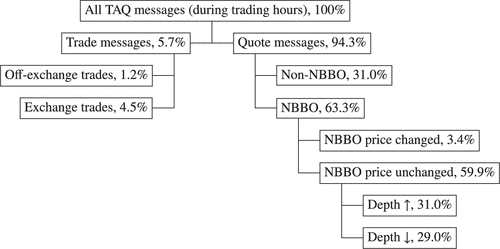
Notes. This figure decomposes the TAQ data set according to the types of messages. The sample is based on all the messages during trading hours (9:30 a.m. to 4:00 p.m. Eastern time) of 400 randomly selected stocks across all trading days in 2018. There are in total 25.39 billion such messages, which are then classified according to the respective labels. The percentages are computed as the total number of the respective message type divided by 25.39 billion. For example, there are, in total, 1.44 billion trade messages and, hence, .
Section 2 sets up the model. A number of liquidity suppliers simultaneously submit limit orders to a one-tick empty limit order book.2 These limit orders are then randomly queued. To study depth dynamics, the liquidity suppliers are allowed, with some probability, to observe their orders’ queue positions and to revise them. Finally, an investor arrives and endogenously chooses an optimal market order to trade against the randomly queued limit orders. The investor demands liquidity for two reasons: she needs to hedge an endowment shock and wants to speculate on a privately observed signal about the asset’s fundamentals.
Section 3 then solves the equilibrium. Section 3.1 derives how the investor combines their two trading motives into the optimal market order size, taking as given the order book depth. In particular, their hedging motive is the source of limit orders’ profit, whereas their speculation creates adverse selection that makes limit orders lose money. Section 3.2 shows that as the optimal market order becomes larger, the adverse selection component intensifies, and, consequently, front-of-queue limit orders expect higher profit than end-of-queue orders, which, in fact, lose money.
The literature has examined the order book equilibrium in similar settings (as surveyed by Parlour and Seppi 2008), and the equilibrium depth has been defined to be such that the end-of-queue marginal limit order breaks even. However, Section 3.3 highlights that this is no longer the case with queuing uncertainty, which instead makes the end-of-queue limit order always lose money. That is, the equilibrium depth always overshoots—beyond the marginally break-even level.
To see why, consider, first, a benchmark where the limit order queue is deterministic. In this case, knowing that their order will be first in queue, a liquidity supplier will occupy all profitable depth in the order book, as if they were a monopolist. That is, the last unit of their limit order must break even, and so, no further limit orders down the queue will be profitable. All other liquidity suppliers are crowded out by the first-in-queue monopolist, and there is effectively no competition.
Queuing uncertainty brings competition back to the game: all suppliers, whose orders might queue in the front probabilistically, will have incentive to compete for such front-of-queue profit. The increased competition pushes the equilibrium book depth to always exceed the monopolist (marginally break-even) level. In other words, the last unit of liquidity supply always “overshoots,” losing money in expectation. In fact, the severity of queuing uncertainty becomes a synonym of competition, bridging monopoly (no queuing uncertainty) with perfect competition (maximum queuing uncertainty).
Section 3.4 then turns to order book depth dynamics: if a liquidity supplier realizes that their submitted limit order is (likely) to be end of queue, she will have incentive to (partially) cancel it. This leads to a stylized pattern that the book depth initially overshoots but then quickly reverts. The short-lived overshooting recalls the phenomenon of “ghost” or “phantom” liquidity, which often has the negative connotation of being elusive, intangible, and possibly associated with the ill-purposed strategies such as quote stuffing. Instead, joining Baruch and Glosten (2013), this paper argues that at least some of such fleeting, short-lived liquidity is a natural equilibrium manifestation of liquidity suppliers’ competition.
The depth dynamics generate two additional empirical predictions. First, if liquidity suppliers turn more aggressive, exacerbating the overshooting, then there will be more cancellations. Among other factors, adverse selection is arguably a leading deterrent to liquidity suppliers’ aggressiveness. The model therefore predicts that limit orders’ cancellations (relative to submissions) should be negatively correlated with order flow toxicity.
Second, note that a faster liquidity supplier, knowing that their order is more likely to be at the top of the queue, will play more aggressively (i.e., submitting larger orders) than their slower competitors. In equilibrium, therefore, larger orders tend to be faster and more likely to concentrate in the front of the queue, with smaller ones slower and in the rear. Thus, cancellations (mostly at the rear of the queue) are bound to be smaller than additions (mostly at the front). Because of this mechanism, the model predicts that a smaller cancellation size relative to addition size is an indication of more faster liquidity suppliers (e.g., high-frequency market makers).
Section 4 examines how queuing uncertainty affects welfare in terms of total gains from trade. The analysis shows that liquidity overshoot—as a result of queuing uncertainty—whereas it initially improves welfare, might eventually hurt welfare; this happens because the investor in the model is the inefficient holder of the asset (because of their private costs, such as their inventory and/or risk aversion) compared with liquidity suppliers. And yet, the investor might speculate, based on their private information, to buy too much of the asset. A social planner disapproves, but the overshooting liquidity—because of queuing uncertainty—actually indulges, such inefficient overbuying.
This novel, nonmonotonic link between market liquidity and welfare sheds new light on market design issues. Notably, many protocols aiming at taking away speed advantages, such as speed bumps and latency floors, can have potential detrimental welfare effects: leveling everyone’s speed, they essentially increase limit orders’ queuing uncertainty, intensify competition, and, consequently, might induce too much inefficient speculative trading.
1.1. Contributions and Related Literature
The paper primarily contributes to the literature of limit order book models. The review below explains how the key friction, the equilibrium characterization, and the applications of the current paper relate to other works in this literature. The key model friction, queuing uncertainty, relates to the literature studying smart order routing in settings with fragmented trading venues, as in Foucault and Menkveld (2008). In these models, because of the random types of market orders, a limit order could be executed either in the front of the aggregate queue (against a local market order) or in the back (against a smart order). That is, the uncertain market order types can be a particular source of limit orders’ queuing uncertainty. This paper instead shows that queuing uncertainty can still emerge even without random types of market orders. Additionally, this paper adds novel empirical predictions about order book depth as well as welfare implications of liquidity overshooting.
More broadly speaking, the friction of queuing uncertainty relates to the “pick-off risk” that arises when news suddenly arrives and liquidity suppliers cannot timely cancel their stale limit orders; see, among many others, Menkveld and Zoican (2017), for example. In these models, there is queuing uncertainty between the cancellations of limit orders and the arrivals of (news-driven) market orders. Instead, this paper focuses on the queuing uncertainty among limit orders, with the possibly informed market orders arriving at the end. This paper thus extends the idea of imperfect timing of liquidity taking (pick-off risks) to also liquidity supply.
In terms of equilibrium characterization, the most relevant works are those with nontrivial depth. There are two different definitions of equilibrium depths in this literature. First, many authors require that the marginal depth break even in equilibrium, such as Seppi (1997) and Sandås (2001) (see the review in Parlour and Seppi 2008, section 2). Yet another definition is to require that liquidity suppliers earn zero profit altogether, as in Glosten (1994), for example. Under the former definition, liquidity suppliers together earn the monopolist profit, whereas under the latter, they perfectly compete to earn zero. This paper bridges these two polar cases with queuing uncertainty: with maximum queuing uncertainty, competition becomes so fierce and book depth overshoots so much that liquidity suppliers all earn zero, and without queuing uncertainty, the fastest liquidity supplier is effectively a monopolist, filling the depth until their marginal profit is zero.
In terms of the applications, the paper’s focus on book depth differentiates it from two large classes of limit order book models. First, the static equilibrium has also been characterized in an order book with continuous prices, as in Glosten (1989, 1994), Biais et al. (2000, 2013), and Back and Baruch (2013). Whereas price continuity helps characterize the shape of the equilibrium order book elegantly, it makes queuing uncertainty—the focus of this paper—difficult to conceptualize.3 Second, for tractability, it has become standard to restrict order sizes to be one unit, following Glosten and Milgrom (1985) and Easley and O’Hara (1987, 1992). The book depth then, uninterestingly, degenerates to a constant of one unit. In these two classes of models, instead of depth, the focal liquidity measures are price based, such as bid-ask spread and price impact. The model prediction that the overshooting liquidity is immediately canceled adds to the literature documenting and explaining so-called short-lived limit orders. For example, Hasbrouck and Saar (2009) find evidence consistent with traders use “fleeting orders” to chase price trends or search for latent liquidity. Egginton et al. (2016) document that the phenomenon of “quote stuffing” is pervasive in equity markets. Hasbrouck (2018) examines quote volatility at high frequency and argues that the patterns are more likely because of recurrent cycles of undercutting. Degryse et al. (2024) show that orders duplicated on competing exchanges are swiftly canceled as soon as one of the duplicates is executed. Dahlström et al. (2024) study the cancellations of limit orders in general. From the theory side, both Baruch and Glosten (2013) and Bhattacharya and Saar (2021) predict that short-lived quotes can arise naturally in equilibrium, and this paper joins such an innocuous view to explain short-lived limit orders but from the novel angle of their queuing uncertainty.
The literature focusing on order book depth remains limited. Kavajecz (1999) studies how specialists contribute to depths, focusing on adverse selection and inventory management. Kavajecz and Odders-White (2001) analyze a structural model of specialists’ price schedules in terms of both quotes and depths. Kavajecz and Odders-White (2004) show that various technical analyses predict depth patterns in order books. Over the decades, the market structure has changed drastically, with fragmented electronic limit order books taking over specialist markets. Providing a theoretical framework (and novel predictions) to examine the process of limit order submission, this paper hopes to stimulate new research to analyze book depth empirically, waking up the dormant lion’s share of the widely available data of equity trading (Figure 1).
2. Model Setup
2.1. Overview
The model concerns the trading in a stylized limit order book market. Figure 2 illustrates the timeline. A number of market makers first submit limit orders, which are randomly queued. Then, with some probability, the queuing uncertainty is resolved—all market makers observe the queue positions of their orders and can choose to revise them. After revisions, a liquidity-demanding investor arrives and submits a market order to trade against the standing limit orders. Payoffs then realize, and the game ends. The model belongs to the category of “static equilibrium models” as surveyed by Parlour and Seppi (2008). The new feature is the queuing uncertainty of limit orders.
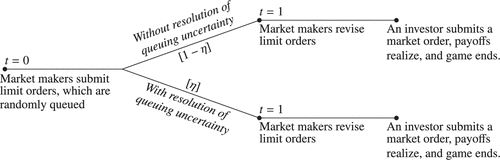
Notes. This figure illustrates the timing of the events. At , market makers submit new limit orders, which are then randomly queued. Queuing uncertainty is resolved only with probability . At , market makers can revise their limit orders. Finally, an investor arrives and submits a market order.
2.2. Asset
Each unit of the traded asset pays a random V units of the numéraire good after trading.
2.3. Limit Order Book
The limit order book has one tick, that is, only two prices, the best bid b and the best ask a, where and is initially empty. By symmetry, only the ask side will be analyzed.
2.4. Liquidity Supply
There are n risk-neutral limit order traders indexed by , where n is a positive integer. These agents are referred to as “market makers” because their limit orders provide liquidity, although in practice, they can be any traders who use limit orders. They arrive at , and each submits a limit order of size , asking at a, to maximize expected trading profit.
2.5. Queuing Uncertainty of Limit Orders
The n limit orders are randomly queued, and the realization is written as a vector of length n, where the i-th value indicates the queue position of the limit order by market maker i. For example, if , a queue realization means that market maker is the second in the queue, the third, and the first. (Ties are ruled out.) Ex ante, is a random vector whose distribution is known to all and is independent of market makers’ order sizes . Speed heterogeneity is allowed. For example, if , market maker is faster than if . Supplementary Appendix S.2 proposes a microfoundation to characterize the distribution of . By , the uncertainty of is resolved, meaning that the market makers observe the realization of , only with probability .
2.6. Order Revision
If one chooses to revise their order at , she can modify its size to . That is, she cannot revise the order size up, as in reality, platforms only allow limit order sizes to be revised down to prevent one from swelling their existing order to push back other orders. The revisions do not affect the orders’ queue (which is formed before ).
2.7. Liquidity Demand
A market order trader, called “the investor,” arrives at the end of . They is risk neutral but incurs quadratic inventory cost; that is, their after-trading payoff if holding x units of the asset is , where () measures the severity of the inventory cost. They privately observes a noisy signal . Their initial inventory is zero but suffers an endowment shock of U units of the asset. Neither S nor U is known to the market makers. Observing the order book depth, she chooses the market order size x to consume liquidity.
2.8. Distribution Assumptions
The fundamental sources of randomness in the model are (i) limit orders queuing , (ii) a Bernoulli draw of whether the queuing uncertainty is resolved by , and (iii) investor and asset characteristics V, , and U. They are assumed to be all independent of each other. In particular, are jointly normal with and respective variances .
2.9. Model Discussions
(
(
Note also that the queuing uncertainty only pertains to the n limit orders, with the market order always arriving last. This is an intentional modeling choice so as to be consistent and more comparable with existing static limit order book models. Blending limit and market orders with queuing uncertainty is similar to models featuring “pick-off risks” such as Menkveld and Zoican (2017). In these models, after sudden news, market orders rush to pick off stale limit orders, which are canceled in time only probabilistically: there is queuing uncertainty between market order arrival and limit order cancellation. This paper extends the idea of imperfect timing also to, and focuses on, liquidity supply. Importantly, there is no fundamental news in the current model, and hence, the equilibrium order revisions are driven only by the resolution of queuing uncertainty.
(
There are also practical reasons why queuing uncertainty might not be (timely) resolved. First, the market order might arrive too soon, before the market makers can parse the queue information and react accordingly.4 Second, even when there is sufficient time before the market order arrives, limit order traders do not always perfectly learn their queue positions: not all platforms disseminate queue positions (or not always timely), lacking sufficient historical latency data, the inferred queue position might not be reliable, and even one’s exact queue position is known within an exchange, its queue position across all exchanges is still uncertain. The parameter reflects how plausible it is to resolve queuing uncertainty.
(
(
3. Equilibrium
This section solves the model and derives empirical predictions. The equilibrium is analyzed backward by first deriving the investor’s optimal market order, then characterizing market makers’ limit order profitability, and, finally, examining the limit order submission and revision strategies.
3.1. The Investor’s Optimal Market Order
Arriving in period , the investor observes the depth y () at the ask price a. (For now, y is taken as given, though later in equilibrium, y will be endogenously determined as the sum of the limit order sizes, i.e., .) Conditional on their private information , she then chooses the market order size x (, to buy) to maximize their expected trading gain (after trade minus no trade):
For notation simplicity, define z as the investor’s pretrade marginal valuation for the asset; that is,
The Quadratic Optimization Problem (1) has a possibly cornered solution:
That is, the investor submits a market (buy) order only if their pretrade marginal valuation z is above the ask price a, and their order size is capped by the depth y if .
3.2. Limit Orders’ Profitability
Given the Optimal Market Order (3), how profitable are the limit orders? Let be the marginal profit of the y-th unit of limit order at the best ask a. Then, the profit of the first y units of limit order is . As such, for example, a first limit order of size three expects , and if another limit order of size 10 is appended behind, it expects .
The exact functional form of can be derived using (3). In particular, the y-th unit of the limit order is executed if and only if . Therefore, the expected marginal profit is
Figure 3(a) illustrates the marginal profit function , and several properties are worth highlighting. Notably, is initially positive but eventually negative, crossing zero once and only once at . That is, if the market makers’ limit orders form a queue, those at the front expect positive profit, whereas those at the rear expect losses. This is the “top-of-queue advantage” of limit orders: end-of-queue limit orders are (i) less likely to be executed, and (ii) conditional on being executed, they are more likely adversely selected by a more informed market order. Figure 3(b) plots the total profit . Consistent with (a), initially increases, peaks at , and then drops, eventually becoming negative. The following lemma characterizes these features formally.
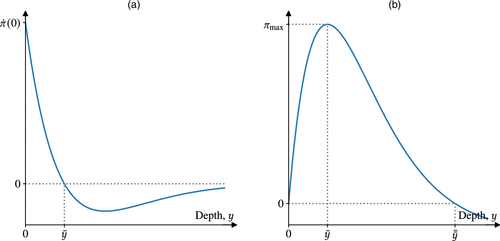
Notes. (a) and (b) plot, respectively, the marginal profit and the total profit of limit orders. The threshold is where the marginal profit , thus maximizing the total profit . The threshold is where . For this illustration, the parameters are set as , , , , and .
(
the marginal profit satisfies , crosses zero once and only once at , and is strictly decreasing on .
The total profit equals zero only at and at , is strictly positive when , peaks at , and is strictly negative when .
From their on, the analysis shall always assume that and . Three comments are in order. First, a sufficiently high ask price a () is required to ensure at least for some . Intuitively, if an ask price is too low, insufficient to compensate adverse selection, then no limit order will be posted there.5 In other words, with a more elaborate order book of multiple ticks, market makers will always find a sufficiently high ask price that is profitable enough to provide liquidity.
Second, a sufficiently large makes market makers’ adverse selection sufficiently severe, which is a commonly needed assumption for limit order book models (see, e.g., Back and Baruch 2013). Intuitively, a large means more precise hedging motive and, so, a more informed market order from the investor. Specifically, ensures the existence of the zero-profit depth, that is, , or equivalently, , so that the aggregate depth, that is, , is always bounded in equilibrium. The same can be achieved by assuming, instead, a sufficiently large .
Third, it is worth emphasizing that the above top-of-queue property is more general than the current specific setup. Supplementary Appendix S.3 demonstrates that the above features of and also naturally emerge in other commonly used microstructure frameworks. In fact, the results in Sections 3.3 and 3.4 only require the features of as characterized in Lemma 1. The specific microfoundation (the way the market order is endogenized) is useful for the welfare analysis in Section 4.
3.3. Without Resolution of Queuing Uncertainty
Consider first a benchmark without the resolution of queuing uncertainty, that is, setting . Because there is no new information about the random queue , market makers will not revise their orders in , even if they can do so. In this sense, in the upper branch of Figure 2, the event of “market makers revise limit orders” can be omitted.
3.3.1. Equilibrium Limit Order Sizes in .
Because there will be no revision in , it only remains to determine market makers’ optimal limit order size in . Consider market maker i, whose limit order’s queue position is written as . Then, the aggregate size of the orders that are queued before i’s order is
Given others’ order sizes (where ), she then chooses their own order size to maximize their expected profit, where the expectation is taken over the random queue :
A (pure-strategy) Nash equilibrium is a set that solves (6) for all .
(
Note that Lemma 2 gives an upper bound, , for each individual’s equilibrium limit order size. This is because of the top-of-queue advantage: no market maker will post more than units, for any depth beyond this marginally break-even point always loses, regardless of the queue realization.6
3.3.2. Liquidity Overshoot.
The equilibrium depth always satisfies the following property.
(
To shed some light, consider the following example, which gives an analytical solution.
(
3.3.2.1. Intuition: Queuing Uncertainty Softens Strategic Substitution.
A market maker i’s first-order condition implies as a function of the other market maker’s order size . How does affect ? By the implicit function theorem,
More importantly, the substitution rate is bounded by unity because of queuing uncertainty: market maker i “downplays” such a threat from j, as there is nonzero probability for j’s order to queue behind i’s, in which case the threat is ineffective—market maker i could not care less about those orders behind theirs. As a result, downplaying each other’s threats, the market makers engage in fierce competition, resulting in liquidity overshoot.
Instead, without queuing uncertainty, for example, when , market maker i will never downplay the threat from j’s because that competitor’s order is always first in queue, resulting in . That is, in this case, j’s order fully substitutes—or crowds out—i’s limit order. As a result, , , and depth —no more overshoot.
3.3.3. Enriching the Notion of Equilibrium Depth.
The above discussion alludes to a connection between queuing uncertainty and market makers’ competition: on the one hand, when there is no queuing uncertainty, for example, when , market maker j is effectively a monopolist—effectively no competition. On the other hand, when , which maximizes queuing uncertainty , the equilibrium depth is also maximized —maximum competition between i and j.
This competition view of queuing uncertainty bridges two different definitions of equilibrium order book depth in the literature:
Zero-profit equilibrium: Glosten (1994, p. 1139, proposition 2(iii)) defines the equilibrium depth to be “the solution to the zero-profit condition,” that is, in the current model.
Marginally break-even equilibrium: Seppi (1997, p. 112, definition 1) defines the equilibrium depth to be “such that the marginal expected profit [is zero],” that is, in the current model. Similarly, in Sandås (2001, p. 716), the equilibrium depth is such that “the quantity offered […] must be such that the last unit breaks even.”7
To see how, consider the following special case:
(
On one extreme, if , that is, without any queuing uncertainty, then this monopolist market maker always posts according to the First-Order Condition (7), which becomes , implying , the marginally break-even depth. That is, without queuing uncertainty, the equilibrium conforms with the definition in Seppi (1997) and Sandås (2001).
On the other hand, in the limit of , the First-Order Condition (7) becomes
In between, therefore, captures both the severity of queuing uncertainty and market makers’ competition. The current model thus bridges these two views via the notion of queuing uncertainty, enriching the equilibrium notion of limit order book depths.
3.4. With Resolution of Queuing Uncertainty
This subsection switches back on the possibility that queuing uncertainty might be resolved in (with probability ). In such a case, market makers will likely revise their limit orders:
(
Putatively, suppose the market makers have submitted the above orders in and then observed their queue positions in . Then, the second in queue will want to revise their order: the break-even depth is , and their contribution to the depth starts from and ends at . The latter half of this second-in-queue order, from to , loses money in expectation and therefore will be canceled.
However, the above is not an equilibrium because knowing such revision opportunity in , the two market makers would play more aggressively in . The rest of this subsection first solves the equilibrium backward from to and then examines model implications.
3.4.1. Equilibrium
3.4.1.1. The Optimal Revisions at .
If queuing uncertainty is not resolved, there is no revision. If resolved, a market maker i knows that there is units of depth queued before their own order, which is of size . Because all depth beyond lose money, she then revises their order according to
For convenience, the three scenarios will be referred to as the order i being “in the money” (), “at the money” (), and “out of the money” (), respectively.
For now, it is a conjecture (verified below in Proposition 2) that . Therefore, no market maker will submit new orders at . Neither can they revise up their existing order sizes (see Section 2.6). The only equilibrium actions in are the above cancellations by those whose orders are either ATM or OTM, and the after-revision book depth is always , breaking even on the margin. Note that such cancellations are only triggered by the resolution of queuing uncertainty. This differs from the order revisions driven by fundamental information, for example, in Budish et al. (2015), Dugast (2018), and Bhattacharya and Saar (2021).
3.4.1.2. The Optimal Order Sizes at .
Knowing their Optimal Revision Strategy (9) and taking all others’ initial order sizes as given, a market maker i chooses to solve
A pure-strategy Nash equilibrium exists, following the same Proof of Lemma 2 in the appendix.
3.4.1.3. Overshooting Is Exacerbated.
The revision opportunities push market makers to play even more aggressively at :
(
As in Proposition 1, the overshoot is strict if and only if there is no market maker who is always the first in queue. To see why the overshoot exacerbates, consider a market maker’s first-order condition, noting that :
Compared with the No-Resolution Benchmark (7), a new term of arises. It is strictly positive as long as i has nonzero probability of being ITM, thus offsetting some of the losses that would occur without resolution of queuing uncertainty. Larger means larger chances of offsetting losses, giving rise to more fierce competition and hence more severe overshoot.
(
3.4.2. Prediction 1: Depth Dynamics, Overshooting, Then Correction.
Proposition 2 predicts a very stylized pattern of order book depth dynamics: it overshoots and then quickly reverts. Figure 4 illustrates the pattern with equally fast market makers. They each submit the same at . Suppose only the first two fastest limit orders will be ITM, the third ATM, and the last two OTM. Then, at , there will be three modifications, one partial and two full cancellations. These events—five additions and three cancellations—are plotted sequentially.
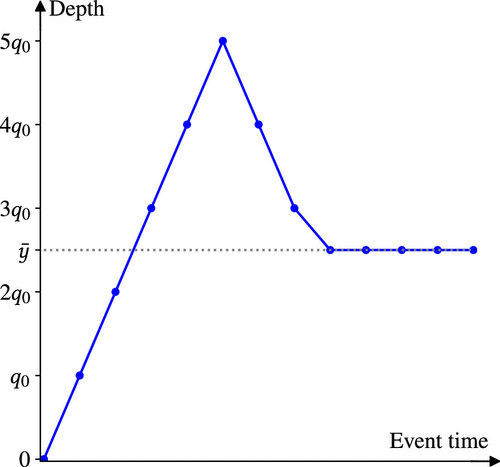
Notes. This figure illustrates the book depth dynamics, initial overshooting followed by immediate correction, with homogeneous market makers, each submitting at a limit order of size . These orders are then randomly queued and arrive sequentially. The resulting depth at the end of the queue, beyond the marginally break-even , is then canceled.
The pattern—clustered submissions followed by immediate cancellations—is similar in appearance to what is known as “ghost liquidity,” “fleeting orders,” and the ill-purposed “quote stuffing.” For example, in a sample of NASDAQ stocks traded in October 2004, Hasbrouck and Saar (2009) refer to those nonmarketable limit orders as “fleeting” if they are canceled within two seconds. Degryse et al. (2024) consider a limit order as a “ghost” if it is a duplicate of liquidity provision in other venues and is intended to be canceled as soon as any other duplicate is executed. Egginton et al. (2016) refer to quote stuffing as “a practice in which a large number of orders to buy or sell securities are placed and then canceled almost immediately.” Hasbrouck (2018) examines the flickering of bid-and-ask prices (but not depth) and studies short-run volatility.
This paper offers a rather innocuous explanation to such transient limit orders: they may be an equilibrium outcome because of queuing uncertainty. This innocuous view seems to echo Baruch and Glosten (2013) and Bhattacharya and Saar (2021), both arguing that “fleeting” limit orders are a natural equilibrium phenomenon. The mechanisms are, however, different. The agents coordinate to play a mixed-strategy stage game repeatedly in Baruch and Glosten (2013). The order book reshuffles upon arrivals of possibly informed orders in Bhattacharya and Saar (2021). Here, because of overshooting, cancellations spontaneously arise and concentrate only on the tails of newly formed limit order queues. A similar idea is seen in, for example, Menkveld and Zoican (2017) and Baldauf and Mollner (2022), where every limit order, except the first in queue, is immediately canceled. The current model enriches the depth dynamics by allowing endogenous limit order sizes and potential cancellations (). Importantly, the current model does not resort to news about asset fundamentals.
3.4.3. Prediction 2: Cancellation vs. Addition Message Counts.
The with-resolution extension speaks to the cancel-to-add count ratio of limit orders. How much of all the order book messages is about cancellation? What does the proportion of cancellations reflect, and what affects it? As shown in Figure 1, the answers to these questions relate to about 60% of the TAQ data, providing a more comprehensive understanding of order book messages.
3.4.3.1. The Equilibrium Cancel-to-Add Count Ratio.
Because depth always overshoots in equilibrium (Proposition 2, assuming ), there is always an ATM limit order. Denote this ATM order’s queue position by so that . At , this -th order is partially canceled, and all those behind it are canceled in full. Therefore, the total number of cancellations is , and the cancel-to-add count ratio is
In general, is random, depending on the queue realization, and the ratio above is therefore also random. Such randomness makes it difficult to characterize the above ratio.
To obtain useful insights, consider a large sector of homogeneous market makers who are equally fast; that is, every limit order is equally likely to be anywhere in the queue, as in Example 2. The homogeneity allows the analysis to focus on a symmetric-strategy equilibrium, where each market maker posts the same at . A “large sector” turns the attention to the limit of . This is to circumvent a technicality: there always is an ATM limit order straddling the break-even threshold . Its partial cancellation, as in (9), introduces an unfriendly “kink.” As , this single ATM limit order becomes inconsequential, thus simplifying the analysis.
(
The endogenous reflects market makers’ liquidity supply aggressiveness. To see why, note that by symmetry, the individual equilibrium order size can be written as . If the market makers were to coordinate, they could each submit an order of size to maximize their aggregate profit, or , not aggressive at all. However, in equilibrium, they compete to submit larger orders, resulting in higher aggressiveness .
Note that also measures the severity of liquidity overshooting. Indeed, the overshooting will be more excessive if the market makers are more aggressive. Unsurprisingly, the limit ratio given by the lemma is monotone in : if market makers post orders more aggressively, the more excessive liquidity overshooting will be followed by more cancellations.
3.4.3.2. Comparative Statics.
To generate testable predictions regarding the ratio, it is useful to ask what market conditions or asset characteristics might affect it, and how. That is, given a relevant empirical measure , what is the model prediction of ? The following proposition states the result.
(
Intuitively, the proposition says there are more limit order cancellations (relative to additions) if and only if the market-making sector becomes more profitable; that is, . Such higher profitability induces market makers to play more aggressively (higher ), and as a result, there is more overshooting and also more correction.
3.4.3.3. Adverse Selection as an Example.
More severe adverse selection should reduce market-making profitability , thus resulting in a lower cancel-to-add count ratio according to Proposition 3. Figure 5(a) graphically illustrates the model predictions. The (blue) solid line (left axis) shows that the equilibrium ratio indeed decreases as adverse selection—the investor’s private signal precision —increases (horizontal axis). The (red) dashed line (right axis) shows that although increases with , it remains negative throughout, ranging from to .
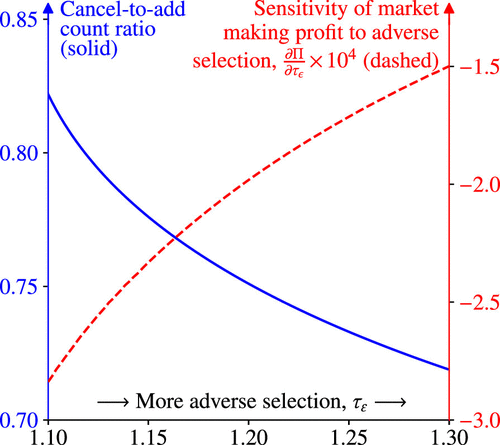
Notes. This figure illustrates how adverse selection, represented by the investor’s private signal precision (horizontal axis), affects the equilibrium ratio (the solid line, left axis). Also plotted is the partial derivative of (the dashed line, right axis). The other parameters are set at , , , , and .
3.4.4. Prediction 3: Cancellation Size vs. Addition Size.
One might also be interested in the size of limit order cancellations. Are they larger or smaller than the additions? What does the size difference imply? What market conditions drive the differences?
3.4.4.1. The Equilibrium Cancel-to-Add Size Ratio.
The submissions at result in an aggregate depth (before revision) of . Because there are n market makers, the average addition size is simply . Recall from Section 3.4.3 that the number of cancellations, partial or full, is , where is the queue position of the ATM order. The total depth canceled is , and the average per-cancellation size is . Therefore, the cancel-to-add size ratio —not to be confused with the lower case count ratio—is
As a quick check, consider the special case of a large sector of homogeneous market makers. As , the count ratio by Lemma 3 and, therefore, the size ratio . Indeed, as the homogeneous market makers all submit the same at , the cancellation size should also be except for the partial cancellation of the ATM order, which becomes inconsequential in a large market-making sector.
3.4.4.2. Speed Heterogeneity and the Cancel-to-Add Size Ratio.
In reality, however, not all market makers are identical. An important dimension, in the context of queuing uncertainty, is their speed. To reflect such differences and enrich the model predictions regarding ratio, consider two groups of market makers, “F” for fast and “S” for slow. Specifically, there are fast market makers and slow ones, where . Market makers within each group are homogeneous—equally fast—and have the same latency distribution. That is, a limit order submitted by the market maker i from group is processed by the exchange with latency , which is i.i.d. from the cumulative distribution function (c.d.f.) . For the labels of “F” and “S” to be meaningful, let first-order stochastically dominate . The stochastic dominance means that a fast market maker is strictly more likely to draw a lower latency than a slow one (see Supplementary Appendix S.2). Assume that both are everywhere differentiable so that there are almost surely no ties. Normalize the supports for both to be . This way, all limit orders submitted at will have been processed by , consistent with the timeline sketched in Figure 2. The analysis shall focus on symmetric strategies; that is, all market makers within the same group j submit limit orders of the same size at .
(
The intuition is as follows. Because of the top-of-queue advantage, the fast market makers will play more aggressively than the slow ones. That is, the faster limit orders are not only more likely to be at the top of the queue but also larger in size. Equivalently, the slow orders are smaller, concentrate in the rear of the queue, and, therefore, constitute the bulk of the cancellations. Therefore, the cancel-to-add size ratio is lower than one.
When there are more fast market makers (larger ), they compete more fiercely within group F, and every fast limit order becomes smaller. On the other hand, the fewer slow market makers compete less, and every slow order becomes larger. The size ratio of slow orders over fast ones then increases with . In other words, most of the canceled orders (the slow ones) become relatively larger.
3.4.4.3. Measuring Market-Making Activeness.
Proposition 4 suggests that the ratio could serve as a proxy for the “activeness” of the fast or high-frequency market makers. Figure 6 illustrates this prediction. As the fraction of fast market makers increases, the ratio monotonically increases (solid line, left axis), whereas the average limit order latency drops (dashed line, right axis).
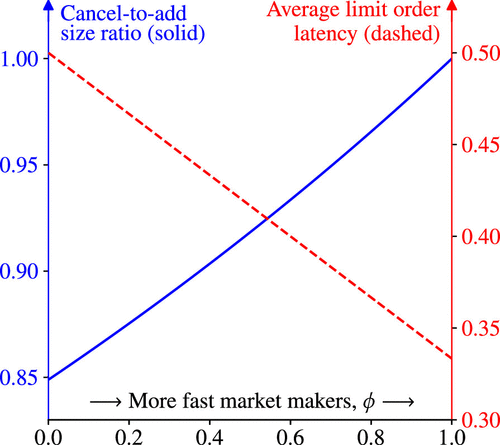
Notes. This figure illustrates Proposition 4 by varying the fraction of fast market makers on the horizontal axis. The left axis plots the equilibrium ratio (the solid line), whereas the right axis plots the average limit order latency (the dashed line). The other parameters used in this illustrations are , , , , , and . The latency distributions are and , where .
4. Welfare
Is the liquidity overshoot generated by queuing uncertainty socially good or bad? This section examines the model implications for welfare and discusses the related market design implications.
4.1. Welfare, Liquidity Supply, and Queuing Uncertainty
Welfare is the sum of (i) the investor’s expected trading gain, and (ii) the total expected profit of the n market makers. To derive (i), note that for any given depth y, the investor expects9
In equilibrium, the depth is either the endogenously submitted when, with probability , there is no resolution of queuing uncertainty, or the marginally break-even when, with probability , there is resolution. Therefore, welfare can be written as
Note that welfare w is written as a function of the endogenous no-resolution depth . This is because queuing uncertainty only affects —the more severe is queuing uncertainty, the larger is (as illustrated in Examples 1 and 2). Therefore, to explore the effect of queuing uncertainty on welfare, the analysis below simply varies () as if it is an exogenous variable.10
(
Proposition 5 notes that there might be times when too much liquidity—order book depth—hurts welfare ( locally). Figure 7(a) illustrates an example of such inefficient liquidity overshoot (when ). The discussion below explains this perhaps surprising result in two steps: the source of the potential welfare loss and how that relates to queuing uncertainty.
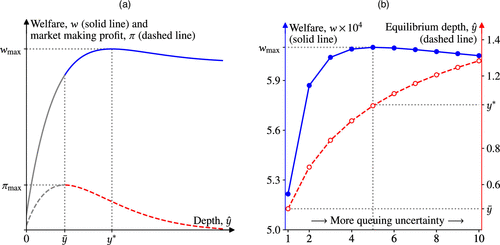
Notes. (a) The shape of welfare w (solid line) and the aggregate market-making profit (dashed line) as functions of the no-revision depth (which is varied by exogenously changing the severity of queuing uncertainty). (b) How, in equilibrium, the no-revision depth and welfare w respond to the amount of queuing uncertainty. For both panels, the parameters are set at , , , , , and . In (b), the severity of queuing uncertainty is captured by the number of equally fast market makers (as in Example 2).
4.1.1. How Welfare Loss Arises.
Only the investor’s private-value trading motive, which is to hedge against the inventory shock U, possibly creates welfare gain.11 If a social planner observes U and can prescribe the market order size x, she would minimize the investor’s inventory cost by setting , subject to (because the model focuses on the ask side). That is, the planner would like the investor to buy units only from the market makers.
But the investor has, in addition to hedging, another motive: to speculate on their private signal S. (Indeed, as shown in (2), the investor’s marginal valuation is .) As such, when they buys, the combined motive might push their to buy too much so that . This happens in particular when S is very large. The resulting inventory cost then turns into welfare loss.
4.1.2. The Role of Queuing Uncertainty.
For the investor to buy “too much,” the depth must be sufficiently large. This is where queuing uncertainty comes in: it encourages market makers’ competition and results in liquidity overshoot (Proposition 1). Figure 7(b) illustrates how more severe queuing uncertainty (larger n, as in Example 2) exacerbates liquidity overshoot (the dashed line, right axis) and possibly hurts welfare (the solid line, left axis).
In particular, note that Proposition 5 emphasizes that the welfare-maximizing depth is larger than market makers’ marginally break-even . Hence, for welfare losses to occur (), market makers must be losing money (), which must be because of severe adverse selection. This observation first echoes with the above discussion that the investor must be speculating on S when welfare losses occur. Second, it underscores why queuing uncertainty is necessary: when queuing is certain, that is, when for some i, the equilibrium depth is (Propositions 1 and 2), and welfare loss cannot arise at all in this case.
To sum up, the model reveals a novel detrimental effect of too much liquidity (depth), driven by queuing uncertainty: it creates liquidity overshoot, which, if severe enough, allows the investor to speculate too much. Such speculation-driven transfers can be inefficient from a social planner’s point of view.
4.2. Market Design Implications
Many real-world market designs affect queuing uncertainty—hence, also the equilibrium liquidity supply and welfare. Notably, various forms of “speed bumps” have emerged in recent years. Whereas the exact implementations differ, such “sand in the wheels” has been often viewed as deterrence against excessively fast trading (and the arms race behind; see, e.g., Baldauf and Mollner 2020, Brolley and Cimon 2020, Khapko and Zoican 2021). The novel welfare mechanism above sheds new light on such market designs.
4.2.1. Speed Bumps Targeting Limit Orders.
Not all speed bumps are the same. Consider first the effect of those targeting limit orders, directly affecting their queuing. For example, in foreign exchange markets, EBS implements a “latency floor” that randomizes the sequences of orders by different participants (CME Group 2023). The aim is to curb the ultrafast participants’ speed advantages, effectively increasing queuing uncertainty.
The current model cautions that such queue-randomizing speed bumps must be calibrated with great care. As seen from Example 1, the equilibrium depth increases with queuing uncertainty, but a deeper order book does not necessarily mean better welfare, as seen in Proposition 5. In particular, if the initial level of queuing uncertainty is already too high, that is, if the order book depth is already very large (), then queue randomization further increases and hurts welfare. Even if there is room for welfare improvement (if ), injecting too much queuing uncertainty can still hurt because the excessive liquidity overshoot might indulge too much risk taking by speculative traders. Figure 7(b) illustrates such scenarios: whereas the equilibrium depth (right axis) always increases, welfare (left axis) is hump-shaped, peaking at some modest amount of queuing uncertainty.
4.2.2. Speed Bumps Targeting Market Orders.
Many marketplaces impose speed bumps that only slow down market orders (see, e.g., Khapko and Zoican 2021, table 1). Such speed bumps effectively give more time to market makers to revise their orders—a higher . How is market quality, in particular, welfare affected?
The current model framework can shed light on this question. From (16), it can be seen that an increase in —a slowdown of market orders—therefore has two effects on welfare:
With a larger , market orders arrive more slowly, and there is more time to cancel the overshooting limit orders. The direct welfare effect reflects the reduction of depth from the overshooting to the monopolist level . Intuitively, this direct effect is negative because the minimum depth is as if supplied by a monopolist, constraining the possible gains from trade.
The indirect effect arises from how boosts the no-revision depth : (Proposition 2). Such a boost happens only with probability and improves welfare only if . However, for large enough, this indirect effect becomes negligible (as ). Then, the detrimental direct effect dominates.
(
The corollary cautions against such market-order speed bumps. The conventional wisdom suggests that with market orders slowing down, market makers face less adverse selection and will compete to narrow bid-ask spreads—improving liquidity. This has been a focal point of many empirical studies, such as Chen et al. (2017) and Hu (2019). Such a channel is switched off in the current model, as does not affect limit order profitability . Instead, complementing this liquidity-enhancing (spread-narrowing) view of speed bumps, Corollary 1 unveils a novel negative liquidity channel of depth reduction: they give more time to revise and cancel the overshooting limit orders. The current model, therefore, emphasizes the importance of empirically examining, and distinguishing, the different measures of liquidity (spread versus depth) when studying speed bumps.
5. Conclusion
This paper introduces queuing uncertainty to a standard limit order book model. When submitting limit orders, market makers face queuing uncertainty, which strengthens their competition and results in liquidity—book depth—overshoot in equilibrium.
The model enriches the understanding of order book depth dynamics. Specifically, the model predicts a stylized pattern: the book depth first shoots up and, after peaking, quickly lowers to the marginally break-even level. Further, the model predicts that the cancel-to-add count ratio and the size ratio relate to, respectively, the severity of adverse selection and the amount of high-frequency market-making activity. To this extent, this paper answers the call from O’Hara (2015) and pushes forward the understanding and utilization of modern microstructure data.
Further, the model shows that the overshooting liquidity might hurt welfare by allowing the liquidity demander to engage in excessive risky speculation. Queuing uncertainty thus underscores a novel channel through which limit order book depths affect welfare nonmonotonically. This novel angle sheds new light on market design issues such as speed bumps.
The author thanks the editor (Agostino Capponi), an associate editor, and two referees for their constructive feedback and comments. Additionally, this paper benefits tremendously from very helpful discussions with Shmuel Baruch, Hans Degryse, Jérôme Dugast, Thierry Foucault, Sergei Glebkin, Terrence Hendershott, Andrei Kirilenko, Roman Kozhan, John Kuong, Katya Malinova, Albert Menkveld, Sophie Moinas, Artem Neklyudov, Andreas Park, Christine Parlour, Barbara Rindi, Ioanid Roşu, Duane Seppi, Mark van Achter, Vincent van Kervel, Kumar Venkataraman, Chen Yao, Mao Ye, Haoxiang Zhu, and the seminar and conference participants at the University of Gothenburg, Rotterdam School of Management, Aalto University Business School, INSEAD, IHS Vienna, Paris-Dauphine, China Interenational Conference in Finance (Chengdu), Western Finance Association meeting (Monterey), Frontiers of Finance (Warwick), 17th SGF (Zürich), 11th Paris Finance Meeting, and 2013 NBER Market Microstructure Meeting. There are no competing financial interests that might be perceived to influence the analysis, the discussion, and/or the results of this article.
Appendix. Proofs
From (4), at , , where the last equality follows the mean of a truncated normal distribution. Hence, , where is the Mills ratio (or the reciprocal of the hazard rate). It is a known property that the product is monotone increasing in from zero to (e.g., Pinelis 2002, proposition 1.2). Therefore, there exists a unique threshold defined by (noting that )
Next, consider the existence and the uniqueness of that satisfies . Note that the integrand in drops below zero and stays strictly negative for sufficiently large z. Therefore, for sufficiently large y, . Because for , there exists at least one . To see the uniqueness, note that , where the inequality follows because in the range of integration, . This implies that . Note that . Hence, . That is, at any , is strictly concave, and therefore, crosses zero once and only once (from above).
Note from the above that . The above has established that, for all , . Hence, on this range, .
Finally, consider the limit of the total profit : . Recall that and , where . That is, is a function of and satisfies . That is, is monotone decreasing in . Also,
Therefore, there exists a unique that solves
This proof applies to the general case with . First, recall from Lemma 1 that there exists a unique such that ; that is, the -th marginal order breaks even. Second, no market maker will submit a limit order larger than because the part exceeding always loses in expectation ( for all ). This confines each market maker’s strategy space to . Therefore, all best response correspondences can be summarized as a vector-valued function , which is nonempty and compact. The convexity of the value set follows the differentiability of . Then, by Kakutani’s fixed-point theorem, there exists at least one fixed point that solves all market makers’ optimization problems.
Now, consider the First-Order Condition (7). In equilibrium, its left-hand side, which is the first-order derivative of market maker i, must be nonpositive. If it were strictly negative for all i, then for all i, which cannot be the case in equilibrium because following Lemma 1. □
The proof proceeds in three steps: (1) to prove that always holds in equilibrium; (2) to prove that if the inequality is strict, then no market maker can be almost surely first in queue; and (3) to prove that if no market maker is almost surely first in queue, then the inequality is strict.
To prove : Suppose the opposite holds; that is, . Recall from Lemma 1 that for all , and is strictly decreasing on . Note that for any queue realization , . Therefore, for any realized , and so, any market maker i’s first-order derivative . They can therefore always improve their expected profit by raising , making it no longer an equilibrium. Thus, the opposite must be true; that is, , and .
To prove for all i: If any market maker i is almost surely first in queue, that is, if for i, their first-order derivative becomes , and Lemma 1 ensures that they always chooses . Knowing this, all other market makers choose for . This leads to , contradicting . Therefore, given that , there can be no for any i, or equivalently, for all i.
To prove the other direction for all i : Note that given , no market maker will post . If i did so, their first-order condition would hold only if all others post . But that cannot be true because if it were true, for any , their first-order derivative would be
Then, let us assume that, opposite to the statement, . That is, for any queue realization , , and hence, . Note that there must exist at least one market maker i for whom , and their first-order derivative
The First-Order Condition (10) implies that , where the inequality holds because of the conditioning on . Therefore, by the implicit function theorem,
Under symmetry, the unique break-even queue position is defined by . Equivalently, scaling the inequality by ,
Note that both the upper and the lower bounds of above converge to as . Therefore, the Ratio (11) also converges to . □
The proof proceeds in three steps. The first is to derive an explicit expression of . Note that the expected profit for a market maker i is . Adding this up for all yields
The second step is to show that it is a necessary equilibrium outcome that when . From the Proof of Lemma 3, , where is the break-even queue position such that . Every market maker has the same ITM probability of . Then, in the limit of , the First-Order Condition (10) becomes
Finally, note that by fixing , any exogenous parameter , other than , affects via either or ; that is, can be written as a function of . If is , then . Because , by implicit function theorem, . Note that because of the top-of-queue advantage (Lemma 1). Noting that the ratio increases in ; therefore, . □
After all n market makers submit limit orders at by time , the fraction of these n orders that have been processed is, by the law of large numbers,
Define as the “intensity” of the group j’s limit order size.12 Then, in the limit, the total depth that will have been processed by time t is
(For now, it is a conjecture that exists in the limit for both , and it is verified below.) Clearly, is monotone increasing in , with , and by Proposition 2, . Therefore, there exists a unique such that . That is, is the latency threshold below which a limit order is ITM. A group j market maker i’s probability of being ITM is .
Suppose a market maker i is from group j, and their order arrives at . Following the definition of above, the book depth at that time, including their order, converges to
Depending on whether , an equilibrium must be of one of the following three cases: (a) but , (b) but , or (c) . The other cases cannot be an equilibrium: if , a group j market maker will always want to increase their order size intensity , and if both and , then the equilibrium depth , contradicting (Lemma 1). If , it is a cornered equilibrium with , but this does not mean that the group j investors do not submit limit orders. Instead, they submit negligibly small orders in the limit of (and cancel them if OTM).
In any of the three cases, the following property holds: scale (A.4-j) with the respective aggregate depth from group j, that is, for F and for S, and sum them up to get
The equilibrium can then be determined: Define , which is monotone increasing in t from to . The break-even latency is then uniquely determined by , or .
Following (13), . In equilibrium, is the fraction of orders that arrive after , that is, because, following the stochastic dominance, . Note that , and so, is effectively a weighted average between and , and hence, and . Therefore, . That is, in any of the cases, , and hence, .
Next, consider the cases separately to examine the effect of on .
Case (a) and (b): These two cases can be combined as and , and therefore, and . Then, , and hence, . Neither or is affected by . Therefore, because of the stochastic dominance, and so, a higher increases .
Case (c): In this case, the two are endogenously determined by the two first-order conditions of . Consider either , which involves (using ). Therefore, by implicit function theorem,
The above then implies that the product is unaffected by : , and .
Recall that , or equivalently, , which implies
That is, the break-even time is not affected either. Then, finally, Hence, a higher also increases in this case. □
Note from (16) that the equilibrium depth only affects the case of no-revision, that is, the first expectation. Because this proposition is about the shape of , therefore, setting does not change . Fix a depth level of . Direct computation yields , which is positive because in the integrand. Therefore, for all , . Recall that for all . Then, ; that is, is strictly increasing initially on . In particular, the that maximizes must satisfy because .
To show that eventually decreases, directly compute to get
Consider the direct effect first. Directly evaluate the difference where the inequality follows because in the inner definite integral, and the last equality uses the expression of derived in the Proof of Lemma 1, with denoting the Mills ratio. Integrating by parts, because for and because is monotone decreasing. Therefore, .
Next, consider the indirect effect, . Recall from Proposition 2 that . If , then as seen in Figure 7(a), and the indirect effect is negative. Consider the case of . In this range, as , the indirect effect converges to zero if and are both bounded, which is indeed the case: direct evaluation yields , which is clearly finite, because the upper tail expectation of a normally distributed z is finite. Also, is bounded because . By continuity, there exists an such that for all , . □
1 Almost all exchanges adopt the time priority rule, under which limit orders of the same limit price are matched with market(able) orders on a first-in-first-out basis.
2 Whereas in the model, limit orders are posted simultaneously, it should be emphasized that these liquidity suppliers are not required to move simultaneously in reality. Rather, they only need to move within a relatively tight time interval, unable to observe each other’s decision. The simultaneity is a means of modeling queuing uncertainty.
3 When the liquidity supply is a continuous and smooth function of price, any two (nonzero measure) limit orders must differ in their limit prices, for otherwise, the supply would not be smooth. Then, the time priority is no longer meaningful, and neither is queuing uncertainty, as the orders’ execution sequence is only determined by price priority.
4 Indeed, the arrival time of market order is unpredictable: investors make trading decisions at unpredictable times (e.g., a trader might be taking a coffee break), market orders’ transmission latencies are random, (re)routing across venues can take an uncertain amount of time, speed bumps slow trading randomly, etc.
5 The threshold is, in fact, the lowest ask price at which competitive market makers will post limit orders. Its Definition (A.1) coincides with the one under the normal distribution example of Glosten (1994). As such, is a standard assumption inherent from the literature to ensure nonempty limit order books.
6 Lemma 2 only establishes the existence of the equilibrium. In general, multiple equilibria are possible, as are common in quantity competition games (see, e.g., Tirole 1988, chapter 5).
7 Whereas this paper focuses on discrete-price limit order books, the distinction between the two definitions does not rely on price discreteness. Even when prices are continuous, the difference is still meaningful, as can be most clearly seen by comparing the continuous-price part of Glosten (1994), which is a zero-profit equilibrium, with the monopolist specialist part of Glosten (1989), which is a marginally break-even equilibrium. The resulting shapes of the equilibrium order books are clearly different, despite that prices are continuous in both cases.
8 Quantifying the severity of queuing uncertainty in general requires a huge number of parameters: the random queue has n! possible realizations, and hence, parameters are needed to fully characterize its distribution. The homogeneity of market makers simplifies this quantification by naturally directing the attention to the symmetric-strategy equilibrium so that a single parameter n suffices.
9 The welfare analysis is isomorphic if instead the investor has mean-variance utility or constant absolute risk aversion (CARA) utility. The advantage of adopting quadratic utility is that it gives clear decomposition of the gains from trade, thus making the intuition transparent.
10 More formally, denote the degree of queuing uncertainty by , which can be the in Example 1 or the n in Example 2. Then, , where is monotone increasing in . As such, for the purpose of examining welfare, varying is equivalent to varying .
11 To see this, consider the limit case of ; that is, the investor has only the speculative trading motive. Then, welfare indeed reduces to zero. For example, consider the first expectation in Expression (16), which reduces to . Note from (3) that as , . Therefore, , where the last equality holds by iterated expectations. Recall that , where as . Therefore, the above expectation is indeed zero, and the same holds for the second expectation, yielding .
12 More generally, one can define a measure for the power set of the n market makers, where each market maker i has the same measure of . This way, the measure of the fast group is , and the slow is . Then, a market maker i’s intensity is essentially their order size relative to their measure . This construct will be convenient in analyzing the limit of . For example, consider the aggregate depth, which is , where if i is in group j. In the limit of , it has an intuitive integral equivalent of .
References
- (2015) Time pro-rata matching: Evidence of a change in LIFFE STIR futures. J. Futures Markets 35(6):522–541.Crossref, Google Scholar
- (2013) Strategic liquidity provision in limit order markets. Econometrica 81(1):363–392.Crossref, Google Scholar
- (2020) High-frequency trading and market performance. J. Finance 75(3):1495–1526.Crossref, Google Scholar
- (2022) Fast traders make a quick buck: The role of speed in liquidity provision. J. Financial Markets 58:100621.Crossref, Google Scholar
- (2013) Fleeting orders. Working paper, Carlson School of Management, Minneapolis.Google Scholar
- (2021) Limit order markets under asymmetric information. Working paper, Cornell SC Johnson College of Business, Ithaca, NY.Google Scholar
- (1995) An empirical analysis of the limit order book and the order flow in the Paris bourse. J. Finance 50(5):1655–1689.Crossref, Google Scholar
- (2000) Competing mechanisms in a common value environment. Econometrica 68(4):799–837.Crossref, Google Scholar
- (2013) Corrigendum to “competing mechanisms in a common value environment”. Econometrica 81(1):393–406.Crossref, Google Scholar
- (2020) Order flow segmentation, liquidity and price discovery: The role of latency delays. J. Financial Quant. Anal. 55(8):2555–2587.Crossref, Google Scholar
- (2015) The high-frequency trading arms race: Frequent batch auctions as a market design response. Quart. J. Econom. 14(3):1547–1621.Crossref, Google Scholar
- (2015) Sub-penny and queue-jumping. Working paper, Bocconi University, Milan.Google Scholar
- (2017) The value of a millisecond: Harnessing information in fast, fragmented markets. Preprint, submitted October 28, https://doi.org/10.2139/ssrn.2860359.Google Scholar
CME Group (2023) EBS dealing rules—Appendix. Technical report, CME Group, Chicago, https://www.cmegroup.com/trading/market-tech-and-data-services/files/ebs-dealing-rules-ebs-mar ket-appendix-effective-20230811.pdf.Google Scholar- (2012) Trading fees and efficiency in limit order markets. Rev. Financial Stud. 25(11):3389–3421.Crossref, Google Scholar
- (2024) The determinants of limit order cancellations. Financial Rev. 59(1):181–201.Crossref, Google Scholar
- (2022) Priority rules. Preprint, submitted May 29, https://doi.org/10.2139/ssrn.3186009.Google Scholar
- (2024) Duplicated orders, swift cancellations, and fast market making in fragmented markets. Preprint, submitted April 10, https://doi.org/10.2139/ssrn.3356695.Google Scholar
- (2014) How slow is the NBBO? A comparison with direct exchange feeds. Financial Rev. 49(2):313–332.Crossref, Google Scholar
- (2018) Unscheduled news and market dynamics. J. Finance 73(6):2537–2586.Crossref, Google Scholar
- (1987) Price, trade size, and information in securities markets. J. Financial Econom. 19(1):69–90.Crossref, Google Scholar
- (1992) Time and the process of security price adjustment. J. Finance 47(2):576–605.Crossref, Google Scholar
- (2016) Quote stuffing. Financial Management 45(3):583–608.Crossref, Google Scholar
- (2008) Competition for order flow and smart order routing systems. J. Finance 63(1):119–158.Crossref, Google Scholar
- (1989) Insider trading, liquidity, and the role of the monopolist specialist. J. Bus. 62(2):211–235.Crossref, Google Scholar
- (1994) Is the electronic limit order book inevitable? J. Finance 49(4):1127–1161.Crossref, Google Scholar
- (1985) Bid, ask, and transaction prices in a specialist market with heterogeneously informed agents. J. Financial Econom. 42(1):71–100.Crossref, Google Scholar
- (2018) High frequency quoting: Short-term volatility in bids and offers. J. Financial Quant. Anal. 53(2):613–641.Crossref, Google Scholar
- (2009) Technology and liquidity provision: The blurring of traditional definitions. J. Financial Markets 12(2):143–172.Crossref, Google Scholar
- (2013) Low-latency trading. J. Financial Markets 16(4):646–679.Crossref, Google Scholar
- (2019) Intentional access delays, market quality, and price discovery: Evidence from IEX becoming an exchange. Preprint, submitted June 27, https://doi.org/10.2139/ssrn.3195001.Google Scholar
- (1999) A specialist’s quoted depth as a strategic choice variable. J. Finance 54(2):747–771.Crossref, Google Scholar
- (2001) An examination of changes in specialists’ posted price schedules. Rev. Financial Stud. 14(3):681–704.Crossref, Google Scholar
- (2004) Technical analysis and liquidity provision. Rev. Financial Stud. 17(4):1043–1071.Crossref, Google Scholar
- (2021) Do speed bumps curb low-latency investments? Evidence from a laboratory market. J. Financial Markets 55:100601.Crossref, Google Scholar
- (2023) Discrete prices, discrete quantities, and the optimal price of a stock. Preprint, submitted March 8, https://doi.org/10.2139/ssrn.3763516.Google Scholar
- (2017) Need for speed? Exchange latency and market quality. Rev. Financial Stud. 30(4):1188–1228.Crossref, Google Scholar
- (2015) High frequency market microstructure. J. Financial Econom. 116(2):257–270.Crossref, Google Scholar
- (2008)
Limit order markets: A survey . Boot AWA, Thakor AV, eds. Handbook of Financial Intermediation and Banking (Elsevier Publishing, Amsterdam) 63–96.Crossref, Google Scholar - (2002) Monotonicity properties of the relative error of a Padé approximation for Mills’ ratio. J. Inequalities Pure Appl. Math. 3(2):1–8.Google Scholar
- (2021) Optimal market access pricing. Working paper, Bocconi University, Milan.Google Scholar
- (2001) Adverse selection and competitive market making: Empirical evidence from a limit order market. Rev. Financial Stud. 14(3):705–734.Crossref, Google Scholar
- (1997) Liquidity provision with limit orders and a strategic specialist. Rev. Financial Stud. 10(1):103–150.Crossref, Google Scholar
- (1988) The Theory of Industrial Organization (MIT Press, Cambridge, MA).Google Scholar
- (2018) Why trading speed matters: A tale of queue rationing under price controls. Rev. Financial Stud. 31(6):2158–2183.Crossref, Google Scholar