Click First or Last? Strategic Order Submission During the Euronext Preopening Session
Abstract
We examine traders’ order submission strategies during the Euronext preopen, which uses price-time priorities to arrange opening trades via a call auction. Preopening order submissions follow a J-shape pattern. Sophisticated proprietary traders arrive late, consistent with information leakage concerns. Slow clients arrive early and place aggressive orders to advertise their trading needs and strategically gain time priority. Their early order submissions often occur in stocks with an increase in the tick size and on days with expected liquidity shocks. They also contribute to daily price discovery. Using a preopening outage as a natural experiment, we show that the Euronext preopen improves price discovery on a rival venue. These benefits hold even in the absence of an opening auction taking place.
This paper was accepted by Lin William Cong, finance.
Funding: Financial support from the Agence Nationale de la Recherche [Grants ANR-16-CE26-0008, ANR-17-EURE-0010 (Investissements d’Avenir program)].
Supplemental Material: The online appendix and data files are available at https://doi.org/10.1287/mnsc.2023.03998.
1. Introduction
Several exchanges open with a call auction preceded by a preopening period. The preopen is characterized by the accumulation of orders and the absence of trade execution. Its aim is to reduce price uncertainty and absorb price pressure accumulated during the market closing hours. Throughout the preopen of Euronext Paris (previously the Paris Bourse), traders can place tentative orders at no cost and observe the resulting indicative clearing price and trade volume even though no actual trades are executed. At the end of this period, no new orders are accepted, the limit order book is frozen momentarily, and the opening call auction takes place. In a seminal paper, Biais et al. (1999) show that traders participate actively in the last minutes of this preopening tâtonnement process, making price discovery easier and opening prices efficient. A few years after their study, the Paris Bourse changed its call auction matching procedure, moving from a prorata to a time priority allocation rule, which has prevailed since then. Our paper examines traders’ incentives to participate in the Euronext preopen, which ultimately determines their strategies and the characteristics of the preopening price discovery process.
The time of arrival as a secondary precedence rule—to allocate shares at the clearing opening price when supply is not equal to demand—is used by most developed markets, such as the NASDAQ or CBOE Equities in the United States, the Australian Securities Exchange in Australia, or any large European exchanges (such as Deutsche Börse, the London Stock Exchange, or Nasdaq OMX).1 On the one hand, time priority rewards the earliest orders by giving them a higher priority. On the other hand, submitting early orders during a nontrading phase implies a risk of information leakage, which is particularly relevant in the context of Euronext’s transparent preopening mechanism. The extent to which this feature affects incentives for traders to participate in the preopen and how they contribute to price discovery is an important empirical question.
To better understand the performance of the preopen and the role of time priority during a call auction, our empirical strategy consists of contrasting different groups of traders and testing specific hypotheses about their trading behavior. The background null hypothesis posits that members place orders nonstrategically or randomly, and hence, we should not expect any clustering of orders. In contrast, our two alternative hypotheses, not mutually exclusive, suggest various possible strategic trading behaviors. First, the sunshine trading hypothesis posits that traders who might incur significant penalties for nonexecution submit orders as soon as the preopen starts (i.e., the early phase). Their aim is to announce their trading needs and maximize the probability of orders being filled. Second, under the information leakage concerns hypothesis, we posit that informed traders send orders in the last minutes, right before the opening call auction, to strategically conceal their orders and minimize the cost of information revelation. Because the strategic arrival of informed traders should influence the dynamics of price discovery, we investigate the impact of early versus late submission strategies on the informational content of prices. Additionally, we also explore events that alter the composition of traders (e.g., changes in information flow, shifts in liquidity, or external disruptions) and, thus, the quality of price discovery.
Our data source is the EUROFIDAI-BEDOFIH database, from which we obtain detailed information on messages and member characteristics related to French SBF120 index constituents from May 2, 2012, to December 31, 2013.2 Besides snapshots of the limit order book observed every 15 minutes during the preopen, the data offers two crucial features. First, it contains all messages submitted during the preopen, that is, new orders, modifications, and cancellations. Second, although the data does not contain individual identifiers of members, it includes two flags that together allow the identification of member-types. The first flag, provided by the French Market Authorities (AMF), distinguishes members according to their trading speed (fast, slow, or mixed traders using both strategies). The second flag indicates the account type, including broker orders executed for clients, proprietary trading orders, and orders sent by designated liquidity suppliers. Combining these two flags enables us to obtain 12 member-types.
These member-types are allocated to one of three categories on the basis of the following criteria: whether members trade on a proprietary or agency basis, the degree of sophistication proxied by daily trading profit and trading speed, and the degree of position building shown by the end-of-day inventory. The resulting three categories are sophisticated proprietary traders (SP), who are skillful and fast, typically ending the day with a low inventory position; slow clients (SC), consisting of unprofitable, less sophisticated, and more impatient members sending orders on behalf of clients; and other agency (OA) traders comprising slow or fast members that cannot be allocated to either of the first two categories.
We find that preopening order placement activity follows a J-shape pattern with a first peak in the first minutes and the highest peak in the last minutes. Many of these orders are aggressive and executed at the open. This pattern of message clustering suggests that members behave strategically during the preopen. Moreover, we observe that slow clients are the sole group placing many orders during the first minutes of the preopen. This behavior is particularly strong for stocks that experience an increase in the tick size and on days with expected liquidity shocks, that is, when gaining time priority has more value and in line with the sunshine trading hypothesis. We also find that sophisticated proprietary traders arrive later and place more late orders on days of earnings announcements, consistent with traders strategically controlling information leakage.
We then relate measures of price informativeness to the aggregate behavior of member categories. First, using unbiasedness regressions, we find that, although the last preopening prices contribute most to price discovery, very early tentative prices are also statistically informative, unlike Biais et al. (1999). Second, to analyze which member category contributes to price formation, we regress the close-to-close return on order imbalances generated by each category.3 Early order imbalances from the slow clients category contribute significantly and positively to price discovery in the first minutes of the preopen. This implies that these early orders, submitted to advertise trading needs, contain information. Consistent with information leakage concerns, we find that late order imbalances from the sophisticated proprietary traders category are strongly associated with the price discovery. This pattern also holds for late orders of slow clients. These results suggest that the slow clients category, for which we cannot be more granular because of data limitations, is heterogeneous, encompassing orders from retail clients and also from institutional clients.4
As robustness tests, we use two quasi-experiments involving delayed openings on Euronext. We examine shifts in the behavior of market participants during these episodes and assess how these shifts affect price discovery on Euronext and Chi-X, a competing trading venue. The first episode involves an outage that disrupted the usual Euronext preopen. On June 6, 2013, a glitch in the Euronext computer systems delayed the preopen, preventing order submission at the usual time. The session resumed at 9:21 a.m. with the opening call occurring at 10:00 a.m. Meanwhile, Chi-X, a competitor venue, was open. We find that all member categories adjusted their behavior. Sophisticated traders migrated to Chi-X, whereas slow clients and other agency traders stayed on Euronext, likely bound by the best execution duty of the primary best bid and offer. On that day, slow clients and other agency traders made a larger contribution to price discovery. We also find that stocks trading on Chi-X before the Euronext open showed impaired price efficiency, highlighting the value of the preopen. The second experiment involves stock days in which the preopen took place but the open was delayed because of an insufficient volume of orders. These cases occur in thinly traded stocks. We show that the order activity is significantly reduced, but there is no significant inefficiency on Chi-X, confirming the importance of Euronext preopening sessions.
Finally, we investigate the possibility of interactions between categories, such as concealing strategies. Informed traders or investors with large orders might be willing to hide orders among less sophisticated slow clients. Although we find evidence of order clustering, we do not detect indications of order concealing. Instead, we obtain results consistent with some sophisticated traders following late contrarian strategies for absorbing early order imbalances from slow clients.
Our research adds to the literature examining strategic behaviors during pretrading periods. Biais et al. (1999) for the Paris Bourse, Davies (2003) for the Toronto Stock Exchange, or Comerton-Forde and Rydge (2006) for the Australian Stock Exchange focus on the late phase of the preopen and show that the speed of learning and price discovery accelerate when the opening of the market is imminent. Bellia et al. (2024) study the preopening behavior of high-frequency traders (HFTs) on the Tokyo Stock Exchange. These papers, as ours, address limit order book markets.5 Our paper examines the entire preopening period and the trading behaviors of differently informed trader categories strategically choosing the timing of order submissions. One of the new findings of our paper is that some impatient traders submit early orders to advertise their needs for trading and gain time priority, and their aggregate order flow contributes to price discovery. Using the same data set as ours, Anagnostidis et al. (2020) examine the price impact of HFTs in the last 30 minutes of the preopen, whereas Bellia et al. (2020) focus on the HFT-related behavior and outcomes such as speed, profits, or liquidity provision. In contrast, we use a more comprehensive classification that includes several types of traders, including HFTs, and compare their aggregate strategic behaviors during the entire preopening period. Moreover, we use a preopening outage as a natural experiment to provide evidence of the value of a transparent preopen for all venues, even without an opening call auction.
The paper is organized as follows. Section 2 describes the trading environment and presents our testable hypotheses. Section 3 describes the data, the sample selection, our classification of market participants, and provides summary statistics. In Section 4, we analyze the dynamics of preopening messages, test our hypotheses on member preopening strategies, and relate price discovery to the behavior of member categories. Section 5 is dedicated to robustness tests. Section 6 concludes.
2. The Trading Environment and Hypothesis Development
2.1. Overview of European Markets
Euronext Paris is one of the founding primary markets of Euronext, the largest stock exchange in Europe. The French exchange operates continuously as a pure anonymous electronic limit order book market from 9:00 a.m. to 5:30 p.m. Central European Time (CET) for securities that are liquid enough. In Europe, the Market in Financial Instruments Directive (MiFID I) regulation, implemented in 2007, enabled the entry of new trading platforms challenging the market share of major incumbent stock exchanges. Chi-X, a UK company established in 2007 by Instinet, is Euronext’s main competitor during our study period. Chi-X is a lit venue operating continuously on the same schedule as Euronext [from 9:00 a.m. until 5:30 p.m.]. Even if it operates a continuous limit order book, Euronext and Chi-X differ in some characteristics. First, during the period of our study, Euronext is the only venue starting with a preopening period and a call auction to open the market of continuously traded French stocks (see Section 2.2 for more details). Chi-X has no special opening facility. Second, Chi-X offers lower fees and ultralow latency, targeting particularly fast traders. Third, Chi-X allows submission of orders pegged to the primary best bid and offer (here, Euronext) to guarantee attractive prices to all investors.6 Unlike the U.S. markets, neither a consolidated tape of prices nor a no-trade-through rule exists in Europe. Prices formed on a primary market such as Euronext Paris are essential to price discovery and provide a benchmark for trade execution.7
2.2. Preopening Period and Opening Call Auction on Euronext
The Euronext preopening session operates from 7:15 a.m. to 9:00 a.m. Market participants can submit market, limit, stop, hidden, or market-on-opening orders during this time. Orders are automatically recorded in the limit order book without triggering any trade. An indicative opening price and the components of the potentially executable volume at that price, triggered each time a new order arrives, are continuously disseminated. In addition, the limit order book is fully transparent from the start of the preopening period at 7:15 a.m.
At 9:00 a.m., the opening price is set by crossing the cumulative supply and demand functions based on the orders in the book to maximize the largest possible executable volume of trades. Additionally, if necessary, the reference price (most often the previous day’s closing price) is considered when establishing the auction price. Market orders, buy orders with a price limit above the opening price, and sell orders with a limit below the opening price are filled. In case of an imbalance between supply and demand, time priority plays a tie-breaking role, and orders at the clearing price are filled on a first-come, first-served basis.8 Any unexecuted orders are carried through to the continuous limit order book.
2.3. Why Submit Orders During the Preopening Session?
The preopening period is a very specific session. No trades can occur, and orders are not binding because they can be canceled at no cost and at any time during this session. Nevertheless, even without trading, price discovery can occur through quote changes, that is, through the submission of serious limit orders by market participants (see, for instance, Biais et al. 1999, Brogaard et al. 2019, Gregoire and Martineau 2022). Moreover, most corporate news events, such as earnings announcements, are released during off-hours. What are the possible theoretical motivations that drive order submission during the preopening session?
Under the null hypothesis, market participants behave nonstrategically and submit orders randomly during the preopen. Testing for order clustering provides a straightforward way to rule out this possibility because evidence of order concentration suggests that some traders intentionally attempt to time their preopening orders. We propose two alternative hypotheses to explain strategic behavior during the preopening phase. It is important to note that the following hypotheses are not mutually exclusive and do not encompass all possible scenarios.
One possibility is that traders participate in the preopening phase with the strategic intent to execute their orders, particularly to capture the benefits of the opening call auction in terms of limiting price impact (e.g., Stoll 1985). These traders face a trade-off. On the one hand, they might be willing to submit very early orders to gain or retain time priority and, in turn, have more chances to be executed (whether at the opening call auction or thanks to a better position in the queue of orders at a given price). Queue position matters and leads to earlier execution and higher fill rates. On the other hand, submitting an order during the nontrading phase reveals private information (whether fundamental or nonfundamental) and exposes traders to the cost of information leakage. These costs and benefits vary for different categories of traders, resulting in a separation of trader categories based on the timing of their preopening order submissions: either very early or very late.
Traders who incur significant penalties for nonexecution and have a low cost of information leakage should opt for submitting orders very early to gain time priority. Liquidity traders, along with those known as “impatient” traders (Foucault et al. 2005), could be placed within this category. For traders valuing time priority, we should, therefore, observe a concentration of orders during the first minutes of the preopening session. Time priority is meaningful, particularly when capturing price priority is expensive (Harris 1996). Hence, we also expect a more significant number of early preopening orders on days with expected liquidity shocks or in stocks with an increase in tick sizes. Submitting orders early can also be interpreted as a mechanism to announce trading needs to other market participants, similar to sunshine trades. Admati and Pfleiderer (1991) find that the announcement of liquidity orders reduces the trading costs of those who preannounce and increases the informativeness of the price. De Frutos and Manzano (2014) show that all uninformed traders opt for sunshine trading in sufficiently large markets.
Conversely, informed traders (with permanent price impact) or investors with large orders (with temporary price impact) should be reluctant to submit orders early. These traders bear high costs of information leakage and should, therefore, submit orders very late, close to the opening call, to reduce the competitors’ ability to learn information (Medrano and Vives 2001). In particular, on earnings announcement dates, we should observe more preopening orders submitted by informed traders toward the end of the preopening. This strategy entails a higher execution risk because they lose time priority at the auction or during the day.
The two following hypotheses formalize our argument.
Early orders and sunshine trading: some traders incurring large penalties for nonexecution submit early preopening orders (without canceling them) to gain time priority and advertise their trading needs.
Late orders and informed trading: some informed traders (including fundamental information and order flow information) submit late preopening orders to trade on their private information at the open.
Note that traders might also engage in so-called order spoofing or order-based manipulation. Manipulators place nonserious orders that may seem to convey information but are made to deliberately mislead small traders. Manipulators subsequently cancel these orders close to the opening time such that small traders cannot update their orders (Camerer 1998, Medrano and Vives 2001, Kuk et al. 2015). A consequence of this behavior is that manipulative orders are not informative, and preopening prices remain noisy. Whereas we cannot rule out the presence of such behaviors during our period, we choose to focus on the impact of serious order placement strategies on price discovery. Note also that any shock altering the composition of traders (e.g., informational shocks, liquidity shocks, or preopening outages) should have an impact on the dynamics of the preopening price discovery. Finally, informed traders could adopt hiding strategies by pooling orders with the orders sent by other market participants, leading to potential interactions between informed and impatient traders.
3. Data and Summary Statistics
3.1. Data Sources and Sample of Stocks
Data Sources.
Our analysis is based on an intraday data set provided by EUROFIDAI-BEDOFIH. We have access to messages, trades, and quotes from both Euronext Paris and Chi-X Europe. Quote data consists of 15-minute snapshots of limit order books between 7:15 a.m. and 5:30 p.m. Trades and messages are time stamped down to the microsecond. Messages consist of all new orders, modifications, and cancellations during the preauctions and continuous trading phases.
Sample Selection.
Our sample consists of 97 French stocks of the SBF120 index simultaneously and continuously traded on Euronext Paris and Chi-X from May 2, 2012, to December 31, 2013. Of those stocks, 32 belong to the CAC40, one of Euronext’s leading national indices, which had a market capitalization to French gross domestic product ratio of 58.7% in April 2012. The remaining 65 stocks represent mid or small caps.9 We identify one day during which Euronext faced an outage at the beginning of the preopening session, namely, June 6, 2013. We exclude this day from the main analysis but further exploit it as a robustness case in Section 5.1. Our final panel consists of 421 trading days and 40,138 stock day observations.
Table 1, panel A, reports sample statistics. The average share price is €48.56, and the average market capitalization amounts to €9.03 billion with a high dispersion (€14.7 billion), which is representative of the large cross-section of French firms in the sample. The average daily return amounts to 0.11%. At the time, tick sizes vary with share price on Euronext. We use the closing price to assess the tick size of each stock s on each day t. The average tick size for our sample is €0.009.10 There are 174 increases and 151 reductions in the tick size during our period.
|

Table 1. Summary Statistics on the Stock Day Panel
| Variable | Mean | Standard deviation | N |
|---|---|---|---|
| Panel A: Trading characteristics of the sample stocks | |||
| MARKET_CAP (mio €) | 9,029 | 14,668 | 40,138 |
| 0.11% | 1.70% | 40,138 | |
| HILO | 0.0233 | 0.0323 | 40,138 |
| Price (€) | 48.56 | 47.51 | 40,138 |
| TICK_SIZE (€) | 0.009 | 0.012 | 40,138 |
| Panel B: Stock day events | |
|---|---|
| # Earnings announcements () | 351 |
| # Days with liquidity shocks () | 4,690 |
| 169 |
| 1,836 |
| 385 |
| # Increases in tick size | 174 |
| # Decreases in tick size | 150 |
| Panel C: Daily trading activity by trading venue | ||||
|---|---|---|---|---|
| Euronext | ||||
| # TRADES | 3,233 | 3,680 | 40,138 | |
| tot_volume (mio €) | 24.38 | 40.37 | 40,138 | |
| tr_size (€) | 5,316 | 3,096 | 40,138 | |
| QUOTED_SPREAD (bps) | 12.1 | 8.9 | 40,138 | |
| Chi-X | ||||
| MARKET_SHARE | 22% | 8% | 40,138 | |
| QUOTED_SPREAD (bps) | 22.3 | 39.3 | 40,137 | |
Notes. This table reports summary statistics for the sample of stocks used in this study. The sample consists of 97 French stocks (included in the SBF120 index) from May 2, 2012, to December 31, 2013 (421 trading days). Euronext and Chi-X intradaily data are obtained from EUROFIDAI-BEDOFIH. Panel A reports stocks’ characteristics: the market capitalization, MARKET_CAP, is defined as the number of outstanding shares times the daily closing price on Euronext (in million €); the (cum dividend) close-to-close return, denoted , is computed from Euronext closing price; the HILO variable is the daily price range defined as , where () is the highest (lowest) transaction price on day t; the variable Price is the daily average transaction price; and the TICK_SIZE is the minimum price variation between two consecutive prices. Panel B refers to stock day events and reports the number of stock day observations for which there is an earnings announcement (for which the dummy variable takes the value of one) or for which there is an expected liquidity shock event (for which the dummy variable takes the value of one). An expected liquidity shock event is defined as a dividend payment day, a witching day and its following trading day, or the first and last day of the quarter. Panel B also reports the number of increases and decreases in tick size. Panel C reports (cross-sectional) daily activity statistics for Euronext: the number of trades per day (# TRADES); the daily trading volume tot_volume is calculated as the total value of shares traded for the day (in million €); the trade size, tr_size, is the value of shares for each transaction (in €); and the variable QUOTED_SPREAD is the relative bid–ask spread defined as the difference between the best ask quote and the best bid quote and divided by the midquote (expressed in bps). We also report statistics based on the Chi-X intraday data set: the MARKET_SHARE defined as the daily trading volume executed on Chi-X relative to the total daily volume executed on both Euronext and Chi-X and QUOTED_SPREAD, the relative bid–ask spread on Chi-X (expressed in bps).
Earnings’ Announcements and Expected Liquidity Shocks.
We collect the dates and times of earnings announcements from London Stock Exchange Group Eikon and keep only after-hours earnings announcements [between 5.30 p.m. and 9:00 a.m.].11 Those days are likely to be characterized by abnormal informed trading around the open. We define a dummy variable denoted that takes the value of one on these days and zero otherwise.
We also consider the days on which predictable liquidity shocks may occur. We focus on three types of events. Witching days are days on which index derivatives expire (taking place on the third Friday of the month), increasing the trading volume in the underlying securities (Stoll and Whaley 1990, Barclay et al. 2008). There are 19 witching days in our sample. In Europe, the settlement price for CAC40 derivatives is not the opening price, as in the U.S. markets, but the arithmetic mean of all index values calculated and disseminated between 3:40 p.m. and 4:00 p.m. CET. Consequently, the abnormal trading volume generated by the arbitrageurs’ cash market trades to close their positions is likely to occur more at the opening of the next trading day than at the opening of the expiration day. For completeness, we consider both the day of the index expiration and the next trading day. Finally, we consider dividend payment days and quarter’s ends, typically characterized by abnormal trading volume because of portfolio, arbitrage, or inventory position rebalancing (He et al. 2004). We include 169 dividend payment days collected from COMPUSTAT and 10 days corresponding to each quarter’s last and first trading day. We define a dummy variable denoted that takes the value of one for any of these days with expected liquidity shocks. Table 1, panel B, summarizes the number of observations for each type of shock.
Summary Statistics.
Table 1, panel C, reports descriptive statistics about market activity and liquidity. Euronext’s average trade size is €5,316, and the daily trading activity amounts to €24.4 million per stock. To measure market liquidity, we use the best bid and ask quotes observed every 15 minutes and calculate the average daily quoted bid–ask spread standardized by the midpoint. On Euronext, the average bid–ask spread is 12.1 basis points (bps), lower than Chi-X’s 22.3 bps. Accordingly, the market share of Chi-X (viz., Euronext) in terms of trading volume is smaller with 22%. Despite market fragmentation, Euronext remains the dominant venue in terms of liquidity and trading activity for French stocks, especially for smaller and less liquid stocks.
3.2. Euronext Member Categories
Our 2012–2013 Euronext data do not contain any individual identifier (ID) of the member placing an order. A crucial feature of the data is that all trades or messages include a speed flag and an account flag. The speed flag identifies whether the message was entered by a member trading at high or slow frequency. This flag is provided by the AMF, the market regulator. It can take one of the three following values: HFTs (for pure high-frequency traders such as Virtu Financial or Optiver), NHFTs (non-HFT or slow traders, such as European private banks or regional banks), or MX (for financial entities mixing fast and slow trading, such as large investment banks, such as Goldman Sachs or Merrill Lynch).12 The account flag indicates whether the message was posted by a member trading on the member’s own account or on behalf of a client. This flag can take five different values. Three of them are standard and mostly used by members: proprietary trading (PROP), liquidity provision or corporate brokerage (LP), and agency trading on behalf of a client (CLIENT). Two values are specific to Euronext and less frequent: order placed by an affiliate for its own account or on behalf of clients (related party or RP) and order placed by a retail investor to be executed by a retail market organization (RT).13
Combining the speed and account flags allows us to identify member-types. Precisely, the product of the three values for the speed and the five values for the account variables enables us to identify 15 different member-types, among which three member-types are discarded because no data are observed, leading us to 12 original member-types. We then classify messages and trades according to the member-type.
3.2.1. Classification of Member Types.
To test our hypotheses, we examine the aggregate behavior of three different categories of member-types: sophisticated prop traders (SP), slow clients (SC), and other agency traders (OA). We follow a data-driven approach based on the profitability of the trading activity and inventory patterns for each member-type.
First, we build a measure of daily trading profit aggregated at the member-type level consisting of the cumulative cash received from sales minus the cash paid for buying shares plus the value of any outstanding end-of-day positions valued at the closing price (CLOSEP). This variable is standardized by the raw daily trading volume and expressed in bps:
Second, we define the daily aggregate relative inventory for each member-type c as the absolute value of their end-of-day position (the sum of the signed number of shares) relative to their daily trading volume (the total number of shares traded):
This variable captures whether members follow strategies to maintain low inventory relative to the volume of the day (such as market-making strategies) or, on the opposite, whether members build or unwind large positions or whether the inventory is not a crucial parameter of their trading strategy.
A member-type is classified as SP traders if (i) they trade on their own account as proprietary traders (PROP) or as liquidity providers (LP) and (ii) their average daily trading profits are strictly positive (). The requirements of proprietary trading and positive profits aim at identifying a category with skills and the ability to implement complex trading strategies (e.g., via algorithms, improved monitoring, or speed of execution), which consists of a (potentially short-term) informational advantage. Table 2, panel A, details the different trading activity measures for each of the five member-types constituting this category (rows (1)–(5)).
|
Table 2. Characteristics of Member Categories During Preopening and Trading Hours
| Panel A: Trading characteristics for each member category | |||||||
|---|---|---|---|---|---|---|---|
| Category | Account | Speed | Number of stocks | Number of days | PROFIT (bps) | (%) | VOLUME (€1,000) |
| Sophisticated proprietary trader (SP) | |||||||
| (1) | PROP | HFT | 97 | 416 | 2.11 | 22 | 1,237 |
| (2) | PROP | MX | 97 | 416 | 1.12 | 16 | 18,753 |
| (3) | PROP | NHFT | 97 | 416 | 0.57 | 38 | 3,455 |
| (4) | LP | HFT | 47 | 416 | 0.40 | 4 | 17,142 |
| (5) | LP | MX | 51 | 416 | 0.17 | 22 | 7,036 |
| All | 1.12 | 11 | 35,169 | ||||
| Slow clients (SC) | |||||||
| (6) | CLIENT | NHFT | 97 | 416 | −2.79 | 29 | 5,982 |
| (7) | RT | NHFT | 54 | 231 | −2.57 | 83 | 75 |
| All | −2.80 | 29 | 5,994 | ||||
| Other agency trader (OA) | |||||||
| (8) | CLIENT | MX | 97 | 416 | 0.38 | 39 | 5,060 |
| (9) | RP | MX | 97 | 416 | 0.80 | 39 | 2,514 |
| (10) | LP | NHFT | 34 | 415 | −3.01 | 61 | 176 |
| (11) | CLIENT | HFT | 62 | 387 | −1.49 | 81 | 230 |
| (12) | RP | NHFT | 92 | 282 | −0.39 | 88 | 306 |
| All | 0.20 | 29 | 7,597 | ||||
| Panel B: Order submission characteristics by member category during trading hours | |||
|---|---|---|---|
| Variable | Sophisticated proprietary traders | Slow clients | Other agency traders |
| (SP) | (SC) | (OA) | |
| ORD | 71,426 | 1,105 | 4,886 |
| CANC | 68,694 | 649 | 4,483 |
| MONITORING (%) | 48 | 35 | 47 |
| PCT_AGGR (%) | 0 | 9 | 0 |
| PCT_HID (%) | 1 | 13 | 21 |
| PCT_EXEC (%) | 5 | 39 | 9 |
| Panel C: Order submission characteristics by member category during preopening hours | |||||||||
|---|---|---|---|---|---|---|---|---|---|
| Variable | SP | SC | OA | ||||||
| Early | Late | All | Early | Late | All | Early | Late | All | |
| ORD | 0.2 | 265 | 276 | 52 | 23 | 94 | 0 | 48 | 52 |
| CANC | 0 | 43 | 44 | 4 | 6 | 13 | 0 | 28 | 29 |
| MONITORING (%) | 3.2 | 9.8 | 9.9 | 6.5 | 13.2 | 10 | 9.6 | 24.3 | 24 |
| PCT_AGGR (%) | 13.9 | 5.2 | 5.5 | 20.5 | 24.2 | 21.4 | 46.8 | 6.1 | 7.6 |
| PCT_HID (%) | 0.9 | 1.1 | 1.3 | 0 | 12.8 | 5.8 | 1.3 | 50.5 | 47.9 |
| PCT_EXEC (%) | 24.8 | 8.5 | 8.4 | 47.5 | 41.8 | 44.4 | 42.7 | 14.8 | 15.1 |
Notes. Panel A reports summary statistics on trading characteristics for each category of members: sophisticated proprietary (SP) traders, slow clients (SC), and other agency (OA) traders. The speed flag is defined by the French Market Authority (AMF) and can take three values: high-frequency-traders (HFT), mixed members (MX) (trading at high or low frequency), and slow members (NHFT). The account flag is provided by Euronext and can take five values: proprietary trading (PROP), liquidity provision or corporate brokerage (LP), agency (CLIENT), retail market organization (RT), and related parties (RP). The variable Number of stocks is the maximum number of stocks traded; the variable Number of days corresponds to the maximum number of trading days. PROFIT is the daily profit marked-to-market at the closing price and standardized by the euro trading volume (expressed in bps), |INVENTORY| is the absolute value of the end-of-day position standardized by the total number of shares traded during the day, VOLUME is the daily trading volume on Euronext (conditional on a trade) expressed in 1,000 euros. Panel B reports descriptive statistics on message traffic by member category (SP, SC, and OA) during the continuous trading phase. Panel C reports descriptive statistics on message traffic by member category (SP, SC, and OA) during the preopening phase. Preopening statistics are computed over three periods: the early phase [7:15 a.m.–7:45 a.m.], the late phase [8.30 a.m.–9.00 a.m.], or the full preopen [7:15 a.m.–9.00 a.m.]. ORD is the number of new or resubmitted orders (following a modification). CANC is the number of modifications or cancellations. MONITORING is the ratio of updates to the number of messages: . PCT_AGGR is the proportion of aggressive orders, that is, orders flagged as market, market-to-limit, or market-on-opening orders. PCT_HID is the proportion of orders with a hidden volume. PCT_EXEC is the proportion of orders at least partially executed. Statistics in panels B and C are computed per stock and day.
A member-type is categorized as SC if (i) members trade on behalf of a client (CLIENT or RT), (ii) they implement low-frequency trading strategies (NHFT), and (iii) they earn negative daily profits (). This category is more likely to capture less sophisticated and less informed traders (rows (6) and (7)).
A member-type is classified as an OA trader when it cannot be classified as SP or SC. In this category, members could trade strategically for information or liquidity reasons. MX members acting on behalf of clients or using a related party account (rows (8) and (9)) most probably consist of asset managers or proprietary trading subsidiaries of large investment banks. They seem more sophisticated than the SC group because they can use speed, which gives a trading advantage, and earn positive daily trading profits on average (). Positive profits may be driven by the acquisition of fundamental information or by the ability to time and reduce the price impact of trades (discretionary traders). The NHFT-liquidity providers type (row (10)) likely includes corporate brokers, typically bound by liquidity contracts with issuers, performing activities such as repurchases or liquidity supply on their behalf. The other two member-types (rows (11) and (12)) trade infrequently, earn negative profits, and implement mostly unidirectional trades (large end-of-the-day inventory position). The motive of their trade is unclear: they may have large liquidity needs or follow long-term investment strategies.
To summarize results reported in Table 2, panel A, SP traders trade intensively and make positive profits. This category also holds, on aggregate, a low end-of-the-day inventory, corroborating its main characteristics (proprietary or/and fast traders tend to tightly manage inventory risk). The SC group aggregates slow members, acting on behalf of clients, trading moderately, and making negative daily trading profits. The last OA category can be slow or fast, trades on behalf of clients or for own account, and holds a large end-of-day position.14
Unlike existing studies, we employ a broad classification for members and do not exclusively focus on HFTs. During the preopening phase, skills such as extracting important information from overnight news might outweigh speed advantages. Nevertheless, alongside the PROFIT variable, the speed factor acts as a proxy for traders’ level of trading expertise.
3.2.2. Order Submission Activity by Member Category During the Trading Session.
To investigate how the preopening behavior of members influences daily price discovery, we build conventional measures of message traffic, capturing some features of order submission strategies.
The variable ORD represents the number of new or resubmitted orders. The variable CANC denotes the number of updates triggered by the modification of an existing order or its cancellation. We then define the monitoring intensity, MONITORING, by the ratio of the number of cancellations to the total number of messages, ).
To analyze the aggressiveness of orders, we create an aggressive dummy variable that takes the value of one if orders are flagged as market or market-to-limit or market-on-opening orders.15 The dummy takes the value of zero for all the remaining types of orders. The order aggressiveness ratio, , is the number of aggressive orders over the number of orders. We build the ratio of hidden orders as the number of orders with a hidden quantity divided by the number of orders. Finally, we define the variable as the ratio of the number of orders (at least partially) executed during the day to the total number of orders based on the matching between orders and trades.
Descriptive Statistics of the Order Submission Strategies.
To benchmark our classification of members, we report average measures of message traffic for the continuous phase in Table 2, panel B. All measures are consistent with our classification: SP traders place a substantial volume of nonaggressive orders (15 to 60 times more than other categories), monitor more orders, and execute a very small fraction of them (5%). In contrast, slow clients submit more aggressive orders and update them less, and about 40% of them are at least partially executed. We interpret this as further evidence that SC traders are less sophisticated and more impatient.
The Broad Picture.
During our period, the average proportion of daily volume executed at the opening call is 1.5%, in line with the findings of Pagano and Schwartz (2003) based on 1998 data.16
Regarding members’ activity, Online Table A.6, panel B, shows that the SP traders category has the largest market share with 65% of the total average daily volume, followed by the SC category (20%) and the OA category (15%).17 As in any modern equity market, a large chunk of the daily trading volume is driven by fast traders in the SP category. Slow clients trade relatively more at the open with a market share jumping from 21% during the continuous trading hours to 38% at the opening call. In contrast, panel C of Online Table A.6 shows that OA traders cluster 25% of their daily trading volume at the close, consistent with asset managers rebalancing portfolio.
4. Traders’ Participation to the Preopen and Price Discovery
4.1. Dynamics of Preopening Activity
Using the sequence of 15-minute snapshots of the limit order book provided by Eurofidai, we divide the preopening period into seven 15-minute intervals ranging from 7:15 a.m. to 9:00 a.m. To enhance readability, we further categorize the 15-minute intervals into three distinct phases: the early phase, prior to 7:45 a.m.; the late phase, after 8:30 a.m.; and the middle phase, consisting of the three intermediate intervals between 7:45 a.m. and 8:30 a.m.
Figure 1 shows the average number of orders submitted by the three member categories for each 15-minute interval of the preopen. The dynamics of order submission exhibit two clusters in the first and last half hours. Many orders are submitted in the early phase, more than 75 minutes before the call auction. Order submission then accelerates in the last 30 minutes of the preopen to reach the highest activity peak close to the opening call. This J-shape pattern shows that order submission is not random, ruling out our null hypothesis.
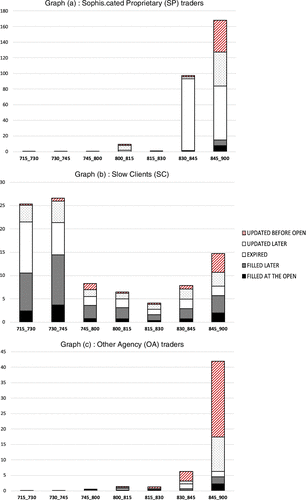
Notes. This figure shows preopening messages for each 15-minute interval between 7:15 a.m. and 9:00 a.m. (per stock and day). Graph (a) shows the total number of orders for sophisticated prop (SP), graph (b) focuses on slow clients (SC), and graph (c) focuses on other agency traders (OA). The bars are broken down into five order events, namely, (i) filled at least partially at the open, (ii) filled after the open, (iii) expired, (iv) updated (i.e., modified or canceled) after the open, or (v) updated before the open.
Figure 1 also depicts, for each 15-minute interval, the classification of orders according to different events. More precisely, we track the life of orders by matching orders and trades based on order sequence numbers and collect the time stamp of any order updates or partial executions. We identify five different events: whether the order has (i) been filled at least partially during the opening call, (ii) been filled after the opening call, (iii) expired without triggering any trade, (iv) been updated (modified or canceled) after the opening call, or (v) been updated (modified or canceled) before the opening call. The composition of each bar displayed in Figure 1 represents the proportion of these five events for all orders submitted during the interval.
The Overall Preopening Dynamics.
Overall, we find that 11% (respectively, 45%) of the orders submitted in the early phase [7:15–7:45] are filled at the open (at the open or later) versus 3% (7%) of the orders submitted in the late phase [8:30–9:00]. The substantial execution rate, particularly for orders placed during the first half hour, suggests that some participants are willing to submit serious preopening orders, that is, with the intention to execute them. In contrast, there are more modifications/cancellations of orders during the last half hour, which may suggest some learning and/or attempts to manipulate prices or beliefs.
The Order Dynamics for Each Category of Members.
Turning to the members, Figure 1 shows that the most active members are SC and SP traders. SC enter during the early phase and are less active in the late phase. Many of their orders are executed at the open or during the day. In contrast, SP traders enter in the late period. Their submission strategy is intense with more than 100 orders per 15-minute interval/stock/day, but only a minority of these orders is executed. OA traders participate only in the last 15-minute interval, and they mostly update orders. Table 2, panel C, reports statistics for the measures of message traffic (defined in Section 3.2.2), corroborating the behaviors illustrated in Figure 1. SP traders submit late nonaggressive orders, and less than 10% of them are executed. In comparison, slow clients submit early aggressive orders, and nearly half of their orders result in execution. OA traders tend to submit late nonaggressive orders and utilize more hidden orders, likely with the intention of concealing large orders.
4.2. Determinants of Preopening Order Submission
The previous section shows that at least some preopening orders are purposefully and strategically submitted with the intention to be filled. Moreover, orders submitted early or late have different characteristics, suggesting that their submission may be driven by distinct motives.
In this section, we test our Hypotheses 1 and 2 by running the following regression:
Hypothesis 1 predicts that we should observe more early orders when the value of gaining time priority is high. To test it, we use the dummy variable for liquidity shock days () defined in Section 3.1 and create an additional dummy variable TICK_INCREASE taking the value of one when there is an increase in the tick size of stock s on day t. We then interact these two variables with the slow clients dummy . For the early phase [7:15–7:45], Hypothesis 1 implies that , , and should be positive: Slow clients, more impatient, should be more willing to post orders early, particularly on days with a liquidity shock when the cost of nonexecuting is higher. Moreover, a larger tick size increases the value of gaining time priority, leading to more early orders in such stocks.
Hypothesis 2 predicts that we should observe more late orders when the cost of information leakage is large. To test it, we interact the SP traders dummy with the informational shock days dummy defined in Section 3.1. For the late phase [8:30–9:00], the cost of information leakage should be smaller, and Hypothesis 2 implies that and should be positive. Traders should be less reluctant to potentially leak private information late in the preopening period, especially on days with an informational shock.18
The set of control variables, denoted X, includes the (log) volatility and the Euronext daily number of trades of the previous day, and the total preopening order activity. For completeness, the set of controls also includes the two dummies and and their converse set of interactions with and and a dummy variable TICK_DECREASE taking the value of one if there is a reduction in the tick size of stock s on day t and its interactions with and , respectively. We estimate the panel regression with stock fixed effects. All variables’ definitions are presented in Online Table A.4. Table 3 presents the results for the early phase (columns (1)–(3)) and for the late phase (columns (4)–(6)).
|
Table 3. Early vs. Late Preopening Order Activity: Effects of Tick Size, Members’ Participation, and Stressing Shocks
| Variable | [7:15–7:45] | [8:30–9:00] | ||||
|---|---|---|---|---|---|---|
| (1) | (2) | (3) | (4) | (5) | (6) | |
| D_SC | 3.096*** | 3.068*** | 3.067*** | −1.205*** | −1.191*** | −1.191*** |
| (48.08) | (47.75) | (47.69) | (−46.61) | (−45.90) | (−45.72) | |
| D_SP | −0.584*** | −0.576*** | −0.576*** | 0.192*** | 0.187*** | 0.187*** |
| (−7.89) | (−7.82) | (−7.81) | (6.51) | (6.38) | (6.36) | |
| D_SC D_Liq | 0.259*** | 0.259*** | −0.155*** | −0.155*** | ||
| (4.67) | (4.67) | (−3.19) | (−3.19) | |||
| D_SP D_Inf | −0.029 | −0.029 | 0.041*** | 0.041*** | ||
| (−1.17) | (−1.16) | (4.54) | (4.57) | |||
| D_SC × TICK_INCREASE | 0.278** | −0.094* | ||||
| (2.55) | (−1.78) | |||||
| D_SP D_Liq | 0.005 | 0.005 | 0.001 | 0.001 | ||
| (0.21) | (0.21) | (0.10) | (0.10) | |||
| D_SC D_Inf | −0.053 | −0.053 | 0.442*** | 0.442*** | ||
| (−0.72) | (−0.72) | (12.21) | (12.19) | |||
| D_SC × TICK_DECREASE | 0.140 | 0.004 | ||||
| (1.20) | (0.08) | |||||
| D_SP × TICK_INCREASE | −0.007 | 0.026 | ||||
| (−0.09) | (0.91) | |||||
| D_SP × TICK_DECREASE | −0.066 | 0.027 | ||||
| (−0.86) | (1.10) | |||||
| Controls | Yes | Yes | Yes | Yes | Yes | Yes |
| Stock fixed effects | Yes | Yes | Yes | Yes | Yes | Yes |
| N | 120,129 | 120,129 | 120,129 | 120,129 | 120,129 | 120,129 |
| Adjusted R2 | 0.8942 | 0.8949 | 0.8949 | 0.9433 | 0.9440 | 0.9440 |
Notes. This table reports coefficients (t-statistics) from regressions of the number of preopening orders on dummies for member categories, their interactions with dummies for liquidity and informational shocks, and for an increase in the tick size. In columns (1)–(3), the dependent variable [7:15–7:45] is the (log) number of preopening orders submitted before 7:45 a.m. (the early phase). In columns (4)–(6), the dependent variable [8:30–9:00] is the (log) number of preopening orders submitted after 8:30 a.m. (the late phase). The right-hand side variables include two dummy variables and that take the value one if the member is of category SC and SP, respectively; their interaction with , a dummy that takes the value one when there is an expected liquidity shock, with a dummy that takes the value one when there is an overnight earnings announcement, and with a dummy variable TICK_INCREASE that takes the value one if there is an increase in the tick size. All specifications include the following control variables: and ; a dummy variable controlling for a decrease in the tick size (TICK_DECREASE) and its interactions with and ; the total (log) number of preopening orders ([7:15–9:00]) that controls for the preopening activity, the lagged (log) high-low volatility (HILO) and the lagged (log) total daily number of trades in euros (# TRADES_d)) controlling for the trading activity of the previous trading day. The regression includes stock fixed effect, and standard errors are clustered by stock member category and date.
***, **, and * denote significance levels of 1%, 5%, and 10%, respectively.
We find that slow clients submit more preopening orders in the early phase (), and their early order submission increases on days characterized by expected liquidity shocks (). Moreover, slow clients also place more early orders in stocks experiencing an increase in the tick size ( in column (3)). All these patterns are consistent with Hypothesis 1. Note also that slow clients place fewer orders in the late phase and particularly on days with liquidity shocks or in stocks with an increase in tick size (columns (4)–(6)) in accordance with the value of time priority.
Regarding the second hypothesis, the results show that SP traders submit a higher number of preopening orders but only in the late phase (and less in the early phase), . This result is reinforced on days characterized by informational shocks () as shown in columns (5) and (6). These results support Hypothesis 2. Overall, the findings support the notion that at least part of the (early) preopening orders are submitted strategically.19
4.3. Price Discovery and Strategic Order Submission
4.3.1. Price Discovery Metrics.
To investigate the contribution of the preopen to daily price discovery, we use measures of price discovery based on returns. The index m designates the trading venue, where for Euronext and for Chi-X. We omit the stock subscript (s) for brevity when unambiguous.
During the preopening period, Euronext continuously displays its limit order book and updates the indicative opening price. We use the same information set as Euronext members to determine the indicative opening price that would clear the market given the orders displayed in the limit order book at any given point in time. Using the EUROFIDAI-BEDOFIH 15-minute snapshots, we rebuild the cumulated demand and supply functions at time , where corresponds to 7:30, 7:45, 8:00, 8:15, 8:30, or 8:45 a.m. When they cross, we identify the indicative opening price that maximizes the volume traded (in number of shares). We then compute the close-to-time return as zfollows:
Further, we use the opening price observed in venue m, (determined by the opening call on Euronext and by the first trade on Chi-X) to define the close-to-open return of venue m as
Finally, we use the closing price as proxy for the fundamental value and compute the close-to-close return as follows:
4.3.2. Price Discovery During the Preopen.
Building on the approach of Biais et al. (1999) and Barclay and Hendershott (2003), we use the estimates of the coefficients of the following unbiasedness regression panel for each interval :
As explained in Barclay and Hendershott (2003) or Biais et al. (1999), if returns are serially uncorrelated and measured without error, the slope coefficient in the unbiasedness regression (7), , equals one. If, however, one cannot observe the true return process but the true return plus noise, the estimated coefficient represents the signal-to-noise ratio. Consequently, the coefficient measures the informational content of the preopening and opening prices.
Results are reported in Table 4. Overall, price discovery starts very early [at time 7:30 a.m.]: coefficients are all significantly positive. In the early phase, coefficients are low and are increasing over time as are the of the regressions. In addition, we find that preopening indicative prices are significantly more informative (at the 10% level) on corporate event days and the opposite for liquidity shock days.
|
Table 4. Contribution of Preopening Time Periods to Daily Price Discovery During Normal and Stressed Days
| Close-to-close return | |||||||
|---|---|---|---|---|---|---|---|
| (1) | (2) | (3) | (4) | (5) | (6) | (7) | |
| 0.072*** | |||||||
| (3.61) | |||||||
| D_Inf | 0.497* | ||||||
| (1.85) | |||||||
| D_Liq | −0.071*** | ||||||
| (−3.60) | |||||||
| 0.075*** | |||||||
| (4.35) | |||||||
| D_Inf | 0.354** | ||||||
| (2.35) | |||||||
| D_Liq | 0.038 | ||||||
| (1.00) | |||||||
| 0.068*** | |||||||
| (5.91) | |||||||
| D_Inf | 0.532*** | ||||||
| (3.79) | |||||||
| D_Liq | −0.051** | ||||||
| (−2.57) | |||||||
| 0.067*** | |||||||
| (4.43) | |||||||
| D_Inf | 0.502*** | ||||||
| (3.41) | |||||||
| D_Liq | 0.017 | ||||||
| (0.48) | |||||||
| 0.113*** | |||||||
| (6.64) | |||||||
| D_Inf | 0.423*** | ||||||
| (2.88) | |||||||
| D_Liq | 0.007 | ||||||
| (0.22) | |||||||
| 0.127*** | |||||||
| (3.43) | |||||||
| D_Inf | 0.741*** | ||||||
| (5.00) | |||||||
| D_Liq | 0.071 | ||||||
| (1.23) | |||||||
| 0.936*** | |||||||
| (17.62) | |||||||
| D_Inf | 0.156 | ||||||
| (1.65) | |||||||
| D_Liq | 0.056 | ||||||
| (0.31) | |||||||
| D_Inf | 0.006** | 0.005** | 0.006*** | 0.005** | 0.005** | 0.004** | 0.002 |
| (2.43) | (2.40) | (2.86) | (2.52) | (2.44) | (2.25) | (1.36) | |
| D_Liq | −0.0001 | 0.0002 | 0.0001 | 0.0003 | 0.0004 | 0.0006 | 0.0001 |
| (−0.05) | (0.12) | (0.06) | (0.19) | (0.23) | (0.38) | (0.09) | |
| Stock fixed effects | Yes | Yes | Yes | Yes | Yes | Yes | Yes |
| Year-month fixed effects | Yes | Yes | Yes | Yes | Yes | Yes | Yes |
| N | 26,973 | 34,482 | 35,273 | 36,118 | 36,691 | 37,627 | 40,138 |
| Adjusted | 0.0082 | 0.0105 | 0.0115 | 0.0139 | 0.0181 | 0.0286 | 0.1866 |
Notes. This table reports estimates of unbiasedness regressions. The close-to-close return, , is regressed on the return from the previous close to the indicative preopening price at , . We estimate this regression separately for each {7:30, 7:45, 8:00, 8:15, 8:30, 8:45}. We use the close-to-open return, when 9:00 a.m. We also include the dummies and (described in Table 1) and their interactions with the variable as variables of interest. All regressions use stock and month-year fixed effects. Standard errors are clustered by stock and date. t statistics appear in parentheses.
***, **, and * denote significance levels of 1%, 5%, and 10%, respectively.
4.3.3. Who Participates in the Price Discovery During the Preopen?
This section investigates the impact of members’ preopening order submissions on price discovery. We introduce a measure of order imbalance specific to member category c within a given preopening time interval denoted by [l]; here, l refers to the early, middle, and late phases of the preopen. Order imbalances are defined as the difference between the volume of buy orders minus sell orders in number of shares, net of canceled orders within the interval [l]. To remove differences in absolute order imbalance sizes, we standardize imbalances by their standard deviation (within category-interval-stock): .20 We then explore how members’ preopening order imbalances influence the returns. Precisely, we run the following regression:
Table 5 reports the results using five specifications. Columns (1)–(3) use the Euronext close-to-close return as the dependent variable; column (4) uses the Euronext close-to-open return, and column (5) the Chi-X close-to-open return. Column (2) focuses on days with liquidity shocks, whereas column (3) focuses on days with informational shocks.
|
Table 5. Price Discovery Measures and Preopening Activity of Member Categories
| Interval | Determinants | If D_Liq | If D_Inf | |||
|---|---|---|---|---|---|---|
| (1) | (2) | (3) | (4) | (5) | ||
| [7:15–7:45] | −0.797 | 4.332 | −1.270 | 0.653 | 0.765 | |
| (−0.60) | (1.56) | (−0.08) | (0.99) | (1.16) | ||
| 6.144*** | 0.586 | 61.03** | 7.511*** | 7.135*** | ||
| (4.24) | (0.23) | (2.30) | (8.09) | (7.68) | ||
| −0.151 | −0.001 | 5,104.8*** | 1.529*** | 1.691*** | ||
| (−0.10) | (−0.00) | (10.53) | (2.77) | (3.12) | ||
| 1.616 | −1.676 | 3.189 | 1.452** | 1.258* | ||
| (1.31) | (−0.44) | (0.18) | (2.40) | (1.96) | ||
| [7:45–8:30] | 6.187*** | 10.19*** | −8.345 | 6.712*** | 6.632*** | |
| (5.25) | (2.74) | (−0.53) | (7.52) | (7.43) | ||
| 2.198** | −0.221 | 19.73 | 3.209*** | 2.926*** | ||
| (2.13) | (−0.08) | (1.28) | (5.42) | (4.89) | ||
| 11.19*** | 13.72*** | 41.28*** | 4.927*** | 6.963*** | ||
| (6.15) | (2.99) | (2.68) | (4.49) | (6.40) | ||
| [8:30–9:00] | 18.34*** | 9.601*** | 43.46*** | 12.12*** | 13.67*** | |
| (12.35) | (2.76) | (4.63) | (10.45) | (10.86) | ||
| 6.757*** | 15.20* | 80.54*** | 5.164*** | 6.147*** | ||
| (2.93) | (1.88) | (3.54) | (5.17) | (6.23) | ||
| Controls | Yes | Yes | Yes | Yes | Yes | |
| Stock fixed effects | Yes | Yes | Yes | Yes | Yes | |
| N | 40,043 | 4,690 | 351 | 40,043 | 40,030 | |
| Adjusted R2 | 0.0209 | 0.0206 | 0.1937 | 0.0672 | 0.0640 |
Notes. This table reports coefficients (t-statistics) from regressions capturing the impact of preopening order imbalances on price discovery. In columns (1)–(3), the dependent variable is the close-to-close return on Euronext (expressed in bps). In column (2) (column (3)), we reestimate model (1) focusing on days on which there is a liquidity shock (an information shock). In column (4) (column (5)), the dependent variable is the close-to-open return on Euronext, denoted the close-to-open return on Chi-X, denoted ) (expressed in bps). The independent variables are the standardized order imbalances for each category of members ( SP, SC, OA) in each interval [l], [7:15–7:45], [7:45–8:30], and [7:45–9:00] (see Online Table A.7 for summary statistics). All specifications use the following control variables: and , the dummies that control for an informational shock or an expected liquidity shock, the lagged (log) high-low volatility (), and the lagged (log) total daily number of trades in Euros () controlling for level of the daily trading activity of the previous trading day. All regressions include stock fixed effects. Standard errors are clustered by stock and date.
***, **, and * denote significance levels of 1%, 5%, and 10%, respectively.
First, column (1) shows that only early order imbalances from SC traders are significantly and positively correlated with close-to-close returns. A one-standard-deviation increase in slow clients’ early order imbalances has an impact of 6.14 bps on the close-to-close return. Late order imbalances from SC or SP traders have a more significant price impact: a one-standard-deviation increase in SC (SP) order imbalances is related to a variation of 18.34 bps (11.19 bps) of the close-to-close return. Note that price contribution from SP traders occurs only in the late phase across specifications (1), (2), or (3), which is consistent with traders being aware of the cost of the information leakage.
Second, we find that late imbalances are positively related to close-to-open prices on Euronext and Chi-X. Despite Chi-X lacking a preopening or opening mechanism, column (5) shows that Euronext preopening imbalances significantly influence Chi-X’s close-to-open return with similar magnitudes to Euronext (column (4)). This demonstrates the contribution of Euronext’s preopening sessions to price formation on other venues.
Discussion. The fact that that SC preopening order imbalances reveal information on the direction of future price changes, even though SC traders are presumably less informed and less sophisticated, might be explained by the diversity among members. Using older Euronext data with member IDs, Online Section A.1 shows that slow clients regroup diverse members such as retail brokers, institutional brokers, private banks, asset managers, or investment and securities banking divisions. Only retail brokers are both uninformed and unable to extract positive trading revenues. Even if their orders represent a sizable portion of the total preopening order flows, the activity from other subcategories of slow clients is equally important, which explains the contribution to price discovery of this category.21 Additionally, the liquidity providers of the SP category follow contrarian strategies in the late interval, reducing the aggregate impact of SP imbalances (see also our robustness tests in Section 5.2).
5. Robustness
The aim of this section is to dig further into the impact of member preopening behaviors on opening price formation. We examine days with exceptional preopening sessions: (i) a day with an outage (on June 6, 2013) and (ii) stock days with delayed openings. Additionally, we explore the possibility of strategic interactions between member categories, such as concealing strategies.
5.1. Effects of the Euronext Preopening Session on Other Venues: Evidence from a Preopening Glitch
On June 6, 2013, the Euronext opening call auction was unexpectedly delayed because of a technical glitch, which prevented members from submitting orders to the market at the regular preopening starting time [7:15 a.m.]. Preopening order submission resumed at 9:21 a.m., and the opening call took place at 10:00 a.m., one hour later than usual.22 Meanwhile, Chi-X opened at 9:00 a.m. We exploit this natural experiment to examine how traders altered their preopening strategies and to explore how it affected price discovery on Euronext and Chi-X. This experiment helps to shed light on the impact of the Euronext preopening session on Chi-X opening price formation.23
5.1.1. Preopening Activity on the Day of the Glitch.
To delve into the potential changes in price discovery and preopening activity around the glitch, we split our sample into two groups: (i) group T for the 35 (Treated) stocks that started to trade on Chi-X before 10:00 a.m. (i.e., before the Euronext opening call) and (ii) group C for the 62 (Control) stocks that started trading on Chi-X only after 10:00 a.m. Group T is the subsample of interest; we further split it into group for the 30 stocks trading on Chi-X before 9:21 a.m. (i.e., no preopen having taken place yet) and group consisting of five stocks trading on Chi-X between 9:21 a.m. and 10:00 a.m. (i.e., at the same time as the preopen taking place). Figure 2 summarizes the timeline of the events and illustrates our decomposition into groups of stocks.
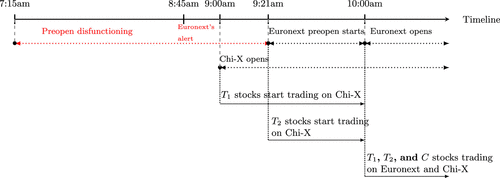
Notes. This figure shows the timeline of the events on the day of the glitch (June 6, 2013) from the first alert issued by Euronext at 8:45 a.m. to the opening call delayed at 10:00 a.m. Our treated group (T) consists of the 35 stocks trading on Chi-X before 10 a.m., which we further split into group for the 30 stocks trading on Chi-X before 9:21 a.m. and group consisting of five stocks trading on Chi-X between 9:21 a.m. and 10:00 a.m. The control group (C) consists of the 62 stocks that started trading on Chi-X only after 10:00 a.m.
The Overall Picture.
We use our measures of trading activity and message traffic defined in Section 3.2.2 to investigate whether the glitch caused any changes relative to the other (normal) days of the same week. Table 6 reports univariate tests. Panel A shows that, once resolved, the outage had little impact on the liquidity and trading activity on Euronext. Only stocks starting to trade on Chi-X before the preopen (group ) have fewer preopening orders (almost −20%) and fewer opening trades at the opening call (almost −15%), but differences are not statistically significant. Regarding Chi-X, panel B shows that, because Euronext was closed, the possibility of trading on Chi-X attracted a lot of orders, in particular, for stocks. Despite this surge in order submissions, the number of transactions is very low (1.93 trades in the first minute after the first trade on Chi-X referencing the opening price). When we zoom in on the liquidity, the bid–ask spread observed 15 minutes after the first trade on Chi-X (when Euronext was closed for group T) is very large, presumably reflecting higher adverse selection costs. For stocks, bid–ask spreads amount to almost 953 bps (as compared with 20 bps for the normal days) and for the stocks to 335.6 bps (versus 9.7 bps), explaining the low number of transactions.
|
Table 6. Descriptive Statistics Surrounding the Day with the Preopening Glitch
| Trading on Chi-X | ||||||
|---|---|---|---|---|---|---|
| Before the open on Euronext T stocks | After the open on Euronext C stocks | |||||
| Before 9:21 a.m. stocks | After 9:21 a.m. stocks | |||||
| Glitch | Normal | Glitch | Normal | Glitch | Normal | |
| Number of stock events | 30 | 30 | 5 | 5 | 62 | 62 |
| Panel A: Euronext | ||||||
| ORD | 688 | 847 | 734 | 731 | 260 | 286 |
| MONITORING (%) | 17.6 | 20.4 | 20.2 | 23.5 | 12.9 | 13.4 |
| PCT_AGGR (%) | 17.1*** | 10.1 | 17.1 | 7.9 | 9.5 | 10.1 |
| PCT_HID (%) | 1.9 | 2.3 | 4.5 | 2.9 | 5.9 | 4.9 |
| # OPEN_TR | 74.63 | 88.53 | 76.60 | 72.55 | 25.77 | 30.42 |
| QUOTED_SPREAD (OPEN+15’) (bps) | 11.4 | 11.9 | 8.7 | 9.6 | 18.1 | 19.7 |
| Panel B: Chi-X | ||||||
| Delay of the first trade relative to the Euronext open | −55’** | 3′ | −25’*** | 2’ | 13’ | 13’ |
| ORD (before the preopen) | 538*** | — | 183** | — | 25*** | — |
| ORD (before the open) | 2,295*** | — | 414** | — | 78*** | — |
| ORD (OPEN+5′) | 4,214*** | 801 | 2,551** | 675 | 565*** | 199 |
| ORD (before the first trade) | 24*** | 140 | 275 | 113 | 273* | 134 |
| MONITORING (%) | 32.3 | 34.6 | 57.7*** | 35.9 | 56.0*** | 36.7 |
| # TRADES (first trade + 1’) | 1.93*** | 9.78 | 0.8* | 6.85 | 5.21** | 2.98 |
| QUOTED_SPREAD (first trade + 15’) (bps) | 952.8** | 20.4 | 335.6* | 9.7 | 43.2 | 55.1 |
Notes. This table reports the results of cross-sectional t-tests comparing the trading activity around the open on the glitch day (June 6) and or normal days (i.e., June 3, 4, 5, and 7). T stocks are stocks for which we observe a trade on Chi-X before the Euronext opening call at 10:00 a.m. T stocks are split into two groups: stocks for which we observe a trade before the 9:21 a.m. preopen resumption and stocks for which we observe a trade between 9:21 a.m. and the 10:00 a.m. opening call. The group of control stocks, denoted C, consists of stocks with a trade on Chi-X only after the Euronext 10:00 a.m. opening call. Panel A shows descriptive statistics for Euronext, whereas Panel B focuses on the activity around the open on Chi-X. For Euronext, we report statistics on message traffic during the preopen, namely, the number of orders (ORD), the monitoring ratio (MONITORING), the aggressiveness ratio (PCT_AGGR), and the proportion of hidden volume (PCT_HID). All these variables are defined in the caption of Table 2. We also report the number of trades executed at the opening call (# OPEN_TR) and the bid–ask spread measured 15 minutes after the opening call (QUOTED_SPREAD (OPEN + 15’), expressed in bps). Panel B reports the following variables: Delay of the first trade on Chi-X relative to the Euronext open (expressed in number of minutes); the variable ORD is split into four different periods: the number of order submissions before the Euronext preopening phase (ORD (before the preopen)), those before the Euronext open (ORD (before the open)), those five minutes after the Euronext open (ORD (OPEN + 5′)), and those before the first trade on Chi-X (ORD (before the first trade)). MONITORING is the monitoring ratio described in the caption of Table 2. # TRADES (first trade + 1’) is the number of trades executed within one minute after the first trade on Chi-X. QUOTED_SPREAD (first trade + 15’) is the quoted spread on Chi-X measured 15 minutes after the first trade on Chi-X (expressed in bps).
***, **, and * denote significance levels of 1%, 5%, and 10%, respectively.
The Preopening Behavior of Market Participants.
Table 7 examines the participation of members at the Euronext opening call around the glitch. It shows that only OA traders decreased significantly their preopening order submission activity on the day of the glitch (−5 percentage points (pp) on average for T stocks and −6 pp for C stocks). It is worth noting that the market share of SP traders at the opening call is significantly lower (−25 pp for T stocks and −16 pp for C stocks), whereas the market share of SC has relatively increased by 16 pp for T stocks and 15 pp for C stocks. The market share of OA traders has also relatively increased for stocks in T stocks (+8 pp).
|
Table 7. Members’ Participation on the Day of the Preopening Glitch
| Trading on Chi-X | |||||||||
|---|---|---|---|---|---|---|---|---|---|
| Before the open on Euronext T stocks | After the open on Euronext C stocks | ||||||||
| Category | Glitch | Normal | t-stat | Diff | Glitch | Normal | t-stat | Diff | |
| Panel A: Number of orders | |||||||||
| ORD | SP | 464 | 542 | −0.98 | 167 | 166 | 0.04 | ||
| SC | 167 | 187 | −0.47 | 69 | 75 | −0.35 | |||
| OA | 64 | 93 | −2.07 | ** | 24 | 45 | −2.77 | *** | |
| All | 695 | 822 | −1.14 | 260 | 286 | −0.77 | |||
| PCT_ORD (%) | SP | 67 | 64 | 1.07 | 65 | 59 | 2.78 | *** | |
| SC | 22 | 21 | 0.74 | 23 | 23 | 0.19 | |||
| OA | 11 | 16 | −1.80 | * | 12 | 18 | −3.15 | *** | |
| Panel B: Volume | |||||||||
| OPEN_VOLUME (€ 1,000) | SP | 326 | 932 | −2.66 | *** | 83 | 97 | −0.49 | |
| SC | 443 | 438 | 0.03 | 206 | 88 | 2.46 | ** | ||
| OA | 392 | 504 | −0.76 | 69 | 40 | 1.70 | * | ||
| All | 1,161 | 1,874 | −1.56 | 358 | 225 | 1.79 | * | ||
| MARKET_SHARE (%) | SP | 26 | 50 | −8.56 | *** | 27 | 43 | −5.68 | *** |
| SC | 44 | 28 | 4.69 | *** | 54 | 39 | 4.53 | *** | |
| OA | 30 | 22 | 2.95 | *** | 19 | 18 | 0.58 | ||
Notes. This table presents cross-sectional t-tests comparing preopen activity around the glitch day. Group T includes treated stocks that traded on Chi-X before Euronext’s open, whereas group C consists of control stocks trading on Chi-X only after Euronext’s open. Panel A reports preopening activity based on order count (ORD) and percentage (PCT_ORD) across the three categories of members (SP, SC, OA) on the glitch day vs. normal (control) days. Panel B reports opening activity using volume in euros (OPEN_VOLUME) and percentage (MARKET_SHARE).
***, **, and * denote significance levels of 1%, 5%, and 10%, respectively.
To better understand this composition change, we investigate the dynamics of the preopening order submission strategy followed by members during the 39 minutes of the preopen affected by the outage. We split these 39 minutes into three intervals: (i) 39 to 30 minutes prior, (ii) 30 to 15 minutes prior, and (iii) less than 15 minutes prior to the opening call. This partition allows us to compare the preopen of the glitch to that of normal days. We illustrate the dynamics of preopening order submission in Figure 3.
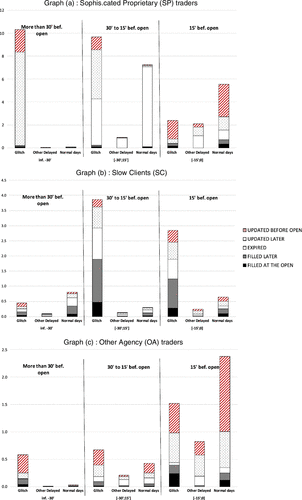
Notes. This figure shows preopening messages per stock averaged by minute on days with a delayed opening relative to other normal (control) days of the week. We contrast the delayed opening which is due to the technical outage of June 6, 2013 (glitch) from other delayed openings (other delayed). In each graph, we split the preopening period into three intervals: 15 minutes before the opening call, between 30 and 15 minutes before the call, or more than 30 minutes before the call. The legend of the bars is similar to that of Figure 1. Graph (a) shows the preopening order submission for sophisticated proprietary (SP) traders, graph (b) focuses on (SC) slow clients, and graph (c) on other agency (OA) traders.
On the day of the glitch, SP traders arrive first in the limit order book, but because most of their orders are subsequently updated, they ultimately lose their time priority. SP traders submit fewer orders in the last interval compared with normal days, but these orders are more aggressive and monitored more actively. Slow clients refrain from placing orders in the early interval (consistent with becoming sidelined because of uncertainty) but submit more preopening orders during the second interval (30 to 15 minutes before the opening call), half of them being executed at the open or later during the day. SC traders are also very active in the final interval—more so than usual—with a large share of their orders being executed.24 OA traders place more orders in the first minutes, some of them being executed later, and submit fewer preopening orders in the last minutes, but more aggressively and with a higher fill rate than on normal days.
In conclusion, all members alter their order placement strategy during the glitch; the behavior of SP traders suggests that part of them migrate to Chi-X, consistent with the fact that this category includes skilled traders who can trade on multiple venues, possibly on short-lived information. SC and OA traders seem to be less able to switch to other competing venues, possibly because of the best execution duty often tied to the primary best bid and offer, which remains undefined until Euronext opens. They, however, strategically adapt their preopening behavior on that day.
5.1.2. Price Discovery on the Day of the Glitch.
The glitch influences price discovery on Euronext and Chi-X differently. The evidence presented earlier shows that price discovery starts very early. On Chi-X, the glitch presumably affects stocks trading before the open of Euronext, particularly before the Euronext preopen because of the absence of preopening information. On Euronext, the price discovery of T stocks might be affected because informed traders may migrate away to open alternative venues such as Chi-X.
To examine price discovery, we use the methodology of unbiasedness regressions described in Section 4.3 in a difference-in-difference (DiD) setup. We contrast T stocks starting to trade on Chi-X before the Euronext opening call (the Treated stocks) with C stocks (playing the role of control stocks). To address the potential endogeneous treatment issue for T stocks, we use a Heckman two-stage estimation method. The results of the estimation of the selection model are reported in the Online Table A.8 for brevity. Larger stocks with more preopening activity and more volatility are more likely to start trading on Chi-X before the Euronext opening call.
Based on Equation (7) and our DiD setup, we estimate the following outcome equation:
Table 8 reports the results in columns (1)–(4). First, we document a negative but insignificant impact of the glitch on the informational content of the first price on Chi-X and Euronext (in all specifications). This suggests that the glitch has not significantly impaired price discovery for C stocks trading on Chi-X after the Euronext opening call. In contrast, price discovery significantly worsens on Euronext and Chi-X on June 6 for T stocks (t-stat at 10% and 1% levels in columns (1) and (3)). Results reported in column (2) further show that the price discovery on Euronext for stocks is negatively impacted but not significantly. In contrast, on Chi-X (column (4)), not having a preopening period on Euronext has significantly damaged price efficiency. This suggests that there is value in the price discovery of the preopen even without an opening call auction.
|
Table 8. Daily Price Discovery on Days with Delayed Openings
| Euronext close-to-close return | |||||||
|---|---|---|---|---|---|---|---|
| Glitch | Other delayed openings | ||||||
| (1) | (2) | (3) | (4) | (5) | (6) | ||
| Euronext | TDelay | −0.784* | 0.349 | 0.946 | |||
| (−1.70) | (0.34) | (0.46) | |||||
| T1 Delay | −1.121 | ||||||
| (−1.03) | |||||||
| Delay | −0.387 | −0.388 | −0.659 | ||||
| (−1.50) | (−1.51) | (−1.44) | |||||
| T | 0.211 | −0.397 | 0.131 | ||||
| (1.17) | (−0.83) | (0.27) | |||||
| T1 | 0.670 | ||||||
| (1.37) | |||||||
| 0.935*** | 0.935*** | 0.832*** | |||||
| (8.00) | (8.03) | (6.24) | |||||
| Chi-X | T Delay | −0.870*** | 0.039 | 0.509 | |||
| (−2.87) | (0.06) | (0.47) | |||||
| T1Delay | −0.981* | ||||||
| (−1.70) | |||||||
| Delay | −0.300 | −0.300 | −0.750*** | ||||
| (−1.14) | (−1.14) | (−3.18) | |||||
| T | 0.089 | −0.376 | 0.239 | ||||
| (0.53) | (−0.76) | (0.70) | |||||
| T1 | 0.508 | ||||||
| (1.01) | |||||||
| 1.085*** | 1.085*** | 0.874*** | |||||
| (10.44) | (10.49) | (8.54) | |||||
| IMR | −0.0002 | −0.00006 | −0.00007 | −0.00002 | −0.0035 | −0.00215 | |
| (−0.12) | (−0.04) | (−0.05) | (−0.02) | (−1.15) | (−0.74) | ||
| Controls | Yes | Yes | Yes | Yes | Yes | Yes | |
| N | 479 | 479 | 479 | 479 | 337 | 337 | |
| R2 | 0.2515 | 0.2566 | 0.3170 | 0.32411 | 0.1173 | 0.2045 | |
Notes. This table reports the estimates of unbiasedness regressions capturing the impact of a delayed opening on Euronext on the price discovery of Euronext and Chi-X in a DiD setup in which the day of the delayed opening is the treatment. We contrast the impact of a delayed opening on the group of stocks that trade on Chi-X before the open on Euronext (group T) with stocks that trade on Chi-X after the open on Euronext (group C). We use a Heckman two-stage process to deal with the endogeneity of T stocks. The estimates of the selection equation are reported in Online Table A.8. This table reports the results of the outcome equation. The dependent variable is the close-to-close return, (expressed in percentage). The independent variables are the close-to-open return on venue m (where (Euronext), C (Chi-X)), the variable Delay, which is a dummy variable that takes the value of one when the opening call of 9:00 a.m. is delayed for stock s at date t and zero on the four normal (control) days of that week, and the variable T, which is a dummy variable that takes the value of one for stocks in group T. The right-hand side variable of interest is the triple interaction term between the close-to-open return , Delay, and T. Columns (1)–(4) report results when the opening delay is due to the technical outage of June 6, 2013 (the glitch). Columns (5) and (6) focus on other delayed openings (excluding the glitch). In columns (2) and (4), we further split group T stocks in the 30 stocks trading before the Euronext preopen resuming at 9:21 a.m. taking place (group T1), and the other five stocks trading later. We use the dummy variable T1 that takes the value of one if the stock starts to trade before the Euronext preopening. The control variables include the variables Delay, T, their interactions, and the IMR from the selection model. t statistics appear in parentheses.
***, **, and * denote significance levels of 1%, 5%, and 10%, respectively.
When considering the influence on price discovery of members altering their preopening strategies, we observe a departure from normal days (results are shown in Online Table A.9). On the day of the glitch, early order imbalances, in particular from slow clients, are not statistically significant, consistent with a switch to a wait-and-see inactivity mode described above. Only those generated by later preopening submissions, whether from the SC or SP categories, make a significant contribution to price discovery.
5.1.3. Other Delayed Openings.
Stocks might experience delayed openings for reasons other than a technical glitch. Most often, it is because of endogenous reasons, that is, the limit order book at the end of the preopening period is not deep enough to trigger a trade matching at the opening call. Accordingly, the price of the first trade occurring in the main trading session is designated as the opening price. Note that, although the open is delayed, a preopen takes place. In this section, as a robustness test, we identify all the days in our sample for which an opening matching did not occur at 9:00 a.m. Stocks experiencing an opening delay are relatively thinly traded stocks (see Online Table A.10).
Figure 3 shows that the strategic behavior of traders is different from that on the day of the glitch. All member categories reduce their order placements with almost no early orders and very few late orders submitted. In particular, slow clients choose not to submit any early aggressive orders. This change is consistent with De Frutos and Manzano (2014) or Schöneborn and Schied (2009), who show that sunshine trading closely depends on market conditions.25
We follow a methodology similar to the two-stage DiD approach described above and estimate an outcome equation similar to Equation (9) except that the dummy variable Delay now takes the value of one on days with a delayed opening. T stocks include those that traded on Chi-X before Euronext’s first trade, whereas C stocks began trading on Chi-X only after the Euronext first trade. Table 8 reports the results in columns (5) and (6). Results show that the delay does not affect the price efficiency of T stocks, whether on Euronext or on Chi-X. T stocks benefit from the price discovery of the preopen, corroborating that there is value in the preopen without an opening call. The price discovery of C stocks appears to be significantly impaired on Chi-X, likely because of insufficient liquidity compared with Euronext. Results of Online Table A.9 show that only late imbalances from slow clients significantly contribute to price discovery on days with a delayed opening, reflecting a general reduced preopening activity reported above.
5.2. Are They Strategic Interactions Between Categories?
We now explore the possibility for member categories to interact strategically during normal times. In particular, we investigate the case of concealing strategies. SP or OA traders could use the early sunshine trading strategy from slow clients to hide private information by pooling their orders with those of slow clients (Admati and Pfleiderer 1988). In addition, slow clients could also follow a camouflage trading strategy in the late phase of the preopen if an early sunshine trading strategy is too costly (Schöneborn and Schied 2009). Figure 1 shows that more sophisticated traders proxied by the SP or OA categories submit almost no orders during the early preopening phase used by slow clients to gain time priority. At the beginning of the preopen, visual inspection reveals no evidence of orders pooling, challenging the likelihood of informed traders engaging in early strategic information concealing. During the final phase, there is a higher concentration among all groups although slow clients reduce their order placement activity compared with the earlier phase.
To further investigate the possibility of concealing strategies, we use Equation (3) to explore how preopening activity correlates across the different member groups. We run the following regression model:
Table 9, panel A, shows that late contemporaneous order submission activity is significantly positively correlated across all member categories. In the early phase, only slow clients tend to increase their order submission when other members are more active. These results might be due to strategic order clustering, but the evidence remains weak. Table 9, panel B, does not show any evidence of early or late imbalance clustering, weakening the hypothesis of order concealing. It could be that our tests fail to detect such strategies. To further investigate the clustering behavior of SPs, presumably the category more eager to camouflage orders, we split SPs according to the value of the account flag (LP or PROP). SP_LP designates sophisticated liquidity providers. Other SPs, which are all proprietary (PROP) members, are differentiated according to the value of the speed flag: SP_HFT, SP_MX, and SP_NHFT. Table 9, panel C, reports the results. We do not find strong evidence in favor of concealing strategies except possibly for SP_HFT. Additionally, we find that SP_LP and SP_NHFT late imbalances are negatively and significantly correlated with early imbalances. These traders seem to absorb early imbalances and supply liquidity to slow clients, the category submitting many early orders, which is consistent with the sunshine trading hypothesis.26
|
Table 9. More Strategic Preopening Interactions?
| Panel A: Number of preopening orders | ||||||
|---|---|---|---|---|---|---|
| [7:15–7:45] | [7:45–9:00] | |||||
| SP | SC | OA | SP | SC | OA | |
| (1) | (2) | (3) | (4) | (5) | (6) | |
| [7:15–7:45] | 0.013 | 0.078** | 0.005 | 0.035* | −0.037* | −0.015 |
| (1.51) | (2.02) | (1.17) | (1.73) | (−1.71) | (−0.86) | |
| [7:45–9:00] | 0.130*** | 0.114*** | 0.209*** | |||
| (5.95) | (4.32) | (7.66) | ||||
| [7:15–7:45] | 0.015 | 0.360*** | 0.042* | |||
| (0.60) | (9.37) | (1.67) | ||||
| Controls | Yes | Yes | Yes | Yes | Yes | Yes |
| Stock fixed effects | Yes | Yes | Yes | Yes | Yes | Yes |
| N | 40,043 | 40,043 | 40,043 | 40,043 | 40,043 | 40,043 |
| Adjusted R2 | 0.1176 | 0.7045 | 0.1292 | 0.8310 | 0.7441 | 0.7064 |
| Panel B: Standardized order imbalances | ||||||
|---|---|---|---|---|---|---|
| [7:15–7:45] | [7:45–9:00] | |||||
| SP | SC | OA | SP | SC | OA | |
| (1) | (2) | (3) | (4) | (5) | (6) | |
| [7:15–7:45] | 0.002 | −0.0034 | −0.0008 | −0.009 | 0.0050 | 0.0092 |
| (0.58) | (−0.74) | (−0.25) | (−0.90) | (1.04) | (0.91) | |
| [7:45–9:00] | 0.0031 | 0.0065 | −0.0046 | |||
| (0.21) | (0.44) | (−0.29) | ||||
| [7:15–7:45] | −0.0066 | 0.0169 | −0.0069 | |||
| (−0.64) | (1.47) | (−0.59) | ||||
| Controls | Yes | Yes | Yes | Yes | Yes | Yes |
| Stock fixed effects | Yes | Yes | Yes | Yes | Yes | Yes |
| N | 40,043 | 39,235 | 40,043 | 40,043 | 39,235 | 40,043 |
| Adjusted R2 | 0.0068 | 0.0489 | 0.0052 | 0.1900 | 0.1281 | 0.0937 |
| Panel C: Standardized order imbalances for subgroups of SP traders | ||||||||
|---|---|---|---|---|---|---|---|---|
| [7:15–7:45] | [7:45–9:00] | |||||||
| SP_LP | SP_HFT | SP_MX | SP_NHFT | SP_LP | SP_HFT | SP_MX | SP_NHFT | |
| (1) | (2) | (3) | (4) | (5) | (6) | (7) | (8) | |
| [7:15–7:45] | 0 | 0.004 | 0.002 | 0.0005 | −0.019*** | −0.009 | 0.004 | −0.017* |
| (.) | (1.06) | (0.72) | (0.11) | (−3.16) | (−0.69) | (0.36) | (−1.79) | |
| [7:45–9:00] | −0.001 | 0.073*** | 0.021 | 0.008 | ||||
| (−0.10) | (4.61) | (1.24) | (0.61) | |||||
| [7:15–7:45] | 0 | 0.001 | −0.028 | −0.010 | ||||
| (.) | (0.06) | (−1.58) | (−1.31) | |||||
| Controls | Yes | Yes | Yes | Yes | Yes | Yes | Yes | Yes |
| Stock fixed effects | Yes | Yes | Yes | Yes | Yes | Yes | Yes | Yes |
| N | 40,043 | 40,043 | 40,043 | 40,043 | 40,043 | 40,043 | 40,043 | 40,043 |
| Adjusted R2 | . | 0.0017 | 0.0042 | 0.0081 | 0.0093 | 0.2375 | 0.1214 | 0.0462 |
Notes. This table reports estimates of how the preopening activity of a member category relates to that of its peers. Columns (1)–(3) use a dependent variable measuring preopening activity between 7:15 a.m. and 7:45 a.m., whereas the remaining columns focus on activity from 7:45 a.m. to 9:00 a.m. In panel A, the preopening activity is proxied by the (log) number of preopening orders for each member category c ( SP, SC, and OA). In panels B and C, the preopening activity is measured by standardized imbalances defined in Online Table A.4. In panel C, we split the SP category into subgroups according to the value of account flag (LP and PROP). SP_LP designates sophististicated liquidity providers. All other proprietary SPs are differentiated according to the value of the speed flag: SP_HFT, SP_MX, and SP_NHFT. The explanatory variables of interest are the preopening activity measures of peers (); in specifications (4)–(6), we include lagged preopening activity measures. All regressions use the same set of control variables Z: the tick size, and , the dummies that control for informational or liquidity shocks, the lagged (log) high-low volatility (), and the lagged (log) total daily number of trades in euros (). All regressions include stock fixed effects. Standard errors are clustered by stock and date.
***, **, and * denote significance levels of 1%, 5%, and 10%, respectively.
6. Conclusion
This paper analyzes trader preopening strategies when price-time precedence applies at the opening call and relates them to the quality of the opening price discovery. Using Euronext data on speed and accounts of market participants trading stocks belonging to the SBF120 index constituents from May 2, 2012, to December 31, 2013, we show that slow clients, a category of members characterized by less trading sophistication and less informedness, place very early serious orders to gain time priority, resulting in a first peak of order submissions at the beginning of the preopen session. This strategy shows similarities to sunshine trading, showcasing preannouncement characteristics. The second highest peak takes place close to the opening call. All members participate in the late phase, in particular, sophisticated traders, consistent with a privately informed group closely monitoring the cost of the information leakage. We find that information is significantly incorporated into prices during the entire preopening session unlike other studies. There is an intense acceleration of price discovery in the last minutes, consistent with the existing literature. Using days with exceptional opening delays and, in particular, a preopening outage, we show that the preopen has value for price discovery even without an opening call, in particular, for other competing satellite trading venues.
The authors are very grateful to one associate editor, three anonymous referees, Will Cong, and Haoxiang Zhu whose comments helped to improve the paper significantly. The authors especially thank the European Financial Data Institute (EUROFIDAI) for providing access to the Base de données européennes à haute fréquence (BEDOFIH) data (data obtained via the EUROFIDAI Equipex PLADIFES ANR-21-ESRE-0036, within the framework of France 2030). The authors also thank Paul Besson, Dion Bongaerts, Julio Crego, Catherine d’Hondt, Thierry Foucault, Jose Miguel Gaspar, Carole Gresse, Alexander Guembel, Albert Menkveld, Giang Nguyen, Sebastien Pouget, Erik Theissen, and Marius Zoican as well as seminar participants at the Third Forum “Market Microstructure: Confronting Many Viewpoints”, at the conference of the Northern Finance Association (Charlevoix), at the Microstructure Exchange, at the Microstructure Online Seminars Asia Pacific, and at the IEX ARC conference as well as members of the Scientific Committee of the French Market Authorities (AMF) and, in particular, Philippe Guillot and Charles-Albert Lehalle, for providing useful comments. This paper previously circulated with the title “Does a preopen matter in fragmented markets?”.
1 The New York Stock Exchange (NYSE) uses a price-parity rule that prioritizes orders from the floor traders over similar orders placed through its electronic order book (see, for instance, Battalio et al. 2021, Jegadeesh and Wu 2022).
2 The SBF120 index is a French stock market index representing the 120 most actively traded stocks listed in Paris. During our time period, the SBF120 index captured almost 40% of the total French market capitalization.
3 Our results complement Hu and Murphy (2024) and Jegadeesh and Wu (2022), who examine the role of order imbalances in price discovery at the close. Closing auctions concentrate the highest volume of orders at a single point in time. Although there is no need to solve any crucial overnight information asymmetry, liquidity pressure is stronger at the close because of participants following passive management strategies (see, for instance, Bogousslavsky and Muravyev 2023). Therefore, price dynamics are likely to differ during the preopen when trading motives vary.
4 Online Section A.1, which replicates our main findings on older (2007) data from Euronext, which include individual identifiers of members, corroborates this conjecture.
5 Outside of limit order markets, Cao et al. (2000) investigate the NASDAQ market (at the time, a decentralized, nonanonymous dealer market) and show that market-makers use nonbinding quotes to signal information. Barclay et al. (2008) and Pagano et al. (2013) show that the decentralized opening design of NASDAQ negatively affected price efficiency. NASDAQ introduced a consolidated opening call in 2004.
6 At the time, MiFID I used the primary market reference price as a benchmark for best execution.
7 Some other lit venues exist, such as BATS Trading Limited (BATS) or Turquoise. They operate similarly to Chi-X, but under different rules, and attract lower volume. For our sample, the market share of lit venues amounts, on average, to 70%. The rest of the volume is executed over the counter (OTC) (around 25%) and on small dark pools such as Equiduct, Tradegate, or SigmaX.
8 Note that, during all sessions, an order modification leads to a new time priority if either the price limit is changed or the modification negatively impacts the priority of the execution of other orders.
9 Out of the 120 constituents, we drop stocks that did not belong to the SBF120 index on January 1, 2012, and stocks that did not trade continuously or frequently enough on Chi-X. We drop 10 trading days and 212 stock day observations because of trading halts, half-day trading sessions, and Euronext-flagged data reporting issues. Twelve stock split days are identified using COMPUSTAT, and returns are adjusted accordingly.
10 During the period of our study, the tick value is €0.001 when the stock price is below €9.999, €0.005 when the stock price varies between €10 and €49.995, €0.01 between €50 and €99.99, and €0.05 for a price above €100. This rule is valid for Euronext and Chi-X (Europe).
11 In our data, one third of the announcements occur overnight after markets close and two thirds before markets open. In the latter case, earnings are often released around 7:00 a.m., and the announcement may be followed by a conference call that usually takes place after the market opens, either in the morning or afternoon.
12 The AMF classifies members based on the median lifetime of canceled orders and on the number of canceled orders. The classification is immutable: it is impossible for a member to post an order flagged “HFT” and another one flagged “MX.” It is revised on a yearly basis but is extremely persistent. There are 10 to 20 pure HFT members (see https://www.fia.org), 10 to 20 MX members, and more than 150 NHFT members, according to the AMF. Note that this flag is only available for the primary exchange and not for the other lit venues, such as Chi-X.
13 An RP is often a subsidiary of a Euronext member, trading with the membership ID of the latter and under its supervision. The RT facility was launched by Euronext on January 28, 2013. It aimed at bringing retail brokers an additional layer of liquidity by offering a best-of-the-book execution or even a price improvement for less informed retail orders. At the launch, the service was only available for the constituents of the major national indices (for our study, the constituents of the CAC40). At the end of 2014, retail order flow flagged RT represented 2% on Euronext (see the Euronext Universal Registration Document 2014).
14 Online Table A.5 provides descriptive statistics on a more complete set of measures of trading and quoting activity for the 12 member-types. In particular, the member-type profits computed using the closing price five business days later to value the net daily position, , is consistent with our measure of daily PROFIT using the closing price of the day of the trade.
15 A market‐to‐limit order is sent in as a market order to execute at the current best price. If the entire order does not immediately execute at the market price, the remainder of the order becomes a limit order with the limit price set to the price at which the market order portion of the order executed.
16 Biais et al. (1999) find that trading at the opening call represented about 10% of the total daily trading volume for CAC40 stocks in 1991. The decrease in the market share of the opening call in the 1990s might be explained by several factors: (i) regulatory changes (such as the implementation of the 1993 European Investment Service Directive liberalizing capital flows in Europe); (ii) the discontinuation of the opening price as the reference price for some derivatives and OTC trades; or (iii) the competitive pressure from the SEAQ International (SEAQI), the London Stock Exchange’s electronic price information system for non-UK equities. The SEAQI was especially attractive for block trades because it was deeper, guaranteed lower transaction costs for large trades, and was opaque. The limit order book of the Paris Bourse was—at that time—totally transparent, making block trades more risky because they were reported and displayed immediately in the system (see Pagano and Roell 1990, Gresse and Jacquillat 1998).
17 Online Table A.6, panel A, details the shares of the trading volume (in euros) by trading phase (open, continuous, or close), by members’ account (in row) and speed (in column). It shows that HFTs’ market share at the open is below 6% (mainly driven by HFT-PROP traders). HFTs do not participate in the closing auction either (market share lower than 3%). Speed does not provide a critical advantage during an auction.
18 To quantify the damages of information leakages, granular member-level data would be necessary to track informed traders’ strategies, examine if their strategies are detected, and analyze the impact of order anticipation strategies on execution costs. Our data lacks this granularity, making a full assessment beyond the scope of this study.
19 Panel (a) of Online Figure A.3 shows that, on days with an informational shocks, only SP traders alter their preopening strategy by submitting more orders in the late stage (in line with Hypothesis 2). Panel (b) shows that, on days with expected liquidity shocks, slow clients place more early orders and fewer late orders (in line with Hypothesis 1).
20 The absolute order imbalances are reported in Online Table A.7. Robustness tests based on two alternative approaches to measure order imbalances are reported in Online Section A.2. Tests show that our results are not sensitive to the way we measure imbalances.
21 In Online Section A.1, we replicate results from Figure 1 and Tables 2 and 5 using 2007 Euronext data for which we observe member IDs. We find similar results, which suggests that our findings are robust over time. The slow clients category exhibits substantial heterogeneity in the degree of informedness and sophistication, clarifying why they make, in aggregate, trading losses but still contribute to price discovery.
22 The exchange released an alert at 8:45 a.m. The statement was “NYSE Euronext continued to experience issues and had delayed the opening auction for equities, indices, bonds, ETFs, warrants and certificates and Smartpool stocks (dark pool trading). This impacted customers globally.” As a consequence of this delay, the opening of the related individual equity option and single stock futures was also delayed (source: Info-flash, NYSE-Euronext, 6/6/2013).
23 Barclay et al. (2008) and Comerton-Forde et al. (2007), among others, examine the impact of introducing a call on market quality. The preopening outage allows us to complement these papers by focusing on the preopening phase and price discovery, while excluding the impact of the call auction mechanism.
24 This finding suggests that early orders submitted at 7:15 a.m. on normal days by the SC group are not purely mechanically or nonstrategically programmed to be sent at the beginning of the preopen.
25 Schöneborn and Schied (2009) explicitly show that sunshine trading is not the optimal execution strategy when markets are illiquid and the number of potential liquidity providers in competition is reduced, conditions that closely resemble those of stocks with delayed openings, rather illiquid and thinly traded.
26 When we examine which SP subcategory contributes more to the daily price discovery, we find that SP_MX members significantly enhance price discovery in the late phase. In contrast, the SP_LP subgroup negatively contributes, offsetting other SP traders’ effects and potentially explaining a weaker-than-expected impact of the SP category in Table 5. These results are reported in Online Table A.11. The SC and SP categories, thus, embrace diverse trading motives, which explains why, although SP imbalances are rather negatively correlated with early SC imbalances, a part of both the SC and the SP order flows stems from more informed traders and correlates positively with close-to-close returns.
References
- (1988) A theory of intraday patterns: Volume, and price variability. Rev. Financial Stud. 1(1):3–40.Crossref, Google Scholar
- (1991) Sunshine trading and financial market equilibrium. Rev. Financial Stud. 4(3):443–481.Crossref, Google Scholar
- (2020) Are high-frequency traders informed? Econom. Model. 93:365–383.Crossref, Google Scholar
- (2003) Price discovery and trading after hours. Rev. Financial Stud. 16(4):1041–1073.Crossref, Google Scholar
- (2008) Order consolidation, price efficiency, and extreme liquidity shocks. J. Financial Quant. Anal. 43(1):93–122.Crossref, Google Scholar
- (2021) Deviations from time priority on the NYSE. J. Financial Markets 53:100567.Crossref, Google Scholar
- (2020) Coming early to the party. University Ca’ Foscari of Venice, Dept. of Economics Research Paper Series No. 11/WP/2020 NYU Stern School of Business, Venice, Italy.Google Scholar
- (2024) Pre-opening period, high-frequency trading, and market quality. SAFE Working Paper No. 144, Frankfurt am Main.Google Scholar
- (1999) Price discovery and learning during the preopening period in the Paris Bourse. J. Political Econom. 107(6):1218–1248.Crossref, Google Scholar
- (2023) Who trades at the close? Implications for price discovery and liquidity. J. Financial Markets 66:100852.Crossref, Google Scholar
- (2019) Price discovery without trading: Evidence from limit orders. J. Finance 74(4):1621–1658.Crossref, Google Scholar
- (1998) Can asset markets be manipulated? A field experiment with racetrack betting. J. Political Econom. 106(3):457–482.Crossref, Google Scholar
- (2000) Price discovery without trading: Evidence from the Nasdaq preopening. J. Finance 55(3):1339–1365.Crossref, Google Scholar
- (2006) The influence of call auction mechanism rules on market efficiency. J. Financial Markets 9(2):199–222.Crossref, Google Scholar
- (2007) Opening and closing behavior following the introduction of call auctions in Singapore. Pacific Basin Finance J. 15(1):18–38.Crossref, Google Scholar
- (2003) The Toronto stock exchange preopening session. J. Financial Markets 6(4):491–516.Crossref, Google Scholar
- (2014) Market transparency, market quality, and sunshine trading. J. Financial Markets 17:174–198.Crossref, Google Scholar
- (2005) Limit order book as a market for liquidity. Rev. Financial Stud. 18(4):1171–1217.Crossref, Google Scholar
- (2022) How is earnings news transmitted to stock prices? J. Accounting Res. 60(1):261–297.Crossref, Google Scholar
- (1998) The diversion of order flow on French stocks from CAC to SEAQ International: A field study. Eur. Financial Management 4(2):121–142.Crossref, Google Scholar
- (1996) Does a large minimum price variation encourage order exposure? New York Stock Exchange working paper, University of Southern California, Los Angeles.Google Scholar
- (2004) Quarterly trading patterns of financial institutions. J. Bus. 77(3):493–509.Crossref, Google Scholar
- (2024) Vestigial tails: Floor brokers at the close in modern electronic markets. Management Sci. Forthcoming.Google Scholar
- (2022) Closing auctions: Nasdaq versus NYSE. J. Financial Econom. 143(3):1120–1139.Crossref, Google Scholar
- (2015) Strategic order submission and cancellation in pre-opening periods: The case of IPO firms. Working paper, Colonial First State Global Asset Management, now known as First Sentier Investors, Sydney, Australia.Google Scholar
- (2001) Strategic behavior and price discovery. RAND J. Econom. 32(2):221–248.Crossref, Google Scholar
- (1990) Trading systems in European stock exchanges: Current performance and policy options. Econom. Policy 5(10):63–116.Crossref, Google Scholar
- (2003) A closing call’s impact on market quality at Euronext Paris. J. Financial Econom. 68(3):439–484. Crossref, Google Scholar
- (2013) A call auction’s impact on price formation and order routing: Evidence from the NASDAQ stock market. J. Financial Markets 16(2):331–361.Crossref, Google Scholar
- (2009) Liquidation in the face of adversity: Stealth versus sunshine trading. Munich Personal RePEc Archive paper 5548, AHL (Man Investments); University of Oxford - Oxford-Man Institute of Quantitative Finance, Oxford.Google Scholar
- (1985) The Stock Exchange Specialist System: An Economic Analysis, Monograph Series in Finance and Economics, vol. 2 (Salomon Brothers Center, New York University, New York).Google Scholar
- (1990) Stock market structure and volatility. Rev. Financial Stud. 3(1):37–71.Crossref, Google Scholar