The Strategic Value of Data Sharing in Interdependent Markets
Abstract
Large, generalist, technology firms—so-called “big-tech” firms—powerful in their primary market, routinely enter secondary markets consisting of specialist firms. Naturally, one might expect a specialist firm to be fiercely protective of its data as a way to maintain its market position in the secondary market. Counter to this intuition, we demonstrate that a specialist firm willingly shares its market data with an intruding generalist. We do so by developing a model of cross-market competition in which the data collected via consumer usage in one market can improve product quality in another. We show that a specialist firm shares its data to strategically create codependence between the two firms, thereby softening competition and transforming the generalist firm from a traditional competitor into a coopetitor. For the generalist intruder, data from the specialist firm substitute for its own investments in product quality in the secondary market. As such, the act of sharing data makes the generalist a stakeholder in the data collected by the specialist, and consequently in the specialist’s continued success. Moreover, although the firms benefit from data sharing, consumers can be worse off from weakened price competition and lower investments in innovation. Our results have managerial and policy implications, notably on account of backlash against data collection and the market power of big-tech firms.
This paper was accepted by David Simchi-Levi, information systems.
Funding: D. Ronayne is grateful for support from the Deutsche Forschungsgemeinschaft [CRC TRR 190; Project 280092119].
Supplemental Material: The online appendix is available at https://doi.org/10.1287/mnsc.2024.04938.
1. Introduction
Several dominant firms in technology industries offer mass-market products, such as Google’s search engine and Open AI’s large language models. These products often exhibit data-driven network effects: Their quality improves as they gather and feed more data from more users into their algorithms, as is the case for both Google Search and Open AI’s ChatGPT. In pursuit of even more, and more diverse, data, these Goliath firms move into secondary markets with products and services that can bring in new kinds of specialized data. For instance, Google has introduced its own products (such as Pixel phones, Nest home thermostats, etc.) in markets (Android handsets, wearable devices, hubs, routers, sensors, thermostats, etc.) where it also collects data from users of non-Google products through front-end interfaces such as Google Assistant (Ren et al. 2019, Mandalari et al. 2021). Looking ahead, firms offering general-purpose artificial intelligence (AI) and machine learning technologies will chase the same data objectives by offering products in specialized sectors such as healthcare, financial services and transportation.
Data-driven network effects (Argenton and Prüfer 2012, Gregory et al. 2021, Prüfer and Schottmüller 2021) have occupied a central role in the debate on the regulation of big-tech firms (European Commission 2020a, Cennamo and Sokol 2021, Parker et al. 2021, Krämer and Schnurr 2022). Cross-market data sharing creates a virtuous cycle (Figure 1(a)), as more sales or usage in one market generates more data, providing a basis for improved analytics and algorithmic learning, leading to better products in both markets. For instance, a search engine can improve its search results and sponsored advertising algorithms by using behavioral and activity data collected from personal electronic devices; conversely, it can leverage users’ search data to refine and develop those products.1 Cross-market data allow generalist firms to challenge incumbent “specialist” firms in their own markets. Ever-growing needs for new data have already led OpenAI to secure new data sources to train its AI systems.2 A recent partnership between OpenAI and LoveFrom (a leading industrial design company that helps digital firms develop products before they are brought to market) foretells the increasing role of cross-market data in the future.3 Although the companies have until now not disclosed the type of product they are developing, consider a prospective scenario in which OpenAI enters a market for connected devices. What tactic should an established specialist firm adopt regarding proprietary data in its market? Would it be better to hoard its data to protect the competitive advantage it provides? Or should it willingly share data with OpenAI, its generalist rival (Figure 1(b))? If so, when and why might such a potentially counter-intuitive strategy make sense, and what are the impacts on profits and consumers? Turning to the entry decision of OpenAI, does it benefit from securing data sharing deals with specialist firms while remaining out of their market or can it prompt data sharing under more favorable conditions by entering and competing with these firms?
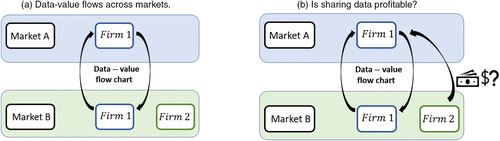
This paper tackles the questions mentioned above. Our core contribution is to identify a novel strategic rationale for why specialist firms may want to share data with their generalist rivals, even for free. We also show how generalists benefit from entry into secondary markets as it incentivizes specialist firms to share their data.
Formally, we model a “big-tech” generalist firm (firm 1) that operates in a primary market A and enters into a secondary market B. Market B features an incumbent firm 2 that only operates in this market (Figure 1(a)). If firm 1 could get firm 2’s market B data, it would improve both its market A and market B products. One might therefore expect incumbent firm 2 to be highly protective of its own proprietary data in market B. Counter to that intuition, we show that the specialist firm 2 can gain by granting the intruding generalist firm 1 access to all its data, including for free or even when sharing carries some cost for firm 2. The intuition is that for firm 2, giving a competitive gift (of its own market B data) to firm 1 (i) reduces the intensity with which 1 competes with 2 in market B (because investing in its own product directly is a more costly way to boost quality than harnessing extra data), due to which (ii) firm 2 faces a less competitive market B. Firm 1 now views firm 2 as a coopetitor in market B rather than a traditional competitor, because a higher demand for firm 2 translates into more data, a better product, and more revenue for firm 1 in market A.
The incentives our work reveals are particularly relevant given the current business and policy atmosphere around data sharing in general. Business-to-business (B2B) data sharing is becoming increasingly common and encouraged under a widespread recognition that leveraging data can improve products and services.4 European policymakers have even launched several public initiatives to foster B2B data sharing and improve the efficiency of data-intensive companies, in particular for firms in the same industry.5 Our results suggest that encouraging data sharing practices is in fact a way for policymakers to help small firms in the face of tech giants. Some companies have already designed data strategies that may at first seem counter-intuitive, but which can be explained by our results. For example, the smartwatch company Mobvoi, whose TicWatch Pro 5 smartwatch competes with Google’s Pixel and Sense smartwatches, requires users to accept Google Cloud Sync terms of service, including granting Google access to the data collected by Mobvoi.6 Consumers cannot opt out and must comply with Google accessing and using their data if they want to use the watch.7 Although in this case, sharing allows Mobvoi to use the servers of Google and provides a direct benefit to the firm, our results show that it can also induce a subtle underlying effect of coopetition that benefits both firms by softening competition between their products. As such, our analysis sheds new light on the motivations and implications of this type of partnership.
Given the widely acknowledged procompetitive aspects of data sharing (Graef and Prüfer 2021), our work shows there is a need for a nuanced view of the practice in the presence of cross-market externalities. Data sharing from a specialist to a generalist big-tech firm can be a win for both firms, but detrimental to customers.8 When the firms engage in coopetition, the less intense competition can make customers worse off through less investment in innovation and lower output.
Widening the scope of consideration, we also discuss how long-term competitive dynamics can be seen to weaken or strengthen these observations. On the one hand, if data fuel long-term innovation, data sharing may help the generalist firm to exclude its specialist rival from the market in the long run. On the other hand, as the specialist firm invests more in innovation when data are shared, this may also help its long-term growth. We discuss the possible interactions between the mechanism we identify and other effects in a broader context in Section 6.
Our results send a cautionary note to policymakers when it comes to the procompetitive effects of data and the benefits of data sharing practices for consumers. Although data sharing can enhance value creation, it can make consumers worse off when the reduction in competition overpowers the value-creation effect. Hence, an unintended anticompetitive effect may arise when firms implement such data sharing practices. This suggests that there is no such thing as a one-size-fits-all mandatory data sharing policy. Rather, our results suggest that policymakers should be especially cautious when it comes to data sharing in interrelated markets, in which case a small firm sharing its data with a competing conglomerate may be of concern. On the other hand, there is no such negative effect of data sharing on consumers when markets are independent, suggesting that data sharing practices there may create value and increase welfare in a more straightforward fashion.
2. Literature
2.1. Information Sharing
Scholars and practitioners have examined information sharing between firms for more than 50 years. A large theoretical literature analyzes whether competing firms have incentives to exchange information about market characteristics such as consumer demand and production costs (Raith 1996). Influential papers include Vives (1984) and Gal-Or (1985), which characterize when it is profitable for duopolists to share information about uncertain demand. With recent advancements in technologies such as machine learning and AI, consumer-level data are important inputs in digital markets, the sharing (or protection) of which has become a key subject for analysis. For example, Jones and Tonetti (2020) show that dominant firms may choose to hoard their data sets to preserve their competitive advantage. In contrast, Choe et al. (2024) study the incentives of firms to share data in a context where data are used to price discriminate. They show that a firm endowed with data on consumers would be willing to give certain data to a data-less competitor to soften price competition. In a similar spirit, Huang et al. (2020) show that sharing intellectual property can soften competition between firms when learning costs are sufficiently high. In contrast to these studies, we develop a model in which data are valuable across markets and firms are ex ante asymmetric: We study the incentive of specialist (single-market) firms to share data with their generalist (multimarket) rivals. We find that specialist firms may have incentives to share data with their generalist rivals as a strategic device to lower the intensity of competition.
2.2. Partial Ownership
By sharing its data, a specialist firm gives its competitor access to its assets, and for this reason our paper relates to the literature on partial ownership (O’Brien and Salop 1999, Gilo et al. 2006, Ederer and Pellegrino 2022, Hunold and Shekhar 2022, Antón et al. 2023). The competition reduction induced by partial ownership has received the attention of policymakers, and regulations have been formulated in response.
Our contribution is to show that, in contrast to partial ownership effects, both firms have higher profits when data are shared (via arrangements free of other obligations). As such, there is no loss for the specialist firm in sharing data per se, whereas partial ownership usually requires a firm to give away part of its control over its activities. Moreover, data sharing may not bear the contractual complexity of partial ownership and therefore may be particularly ripe for adoption by data management teams. In particular, partial ownership deals can be costly to establish and reverse, whereas data sharing can be more easily turned on or shut down.
From a regulatory perspective, although policymakers are usually wary of partial ownership practices, B2B data sharing has thus far seemingly slipped through the antitrust dragnet. Instead, it has had mostly the positive (surplus-generating) aspects highlighted, in places leading to an encouragement of the practice in general.9
2.3. Data-Driven Network Effects
We contribute to the emerging literature on the economic impacts of data-driven network effects (Gregory et al. 2021). Argenton and Prüfer (2012) consider those effects in the context of search engines and find they can lead to market tipping. Schaefer and Sapi (2023) also consider the search engine market and use real search engine query logs to empirically investigate the quality improvements from such effects. Prüfer and Schottmüller (2021) study the investment incentives of competing firms under data-driven network effects in a dynamic setting, including when data in one market can be leveraged in another. Unlike them, we model data-driven network effects as enhancing user experience, which we build on to study the interplay between competitive strategies and innovation decisions. The cross-market interaction encourages more innovation in the primary and secondary market by the generalist firm than if the two markets were not connected. Further, we allow competing firms to choose how much to invest directly in innovation via costly methods such as research and development (R&D).
2.4. Cross-Market Externalities
Our work also contributes to the literature on cross-market externalities where the positive impact of corporate diversification on firms’ profitability has been empirically established (Lang and Stulz 1994, Berger and Ofek 1995, Lins and Servaes 1999, Graham et al. 2002). The rationale for such a strategy is the resulting synergies that may stem from economies of scope in production and the uses of common distribution channels for different products within a firm, such as the Apple Store for Apple’s physical goods, or Google Play for mobile applications (Hill and Hoskisson 1987), or from innovation spillovers across related products (Baysinger and Hoskisson 1989). Additionally, Gomes and Livdan (2004) argue that diversification allows corporate firms to undertake potentially high-reward risky projects while securing a steady cash flow from other, more stable markets. In a similar spirit, we model competition between a large multimarket firm, and a smaller single-market competitor. This market structure is supported by empirical evidence of product diversification by digital giants, a strategy long analyzed in economics and management, back to Hill and Hoskisson (1987) and Shaked and Sutton (1990). We model synergies as the value generated from data collected in other markets, which activates a virtuous cycle of data-driven network effects, and contribute by studying the incentives and effects of a specialist firm to share its data with a generalist competitor.
3. Model
We study a game-theoretic model with two firms, i = 1, 2, and markets for two goods, A and B, with production costs set to zero for simplicity. Firm 1 is a monopolist in market A. Firm 2 operates in market B, which firm 1 enters. Firm 2 decides whether to share data with firm 1. Each firm then chooses how much to invest in product quality before finally choosing output.
Market A is governed by an (inverse) demand function (where is base quality, PA is price, and qA is quantity). We extend this in the following ways, representing two mechanisms for firm 1 to improve the value delivered to its users in market A. First, firm 1 can shift the demand curve up by vA via direct investments in innovation or operational expenditures such as customer support or service infrastructure, at cost . Second, it raises demand by using data from market B. This includes data generated by its own sales in market B, q1, and, if firm 2 shares, data from firm 2’s sales in B, q2. Let the indicator variable be one when firm 2 shares its data with firm 1 and zero otherwise.10 The total data available to firm 1 in market A are thus . Last, let be the rate at which a unit of data translates into higher willingness to pay of consumers, that is, the strength of the cross-market externality.11 With those features, firm 1’s inverse demand in A is
The last term gives the standard (linear) inverse relationship between price and sales.
Similarly, market B is governed by (where QB is the sum of outputs q1 and q2). (The intercept terms can be reformulated as (and ), where and (βB) can be interpreted as the average and spread of willingness to pay, respectively.12) Demand in market B is also adjusted for quality investments and, only for firm 1, an additional quality increment due to its data advantage.13 Firm 1 can use the data it generates from its sales in market A, qA, to improve its product in B, shifting demand by . The resulting demand expressions for each firm in market B are
We allow sharing data to be costly such that κ1 and κ2 are incurred, respectively, by firms 1 and 2 if firm 2 shares its data with firm 1. The costs can be positive, zero, or negative.14 Profits of firms 1 and 2 are
The timing of the game is as follows. At stage 1, firm 2 decides whether to share data with firm 1.15 At stage 2, firms simultaneously choose their investment levels vA, v1, and v2 in the markets they operate in. At stage 3, firms set outputs simultaneously. Last, profits are realized. We seek subgame perfect Nash equilibria. We present a summary of notations in Table 1.
|

Table 1. Notation Guide
| Variable | Interpretation |
|---|---|
| i | Index to represent firms . |
| PA | Inverse demand function of firm 1 in market A. |
| Pi | Inverse demand function of firm i in market B. |
| Base quality of products in markets A and B. | |
| θ | Productivity of data-driven network effect. |
| I(v) | Investment cost to reach innovation level v. |
| Φ = 1 when firm 2 shares its data with firm 1, Φ = 0 otherwise. | |
| κi | Cost of data sharing, incurred if Φ = 1. |
| Πi | Profit of firm i. |
| CSm | Consumer surplus in market . |
| βm | Output sensitivity of demand in market m. |
| qA | Output in market A. |
| qi | Output of firm i in market B. |
| vA | Innovation effort by firm 1 in market A. |
| vi | Innovation effort by firm i in market B. |
We impose the following technical restrictions.
For increased tractability we set , which implies .
The data externality is not too strong: .
The demand intercept terms are not too high: .
Restrictions 1 and 2 ensure the firms’ objective functions are concave. Restrictions 2 and 3 rule out uninteresting corner solutions in which firms reach all consumers in each market, yielding inelastic demands and shutting down strategic interactions. (In such a case, firm 2 does not share information because it does not sell anything and so does not collect any data.) In contrast, the interior solution case allows us to elicit the relevant interactions. We discuss our assumptions and probe our model’s robustness further in Section 5 and the Online Appendix.
Overall, our model can be seen to stack the odds against data sharing in equilibrium in at least two ways. Firstly, data shared by firm 2 allow firm 1 to attract more demand and collect more data in market A. Hence, data sharing also increases the competitiveness of firm 1 in market B through enhanced cross-market data externalities from A to B, and therefore sharing data could reasonably be thought to have a negative impact on firm 2. Secondly, we assume quantity (Cournot) competition because it is the most conservative setting for our data sharing result. This is because products are effectively identical from the perspective of consumers (because firms charge quality-adjusted prices), which a priori suggests a strong procompetitive effect of data sharing in market B, which could naturally be thought to reduce the firm 2’s willingness to share its data. (In line with this, our results also hold under price competition with (horizontally) differentiated products; see Section 5.2 and other extensions in our Online Appendix.)
4. Analysis and Results
4.1. Benchmark Case Without Entry
Before solving the model, consider a hypothetical benchmark case where firm 1 is present only in market A and does not enter market B at all, rendering the two markets separate and independent. In that setting, data sharing has no impact on firm 2, but it carries some advantage for firm 1. Hence, under these separate markets, firm 1 would be willing to pay some price (up to its gain from data sharing), whereas firm 2 would be willing to share data for any payment from firm 1. With this in mind, we return to our main setting where firm 1 enters market B, where we show that firm 2 is still willing to share its data with firm 1, even for free, despite the direct competitive threat it faces in market B.
4.2. Main Model
4.2.1. Output-Setting Stage.
The first-order conditions for the two firms’ output decisions are
Firms face the standard volume and margin tradeoff. In addition, firm 1 benefits, in each market, from increased margins due to the value it creates with data from the other market.
Solving simultaneously, the above system yields the equilibrium outputs as functions of the sharing decision and quality improvement levels (above base quality), denoted by and .16 Intuitively, as quality improvements increase consumers’ willingness to pay, firms produce more in the corresponding market, and so . Because of the cross-market data externality, as firm 1 invests more in quality (increasing output, which generates more data) in one market, its product in the other market also improves, boosting demand, so firm 1 produces more there too, that is, . In contrast, firms produce less when their rival invests more in quality. For example, if firm 1 invests more in market B, then it produces more in B, which increases the competitive pressure on firm 2 that responds by producing less because output choices are strategic substitutes. That is, we have the following relations:
Given these output choices, if we hold investments constant and suppose a positive cost of sharing for firm 2 (), then we find firm 2 should not share its data with firm 1.
(
Without responses in investment, data sharing by firm 2 returns to hurt it. Put differently, sharing is unprofitable if it does not affect investment decisions. This is because data sharing enhances firm 1’s value proposition in market A and, via cross-market data network effects, strengthens firm 1’s position in market B also. This lowers both firm 2’s output and profit, implying that firm 2 does not find it profitable to share its data (for free). This result lays some groundwork with which to view our contribution: Lemma 1’s punchline is reversed when one accounts for direct investments as an alternative (more costly) lever for firms to improve product quality.
4.2.2. Innovation-Setting Stage.
Substituting in the optimal output choices, we write the demand functions in terms of choices made at stages 1 and 2: , and . Firms set innovation levels to maximize profits:
Applying the envelope theorem to the first-order conditions, we obtain the following system:
The terms labeled direct effects are two classic and opposing forces. A unit increase in quality increases consumers’ willingness to pay and thus also the firm’s margins, boosting profits, but also requires costly investment. The strategic effects account for the rival’s reactions to quality improvements. Here, there are two opposing effects. First, the competitive effect represents the increased profitability for a firm in market B following its rival’s scaling back in market B. The second is the data sharing effect, triggered when firm 2 shares data (Φ = 1). This effect captures the decreased profitability of firm 1 in market A caused by the reduction in the amount of data available to it in A following firm 2’s contraction in market B (and the corresponding fall in data shared by firm 2). This effect dampens the incentive of firm 1 to invest in quality improvement when firm 2 shares data (Φ = 1). It is a manifestation of the transformation of the relationship between the firms from one of competition to one of coopetition. The strength of this effect determines whether firm 1 innovates more in market A or in market B. Solving these first-order conditions simultaneously yields the equilibrium quality improvement levels as function of firm 2’s sharing decision, , denoted by , and . Substituting the optimal investment choices at stage 2 into the optimal outputs as functions of quality improvement at stage 3 yields the equilibrium outputs , and , and equilibrium profits and .
4.2.3. Data-Sharing Stage.
Recall that data sharing by firm 2 generates a greater data advantage in market A. This allows firm 1 to collect more data in A, which it can then leverage to enhance its data advantage in B to the detriment of firm 2. Hence, for firm 2, sharing its market B data with firm 1 may seem to be self-sabotage. Contrary to this, we find the following result, as long as the direct costs of sharing data are not prohibitively high.17
(
If the cost of sharing is not too high, firm 2 shares its data with firm 1, increasing its profits relative to not sharing.18 Therefore, as those costs of sharing (transfer, handling, interpreting, etc.) fall over time, our result’s reach grows. By sharing, firm 2 transforms firm 1 from a competitor into a coopetitor. Firm 1 steps back in market B where firm 2’s increased data collection in market B benefits 1 in its monopoly market, A. To unpack the intuition, we examine the impact of firm 2 sharing data on equilibrium quality-investment and output choices.
(
In market A, the receipt of data from market B induces firm 1 to scale back its operations if cross-market externalities are sufficiently strong:
When firm 2 shares data the data sharing effect reduces firm 1’s incentive to invest in quality improvements in both markets because the data it receives from firm 2 substitutes for its own investments. Firm 2 optimally responds by increasing its investment (and output) in market B. The effects of data sharing on output largely follow those on quality improvement in B. Indeed, as data sharing lowers firm 1’s quality improvement efforts in B, its output in B also falls. Because output choices in B are strategic substitutes, firm 2 increases production, which is further enhanced by the increased investment by firm 2 in B. Together, the changes in investment and output in market B show how firm 1 accommodates its data sharing rival. Hence, data sharing is a way for firm 2 to soften the aggressiveness of its new competitor.
In market A, firm 1 faces fewer forces on its incentives to invest in quality improvements. The overall effect of data sharing there depends on the rate at which data translates into increased consumer willingness to pay, θ. When the externality is sufficiently low, , the data sharing effect is relatively weak, and firm 1 improves the quality of its product in market A, compensating for a reduction in quality improvements in market B. But when , the data sharing effect dominates and firm 1 invests less in quality improvements even in market A (and hence in both markets) when firm 2 shares its data. The results for output in A follow the effects on quality improvements levels in A. Specifically, when θ is high, in addition to lowering output in market B, firm 1 further lowers its investments level in A, softening the effect of the cross-market externality and lowering the quality of its product in market B. As a consequence, firm 2 prefers to share its data. This is the case when the direct costs of sharing for firm 2 are zero (), but because it strictly benefits from the sharing, it would also be willing to incur such costs () as long as they are not too high such that they wipe out the extra profits it makes from sharing.
4.2.4. Welfare Effects of Data Sharing.
It follows from Proposition 1 that industry profits are higher when firm 2 shares its data. The effect on consumers is less immediate. In our (quality-adjusted) Cournot setting, total output is a sufficient statistic to analyze consumer surplus variations in a given market: Consumers in a market are better off when the total output in that market rises. (We confirm this at the end of the Online Appendix.) Therefore, Corollary 1 tells us consumer surplus in market A falls when the cross-market externality is strong () and rises when it is not. Corollary 1 also tells us that when firm 2 shares data, firm 1 produces less in market B, whereas firm 2 produces more. Corollary 2 summarizes these intuitions.
(
Industry profit is higher.
Consumer surplus is (i) lower in market A if and only if and (ii) lower in market B.
4.2.5. Impact of the Generalist’s Entry in Market B.
Comparing the benchmark case to our main analysis (Sections 4.1 and 4.2), we can see how entry by firm 1 in market B impacts the data sharing decision of firm 2. Doing so, we uncover a novel rationale for market entry: Entering market B firm 1 prompts firm 2 to share data on more favorable terms. After firm 1’s entry in market B, firm 2 is no longer indifferent and instead gains from sharing data with firm 1. Combining these observations gives Proposition 2.
(
By being active in market B and exerting competitive pressure on firm 2, firm 1 prompts firm 2 to share its data because it softens competition in market B. After entry, firm 2 would pay a cost (up to some ) to share its data. This stands in stark contrast to the case without entry (Section 4.1) where firm 2 would need subsidizing to accept to share its data.19
4.2.6. Selling Access to Data.
We have thus far considered any costs of sharing as exogenous, but we need not. In practice, B2B sharing arrangements may entail payments between the firms involved, which can occur for instance in data marketplaces (Mišura and Žagar 2016). Proposition 1 reports that both firms do better when the specialist shares data with the generalist entrant, and, in the absence of costs, that both strictly benefit from the arrangement. That means, as also reported by Proposition 1, that both would be willing to suffer some cost in order to implement the arrangement. We therefore predict that, although we may observe no payment at all (sharing for free), our result is also consistent with (nonprohibitive) payments in either direction: from the specialist to the generalist or vice versa. Exactly which prices might be paid depends on numerous factors, including, for example, the relative bargaining power of the players. If we expect the generalist to be the more powerful negotiator, then we could see (and our results allow for) the specialist paying to share its data. However, neither firm can extract without limit. The paying firm is only willing to part with an amount up to the increase in profits it expects post sharing.
5. Robustness
In this section, we present several extensions to probe the robustness of our model. We consider (i) partial data sharing; (ii) price competition; (iii) same-side network effects; (iv) heterogeneous cross-market externalities; and (v) two generalist firms.20 We also omit the direct costs of sharing data from the presentation, that is, set . For the robustness of our main result this is without loss because we will (continue to) find that firm 2 has a strict incentive to share data with firm 1 and hence would do so for sufficiently small but positive costs too.
5.1. Data Sharing Choice
To now, we presented a setting with a binary sharing decision by firm 2. Specifically, firm 2 decides either to share all its data or none. In this extension, we allow firm 2 to share only a portion of its data and will find that its profits increase in the proportion it shares. This shows that it our restriction to sharing either all or nothing in our main analysis was without loss of generality. Formally, let be the portion of data firm 2 is willing to share, such that is the total amount of data shared by firm 2. A positive value less than 1 reflects for instance that firm 2 withholds certain subsets of data from firm 1.
At stage 1, firm 2 chooses to maximize its profit:21
In our model, firm 2 strictly prefers to share more data than less. Therefore, if it is profitable for firm 2 to share any data, then it is profit maximizing for it to share all its data.
(
As in our main analysis with all-or-nothing sharing, if there are costs to data sharing, then those costs must not be so high as to outweigh the benefit. However, when we see data sharing in equilibrium, Proposition 3 shows that it will be complete. This highlights the strength of the mechanism we revealed. Firm 2 benefits from the coopetitive relationship that data sharing installs and benefits increasingly in the amount of data it shares with firm 1.
5.2. Differentiated Bertrand Competition
Our main model features classic Cournot competition so that once firms set their quality-adjusted prices, products are perfect substitutes from perspective of consumers. Our insights about data sharing also hold for horizontally differentiated products. We show this with a demand system arising from the well-known Hotelling set-up in which firms choose prices. There is a unit mass of consumers in each market. In market A, their valuations are distributed according to an outside option, :
In market B, the generalist firm 1 and the incumbent specialist firm 2 compete to attract consumers who are distributed uniformly on a unit-length Hotelling preference line. Firm 1 is located at zero and firm 2 is located at one.
The utility of a consumer of type x from firm 1 and 2’s products are, respectively,
Demands are constructed by identifying the consumer indifferent between buying from firm 1 or firm 2, denoted as , that is, . Thus, in this framework, we can represent the demands as22
Note that consumer demands are now directly affected by the value generated from data collected in market A. Specifically, as the data collected in market A increases, the demand for firm 1’s product increases, whereas the demand for firm 2’s product decreases. This direct effect of data on demand for the product of the two firms is a novel feature of this demand system that was absent in our main, Cournot, setting. The profits of the firms are calculated as before:
The timing of the game is as follows: (i) firms set investments v1, vA, and v2; (ii) firms set prices p1, pA, and p2; and (iii) consumers form expectations on the value generated by data then decide whether to buy. Expectations are assumed to be correct in equilibrium as usual. To address out-of-equilibrium cases, we assume expectations are “responsive” in the sense that they are correct for any choices of firms at prior stages. We impose the following technical restrictions.
The value of cross-network data externality θ is sufficiently low, .
The transportation cost parameter is intermediate, .
These restrictions ensure that the firms’ problems are concave and that we get an interior solution. In particular, under these conditions, market A is not covered so that the demand is elastic and the generalist firm invests in innovation and benefits from the data of the specialist firm. On the contrary, market B is covered and firms compete in this market. These differences do not undo the forces behind our main result, and in our detailed analysis in the Online Appendix, we show that firm 2 prefers to share data with firm 1, , as per our main result.
5.3. Same-Side Data Externalities
The mechanism we reveal with our main model relies on the presence of cross-market externalities. Same-side network effects may of course also exist such that a product improves when there is more consumer data generated from a product’s own use. In this section, we show that our main result is qualitatively unaffected with the addition of same-side network effects.
Consider the following demand system:
The first is a “neutral” or “balanced” case, in which data from market A are equally helpful as those from B for product enhancement, that is, . In a second natural case of interest, we consider data from the same market to be more helpful for product development, . In both cases, our main result prevails: firm 2 strictly prefers to share its data.
The presence of an intramarket externality in market B incentivizes firms to produce more. All else equal, a firm producing more would typically lower the market price (and this still happens in our model because σ must be sufficiently small to produce well-defined solutions) but the product enhancements raise consumers’ willingness to pay, which encourages higher prices. Overall, this makes price less sensitive to output, and so output in market B increases in σ. This increases the importance of a firm’s own market B production in its total profits.
This does not overturn the willingness of firm 2 to share its data, because doing so still prompts firm 1 to accommodate firm 2 in B. In particular, the effects described by (11) persist. As such, the mechanism we uncover is present in the face of the intramarket externality. However, an increase in its strength (σ) reduces the extent to which firm 1 accommodates firm 2, and as such, firm 2’s profit falls with σ. Overall, the intramarket externality reduces the potency of the forces we identify with our main result but does not overturn them.
5.4. Heterogeneous Cross-Market Externalities
Our contribution relies crucially on cross-market externalities, the strength of which is represented by : the rate at which data from sales of one product translate into a higher willingness to pay for another product. We assumed the rates at which data from market A affects product B, and vice versa, to be equal. This is inaccurate when data from A are more useful in improving product B than data from B are in improving product A, or vice versa, or, when the rate at which a company can take advantage of data is different for data sourced internally (as is the case for firm 1) versus externally (when firm 2 shares with firm 1).24
To address this, here we consider asymmetric cross-market externalities. Namely, data collected in market A and shared in B induce an externality proportional to θA, whereas data collected in B and shared in A induce an externality proportional to θB, which gives demands
As we detail in the Online Appendix, different cross-market externalities do not change our model’s qualitative results. What matters for the mechanism we revealed is that data from one market improve quality in the other, that is, that , not the relative rates at which they do so.
5.5. Two Competing Generalist Firms
In the baseline model, the specialist firm faces one generalist competitor. We now show that the core effects at play when firm 2 decides to share its data remain unchanged with two generalist firms.
The two generalist firms are indexed as firms 1 and 3, whereas the specialist remains indexed as firm 2. Indicators and capture the decision of firm 2 to share data with firm 1 and firm 3, respectively (as before, a value of one indicates data are shared). The total outputs are now in market A and . The inverse demand functions in markets A and B are
The resulting profits of the firms can be written as
We focus our discussion on the decision of firm 2 to share its data and on the willingness of the generalist firms to accept the data. Denote by , and , respectively, the profits of firms 1, 2, and 3 depending on whether firm 2 shares its data with firm 1 and firm 3.
In the Online Appendix, we prove that the specialist firm shares its data with both generalists. To do so, we first confirm that firm 2 is willing to share its data with both competitors:
Note that sharing data with one of the firms, and not the other, is less profitable for firm 2 than sharing data with both generalist firms. It remains to show that both generalist firms are willing to accept the data. Compared with a situation in which neither generalist firm has data from firm 2, it is profitable for a generalist to accept the data:25
The effects at play are as in our main analysis. Sharing incentivizes generalist firms to accommodate the specialist by lowering their output in market B. This prompts firm 2 to expand and share more data, and the fact firms compete in market A does not remove this effect.
6. Implications and Discussions
6.1. Managerial Implications
In general terms, our work highlights the importance for data-driven companies to put data governance at the center of their business models and to acknowledge the strategic role of data.
When a large firm enters a new market, to benefit from cross-market data externalities, it may be profitable for a smaller incumbent to share its data with it, even for free. Data sharing can be a strategic device to lower the multimarket firm’s aggressiveness.
With this point, we offer stark and a priori counter-intuitive advice to managers of specialist firms. Sharing value-enhancing data with a multimarket rival can in fact afford some breathing space, potentially much needed in today’s competitive digital landscape. Specifically, our results show that data sharing can make even a formidable rival a less aggressive competitor because it makes them internalize the value of the data shared with them.
Turning to generalist firms, our advice may also run counter to first instincts.
A generalist (multimarket) firm can increase its overall profit by giving up market share to a specialist (single-market) rival when the specialist shares its data.
Giving up market share is of course poor advice in isolation, but our work shows that doing so in one market can be more than compensated by increased profits in another. When a specialist is willing to share their data, it may be profitable to respond by accommodating the rival because it increases the flow of data that can be used to increase the value proposition to customers. The increased data collection substitutes for more costly investments, improving bottom lines.
Last, we propose a new consideration for firms considering entry into new markets.
Entry into a market for which data are related to the firm’s existing operations can result in more favorable data sharing agreements with incumbent specialist firms.
This suggests that firms should explore opportunities in data-relevant markets. In addition to collecting relevant data, their presence in a new market also gives them the leverage to negotiate more favorable terms for data sharing with incumbent specialist firms. This shows a new source of value to establishing a subsidiary in data-relevant markets and therefore constitutes a new strategic rationale for entry in the presence of cross-market externalities.
6.2. Policy Implications and Regulation
Recognizing the importance of data as a competitive advantage, there is a growing policy and academic discussion on optimal regulation in the presence of data-driven network effects (Afuah 2013, European Commission and Directorate-General for Competition et al. 2019, Tucker 2019, Parker et al. 2021, Prüfer and Schottmüller 2021, Krämer and Schnurr 2022, Hagiu and Wright 2023, Krämer and Shekhar 2025, Rhodes et al. 2025).
We predict that by sharing its data, the specialist firm boosts its sales and profits due to the strategic retreat of the generalist firm in that market. In general terms, we show data sharing to be a form of “puppy-dog” strategy by specialists that softens the aggressiveness of “fat cat” generalists (in the spirit of Fudenberg and Tirole (1984)).
Both firms in our model profit from data sharing. To competition authorities, information exchange between firms is a classic signal of collusion (Clarke 1983, Kandori and Matsushima 1998, Cason and Mason 1999, Awaya and Krishna 2016). But in our setting, data sharing softens competition without any explicit collusion. Also, of course, data sharing can unleash economies of scope and provide benefits across markets—a message well received by policymakers. For example, the European Commission (2022) reports the following:
“As data are a non-rivalrous resource, it is possible for the same data to support the creation of several new products, services or methods of production. So, companies can engage with the same data in different arrangements with other [companies] or the public sector. This way, the value resulting from the data can be fully exploited.”
Those benefits seem undeniable (and are captured by our model’s externalities). In line with that general and positive sentiment, in our analysis, firms benefit from sharing and the increased data availability leads to improved products and services. Those improvements increase the total surplus available and may yield further beneficial effects outside the scope of our study.
Yet, the benefits will remain unrealized if firms are resistant to data sharing. With a view to unlocking the gains from sharing, reports such as that by the European Commission (2020a) emphasize when it may harm the sharer and constitute a market failure.26 To those points, our analysis shows data sharing to be an important strategic decision for firms that can be mutually profitable for both sharer and receiver, even when they have asymmetric market positions.
Data sharing can reduce market concentration and enhance the market share of smaller specialist firms.
Data sharing is a double-edged sword for policy. On the one hand, it encourages generalist firms to accommodate specialists, which increases the specialist’s investments in innovation. On the other hand, it lowers consumer surplus as investment intensity drops and firms fall into a coopetitive relationship. This presents a dilemma for policymakers and data sharing policies should acknowledge that increased market share of specialist firms in market B does not imply fiercer competition.
When a specialist (single-market) firm shares its data with a generalist competitor that operates in two markets, consumer welfare can fall in the market in which they compete. Consumer welfare can also fall in the primary market of the generalist.
Finally, our results suggest that reduced competition caused by data sharing can carry long-term implications. This follows from the lower innovation intensities data sharing prompts.
Data sharing may lower innovation in both markets when the value of intermarket data are high.
The negative impacts of data sharing we reveal call for caution over recent regulations such as the European Commission’s Data Act,27 in which Chapter II standardizes data access between firms, and the proposed Data Governance Act,28 which aims to facilitate B2B data exchanges.
Another issue intimately related to data sharing and often near the top of the list of concerns is that of consumer privacy. For example, limits on information-sharing practices are included in the California Consumer Privacy Act and the European General Data Protection Regulation.29 That said, technological advances are providing an increasing number of privacy-preserving data sharing solutions, which may reduce the tension between privacy and data sharing.30 When firms cannot share data, our work suggests that consumers can in fact benefit not (only) from privacy protection, but from more intense competition between firms.
In sum, our insights present tensions for policy. It is not within the scope of our analysis to provide a complete resolution to these tensions, and these markets and the associated technologies continue to develop rapidly. But our analysis does show that any blanket support for B2B data sharing would seem misguided. More generally, we hope to bring the competitive consequences of cross-market data sharing agreements to the forefront of the debate.
6.3. Antitrust Issues: Exits and Acquisitions
Entry of a generalist firm into a secondary market may be followed by market changes that alter that firm’s objectives. If market B becomes larger or more lucrative over time, firm 1’s objectives might well shift to full domination of B and threaten the survival of firm 2. Our analysis thus far assumes a one-shot game featuring data sharing and competition, in which data sharing is shown to be a source of coopetition. One topic for further research is to consider how the forces we identify interact with features relevant to a more dynamic competitive setting. Here we discuss two central factors that may impact the willingness of firms to share: uncertainty over long-term profits and mergers and acquisitions.
6.3.1. Innovation and the Possibility of Exit.
Consumer data are typically used to better direct innovation and understand future trends. In an environment where each firm is uncertain about its future production and innovation costs, access to large amounts of consumer data can allow a firm to reduce future uncertainty and lower the chance of exit while increasing its own dominance and potentially increasing rivals’ rate of exit. In this case, would a specialist still be willing to share its data if its larger rival could use them in the long run to cement its dominance and force the specialist out of business?
Although a technical analysis of the long run is outside the scope of this article, we discuss some of the different factors at play in light of our results. On the one hand, if data allow a firm to lower its production costs over time, a small firm could be reluctant to share its data and increase the chances of being pushed out of the market by an increasingly efficient rival. On the other hand, we showed that a specialist firm innovates more when it shares its data, whereas the generalist rival invests less. These shifts in investment may have long-lasting positive impacts on the profits of the specialist firm, even in current markets where the most valuable data are short lived or only useful for a very short amount of time (Chiou and Tucker 2017, Hagiu 2020). In other words, short-lived data can substitute for long-term investment strategies and shape the future competitive nature of the market. Hence, the willingness of a specialist to share data when it accounts for such competitive dynamics crucially depends on the respective importance of data and investments in innovation on future production costs and expected profits.
6.3.2. Mergers and Acquisitions.
A second and related factor is acquisitions, which are commonly carried out by big-tech generalist firms. Moreover, some smaller or specialist companies seem, from their inception, to wish to be acquired (e.g., because of pressure from their investors). For these specialist firms, sharing their data with a generalist can be valuable for various reasons. First, it helps the generalist better assess the value generated by the data generated by the firms they want to acquire. Second, sharing data increases the specialist’s profits, which could in turn increase the acquisition price paid (benefiting investors).
From an antitrust perspective, we highlight two points regarding acquisitions and data sharing in the presence of cross-market externalities. Firstly, specialist firms may be acquired specifically to be shut down (because they may pose future threats), which is often referred to as “killer acquisitions.” However, if data from the acquired firm’s market are valuable due to cross-market externalities, the acquired firm is less likely to be shut down after being acquired. Secondly, after an acquisition the generalist may have stronger incentives to stifle entry and minimize future competition in the secondary market. To do so, the generalist may choose to expand its presence in that market, a strategy well known as the fat cat effect, to discourage entry and preserve its data collection ability. However, such a strategy is costly as it requires output expansion beyond the profit maximization level, and more so if entry costs are low. Even if such a strategy is profitable, it is unclear if total consumer surplus across the two markets decreases because the data collected, following the output expansion, will benefit consumers in the generalist’s primary market. The gains in value from such a strategy must be balanced with any losses due to reduced competition in the secondary market and the sum of the opposing effects is unclear a priori. This line of reasoning suggests at least one way in which policymakers should be circumspect when designing policies for such contexts.
7. Concluding Discussion
Business-to-business data sharing is increasingly common. In contrast to oft discussed advantages like information synergies and value creation, we unveil a new strategic rationale for B2B data sharing in the presence of cross-market externalities. We show that specialist (single-market) firms can use data sharing arrangements to mitigate competition by transforming generalist (multimarket) competitors into cooperative partners (coopetitors). This strategy allows small incumbent firms to better cope with the entry of large generalist competitors.
However, we caution that the approach may not always yield such positive outcomes for specialists, and managers need to discern the conditions under which such data sharing is profitable. Specifically, if data sharing fails to diminish the aggressive nature of a multimarket rival, then the smaller firm may find sharing data unprofitable. This is particularly true in scenarios where the technology is already mature, and there is limited potential for medium-term quality improvements. In such cases, smaller firms may refrain from data sharing, as their investments would have a negligible impact on reducing the aggressiveness of the dominant firm in the market they compete in.
We hope our work can be used and built on to further explore how data sharing affects market outcomes. One direction we discussed is to consider richer competitive dynamics. For instance, consider the incentives of multimarket firms to acquire specialist competitors (especially relevant given how many acquisitions occur in digital markets). On the one hand, data sharing may help firms better anticipate the value of information synergies resulting from a merger (Dubus and Legros 2022) and increase the overall value of mergers and acquisitions. On the other hand, after data are shared, the benefits of a merger are reduced compared with the no-sharing case in which firms compete head-to-head. Once data are shared, as we have shown, firms may compete less aggressively. This lowers the competition-reducing profit-gains of a merger in the case data were already shared before the merger (vis-á-vis no sharing before the merger). This suggests that after data are shared, firms are more likely to merge for efficiency gains than to weaken competition, an issue relevant to firms and regulators alike.
The authors thank participants at the 2022 Workshop on Information Systems and Economics, the Paris Digital Economics Seminar, the 2022 Workshop on Platforms at the National University of Singapore, the Joint Research Center Economic Seminar, and the 2023 Swiss Society of Economics and Statistics Annual Conference. The authors contributed equally and are listed in alphabetical order.
Appendix. Proofs for the Main Model
In this appendix, we prove the results of our main model, introduced in Section 3. In doing so, we also provide the exact expressions behind the terms we referenced in the main text.
Differentiating the profit of firm 1 with respect to qA and q1 and the profit of firm 2 with respect to q2 yields the following system of first-order conditions:
Solving yields the equilibrium output choices as functions of sharing and investment decisions:
Firms choose investments to maximize profits:
Applying the envelope theorem to the first-order conditions gives Equations (9) and (10). Solving gives the equilibrium quality improvement levels as functions of sharing decision :
Similarly, equating the profit of firm 1 under data sharing to none and solving for κ1 yields
Comparing the equilibrium investment of firm 1 in market B under data sharing with its investment without data sharing, we find
The results follow from the arguments made in the main text. □
1 See Klein et al. (2025) for a discussion of how data is a key input in improving the quality of search results. Via a large-scale experiment, Lei et al. (2023) demonstrate the complementary value of cross-market data. They show a query autocomplete company’s click-through rate rises about 5% with access to (another firm’s) search-engine data. They review several other empirical studies showing the benefits of cross-market data sharing.
2 See, for example, “Financial Times announces strategic partnership with OpenAI” (accessed April 29, 2024, https://aboutus.ft.com/press_release/openai).
3 See “iPhone Designer Jony Ive and OpenAI’s Sam Altman Reportedly Working on a Top-Secret AI Device” (last accessed November 7, 2024, https://www.cnet.com/tech/mobile/iphone-designer-jony-ive-and-openai-ceo-sam-altman-working-on-a-top-secret-ai-device/).
4 A report by the European Commission (2018) points to a large and sharply increasing practice of B2B data sharing in general: Of the companies surveyed, 37% share data, and 14% share more than 50% of the data they generate, including 2% of companies that generate more than 1 PB/month—figures the report emphasizes are rapidly increasing. Speaking to the expected growth in sharing, the European Commission (2020b) will, over 2021–2027, invest in European data spaces and federated cloud infrastructures, as part of the European Strategy for Data. There is also an emerging industry of firms that facilitate and support such B2B data sharing (see, e.g., StartUs Insights: https://www.startus-insights.com/innovators-guide/discover-5-top-data-sharing-startups-scaleups/, accessed January 19, 2023).
5 For example, projects GAIA X (https://www.bmwk.de/Redaktion/EN/Dossier/gaia-x.html, accessed February 13, 2024) and Catena-X (https://catena-x.net/en/, accessed August 22, 2024). Cross-industry data sharing practices have also recently been recommended in the Draghi report to enhance competitiveness (https://commission.europa.eu/topics/strengthening-european-competitiveness/eu-competitiveness-looking-ahead_en, accessed September 24, 2024).
6 This includes, for instance, information on personal characteristics such as gender or age, or even traffic or geolocalization data on consumers that can help Google optimize services such as Nest or Waze. Even though under data protection regulations such as the GDPR in Europe Mobvoi could potentially require a contract to limit the use of these data (for instance to avoid improvement of Google’s product that competes directly with Mobvoi), Mobvoi’s product in fact only functions with the transfer of Mobvoi data to Google.
7 See “Mobvoi TicWatch Pro 5 review: timing is everything,” for details (accessed September 24, 2024, https://www.theverge.com/23733359/mobvoi-ticwatch-pro-5-review-wear-os-3-smartwatch-wearables).
8 The win-win result in our baseline model means both firms 1 and 2 earn (strictly) greater profit when 2 shares its data with 1. This implies that firm 2 strictly prefers to share its data, which means it would do so for free, but also at a cost; that is, it would even pay to give firm 1 access to its data (and of course it would also gladly accept payment for access too; we explore these points further at the end of Section 4.2).
9 These policy recommendations include the European Data Governance Act and the Data Act (which can be accessed, respectively, at https://ec.europa.eu/commission/presscorner/detail/en/ip_22_1113 and https://digital-strategy.ec.europa.eu/en/policies/data-governance-act).
10 Focusing on firm 2 sharing all (or no) data is without loss of generality. In Section 5.1, we show that firm 2’s profit is increasing in the amount of data it shares when it can share any fraction of it, that is, with .
11 For our main model, we consider identical θ identical from market A to B and vice versa with no intramarket externalities. We provide extensions without those assumptions in Section 5.
12 We provide a corresponding microfoundation for this interpretation in our Online Appendix.
13 Note that data collected in a market can of course have a direct (or same-side) effect of creating value in that market itself. We abstract from such effects for our baseline model because they are not necessary for our main results to hold. We instead expand the model to incorporate these effects in Section 5.3.
14 Positive costs reflect any additional resources needed to transfer, interpret, or handle the data. They could also reflect technical costs to establish the data sharing connection between both firms (Legenvre and Hameri 2024). Negative costs reflect a subsidy. Naturally, these can also include any opportunity costs (or savings) of sharing. For now we treat the costs as exogenous. At the end of Section 4.2, we drop the exogeneity of these costs and interpret and discuss these costs as prices agreed between the firms in exchange for the data. Our results are also robust to alternative cost specifications, such as costs that vary with the total amount of data shared and .
15 Decisions to share follow long term strategy plans, and are typically made much less frequently than product updates or pricing decisions (see “Building A Lasting Data Management Strategy Requires A Data-First Mindset”; accessed November 7, 2024, https://www.forbes.com/councils/forbestechcouncil/2023/12/15/building-a-lasting-data-management-strategy-requires-a-data-first-mindset/). We will show (in Lemma 1) that firms do not share data if the sharing decision comes after investments. Thus, the timing we consider (firms first settling their data sharing arrangement) is better for profits, and therefore we provide theoretical grounds for data-first strategies.
16 The terms we reference in the text are fully written out in appendix’s proofs of Lemma 1 and Proposition 1.
17 As laid out in the proof of Proposition 1 in Equation (A.36), each firm i = 1, 2 has a critical cost threshold, , above which the cost of data sharing outweighs the benefit. For brevity, the lower of these two thresholds, , is reported in the formal statement of the result.
18 Krämer et al. (2019) discusses voluntary social login adoption by specialist content providers when competing for advertising revenues with a generalist content provider.
19 This result may explain the relationship between Microsoft and OpenAI and the note-taking app Notion. With its rapid success, OpenAI entered into discussion with Notion to access its note data. A few weeks after these firms disclosed they were working together, Microsoft launched a product competing with Notion, Microsoft Loop. Our result allows us to understand this launch (and its timing) as a way for Microsoft-OpenAI to prompt Notion to share its data on more favorable terms. See “Notion’s now letting anyone use its AI features,” accessed February 17, 2025, https://www.theverge.com/2023/2/22/23610773/notion-ai-general-release-pricing and “Microsoft officially launches Loop, its Notion competitor,” accessed February 17, 2025, https://www.theverge.com/2023/11/15/23959801/microsoft-loop-launch-notion-competitor.
20 Proofs are in the Online Appendix; we also combine (ii) and (iii) along with further extensions.
21 This is the same objective function as in our main analysis of Section 4.2, written out in (A.32) in appendix, except that now a richer choice of is permitted. The starred (optimal-response) quantities and investments (and implied prices) used in the main analysis can also be used here.
22 In this extension, consumers form an expectation on participation by other consumers before joining, which determines their willingness to pay for the product. We discuss this rational expectation assumption in the Online Appendix, where we show that we can use it also for the main model, as an alternative to our current modeling choice.
23 One could also consider the case where data shared by firm 2 can be used by firm 1 in market B (although this case may be more likely to be subject to regulatory scrutiny). We pursue this in our Online Appendix and find that our result of free data sharing holds when the value of data across markets is sufficiently high. Nevertheless, if firms can contract for data, data sharing is more likely to happen even if the value of data across markets is not high but large enough to justify the costs associated with sharing.
24 This is the case, for example, in Baldwin (2024), who models a one-way externality.
25 Also, when one generalist receives data, the other benefits too:
26 Related to our work, that report points out an incentive for firms to share data across markets when goods are complements (European Commission 2020a, pp. 20–21).
27 See https://digital-strategy.ec.europa.eu/en/policies/data-act, accessed November 7, 2022.
28 See https://eur-lex.europa.eu/legal-content/EN/TXT/?uri=celex:52020PC0767, accessed November 7, 2022.
29 See https://theccpa.org/ and https://gdpr.eu/, both accessed September 27, 2022.
30 See, for example, the Deloitte Insights 2022 report here: https://www2.deloitte.com/xe/en/insights/focus/tech-trends/2022/data-sharing-technologies.html, accessed January 19, 2023.
References
- (2013) Are network effects really all about size? The role of structure and conduct. Strategic Management J. 34(3):257–273.Crossref, Google Scholar
- (2023) Common ownership, competition, and top management incentives. J. Political Econom. 131(5):1294–1355.Crossref, Google Scholar
- (2012) Search engine competition with network externalities. J. Competition Law Econom. 8(1):73–105.Crossref, Google Scholar
- (2016) On communication and collusion. Amer. Econom. Rev. 106(2):285–315.Crossref, Google Scholar
- (2024) Design Rules, Volume 2: How Technology Shapes Organizations (MIT Press, Cambridge, MA).Crossref, Google Scholar
- (1989) Diversification strategy and R&D intensity in multiproduct firms. Acad. Management J. 32(2):310–332.Crossref, Google Scholar
- (1995) Diversification’s effect on firm value. J. Financial Econom. 37(1):39–65.Crossref, Google Scholar
- (1999) Information sharing and tacit collusion in laboratory duopoly markets. Econom. Inquiry 37(2):258–281.Crossref, Google Scholar
- (2021) Can the EU regulate platforms without stifling innovation? Harvard Bus. Rev. (March 1), https://hbr.org/2021/03/can-the-eu-regulate-platforms-without-stifling-innovation.Google Scholar
- (2017) Search engines and data retention: Implications for privacy and antitrust. NBER Working Paper No. 23815, National Bureau of Economic Research, Cambridge, MA.Google Scholar
- (2024) Softening competition through unilateral sharing of customer data. Management Sci. 70(1):526–543.Link, Google Scholar
- (1983) Collusion and the incentives for information sharing. Bell J. Econom. 14(2):383–394.Crossref, Google Scholar
- (2022) The sale of data: Learning synergies before M&As. CEPR Discussion Paper No. 17404, CEPR Press, Paris.Google Scholar
- (2022) A tale of two networks: Common ownership and product market rivalry. NBER Working Paper No. 30004, National Bureau of Economic Research, Cambridge, MA.Google Scholar
European Commission (2018) Study on data sharing between companies in Europe: Final report. Accessed November 16, 2023, https://op.europa.eu/en/publication-detail/-/publication/8b8776ff-4834-11e8-be1d-01aa75ed71a1/language-.Google ScholarEuropean Commission (2020a) Business-to-business data sharing: An economic and legal analysis. Working paper, European Commission, Brussels.Google ScholarEuropean Commission (2020b) A European strategy for data. Accessed November 17, 2023, https://eur-lex.europa.eu/legal-content/EN/TXT/?uri=CELEX%3A52020DC0066.Google ScholarEuropean Commission (2022) Guidance on private sector data sharing. Accessed January 19, 2023, https://digital-strategy.ec.europa.eu/en/policies/private-sector-data-sharing.Google Scholar- European Commission and Directorate-General for Competition, de Montjoye Y-A, Schweitzer H, Crémer J (2019) Competition Policy for the Digital Era (Publications Office, Luxembourg).Google Scholar
- (1984) The fat-cat effect, the puppy-dog ploy, and the lean and hungry look. Amer. Econom. Rev. 74(2):361–366.Google Scholar
- (1985) Information sharing in oligopoly. Econometrica 53(2):329–343.Crossref, Google Scholar
- (2006) Partial cross ownership and tacit collusion. RAND J. Econom. 37(1):81–99.Crossref, Google Scholar
- (2004) Optimal diversification: Reconciling theory and evidence. J. Finance 59(2):507–535.Crossref, Google Scholar
- (2021) Governance of data sharing: A law & economics proposal. Res. Policy 50(9):104330.Crossref, Google Scholar
- (2002) Does corporate diversification destroy value? J. Finance 57(2):695–720.Crossref, Google Scholar
- (2021) The role of artificial intelligence and data network effects for creating user value. Acad. Management Rev. 46(3):534–551.Crossref, Google Scholar
- (2020) When data creates competitive advantage. Harvard Bus. Rev. 98(1):94–101.Google Scholar
- (2023) Data-enabled learning, network effects, and competitive advantage. RAND J. Econom. 54(4):638–667.Crossref, Google Scholar
- (1987) Strategy and structure in the multiproduct firm. Acad. Management Rev. 12(2):331–341.Crossref, Google Scholar
- (2020) Altruism or shrewd business? Implications of technology openness on innovations and competition. MIS Quart. 44(3):1049–1072.Crossref, Google Scholar
- (2022) Supply chain innovations and partial ownership. Rev. Industrial Organ. 60(1):109–145.Crossref, Google Scholar
- (2020) Nonrivalry and the economics of data. Amer. Econom. Rev. 110(9):2819–2858.Crossref, Google Scholar
- (1998) Private observation, communication and collusion. Econometrica 66(3):627–652.Crossref, Google Scholar
- (2025) How important are user-generated data for search result quality? J. Law Econom. Forthcoming.Google Scholar
- (2022) Big data and digital markets contestability: Theory of harm and data access remedies. J. Competition Law Econom. 18(2):255–322.Crossref, Google Scholar
- (2025) Regulating digital platform ecosystems through data sharing and data siloing: Consequences for innovation and welfare. MIS Quart. 49(1):123–154.Crossref, Google Scholar
- (2019) Winners, losers, and facebook: The role of social logins in the online advertising ecosystem. Management Sci. 65(4):1678–1699.Link, Google Scholar
- (1994) Tobin’s q, corporate diversification, and firm performance. J. Political Econom. 102(6):1248–1280.Crossref, Google Scholar
- (2024) The emergence of data sharing along complex supply chains. Internat. J. Oper. Production Management 44(1):292–297.Crossref, Google Scholar
- (2023) Trade-offs in leveraging external data capabilities: Evidence from a field experiment in an online search market. Management Sci. Accepted.Google Scholar
- (1999) International evidence on the value of corporate diversification. J. Finance 54(6):2215–2239.Crossref, Google Scholar
- (2021) Blocking without breaking: Identification and mitigation of non-essential IoT traffic. Preprint, submitted May 11, https://arxiv.org/abs/2105.05162.Google Scholar
- (2016) Data marketplace for internet of things. Proc. Internat. Conf. Smart Systems Tech. (IEEE, Piscataway, NJ), 255–260.Google Scholar
- (1999) Competitive effects of partial ownership: Financial interest and corporate control. Antitrust Law J. 67:559.Google Scholar
- (2021) Platform mergers and antitrust. Industrial Corporate Change 30(5):1307–1336.Crossref, Google Scholar
- (2021) Competing with big data. J. Industrial Econom. 69(4):967–1008.Crossref, Google Scholar
- (1996) A general model of information sharing in oligopoly. J. Econom. Theory 71(1):260–288.Crossref, Google Scholar
- (2019) Information exposure from consumer IoT devices: A multidimensional, network-informed measurement approach. Proc. Internet Measurement Conf. (ACM, New York), 267–279.Google Scholar
- (2025) Digital ecosystems and data regulation. Working paper, Toulouse School of Economics, Toulouse, UK.Google Scholar
- (2023) Complementarities in learning from data: Insights from general search. Inform. Econom. Policy 65:101063.Crossref, Google Scholar
- (1990) Multiproduct firms and market structure. RAND J. Econom. 21(1):45–62.Crossref, Google Scholar
- (2019) Digital data, platforms and the usual [antitrust] suspects: Network effects, switching costs, essential facility. Rev. Industrial Organ. 54(4):683–694.Crossref, Google Scholar
- (1984) Duopoly information equilibrium: Cournot and Bertrand. J. Econom. Theory 34(1):71–94.Crossref, Google Scholar