Does Personalized Pricing Increase Competition? Evidence from NIL in College Football
Abstract
We investigate the impact of personalized pricing through Name, Image, and Likeness (NIL) rights within college athletics on the recruitment of high school football players by college programs. We focus on whether the new policy disrupts competitive balance by increasing the concentration of talent among top-ranked institutions. Using a data set that encompasses pre- and post-NIL recruitment patterns to examine the distribution of 3, 4, and 5* recruits at college football programs, we find a notable increase in the dispersion of talent. Contrary to the hypothesis that NIL would lead to a “rich get richer” dynamic, we observe a tendency for lower-ranked football programs to attract higher-quality recruits post-NIL, especially among 5- and lower ranked 4* athletes. Furthermore, we show that post-NIL 3* recruits are sacrificing schooling for NIL money and are attending colleges that are less selective and have lower SAT class averages and whose graduates earn a lower midcareer income. We also do not find evidence that schools that spend more money on football are attracting better talent post-NIL. Competitiveness improves post-NIL as sportsbooks set smaller point differentials even after controlling for talent, performance, and the transfer portal. Ultimately, this study offers a comprehensive examination of NIL’s short-term effects on competitive balance and sets the stage for ongoing research into the long-term consequences of this landmark policy change.
This paper was accepted by Duncan Simester, marketing.
Supplemental Material: The data files are available at https://doi.org/10.1287/mnsc.2024.06423.
1. Introduction
Price discrimination is a widely used tool for firms to maximize profits. Through personalized pricing, a specific form of price discrimination where firms tailor prices to individual consumers, some consumers pay more and others pay less compared with a uniform pricing policy. (e.g., price of college tuition). In a monopoly setting, theory predicts that price discrimination increases prices and profits (Pigou 1920). However, when competition is included, the direction is unclear. Thisse and Vives (1988) determined that “firm[s] tr[y] to poach consumers on [their] rival’s ‘turf’ with low prices which then forces the rival to charge less even to consumers with a strong preference for its product.” Research from Armstrong (2006) and Ali et al. (2023) overturned the results of Thisse and Vives (1988) and found uniform prices are lower than personalized prices for some consumers. Empirically, studying the competitive effects of personalized pricing is challenging for two main reasons. First, it is extremely difficult to obtain individual price data across an entire industry; second, contexts where personalized pricing is suddenly implemented throughout an entire industry are virtually nonexistent. What empirical research that does exist focuses on a single firm and the maximizing of its own profits through personalized pricing (Belloni et al. 2012, Shiller 2020, Dubé and Misra 2023).
This paper studies whether personalized pricing increases competition through the introduction of Name, Image, and Likeness (NIL) rights in college football. The Supreme Court ruling in National Collegiate Athletic Association v. Alston in July 2021 laid the legal foundation for universities to set personalized prices for academic and athletic services to student-athletes based on NIL rights.1 Those NIL rights were created by a preceding lawsuit brought by Ed O’Bannon, a former UCLA basketball player, against the NCAA, which was decided by the 9th Circuit Court of Appeals in 2015. The lawsuit alleged that the NCAA’s rules prohibiting athletes from being compensated for the use of their NIL were an illegal restraint of trade. The Court found these rules anticompetitive in the “college education market” in which “FBS football and Division I basketball schools compete to recruit the best high school players.” The NCAA had “fixed an aspect of the ‘price’ that recruits pa[id] to attend college” [O’Bannon v. National Collegiate Athletic Ass’n, 802 F.3d 1049 (9th Cir. 2015)]. The court determined that were it not for the NCAA rules, schools would compete with each other by offering recruits a price discount “exceeding the cost of attendance, which would effectively lower the price that the recruits must pay for the combination of educational and athletic opportunities that the schools provide” [O’Bannon v. NCAA].2
Despite price-fixing generally being a per se violation of the Sherman Act, the courts found that the plaintiff’s claims required analysis under the Rule of Reason. This allowed the NCAA to present evidence demonstrating that its rules were procompetitive. In O’Bannon, the NCAA offered four justifications for its rules: preserving the amateur tradition and identity of college sports, leveling the playing field to maintain competitive balance between schools, integrating athletics and academics by improving educational services for student-athletes, and increasing output by expanding student athletic opportunities.
The validity of the argument from the NCAA, that setting the NIL price at zero for all athletes levels the playing field and maintains competitive balance between schools, remains unclear. The NCAA and its NIL critics speculate that NIL could exacerbate existing inequalities within college sports, allowing wealthier, top-ranked programs to dominate recruitment by offering lucrative NIL deals. One such critic is Nick Saban, former Alabama head coach and seven-time national college football champion. He believes that NIL will “create a caste system where the rich will get richer and the poor get poorer.”3 In contrast, proponents argue that NIL democratizes player recruitment by offering athletes from all ranks more control over their economic prospects, potentially dispersing talent more evenly across programs and increasing competition.
We ask the following question: Has NIL led to the “rich” getting richer? Or does oligopoly price discrimination lead to increased competition? Specifically, we empirically determine whether personalized pricing leads to increased competition for players by analyzing which college football program a high school recruit selects as well as football game outcomes by analyzing point spreads from sportsbooks and realized spreads from game outcomes. Using revealed preference data, we are able to recover the impact of NIL on competition and education services by analyzing the assortment of top-tier college recruits before and after the implementation of NIL.
Before NIL, student-athletes selected a college to attend based on promises of athletic and academic development. Football recruits, in return for their athletic ability, received an athletic scholarship that included a complete price reduction in the amount equal to the total of tuition and room and board. Schools were unable to differentiate beyond this scholarship amount to provide a personalized price and further incentivize selection, leading to an “effective” uniform college price for athletic and academic development of zero [O’Bannon v. NCAA]. After the introduction of NIL, coaching staffs worked directly with alumni-backed “collectives” to determine each recruit’s NIL package.4 In 2024, the median total NIL earnings per year for a D1 FBS college football player was , with an average amount of , according to NCAA records.5 Additionally, 47% of all NIL deals had a value below . Regardless of the amount, these NILs act as additional individual-specific incentives to select a specific college athletic program.
For D1 FBS college football recruits, NIL lowers the cost of educational and athletic opportunities at a college beyond the cost of attendance. This, however, is not the norm. In Division I athletics, only football and men’s basketball, plus women’s basketball, volleyball, gymnastics, and tennis, are known as head count sports and provide full athletic scholarships.6 In all other sports, student-athletes receive partial scholarships. After accounting for the median total NIL deal value of $586 per year for these non-head-count athletes (or the average of $5,034),7 it is likely NIL does not cover the total cost of attendance for the typical recruit and therefore acts as a personal “price” discount toward the student-athlete’s total educational cost. It is important to note that this setting is similar to the university marketplace for college students, where schools provide personalized price discounts for university attendance through the use of merit-based aid.
More broadly, our analysis and insights can be leveraged to understand how deregulation of pricing in one level of the market impacts competition elsewhere. For instance, price discrimination is widely used in academic admissions (Belloni et al. 2012). Administrators in charge of enrollment management for colleges and universities play a central role in how universities compete in the marketplace for students and in rankings. Over the last several decades, the posted price of tuition has become less and less the price that students actually pay. One direct benefit of a high posted price is that it “signals quality and prestige, yet it also burdens families who cannot afford to pay tuition.”8 So colleges price discriminate, “discounting” tuition by returning tuition revenue in the form of scholarship aid (Belloni et al. 2012). To attract first-year students, private colleges discount tuition by more than 56%.9 Public institutions engage in personalized pricing, too. According to New America’s 2020 report, “Crisis Point: How Enrollment Management and the Merit-Aid Arms Race Are Derailing Public Higher Education,” public universities and colleges increased spending on non-need-based aid from $1.1 billion in 2001 to $3 billion in 2017. During this time, 52% of public colleges more than doubled their merit aid spending, and more than 25% more than quadrupled it. That said, not all colleges offer merit aid because they simply do not need to (e.g., the Ivy League, Stanford, and the Massachusetts Institute of Technology).10
Like NIL, the consequences of using merit-based aid to offer personalized prices to students are unclear. Does merit aid increase the sorting of students (by quality) across the university marketplace, or does it lead to an increase in the mixing of students? Furthermore, what impact does merit-based aid have on the competitive balance in the university marketplace? Some academic research has, theoretically and through calibrated models, studied the likely effects of policy changes in higher education financing. These include Winston (1999), Epple et al. (2002), Epple et al. (2006), Waldfogel (2015), and Fillmore (2023).
Whereas our research focuses on the $5 billion a year college football industry, the introduction of NIL in college athletics, in general, parallels the use of merit-based aid in higher education. Both serve as financial incentives to attract top talent and to build the best (student or football recruiting) class possible. Moreover, it provides insights to the presidents of those very same universities on how to compete in the university marketplace with merit aid and how to understand its potential equilibrium effects.
To address our research questions, we use multiple causal inference methods to determine that the “rich” are not getting richer and that competition has increased. We see an extensive increase in the mixing of recruits. We use propensity score methods like inverse probability weighting (IPW) and the augmented inverse probability weighting (AIPW) estimator, which treat NIL as a natural experiment. Additionally, we leverage international recruits as a control group in a difference-in-difference strategy because they are not eligible for NIL as student visa holders.
In general, lower-ranked programs match more with higher-quality players in a post-NIL world, so NIL and personalized prices decrease the degree to which matching is positively assortative. Our results show that post-NIL five-star (5*) recruits choose schools with worse historical performance, especially in the previous year. They take advantage of their existing talent and social media presence, choosing the most profitable NIL contract while minimally sacrificing player development, because these athletes have a 65% probability of being drafted into the National Football League (NFL).11 Their post-NIL chosen schools still maintain large TV audiences and spend plenty on their football programs, indicating that NIL has been a tool for “temporarily embarrassed” football programs to chase after top talent in an attempt to return to their former glory.
We find that 3* recruits exhibit behavior that is also consistent with maximizing NIL money; they choose schools that are less popular and have lower education quality. Notably, 3* recruits attend colleges post-NIL that have higher admission rates, lower SAT averages, and lower midcareer earnings. Thus, the NCAA’s arguments in O’Bannon are found to be true with respect to the integration of athletics and academics by improving educational services for student-athletes, but again, only for 3*s. Unlike 5* recruits, 3* have a much lower probability of being drafted (8.4%), making immediate financial gain through NIL deals more lucrative than developing their skills to improve their NFL draft prospects. Lower-ranked 4* recruits behave similarly to 5* and 3* recruits, choosing football programs post-NIL with significantly worse historical performances. However, higher-ranked 4* recruits do not display this trend, suggesting that they may be beneficiaries of 5* and lower 4* recruits choosing lower-ranked football programs. We justify higher-ranked 4* recruits’ behaviors by noting that the marginal effect of quality on the probability of being drafted is uniquely large for this specific group of 4* recruits.
Finally, we test whether personalized prices via NIL has led to an increase in competitiveness by directly analyzing point spreads. Sportsbooks/gambling platforms set the “spread,” which is the predicted point differential by which a favored team will win a football game. When a powerhouse college team plays one from a small school, the spread is large because everyone expects the powerhouse to beat the small school by many points. A small spread means that the game is predicted to be close, indicating more competitiveness. We obtain evidence that NIL is correlated with smaller betting spreads, actual point differentials, and more losses by the favored team after controlling for talent, performance, and the transfer portal.
1.1. Literature Review
Personalized pricing is a growing area for academic research. The seminal piece of research is that of Pigou (1920) that studied price discrimination in a monopoly setting. Thisse and Vives (1988) extended Pigou’s work to study personalized pricing in a competitive setting using a Hotelling model. They determined that when consumers are uniformly distributed, “each firm tries to poach consumers on its rival’s “turf” with low prices” (e.g., NIL leading to lower “effective” college prices), “which then forces the rival to charge less even to consumers with a strong preference for its product.” This result is also found in Chen et al. (2020), where users are assumed to be unable to manage their identity, and thus “consumer information intensifies competition because firms can effectively defend their turf through targeted personalized offers.” Baik et al. (2023) and Rhodes and Zhou (2024) characterized other economic conditions where personalized pricing may intensify competition. However, research from Armstrong (2006) and Ali et al. (2023) overturned the results of Thisse and Vives (1988). When consumers are distributed along the Hotelling line according to a symmetric and strictly log-concave line, personalized prices do not change, but uniform prices fall, resulting in some personalized prices being higher than the uniform price. Additionally, “less is known about whether implementing [personalized pricing] is profitable when changes in positioning and hence, differentiation are also possible” (Li et al. 2024).
Empirically, Dubé and Misra (2023) studied the impact of personalized pricing through the use of machine learning on consumer welfare and found that it led to a 55% increase in the focal firm’s profits. Personalized pricing also raises privacy concerns through the use of a large amount of personalized data. Shiller (2020) demonstrated that Netflix could increase profits by 13% by using consumer-level browsing data to price discriminate. Ali et al. (2023) studied the impact of information disclosure on personalized pricing and determined that consumer control can improve consumer welfare relative to both perfect price discrimination and uniform pricing.
Beyond personalized pricing, our paper contributes to the empirical evidence on merit aid in higher education, particularly its impact on student choice and outcomes. Much of this literature has used observational data from state merit-aid programs (Dynarski 2000, Cohodes and Goodman 2014, Fitzpatrick and Jones 2016, Scott-Clayton and Zafar 2019), with only Angrist et al. (2022) offering experimental evidence. A subset of this literature has also studied how merit aid is used to price discriminate (Waldfogel 2015, Epple et al. 2019). Our setting is unique in that all high school athletes can solicit competing NIL offers across all colleges, whereas state merit aid programs are available only to residents of that particular state. Furthermore, we can analyze the equilibrium impact of merit aid on the competitiveness of the university marketplace because we observe athlete choices, athlete and school rankings, and a world where NIL does not exist.
We also pull from the treatment effect literature to dive deeper into the effects of NIL. This line of research allows one to assess the causal impact of interventions or treatments on the outcomes of interest. By employing regression models, propensity score techniques (such as augmented inverse probability weighting, or AIPW), and difference-in-differences methods, we ensure that we determine the causal impact of the NIL policy change. The leading research in this field originated from the pioneers of Rubin (1974), Rosenbaum and Rubin (1983), and Imbens and Angrist (1994). Athey et al. (2019) and Athey and Wager (2021) presented an approach on how to estimate conditional means and propensity scores using random forests, which allows research to take a nonparametric position on how the model characteristics X affect both. We follow the best differences-in-differences practices as recommended by the recent literature (Roth et al. 2023).
In addition to the methodological research, we highlight several important papers in the field of the economics of sports. We contribute to the literature on how policies affect the competitiveness of sports leagues (Fort and Quirk 1995, Fort and Lee 2007), empirically documenting an increase in competitiveness as recruitment restrictions are relaxed. Eckard (1998) and Blair and Wang (2018) studied the competitiveness of college football/athletics through the economic theory of cartels. This theory suggests that cartels reduce competitive balance because “restrictions inhibit weak teams from improving, and protect strong teams from competition.” Our paper supports the findings of Eckard (1998) in that competitiveness improves post-NIL as the NCAA “cartel” loses its ability to regulate compensation. Garthwaite et al. (2020) also studied college athletics and characterized the economic rents in intercollegiate athletics. These authors found that rent-sharing (revenue sharing between revenue-and nonrevenue-generating sports) effectively transfers resources away from students who are more likely to be black and more likely to come from poor neighborhoods. Those who benefit are students who are more likely to be white and come from higher-income neighborhoods. Romer (2006) leveraged data and evidence from the NFL to assess whether firms maximize profits. Chung (2013) empirically investigated the “Flutie” effect to determine the relative importance of a school’s athletic success compared with other factors on admissions. Papers from Chung et al. (2013) and Derdenger et al. (2018) studied athlete endorsements, with Chung et al. (2013) addressing the simple question of whether endorsements have a causal impact on product sales by changing consumer behavior. Derdenger et al. (2018) “investigates how [athlete] endorsements affect consumer choices during new product introductions, the roles of planned advertising and unplanned media exposure, and how firms can strategically leverage the unplanned component” to increase new product sales.
2. Institutional Detail
2.1. College Football and Recruiting
College football is one of the largest sports in the United States and the single largest revenue driver in collegiate athletics. In 2022, the 110 public schools in Division I (D1) FBS college football—the highest level of competition—generated $4.7 billion in revenues, with the median D1 FBS public school generating $22 million dollars.12 Every other college sport at these schools generated only a combined total of $4.3 billion in revenue. In addition, these numbers do not account for the indirect benefit that college football has on local economies and businesses through increased tourism. Among all Division I athletics, $15.8 billion in revenues were generated in 2019, according to the NCAA (PBS 2023).
Participation in football at the high school and college level is high. More than 1 million high school students participate in football each year in the United States.13 More than 75,000 of these high school athletes end up playing football at some level in college; 30,000 of them compete in Division I (D1), and 20,000 compete in Division II (D2). Table 1 provides some characteristics of college football in D1 and D2.14
|

Table 1. Characteristics of D1 and D2 College Football Programs
| Division I | Division II | |
|---|---|---|
| Teams | 254 | 170 |
| Players | 30,722 | 20,414 |
| Scholarships per team | 85 | 63 |
Note. Data from the NCAA Sports Sponsorship and Participation Rates Database for 2023–2024.
Athletes are sorted into colleges through a practice known as recruiting. A highly simplified explanation of recruiting is as follows. College coaches (assistant or head) allocate their limited time to visit high schools throughout the high school football season and to scout potential recruits.15 If a school likes an athlete enough, it can make a scholarship offer. The athletes then decide which school they would like to attend given their offers. Before NIL, this decision could be based on coaching, scholarships/academics, facilities, playing time, and other nonpecuniary factors. After NIL, money could also be used as a deciding factor. To help make their decision, athletes can visit interested schools on a limited basis.16
The recruiting process is extremely decentralized and difficult for fans (and even coaches) of schools to keep track of. As a result, over the past few decades, third-party websites have established themselves in the grading and ranking of high school recruits. These websites include Rivals, 247Sports, ESPN, and more. Each website independently rates and ranks thousands of high school football players yearly. The website 247Sports assigns a 247 Composite Score to each player, aggregating ratings across all major recruiting websites into a consensus score for each player on the interval [0, 1]. The 247 Composite score can then be ordered to determine the top recruits in each high school class.
Traditionally, recruits have been subdivided into a discretized five-star system that assigns a star rating based on the perceived quality of the recruit.17 Five-star recruits are foundational building block players for a college football program. These players have an excellent chance of becoming a professional football player in the National Football League (NFL). Sixty-five percent of 5* high school football recruits end up being drafted by an NFL team (Table 6); 4*s are slightly less prestigious than 5*s but are still considered excellent prospects. Three-stars are good players that may develop into solid players at the college level. Two-stars and below rarely make it to the NFL. The 247 Composite Score maps onto the five-star scale. Table 2 shows the number of recruits grouped by stars in each year according to the 247 Composite Score:
|
Table 2. Number of 3, 4, and 5* Recruits Each Year Based on 247Sports Data in August 2024
| Year | 3 Stars | 4 Stars | 5 Stars | |
|---|---|---|---|---|
| Pre-NIL | 2017 | 1,856 | 320 | 33 |
| 2018 | 1,955 | 347 | 29 | |
| 2019 | 2,292 | 388 | 34 | |
| 2020 | 2,604 | 378 | 32 | |
| Post-NIL | 2021 | 2,083 | 365 | 35 |
| 2022 | 1,707 | 392 | 34 | |
| 2023 | 1,826 | 411 | 39 | |
| 2024 | 2,048 | 440 | 37 |
Note. 247Sports and other recruiting services may retroactively change their recruiting ratings, affecting the number of recruits in each cell.
Assuming 20,000 of the 75,000 athletes are freshmen, 4* and 5* recruits compose the top 2% to 3% of all high school recruits; including 3* recruits, we have about the top 10% of high school recruits.18 To put things into perspective, about 250 college players are selected each year to become professional football players through the NFL Draft. So, although the dream of many high school and college football players is to play professionally, the reality is often very different.
2.2. College Football Division I FBS
Division I Football Bowl Subdivision (FBS) is the highest level of college football in the United States. We provide additional context on D1 FBS because more than 99% of 3* or better recruits end up in a D1 FBS program. As of the 2024 season, there are 134 teams split into 10 conferences in D1 FBS. The five historically most dominant and the largest, most athletically relevant D1 FBS conferences during this period were called the “Power 5” conferences. They consisted of the Southeastern Conference (SEC), Big Ten, Big 12, Pac-12, and the Atlantic Coast Conference (ACC).19 In D1 FBS, 58% of the players are black20 and disproportionately come from the American South.21
The FBS season begins in late August or early September, with each school playing just one game per week, usually on Saturdays. Most FBS schools play 12 regular season games per year, with eight or nine of those games coming against intraconference schools. After the regular-season games, each conference selects the two teams with the best intraconference record to play in a conference championship game. Once the conference champions are decided, a third-party committee chooses its perceived 12 best teams in the country to compete in the College Football Playoff to determine its national champion.22
Crucial to our analysis, coaches and media outlets rank who they believe are the top 25 college football teams after each week, including after the national championship game. These rankings are aggregated into two main polls: the Coaches’ Poll and the Associated Press (AP) Top 25 Poll. D1 FBS teams are the only teams that have ever been ranked, even though non-D1 FBS teams can also be ranked. A team rank of 1 implies that it is the best in the country, whereas teams below the top 25 are not ranked. Rankings are sticky within a season; a team’s rank in week is highly dependent on its rank in week t, but the ranks reset at the beginning of the next season. For the purposes of this paper, our analysis uses only the AP rankings after the national championship game. We refer to a team being “Top X” if the team is ranked X or better in the previous season. For example, if a class of 2024 recruit chooses a top 25 school, then that school was ranked 25 or better at the end of the 2023 college football season.23
2.3. Name, Image, and Likeness (NIL)
Name, Image, and Likeness (NIL) in college athletics refers to the ability of student-athletes to profit from their name, image, and likeness while maintaining their eligibility to participate in collegiate sports. Athletes profit from their NIL by signing sponsorship deals with brands and local businesses, exchanging social media posts or advertising appearances for money. Traditionally, the National Collegiate Athletic Association (NCAA) rules prohibited athletes from receiving scholarships and stipends beyond their tuition costs, citing the preservation of amateurism as a fundamental principle of college athletics.
With the rise of social media and influencer marketing, student-athletes have become increasingly valuable to brands seeking to engage with young and active audiences. Schools collaborate with their collectives, groups of boosters and donors, to facilitate NIL packages for student-athletes. According to a recruiting coordinator at a top SEC school, coaches highlight potential recruits for their collectives, who then come up with a personalized NIL package: “We like this guy, can you [the collective] get in touch with him,” the recruiter said.24 “We don’t even need to know what the number is. I don’t care. Figure out what his number is, and if we can do it, do it.”
These collectives receive millions in funding from alumni, businesses, and increasingly, student fees: “According to On3, more than two-thirds of NIL transactions come from school-specific collectives.”25,26 Through these college-associated collectives, coaches use NIL “opportunities” to recruit top athletic talent by offering financial incentives, similar to how merit-based scholarships are used to attract academically gifted students. As evidenced from the SEC recruiter’s comments, these NIL deals are highly personalized and are affected by a variety of factors such as performance, social media followers, and even a recruit’s own name.27 Program administrators believe that “At the end of the day, NIL is probably the most direct line to being competitively relevant.”28
To put the monetary potential of NIL in perspective for the reader, Josh Petty, a 4* high school recruit in the class of 2025, committed to Georgia Tech with a disclosed annual NIL payment of $800,000.29 Just how much is this? The starting QB for the Super Bowl runner-up San Francisco 49ers, Brock Purdy, earned in 2023. NIL is not only for 5* or 4* recruits. A 3* defensive tackle secured $500,000 over four years for his NIL rights.30 According to the NCAA, The average(median) D1 FBS football player has earned $63,592 ($3,168) from NIL deals in 2024.31
Below, we provide a timeline that covers key events that led to the (de)regulation of Name, Image, and Likeness (NIL) in college athletics.
September 30, 2015: The 9th Circuit Court of Appeals determines that NCAA rules restricting the price of NIL to zero violate antitrust laws in O’Bannon v. NCAA.
March 9, 2019: The NCAA announces the formation of a working group to examine issues related to the name, image, and likeness of student-athletes.
October 29, 2020: The NCAA Division I Council introduces proposed NIL legislation but delays voting.
June 21, 2021: The U.S. Supreme Court delivers its ruling in NCAA v. Alston, unanimously affirming a lower court decision that the NCAA’s restrictions on education-related benefits for college athletes violate antitrust laws.
June 30, 2021: The NCAA Board of Governors adopts an interim NIL policy that allows athletes to profit from their name, image, and likeness without jeopardizing their eligibility. This move is in part in response to the impending implementation of various state NIL laws.
July 1, 2021: NIL laws go into effect in several states, including Alabama, Florida, Georgia, Mississippi, and New Mexico, allowing college athletes to profit from their name, image, and likeness.32
The important date is July 1, 2021. We use this date as a pre/post-cutoff to study the impact of NIL.
2.4. Transfer Portal
Although we focus our attention on high school seniors and their recruiting decisions, we would be remiss to not discuss the importance of the college football transfer portal for athletes who have already played one year of athletics at a given college. The NCAA transfer portal launched on October 15, 2018, in order to manage and facilitate the process for student-athletes seeking to transfer between schools (but with very limited use until 2021). In 2021, the NCAA relaxed its policy allowing student-athletes to change schools using the portal without forgoing a year of athletic eligibility after transferring.
A concern for our analysis is the potential for the transfer portal to systematically change the number of high school athletes being recruited and thus the composition of the team by class (freshman to senior). In order to mitigate this concern, we use the 247Sports transfer rankings to illustrate that transfers are used to replace athletes who leave rather than as substitutes for high school athletes (Table 3). Of all schools in D1 FBS, the average number of transfers in is about six to eight fewer than the average number of transfers out per year. Moreover, in every year, almost 90% of the schools had fewer transfers in than out.
|
Table 3. Transfer Portal Statistics by Year, D1 FBS Schools Only
| Year | Average transfers in | Average transfers out | No. of schools out in (D1 FBS) |
|---|---|---|---|
| 2021 | 6.2 | 12.8 | 112/125 |
| 2022 | 8.2 | 16.2 | 115/126 |
| 2023 | 10.7 | 17.2 | 110/126 |
| 2024 | 15.3 | 22.5 | 108/126 |
Note. 126 Out of 134 schools represented in data sample.
One potential reason for this data pattern is the NCAA rule that limits football programs to a maximum number of 85 scholarship athletes. Consequently, coaches appear to be managing their rosters by continuing to smooth offers over each class so that they do not find themselves in a situation where they are required to bring in (e.g., 50+) new high school scholarship athletes in a given year.
Another concern regarding the transfer portal is that recruits make their school decision differently in the portal era. A plausible story is that some highly ranked recruits choose to be a star at a smaller program in exchange for NIL deals and then later transfer to a top program for NFL exposure. Although potentially true anecdotally (see Section 5.1.1 regarding Travis Hunter), we show that this story does not seem to be true in general.
Figure 1 displays the difference in rank between the schools a recruit has transferred to and from (ignoring unranked to unranked transfers), whereas Figure 2 displays the difference in winning percentages for all transfers.33 Notably, 3* recruits appear to going to lower-ranked schools, whereas 4* and 5* recruits are going to higher and lower-ranked schools at equal frequency. Interestingly, the difference in win percentage seems to be symmetrically distributed around zero for all recruits. Given how AP rankings are constructed, this indicates that 3* recruits are moving to less competitive football conferences because their destination schools are lower-ranked but have similar winning percentages.
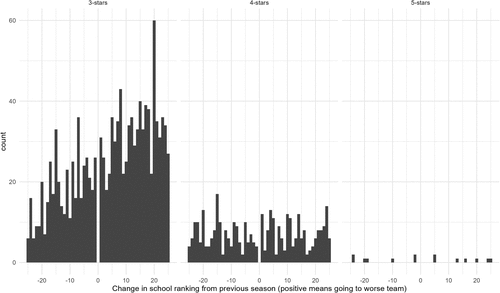
Notes. Years 2021–2025. Dropped transfers who went from unranked to unranked schools. Transfer portal data exist only for years 2021 and later.
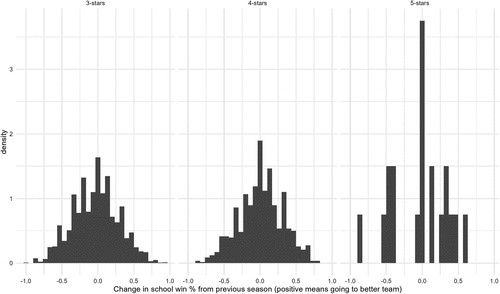
Notes. Includes transfers who were able to find a school to transfer to in 2021–2025. Transfer portal data exist only for years 2021 and later.
Figure 3 supports this conclusion. Most transfers are within Power 5 conferences, but considerably more transfers are moving away from Power 5 conferences than transferring into a Power 5 conference from a non-Power 5 conference across all stars. Four-star recruits are the most evenly balanced, whereas very few five-star recruits are transferring up to a Power 5 conference.
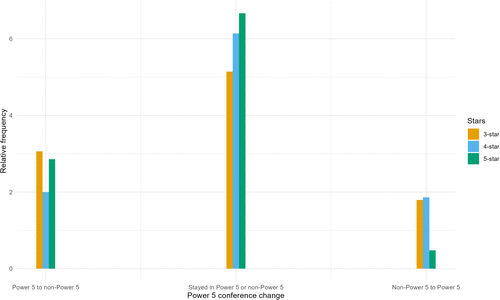
Note. Binwidth of 0.1 implies that 10× y-axis is the percentage of n-star recruits in that specific bin (or 1/10 y-axis is the proportion).
Together, the figures suggest that whereas some high-quality recruits may be chasing NIL deals initially and moving to better schools later, other recruits are using the transfer portal to leave well-performing schools for lower-performing ones. Although we cannot definitively say why, the reasons may vary from NIL to playing time. The transfer portal has indubitably affected individual recruits’ decisions, but on average it appears to have had minimal effects on the overall distribution of high school recruits.
3. Data and Descriptive Evidence
3.1. Data
Our data come from the College Football Data API, which scrapes 247Sports.34 Figure 4 shows the available data, including the location of the high school athlete, physical attributes, rating, school choice set, and school decision. We have additional data on each recruit’s outcomes in the NFL draft and have data on each school’s historical performance and rankings, location, and facilities. College football coaching salaries come from USA Today. We augment our data with DMA-level data on DMA rankings and the number of households.
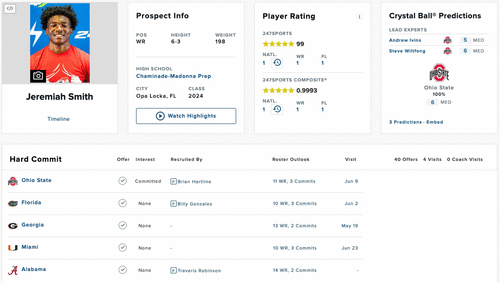
Note. Everything observable in this screenshot is available in our data.
Our data sample is divided into two periods: three recruiting classes before the NIL policies went into effect (2018–2020) and three recruiting classes after the NIL policies went into effect (2022–2024). We start with the class of 2018 because that class was the first class affected by major recruiting changes implemented in 2017.35 These changes, including the introduction of an early signing period in December the year before graduation, as well as another visiting period, greatly impacted how schools could influence recruits’ choices. We dropped the class of 2021, which was most affected by COVID-19. Many school visits were canceled in late 2020, and every collegiate conference had different rules regarding recruiting during the COVID-19-affected seasons.36 We also drop international recruits, Army/Navy/Air Force commitments, and rated prospects who ultimately committed to another sport, except for when we deploy our difference-in-difference estimator. Lastly, we filter on recruits 3* or above because 247Sports stops ranking two-star and one-star players in this period. Our cleaned data set has more than 13,000 recruits spread over six recruiting classes.
3.2. Model-Free Evidence
Here, we show some patterns in the raw data related to competitive balance and the choice of college programs by top recruits.
Table 4 presents the number of recruits in our cleaned data by quality level matched with a given football program, also by quality. What is most evident from this table is the striking decrease in the number of 5* recruits matching to a top-10 program and an equivalently large increase in the number of 5* recruits matching to an unranked program before NIL (2018–2020) to post-NIL (2022–2024). A school’s ranking in the previous season can be subject to high variability such as injuries or a large graduating class. To get a less noisy measure of recent performance, we plot the raw three-year winning percentages of the schools that recruits choose.
|
Table 4. Sorting Tables: Pre- and Post-NIL
| Top 10 | 11–25 | Rank 25 | |
|---|---|---|---|
| Panel A: Pre NIL (2018–2020) | |||
| 5* Recruits | 63 | 13 | 18 |
| 4* Recruits | 343 | 222 | 472 |
| 3* Recruits | 265 | 572 | 48,29 |
| Panel B: Post NIL (2022–2024) | |||
|---|---|---|---|
| 5* recruits | 47 | 23 | 40 |
| 4* recruits | 373 | 304 | 592 |
| 3* recruits | 267 | 531 | 4,350 |
Note. Cleaned data only.
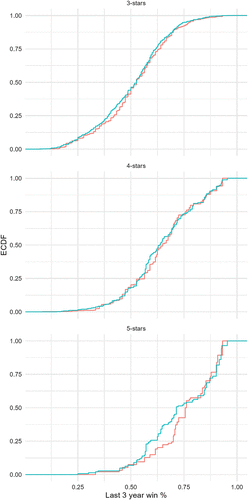
Figure 5 displays the density of the schools’ winning percentages in the three years before the recruit arrives, and Figure 6 displays the associated empirical CDF. We group similar-star recruits and plot pre- and post-NIL distributions in the same panel. The raw data show large negative effects of NIL on the historical winning percentages of schools chosen by 5* recruits and smaller negative effects on 3* and 4* recruits. Post-NIL, it appears that 5* recruits are attending schools with much lower three-year winning percentages, with much of the substitution away from schools with 70%–80% winning percentages toward schools with 50%–60% winning percentages. Three-star recruits also move to schools that perform worse. The empirical CDF in Figure 6 shows that the pre-NIL eCDF of 3* recruits is almost first-order stochastically dominant over the post-NIL eCDF. The eCDF of the winning percentages for 4* recruits also has some gaps that suggest that 4* recruits are going to slightly lower-performing schools.
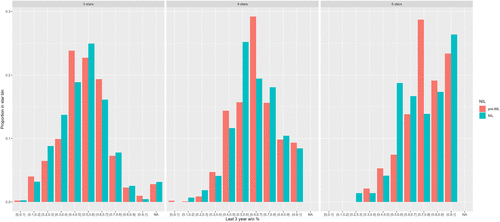
Note. Densities are grouped by recruits’ star level.
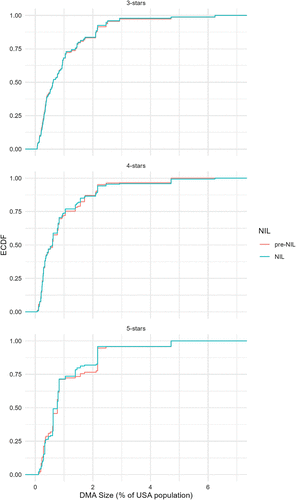
A natural follow-up would be to ask whether these recruits are going to wealthier schools or schools in larger media markets. Figures 7 and 8 plot empirical CDFs related to the wealth of the school that a recruit commits to, and Figure 9 shows the empirical CDF of the size of the DMA the recruit’s school is located in.
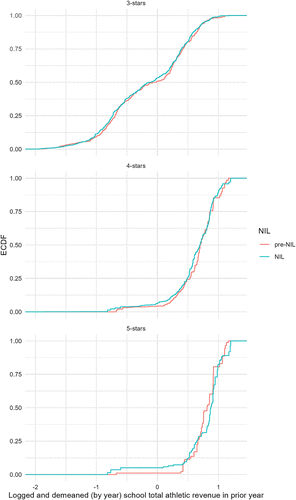
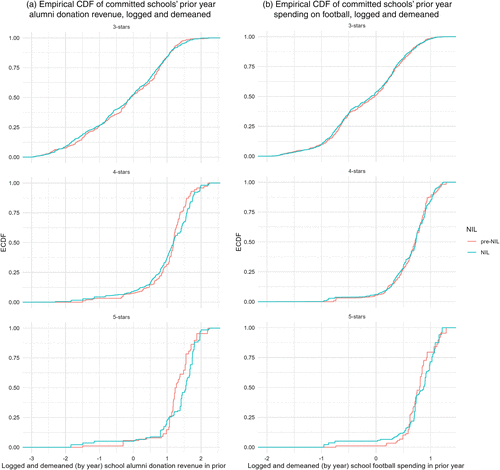
For Figures 7 and 8, raw revenue and spending numbers are always increasing over time. To get an accurate assessment of whether recruits are choosing relatively more wealthy schools, we take logs of the numbers and then demean them within year. This gives a relative assessment where zero on the x-axis means that the school receives the mean amount of revenue or spends the mean amount when compared with all other schools within a given year.
The eCDFs suggest that 3* recruits are going to less wealthy schools, whereas 5* recruits may be going to slightly wealthier ones. For 3* recruits, Figures 7 and 8 all show that the pre-NIL eCDFs almost first-order stochastically dominate the post-NIL eCDFs, although the differences are slim. Figure 8(a) shows that 5* recruits may be attending schools with more alumni donations post-NIL, which can be positively correlated with NIL deals.
Looking at the eCDF of DMA size where schools are located (Figure 9), we find very little differences between pre- and post-NIL distributions. The distribution of DMA market sizes for 5* recruits seems to be slightly shifted to the left post-NIL, but the differences for 3* and 4* recruits are negligible in magnitude.
Finally, we look at the competitiveness of college football games. The “spread” of a football game is the expected point differential between the two teams. Instead of betting on who will win a football game outright, bettors often bet whether a team will “cover” the spread.37 For example, the 2024 Texas versus Oklahoma college football game had a spread of Texas by −16.5, indicating that Texas was a 16.5-point favorite to win the game. Bettors who bet on Texas to cover won if and only if Texas won by 17 or more points.38 Sportsbooks are market makers who have an incentive to set accurate spreads to obtain 50% of the bets on either side of the spread because it generates the most volume and also minimizes their risk. In our data, the spread was covered by the favorite 50.6% of the time pre-NIL and 49.4% of the time post-NIL.39
A spread close to zero means that the favorite is expected to win by fewer points, indicating a more competitive game. Figure 10 plots the evolution of the average spread of a football game and the average realized point differential by year. We observe that spreads post-NIL are on average smaller than spreads pre-NIL, with the exception of the COVID-19 year. Actual point differentials are larger than spreads but have also been trending downward in the NIL era. The average spread in 2023 and 2024 is significantly lower than the spread in many pre-NIL years. Unsurprisingly, the decrease in average spread also has led to an increase in the number of underdogs winning. Figure 11 plots the proportion of college football games in each year where the underdog (the team less likely to win, as indicated by the spread) won the football game outright. In 2024, 26% of underdog teams won their games, the highest proportion on record. This number is significantly larger than the <20% in 2013 and 2015 pre-NIL. In general, the post-NIL years have a higher proportion of underdog victories than pre-NIL years, with the exception of the COVID-19 year.
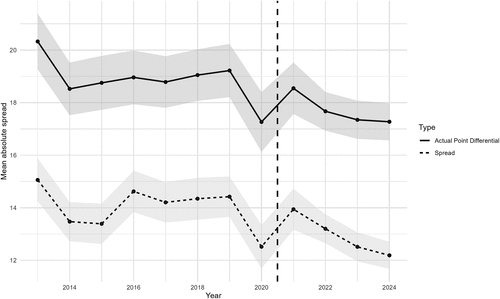
Notes. Solid line indicates the actual spread (point differential), whereas the dotted line indicates the pregame betting spread. Vertical dashed line indicates implementation of modern NIL policies. Shaded area represents the 95% confidence interval. (Note: 2020 is the COVID-19 year with shortened schedules and minimal out-of-conference games).
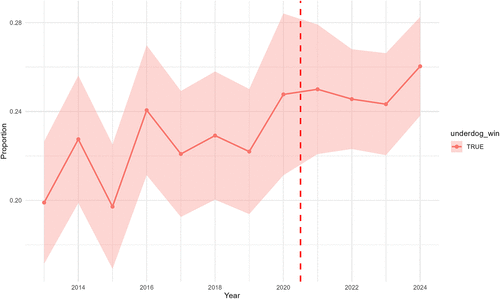
Notes. Vertical dashed line indicates implementation of modern NIL policies. Shaded area represents the 95% confidence interval (Note: 2020 is the COVID-19 year with shortened schedules and minimal out-of-conference games).
4. Impact of NIL on Program Choice: Empirical Strategy
We now take a closer look at recruit behavior for each star rating and how NIL has causally affected their school choices. We then discuss the rationale for the recruit behavior from the causal estimates.
4.1. Empirical Model Setup
We want to recover the average treatment effect (ATE) or the average treatment effect on the treated (ATT) of the 2021 NIL policy on various college football recruiting outcomes using observational data from high school football recruits’ school choices. In particular, we care whether the characteristics of the schools being chosen by recruits post-NIL are different from the characteristics of schools chosen before NIL.
To do so, we first turn to a potential outcome framework with discrete treatment. Define our potential outcome of interest , which is directly a function of i’s choice of school. This can be anything from the size of recruit i school’s DMA to the prior year’s performance by recruit i’s chosen school. Our treatment is the binary indicator , where the value 1 is realized if i is in the high school class of 2022 or later. The value of 0 corresponds to high school classes before 2020. High school athletes graduating in 2022 are the first to fully benefit from the NIL policy and to have it potentially impact their college choice. Although the NCAA relaxed its policy on July 1, 2021, athletes from the class of 2021 had already signed their letters of intent in February 2021 and were legally bound to attend that school.
A key identification assumption is unconfoundedness; that is, being in a pre- or post-NIL world is as good as random after conditioning on observable athlete characteristics :
(
where are athlete-specific characteristics. In all of our methods below, we use the same characteristics in : 247Sports Composite Rating, rank (as implied by the 247 Composite Rating), position, height, weight, hometown state, and hometown DMA ranking.
We will examine a few dependent variables. First, we estimate the effect that NIL has on the football program quality of the school chosen by the recruits, with the historical performance over a variety of time periods as our Y variable. We then check whether NIL is making recruits choose a lower-quality education. Third, we proxy for “rich” schools with TV viewership, which can be indicative of fan support and team performance. Finally, we take “rich” in a literal sense and look at whether NIL is leading recruits to choose schools with more spending on their football programs (football spending, coaches’ salaries, and university donations).
We measure these effects with a few methods. The first is a simple OLS regression. If the treatment is randomly assigned conditional on observables, then the coefficient on the treatment dummy will capture the true treatment effect. We also use an inverse probability weighting (IPW) estimator, where NIL is the binary treatment and weights are calculated based on the propensity scores. A third estimator we use is an augmented inverse probability weighting (AIPW) estimator, which enhances the IPW method by incorporating outcome models to improve efficiency and reduce bias. We discuss these methods next.
4.1.1. Ordinary Least Squares.
We first measure effects using an OLS regression as a reference. Consider the following regression equation:
Assumption 1 implies that . This independence is generally a strong assumption in observational studies but is somewhat plausible in our setting. After controlling for athlete-specific characteristics, the population of recruits before and after NIL is likely similar. We dropped the year (2021) around NIL implementation, which helps with the possibility that athletes chasing NIL deals deferred enrollment in 2020 to fully take advantage of NIL in 2021. There are no other ways for athletes to selectively choose into NIL; for example, an athlete’s parents likely did not think about timing their children to fully take advantage of NIL almost two decades ago. Lastly, it seems plausible that the motivation behind choosing college football programs has stayed constant over time; the goal for many of these athletes is to maximize their career earnings or maximize their possibilities of entering the NFL. Although we believe that these assumptions hold, if they do not, then the OLS regression serves as a baseline to compare the estimates from the other methods.
4.1.2. The Augmented Inverse Propensity Score (AIPW) Estimator.
As a benchmark, we use the classic inverse probability weighting (IPW) estimator. The IPW estimator of the average treatment effect (ATE) is calculated as
However, a challenge in our setting is the potential for poor overlap in propensity scores, particularly because covariates like recruit rank are highly predictive of treatment status because the number of 3* and above recruits has increased in the post-NIL period. When propensity scores are close to 0 or 1, IPW estimators can become unstable because of extreme weights.40
To improve robustness, we use the augmented inverse propensity weighting (AIPW) estimator of Robins et al. (1994). The AIPW method first estimates the ATE by estimating the conditional means; then, it corrects for the biases of this estimation by applying inverse propensity score weighting to the residuals. One of AIPW’s best statistical properties is double robustness; AIPW is consistent if the conditional mean or propensity score estimate is consistent (Wager 2022).
The AIPW estimator for the ATE is given by
To further address issues with poor overlap, we compute an overlap-weighted average treatment effect (OW-ATE), as proposed by Li et al. (2018). The OW-ATE uses weights that emphasize observations with propensity scores near 0.5, reducing the influence of units with extreme propensity scores and mitigating instability from dividing by values close to 0 or 1. This approach improves the estimator’s efficiency and robustness in the presence of limited overlap. We tune all parameters of our random forests using cross-validation.
4.2. Differences-in-Differences
Although the previous methods provide estimates of the effect of NIL policies, they may be confounded by contemporaneous changes in the recruiting environment that coincide with NIL implementation. Factors such as conference realignment and the introduction of the transfer portal could independently influence athlete outcomes and recruiting patterns, making it challenging to isolate the causal effect of NIL.42 Whereas we address the transfer portal in Section 2.4, here we employ a differences-in-differences (DiD) strategy that leverages a natural experiment arising from U.S. visa restrictions on foreign college football players. One caveat of our DiD estimator is that the number of international recruits is small (especially for 4* recruits), so DiD results should be taken with a grain of salt.43 We discuss the details of this estimator in Appendix A.5.
5. NIL Effects
5.1. Football Program Quality
In O’Bannon, the NCAA argued before the district court that limiting student-athlete aid helps “level the playing field between FBS and Division I schools in recruiting, thereby maintaining competitive balance among those schools’ football” teams. We assess this argument by measuring the impact of NIL on recruits’ selection of football programs based on program quality.
We use five quality metrics: two indicator variables for whether the program finished in the top 10 or top 25 in the season before the recruit’s arrival, two count variables for the total number of top 10 and top 25 finishes in the previous three seasons, and a final measure based on the program’s winning percentage over the prior three seasons. In Appendix A.6, we provide alternative measures for program quality, such as advanced statistics measurements like SP+ and ELO (Tables A.5 and A.9),44 historical draft success (Tables A.4, A.8, and A.12), and historical recruiting rankings (Tables A.6, A.10, and A.13). Our results are robust to all of these alternative measures.
|
Table 5. Treatment Effects of NIL on the Probability of Recruits Attending Top-Ranked Schools (Standard Errors Clustered at the Position Level)
| Y | Method | Treatment | 5* recruits | 4* recruits | 3* recruits | |||
|---|---|---|---|---|---|---|---|---|
| Estimate | SE | Estimate | SE | Estimate | SE | |||
| College ranked top 10 prior season | IPW | ATE | −0.328 | 0.070 | −0.024 | 0.021 | −0.047 | 0.004 |
| IPW | ATT | −0.269 | 0.094 | −0.044 | 0.023 | −0.014 | 0.008 | |
| AIPW | OW-ATE | −0.253 | 0.069 | −0.025 | 0.024 | 0.009 | 0.008 | |
| AIPW | ATT | −0.229 | 0.069 | −0.035 | 0.021 | 0.009 | 0.004 | |
| OLS | ATE | −0.293 | 0.078 | −0.016 | 0.020 | −0.000 | 0.005 | |
| DID | ATT | – | – | 0.008 | 0.152 | 0.020 | 0.028 | |
| College ranked top 25 prior season | IPW | ATE | −0.207 | 0.073 | 0.005 | 0.022 | −0.120 | 0.012 |
| IPW | ATT | −0.134 | 0.087 | −0.026 | 0.024 | −0.008 | 0.012 | |
| AIPW | OW-ATE | −0.182 | 0.063 | 0.003 | 0.025 | 0.013 | 0.014 | |
| AIPW | ATT | −0.164 | 0.063 | 0.003 | 0.022 | 0.012 | 0.007 | |
| OLS | ATE | −0.166 | 0.073 | −0.045 | 0.034 | −0.049 | 0.017 | |
| DID | ATT | – | – | 0.012 | 0.120 | 0.082 | 0.039 | |
| Total top 10 finishes prior three seasons | IPW | ATE | −0.405 | 0.177 | −0.083 | 0.048 | −0.154 | 0.009 |
| IPW | ATT | −0.103 | 0.207 | −0.120 | 0.054 | −0.070 | 0.019 | |
| AIPW | OW-ATE | −0.361 | 0.173 | −0.041 | 0.057 | −0.011 | 0.018 | |
| AIPW | ATT | −0.288 | 0.174 | −0.058 | 0.050 | −0.012 | 0.009 | |
| OLS | ATE | −0.422 | 0.253 | −0.042 | 0.050 | −0.029 | 0.010 | |
| DID | ATT | – | – | −0.459 | 0.356 | −0.007 | 0.064 | |
| Total top 25 finishes prior three seasons | IPW | ATE | −0.332 | 0.152 | −0.085 | 0.049 | −0.185 | 0.011 |
| IPW | ATT | −0.325 | 0.196 | −0.118 | 0.054 | −0.101 | 0.029 | |
| AIPW | OW-ATE | −0.240 | 0.147 | −0.067 | 0.055 | 0.013 | 0.029 | |
| AIPW | ATT | −0.220 | 0.148 | −0.077 | 0.049 | −0.041 | 0.016 | |
| OLS | ATE | −0.203 | 0.174 | −0.045 | 0.042 | −0.049 | 0.017 | |
| DID | ATT | – | – | −0.133 | 0.322 | 0.114 | 0.097 | |
| Win percentage prior three seasons | IPW | ATE | −0.050 | 0.019 | −0.010 | 0.007 | −0.041 | 0.016 |
| IPW | ATT | −0.028 | 0.023 | −0.013 | 0.008 | −0.020 | 0.005 | |
| AIPW | OW-ATE | −0.045 | 0.022 | −0.007 | 0.008 | −0.019 | 0.007 | |
| AIPW | ATT | −0.039 | 0.022 | −0.006 | 0.007 | −0.026 | 0.003 | |
| OLS | ATE | −0.047 | 0.029 | −0.005 | 0.006 | −0.021 | 0.005 | |
| DID | ATT | – | – | −0.078 | 0.036 | 0.020 | 0.018 | |
5.1.1. Five-Star Recruits’ Football Program Quality.
We first discuss the behaviors of 5* recruits. In our data period, there are only 94 “control” (2018–2020) 5* recruits and 110 “treated” (2022–2024) recruits. We do not compute the differences-in-differences estimates for 5* recruits because there are no 5* international recruits post-NIL. We find a significant effect where 5* recruits choose schools with worse-performing records in the previous season.
Columns 4 and 5 in Table 5 display the measured effects of NIL on the football programs that 5* recruits choose. We see a statistically significant and economically meaningful decrease in the probability of 5* recruits going to the top 10 and top 25 ranked schools. These magnitudes are quite large; on average, 5* recruits are more than 15% less likely to attend top 10 or top 25 ranked schools. Over a three-year horizon we see similar magnitudes; the teams that 5* recruits join have on average 0.2 to 0.3 fewer top 10 and top 25 finishes. The three-year winning percentage is also negative, with a magnitude of about 4%. This translates to about two fewer wins over the three college football seasons, which could be the difference between a national championship contender or just a good team. Historical school performance is highly indicative of future performance and school prestige, so choosing a worse-performing team means less value associated with prestige.45
These results highlight important tradeoffs that we believe recruits are making to determine their program choice, with the three most important dimensions for program choice being player development/NFL potential, program prestige, and NIL. We were able to rationalize the results in Table 5, where 5* recruits increasingly favor lower-ranked schools post-NIL.46 For 5* recruits to move to a lower-quality school, the value from NIL must be larger than what is generated from higher-quality schools. In addition, this difference in money must also be greater than the difference in prestige between lower- and higher-quality schools. Finally, we must see that player development/NFL potential is not impacted by program choice.
To rule out any impact of school choice on NFL potential, we construct a data set with 10 years’ worth of NFL draft data (2014–2024), tracking the universe of high school recruits 3* and above throughout college and into the NFL. We observe their 247 Composite Score and star rating, the school they initially committed to, the last college where they played football before they were drafted or completed their eligibility, and when they were selected in the NFL Draft, if at all. Table 6 presents the results for each classification of player (3*, 4*, and 5*). For 5* players, we determine that school choice plays no role in the likelihood of being drafted to the NFL. Note that the results also provide some assurance that any future NIL deals for 5* recruits should be independent of initial college choice because these recruits remain highly relevant throughout their college careers regardless of initial school quality.
|
Table 6. NFL Draft Logit Regressions by Stars; 2014–2024 NFL Drafts, all 3- to 5-Star Recruits from 247Sports
| Y: 1{Selected in NFL Draft} | 3 Star | 4 Star | 5 Star |
|---|---|---|---|
| Height | 0.093 | 0.098 | −0.015 |
| Weight | 0.001 | 0.002 | |
| School Top 25 before recruit | 0.301 | 0.229 | |
| Num. obs. | 12,806 | 2,736 | 293 |
| Position FE | Y | Y | Y |
| Conference FE | Y | Y | Y |
| Recruit year FE | Y | Y | Y |
| Mean Y: | 0.084 | 0.266 | 0.655 |
Note. Standard errors (in parentheses) clustered by position.
Our model implies that personalized pricing through NIL greatly affects 5* recruits who already possess immense talent and are willing to trade off prestige at higher-ranked or higher-quality schools to obtain NIL money. The effects of program quality have shown to be ineffective at improving a 5* recruit’s future outcomes (Table 6), so colleges can seemingly convince 5* recruits to attend simply by paying them more.
Anecdotes seem to support our theoretical and data-driven findings. The most noticeable example occurred in 2021, when the number one ranked high school football recruit, Travis Hunter, decided to enroll at Jackson State University. This decision was unprecedented because Hunter became the first 5* high school recruit to ever sign with a Historically Black College and University (HBCU)47 and the first 5* recruit to sign with an FCS school (collegiate second division).48 It turns out that Hunter received NIL deals specifically for signing with an HBCU.49
5.1.2. 4* Recruits’ Football Program Quality.
Columns 6 and 7 in Table 5 show that post-NIL, 4* recruits are equally as likely to attend a top 10 or top 25 ranked program from the previous season. The three-year horizon tells a similar story; although the estimates suggest that 4* recruits attend schools with fewer top finishes, none are significant.
It is interesting to understand why 4* recruits’ behaviors do not seem to be changing on average. One explanation could be that within 4* recruits, quality is spread out. The top 4* recruits talent-wise may be very close to 5* recruits, whereas the bottom 4* recruits may be only as skilled as 3* recruits.50 With 5* recruits seemingly moving to lower-quality schools, top 4* recruits could potentially be replacing them at higher-quality schools. We augment our analysis by separating the 4* recruits into the top 100 4* recruits and 101st ranked 4* recruit and worse to see whether the football program quality of top 4* recruits is being averaged out by the lower tier 4* recruits.
Across all five football program quality measures and estimation methods (Table 7), lower-ranked 4* recruits go to worse football schools, whereas top-ranked 4* recruits attend similar quality programs or slightly better. With 5* recruits increasingly attending lower-ranked programs post-NIL, vacancies and opportunities arise at higher-ranked programs that were previously less accessible to top 4* recruits. This shift allows the top 4* recruits to fill the roles and positions left open by the departing 5* recruits to potentially obtain better development and increase their prospects in the NFL Draft.51
|
Table 7. Treatment Effects of NIL on the Probability of Recruits Attending Top-Ranked Schools for 4* Recruits (Standard Errors Clustered by Position)
| Y | Method | Treatment | Top 100 4* recruits | 101+ ranked 4* recruits | ||
|---|---|---|---|---|---|---|
| Estimate | Std. error | Estimate | Std. error | |||
| Top 10 prior season | IPW | ATE | 0.069 | 0.081 | −0.055 | 0.031 |
| IPW | ATT | 0.025 | 0.091 | −0.097 | 0.047 | |
| AIPW | OW-ATE | −0.013 | 0.042 | −0.035 | 0.030 | |
| AIPW | ATT | −0.018 | 0.041 | −0.043 | 0.028 | |
| OLS | ATE | −0.022 | 0.053 | −0.021 | 0.023 | |
| DID | ATT | 0.409 | 0.494 | −0.112 | 0.152 | |
| Top 25 prior season | IPW | ATE | 0.163 | 0.075 | −0.031 | 0.033 |
| IPW | ATT | 0.113 | 0.120 | −0.029 | 0.048 | |
| AIPW | OW-ATE | 0.019 | 0.041 | −0.009 | 0.032 | |
| AIPW | ATT | 0.019 | 0.041 | −0.011 | 0.027 | |
| OLS | ATE | 0.052 | 0.048 | −0.012 | 0.025 | |
| DID | ATT | 0.028 | 0.389 | −0.005 | 0.120 | |
| Total top 10 prior 3 seasons | IPW | ATE | 0.276 | 0.198 | −0.157 | 0.077 |
| IPW | ATT | 0.211 | 0.246 | −0.236 | 0.122 | |
| AIPW | OW-ATE | 0.027 | 0.103 | −0.087 | 0.068 | |
| AIPW | ATT | 0.018 | 0.101 | −0.086 | 0.056 | |
| OLS | ATE | 0.015 | 0.117 | −0.075 | 0.060 | |
| DID | ATT | 0.931 | 1.232 | −0.874 | 0.195 | |
| Total top 25 prior 3 seasons | IPW | ATE | 0.364 | 0.197 | −0.202 | 0.072 |
| IPW | ATT | 0.336 | 0.331 | −0.239 | 0.107 | |
| AIPW | OW-ATE | 0.067 | 0.092 | −0.149 | 0.070 | |
| AIPW | ATT | 0.064 | 0.092 | −0.141 | 0.058 | |
| OLS | ATE | 0.097 | 0.124 | −0.125 | 0.055 | |
| DID | ATT | 0.915 | 0.768 | −0.423 | 0.274 | |
| Win percentage prior 3 seasons | IPW | ATE | 0.072 | 0.036 | −0.030 | 0.011 |
| IPW | ATT | 0.065 | 0.058 | −0.034 | 0.016 | |
| AIPW | OW-ATE | 0.014 | 0.014 | −0.020 | 0.008 | |
| AIPW | ATT | 0.013 | 0.014 | −0.016 | 0.008 | |
| OLS | ATE | 0.022 | 0.019 | −0.019 | 0.008 | |
| DID | ATT | 0.121 | 0.139 | −0.078 | 0.036 | |
Figure 12 displays the residualized binscatter (Cattaneo et al. 2024) where the dependent variable is an indicator that the athlete is drafted by an NFL team and the independent variable is the 247Sports Composite Rating. We control for height, weight, position of the athlete, year, and graduating program. Beyond a rating of around 0.96, the probability that an athlete is drafted increases exponentially. The steep slope of the binscatter implies that for these recruits, developing their skills would increase their draft prospects—and thus their expected future income—the most.52 This rating corresponds to just about the top 90–100 recruits in each draft class or the top 60–70 4* recruits. Thus, the marginal value of development on the top 4* recruits is uniquely large.
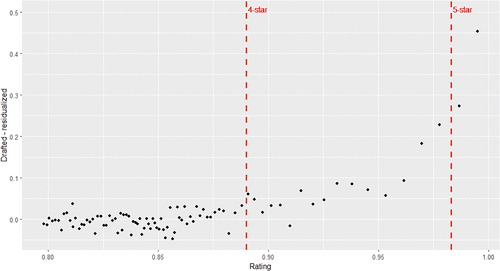
Note. Controls for observable recruit characteristics: Height, weight, position, year, and college attended in final year.
5.1.3. Three-Star Recruits’ Football Program Quality.
Columns 8 and 9 in Table 5 show that NIL has mixed effects on the football program quality chosen by 3* recruits. There is some indication that 3* recruits are choosing schools that performed better in the previous year. Conversely, there are more significantly negative effects over the lagged three-year horizon. The effect magnitudes are small, and the DiD estimates often return a positive but insignificant result. Small effect sizes can be attributed to the fact that 3* recruits generally do not choose football programs with many top finishes. The schools chosen by the 3* recruits post-NIL win 2% fewer games, which is about one game over the previous three seasons.
Like 4* recruits, the top-ranked 3* recruits around the 3*/4* cutoff could be different from the bottom-ranked and may benefit from lower 4* recruits choosing lower-quality programs post-NIL; recruiting websites like 247Sports even mention that some 3*s should be valued as much as 4* recruits.53 To see if top 3* recruits are affected differently, we conduct the same exercise as before, splitting the 3* recruits into the top 100 and 101+ ranked 3* recruits and rerunning our estimators. The results are in Table A.11, which shows similar results across top and bottom 3* recruits. The residualized binscatter of draft probability on 247Composite Rating (Figure 12) may explain why these recruits on the 3*/4* margin may differ from those on the 4*/5* margin. The marginal value of development is not high for all 3* and lower-ranked 4* players and may not affect their draft outcomes. The residualized probabilities remain both relatively constant and relatively low for these recruits. As a result, the marginal value from an NIL deal may outweigh the marginal value from better development for top 3* recruits, unlike their top 4* counterparts. Overall, the pattern for 3* recruits seems to be that they are going to football programs that perform slightly worse post-NIL.
5.1.4. Discussion.
An outcome implied by the above empirical analysis is the result that lower-quality programs are often offering more lucrative personalized NIL packages than higher-quality programs. This behavior aligns with the strategic use of personalized pricing in oligopolistic competition, where firms (schools) tailor financial incentives to attract high-value consumers (athletes), thereby intensifying competition. To understand why, we turn to the academic literature on merit-based aid and competition in university admissions.
In Epple et al. (2003), the authors sought to understand the relationship between merit-based aid and student quality as a function of university rank. They determined that merit aid increases as university rank decreases; top universities offer less merit aid because “top schools face no competition from above.” Ability discounting exists in equilibrium among lower-quality schools because at lower-ranked universities, the gap in quality between accepted and rejected candidates tends to be larger. With universities valuing student ability, lower-ranked universities are willing to provide merit aid to attract high-quality students. The same is not true for high-ranking universities, which have less incentive to provide merit aid because of the availability of similarly qualified candidates.
The result maps to our setting by suggesting that NIL offers and program quality are negatively correlated for 5* players. Epple et al. (2003) determined that the merit-based aid increases with the difference in the valuation of the prospective candidate and pool of safety candidates. Therefore, high-quality programs do not need to offer large NIL deals to attract top talent because they can rely on their prestige and the availability of high-quality substitutes (e.g., top 4* players). This creates a competitive environment where lower-ranked programs use personalized pricing strategically to attract top recruits, increasing overall competition in the market. As a result, 5* athletes may choose lower-ranked schools offering better NIL deals without significantly harming their NFL draft prospects. These findings are consistent with the theory of personalized pricing affecting competition in oligopolistic markets.
5.2. Academic Quality
Being talented at football affects a recruit’s expected future earnings, but the quality of education that they receive at their enrolled college can also affect the expected future income. Here, we take a look at whether NIL has affected recruits’ college choices in terms of academic quality. This too is an important question because it is directly related to one of the arguments the NCAA put forth in O’Bannon—restraints on NIL integrate athletics and academics and thereby “improve the quality of educational services provided to student-athletes.” We use metrics such as admission rate, SAT scores, and median cohort earnings (all demeaned yearly) to determine whether recruits are trading off a better education for NIL money.
Table 8 displays the effects of NIL on the academic quality of recruits’ chosen schools by star level. Overall, there does not seem to be consistent evidence that 5* or 4* recruits are trading off academic quality for NIL money. These recruits are the most likely to make the NFL, so it makes sense that their focus is on developing their football talent and not academic merit. However, 3* recruits are significantly more likely to attend schools with higher admission rates (less selective), lower SAT scores, and lower career earnings post-NIL.
|
Table 8. Treatment Effects of NIL on Academic Quality of Recruits’ Chosen Schools (Standard Errors Clustered by Position)
| Y | Method | Treatment | 5* recruits | 4* recruits | 3* recruits | |||
|---|---|---|---|---|---|---|---|---|
| Estimate | SE | Estimate | SE | Estimate | SE | |||
| Admit rate (demeaned) | IPW | ATE | −0.023 | 0.040 | −0.001 | 0.011 | 0.124 | 0.018 |
| IPW | ATT | −0.034 | 0.031 | −0.005 | 0.011 | 0.000 | 0.008 | |
| AIPW | OW-ATE | 0.001 | 0.029 | −0.007 | 0.012 | 0.029 | 0.010 | |
| AIPW | ATT | 0.003 | 0.029 | −0.010 | 0.010 | 0.011 | 0.005 | |
| OLS | ATE | 0.011 | 0.028 | −0.005 | 0.015 | 0.012 | 0.006 | |
| DID | ATT | – | – | 0.079 | 0.073 | 0.040 | 0.024 | |
| SAT average (demeaned) | IPW | ATE | 3.405 | 12.265 | 0.884 | 3.659 | −95.296 | 5.889 |
| IPW | ATT | 10.653 | 11.886 | 0.891 | 3.936 | −3.848 | 3.579 | |
| AIPW | OW-ATE | −1.139 | 9.671 | 4.436 | 4.251 | −26.228 | 4.826 | |
| AIPW | ATT | −1.990 | 9.899 | 4.334 | 3.691 | −18.014 | 2.513 | |
| OLS | ATE | −6.169 | 10.724 | 2.301 | 4.641 | −13.611 | 3.248 | |
| DID | ATT | – | – | −55.086 | 36.194 | −19.973 | 17.240 | |
| Log median income 10 years postgraduation (demeaned) | IPW | ATE | 0.000 | 0.021 | 0.001 | 0.007 | −0.129 | 0.021 |
| IPW | ATT | −0.002 | 0.017 | 0.003 | 0.008 | −0.003 | 0.006 | |
| AIPW | OW-ATE | 0.000 | 0.018 | 0.006 | 0.008 | −0.040 | 0.008 | |
| AIPW | ATT | −0.003 | 0.019 | 0.008 | 0.007 | −0.030 | 0.004 | |
| OLS | ATE | −0.003 | 0.010 | 0.003 | 0.008 | −0.020 | 0.006 | |
| DID | ATT | – | – | −0.094 | 0.081 | −0.009 | 0.028 | |
This finding is significant because it suggests that personalized pricing is negatively impacting the education quality that 3* high school recruits are choosing. These recruits are unlikely to secure an NFL career, so education is important to their future earnings. Whether these players are worse off because of NIL depends on the size of their NIL contracts and their time preference for money. Our results indicate that these athletes choose schools where the median income a decade after graduation is approximately 3% lower (roughly $1,500 less per year) post-NIL. Given that the median D1 FBS NIL earnings was $1,548 in 2024, the difference between NIL offers of schools likely does not exceed this projected decrease in future earnings.54 Recruits prioritize immediate financial benefits from NIL deals and underweight the potential long-term earnings loss from attending a lower-quality educational institution.55
5.3. TV Ratings and Media Markets
A college football player’s NIL valuation is driven largely by their quality and exposure. The more visibility a player has, the greater his reach, allowing him to command higher compensation for endorsements and advertising services. One significant factor that might influence exposure is TV ratings—the frequency and scale at which a school’s games are broadcasted can enhance a player’s national profile. NIL critics argue that popular schools with many nationally broadcasted games or schools located in large media markets may have unfair advantages with NIL. Consequently, we assess whether recruits in the post-NIL era tend to choose schools located in larger media markets or with more extensive TV coverage in previous years.
Table 9 presents the treatment effects of NIL on prior-season TV ratings for different groups of recruits. Prior-season TV ratings are used to remove a potentially endogenous response whereby a school with a strong recruiting class ends up on broadcast TV more often because of its hype, quality, or popularity. We examine three metrics: the log of total TV audience size over the three years preceding the recruit’s enrollment adjusted by subtracting the yearly mean to control for time trends, the number of times a school’s games were broadcasted on TV over the prior three years, also demeaned annually, and the DMA size of the college the recruit committed to.
|
Table 9. Treatment Effects of NIL on TV Ratings for Different Groups of Recruits (Standard Errors Clustered by Position)
| Y | Method | Treatment | 5* recruits | 4* recruits | 3* recruits | |||
|---|---|---|---|---|---|---|---|---|
| Estimate | SE | Estimate | SE | Estimate | SE | |||
| Log three-year total TV viewership (demeaned) | IPW | ATE | 0.012 | 0.150 | 0.035 | 0.035 | −2.651 | 0.765 |
| IPW | ATT | 0.019 | 0.190 | −0.001 | 0.041 | −0.156 | 0.117 | |
| AIPW | OW-ATE | 0.001 | 0.174 | 0.060 | 0.042 | −0.618 | 0.191 | |
| AIPW | ATT | 0.004 | 0.190 | 0.048 | 0.038 | −0.829 | 0.083 | |
| OLS | ATE | 0.023 | 0.207 | 0.062 | 0.029 | −0.482 | 0.154 | |
| DID | ATT | – | – | −0.102 | 0.165 | −0.204 | 0.416 | |
| Three year total TV broadcasts (demeaned) | IPW | ATE | −0.012 | 0.896 | −0.020 | 0.308 | −7.243 | 0.700 |
| IPW | ATT | 0.323 | 0.907 | −0.017 | 0.336 | −1.016 | 0.295 | |
| AIPW | OW-ATE | −0.186 | 0.928 | 0.095 | 0.352 | −1.908 | 0.346 | |
| AIPW | ATT | −0.048 | 0.931 | 0.133 | 0.311 | −2.139 | 0.176 | |
| OLS | ATE | 0.469 | 1.043 | 0.006 | 0.170 | −1.482 | 0.215 | |
| DID | ATT | – | – | 0.478 | 2.453 | 0.564 | 1.157 | |
| School DMA % of U.S. Population | IPW | ATE | 0.133 | 0.157 | 0.030 | 0.044 | 0.111 | 0.110 |
| IPW | ATT | 0.180 | 0.154 | 0.035 | 0.043 | 0.004 | 0.032 | |
| AIPW | OW-ATE | −0.076 | 0.146 | 0.021 | 0.049 | −0.041 | 0.040 | |
| AIPW | ATT | −0.070 | 0.148 | 0.027 | 0.041 | −0.039 | 0.020 | |
| OLS | ATE | −0.028 | 0.176 | 0.021 | 0.042 | −0.008 | 0.027 | |
| DID | ATT | – | – | −0.527 | 0.388 | −0.086 | 0.197 | |
For 3* recruits, the results generally suggest a negative effect of NIL on their selection of schools with greater TV exposure. The estimates for the log of the total TV viewership over the prior three years are all negative (and some significant), with magnitudes suggesting at least a 25% or more decrease in viewership. Prior three years’ total TV broadcasts are negatively affected, but the DiD results do not align with the others. Interestingly, there appears to be little effect on the DMA size where the school is located, aside from a small, negative effect measured by the AIPW ATT estimator. We show in Table A.15 that these changes are driven mainly by lower-ranked 3* recruits going to lower-visibility schools.
For 5* and 4* recruits, the findings are mixed but generally indicate no significant change in school selection based on TV exposure post-NIL. So, even as 5* recruits select slightly worse-performing football programs and top 4* recruits go to slightly better ones post-NIL, they still choose schools with similar amounts of viewership and TV broadcasts. However, no significant result means that popular schools are not disproportionately attracting the best talent, so the rich are not getting richer in this sense.
5.4. School Wealth
Thus far, our discussion of “rich” schools has referred to institutions abundant in athletic talent. However, financial resources vary significantly between colleges, and some have considerably more wealth than others. In this section, we investigate whether NIL policies have influenced high school recruits to favor schools with greater financial assets, interpreting “rich” in a literal financial sense. We leverage expenditure data from the Knight-Newhouse database, which provides comprehensive revenue and spending information for all public universities in Division I FBS and FCS college football.
A key limitation of these data is that they include only public institutions. If recruits are systematically choosing private schools over public ones in the post-NIL era, this could pose a challenge to our analysis. In general (Table 10), it seems that not much has changed with regard to public versus private school choice. However, there seems to be an increase in the selection of international recruits to private schools, which may affect our DiD estimates.
|
Table 10. Proportion of Recruits Choosing Private Schools Pre- and Post-NIL
| Pre-NIL (international) | Post-NIL (international) | |
|---|---|---|
| 5* | 0.064 | 0.049 |
| 4* | 0.117 (0.000) | 0.120 (0.308) |
| 3* | 0.191 (0.195) | 0.201 (0.215) |
We proceed by examining three school wealth-related dependent variables to assess the impact of NIL policies (Table 11). The first variable is football coaching salary, which includes all assistants and scouts. The second variable is total football spending, which includes expenditures training, facilities, recruiting, and other football-related activities. We also assess whether alumni donations to the school are affecting recruits’ choices. For all three variables, we use the prior year’s values to minimize potential endogenous responses by the school or boosters to a strong or weak recruiting class.
|
Table 11. Treatment Effects of NIL on Log Football Spending, Log Coach Salaries, and Log Alumni Donations for Different Groups of Recruits (Standard Errors Clustered by Position; Public School Data Only)
| Y | Method | Treatment | 5* recruits | 4* recruits | 3* recruits | |||
|---|---|---|---|---|---|---|---|---|
| Estimate | Std. error | Estimate | Std. error | Estimate | Std. error | |||
| Log football coach salaries (prior year, demeaned) | IPW | ATE | −0.004 | 0.049 | 0.006 | 0.019 | −0.636 | 0.055 |
| IPW | ATT | −0.026 | 0.060 | −0.002 | 0.021 | −0.060 | 0.024 | |
| AIPW | OW-ATE | −0.010 | 0.064 | 0.014 | 0.023 | −0.177 | 0.026 | |
| AIPW | ATT | 0.008 | 0.065 | 0.015 | 0.020 | −0.184 | 0.014 | |
| OLS | ATE | 0.023 | 0.061 | 0.010 | 0.017 | −0.122 | 0.020 | |
| DID | ATT | – | – | −0.164 | 0.104 | 0.088 | 0.086 | |
| Log football spending (prior year, demeaned) | IPW | ATE | 0.046 | 0.054 | 0.004 | 0.018 | −0.595 | 0.050 |
| IPW | ATT | 0.065 | 0.076 | 0.003 | 0.020 | −0.059 | 0.022 | |
| AIPW | OW-ATE | −0.002 | 0.060 | 0.005 | 0.022 | −0.157 | 0.024 | |
| AIPW | ATT | 0.014 | 0.060 | 0.008 | 0.019 | −0.159 | 0.013 | |
| OLS | ATE | 0.047 | 0.052 | 0.004 | 0.018 | −0.110 | 0.020 | |
| DID | ATT | – | – | −0.200 | 0.083 | 0.101 | 0.080 | |
| Log alumni donations (prior year, demeaned) | IPW | ATE | 0.022 | 0.084 | 0.014 | 0.085 | −1.146 | 0.204 |
| IPW | ATT | 0.002 | 0.110 | 0.019 | 0.036 | −0.080 | 0.039 | |
| AIPW | OW-ATE | −0.004 | 0.099 | 0.037 | 0.040 | −0.259 | 0.047 | |
| AIPW | ATT | 0.010 | 0.099 | 0.032 | 0.035 | −0.258 | 0.024 | |
| OLS | ATE | 0.086 | 0.127 | 0.036 | 0.038 | −0.197 | 0.032 | |
| DID | ATT | – | – | −0.183 | 0.141 | 0.242 | 0.147 | |
Again, we find no discernible impact of NIL on the wealth of 5* and 4* recruits’ schools. Even by changing our definition of rich to material wealth, we fail to show that the richest football schools get “richer” post-NIL. At best, there is no effect of NIL on the positive assortativeness of high school recruits and schools. These results reject a hypothesis that wealthier schools are obtaining better talent and instead weakly suggest that recruits are increasingly opting for schools with fewer financial resources in the post-NIL era.
5.5. Impact on Competition
We have shown that personalized pricing through NIL has had consequences for the initial distribution of high school talent among colleges. Five-star and lower-ranked four-star recruits are choosing lower-performing teams. Three-star recruits are choosing teams that are slightly worse historically. A natural follow-up question would be the following: Has this distributional shift created any impact on the competitiveness of college football games? We now use betting data and realized point differential data to assess whether college football has become more competitive post-NIL.56
We can assess whether games are more competitive if the absolute value of the predicted spread () or the absolute value of the realized point differential between teams () is smaller post-NIL.57 We run the following regression where is either variable:
Game g occurs in season t between two teams. is the difference in AP ranking between the two teams competing in game g, is the difference in recruiting class metrics for the incoming recruiting class between the teams according to two separate metrics, is the difference in two separate incoming transfer class metrics between the two teams, are other observable game and time-varying characteristics, are team fixed effects, and is the error term. We display the results in the first two columns of Table 12.
|
Table 12. Columns 1 and 2: OLS Regression of Betting Spread on Various NIL, Ranking, Recruiting, and Transfer Portal Variables (Negative Coefficients Imply a Smaller Spread and a More Competitive Football Game)
| Y: abs(spread) | Y: abs(point diff) | Y: underdog win | |||||
|---|---|---|---|---|---|---|---|
| (1) | (2) | (3) | (4) | (5) | (6) | (7) | |
| NIL | 0.257 | 0.093 | 0.500 | ||||
| Rank diff | 0.546 | 0.540 | 0.331 | 0.333 | 0.003 | 0.011 | |
| 247 recruiting class rating diff | 0.048 | 0.046 | 0.038 | 0.033 | 0.000 | 0.000 | |
| Total recruit rating diff | 0.082 | 0.151 | 0.096 | 0.132 | |||
| Home team unranked | 0.017 | 0.222 | 0.345 | 0.059 | 0.057 | 0.113 | |
| Away team unranked | 3.429 | 3.274 | 1.235 | 0.918 | 0.109 | 0.182 | |
| Home team recruiting class unranked by 247 | 1.916 | 1.991 | |||||
| Away team recruiting class unranked by 247 | 0.111 | 0.317 | |||||
| Home team no ranked recruits | 2.574 | 2.360 | 0.229 | 0.244 | 0.173 | ||
| Away team no ranked recruits | 0.203 | 1.236 | 1.481 | 0.021 | 0.083 | 0.170 | |
| NIL × net number of transfers diff | 0.024 | 0.037 | 0.003 | 0.004 | |||
| NIL × net 247 rating of transfers diff | 0.044 | 0.044 | 0.012 | 0.016 | |||
| NIL × rank riff | 0.016 | 0.001 | |||||
| NIL × 247 recruiting class rating Diff | 0.006 | 0.010 | |||||
| NIL × total recruit rating diff | |||||||
| NIL × home team unranked | |||||||
| NIL × away team unranked | 0.453 | 1.064 | |||||
| NIL × away team recruiting class unranked by 247 | 2.649 | ||||||
| NIL × home team no ranked recruits | 0.338 | 0.116 | |||||
| NIL × away team no ranked recruits | 1.023 | ||||||
| abs(spread) | |||||||
| NIL × abs(spread) | 0.003 | ||||||
| Num. obs. | 11,347 | 11,347 | 11,412 | 11,412 | 11,253 | 11,253 | 11,253 |
| Team FE | Y | Y | Y | Y | Y | Y | Y |
| Game week FE | Y | Y | Y | Y | Y | Y | Y |
| R2 (full model) | 0.586 | 0.587 | 0.246 | 0.247 | – | – | – |
| Log Likelihood | – | – | – | – | −5,530.763 | −5,048.798 | −5,046.253 |
Notes. Columns 3 and 4: OLS regression of actual point differential on various NIL, ranking, recruiting, and transfer portal variables. Negative coefficients imply a smaller spread and a more competitive football game. Columns 5–7: logit regression of an indicator variable for an underdog winning on various NIL, ranking, recruiting, and transfer portal variables. Positive coefficients imply a positive correlation with an upset victory occurring. Standard errors (in parentheses) clustered at the team level. Data from games 2013–2024. We ran separate regressions with a linear time which are not included. The linear time trend parameter is not significant and inflates standard errors on other coefficients. Coefficient significance on NIL are unaffected for point differential and spread, but the linear time trend slightly affects the significance of NIL in Column 5.
Controlling for recruiting class ratings and the transfer portal, we observe that NIL has a significant and economically meaningful 1.2-point decrease in the spread when controlling for interaction terms (and a 1.5-point decrease without controlling for NIL interactions), meaning that games are predicted to be at least 1.2 points closer on average post-NIL. NIL also has a negative effect on the actual point differential from the game. These magnitudes are similar to the magnitudes of decrease reflected in Figure 10. NIL interaction terms are largely insignificant, with the exception that the interaction of NIL and “Total recruit rating diff” is significantly negative.58 We find a similar effect when analyzing the absolute point differential. In columns 5–7 of Table 12, we find that NIL is positively correlated with more underdog teams winning, even after controlling for the spread. By teasing apart the transfer portal effect on the spread and underdog teams winning, we have provided additional evidence that NIL has, in fact, made college football more competitive.
5.6. Discussion
Our findings indicate that NIL policies have introduced significant changes in the college football recruiting landscape, affecting recruits differently according to their star ratings. Post-NIL, 5* recruits move to football programs that have performed poorly in the past one to three years. Even then, these programs still command TV attention and are financially well supported. Our interpretation is that 5* recruits are choosing to attend “temporarily embarrassed” programs that have a lot of support but have done poorly recently. Fans, donors, and boosters of the program want to see these once great programs do well again, so they contribute large amounts of NIL money to attract 5* recruits.
For 4* recruits, the impacts are more nuanced. Top-ranked 4* athletes are entering roles in higher-performing programs post-NIL, possibly filling the gaps left by 5* recruits. They have the highest marginal value for development, which allows them to capitalize on improved development opportunities and potentially improve their future NFL prospects at better programs. However, lower-ranked 4* recruits appear to be attracted to lower-performing programs, perhaps drawn by the NIL opportunities. Outside of football program performance, the impact of NIL on other characteristics of schools chosen by 5* and 4* recruits is generally null.
One pertinent question remains: Why are 3* recruits moving to less popular and lower-educational-quality schools? Figure 12 provides some evidence, where we observe almost no effect of rating on the draft outcomes for 3* recruits. Thus, these recruits might explicitly seek environments in which they can prioritize immediate NIL benefits over long-term career development or educational opportunities. Local businesses in smaller markets may be more inclined to partner with these athletes, providing them with meaningful NIL deals that they might not receive at larger programs, where they could be overshadowed by higher-ranked players. These 3* recruits are likely to be the “big fish” for a smaller program, so the school may throw disproportionately more resources into securing a top 3* recruit versus a 4* or 5* recruit who they have no chance of obtaining.
An alternative explanation for a 3* recruit’s behavior may not be entirely due to his own preferences but rather a result of intensified competition stemming from changes in 4* recruits’ behaviors. Lower-ranked 4* recruits might be targeted with NIL deals by worse-performing schools, thinking that NIL can sway them. Consequently, the trend of 3* recruits attending less prestigious programs could be partially attributed to this cascading talent redistribution. Both NIL resources and playing time are scarce, so they may find themselves with fewer options among traditionally stronger schools. Ultimately, our methodology does not allow us to clearly disentangle which of these explanations is the prevailing one for these 3* athletes, but our finding that 3*s attend schools with lower educational quality supports NIL chasing and an increased emphasis on present-day income.59
6. Managerial Implications and Conclusions
Does personalized pricing increase competition in oligopolistic markets? As discussed in our introduction, theoretical models offer ambiguous predictions about the impact of price discrimination on competition. Our empirical evidence from the introduction of Name, Image, and Likeness (NIL) rights suggests that, yes, personalized pricing has increased competition among college football teams. In general, the introduction of NIL has not enriched already wealthy programs but has reshaped the recruiting landscape in a way that promotes a more equitable distribution of talent. Even by using multiple definitions of “rich”—from historical school performance to football budgets—we find negative or null effects of NIL on the positive assortative matching between recruits and schools. This democratization of talent acquisition challenges the notion that “the rich get richer” and opens up possibilities for increased competitiveness across college football.
Our findings can also provide further insight into the financial aid, college choice, and return to the education literature (Card 1999, Dynarski et al. 2023). Tracking individual long-term outcomes for college athletes is challenging, especially post-NIL recruits. However, we do provide evidence that financial packages (NIL) steer students (3* recruits—very unlikely to make NFL) into choosing lower-educational-quality colleges, as measured by admission rate and SAT averages, as well as worse long-term outcomes when measured by median midcareer earnings. This is one of the few papers to document any causal negative effect of merit aid or scholarships (Cohodes and Goodman 2014), especially on postcollege outcomes. These results tie back to our initial discussion on personalized pricing, suggesting that although it can increase competition, it may also lead to suboptimal long-term outcomes for certain groups, raising important policy considerations. Our paper provides further evidence to policymakers and college administrators that short-term financial instruments influence education choices from racially diverse and underprivileged communities more than longer-term benefits.
Furthermore, what has not been studied, and specifically in the education literature, is the impact of personalized pricing (merit aid) on the competitiveness of the marketplace. For example, is there a causal effect of competition, and in which direction? Specific to merit aid, does it causally shift university rankings? This is difficult to study because the question requires a unique data set of industry-wide personalized prices and for merit aid, student choices, rankings, and a world where merit aid is shut off across the university marketplace. Although these data are not possible to retrieve, the data requirements and setting are available in studying a college athlete’s program choice with the introduction of NIL.
In conclusion, our research demonstrates that personalized pricing through NIL has increased competition in college football, providing valuable empirical evidence to inform economic theory and policy. The introduction of NIL in college athletics parallels the use of merit-based aid in higher education because both serve as financial incentives to attract top talent, athletic or academic. Thus, our research is pertinent to regulators and policymakers concerned about the increasing adoption of personalized pricing, the multibillion-dollar college football industry, and the presidents of those very same universities competing in the university marketplace with merit aid.
Appendix A
A.1. Impact of NIL on Program Choice: Theory
To understand the possible impact of NIL and personalized pricing, we provide a scholarship choice model for high school recruits. With our theoretical choice model, we make several simplifying assumptions from the above setting to articulate the new NIL forces in a college choice decision. A high school recruit i of quality receives scholarship offers from two college football programs. A program’s quality is and captures the ranking of a program. Program 1 is initially of high quality (h) and can be thought of as being ranked in the top 25 in practice, and program 2 is of initial low quality (l) (and is not ranked among the top 25) in period t. Recruits are forward-looking. They take an action that indicates the program choice. For simplicity, we note the state variables as , which includes player and program quality in period t and where program quality is allowed to transition over time.60 If recruit i decides to accept the scholarship offer from football program j in time period t, he obtains the utility given by
is an important term for our model because it captures the discounted expected future value a recruit receives by playing on a high-quality (ranked) team in the future, his development over time in college, and playing in the NFL. Finally, we view as the fit between recruit i and program j at time t.62
We focus our attention on a high school recruit’s first college decision at . Abstracting away from the player-program fit () for simplicity, we see that the initial choice of the program is driven in large part by the prestige of the program and the player’s expected future value from choice . A high school recruit will select the low-quality program (2) over the high-quality program (1) when , which leads to the condition of
Here, the recruit will choose the initial low-quality program (2) when the difference in the expected future value of attending the initial low-quality (unranked) program from the high-quality (ranked) program is greater than the prestige of attending a (ranked) high-quality program.
To gain insight into the sign of the term on the left-hand side, we analyze a player’s likelihood of being drafted into the NFL based on his and the school’s quality (Table 6). We construct a data set with 10 years’ worth of NFL draft data (2014–2024), tracking the universe of high school recruits 3* and above throughout college and into the NFL. We observe their 247 Composite Score and star rating, the school they initially committed to, the last college they played football at before they were drafted or completed their eligibility, and when they were selected in the NFL Draft, if at all.
Our empirical analysis indicates that conditional on player quality, the difference in expected value functions is likely either negative or near zero. For instance, conditional on player quality (star rating), 5* recruits’ NFL draft probability is not positively correlated with committing to a ranked program. However, the draft outcomes of the 3* and 4* star recruits are correlated (Table 6). Such an analysis would indicate that 3* and 4* recruits have an incentive to attend the highest-quality school possible to increase their likelihood of being drafted into the NFL and thus their expected future value. For these recruits, would be larger than . For 5* recruits, the difference in expected values appears negligible, resulting in their decisions being driven by each player’s prestige effect for ranked teams (). Given our analysis, we hypothesize that players match with like-quality programs with uniform prices (or without NIL).
Under NIL, all football programs are effectively able to engage in personalized pricing, and as a result the state variables that enter the decision processes for a high school recruit change. High school recruits now also incorporate the impact of personalized pricing through NIL income in their flow utility and in their expected value function. Naturally, NIL impacts their flow utility through multiyear NIL contracts at the time of signing with a college football program.63 NIL also impacts a recruit’s future value through the potential of additional NIL contracts above and beyond the initial ones.
In the following, we highlight the choice decision with NIL. The utility for player i with NIL now takes the form
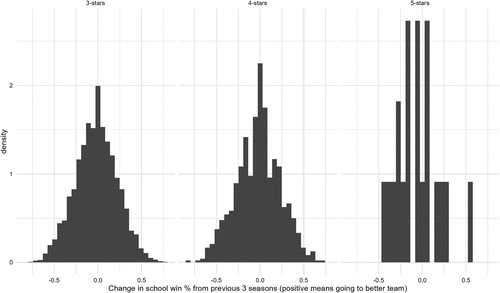
Notes. Includes transfers who were able to find a school to transfer to in the years 2021–2025. Transfer portal data exist only for years 2021 and later.
This condition differs from the earlier one without NIL in that the choice depends on the difference in expected values, , and the difference in NIL income, , across programs at time t. Moreover, the expected value functions differ from those presented without NIL. The sign of this difference and the difference in NIL income in period t is unclear. For high-quality 5* recruits, it could be the case that both are positive, which is attributed to the fact that the low-quality program could generate larger deals now and in the future for athlete i (e.g., due to being in a larger media market and/or valuing the player relatively more) and that the impact of program quality on NFL draft likelihood is statistically insignificant for 5* athletes. Both terms could also be negative, where the higher-quality programs with their “rich” collectives are able to incentivize top players to accept the program’s scholarship offer with larger NIL contracts.
The difference in present and expected value terms is also unclear for 3* and 4*. For these athletes, program choice (quality) affects their chances of being drafted (it is positive and significant) and thus affects the expected future value terms. However, the probability of being drafted into the NFL is and , respectively, indicating that the expected value terms are smaller than 5* athletes. But the arguments presented above for the impact of NIL on and for 5* recruits also hold for these 3* and 4* players, albeit likely on a smaller scale. Given this, the impact of NIL (personalized pricing) on program choice is empirically unclear.
A.2. Transfer Portal Plots
|
Table A.1. Regression of Win Percent on Last Year’s Win Percent, Recruiting Class Strength, and School and Conference Fixed Effects
| Y: Current year win percentage | |
|---|---|
| Last year win percentage | 0.30 |
| log(s_recruiting_points) | 0.014 |
| Largest school fixed effect | Alabama:0.33 (0.02) |
| Num. obs. | 2,490 |
| School FE | Y |
| Conference FE | Y |
| Adj R2 | 0.34 |
Notes. FBS schools only. Years 2005–2024. Standard errors (in parentheses) clustered by conference.
|
Table A.2. Recruiting Outcomes Regression on “Have Nots,” Prior Season Performance, and Transfer Ratings
| Placebo | |||
|---|---|---|---|
| Y: 247Sports Composite Team Points | |||
| have_notTRUE | |||
| lag_wins | 4.013 | 3.937 | 3.712 |
| net_transfers_rating_247 | |||
| Num. obs. | 532 | 532 | 532 |
| R2 | 0.620 | 0.613 | 0.617 |
| Conference FE | Yes | ||
| Year FE | Yes | ||
A.3. College Football Win Probabilities
|
Table A.3. Recruiting Outcomes Regression on Conferences
| Y: 247Sports Composite Team Points | |
|---|---|
| FBS (True) | 237.116 |
| Big Ten Conference | |
| Big 12 Conference | |
| Pac-12 Conference | |
| ACC Conference | |
| American Athletic Conference | |
| Conference USA | |
| FBS Independents | |
| Mid-American Conference | |
| Mountain West Conference | |
| Sun Belt Conference | |
| NIL × FBS | 1.564 |
| NIL × Big Ten Conference | 0.024 |
| NIL × Big 12 Conference | 5.078 |
| NIL × Pac-12 Conference | |
| NIL × ACC Conference | |
| NIL × American Athletic Conference | |
| NIL × Conference USA | |
| NIL × FBS Independents | |
| NIL × Mid-American Conference | 1.962 |
| NIL × Mountain West Conference | |
| NIL × Sun Belt Conference | |
| Num. obs. | 5,412 |
| Year FE | Y |
Notes. The conference “SEC” is dropped from the regression and should be interpreted as the baseline. Data are from years 2017–2024.
A.4. Talent Distribution Within or Across Conferences
Here, we analyze whether high school recruits post-NIL are resorting within conferences or going to different schools in different conferences. We restrict our attention to an eight-year interval: four years before and four years after NIL implementation. We define “have-nots” as teams who have not had a single finish in the top half of their conference in the four years pre-NIL. We then run the regression
To assess across-conference talent, we regress
A.5. DiD Details
International recruits playing on F-1 student (or other) visas are not allowed to make money in the United States.65,66 Although loopholes exist that allow these students to earn money outside the United States, American football is much less relevant outside the United States than other sports, like basketball or soccer. This creates a natural control group—international recruits—that was not affected by the change in the NIL policy, allowing us to control for factors that vary over time and affect both groups in a similar way.67
Our DiD approach compares the changes in outcomes for domestic recruits before and after NIL implementation to the changes in outcomes for international recruits over the same periods. The key identifying assumption of DiD is the parallel trends assumption, which posits that, in the absence of the treatment (NIL policies), the average outcomes for domestic and international recruits would have evolved similarly over time. We have repeated cross-sectional data, and our treatment is not staggered, so we are able to recover ATT estimates using a standard DiD regression estimator (Roth et al. 2023),
The coefficient of interest is , which measures the average treatment effect of NIL policies post-NIL on domestic recruits relative to international recruits.68
We plot all event studies in Appendix A.5 and use them to check for the existence of pre-trends, which helps test the parallel trends assumption. Our event studies use the regression specification
One challenge facing the DiD is the small sample size of international recruits. There are no 5* international recruits post-NIL and only a handful of 4* international recruits each year. Because we can control for unobserved time-varying factors with the DiD, we expand upon the data set used in Section 4.1 to obtain a larger sample. We reintroduce the 2021 class, and we extend the pre-period from 2018 to 2015 because recruiting rules and challenges affected both international and domestic athletes equally. Although power issues may persist, our goal with the DiD is for it to act as a robustness check for the propensity score estimators in Section 4.1 because it uses a different source of variation to identify the effects of NIL.
A.6. Other Tables
We have other measures of football quality that are not included in the main text. First, we use the number of players drafted by a school in the prior year and the prior three years as a measure of a program’s quality. These results suggest that 4* and 5* recruits choose schools that have more NFL draft success historically, but the DiD results are negative and insignificant. The results for 3* recruits suggest that they are attending schools with worse track records of getting athletes drafted by the NFL, which is consistently negative for all estimators.
We also use stickier metrics of quality that do not vary as much year to year, like SP+ and ELO. Results using these metrics suggest that talent is being redistributed across all star levels, although the DiD estimate is positive and insignificant.
We can use the 247Sports Composite Team Ranking to determine the strength of recruiting classes in the previous year and the average strength over the prior three years.
Finally, we can also observe whether athletes are more willing to stay in state or close to home post-NIL. NIL may provide a new incentive for recruits to move far away to big cities for NIL opportunities. We find that this generally isn’t the case. Our results in Table A.7 show that NIL is not causing recruits to move significantly further away from home.
A.6.1. Four-Star Recruit Results.
We now take a look at the alternative measures of football program quality, such as historical draft and recruiting metrics as well as SP+ and ELO ratings, and study top and bottom 4* recruits.
A.6.2 Three-Star Recruit Results.
We now break down behaviors by 3* recruits. Table A.11 looks at measures of football program quality from the main text, broken down by top and bottom 3* recruits.
The next few tables look at the alternative measures of program quality.
Table A.14 presents the treatment effects of NIL on academic quality measures for these subgroups. For the top 100 ranked 3* recruits, our results show no significant changes in the academic quality of their chosen schools post-NIL. In contrast, almost all of our estimators indicate that lower-ranked 3* recruits (ranked 101 and beyond) exhibit a notable shift toward schools with lower educational quality—characterized by higher admission rates, lower SAT scores, and reduced future earnings.69
We now analyze the popularity of schools chosen by 3* recruits as measured by TV ratings, number of broadcasts, and DMA size where the school is located.
|
Table A.4. Treatment Effects of NIL on Committed School’s Number of NFL Draftees in Prior Season by 5*, 4*, and 3* Recruits (Standard Errors Clustered By Position)
| Y | Method | Treatment | 5* recruits | 4* recruits | 3* recruits | |||
|---|---|---|---|---|---|---|---|---|
| Estimate | Std. error | Estimate | Std. error | Estimate | Std. error | |||
| Last year no. drafted | IPW | ATE | 0.436 | 0.419 | 0.261 | 0.130 | −1.320 | 0.060 |
| IPW | ATT | 0.448 | 0.518 | 0.168 | 0.140 | −0.166 | 0.063 | |
| AIPW | OW-ATE | 0.733 | 0.441 | 0.412 | 0.151 | −0.144 | 0.067 | |
| AIPW | ATT | 0.816 | 0.444 | 0.363 | 0.132 | −0.082 | 0.035 | |
| OLS | ATE | 0.506 | 0.639 | 0.347 | 0.119 | −0.098 | 0.056 | |
| DID | ATT | – | – | −1.387 | 1.005 | −0.114 | 0.261 | |
| Last 3 years no. drafted | IPW | ATE | 0.611 | 1.157 | 1.077 | 0.313 | −3.124 | 0.190 |
| IPW | ATT | 0.844 | 1.267 | 0.943 | 0.336 | −0.641 | 0.163 | |
| AIPW | OW-ATE | 1.863 | 1.116 | 1.424 | 0.360 | −0.586 | 0.161 | |
| AIPW | ATT | 2.112 | 1.115 | 1.335 | 0.310 | −0.566 | 0.084 | |
| OLS | ATE | 1.238 | 1.518 | 1.364 | 0.324 | −0.420 | 0.121 | |
| DID | ATT | – | – | −2.568 | 2.258 | −1.213 | 0.611 | |
|
Table A.5. Treatment Effects on Last Year SP Rating and Elo for Different Groups of 5*, 4*, and 3* Recruits (Standard Errors Clustered by Position)
| Y | Method | Treatment | 5* recruits | 4* recruits | 3* recruits | |||
|---|---|---|---|---|---|---|---|---|
| Estimate | SE | Estimate | SE | Estimate | SE | |||
| Last year SP rating | IPW | ATE | −5.877 | 1.296 | −2.150 | 0.461 | −5.762 | 1.159 |
| IPW | ATT | −4.916 | 1.336 | −2.359 | 0.508 | −1.511 | 0.397 | |
| AIPW | OW-ATE | −5.045 | 1.360 | −2.149 | 0.529 | −0.637 | 0.473 | |
| AIPW | ATT | −4.754 | 1.364 | −2.105 | 0.463 | −1.442 | 0.230 | |
| OLS | ATE | −5.399 | 1.911 | −1.841 | 0.478 | −0.745 | 0.184 | |
| DID | ATT | – | – | 1.627 | 2.744 | 1.075 | 1.404 | |
| Last year Elo | IPW | ATE | −120.748 | 35.016 | −27.244 | 11.738 | −115.118 | 25.586 |
| IPW | ATT | −74.311 | 39.679 | −34.118 | 12.675 | −22.798 | 8.717 | |
| AIPW | OW-ATE | −109.561 | 36.821 | −22.996 | 13.503 | −7.621 | 10.396 | |
| AIPW | ATT | −99.506 | 36.822 | −20.703 | 11.724 | −33.040 | 5.110 | |
| OLS | ATE | −121.389 | 48.334 | −21.075 | 10.961 | −22.885 | 5.105 | |
| DID | ATT | – | – | 5.148 | 53.368 | 29.088 | 35.959 | |
|
Table A.6. Treatment Effects on Last Year and Last 3 Years Recruit Points for Different Groups of 5*, 4*, and 3* Recruits (Standard Errors Clustered by Position)
| Y | Method | Treatment | 5* recruits | 4* recruits | 3* recruits | |||
|---|---|---|---|---|---|---|---|---|
| Estimate | SE | Estimate | SE | Estimate | SE | |||
| Last year recruit points | IPW | ATE | −2.572 | 5.518 | −3.681 | 1.800 | −41.973 | 4.945 |
| IPW | ATT | 3.863 | 6.620 | −4.517 | 2.005 | −12.014 | 1.779 | |
| AIPW | OW-ATE | 0.655 | 5.397 | −3.880 | 2.038 | −16.393 | 2.058 | |
| AIPW | ATT | 0.849 | 5.373 | −5.492 | 1.754 | −20.853 | 1.019 | |
| OLS | ATE | −5.398 | 7.275 | −2.389 | 1.369 | −12.760 | 1.016 | |
| DID | ATT | – | – | −23.398 | 9.448 | −7.217 | 5.659 | |
| Last 3 years recruit points average | IPW | ATE | −3.869 | 4.720 | −1.016 | 1.639 | −33.071 | 4.705 |
| IPW | ATT | −0.790 | 4.756 | −1.700 | 1.861 | −6.049 | 1.793 | |
| AIPW | OW-ATE | −0.589 | 4.838 | −0.435 | 1.845 | −2.306 | 1.928 | |
| AIPW | ATT | 0.210 | 4.879 | −1.442 | 1.614 | −5.509 | 0.970 | |
| OLS | ATE | −3.013 | 5.817 | 0.526 | 1.148 | −2.875 | 0.943 | |
| DID | ATT | – | – | −18.676 | 9.672 | −4.529 | 5.112 | |
|
Table A.7. Effects of NIL on Distance from Home and Probability of Staying in State for 3*, 4*, and 5* Recruits (Standard Errors Clustered by Position)
| Y | Method | Treatment | 5* recruits | 4* recruits | 3* recruits | |||
|---|---|---|---|---|---|---|---|---|
| Estimate | SE | Estimate | SE | Estimate | SE | |||
| Distance from home (km) | IPW | ATE | −0.022 | 0.167 | 0.074 | 0.061 | −0.317 | 0.182 |
| IPW | ATT | 0.110 | 0.179 | 0.103 | 0.069 | −0.007 | 0.043 | |
| AIPW | OW-ATE | 0.167 | 0.180 | 0.028 | 0.069 | −0.062 | 0.056 | |
| AIPW | ATT | 0.175 | 0.182 | 0.045 | 0.060 | −0.065 | 0.027 | |
| OLS | ATE | 0.142 | 0.210 | 0.065 | 0.067 | −0.008 | 0.029 | |
| DID | ATT | – | – | −0.833 | 0.386 | 0.001 | 0.258 | |
| Probability of staying in state | IPW | ATE | 0.062 | 0.074 | −0.025 | 0.021 | 0.063 | 0.066 |
| IPW | ATT | −0.010 | 0.089 | −0.040 | 0.024 | 0.015 | 0.014 | |
| AIPW | OW-ATE | −0.015 | 0.067 | −0.001 | 0.024 | 0.023 | 0.020 | |
| AIPW | ATT | −0.019 | 0.068 | −0.005 | 0.021 | 0.018 | 0.010 | |
| OLS | ATE | −0.002 | 0.100 | −0.022 | 0.022 | 0.006 | 0.010 | |
| DID | ATT | – | – | 0.027 | 0.086 | −0.012 | 0.031 | |
|
Table A.8. Treatment Effects of NIL on Draft Rates for Top 100 and Bottom Ranked 4* Recruits (Standard Errors Clustered by Position)
| Y | Method | Treatment | Top 100 4* recruits | 101+ ranked 4* recruits | ||
|---|---|---|---|---|---|---|
| Estimate | SE | Estimate | SE | |||
| Last year no. drafted | IPW | ATE | 1.397 | 0.485 | 0.087 | 0.199 |
| IPW | ATT | 1.133 | 0.531 | 0.039 | 0.313 | |
| AIPW | OW-ATE | 0.834 | 0.273 | 0.204 | 0.183 | |
| AIPW | ATT | 0.762 | 0.273 | 0.219 | 0.150 | |
| OLS | ATE | 0.715 | 0.297 | 0.120 | 0.158 | |
| DID | ATT | 0.470 | 3.070 | −1.996 | 0.688 | |
| Last 3 years no. drafted | IPW | ATE | 4.970 | 1.476 | 0.286 | 0.429 |
| IPW | ATT | 3.315 | 0.984 | 0.440 | 0.632 | |
| AIPW | OW-ATE | 2.943 | 0.653 | 0.643 | 0.434 | |
| AIPW | ATT | 2.771 | 0.650 | 0.824 | 0.352 | |
| OLS | ATE | 2.818 | 0.802 | 0.479 | 0.335 | |
| DID | ATT | 1.276 | 7.719 | −3.921 | 1.913 | |
|
Table A.9. Treatment Effects on Last Year SP Rating and Elo for Top 100 and Bottom Ranked 4* Recruits (Standard Errors Clustered by Position)
| Y | Method | Treatment | Top 100 4* recruits | 101+ ranked 4* recruits | ||
|---|---|---|---|---|---|---|
| Estimate | Std. error | Estimate | Std. error | |||
| Last year SP rating | IPW | ATE | 1.320 | 1.802 | −3.184 | 0.736 |
| IPW | ATT | 0.715 | 2.729 | −3.305 | 1.150 | |
| AIPW | OW-ATE | −0.973 | 0.879 | −2.876 | 0.672 | |
| AIPW | ATT | −1.000 | 0.883 | −2.768 | 0.547 | |
| OLS | ATE | −0.814 | 1.029 | −2.559 | 0.543 | |
| DID | ATT | 4.114 | 6.734 | 0.829 | 4.291 | |
| Last year Elo | IPW | ATE | 101.843 | 61.136 | −50.469 | 18.793 |
| IPW | ATT | 78.140 | 103.625 | −55.702 | 29.742 | |
| AIPW | OW-ATE | 3.637 | 23.077 | −40.145 | 17.004 | |
| AIPW | ATT | 2.356 | 23.110 | −32.844 | 13.763 | |
| OLS | ATE | 14.118 | 24.807 | −35.324 | 13.577 | |
| DID | ATT | 19.030 | 166.109 | −2.127 | 69.444 | |
|
Table A.10. Treatment Effects on Last Year and Last 3 Years Recruit Points for Top 100 and Bottom Ranked 4* Recruits (Standard Errors Clustered by Position)
| Y | Method | Treatment | Top 100 4* recruits | 101+ ranked 4* recruits | ||
|---|---|---|---|---|---|---|
| Estimate | SE | Estimate | SE | |||
| Last year recruit points | IPW | ATE | 20.694 | 7.157 | −13.169 | 2.672 |
| IPW | ATT | 16.067 | 11.626 | −13.708 | 3.870 | |
| AIPW | OW-ATE | 6.454 | 3.257 | −9.892 | 2.633 | |
| AIPW | ATT | 6.337 | 3.226 | −9.275 | 2.097 | |
| OLS | ATE | 8.266 | 3.361 | −9.124 | 1.707 | |
| DID | ATT | −2.201 | 28.497 | −29.201 | 12.021 | |
| Last 3 years recruit points | IPW | ATE | 15.910 | 5.995 | −8.402 | 2.335 |
| IPW | ATT | 13.823 | 8.878 | −9.952 | 3.333 | |
| AIPW | OW-ATE | 6.139 | 2.935 | −4.231 | 2.411 | |
| AIPW | ATT | 5.456 | 2.949 | −4.149 | 1.936 | |
| OLS | ATE | 6.158 | 3.880 | −4.075 | 1.368 | |
| DID | ATT | 4.066 | 24.086 | −25.098 | 13.562 | |
|
Table A.11. Treatment Effects of NIL on the Probability of Recruits Attending Top-Ranked Schools for 3* Recruits (Standard Errors Clustered by Position)
| Y | Method | Treatment | Top 100 3* recruits | 101+ ranked 3* recruits | ||
|---|---|---|---|---|---|---|
| Estimate | SE | Estimate | SE | |||
| Top 10 prior season | IPW | ATE | −0.049 | 0.045 | −0.036 | 0.003 |
| IPW | ATT | −0.001 | 0.415 | 0.007 | 0.005 | |
| AIPW | OW-ATE | −0.021 | 0.069 | 0.010 | 0.007 | |
| AIPW | ATT | −0.045 | 0.084 | 0.015 | 0.004 | |
| OLS | ATE | 0.005 | 0.081 | 0.007 | 0.005 | |
| DID | ATT | 0.079 | 0.366 | 0.021 | 0.026 | |
| Top 25 prior season | IPW | ATE | −0.023 | 0.655 | −0.111 | 0.011 |
| IPW | ATT | 0.080 | 0.179 | 0.021 | 0.009 | |
| AIPW | OW-ATE | 0.040 | 0.091 | 0.022 | 0.014 | |
| AIPW | ATT | 0.019 | 0.096 | 0.021 | 0.007 | |
| OLS | ATE | −0.104 | 0.068 | 0.016 | 0.007 | |
| DID | ATT | 0.411 | 0.269 | 0.080 | 0.042 | |
| Total top 10 prior 3 seasons | IPW | ATE | −0.153 | 0.284 | −0.118 | 0.007 |
| IPW | ATT | −0.112 | 0.372 | 0.004 | 0.013 | |
| AIPW | OW-ATE | −0.059 | 0.156 | −0.004 | 0.016 | |
| AIPW | ATT | −0.094 | 0.139 | −0.003 | 0.008 | |
| OLS | ATE | −0.100 | 0.169 | −0.007 | 0.011 | |
| DID | ATT | −0.499 | 0.995 | 0.032 | 0.071 | |
| Total top 25 prior 3 seasons | IPW | ATE | −0.185 | 2.147 | −0.261 | 0.054 |
| IPW | ATT | 0.092 | 1.355 | 0.025 | 0.020 | |
| AIPW | OW-ATE | −0.094 | 0.201 | 0.012 | 0.028 | |
| AIPW | ATT | −0.117 | 0.190 | −0.041 | 0.015 | |
| OLS | ATE | −0.314 | 0.184 | −0.025 | 0.016 | |
| DID | ATT | −0.312 | 0.755 | 0.161 | 0.116 | |
| Win percentage prior 3 Seasons | IPW | ATE | −0.042 | 0.036 | −0.032 | 0.018 |
| IPW | ATT | −0.014 | 0.443 | −0.004 | 0.005 | |
| AIPW | OW-ATE | −0.025 | 0.026 | −0.016 | 0.008 | |
| AIPW | ATT | −0.039 | 0.025 | −0.022 | 0.004 | |
| OLS | ATE | −0.073 | 0.033 | −0.019 | 0.005 | |
| DID | ATT | 0.071 | 0.152 | 0.022 | 0.021 | |
|
Table A.12. Treatment Effects of NIL on Committed School’s Number of NFL Draftees in Prior Season for Top 100 and Bottom Ranked 3* Recruits Standard Errors Clustered by Position)
| Y | Method | Treatment | Top 100 3* recruits | 101+ ranked 3* recruits | ||
|---|---|---|---|---|---|---|
| Estimate | SE | Estimate | SE | |||
| Last year no. drafted | IPW | ATE | −0.116 | 4.540 | −1.224 | 0.056 |
| IPW | ATT | 0.668 | 5.318 | 0.125 | 0.047 | |
| AIPW | OW-ATE | 0.662 | 0.456 | −0.173 | 0.064 | |
| AIPW | ATT | 0.624 | 0.375 | −0.097 | 0.033 | |
| OLS | ATE | 0.602 | 0.483 | −0.078 | 0.050 | |
| DID | ATT | −1.790 | 2.285 | −0.045 | 0.244 | |
| Last 3 years no. drafted | IPW | ATE | −0.182 | 2.768 | −2.777 | 0.198 |
| IPW | ATT | 1.105 | 5.124 | 0.199 | 0.116 | |
| AIPW | OW-ATE | 1.544 | 1.014 | −0.625 | 0.153 | |
| AIPW | ATT | 1.211 | 0.825 | −0.612 | 0.079 | |
| OLS | ATE | −0.241 | 1.259 | −0.361 | 0.125 | |
| DID | ATT | −6.192 | 4.151 | −0.937 | 0.624 | |
|
Table A.13. Treatment Effects on Last Year and Last 3 Years Recruit Points for Top 100 and Bottom Ranked 3* Recruits (Standard Errors Clustered by Position)
| Y | Method | Treatment | Top 100 3* recruits | 101+ ranked 3* recruits | ||
|---|---|---|---|---|---|---|
| Estimate | SE | Estimate | SE | |||
| Last year recruit points | IPW | ATE | −7.968 | 43.091 | −36.931 | 5.302 |
| IPW | ATT | 8.922 | 20.525 | −2.372 | 1.483 | |
| AIPW | OW-ATE | 0.362 | 8.674 | −16.073 | 2.180 | |
| AIPW | ATT | 1.935 | 11.604 | −21.334 | 1.065 | |
| OLS | ATE | −22.079 | 7.145 | −12.916 | 1.170 | |
| DID | ATT | −46.624 | 28.611 | −5.207 | 5.426 | |
| Last 3 years recruit points | IPW | ATE | −10.777 | 31.211 | −28.185 | 5.117 |
| IPW | ATT | 7.950 | 26.018 | 3.920 | 1.501 | |
| AIPW | OW-ATE | −2.040 | 8.237 | −1.843 | 2.037 | |
| AIPW | ATT | 1.171 | 10.424 | −5.953 | 1.016 | |
| OLS | ATE | −5.197 | 7.055 | −2.483 | 1.043 | |
| DID | ATT | −46.176 | 25.604 | −2.418 | 4.760 | |
|
Table A.14. Treatment Effects of NIL on Academic Quality-Related Numbers for Different Groups of 3* Recruits (Standard Errors Clustered by Position)
| Y | Method | Treatment | Top 100 3* recruits | 101+ ranked 3* recruits | ||
|---|---|---|---|---|---|---|
| Estimate | SE | Estimate | SE | |||
| Admit rate (demeaned) | IPW | ATE | 0.036 | 0.169 | 0.125 | 0.019 |
| IPW | ATT | −0.068 | 0.112 | −0.005 | 0.007 | |
| AIPW | OW-ATE | 0.055 | 0.049 | 0.036 | 0.010 | |
| AIPW | ATT | 0.015 | 0.049 | 0.017 | 0.005 | |
| OLS | ATE | −0.030 | 0.038 | 0.017 | 0.006 | |
| DID | ATT | 0.192 | 0.193 | 0.037 | 0.029 | |
| SAT scores (demeaned) | IPW | ATE | −12.350 | 173.652 | −96.068 | 6.223 |
| IPW | ATT | 23.868 | 31.245 | 3.031 | 3.330 | |
| AIPW | OW-ATE | −25.842 | 19.721 | −28.669 | 5.120 | |
| AIPW | ATT | −0.773 | 20.449 | −19.277 | 2.638 | |
| OLS | ATE | 9.393 | 15.905 | −17.843 | 3.494 | |
| DID | ATT | −127.910 | 88.452 | −17.393 | 17.521 | |
| Log median income 10 years postgraduation (demeaned) | IPW | ATE | −0.010 | 0.030 | −0.128 | 0.023 |
| IPW | ATT | −0.014 | 0.443 | 0.007 | 0.006 | |
| AIPW | OW-ATE | −0.025 | 0.026 | −0.044 | 0.008 | |
| AIPW | ATT | −0.039 | 0.025 | −0.033 | 0.004 | |
| OLS | ATE | −0.073 | 0.033 | −0.026 | 0.006 | |
| DID | ATT | 0.071 | 0.152 | −0.003 | 0.029 | |
|
Table A.15. Treatment Effects of NIL on TV Ratings for Different Groups of 3* Recruits (Standard Errors Clustered by Position)
| Y | Method | Treatment | Top 100 3* recruits | 101+ ranked 3* recruits | ||
|---|---|---|---|---|---|---|
| Estimate | SE | Estimate | SE | |||
| Log 3 year ratings (demeaned) | IPW | ATE | −0.040 | 0.989 | −2.534 | 0.819 |
| IPW | ATT | 0.195 | 0.392 | 0.186 | 0.123 | |
| AIPW | OW-ATE | 0.102 | 0.219 | −0.638 | 0.211 | |
| AIPW | ATT | 0.158 | 0.227 | −0.856 | 0.091 | |
| OLS | ATE | −0.081 | 0.386 | −0.557 | 0.171 | |
| DID | ATT | −0.145 | 0.680 | −0.232 | 0.438 | |
| TV broadcasts over 3 years (demeaned) | IPW | ATE | 0.155 | 6.295 | −6.670 | 0.749 |
| IPW | ATT | 1.374 | 6.286 | 0.293 | 0.251 | |
| AIPW | OW-ATE | 0.612 | 1.458 | −1.980 | 0.363 | |
| AIPW | ATT | 0.867 | 1.561 | −2.312 | 0.183 | |
| OLS | ATE | −0.727 | 1.478 | −1.647 | 0.263 | |
| DID | ATT | 3.422 | 6.621 | 0.476 | 1.352 | |
| School DMA % of U.S. Population | IPW | ATE | 0.149 | 0.712 | 0.136 | 0.121 |
| IPW | ATT | 0.550 | 0.999 | 0.013 | 0.027 | |
| AIPW | OW-ATE | 0.099 | 0.157 | −0.034 | 0.041 | |
| AIPW | ATT | 0.186 | 0.186 | −0.032 | 0.021 | |
| OLS | ATE | −0.089 | 0.158 | −0.011 | 0.025 | |
| DID | ATT | 0.120 | 0.223 | −0.115 | 0.202 | |
1 National Collegiate Athletic Association v. Alston focused on the NCAA’s limits to academic-related benefits for athletes; it did not address restrictions on NIL deals for student-athletes. Alston v. NCAA catalyzed the arrival of NIL by exposing the NCAA’s legal weaknesses and forcing the organization to abandon its resistance.
2 The decision by the 9th Circuit also provided an alternative reasoning: “The court found in the alternative that the college education market can be thought of as a market in which student-athletes are sellers rather than buyers and the schools are purchasers of athletic services. In the court’s alternative view, the college education market is a monopsony.” Note that with this rationale acting as an alternative, the primary decision was based on the education market as the “product.” For nonlegal scholars, an “alternative ruling” refers to a situation where the court makes a decision based on one legal argument but also provides another legal argument or rationale as a backup.
8 https://www.bestcolleges.com/news/hidden-truth-behind-merit-scholarships/.
9 https://www.bestcolleges.com/news/hidden-truth-behind-merit-scholarships/.
10 https://www.bestcolleges.com/news/hidden-truth-behind-merit-scholarships/.
11 From our own analysis in Section A.1.
13 https://ncaaorg.s3.amazonaws.com/research/pro_beyond/2020RES_ProbabilityBeyondHSFiguresMethod.pdf.
14 www.ncaa.org/sports/2018/10/10/ncaa-sports-sponsorship-and-participation-rates-database.aspx.
15 Colleges are constrained on which months and the number of days they can use to visit high schools.
16 Before April 13, 2023, athletes were limited to five school visits. Today, athletes can visit an unlimited number of schools but are still restricted to one visit per school. https://www.ncaa.org/news/2023/4/13/media-center-di-council-adopts-proposal-for-student-athlete-representation.aspx.
17 See https://247sports.com/article/247sports-rating-explanation-81574/ for an explanation of how 247Sports assigns star ratings.
18 Given an average of four years of college and students quitting to focus on academics as they get older, this number is likely a conservative estimate.
19 The Pac-12 has dissolved, with notable schools like USC and UCLA leaving for the other Power 5 conferences.
20 See https://www.ncaa.org/sports/2018/12/13/ncaa-demographics-database.aspx.
21 https://ncaaorg.s3.amazonaws.com/research/pro_beyond/2020RES_HSParticipationMapByState.pdf.
22 Prior to the 2024 season, this playoff was restricted to only four teams.
23 Note: the national championship game for the 2023 season was played in January 2024.
25 https://collegefootballnetwork.com/human-cost-of-nil-2024/.
26 https://apnews.com/article/nil-college-boosters-67da0dc7cc98f6508915b36d629c99ec.
27 For example, a popular commercial was done by 3* recruit DeColdest Crawford for an air conditioning company.
28 https://collegefootballnetwork.com/human-cost-of-nil-2024/.
30 https://theathletic.com/3256808/2022/04/19/college-football-recruiting-nil/.
31 Data are accurate as of October 18, 2024; see https://nilassist.ncaa.org/data-dashboard/.
32 These laws were to force the NCAA to permit NIL for athletes. It is important to note that it was not illegal to make a profit from your NIL in any state. Rather, if one did so before the June 30 NCAA decision, then a student-athlete would be ruled ineligible for competition.
33 See Figure A.1 in the Appendix for the three-year win percentage plot; results remain similar.
36 Meanwhile, class of 2020 recruits had already committed to colleges in December 2019 and February 2020 before COVID-19 restrictions were implemented.
37 Popular podcasts and TV programs often focus on the spread. For example, the popular sports podcast The Bill Simmons Podcast dedicates an entire episode every week during football season to “Guess the Lines (spreads)” for NFL games.
38 Spread provided by ESPN Bet. Texas ended up winning 34-3, covering the spread; https://www.espn.com/college-football/game/_/gameId/401628390/texas-oklahoma.
39 Npre = 6,301 and Npost = 4,348. There is no statistically significant difference with a z-score of 1.217.
40 In estimation on the subset of top 3* recruits, we have to resort to a binned rank metric versus actual rank because of poor overlap.
41 This is implemented with the grf package in R.
42 Note: Results of the AIPW estimator are robust to dropping the class of 2024, the only class to be affected by conference realignment in our data.
43 Our sample size is much larger than 247Sports’ because of additional research done on pipelines that enable international students to play high school football in the United States and data from the Canadian Football League.
44 SP+ is a metric created by Bill Connelly of ESPN. See https://www.sbnation.com/college-football/2017/10/13/16457830/college-football-advanced-stats-analytics-rankings.
45 See Table A.1, where last year’s win percentage is as large as any school-specific fixed effect.
46 See Appendix A.6 for directionally similar but weaker evidence that 5* recruits are choosing lower-quality schools.
48 https://www.axios.com/2021/12/16/hbcu-jackson-state-travis-hunter-florida-football.
49 For example, see https://www.forbes.com/sites/michaellore/2022/09/15/travis-hunter-signs-nil-deal-with-michael-strahan-brand/?sh=1a2b07cf6a5d.
50 247Sports gives this exact interpretation for their rankings; https://247sports.com/article/247sports-rating-explanation-81574/.
51 Table A.8 also supports this claim that top 4* recruits seem to be focusing on schools with good historical draft success.
52 We cannot break the binscatter out by pre- and post-NIL recruits because the high school athletes who were recruited at the legalization of NIL (class of 2021) are now just eligible for the NFL draft (2024 NFL Draft). Some recruits may stay at college for five years or more before being drafted.
55 See https://www.nytimes.com/interactive/2024/08/31/business/nil-money-ncaa.html, https://www.nytimes.com/2023/10/21/us/college-athletes-donor-collectives.html, and https://www.cbssports.com/college-football/news/inside-the-college-football-nil-market-how-much-players-at-each-position-are-actually-getting-paid/ for discussions on NIL earnings and their impact on college athletes.
56 See Section 3.2 for an explanation on why betting data can assess competitiveness.
57 We take absolute values because spread and point differential can be negative, depending on whether the home or away team is favored or has won the game.
58 Almost all transfers before 2021 were ineligible for one year after a transfer; 247Sports does not even provide a transfer class rating pre-NIL.
59 We also find that 3* recruits seemingly choose schools with worse historical NFL draft success (Tables A.4 and A.12).
60 We do not explicitly model the transition here, but historically it has remained quite sticky (i.e., high-quality teams usually remain high-quality and vice versa).
61 See Table A.1 in the Appendix for empirical support that prior season performance is indicative of performance in the subsequent season.
62 We should highlight that our utility function for player i ignores the impact of future income from academic quality in order to focus on what we believe are first-order effects of NIL and to keep the model interpretable. Below, we discuss how NIL has shifted college decisions based on academic quality, particularly for 3* recruits.
63 Or shortly after.
64 We ignore the error term again.
66 For example, Zach Edey, a famous Canadian college basketball star at Purdue, was unable to earn NIL money; see https://www.espn.com/mens-college-basketball/story/_/id/39882011/purdue-zach-edey-missing-profits-due-us-nil-law.
67 Note that “international” does not necessarily imply that the athlete attended high school internationally. In fact, many top “international” recruits end up playing football at U.S. high schools because the sport is so localized to the United States, and high school football in the United States is the best pathway to be recognized by college scouts.
68 That is, is a measurement of the ATT.
69 The only occasional exception is the IPW estimate for the ATT, which is included again only as a benchmark because of the lack of overlap at times. Estimates may be directionally dissimilar but remain statistically and economically insignificant.
References
- (2023) Voluntary disclosure and personalized pricing. Rev. Econom. Stud. 90(2):538–571.Crossref, Google Scholar
- (2022) Marginal effects of merit aid for low-income students. Quart. J. Econom. 137(2):1039–1090.Crossref, Google Scholar
- (2006) Recent Developments in the Economics of Price Discrimination. Blundell R, Newey W, Persson T, eds. Advances in Economics and Econometrics: Theory and Applications, Ninth World Congress, Econometric Society Monographs, vol. 2 (Cambridge University Press, Cambridge, UK), 97–141.Google Scholar
- (2021) Policy learning with observational data. Econometrica 89(1):133–161.Crossref, Google Scholar
- Athey S, Tibshirani J, Wager S (2019) Generalized random forests. Annals Statist. 47(2):1148–1178.Google Scholar
- (2023) Price discrimination in the information age: Prices, poaching, and privacy with personalized targeted discounts. Rev. Econom. Stud. 90(5):2085–2115.Crossref, Google Scholar
- (2012) Optimal admission and scholarship decisions: Choosing customized marketing offers to attract a desirable mix of customers. Marketing Sci. 31(4):621–636.Link, Google Scholar
- (2018) The NCAA cartel and antitrust policy. Rev. Ind. Organ. 52(2):351–368. Crossref, Google Scholar
- (1999) The causal effect of education on earnings. Handbook Labor Econom. 3A:1801–1863. Crossref, Google Scholar
- (2024) On binscatter. Amer. Econom. Rev. 114(5):1488–1514.Crossref, Google Scholar
- (2020) Competitive personalized pricing. Management Sci. 66(9):4003–4023.Link, Google Scholar
- (2013) The dynamic advertising effect of collegiate athletics. Marketing Sci. 32(5):679–698.Link, Google Scholar
- (2013) Economic value of celebrity endorsements: Tiger woods’ impact on sales of nike golf balls. Marketing Sci. 32(2):271–293.Link, Google Scholar
- (2014) Merit aid, college quality, and college completion: Massachusetts’ adams scholarship as an in-kind subsidy. Amer. Econom. J. Appl. Econom. 6(4):251–285.Crossref, Google Scholar
- (2018) Firms’ strategic leverage of unplanned exposure and planned advertising: An analysis in the context of celebrity endorsements. J. Marketing Res. 55(1):14–34.Crossref, Google Scholar
- (2023) Personalized pricing and consumer welfare. J. Political Econom. 131(1):131–189.Crossref, Google Scholar
- (2000) Hope for whom? Financial aid for the middle class and its impact on college attendance. National Tax J. 53(3):629–661.Crossref, Google Scholar
- (2023)
College costs, financial aid, and student decisions . Hanushek EA, Machin SJ, Woessmann L, eds. Handbook of the Economics of Education, vol. 7 (Elsevier, Amsterdam), 227–285. Google Scholar - (1998) The NCAA cartel and competitive balance in college football. Rev. Indust. Organ. 13(3):347–369. Crossref, Google Scholar
- (2002) On the demographic composition of colleges and universities in market equilibrium. Amer. Econom. Rev. 92(2):310–314. Google Scholar
- (2003) Peer effects, financial aid, and selection of students into colleges. J. Appl. Econometrics 18(5):501–525.Crossref, Google Scholar
- (2006) Admission, tuition, and financial aid policies in the market for higher education. Econometrica 74(4):885–928. Google Scholar
- (2019) Market power and price discrimination in the US market for higher education. RAND J. Econom. 50(1):201–225.Crossref, Google Scholar
- (2023) Price discrimination and public policy in the US college market. Rev. Econom. Stud. 90(3):1228–1264.Crossref, Google Scholar
- (2016) Post-baccalaureate migration and merit-based scholarships. Econom. Ed. Rev. 54:155–172. C28220052Crossref, Google Scholar
- (2007) Structural change, competitive balance, and the rest of the major leagues. Econom. Inquiry 45(3):519–532.Crossref, Google Scholar
- (1995) Cross-subsidization, incentives, and outcomes in professional team sports leagues. J. Econom. Lit. 33(3):1265–1299.Google Scholar
- (2020) Who profits from amateurism? Rent-sharing in modern college sports. NBER Working Paper No. 27734, National Bureau of Economic Research, Cambridge, MA.Google Scholar
- (1994) Identification and estimation of local average treatment effects. Econometrica 62(2):467–475. Crossref, Google Scholar
- (2018) Balancing covariates via propensity score weighting. J. Amer. Statist. Assoc. 113(521):390–400.Crossref, Google Scholar
- (2024) Is personalized pricing profitable when firms can differentiate? Management Sci. 70(7):4184–4199.Link, Google Scholar
PBS (2023) Analysis: Who is winning in the high-revenue world of college sports? Accessed October 27, 2024, https://www.pbs.org/newshour/economy/analysis-who-is-winning-in-the-high-revenue-world-of-college-sports.Google Scholar- Pigou AC (1920) The Economics of Welfare, 1st ed. (Macmillan, London).Google Scholar
- (2024) Personalized pricing and competition. Amer. Econom. Rev. 114(7):2141–2170.Crossref, Google Scholar
- (1994) Estimation of regression coefficients when some regressors are not always observed. J. Amer. Statist. Assoc. 89(427):846–866.Crossref, Google Scholar
- (2006) Do firms maximize? Evidence from professional football. J. Political Econom. 114(2):340–365.Crossref, Google Scholar
- (1983) The central role of the propensity score in observational studies for causal effects. Biometrika 70(1):41–55. Crossref, Google Scholar
- (2023) What’s trending in difference-in-differences? A synthesis of the recent econometrics literature. J. Econom. 235(2):2218–2244.Crossref, Google Scholar
- (1974) Estimating causal effects of treatments in randomized and non-randomized studies. J. Ed. Psych. 66(5):688–701.Crossref, Google Scholar
- (2019) Financial aid, debt management, and socioeconomic outcomes: Post-college effects of merit-based aid. J. Public Econom. 170:68–82. Crossref, Google Scholar
- (2020) Approximating purchase propensitites and reservation prices from broad consumer tracking. Internat. Econom. Rev. 61(2):847–870.Crossref, Google Scholar
- (1988) On the strategic choice of spatial price policy. Amer. Econom. Rev. 78(1):122–137.Google Scholar
- (2022) Stats 361: Causal inference. Lecture notes, Stanford University, Stanford.Google Scholar
- (2015) First degree price discrimination goes to school. J. Indust. Econom. 63(4):569–597.Crossref, Google Scholar
- (1999) Subsidies, hierarchies, and peers: The awkward economics of higher education. J. Econom. Perspect. 13(1):13–36.Crossref, Google Scholar