


What Do Shareholders Want? Consumer Welfare and the Objective of the Firm
Abstract
Shareholders want a firm’s objective function to place some weight on consumer welfare, motivated by both self-interest and altruism. Firms have a unique technology for improving consumer welfare: lowering inefficient price markups. Optimal pricing formulas can account for shareholders’ marginal rate of substitution between profits and consumer welfare. Calibrations show shareholders should place nontrivial weights on consumers. A survey experiment with a representative sample shows how shareholders would vote on resolutions giving strategic guidance to firms. Only 7% would vote for pure profit maximization. The median individual is indifferent between $0.44 in profits or $1 in consumer surplus.
This paper was accepted by John Beshears, behavioral economics and decision analysis.
Funding: This work was supported by Boston University (Impact Measurement and Allocation Program and Ravi K. Mehrotra Institute for Business, Markets, and Society).
Supplemental Material: The online appendix and data files are available at https://doi.org/10.1287/mnsc.2025.00094.
1. Introduction
What do shareholders want firms to maximize? Maximizing profits, or shareholder financial value, is often assumed to be the objective of the firm, with Friedman (1970) classically arguing that “the social responsibility of business is to increase its profits.” Most economic theory assumes shareholders want to maximize financial value (e.g., Shleifer and Vishny 1988).1 However, shareholders have various motivations and may care directly about various environmental, social, and governance outcomes. Thus, Hart and Zingales (2017) argue that firms should maximize shareholder welfare instead. To act in the interest of shareholders requires understanding shareholders’ objectives.
This paper examines the objectives of shareholders, both theoretically and empirically, and identifies a component that has largely been overlooked in the debate over the potential objectives of the firm: consumer welfare.
I develop a model showing that firms that maximize shareholder utility should place some weight on consumer welfare for two reasons. First, shareholders want firms to place weight on consumer welfare because they are consumers themselves who benefit directly from lower prices. Second, shareholders are people who may directly value the welfare of others.2 These two motivations can be used to quantify shareholders’ desired weight on consumer welfare. The self-interested component depends on the ratio of the share of the firm’s output a shareholder consumes to the share of the firm that they own. The theory then shows how adding altruistic social preferences affects shareholders’ desired weight on consumer welfare.
Valuing consumer welfare changes how firms should optimally set prices in imperfectly competitive markets. The key parameter is the marginal rate of substitution between profits and consumer welfare in the firm’s objective function, which I term . A firm that was previously profit maximizing can implement optimal pricing by reducing the Lerner index (markups as a percentage of price) by approximately percent. For instance, if a $1 increase in profits is equivalent to a $10 increase in consumer welfare in the shareholders’ desired objective function, then the weight , and markups as a percentage of price should be about 10% lower relative to the profit-maximizing level.
The structure of profit and utility maximization, together with estimates of the own-price elasticity of demand, allows us to derive the resulting impact on profits and consumer surplus. When firms reduce markups, they both transfer money to existing consumers and induce new, socially efficient, purchases. As a result, the gain in consumer welfare is larger than the loss in profits. The gain, relative to the loss, is particularly large when considering changes near the profit-maximizing price, where a small reduction in price has no first-order impact on profits (because it induces more sales) but does have a first-order impact on consumer welfare. Thus, the model shows why shareholders would want to achieve their objectives via firms, rather than taking profits and donating to charity: firms have access to a unique technology for improving consumer welfare–lowering inefficient markups.3
Numerical calibrations in a stylized model show that implementing in imperfectly competitive markets would increase consumer surplus by about 200 times the cost in lost profits. I provide estimates of the gains to consumer surplus and cost in lost profits under varying elasticities of demand and desired . For instance, using Allcott et al. (2026)’s estimates of average elasticities for grocery chains, I estimate that implementing would reduce variable profits by 1% but increase consumer surplus by 20 times that amount.
Data on consumption and stock ownership can be used to estimate weights that a nonaltruistic shareholder might attach to consumer welfare. For instance, because the top decile of income owns about 71% of stock and consumes about 22% of consumption, under stylized assumptions of a diversified portfolio and diversified consumption, a representative nonaltruistic individual from this group would have a . Constructing weights for more detailed demographic groups, I show that the weights are substantial for most shareholders. However, average weighted by share ownership is less than the simple average across people, as stockholding is more concentrated than consumption (Gans et al. 2019). The median nonaltruistic individual would have greater than one, whereas the median share of stock would be held by an individual whose nonaltruistic is about 0.28.
The calibrations then consider a simple type of altruism that attaches equal weight to all individuals and contains no motive for redistribution. Because each individual’s claim on profits is a relatively small share of total profits, even small amounts of altruism lead to a substantial weight on consumers, driving close to one—equal treatment of profits and consumer surplus—for most of the population.
I then use choice experiments to directly elicit shareholders’ desired weights on consumer welfare. I ask how shareholders would vote on resolutions giving strategic guidance to firms about what objective function to pursue.4 Specifically, I elicit how they want firms to trade off profits against benefits to consumers. These types of resolutions give general guidance to firms and do not require shareholders to have specific knowledge about the relative costs and benefits of particular actions.5
I use an approximately representative sample of Americans recruited from the RAND American Life Panel (ALP). The median desired weight on consumer surplus is about , with substantial heterogeneity across individuals. Of people identified as owning stock, the median . Only 7% of participants vote for firms to be purely profit maximizing. To put these estimates in context, I also give participants a similar choice between reducing environmental harms versus increasing profits. The resulting estimates show that the desired weight on consumer welfare and the environment is similar for stockholders but that nonstockholders place a higher weight on environmental benefits.
Even though consumer welfare has not played a prominent role in the literature on corporate social responsibility, these results indicate that how firms affect consumers is a key dimension of corporate impact and that shareholders care about that impact. This research is complementary to recent research by Allcott et al. (2026), which, for various firms and industries, examines externalities, internalities, and the impact on consumer surplus if a firm were to exit the industry. They conclude that consumer welfare is one of the most important dimensions of corporate impact. They show that profit-maximizing firms have a major impact on consumers. In contrast, this paper shows how shareholders would like firms to behave toward consumers and that firms can deliver large benefits to consumers at low costs in terms of profits.6
These results open new questions. Though consumer welfare is valued by shareholders, it is unclear whether firms currently account for this preference in their pricing. The active debate over whether shareholder financial value or shareholder utility should be the firm’s objective (Hart and Zingales 2017, Bartlett and Bubb 2024), as well as over what is legally permissible, could limit the willingness of the firm to implement such preferences. In the narrowest definition of fiduciary duty, managers must look after the value of the firm to shareholders; in another definition, managers must look after the interests of shareholders, which can include the value of the firm, direct economic benefits in the form of prices paid by shareholders for goods sold by the firm, and noneconomic benefits, such as shareholders’ social objectives (see Hart and Zingales (2022) and Stout (2008) for discussions). Finally, note that the debate over what is legally permissible for traditional for-profit firms is not constraining for public benefit corporations, a relatively new corporate form that is explicitly authorized to consider other factors alongside profit maximization (see Hiller (2013) for background).
These questions about whether firms do and should implement shareholder preferences echo those raised by the common ownership literature, which notes that shareholders should want firms to broaden their focus from maximizing their own profits to maximizing the profits of their owners’ entire portfolio.7
Finally, the way in which shareholder preferences are represented is a topic of policy interest; proposals have been made to require asset managers to offer “pass-through voting” in which individual investors choose how to vote their shares, rather than have the asset manager (e.g., index fund) vote them. Various asset managers, such as BlackRock and Vanguard, are exploring voluntarily implementing pass-through voting. Montagnes et al. (2025) examine how well different pass-through voting strategies would represent individual shareholders; see also Haber et al. (2022) and Zytnick (2022) on how asset managers reflect individual investors when voting. This paper’s method of eliciting strategic guidance on the objective of the firm might be a more effective method than having individual small investors vote on more detailed questions that require knowledge of the business situation of the firm to assess.
1.1. Related Literature
Hart and Zingales (2017, 2022) argue that shareholder welfare, rather than financial value, is the legitimate objective of the firm. Relatedly, Morgan and Tumlinson (2019) theoretically examine the implications of maximizing shareholder welfare in the context of public goods provision.8 Whereas those papers focus on externalities, my paper examines the novel implication of shareholders’ preferences for price setting and quantifies those preferences. The theoretical results in this paper focus on how firms affect consumer welfare through prices. The structure of profit and utility maximization allows me to identify a shareholder preference parameter and use that to provide pricing guidance to the firm.
My model of shareholders builds on previous literature that examined self-interested owners as consumers. Classically, Farrell (1985) showed that self-interested shareholders would want firms to set prices to maximize social welfare in an egalitarian economy that has homogeneous consumers all owning an equal share of all firms. Gans et al. (2019) extended these results to include consumer heterogeneity in ownership share and showed conditions on the largest ownership share that would induce the median shareholder to vote to set the socially efficient price. I further extend these models to include both social preferences and heterogeneity in how much individuals consume.
The literature on corporate social responsibility (CSR) is vast. In the taxonomy of Kitzmueller and Shimshack (2012), a firm can engage in CSR activities because it has strategic motivations to do so (e.g., these activities may raise profits by increasing consumer demand or lowering the cost of attracting employees), agency problems (managers pursue objectives other than profits over the wishes of shareholders), or not-for-profit motivations (shareholders desire the firm to undertake CSR activities independently from their impact on profits).9 This paper’s model examines firms engaged in not-for-profit CSR, as shareholders deliberately choose to sacrifice profits to promote consumer welfare, or what Benabou and Tirole (2010, p. 1) describe as “the delegated exercise of prosocial behaviour on behalf of stakeholders.”
Other work has examined the goals of stockholders in corporate governance. Existing data on voting are not very informative about individual shareholder preferences toward consumer welfare, as I am unaware of any shareholder votes on the extent to which firms should promote consumer welfare alongside profits, rather than other environmental, social, or governance objectives. Moreover, few individual shareholders actively vote, and information provision is low. Institutional investors such as mutual funds vote but may have objectives that differ from those of the ultimate individual account owners, or they may not know their ultimate asset owners’ preferences.10 Bubb and Catan (2022) document how different mutual funds vote their shares, showing variation in objectives between funds and identifying a subset of funds that vote for corporate governance reform. Similarly, Agrawal (2012) shows that union pension funds appear to promote the interest of union labor objectives over and above shareholder welfare alone, but it is unclear whether that is consistent with the preferences of individual claimants on those pension funds.
This paper focuses on how shareholders would like the firms they currently own to behave, which is distinct from the portfolio choice decision: what firms individuals choose to invest in. Broccardo et al. (2022) develop a model that compares the relative efficacy of these two methods (votes versus exit) of shareholder influence. Empirically, Riedl and Smeets (2017) find that investors hold socially responsible mutual funds for both social preferences and reputational reasons and that investors are willing to forgo financial performance to invest in accordance with their social preferences, suggesting there is a role for “nonprofit” CSR motives. Hartzmark and Sussman (2019) find that low sustainability rankings of mutual funds led to an outflow of investment. Finally, Bonnefon et al. (2025), Heeb et al. (2023), and Hirst et al. (2023) conduct laboratory experiments examining how investors value attributes of investments apart from their financial return.
2. Simple Model
In this section, I develop a simple one-period model with a single monopolistically competitive firm and heterogeneous individuals who are potentially both shareholders and consumers of the firm’s product. Individuals care about their own consumption utility and hence benefit from higher firm profits via increased budgets. Individuals also may care about other individuals and have social preferences in the form of altruism.
2.1. Individuals: Shareholders and Consumers
There is a large number N of individuals. Each individual i owns fraction of the firm, with ownership shares summing to one: and
Individuals have consumption utility that is quasilinear in the good produced by the firm and the numeraire. Hence, consumption utility for individual i is given by , where is their consumption of the numeraire, is their quantity of the good consumed, and is their valuation of the good. The function can be heterogeneous across individuals and is continuous, increasing, and concave. Consumption is funded from background income y (which we can normalize to be zero without any loss of generality) and their share of the firm’s profits, . Facing price p for the good produced by the firm, the budget constraint is . For simplicity, assume that the individual does not account for the effect of their choice on profits when choosing how much to consume.11
Individuals may also have social preferences, which here take the form of some weight that they place on the consumption utility of other individuals—a form of altruism. This altruism weight attaches to other consumers’ surplus from consuming both the firm’s good and the numeraire (and hence profits). There is no motive for redistribution in this model of altruism, given that it puts equal weight on each person and people have quasilinear utility. I consider extensions that allow for a greater weight on low-income people in Section 3.
Define the individual consumer surplus from purchasing the firm’s good as and then total consumer surplus as . Then, let be individual i’s share of consumer welfare. The social preference component of utility is then .12
An individual’s utility can then be expressed as the sum of their weights on profits and on consumer surplus, which depends on their ownership share , their share of consumer surplus , and their social preferences as follows:
Thus, an individual is indifferent between $1 of additional consumer surplus and $ of additional profits.13 This parameter is what will govern shareholders’ preferences about how firms should trade off profits versus consumer surplus.
Note that for self-interested individuals (), when an individual’s ownership share equals their consumer surplus share (), then , and they treat profits and consumer surplus equally, a result established by Farrell (1985) and Gans et al. (2019). However, even when is low, can also approach 1 as the altruism weight gets large relative to ownership share . Finally, whereas it is natural to think of as being between zero and one, can exceed one for individuals whose consumer surplus share is larger than their ownership share (). In this case, the individual is willing to tolerate $1 loss in profits for a smaller than $1 gain in consumer welfare.
2.2. Shareholder Heterogeneity
Each shareholder would like firms to optimize a weighted sum of profits and consumer surplus, but, as shown in Equation (1), that weight varies between shareholders. Given this heterogeneity, there will be disagreement about the desired weight on consumer surplus in the firm’s objective function.14
I assume that shareholders induce some marginal rate of substitution between profits and consumer surplus in the firm’s objective function. It could simply be that of the median voter among the shareholders. In other models, though, the firm resolves disagreements among shareholders as a social choice problem with Pareto weights that may be proportional to ownership share (e.g., Backus et al. 2021). Regardless of what value is chosen, as in Morgan and Tumlinson (2019), I assume that the shareholders write a contract to incentivize managers to maximize their preferred objective function.
2.3. The Firm
The firm chooses linear price per unit p. It faces a demand curve derived from individual demand and has a constant marginal cost , but no fixed costs. Profits are given by .
The firm sets a price to maximize the objective function
2.4. Results and Implications
2.4.1. Price Setting Behavior Implemented by Shareholders.
The following proposition shows that the optimal price shareholders will want firms to choose is a modification of standard markup pricing.
The price that maximizes the objective function in Equation (2) is , implying that the Lerner index at the optimal price is
The first-order condition (FOC) is . We have as , and by the envelope theorem, we know that for each individual i. Then, the FOC becomes , which then gives . A simple rearrangement yields the Lerner index. □
The formula for optimal price in Equation (3) nests the profit-maximizing case when . On the other end of the spectrum, when , the firm engages in socially efficient marginal cost pricing. Whereas may be desired by shareholders, I only consider for the purposes of pricing, as would entail price below marginal cost; once price is at marginal cost, further transfers to consumers are more efficiently made by transfers, rather than price reduction.15
In the special case of (or approximation with) constant elasticity of demand , Proposition 2 provides a simple way of describing how to implement shareholders’ desired objective function: a firm that was previously setting the profit-maximizing price should “lower its markup as a percentage of price by .”
Consider a firm that was formerly profit maximizing but now implements in its pricing as in Proposition 1. Suppose the elasticity is constant in the region between the profit-maximizing price and . Then, the change in the Lerner index is
The change in the Lerner index follows immediately from Proposition 1 given a constant . To calculate , note that Proposition 1 also implies that that for any , . Then, , which gives . □
The proposition also shows that the percentage change in prices (and hence, quantities) is a function of the elasticity of demand . The impact of implementing on markups is larger the more inelastic demand is. As a result, as the environment approaches perfect competition (infinite elasticity of demand) and the markup goes to zero, firms already price at marginal cost pricing, and there is no scope for a weight on consumers to matter.
2.4.2. How Costly Is It to Account for Shareholder Utility?
The next proposition shows that, beginning from profit maximization, adding some weight on consumer welfare has no first-order effect on profits. However, doing so yields a first-order increase in consumer welfare.16
Adding a small amount of weight on consumer surplus (moving from to positive) has no first-order effect on profits, but does create a first-order improvement in consumer welfare.
The absence of a first-order effect on profits follows immediately from the envelope theorem. Define optimally chosen as a function of so . Recall that when evaluated at the profit-maximizing price. Next, note that where we can sign by taking the first-order condition that defines p in Proposition 1 and differentiating with respect to . This gives , where the denominator is the second-order condition for the firm’s objective function, which is negative. □
Proposition 3’s result does not rely on a specific model of shareholder preferences. At the profit-maximizing price, the marginal rate of transformation of profits into consumer surplus is infinite. This gives firms a technology to convert profits into consumer benefits at near-zero cost. As a result, so long as a shareholder places some positive weight on consumer welfare, they will want to lower markups slightly relative to the profit-maximizing level.
2.5. Illustration: Effect of Implementing on Profits
The theoretical results show that the impact of implementing depends on the elasticity of demand faced by the firm. To illustrate these results, I take elasticity estimates for two industries from Allcott et al. (2026), which estimate own-price elasticities for various firms. The average automobile maker in their data has an , whereas the average grocery chain has .
I assume a constant elasticity of demand curve and use this demand curve to calculate the exact change in quantity. I calculate the change in consumer surplus approximated with a linear demand curve for the familiar triangle form: , where Q is the profit-maximizing quantity, and is the change in quantity between that and . As in the model, firms have constant marginal costs and no fixed costs. Adding fixed costs would change the level of profits but would not change the ratio of lost profits to gains to consumers for a given price change. Based on this setup, percentage changes in prices, quantity, and profits and the change in consumer surplus relative to profits do not depend on the scale of the industry or the level of marginal costs.
Table 1 summarizes the results. In each case, implementing reduces the Lerner index by percent—for instance, = 0.1 lowers the index by 10% relative to the profit-maximizing benchmark. The percentage change in price will depend on the elasticity of demand, as shown in Proposition 2, and is displayed in the table. The demand system then gives the corresponding change in quantity and, hence, profits and welfare.
|

Table 1. Impact of Implementing Weight on Consumer Welfare
| Value of | (%) | (%) | (%) | (%) | ||
|---|---|---|---|---|---|---|
| Elasticity of demand = 1.9 | 0.01 | −1.1 | 2.1 | −0.01 | 2.1 | 200.0 |
| 0.1 | −10.0 | 22.2 | −1.05 | 21.1 | 20.1 | |
| 0.25 | −21.7 | 59.3 | −6.49 | 53.6 | 8.3 | |
| Elasticity of demand = 3.6 | 0.01 | −0.4 | 1.4 | −0.007 | 1.4 | 199.8 |
| 0.1 | −3.7 | 14.6 | −0.72 | 14.3 | 19.8 | |
| 0.25 | −8.8 | 39.2 | −4.78 | 37.8 | 7.9 |
Notes. Calculations as described in text. Assumes constant elasticity of demand function. display percentage changes in prices, quantities, and profits relative to the profit-maximizing amounts. Profits exclude fixed costs (variable profits). represents the change in consumer surplus as a percentage of the profit-maximizing level of profits. Finally, shows the ratio of gains to consumers over losses in profits.
A small has minimal effects on profits—about a 0.01% decline—regardless of the elasticity of demand, consistent with Proposition 3. Whereas prices decline slightly (−0.4% to −1.1%), quantities increase. The column shows that the impact on consumer surplus is two orders of magnitude higher: 1.4%–2.1% of original profits, depending on the elasticity. This is about the same as the percentage change in quantity, also as implied by theory. The final column explicitly compares the gains to consumers against the losses in profits. Gains are about 200 times as large as the losses. Note that the firm sets the trade-off between consumer surplus and profits to be at the margin. However, the overall ratio of the increase in consumer welfare relative to profits is much larger, as the early price decreases deliver large social benefits for small profit costs.
A larger is more costly in terms of profits (about a 1% decline) but delivers much larger consumer benefits, about 20 times as large as the profit loss. Finally, would entail a decline in profits of about 4.8%–6.5%, but consumer surplus would increase by about eight times the amount of profit decrease.
2.6. Calibrating Values of
2.6.1. Self-Interested Motivations Alone.
Theory plus existing data can illuminate what types of values for are plausible based on the underlying distribution of ownership shares, consumption shares, and social preferences. I make rough assumptions that provide a reasonable approximation for how an owner of a diversified index fund owning the entire economy might instruct the fund manager to vote on their behalf.17
To get a better estimate of the distribution of in the population, I use estimates of equity ownership from the 2022 Survey of Consumer Finances (SCF) and consumption from the 2022 Consumer Expenditure Survey (CEX).
First, to calibrate ownership share , I assume that each individual is fully diversified and owns the same share of each firm. Then, to calibrate , I examine each individual’s overall share of consumption. The value of will depend on the degree of specificity with which shareholders express their preference. Just as in the setting of tax rates, I assume that shareholders cannot vote for person-specific prices or product-specific prices.18 Instead, I assume shareholders vote on a general weight on consumer welfare, rather than a product-specific pricing strategy. Their consumption share overall thus roughly proxies for their consumption share at any particular firm.
Unfortunately, a single data set does not contain both consumption and equity shares. I therefore link the two data sets at the demographic cell level using key attributes that predict equity ownership and consumption that are observed in both data sets: age and income. This allows me to gain estimates of for a representative individual in demographic cell j.
I use the SCF to measure equities held both directly and indirectly. I divide observations in the SCF into 20 income quantiles based on total household income. I also divide the observations in the SCF into seven age categories (29 and below, 30 to 39, …, through 80 and above), based on the age of the reference person in the household. This results in 140 demographic cells formed by the combination of income quantiles by age category.
I use the CEX to measure household consumption. Similarly, I divide the observations in the CEX into 20 income quantiles (using the total family income before taxes) and the same seven age categories (using the age of the reference person). I use income quantiles to match households, rather than income dollar cutoffs, to account for differences between surveys in exactly how income is measured.
For each demographic cell, I construct , the share of total equity held by cell j, using weights from the SCF, and similarly construct , the share of total consumption consumed by j, using weights from the CEX. Then, assuming homogeneity within a cell, each individual i in cell j then has and . I then merge the data sets based on income-age demographic cells.
Each individual in each cell’s “self-interested ” is constructed as , as the population in each cell cancels out in the ratio when . For intuition, consider a simple example: the top decile of income owns about 71% of stock and consumes about 22% of consumption, so a representative individual from this decile would have a .
Finally, I aggregate these to describe both the household-level distribution19 and the share-weighted distribution. The household-level median describes the median household, whereas the share-weighted median describes the median share, which may be informative for the values of that might win a shareholder vote.
Figure 1 shows the distributions of self-interested , both household level and equity weighted. Figure 1(a) truncates the x-axis at , whereas Figure 1(b) shows the extended distribution, though values of are unlikely to be implemented. The median household has a self-interested far above one (about 6.3), whereas the median share is held by an owner with a self-interested of 0.28.
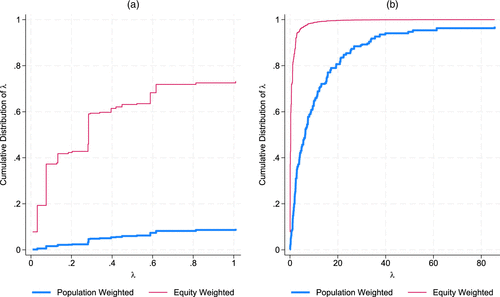
Notes. Data: Demographic cell estimates of assuming , derived from the 2022 Survey of Consumer Finances and 2022 Consumer Expenditure Survey. (a) X-axis truncated at . (b) Extended X-axis.
2.6.2. Considering Altruism.
The role of altruism, though, is likely to be quite important. What weight might an individual place on others’ outcomes relative to their own? Data on the distribution of altruism in the population is not available, limiting us from constructing the distribution of actual . However, a recent estimate comes from Ottoni-Wilhelm et al. (2017), who estimate a structural model from laboratory experiment decisions and find an altruism weight of about 0.6. Conservatively adjusting this estimate weight downward, consider the impact of such that an individual is indifferent on the margin between $1 of personal benefits and $5 of social benefits.
This level of altruism bounds between 0.167 and six. If an individual were to own all the equity and had no share of the consumption benefits from lower prices (), then , whereas if the individual were to own no equity but received all of the consumption benefits (), then .
However, given the small size of most individuals in the population, both and are approximately zero compared with the altruism parameter, and is near one. In contrast to the self-interested calculation, the size of the population in each demographic cell now matters. Note that the limit as the number of individuals in each goes to infinity is that each individual’s equity share and consumption share go to zero, and . As a result, even very large equity holdings still lead to a high value of , given the number of shareholders. For instance, for an individual who owned 1/1,000th of U.S. equity (holdings on the order of billions of dollars), , and still, with ; even with (indifferent between $1 to self and $100 in social benefits), this large equity holder would have .
As a practical matter, the data show that individuals have much lower equity shares such that even when , the population-weighted and the equity-weighted are slightly below 1: 0.999994.
Of course, other models of social preferences would deliver alternative results.20 Note that this model shows that shareholders want price reductions apart from any desire for redistribution; redistribution could create an additional motivation for lowering prices at the cost of profit reductions. Whereas these calculations are only rough approximations, they show that the weights that shareholders might place on consumer welfare are not trivially small and that the role of shareholder altruism can play an important role in desired outcomes.
3. Extensions and Robustness
This section examines how the basic model extends to more complex settings. The first subsection discusses multiple periods, multiple firms, externalities, innovation, and incentivizing managers. The second subsection considers the impact of generalizing the model of altruism and giving the firm the option to make donations; that model shows that shareholders will still want to implement via pricing.
3.1. Generalizability
First, the results extend to a multiperiod model in which the profit-maximizing firm’s price in the current period is below the static profit-maximizing price. For instance, the firm could be engaging in invest-then-harvest pricing and pricing low to increase future market share (Klemperer 1995, Ericson 2014), or the firm could be engaging in limit pricing and pricing low to deter entry (e.g., Milgrom and Roberts 1982, Wilson 1992). Online Appendix Section A.1 develops such a model. Firms still face no first-order loss in the present discounted value of profits from small declines in price, just as in the static model. When the firm places a weight on consumer surplus, the optimal price markup over costs consists of two components: the standard markup term, multiplied by as in Proposition 1, plus a new term accounting for the effect of today’s price on expected future profits and expected future consumer surplus.
Second, Online Appendix Section A.2 develops a model in which the firm invests today to create a new product (e.g., pharmaceutical development). The results for optimal price follow those in Proposition 1; however, the level of investment with can be higher or lower than under profit maximization, depending on how the shareholders value the creation of the new product.
Third, Online Appendix Section A.3 adds a pollution externality to the main model and considers how shareholder concern about harm from externalities interacts with concern for consumer welfare. Interestingly, if a firm accounts for harmful externalities in price setting by setting higher prices, then the price is above the profit-maximizing price, and adding some concern about consumer surplus would actually increase profits.
Fourth, market structure and strategic interactions between firms will affect the equilibrium that results from a firm implementing its desired value of . Extensions will need to consider particular types of market structures. As an example, Online Appendix Section A.4 considers the case of duopoly. It develops a Stackelberg leader-follower model to show how strategic interaction between firms would affect price setting by firms placing weight on consumer surplus. The follower takes the leader’s price as given and thus has an optimal pricing condition that is the same as in the main model. However, if prices are strategic complements, a price cut by the leader results in a price cut by the follower. The leader considers this dynamic when setting the profit-maximizing price, creating a force that raises profit-maximizing prices. When the leader firm places a weight on consumer surplus, though, the follower firm’s price decrease yields an additional benefit to the shareholders of the leader firm, as they care about consumers who now pay lower prices. The resulting optimal pricing condition for the leader has a term multiply the standard markup formula, but also has an additional term that accounts for the benefit of the follower’s price reduction. Other market structures would raise different issues. For instance, in a vertical industry model, shareholders will need to assess the pass through of prices intermediate goods to final goods to determine pricing strategy.
Fifth, a natural concern is whether the firm can actually write an incentive contract for managers to implement a concern for consumer welfare. Whereas the literature on optimal contracting is complex, giving a manager a share of the profits helps induce them to maximize profits when choosing price. The first-order condition for the optimal choice of price developed in Proposition 1 shows how a firm could write such a contract: in addition to profits, the firm would want the manager to consider the quantity sold, with a weight on quantity that depends on . Specifically, suppose a manager is paid some fixed wage, plus share of profits, plus for some constant z. The term compensates the manager based on the area under the demand curve above price p, getting their marginal incentives correct. Then, if the manager chooses p to maximize their own pay, they implement the same price as that satisfying the first-order condition of Proposition 1: .
3.2. Donations and Differential Altruism
In this subsection, I enhance the model to allow firms to make donations and to incorporate a richer model of altruistic utility in which individuals may place greater weight on lower-income individuals. Even when donations can be thus targeted, shareholders will still want , and their optimal price will be below the profit-maximizing price. The envelope theorem result provides intuition for why—the marginal rate of transformation of profits into consumer surplus is infinite at the profit-maximizing price, so even if donations are valued highly (thus making profits valued highly), the optimal price will still be lower.
Now, let a shareholder’s altruistic weight on others’ consumption utility differ by the type of target individual. A shareholder can place weight on other shareholders, weight on individuals targeted by donations from the firm (e.g., lower-income individuals), and weight on transfers to consumers. It is natural—but not necessary—to believe that .
I assume the firm chooses to donate fraction of predonation profits and that these donations are targeted to lower-income individuals who receive weight . Profits returned to shareholders are given by . A shareholder’s utility is then
Conditional on donation policy d, optimal pricing maximizing a shareholder’s utility proceeds as in the main model, where the weight on consumer surplus relative to profits is now
Thus, will still be positive. In fact, a purely self-interested shareholder would have a higher value of with than when , as they receive the material benefits of lower prices in their role as a consumer () but receive less profits as d increases. The value of is decreasing in the amount donated d if and only if ; that is, the weight placed on targeted donations is sufficiently high relative to oneself and other shareholders.
If the shareholder cares more about consumers than other shareholders () and d is not too large, then their value of will be higher compared with the case where the same applies to all individuals. On the other hand, if the donation rate d and weight on donation recipients are both high enough, then will be lower compared with the case where the same applies to all individuals.
We can illustrate with a similar calibration as in Section 2.6. Consider an individual with (holding on the order of billions of dollars of stock), and let for simplicity. With the simple model of altruism applying to all individuals, . Now, let , and . That is, this individual places nine times as much value on donation recipients than on consumer surplus recipients and no altruistic value on other shareholders. Without donations (), weight on consumer surplus increases to because the shareholder doesn’t care about shareholders and only has a claim on 1/1,000th of the profits. As the donations increase, their desired value of declines. If so that 20% of profits go to donations, then , about halfway between profit maximizing and marginal cost pricing. If 100% of profits go to donations, then .
Finally, a shareholder’s preferred donation policy d will not generally be closely related to their desired weight on consumers. Donations affect how profits are allocated and depend on how donation recipients are valued relative to shareholders: the preferred if , and otherwise, the preferred . The desired trade-off between profits and consumers, though, depends on . An individual could have a high if , but also have and prefer setting zero donations. Alternatively, an individual could have a low from , but desire . I do not model the firm’s choice of donation policy, as with heterogeneity between shareholders in both and d, it is a difficult multidimensional preference aggregation problem.
4. Survey Experiment
4.1. Design
I designed a survey experiment to elicit shareholders’ preferences regarding the objective function they would want a firm to maximize. To infer the weight shareholders place on consumer surplus relative to firm profits, participants were asked how they would vote as a stockholder in one of the companies they owned stock in. (If they did not own stock, they were asked to suppose they owned $100 worth of stock in a company.) The question was not specific about which firm was being considered, with the goal of eliciting a general parameter that could be used by fund managers to represent shareholder preferences. Moreover, calibrations suggested that variation in altruism, rather than any direct pricing benefit, would be most important in determining .
The crucial question asked participants to:
Consider a shareholder vote on pricing strategy.
Prices could be set to maximize the firm’s overall present and future profits.
Alternatively, prices could be set lower. This would reduce profits. However, it would benefit consumers, who would pay lower prices and who might buy more.
Participants then chose between voting to “Set prices to maximize profits” or to “Set prices lower. Give up $1 million in profits, but gain $x for consumers.”
The value of x was initialized at $64 million and iteratively updated based on their choices to produce an estimate of their indifference point . Participants saw eight questions about this trade-off. The question gave shareholders a choice of what the firm should optimize: profits or profits plus some weight on consumer welfare, as in Equation (2). Their indifference point implies .
Participants were also asked to choose between profit maximization and a more traditional environmental, social, and governance (ESG)–related topic to provide context for the estimate of . The scenario asked about a shareholder vote on environmental strategy:
The firm’s production could be designed to maximize its overall present and future profits while complying with all relevant environmental laws.
Alternatively, the firm could use more environmentally friendly processes, which would lower profits. However, individuals would benefit via reduced exposure to pollution and reduced carbon emissions.
Participants then chose between voting to “design production to maximize profits” or to “make production more environmentally friendly. Give up $1 million in profits but gain $x in environmental benefits to individuals.”
Again, x was varied over eight questions using the same methodology as for the previous question. Just like for the original question, choices here allow us to infer a weight on environmental benefits relative to profit maximization. I term that weight .
Whereas these survey results are not incentivized, shareholder votes are also not heavily incentivized because an individual shareholder is unlikely to be pivotal when voting. Of course, actual votes may be influenced by debate, lobbying, information acquisition, and context-specific factors. Nonetheless, these questions should be reasonable guides to how shareholders would vote if presented with a similar resolution.
4.2. Iterative Procedure
To identify the indifference point , I use a binary search over the interval and million and present a series of choices that narrow the range between and . The choice of the interval was informed by pilot survey data and calibrations. The choice of binary search algorithm was determined by technological constraints of the survey implementation. Details are provided in Online Appendix Section B.1.
If a participant’s indifference point is located between zero and 128, we can identify it within 0.5 million based on their choices—I assign to be the midpoint of the remaining interval. I then calculate as . If a participant always chooses to maximize profits, , and I impute . If a participant never chooses to maximize profits, our estimate of , and I impute when calculating means. An identical procedure is used to calculate individual values of from choices about trading off profits versus environmental benefits.
4.3. Survey Deployment
In fall 2023, the survey was released via the RAND American Life Panel, targeting approximately 500 participants drawn from a representative sample of Americans.21 For more on the RAND American Life Panel, see Pollard and Baird (2017). The full text of the survey questions is available in the Online Appendix. Participants first answered a series of demographic questions. Additional demographic characteristics, including income, gender, race, and age, are provided by the American Life Panel.
Participants then answered questions about whether they owned stock. These questions aim to identify both direct stockholding as well as indirect stockholding (such as stock held in a mutual fund, ETF, or retirement account). Participants were categorized as stockholders if they said yes to any of the following: having “any investments in stocks or mutual funds that are not in a retirement plan,” having ever invested in “stocks, mutual funds, or index funds,” or if they participated in a defined contribution retirement plan (which typically contains some allocation to equities). These questions were designed as a simplified version of the Survey of Consumer Finances questions measuring direct and indirect stockholding.
Participants then saw the key questions that elicited their preferred trade-off between profits and either consumer welfare or the environment. The order of seeing consumer welfare or environmental questions was counterbalanced between participants.
Participants then answered questions about what strategy they predict would win in a majority vote of shareholders. That is, they answered a set of eight questions about which option they believe would win in a vote between profit maximization and a lower price strategy that would gain $x for consumers. They also answered the same questions about a vote between profits and environmental benefits.
To ensure high-quality responses, the study included an attention screener. The analysis excludes the 17% of participants who failed that check. Participants are also excluded if they either took longer than two hours or shorter than three minutes to complete the survey. The remaining 436 participants comprise the analysis sample.
The RAND ALP provides a sample weight for each observation to enable researchers to obtain estimates representative of the U.S. population. These weights are constructed using age, gender, ethnicity, household income, and education (see Pollard and Baird 2017). The main text presents weighted estimates. The unweighted values of are slightly lower (see Online Appendix Table A.1).
Online Appendix Table A.2 provides descriptive statistics of the analysis sample. I identify 47% of the sample as owning stock. By comparison, in the 2022 Survey of Consumer Finances, about 58% of Americans are identified as owning stock either directly or indirectly (Aladangady et al. 2023). Compared with the U.S. population, the weighted analysis sample is slightly more likely to be women, but has a similar racial distribution, educational attainment, and family income. Political affiliation varies over time, but the sample underrepresents individuals who identify as Republican.
4.4. Main Results
Figure 2 presents the distribution of the estimated value of . It shows the distribution for the full representative sample, as well as a separate line for the subset of participants who own stock.
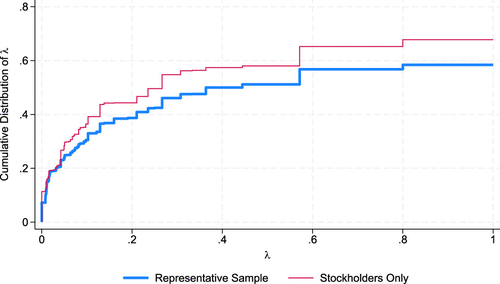
Notes. Data: Representative sample, with weights from the RAND American Life Panel. Distribution is truncated at .
Result 1: Most individuals do not want firms to purely maximize profits. Only 7.3% of the sample vote for zero weight on consumer surplus () in the firm’s objective function, with another 3.6% voting for a weight between zero and 0.01. Similarly, only 6.9% vote for zero weight on environmental benefits ().
Result 2: A substantial fraction of the sample (42%) has a preferred value of above one. This implies they would be willing to forgo $1 of profits for less than $1 of consumer benefits, which does not promote efficiency in a social welfare function that equally weights profits and consumer surplus. As the theory model showed, can result from self-interested concerns, where a small shareholder receives little to no benefit from profits but may receive benefits from lower prices; a richer model of social preferences can also deliver . Legal, ethical, and practical constraints may limit implemented to be no greater than one.
Conditional on having , 70% of those participants always favor consumers over firms, regardless of the amount. I impute for these individuals. However, we will focus on sample medians, which are less affected by extreme values of .
Result 3: The median value of is substantial. Panel A of Table 2 provides summaries of the elicited values of and , split by whether the participant owns stock or not. Overall, the median value of is 0.44. The mean estimated value of is 1.55, but this is affected by individuals with extreme values, as the mean of is 0.52.22
|
Table 2. Desired Weight on Consumer Welfare () and Environmental Impact () Relative to Profits
| (Consumers) | (Environment) | |||
|---|---|---|---|---|
| Mean | Median | Mean | Median | |
| Panel A: Elicited values | ||||
| Owns stock | 1.25 | 0.27 | 1.42 | 0.27 |
| (0.28) | (0.23) | |||
| Does not own stock | 1.81 | 0.80 | 2.29 | 4.00 |
| (0.39) | (0.33) | |||
| Total | 1.55 | 0.44 | 1.88 | 1.33 |
| (0.26) | (0.24) | |||
| Panel B: Predicted winning values in votes | ||||
|---|---|---|---|---|
| Owns stock | 0.59 | 0.01 | 0.69 | 0.02 |
| (0.30) | (0.69) | |||
| Does not own stock | 0.64 | 0.03 | 0.66 | 0.02 |
| (0.22) | (0.22) | |||
| Total | 0.62 | 0.02 | 0.68 | 0.02 |
| (0.18) | (0.18) | |||
Notes. Data: Representative sample, with weights from the RAND American Life Panel. Standard errors of the mean are in parentheses.
Result 4: Stockholders have a lower estimated value of than nonstockholders. The theory model shows that all else equal, individuals with higher ownership share should have a lower value of because they benefit more from profits. Measuring exact holdings, however, is difficult, so I provide estimates of for stockholders versus nonstockholders. This is not a perfect test of the theory, as stockholders might also differ in their social preferences or consumption, but it is still informative.
Stockholders and nonstockholders differ in their estimated values of in the direction predicted by the theory. Table 2 shows that nonstockholders have a higher median (0.80 versus 0.27) and mean (1.81 versus 1.25, with top-coded at four), as compared with stockholders. With weighted estimates, the sample weights make standard errors somewhat large, and the difference in means is not statistically significant. However, the unweighted estimates in Online Appendix Table A.1 show a slightly smaller difference (1.41 versus 1.02) that is statistically significant at .
Result 5: Stockholders place similar weights on consumer welfare () and environment benefits (). One way to assess the magnitude of is to compare it to other preferences that have been studied more extensively, such as preferences for environmental impact. Table 2 also shows that stockholders’ median values for and are, in fact, identical, with quite similar means as well. Online Appendix Figure A.1 shows that the distribution of weights on environmental benefits is similar to the distribution of .
In contrast, nonstockholders place a much higher value on environmental factors, with more than half of nonstockholders never identifying an amount of profits that they prefer over avoiding environmental damage (and thus being imputed ).
Individuals who place more weight on consumer welfare are also more likely to place more weight on environmental concerns: and are positively correlated at 0.57. Online Appendix Figure A.2 shows a scatterplot of and .
Result 6: The median individual expects firms to implement a much lower than they prefer. Panel B of Table 2 shows what participants believe would win in a majority vote among shareholders. The median participant does not believe that firms will implement much weight on consumers or the environment, with a belief of about 0.02 for the value of and that would win in a shareholder election. The mean belief is substantially higher, at about 0.6. The divergence between predicted and observed average values could result from incorrect beliefs about preferences or from compositional differences between this sample and who owns stock or who votes in elections. Nonetheless, Table 1 showed that even a small value of increases consumer welfare by about 1.5%–2% of profits, 200 times the cost in lost profits.
Result 7: Many participants do not perceive social gains from lower prices. Participants were also asked about what would happen if “a typical firm chose to lower prices relative to the amount that would maximize profits.” They were asked to choose the category that was their best estimate for how much consumers would gain if the firm lost $1 million. Online Appendix Figure A.3 shows that perceived social gains from lower prices are low. It is notable that 40% of the sample did not anticipate any substantial social gain from lower prices: 23% said consumers would gain $0.5 million or less, and 17% said consumers would gain $1 million (which, given coarse response options, could be consistent with beliefs of gains up to $2 million). It is difficult to determine a “right” answer to the question, as beliefs could vary about whether the price change is small or large, and markups vary substantially between firms. Nonetheless, the calculations in Section 2.5 suggested a large ratio of consumer gains to lost profits: 200 for and still eight times for . The evidence suggests that participants underestimate the social gains to lower prices. Whereas the strategic questions about the firm’s objective function used to elicit do not require accurate beliefs about the impact of any particular change, beliefs that the social gain from lower prices is small to nonexistent could help explain the limited role consumer welfare has played in the discussion of ESG investing.
4.5. Supplementary Experiment
In a follow-up survey, I explored two additional factors that might affect individuals’ desired weight on consumer surplus. First, if the alternative to price reductions is that the firm makes donations, do individuals have less desire to lower prices? Second, how does the desired vary by the type of firm selling the product? One hundred U.S. adults were recruited in May 2025 via the platform Prolific. Unlike the main survey, this sample is not representative of the U.S. population, and so I focus on differences between conditions rather than levels; levels of in the nonrepresentative sample are lower, and this sample has a higher fraction of stockowners. Online Appendix C provides more details on the survey implementation and results.
The first result is that participants want firms to place roughly the same weight on consumer surplus—achieved by lowering prices—whether the alternative use of funds is charitable donations or returning profits to shareholders. In both scenarios, the median weight on consumer surplus is very similar, implying the median respondent would be indifferent between generating $5.88 of consumer surplus and the firm making a $1 donation and between $6.25 of consumer surplus and $1 of profits. Thus, even when donations are an option, lowering prices remains a key channel through which shareholders believe firms should deliver social benefits.
Second, participants’ desired weight on consumer surplus is responsive to the type of firm being considered. In addition to asking about the trade-off between profits and consumer surplus at a generic firm, this survey also asked about specific types of firms: a grocery chain in low-income areas and a luxury retailer. Participants had higher for the grocery chain than for the generic firm, which, in turn, was higher than for the luxury retailer.
5. Conclusion
Theory shows that firms maximizing shareholder welfare will place some weight on consumer welfare when setting price because shareholders may receive a direct benefit from lower prices or have altruistic preferences. Firms can implement shareholder preferences when setting prices by lowering their markups as a percentage of price by approximately . The gains to consumers, relative to the costs in profits, can be substantial.
Both calibrations and survey experiments show that shareholders’ desired weight on consumer welfare is nontrivial and that there is substantial heterogeneity across shareholders. Few participants are consistent with a pure profit maximization motive.
This paper has examined the objectives that owners of a firm would like that firm to pursue, but those objectives, in turn, influence who chooses to invest in that firm and thus its cost of capital. Firms that do not maximize profits have lower financial returns and thus may be less attractive to purely self-interested investors, but they may be more attractive to investors seeking social impact. Whereas there is a common intuition that competitive markets weed out firms that pursue any goal other than profit maximization (e.g., Alchian 1950, Friedman 1953), formal models with endogenous financing show that profit maximizers are not necessarily the survivors (Dutta and Radner 1999). Empirically, the wide dispersion in productivity across firms (Syverson 2011) gives more efficient firms room to pursue nonprofit objectives and still outperform less productive rivals. The potential for firms to pursue objectives beyond profit maximization is thus contingent upon their relative market position and shareholders’ willingness to support alternative corporate goals.
The paper’s method of eliciting shareholder preferences can be used by firms seeking to know their owners’ preferences, as well as by index funds and pension funds in a variety of areas seeking to represent the ultimate owners’ interests. The impact of accounting for consumer welfare will vary by firm and context.
Eliciting strategic guidance on the objective of the firm may be more informative than investment decisions for how shareholders would like firms to behave. Investment decisions reflect both preferences and beliefs about what firms will do and how that will impact returns. Given critiques that many firms are “greenwashing” and given wide disagreement among ESG ratings (Berg et al. 2022), an individual may still choose to invest without regard to firms’ purported social responsibility but still wish to shape the objective function of the firm.
Whereas the paper has focused on consumer welfare and the objective of the firm, there are implications for other domains. For instance, this paper’s framework can be used to analyze how shareholders want firms to set wages in imperfectly competitive labor markets. Shareholders who are also employees receive a direct benefit, whereas nonemployee shareholders may value any gains from moving toward the socially efficient choice of employment and wages.
Finally, there seems to be a disconnect between shareholders’ desire for firms to consider consumer welfare and the absence of a discussion of consumer welfare in the ESG investing field. Given the similar magnitude of shareholder concern for consumer welfare and the environment, this paper’s results, along with those of Allcott et al. (2026), suggest that the impact of firms on consumers should receive more attention when assessing the social impact of investing. Part of an explanation for this disconnect is that many participants do not perceive large social gains from lowered prices.
The author thanks Angie Acquatella, Ryan Bubb, Florian Ederer, Tal Gross, Michael Kopel, Nalin Kulatilaka, Christian Leuz, Ross Levine, Megan MacGarvie, Pablo Montagnes, Jim Rebitzer, Michael Salinger, Amanda Starc, and participants at various seminars for helpful conversations. Vignesh Somjit provided excellent research assistance. The author thanks Boston University’s Impact Measurement and Allocation Program and Ravi K. Mehrotra Institute for Business, Markets, and Society for funding.
1 This assumption builds on the Fisher separation theorem (Fisher 1930) and subsequent literature showing conditions under which shareholders would unanimously prefer firms to maximize profits (Dreze 1974, Radner 1974, Grossman and Hart 1979, DeAngelo 1981).
2 Evidence suggests that people care about others in a variety of ways, including efficiency-promoting preferences (e.g., Fisman et al. 2007, Rotemberg 2014).
3 A second reason shareholders would want to act via the firm is that increasing consumer welfare has aspects of public goods provision, as many individuals benefit. Free riding will lead to underprovision of public goods, but when the firm reduces profits to contribute to the public good, it effectively commits all shareholders to contribute (Morgan and Tumlinson 2019).
4 Whereas choices were unincentivized, they did not require participants to acquire data but express their own objectives. Individuals are also unlikely to be the pivotal voters in actual votes.
5 In contrast, existing shareholder resolutions typically ask firms to take some specific action, such as releasing information about environmental impact, improving working conditions, or reducing managerial rent seeking (see Renneboog and Szilagyi 2011). These require some knowledge of issue-specific costs and benefits for shareholders to effectively express their preferences.
6 Ederer and Pellegrino (2025) also model how managers behave when they consume some of the goods that their firms produce, which would lead them to place some weight on consumer surplus.
7 For instance, Azar et al. (2018) and Backus et al. (2021), building on the framework of Rotemberg (1984), argue that overlapping ownership leads firms to include profits of other firms in their objective function. Antón et al. (2023) find that, indeed, top managers experience lower performance incentives with more common ownership. Azar and Vives (2021) examine how ownership structure will affect employment in imperfectly competitive labor markets. For a more detailed review of the literature on common ownership, see Schmalz (2018).
8 Also related are Magill et al. (2015) and Fleurbaey and Ponthière (2023), who examine firms run in the interest of stakeholders (rather than solely shareholders) and show that such a firm will not fully exploit its market power.
9 Yet another literature examines the strategic incorporation of CSR motives into the objective function—essentially how committing to CSR might strategically benefit the firm. For instance, both Wirl et al. (2013) and Planer-Friedrich and Sahm (2020) examine how firms would choose to commit to including CSR motives in their objective function before engaging in competition. An empirical debate also exists over the extent to which social components are instrumentally useful in predicting firms’ financial performance. See Edmans (2011) on employee satisfaction, Edmans et al. (2023) on diversity, and Khan et al. (2016) and Berchicci and King (2022) on sustainability.
10 For a discussion of shareholder voting see Yermack (2010). Hart and Zingales (2022) discuss the legal challenges shareholders face in getting management to implement their preferences.
11 Allowing for this effect would reduce the shareholders’ effective price to , as they would get back share of the markup over costs in terms of higher profit. Thus, individuals with higher ownership shares would act as if they faced lower prices, raising their willingness to pay in the market. With diversified ownership, this is unlikely to be quantitatively important.
12 This assumes that multiplies all individuals’ utilities, including the index target individual. This simplifies the expression and is a good approximation with a large N of consumers. Otherwise, the social preference component would be .
13 Note that the theory assumes does not vary depending on the firm’s choice of price p. Ownership share does not depend on p, and also will not vary with p in most social preference models. An individual’s share of consumer welfare may depend on price depending on the form of preference heterogeneity. , which equals zero so long as the individual’s share of consumer welfare is also their consumption share.
14 Shareholder disagreements may be difficult to resolve. These challenges are not unique to consumer surplus; there are many cases where the Fisher (1930) separation theorem breaks down. See also disagreement on issues such as ESG and executive compensation in Yermack (2010).
15 Pricing at marginal cost may entail negative profits in the presence of fixed costs. In the absence of other frictions, Online Appendix A.2 shows that once the fixed cost is paid, shareholders with would still want marginal cost pricing and would still be willing to make the investment if they value the consumer surplus created by the product’s existence enough. However, the model could also be altered to have the firm choose price, subject to the constraint that profits are nonnegative or above some level.
16 This is similar in spirit to Akerlof and Yellen (1985)’s result on near optimality of firm price setting.
17 Depending on the ownership of the firm, shareholders’ desired may vary. For instance, owners of privately held or closely held firms likely consume a small amount from that firm relative to their shareholding, so their purely self-regarding motives for placing weight on consumer surplus are small. Conversely, owners of privately held firms may still have altruistic motives for placing weight on consumer surplus and may be more able to express those objectives.
18 First, a self-interested shareholder would only like to include consumer welfare in the objective function for the particular products they purchase. However, the ways in which shareholders induce the firm to change its objective function are not this specific, and individuals will have uncertainty about what they will buy and thus what share of their expenditure is at a particular firm. Second, shareholders may prefer that only shareholders (and not nonshareholders) receive a discounted price. This is often infeasible because of administrative costs and the possibility of shareholders reselling goods. On shareholder perks, see Karpoff et al. (2021).
19 A challenge for the aggregation is that each demographic cell has two potential weights: that from the SCF and the CEX. The weights are highly, but imperfectly, correlated. I rescale the weights to a common scale and take the average weight across the two data sets for each demographic cell.
20 For instance, consider an alternative model in which the individual attaches weight to the consumption utility of others, capturing the idea that shareholders feel responsible for the actions of the firm only in proportion to their role (as owner) in facilitating those outcomes. In this case, , which would produce results closer to the self-interested case.
21 The survey was also given to another, unrepresentative, group of individuals who had previously participated in a finance-related survey. Moreover, a pilot survey, with a slightly different design, was fielded in May 2023 on a sample recruited from Prolific.
22 Unrepresentative samples show a lower median but are still consistent with most individuals placing a positive value on consumer surplus. A pilot survey on Prolific had a sample that was more educated and more likely to hold stock than the representative sample. The median value was lower at 0.10, but still, only 11% wanted = 0. A different, unrepresentative sample of RAND American Life Panel participants recruited from individuals who had participated in a previous finance-related study and had said they owned stock yielded a median of 0.08, with only 19% preferring .
References
- (2012) Corporate governance objectives of labor union shareholders: Evidence from proxy voting. Rev. Financial Stud. 25(1):187–226.Crossref, Google Scholar
- (1985) A near-rational model of the business cycle, with wage and price inertia. Quart. J. Econom. 100:823–838.Crossref, Google Scholar
- (2023) Changes in U.S. family finances from 2019 to 2022: Evidence from the survey of consumer finances. Report, Board of Governors of the Federal Reserve System, Washington, DC.Google Scholar
- (1950) Uncertainty, evolution, and economic theory. J. Political Econom. 58(3):211–221.Crossref, Google Scholar
- (2026) An economic view of corporate social impact. J. Finance 81(1):285–328.Google Scholar
- (2023) Common ownership, competition, and top management incentives. J. Political Econom. 131(5):1294–1355.Crossref, Google Scholar
- (2021) General equilibrium oligopoly and ownership structure. Econometrica 89(3):999–1048.Crossref, Google Scholar
- (2018) Anticompetitive effects of common ownership. J. Finance 73(4):1513–1565.Crossref, Google Scholar
- (2021) Common ownership in America: 1980–2017. Amer. Econom. J. Microeconom. 13(3):273–308.Crossref, Google Scholar
- (2024) Corporate social responsibility through shareholder governance. Southern California Law Rev. 97(2):417–494.Google Scholar
- (2010) Individual and corporate social responsibility. Economica 77(305):1–19.Crossref, Google Scholar
- (2022) Corporate sustainability: A model uncertainty analysis of materiality. J. Financial Reporting 7(2):43–74.Crossref, Google Scholar
- (2022) Aggregate confusion: The divergence of ESG ratings. Rev. Finance 26(6):1315–1344.Crossref, Google Scholar
- (2025) The moral preferences of investors: Experimental evidence. J. Financial Econom. 163:103955.Google Scholar
- (2022) Exit versus voice. J. Political Econom. 130(12):3101–3145.Crossref, Google Scholar
- (2022) The party structure of mutual funds. Rev. Financial Stud. 35(6):2839–2878.Crossref, Google Scholar
- (1981) Competition and unanimity. Amer. Econom. Rev. 71(1):18–27.Google Scholar
- (1974)
Investment under private ownership: Optimality, equilibrium and stability . Dreze JH, ed. Allocation Under Uncertainty: Equilibrium and Optimality (Palgrave Macmillan, London), 129–166.Crossref, Google Scholar - (1999) Profit maximization and the market selection hypothesis. Rev. Econom. Stud. 66(4):769–798.Crossref, Google Scholar
- (2025) A tale of two networks: Common ownership and product market rivalry. Rev. Econom. Stud., rdaf057.Google Scholar
- (2011) Does the stock market fully value intangibles? Employee satisfaction and equity prices. J. Financial Econom. 101(3):621–640.Crossref, Google Scholar
- (2023) Diversity, equity, and inclusion. NBER Working Paper No. 31215, National Bureau of Economic Research, Cambridge, MA.Google Scholar
- (2014) Consumer inertia and firm pricing in the Medicare PART D prescription drug insurance exchange. Amer. Econom. J. Econom. Policy 6(1):38–64.Crossref, Google Scholar
- (1985) Owner-consumers and efficiency. Econom. Lett. 19(4):303–306.Crossref, Google Scholar
- (1930) The Theory of Interest: As Determined by Impatience to Spend Income and Opportunity to Invest It (Macmillan, New York).Google Scholar
- (2007) Individual preferences for giving. Amer. Econom. Rev. 97(5):1858–1876.Crossref, Google Scholar
- (2023) The stakeholder corporation and social welfare. J. Political Econom. 131(9):2556–2594.Crossref, Google Scholar
- (1953)
The methodology of positive economics . Essays in Positive Economics (University of Chicago Press, Chicago).Google Scholar - (1970) The social responsibility of business is to increase its profits. New York Times (September 13), https://www.nytimes.com/1970/09/13/archives/a-friedman-doctrine-the-social-responsibility-of-business-is-to.html.Google Scholar
- (2019) Inequality and market concentration, when shareholding is more skewed than consumption. Oxford Rev. Econom. Policy 35(3):550–563.Crossref, Google Scholar
- (1979) A theory of competitive equilibrium in stock market economies. Econometrica 47(2):293–329.Crossref, Google Scholar
- (2022) ESG investing: What shareholders do fund managers represent? Rock Center for Corporate Governance at Stanford University Working Paper No. 4267270, Rock Center for Corporate Governance at Stanford University, Stanford, CA.Google Scholar
- (2017) Companies should maximize shareholder welfare not market value. J. Law Finance Accounting 2(2):247–275.Crossref, Google Scholar
- (2022) The new corporate governance. The University of Chicago Business Law Review, vol. 1, no. 1 (The University of Chicago, Business Law Review, Chicago), 195–216.Google Scholar
- (2019) Do investors value sustainability? A natural experiment examining ranking and fund flows. J. Finance 74(6):2789–2837.Crossref, Google Scholar
- (2023) Do investors care about impact? Rev. Financial Stud. 36(5):1737–1787.Crossref, Google Scholar
- (2013) The benefit corporation and corporate social responsibility. J. Bus. Ethics 118(2):287–301.Crossref, Google Scholar
- (2023) How much do investors care about social responsibility? Wisconsin Law Rev. 2023(3):977–1040.Google Scholar
- (2021) Shareholder perks and firm value. Rev. Financial Stud. 34(12):5676–5722.Crossref, Google Scholar
- (2016) Corporate sustainability: First evidence on materiality. Accounting Rev. 91(6):1697–1724.Crossref, Google Scholar
- (2012) Economic perspectives on corporate social responsibility. J. Econom. Literature 50(1):51–84.Crossref, Google Scholar
- (1995) Competition when consumers have switching costs: An overview with applications to industrial organization, macroeconomics, and international trade. Rev. Econom. Stud. 62(4):515–539.Crossref, Google Scholar
- (2015) A theory of the stakeholder corporation. Econometrica 83(5):1685–1725.Crossref, Google Scholar
- (1982) Limit pricing and entry under incomplete information: An equilibrium analysis. Econometrica 50(2):443–459.Crossref, Google Scholar
- (2025) How well do voting choice policies represent public and investor preferences? Preprint, submitted March 4, https://ssrn.com/abstract=5093097.Google Scholar
- (2019) Corporate provision of public goods. Management Sci. 65(10):4489–4504.Link, Google Scholar
- (2017) Why do people give? Testing pure and impure altruism. Amer. Econom. Rev. 107(11):3617–3633.Crossref, Google Scholar
- (2020) Strategic corporate social responsibility, imperfect competition, and market concentration. J. Econom. 129(1):79–101.Google Scholar
- (2017) The RAND American life panel: Technical description. Technical report, RAND Corporation, Santa, Monica, CA.Google Scholar
- (1974) A note on unanimity of stockholders’ preferences among alternative production plans: A reformulation of the Ekern-Wilson model. Bell J. Econom. Management Sci. 5(1):181–184.Crossref, Google Scholar
- (2011) The role of shareholder proposals in corporate governance. J. Corporate Finance 17(1):167–188.Crossref, Google Scholar
- (2017) Why do investors hold socially responsible mutual funds? J. Finance 72(6):2505–2550.Crossref, Google Scholar
- (1984) Financial transaction costs and industrial performance. Massachusetts Institute of Technology working paper, Massachusetts Institute of Technology, Cambridge, MA.Google Scholar
- (2014) Models of caring, or acting as if one cared, about the welfare of others. Annual Rev. Econom. 6(1):129–154.Crossref, Google Scholar
- (2018) Common-ownership concentration and corporate conduct. Annual Rev. Financial Econom. 10(1):413–448.Crossref, Google Scholar
- (1988) Value maximization and the acquisition process. J. Econom. Perspect. 2(1):7–20.Crossref, Google Scholar
- (2008) Why we should stop teaching Dodge v. Ford. Virginia Law Bus. Rev. 3(1):163–176.Google Scholar
- (2011) What determines productivity? J. Econom. Literature 49(2):326–365.Crossref, Google Scholar
- (1992)
Strategic models of entry deterrence . Aumann RJ, Hart S, eds. Handbook of Game Theory with Economic Applications, Handbooks in Economics, vol. 1 (North-Holland, Amsterdam), 305–329.Crossref, Google Scholar - (2013) Individual firm and market dynamics of CSR activities. J. Econom. Behav. Organ. 86:169–182.Crossref, Google Scholar
- (2010) Shareholder voting and corporate governance. Annual Rev. Financial Econom. 2(1):103–125.Crossref, Google Scholar
- (2022) Do mutual funds represent individual investors? NYU Law and Economics Research Paper No. 21-04, New York University, New York.Google Scholar

