How Many Vertices Does a Random Walk Miss in a Network with a Moderately Increasing Number of Vertices?
Abstract
Real networks are often dynamic. In response to it, analyses of algorithms on dynamic networks attract more and more attention in network science and engineering. Random walks on dynamic graphs have also been actively investigated for over a decade, where in most cases the edge set changes but the vertex set is static. The vertex sets are also dynamic in many real networks. Motivated by the setting of random walks on growing networks, this paper introduces a simple model of graphs with an increasing number of vertices and presents an analysis of random walks associated with the cover time on such graphs. In particular, we reveal that a random walk asymptotically covers all but vertices if the vertex set grows moderately. Moreover, we apply our model to the growing preferential attachment model that is a prominent random graph model for real networks.
Funding: This work is partly supported by the Japan Society for the Promotion of Science KAKENHI [Grants JP17K19982, JP19J12876, JP19K20214, JP21H03396, and JP23K21645].
1. Introduction
Networks appearing in the real world, such as the internet, transportation networks, sensor/wireless networks, social networks, and chemical dynamics, change their shape over time. Nevertheless, what is known about the analyses of algorithms on dynamic networks is quite limited, compared with a wealth of knowledge on computations in static networks. In response to it, theoretical analyses of models and algorithms on dynamic networks have received a lot of attention recently, in particular within the context of network science and engineering, concerning such subjects as connectivity, exploration, information spreading, gathering, agreement, sampling, population protocol, random walks, and other stochastic processes; see, for example, Augustine et al. [4], Clementi et al. [10], Cooper [11], Kuhn and Oshman [25], Michail [29], Michail and Spirakis [30], and Sarma et al. [36].
A random walk on a graph is a fundamental stochastic process: a walker on a vertex moves to a randomly picked neighbor at each discrete time step. A random walk is a simple and powerful tool in the wide range of computer science, such as randomized search, page rank, and Markov chain Monte Carlo (MCMC), and also in networking science and engineering (Avin et al. [6], Cooper [11], Sarma et al. [36], Sauerwald and Zanetti [37]). The cover time of a random walk is the time it takes for a walker to visit all vertices of the graph. The cover time is one of the fundamental quantities of a random walk (see, e.g., Aldous [1], Aldous and Fill [2], Aleliunas et al. [3], Doyle and Snell [17], Feige [19], Feige [20], Levin and Peres [27], Matthews [28]), and it is important in applications such as randomized search. Analyses of random walks on dynamic graphs have been actively developed in the context where the cover time is a central issue (Avin et al. [5], Avin et al. [6], Cooper [11], Cooper and Frieze [12], Denysyuk and Rodrigues [15], Lamprou et al. [26], Sauerwald and Zanetti [37], Yu and McCann [39]) (see Section 1.3 for more details).
Those existing works, except for Cooper and Frieze [12], about random walks on dynamic networks are concerned only with networks over a static vertex set. However, the real networks change their vertex sets time by time. For example, graph structures in Social Networking Service (SNS) change their vertex sets by creating or deleting accounts. Motivated by analyzing such networks, this paper investigates random walks on graphs with an increasing number of vertices. A dynamic vertex set causes some technical troubles: it is questionable if the “cover time,” which is a natural quantity for a static vertex set, is also appropriate for a dynamic vertex set, and also it is hopeless, as Cooper and Frieze [12] revealed, to cover vertices beyond a constant ratio when the number of vertices constantly increases. In view of this, we introduce a simple model of growing graphs, and present an analysis of the number of vertices remaining unvisited by a random walk as a counterpart to the cover time of a random walk on a static vertex set.
1.1. Model and Quantities
1.1.1. Example: Collection of Coupons with an Increasing Number of Types.
To introduce our model, let us start with a simple and intuitive example. Suppose you draw a coupon randomly from a finite number of types of coupons every day. A single type of coupon exists on the first day, and a new type of coupon is released at intervals of n days for the number n of existing types of coupons; that is, you draw from two types of coupons for the second and the third days, draw from three for the fourth to the sixth days, and draw from n for the -st to the -th days. It might be difficult to complete all types of coupons because new types are sequentially released. Then, how many types of coupons do you expect to collect? We will prove that you can miss at most two types of coupons in expectation. On the other hand, interestingly, the number of uncollected types of coupons diverges to infinity as the days go by if the release intervals are , for example, days (see Theorem 1).
The coupon collector’s problem is often connected to the cover time of a random walk on a complete graph. Generalizing the above example, we investigate a random walk on a network with a moderately increasing number of vertices. In the network model, we introduce a parameter corresponding to the growth rate of the vertex set, which will be represented by the duration. Then, we will be concerned with the number of unvisited vertices, instead of the cover time.
1.1.2. Random Walk on a Growing Graph.
A growing graph is a sequence of graphs where each is a connected simple undirected graph such that . Here, and are the vertex and edge set of , respectively. A random walk on a growing graph (RWoGG) is a stochastic process (), where the transition probability from Zt to is provided as a random walk on . We remark that holds for .
This paper is particularly concerned with a simple model of growing graphs with moderate changes. We assume that each graph in a growing graph belongs to the same graph class. For instance, is a complete graph, a path graph, an expander graph, etc., of order n, respectively. We do not consider the case that Gi is a path but is a complete graph. For each n, the graph is unchanged for some duration of steps, and then changes its topology to by adding a single vertex and connecting it to . Let be a function, say, , denoting the duration of keeping the graph unchanged. Then, is given as for t satisfying for , where is a connected graph such that and for some and for .
Notice that is the graph on a single vertex (this is just for convenience of description, but not essential in our later analyses). In other words, denotes the duration of , and hence, holds. For convenience, let . Table 1 shows the correspondence between and in the case of .
|

Table 1. Correspondence between and when . The transition from Zt to is performed on , and hence holds. In this example, , and .
| Z0 | Z1 | Z2 | Z3 | Z4 | Z5 | Z6 | |
This paper is also concerned with a particular model of random walks on growing graphs. For , let be the transition matrix of a random walk on , that is, when . We define an RWoGG as a triple .
Then, we are concerned with the number of vertices unvisited by an RWoGG, formally given by
1.1.3. Terminology on Time-Homogeneous Markov Chains.
We here briefly introduce other terminology for random walks on static graphs, or time-homogeneous Markov chains (cf. Levin and Peres [27]). Suppose that is a random walk on a static graph characterized by a time-homogeneous transition matrix where . A transition matrix P is irreducible if , and is aperiodic if . An irreducible and aperiodic P is said to be ergodic. A probabilistic distribution π over V is a stationary distribution if it satisfies . It is well known that an ergodic P has a unique stationary distribution (Levin and Peres [27]). A random walk is lazy if for all , and is reversible if for all , where is the stationary distribution. A simple random walk (resp. simple lazy random walk) on an undirected graph is given by for (resp. for and ) where du is the degree of u. The hitting time (also denoted by ) is given by
The cover time (or ) is given by
The mixing time is given by
Mixing time is usually parametrized by ϵ, but we call mixing time in this paper (Levin and Peres [27]).
1.2. Our Results
This paper investigates the behavior of in relation to for an RWoGG , where recall that U is an abbreviation of denoting the number of vertices unvisited by the random walk at the moment just before a new vertex is attached (see Section 1.1 for details). Our results are summarized as follows. See also Tables 2 and 3.
|
Table 2. Summary of our results for general growing graphs. The results for short duration in the last line (Theorems 4, 5, and 7) require some assumptions.
| Ref. | ||
|---|---|---|
| Obvious | ||
| Theorem 2 | ||
| Theorem 2 | ||
| Theorems 4, 5, 7 |
|
Table 3. Concrete examples derived from our results for short duration (Theorems 4, 5, and 7). Here, is an arbitrary constant.
| Examples | Ref. | ||
|---|---|---|---|
| Complete | Theorem 1 | ||
| Theorem 1 | |||
| Path | Corollary 7 | ||
| Theorem 8 | |||
| Lollipop | Corollary 3 | ||
| Metropolis | Corollary 4 | ||
| Expander | Corollary 5 | ||
| PA | Theorem 6 |
1.2.1. Growing Complete Graph.
As an introductory example of our analyses, we are firstly concerned with the simple random walk on a growing complete graph (with self-loops), which corresponds to the example of collecting coupons with new releases in Section 1.1.
Consider the simple random walk on a growing complete graph, where is a complete graph of order i, and for any and (including u = v). Then, the following holds:
(1) If there is a constant C > 0 such that for all , then .
(2) If diverges (i.e., as ), then as .
(3) If is nonincreasing and converges to zero (i.e., for all and as ) and if is nondecreasing and diverges (i.e., for all and as ), then .
(4) If is constant (i.e., for some constant for all ), then .
Notice that Item (1) implies that the number of missing types of coupons is at most constant in expectation, that is, at any time t, if , whereas Item (2) claims a stronger upper bound with a stronger assumption of that the expected number of missing types is asymptotic to zero every time just before a new release (recall the relation between U and ). Item (3) claims in the case of and that up to the leading coefficient; for instance, holds if as well as holds if , where C > 0 and are arbitrary constants common in both equations (see also Proposition 1). Item (4) is the counterpart of Item (3) for constant . For example, if a new vertex appears at every step (), a random walk on a growing complete graph misses half of the number of vertices in expectation.
1.2.2. General Bound for Long Duration.
Next, we focus on upper bounds of with respect to for RWoGG , in general. For convenience, let , and respectively denote the hitting, cover, and mixing times of , in the rest of the paper.
To begin with, we remark that it is easy to prove that if for any RWoGG using the known fact that the number of unvisited vertices exponentially decays every unit time of (see, e.g., sections 2.4.3 and 2.6 of Aldous and Fill [2]; see also Lemma A.3 in the appendix). Thus, our interest is in the case that . We establish the following upper bound of , claiming that if for C > 1. We remark that the following theorem is an extension of Items (1) and (2) of Theorem 1 for “a specific random walk on growing complete graphs” to general random walks and graphs.
Let be an arbitrary RWoGG.
If there is a constant C > 1 such that for all , then .
If as , then as .
1.2.3. General Bound for Short Duration.
In contrast to the case of in Theorem 2, the case of does not seem easy: it contains an issue of “short random walks,” which is a challenging topic in the literature of the cover time of multiple random walks, and so on; see, for example, Kanade et al. [23]. In this paper, we give the upper bounds of under for RWoGG where the stationary distribution changes moderately (Theorems 4 and 7), or the mixing time is sufficiently smaller than the hitting time (Theorem 5). Roughly speaking, for any constant , we show that if . We put the formal statements of these results in Section 4, the most technical part of this paper. Here, we list some concrete examples derived from our general results.
(i) A natural example of growing graphs is a path that grows toward one side. We prove that the lazy simple random walk on the growing path with duration misses vertices, and moreover, this bound is tight up to a constant factor. These are direct consequences of Corollary 7.
(ii) Lollipop graphs gather special attention in random walk theory because they attain asymptotically the worst hitting and cover times of (Feige [19], Feige [20]). We are concerned with the growing lollipop (see Section 4.2 for details). We show that the lazy simple random walk on the growing lollipop graph misses vertices if , which follows immediately from Corollary 3.
(iii) The preferential attachment model (PA model) is a prominent model of real-world networks. It can be seen as a sequence of growing random graphs where is obtained by adding to Gt a new vertex and random edges incident to it. We show that the lazy simple random walk on the PA model misses vertices if (Theorem 6).
(iv) Expander graphs gather special attention in the context of rapid mixing. This paper concerns a class of expander graphs called degree restricted expanders. Roughly speaking, a graph is a degree restricted expander if it exhibits sufficiently small spectral expansion properties and its degree distribution is “balanced.” We refer the definition to Section 4.3. We show that the lazy simple random walk on a growing degree restricted expander misses vertices if (Corollary 5).
(v) Consider the Metropolis walk of Nonaka et al. [32] in which the walker on a vertex u moves to a vertex v with probability proportional to . We show that the lazy Metropolis walk on any connected growing graph with duration misses if (Corollary 4), where denotes the hitting time of the walk on the fixed . Note that the Metropolis walk has an hitting time for any n-vertex connected graphs (Nonaka et al. [32]) as opposed to the worst bound for simple random walks (Feige [19]).
1.3. Related Works
The cover time is a fundamental topic of analyses of random walks. Here, we review some representative results about the cover times of random walks on static graphs and on dynamic graphs.
1.3.1. Cover Times of Random Walks on Static Graphs.
The cover time of a simple random walk satisfies (Aldous [1], Aleliunas et al. [3]). Matthews [28] devised a technique of upper and lower bounding by , of which a celebrated implication is . The lollipop graph is famous for , and hence . Feige [20] gave a tight upper bound on the cover times of simple random walks on any graphs of , whereas in [19] he gave a tight lower bound of , using the Matthews method [28]. The connection between the hitting time and electric circuits is well known (see, e.g., Aldous [2], Doyle and Snell [17], Levin and Peres [27]).
Motivated by a faster covering by a random walk, Ikeda et al. [22] (see also Ikeda et al. [21]) proposed a β-random walk, which makes transitions only using local information, and proved that the cover time of a β-random walk is upper bounded by for any graph. Nonaka et al. [32] proved the same bound holds for a Metropolis walk, which is simpler than a β-random walk. Recently, David and Feige [13] (see also David and Feige [14]) proved that a biased random walk achieves cover time for any graph, and affirmatively settled the question posed by Ikeda et al. [22].
1.3.2. Cover Time of Random Walks on Dynamic Graphs.
An early work by Cooper and Frieze [12] investigated random walks on “web graphs.” Specifically, they considered a random walk on a growing preferential attachment graph with a constant duration (i.e., the number of vertices increases every constant steps). Note that our framework of RWoGG contains their model as a special case. They proved that converges to some constant as n tends to infinity.
There are several results about the cover times of random walks on dynamic graphs, sometimes called “evolving graphs,” with static vertex sets. Avin et al. [5] (see also Avin et al. [6]) investigated the hitting time, mixing, and cover times of random walks on evolving graphs with static vertex sets. They gave a prescribed sequence of graphs on which the hitting time of a simple random walk gets , and hence, this bound holds for the cover time as well. On the other hand, they proved that the cover time of a max-degree random walk is where is the maximum degree of the evolving graph. Denysyuk and Rodrigues [15] were concerned with the ρ-recurrent family of evolving graphs, where preferable graphs are assumed to appear frequently in the graph sequence. Then, for max-degree random walks on ρ-recurrent families, they gave upper and lower bounds of the cover time in terms of the hitting time, as well as giving an upper bound of the mixing time. Lamprou et al. [26] were concerned with two random walks of “a random walk with delay” (RWD), where, at each step, the walker chooses an edge of the underlying graph and moves when it appears, and “a random walk on what is available” (RWA), where the walker chooses an edge of the current graph and moves immediately. Then, they investigated the cover times of the RWD and RWA for edge-uniform stochastically evolving graphs. Sauerwald and Zanetti [37] extended the argument by Avin et al. [6] in the case that a sequence of graphs has the same stationary distribution, and presented an upper bound of the cover time on d-regular dynamic graphs.
1.3.3. Other Related Works.
Saloff-Coste and Zúñiga investigated time-inhomogeneous Markov chains, and provided some Nash and log-Sobolev inequalities (Saloff-Coste and Zúñiga [34], Saloff-Coste and Zúñiga [35]). Recently, Cai et al. [9] investigated the relation between the density of edge-Markovian dynamic graphs and the mixing time. They showed for fast-changing dynamic graphs that in the sparse case whereas in the dense case. They also showed for slowly changing dynamic graphs that in the sparse case whereas in the dense case. Random walks on dynamic graphs are also of use in data mining applications. Yu and McCann [39] presented an analysis on “a random walk with restart,” which is used as a measure of proximity between vertices of a graph in the context, over dynamic graphs.
There are many works on other stochastic processes on dynamic graphs, such as exploration, information spreading, rumor spreading, gossiping, and voter model; see, for example, Augustine et al. [4], Berenbrink et al. [8], and Clementi et al. [10]. Theoretical analyses of algorithms on dynamic graphs attract high attention in the context of distributed computing, and there are many works concerning the topics, such as connectivity, exploration, gathering, agreement, flooding, and population protocol, on dynamic networks; see, for example, Kuhn and Oshman [25], Michail [29], and Michail and Spirakis [30].
1.4. Organization
In Section 2, we are concerned with the simple random walk on a growing complete graph (with self-loops). This corresponds to the example of collecting coupons with new releases in Section 1.1. In Section 3, we consider general RWoGGs under the assumption that . In Section 4, we consider the case of , focusing on lazy and reversible random walks. We prove the general bound that implies several bounds for concrete examples mentioned in Section 1.2. Also, we prove another general bound for rapidly mixing walks without the assumption concerning the stationary distribution above. In Section 5, we focus on the lazy simple random walk on the preferential attachment model. We will combine the structural properties of the preferential attachment model concerning the expansion with our slightly modified general bound to obtain a bound of for this setting. This part is the main difference of this paper from the preliminary version (Kijima et al. [24]). In Section 6, we obtain a tight lower bound of for random walks on a growing path. We conclude this paper and pose possible future directions in Section 7.
2. Complete Graph
This section is devoted to proving Theorem 1. Throughout this paper, we consider a random walk of length . For convenience, divide the -step random walk into n random walks each of length (for ). We call each period a round. For a round , let denote a random walk in the i-th round (specifically, it is a random walk according to ) with the initial state . Note that is a random walk on . Table 4 illustrates the correspondence between Zt and in the case of .
|
Table 4. Correspondence between Zt and when . For each is a random walk on . Note that holds for . In this example, .
| Z0 | Z1 | Z2 | Z3 | Z4 | Z5 | Z6 | Z7 | Z8 | ||
|---|---|---|---|---|---|---|---|---|---|---|
For , let denote the event that (). In other words, means that the random walk does not visit the vertex v. For the vertex vk attached to at time Tk, we see that holds, and thus
For a function , let .
(i) If for every , then .
(ii) If f satisfies for all , then .
(iii) If f satisfies , then for all , .
(iv) If there is a constant such that f(i) = c for all , then for all , .
Because , we have
Observe that and for all ,
We prove (ii) by induction on n. In the base case, and we are done. If , then
Here, we used in the second inequality and in the last inequality. Combining (1) and (2), and we are done. □
The proof is obtained by induction on . When n = 1, . Assume . Then,
Note that for all and . The second inequality follows from . □
The proof is obtained by induction on n. First, we have . Assume . Then, from (1) and the induction assumption, we have
Note that we use again and in the first and the last equality. □
We are ready to prove Theorem 1.
Recall that . Item (1) follows from Lemma 1(i). Item (3) follows from (ii) and (iii) of Lemma 1. Item (4) follows from (ii) and (iv) of Lemma 1.
We prove Item (2). Formally, we prove that, for any , there is such that for all , holds. Because , for any C > 0, there exists such that holds for all . From Lemma 1(i), we have . For a fixed arbitrary small constant , take such that holds. According to this constant C, we can take i0 such that f(i) > Ci for all holds. Now C and i0 are fixed. Hence, for sufficiently large n, we have . This implies and we are done. □
2.1. Remark
We remark on some monotonicity of on the sequence of complete graphs with respect to . Suppose functions and satisfy for all i. Let and U(n) respectively denote the numbers of unvisited vertices at the end of the n-th round for and . Then, is clear. From this observation, Lemma 1 implies the following proposition, which is a variant of Theorem 1 Items (1), (3), and (4).
Consider the simple random walk on a growing complete graph, where is a complete graph of order i, and for any and (including u = v). Let be arbitrary constants. Then, the following holds:
(1) If for all i, then .
(2) If for all i, then .
Finally, we consider an RWoGG on a growing complete graph which is initially for some . We prove the following analogous bound of Theorem 1 Item (2) (note that Theorem 1 addresses the case of ).
Let , that is, the complete graph with vertices, and let for all in . Let N be an arbitrary positive number. If for all i, then .
If and we are done. Suppose that . Then it is straightforward to see that
Note that we use Lemma 6 in the last inequality. □
3. Upper Bound for Larger than
This section is devoted to proving Theorem 2. Let denote the hitting time of the random walk specified by the fixed . Consider an RWoGG . Recall that, at each round i, denotes the random walk according to where holds (see Table 4 for an example). Let denote the stationary distribution of . Let ; that is, denotes the time taken for a random walk to reach . Note that . Suppose that the initial position is fixed, that is, . For any round , the probability that the walker does not visit the vertex vk before the end of the round n is equal to . Hence, we have
The rest of this section is devoted to bounding (3) and (4). We show Theorem 2 in this section. To begin with, we show the following useful lemma.
For any , we have
Consider a fixed vertex vk with k > 1. For a round and a vertex , let denote the event that the walker is in vertex u at the end of the i-th round without visiting vertex vk during the round. Formally is defined as the event of . Then for any ,
To bound (5), we first observe that, for any vertices, ,
From the Markov inequality, for any and , we have
Hence, from Lemma 2, we obtain
For an arbitrary (small) , let . From the assumption of Item (2), we can take some such that for all . Let . From Lemma 2,
Then we can take some satisfying . Hence, for any and we obtain the claim. □
4. Upper Bound for Smaller than
4.1. General Upper Bound
In this subsection, we prove the following technical result that provides general upper bounds on . Let be an RWoGG. Let
Let be an RWoGG, where is reversible and lazy. Let N > 0 be an arbitrary number. If for all i, then , where ri is defined in (10).
To show Theorem 4, we set the following notations. For two vectors and a probability vector , let . Then, the -norm of f is defined by . For two vectors where holds for all , define by . Note that from these definitions, for any probability vector holds. Here, denotes the n-dimensional vector where all elements are equal to one. For a matrix , let denote the j-th largest (in absolute value) eigenvalue of M.
For any round and , define a probability vector where
In the rest of this section, we show the following bounds of and , from which we immediately derive Theorem 4.
Let be an RWoGG, where is reversible and lazy. If , then
Let be an RWoGG, where is reversible and lazy. Let N be an arbitrary positive number. If for all , then where ri is defined in (10).
Suppose for all . Then, from Lemma A.7. Furthermore, . Thus, applying Lemmas 3 and 4 to (13),
First, we show the following lemma, which gives a general upper bound of in terms of ri.
Let be an RWoGG, where is reversible and lazy. Then for any round ,
To obtain the claim, we show the following recurrence inequality:
Write , and for notational convenience. If (14) holds for any , applying (14) repeatedly yields
Because from definition, we obtain the claim.
Now we show (14). From the reversibility of , it is easy to see that, for all ,
From (15) and Lemma A.6, it holds that
Furthermore, for a vertex which appears at the round , because holds, we have
First, we observe that . Hence, it holds that
Applying Lemma 5, we obtain
We begin by presenting two auxiliary results.
For and , let
Let n > 0 be an arbitrary number. If for all , then .
It is easy to check that
Note that we use in the first and last inequalities. □
Let be an RWoGG, where is reversible and lazy. Then, for any round k satisfying ,
For a transition matrix and a vertex , define by
In other words, for . Note that is a substochastic matrix (see, e.g., section 3.6.5 of Aldous and Fill [2]); that is, holds for any . Observe that, for any and T > 0,
Here, denotes a sequence of a random walk according to P and τw denotes the hitting time to w. Note that if u = w or v = w.
Consider a fixed k > 1. Write and for notational convenience. The key property for the proof is the following recurrence equation: for all and , it holds that
This equation holds because for any , combining (8), (12), and (19) yields
Using (20) and Corollary A.2, we obtain
Hence, applying (21) repeatedly, it holds that
From the definition of and , Lemma A.5 implies
Because , we have
Thus, combining Lemma 7 and (24),
We invoked Lemma 6 in the last inequality. □
4.2. Example: Lollipop Graphs and Metropolis Walks
Let be an RWoGG such that is lazy and simple, and that for all i (), hold for some positive constant L. Let C > 0 and be arbitrary constants. If holds for any , then .
Let denote the degree of a vertex at round i. Then, for all ,
Note that holds from our assumption. Combining the assumptions on and , we have . Thus, we obtain the claim by taking in Theorem 4. □
Let be an RWoGG such that is lazy and symmetric (i.e., for all ). Let C > 0 and be arbitrary constants. If for all , then .
Because is symmetric, for all i > 1. From the assumption of Corollary 2, for all . Thus, we obtain the claim by taking in Theorem 4. □
4.2.1. Example: Lollipop Graph.
Consider a growing lollipop graph: We consider consisting of the complete graph and the path graph . Formally, at each round , the set of odd vertices forms the complete graph , the set of even vertices forms a path graph, and these two components are connected by . Let be the transition matrix of the simple lazy random walk on . For such , it is well known that (see, e.g., Feige [20]).
Let be an RWoGG, where is the lollipop graph defined above and is the transition matrix of the lazy simple random walk on . Let be an arbitrary constant. If for all i, then . Here, C1, C2 are some positive constants.
By definition, and . Thus, for any i, for some constant K1. Furthermore, holds for some constant K2. Applying Corollary 1, we obtain the claim. □
4.2.2. Example: Metropolis Walk.
For a given , the transition matrix of the lazy Metropolis walk on G is defined by
Because of the work of Nonaka et al. [32], we have for any connected graphs. Because P is a symmetric matrix, we can apply Corollary 2.
Suppose that is the lazy Metropolis walk on a connected graph in . Let and C > 0 be arbitrary constants. If for all , then .
4.3. Upper Bound for Random Walks with Small Mixing Times
In this section, we show the following general result that concerns an RWoGG with a small mixing time.
Let be an RWoGG, where is reversible and lazy. Let N > 0 be an arbitrary positive number. If for all , then .
To show Theorem 5, we introduce the following lemma that is a useful variant of Lemma 2.
Let be an RWoGG. For any function such that holds for all i, we have
Fix and i satisfying . First, for any , from the definition of the conditional probability, we observe that
If is reversible, for any and , some transition matrix exists such that
We use Corollary A.1 in the first inequality. Now, for a positive integer L, consider a random variable . Here, is the binomial distribution with parameters L and 1/4. Then, it is straightforward to see that
The last inequality follows because
4.3.1. Example: Degree Restricted Expander Graph.
For a graph , let and denote the average and the minimum degree of G, respectively. Suppose that P is the transition matrix of the lazy simple random walk on G and let denote the second-largest eigenvalue of P. We call a graph G degree restricted expander graph if both and are upper bounded by some positive constant. For any degree restricted expander graph, we have and (see Lemma A.7 in the appendix and theorem 12.4 in Levin and Peres [27]). Thus, Theorem 5 implies the following.
Let be an RWoGG, where is a degree restricted expander graph and is the transition matrix of the lazy simple random walk on . Let and C > 0 be arbitrary constants. Then there exist two positive constants K1, K2 such that if for all .
Because there exist some positive constants K1, K2 satisfying and , we obtain the claim from Theorem 5. □
5. Random Walk on a Growing Preferential Attachment Model
The structure of large-scale real-world networks such as social networks, citation networks, and protein-interaction networks has gathered considerable attention in network analysis. These networks typically have several structural features including the small-world property (Watts and Strogatz [38]) and scale-free degree distribution (Barabási and Albert [7]). Because real-world networks expand day by day, it is natural to model them with a growing sequence of random graphs. A prominent example of such a model is the PA model (Barabási and Albert [7]).
The PA model is a sequence of random graphs with a constant parameter generated in the following way: We first generate the following random graph Tnd on nd vertices. Initially, T1 consists of a single vertex u1 with a self-loop. The graph can be obtained by adding a vertex and an edge to Tk, where the index i is chosen from with probability proportional to the degree of ui. Finally, we obtain the graph by contracting d consecutive vertices of Tnd for each . Note that may contain self-loops and multiedges. We obtain the following result concerning the lazy simple random walk on .
For any , there exist constants and such that the RWoGG for the lazy simple random walk on with duration satisfies with probability over the construction of .
The proof of Theorem 6 is the main difference of this paper from the preliminary version (Kijima et al. [24]). To prove Theorem 6, we exploit the structural properties of , namely the conductance. The conductance of a graph is
(
Mihail et al. [31] proved that has a constant conductance.
(
For any , there exist positive constants , and such that the RWoGG for the lazy simple random walk on satisfies the following with probability (here, the probability is taken over the construction of ): For every , .
Let be a sufficiently large constant (say, ). From Lemma 10 and the union bound over , with probability , all have conductance at least . Conditioned on this event, the Cheeger inequality (Lemma 9) implies for . This implies (see Lemma A.7). Note that because has minimum degree at least d and id edges. □
Note that Corollary 6 establishes the rapid hitting for every sufficiently large graph (i.e., graphs on vertices). Our strategy is to apply Theorem 4 that bounds in terms of the hitting time. However, Theorem 4 requires the condition that the duration is large for all . We will show that this condition can be relaxed as follows.
Let be an RWoGG, where is reversible and lazy. Let , where ri is defined in (10). Let N > 0 be an arbitrary number. If for any , then .
Note that the upper bound of Theorem 7 could be worse than that of Theorem 4 if : Taking L = 1, for Theorem 4 and for Theorem 7.
Assume that holds for every with an appropriate constant , which occurs with probability by Corollary 6. Under the condition, we apply Theorem 7 with and C = 1 (note that ). Then, for a sufficiently large n, we have
5.1. Relax the Condition on
Assumptions of our results so far are of the form for all . We relax this condition to the form for any and obtain upper bounds of in terms of L. Note that, by the same argument as (13), for any M, we have
We will determine M later.
Let be an RWoGG, where is reversible and lazy. Let , where ri is defined in (10). If for any , then, for all k satisfying , .
From the definition of C, we have and . Fix . From Lemma 5, we have
Let S1 and S2 be the former and latter summation, respectively.
From the condition on , we have
We used and the condition that . From the proof of Lemma 3, we have . □
Let be an RWoGG, where is reversible and lazy. Let N be an arbitrary positive number. If for all , then where ri is defined in (10).
We divide , where
Note that because . To bound T2, we use Lemma 7 and (24), which implies
In the last equality, we used Lemma 6. □
Set in (30) (note that and ). From Lemma 11, for each , we have
Then
6. A Lower Bound for a Growing Path
In contrast to upper bounds, obtaining lower bounds seems to require more technically complicated arguments. We establish a lower bound of for a random walk on a growing path graph, which implies that the upper bound by Corollary 2 is tight in the case. Let be a random walk on a growing path graph, where is given by , and , and is given by
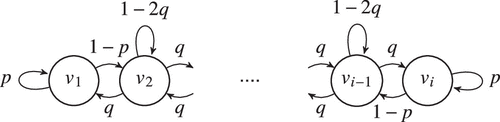
Let be the RWoGG on a growing path, where is given in (31) such that and . If in for some constants C > 0 and , then .
Corollaries 1 and 2 and Theorem 8 imply the following tight bounds of .
For , where is the transition matrix of either the lazy simple random walk or the lazy Metropolis random walk. Then
(i) If for some constants C > 0 and , then .
(ii) If for some constants C > 0 and , then .
We prove Theorem 8. Let be parameters satisfying L < R. For a vertex , let be the event that . In other words, means that the walker does not visit the vertex v during the walk. For two vertices , we write if . Note that, for any two vertices and any round , it holds that . Then, we have
We will determine the parameters R and L such that, for all , , and . This yields the lower bound . For a fixed parameter R, let denote the number of steps of the walk during the last rounds.
Let be parameters satisfying L < R and let . Then, the following holds.
(i) , and
(ii) for all .
We recall the notion of stochastic dominance: For two random variables X and Y, we say X dominates Y if, for any , we have . Let be i.i.d. random variables sampled from the uniform distribution over and denote the sum. For a vertex , let denote the position of vi. Then the complementary event conditioned on is identical to the event . Moreover, the random variable is dominated by (recall ). This is because the distribution of conditioned on is uniform on . Thus, letting , we obtain
In the last inequality, we used the Kolmogorov inequality (Lemma A.1). □
It suffices to show that
By solving this inequality for , we obtain Item (ii). Here, in the second inequality, note that for all j > L and, thus, the average is at most the maximum .
Now we prove the inequality (33). Let denote the distribution of . To simplify the notations, for a vector , we write for the u-th element of y. We call the distribution monotone if holds for any . Our aim here is to prove that is monotone, which is equivalent to (33).
Indeed, we will prove a stronger statement: is monotone for any i and j. We prove this statement inductively. As the base case, observe that the vector is monotone. Suppose that is monotone. We claim is also monotone. To see this, note that is obtained by concatenating with zero. More precisely, satisfies
Finally, we check that is monotone if is monotone. Let , (for ), and . From (31), we have
By the induction assumption, is monotone. Now we check that is monotone. For k = 1, because , we have
For , because , we have
Finally, for k = i, because , we have
Therefore is monotone. □
Now we are ready to prove Theorem 8. Recall . Fix a small positive constant ϵ such that . Set and . Then we have and thus and . Then, from (32) and Lemma 13, we have
7. Concluding Remarks
This paper has investigated the expected numbers of vertices remaining unvisited by random walks on growing graphs parametrized by . We have presented some upper bounds of with respect to , where we revealed that if for C > 1 in general (Theorem 2), and that if on some natural assumptions (Theorem 5 and Corollaries 1 and 2). We have also presented lower bounds of for random walks on growing complete graphs and on growing path graphs, which imply the upper bounds by Theorem 5 and Corollaries 1 and 2 are tight in those cases. A general lower bound of is a challenge: a natural question remains unsettled whether requires . A concentration result should be another future work (Cooper and Frieze [12]).
In this paper, we have been concerned with a simple model of graphs with the increasing number of vertices, to develop a new technique for analyses of random walks on dynamic graphs. Clearly, it is an interesting and important future work to analyze algorithms on dynamic graphs whose vertex set and edge set are both dynamic.
A preliminary version appeared in Proceedings of the 32nd Symposium on Discrete Algorithms (SODA21) [Kijima S, Shimizu N, Shiraga T (2021) How many vertices does a random walk miss in a network with moderately increasing the number of vertices? Proc. 32nd Annual ACM-SIAM Sympos. Discrete Algorithms (SODA) (SIAM, Philadelphia), 106–122].
Appendix. Tools
(
(
(
To see this, divide a -steps random walk into c independent random walks each of length . Then, in each walk, the walker does not visit a specific vertex with probability at most from the Markov inequality.
Using Lemma A.3, it is easy to see that for any . This implies that, for any RWoGG with , the number of unvisited vertices is at most one in expectation at the end of every round.
(
Taking for all in Lemma A.4, we immediately obtain the following.
Let be an irreducible, reversible, and lazy transition matrix over V, and let denote its stationary distribution. Let denote the Markov chain according to P. Let and let . Then, for any and t > 0,
(
Furthermore, for any and any ,
Because , we have the following corollary.
Let be an irreducible, reversible, and lazy transition matrix over V, and let denote its stationary distribution. Suppose that is a matrix defined in Lemma A.5. Then for any and any ,
Here, denotes the largest eigenvalue in absolute value of a matrix M.
(
(
References
- [1] (1983) On the time taken by random walks on finite groups to visit every state. Z. Wahrscheinlichkeitstheorie Verw. Gebiete 62:361–374.Crossref, Google Scholar
- [2] (2002) Reversible Markov chains and random walks on graphs, https://www.stat.berkeley.edu/users/aldous/RWG/book.html.Google Scholar
- [3] (1979) Random walks, universal traversal sequences, and the complexity of maze problems. Proc. 20th Annual Sympos. Foundations Comput. Sci. (FOCS) (IEEE, New York), 218–223.Google Scholar
- [4] (2016) Distributed algorithmic foundations of dynamic networks. ACM SIGACT News 47(1):69–98.Crossref, Google Scholar
- [5] (2008) How to explore a fast-changing world (cover time of a simple random walk on evolving graphs). Aceto L, Damgård I, Goldberg LA, Halldórsson MM, Ingólfsdóttir A, Walukiewicz I, eds. Proc. 35th Internat. Colloquium Automata Languages Programming (ICALP) (Springer, Berlin), 121–132.Google Scholar
- [6] (2018) Cover time and mixing time of random walks on dynamic graphs. Random Structures Algorithms 52(4):576–596.Crossref, Google Scholar
- [7] (1999) Emergence of scaling in random networks. Science 286(5439):509–512.Crossref, Google Scholar
- [8] (2016) Bounds on the voter model in dynamic networks. Chatzigiannakis I, Mitzenmacher M, Rabani Y, Sangiorgi D, eds. Proc 43rd Internat. Colloquium Automata Languages Programming (ICALP) (Schloss Dagstuhl – Leibniz-Zentrum für Informatik, Wadern, Germany), 146:1–146:15.Google Scholar
- [9] (2020) Random walks on randomly evolving graphs. Richa AW, Scheideler C, eds. Proc. 27th Internat. Colloquium Structural Inform. Comm. Complexity (SIROCCO) (Springer-Verlag, Berlin), 111–128.Google Scholar
- [10] (2015) Information spreading in dynamic graphs. Distributed Comput. 28:55–73.Crossref, Google Scholar
- [11] (2011) Random walks, interacting particles, dynamic networks: Randomness can be helpful. Kosowski A, Yamashita M, eds. Proc. 18th Internat. Colloquium Structural Inform. Comm. Complexity (SIROCCO) (Springer, Berlin), 1–14.Google Scholar
- [12] (2004) Crawling on simple models of web graphs. Internet Math. 1(1):57–90.Crossref, Google Scholar
- [13] (2017) Random walks with the minimum degree local rule have O(N2) cover time. Proc. 28th Annual ACM-SIAM Sympos. Discrete Algorithms (SODA) (SIAM, Philadelphia), 1839–1848.Google Scholar
- [14] (2018) Random walks with the minimum degree local rule have O(n2) cover time. SIAM J. Comput. 47(3):755–768.Crossref, Google Scholar
- [15] (2014) Random walks on evolving graphs with recurring topologies. Kuhn F, ed. Distributed Comput. DISC 2014 (Springer, Berlin), 333–345.Google Scholar
- [16] Doerr B, Neumann F, eds. (2020) Theory of Evolutionary Computation: Recent Developments in Discrete Optimization (Springer International Publishing, Cham, Switzerland).Crossref, Google Scholar
- [17] (1984) Random Walks and Electric Networks (Mathematical Association of America, Washington, DC).Crossref, Google Scholar
- [18] (2019) Probability: Theory and Examples (Cambridge University Press, Cambridge, UK).Crossref, Google Scholar
- [19] (1995) A tight lower bound on the cover time for random walks on graphs. Random Structures Algorithms 6(4):433–438.Crossref, Google Scholar
- [20] (1995) A tight upper bound on the cover time for random walks on graphs. Random Structures Algorithms 6(1):51–54.Crossref, Google Scholar
- [21] (2009) The hitting and cover times of random walks on finite graphs using local degree information. Theoret. Comput. Sci. 410(1):94–100.Crossref, Google Scholar
- [22] (2003) Impact of local topological information on random walks on finite graphs. Baeten JCM, Lenstra JK, Parrow J, Woeginger GJ, eds. Proc. 30th Internat. Colloquium Automata Languages Programming (ICALP) (Springer, Berlin), 1054–1067.Google Scholar
- [23] (2019) On coalescence time in graphs: When is coalescing as fast as meeting? Proc. 30th Annual ACM-SIAM Sympos. Discrete Algorithms (SODA) (SIAM, Philadelphia), 956–965.Google Scholar
- [24] (2021) How many vertices does a random walk miss in a network with moderately increasing the number of vertices? Proc. 32nd Annual ACM-SIAM Sympos. Discrete Algorithms (SODA) (SIAM, Philadelphia), 106–122.Google Scholar
- [25] (2011) Dynamic networks: Models and algorithms. SIGACT News 42(1):82–96.Crossref, Google Scholar
- [26] (2018) Cover time in edge-uniform stochastically-evolving graphs. Algorithms 11(10):149.Crossref, Google Scholar
- [27] (2017) Markov Chain and Mixing Times, 2nd ed. (The American Mathematical Society, Providence, RI).Crossref, Google Scholar
- [28] (1988) Covering problems for Markov chains. Ann. Probab. 16(3):1215–1228.Crossref, Google Scholar
- [29] (2016) An introduction to temporal graphs: An algorithmic perspective. Internet Math. 12(4):239–280.Crossref, Google Scholar
- [30] (2018) Elements of the theory of dynamic networks. Comm. ACM 61(2):72–81.Crossref, Google Scholar
- [31] (2006) On certain connectivity properties of the internet topology. J. Comput. System Sci. 72(2):239–251.Crossref, Google Scholar
- [32] (2010) The hitting and cover times of metropolis walks. Theoret. Comput. Sci. 411(16–18):1889–1894.Crossref, Google Scholar
- [33] (2019) Random walks on graphs: New bounds on hitting, meeting, coalescing and returning. Proc. 16th Workshop Anal. Algorithmics Combinatorics (ANALCO), 119–126.Google Scholar
- [34] (2009) Merging for time inhomogeneous finite Markov chains. Part I: Singular values and stability. Electronic J. Probab. 14(49):1456–1494.Google Scholar
- [35] (2011) Merging for inhomogeneous finite Markov chains. Part II: Nash and log-Sobolev inequalities. Ann. Probab. 39(3):1161–1203.Crossref, Google Scholar
- [36] (2015) Distributed computation in dynamic networks via random walks. Theoret. Comput. Sci. 581:45–66.Crossref, Google Scholar
- [37] (2019) Random walks on dynamic graphs: Mixing times, hitting times, and return probabilities. Baier C, Chatzigiannakis I, Flocchini P, Leonardi S, eds. Proc. 46th Internat. Colloquium Automata Languages Programming (ICALP) (Schloss Dagstuhl – Leibniz-Zentrum für Informatik, Wadern, Germany), 93:1–93:15.Google Scholar
- [38] (1998) Collective dynamics of ‘small-world’ networks. Nature 393:440–442.Crossref, Google Scholar
- [39] (2016) Random walk with restart over dynamic graphs. Proc. IEEE 16th Internat. Conf. Data Mining (ICDM) (IEEE, New York), 589–598.Google Scholar