On the Value of Information Across Decision Problems
Abstract
Winner of the 2025 Clemen–Kleinmuntz Decision Analysis Best Paper Award
The value of information is an important concept in decision analysis that has been quantified as the buying price (BPI) for the information and the expected utility increase (EUI) obtainable by using the information. These two measures rank information sources identically in a scalar-valued decision problem only when the utility function is linear or exponential. In contrast, this paper focuses on the value of information across scalar-valued decision problems sharing the same utility function such as different divisions within an organization exploring various information sources for their decisions using the same organizational utility function. In this context, it still makes sense to ask which sources are more informative. We show that BPI and EUI rank information sources identically in this context only when the utility function is linear. However, if the certainty equivalent increase is used instead of EUI, then identical ranking with BPI across problems is maintained for the broader class of linear or exponential utility functions. We discuss the importance of these results for distributed decision-making settings, where different departments within an organization may calculate the value of information separately. Our results advise against using EUI to measure information value in this context when risk attitude is important.
1. Introduction
The value of information is an important concept in decision analysis. The phrase can be used generically to refer to the benefit obtainable in decision problems from the revelation of an outcome of a particular uncertainty prior to choosing. It is typically quantified in risk-neutral settings as the expected monetary benefit of the revelation (e.g., Schlaifer 1959). In risk-sensitive settings the value of information has been defined as the expected utility increase (EUI) of the revelation (e.g., Raiffa and Schlaifer 1961), or the buying price (BPI, the most one should pay) for the revelation (e.g., Howard 1967, Howard and Abbas 2015), as it provides an upper bound on the value of any information-gathering activity related to an uncertainty of interest, and therefore measures the importance of that uncertainty to the decision problem.
Several authors have since characterized properties of the value of information in a given decision. Hilton (1981) examines EUI, BPI, and also the selling price for information, and shows that there is no general monotonicity between the degree of absolute or relative risk aversion and the value of information. LaValle (1968) shows that there is no general monotonic relationship between wealth and information value, and that information value is invariant with respect to wealth if and only if the utility function is linear or exponential. Abbas et al. (2013) derive conditions under which the value of information is monotone with risk aversion in a two-action decision problem for a decision maker with an exponential utility function with deterministic initial wealth.
Hazen and Sounderpandian (1999) derive several propositions to show the equivalence in rankings between various measures of information value within the context of a single decision problem. Two such measures are the expected utility increase and buying price BPI mentioned above. Another is the certainty equivalent increase , the amount by which the optimal certainty equivalent increases (if at all) when actions are allowed to depend on the revealed uncertainty. They show that EUI and certainty equivalent increase (CEI) are ordinally equivalent, that is, they always rank any two uncertain quantities X,Y within the same decision problem identically. Moreover, they show that EUI (respectively CEI) is ordinally equivalent to BPI when risk attitude is constant (i.e., the utility function is linear or exponential, in which case CEI and BPI are equal).
Our focus in this paper is the comparison of information measures BPI, EUI, and CEI across scalar-valued decision problems (where prospects are described by a single attribute or value measure or some other scalar value), using the same utility function. Our focus will be on distributed decision settings, as for instance in an organization with different decision makers who face different decision problems in which various independent information sources may arise. Examples include energy and gas companies conducting geological surveys for geographically distant locations and where different decision makers are interested in gathering information about the oil and gas reserves present in their regions of interest. The decision makers may then wish to report to headquarters the potential value of various information sources.
As we shall see, rankings of information sources across problems based on the expected utility increase is not necessarily equivalent to rankings based on the buying price, that is, EUI and BPI are not ordinally equivalent. This remains true even with a shared exponential utility function, in notable contrast to comparisons within a single decision problem, where they are equivalent under exponential utility. The primary contribution of the present paper is to demonstrate that across decision problems sharing a utility function, EUI and BPI are ordinally equivalent only under risk neutrality (a linear utility function). We also show, however, that just as with a single decision problem, CEI and BPI are ordinally equivalent (in fact, equal) across decision problems only under constant risk attitude. These relationships are more easily summarized diagrammatically, as in Figure 1, where Figure 1(a) depicts already known ordinal equivalences within decision problems, and Figure 1(b) depicts equivalences across decision problems that we demonstrate in this paper. Finally, we show the benefits of using CEI or BPI versus EUI as information measures in distributed decision settings particularly when the utility function is linear or exponential.
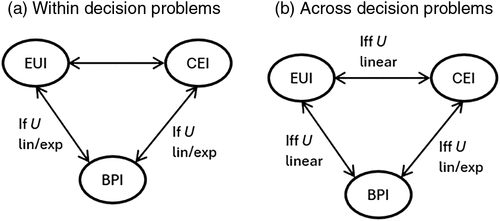
Notes. Each equivalence is represented by a double arrow with conditions (if any) on utility U under which the equivalence is valid. (a) Equivalences within a given decision problem (known results). (b) Equivalences across decision problems sharing the same U (results derived in this paper). “Iff” stands for “If and only if.” “lin/exp” stands for “linear or exponential.”
The remainder of this paper is structured as follows. Section 2 provides two motivating examples to illustrate the difference in rankings between EUI and BPI within and across decision problems. Section 3 presents the main results described above. Section 4 explicitly examines the distributed decision setting and highlights the drawbacks of using EUI in this setting. The appendix provides proofs of the theorems.
2. Motivating Examples
This section presents two simple numerical examples to demonstrate (i) equivalence in ranking of the expected utility increase (EUI) with the buying price of information (BPI) within a single decision problem under exponential utility and (ii) difference in rankings provided by EUI and BPI across different decision problems with shared exponential utility.
We assume that the decision maker has constant deterministic initial wealth, w. Because the valuation of lotteries is independent of initial wealth for an exponential utility function (see, for example, Howard and Abbas 2015), we omit the reference to the initial wealth in the following examples.
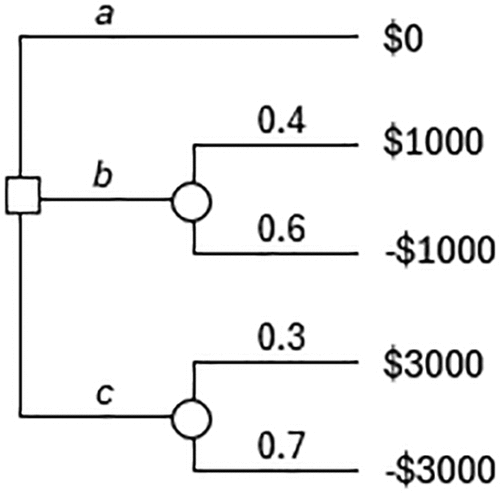
(
If alternative a is chosen, then the payoff is $0.
If alternative b is chosen, then the payoff is determined by the lottery B = 〈0.4, $1,000; 0.6, −$1,000〉.
If alternative c is chosen, then the payoff is determined by the lottery 〈0.3, $3,000; 0.7, −$3,000〉.
The uncertainties B and C are probabilistically independent. Now suppose that the decision maker has access to information that will reveal the value of B that will occur, and also information that will reveal the value of C that will occur. Which information source would be preferred? If the expected utility increase from revealing the value of B exceeds that from revealing the value of C, does that guarantee that the decision maker would pay more to reveal B than to reveal C, and vice versa?
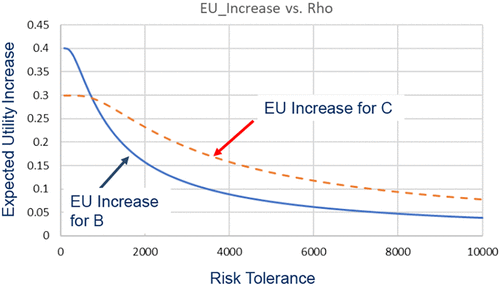
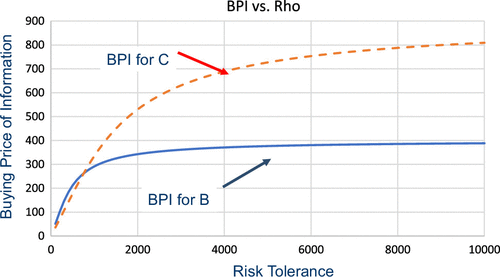
Figures 3 and 4 plot the expected utility increase and the buying price of information for the uncertainties B and C as a function of the risk tolerance. Note that B and C are ranked identically by both the expected utility increase and the buying price regardless of what exponential utility function is used: The value of risk tolerance at which the curves cross in each figure is the same; above this value C is ranked higher, and below it, B is ranked higher. This observation illustrates the following proposition from Hazen and Sounderpandian (1999).
(
(
Department 1 faces a decision with two alternatives as shown in Figure 5(a).
If alternative a is chosen, then the payoff is $0.
If alternative b is chosen, then the payoff is either $1,000 or −$1,000 with equal probability, that is, the payoff is described by the lottery B = 〈0.5, $1,000; 0.5, −$1,000〉.
Department 2 faces a decision with two alternatives as shown in Figure 5(b).
If alternative c is chosen, then the payoff is $1,000.
If alternative d is chosen, then the payoff is either $2,000 or −$2,000 with probabilities 0.9/0.1, respectively, that is, the payoff is described by the lottery D = 〈0.9, $2,000; 0.1, −$2,000〉.
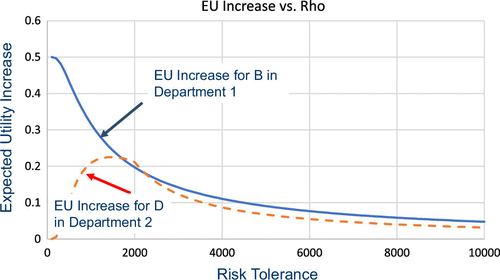
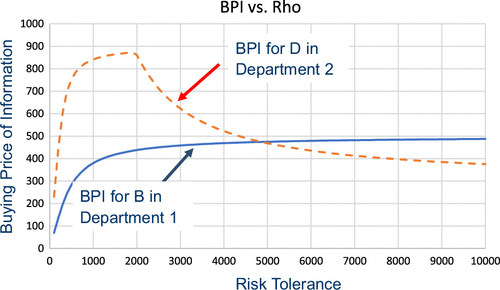
Which information source is more valuable, B in department 1 or D in department 2? As a function of risk tolerance , Figure 6 plots the expected utility increase EUI for B and for D, and Figure 7 plots buying price of information BPI for B and for D. The figures show EUI and BPI are not ordinally equivalent: For a risk tolerance above $2,200, the expected utility increase for B in department 1 is higher than for D in department 2, whereas the reverse is true for BPI of these two variables in in the overlapping range $2,200–$4,850.
Examples 1 and 2 illustrate that although EUI and BPI are ordinally equivalent within a single decision problem under exponential utility, they fail in general to be ordinally equivalent across decision problems sharing the same utility function, even if it is exponential. In the latter case, BPI is in fact always equal to certainty equivalent increase CEI, so BPI and CEI are ordinally equivalent for exponential utility functions, both in and across decision problems. As Hazen and Sounderpandian (1999) show, they are not ordinally equivalent for general utility functions in a single decision problem, and as we will show below, the same statement holds across decision problems (see Figure 1).
As we show in the next section, EUI and BPI fail to be ordinally equivalent across decision problems with shared utility function unless utility is risk neutral (linear). This failure means, for example, that in the absence of risk neutrality, the reporting of expected utility increase by different departments within an organization might produce different rankings than the reporting of buying prices, even if they operated with the same exponential utility function.
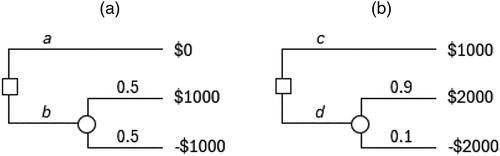
Notes. (a) Decision tree for department 1. (b) Decision tree for department 2.
3. Information Value Rankings Across Decision Problems
We consider an arbitrary collection of scalar-valued decision problems sharing the same utility function. Under what conditions is ranking information sources across problems using buying price of information (BPI) equivalent to the ranking obtained by using expected utility increase (EUI) or by CEI? The following is the primary result of this paper.
and are ordinally equivalent across decision problems sharing the same utility function U if and only if is linear.
The next question we consider is whether ranking information sources by the certainty equivalent increase (CEI) would be ordinally equivalent to the buying price of information (BPI) in this setting.
BPI and are ordinally equivalent across decision problems sharing the same utility function U if and only if is linear or exponential.
For completeness, we also provide the following result.
CEI and EUI are ordinally equivalent across decision problems sharing the same utility function if and only if is linear.
The following corollary results from the intersections of Theorems 1, 2, and 3.
BPI, , and EUI are ordinally equivalent across decision problems sharing the same utility function U if and only if is linear.
3.1. Implications for Distributed Decision Making
If two departments within an organization calculate the value of information independently, and if the organization does not wish to be risk neutral, then the value of information ranking determined by the buying price of information need not correspond to the ranking from expected utility increase. Theorem 1 implies that this potential conflict would remain unless the utility function is linear. In contrast, ranking by certainty equivalent increase would by Theorem 2 create no potential conflict with buying price rankings unless the shared utility function falls outside the linear/exponential class. Within that class, BPI is in fact equal to CEI.
Theorems 1 and 2 do not discuss which information measure, EUI or BPI, should be incorporated across decision problems but point out the conditions under which different measures could result in conflicting rankings. The next section highlights drawbacks of using EUI as a measure of information value across all decisions.
4. Information Value in Distributed Decision Settings
From a perspective of efficiency in decision making, it would be convenient if an organization distributed its decision making across its various divisions instead of having to make all decisions at the organizational level. A practical setting is oil and gas exploration. One “division” might be a particular geographic location whose uncertainties are geological structures and formation densities that are relevant to the amount of hydrocarbons present. It is plausible that these uncertainties are independent of the presence or absence of such structures in other locations.
It is important within this setting to make sure that there is no loss in value incurred by decentralization. The economic, behavioral, and optimization literature on distributed decision making is broad, and we do not review it in detail here. Quite often, targets and incentives are used to distribute decision making. A desirable feature within this distributed target-based setting is that a division that chooses projects to meet its targets would also be making decisions that maximize the overall value to the organization (see, for example, Bordley and Kirkwood 2004 and Abbas and Matheson 2005, 2009).
Can such decentralization that guarantees no loss in value be obtained for information value measures? Consider a hypothetical organization whose overall financial payoffs are the sum of the uncertain financial payoffs from a particular department and the uncertain financial payoffs from the rest of the organization, from which department ’s payoffs are probabilistically independent. (The departments that subdivide the rest of the organization need not have probabilistically independent payoffs.) We assume that the organizational utility is linear or exponential and is shared across departments. This means that buying price BPI for information is equal to the certainty equivalent increase CEI. We wish to address two seemingly reasonable practices related to distributed decision making for this organization:
Practice 1: Headquarters can mandate a decision policy for department , but for logistical reasons leaves that choice to department , in the belief that an optimal choice at that level would produce an optimum for the organization.
Practice 2: If is an uncertainty that affects only department , headquarters could itself calculate the value of the information to the organization but instead lets department do so for itself, hoping that the value of the information to department would equal its value to the organization, or failing this, that the ranking of information values for uncertainties affecting only department would be identical at the organizational and department levels.
Regarding practice 1, it is fairly easy to show that the natural requirement of probabilistic independence for department is sufficient to justify leaving policy choices to that department. We derive such a result in Theorem 4 below.
Regarding practice 2, we can ask what information reporting policy—BPI, EUI, CEI—should the organization mandate for department regarding information sources if it desires to justify this practice?
Theorems 1 and 2 do not bear directly on this mandate question except to point out that different policies could result in conflicting rankings. We suspect that many decision makers would prefer BPI, as it is precisely the financial value of information and is therefore easily integrated with other financial considerations. In general BPI is more cumbersome to compute than EUI, but when utility is linear/exponential, it is equal to CEI, which is practically no more cumbersome than EUI. Regarding financial conclusions, these can also be derived from EUI values by translating to certainty equivalents—but if this is done, then one must ask why the certainty equivalent increase CEI was not being used in the first place.
The following example shows how BPI can justify practice 2 in the strongest sense, whereas EUI fails even weakly to do so.
(
The organization can calculate combined BPIs (equal to combined CEIs) for B and for D in the decision tree of Figure 8. It turns out the resulting CEI (or BPI) chart is identical to the chart of Figure 7 from Example 2. That is, regardless of risk tolerance , the combined is identical to as calculated in department 1, and the analogous statement holds for . Comparing calculations at the organizational and departmental levels, not only is there no change in how information sources are ranked under BPI, but the BPI values are in fact identical at the organizational and departmental levels.
The organization can also calculate and for the combined tree in Figure 8, where and , as in Example 2. The results of these calculations are shown in Figure 9 as a function of risk tolerance . Here we see that the curves in Figure 9 are completely different from the corresponding curves in Figure 6 of Example 2, which are calculated at the departmental level. Regardless of risk tolerance, the combined is not the same as the in department 1, nor is the combined equal to the in department 2. Not only do organizational and departmental calculations produce different EUI values, but they may also produce different EUI rankings. For instance, compare the EUIs for in Figures 6 and 9.
Note, further, that although the risk tolerances at which the EUI curves cross in Figures 6 and 9 are different, the risk tolerance corresponding to the crossover point in Figure 9 for the combined decision occurs at the same level of risk tolerance as for the CEI crossover in Figure 7. The crossover point for EUI differs based on individual or combined calculations, whereas the entire curves for BPI remained the same at the individual or combined levels.


4.1. Distributed Decisions—A General Result
Example 3 highlighted the issue of using EUI for information value in a distributed decision setting. The following general result guarantees that the advantages just pointed out for BPI will always occur, and the difficulties for EUI are almost sure to happen in this type of situation.
Consider an organization operating with a linear or exponential utility function that is shared across departments, and in which the organization’s overall financial payoff is the sum of an uncertain payoff from department , and an independent financial payoff from the rest of the organization. Then the following conditions hold:
The optimal policy for the organization is the combination of the optimal policy for department and the optimal policy for the rest of the organization. It has expected utility that can be simply calculated from the optimal expected utility for department and the optimal expected utility for the rest of the organization. It has certainty equivalent equal to the sum of certainty equivalents from department and from the rest of the organization.
If the utility function is risk neutral (linear), then for an uncertainty in department , the expected utility increase for the organization is equal to the expected utility increase within department .
Suppose the utility function is risk sensitive (i.e., exponential with nonzero risk tolerance ). For an uncertainty in department the absolute percentage expected utility increase for the organization is equal to the absolute percentage expected utility increase within department .
For an uncertainty in department , the certainty equivalent increase for the organization is equal to the certainty equivalent increase within department .
So according to point 1 of Theorem 4, practice 1 is a reasonable one for this hypothetical organization. Moreover, point 2 of Theorem 4 indicates that under risk neutrality (linear utility), EUI for an uncertainty specific to department is an accurate indicator of organizational EUI for that uncertainty, supporting practice 2. However, if utility is risk sensitive, then point 3 indicates that it is only the percentage increases in EUI that match for department and the organization. This obviously does not entail that the actual EUIs match. Moreover, a larger percentage increase for EUI of in department than of in a likewise independent department does not necessarily indicate that the EUI of is larger for the organization. Therefore, under exponential utility, EUI cannot support practice 2, either strongly or weakly.
These problems disappear if instead CEI (equal to BPI) is used to measure information value, according to point 4 in the theorem: Not only are CEI rankings the same for department and the organization—the CEI values are in fact identical. Therefore, practice 2 is supported both weakly and strongly.
For these reasons, we suspect that many decision makers would prefer to use BPI or CEI rather than EUI to measure information value at department levels when risk attitude is not neutral.
5. Summary
Theorem 1 states that buying price (BPI) and expected utility increase (EUI) for information are ordinally equivalent across decision problems sharing the same utility function if and only if that utility function is linear. This theorem also implies that using any other utility function or arbitrary constructed scale besides a linear transformation of the decision payoff will result in different information rankings across decision problems. Further, even a single decision maker facing independent decisions over time using the same linear/exponential utility function might reverse rankings of information sources depending on whether EUI or BPI is used—unless the utility function is linear.
Theorem 2 shows that BPI and the certainty equivalent increase (CEI) are ordinally equivalent (in fact, equal) across decision problems sharing a utility function only for the broader class of linear or exponential utility. This fact was already known to be true within individual decision problems because of the nature of the Delta property for linear and exponential utility functions, but it is hereby extended to show equivalence in information rankings using both BPI and CEI measures across all decisions.
Theorems 1 and 2 highlight the differences in rankings obtained by different measures across decision problems and naturally lead to the question of which information measure to use. In the special case of distributed decision making for an organization across independent departments under linear or exponential utility, we show in Theorem 4 that organizational EUI for information influencing only a single department is equal to the departmental EUI for that information only for linear utility, but almost never for exponential utility. In contrast, in the same situation, organizational BPI for that information is always identical to departmental BPI. Because of these pitfalls, shared EUI across departments in a distributed setting should be used with caution, and avoided in favor of BPI with the understanding that ordinal rankings of EUI would be inconsistent for an analysis that involves combined versus individual calculations of information value.
Appendix
Our proofs in this appendix require more specific notation and terminology, which we introduce as follows.
We say that is a random variable from a probability space 1 if is an -measurable real-valued function over . A scalar-valued decision problem is a triple with (i) associated probability space , (ii) an objective function that assigns to each alternative in its domain a real-valued random variable from the probability space , and (iii) a strictly increasing utility function over the reals. We say that is a random variable from a decision problem if is a random variable from the probability space of that decision problem.
Let , or simply , denote expectation in the probability space of a decision problem. The certainty equivalent of a variable W from that decision problem is given by
Linear or exponential utility functions have the so-called Delta property, namely,
For a decision problem , suppose
Let be a deterministic scalar. On occasion, we may need to consider a maximizer over of . We denote the associated optimal value as the random variable . It has associated expected utility and associated certainty equivalent .
Given a random variable from a decision problem , let
For a scalar , we shall also need to introduce
Define
We may also define the buying price for information as the most one would pay for the information , the solution to the equivalent equalities
A.1. A Restricted Delta Property
The derivations in this appendix assume a strictly increasing continuously differentiable utility function and its associated certainty equivalents. We begin with a restricted version of the so-called Delta property, the equation that holds for any linear or exponential utility function.
for all random variables bounded below with probability one by and all real values with if and only if is linear or exponential over ).
(
Take of both sides to get
Let . Then , so , so the last equation becomes
Let . Because is equivalent to , we have shown
Specialize to the case in which is equally likely to be or . Then we can assert
Set and note that to get
Take derivatives of both sides to get
It follows that for , or more briefly, , where . Substituting the definition of , we have
Substitute to get
Substitute to get
Differentiate to get
Set to conclude and substitute this back into the previous equation to get
Make the change of variable to get
So, with , we have shown for all . We invoke the result that the only nonzero solution to this equation is for some constant (Small 2007, section 2.5). The solution is ruled out because it would imply is constant. Therefore, we have
It follows that for , so that has constant risk attitude, that is, is linear or exponential over the interval .
A.2. Preliminaries
We begin with the following result.
Let be any random variable from decision problem , and suppose and . Then
Both sides of this equality are equal to according to the respective definitions of and .
For any real values and , let . For a random variable , we shall be particularly interested in the random variable , which can be thought of as the value of truncated below by .
For any random variable from a probability space , introduce a decision problem with the same probability space having two alternatives with corresponding payoffs , and utility function .
In decision problem , we have
(a)
(b)
(c) If and then
The derivations (a), (b) are elementary. The equation in (c) is the equation of Proposition A.1 specialized to problem .
Let be an arbitrary random variable bounded below with probability one by the constant , and let be a real value with . Then there is a random variable satisfying the equations
For , let the random variable take on the value with probability and the value with probability . Then we will have , so the first equation will be satisfied. It remains to find a value for which the second equation above holds for .
Note first that the quantity in this equation is equal to if and only if , that is, if and only if We have
Let us solve the second equation above for . We have
The case is impossible because . The case is equivalent to
Let be an arbitrary random variable bounded below with probability one by the constant , and let be a real value with . Then there is a random variable such that in the decision problem we have , and if , then .
From the definition of , using Lemmas A.2 and A.3 we have
This accounts for the first claim in Corollary A.1. The second claim follows from Lemma A.2 after noting that .
The following result is demonstrated in Hazen and Sounderpandian (1999), but we here provide a cleaner proof.
(
Sufficiency is easy to verify. For necessity, let be an arbitrary real number, and let be any random variable bounded below by with probability one, and any real value with We shall demonstrate the Delta property
This holding for any such and implies by Lemma A.1 that must be linear or exponential over .
Invoke Corollary A.1 to Lemma A.3 to guarantee there is a random variable such that in the decision problem we have , and if , then .
The quantity is equal to by assumption, so therefore . Therefore, by Lemma A.1, must be linear or exponential over . Because was arbitrary, it follows that must be linear or exponential over the real line.
and are ordinally equivalent across all decision problems having utility function implies is linear or exponential.
The ordinal equivalence assumption is equivalent to the statement that there is an increasing transformation such that
Let be an arbitrary real number, and let be any random variable bounded below by with probability one, and any real value with By Corollary A.1 to Lemma A.3, there is a random variable such that in the decision problem we have , and if , then . It follows from (A.1) that
In particular, if is any constant , then certainty equivalents collapse and we have , that is, over . The constant can be made arbitrarily large, so we obtain over . Therefore Equation (A.1) implies that
Invoke Proposition A.2 to conclude that must be linear or exponential.
Hazen and Sounderpandian (1999) show that the information measures (but not necessarily ) are ordinally equivalent within any given decision problem; that is, for any random variables from the same decision problem, we have
This means that any one of is a strictly increasing transformation of any other one. It will be useful to identify the transformation associated with .
For any decision problem with objective , there is a strictly increasing function such that for all from
The function is given by
From the definitions of and , we have
A.3. Proof of Theorem 1
Fix a utility function , and consider the collection of scalar decision problems that share the utility function . Here we are interested in the ordinal equivalence of and across , meaning that for all decision problems and all from , from
and are ordinally equivalent across the class of decision problems if and only if is risk neutral.
(
Because is strictly increasing, it follows by Proposition A.3 that the utility function is linear or exponential. Invoking the Delta property for such a utility function, we have and it follows that is the identity function, hence that .
In the exponential case with , the function is given by
Fix the value . The class of decision problems of interest must contain at least two decision problems with different optimal certainty equivalent values that give two different values of . They cannot both equal This contradiction implies that cannot be an exponential( utility function for . It must therefore be that is linear.
(Sufficiency) If is linear, so that for some , then and . Therefore, statement (A.3) holds with so that and are ordinally equivalent across decision problems .
A.4. Proof of Theorem 2
Theorem 2 is contained in the following slightly more general proposition.
The following statements are equivalent:
and are ordinally equivalent across the class of decision problems.
The utility function is linear or exponential.
for all and all from .
That (a) implies (b) is simply Proposition A.3. If (b) holds, then the Delta property implies that (c) holds. And obviously if (c) holds, then (a) holds. Hence (a), (b), and (c) are equivalent.
A.5. Proof of Theorem 3
and CE are ordinally equivalent across the class of decision problems if and only if is risk neutral.
(
From Lemma A.4 we know that
Therefore, we have
Therefore, is the identity function, from which it follows that and
Because cannot depend on , neither can the quantity We assume the set of decision problems is rich enough so that spans the real numbers. and therefore does not depend on , and we have
Therefore, for all and it follows that is a constant function, and must therefore be linear, as desired.
The proof of sufficiency is virtually identical to the sufficiency proof for Theorem 1.
A.6. Proof of Theorem 4
We here demonstrate a general version of Theorem 4. We consider a decision problem with the following structure. The feasible actions will be vectors , and overall payoff will be the random variable , where are mutually probabilistically independent random variables. The goal is to choose to maximize the expected utility .
Theorem 4 considers the case in which and actions occur in department , whereas actions occur in the rest of the organization. Part of the discussion following the theorem also considers the case in which actions occur in department , actions occur in department , and actions occur in the rest of the organization.
A.6.1. Optimal Choice Is Distributed.
In the special case in which is risk neutral, then we have
A.6.2. Risk-Neutral Expected Utility Increase.
We have by definition
Consider a random variable that influences only the objective but is independent of all other . Then an optimal action is . Therefore,
Under risk neutrality, these equations become
A.6.3. Risk-Sensitive Expected Utility Increase.
Suppose utility is exponential with parameter as above. Note that for exponential utility, we have
Therefore, we have
Therefore,
Divide through by to obtain
Therefore, the overall absolute percentage increase in is equal to the absolute percentage increase in subproblem .
A.6.4. Certainty Equivalent Increase.
By definition, we have
For linear or exponential utility, certainty equivalents have the property
As above, consider a random variable that influences only the objective but is independent of all other . We have
It follows that
1 As is conventional, is a sigma algebra of subsets of , and is a probability measure over .
References
- (2005) Normative target-based decision-making. Managerial Decision Econom. 26(6):373–385.Crossref, Google Scholar
- (2009) Normative decision-making with multiattribute performance targets. J. Multi-Criteria Decision Anal. 16(3):67–78.Crossref, Google Scholar
- (2013) Effects of risk aversion on the value of information in two-action decision problems. Decision Anal. 10(3):257–275.Link, Google Scholar
- (2004) Multiattribute preference analysis with performance targets. Oper. Res. 52(6):823–835.Link, Google Scholar
- (1999) Lottery acquisition vs. information acquisition: Prices and preference reversals. J. Risk Uncertainty 18(2):125–136.Crossref, Google Scholar
- (1981) The determinants of information value: Synthesizing some general results. Management Sci. 27(1):57–64.Link, Google Scholar
- (1967) Value of information lotteries. IEEE Trans. Systems Sci. Cybernetics 3(1):54–60.Crossref, Google Scholar
- (2015) Foundations of Decision Analysis (Prentice Hall, New York).Google Scholar
- (1968) On cash equivalents and information evaluation in decisions under uncertainty: Part I: Basic theory. J. Amer. Statist. Assoc. 63(321):252–276.Crossref, Google Scholar
- (1961) Applied Statistical Decision Theory (Harvard University Press, Boston).Google Scholar
- (1959) Probability and Statistics for Business Decisions: An Introduction to Managerial Economics Under Uncertainty (McGraw Hill, New York).Google Scholar
- (2007) Functional Equations and How to Solve Them (Springer Science+Business Media, LLC, New York).Crossref, Google Scholar
Ali Abbas is professor of industrial and systems engineering at the University of Southern California. He is author, coauthor, and editor of numerous books including Foundations of Decision Analysis, with Ronald A. Howard, Foundations of Multiattribute Utility, Next Generation Ethics, and Ethical Decision Quality: Building an Ethical Decision Culture. He received the Decision Analysis Society Best Paper Award in 2011 and the IEEE Systems Council Best Publication Award in 2019.
Gordon Hazen is professor emeritus in industrial engineering and management sciences at Northwestern University. He specializes in decision analysis methodology, decision analytic information value, medical decision analysis, and Markov modeling of medical treatment decisions, for which he developed the Microsoft Excel addin StoTree. He received the 2023 Clemen -Kleinmuntz Decision Analysis Best Paper Award, and the 1996 Publication Award from the Decision Analysis Society of INFORMS.