


Interfaces Instructions to Authors
The mission of Interfaces is to publish manuscripts focusing on the practice of operations research and management science (OR/MS) and the impact this practice has on organizations throughout the world. The most appropriate papers are descriptions of the practice and implementation of OR/MS in commerce, industry, government, or education. The journal publishes papers in all areas of OR/MS including operations management, information systems, finance, marketing, education, quality, and strategy. Comments on published material and on how Interfaces can better serve its readers are solicited. A verification letter should accompany the paper (see Verification Letter below). Interfaces also publishes opinion papers about operational problems with less quantifiable results, tutorials, reports on OR/MS training programs, news items on specific applications, state-of-the-art reviews and use surveys, and comments from corporation managers. Papers that detail the design or development of a model or algorithm (especially those that are largely mathematical) should be sent to Operations Research or to Management Science.
Submitting a Paper
To submit a paper to Interfaces, please send it electronically using the Interfaces ScholarOne Manuscripts website:
http://mc.manuscriptcentral.com/inte.
Papers submitted must not be under consideration elsewhere, accepted for publication, or published. We screen papers carefully for appropriateness and then review those suitable for the journal as rapidly as possible.
When you submit the final accepted version of your paper for editing, please include a Microsoft Word or LaTeX version of the paper. Information about file preparation is available on the INFORMS Author Portal at http://www.informs.org/Find-Research-Publications/journals/Author-Portal.
Organizing a Paper
The following outline suggests an effective way of organizing a paper:
Describe the problem;
Explain what you did, how you did it, and what obstacles you encountered;
List the resulting benefits, both quantitative and qualitative; and
If appropriate, provide an appendix giving the particulars of the model or data.
Writing a Paper
In writing your paper, explain your work so readers outside your field can understand it. If you must use a specialized term, abbreviation, or acronym, please define it; write out the meaning of an acronym or abbreviation the first time you use it, and enclose the acronym or abbreviation in parentheses immediately afterwards.
Where it is feasible, use the active voice rather than the passive, and the first person rather than the third.
Appearance and Length
Make papers as concise as possible. We recommend 15 to 25 double-spaced pages—excluding references, figures, and tables. Use a 12-point type, a standard font (e.g., Times New Roman), and margins of at least one inch on each side. Double-space the entire paper—including the abstract, body, quotations, table and figure captions, acknowledgments, and the references. Because of this page limitation, do not be repetitive.
Title
Make your title short and specific. Instead of “Systems Analysis and Order Processing in a Multiechelon System,” try “Verizon Uses Systems Analysis to Speed Telephone Orders.” When readers are told they are going to read about a telephone company, they have a vivid image that includes the notion of a “multiechelon system.” Titles should be a maximum of 10 words in length—five or six words are preferable.
Author Contact Information
Do not include author contact information in the submitted paper. Instead, upload a separate file labeled “cover sheet” and designated “supplemental file” in ScholarOne Manuscripts showing the paper title, and the name, affiliation, mailing address, and e-mail address of each author.
Abstract
Please write a brief abstract that sets forth the main points of the paper. Many people decide whether to read a paper based on the abstract. It should summarize your paper—it should not be an introduction. The abstract should be less than one double-spaced page. Every paper, including editorial columns, should have an abstract.
It is important that your abstract not contain mathematical symbols or accented variables; such notation may be difficult to properly present in Web browsers. The abstract is not only a part of the full article (print and online) but, more importantly, serves as the only free-to-all record of your paper. It is reused and remapped by a variety of online portals and metadata databases, some of which are text-only. Please ensure that your abstract is also text-only.
Keywords
Please include a set of key words (three to eight are appropriate) to enable readers searching for specific information to find your paper easily. See the INFORMS website for a list of suggested keywords:
http://www.informs.org/Find-Research-Publications/INFORMS-Journals/Author-Portal/Key-Words.
Headings
Please use one or two levels of headings. Do not use numbered headings; to refer to a particular section, use the title of the section (e.g., use “in the Research Planning section, we describe …” rather than “in Section 5, we describe …”).
Figures and Tables
Please write captions for figures and tables as complete sentences that explain the figure or table fully without forcing the reader to refer to the text (see Figure 1).
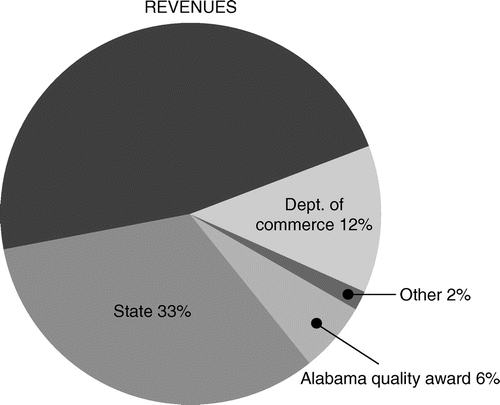
Conversely, readers should not have to refer back and forth from the text to the exhibits to understand the paper. Please refer to figures where appropriate with “(Figure 1)” and explain the meaning and implications of your data fully in the text. Do not require the reader to interpret the figure to understand what you have done, as in “Figure 1 shows the outcome of this survey.” Tables should list information in some obvious logical order.
Please be sure that figures are effective and efficient in their use of space. Labels interior to the figure should be large enough to be legible when the figure is reduced. Figures should be equivalent in quality to typeset material. Show the figure number and, if necessary, indicate the vertical direction of the figure. Figures must be indistinguishable in quality from those prepared by a graphic artist. After the paper is accepted, authors must send source files and PDF files of all figures and tables for production purposes. Label each figure numerically using the word “Figure” or “Table” (e.g., Figure1.eps). For example, label the figure as ∖label{Figure1} and cite the figure in text as ∖cite{Figure1}. The name of the figure (table) inserted into the paper should match the label of the associated figure (table) in the paper, e.g., figure1.pdf.
Provide vector-based art (drawings) in source format or as files with EPS, PDF, XLS, XLSX, or WMF extensions. EPS, TIFF, and JPEG (JPG) formats submitted in 600 dpi are acceptable for photographs. Bitmaps (i.e., files with a BMP extension) are not acceptable.
Color Figures and Artwork
Interfaces is typically published in black and white. In rare situations, an exception may be made for publication of color figures or artwork. The editor in chief’s office must approve any color publication at a paper’s acceptance, prior to production. The author is responsible for color publication fees and must pay them prior to publication.
Equations
Write the body of the paper in words and put mathematical details in an appendix. If you insert equations elsewhere, please use numbers enclosed in parentheses flush with the right margin. When referring to the equation in the text, use the format Equation (1).
Footnotes
Do not use footnotes. If information is important, it deserves a place in the text.
References
All references cited in the text must be cited in the bibliographical reference list; conversely, ensure that all entries that you cite in the reference list are in the text. Verify that the year of publication cited in the text matches the year of publication in the reference list. Alphabetize the list of references according to the name of the first author.
In creating your reference list, use the following formats:
Journal:
Flynn J, Gartska SK (1990) A dynamic inventory model with periodic auditing. Oper. Res. 38(6): 1089–1103.
Book:
Makridakis S, Wheelwright SC, McGee VE (1983) Forecasting: Methods and Applications, 2nd ed. (John Wiley & Sons, New York).
Edited Book:
Martello S, Toth P (1979) The 0-1 knapsack problem. Christofides N, Mingozzi A, Sandi C, eds. Combinatorial Optimization (John Wiley & Sons, New York), 237–279.
Conference Proceedings, Published:
Hill RR (1996) An analytical comparison of optimization problem generation methodologies. Medeiros DJ, Watson EF, Carson JS, eds. Proc. 1998 Winter Simulation Conf. (Institute of Electrical and Electronics Engineers, Washington, DC), 609–615.
Presentations:
Haltiwanger J (2004) What do we know (and not know) about the contribution of young businesses to economic growth? Presentation, Entrepreneurship in the 21st Century Conference, March 26, Office of Advocacy, U.S. Small Business Administration, Washington, DC.
Dissertations, unpublished:
Yi Y (1998) Developing and validating an observational learning model of computer software training. Unpublished doctoral dissertation, University of Maryland, College Park.
Working paper, unpublished:
Mishina K (1992) Learning by new experiences. Working paper, Harvard Business School, Boston.
Note: For all URLs, include the date that you referenced the material.
Verification Letter
A paper that is describing applications or implementations must include a letter from the relevant organization(s) verifying the actual use of the application and its resulting benefits. The paper will not go out for review until this verification letter is received. It must be printed on company letterhead, signed, addressed to the Interfaces Editor-in-Chief. An electronic copy of this letter should be submitted through ScholarOne Manuscripts with the paper. The file should be designated as a “verification letter” in ScholarOne Manuscripts. In general, columns and editorials are exceptions and do not require verification.
Note: The verification letter must be written by someone other than an author of the subject paper.
Supplemental Material
If your paper has an electronic companion (additional material that is too voluminous to include in the Interfaces printed article), please provide it in a separate file labeled “Supplemental Material” and designated “supplemental file” in ScholarOne Manuscripts, when you submit your paper. Examples of electronic companions include backup tables and figures, programs, code, and executable software.
Recommendations
For a discussion of writing, we recommend the following:
Strunk W Jr, White EB, Angell R (2000) The Elements of Style, 4th ed. (Allyn & Bacon, Needham Heights, MA).
For a formal treatment of the process of preparing a paper for publication, we recommend the following:
The University of Chicago Press (2010) The Chicago Manual of Style, 16th ed. (The University of Chicago Press, Chicago).

