


Developing Operations Research Practitioners: United States Air Force Academy Operations Research Program
Abstract
The success of the United States Air Force Academy (USAFA) in graduating effective operations research (OR) practitioners, as supported by its award of the 2017 INFORMS UPS George D. Smith Prize, rests upon a close relationship with the primary customer that graduates serve. The USAFA mission is “To educate, train and inspire men and women to become officers of character motivated to lead the United States Air Force in service to our Nation.” Although the Air Force is USAFA’s primary customer, the Air Force Analytic Community (AFAC), which oversees a corps of approximately 1,100 military and civilian analysts stationed across the globe, is the USAFA OR program’s primary customer. Although not all USAFA OR graduates become OR analysts in the Air Force and not all OR analysts in the Air Force are USAFA OR graduates, the focus of the program is to produce high-performing OR analysts for the AFAC. This paper describes the four practical components of the USAFA OR program, which explain how the program has been tailored to meet the needs of the AFAC by producing good practitioners of OR for the Air Force. We conclude by explaining how these components may be generalized for a typical OR program at a college or university.
Introduction
The 2017 INFORMS UPS George D. Smith Prize was awarded to the United States Air Force Academy (USAFA) operations research (OR) program for “effective and innovative preparation of students to be good practitioners of operations research, management science, or analytics.” USAFA’s success in graduating effective OR practitioners rests upon a close relationship with the primary customer that its graduates serve. Since the inaugural class of 1959, USAFA has offered four-year bachelor of science degrees and has served as one of three commissioning sources for officers in the United States Air Force. The USAFA mission is “To educate, train and inspire men and women to become officers of character motivated to lead the United States Air Force in service to our Nation.” Although the Air Force is USAFA’s primary customer, the Air Force Analytic Community (AFAC), which oversees a corps of approximately 1,100 military and civilian OR analysts stationed across the globe, is the USAFA OR program’s primary customer. Not all USAFA OR graduates become OR analysts in the Air Force, and not all OR analysts in the Air Force are USAFA OR graduates; however, the focus of the program is to produce high-performing OR analysts for the AFAC.
In this paper, we describe four practical components of the USAFA OR program, which illustrate how it has been tailored to meet the needs of the AFAC:
Interdisciplinary structure breeds broad analytic skills required by the AFAC.
Students learn from faculty with direct experience in applying OR to Air Force scenarios.
Focused curriculum innovation anticipates and responds to Air Force needs.
Applied research and consulting opportunities allow students to hone their skills.
In the next section we provide an overview of the curriculum to give the reader insight into the OR program and the broader USAFA curriculum. We follow that by discussing each of the four practical components of the USAFA OR program. We conclude by summarizing how these components come together to prepare graduates to be good OR practitioners for the Air Force and discussing how they may be generalized for a typical OR program at a college or university.
Curriculum Overview
USAFA’s core curriculum forms an intentional and coherent whole that is organized to promote learning and growth toward nine institutional outcomes:
Critical thinking
Clear communication
Application of engineering fundamentals
Scientific reasoning and the principles of science
The human condition, cultures, and societies
Leadership, teamwork, and organizational management
Ethics and respect for human dignity
National security of the American Republic
Warrior ethos as airmen and citizens
In total, the course requirement for a bachelor of science degree in OR is 141.5 semester hours, and all USAFA graduates must complete their program’s course requirements in four years. The 94.5 semester-hour core curriculum includes 24 semester hours in basic science disciplines (e.g., chemistry and math), 18 semester hours in engineering (e.g., aeronautical and mechanical), 25.5 semester hours in social science disciplines (e.g., economics and management), 21 semester hours in the humanities (e.g., English and history), and 6 semester hours of interdisciplinary coursework (systems option and sociocultural option). These courses lay the foundation onto which physical education (five semester hours) and OR course requirements are added.
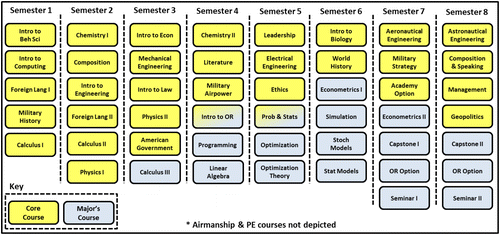
The OR major requires 42 semester hours of coursework beyond the core and physical education courses. The curriculum consists of a variety of math, computer science, economic, and management department-led courses aimed at building competency in the essential tools of OR. Figure 1 depicts the nominal course sequence required to earn the bachelor of science degree in OR.
Compared with undergraduate analytics programs surveyed in a recent benchmarking study (Gorman and Klimberg 2014), USAFA’s OR program is similarly priced, with an annual cost of education at $50,335 per student; however, it is more demanding in terms of total semester hours and semester hours required within the major (United States Air Force Academy 2015). The USAFA curriculum is intentionally demanding. For example, the Air Force requires its officers to be adept at addressing complex and ill-defined problems with agile intellectual skills. Students that demonstrate success in USAFA’s academic program, while managing the demands of cadet wing and athletic department mission elements outside of the classroom, are well prepared for the challenges that they will face as Air Force officers. In Johnson (2017), Lt Gen (ret) Michelle Johnson, former USAFA Superintendent and distinguished graduate of the USAFA OR program, describes this broad developmental approach and the need to prepare graduates to seize creative chances needed to solve complex problems.
Interdisciplinary Operations Research Program
The USAFA OR program includes more than 30 faculty members from the four departments of computer science, economics and geosciences, management, and mathematical sciences. Dedicated faculty members from these four departments constitute the operations research working group (ORWG), which administers the OR program. This group leads operational efforts of the program, such as curriculum administration, assessment, outreach, advising, career fairs, academic-major fairs, seminars, independent-study offerings, special topic offerings, and social activities. The ORWG reports to its four department heads with respect to the program, and the four department heads report to divisional chairs and to the dean of the faculty. The OR major spans three of the four academic divisions at USAFA, excluding only the humanities division, from which students receive substantial exposure through the core curriculum. The ORWG structure is presented in Figure 2.

OR faculty members from the department of computer science bring computational and algorithmic perspective to the program, teaching introductory computer science courses as well as OR courses. They work closely with colleagues from their respective departments and from the Air Force cyber innovation center. That collaboration allows exposure to a new set of OR problems within the cyber domain. OR faculty members from the department of economics and geosciences bring a unique perspective that aims to explain that incentives matter, provides optimization theory for allocating scarce resources, and parses out causal relationships that underpin data analyses. They regularly collaborate with their economist colleagues and teach introductory economics courses in addition to OR courses. OR faculty members from the department of management help to focus students on how OR tools can be used to impact people, organizations, and processes. These faculty members work closely with business and management faculty from their respective departments and teach quantitatively rich management courses in addition to OR courses. Finally, OR faculty members from the department of mathematical science integrate theoretical underpinnings and quantitative rigor of OR methods into the program. As with OR faculty from the other departments, they work closely with math faculty members and teach a wide range of math courses in addition to OR courses.
The interdisciplinary expertise, combined with the teamwork and dedication, of the faculty and administrators creates a synergy impossible to duplicate within a single department. The diverse perspectives of members in the four departments allow the program to meet its unique and critical mission of developing well-rounded OR analysts capable of tackling diverse scenarios. The structure provides our graduates with a better understanding of how concepts from these complementary disciplines can be used to frame and solve complex and ill-defined problems.
A representative example of the value of this interdisciplinary perspective can be seen in a recent study conducted by a team of analysts (one of which is a USAFA faculty member) to address manpower shortfalls in the Air Force’s remotely piloted aircraft enterprise (Martin et al. 2017). Being successful in this study required a broad skill set that drew from concepts taught by each of the four academic departments that constitute the USAFA OR program. First, the team spent months listening to and asking questions of key stakeholders to define and scope both the business problem and the analytic problem to be solved. These concepts are covered in depth in the OR capstone course, which is administered by management faculty who work to incorporate soft skills into the OR program. Next, the team gathered data to understand a complex system and built initial models capturing broad trends, a topic covered in different ways in most USAFA OR courses administered by each of the four departments. The initial modeling effort led to a concrete understanding of necessary improvements in scope, data, and modeling. The team developed a Markov decision-process model and incorporated historic pilot-retention rates to improve analytical fidelity. Understanding both the capabilities and limitations of a wide range of mathematical models and being able to develop new models are the focus of several OR courses (e.g., stochastic models, optimization, advanced statistical models) that the math faculty administers. The team then built and deployed their model using programming and decision support tool development skills that are covered in the Introduction to Programming for Analysts and Quick Turn Analysis (OR option) courses, which are administered by computer science faculty. Finally, the team developed, evaluated, and presented policy alternatives from which senior decision makers could choose to address the original business problem—a focus of OR courses administered by economics faculty, in which students are taught to be wary of unintended consequences and to understand strategic interactions that govern decision making.
This problem is representative of many complex problems throughout the Air Force. Solving such problems requires a broad skill set that, we would argue, cannot be adequately covered within a single discipline. It is instructive to consider whether the team would have been as successful had its members been able to develop a perfect analytical model (if such a thing exists); however, they lacked the skills necessary to quickly deploy a tool to illuminate the impacts of interconnected policy alternatives. So, we think the answer is a resounding no.
Faculty Experience in Solving OR Problems in the Air Force
Many USAFA OR faculty members are graduates of the program, and many are not; however, each brings many years of applied OR experience combined with analytic rigor developed through his (her) graduate programs at other academic institutions. Becoming and continuing to be a member of the USAFA faculty is a competitive endeavor. USAFA does not offer tenure. The only permanent professors are the dean, the vice dean, and academic department heads. Civilian faculty members, who must have strong academic and applied research backgrounds, are hired as government employees. Their appointment as faculty members is renewed on a rolling three-year basis, provided they continue to excel in scholarship, teaching, and service to the institution and their professional communities. Junior military members are recruited from across the Air Force and encouraged to apply for a master’s degree in OR (or a related discipline) through the USAFA’s faculty pipeline program, which provides an opportunity to earn an advanced degree at another academic institution under Academy sponsorship. In some cases, prospective junior military faculty members have already completed a master’s degree; thus, they make the transition to the faculty directly from operational assignments. Senior military faculty members, primarily field-grade officers who have many years of experience applying OR in the Air Force and have previously excelled as junior faculty members at USAFA, are encouraged to apply for a doctoral degree in OR (or a related discipline). Only the best applicants are selected and, following completion of their educational programs, they must serve in an intervening operational assignment before returning to USAFA as a faculty member. This highly selective process enables faculty to gain experience applying OR in the Air Force, provide technical expertise to inform decisions regarding current Air Force challenges, and integrate current OR applications back into the classroom.
With respect to practicing operations researchers, the Academy has the second-largest concentration of OR analyst officers in the Air Force, surpassed only by the Pentagon. Air Force OR analysts typically serve in three-year assignments within operational units around the world. The problems they work on are varied. Examples include analyzing personnel issues, modeling long-term air-mobility requirements, modeling anticipated applications of military force, and advising senior leaders as staff analysts in a headquarters location. The expertise that these analysts bring based on their operational experiences is integrated into the curriculum to provide the Air Force with young officers who are experienced in current operations and challenges within the Air Force. Next, we offer three examples of applications.
In the early 2000s, USAFA’s OR faculty members developed an optimization model to assist the Air Force with assigning USAFA graduates to career fields on the basis of a combination of factors, including Air Force needs and individual preferences (Armacost and Lowe 2005). A decade later, impressed with its speed and flexibility, the Air Force began using the model to assign new-officer accessions from all commissioning sources to career fields. Portions of this model were incorporated in the Introduction to OR and Optimization courses. This example resonates with students because of its relevance to their near-term career aspirations as future Air Force officers. Along the way, they are exposed to large-scale optimization and algebraic modeling, which can be challenging topics for undergraduates who are used to small optimization problems with few decision variables and constraints.
Another important analytic tool in military applications is multiobjective decision analysis (MODA). MODA is often used to assess the extent to which military campaigns are achieving their desired objectives (Clark and Cook 2008) and to advise senior decision makers as to the best allocation of government resources (Ewing et al. 2006). Although details of military campaigns are classified and cannot be presented in a classroom environment, MODA is taught in the Introduction to OR course to expose students to analytic tools that they are likely to encounter as future Air Force officers. Students are taught to decompose goals into attributes and measures that can help to illuminate critical deficiencies in military planning. They are taught the importance of sensitivity analysis, because decision makers are usually more interested in understanding the conditions under which the recommended course of action ceases to be preferred than they are in single-point solutions.
Econometrics heavily emphasizes the assumptions needed to estimate a causal relationship between multiple parts of a system and explores methods to highlight causal effects using appropriate data and techniques when those assumptions are difficult to satisfy. Estimated causal effects can then be used in other OR models to produce more accurate results. For example, a former econometric study estimated the effect of the Army’s selective reenlistment bonus (SRB) on retention rates, using a logit model, to improve upon the Pentagon’s constant response rate assumption (Hogan et al. 2005). The OR program’s Econometrics II course teaches the merits and disadvantages of logit, probit, and linear probability models to estimate effects with a binary dependent variable (i.e., stay or leave). Furthermore, demographic and labor market condition control variables were added, and the data were partitioned by occupational group and time until retirement to reduce bias in the estimated effect of the SRB. Econometrics I students would have questioned the authors’ use of many control variables versus time and entity fixed-effect variables to control for known and unobserved or hard-to-measure differences across years and soldiers, respectively.
The preceding examples have one important feature in common. USAFA OR faculty members, who served as Air Force OR analysts, brought their experiences into the curriculum. They understood both the OR methodology and the impact of its application in the Air Force. This concrete applicability to military decision making makes these examples, and several others not discussed here, compelling for students in the classroom.
Having regular faculty assignments in the Air Force brings benefits that allow the USAFA OR program to thrive; however, this approach also brings challenges that require mitigation strategies. The annual turnover rate of USAFA OR faculty is between 20% and 30%, and many of the new faculty members have no formal teaching experience. To ensure consistent, high-quality teaching, USAFA mandates extensive new-faculty instructor training, requires new faculty members to participate in workshops held by professional organizations (e.g., INFORMS Teaching Effectiveness Colloquium), and has designed the OR program to follow an audit–teach approach. Any faculty member assigned to teach a particular course must first audit the course by attending class sessions taught by an experienced faculty member. This audit–teach approach is not only effective in preparing new faculty members to teach, but it is also an opportunity for the audited faculty member to get feedback from a colleague, which in turn enables continuous improvement of the course and infuses senior military and civilian faculty members with fresh ideas. To guard against unproductive curriculum changes, each academic department uses an end-of-semester curriculum review process whereby lessons learned are gathered from the most recent semester and course changes are proposed and vetted for the next course offering. Overall, although it is certainly possible to incorporate real-world examples into an OR curriculum via other means, we submit that the applied expertise of the faculty is an essential ingredient that allows the USAFA OR program to prepare graduates to be good OR practitioners.
Focused Curriculum Innovation Aligned to Air Force Needs
The USAFA OR program differs from those at other institutions of higher learning not only in its interdisciplinary nature but also because its curriculum has been developed for a specific Air Force career field—the Air Force OR analyst. The other military service academies cannot make the same claim. The Navy does not have a dedicated OR analyst career field, and West Point graduates enter the Army’s analyst career field as a midcareer transition opportunity after having completed multiple operational assignments. Although graduates of other OR, management science, and analytics programs may enter seemingly similar career fields, the purview of work between, for example, two data scientists often differ significantly; those differences only increase when we consider the interplay between different types of data scientists, such as data analysts, data engineers, OR analysts, industrial engineers, process engineers, and business analysts.
USAFA’s program is purposefully designed to be a pipeline for the Air Force OR analyst career field, which graduates can enter immediately upon graduation. This deliberate design drives curriculum innovation and is enabled through continuous two-way communication with the AFAC.
The program strives to be responsive to the needs of the Air Force and also anticipates advances in OR that arm future Air Force OR analysts with new methods and tools. Accordingly, the ORWG has developed new courses, expanded existing courses, and incorporated new material and tools throughout the program over recent years. These changes are evident throughout the curriculum.
Introduction to Operations Research (see Figure 1) can be taken by any student to satisfy a technology and systems option graduation requirement. The course is well regarded by faculty and students because of its rigor and applicability; thus, approximately 50% of all USAFA graduates over recent years have taken this course. Lowe and Armacost (2010) summarize the structure of this course and highlight several hard-won lessons learned. The course has since been fine-tuned; however, much of the material and structure remain unchanged. In this course, the OR majors are exposed to fundamental OR and analytics tools (e.g., optimization, queueing, decision analysis, simulation, and forecasting) for the first time; it may be the only course that exposes non-OR majors to these concepts. This wide exposure of OR concepts to the students is one of the reasons for the success of OR in the Air Force. When future nonanalysts are able to learn the value of OR, analytics, and data-driven decision making before they become leaders, the AFAC gains another future advocate. Furthermore, OR majors are able to learn early about how to work alongside nontechnical decision makers, a skill that will prove invaluable as they progress through their analytic careers.
Other new and operationally relevant methods have been incorporated into the curriculum by integrating new material into existing courses; the Applied Statistical Modeling course (“Stat Models” in Figure 1) illustrates this. In 2014, advanced and modern data analysis methods were integrated into the Probability and Statistics course sequence by taking a blended learning approach to traditional probability and statistics material in the precursor course (“Prob & Stats” in Figure 1). This permitted an acceleration of probability and statistics learning, freeing up syllabus space in the follow-on course and adding advanced topics that are important for applying OR in the modern Air Force.
This change maintains a mathematically sound, traditional Probability and Statistics course, while modernizing the Applied Statistical Modeling course to focus on predictive, computationally intensive classification and regression methods, and places an increased emphasis on practical statistical reasoning. The course strives to be flexible and adaptive and to include novel techniques. Methods that have been taught in recent years include logistic regression, text analysis, classification and regression trees, and neural networks. In addition to the practical skills taught, the course strives to help students become self-educators by using online courses and resources, a necessary skill in an ever-changing field. Students use R and Python in class and are expected to use Python and Apache Spark to complete the final project, which focuses on analyzing big data using machine-learning and parallel-processing techniques. At the time of this writing, the AFAC is considering broad changes to the tools used in the career field; examples include a more deliberate approach to advanced analytics and working with big data. The USAFA OR program is ahead of the curve thanks to this innovative course.
The Deterministic Models course (“Optimization” in Figure 1) has long covered the foundational elements of linear programming. Students learn necessary and sufficient conditions and are introduced to duality. They see it for the first time in the context of sensitivity analysis in the Introduction to OR core course (“Intro to OR” in Figure 1); however, the powerful implications of duality are revealed here. In 2012 the content of the course was expanded to cover algebraic modeling and large-scale applications to better prepare students for some of the challenging problems that they are likely to encounter in graduate school and as Air Force analysts. A positive, unintended consequence of this change is that it has improved the quality of the optimization-focused capstone projects, which we discuss below in the Applied Research and Consulting section). Finally, in 2017 the course incorporated Python as a modeling front end that calls optimization solvers to improve consistency and learning across OR program courses and align with the AFAC’s vision of advanced analytics.
New courses have also been created. An example of this can be seen in the Quick-Turn Analysis course (“OR Option” in Figure 1). This course originally started as an experimental OR elective in 2011. This fast-paced course is designed specifically for students who wish to become Air Force OR analysts. The goal of the course is to produce creative problem solvers who understand the importance of quality analysis done quickly and with limited resources. It combines practical programming experience, recent Air Force analysis problems, data visualization techniques, and communication of analysis to decision makers.
The course is oriented toward the tools that are typically available to all Air Force OR analysts: the Microsoft Office suite with Visual Basic for Applications (VBA) programming and Google Earth with Keyhole Markup Language (KML). Students learn about advanced spreadsheet analysis techniques, programming in VBA, database usage and design, component-based software development that uses VBA to integrate and leverage capabilities of the Microsoft Office suite, and advanced visualization techniques using KML to explore data with Google Earth. These skills are applicable across a wide spectrum of OR analyst activities, but they are especially useful in deployed operations support environments.
Several project problems are pulled directly from ongoing military operations. One recent Air Force problem considered in the course is determining the amount, location, and scheduling of aircraft to support ground forces on the basis of air support engagement time-series data. Another example is the analysis of operational impact over a set of operations on the basis of assessment data from a variety of sources.
Students are expected to produce concise, actionable summaries for each problem and are required to present their findings multiple times in the course. Lessons regarding visual analytics have been added to the course to deliberately focus students on design. Students are exposed to interactive visualization solutions for select problems and are expected to apply visualization principles.
The catalyst for these curriculum innovations has been a close relationship between the ORWG and the AFAC. Guest speakers from throughout the Air Force regularly speak at OR Seminar courses (Figure 1) about current challenges and OR applications in the Air Force. The Air Force chief analyst often visits USAFA to talk to faculty about topics such as potential curriculum innovations, and at least one of the USAFA OR department heads (Figure 2) serves as a member of ORWG, the AFAC steering group, which sets the course for OR and analytics use throughout the Air Force. These activities, in addition to the professional networks of military faculty members who have served as Air Force OR analysts in previous assignments, result in a close, continuing relationship that ensures the USAFA OR program is able to meet the needs of its primary customer.
Applied Research and Consulting
The USAFA OR program’s applied capstone provides the culminating experience that inspires graduates to be creative problem solvers who are able to tackle a wide variety of problems in the Air Force. Armacost and Lowe (2003) describe the USAFA capstone experience in detail. Below we highlight aspects of the course that are germane to this article and describe recent improvements.
Students are challenged to synthesize what they have learned in previous courses and to learn new skills to solve ill-defined applied OR problems. The capstone course started in 1988 as a one-semester course built around case studies; however, it has evolved into a two-semester course sequence (“Capstone I/II” in Figure 1) in which teams of students work on OR analysis projects for clients that are external to USAFA.
The capstone experience begins by guiding students through a month-long mini-project in which students learn to practice an analytic process that has its roots in the seven domains of analytic practice (Nestler et al. 2012) and uses social science research methods (Hanington and Martin 2012) as tools to enhance problem-framing activities. The capstone teaches student writing (Schimel 2011), presenting, and consulting (Block 2011), and soft skills that they will need to be successful in their capstone projects and later in their careers as Air Force OR analysts. Student teams collaborate and give feedback to each other throughout the experience. Students are asked to apply the analytic tools that they have learned in other OR courses and use these newly learned soft skills to address an ill-defined decision problem that is amenable to an analytics solution, just as they will be expected to address in their capstone projects. Given the short period that students are allotted for this mini-project, high-quality analytic results are not expected. Rather, the focus is to exercise an analytic process and to practice technical writing and presenting.
Although students are sometimes frustrated by having to spend significant time on an artificial problem, this exercise is invaluable. Left to their own devices, students would often fall victim to one or more common pitfalls. First, students tend to rush to model without sufficient consideration for stakeholder requirements. Although the design before you build approach is emphasized, most students stumble in this area during the mini-project. This is inconsequential when the problem is artificial; however, it is undesirable when real stakeholders are involved, as is the case with the capstone project. Second, students excel in giving short presentations about their work, but they struggle with technical writing. By the time students reach their capstone course, they have given countless presentations in the three preceding years. In most cases they can communicate the details of their work at a fairly high level; however, they have not thought through all the details to the degree expected of a professional analyst. To address this issue, students must write their reports before giving their presentations. Our experience is that this sequence yields both better written reports and better presentations.
Following the mini-project, teams of students are matched to capstone projects that aim to address a current decision problem for a client organization. The capstone provides a rigorous experience, and students act as operations research consultants, managing the expectations of all stakeholders (clients, faculty, and their teams). Capstone work is done on a pro bono basis, which allows USAFA to offer analytics consulting as a service to the local community and to nonprofit organizations. This is often not how research and consulting projects are offered in other well-regarded OR programs (e.g., Sawhney et al. 2013, Seiford et al. 2013, Atkins et al. 2015). Client organizations understand that student education is the first priority of the USAFA OR capstone. Although delivering high-quality project results is a close second priority, results have been overwhelmingly positive. Students routinely garner awards in competitions at student conferences, the client sponsors rave about the results and seek to sponsor projects the following year, and the academic outcomes are met.
Empowerment drives high-quality project results. The faculty capstone director arranges for a surplus of projects to be proposed by prospective client organizations. Client organizations agree to this arrangement and embrace the challenge of clearly describing their organization and their business problem to the class. During project selection each student rates projects using a MODA model that the student developed to assess his (her) varied interests. Each student’s ratings are entered into an assignment optimization model that maximizes total student preference while ensuring a number of requirements are met (e.g., team size restrictions must be met, all students must be are assigned to a project). The optimal assignment solution typically consists of matches that do not include first choices. Over many years of selecting capstone projects in this manner, including some years that lacked a surplus of projects, we have found that overall student performance on projects seemed to correlate positively with the size of the project surplus. It is well known that workforce empowerment leads to increased productivity (Laschinger et al. 2004, Seibert et al. 2011), and we have seen that students tend to be more motivated when they have a role in selecting their projects.
The capstone director regularly solicits feedback from client organizations. At the end of the fall semester, clients are asked to give feedback on the student team, the faculty advisors, and the progress made on the project up to that point. At the end of the spring semester when the project has been completed, clients are asked for the same type of feedback and invited to attend a formal presentation of the final project at USAFA. This feedback mechanism has served as a catalyst for making improvements to the capstone experience. For example, greater emphasis is currently placed on problem framing in response to feedback from a client who felt the project team would have done better to understand the business problem from the perspectives of other stakeholders.
To expose students to a wide variety of applications, the goal of which is to train them in broad analytic skills that the AFAC needs, capstone projects are selected from a diverse group of proposed projects, and client organizations operate in many different sectors. As examples of the variety of projects students take on in the capstone, consider the following sample of recent capstone efforts. Teams have completed optimization and simulation projects for defense sector client organizations (Guadagno et al. 2015, Colbacchini et al. 2016, Whitaker et al. 2016); student capstone teams have worked with a variety of industry partners on marketing, forecasting, and process analysis projects (Jameson et al. 2015, Furtado et al. 2016, Mackintosh et al. 2017); and teams have worked with nonprofit organizations on scheduling and data analytics projects (Gallinatti et al. 2014, Fairman et al. 2015, Hayes et al. 2018). The capstone experience opens students’ eyes to the broad use of OR in the Air Force, in industry, and in the community.
Summary and Conclusions
The purpose of the UPS George D. Smith Prize is to award “effective and innovative preparation of students to be good practitioners of operations research, management science, or analytics.” Prior recipients of the prize have had their own contributions and approaches, albeit exclusively at the graduate level. The unique contribution of the OR program at USAFA is its undergraduate curriculum infused with application through a close relationship with the organization in which the majority of our graduates will be employed. This type of relationship is not unique to the USAFA OR program. Typical OR programs (i.e., those at nonmilitary colleges or universities) also maintain relationships with industry though advisory board representation, research sponsorships, summer internships, alumni connections, or some combination thereof. These industry connections also exist at USAFA, and the connection between industry and faculty members is equally strong. The design of the USAFA OR program reinforces this connection via four practical components.
The United States Air Force is one of the largest organizations in the world and has an annual budget that rivals the annual revenue of companies like Amazon and Apple. The decision problems that Air Force leaders face are as diverse as they are challenging. The interdisciplinary structure of the USAFA OR program breeds broad analytic skills that Air Force analysts need to solve the wide variety of problems they will encounter in their careers. Although diverse problems are not unique to the Air Force, and interdisciplinarity may not be unique to the USAFA OR program, the breadth of the USAFA OR program is designed to prepare graduates to handle diverse Air Force problems. As a topic in the USAFA OR program, econometrics is on equal footing with typical OR topics (e.g., stochastic modeling) because of the need for Air Force analysts to understand the policy implications of their analyses. Considering a typical OR program that, for example, maintains a connection to the manufacturing industry, we would submit that its curriculum requires coursework areas such as production and operations management.
Students learn from faculty who are experienced in solving real OR problems for the Air Force. Military faculty members gain industry experience through mandatory assignments to other Air Force organizations. They bring these experiences into the classroom and share them with other faculty members. In contrast, sabbatical opportunities afforded to professors at typical OR programs rarely offer the same level of practical relevance, and sabbaticals are typically taken less frequently and for shorter durations. Projecting to what may be possible at a typical OR program, we submit that some type of corporate-endowed faculty position may be created where a faculty member works for an industry partner for a year (or two) on a rotating basis. The company, receiving the benefit of the work of a highly knowledgeable individual, would almost surely be willing to take on some portion of the financial burden of his (her) salary. The college or university would benefit from industry experience that this faculty member brings back to the curriculum.
The close relationship between the USAFA OR program and the Air Force analytical community allows for focused curriculum innovation that ensures that graduates will be good OR practitioners. Again, this is not unique to the USAFA OR program, because many other OR programs adjust their curriculum over time to incorporate new technologies and emerging techniques. The USAFA OR program does this by anticipating Air Force analytic needs, and it also responds to Air Force analytic needs by incorporating tools and techniques tailored to solving Air Force problems. Clearly, the same could be true of another OR program with strong ties to industry partners.
Finally, applied research and consulting opportunities allow students to hone their creative problem-solving skills so that they will be productive Air Force analysts upon graduation. Although most typical OR programs also have applied research opportunities with senior capstone experiences and (or) summer internship programs, the USAFA OR program tailors these opportunities to prepare students for their postgraduation careers.
Being awarded the 2017 UPS George D. Smith Prize would not have been possible without a long and collective effort from current and former faculty, staff, graduates, students, and sponsors of the program, all the way back to the inception of the USAFA OR program in 1966. The authors also thank both UPS for sponsoring the prize and the INFORMS Section on Practice for administering the award. The views expressed in this article are those of the authors and do not necessarily reflect the official policy or position of the Air Force, the Department of Defense, or the U.S. Government. Distribution A: Approved for Public Release, Distribution Unlimited.
References
- (2003) Operations research capstone course: A project-based process of discovery and application. INFORMS Trans. Ed. 3(2):2–13.Google Scholar
- (2005) Decision support for the career field selection process at the US Air Force Academy. Eur. J. Oper. Res. 160(3):839–850.Crossref, Google Scholar
- (2015) Operations excellence through analytics: The Centre for Operations Excellence and the Master of Management in Operations Research Program at the University of British Columbia. Working paper, University of British Columbia, Vancouver.Google Scholar
- (2011) Flawless Consulting: A Guide to Getting Your Expertise Used (Pfeiffer, San Francisco).Google Scholar
- (2008) A practical approach to effects-based operational assessment. Air Space Power J. 22(2):82–99.Google Scholar
- (2016) Simulation of the support fleet maintenance of modern stealth fighter aircraft. Proc. Systems Inform. Engrg. Design Sympos. (Institute of Electrical and Electronics Engineers, Washington, DC), 211–215.Crossref, Google Scholar
- (2006) Use of decision analysis in the army base realignment and closure (BRAC) 2005 military value analysis. Decision Anal. 3(1):33–49.Link, Google Scholar
- (2015) Give! Campaign analysis. Proc. General Donald R. Keith Memorial Capstone Conf. (Curran Associates, Inc., Red Hook, NY).Google Scholar
- (2016) Improving the production process for a medical device manufacturing company using Monte Carlo simulation. Indust. Systems Engrg. Rev. 4(1):45–53.Google Scholar
- (2014) AlloSource production scheduling. Proc. General Donald R. Keith Memorial Capstone Conf., West Point, New York.Google Scholar
- (2014) Benchmarking academic programs in business analytics. Interfaces 44(3):329–341.Link, Google Scholar
- (2015) Optimizing humanitarian relief operations with transloads. Indust. Systems Engrg. Rev. 3(2):98–106.Google Scholar
- (2012) Universal Methods of Design: 100 Ways to Research Complex Problems, Develop Innovative Ideas, and Design Effective Solutions (Rockport Publishers, Beverly, MA).Google Scholar
- (2018) Complementary and integrative health analysis of a non-profit military veteran clinic. Internat. J. Appl. Management Sci. Engrg. 5(1):1–10.Google Scholar
- (2005) A model of reenlistment behavior: Estimates of the effects of Army’s selective reenlistment bonus on retention by occupation. Report, United States Army Research Institute for the Behavioral and Social Sciences, Arlington, VA.Google Scholar
- (2015) Hotel Eleganté room occupancy forecasting. Proc. General Donald R. Keith Memorial Capstone Conf. (Curran Associates, Inc., Red Hook, NY).Google Scholar
- (2017) Creative chances and the burden of freedom. J. Character Leadership Integration (Winter 2016):86–90. Accessed April 6, 2018, https://jcli.scholasticahq.com/article/1213-creative-chances-and-the-burden-of-freedom.Google Scholar
- (2004) A longitudinal analysis of the impact of workplace empowerment on work satisfaction. J. Organ. Behav. 25(4):527–545.Crossref, Google Scholar
- (2010) Innovative education: All for one and ‘O.R. for all.’ OR/MS Today 37(4):38–44.Google Scholar
- (2017) Maximizing clicks in email marketing campaigns for a retail company. Internat. J. Appl. Indust. Engrg. 4(2):33–46.Crossref, Google Scholar
- (2017) Sustaining the drone enterprise: How manpower analysis engendered policy reform in the United States Air Force. Interfaces 47(2):137–149.Link, Google Scholar
- (2012) Certified analytics professional: INFORMS prepares to launch first-of-its-kind program. OR/MS Today 39(5), http://www.informs.org/ORMS-Today/Public-Articles/October-Volume-39-Number-5/Certified-Analytics-Professional.Google Scholar
- (2013) Center for productivity innovation’s student project with industry program at the University of Tennessee, Department of Industrial and Systems Engineering. INFORMS Trans. Ed. 13(2):83–92.Link, Google Scholar
- (2011) Writing Science: How to Write Papers That Get Cited and Proposals That Get Funded (Oxford University Press, New York).Google Scholar
- (2011) Antecedents and consequences of psychological and team empowerment in organizations: A meta-analytic review. J. Appl. Psych. 96(5):981–1003.Crossref, Google Scholar
- (2013) Unique partnership, intensive internships distinguish University of Michigan’s award-winning Tauber Institute for Global Operations. OR/MS Today 40(4), https://www.informs.org/ORMS-Today/Public-Articles/August-Volume-40-Number-4/Innovative-Education-Engineering-business-schools-team-up-to-benefit-students.Google Scholar
United States Air Force Academy (2015) USAFA quick facts. Accessed April 6, 2018, https://www.usafa.af.mil/About-Us/Fact-Sheets/Display/Article/618977/usafa-quick-facts/.Google Scholar- (2016) An optimization approach to balancing risk and cost in combatant command capability advocacy Indust. Systems Engrg. Rev. 4(1):12–21.Google Scholar
Andrew Armacost is Dean of Faculty at the U.S. Air Force Academy, CO. He leads a faculty of 550 in delivering Bachelor of Science degrees to a student body of more than 4,300. His research interests are in large-scale optimization and logistics. He is an Edelman Laureate and recipient of the George B. Dantzig dissertation prize. His teaching has been focused on both OR techniques and the consulting process, and he has been at the forefront of developing survey OR courses designed for all students.
James Lowe is Professor Emeritus at the U.S. Air Force Academy, CO. During his tenure at the Academy, he published work in the areas of curriculum development and the practice of operations research and is honored to have engaged the best and brightest for three decades. He is a retired member of INFORMS and the Military Operations Research Society. He holds a BS in civil engineering from the U.S. Air Force Academy and an MS and PhD in management from Georgia Institute of Technology.
Jesse Pietz is an Air Force OR analyst and associate professor at the U.S. Air Force Academy. He currently serves as Chief of Integrated Warfare Analysis at Headquarters Air Force Studies, Analysis and Assessments in Washington, DC. He has published work in the areas of optimal spacecraft control, optimal search theory, and applied OR. He is a Certified Analytics Professional and holds a BS from the U.S. Air Force Academy, an MA from Rice University, and a PhD from the Naval Postgraduate School.
Kiel Martin currently serves as Assistant Professor at the Air Command and Staff College, AL. He has also served as Assistant Professor of Computer Science at the U.S. Air Force Academy, as a program analyst informing the remotely piloted aircraft enterprise, and has executed operational testing. He has deployed in support of operations in the Middle East. He completed a BS in OR from the U.S. Air Force Academy, an SM in OR at Massachusetts Institute of Technology, and a PhD in OR at the University of Texas.
Joseph Wilck is a professional engineer and has been teaching since 2006. His research is in the area of applied optimization and analytics. He is a member of the Institute of Industrial and Systems Engineers, INFORMS, and the Military Operations Research Society. He is an associate professor at the College of William and Mary, VA, and formerly taught at the U.S. Air Force Academy. He holds a BS and an MS from Virginia Tech and a PhD from Pennsylvania State University.
Drew Ives is currently a modeling and simulation analyst for Headquarters Air Force Studies, Analysis and Assessments in Washington, DC. He was formerly an assistant professor of economics at the U.S. Air Force Academy. His research has focused on evaluating the effects of educational outcomes on flipping a classroom. He is a Distinguished Graduate from the U.S. Air Force Academy's Operations Research Program and holds an MS in industrial and systems engineering from the University of Florida.

