


Text Performance on the Vine Stage? The Effect of Incentive on Product Review Text Quality
Abstract
Incentivized reviews have become increasingly prevalent on product review sites such as Amazon. Whereas outright fake reviews are clearly unacceptable and should be removed from review platforms, reviews by incentivized consumers with otherwise authentic product experiences fall into a gray area. On the one hand, many critics and researchers have warned of their harm by pointing out their biased ratings. On the other hand, these reviews might complement organic reviews with review text of higher quality. The current paper studies whether incentivized reviews on Amazon are more coherent and offer richer detail. We use Amazon’s platform-incentivized reviews, known as Vine reviews, for our primary sample and use seller-incentivized reviews for checking robustness. Estimations from a two-way fixed-effect model consistently show that incentivized reviews do compensate for their reduced impartiality through better text quality, measured by discourse coherence and level of relevant detail. This finding is further supported by a randomized experiment using Amazon Mechanical Turk. Hence, current literature findings on the poor quality of text of incentivized reviews, based on review length and lexical complexity, portray only an incomplete picture of incentivized reviews. Given that numerical ratings for products via incentivized reviews are likely biased whereas their text content is of high quality, a natural way to embrace incentivized reviews is to keep their text content, suppress their numerical ratings, and always highlight the label of “incentivized reviews.”
History: Juan Feng, Senior Editor; Jianqing Chen, Associate Editor.
Funding: This work was supported by Singapore Ministry of Education Tier 1 Research Grant [Grant A-0008174-00-00].
Supplemental Material: The online appendix is available at https://doi.org/10.1287/isre.2022.1146.
1. Introduction
In the preinternet era, consumers would learn about products from advertisements via mass media and from (offline) word-of-mouth comments shared by family and friends. Although an advertisement is by definition incentivized with carefully crafted content, a word-of-mouth message is organic, albeit less well crafted. The arrival of the internet and the ensuing social media revolution overcame the limitation of offline word-of-mouth opinions by digitally connecting all consumers through various online platforms such as Yelp and Amazon. For a while, it was widely believed that consumer reviews, as the digital counterpart of offline consumer word of mouth, were organic and trustworthy. However, as a recent Wall Street Journal article1 warned, more than a third of online reviews on major websites, including those on Amazon.com, Walmart.com, and Sephora.com, are generated by robots or people paid to write them. Whereas outright fake reviews are clearly unacceptable and should undoubtedly be rooted out, reviews by incentivized consumers with otherwise authentic product experiences (henceforth referred to as incentivized reviews) fall into a gray area. These reviews are essentially a hybrid of advertisements and word-of-mouth opinions.
Should we reject these reviews by discouraging their generation and dissemination because of their incentivized nature? Or do they have a role to play in the product review ecosystem, given their significant volume and potential values, especially for products with relatively few reviews? Existing literature has largely sounded the alarm about the biased numerical ratings of products related to these incentivized reviews, which is an important dimension of product reviews. The other dimension, the quality of review text, is certainly no less important but is much less well understood, partly because of the difficulty of measuring review text quality.
Given this industry background and literature status, we aim to address the following research question in the current paper.
Does an incentive provision affect review text quality?
We hypothesize that incentivized reviews are of higher text quality and therefore sit in the middle of the product information spectrum with advertisements and organic reviews at either end. Our basic intuitions are twofold. First, from the social psychological perspective, consumers who receive an incentive for writing a review are more likely to treat the production of the review as a job being “scrutinized” by their “employers” (i.e., the platform or the seller). Such a front-stage performance, using the language of Goffman (1956), naturally results in higher text quality than that of organic reviews, which are more like a backstage performance in the minds of nonincentivized reviewers. Second, from the economic perspective, and assuming the objective of reviewers is influencing or gaining approval from other consumers, incentivized reviewers will naturally exert more effort in writing better quality reviews to compensate for their disadvantage of being perceived as less impartial because of the explicit label of incentivized reviews. These intuitions lead us to believe that with the activation of the “incentivized mode,” reviewers are more likely to improve the text quality of their reviews.
Current literature has documented certain evidence indicating that incentivized reviews tend to be shorter and use less complex words. We depart from the literature by more directly measuring review text quality using coherence and aspect richness, both of which are important quality indicators but have not yet been examined in the product review literature or used in the information systems (IS) field. Coherence is directly related to inference during reading, and aspect richness is important for product reviews. The construction of both measures is based on recent developments in computational linguistics.
Our main empirical setting is Amazon product reviews. We treat Amazon Vine reviews as incentivized reviews and use a two-way fixed-effect model (i.e., product fixed effect and reviewer fixed effect) for identification. Estimation results consistently support our hypothesis, whether we use syntax-based coherence measures or semantic-based coherence measures, and regardless of how we measure aspect richness. Furthermore, we find similar results if we replace platform-incentivized reviews (i.e., Vine reviews) with seller-incentivized reviews. To complement the observational study, which is inevitably vulnerable to some concern regarding endogeneity, we conducted a randomized experiment using Amazon Mechanical Turk (MTurk), the results of which also suggest that incentivized reviews score higher in coherence and aspect richness.
Despite the legitimate concerns that incentivized reviews may be biased in the same way traditional advertisements are, our study suggests that they are also more coherently written and include more detail. Hence, we believe that incentivized reviews complement organic reviews and should have their place on review platforms as long as they are explicitly labeled.
The rest of the paper is organized as follows. In Section 2, we review the burgeoning literature on incentivized reviews. In Section 3, we develop our hypothesis based on two different mechanisms. Section 4 presents detailed descriptions of how we measure coherence and aspect richness. In Section 5, we report estimation results, followed by various robustness checks and heterogeneous analyses. In Section 6, we conduct a randomized experiment using MTurk to further test the hypothesis. We conclude the paper in Section 7 by discussing the contributions and limitations of the current paper.
2. Research Background
There is a broad range of literature that studies the use of financial incentives to increase the quantity and quality of user-generated content in a variety of settings. For example, Hsieh et al. (2010) found that for community-based question answering (CQA) platforms, financial incentives result in more answers but not higher answer quality. In a review community that allows for “friend” connections, Sun et al. (2017) found that introducing monetary rewards can undermine contribution rates from community members who are more socially connected whereas enticing members with no friends to contribute more reviews. On the other hand, reviews contributed by members without friends seem to become shorter and less helpful after the introduction of monetary rewards; such an effect is absent for socially connected members. Kuang et al. (2019) found that when paid-for live service is enabled within a CQA community, users tend to engage in more voluntary answer contributions to match their revenue received in the paid-for live session. On Seeking Alpha, a crowdsourced content service for financial markets, Chen et al. (2019) found that providing monetary incentives can significantly increase users’ content output but hardly change content quality. Through a field experiment, Burtch et al. (2019) found that financial incentives increase the volume but decrease the novelty of content on Reddit.
The current paper is more closely related to the specific but important stream of literature on incentivized product reviews. As many review platforms and sellers use financial incentives such as cash rewards or free samples to elicit reviews from consumers, researchers are interested in and have been investigating how the provision of a financial incentive affects the quality of product reviews. Some theoretical models have been developed to understand the impact of incentives on review contribution. For example, Liu and Feng (2021) found that different market equilibrium outcomes can emerge in review contribution when incentives vary. Duan et al. (2019) designed a two-stage game-theoretical model to analyze how incentive provision affects review contributions and the seller’s profits. Although they consider review quality in their model, it mostly captures review valence. Empirical works that investigate the impact of incentives on review contribution can be roughly classified into two streams, with one focusing on the direct impact of incentives on those incentivized review contributions and the other focusing on the indirect impact of incentives on subsequent nonincentivized review contributions. We provide a summary of these works in Table 1. Our study is more related to the first stream (i.e., uncovering the impact of incentives on the quality of incentivized reviews).
|

Table 1. Literature Review
| Review features | ||||||||
|---|---|---|---|---|---|---|---|---|
| Study | Volume | Rating | Length | Helpful votes | Feedback speed | Lexical complexity | Video game features | Self-reported objectivity |
| Direct impacts on incentivized reviews | ||||||||
| Burtch et al. (2018) | + | − | ||||||
| Cabral and Li (2015) | ○ | + | ○ | |||||
| Khern-am nuai et al. (2018) | + | − | − | − | − | |||
| Lin et al. (2019) | + | |||||||
| Stephen et al. (2012) | ○ | ○ | + | ○ | ||||
| Wang et al. (2012) | ○ | |||||||
| Wang et al. (2016) | + | ○ | ○ | |||||
| Wang and Sanders (2019) | + | − | + | |||||
| Indirect impacts on nonincentivized reviews | ||||||||
| Qiao et al. (2020) | − | + | − | ○ | − | |||
| Yu et al. (2022) | + | ○ | + | + | ||||
Notes. The table mainly summarizes the impacts of incentives on review contribution whereas not including findings about the combinative use of incentives and other interventions. A plus sign (+) indicates significantly positive impacts, a minus sign (−) indicates significantly negative impacts, and an empty circle (○) indicates no significant impacts. A blank cell means no analyses were carried out on the corresponding variable in the particular paper.
Although an objective quality measure is difficult to obtain, researchers in previous studies have generally focused on two aspects of review quality: numerical rating and review text. On numerical rating, the research attention is on whether incentive provision results in an upward bias. Current literature has largely validated this concern. For example, through a series of field experiments, Cabral and Li (2015) showed that providing buyers with rebates could solicit more positive feedback, which benefits the seller at the expense of general consumers. Using a data set from Taobao.com, Lin et al. (2019) found an upward rating trend in products that use free samples to solicit reviews, further suggesting a numerical product rating bias of incentivized reviews. Similarly, but measuring positivity as the difference between the percentage of positive emotion words and the percentage of negative emotion words in a review text, Woolley and Sharif (2021) found through controlled experiments that incentive leads to review texts with more positive words relative to negative words.
Unlike the quality evaluation of numerical ratings, assessing the quality of review text has proven to be much harder. Because our study is more related to the research listed in the top panel of Table 1, we will focus on this stream of literature. Using review length and text readability as quality measures, Khern-am nuai et al. (2018) found that, for a given product, the introduction of financial incentives significantly reduces review quality in the sense of a shorter review and more readable text (i.e., requiring fewer years of education). However, such a decline in text quality is largely driven by the changing composition of reviewers as a result of the financial incentive policy. Although existing reviewers seem to write product reviews of the same quality, new reviewers who join the review platform because of the financial incentive policy produce reviews of significantly lower quality compared with those from existing reviewers. These findings are alarming but not surprising, given how the financial incentive is structured: the incentive is proportional to the number of contributed reviews, each of which must meet the 50-character minimal length requirement. An important takeaway from this study is that the design of incentive is crucial if a platform wishes to incentivize review contribution in a meaningful way.
Burtch et al. (2018) examined the effect of financial incentives, social norms, and the combination of these two on review volume and review length. Through two randomized experiments, they found that financial incentives do not stimulate longer reviews but that social norms do. Furthermore, through an observational study, they found that on Amazon, consumers tend to write shorter reviews as a result of a financial incentive provided by third-party sellers. An important distinction between Burtch et al. (2018) and Khern-am nuai et al. (2018) is that whereas the treatment is at the product level in Khern-am nuai et al. (2018), it is at the reviewer level in Burtch et al. (2018). Together, these two pioneering papers raise the alarm on the effect of providing financial incentives on review text quality. The current paper continues this investigation but differs from the literature in two important ways. First, we propose theoretical mechanisms to understand why reviewers might exert more effort in writing reviews in response to a financial incentive, leading to better review text quality. Although this implication seems to be at odds with current literature findings, such an effect is not entirely counterintuitive. Indeed, if we consider incentivized reviews as a type of commercialized content, then the literature on ad-supported content suggests that content quality may increase as a result of financial incentives. For example, in a very different context, Sun and Zhu (2013) found that bloggers who participated in an ad-revenue-sharing program wrote blogs of a better quality relative to those who did not participate. Second, we evaluate text quality with measures based on linguistic theory and derived from machine learning algorithms, which allow us to go beyond word count and further enrich our understanding of reviewers’ behavioral change in response to a financial incentive.
3. Hypothesis Development
By writing a review, a consumer becomes associated with the platform, the seller, and other consumers. Both the platform and sellers can provide incentives to consumers to write reviews. For ease of illustration, we refer to both as incentive providers, or simply providers, in this paper. To understand how such an incentive might affect the effort a consumer puts into writing a review, we propose two mechanisms, one based on the reviewer’s consideration of the incentive provider and the other based on the reviewer’s consideration of other consumers. For any individual reviewers, the effect of an incentive provision on effort may be driven by either or both mechanisms. We analyze these two mechanisms separately in this section.
3.1. Provider-Oriented Mechanism
The intuition for the effect of an incentive provision on review effort is quite simple: when a consumer writes an incentivized review knowing that the review will likely be scrutinized by the incentive provider, the consumer will put more effort into crafting the message because the review is essentially a “text performance” at the stage front. Such a phenomenon has been well studied in what is known as dramaturgical theory in sociology.
According to this theory, people engage in “front-stage performance” when their behaviors are observed by some form of audience (Goffman 1956). This is a theatrical metaphor that sociologists propose to interpret and model social interactions that share the basic elements of the dramaturgy: (1) the setting, which defines the context or situation where a performance takes place, (2) the front, which refers to the expressive equipment like appearances and manners that actors can manage to help achieve the performance goal, and (3) the performance, which is the final dramaturgical realization delivered to the audience. In social interactions, all participants define a situation where individuals intentionally or unwittingly adjust their expressions in an attempt to foster a favorable impression, in much the same way as actors performing their roles in front of the audience.
Business researchers have conducted dramaturgical analyses in service marketing (Swartz and Iacobucci 2000). Production and consumption are simultaneous in service exchange, which characterizes a high degree of interactions between service providers and consumers. This interactive nature defines service delivery as a stagelike context, where impression management is the very essential goal of dramaturgical performance (Grove and Fisk 1992). Service providers, such as restaurant waiters and airline attendants, must carefully manage their “front” (e.g., proper demeanor and attitudes) to create a positive, solid image and ensure consumer satisfaction. Evaluating service exchange using this dramaturgical perspective can help guide service provision (Grove and Fisk 1983, Solomon et al. 1985). For example, management consultants analyze their activities via the dramaturgical view to help coach candidates so that they can better serve clients (Clark and Salaman 1998). The essence of dramaturgical theory can be summarized as impression management. In the presence of audiences, individuals perform similar to actors (e.g., adjusting their appearances and manners) to control the impression they can make on others.
Writing a review in exchange for an incentive is essentially a service exchange and hence may naturally trigger the front-stage behavior of the review writer. However, the performance is delivered completely through text and rating. Therefore, impression management is achieved through upward-biased ratings and higher-quality writing.
3.2. Consumer-Oriented Mechanism
Reviews are public goods that benefit all consumers. Many consumers write their reviews with the objective of helping other consumers make informed buying decisions. Hence, we analyze how such a consideration in motivating review contribution is moderated by the provision of incentive. To do so, we propose a stylized model and assume the reviewer’s objective is to maximize the approval rate of his or her review by other consumers. For example, the reviewer might hope to win many helpful votes from other consumers.
We start by modeling the value of a review, which depends both on the impartiality of the review and on the quality of the review. An impartial review makes it easy for consumers to evaluate the quality of the associated product, and hence such a review is considered more helpful. On the other hand, the quality of a review, such as its coherence and aspect richness, is also an important dimension to the value of a review. Therefore, we model the value of a review using the Cobb–Douglas production function:
A consumer considers a review helpful only if the value of the review exceeds a certain threshold h. Clearly, different consumers have different thresholds. We model h as a random variable drawn from some distribution. Because power law distributions have been widely used in physical, biological, and social sciences to model the heterogeneity of magnitudes, we assume a Pareto distribution for h, with scale parameter hm and shape parameter α. The percentage of consumers who would find the review helpful is thus , which is the cumulative distribution function of the Pareto distribution
Suppose the cost for writing a review of quality w is C(w), which is an increasing and convex function. The reviewer’s decision problem is choosing the best w so as to maximize the objective function . In our context, we treat the impartiality r as exogenous rather than a decision variable. Related to our empirical setting, we can think of r as a dichotomous variable whose value is larger for an organic review than for an incentivized review.
From the first-order condition, we have . With the Cobb–Douglas production function (i.e., Equation (1)), we have
With the Pareto distribution (i.e., Equation (2)), we obtain
Hence, the optimal writing quality as a function of impartiality r is determined by
Finally, taking the derivative of (3) with respect to r, we have
Because , and C is increasing and convex, we immediately see that ; hence we have the following proposition.
The optimal text quality is a decreasing function of the review impartiality r.
To summarize, whether the consideration is oriented toward the incentive provider or other consumers, the effect of an incentive provision on the text quality of a review is positive. Therefore, we propose the following hypothesis for empirical testing.
Receiving a financial incentive causes a reviewer to write higher-quality review text.
There are two challenges to the empirical test of the preceding hypothesis. First, how do we measure the text quality of a product review? Second, how do we identify the effect of an incentive provision in the absence of an ideal experiment where researchers can randomly assign an incentive provision among reviewers? We devote the next section to addressing the first challenge before discussing and executing our empirical strategy in Section 5.
4. Measurements
Wang and Strong (1996) proposed a conceptual framework to assess data quality on multiple dimensions. We propose two quality measures for review texts that are consistent with this conceptual framework in terms of understandability/interpretability and completeness. The concept of discourse coherence in linguistics intends to capture the extent to which inference load is needed when we read a discourse (Grosz et al. 1995). Higher coherence means better understandability/interpretability; hence it is a good proxy for text data quality assessment. This is especially true for review texts because the evaluative nature (Carenini et al. 2013) of a review makes the smoothness of logical inference particularly relevant. Another important dimension in the assessment framework of Wang and Strong (1996) is completeness—the extent to which data are of sufficient breadth, depth, and scope for a task. The measure of aspect richness is consistent with this notion; hence it is a good proxy for completeness. Indeed, we tend to associate high-quality reviews as those presenting complete and detailed comments on a product reflecting multiple aspects of the product.
We elaborate in this section on the details of measure construction for discourse coherence and aspect richness.
4.1. Discourse Coherence
As evaluative texts, it is important for a review to demonstrate logical coherence to be convincing and persuasive. In linguistics, discourse coherence refers to “the quality of being logically integrated, consistent, and intelligible” (Perrault and Allen 1978) and indicates how well information is connected in verbal or written discourses (Foltz et al. 1998). Coherence is a foremost quality proxy for textual discourses (Witte and Faigley 1981). A coherent discourse can reduce the inference load during the comprehension (Grosz et al. 1995). Many educational institutes evaluate student essays at least partially based on coherence (Higgins et al. 2004).
The most influential framework for theorizing discourse coherence is the centering theory (Grosz et al. 1995), the basic premise of which is that the smooth shift of attentional states across utterance determines the degree of coherence of a discourse. The attentional state models the focus of attention for users in discourse construction and interpretation. This centering principle is a cornerstone for our understanding of the mechanism of discourse coherence, guiding many studies after its establishment (Poesio et al. 2004).
Researchers have developed different methods to measure discourse coherence, which can be roughly categorized into the syntactic approach and the semantic approach. With the syntactic approach, coherence is modeled as how entities are introduced and discussed in discourses (Karamanis et al. 2004, Elsner and Charniak 2011). Consistent with the centering principle, these entities indicate the attentional centers, whereas choices of referring expressions could help sustain the connectedness. Earlier attempts to implement this approach relied on predefined knowledge and manually annotated corpus (Reiter and Dale 2000), which suffer from the scalability issue. Barzilay and Lapata (2008) proposed an automatic approach called the entity-grid method. This method derives an entity-grid representation for each discourse, where columns correspond to entities with different saliences, and rows correspond to sentence sequences within the investigated discourse. Across-utterance center transitions under the centering theory are therefore projected to entity transfer at the sentence level. Such an entity-grid representation enables automatic learning of the distributed patterns of entity transition and hence can be easily used to measure coherence.
The semantic approach can be traced back to Halliday and Hasan (1976), who argued that the relatedness of lexical meaning across textual units is the fundamental property of discourse coherence. To model such semantic relatedness, Foltz et al. (1998) developed an LSA-based method to automatically vectorize the meaning of each sentence and measure the relatedness of adjacent sentences by the cosine similarity of their vector representations. More specifically, for a discourse consisting of n sentences, its semantic coherence is measured as the average similarity of each neighboring sentence pair, as formulated in the following:
For the current study, we use both the syntactic approach and the semantic approach to measure coherence. For the syntactic approach, we use the entity-grid method. The entity-grid method relies on the model likelihood value to measure the coherence of each review text. Although it is difficult to interpret the magnitude of the syntactic coherence, such a coherence value enables us to rank reviews similar to the ordinal principle for measuring individual utilities in economics. The ordinal approach also well suits the platform’s needs (i.e., ranking reviews based on text quality to reduce inference load). Figure 1 shows two examples of reviews with different syntactic coherence scores. For the semantic approach, we replace the LSA semantics with word2vec, which is more up to date and has been widely used in many disciplines. A sentence is represented as the average embedding of the words in the sentence, which is then used to compute the semantic coherence based on Equation (4).

4.2. Aspect Richness
Product reviews are a unique type of discourse because they are expected to convey information on multiple product attributes. Reviewers express opinions on these product attributes, which constitute the basis for other consumers to evaluate a product. In text analytics, product attributes are referred to as aspects. Whether a review covers many aspects of a product is an important indicator of the review text quality.
The main challenge of measuring aspect richness is the extraction of aspect terms. The literature has proposed three general approaches for this task: rule-based, supervised, and unsupervised. The rule-based approach identifies aspect terms using a combination of frequent nouns and noun phrases, dependency parsing, and opinion lexicon. This approach works well only when the aspect terms are restricted to a small set of nouns. The supervised approach relies on manual annotation and suffers from the domain adaptation issue. Because our data consist of a large number of reviews on a variety of different product types, an unsupervised approach is more promising. Most algorithms for unsupervised aspect extraction are based on variants and extensions of latent Dirichlet allocation (LDA). However, conventional LDA models encode word co-occurrence information only at the document level and are less efficient at identifying aspect terms. He et al. (2017) proposed the attention-based aspect extraction (ABAE) model to overcome the limitation of LDA-based aspect extraction algorithms. The objective of the ABAE model is to learn a set of aspect embeddings, where each aspect can be interpreted by examining its nearest words (representative words) in the embedding space. More specifically, the ABAE model operates at the sentence level by first constructing a sentence embedding vector , where is the word embedding vector for the ith word in the sentence, and the weight ai is computed by an attention model. Second, the sentence embedding vector is reconstructed using aspect embedding , where T is the aspect embedding matrix representing the embedding vector for each aspect, and pt is the weight vector representing the probability that the input sentence belongs to the related aspect. The neural network is trained to minimize the reconstruction error. By combining attention mechanisms and neural networks, He et al. (2017) demonstrated the superior performance of an ABAE model compared with other aspect extraction methods. Following the success of the ABAE model, researchers have found many applications for tasks such as recommendation justification (Ni et al. 2019), review summarization (Angelidis and Lapata 2018), and fine-grained sentiment analysis (Wang et al. 2018).
We use the ABAE model to derive a measure for aspect richness. Specifically, we derive two variables from the output of the ABAE model. The first one counts the number of aspect terms each review contains. For each aspect, the ABAE model generates a set of aspect terms that are close to the aspect embedding in the embedding space. These terms can be interpreted as the linguistic embodiments of the abstract concept of an aspect. The more aspect terms a review contains, the more detailed that aspect is covered by the review. Our second variable is based on the number of aspects a review touches on where we use a threshold to determine whether an aspect is sufficiently covered in the review.2 In the online appendix, we provide examples of aspect terms in the category we call “Electronics.” For ease of understanding, we name each aspect through manual inspection of the corresponding aspect terms. The example is based on 10 aspects with 50 terms in each aspect.
4.3. Measure Validation
Although both measures have been validated in the literature in other contexts, we further check the validity of the proposed metrics in our specific context. To do so, we randomly selected 1,000 pairs of reviews, each of a similar length and within the same category. For each pair of reviews, we recruited three annotators to answer the following questions: “Which review is more coherent?” and “Which review is more detailed?” After aggregating such annotations for each pair of reviews, we compare the coherence annotation with our own computation using the kappa statistic, which is a popular method to measure interrater reliability (McHugh 2012). The kappa statistic is 0.87 for coherence and is 0.85 for detailedness. Because a value over 0.8 indicates a strong agreement between raters (human annotation and our computation), we believe the proposed metrics capture coherence and aspect richness well for review texts.
5. Observational Study
We use product reviews on Amazon for the observational study. The full data set includes all reviews available on Amazon from the inception of this platform until August 2015. We focus on Vine reviews3 because these constitute the most important type of incentivized review on Amazon, and their clear labeling by Amazon also ensures that our analyses are less susceptible to measurement errors. In one of our robustness checks, we also used text mining to construct an alternative sample by detecting third-party incentivized reviews to further test the main findings of our study.
To participate in Amazon’s Vine program, sellers first register their products in the program. Amazon then distributes free samples of these products to consumers who will post reviews after receiving and assessing the products. Direct contact between sellers and reviewers is prohibited to minimize the possibility of collusion. Figure 2 shows an example of a Vine review. Because consumers write Vine reviews in exchange for products given to them for free, these Vine reviews are clearly incentivized reviews.

For an ideal experiment for our empirical question, we needed to randomly assign some consumers to the treatment group, who write product reviews in exchange for some financial incentive, and other consumers to the control group, who would then write organic reviews without a financial incentive. Such a field experiment is difficult to conduct in practice. Hence, we resorted to a two-way fixed-effect model for identification. We essentially exploited the fact that many reviewers write multiple reviews and many products receive multiple reviews. Therefore, including both reviewer fixed effects and product fixed effects in a panel data model can alleviate endogeneity concerns as a result of unobserved reviewer characteristics or unobserved product characteristics. Because of this identification strategy, only reviews whose authors have written at least one organic review and one Vine review can contribute to the coefficient estimation for our main variable. Similarly, only reviews for which the associated products have received at least one organic review and one Vine review will contribute to the estimation. After applying these criteria to the full data set, we obtained our main sample. Table 2 reports summary statistics for the data at the review level, reviewer level, and product level. Table 3 reports summary statistics for Vine reviews in particular. Table 4 reports the correlations between the proposed metrics and other review-relevant variables.
|
Table 2. Descriptive Statistics
| Measure | Count | Mean | Min | Max | Std. dev. |
|---|---|---|---|---|---|
| Measures at review level | |||||
| Syntactic Coherence | 4,234,594 | −0.0141 | −113.6842 | 0.6500 | 1.0100 |
| Semantic Coherence | 4,234,594 | 0.5097 | −0.0737 | 1.0000 | 0.1107 |
| Review Length | 4,234,594 | 197.7548 | 1.0000 | 8,717.0000 | 246.6459 |
| Detailedness I (With 10 Aspects) | 4,234,594 | 2.4706 | 0.0000 | 7.3018 | 0.9879 |
| Detailedness II (With 10 Aspects) | 4,234,594 | 1.8263 | 0.6931 | 2.3026 | 0.2127 |
| Detailedness I (With 20 Aspects) | 4,234,594 | 2.8461 | 0.0000 | 7.6158 | 0.9470 |
| Detailedness II (With 20 Aspects) | 4,234,594 | 2.4542 | 1.3863 | 2.8332 | 0.1795 |
| Measures at product level | |||||
| Syntactic Coherence | 899,987 | −0.2734 | −61.9884 | 0.6500 | 1.1347 |
| Semantic Coherence | 899,987 | 0.5276 | 0.0139 | 0.9800 | 0.0837 |
| Review Length | 899,987 | 261.5039 | 4.0000 | 7,973.0000 | 257.4327 |
| Detailedness I (With 10 Aspects) | 899,987 | 2.7780 | 0.0000 | 7.3018 | 0.8406 |
| Detailedness II (With 10 Aspects) | 899,987 | 1.8710 | 0.6931 | 2.3026 | 0.1896 |
| Detailedness I (With 20 Aspects) | 899,987 | 3.1580 | 0.0000 | 7.6158 | 0.7930 |
| Detailedness II (With 20 Aspects) | 899,987 | 2.5028 | 1.3863 | 2.8332 | 0.1694 |
| Review Number | 899,987 | 4.7052 | 1.0000 | 8,263.0000 | 41.2990 |
| Vine Review Number | 899,987 | 0.7228 | 0.0000 | 272.0000 | 4.1513 |
| Measures at reviewer level | |||||
| Syntactic Coherence | 1,451,311 | 0.3783 | −58.9852 | 0.6500 | 0.4656 |
| Semantic Coherence | 1,451,311 | 0.4752 | −0.0650 | 1.0000 | 0.1240 |
| Review Length | 1,451,311 | 90.8946 | 1.0000 | 7,283.0000 | 124.6621 |
| Detailedness I (With 10 Aspects) | 1,451,311 | 1.9085 | 0.0000 | 6.5381 | 0.8308 |
| Detailedness II (With 10 Aspects) | 1,451,311 | 1.7492 | 0.6931 | 2.3026 | 0.1961 |
| Detailedness I (With 20 Aspects) | 1,451,311 | 2.2910 | 0.0000 | 6.8865 | 0.8054 |
| Detailedness II (With 20 Aspects) | 1,451,311 | 2.3869 | 1.3863 | 2.8332 | 0.1628 |
| Review Number | 1,451,311 | 2.9178 | 1.0000 | 30,721.0000 | 47.6980 |
| Vine Review Number | 1,451,311 | 0.4482 | 0.0000 | 3,957.0000 | 10.6816 |
|
Table 3. Descriptive Statistics of Vine Reviews
| Statistics of Vine reviews | Count | ||||||
|---|---|---|---|---|---|---|---|
| Number of Vine Reviews | 650,488 | ||||||
| Number of Reviewers with Vine Reviews | 9,256 | ||||||
| Number of Products with Vine Reviews | 33,087 | ||||||
| Vine Proportion (%) | 15.36 | ||||||
| Vine Proportion in Search Goods (%) | 14.68 | ||||||
| Vine Proportion in Experience Goods (%) | 15.74 | ||||||
| Statistics of Vine proportiona | Count | Mean | Min | Max | Std. dev. | ||
| Vine Proportion Per Reviewer | 8,077 | 0.3199 | 0.0007 | 0.9859 | 0.2303 | ||
| Vine Proportion Per Reviewer-Category | 55,290 | 0.4648 | 0.0003 | 0.9968 | 0.2511 | ||
| Vine Proportion Per Product | 28,313 | 0.4991 | 0.0024 | 0.9714 | 0.2778 | ||
| Statistics of sentiment/ratingb | Positive | Negative | 1 | 2 | 3 | 4 | 5 |
| Vine Reviews (%) | 89.54 | 10.4 | 1.78 | 5.39 | 16.16 | 36.38 | 40.28 |
| Non-Vine Reviews (%) | 85.94 | 14.06 | 3.24 | 4.60 | 11.20 | 27.93 | 53.02 |
aThe Vine proportion is calculated as the percentage of Vine reviews versus all reviews in the corresponding classification. For example, Vine Proportion per Reviewer is the average of Vine proportions over all reviewers who have written both Vine and non-Vine reviews. The calculations are similar for other classifications in this panel.
b“Sentiment” is calculated based on reviews’ textual content using the Python package VADER, which is a popular method for sentiment measurement. The computation of sentiments and ratings is based on reviews from reviewers who have written both Vine and organic reviews.
|
Table 4. Correlations Between Variables
| Syntactic Coherence | Semantic Coherence | Detailedness I | Detailedness II | Review Length | Helpfulness | Star Rating | |
|---|---|---|---|---|---|---|---|
| Syntactic Coherence | 1 | ||||||
| Semantic Coherence | −0.0693 | 1 | |||||
| Detailedness I | −0.6746 | 0.2169 | 1 | ||||
| Detailedness II | −0.1647 | 0.0232 | 0.2829 | 1 | |||
| Review Length | −0.7539 | 0.2542 | 0.8745 | 0.2397 | 1 | ||
| Helpfulness | −0.1078 | 0.0312 | 0.1482 | 0.0417 | 0.1685 | 1 | |
| Star Rating | −0.0439 | 0.0047 | 0.0526 | 0.0389 | 0.0459 | 0.1741 | 1 |
Note. The measurement of helpfulness might not be very accurate, because reviews are known to have the scarcity problem of receiving votes.
5.1. Main Results
The two-way fixed effect model can be formulated as
The dependent variable Yij denotes review text quality, measured by either coherence or aspect richness. Our main variable of interest is the binary variable Incentiveij, indicating whether a review is a Vine review. The product fixed effect is captured by θi, and the reviewer fixed effect is captured by . The vector of control variables Xij includes review length, year fixed effects, and regional market fixed effects. Review length is an important control variable for the measurement of coherence and aspect richness, and it has been used in the literature as an alternative indicator of review text quality. We are interested in the estimate of β, which captures the effect of the incentive provision on coherence or aspect richness. We clustered standard errors both by product and by reviewer, so we allowed for error correlation both across reviews of the same product and across reviews by the same reviewer.
Table 5 reports the estimation results. Column (1) reports the estimation results when the dependent variable is syntactic coherence, and column (2) reports the estimation results when the dependent variable is semantic coherence. For both coherence measures, we found significant and positive coefficients of Incentive, suggesting that incentive provision leads to higher coherence levels of the review text.
|
Table 5. Main Analysis: Incentive Effect on Writing Quality
| Variable | ||||||
|---|---|---|---|---|---|---|
| (1) | (2) | (3) | (4) | (5) | (6) | |
| Syntactic Coherence | Semantic Coherence | Detailedness I (With 10 Aspects) | Detailedness II (With 10 Aspects) | Detailedness I (With 20 Aspects) | Detailedness II (With 20 Aspects) | |
| Incentive | 0.0147*** | 0.0111*** | 0.0768*** | 0.0055*** | 0.0910*** | 0.0056*** |
| (0.0021) | (0.0005) | (0.0044) | (0.0008) | (0.0045) | (0.0008) | |
| Observations | 2,260,808 | 2,260,808 | 2,260,808 | 2,260,808 | 2,260,808 | 2,260,808 |
| Adjusted R2 | 0.9571 | 0.3188 | 0.7919 | 0.5956 | 0.7985 | 0.7233 |
| User FE | YES | YES | YES | YES | YES | YES |
| Product FE | YES | YES | YES | YES | YES | YES |
| Review length | YES | YES | YES | YES | YES | YES |
| Time FE | YES | YES | YES | YES | YES | YES |
| Regional market FE | YES | YES | YES | YES | YES | YES |
Notes. For each aspect, we selected top 100 words in the embedding vector to measure Detailedness. We also vary the number of words used in the embeddings to 50, 70, and 90, which give us consistent results. Robust standard errors are in parentheses. FE, fixed effect.
***p < 0.01.
Columns (3)–(6) report estimation results when the dependent variable is aspect richness. Whether we used 10 or 20 aspects or whether we measured aspect richness by the number of aspect terms or the number of covered aspects, the results consistently indicated that reviewers respond to incentive by providing a more detailed product description in the review text. For example, the estimated coefficient of Incentive in column (3) suggests an increase of in terms of the number of words about product attributes as a result of incentive provision.
In summary, we find strong support for our hypothesis based on estimation results from the two-way fixed-effect model using Amazon’s Vine review data.
5.2. Robustness Check: Time-Varying Factors
The main threat to the two-way fixed-effect identification strategy is the potential correlation between incentive provision and some time-varying confounding factors. For example, if reviewers are inclined to write more-coherent reviews over time and also are more likely to write Vine reviews over time, then the estimated coefficient of Incentive would be upward biased for the coherence regression. On the other hand, if a product is more likely to receive Vine reviews during a certain period of time, and consumers are less likely to write detailed reviews during such a period, then the estimated coefficient of Incentive would be downward biased in the regression for aspect richness.
To alleviate these concerns, we introduce two additional control variables, and , in the regressions. The variable is calculated as the total number of reviews that reviewer j has previously written before posting a review of product i. The variable is calculated as the total number of reviews product i has received before it is reviewed by reviewer j.
Table 6 reports the estimation results after we include these two control variables. The positive and statistically significant estimates for the coefficient of Incentive suggest that our main findings are robust.
|
Table 6. Robustness Check: Accounting for User/Product Experience
| Variable | ||||||
|---|---|---|---|---|---|---|
| (1) | (2) | (3) | (4) | (5) | (6) | |
| Syntactic Coherence | Semantic Coherence | Detailedness I (With 10 Aspects) | Detailedness II (With 10 Aspects) | Detailedness I (With 20 Aspects) | Detailedness II (With 20 Aspects) | |
| Incentive | 0.0140*** | 0.0111*** | 0.0765*** | 0.0055*** | 0.0913*** | 0.0059*** |
| (0.0020) | (0.0005) | (0.0044) | (0.0008) | (0.0044) | (0.0007) | |
| Observations | 2,260,808 | 2,260,808 | 2,260,808 | 2,260,808 | 2,260,808 | 2,260,808 |
| Adjusted R2 | 0.9571 | 0.3189 | 0.7920 | 0.5956 | 0.7986 | 0.7234 |
| User FE | YES | YES | YES | YES | YES | YES |
| Product FE | YES | YES | YES | YES | YES | YES |
| Review length | YES | YES | YES | YES | YES | YES |
| Time FE | YES | YES | YES | YES | YES | YES |
| Regional market FE | YES | YES | YES | YES | YES | YES |
| User experience | YES | YES | YES | YES | YES | YES |
| Product experience | YES | YES | YES | YES | YES | YES |
Notes. Robust standard errors are in parentheses. FE, fixed effect.
***p < 0.01.
5.3. Robustness Check: Propensity Score Matching
Matching is often used to reduce model sensitivity of regression analysis resulting from extrapolation over data ranges that do not include both groups. By balancing the distributions of observed covariates across the treated and control groups, matching may also potentially improve the balance of unobserved covariates. Because we have included both reviewer and product fixed effects in our analysis, matching can potentially alleviate concerns for unobserved time-varying confounding factors that differ across Vine reviewers and non-Vine reviewers. So the goal of matching in our study is to ensure that Vine reviewers and non-Vine reviewers are comparable.
Propensity score matching (PSM) is a popular technique that matches treated units (i.e., Vine reviewers in our study) to control units (i.e., non-Vine reviewers) based on the estimated propensity score—that is, the probability of becoming a Vine reviewer. To improve covariate balance at the reviewer level using PSM, we use the average characteristics of a Vine reviewer’s reviews before their first Vine review to do the matching. Because the treatment and control groups should share a common support in terms of the propensity score, we discarded observations that lie outside of the common support region based on the minima and maxima comparison (Caliendo and Kopeinig 2008). We set the caliper value to 0.2 and adopted nearest-neighbor matching with replacement to find one comparable control unit for each treated unit. Of the 7,938 Vine reviewers, we are able to match 6,761 successfully. We report in Table 7 the balance test results before and after the matching. As we can see, there is a significant improvement in covariate balance between Vine reviewers and non-Vine reviewers after the matching. Using the matched sample, we reran the two-way fixed effect model. The estimations are reported in Table 8. Again, we qualitatively obtained the same findings that offering an incentive leads to a significant improvement of review textual quality, measured by coherence and aspect richness.
|
Table 7. Propensity Score Matching: Balance Test Between Treated (Vine Reviewers) and Control (Non-Vine Reviewers) Groups
| Prematching | Postmatching | |||||
|---|---|---|---|---|---|---|
| Mean control | Mean treated | Standardized difference | Mean control | Mean treated | Standardized difference | |
| Average Log Helpful Votes | 0.4516 | 1.6260 | 1.8240 | 1.5298 | 1.5421 | 0.0198 |
| Average Rating | 4.0069 | 4.1622 | 0.2913 | 4.1625 | 4.1742 | 0.0214 |
| Average Syntactic Coherence | 0.3866 | −0.1745 | −0.7069 | −0.1037 | −0.1214 | 0.0258 |
| Average Semantic Coherence | 0.4709 | 0.5365 | 0.9610 | 0.5315 | 0.5320 | 0.0083 |
| Average Log Length | 3.9805 | 5.0752 | 1.6672 | 5.0485 | 5.0467 | 0.0029 |
| Average Detailedness I (With 10 Aspects) | 1.8647 | 2.7375 | 1.4181 | 2.7362 | 2.7179 | 0.0298 |
| Average Detailedness II (With 10 Aspects) | 1.7046 | 1.8724 | 1.4008 | 1.8682 | 1.8720 | 0.0301 |
| Average Detailedness I (With 20 Aspects) | 2.2441 | 3.0523 | 1.3368 | 3.0522 | 3.0342 | 0.0302 |
| Average Detailedness II (With 20 Aspects) | 2.3147 | 2.4829 | 1.3707 | 2.4761 | 2.4799 | 0.0291 |
|
Table 8. Robustness Check: Using Propensity Score Matching
| Variable | ||||||
|---|---|---|---|---|---|---|
| (1) | (2) | (3) | (4) | (5) | (6) | |
| Syntactic Coherence | Semantic Coherence | Detailedness I (With 10 Aspects) | Detailedness II (With 10 Aspects) | Detailedness I (With 20 Aspects) | Detailedness II (With 20 Aspects) | |
| Incentive | 0.0158*** | 0.0088*** | 0.0689*** | 0.0068*** | 0.0770*** | 0.0057*** |
| (0.0024) | (0.0006) | (0.0049) | (0.0010) | (0.0048) | (0.0010) | |
| Observations | 1,122,082 | 1,122,082 | 1,122,082 | 1,122,082 | 1,122,082 | 1,122,082 |
| Adjusted R2 | 0.9624 | 0.2323 | 0.7816 | 0.6174 | 0.7847 | 0.7404 |
| User FE | YES | YES | YES | YES | YES | YES |
| Product FE | YES | YES | YES | YES | YES | YES |
| Review length | YES | YES | YES | YES | YES | YES |
| Time FE | YES | YES | YES | YES | YES | YES |
| Regional market FE | YES | YES | YES | YES | YES | YES |
Notes. Robust standard errors are in parentheses. FE, fixed effect.
***p < 0.01.
5.4. Robustness Check: Entropy Balance Matching
Whereas PSM is a classical and popular matching technique, several new matching methods have been proposed in recent years, among which the entropy balancing (EB) technique (Hainmueller 2012) is particularly effective in terms of achieving covariate balance. The EB technique relies on a maximum entropy reweighing scheme to produce a more balanced sample. As another robustness check and to reduce the reliance on PSM, we reestimated the two-way fixed-effect model using the weighed sample generated by EB. The set of matching covariates is the same as that used in PSM. Table 9 reports the balance test results where we find an even more significant improvement of covariate balance. Table 10 reports the estimation results. Again, the results remain qualitatively the same.
|
Table 9. Entropy Balance Matching: Balance Test Between Treated (Vine Reviewers) and Control (Non-Vine Reviewers) Groups
| Prematching | Postmatching | |||||
|---|---|---|---|---|---|---|
| Mean control | Mean treated | Standardized difference | Mean control | Mean treated | Standardized difference | |
| Average Log Helpful Votes | 0.4516 | 1.6260 | 1.8240 | 1.6260 | 1.6260 | 0.0000 |
| Average Rating | 4.0069 | 4.1622 | 0.2913 | 4.1622 | 4.1622 | −0.0001 |
| Average Syntactic Coherence | 0.3866 | −0.1745 | −0.7069 | −0.1752 | −0.1745 | 0.0009 |
| Average Semantic Coherence | 0.4709 | 0.5365 | 0.9610 | 0.5364 | 0.5365 | 0.0003 |
| Average Log Length | 3.9805 | 5.0752 | 1.6672 | 5.0750 | 5.0752 | 0.0002 |
| Average Detailedness I (With 10 Aspects) | 1.8647 | 2.7375 | 1.4181 | 2.7375 | 2.7375 | 0.0001 |
| Average Detailedness II (With 10 Aspects) | 1.7046 | 1.8724 | 1.4008 | 1.8724 | 1.8724 | 0.0003 |
| Average Detailedness I (With 20 Aspects) | 2.2441 | 3.0523 | 1.3368 | 3.0522 | 3.0523 | 0.0001 |
| Average Detailedness II (With 20 Aspects) | 2.3147 | 2.4829 | 1.3707 | 2.4829 | 2.4829 | 0.0002 |
|
Table 10. Robustness Check: Using Entropy Balance Matching
| Variable | ||||||
|---|---|---|---|---|---|---|
| (1) | (2) | (3) | (4) | (5) | (6) | |
| Syntactic Coherence | Semantic Coherence | Detailedness I (With 10 Aspects) | Detailedness II (With 10 Aspects) | Detailedness I (With 20 Aspects) | Detailedness II (With 20 Aspects) | |
| Incentive | 0.0142*** | 0.0086*** | 0.0717*** | 0.0071*** | 0.0803*** | 0.0061*** |
| (0.0022) | (0.0005) | (0.0044) | (0.0009) | (0.0044) | (0.0008) | |
| Observations | 2,255,791 | 2,255,791 | 2,255,791 | 2,255,791 | 2,255,791 | 2,255,791 |
| Adjusted R2 | 0.9558 | 0.1859 | 0.7582 | 0.5813 | 0.7616 | 0.7168 |
| User FE | YES | YES | YES | YES | YES | YES |
| Product FE | YES | YES | YES | YES | YES | YES |
| Review length | YES | YES | YES | YES | YES | YES |
| Time FE | YES | YES | YES | YES | YES | YES |
| Regional market FE | YES | YES | YES | YES | YES | YES |
Notes. Robust standard errors are in parentheses. FE, fixed effect.
***p < 0.01.
5.5. Robustness Check: Verified Purchase Subsample
Although Vine reviews are straightforward to identify thanks to the label provided by Amazon, there is no label for organic reviews. In our main analysis, we treat all non-Vine reviews as organic reviews. Such a labeling method is not perfect because some non-Vine reviews might have resulted from incentives provided by sellers. However, the “contamination” of organic reviews by incentivized reviews may only result in an underestimation of the causal effect we are trying to estimate. Nevertheless, we explore this issue by restricting our sample to reviews from verified purchases,4 along with those Vine reviews. This sample restriction reduces the sample size by almost half, but it can provide insight into the full measure of the effect of an incentive provision on review text quality.
Table 11 reports the estimation results. Again, we find qualitatively the same results. More interestingly, we find that all coefficient estimates are much larger in magnitude than those reported in Table 5, which confirms our intuition and suggests that our estimation based on the full sample in the main analysis is likely conservative.
|
Table 11. Robustness Check: Using the Verified Purchase Subsample
| Variable | ||||||
|---|---|---|---|---|---|---|
| (1) | (2) | (3) | (4) | (5) | (6) | |
| Syntactic Coherence | Semantic Coherence | Detailedness I (With 10 Aspects) | Detailedness II (With 10 Aspects) | Detailedness I (With 20 Aspects) | Detailedness II (With 20 Aspects) | |
| Incentive | 0.0252*** | 0.0132*** | 0.1427*** | 0.0100*** | 0.1659*** | 0.0122*** |
| (0.0028) | (0.0007) | (0.0060) | (0.0013) | (0.0059) | (0.0012) | |
| Observations | 1,323,335 | 1,323,335 | 1,323,335 | 1,323,335 | 1,323,335 | 1,323,335 |
| Adjusted R2 | 0.9534 | 0.3381 | 0.7803 | 0.5413 | 0.7964 | 0.6809 |
| User FE | YES | YES | YES | YES | YES | YES |
| Product FE | YES | YES | YES | YES | YES | YES |
| Review length | YES | YES | YES | YES | YES | YES |
| Time FE | YES | YES | YES | YES | YES | YES |
| Regional market FE | YES | YES | YES | YES | YES | YES |
Notes. Robust standard errors are in parentheses. FE, fixed effect.
***p < 0.01.
5.6. Robustness Check: Third-Party Incentive
As we previously discussed, there are two types of incentivized reviews: those incentivized by the platform and those incentivized by sellers. Thus far, we have used platform-incentivized reviews (i.e., Amazon Vine reviews) to test our hypothesis. Before October 2016, Amazon also allowed seller-incentivized reviews as long as a reviewer discloses in the review text his or her relationship with the seller. Figure 3 shows an example of such a review where the reviewer received a free sample in exchange for the writing of a review. In this robustness check, we replace Vine reviews with seller-incentivized reviews to check the robustness of our main finding with this different structure of incentive provision.

The key challenge of this test was to identify reviews incentivized by sellers. Unlike Vine reviews, which are clearly labeled by Amazon, we had to label seller-incentivized reviews by analyzing the review text. To do so, we first randomly selected 10,000 non-Vine reviews. We then hired 15 annotators to manually extract self-disclosures indicating seller-provided incentives. From these disclosures, we designed regular expressions that could be used to automatically detect similar disclosures. Testing based on another set of randomly selected 10,000 non-Vine reviews suggests that the accuracy of this classifier is above 90%.
After removing all Vine reviews from the main sample, we labeled each remaining review as incentivized if our classifier detected any disclosure of incentive provision by the seller. Table 12 reports the two-way fixed effect estimation results based on this alternative sample. Consistent with our main analyses, we again find qualitatively the same results, thereby further supporting our hypothesis.
|
Table 12. Robustness Check: Using the Seller-Incentivized Subsample
| Variable | ||||||
|---|---|---|---|---|---|---|
| (1) | (2) | (3) | (4) | (5) | (6) | |
| Syntactic Coherence | Semantic Coherence | Detailedness I (With 10 Aspects) | Detailedness II (With 10 Aspects) | Detailedness I (With 20 Aspects) | Detailedness II (With 20 Aspects) | |
| Incentive | 0.0338*** | 0.0041*** | 0.1067*** | 0.0034*** | 0.0995*** | 0.0016*** |
| (0.0027) | (0.0004) | (0.0031) | (0.0006) | (0.0030) | (0.0005) | |
| Observations | 1,613,865 | 1,613,865 | 1,613,865 | 1,613,865 | 1,613,865 | 1,613,865 |
| Adjusted R2 | 0.9560 | 0.3279 | 0.7973 | 0.5974 | 0.8010 | 0.7194 |
| User FE | YES | YES | YES | YES | YES | YES |
| Product FE | YES | YES | YES | YES | YES | YES |
| Review length | YES | YES | YES | YES | YES | YES |
| Time FE | YES | YES | YES | YES | YES | YES |
| Regional market FE | YES | YES | YES | YES | YES | YES |
Notes. Robust standard errors are in parentheses. FE, fixed effect.
***p < 0.01.
5.7. Heterogeneity Analysis: Review Extremity
Extreme reviews are strongly opinionated. Expectations from the platform, the seller, or other consumers are naturally higher for extreme reviews, in terms of both coherence and aspect richness. Indeed, to make a strong case for or against a product, an incentivized review writer needs to deliver a particularly coherent argument that covers many details. On the other hand, extreme reviews are associated with intense emotion, which may induce less coherent arguments. On the basis of these intuitions, we conjecture that extreme reviews are less coherent in general, but such an effect is attenuated for incentivized reviews. To test this, we first defined a review as being extreme if the numerical rating was either 1 or 5 (Mudambi and Schuff 2010). We then included the corresponding binary variable Extreme and its interaction with Incentive in the regression.
Table 13 reports the estimation results. Consistent with our intuitions, the negative coefficients of Extreme in columns (1) and (2) suggest that non-Vine reviews that are extreme are less coherent. However, the positive and statistically significant coefficients for the interaction term suggest that incentive provision does make an extreme review less incoherent compared with an otherwise similar but not incentivized review. Interestingly, we find that although extreme organic reviews appear to contain fewer details than nonextreme organic reviews, such a relationship seems to be reversed for incentivized reviews.
|
Table 13. Heterogeneous Analyses Over Rating Extremity
| Variable | ||||||
|---|---|---|---|---|---|---|
| (1) | (2) | (3) | (4) | (5) | (6) | |
| Syntactic Coherence | Semantic Coherence | Detailedness I (With 10 Aspects) | Detailedness II (With 10 Aspects) | Detailedness I (With 20 Aspects) | Detailedness II (With 20 Aspects) | |
| Incentive | 0.0118*** | 0.0077*** | 0.0621*** | 0.0034*** | 0.0755*** | 0.0050*** |
| (0.0023) | (0.0005) | (0.0045) | (0.0009) | (0.0045) | (0.0008) | |
| Extreme | −0.0199*** | −0.0160*** | −0.0095*** | −0.0025*** | −0.0258*** | 0.0013*** |
| (0.0008) | (0.0003) | (0.0014) | (0.0003) | (0.0013) | (0.0002) | |
| Extreme × Incentive | 0.0023** | 0.0045*** | 0.0339*** | 0.0045*** | 0.0318*** | 0.0018*** |
| (0.0010) | (0.0004) | (0.0022) | (0.0005) | (0.0021) | (0.0004) | |
| Observations | 2,260,808 | 2,260,808 | 2,260,808 | 2,260,808 | 2,260,808 | 2,260,808 |
| Adjusted R2 | 0.9572 | 0.3228 | 0.7920 | 0.5957 | 0.7986 | 0.7234 |
| User FE | YES | YES | YES | YES | YES | YES |
| Product FE | YES | YES | YES | YES | YES | YES |
| Review length | YES | YES | YES | YES | YES | YES |
| Time FE | YES | YES | YES | YES | YES | YES |
| Regional market FE | YES | YES | YES | YES | YES | YES |
Notes. Robust standard errors are in parentheses. FE, fixed effect.
***p < 0.01; **p < 0.05.
5.8. Heterogeneity Analysis: Search vs. Experience Goods
Search goods have more objective attributes compared with experience goods. It is interesting to explore whether such a difference moderates the effect of an incentive provision. Following the previous literature (Mudambi and Schuff 2010), we categorized products into search goods (e.g., office products, electronics) and experience goods (e.g., video DVD, video games, and beauty). We included the binary variable Search and its interaction with Incentive into the regression.
Table 14 reports the estimation results. Although we do not find any significance in the coefficients of the variable Search, we do find significantly positive coefficients of the interaction term. It seems that the effect of the incentive provision is particularly stronger for search goods. One interpretation is that there are more objective attributes of search goods for incentivized reviewers to write about, which provides more room for them to perform and to demonstrate the value of their otherwise less impartial reviews.
|
Table 14. Heterogeneous Analyses Over Search vs. Experience Goods
| Variable | ||||||
|---|---|---|---|---|---|---|
| (1) | (2) | (3) | (4) | (5) | (6) | |
| Syntactic Coherence | Semantic Coherence | Detailedness I (With 10 Aspects) | Detailedness II (With 10 Aspects) | Detailedness I (With 20 Aspects) | Detailedness II (With 20 Aspects) | |
| Incentive | 0.0234*** | 0.0114*** | 0.0750*** | −0.0230*** | 0.0782*** | −0.0093*** |
| (0.0057) | (0.0019) | (0.0124) | (0.0037) | (0.0114) | (0.0028) | |
| Search | 0.0186 | −0.0192 | 0.1791 | 0.1242*** | 0.0059 | 0.0729** |
| (0.0236) | (0.0147) | (0.1253) | (0.0338) | (0.1056) | (0.0297) | |
| Search × Incentive | 0.0081* | 0.0065*** | 0.0541*** | 0.0193*** | 0.0198* | 0.0154*** |
| (0.0047) | (0.0018) | (0.0108) | (0.0035) | (0.0101) | (0.0025) | |
| Observations | 213,461 | 213,461 | 213,461 | 213,461 | 213,461 | 213,461 |
| Adjusted R2 | 0.9526 | 0.3344 | 0.7445 | 0.2776 | 0.7733 | 0.4079 |
| User FE | YES | YES | YES | YES | YES | YES |
| Product FE | YES | YES | YES | YES | YES | YES |
| Review length | YES | YES | YES | YES | YES | YES |
| Time FE | YES | YES | YES | YES | YES | YES |
| Regional market FE | YES | YES | YES | YES | YES | YES |
Notes. Robust standard errors are in parentheses. FE, fixed effect.
***p < 0.01; **p < 0.05; *p < 0.1.
5.9. Additional Analysis: Review Length
Although content word count has been used in the literature as a proxy for review text quality (Khern-am nuai et al. 2018), it is clearly a crude one and likely has a low signal-to-noise ratio. Nevertheless, because of its simplicity and convenience, it is currently widely used and could serve as a good benchmark for comparison with the literature. Hence, we reestimate our econometric model with review word count as the dependent variable. Table 15 reports the results. As we can see, the results are not consistent across different samples. For the main sample, we find negative and significant coefficients for Incentive, suggesting that Vine reviewers write shorter reviews than non-Vine reviewers. However, if we only use reviews from verified purchases, the estimated coefficient becomes significantly positive, with more than twice the magnitude. Similarly, we find a significantly positive coefficient for Incentive if we use third-party incentivized reviews. These inconsistent results suggest that a simple word count may be too noisy a measure for review text quality.
|
Table 15. Incentive Effect on Review Length Quality
| Variable | (1) | (2) | (3) | (4) |
|---|---|---|---|---|
| Main analysis | Analysis with product/user experience | Analysis with verified purchase subsample | Analysis with seller-incentivized subsample | |
| Incentive | −0.0475*** | −0.0511*** | 0.1180*** | 0.3425*** |
| (0.0074) | (0.0074) | (0.0093) | (0.0047) | |
| Observations | 2,260,808 | 2,260,808 | 1,323,335 | 1,613,865 |
| Adjusted R2 | 0.6556 | 0.6562 | 0.6541 | 0.6981 |
| User FE | YES | YES | YES | YES |
| Product FE | YES | YES | YES | YES |
| Review length | YES | YES | YES | YES |
| Time FE | YES | YES | YES | YES |
| Regional market FE | YES | YES | YES | YES |
| User experience | YES | |||
| Product experience | YES |
Notes. The dependent variable across all columns in this table is the log transformation of review length. Robust standard errors are in parentheses. FE, fixed effect.
***p < 0.01.
6. Experimental Study
The strength of causal inference in our observational study is only as good as the underlying identification assumption. Although we believe the two-way fixed-effect estimation and various robustness checks alleviate many endogeneity concerns, time-varying unobserved confounding factors may still threaten the internal validity. Inspired by many recent experimental studies using MTurk, we conducted randomized experiments using MTurk to further test our hypothesis. MTurk is a marketplace where requesters publish human intelligence tasks (HITs) and workers collect a reward for completing a task. The easy access to a large subject pool on MTurk has attracted researchers across various disciplines to conduct experiments on this platform. For our study purpose, we published a series of HITs on MTurk, where each participant was paid $0.3 upon the completion of one HIT. To complete the task, a participant was asked to first watch a video snippet in which a YouTuber describes the use experience of a product and then answer some questions. After completing the above-mentioned required task, each participant was invited to write a review about the product. The review writing part was disclosed to the participants as a voluntary contribution. All participants, upon accepting the HIT, were randomly assigned into either the treatment group or the control group. For the treatment group, referred to as the “With Payment” group, we paid the participants $0.5 for writing a review. For the control group, referred to as the “No Payment” group, there was no incentive for writing a review. Participants were unaware of the two groups, and treated participants were only informed about the incentive when they were invited to write a review.
To make sure that the participants were aware of the incentive administered to the review writing process, we asked the participants to write down the money they would receive at the end of the experiment. For a participant in the treated group, the correct amount should have been $0.8, whereas for a participant in the control group, the correct amount should have been $0.3. Submissions with wrong answers were considered to have failed the manipulation check and were excluded from further analyses. The step-by-step experiment procedure is reported in Figure 4. Note that the comparison between the treated and control group is only for the review writing section, which is separate from the HIT task itself (i.e., watching the video and answering questions to receive the payment of $0.3). To highlight the distinction, we emphasized the voluntary nature of review writing in the control group and reminded participants in the treated group that the bonus $0.5 was specifically provided for review contribution.
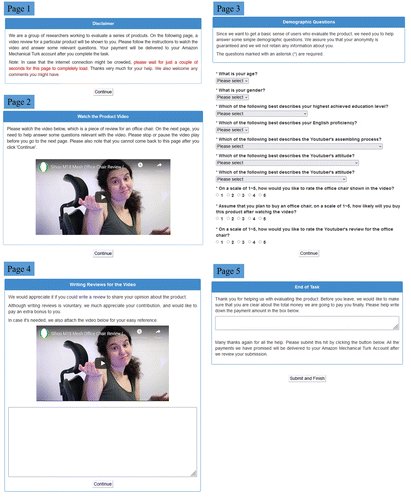
To increase external validity, we conducted randomized experiments using two different products.5 For each product, we recruited 2,000 participants, with 1,000 users randomly assigned to the With Payment group and the remaining users assigned to the No Payment group. We obtained, in total, 2,326 completed responses. The average answer time for participants to complete an HIT was 12 minutes. Table 16 reports the descriptive statistics for continuous variables, and Table 17 reports the number of observations at each level of those categorical variables. In Table 18, we conducted a randomization check on these two groups of responses. No significant differences were found between With Payment and No Payment groups across all variables. We hence conclude that subjects are comparable between these two groups and are appropriate for the subsequent statistical analysis.
|
Table 16. Descriptive Statistics for Continuous Variables
| Variable | Obs. | Mean | Min | Max | Std. dev. |
|---|---|---|---|---|---|
| Experiment I | |||||
| Age | 1,246 | 35.8138 | 10 | 83 | 12.0504 |
| Syntactic Coherence | 1,246 | −1.29E-09 | −4.5602 | 1.8007 | 1 |
| Semantic Coherence | 1,246 | 0.5425 | 0.1429 | 0.9001 | 0.1164 |
| Detailedness I | 1,246 | 2.3938 | 0 | 3.5553 | 0.4846 |
| Detailedness II | 1,246 | 1.1004 | 1.0986 | 1.6094 | 0.0261 |
| Review Length | 1,246 | 51.1613 | 9 | 172 | 25.0188 |
| Experiment II | |||||
| Age | 1,080 | 33.7037 | 18 | 73 | 10.0873 |
| Syntactic Coherence | 1,080 | −3.71E-10 | −4.269 | 1.6405 | 1 |
| Semantic Coherence | 1,080 | 0.5347 | 0.1742 | 0.8622 | 0.1064 |
| Detailedness I | 1,080 | 2.4105 | 0 | 3.7842 | 0.5297 |
| Detailedness II | 1,080 | 1.1003 | 1.0986 | 1.7918 | 0.0289 |
| Review Length | 1,080 | 55.6750 | 9 | 187 | 28.4163 |
|
Table 17. Descriptive Statistics for Categorical Variables
| Education | English Proficiency | Gender | |||
|---|---|---|---|---|---|
| Experiment I | |||||
| Associate’s degree | 166 | Acceptable | 10 | Female | 773 |
| Bachelor’s degree | 435 | Good | 39 | Male | 462 |
| Graduate degree | 172 | Native | 1,083 | Other | 11 |
| High school | 139 | Proficient | 114 | ||
| Less than high school | 8 | ||||
| Some college | 326 | ||||
| Experiment II | |||||
| Associate’s degree | 149 | Acceptable | 14 | Female | 666 |
| Bachelor’s degree | 356 | Good | 43 | Male | 396 |
| Graduate degree | 126 | Native | 923 | Other | 18 |
| High school | 138 | Proficient | 100 | ||
| Less than high school | 6 | ||||
| Some college | 305 | ||||
|
Table 18. Randomization Check
| Experiment I | Experiment II | ||||
|---|---|---|---|---|---|
| Variable | χ2 | P-value | Variable | χ2 | P-value |
| Age | 0.05 | 0.823 | Age | 2.0690 | 0.1503 |
| Gender | 2.7003 | 0.259 | Gender | 6.9547 | 0.031 |
| Education | 6.3128 | 0.277 | Education | 12.5961 | 0.027 |
| English Proficiency | 2.0501 | 0.727 | English Proficiency | 0.3278 | 0.988 |
Table 19 reports the estimation results using the experimental data. We adopted the methods introduced in Section 4.1 to measure both the syntactic coherence and the semantic coherence of these reviews. As the coefficients of Incentive in columns (1) and (2) indicate, incentivized reviews are more coherent when compared with nonincentivized reviews. We also calculated the aspect richness of these reviews using the attention-based algorithm described in Section 4.2. Coefficients of Incentive in columns (3) and (4) indicate that incentivized reviews are more detailed compared with nonincentivized reviews, although the level of statistical significance is at the 10% level, which might be due to the relatively smaller sample size of the experimental study compared with the observational study.
|
Table 19. Regression Results Using Experimental Data
| Variable | (1) | (2) | (3) | (4) |
|---|---|---|---|---|
| Syntactic Coherence | Semantic Coherence | Detailedness I | Detailedness II | |
| Experiment I | ||||
| Incentive | 0.0440** | 0.0281*** | 0.0462** | 0.0027* |
| (0.0174) | (0.0062) | (0.0196) | (0.0015) | |
| Observations | 1,246 | 1,246 | 1,246 | 1,246 |
| Adjusted R2 | 0.8030 | 0.1521 | 0.5150 | 0.0106 |
| Experiment II | ||||
| Incentive | 0.0317* | 0.0362*** | 0.0473** | 0.0032* |
| (0.0182) | (0.0062) | (0.0209) | (0.0018) | |
| Observations | 1,080 | 1,080 | 1,080 | 1,080 |
| Adjusted R2 | 0.8272 | 0.1018 | 0.5823 | 0.0068 |
| Control for Age | YES | YES | YES | YES |
| Control for Gender | YES | YES | YES | YES |
| Control for Education | YES | YES | YES | YES |
| Control for English Proficiency | YES | YES | YES | YES |
| Control for Review Length | YES | YES | YES | YES |
Notes. The calculations of detailedness are based on 10 aspects. Standard errors are in parentheses.
***p < 0.01; **p < 0.05; *p < 0.1.
Overall, the results from the randomized experiment support the findings from the observational study. The context based on YouTube videos also complements the context of hands-on product experience, which supports the external validity of our findings.
One caveat of the experimental study is the potential entanglement of the HIT task and the review writing task. Because we have to pay subjects to watch the video regardless of their treatment status, some participants may perceive the two causal states as low incentive ($0.3) and high incentive ($0.8), rather than $0 and $0.5, which are more analogous to the incentive structure of our observational study. It is possible that the causal effect of financial incentive has a jump at $0 or is concave so that the effect of raising the incentive from $0 to $0.5 is greater than the effect of raising the incentive from $0.3 to $0.8. In such a case, our estimate from the experimental study is an underestimation of the corresponding causal effect defined for the observational study. So our qualitative findings should remain the same.
7. Conclusions and Limitations
Despite criticisms of incentivized reviews being biased, this study shows that these reviews are not without merit because they are of higher text quality, at least in terms of coherence and aspect richness. The discoveries of this study provide valuable managerial implications in several aspects. First, our study offers a fresh perspective on understanding the relation between incentivized reviews and its two “extreme” counterparts (i.e., organic reviews and advertisements). Advertisements are well crafted but biased because they are specifically designed to influence consumers in favor of the advertisers, whereas organic reviews are mostly unbiased but are often in the form of crude and incomplete review text. Incentivized reviews are less biased than advertisements. Meanwhile, our empirical evidence suggests they are of higher textual quality than organic reviews, thereby resembling the well-crafted nature of traditional advertisements. The balance of unbiasedness and text quality suggests that as long as the incentive is properly disclosed, incentivized reviews can play a constructive role as advertising evolves in the age of social media.
Second, our study provides helpful guidelines in managing the review system. Instead of throwing incentivized reviews out of the consumer review ecosystem because of their rating bias, we recommend retaining them but with a watchful eye. Although more studies are clearly needed to understand their impact on consumer and reviewer behaviors, we believe review platforms can consider at least two remedies: (1) All incentivized reviews must be clearly and explicitly labeled so that other consumers will not confuse them with organic reviews; Amazon pioneered this with its Vine review program, but other review platforms may need to be more proactive on this front. (2) Given that numerical ratings of incentivized reviews are likely biased with no easy approach to correcting them, we recommend either not incorporating numerical ratings from incentivized reviews into the overall product rating or simply blocking or not even soliciting numerical ratings at all from incentivized reviewers. Indeed, if the value of an incentivized review mostly comes from its review text instead of the numerical rating, it is only natural to retain the review text whereas discarding the numerical rating. We suggest that the future commercial system organize reviews with three components: numerical rating based solely on organic reviews, textual content from organic reviews, and textual content from incentivized reviews. To summarize our recommendation, we envision the interface of future review platforms as resembling the design shown in Figure 5.
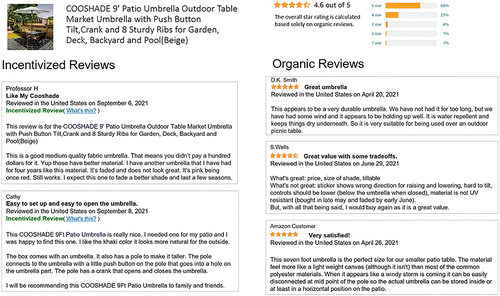
Third, given the value of the review text, incentivized reviews can alleviate the cold-start problem for new products in the e-commerce era, thereby facilitating market competition. Launching a new product on an e-commerce platform is particularly challenging because of the lack of product reviews. Even if the new product is of high quality and has an attractive low price, consumers may still be hesitant to make a purchase because quality is indirectly revealed by consumer reviews, which are lacking for any new product. As a result, existing products equipped with large numbers of reviews may pose a significant barrier for the entry of new products, which consequently hinders market competition. Allowing clearly labeled incentivized reviews can help break down this barrier by jump-starting a new product. Once the new product accumulates a sufficient number of organic reviews to reveal its quality, the market force will take over, and consumers will benefit from healthy competition among sellers.
In addition to the above-mentioned managerial implications, this paper also contributes to the academic literature on incentivized reviews. First, whereas previous literature has compared incentivized reviews and organic reviews in terms of text length and lexical complexity, to our knowledge, this is the first paper to examine deeper and more direct text quality measures including coherence and aspect richness. Given that these techniques from computational linguistics have not previously been employed in the IS field, their introduction in the current paper seems particularly valuable. Second, whereas previous literature has been inconclusive on whether incentive provision induces higher or lower text quality, our findings consistently show that the effect of an incentive provision on text quality is positive, at least when quality is measured by coherence and aspect richness. Finally, our theoretical analyses for the hypothesis development also shed new light on the mechanisms behind the effect of an incentive provision on review text quality.
There are clearly exciting future research opportunities given the findings and limitations of the current paper. First, although the two text quality measures introduced in this paper are particularly well suited for the review text quality, future research should go beyond these measures, especially given the rapid advancement of computational linguistics and artificial intelligence technologies. Second, the observational study in the current paper is based only on incentivized reviews on Amazon, which is arguably the most important product review platform. Future research can examine incentivized reviews on other review platforms to further evaluate the generalizability of our findings. Third, both extrinsic and intrinsic motivations play important roles in review writing. How financial incentives affect intrinsic motivation is a particularly interesting and important direction for future research. Last, when more granular data such as product sales and costs become available, effort can be extended to understanding how incentivized reviews affect seller profits.
The authors express gratitude to the senior editor, the associate editor, and three anonymous reviewers for their helpful comments and suggestions.
1 See https://www.wsj.com/articles/black-friday-shoppers-beware-of-fake-five-star-reviews-11574937001.
2 The ABAE model maps each review to a distribution over all aspects. When a review’s probability on one particular aspect is larger than the median value of all probability values, we consider the aspect covered by the review.
4 According to Amazon, an “Amazon Verified Purchase” review means Amazon has verified that the person writing the review purchased the product on Amazon and did not receive the product at a deep discount. See https://www.amazon.com/gp/help/customer/display.html?nodeId=202076110.
5 The links for the two products are https://www.youtube.com/embed/cjI7ctWXkT0 and https://www.youtube.com/embed/dhBRdj2t3-s, respectively.
References
- (2018) Summarizing opinions: Aspect extraction meets sentiment prediction and they are both weakly supervised. Preprint, submitted August 27, https://doi.org/10.48550/arXiv.1808.08858.Google Scholar
- (2008) Modeling local coherence: An entity-based approach. Comput. Linguistics 34(1):1–34.Crossref, Google Scholar
- (2019) Peer awards increase user content generation but reduce content novelty. Proc. 40th Internat. Conf. Inform. Systems, Munich, Germany.Google Scholar
- (2018) Stimulating online reviews by combining financial incentives and social norms. Management Sci. 64(5):2065–2082.Link, Google Scholar
- (2015) A dollar for your thoughts: Feedback-conditional rebates on eBay. Management Sci. 61(9):2052–2063.Link, Google Scholar
- (2008) Some practical guidance for the implementation of propensity score matching. J. Econom. Surveys 22(1):31–72.Crossref, Google Scholar
- (2013) Multi-document summarization of evaluative text. Comput. Intelligence 29(4):545–576.Crossref, Google Scholar
- (2019) Monetary incentive and stock opinions on social media. J. Management Inform. Systems 36(2):391–417.Crossref, Google Scholar
- (1998) Creating the “right” impression: Toward a dramaturgy of management consultancy. Service Indust. J. 18(1):18–38.Crossref, Google Scholar
- (2019) The impact of monetary rewards for online reviews. Asia Pacific J. Marketing Logist. 31(5):1486–1515.Crossref, Google Scholar
- (2011) Extending the entity grid with entity-specific features. Proc. 49th Annual Meeting Assoc. Comput. Linguistics: Human Language Tech. (Association for Computational Linguistics, Stroudsburg, PA), 125–129.Google Scholar
- (1998) The measurement of textual coherence with latent semantic analysis. Discourse Processes 25(2–3):285–307.Crossref, Google Scholar
- (1956) The Presentation of Self in Everyday Life, Monograph 2 (University of Edinburgh Social Sciences Research Centre, Edinburgh, UK).Google Scholar
- (1995) Centering: A framework for modeling the local coherence of discourse. Comput. Linguist. 21(2):203–225.Google Scholar
- (1983)
The dramaturgy of services exchange: An analytical framework for services marketing . Berry LL, Shostack GL, Upah GD, eds. Emerging Perspectives on Services Marketing (American Marketing Association, Chicago), 45–49.Google Scholar - (1992)
The service experience as theater . Sherry JF Jr., Sternthal B, eds. Advances in Consumer Research, vol. 19 (Association for Consumer Research, Provo, UT), 455–461.Google Scholar - (2012) Entropy balancing for causal effects: A multivariate reweighting method to produce balanced samples in observational studies. Political Anal. 20(1):25–46.Crossref, Google Scholar
- (1976) Cohesion in English, English Language Series No. 9 (Longman, London).Google Scholar
- (2017) An unsupervised neural attention model for aspect extraction. Barzilay R, Kan M-Y, eds. Proceedings of the 55th Annual Meeting of the Association for Computational Linguistics, vol. 1: Long Papers (ACL, Vancouver), 388–397.Google Scholar
- (2004) Evaluating multiple aspects of coherence in student essays. Hirschberg J, Dumais ST, Marcu D, Roukos S, eds. Human Language Tech. Conf. North Amer. Chapter Assoc. Comput. Linguistics (HLT-NAACL) (Association for Computational Linguistics, Boston), 185–192.Google Scholar
- (2010) Why pay? Exploring how financial incentives are used for question & answer. Mynatt ED, Schoner D, Fitzpatrick G, Hudson SE, Edwards WK, Rodden T, eds. Proc. 28th Internat. Conf. Human Factors Comput. Systems (CHI) (ACM, New York), 305–314.Google Scholar
- (2004) Evaluating Centering-Based Metrics of Coherence for Text Structuring Using a Reliably Annotated Corpus (Association for Computational Linguistics, Stroudsburg, PA), 391.Google Scholar
- (2018) Extrinsic vs. intrinsic rewards for contributing reviews in an online platform. Inform. Systems Res. 29(4):871–892.Link, Google Scholar
- (2019) Spillover effects of financial incentives on non-incentivized user engagement: Evidence from an online knowledge exchange platform. J. Management Inform. Systems 36(1):289–320.Crossref, Google Scholar
- (2019) An empirical study of free product sampling and rating bias. Inform. Systems Res. 30(1):260–275.Link, Google Scholar
- (2021) Does money talk? The impact of monetary incentives on user-generated content contributions. Inform. Systems Res., ePub ahead of print March 18, https://doi.org/10.1287/isre.2020.0971.Link, Google Scholar
- (2012) Interrater reliability: The kappa statistic. Biochem. Medica (Zagreb) 22(3):276–282.Crossref, Google Scholar
- (2010) What makes a helpful online review? A study of customer reviews on Amazon.com. MIS Quart. 34(1):185–200.Crossref, Google Scholar
- (2019) Justifying recommendations using distantly-labeled reviews and fine-grained aspects. Inui K, Jiang J, Ng V, Wan X, eds. Proceedings of the 2019 Conference on Empirical Methods in Natl. Language Processing and 9th Internat. Joint Conf. Natl. Language Processing (EMNLP-IJCNLP), (Association for Computational Linguistics, Stroudsburg, PA), 188–197.Google Scholar
- Perrault CR, Allen JF (1978) Speech acts as a basis for understanding dialogue coherence. Waltz DL, ed. Theoretical Issues in Natural Language Processing-2 (TINLAP), July 25–27, University of lllinois at Urbana-Champaign, IL, 125–132. Accessed June 15, 2022, https://aclanthology.org/T78-1017/.Google Scholar
- (2004) Centering: A parametric theory and its instantiations. Comput. Linguistics 30(3):309–363.Crossref, Google Scholar
- (2020) Financial incentives dampen altruism in online prosocial contributions: A study of online reviews. Inform. Systems Res. 31(4):1361–1375.Link, Google Scholar
- (2000) Building Natural Generation Systems, Studies in Natural Language Processing (Cambridge University Press, Cambridge, UK).Crossref, Google Scholar
- (1985) A role theory perspective on dyadic interactions: The service encounter. J. Marketing 49(1):99–111.Crossref, Google Scholar
- (2012) Does paying for online product reviews pay off? Gürhan-Canli Z, Otnes C, Zhu R(J), eds. Advances in Consumer Research, vol. 40 (Association for Consumer Research, Duluth, MN), 228–231.Google Scholar
- (2013) Ad revenue and content commercialization: Evidence from blogs. Management Sci. 59(10):2314–2331.Link, Google Scholar
- (2017) Motivation of user-generated content: Social connectedness moderates the effects of monetary rewards. Marketing Sci. 36(3):329–337.Link, Google Scholar
- (2000) Handbook of Services Marketing and Management (Sage Publications, Thousand Oaks, CA).Google Scholar
- (2019) For money, and for fun: Exploring the effects of gamification and financial incentives on motivating online review generation. AMCIS 2019 Proc., vol. 1 (Association for Information Systems, Atlanta).Google Scholar
- (1996) Beyond accuracy: What data quality means to data consumers. J. Management Inform. Systems 12(4):5–33.Crossref, Google Scholar
- (2012) Bonus, disclosure, and choice: What motivates the creation of high-quality paid reviews? Proc. 33rd Internat. Conf. Inform. Systems, vol. 2 (Association for Information Systems, Atlanta), 1763–1777.Google Scholar
- (2016) On monetary incentives, online product reviews, and sales. Proc. Internat. Conf. Inform. Systems, vol. 2 (Association for Information Systems, Atlanta), 1462–1481.Google Scholar
- (2018) Sentiment analysis by capsules. Champin P-A, Gandon F, Lalmas M, Ipeirotis PG, eds. Proc. 2018 World Wide Web Conf. World Wide Web (ACM, New York), 1165–1174.Google Scholar
- (1981) Coherence, cohesion, and writing quality. College Composition Comm. 32(2):189–204.Crossref, Google Scholar
- (2021) Incentives increase relative positivity of review content and enjoyment of review writing. J. Marketing Res. 58(3):539–558.Crossref, Google Scholar
- (2022) When paying for reviews pays off: The case of performance-contingent monetary rewards. MIS Quart. 46(1):609–626.Crossref, Google Scholar

