From Data–Model Fit to Model–World Fit: A Framework for Integrating Domain Knowledge into Artificial Intelligence
Abstract
Machine learning (ML)–based artificial intelligence (AI) systems often perform well in controlled settings but fail when deployed in the real world. These failures stem from a fundamental problem: ML/AI models optimize data–model fit by increasing statistical performance on training data, whereas real-world deployment demands a new paradigm in ML/AI: model–world fit that preserves domain semantics and contextual understanding. We propose a machine learning model–world fit framework that provides both a conceptual structure for understanding how domain knowledge shapes ML/AI systems and a research road map for investigating these relationships. The framework identifies how domain knowledge can be integrated into the ML/AI development process via external knowledge representations, such as data, value, process models, or domain ontologies. Incorporating external knowledge representations can help overcome three types of knowledge deficiencies in AI: know-what, know-how, and know-why. To illustrate the framework, we apply it to a child welfare placement case, a domain in which contextual understanding is critical and statistical accuracy is an insufficient evaluation criterion. Our insights lead to several directions for scholars working at the intersection of machine learning, design science, and knowledge representation.
History: Ahmed Abbasi, Senior Editor; Min Zhao, Associate Editor.
Supplemental Material: The online appendix is available at https://doi.org/10.1287/isre.2023.0031.
1. Introduction
A Tesla Autopilot system failed to detect a trailer crossing a road, and this resulted in a fatal collision (Poland et al. 2018). The parents of 16-year-old Adam Raine filed a wrongful death lawsuit against OpenAI, alleging that ChatGPT failed to maintain adequate safeguards when the teenager expressed suicidal intent over several months of interaction (Hill 2025). Property pricing algorithms have amplified errors in the housing market, distorting property values and creating economic inefficiencies (Malik and Manzoor 2023). These are not isolated incidents: industry estimates place artificial intelligence (AI) failure rates as high as 95% (Challapally et al. 2025). A common factor in most AI failures is the disconnect between what machine learning (ML) models learned from training data and how the world actually works (Marcus 2025).
This disconnect persists despite remarkable advances in ML/AI over the past decade. Modern ML/AI systems perform very well in controlled settings from game-playing (Silver et al. 2016) to generating human-like content (Cao et al. 2023). Yet, when deployed in real-world contexts, these same systems frequently produce results that are unreliable, biased, or dangerously misaligned with domain expertise; for example, in healthcare diagnostics (Lebovitz et al. 2021), criminal justice decisions (Dressel and Farid 2018), or child welfare predictions (Trudeau et al. 2023).
Modern AI usually focuses on fitting a model to data and evaluating this fit using performance metrics on holdout data in a controlled setting. However, any data set can only represent a small portion of what is known about a domain. Furthermore, data sources for training may be inaccurate, outdated, or biased. Practical ML/AI deployment demands that systems deliver reliable, meaningful, and ethically appropriate results. This disconnect between how well a model fits available data (data–model fit) and how well a model reflects what we know about the world (model–world fit) becomes a critical societal challenge as more human existence begins to depend on artificial intelligence. Our model–world fit seeks to support ML/AI integration into modern organizational and daily routines and complements rather than replaces traditional performance measures.
This model–world fit challenge stems from how current ML development practices conceptualize and integrate knowledge. We define knowledge as the understanding possessed by humans or systems comprising three fundamental dimensions: know-what (declarative facts and concepts), know-how (procedural capabilities and methods), and know-why (causal understanding and rationale) (Garud 1997). Domain knowledge is the field-specific instantiation of these dimensions and reflects the concepts, processes, and causal mechanisms of a domain. Domain knowledge can be expressed along a continuum from more symbolic forms (e.g., formal, human-specified structures, including concepts, relationships, constraints, and logical rules) to more nonsymbolic forms (e.g., statistical patterns computationally derived from data) (Dash et al. 2022). Although representational forms toward either end can be formalized, what matters for our framework is whether knowledge is made explicit and inspectable or remains implicit in what a model learns.
Modern ML practice emphasizes nonsymbolic knowledge acquired from data, underutilizing symbolic domain knowledge. Although domain knowledge might constrain exploration and limit discovery, neglecting it often produces models that perform well statistically but fail to capture what is known to be true in the world (Von Rueden et al. 2021). This imbalance highlights the need to integrate representational forms across the symbolic–nonsymbolic spectrum that capture both preexisting knowledge structures and knowledge learned from data.
ML/AI model evaluation and deployment face fundamental problems. For medical imaging AI, Lebovitz et al. (2021) demonstrate that ML classification models achieved good statistical performance on expert-labeled data sets (strong data–model fit), but did not capture the situated know-how practices essential for effective medical diagnosis (poor model–world fit). These findings revealed that ground truth labels and accuracy metrics, which are the foundation of ML evaluation, systematically ignore or omit contextual knowledge crucial to performance. Even state-of-the-art models that spontaneously develop internal world models (Ha and Schmidhuber 2018, Spies et al. 2024) remain opaque without explicit representational mechanisms to ground them in domain knowledge.
Other research confirms these representational limits: large language models (LLMs) hallucinate; naïve retrieval fails to preserve relational structure (Buehler 2024). However, structured representations, such as ontological knowledge graphs and embedded ontologies (e.g., the Unified Medical Language System, UMLS), can express explicit knowledge and improve performance and trust (Lee and Ram 2024).
Failing to incorporate domain knowledge in ML/AI results in systematic deficiencies across all three knowledge dimensions. ML/AI systems might learn statistical patterns (partial know-what) without understanding domain concepts, approximate behaviors (partial know-how) without grasping underlying processes, or identify correlations (partial know-why) without causal comprehension (Samtani et al. 2023). Although existing frameworks for managing machine learning projects (e.g., Cross-Industry Standard Process for Data Mining (CRISP-DM), team data science process) provide general guidance for ML development and deployment (Shafique and Qaiser 2014), they do not provide a detailed, systematic way to integrate domain knowledge throughout ML development.
We introduce the machine learning model–world fit (MWF) framework to conceptualize how both symbolic and nonsymbolic domain knowledge can be integrated into ML/AI to preserve meaning across the ML/AI process via structured explicit representations. This framework addresses the incommensurable perspectives that exist between computational performance and representational fidelity in ML/AI (Abbasi et al. 2024). It provides a research road map for ML/AI computational design researchers and knowledge representation researchers by clarifying the distinction between domain application (applying general ML approaches within a particular problem context) and domain adaptation (tailoring the artifact to the domain’s characteristics in ways that justify new technical solutions and yield transferable design insights).
Next, we review challenges in ML/AI and approaches to incorporating domain knowledge across its life cycle. We then explain how representation theory (RT) can address knowledge deficiencies. From these foundations, we present the MWF framework and illustrate its application in foster care, a domain in which model–world fit depends on domain knowledge that cannot be inferred from data alone. We conclude with an agenda for future research, emphasizing theoretical development and the design of machine learning systems that are aligned with the real world they aim to serve.
2. Prior Efforts and Theoretical Foundations
This section first reviews prior efforts to integrate domain knowledge into ML development and identifies gaps that motivate our focus on a systematic approach to incorporating domain knowledge across the machine learning life cycle. We then establish RT as a foundation for systematically investigating domain knowledge integration in ML research.
2.1. Incorporating Domain Knowledge in Machine Learning
Insufficient domain knowledge integration is a leading cause of ML/AI project failure (Schlegel et al. 2023). Consequences include an inability to detect and mitigate biases (Adadi and Berrada 2018), ignoring of critical contextual and ethical issues that results in erosion of trust and discriminatory systems (Barocas and Selbst 2016), and low generalizability of models (Doshi-Velez and Kim 2017). For example, rather than relying solely on statistical patterns, large data sets require domain knowledge to guide interpretation and ensure meaningful insights (Marcus and Davis 2019). Even successful AI initiatives face challenges because of insufficient integration of domain knowledge. Large language models fabricate information and amplify biases when they lack reliable domain knowledge (Zhang et al. 2023).
Despite the recognized value of leveraging expert knowledge in AI development, the field has long struggled to do so effectively (Russell and Norvig 2016). In early AI research (1950s to 1980s), the dominant paradigm was symbolic AI, relying on explicitly defined rules and logical reasoning to model intelligence. Later, the situation reversed as challenges of scaling human expertise led to the abandonment of explicit symbolic models for more data-driven approaches that still dominate today.
Symbolic AI resulted in advances in expert systems that sought to recreate human experts by encoding a structured set of production rules. The rigidity of these systems led to the development of description logic, domain ontologies, and knowledge graphs to represent domain knowledge explicitly. These structures provide valuable features and constraints that guide learning and have become valuable in ML development, such as taxonomic relationships (e.g., classification) (Von Rueden et al. 2021). Pretrained models such as BERT (Devlin et al. 2019) and embeddings from knowledge graphs, such as UMLS, provide structured knowledge and enable models to capture meaningful relationships (Kang et al. 2023). Knowledge graphs inspired new ML architectures such as graph neural networks that naturally operate on graph-structured data (Wu et al. 2020). Neuro-symbolic approaches fuse knowledge graphs or ontological hierarchies directly into neural architectures (Gaur et al. 2022), illustrating concrete pathways for incorporating knowledge representations into ML.
Transformer-based models with self-attention mechanisms enabled architectures capable of dynamically weighting domain-specific relationships (Vaswani et al. 2017). Reinforcement learning developed this further by framing knowledge integration as policy optimization, in which models such as AlphaGo learned domain strategies through reward signals (Silver et al. 2016). reinforcement learning with human feedback and LLMs attempt to incorporate expert feedback and environmental interaction to ground models in real-world tasks (Chang et al. 2024). However, these mechanisms depend on statistical reinforcement rather than representational alignment, making it challenging to ensure semantic fidelity between learned and real-world structures.
Advances in world models extend these efforts by enabling agents to construct internal representations of their environments to support creativity and autonomous reasoning (Wang et al. 2023, Rossi et al. 2024). Such emergent models illustrate the potential for generative and embodied systems to produce novel solutions yet show the continued need for explicit representational grounding to preserve semantic fidelity. Thus, agents can infer internal world models but still require structured mechanisms to ensure that emergent reasoning remains aligned with domain rules, rationale, and intended real-world meaning. Domain adaptation, wherein ML artifacts are tailored to reflect domain-specific characteristics, has been identified as one way information systems (IS) researchers can contribute to AI research (Abbasi et al. 2024).
In the absence of a unifying theoretical foundation, existing efforts to integrate domain knowledge into ML have largely been ad hoc. Successful applications of data-intensive ML have reinforced the perception that explicit domain knowledge is unnecessary. Symbolic AI has even been dismissed as a waste of time (Belle 2023). The prevailing emphasis on predictive performance over semantic comprehension has discouraged systematic exploration of how domain knowledge can enhance machine learning. Yet AI systems operating in ethically sensitive or safety-critical domains require greater incorporation of explicit domain knowledge to avoid catastrophic failures such as misdiagnoses. Addressing this gap requires a systematic approach to investigating how domain knowledge can be represented and incorporated throughout the ML process (Belle and Marcus 2026).
There are clear benefits from knowledge integration in AI. Das Gupta and Sheng (2020) demonstrate that incorporating three forms of domain knowledge: (i) relational (e.g., ontologies, knowledge graphs), (ii) logical (e.g., rules, propositional logic), and (iii) scientific (e.g., physical laws), improves model performance regardless of application context. The potential of domain-specific theories has been recognized across diverse domains from marketing (Kitchens et al. 2018) to physics (Hao et al. 2022), demonstrating that embedding real-world semantics and expertise enhances performance and transparency.
Data collection and adaptation strategies are critical complements in knowledge integration. Lukyanenko et al. (2019) demonstrate how instance-based data collection captures both expected and unexpected domain phenomena, affecting the quality of ML models. Likewise, transfer learning research has methods for tailoring models to domain-specific constraints by reusing parameters (feature-based approaches) or reweighting training instances (Zhuang et al. 2020). Miller et al. (2024) provide cross-industry cases showing how embedding domain expertise from feature engineering to interpretable AI improves transparency and trust. Finally, interest in hybrid approaches grows with forums such as AAAI-MAKE1 reflecting a wider convergence of ML and knowledge engineering, emphasizing multimodal, trustworthy, and domain-grounded AI.
Despite such examples, efforts to integrate domain knowledge into machine learning are mostly isolated and unsystematic. A more coherent approach would recognize that ML/AI systems do more than compute. They also represent aspects of the real world and organizations that use them. This provides a basis for applying representation theory to guide how ML models are designed and evaluated.
2.2. Representation Theory
Machine learning systems face the same representational challenges that have long existed in IS research. RT, which explains how information systems correspond to aspects of the real world, provides a foundation for understanding how ML/AI models can achieve model–world fit. RT was developed to understand and guide information systems design (Wand and Weber 1993) and broadly seeks to evaluate and improve representational fidelity or fit between a system and the real world. We ground our framework in this theory (Burton-Jones et al. 2017), supported by research on effective use (Burton-Jones and Grange 2012), IS design (Recker et al. 2019), and conceptual modeling (Recker et al. 2021).
RT is based on the idea that the main function of an information system is to represent reality, so it must enable both symbolic processing by computers and human interpretation of meaning (Burton-Jones et al. 2017). By providing structured representations of reality, information systems support efficient, safe, and effective management of complex domains (Weber 1997). RT identifies two primary indicators of the quality of information systems as representations: the extent to which IS faithfully represent reality and the extent to which users can extract meaningful information to support decision making (Burton-Jones and Grange 2012). These can be understood in RT through three models: representation, state tracking, and good decomposition.
The representation model was originally developed for conceptual modeling and identifies four categories of deficiencies in modeling languages that can prevent an information system from properly representing reality: deficit (missing modeling constructs), excess (unnecessary modeling constructs introducing complexity), redundancy (overlapping modeling constructs obscuring meaning), and overload (same constructs representing different semantics, introducing meaning ambiguity). The state-tracking model articulates the conditions under which IS can maintain accurate, up-to-date representations of the real world. IS must track changes in reality and update corresponding representations. If IS lack mechanisms for state tracking, its representations become outdated, reducing its usefulness for decision making (Wand and Weber 1993). Good decomposition proposes that IS representations should be well-structured and clearly decomposed so stakeholders can unambiguously interpret real-world states. It helps users understand relationships between different IS elements and supports clear communication of meaning.
To develop faithful IS (information systems whose representations correspond to the real-world phenomena they are meant to capture) and evaluate the faithfulness of representations, RT promotes the use of external representations. These are scripts (ordered strings of symbols) prepared “to describe the real-world phenomena that the information system seeks to represent” (Burton-Jones et al. 2017, p. 1310). Scripts are explicit and external to the human mind or a machine representation. This makes them available for human or machine inspection, analysis, or auditing to verify their accuracy and qualities such as completeness, internal coherence, and consistency. This contrasts with internal representations, such as mental models of experts, which cannot be directly observed and scrutinized (Fodor 1981). Consequently, the extraction of internal representations requires additional effort (e.g., engaging experts in interviews or surveys), and their qualities cannot be assessed until extraction is done. The construction of external representations typically follows design methods intended to increase their desirable qualities (e.g., accuracy, completeness, and consistency).
In RT, external scripts need to be based on theoretically grounded engineering principles that satisfy RT’s criteria of representation, state tracking, and good decomposition. The use of scripts provides IS developers with a systematic and rigorous approach to capture domain knowledge and communicate meaning of the real world the IS seeks to represent (Burton-Jones et al. 2017).
Building effective and safe information systems is a process involving stepwise transformation of real-world semantics into the structures of IS (Burton-Jones et al. 2017). The first step in developing IS is to create a high-level representation, such as a goal, process, or data model, that captures the essential facts about the domain (e.g., a credit account must belong to an active customer) (Tegarden et al. 2025). To maintain faithful representations, script transformations need to ensure that relevant domain semantics are not misrepresented as components of IS are developed. Although RT provides the theoretical foundation for understanding representational fidelity in information systems, applying these principles to ML requires adapting them to address the unique challenges of data-driven systems.
3. Representation Mechanisms for Achieving ML Model–World Fit
We adapt representation theory to identify three representation mechanisms that help align ML/AI development with real-world phenomena: world–model articulation and agreement, faithful stage transitions, and semantically clear transformations. These mechanisms describe how meaning can be preserved and translated as knowledge representations evolve across stages of ML/AI development. Although rooted in RT, they extend it to provide practical guidance for identifying where and how misalignments between ML/AI models and domain knowledge arise. By applying these mechanisms, we can systematically identify knowledge deficiencies, gaps in the know-what, know-how, and know-why, that often impede model relevance, generalizability, or trustworthiness.
We introduce the concept of external knowledge representations (EKRs) as explicit, structured, formal or semiformal scripts that encode relevant domain knowledge in a form that is directly accessible to humans and machines for inspection, validation, and use. EKRs serve as design interventions that help articulate and translate domain meaning into a computational form, preserving alignment throughout the ML process. Examples are provided in the Online Appendix.
Applying RT’s distinction between external and internal representations to ML, we operationalize external representations through the criterion of deliberate human involvement (i.e., constructing, curating, or validating a representation so that it encodes domain knowledge in a form accessible for inspection and use). For example, building an ontology, curating a domain-specific training corpus, or validating learned embeddings through expert review each constitute the kind of deliberate human involvement that qualifies a representation as external. Even when a representation is computationally derived, it qualifies as an EKR only when domain experts have deliberately validated it as encoding relevant domain knowledge whether that validation occurs before, during, or after model development. Just as RT asserts that human mental models must be externalized for quality evaluation (Burton-Jones et al. 2017), domain knowledge in ML must be deliberately externalized to serve as a basis for achieving and maintaining model–world fit. This criterion distinguishes EKRs from raw ML outputs. A learned embedding does not automatically qualify as an EKR. It can qualify as an EKR when it has been deliberately validated by domain experts and made inspectable for the ML task. Similarly, delivery mechanisms such as retrieval-augmented generation (RAG) pipelines or agentic AI workflows are not themselves EKRs; rather, they operationalize access to underlying representations (e.g., curated knowledge bases or domain ontologies) that may qualify as EKRs. The critical boundary is not architectural but epistemic: whether the representation has been deliberately constructed, curated, or validated by humans to encode domain knowledge in inspectable form.
The representational mechanisms and EKRs provide a foundation for improving ML model–world fit by ensuring that model development is grounded in contextually appropriate, semantically rich representations of the domain.
3.1. World–Model Articulation and Agreement
The first step in information systems development and ML model development is to obtain a shared understanding among stakeholders of the referent domain (or world). RT highlights that multiple conflicting views might exist about real-world facts and norms. Ideally, these conflicts should be resolved before developing ML models. This is often not feasible, or conflicts go unnoticed (Sambasivan et al. 2021, Storey et al. 2022). RT suggests that an ML model does not represent the world per se but an agreed-upon reality, shaped by explicit and tacit culture, beliefs, biases, and assumptions of those involved in shaping the model. For simplicity, we assume a single agreed-upon and desired view of reality can be constructed through stakeholder reconciliation. We define ML model–world fit as the extent to which an ML model corresponds to the actual or desired view of reality as understood and agreed upon by relevant stakeholders.
An important insight of RT is that fit is both the fitness of the final product and the fitness of the intermediate stages. Indeed, the final fit cannot be achieved if the intermediate stages do not fit the world. It should not be assumed that world–model articulation and agreement exists. EKRs make two valuable contributions to world–model articulation and agreement. First, EKRs express the actual or desired view of reality achieved through rigorous requirements elicitation and analysis, giving stakeholders an inspectable record of what was agreed upon. In this case, the concepts that EKRs employ (e.g., classes, associations, aggregations) also help structure this elicitation process. Second, EKRs formally capture and reconcile the facts elicited during planning and analysis. As a result, EKRs help distill the complexity of the real world into tractable and precise categories that are clearly understood by the stakeholders.
3.2. Faithful Stage Transitions and Transformations
RT indicates that information systems development undergoes multiple stages (e.g., planning, coding, testing, deployment). The success of an information system depends on how faithfully it maintains alignment with the real world throughout these stages. ML development similarly follows a staged process, as found in CRISP-DM and similar frameworks, including problem understanding, data acquisition, model training, and deployment (Shafique and Qaiser 2014). However, unlike traditional information systems, ML development lacks formalized methods for stage transitions. In the absence of transition and transformation methods covering the entire ML cycle, there is little assurance that the original meaning is preserved across stages. Existing ML research focuses primarily on data–model fit, ensuring that models learn effectively from available data, for example, via deep learning (Vaswani et al. 2017). In contrast, the stage transitions between, for example, world and data, mainly focus on biases in data (Mehrabi et al. 2021). Deficiencies, such as data incompleteness and data inaccuracy, receive less attention in the age of big data. Failures in faithful stage transitions can lead to cascading errors as often observed in real-world ML failures (Lebovitz et al. 2021, Sambasivan et al. 2021). If early misrepresentations are present in training data, they persist throughout model development, compounding inaccuracies and ultimately producing unreliable models.
3.3. Semantically Clear Transformations
Transitions and transformations in information systems development need to be semantically clear, ensuring that the conversions, underlying assumptions, and necessary deviations are explicitly recognized and documented. This enhances their impact on world fit and can be applied to ML, in which the challenge of aligning representations with the real world is manifested in the transparency and explainability problems. Semantic fidelity concerns how well a model’s representations correspond to the world. In contrast, transparency and explainability focus on making those representations and decision processes interpretable to humans seeking to understand or explain why an ML model made a particular decision or how it generally arrives at decisions.
RT highlights a notable gap in the current explainable AI (XAI) efforts, emphasizing that meaning must be preserved across all stages of ML development. Most attention has focused on the ability to understand the meaning of a given ML model as opposed to the intermediate stages and the processes involved in moving from the world to deployment. Failures and undesirable outcomes are expected if the process that led to the development of the ML model was flawed. These representational challenges highlight the need for structured mechanisms that preserve meaning across the entire ML process.
3.4. External Knowledge Representations and Knowledge Deficiencies
Representation theory suggests that structured representations can improve information systems development (Burton-Jones et al. 2017). Examples in IS are data models, process models, user stories, and data narratives (Tegarden et al. 2025), which can represent domain semantics. EKRs may contain information beyond what can be inferred from data alone because data sets typically represent historical states and events and, therefore, do not fully represent the scope of what is possible or impossible in a domain. EKRs can complement existing approaches to ML by ensuring that ML models correspond to an agreed-upon view of the real-world applications they seek to represent rather than maximize fit to available data. Many EKRs draw on representational traditions developed and refined over decades, whereas emergent forms are validated through expert assessment of domain fidelity.
RT expands ML evaluation from data–model fit (e.g., F1 scores, area under the curve (AUC)) to include model–world fit, ensuring that ML models align with real-world knowledge, goals, and ethics (Lebovitz et al. 2021), allowing the ML process to be adapted so that ML models are consistent with domain knowledge. By integrating EKRs into ML development, we aim to improve performance, transparency, and fairness and to mitigate unintended harms. We position EKRs along a symbolic-to-nonsymbolic continuum. Table 1 illustrates this continuum by placing example EKRs from more symbolic (formal/rule-based) toward more nonsymbolic (learned/emergent) forms, emphasizing that representational forms exist on a spectrum.
|

Table 1. EKRs on a Symbolic–Nonsymbolic Spectrum
| Knowledge deficiency | More symbolic (formal/rule-based) | Representational form | More nonsymbolic (learned/emergent) | |
|---|---|---|---|---|
| Know-what (facts, concepts, structure) | Ontologies (OWL), conceptual data models (ER, UML class), data dictionaries, SHACL constraints | Knowledge graphs with embedded constraints | Data sheet templates, provenance models (W3C PROV), data narratives | Domain-validated embeddings (expert-curated corpus, UMLS-based) |
| Know-how (procedures, methods, processes) | BPMN, DMN, UML activity diagrams, decision tables, policy models (XACML) | Enterprise models (ArchiMate, SysML), compliance frameworks | User stories, process narratives, instance-based models | Domain task specifications with procedural constraints; curated procedural knowledge bases |
| Know-why (causation, rationale, goals, values) | Causal diagrams, goal models, legal ontologies (LKIF core), rule sets | Motivation models (BMM), value models, ESG models, stock-and-flow diagrams | Explanation templates, conceptual narratives | Expert-validated causal models; causal inference models |
Notes. References are available in the supplementary material. As representational forms move toward the emergent end of the continuum (left to right), qualifying as an EKR requires increasing human engagement from direct construction to expert validation of computationally derived structures. This table lists representational forms, not the delivery mechanisms through which they may be accessed. Identifying validation criteria for emergent EKRs is a direction for future research (see Table 6).
This spectrum also clarifies how representational forms address specific types of knowledge gaps in ML development. Three types of knowledge, know-what, know-how, and know-why, capture the factual, procedural, and causal knowledge needed for effective learning. Each of these knowledge types plays a role in ML development and deficiencies in each can be reduced using EKRs. Whereas ML models encode aspects of domain knowledge implicitly through learned representations, EKRs make this knowledge explicit and inspectable, enabling systematic assessment of what a model has or has not captured. Many EKRs address multiple knowledge deficiencies simultaneously; for instance, provenance models support both know-what and know-why.
Although the symbolic-to-nonsymbolic spectrum emphasizes representational character, EKRs are also effective because they target specific gaps in ML development. EKRs provide structured representations to improve how ML models fit the real world, but their success depends on the specific knowledge gaps they address. ML models can learn patterns from data that reflect domain knowledge, but this implicit learning often leads to representational mismatches.
4. ML Model–World Fit Framework: Road Map for Domain Knowledge Integration
The ML model–world fit framework provides a conceptual road map for how domain knowledge can be represented, preserved, and applied throughout the ML process. The framework establishes theoretical relationships between representational mechanisms and knowledge deficiencies and guides future studies rather than prescribing specific implementation steps. MWF provides a unifying representational lens for both traditional and contemporary ML paradigms, intended to guide researchers investigating the representational challenges of machine learning and the role of structured knowledge interventions. As defined in Section 3, EKRs make it possible for domain knowledge to systematically and transparently influence ML design, evaluation, and use.
The framework, illustrated in Figure 1, maps world–model articulation, faithful stage transitions, and semantically clear transformations to recurring knowledge deficiencies of know-what, know-how, and know-why across the stages of ML development. The framework captures the importance of accurately reflecting real-world structures and maintaining meaning as representations develop throughout the sequence of activities in the ML process from problem framing and data handling to model deployment and monitoring. The framework addresses the risk of domain semantics degrading across these transitions by providing a structure for maintaining representational alignment throughout.
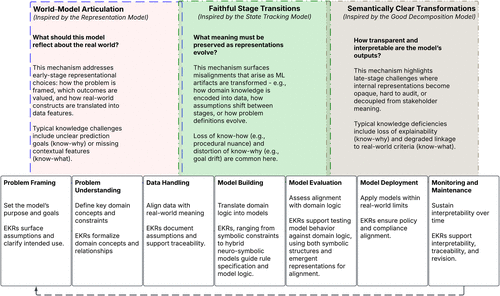
Instead of viewing knowledge gaps as fixed categories or rigid stages, the MWF framework highlights how such challenges can develop throughout the life cycle. The framework maps three mechanisms derived from the representation, state tracking, and good decomposition models in representation theory (world model articulation, faithful stage transitions, and semantically clear transformations) to stages of the ML process from problem framing through monitoring and maintenance. For each stage, the framework identifies the knowledge gaps most likely to appear and shows how EKRs can be used to address them. Together, these mappings provide a structured view for diagnosing representational vulnerabilities and choosing interventions that keep the model aligned with its real-world referent. The arrangement is intentionally adaptable: deficiencies can occur at multiple stages. A single EKR can address more than one deficiency or mechanism. This flexibility allows the framework to suit various ML contexts and paradigms, including challenges specific to the field, such as semantic drift during retraining, opacity in automated model-building pipelines, and feature engineering practices that hide original domain semantics. MWF provides a unifying representational lens for both traditional and contemporary ML paradigms, guiding how symbolic and nonsymbolic knowledge can be combined to preserve meaning, transparency, and reliability.
Table 2 integrates the perspectives in Table 1 and Figure 1, mapping life cycle stages to knowledge deficiencies and sample EKRs, indicating where each EKR lies along the symbolic-to-nonsymbolic continuum. This explicates how different types of EKRs can be deployed at the correct stage to maintain alignment. EKRs do not guarantee alignment. Their value depends on appropriate selection, structuring, and use. The ML model–world fit framework shows that keeping models aligned with their real-world referents requires interventions throughout the ML process. EKRs provide a way to make these interventions tangible by connecting frequent knowledge gaps to stage-specific representational methods. In Table 2, we highlight where EKRs are likely to maintain domain meaning and prevent semantic drift.
|
Table 2. ML Process Stages: Knowledge Deficiencies, EKRs, and Contributions to Alignment
| ML stage | Knowledge deficiency | Example EKR(s) | Contribution to alignment |
|---|---|---|---|
| Problem framing | Know-why | Goal model, value model, motivation model | Clarify intended outcomes, priorities, and model purpose |
| Problem understanding | Know-what | Conceptual data model, ontology | Formalize domain structure and shared vocabulary |
| Data handling | Know-what, know-why | Data sheet template, data dictionary, data flow diagram, data provenance model | Surface assumptions, improve traceability |
| Model building | Know-how | BPMN diagram, UML activity diagram, decision table; knowledge graph with embedded constraints | Encode procedural logic, reduce ambiguity |
| Model evaluation | Know-why/what | Causal diagram, explanation template; domain-validated representation | Compare models to real-world processes, improve ecological validity |
| Model deployment | Know-why/what | Legal ontology, policy model, ESG model; compliance frameworks | Ensure outputs conform to real-world constraints |
| Monitoring and maintenance | Know-why/what | Provenance log, explanation template; structured monitoring specifications; drift detection baselines | Support transparency, auditability, and continuous improvement |
4.1. Problem Framing
In ML projects, early stage ambiguity about what a given model is intended to predict and why that prediction matters often leads to downstream misalignment between model outputs and stakeholder needs (D’Amour et al. 2022). Without explicit articulation of objectives, ML models risk optimizing easily measurable proxies rather than the real-world phenomena they are intended to represent. EKRs such as goal models (i*, KAOS, Tropos), value models (value proposition canvas), and motivation models (business motivation model) can reduce this risk by formalizing intended outcomes, success criteria, and trade-offs among competing objectives. In ML, these models can act as both documentation and alignment artifacts: they help guide data set selection, prioritize feature engineering, and set evaluation criteria. For instance, a value model that emphasizes fairness alongside accuracy can influence the choice of metrics and thresholds used in model evaluation. By integrating these considerations early, EKRs support world–model articulation, ensuring that initial design decisions are based on a shared, semantically precise understanding of the model’s purpose.
4.2. Problem Understanding
In ML development, misunderstanding the domain can lead to incomplete, misaligned, or biased data representations that propagate errors throughout the pipeline. This challenge is heightened compared with conventional IS projects because ML models infer structure from data rather than relying solely on predefined rules, so missing or poorly defined domain concepts may never be recovered once training begins (Lebovitz et al. 2021, Sambasivan et al. 2021). These gaps can cause the model to optimize for proxies that diverge from the real-world constructs of interest, undermining model–world fit. EKRs, such as conceptual data models (entity–relationship diagrams, Unified Modeling Language (UML) class diagrams, object–role models) and ontologies (Web Ontology Language (OWL), Protégé), are symbolic and formalize the entities, attributes, and relationships relevant to the ML task. For ML, these artifacts standardize vocabulary and guide feature engineering, highlight data gaps, and provide semantic baselines for interpreting outputs. For example, domain knowledge of potential covariate and concept shifts, whether because of marketing interventions, economic trends, or external shocks, is essential for anticipating how predictive artifacts may degrade under real-world conditions (Duan et al. 2026). By doing so, they support both world model articulation and faithful stage transitions, reducing the risk of semantic drift when translating domain understanding into model features.
4.3. Data Handling
Data preprocessing and transformation decisions often introduce hidden assumptions that may affect the later performance of the models (Sambasivan et al. 2021). Data handling is a critical bottleneck in the development of sound ML; therefore, any support at this stage should have an outsized impact (Slota et al. 2020, Sambasivan et al. 2021). EKRs such as data sheet templates, data flow diagrams, and data provenance models (W3C PROV) are semiformal or contextual representations that record data set sources, collection methods, preprocessing steps, and limitations. In ML, these artifacts enhance traceability, enable a more systematic assessment of data representativeness, and ensure that essential domain semantics are preserved during the transition to model-ready formats. Similarly, the manner in which spatial boundaries are defined and featurized can profoundly affect downstream model performance and policy outcomes, demonstrating the importance of domain-informed data handling decisions in spatiotemporal predictive artifacts (Roderick et al. 2026). This stage primarily supports faithful stage transitions by preserving meaning across data transformations.
4.4. Model Building
Without explicit procedural representations, important domain logic can be lost when designing or refining ML models. EKRs such as business and organizational process models (Business Process Model and Notation (BPMN), UML activity diagrams) and decision tables (Decision Model and Notation (DMN)) explicitly encode procedural logic and constraints relevant to a task. In ML, these artifacts can indicate feature construction, ensure procedural compliance, and make learned decision boundaries more interpretable. At the same time, hybrid representations such as knowledge graphs with embedded constraints support symbolic structure with machine learning, ensuring that learned associations remain anchored in domain rules. These hybrid forms are particularly valuable during model construction because they integrate procedural know-how with statistical learning, thereby reducing the risk of opaque or misaligned decision logic. For instance, robust predictive modeling approaches such as distributionally robust optimization depend on domain understanding to determine which distributional shifts are plausible and in what direction the training distribution should be expanded to account for them (i.e., designing for anticipated shifts) (Duan et al. 2026). This stage primarily supports faithful stage transitions by preserving procedural meaning from domain knowledge into model design.
4.5. Model Evaluation
ML research and practice have an established tradition of evaluating machine learning models by comparing them to state-of-the-art models, benchmarks, and leaderboards (Padmanabhan et al. 2022, Samtani et al. 2023). However, despite strong established norms, ML evaluations often underperform because they focus on narrowly construed performance characteristics, such as precision, recall, or AUC. Consequently, models that perform well on highly curated data sets often struggle in the real world. EKRs such as causal diagrams (e.g., DoWhy, causal loop diagram) and explanation templates can broaden evaluations to include alignment with domain logic and intended outcomes. Domain-validated knowledge structures provide semantic baselines against which models’ outputs are assessed, for example, by checking whether learned feature importance aligns with established domain relationships. By combining symbolic structures with learned representations, evaluations move beyond accuracy metrics to demonstrate ecological validity and trustworthiness.
Model-driven AI evaluations can provide criterion efficacy and criterion characteristic evidence of world fit. That is, comparisons of ML models against real-world processes can be both direct (efficacy validity) and indirect or judgment-based (characteristic validity) (Larsen et al. 2025). For example, Abbasi et al. (2018) perform a criterion characteristic validation of a text analytics system to estimate the savings realized by implementing the system versus continuing with the current business process. Here, a business process model could also serve as a representation of an existing business process (Weinzierl et al. 2024) that judges can consult to support their estimation calculations. World fit can be demonstrated directly with sufficient ecological validity (fitting models against real-world processes within the application setting) (Larsen et al. 2025).
4.6. Model Deployment
ML models must operate within legal, policy, and organizational constraints that shape how outputs are interpreted and acted upon. Misalignment can produce decisions that are technically correct yet noncompliant or infeasible in practice (Selbst et al. 2019, Leidner and Tona 2021). EKRs such as legal ontologies (e.g., Legal Knowledge Interchange Format (LKIF), LKIF core ontology), policy models (e.g., eXtensible Access Control Markup Language (XACML), data contracts), and environmental, social, and governance (ESG) models capture these constraints in structured, machine-interpretable formats. For ML, these artifacts can be integrated into postprocessing pipelines, decision-support layers, or monitoring systems to ensure that outputs remain within acceptable legal and policy boundaries. Hybrid EKRs, such as compliance workflows or rule-enforced decision pipelines, combine symbolic policies with learned models, embedding organizational and regulatory requirements directly into the deployed system. These hybrids make deployment more robust by ensuring that even adaptive or data-driven components remain tethered to explicit norms. EKRs at this stage support semantically clear transformations, ensuring the translation from model predictions to organizational action preserves meaning and adheres to intended norms.
4.7. Monitoring and Maintenance
Once deployed, ML models are commonly subject to performance degradation, bias drift, and shifts in the underlying data distribution. Without active monitoring, these changes can erode model–world fit, leading to harmful or ineffective decisions (Leidner and Tona 2021). EKRs such as provenance logs (e.g., W3C PROV) and explanation templates are semiformal representations that record decision-making processes, input data contexts, and system changes over time. In ML, these artifacts support continuous auditing by making it possible to trace the origins of model outputs and assess whether changes in input data or operating conditions are causing misalignment. This monitoring capacity can be extended through structured specifications that define acceptable performance bounds and drift thresholds, integrating automated detection with human oversight. Such monitoring must extend beyond aggregate performance. Fairness itself can drift after deployment, shifting across subpopulations in ways that one-time, development-stage assessments cannot anticipate and that model updates may either correct or worsen (Davis et al. 2025). By making both technical updates and domain shifts transparent, EKRs help sustain model–world fit beyond initial deployment.
4.8. Outcomes
Not all research contributions deeply engage with every stage in Table 2. The deployment and monitoring stages might fall outside the scope of many design science studies; however, design choices made earlier in the life cycle can still shape these later stages. For example, the manner in which model outputs are explained to domain experts can alter their metacognitive calibration, affecting effective human–AI delegation (von Zahn et al. 2025). Transparency mechanisms can also reshape the phenomena models predict, creating feedback loops that erode validity over time (Bauer and Gill 2024). Similarly, fairness constraints imposed during training may provoke strategic behavioral responses that reintroduce discrimination after deployment (Shimao et al. 2025). At a minimum, researchers should reflect on how their representation design choices affect downstream accessibility, interpretability, and maintainability even when direct engagement with deployment or monitoring is not feasible.
If model–world fit is strengthened through the targeted use of EKRs across the ML process, several outcomes become possible beyond standard predictive performance. Transparency improves when EKRs such as explanation templates and causal diagrams identify and preserve domain semantics, enabling stakeholders to interpret model behavior in context (Storey et al. 2025). Performance can benefit when EKRs such as conceptual data models and process models guide feature design and evaluation, supporting models that generalize more reliably to real-world conditions. Bias reduction results from explicitly representing domain constraints and subpopulation characteristics, allowing systematic comparisons between modeled abstractions and their real-world referents (Friedman and Nissenbaum 1996). These outcomes illustrate the influence of the framework’s three representational mechanisms (world–model articulation, faithful stage transitions, and semantically clear transformations) on both the technical and social aspects of ML system effectiveness. By aligning these mechanisms with recurring knowledge deficiencies and by drawing on EKRs of varying representational forms along the symbolic to nonsymbolic continuum, the MWF framework identifies opportunities for interventions that preserve domain meaning and maintain model–world alignment. This integrated view provides concrete directions for future research on how EKRs can be embedded into ML processes to operationalize model–world fit.
5. Illustration of the ML Model–World Fit Framework
To illustrate how the MWF framework can be used, we show how combining symbolic and nonsymbolic domain knowledge through EKRs improves model performance and interpretability. First, we show that the concept of trajectory stability, a measure of placement continuity and disruption in the foster care system, can empirically measure model–world fit. Second, we illustrate how it can be interpreted and audited using local interpretability techniques. These assessments reflect world–model articulation and agreement, faithful stage transitions, and semantically clear transformations. They also align with the three forms of validity proposed for evaluating AI artifacts: criterion, causal, and context validity (Larsen et al. 2025).
5.1. Case Context: Placement Trajectory Prediction in Foster Care
Trajectory instability is a persistent challenge in foster care, particularly for children who remain in care for extended periods, for whom multiple placements are common (Casey Family Programs 2023). Instability is linked to poor emotional and behavioral outcomes, including externalizing and internalizing symptoms as well as trauma-related difficulties (Maguire et al. 2024). These patterns are significant because early identification of potential instability or postexit reentry can inform proactive support measures. Research indicates that specific foster care experiences and services, including kinship care and in-home supports, are associated with a lower reentry risk. Machine learning has shown promise in predicting placement success; however, its practical adoption is limited when models are misaligned with professional protocols or offer opaque rationales (Trudeau et al. 2023). These challenges make the foster care domain ideal for illustrating model–world fit: a model must achieve statistical accuracy, remain consistent with the logic of case management, and be understandable to practitioners.
We demonstrate how the MWF framework enhances ML outcomes by classifying foster care placement trajectories, using a deidentified data set of 31,542 placement episodes from 9,160 children spanning four years. Each episode contains entry/exit dates, demographic attributes (e.g., age, gender, race, disabilities), removal reasons (e.g., neglect, parent substance abuse), placement characteristics (e.g., type, county, judicial district), and case information (e.g., plan goals, outcomes). We predict whether a child will experience a single placement (one episode, n = 3,968, 43.3%), limited placements (two or three episodes, n = 2,459, 26.8%), or multiple placements (four or more episodes, n = 2,733, 29.8%). To simulate real-world early risk assessment and to prevent data leakage, only information available at the first placement exit was used. A domain expert with more than 15 years of experience in foster care guided the specification of the problem and helped identify relevant EKRs. The EKRs provided the symbolic grounding for feature engineering, ensuring that model inputs reflected valid decision points and defining what it means for a predictive model to stay aligned with the world of child welfare practice.
This illustration is positioned as improvement research (Gregor and Hevner 2013) because it applies new design knowledge, representational grounding through MWF, to a known problem class. Predicting placement instability in foster care is a well-established problem. We use the MWF framework to ground the predictive design in representational structures that govern case-management decisions. Consistent with Abbasi et al. (2024), the contribution lies in showing how EKRs drawn from entity–relationship diagrams, process models, and policy documents can structure feature engineering, preserve semantic traceability, and enable domain-aligned interpretability. The illustration demonstrates MWF as a framework for design research, not a prescription or tool for prediction.
5.2. Trajectory Stability: Illustrating Model–World Fit and Robustness
To empirically assess model robustness, we propose trajectory stability as a construct that captures how well a model maintains consistent predictive behavior across samples drawn from the same population, providing evidence that learned representations are grounded in stable patterns rather than sample-specific artifacts. We measure trajectory stability through clustered bootstrap resampling, which generates multiple training sets by resampling placement episodes, keeping episodes from the same child together.
Models guided by external knowledge representations that exhibit high trajectory stability demonstrate that their learned representations are grounded in stable domain structures rather than idiosyncratic sample patterns. Although representational fidelity is not directly measured, this behavioral stability provides empirical support for the claim that EKR-guided features produce more robust learned representations. Although trajectory stability provides evidence of representational robustness, faithful stage transitions, one of the MWF framework’s three mechanisms, are more directly evidenced through feature provenance, interpretability analysis, and expert validation as demonstrated in subsequent sections.
5.3. Embedding MWF Principles in Model Development
The MWF framework guided the design of the placement-trajectory models through the representational mechanisms of world–model articulation, faithful stage transitions, and semantically clear transformations. These jointly ensure that the model remains aligned with the semantics of its domain as information moves from the world to data and ultimately to computational form.
World–model articulation formalizes stakeholder understanding of the foster care system through explicit EKRs. The representations include an ER diagram capturing the domain structure with child, placement, and case entities and their relationships; a process diagram documenting the case-management workflow from intake through closure; and organizational and scholarly knowledge sources such as the State Child and Family Services Strategic Plan, the State Child Welfare Safety Assessment Manual, and the empirical literature on placement stability. These materials collectively specify the elements and relationships that define the world that the model is intended to represent. They address the know-what deficiency by making factual and structural knowledge explicit.
Faithful stage transitions preserve domain semantics as knowledge is transformed into engineered features. Features are derived directly from EKR structures, such as converting relationships in the entity–relationship diagram into quantitative attributes and using process diagrams to enforce procedural and temporal validity. Only information available at the point of decision is used, ensuring that features correspond to the real sequence of case-management events. This mechanism operationalizes know-how by embedding procedural logic and decision constraints into the modeling process. It also illustrates how representational fidelity can be maintained as knowledge passes through ML development stages.
Semantically clear transformations ensure that each engineered feature retains interpretability and provenance. Every feature is traceable to its source in an EKR element or to the supporting literature expressed in terminology familiar to practitioners, and accompanied by explicit documentation of its computational logic and temporal constraints. This mechanism addresses the know-why deficiency by linking each data transformation to an underlying causal rationale grounded in theory and practice. In later evaluations, the transparency of these features facilitates explanation and interpretability analyses.
In this illustration, the process diagram and organizational artifacts were implemented within a retrieval-augmented environment using OpenAI’s GPT-5 (Enterprise, October 2025) via the Projects interface. This configuration allows structured interaction with uploaded EKRs such as entity–relationship diagrams, process models, and policy documents through contextual retrieval and grounding. The implementation demonstrates how representational constraints can guide reasoning in a modern enterprise-grade RAG environment without requiring custom tuning.2
Integrating these representational mechanisms produced a coherent set of EKR-guided features that preserve the semantic integrity of the foster care process within the model. An expert reviewed each feature to confirm alignment with policy and practice conventions, ensuring both conceptual validity and computational accuracy. Embedding symbolic representations in this manner exemplifies how MWF enables meaning to persist throughout all stages of design and learning. The resulting model embodies the framework’s central premise that combining symbolic and nonsymbolic knowledge yields artifacts whose internal logic remains consistent with the world they are intended to represent.
5.4. Model Architectures and Training Design
The experimental design follows two model architectures with two feature sets, yielding four configurations. This 2 × 2 design isolates the contribution of EKR-guided domain knowledge from the effects of architectural complexity, addressing two questions: (i) Do MWF-derived features improve predictive performance regardless of architecture? (ii) Can a simpler, interpretable model with MWF features match or exceed a complex neural architecture?
Two feature configurations were developed to isolate the effects of domain knowledge. The baseline feature set consisted of 33 administrative variables directly extracted from case records, including demographic attributes, removal reasons, placement types, geographic identifiers, and case-management variables. These represent the standard data available to agencies and serve as the benchmark against which improvements are assessed. The EKR-guided MWF feature set incorporated six additional variables, shown in Table 3. They were derived through collaboration with a child welfare expert, utilizing the mechanisms of world–model articulation, faithful stage transitions, and semantically clear transformations. Each feature reflects a theoretically grounded or policy-relevant construct, preserving temporal validity.
|
Table 3. EKR-Guided Features Used in Model Development
| Feature | Knowledge source / mechanism | Purpose and description |
|---|---|---|
| First_Placement_LOS | ERD + temporal logic (know-what) | Duration of first placement in days (exit − entry); captures early stability using information computable at decision time. |
| Is_Trauma_Based_Removal | Ontology + literature (know-what + know-why) | Binary indicator = 1 if removal reasons include abuse or neglect, reflecting trauma. |
| Removal_Reason_Count | Ontology + literature (know-why) | Count of all prior removal reasons, operationalizing cumulative risk. |
| Parental_Risk_Factor_Count | Ontology + policy (know-why) | Count of parental risk indicators (substance abuse, incapacity, incarceration). |
| Is_First_Placement_Disruptive | Process model + policy (know-how + know-why) | Indicator = 1 if placement outcome contains terms signaling disruption (“runaway,” “change,” “requested”), linked to placement-stability research. |
| LOS_ZScore_by_Type | Process model + temporal logic (know-how) | Standardized deviation of length of stay within placement-type categories, measuring departures from procedural norms in training data. |
These features operationalize different aspects of the foster care process, maintaining direct ties to policy, theory, and procedures. The combined feature set concatenated all 39 variables (33 administrative and six EKR-guided), enabling a systematic assessment of whether symbolic grounding through MWF features enhances learning across model classes of varying complexity. This stage exemplifies faithful stage transitions, ensuring that the procedural and structural knowledge encoded in the ERD and related EKRs is preserved as it is translated into model features.
Two architectures were selected: a standard tree-based ensemble method widely used in applied ML and a deep learning approach that represents the current state of the art for tabular data. The gradient-boosted machine (GBM) is a tree-based ensemble method widely used in machine learning design research because of its strong performance on tabular data and relative interpretability (H2O.ai’s implementation).3 TabTransformer adapts transformer models, originally developed for natural-language processing, to structured tabular data and represents current state-of-the-art deep learning for tabular prediction tasks (Huang et al. 2020). TabTransformer was selected specifically because of its capacity to model complex feature interactions, providing a strong test of whether EKR-guided features add value even when architectural expressiveness is maximized.4
Crossing two architectures with two feature sets yields four model configurations: GBM with baseline features (the benchmark), GBM with MWF features, TabTransformer with baseline features, and TabTransformer with MWF features. This design enables three key comparisons. First, comparing GBM (baseline) to GBM (MWF) isolates the contribution of EKR-guided features within a simple architecture. Second, comparing TabTransformer (baseline) to TabTransformer (MWF) tests whether domain knowledge improves performance even in state-of-the-art neural models. Third, comparing GBM (MWF) to TabTransformer (MWF) examines whether a simpler, interpretable model with strong representational grounding can match or exceed a complex model using the same features.
5.5. Results and Interpretation
Table 4 summarizes the performance of all model configurations, reporting macro-F1 scores with 95% clustered bootstrap confidence intervals. The results reveal three findings. First, MWF-derived features improve performance for both architectures: GBM improves from 0.643 to 0.719, and TabTransformer improves from 0.611 to 0.658. Second, the simpler GBM with MWF features (0.719) substantially outperforms the complex TabTransformer with the same features (0.658). Third, even the TabTransformer requires EKR-guided features to exceed the baseline GBM, suggesting that architectural complexity alone cannot substitute for domain knowledge. These findings demonstrate that preserving domain semantics through EKR-guided features enhances both data–model fit and model–world fit, supporting the broader claim that meaningful alignment can outperform architectural complexity when domain knowledge is explicitly represented.
|
Table 4. Model Performance Comparison
| Architecture | Feature set | Macro-F1 | 95% confidence interval |
|---|---|---|---|
| GBM | Baseline (33) | 0.643 | [0.628, 0.658] |
| GBM | Baseline + MWF (39) | 0.719 | [0.706, 0.735] |
| TabTransformer | Baseline (33) | 0.611 | [0.596, 0.626] |
| TabTransformer | Baseline + MWF (39) | 0.658 | [0.643, 0.674] |
The illustration provides empirical grounding for criterion, causal, and context validity, each corresponding to a distinct knowledge claim about artifact performance, mechanism, and applicability. The improvements in predictive accuracy establish criterion validity by demonstrating that embedding symbolic representations increases functional utility relative to standard data-driven approaches. The alignment between EKR-derived features and their theoretically grounded effects on predictions supports causal validity, suggesting that the performance gains result from design features rather than model complexity. Constructs such as cumulative parental risk, trauma-based removal, and standardized deviations in placement duration capture stable causal relationships. Their consistent contribution to model accuracy reflects faithful stage transitions, in which the model’s internal representations mirror the causal structure of the world it seeks to represent.
Context validity concerns whether an artifact maintains its intended performance and meaning across relevant settings and data conditions. The improvements observed across model families, tree-based ensembles, and transformer-based neural architectures indicate that the MWF approach generalizes beyond a single modeling paradigm. Interpretability analyses provide further evidence of how representational alignment is expressed in model reasoning. The process diagram with RAG combines a symbolic process model with retrieval-augmented learning to preserve semantic structure and enable adaptive reasoning. Together, these analyses show how explicit representations of domain knowledge can guide both model development and interpretation. This integration operationalizes semantically clear transformations, demonstrating how representational meaning is preserved as knowledge moves from symbolic process diagrams into generative reasoning workflows.
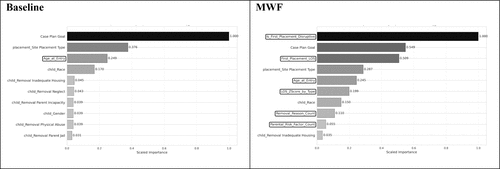
A global and local interpretability analysis illustrates how the MWF framework enhances transparency and semantic alignment. Figure 2 shows the scaled feature importance for the GBM baseline and MWF models. Among the most influential predictors are features whose underlying knowledge is explicitly captured through EKRs, such as whether the initial placement was disruptive, the length of the first placement, and standardized deviations in length of stay. These features show that the MWF model learns from semantically meaningful relationships rather than surface-level correlations. This shift in reasoning demonstrates how integrating structured domain representations improves representational fidelity across stages.
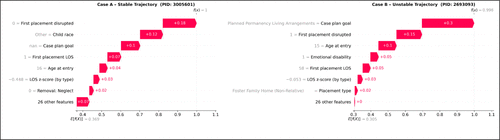
At the case level, Figure 3 presents SHapley Additive exPlanations (SHAP) waterfall plots for two representative instances, each showing feature contributions toward that instance’s own predicted class, illustrating how EKR-informed features shape predictions in ways consistent with practitioner reasoning. For case A (stable trajectory), the model moves from the base rate to a confident prediction of stability, mostly driven by an initial placement that was not disrupted (Is_First_Placement_Disruptive = 0). For case B (unstable trajectory), the initial placement disruption cue points the other way: the placement was disrupted (Is_First_Placement_Disruptive = 1), and this is among the strongest contributors pushing the prediction toward instability, the direction a caseworker would expect from an early disruption. These EKR-grounded cues operate in the direction expected by caseworkers, providing case-level transparency that complements the global interpretability evidence. These interpretability analyses reflect world–model articulation and agreement, showing how the model’s reasoning aligns with practitioner understanding and preserves shared meaning between computational representations and domain expertise.
5.6. Interpretation and Implications of Illustration
These case-level explanations demonstrate local faithfulness between model reasoning and domain expertise, reinforcing world–model articulation and agreement and the interpretability dimension of model–world fit, providing transparency essential for responsible use in practice. Together, these findings demonstrate that the MWF framework contributes to the validity of machine learning artifacts. The improvements in predictive accuracy confirm criterion validity, the theoretically meaningful and semantically clear features enhance causal validity, and the consistent improvement across architectures supports context validity. The illustration shows how explicit representation of domain knowledge yields models whose internal logic is aligned with the world they aim to represent. It also shows how the MWF framework provides a disciplined method for incorporating large language models in machine learning design research. MWF constrains the operation of LLMs through retrieval augmentation and explicit representational boundaries defined by EKRs. Human review reconciles the model’s suggestions with organizational process models and policy artifacts before feature engineering. This transforms LLMs and RAG from opportunistic assistants into interfaces that link domain representations to model design, improving reproducibility and theoretical grounding. Table 5 summarizes how the representational mechanisms of MWF were implemented using RAG.
|
Table 5. Operationalized MWF Components via RAG Constraints
| MWF component | RAG constraint |
|---|---|
| World–model articulation | Knowledge base assembled: ERD entities (child, placement, case), process diagram (intake→assessment→placement→review→closure), research literature on placement stability, and the state child welfare agency’s policies |
| Faithful stage transitions | System prompt constraints: “Derive features from EKR entities/relationships; respect temporal ordering from process diagram; ensure computability at decision point; provide clear provenance in knowledge base” |
| Semantically clear transformations | LLM output requirements: For each feature, trace to source EKR or literature; explain in domain expert terminology; document temporal validity constraints; identify which knowledge deficiency (know-what/how/why) it addresses |
This implementation shows that each representational mechanism in MWF can be operationalized as a controllable step within an LLM-assisted pipeline. World–model articulation defines what information the system can access, faithful stage transitions dictate when and how knowledge may be used, and semantically clear transformations determine how outputs are expressed and documented. Together, these controls convert a generative model into a structured reasoning partner that supports criterion, causal, and context validity by ensuring that generated features remain grounded in the world the model represents.
The broader methodological implication is that representational alignment can be more consequential than algorithmic sophistication. This illustration exemplifies how MWF provides representational guidance for domain-aligned ML design rather than serving as a performance benchmark. By embedding knowledge directly into the process, MWF enables the use of emerging AI tools without sacrificing transparency or rigor. For IS computational design researchers, LLMs can serve as both sources of novelty and tools for encoding, testing, and refining domain representations. MWF links empirical performance to a reproducible method for responsible, AI-assisted model development and motivates further research on integrating domain knowledge into machine learning.
6. Discussion and Future Research
The MWF framework provides a foundation for aligning machine learning artificial intelligence–based systems with real-world knowledge, constraints, and intended applications. It extends domain-specific design approaches into a general guide for investigating model–world fit, providing ML/AI and representation researchers with a systematic way to study, evaluate, and refine learning systems.
The foster care illustration demonstrates the framework’s utility in guiding specific ML development by making the representational workflow visible and theoretically grounded. Although this single illustration cannot establish generalizable claims, it demonstrates how external knowledge representations can be operationalized within MWF and surfaces critical research questions about their construction, maintenance, and use across different contexts.
The MWF framework is intended to serve as a starting point for IS computational design researchers to reconsider how machine learning artifacts are conceived and evaluated. Rather than focusing primarily on how well models fit data, researchers should also explore how models are situated within a target application domain and how they may perform when the model is used in another setting. IS research is uniquely positioned to pursue this agenda because it studies sociotechnical systems.
MWF distinguishes complementary roles of EKRs: addressing knowledge deficiencies (e.g., biases, hallucinations, missing know-how) and enabling knowledge opportunities (e.g., improved fidelity when knowledge of the world is proactively considered). We focus primarily on knowledge deficiencies and how EKRs can bridge them. One opportunity is to take a more open-ended, proactive approach. Instead of identifying knowledge deficiencies, researchers could seek out opportunities for deepening domain knowledge integration into ML via EKRs. For example, even when a model is not deficient per se, learning more about the domain through EKRs may contribute to improved model performance, especially the model’s ability to work in its target environment (ecological validity) as well as other domains (external validity).
Recent advances such as model context protocols5 and agentic AI can extend RAG (Lewis et al. 2020) by coordinating multistep reasoning and tool use. Yet, from an MWF perspective, these remain technical architectures rather than representational solutions, requiring structured mechanisms (e.g., EKRs) to ensure that stage transitions and outputs preserve semantic integrity and align with domain knowledge. MWF outlines how representational mechanisms can convert generative systems into governed interfaces that begin to integrate symbolic and subsymbolic reasoning in accountable ways.
Table 6 identifies research questions derived from our framework. Advancing research in ML model–world fit requires a multifaceted methodological approach. Theory-building research is essential for extending representation theory to ML, refining concepts such as world–model articulation, faithful stage transitions, and semantically clear transformations to account forcomplexities for which RT was not originally developed. Design science research can contribute by developing, testing, and refining new methodologies for integrating EKRs into ML development, ensuring that domain knowledge is systematically captured, preserved, and applied throughout the life cycle.
|
Table 6. Future Research Directions
| Foundation | Future research | Research questions |
|---|---|---|
| Representation theory | World–model articulation and agreement |
|
| Representation theory | Faithful stage transitions |
|
| Representation theory | Semantically clear transformations & explainability |
|
| Representation theory | RT & new ML approaches (LLMs, reinforcement learning) |
|
| Representation theory | Theoretical foundations |
|
| Knowledge deficiencies | Addressing know-what, know-how, know-why |
|
| MWF framework | MWF outcomes beyond performance metrics |
|
| MWF framework | EKR development |
|
| MWF framework | Symbolic–nonsymbolic spectrum |
|
| MWF framework | Boundary conditions |
|
| MWF extensions |
| |
| MWF framework | Evaluation |
|
Empirical studies, including comparative analyses and field experiments, can quantify the impact of EKRs on ML performance, transparency, and bias mitigation, identifying when and how EKRs improve real-world outcomes. Qualitative methods, such as case studies and ethnographic research, can provide deep insights into how practitioners interact with structured knowledge and how these tools influence ML development and decision making. Experimental research can systematically evaluate how EKR-augmented ML models compare with purely data-driven approaches, identifying optimal trade-offs between structured knowledge and statistical learning.
7. Conclusion
Artificial intelligence based on machine learning has advanced largely by improving data–model fit: how well a model captures the patterns in its training data. Data–model fit alone is not sufficient. ML/AI models must also achieve model–world fit, aligning with the real-world knowledge, constraints, and intended applications in domains in which they are used. The machine learning model–world fit framework describes how domain knowledge can be integrated into the machine learning development process using external knowledge representations. EKRs provide relevant domain knowledge, helping to overcome the know-what, know-how, and know-why knowledge deficiencies that arise across an artifact’s life cycle. We illustrate the framework by applying it to a child welfare placement case, a domain in which contextual understanding is critical and statistical accuracy is an insufficient evaluation criterion. By making domain knowledge explicit, the framework provides ML/AI researchers with conceptual and operational guidance for building ML/AI systems that are robust, explainable, and aligned with the world they seek to model. We provide a research road map that identifies directions for researchers working at the intersection of machine learning, design science, and knowledge representation, including how external knowledge representations can be constructed, validated, maintained, and incorporated into machine learning methods.
The authors thank Mann Pawar, a graduate of the Master of Science in Business Analytics program at William & Mary, for assistance with the literature review.
1 See https://www.aaai-make.info/.
2 Additional implementation details are provided in the online supplementary material.
3 H2O.ai provides an open-source implementation of gradient boosting machines widely used in applied machine learning (https://www.h2o.ai/).
4 Further details are available in the online supplementary material.
5 For an example, see https://www.anthropic.com/model-context-protocol.
References
- (2018) Text analytics to support sense-making in social media: A language-action perspective. MIS Quart. 42(2):1–38.Crossref, Google Scholar
- (2024) Pathways for design research on artificial intelligence. Inform. Systems Res. 35(2):441–459.Link, Google Scholar
- (2018) Peeking inside the black-box: A survey on explainable artificial intelligence (XAI). IEEE Access 6:52138–52160.Crossref, Google Scholar
- (2016) Big data’s disparate impact. California Law Rev. 104(3):671–732.Google Scholar
- (2024) Mirror, mirror on the wall: Algorithmic assessments, transparency, and self-fulfilling prophecies. Inform. Systems Res. 35(1):226–248.Link, Google Scholar
- (2023) On the relevance of logic for AI: Misunderstandings in social media, and the promise of neuro-symbolic learning. Neurosymbolic AI J. 1.Google Scholar
- (2026) The future is neuro-symbolic: Where has it been, and where is it going? Koenig S, Jenkins C, Taylor ME, eds. Proc. AAAI Conf. Artificial Intelligence, vol. 40(48) (AAAI Press, Washington, DC) 40954–40961.Crossref, Google Scholar
- (2024) Generative retrieval-augmented ontologic graph and multiagent strategies for interpretive large language model-based materials design. ACS Engrg. Au 4(2):241–277.Crossref, Google Scholar
- (2012) From use to effective use: A representation theory perspective. Inform. Systems Res. 24(3):632–658.Link, Google Scholar
- (2017) Assessing representation theory with a framework for pursuing success and failure. MIS Quart. 41(4):1307–1333.Crossref, Google Scholar
- (2023) A comprehensive survey of AI-generated content (AIGC): A history of generative AI from GAN to ChatGPT. Preprint, submitted March 7, https://arxiv.org/abs/2303.04226.Google Scholar
Casey Family Programs (2023) Placement stability impacts. Accessed October 12, 2025, https://www.casey.org/placement-stability-impacts/.Google Scholar- (2025) The GenAI divide: State of AI in business 2025. Report, MIT NANDA, Massachusetts Institute of Technology, Cambridge. Google Scholar
- (2024) A survey on evaluation of large language models. ACM Trans. Intelligent Systems Tech. 15(3):1–45.Crossref, Google Scholar
- (2022) Underspecification presents challenges for credibility in modern machine learning. J. Machine Learn. Res. 23(226):1–61.Google Scholar
- (2020) A roadmap to domain knowledge integration in machine learning. Chen E, Antoniou G, eds. Proc. 2020 IEEE Internat. Conf. Knowledge Graph (ICKG) (IEEE, Piscataway, NJ), 145–151.Google Scholar
- (2022) A review of some techniques for inclusion of domain-knowledge into deep neural networks. Sci. Rep. 12(1):1040.Crossref, Google Scholar
- (2025) Emerging algorithmic bias: Fairness drift as the next dimension of model maintenance and sustainability. J. Amer. Medical Informatics Assoc. 32(5):845–854.Crossref, Google Scholar
- (2019) BERT: Pre-training of deep bidirectional transformers for language understanding. Burstein J, Doran C, Solorio T, eds. Proc. 2019 Conf. North Amer. Chapter Assoc. Comput. Linguistics: Human Language Tech., vol. 1 (Association for Computational Linguistics, Minneapolis), 4171–4186. Google Scholar
- (2017) Towards a rigorous science of interpretable machine learning. Preprint, submitted February 28, https://arxiv.org/abs/1702.08608.Google Scholar
- (2018) The accuracy, fairness, and limits of predicting recidivism. Sci. Adv. 4(1):eaao5580.Crossref, Google Scholar
- (2026) Robust predictive modeling under unseen data distribution shifts: A methodological commentary. Inform. Systems Res., ePub ahead of print March 23, https://doi.org/10.1287/isre.2022.0537.Link, Google Scholar
- (1981) Representations: Philosophical Essays on the Foundations of Cognitive Science (MIT Press, Cambridge, MA).Google Scholar
- (1996) Bias in computer systems. ACM Trans. Inform. Systems 14(3):330–347.Crossref, Google Scholar
- (1997) On the distinction between know-how, know-why, and know-what. Adv. Strategic Management 14:81–101.Google Scholar
- (2022) Knowledge-infused learning: A sweet spot in neuro-symbolic AI. IEEE Internet Comput. 26(4):5–11.Crossref, Google Scholar
- (2013) Positioning and presenting design science research for maximum impact. MIS Quart. 37(2):337–355.Crossref, Google Scholar
- (2018) Recurrent world models facilitate policy evolution. Bengio S, Wallach H, Larochelle H, Grauman K, Cesa-Bianchi N, Garnett R, eds. Adv. Neural Inform. Processing Systems, vol. 31 (Curran Associates, Red Hook, NY), 2450–2462. Google Scholar
- (2022) Physics-informed machine learning: A survey on problems, methods and applications. Preprint, submitted November 15, https://arxiv.org/abs/2211.08064.Google Scholar
- (2025) A teen was suicidal. ChatGPT was the friend he confided in. The New York Times Online (August 26), https://www.nytimes.com/2025/08/26/technology/chatgpt-openai-suicide.html.Google Scholar
- (2020) TabTransformer: Tabular data modeling using contextual embeddings. Preprint, submitted December 11, https://arxiv.org/abs/2012.06678.Google Scholar
- (2023) Drug–disease association prediction with literature based multi-feature fusion. Frontiers Pharmacology 14:1205144.Crossref, Google Scholar
- (2018) Advanced customer analytics: Strategic value through integration of relationship-oriented big data. J. Management Inform. Systems 35(2):540–574.Crossref, Google Scholar
- (2025) Validity in design science. MIS Quart. 49(4):1267–1294.Crossref, Google Scholar
- (2021) Is AI ground truth really true? The dangers of training and evaluating AI tools based on experts’ know-what. MIS Quart. 45(3):1501–1526.Crossref, Google Scholar
- (2024) Explainable deep learning for false information identification: An argumentation theory approach. Inform. Systems Res. 35(2):890–907.Link, Google Scholar
- (2021) The care theory of dignity amid personal data digitalization. MIS Quart. 45(1):343–370.Crossref, Google Scholar
- (2020) Retrieval-augmented generation for knowledge-intensive NLP tasks. Larochelle H, Ranzato M, Hadsell R, Balcan MF, Lin H, eds. Adv. Neural Inform. Processing Systems, vol. 33 (Curran Associates, Red Hook, NY), 9459–9474. Google Scholar
- (2019) Expecting the unexpected: Effects of data collection design choices on the quality of crowdsourced user-generated content. MIS Quart. 43(2):634–647.Crossref, Google Scholar
- (2024) A systematic review of the impact of placement instability on emotional and behavioural outcomes among children in foster care. J. Child Adolescent Trauma 17(2):641–655.Crossref, Google Scholar
- (2023) Does machine learning amplify pricing errors in the housing market? The economics of machine learning feedback loops. Preprint, submitted February 18, https://arxiv.org/abs/2302.09438.Google Scholar
- (2025) Generative AI’s crippling and widespread failure to induce robust models of the world. Marcus on AI (June 28), https://garymarcus.substack.com/p/generative-ais-crippling-and-widespread.Google Scholar
- (2019) Rebooting AI: Building Artificial Intelligence We Can Trust (Pantheon Books, New York).Google Scholar
- (2021) A survey on bias and fairness in machine learning. ACM Comput. Surveys 54(6):1–35.Crossref, Google Scholar
- (2024) AI in context: Harnessing domain knowledge for smarter machine learning. Appl. Sci. 14(24):11612.Crossref, Google Scholar
- (2022) Machine learning in information systems research. MIS Quart. 46(1):iii–xix.Crossref, Google Scholar
- (2018) Fatal crash between a car operating with automated control systems and a tractor-semitrailer truck. Traffic Injury Prevention 19(2):S153–S156.Crossref, Google Scholar
- (2019) Information systems as representations: A review of the theory and evidence. J. Assoc. Inform. Systems 20(6):735–786.Google Scholar
- (2021) From representation to mediation: A new agenda for conceptual modeling research in a digital world. MIS Quart. 45(1):269–300.Crossref, Google Scholar
- (2026) When vulnerability drives action: Designing forward-looking frameworks for disaster preparedness. Inform. Systems Res.Link, Google Scholar
- (2024) Minecraft as a platform for co-creation of urban space: A case-study with teenagers. Bui TX, ed. Proc. 57th Annual Hawaii Internat. Conf. System Sci. (HICSS, Honolulu), 5723–5730.Google Scholar
- (2016) Artificial Intelligence: A Modern Approach, 3rd ed., global ed. (Pearson Education Limited, Harlow, UK).Google Scholar
- (2021) “Everyone wants to do the model work, not the data work”: Data cascades in high-stakes AI, Proc. 2021 CHI Conf. Human Factors Comput. Systems (ACM, New York), 1–15.Google Scholar
- (2023) Deep learning for information systems research. J. Management Inform. Systems 40(1):271–301.Crossref, Google Scholar
- (2023) Failure factors of AI projects: Results from expert interviews. Internat. J. Inform. Systems Project Management 11(3):25–40.Google Scholar
- (2019)
Fairness and abstraction in sociotechnical systems . Proc. Conf. Fairness Accountability Transparency (ACM, New York), 59–68.Crossref, Google Scholar - (2014) A comparative study of data mining process models (KDD, CRISP-DM and SEMMA). Internat. J. Innovation Sci. Res. 12(1):217–222.Google Scholar
- (2025) Strategic best-response fairness framework for fair machine learning. Inform. Systems Res. 36(4):2391–2403.Link, Google Scholar
- (2016) Mastering the game of Go with deep neural networks and tree search. Nature 529(7587):484–489.Crossref, Google Scholar
- (2020) Good systems, bad data? Interpretations of AI hype and failures. Proc. Assoc. Inform. Sci. Tech. 57(1):e275.Crossref, Google Scholar
- (2024) Transformers use causal world models in maze-solving tasks. Preprint, submitted December 16, https://arxiv.org/abs/2412.11867.Google Scholar
- (2022) Explainable AI: Opening the black box or Pandora’s Box? Comm. ACM 66(4):1–6.Google Scholar
- (2025) Domain knowledge in artificial intelligence: Using conceptual modeling to increase machine learning accuracy and explainability. Data Knowledge Engrg. 160:102482.Crossref, Google Scholar
- (2025) Systems Analysis and Design: An Object-Oriented Approach with UML, 7th ed. (Wiley, Hoboken, NJ).Google Scholar
- (2023) Predicting successful placements for youth in child welfare with machine learning. Child. Youth Services Rev. 153:107117.Crossref, Google Scholar
- (2017) Attention is all you need. Guyon I, Von Luxburg U, Bengio S, Wallach H, Fergus R, Vishwanathan S, Garnett R, eds. Adv. Neural Inform. Processing Systems, vol. 30. (Curran Associates, Red Hook, NY), 5998–6008.Google Scholar
- Kirsch B, et al. (2023) Informed machine learning—A taxonomy and survey of integrating prior knowledge into learning systems. IEEE Trans. Knowledge Data Engrg. 35(1):614–633.Google Scholar
- (2025) Knowing (not) to know: Explainable artificial intelligence and human metacognition. Inform. Systems Res. 37(3):1485–1507.Google Scholar
- (1993) On the ontological expressiveness of information systems analysis and design grammars. Inform. Systems J. 3(4):217–237.Crossref, Google Scholar
- (2023) Voyager: An open-ended embodied agent with large language models. Preprint, submitted May 25, https://arxiv.org/abs/2305.16291.Google Scholar
- (1997) Ontological Foundations of Information Systems (Coopers & Lybrand and the Accounting Association of Australia and New Zealand, Melbourne, Australia).Google Scholar
- (2024) Machine learning in business process management: A systematic literature review. Expert Systems Appl. 253:124181.Crossref, Google Scholar
- (2020) A comprehensive survey on graph neural networks. IEEE Trans. Neural Networks Learn. Systems 32(1):4–24.Crossref, Google Scholar
- (2023) Siren’s song in the AI ocean: A survey on hallucination in large language models. Preprint, submitted September 3, https://arxiv.org/abs/2309.01219.Google Scholar
- (2020) A comprehensive survey on transfer learning. Proc. IEEE 109(1):43–76.Crossref, Google Scholar
Arturo Castellanos is an assistant professor at William & Mary’s Raymond A. Mason School of Business. His research examines how machine learning systems can be designed to fit the complex, evolving contexts of their deployment, drawing on design science, interpretable machine learning, and conceptual modeling. His work has appeared in MIS Quarterly, Information Systems Research, INFORMS Journal on Computing, JAIS, ACM Computing Surveys, and Decision Support Systems.
Monica Chiarini Tremblay is the Hays T. Watkins Distinguished Professor of Business at William and Mary’s Raymond A. Mason School of Business. Her research examines how AI and data governance can improve decision making in complex societal domains such as healthcare and juvenile justice with a focus on transparency and impact. Her work has appeared in Information Systems Research, MIS Quarterly, Decision Sciences, and Journal of the AIS, among others.
Roman Lukyanenko is the Paul Goodloe McIntire Associate Professor of Commerce at the University of Virginia. Roman develops solutions in data management, AI, and citizen science/crowdsourcing. These solutions received the INFORMS Design Science Award, Governor General of Canada Gold Medal, Hebert Simon Design Science Award, AIS Best Doctoral Dissertation in Information Systems, best paper awards at MIS Quarterly and Journal of IT. Roman’s research appeared in over 40 journals, including Nature, MIS Quarterly, and ACM Computing Surveys.
Jeffrey Parsons is a university research professor and professor of information systems in the faculty of business administration at Memorial University of Newfoundland in Canada. His research interests focus on how to better represent human conceptualizations of the world in data and on understanding and improving data repurposing. He is a Fellow of the Association for Information Systems, Distinguished Research Fellow from TU Dresden, Schoeller Senior Fellow, and an ER Fellow.
Veda C. Storey is the Tull Professor of Computer Information Systems and professor of computer science at the J. Mack Robinson College of Business, Georgia State University. Her research interests are in data management, conceptual modeling, and design science. She is particularly interested in the impact of new technologies on business and society from a data management perspective. Dr. Storey is a member of the AIS College of Senior Scholars and an INFORM Fellow.