


How Platform Workers Contest Algorithmic Management: Theorizing the Dynamics of Algoactivistic Practices
Abstract
Algorithmic management (AM) has become a defining feature of online labor platforms (OLPs), profoundly shaping platform workers’ control over their working conditions. Prior research has documented diverse forms of worker resistance to AM—or algoactivism—yet existing studies rest on two problematic assumptions: first, that algoactivistic practices are uniformly accessible and arise directly from workers’ perceptions of structural constraints; and second, that such practices are primarily reactive resistance broadly targeted at the OLP’s AM system. These assumptions obscure heterogeneity in workers’ motivations and resources as well as variation in how algoactivistic practices unfold. This study develops a more textured understanding of platform workers’ algoactivism by tracing how corresponding practices emerge through situated, reflective, and resource-dependent processes. Drawing on the contested terrain lens from labor process theory, we conceptualize the interplay between OLPs and workers as an ongoing struggle over control of working conditions. We examine this struggle in the context of Uber, a widely recognized extreme case of AM. Using a computer-assisted grounded theory approach that integrates topic modeling and qualitative coding procedures across multiple data sources, we develop a process-theoretical model of how platform workers contest AM. Our model centers on three recurring dynamics—reassessing terrain, exploring opportunities for contestation, and contesting terrain through algoactivistic practices—and yields two core theoretical contributions. First, we show that worker algoactivism depends on continual terrain reassessments and uneven capacities to engage in three forms of resourcing—algorithm, market, and voice resourcing. Second, we theorize algoactivism as a heterogeneous and multi-arena phenomenon comprising self-optimizing, distancing, and confronting practices that vary in logics, targets, and durability. Together, these contributions advance a more dynamic and agentic understanding of worker algoactivism and provide actionable insights for the design and governance of platform-mediated work.
History: Sundeep Sahay, Senior Editor; Shirish C. Srivastava, Associate Editor.
Funding: The authors gratefully acknowledge funding from the German Research Foundation (DFG) for the project Algorithmic Control: A Legitimacy Perspective on Worker-level Implications (AlgoWork) (project number 461985572), as well as from the Marianne and Marcus Wallenberg Foundation (2021.0074) and the Erling-Persson Foundation (2023).
Supplemental Material: The online appendix is available at https://doi.org/10.1287/isre.2024.0927.
1. Introduction
Online labor platforms (OLPs)—such as Deliveroo, Fiverr, Uber, or Upwork—have reshaped labor markets worldwide by mediating short-term, task-based work ranging from food delivery and passenger transport to graphic design and programming (see, e.g., Huang et al. 2020, Bucher et al. 2024). Their growing societal and economic significance is reflected in recent estimates suggesting that approximately 435 million people—12.5% of the global workforce—engaged in platform work in 2023 (Datta et al. 2023). A key driver of OLPs’ scalability and success is their reliance on algorithmic management (AM), that is, the use of algorithms to autonomously perform managerial tasks historically carried out by humans (see, e.g., Duggan et al. 2020, Benlian et al. 2022). For many platform workers, these algorithms effectively function as their “boss” (Möhlmann et al. 2021, p. 2007; cf. Curchod et al. 2020).
Given the centrality of AM and its pervasive influence on platform workers, recent research has increasingly examined workers’ lived experiences of being managed by algorithms (see, e.g., Curchod et al. 2020, Bucher et al. 2021, Cameron 2024). In information systems (IS), this work has generated valuable insights into workers’ perceptions and judgments of AM, particularly regarding autonomy and fairness (see, e.g., Tarafdar et al. 2023, Wiener et al. 2023). At the same time, a growing stream of research in adjacent fields such as management and organization theory views platform workers not merely as passive recipients of AM but as agentic actors who resist or reshape it (see, e.g., Cameron and Rahman 2022, Meijerink and Bondarouk 2023). Within this stream, Kellogg et al. (2020) introduced the concept of algoactivism to capture a broad range of resistance practices. Building on this foundation, subsequent studies have identified diverse practices through which workers contest platform-mediated control and push back against OLPs’ use of AM (see, e.g., Bucher et al. 2021, McDaid et al. 2023, Cameron 2024).
Despite these advances, the growing body of algoactivism research rests on two dominant assumptions that merit problematization (Alvesson and Sandberg 2011). First, existing studies implicitly assume that algoactivistic practices are uniformly accessible to platform workers (see, e.g., Kellogg et al. 2020) and arise directly from perceived constraints on autonomy and value extraction (see, e.g., Meijerink and Bondarouk 2023). This assumption overlooks workers’ heterogeneous motivations, situated circumstances, and unequal access to relevant resources. It also obscures the reflective processes through which workers engage in specific algoactivistic practices. As a result, existing research risks overstating platform workers’ capacity to contest AM and underestimating the importance of the resources and preparatory activities required to do so. For practitioners and policymakers, this assumption masks how unequal access to relevant knowledge, peer networks, and alternative job opportunities shapes workers’ ability to resist platform-mediated control. Second, prior research tends to portray algoactivistic practices as primarily reactive forms of resistance (see, e.g., Cameron and Rahman 2022) that broadly target the platform’s AM system (see, e.g., McDaid et al. 2023). This perspective downplays proactive forms of algoactivism and obscures variation in how different practices operate and what or whom they target. Consequently, prior research provides only an incomplete account of the evolving and multitargeted nature of worker contestation, limiting our understanding of how platform workers proactively contest AM.
To develop a deeper and more nuanced account of worker algoactivism, we draw on the metaphor of contested terrain (Edwards 1979, Kellogg et al. 2020) as our theoretical lens. This lens conceptualizes the labor process as a dynamic struggle between OLP providers, who continually reconfigure their AM systems to strengthen managerial control, and platform workers, who employ diverse practices to preserve or expand control over their working conditions. In contrast to the prevalent organizational focus in earlier research (Kellogg et al. 2020, Marabelli et al. 2021), we foreground the perspective of individual platform workers, examining how they pursue terrain gains through algoactivistic practices and how such gains are continually challenged or undermined by ongoing AM reconfigurations. We explore these dynamics in the empirical context of Uber, a widely recognized extreme case of AM that is conducive to theory building (Möhlmann et al. 2021; cf. Gerring 2017). Our analysis draws on rich data from multiple sources (e.g., forum posts, interviews, app release notes) and integrates computational topic modeling with grounded-theory-informed coding, enabling us to combine inductive breadth with interpretive depth and to develop a process-theoretical model explaining how (and why) platform workers contest AM over time.
Our study contributes to research on OLPs, AM, and algoactivism in two important ways. First, we illuminate the situated and reflective processes through which platform workers translate perceptions of structural constraints into the adoption or development of specific algoactivistic practices. In doing so, we identify three types of resourcing activities—algorithm, market, and voice resourcing—that help explain why certain practices are employed by some workers but remain inaccessible or unattractive to others. Second, we extend current conceptualizations of algoactivism by theorizing multiple forms of worker contestation—self-optimizing, distancing, and confronting—that vary in their underlying mechanisms, targets, and outcomes. More broadly, our process-theoretical model provides a dynamic account of how platform workers contest AM over time and how OLP providers respond through ongoing AM reconfigurations. Taken together, our findings offer a more textured and dynamic understanding of worker algoactivism and hold practical implications for platform workers, policymakers tasked with worker protection, and OLP providers seeking to design more equitable and sustainable AM systems.
2. Theoretical Background
2.1. Algorithmic Management on Online Labor Platforms
A central pillar of OLPs’ business models is their reliance on advanced algorithms and digital technologies to coordinate and control their dispersed workforce—referred to as algorithmic management (AM) (Lee et al. 2015, Möhlmann et al. 2021). Following prior work, we define AM as “the large-scale collection and use of data on an OLP to develop and improve learning algorithms that carry out coordination and control functions traditionally performed by managers” (Möhlmann et al. 2021, p. 2001). Within the IS literature, AM is commonly conceptualized in terms of two intertwined functions: algorithmic matching and algorithmic control (ibid; cf. Cram et al. 2022, Wiener et al. 2023). The former enables efficient coordination of supply and demand, whereas the latter aligns workers’ behavior with organizational goals.
The proliferation of AM has transformed managerial practice by enabling OLP providers to exercise unprecedented forms of data-driven oversight (Lee et al. 2015). Scholars generally describe AM as a “tighter” form of management than traditional human-led approaches because of four distinctive features (Kellogg et al. 2020, p. 367).1 First, AM systems rely on a comprehensive array of digital devices—such as mobile apps, sensors, and telematic tools—to continuously gather granular data about workers and their activities, thereby extending organizational monitoring capabilities (Faraj et al. 2018). Second, they deliver instructions, nudges, and feedback in (near) real time, accelerating managerial responsiveness (Rosenblat and Stark 2016). Third, these systems increase the frequency and richness of interactions among workers, platforms, and customers, enabling OLPs to combine internal and external data sources in evaluating and steering worker performance (Tarafdar et al. 2023). Finally, the inner logic of AM systems is largely opaque, making it difficult for workers to understand, anticipate, or challenge algorithmic decision-making (Rahman 2021).
Collectively, these features deepen existing power and information asymmetries between OLPs and their workers. Platform providers leverage these asymmetries to consolidate managerial control and advance organizational interests, often at the expense of worker autonomy (Curchod et al. 2020). Such conditions expose platform workers to precarious earnings, heightened anxiety, dehumanizing interactions, frustration, and social isolation (see, e.g., Rosenblat and Stark 2016, Petriglieri et al. 2018, Möhlmann and Henfridsson 2019, Wood et al. 2019). In turn, such experiences may motivate workers to engage in diverse forms of algoactivism to contest OLPs’ use of AM (see, e.g., Kellogg et al. 2020, Meijerink and Bondarouk 2023).
2.2. Algoactivism on Online Labor Platforms
Because of Lee et al.’s (2015) seminal work on AM, a growing body of research has examined how platform workers make sense of and resist OLPs’ use of AM (see, e.g., Curchod et al. 2020, Rahman 2021, Cameron and Rahman 2022, Möhlmann et al. 2023). In this context, Kellogg et al. (2020) introduced the notion of “algoactivism,” which they defined as “individual and collective resistance of [AM]” (p. 383). Prior studies have identified diverse forms of worker algoactivism, ranging from practical coping behaviors and strategic manipulation to legal mobilization and collective organizing (see, e.g., Kellogg et al. 2020, Möhlmann et al. 2021, Cameron and Rahman 2022, McDaid et al. 2023). In the present study, we focus primarily on individual-level algoactivistic practices. This microlevel focus is crucial for understanding workers’ lived experiences of contesting AM in their everyday encounters with algorithmically mediated work (Curchod et al. 2020, Cameron 2024) and reflects a key distinction between algoactivism and more traditional forms of (social) activism, which predominantly emphasize collective action (see, e.g., Briscoe and Gupta 2016).
Although existing research in IS and adjacent fields offers valuable insights into platform workers’ algoactivism (see Online Appendix A for an overview of key studies), this research stream rests on two dominant assumptions that warrant closer scrutiny and problematization (Alvesson and Sandberg 2011; see Table 1 for a summary). The first assumption is that algoactivistic practices are uniformly accessible to platform workers (see, e.g., Kellogg et al. 2020, McDaid et al. 2023, Cameron 2024) and arise directly from perceived constraints on autonomy and value extraction (Meijerink and Bondarouk 2023; cf. Möhlmann et al. 2021, McDaid et al. 2023). For example, Meijerink and Bondarouk’s (2023) conceptual model of the duality of AM implicitly suggests that worker algoactivism is directly triggered by restrained “autonomy and value” (p. 2) and precarious working conditions more generally (cf. Kellogg et al. 2020, Cameron and Rahman 2022). However, this assumption overlooks platform workers’ heterogeneous motivations, situated circumstances, and unequal access to relevant resources while also obscuring the reflective processes through which workers develop or adopt specific algoactivistic practices. Emerging evidence already points to such heterogeneity. For instance, Cameron (2024) described ride-hailing drivers’ algoactivistic practices as requiring substantial preparation and strategic analysis, whereas Möhlmann et al. (2023) showed that drivers differ considerably in their ability to make sense of algorithms (cf. Weber et al. 2026.
|

Table 1. Problematization of Dominant Assumptions in Existing Research on Algoactivism
| No. | (Implicit) assumption | Critiquing the assumption | Role of adopted theoretical lens in addressing the critique(s) |
|---|---|---|---|
| 1 | Algoactivistic practices are uniformly accessible to workers (e.g., Kellogg et al. 2020) and arise directly from perceived constraints on autonomy and value extraction (see, e.g., Meijerink and Bondarouk 2023). | This assumption overlooks platform workers’ heterogeneous motivations, situated circumstances, and unequal access to relevant resources. It also obscures the reflective processes through which workers engage in specific algoactivistic practices. | Edwards’ (1979) contested terrain lens conceptualizes the workplace as an ongoing struggle shaped by situated conditions and unequal capacities for action. As such, this lens helps explore how—and whether—platform workers engage in different forms of algoactivism. |
| 2 | Algoactivistic practices are primarily reactive forms of resistance (see, e.g., Cameron and Rahman 2022) broadly targeted at the platform’s AM system (see, e.g., McDaid et al. 2023). | This assumption downplays proactive forms of algoactivism and masks variation in how different practices operate and which targets they address. | The contested terrain lens conceptualizes control and resistance as mutually constitutive and unfolding across multiple arenas (Kellogg et al. 2020). Therefore, it helps explore the proactive and multi-targeted character of worker algoactivism. |
The second dominant assumption is that algoactivistic practices are primarily reactive forms of resistance (see, e.g., Curchod et al. 2020, Cameron and Rahman 2022, Meijerink and Bondarouk 2023) that are broadly targeted at the platform’s AM system (see, e.g., Kellogg et al. 2020, McDaid et al. 2023, Cameron 2024). Although this perspective acknowledges worker agency in “reacting to such type of management” (Bucher et al. 2021, p. 45; cf. Curchod et al. 2020, Cameron 2024), it still downplays proactive forms of algoactivism (cf. Weber et al. 2026 and fails to account for variation in how different practices operate and what or whom they target. Existing research already hints at such variation. For instance, Cameron and Rahman (2022) noted that worker resistance may target not only the platform itself but also customers and other actors within the platform ecosystem. More generally, previous studies have tended to identify and categorize algoactivistic practices without examining how these practices evolve over time or interact dynamically with OLPs’ ongoing reconfigurations of AM (see, e.g., Curchod et al. 2020, Newlands 2020, Rahman 2021, McDaid et al. 2023). McDaid et al. (2023), for example, identified several practices that ride-hailing drivers use to resist Uber’s AM but did not elaborate on how these practices differ in their underlying mechanisms or effectiveness, nor on how they evolve. This limitation points to the need for a more dynamic and process-oriented understanding of algoactivism that accounts for both variation in worker practices and the evolving terrain of platform-mediated control (Kellogg et al. 2020).
Table 1 summarizes the two dominant assumptions in existing algoactivism research, along with our problematization of them, and outlines how adopting the theoretical lens of the contested terrain (introduced in Section 2.3) helps address these limitations.
2.3. Contested Terrain of Algorithmic Management on Online Labor Platforms
In professional work settings, organizations (e.g., OLPs) and workers are structurally positioned in a fundamental conflict of interest—a tension long theorized within labor process research (see, e.g., Braverman 1974, Burawoy 1979, Thompson and Smith 2009). Organizations introduce innovative management approaches, such as AM, to advance their interests and maximize value creation and capture (Kellogg et al. 2020). Workers, in turn, develop practices to protect their interests and preserve autonomy (see, e.g., Edwards 1979, Thompson and Van den Broek 2010), including workarounds (Alter 2014), labor movements (Montgomery 1987), sabotage (Morrill et al. 2003), and withholding effort (Gill 2019). To capture the dynamic nature of this ongoing struggle, Edwards (1979) articulated the metaphor of the contested terrain, a theoretical lens that continues to inform contemporary analyses (see, e.g., Bhave et al. 2020, Kellogg et al. 2020).
Translating this lens to the algorithmically mediated work context of OLPs (cf. Kellogg et al. 2020), we conceptualize the contested terrain as the set of AM-relevant working conditions (including worker compensation) that fall under the control of either the OLP or platform workers and can be contested by the other party (see Figure 1 below). This conceptualization highlights that control over working conditions is not fixed but continually negotiated, implying that both the OLP and its workers can gain or lose terrain, with one party’s gain (usually) becoming the other party’s loss. For example, workers may perceive a terrain loss when the OLP closes existing loopholes in its AM system in an effort to strengthen managerial control, referred to as a terrain-claiming AM reconfiguration in our study. Conversely, platform workers may engage in algoactivistic practices to (re)gain terrain, prompting the OLP to respond with either a terrain-claiming reconfiguration of its AM system, a terrain-ceding reconfiguration (e.g., when worker protests trigger regulatory changes), or no response at all (e.g., when the platform provider perceives the practice as inconsequential). Importantly, the contested terrain lens also highlights that control is distributed across multiple, interrelated dimensions of platform work. For instance, OLPs and workers may simultaneously contest terrain related to compensation, performance evaluation, transparency, work allocation, scheduling flexibility, or platform access. Therefore, conceptualizing AM-relevant working conditions as a contested terrain enables a more differentiated understanding of how control and contestation unfold unevenly across different areas of platform-mediated work.
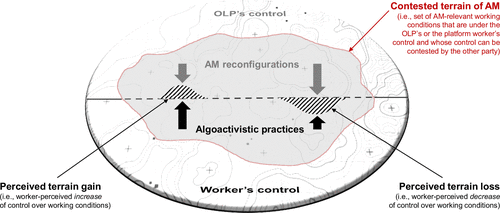
Notes. This conceptualization—including the distinctions between terrain-claiming and terrain-ceding AM reconfigurations, as well as worker-perceived terrain gains and losses—emerged inductively from our data analysis (see Section 3.3). We introduce these distinctions here to enhance the study’s conceptual clarity and narrative coherence.
Adopting the contested terrain as the theoretical lens of our study is particularly useful for addressing the two problematic assumptions and related research shortcomings summarized above (see Section 2.2). First, conceptualizing the workplace as a site of ongoing struggle between management and workers draws attention to how situated circumstances, reflective decision-making, and unequal access to resources shape workers’ choices of algoactivistic practices. Therefore, this lens moves beyond the (implicit) assumption in existing research that diverse practices are uniformly available to workers and follow directly from structural constraints such as restricted autonomy (see, e.g., Meijerink and Bondarouk 2023). By foregrounding heterogeneity in workers’ capabilities and conditions, and ultimately their agency, the contested terrain lens helps explain why different workers adopt particular algoactivistic practices in relation to the specific constraints and opportunities they encounter.
Second, viewing the workplace as a dynamic terrain in which control and resistance are mutually constitutive implies that algoactivistic practices are not merely reactive responses to AM—as is often assumed in prior research—but also include proactive efforts through which platform workers seek to shape and redefine their working conditions. Moreover, the contested terrain lens suggests that such practices unfold across multiple, interlinked “arenas” (Kellogg et al. 2020), illuminating how different forms of worker algoactivism operate and vary in focus. For instance, Kellogg et al. (2020) showed how worker mobilization around privacy and surveillance can shift contestation from organizational arenas to legal and regulatory ones. Furthermore, given the dialectical process underlying the contested terrain (see, e.g., Edwards 1979, Kellogg et al. 2020), this lens is conducive to uncovering the dynamic evolution of workers’ algoactivistic practices, along with their back-and-forth interactions with OLPs’ AM, which itself is subject to frequent reconfigurations (see, e.g., Cameron 2024). In what follows, we describe our methodological approach, including how the contested terrain lens guided our data analysis.
3. Methodology
We adopted a qualitative research design suited for theory building in underexplored domains (Edmonds and Kennedy 2016). To capture the diverse and evolving ways in which platform workers contest AM, we employed a computer-assisted grounded theory approach combining topic modeling with qualitative coding (Nelson 2020, Carlsen and Ralund 2022). Rather than imposing a priori constructs, we drew on Edwards’s (1979) notion of the contested terrain as a sensitizing lens that guided our analysis while allowing codes and relationships to emerge inductively from the data (Strauss and Corbin 1998, Klein and Myers 1999). Applied iteratively across multiple empirical sources, this approach enabled us to identify and refine emergent constructs, which we synthesized into a process-theoretical model of how workers contest AM. Next, we describe the context of our study, followed by our data collection and analysis procedures.
3.1. Empirical Context
To inductively theorize platform workers’ algoactivism, we selected the OLP Uber as our empirical setting. Uber is the global market leader in the highly competitive ride-hailing industry and makes extensive use of AM (see, e.g., Möhlmann et al. 2021, Wiener et al. 2023, Stelmaszak et al. 2025). Whereas some ride-hailing platforms, such as Didi (Chuxing), supplement AM with human managers (see, e.g., Li 2022), Uber relies on a fully automated management approach that largely eliminates direct human interaction with drivers. Extant research has thus characterized Uber as an extreme case of AM, making it “particularly useful for building new theory” (Möhlmann et al. 2021, p. 2001; cf. Gerring 2017).
Our contextual focus is on Uber in the United States, where drivers operate as independent contractors rather than employees (Edwards and Johnson 2024). Although this freelance model also exists in other countries (e.g., Brazil, Canada, China, Mexico, South Africa), in several European countries (e.g., France, Germany, The Netherlands, Spain), Uber drivers are typically employed by fleet companies (Uber 2024) This institutional variation is consequential for AM. In the U.S. context, the absence of employment protections and formal managerial oversight affords Uber substantial latitude in deploying AM techniques, including automated performance evaluation and algorithmic discipline. These conditions intensify drivers’ dependence on Uber’s AM system while limiting formal channels for voice or redress, thereby heightening the salience of individual-level contestation dynamics and making Uber U.S. a particularly fertile context for examining algoactivistic practices (cf. Karanović et al. 2021, Edwards and Johnson 2024).
3.2. Data Collection
Consistent with our inductive approach, we iterated between data collection and analysis (Lindberg 2020, Nelson 2020). Rather than following a fixed sampling plan, our data collection unfolded in three waves, guided by emerging insights and theoretical saturation. Each wave served a distinct purpose in understanding how platform workers contest AM (see Table 2 and Online Appendix B for details).
|
Table 2. Overview of Collected Data and Their Main Purpose
| Wave | Main purpose | Data type | Short description |
|---|---|---|---|
| 1 | Identifying distinct forms of Uber drivers’ algoactivistic practices | Forum posts | ∼980k posts from theme-based subforums of Uberpeople.net |
| 2 | Understanding Uber drivers’ motivations and triggers to engage in algoactivistic practices | Interviews | 22 semi-structured interviews with 18 Uber drivers |
| Discussion panel | Online discussion of interview findings with a panel of 15 Uber drivers | ||
| 3 | Unpacking the dynamic interplay between AM reconfigurations and algoactivistic practices | Forum posts | ∼200 posts from local subforums of Uberpeople.net |
| Vlog entries | 167 scripted YouTube videos (∼23 hours) from popular ride-hailing channels (e.g., The Rideshare Guy, Rideshare Professor) | ||
| Press releases/news articles | ∼50 press releases (e.g., Uber Newsroom) and articles (e.g., The Washington Post) | ||
| App release notes | 275 archived app release notes (2016–2023) about changes to the Uber driver app (from websites like ipa4fun.com) |
In wave 1, we collected online forum posts to identify Uber drivers’ algoactivistic practices and to develop an initial data structure (Gioia et al. 2013. Specifically, we focused on Uberpeople.net, an online discussion forum launched in 2014 with approximately 186,000 members at the time of data collection. Although the forum is open to users worldwide, most participants appear to be from English-speaking countries, particularly the United States. Our preliminary review indicated that drivers frequently use the forum to discuss work-related challenges and to share informal strategies for navigating Uber’s AM system. Based on this observation, we selected theme-specific subforums likely to contain AM-relevant content and scraped posts from them. This resulted in a data set of about 980,000 forum posts spanning January 2015 to August 2021.
Although this material was well-suited to identifying and categorizing algoactivistic practices, it provided limited insight into how these practices were temporally enacted and embedded in a broader constellation of antecedents and consequences. Therefore, wave 2 focused on deepening our understanding of why and under what circumstances drivers engage in specific forms of algoactivism. This wave consisted of 22 semi-structured interviews with 18 U.S.-based Uber drivers (see Online Appendix B for the interview guide). Interviews began with background questions (e.g., tenure, location) and then probed drivers’ perceptions of AM, experiences of constraint or unfairness, and the conditions under which they chose to contest Uber’s AM. Following a grounded-theory logic, we adapted interview questions as new themes emerged, allowing data collection and analysis to evolve in tandem. Interviews were concluded once theoretical saturation was reached (Corbin and Strauss 2015). To further refine our interpretations, we complemented the interviews with a discussion panel involving 15 drivers, who provided critical reflections on our interim findings.
Wave 3 focused on unpacking the dynamic interplay between Uber’s AM reconfigurations and drivers’ situated and reflective use of algoactivistic practices as well as on examining how such practices were enabled or constrained by access to specific resources. To capture these evolving dynamics, we expanded our empirical material. First, we revisited Uberpeople.net and collected approximately 200 additional posts from geographically focused subforums (e.g., San Francisco), where drivers discussed app changes in detail. Second, we analyzed 167 YouTube videos (around 23 hours total) from popular ride-hailing driver channels (e.g., The Rideshare Guy), which featured commentary on updates to Uber’s AM system alongside screenshots or email notifications. Third, to incorporate Uber’s perspective, we gathered about 50 press releases and news articles from Uber’s official Newsroom and major U.S. media outlets (e.g., The Washington Post). Finally, we collected 275 app release notes spanning from October 2016 to September 2023 from websites documenting the full version history of the driver app (see, e.g., iPa4Fun 2024), which enabled us to reconstruct the timing and substance of changes to Uber’s AM system. Taken together, these materials allowed us to trace Uber’s AM reconfigurations over time and to examine how drivers interpreted these reconfigurations and attempted to mobilize relevant resources in response.
3.3. Data Analysis
In parallel with data collection and consistent with inductive theory building, we analyzed our empirical material in three iterative analytical waves using a hybrid strategy that combined topic modeling with qualitative coding techniques. Following a computer-assisted, grounded-theory approach (Nelson 2020, Carlsen and Ralund 2022), we employed topic modeling not as a standalone analytic method but as pre-analytic scaffolding to surface latent semantic patterns in large-scale, unstructured data (Kulkarni et al. 2024). These patterns served as heuristic entry points for subsequent manual coding, consistent with the notion of computationally assisted open coding (Carlsen and Ralund 2022). Importantly, coding was conducted on representative data segments surfaced by the topic models rather than within model outputs themselves, thereby preserving the central role of human interpretation (Kulkarni et al. 2024). This approach enabled iterative movement between computational discovery and interpretive theorizing while remaining faithful to inductive grounded theorizing as practiced in IS research (see, e.g., Wiesche et al. 2017, Chatterjee et al. 2024). We acknowledge the potential risk of topic modeling prematurely structuring our analysis; we mitigated this risk through team-based discussion, iterative triangulation across data sources, and engagement with sensitizing concepts from the literature. Table 3 summarizes our three-wave analytical process, on which we elaborate below.
|
Table 3. Overview of Data Analysis Waves
| Data sources | Analytical steps | Key insights/results | Conceptual outcomes |
|---|---|---|---|
| Wave 1: Identifying distinct forms of Uber drivers’ algoactivistic practices | |||
|
|
|
|
| Wave 2: Understanding Uber drivers’ motivations and triggers to engage in algoactivistic practices | |||
|
|
|
|
| Wave 3: Unpacking the dynamic interplay between AM reconfigurations and algoactivistic practices | |||
|
|
|
|
3.3.1. Wave 1.
To handle the scale and unstructured nature of our first data set (forum posts), we employed Latent Dirichlet Allocation (LDA) topic modeling as a pre-analytic scaffolding technique (Schmiedel et al. 2018; also see Online Appendix C). After standard preprocessing (e.g., deduplication, tokenization, stop-word removal), we trained an LDA model to generate 100 topics, each represented by characteristic keywords and sample posts. Rather than treating these topics as analytical categories, we used them as a structuring device to narrow the corpus to theoretically promising entry points for qualitative interpretation (cf. Kulkarni et al. 2024). We then conducted manual open coding of representative posts associated with each topic to identify first-order concepts related to drivers’ acts of contestation (see Online Appendix D for details on the coding procedures). Whereas this stage drew on principles of classical open coding (Strauss and Corbin 1998), the machine-generated topics inevitably shaped which data segments were foregrounded. Therefore, we characterize this stage as computer-assisted open coding (Carlsen and Ralund 2022), in which human sensemaking remains central but is guided—rather than determined—by computational pattern detection. Following open coding, we engaged in axial coding to group first-order concepts into higher-order dimensions, which we synthesized into three aggregate constructs capturing distinct forms of algoactivistic practices (cf. Croidieu and Kim 2018). Engagement with the literature on algoactivism and resistance (see, e.g., Morrill et al. 2003, Kellogg et al. 2020) sharpened our theoretical sensitivity and prompted us to conceptualize these practices as inherently dynamic. Specifically, they appeared entangled with Uber’s AM, exhibiting recurrent back-and-forth interactions between AM reconfigurations and drivers’ algoactivistic practices. Recognizing this dynamic led us to more explicitly foreground the contested terrain of AM as a sensitizing theoretical lens guiding subsequent analytical waves (Klein and Myers 1999).
3.3.2. Wave 2.
In this wave, we refined our understanding of how drivers perceive and navigate the contested terrain. Building on insights from wave 1 and our deepening engagement with the literature, we conducted a second round of topic modeling on the forum data using BERTopic (Grootendorst 2024). This model generated 150 topics that were thematically sharper and more interpretable than those produced by the initial LDA model (see Online Appendix C). As in wave 1, topic modeling functioned as a discovery-oriented scaffold rather than a coding mechanism. In parallel, we conducted open coding of 22 semi-structured interviews with U.S.-based Uber drivers. Coding the interview material extended our conceptual vocabulary and surfaced first-order concepts not evident in the forum data alone. Through axial and selective coding across all open codes, two aggregate constructs began to stabilize (Gioia et al. 2013): getting the lay of the contested terrain, encompassing perceptions of terrain gains and losses, and resourcing, capturing how drivers draw on available means to contest AM. Throughout wave 2, Edwards’s (1979) notion of the contested terrain functioned as a sensitizing theoretical lens that oriented our attention toward dynamics of control, contestation, and resource mobilization without imposing predefined categories. This wave also yielded preliminary insights into how drivers’ perceptions of terrain gains and losses shifted in response to Uber’s AM reconfigurations, setting the stage for a more explicitly processual analysis.
3.3.3. Wave 3.
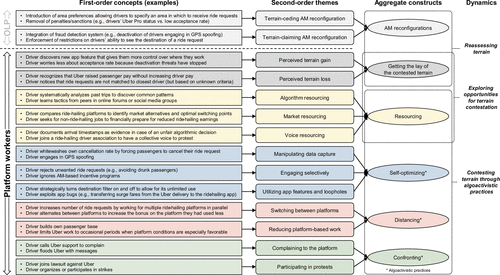
The third analytical wave focused on examining how Uber’s AM reconfigurations interact with drivers’ situated and reflective contestation practices over time. Drawing on additional empirical materials—including posts from local subforums, driver vlogs, press reports, and app release notes—we conducted open and axial coding to identify distinct forms of AM system changes. This analysis led to the conceptual distinction between terrain-ceding and terrain-claiming AM reconfigurations. In parallel, we performed selective coding across data from all three waves to link AM reconfigurations to drivers’ perceptions of terrain gains and losses and to connect their resourcing activities to specific algoactivistic practices. This integrative coding effort produced a more granular understanding of how drivers mobilize algorithmic, market-based, and voice-related resources to engage in distinct forms of algoactivism (see Online Appendix D). Across data sources, three recurring process dynamics consistently emerged: (1) reassessing terrain, (2) exploring opportunities for terrain contestation, and (3) contesting terrain through algoactivistic practices (see our final data structure in Figure 2). The third wave of analysis culminated in the development of a process-theoretical model that synthesizes the constructs and dynamics identified across all three waves. The model offers a longitudinal account of how platform workers contest AM by mobilizing available resources and recalibrating their algoactivistic practices over time.
4. Empirical Findings
In this section, we present our empirical findings, which are organized around the six aggregate constructs and their associated second-order themes identified in our analysis (see Figure 2). Building on these findings, Section 5 integrates the constructs into a process-theoretical model that explains how platform workers contest AM.
4.1. Algorithmic Management Reconfigurations
Consistent with existing research, we find that Uber periodically reconfigures its AM system. Prior studies suggest that OLPs use such reconfigurations primarily to increase control over working conditions (see, e.g., Cameron and Rahman 2022, Meijerink and Bondarouk 2023), that is, to claim terrain from workers. We find, however, that Uber engages in both terrain-claiming and terrain-ceding AM reconfigurations.
4.1.1. Terrain-Ceding AM Reconfiguration.
This type of reconfiguration entails Uber relaxing behavioral constraints imposed by its AM system, thereby ceding some control over working conditions back to drivers. For example, in 2020, in response to driver feedback, Uber introduced an app feature called “area preferences,” which allows drivers to specify areas they do not want to leave. Uber’s matching algorithms subsequently account for these preferences when assigning ride requests (Press Release 1, Vlog Entry 1), granting drivers greater discretion over where they work. Similarly, in 2018, the OLP launched the “Uber Pro” program, which offered rewards such as fuel discounts to high-performing drivers (Press Release 2). Initially, maintaining Uber Pro status required high acceptance rates, incentivizing drivers to accept trips they would otherwise decline (e.g., because of low profitability). In 2019, however, Uber introduced a related AM reconfiguration that allowed drivers to “accept only the trips you want to take, and your Uber Pro status won’t be affected” (Press Release 3), thereby increasing drivers’ discretion over ride selection.
4.1.2. Terrain-Claiming AM Reconfiguration.
In line with prior research, our data analysis indicates that Uber continually adjusts its AM system to expand control over working conditions, thereby claiming terrain from drivers. For example, to combat drivers who spoof their GPS data (see Section 4.4.1 for more details on this algoactivistic practice), Uber added fraud-detection algorithms to its AM system: “Using our fraud-fighting technologies, we can, for instance, differentiate between actual trips and those created by GPS spoofing, or analyze how our apps are being used to reveal fraudsters” (Press Release 4). These algorithms combine altitude and speed profiles with deep-learning models to automatically detect fraudulent activity and disable drivers who engage in such practices. Another example of a terrain-claiming AM reconfiguration concerns Uber’s decision to (re)introduce restrictions on the provision of upfront trip details. Specifically, after determining that providing detailed trip information had resulted in a “56% increase in pickup time for drivers in California” (Press Release 5), Uber decided to condition access to this information. As the company noted, “Based on our data, when upfront trip details are limited to drivers who accept 5 of their last 10 trip requests, we are able to improve this issue while still keeping upfront trip details as part of the app experience” (Press Release 5).
4.2. Getting the Lay of the Contested Terrain
This construct captures how drivers assess their degree of control over working conditions relative to the OLP, resulting in perceptions of either terrain gain or terrain loss.
4.2.1. Perceived Terrain Gain.
Drivers perceive a terrain gain when they experience greater control over their working conditions. Such gains typically result from terrain-ceding AM reconfigurations (see Section 4.1) that increase work efficiency, flexibility, or transparency. For instance, Interviewee 15 described an app feature called “destination filter” that allows drivers to better direct their work: “You can set a filter and drive in a direction toward somewhere you want to go. If you want to go home, you get rides on your way home.” In addition, drivers reported occasions in which Uber appeared to relax the enforcement of certain AM mechanisms. For example, Interviewee 7 reported, “At one time, [Uber] started sending messages, ‘Your acceptance rate is too low. If you continue with this acceptance rate, you may be deactivated.’ These threats [suddenly] stopped.” Similarly, Interviewee 2 noted a change in the rating system that now requires passengers to provide a reason when assigning a low rating. This change allows the platform to distinguish between factors beyond drivers’ control (e.g., high fares) and those within their influence (e.g., car cleanliness), thereby increasing drivers’ perceived fairness and control over how their performance is evaluated:
…now on the app, when a passenger rates you, they have [to give] a reason…And if they choose, like, the price is too high, then I think Uber just doesn’t count that toward you at all. So, it’s less stressful than it used to be.
4.2.2. Perceived Terrain Loss.
In contrast to a perceived terrain gain, drivers perceive a terrain loss when they experience diminished control over working conditions. Such losses often occur following terrain-claiming AM reconfigurations (again, see Section 4.1). For example, Interviewee 9 learned from passengers that Uber had changed its pricing algorithms in ways that increased passenger fares without raising driver pay:
There’ll be times, for example, where the customer will tell us, ‘Hey, why is this ride $100, when normally it is $40?’ I’m like, ‘We don’t know, we’re still getting paid the same. Uber is the one that’s keeping everything else.’ So, there are updates that they do to benefit the company…
Importantly, perceived terrain loss does not necessarily require an explicit change in the AM system; it may also emerge as drivers recalibrate their expectations based on experience. Among new drivers, a common assumption is that Uber’s matching algorithms assign ride requests to the closest available driver, as Interviewee 16 recalled: “In my initial years, I had more trust that it was just kind of like a simple algorithm of matching the rider to the closest driver.” Over time, however, this driver realized that matching decisions were based on additional criteria: “As a passenger, you can order a ride and they’ll tell you…wait 15 minutes and pay $8 for [the] ride, or…wait eight minutes and pay $15…What that says to me is you’re sending a driver who is further away and not sending the closest driver” (Interviewee 16). Relatedly, as drivers gained experience, they learned that some AM-based incentive mechanisms were less reliable than expected. For instance, although Uber’s surge pricing algorithms highlight areas of low supply and promise higher fares, drivers reported that surge premiums often declined or disappeared by the time they arrived in the designated area: “By the time I get there, [surge is] either going down [or gone]…The surge works really well as a tool for redistribution, but it doesn’t work that great for drivers” (Forum Member 1).
4.3. Resourcing
In response to perceived terrain loss, drivers engage in preparatory activities—referred to as resourcing—that enable subsequent algoactivistic practices. There are three types of such activities: algorithm, market, and voice resourcing.
4.3.1. Algorithm Resourcing.
To interact more effectively with Uber’s AM system, drivers cultivate practical knowledge of its algorithmic logics and develop tactics to influence them. These efforts include experimenting with different work practices to identify recurring patterns. For instance, some drivers systematically track their trips to infer which locations and times yield the most profitable rides. As Interviewee 9 explained: “I wrote down in a notebook the areas and the times where I would get rides. From there, I just kind of narrowed it down, like, on a Friday, it’s better for me to work from 9 a.m. to 12 p.m. at this location, and then in the evening, it’s better for me to work at this location.” Beyond individual experimentation, these efforts also have a social dimension. Drivers frequently turn to peer networks (e.g., online forums or WhatsApp groups) to exchange insights about Uber’s algorithms and share practical advice, as Interviewee 2 noted: “I’ve heard of a lot of people…on the forum that have been deactivated. I do a lot of things just to try to avoid deactivation based on what other people say.”
4.3.2. Market Resourcing.
This resourcing type involves monitoring and comparing ride-hailing platforms (e.g., in terms of demand patterns, incentive structures, and available features) to identify market alternatives and assess when platform switching is most advantageous. Through such cross-platform analysis, drivers develop knowledge that enables strategic responses to changing market conditions. For instance, Interviewee 11 described how she learned about differences in demand patterns between Uber and Lyft across locations: “…there are actually certain areas [where] people don’t use Lyft as much. And they use Uber more. And the other way around…” Market resourcing also encompasses preparations for work outside ride-hailing, such as exploring alternative income sources or developing new skills to reduce financial dependence on platform work. For example, Interviewee 15 noted that she “started training to get another job,” illustrating how drivers proactively seek to diversify their potential sources of income.
4.3.3. Voice Resourcing.
Drivers also engage in voice resourcing, that is, preparatory activities aimed at gathering evidence, communicating effectively with Uber, and coordinating with peers. Because Uber tends to side with passengers, drivers document their compliance as a proactive form of self-protection against future disputes. For instance, when a driver waits the required five minutes at a pickup location and the passenger does not show up, they can cancel the ride and collect a cancellation fee. In such cases, drivers commonly use the passenger chat to create a timestamped record of their arrival, as Forum Member 2 explained: “Once I park the car, I text the passenger, ‘Uber Outside’ to let them know I’m waiting. By doing this, it also acts as a Time Stamp for my arrival…I then wait 5 minutes before canceling the ride as a ‘Rider No-Show.’” In addition, drivers develop strategies to interact more effectively with Uber support, such as saving commonly used messages to copy and paste for future complaints. Beyond individual-level strategies, voice resourcing also involves collective efforts that strengthen drivers’ capacity for joint action. One example is participation in associations such as Rideshare Drivers United (RDU), which provide a “platform” for advocating for improved working conditions and organizing collective action, as noted by Interviewee 11: “I got involved with RDU so we can have a voice together. If we stand together, we will actually be able to do something about this. But if we stay apart and sit in our own cars and yell at the world, nobody is going to hear us.”
4.4. Algoactivistic Practices
Building on the resourcing activities described above, platform workers engage in three categories of algoactivistic practices—namely, self-optimizing, distancing, and confronting—each representing a distinct way in which drivers seek to achieve terrain gains.
4.4.1. Self-Optimizing.
Self-optimizing refers to drivers’ efforts to gain advantages within Uber’s AM system, sometimes by exploiting system features in unintended ways. Three prominent forms of self-optimizing are manipulating data capture, engaging selectively, and utilizing app features and loopholes.
4.4.1.1. Manipulating Data Capture.
Some drivers strategically manipulate the data that Uber collects to portray themselves as high performers. One tactic—referred to as “shuffling”—involves accepting a ride request, driving toward the pickup location, and then parking out of sight. This often prompts the passenger to cancel the requested ride (for a fee), allowing the driver to avoid a cancellation penalty while preserving favorable performance metrics. In this way, passengers are effectively “shuffled” from one driver to the next, as Forum Member 3 openly admitted: “Recently, I’ve been keeping my cancellation rate low by accepting trips I know are only going to pay $3 and shuffle every chance I get. Yes, the shady kind of shuffling where you hide around the corner. Sorry, not sorry.” Besides shuffling, some drivers spoof their GPS location to distort the data collected by the AM system. They do so by altering their phone’s GPS settings, which the system uses to determine a driver’s location. By spoofing GPS coordinates, drivers can receive surge ride requests without being in a surge zone or make a trip appear longer than it actually was: “It will simulate a route with the longest route possible while you actually drive the shortest route” (Forum Member 4).
4.4.1.2. Engaging Selectively.
Selective engagement involves drivers accepting or rejecting ride requests based on their own preferences rather than platform incentives. For example, Interviewee 10 explained how he avoids certain pickup locations based on prior experience: “If I see a pickup at a specific bar location that I know has horrible, terrible people that come out of there, I won’t accept it.” Another example concerns Uber’s rewards program (Uber Pro), which offers tiered benefits (e.g., cash-back rewards for gas or electric vehicle [EV] charging) contingent on drivers’ program status, ranging from “blue” to “diamond.” Achieving higher status requires maintaining a minimum acceptance rate, often incentivizing drivers to accept otherwise undesirable rides. In response, some drivers choose to disengage from the program altogether. For instance, Forum Member 5 wrote: “Now I just take the good rides. I don’t care about diamond anymore because I just see no benefit at all.”
4.4.1.3. Utilizing App Features and Loopholes.
Drivers also exploit app features and technical loopholes to optimize their work and maximize earnings. For instance, although Uber limits the use of its app’s destination filter to twice per day, some drivers have discovered ways to circumvent this restriction, enabling repeated use. Forum Member 6 explained: “I would put a destination, get a ride, and remove the destination sometime before dropping off the rider. It ALWAYS showed 2 destinations remaining.” Drivers also rely on external applications to optimize their work. For example, some reject the Uber driver app’s navigation function in favor of alternatives such as Google Maps. In addition, drivers exploit technical glitches across Uber’s apps, as described by Interviewee 8: “There was a bug for a while. At [that] time, Uber Eats was giving some kind of crazy multiplier. So, if you turned on Uber Eats first and then turned on Uber, you [could] get the Uber Eats surge to apply to your rides.”
4.4.2. Distancing.
Distancing encompasses algoactivistic practices through which drivers contest Uber’s AM by strategically reducing their dependence on the platform. Drivers enact distancing by switching between competing ride-hailing platforms and by scaling back platform-based work more generally.
4.4.2.1. Switching Between Platforms.
Many drivers engage in multihoming by working simultaneously for other ride-hailing platforms such as Lyft. By switching between apps based on the relative advantages offered by different platforms, drivers reduce their dependence on any single platform and preserve leverage, particularly in the event of deactivation. Forum Member 8 explained:
I wanted to have more control over my schedule and preferences. Uber and Lyft have different [app] features and options that allow drivers to customize their experience…By using both apps, I can choose the one that suits my needs better at any given time.
Drivers also observed that switching between platforms altered the incentives they faced. Specifically, bonuses often increased on platforms where drivers had been less active, reflecting algorithmic efforts to reengage them. Interviewee 16 noted: “I definitely felt it was important that I had access to both systems…I would go off a system for a couple of weeks [and] my bonuses [would] work their way back up, because they were trying to pull me back over…”
4.4.2.2. Reducing Platform-Based Work.
Drivers distance themselves from Uber by scaling back their platform-based work and, in some cases, bypassing the platform altogether. One strategy involves establishing direct relationships with passengers by distributing personal contact information to arrange rides off-platform. Another involves attempting to complete rides “offline” after Uber’s AM system has matched a driver with a passenger, as Forum Member 9 explained: “First, click start on arrival and see where [the passenger is] going. If the trip is long, cancel when you see the pax coming. Say to the pax, ‘Oops, I canceled by accident. You can pay cash if you want. I will give you a 10% discount.’” Some drivers also reduce their platform work by securing alternative employment and driving only when bonus offers make it financially attractive. For example, Interviewee 16, a former full-time Uber driver who returned to his job as a teacher, now drives only when high bonus incentives are offered:
I just drive very occasionally, about once a month, on the weekend. Because I work so little now, I get these offers sometimes where there are like 10 rides for $100. They give me an extra $10 a ride, because they’re a little short on drivers. So, I’ll go steal the bonus and then get off the road.
4.4.3. Confronting.
Confronting represents an overt challenge to Uber’s AM system, in contrast to the more covert algoactivistic practices of self-optimizing and distancing. Two primary forms of confrontation are complaining to the platform (at the individual level) and participating in protests (at the collective level).
4.4.3.1. Complaining to the Platform.
At the individual level, drivers contest AM by directly lodging complaints with the platform. These complaints typically aim to challenge perceived errors or unfairness in algorithmic decisions, often focusing on passenger ratings—a key performance metric in Uber’s AM system. Because ratings are also shaped by factors beyond drivers’ control—such as traffic congestion or surge pricing—many drivers perceive them as inaccurate and unfair. To push back, drivers regularly contact Uber support via messages or phone calls. As Forum Member 10 wrote: “Uber needs repeated complaints about this poor and unfair rating system.” In this regard, drivers emphasized that complaints must be persistent and increasingly confrontational to elicit any meaningful response:
You must keep sending [Uber support] emails that become progressively more nasty…[until they] escalate it to someone who will give you something close to what you want (Forum Member 11).
4.4.3.2. Participating in Protests.
Uber drivers also engage in collective protest through legal or public means to pressure the OLP to change its AM system and improve drivers’ working conditions. Rather than addressing the platform directly, these efforts shift contestation to broader institutional and public arenas to demand systemic change. Some drivers escalate their complaints by filing lawsuits: “Uber is doing everything they can to try to ‘punish’ me, but their little illegal business tactic is going to backfire on them. I have already filed a lawsuit and will not stop fighting for my rights all the way to the Supreme Court” (Forum Member 12). Alternatively, drivers participate in street protests to raise public awareness of their working conditions. For example, Interviewee 4 pointed out, “I have participated in three [protests]. We were able to get a lot of attention to the larger issues and sort of earn a voice.”
5. Process-Theoretical Model
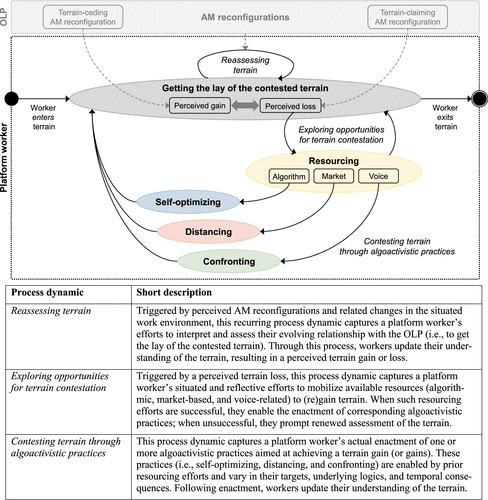
This section integrates the six aggregate constructs introduced above into a process-theoretical model of how platform workers contest AM (see Figure 3). While remaining closely anchored in our empirical data, the model also develops empirically grounded propositions that open avenues for future research on worker contestation under AM. Conceptually, it spans workers’ entry into the contested terrain (i.e., when they begin working for an OLP) through to their exit from that terrain (i.e., when they discontinue work on that platform).2 Upon entering the terrain, workers first develop an understanding of which working conditions are controlled by the OLP and which remain under their own control (i.e., the initial lay of the contested terrain). Following this initial assessment, three recurrent process dynamics come into play: (1) reassessing terrain, (2) exploring opportunities for terrain contestation, and (3) contesting terrain through algoactivistic practices. Below, we elaborate each dynamic to explicate the underlying logic of the model and present propositions that summarize its central theoretical insights.3
5.1. Reassessing Terrain
OLPs’ AM systems are highly adaptive, frequently updated, and often opaque, rendering platform workers’ assessment of the contested terrain inherently dynamic. Rather than responding mechanically to structural constraints, workers continually interpret their working conditions by making situated and reflective judgments about how the boundaries of control between themselves and the OLP are shifting. Assessing the contested terrain thus constitutes a recurrent interpretive process through which workers evaluate their evolving relationship with the platform. This reassessment process is triggered by multiple types of cues that signal shifts in control. First, visible or experienced AM reconfigurations—such as modified app behavior, added features, or removed functionalities—lead platform workers to reconsider how work is governed. For instance, in the case of Uber, the introduction of new app features (e.g., destination filters) or new restrictions on viewing the destination of requested rides (see Section 4.1 for additional examples) led drivers to reassess their degree of control over working conditions.
Second, terrain reassessments may be triggered by AM-related changes in workers’ situated work environment. These include unanticipated income drops, missed bonuses, or unclear pay adjustments, which can violate workers’ expectations and raise more general concerns about the AM system. Interviewee 16 recalled: “Over time, as my income declined, I realized how much I was being algorithmically manipulated for maximum effort [and] minimum pay.” Similarly, reassessments may also be triggered by declining well-being and health concerns arising from AM-mediated work routines. Persistent fatigue, increasing body weight, or other health indicators can signal to workers that their current work environment is unsustainable. Such experiential cues often prompt workers to step back and reappraise their working conditions, as Interviewee 7 reported: “I realized health was not going in the right direction. I was putting weight on because you’re spending so much time in the car. You’re eating junk food…Your blood pressure’s up and your cholesterol…You’re not heading in the right direction. Then you take time to reflect.” Across these triggers, reassessing the contested terrain involves workers forming an interpretive judgment about whether their control over working conditions has contracted or expanded. As detailed in Section 4.2, workers typically perceive greater earning potential, flexibility, or transparency as terrain gains, whereas they perceive additional or heightened constraints as terrain losses. Given the above, we posit the following:
When platform workers experience AM reconfigurations or related changes in their situated work environment, they reassess the contested terrain, resulting in perceptions of terrain gain or terrain loss.
5.2. Exploring Opportunities for Terrain Contestation
Our analysis reveals that platform workers do not respond to perceived terrain losses by engaging immediately in algoactivistic practices. Instead, a perceived loss initiates an exploration of opportunities for terrain contestation. As illustrated in Sections 4.2 and 4.3, workers who experienced declining earnings, reduced flexibility, or diminished transparency frequently responded by seeking information, experimenting with work practices, comparing ride-hailing platforms, or coordinating with peers. Through these activities, they identified potential ways to regain control over working conditions and to mobilize algorithmic, market-based, or voice-related resources. For example, Interviewee 15 described perceiving a terrain loss when he realized that he was earning less for the same amount of work. In response, he engaged in algorithm resourcing, seeking advice in an online forum: “I was becoming more frustrated and making less money for the same amount of work. And I was in a forum where I saw so many people were making money, and I said, ‘How did you do that?’”
Importantly, the specific form of resourcing that workers pursue depends on their individual capabilities, preferences, and social context. Prior experiences, dispositions, and access to information shape how workers can identify, access, and mobilize different types of resources, creating uneven possibilities for responding to perceived terrain losses. For instance, workers with technical knowledge tend to engage in algorithm resourcing by experimenting with app features, those with broader labor market experience may pursue market resourcing, and workers with strong communication or organizing skills often engage in voice resourcing. Interviewee 8, for example, described how her background in organizing led her to engage directly in voice resourcing: “I’m an organizer…A friend of mine sent me an email and said, ‘Hey, I saw some drivers were protesting at LAX.’ And so, I found the article, I called them and said, ‘What are we doing? How can I help?’” When resourcing efforts are successful, they enable workers to engage in actionable forms of terrain contestation through algoactivistic practices. Against this backdrop, we propose the following:
Perceived terrain losses trigger platform workers to explore opportunities to regain control over working conditions and mobilize relevant resources.
Successful resourcing efforts enable platform workers to engage in terrain contestation through algoactivistic practices.
Resourcing efforts, however, are inherently uncertain and not always successful. In some cases, workers’ attempts to mobilize resources fail to provide the capabilities or support needed either to engage in algoactivistic practices at all or to enact particular practices. For example, several interviewees found it difficult to develop a sufficient understanding of the AM system’s algorithmic logic: “I have tried to get mentored by smart drivers, and it’s really hard for me. It’s hard for me when I get a ride to guess whether it’s a good money-making ride or a bad ride, and then if it’s a bad ride, [to] push ‘No.’” (Interviewee 8).
When resourcing fails, workers cycle back to reassessing the contested terrain. Without the capabilities, support, or options needed to contest the terrain effectively, workers often struggle to sustain or escalate algoactivistic efforts. For some, reassessing the terrain leads to an adjustment of expectations and a reluctant acceptance of the perceived terrain loss. Interviewee 16, for instance, described growing frustration with his ride-hailing work at Uber but continued driving because of financial dependence: “I used to be frustrated, but I head back out and hit the road because I was doing this for a living, [for] my main bread and butter, and I had to get out there and work.” By contrast, other workers respond to sustained terrain losses by discontinuing their work, that is, by withdrawing from the contested terrain altogether. For example, one Uber driver concluded, “It’s not worth it…Your time is far better [spent] doing something a LOT more productive and learning life and job skills that will pay you more as you get older.” (Forum Member 13). On this basis, we suggest the following:
When resourcing efforts fail, platform workers return to reassessing the contested terrain and may temporarily accept perceived terrain losses or exit the contested terrain altogether.
5.3. Contesting Terrain Through Algoactivistic Practices
Building on successful resourcing efforts, platform workers proceed to contest AM. As illustrated in Sections 4.3 and 4.4, different forms of resourcing shape workers’ modes of contestation by conditioning the types of algoactivistic practices that they are able to enact. First, algorithm resourcing builds algorithm-specific knowledge that facilitates self-optimizing. By experimenting with app features or exchanging insights with peers, workers learn how the AM system allocates tasks, applies penalties, and calculates rewards, allowing them to tactically influence algorithmic outcomes. As Interviewee 6 explained, he learned from experienced drivers about algorithmic patterns before engaging in self-optimizing practices, such as adjusting when and how he worked:
In the beginning, I [was] driving during the days…and stuff like that, but then talking to drivers who were driving since 2013, [I started] learning from them. Like, what are the good hours, the good days, and stuff like that. If I work from Friday at 10 o’clock at night till Monday [at] three o’clock in the morning, I would make the same amount of money [as] someone who worked from Monday to Sunday. So that’s how I [am] currently still driving.
Second, market resourcing enables distancing. By comparing platforms or developing supplementary income sources outside of ride-hailing, workers learn when and how to shift between markets. These learning processes reduce workers’ dependence on a single OLP and increase control over broader working conditions. For instance, Interviewee 11 compared Uber and Lyft and selectively drove for the platform that provided more transparent information about ride requests: “Uber…sometimes show[s] you where you’re going, and Lyft never did that. Now, Lyft kind of shows you the direction if you are on gold status. I reached the gold status…that’s why I currently drive for Lyft, so I can consistently see the direction where to go.” Similarly, Interviewee 14 described building a private rental business to reduce dependence on Uber and Lyft: “Even though I work with Lyft and Uber, I’m trying to do it on my own way. I also do private rentals. Sometimes I work with the hotels. Sometimes I get downtown, I get a few people who are like pedicab drivers who will let me know when there is a customer.”
Third, voice resourcing enables confronting. Through documentation, structured communication with the OLP, and collaboration with peers or worker associations, platform workers develop communicative and organizational capabilities needed to articulate and escalate grievances. For example, Interviewee 11 noted that drivers with dashcams are more likely to be reinstated after false accusations because they can substantiate complaints: “When you have a dashcam, it’s very much more likely for you to get reinstated. I have had people who were accused…And the driver said, ‘What are you talking about? I have the dashcam give me the time, I will show you all my videos.’ Then, they…were reinstated the next day.” At the collective level, Interviewee 10 described joining a drivers’ union to confront Uber through legal action: “I am a participant with Rideshare Drivers United [RDU]. Basically, I help organize other drivers to try to get things changed so that they are fair and equal, and we’ve been battling [legally] with Uber.”
Importantly, workers may engage in multiple forms of algoactivism in parallel or shift between them over time, depending on the outcomes of their recurring resourcing efforts. For instance, by successfully mobilizing both algorithmic and voice-related resources, Interviewee 6 refined his cherry-picking strategies through peer knowledge exchange while also participating in strikes after joining RDU. More generally, when workers manage to mobilize different types of resources, they are likely to engage in multiple algoactivistic practices simultaneously; when resourcing is limited, however, they typically focus on a single practice. Resourcing thus helps explain why workers differ in how they contest the terrain, reflecting heterogeneous forms of agency. Therefore, we posit the following:
The types of resources platform workers mobilize shape the forms of algoactivistic practices they enact; algorithm resourcing enables self-optimizing, market resourcing enables distancing, and voice resourcing enables confronting.
Although self-optimizing, distancing, and confronting all constitute ways through which platform workers may achieve perceived terrain gains, the three algoactivistic practices differ in their targets of contestation, underlying logics, and temporal consequences. Reflecting the multi-arena nature of worker algoactivism (cf. Kellogg et al. 2020), these practices operate on different dimensions of the contested terrain of AM and thus produce distinct terrain shifts. Specifically, self-optimizing, distancing, and confronting can be understood as forms of terrain incursion (push into), terrain extension (push away), and terrain defense (push back), respectively, as illustrated in Figure 4. In other words, although all three algoactivistic practices aim to improve workers’ control over working conditions, they differ in where contestation is directed, how it is enacted, and how durable resulting terrain gains are likely to be.
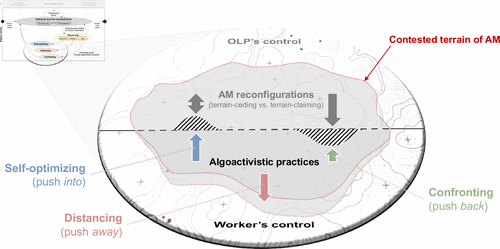
Self-optimizing practices target the algorithms themselves because workers proactively exploit algorithmic features in unintended and often covert ways. Through these practices, workers directly contest the AM system by manipulating data inputs or strategically adapting their engagement with algorithmic outputs and features. Self-optimizing thus constitutes a form of terrain incursion—a push into the OLP’s terrain—through which workers seek immediate gains such as higher earnings or greater autonomy. For example, by selectively accepting ride requests, Interviewee 16 felt that he had outperformed the platform: “At the end of the night, I basically had made about $600, and Uber had made about $590. I felt victorious that day.” Similarly, Interviewee 9 described how self-optimizing helped him make ride-hailing work financially worthwhile: “It is profitable. But you kind of have to adjust to it and just be really smart on the location and the times you drive. But it is profitable.”
However, because self-optimizing relies on exploiting system loopholes, its terrain gains are often short-lived. Once such practices are detected, OLPs frequently respond with terrain-claiming AM reconfigurations designed to close these loopholes. Interviewee 10, for instance, recalled how drivers at airports learned to exploit Uber’s “plus-45” flag (indicating rides exceeding 45 minutes) to target more profitable trips. In response, Uber reconfigured its airport matching algorithm by removing the plus-45 indicator and enforcing automatic acceptance rules: “[They] changed the way the queue works…You have to accept your next ride, or they’re going to kick you out of the queue.” By removing informational cues and limiting opportunities for choice, such reconfigurations reverse prior terrain incursions, render self-optimizing practices obsolete, and reduce workers’ control over working conditions. Reflecting this logic, we propose the following:
Self-optimizing constitutes terrain incursion (“push into”); platform workers exploit loopholes in the AM system to achieve terrain gains, but these gains are often short-lived because OLPs respond with terrain-claiming AM reconfigurations that neutralize such practices.
Distancing practices shift the target of contestation from algorithms to the OLP’s broader business model by challenging key conditions on which platform services depend, including worker availability and reliability. These practices are typically only indirectly visible to the OLP because workers strategically modify their participation in the platform and its AM system (e.g., reducing availability or shifting to part-time work). Distancing thus represents a proactive reorientation of workers’ engagement with the OLP ecosystem, allowing them to redefine the conditions under which they are willing to participate. As such, distancing constitutes a form of terrain extension, whereby workers push away from the contested terrain of a single OLP. In doing so, workers create additional room for maneuver beyond the platform’s immediate control and expand their choice among alternative working arrangements. For example, after reducing her ride-hailing work from full-time to part-time, Interviewee 11 described experiencing greater control over when and where to work: “I [now] have the luxury to choose…If I go to an area where there [are] many drunk people, I can choose to [leave] that area or try other things that maybe another driver who just has to be on the job at two in the morning to get the most money can’t [do].”
In terms of temporal consequences, terrain gains resulting from distancing practices are typically more durable than those associated with self-optimizing because they are partly situated outside the OLP’s direct control and therefore cannot be immediately undermined through terrain-claiming AM reconfigurations. At the same time, such gains rarely persist indefinitely because OLPs may gradually erode them through adjustments at the business-model or ecosystem levels that restrict workers’ autonomy. A case in point is Uber’s introduction of a car rental program that imposed participation conditions—such as a required minimum number of trips—to retain access to the vehicle: “They had a minimum [number] of rides you had to do to retain your rent. Usually, you had to do like a minimum of ten rides a week” (Interviewee 17). Affected drivers perceived this change as a terrain loss because it reduced their flexibility and limited their ability to work for competing platforms such as Lyft. Similarly, drivers viewed the introduction of the “Industry Sharing Safety Program,” through which Uber and Lyft share information about deactivated drivers (Lyft 2021), as constraining their ability to engage in distancing. Interviewee 10 explained, “Uber and Lyft created a holding company that basically shares information about deactivated drivers. So, if you get deactivated on Uber, you get deactivated on Lyft.” Synthesizing these insights, we formulate the following proposition:
Distancing constitutes terrain extension (“push away”); platform workers reduce dependence on a single OLP by extending their engagement across platforms or alternative income arrangements, but the associated terrain gains remain vulnerable to business-model and ecosystem-level adjustments.
Confronting practices are directed at the human actors behind the OLP’s AM system—namely, corporate actors such as managers and technology designers responsible for the system’s algorithmic logic and its governance. Unlike self-optimizing or distancing, these practices are overt because workers openly challenge unfavorable working conditions. As such, confronting represents a distinct form of terrain defense through which workers push back to reclaim contested terrain. At the same time, confronting practices depend on cooperation from the OLP and its governing actors because enduring change requires acknowledgment, negotiation, or compliance on their part. For instance, Uber’s former policy to deactivate drivers with low acceptance rates was successfully challenged in court, prompting terrain-ceding reconfigurations, as Interviewee 1 remarked: “They can’t kick you off the platform if you have a very poor acceptance rate.” Similarly, collective protests in California constituted a broader push back against Uber’s classification of drivers as independent contractors. This confrontation contributed to the passage of Assembly Bill 5 (AB5), requiring Uber to reconfigure its AM system and grant drivers greater control over their working conditions (Wang et al. 2025). Interviewee 6 provided an example: “Uber decided to change the app a little where it gave drivers more control of pricing…You [could] filter the price to get fares that were two times to five times [the base fare].”
Regarding temporal consequences, successful confronting tends to generate more durable terrain gains because it can produce structural change. However, such outcomes are often uncertain and slow to materialize because they depend on the OLP’s responsiveness and broader institutional processes. For instance, legal actions may take years before any terrain gains emerge, as Interviewee 14 explained: “For every tiny thing…there will be a four-year court process, which is like forever, right?” Similarly, when drivers complain directly to Uber support, their concerns frequently go unanswered, as Interviewee 9 noted: “As much as we tell them and…complain, nothing gets done. They just kind of do whatever they want to do.” Still, by seeking to alter the institutional and governance conditions surrounding AM systems, confronting practices hold the potential to produce larger and more enduring perceived terrain gains. In light of the above, we put forward the following:
Confronting constitutes terrain defense (“push back”); platform workers challenge OLP terrain claims through direct or institutionally mediated action. Although confronting can generate durable terrain gains, its outcomes are often uncertain and slow to materialize.
6. Discussion
As platform-based work assumes a growing role in global labor markets (Datta et al. 2023), the algorithmic systems through which it is governed warrant critical attention. Although OLPs promise flexible earning opportunities, their reliance on AM often creates precarious working conditions that prompt worker resistance in the form of algoactivism (Kellogg et al. 2020). Existing research on this phenomenon, however, rests on two dominant yet arguably problematic assumptions that insufficiently account for platform workers’ heterogeneous contexts and motivations, unequal access to resources, and meaningful variation in how different forms of algoactivistic practices operate (see Table 4 for a recap of these assumptions). To address these limitations, our study develops a more textured and processual understanding of worker agency and contestation in platform ecosystems. Anchored in the empirical context of Uber, we draw on the theoretical lens of contested terrain (Edwards 1979) and combine computational topic modeling with grounded theory coding (Nelson 2020, Carlsen and Ralund 2022) to inductively develop a process-theoretical model of how individual platform workers contest OLPs’ use of AM.
|
Table 4. Summary of Research Contributions and Their Implications
| No. | Problematized assumption | Specific contributions | Research implications |
|---|---|---|---|
| 1 | Algoactivistic practices are uniformly accessible to workers and arise directly from perceived structural constraints. |
| Accounting for workers’ resourcing capacities and dynamics enables future research to:
|
| 2 | Algoactivistic practices are primarily reactive forms of resistance broadly targeted at the AM system. |
| Accounting for proactive and varied forms of algoactivism enables future research to:
|
6.1. Research Contributions and Implications
Our study contributes to research on OLPs, AM, and algoactivism in two main ways. First, whereas existing literature often implies that platform workers readily adopt diverse forms of algoactivism in response to structural constraints such as restricted autonomy or economic precarity (see, e.g., Kellogg et al. 2020, Cameron and Rahman 2022, McDaid et al. 2023, Meijerink and Bondarouk 2023), our findings show that engagement in algoactivistic practices is neither automatic nor uniform. Instead, these practices unfold through a situated, reflective process in which workers continually reassess the contested terrain (cf. Edwards 1979). This reassessment involves interpreting AM reconfigurations (terrain-claiming vs. terrain-ceding), as well as broader AM-related changes in workers’ situated work environments, and shapes whether workers perceive terrain gains or losses (see Proposition 1a). Perceived terrain losses, in turn, trigger resourcing efforts through which workers attempt to mobilize algorithmic, market-based, or voice-related resources that enable different forms of algoactivism (see Propositions 1b and 1c).
By foregrounding these resourcing dynamics, our study reveals that worker agency under AM is emergent, conditional, and unevenly distributed—rooted not only in macro-level structural constraints (see, e.g., Möhlmann et al. 2021, McDaid et al. 2023, Meijerink and Bondarouk 2023) but also in workers’ microlevel capacities to identify opportunities for contestation and mobilize relevant resources. Notably, this perspective does not negate the precarity of platform work (see, e.g., Cornelissen and Cholakova 2021, Glavin et al. 2021, Montgomery and Baglioni 2021); rather, it draws greater attention to the choices that individuals in precarious settings may still be able to make available to themselves (Hultin et al. 2022). It also clarifies why worker inaction or silence should not be equated with compliance or consent (cf. Cameron 2024); workers may refrain from contesting algorithmic directives not because they accept them but because they lack sufficient resourcing capacity (see Proposition 1d). This interpretation aligns with Weber et al. (2026), who found that “many workers lack the agency and proactivity required for overt activism or resistance” (p. 19).
Moreover, whereas previous studies often portray algoactivistic practices as discrete or mutually exclusive (see, e.g., Möhlmann et al. 2021, Weber et al. 2026), our findings show that workers may engage in multiple forms of algoactivism simultaneously, depending on the resources they are able to mobilize (see Proposition 1e). This resourcing-based theorization of algoactivism provides a more nuanced account of how capacities for contestation are shaped in platform-based work. More broadly, it opens new avenues for research on how workers develop, combine, and mobilize different resources in response to AM across varying platform and occupational contexts. It also encourages future studies to move beyond structural accounts of precarity by examining how workers’ situated contestation capacities shape divergent forms of engagement with AM systems over time.
Second, existing literature has predominantly conceptualized algoactivism as a reactive form of resistance through which platform workers attempt to reclaim greater autonomy (see, e.g., Möhlmann et al. 2021, Rahman 2021, Tarafdar et al. 2023). Within this literature, the AM system itself is typically treated as the primary target of contestation (see, e.g., Kellogg et al. 2020, Cameron and Rahman 2022, McDaid et al. 2023). Our study extends this perspective by theorizing algoactivism as comprising three qualitatively distinct algoactivistic practices—self-optimizing, distancing, and confronting—each characterized by different logics of action, targets, and temporal consequences. Importantly, our findings show that algoactivism is not exclusively reactive. Whereas confronting mirrors prior descriptions of reactive terrain defense in response to platform-imposed claims (push back), self-optimizing and distancing reflect proactive forms of terrain incursion (push into) and terrain extension (push away), respectively (see Propositions 2a–2c). This broader conceptualization reveals that workers do not merely respond to terrain-claiming AM reconfigurations; rather, they continually and proactively navigate and reshape contested terrain over time. As such, our study advances a more dynamic, agentic, and temporally sensitive understanding of worker algoactivism.
Our expanded perspective further reveals that distinct forms of algoactivism are directed at different sociotechnical targets. Self-optimizing practices contest the algorithmic logic of the AM system, distancing practices challenge key elements of the OLP’s business model, and confronting practices target the human actors who govern the system. These differentiated forms of engagement illustrate how workers navigate, leverage, and resist the platform’s sociotechnical infrastructure, ranging from the algorithms underlying the AM system to the humans “behind” those algorithms (e.g., managers and technology designers).
Furthermore, whereas prior work has rarely problematized the differing temporal consequences of algoactivistic practices (see, e.g., Kellogg et al. 2020, Weber et al. 2026), we show that terrain gains vary substantially in their durability. Self-optimizing tends to generate short-lived gains because platforms often rapidly detect and close related loopholes in the AM system. Distancing produces more moderately durable gains by shifting activities beyond the platform’s immediate purview, yet these gains remain vulnerable to changes in the platform’s business model or surrounding ecosystem. Especially when it leads to structural policy or governance changes, confronting arguably generates the most durable gains—but often also the most hard-won ones (again, see Propositions 2a–2c).
Taken together, these differences show that terrain gains take different forms and are fundamentally shaped by the distinct logics, targets, and temporal horizons of the algoactivistic practices through which they are achieved. Among other things, these insights encourage future research to examine how different forms of algoactivism interact, evolve over time, and give rise to broader control-resistance dynamics in OLP ecosystems. They also highlight the importance of accounting for the heterogeneous targets and temporal consequences of worker contestation in research seeking to design more responsive and equitable governance approaches for platform-based work. Table 4 summarizes the specific contributions of our study and outlines related avenues for future research.
Although our process-theoretical model is transferable to other platform-based work settings, two potentially important contextual boundary conditions should be considered when interpreting it. First, the OLP Uber served as the empirical context of our study. Given its fully automated and “tight” AM approach (Constantiou et al. 2017, p. 232; Wiener et al. 2023), Uber has been described as an extreme case of AM (Möhlmann et al. 2021). Here, “extreme” does not imply uniqueness but rather salience or prototypicality, making the empirical setting particularly well suited for theorizing the focal phenomenon (Gerring 2017). At the same time, algoactivism may be especially pronounced in this setting. Therefore, future research should examine the extent to which our process model generalizes to other settings—for instance, OLPs such as Didi that supplement AM with human managers (Li 2022) or platforms such as Airbnb and Couchsurfing that rely on “looser” AM regimes than Uber (Constantiou et al. 2017, p. 232).
Second, our study focused specifically on Uber in the United States, where drivers are classified as independent contractors (Edwards and Johnson 2024). Although this freelance model remains dominant across many platform-based labor markets worldwide, Uber drivers in several European countries (e.g., France, Germany, The Netherlands, Spain) are frequently employed by fleet car companies operating in partnership with the platform (Uber 2024, Müller et al. 2025). These differences in employment status likely condition the feasibility and attractiveness of certain forms of algoactivism. In particular, employed drivers may face greater constraints in engaging in distancing practices (e.g., switching between ride-hailing platforms) and may also have weaker incentives to pursue self-optimizing practices, especially when compensated through fixed hourly wages. Moreover, cross-national variation in labor protections and the regulation of AI-based systems (see, e.g., Uzunca et al. 2018) suggests that Uber U.S. enjoys greater discretion in deploying and frequently reconfiguring its AM system. This, in turn, may intensify both the scope and dynamics of AM contestation among drivers (cf. Edwards and Johnson 2024). Taken together, these considerations underscore the need for future research to examine the proposed model in other institutional and geographic contexts—particularly Western Europe—to further assess its generalizability.
Beyond these contextual boundary conditions, a more general limitation of our study lies in its focus on the perspective of individual platform workers, opening several promising avenues for future research. Although our findings provide initial insights into the interplay between OLPs’ AM reconfigurations and workers’ algoactivism, our understanding of these bilateral dynamics remains limited. Therefore, future studies could adopt an OLP perspective by collecting first-hand data on how platforms respond to algoactivism (e.g., through interviews with AM system designers) and how decisions are made regarding terrain-claiming versus terrain-ceding AM reconfigurations. Research could also more directly trace the generative dynamics between OLPs and workers by examining how algoactivistic practices are detected, how AM systems are subsequently reconfigured, and how worker responses evolve across multiple waves of interaction. In this regard, it is important to note that AM reconfigurations are unlikely to be triggered by the actions of a single worker; rather, they are more likely to emerge in response to similar practices spreading across a critical mass of workers. This raises further questions about how OLPs identify, evaluate, and respond to patterns of algoactivism as well as about the consequences of different strategic responses for the longer-term evolution of contested terrains of AM.
6.2. Practical Implications
The results of our study carry several important implications for platform workers and, by extension, for policymakers charged with protecting them. For workers, our findings underscore the importance of gaining access to algorithmic, market-based, and voice-related resources—whether through peer networks, collective sensemaking practices, training opportunities, or support tools—to enhance their capacity to identify, evaluate, and enact effective contestation strategies. At the same time, our analysis highlights that different forms of algoactivism entail distinct tradeoffs and temporal consequences. Self-optimizing, for example, often yields only short-lived gains. Because OLPs frequently reconfigure their AM systems to undermine such practices, workers may become caught in a “cat-and-mouse game” requiring continual experimentation and adaptation. Over time, these dynamics can evolve into a “rat race” among workers, in which the contested terrain increasingly favors those with the resources and capabilities to rapidly develop new self-optimization strategies. By contrast, confronting practices—although they require persistence, coordination, and time—hold greater potential to generate durable and structural improvements. Collectively, these insights can help platform workers, worker collectives, and advocacy groups make more informed strategic choices by aligning contestation practices with their specific goals, available resources, and tolerance for the temporal and relational dynamics characterizing contested terrains of AM.
Relatedly, our findings offer policymakers actionable insights into how OLPs use AM systems to create and exploit information and power asymmetries, enabling them to strategically undermine worker algoactivism while advancing their own economic interests. Importantly, workers’ contestation efforts are directed not only at the algorithms constituting AM systems but also at OLPs’ broader business model and the human actors who design, govern, and operate these systems. Therefore, regulatory frameworks should account for these interrelated arenas of contestation—for instance, by combining requirements for algorithmic transparency with obligations to disclose organizational governance arrangements, escalation pathways, and accountability structures through which AM reconfigurations are designed, enacted, and reviewed. From this perspective, regulation plays a critical role not only in protecting workers’ fundamental rights ex post but also in constraining platforms’ ability to strategically reconfigure AM systems in ways that systematically erode workers’ capacity for effective contestation. In this respect, our study aligns with prior calls for regulatory interventions aimed at ensuring a more level playing field between OLPs and workers (see, e.g., Faraj et al. 2018, Tarafdar et al. 2023) and resonates more broadly with research on the social justice risks associated with algorithmic systems (O’Neil 2016, Kronblad et al. 2024). For example, our findings suggest that worker inaction or silence should not be interpreted as acceptance but may instead reflect unequal access to relevant resources and contestation capacities.
In addition, OLP providers can also draw actionable lessons from our findings, which highlight the importance of transparency surrounding AM reconfigurations, especially because workers continually reassess the contested terrain in response to such changes. Clearly communicating the rationale, scope, and anticipated consequences of AM reconfigurations can help reduce uncertainty, mitigate unnecessary friction, and foster trust among workers. Beyond transparency efforts, our findings further suggest that confronting practices, in particular, can serve as a valuable diagnostic resource for OLP providers. Complaints and collective challenges—for example, those concerning confusing, inconsistent, or misleading work instructions—often reveal latent design flaws or misalignments between algorithmic rules and workers’ lived realities. Effectively leveraging these insights, however, depends on the availability of robust and accessible voice infrastructures. Institutionalized mechanisms for worker input (e.g., structured complaint-handling processes, escalation pathways with meaningful follow-up, or periodic algorithmic audits incorporating worker perspectives) can enable platforms to identify and address problems before they escalate into more adversarial forms of contestation. Notably, such mechanisms do not merely serve conflict-resolution purposes; they can also enhance the adaptability and legitimacy of AM systems by integrating worker feedback into ongoing system design and refinement. By investing in these institutionalized channels of engagement, OLP providers may reduce the likelihood of recurrent confrontation while promoting more sustainable, credible, and mutually intelligible forms of worker-platform interaction over time. Taken together, these implications underscore that contested terrains of AM are shaped not only by platform design choices but also by workers’ strategic capacities and the regulatory frameworks conditioning both.
7. Concluding Remarks
In conclusion, our study advances a more dynamic, agentic, and temporally sensitive theorization of how platform workers contest AM through algoactivism. Drawing on the theoretical lens of contested terrain, we show that worker contestation unfolds as a continuous struggle over control of working conditions, shaped by AM reconfigurations, unequal access to resources, and shifting power relations. Although our findings reveal more varied forms and pathways of algoactivism than prior research has acknowledged, AM is likely to continue expanding beyond its prototypical manifestations in OLPs into a wide range of work settings. Against this backdrop, our study underscores the importance of understanding algorithmically mediated work not as a unidirectional system of control but as a dynamic and contested terrain in which AM systems are continually interpreted, negotiated, and reshaped through interaction. By offering a process-theoretical account of how workers navigate and contest this terrain over time, our study invites future research to examine how contested terrains of AM evolve in different organizational and institutional contexts and what these dynamics imply for human agency in an increasingly algorithmically managed world.
1 Kellogg et al. (2020) used the term “tight” to denote a high degree of organizational control and power over workers. This understanding aligns with Constantiou et al.’s (2017, p. 238) distinction between “tight” and “loose” control across four models of sharing economy platforms, in which tight control refers to the specification, standardization, and monitoring of platform participation by the platform owner.
2 We identify explicit entry and exit points for the theorized process dynamics. Although such boundaries are not always visually specified in iterative process models, process theorizing typically aims to explain the dynamics unfolding between an initial trigger and an end state (cf. Langley 1999). This logic is also evident in process-oriented theories of social and organizational behavior, such as Weick’s (1995) episodic view of sensemaking.
3 The numbering of the propositions corresponds to the numbering of the two dominant assumptions in existing algoactivism research problematized in Table 1 (see Section 2.2).
References
- (2014) Theory of workarounds. Comm. Assoc. Inform. Systems 34(55):1041–1066.Google Scholar
- (2011) Generating research questions through problematization. Acad. Management Rev. 36(2):247–271.Crossref, Google Scholar
- (2022) Algorithmic management. Bus. Inform. Systems Engrg. 64(4):825–839.Crossref, Google Scholar
- (2020) Privacy at work: A review and a research agenda for a contested terrain. J. Management 46(1):127–164.Crossref, Google Scholar
- (1974) Labor and Monopoly Capital: The Degradation of Work in the Twentieth Century (Monthly Review Press, New York).Crossref, Google Scholar
- (2016) Social activism in and around organizations. Acad. Management Ann. 10(1):671–727.Crossref, Google Scholar
- (2021) Pacifying the algorithm—Anticipatory compliance in the face of algorithmic management in the gig economy. Organization 28(1):44–67.Crossref, Google Scholar
- (2024) Just another voice in the crowd? Investigating digital voice formation in the gig economy. Acad. Management Discov. 10(3):488–511.Crossref, Google Scholar
- (1979) Manufacturing Consent: Changes in the Labor Process under Monopoly Capitalism (University of Chicago Press, Chicago, IL).Google Scholar
- (2024) The making of the “good bad” job: How algorithmic management manufactures consent through constant and confined choices. Admin. Sci. Quart. 69(2):458–514.Crossref, Google Scholar
- (2022) Expanding the locus of resistance: Understanding the co-constitution of control and resistance in the gig economy. Organ. Sci. 33(1):38–58.Link, Google Scholar
- (2022) Computational grounded theory revisited: From computer-led to computer-assisted text analysis. Big Data Soc. 9(1):1–16.Crossref, Google Scholar
- (2024) The role of dissonant relational multiplexity in information system implementation failures: Insights from a grounded theory approach. J. Assoc. Inform. Systems 25(5):1303–1342.Google Scholar
- (2017) Four models of sharing economy platforms. MIS Quart. Executive 16(4):231–251.Google Scholar
- (2015) Basics of Qualitative Research: Techniques and Procedures for Developing Grounded Theory, 4th ed. (Sage Publications, Thousand Oaks, CA).Google Scholar
- (2021) Profits Uber everything? The gig economy and the morality of category work. Strategic Organ. 19(4):722–731.Crossref, Google Scholar
- (2022) Examining the impact of algorithmic control on Uber drivers’ technostress. J. Management Inform. Systems 39(2):426–453.Crossref, Google Scholar
- (2018) Labor of love: Amateurs and lay-expertise legitimation in the early U.S. radio field. Admin. Sci. Quart. 63(1):1–42.Crossref, Google Scholar
- (2020) Working for an algorithm: Power asymmetries and agency in online work settings. Admin. Sci. Quart. 65(3):644–676.Crossref, Google Scholar
- (2023) Working without borders: The promise and peril of online gig work. World Bank, Washington, DC (July 24), https://openknowledge.worldbank.org/handle/10986/40066.Google Scholar
- (2020) Algorithmic management and app-work in the gig economy: A research agenda for employment relations and HRM. Human Resource Management J. 30(1):114–132.Crossref, Google Scholar
- (2016) An Applied Guide to Research Designs: Quantitative, Qualitative, and Mixed Methods (Sage Publications, Thousand Oaks, CA).Google Scholar
- (1979) Contested Terrain: The Transformation of the Workplace in the Twentieth Century (Basic Books, New York).Google Scholar
- (2024) Uber rideshare lawsuit. Forbes (May 28). https://www.forbes.com/advisor/legal/product-liability/uber-rideshare-lawsuit/.Google Scholar
- (2018) Working and organizing in the age of the learning algorithm. Inform. Organ. 28(1):62–70.Crossref, Google Scholar
- (2017) Case Study Research: Principles and Practices, 2nd ed. (Cambridge University Press, Cambridge, UK).Google Scholar
- (2019) The significance of suffering in organizations: Understanding variation in workers’ responses to multiple modes of control. Acad. Management Rev. 44(2):377–404.Crossref, Google Scholar
- (2013) Seeking qualitative rigor in inductive research: Notes on the Gioia methodology. Organ. Res. Methods 16(1):15–31.Crossref, Google Scholar
- (2021) Über-alienated: Powerless and alone in the gig economy. Work Occup. 48(4):399–431.Crossref, Google Scholar
- (2024) BERTopic. Accessed May 21, 2026, https://maartengr.github.io/BERTopic/.Google Scholar
- (2020) Unemployment and worker participation in the gig economy: Evidence from an online labor market. Inform. Systems Res. 31(2):431–448.Link, Google Scholar
- (2022) Precarity, hospitality, and the becoming of a subject that matters: A study of Syrian refugees in Lebanese tented settlements. Organ. Stud. 43(5):669–697.Crossref, Google Scholar
iPa4Fun (2024) Uber Driver 4.487.10000 for iPhone and iPad. Accessed May 21, 2026, https://www.ipa4fun.com/ipa/88485/.Google Scholar- (2021) Regulated dependence: Platform workers’ responses to new forms of organizing. J. Management Stud. 58(4):1070–1106.Crossref, Google Scholar
- (2020) Algorithms at work: The new contested terrain of control. Acad. Management Ann. 14(1):366–410.Crossref, Google Scholar
- (1999) A set of principles for conducting and evaluating interpretive field studies in information systems. MIS Quart. 23(1):67–93.Crossref, Google Scholar
- (2024) When justice is blind to algorithms: Multilayered blackboxing of algorithmic decision-making in the public sector. MIS Quart. 48(4):1637–1662.Crossref, Google Scholar
- (2024) The future of research in an artificial intelligence-driven World. J. Management Inquiry 33(3):207–229.Crossref, Google Scholar
- (1999) Strategies for theorizing from process data. Acad. Management Rev. 24(4):691–710.Crossref, Google Scholar
- (2015) Working with machines: The impact of algorithmic and data-driven management on human workers. Begole B, Kim J, Inkpen K, Woo W, eds. Proc. 33rd Annual ACM Conf. Human Factors Computing Systems (ACM, New York), 1603–1612.Google Scholar
- (2022) Beyond algorithmic control: Flexibility, intermediaries, and paradox in the on-demand economy. Inform. Comm. Soc. 25(14):2012–2027.Crossref, Google Scholar
- (2020) Developing theory through integrating human and machine pattern recognition. J. Assoc. Inform. Systems 21(1):90–116.Google Scholar
Lyft (2021) Lyft and Uber launch industry sharing safety program in the US. Lyft News Blog (March 11). https://www.lyft.com/blog/posts/lyft-and-uber-launch-industry-sharing-safety-program-in-the-us.Google Scholar- (2021) The lifecycle of algorithmic decision-making systems: Organizational choices and ethical challenges. J. Strat. Inform. Systems 30(3):101683.Crossref, Google Scholar
- (2023) Algorithmic management and the politics of demand: Control and resistance at Uber. Accounting Organ. Soc. 109:101465.Crossref, Google Scholar
- (2023) The duality of algorithmic management: Toward a research agenda on HRM algorithms, autonomy and value creation. Human Resource Management Rev. 33(1):100876.Crossref, Google Scholar
- (2019) What people hate about being managed by algorithms, according to a study of Uber drivers. Harvard Bus. Rev. (August 30). https://hbr.org/2019/08/what-people-hate-about-being-managed-by-algorithms-according-to-a-study-of-uber-drivers.Google Scholar
- (2023) Algorithm sensemaking: How platform workers make sense of algorithmic management. J. Assoc. Inform. Systems 24(1):35–64.Google Scholar
- (2021) Algorithmic management of work on online labor platforms: When matching meets control. MIS Quart. 45(4):1999–2022.Crossref, Google Scholar
- (1987) The Fall of the House of Labor (Cambridge University Press, Cambridge, UK).Crossref, Google Scholar
- (2021) Defining the gig economy: Platform capitalism and the reinvention of precarious work. Int. J. Sociol. Soc. Policy 41(9–10):1012–1025.Crossref, Google Scholar
- (2003) Covert political conflict in organizations: Challenges from below. Annual Rev. Sociol. 29:391–415.Crossref, Google Scholar
- (2025) Under my umbrella? Gig workers’ perspectives on career sustainability as employees in Swedish umbrella companies. J. Vocat. Behav. 163:104182.Crossref, Google Scholar
- (2020) Computational grounded theory: A methodological framework. Sociol. Methods Res. 49(1):3–42.Crossref, Google Scholar
- (2020) Algorithmic surveillance in the gig economy: The organization of work through Lefebvrian conceived space. Organ. Stud. 42(5):719–737.Crossref, Google Scholar
- (2016) Weapons of Math Destruction: How Big Data Increases Inequality and Threatens Democracy (Crown Publishing Group, New York).Google Scholar
- (2018) Agony and ecstasy in the gig economy: Cultivating holding environments for precarious and personalized work identities. Admin. Sci. Quart. 64(1):124–170.Crossref, Google Scholar
- (2021) The invisible cage: Workers’ reactivity to opaque algorithmic evaluations. Admin. Sci. Quart. 66(4):945–988.Crossref, Google Scholar
- (2016) Algorithmic labor and information asymmetries: A case study of Uber’s drivers. Int. J. Comm. 10:3758–3784.Google Scholar
- (2018) Topic Modeling as a strategy of inquiry in organizational research: A tutorial with an application example on organizational culture. Organ. Res. Methods 22(4):941–968.Crossref, Google Scholar
- (2025) When algorithms delegate to humans: Exploring human-algorithm interaction at Uber. MIS Quart. 49(1):305–330.Crossref, Google Scholar
- (1998) Basics of Qualitative Research: Grounded Theory Procedures and Techniques, 2nd ed. (Sage Publications, Thousand Oaks, CA).Google Scholar
- (2023) Algorithms as co-workers: Human algorithm role interactions in algorithmic work. Inform. Systems J. 33(2):232–267.Crossref, Google Scholar
- (2009) Labour power and labour process: Contesting the marginality of the sociology of work. Sociology 43(5):913–930.Crossref, Google Scholar
- (2010) Managerial control and workplace regimes: An introduction. Work Employment Soc. 24(3):1–12.Crossref, Google Scholar
Uber (2024) Join a fleet in Germany to drive with Uber. Accessed May 21, 2026, https://www.uber.com/de/en/drive/.Google Scholar- (2018) Sharing and shaping: A cross-country comparison of how sharing economy firms shape their institutional environment to gain legitimacy. Acad. Management Discov. 4(3):248–272.Crossref, Google Scholar
- (2025) When gig workers no longer gig: The impact of California Assembly Bill 5 on the online labor market. Inform. Systems Res. 37(2):1337–1350.Google Scholar
- (2026) Between proactive and reactive coping: How food delivery workers cope with algorithmic management threats. Eur. J. Inform. Systems 35(3):375–403.Crossref, Google Scholar
- (1995) Sensemaking in Organizations (Sage Publications, Thousand Oaks, CA).Google Scholar
- (2023) Algorithmic control and gig workers: A legitimacy perspective of Uber drivers. Eur. J. Inform. Systems 32(3):485–507.Crossref, Google Scholar
- (2017) Grounded theory methodology in information systems research. MIS Quart. 41(3):685–701.Crossref, Google Scholar
- (2019) Good gig, bad gig: Autonomy and algorithmic control in the global gig economy. Work Employment Soc. 33(1):56–75.Crossref, Google Scholar
Jennifer Jiang received her doctoral degree in Business Information Systems from TU Dresden in 2024. Her research focuses on algorithmic management, algoactivism, and online labor platforms. Her work has been published in the proceedings of leading Information Systems conferences, including the International Conference on Information Systems and the European Conference on Information Systems.
Martin Wiener holds the Chair of Business Information Systems, esp. Business Engineering, at TU Dresden. He is an Affiliated Researcher at FAU Erlangen-Nürnberg and the Stockholm School of Economics Institute for Research. His research focuses on algorithmic management, digital transformation, human-robot collaboration, and open data value creation. His work has appeared in Information Systems Research and MIS Quarterly. He serves as Senior Editor for the Information Systems Journal.
Alexander Benlian is a professor of Information Systems at the Technical University of Darmstadt. He earned his doctorate from LMU Munich and worked at McKinsey & Company. His research explores algorithmic management, AI literacy, and human-AI collaboration. He has published in Information Systems Research and MIS Quarterly. He serves in editorial roles at Information Systems Research and the European Journal of Information Systems. His research is funded by the German Research Foundation.
Martin Adam is a professor of Information Systems at the University of Göttingen. His research explores human-AI collaboration, AI agents, and agentic organizations. He has published in Information Systems Research. His work is funded by the German Research Foundation.
Magnus Mähring holds the Erling Persson Chair in Entrepreneurship and Digital Innovation at the Stockholm School of Economics, where he is Scientific Director of the House of Innovation. He is a Fellow at Cambridge Digital Innovation and co-director of the Swedish Center for Digital Innovation. His current research focuses on digital innovation, innovation ecosystems, and AI in the workplace. He serves on the Swedish Government’s Digitalization Council and Microsoft Sweden’s AI Insight Council.

