


The Evolution of Digital Platform Ecosystems: An Identity Domain Perspective
Abstract
Research on digital platform ecosystems (DPEs) often assumes convergence toward optimal architectural and governance solutions driven by network effects and competition dynamics. However, evidence shows that there is heterogeneity in the strategies that platform sponsors take to navigate the tension between value creation and value capture in their ecosystem. Such heterogeneity generates distinct, nonequifinal evolutionary trajectories for DPEs. In this paper, we theorize this heterogeneity by examining the evolution of Apple’s iOS and Google’s Android over the period 2007–2024. Drawing from research on organizational identity, we develop an identity domain model of DPE evolution. The model theorizes that the identity domain of a DPE frames the strategic choices that the platform sponsor makes to resolve the value creation-capture tension in the ecosystem, resulting in architectural and governance adaptations to the DPE. The identity domain of a DPE offers a powerful perspective to understand which strategic choices are most salient to each platform sponsor and what degrees of freedom they have for strategic variation and distinctiveness. We extract theoretical conjectures from the model that are applicable to other platform ecosystems and discuss the boundary conditions of the model for further research.
History: Youngjin Yoo, Senior Editor; Robert Gregory, Associate Editor.
Supplemental Material: The online appendix is available at https://doi.org/10.1287/isre.2024.1022.
1. Introduction
Platform sponsors face a core tension in designing and managing digital platform ecosystems (DPEs) with respect to enabling value creation via third-party innovation and capturing value (e.g., Wareham et al. 2014, Cennamo and Santaló 2019). This tension is central to DPE evolution but “has not received much attention in the IS community,” particularly in the ways by which platform sponsors leverage recombinatorial innovation, data, and the externalities emerging from those to serve their strategies (Yoo et al. 2024, p. 1508). Studies on the ways that DPEs evolve typically assume a convergence toward optimal and thus, dominant architectural and governance solutions primarily driven by network effects and competition dynamics (Parker et al. 2017, Parker and Van Alstyne 2018, Tiwana 2018). At the same time, research often takes for granted the heterogeneity in the evolution of DPEs propelled by the unique strategies of their platform sponsors. For example, although both Apple and Google—as platform sponsors—can be thought to engage in different forms of “distributed tuning” (Eaton et al. 2015) to respond to exogenous shocks and ecosystem demands in iOS and Android, respectively, they address the tension between third-party innovation and value capture by the platform sponsor differently. Platform sponsors make different architectural and governance adaptations that result in different evolutionary outcomes. These outcomes are much less equifinal than most studies on DPE evolution suggest.
Prior research has drawn on platform and ecosystem theory (Tiwana et al. 2010, Adner 2017, Parker et al. 2017, Jacobides et al. 2018), incorporating ideas from multiple perspectives, including transaction cost economics (Williamson 1979), the resource-based view of the firm (Wernerfelt 1984), and dynamic capabilities (Teece et al. 1997), to theorize how platform sponsors adapt their strategies to address the tension between value creation and capture. These studies have theorized DPEs as a collection of core resources and complementary assets offered through collections of ecosystem transactions based on different incentives (Constantinides et al. 2018). Although we acknowledge the explanations offered in these accounts, we also observe a persistent heterogeneity in the evolutionary trajectories of DPEs operating in similar markets. This observation motivates our research questions. Why and how do platform sponsors adapt their DPEs differently toward value creation and value capture?
We theorize that a DPE strategy is framed by the organizational identity of the platform sponsor, which consequently gives rise to the identity domain of the DPE (Livengood and Reger 2010, Ravasi et al. 2020, Cennamo 2021). Organizational identity is “the members’ consensual understanding of ‘who we are as an organization’” (Nag et al. 2007, p. 824), and thus, it provides a “central, distinctive, and enduring” aspect of how different parties make sense of the organization and its activities (Albert and Whetten 1985, p. 265; also, see Tripsas 2009 and Gioia et al. 2013). Following the seminal work of Livengood and Reger (2010, p. 48) on how organizational identity shapes competitive strategy and of Cennamo (2021) on how it applies to platform strategy, we define a DPE’s identity domain as the top management team members’ consensual understanding of the competitive arena that best demonstrates and reinforces their organizational identity in the marketplace. The identity domain of a DPE is where a platform sponsor focuses their competitive actions with respect to the DPE and its evolution because this is where the greatest value consequences to the DPE and the platform sponsor are perceived to be. Thus, a focus on the identity domain helps identify overlooked sources of heterogeneity and explain why different DPEs place emphasis on distinct competitive arenas and cater to user and complementor demands differently.
We conduct a multiple-case study of the evolution of Apple’s iOS and Google’s Android from their launches in 2007 to 2024. A selection of the matched pair of cases (Eisenhardt 2021) allows us to compare two competing DPEs that were launched at the same time and pioneered the market category of mobile apps yet experienced rather different evolution over the years. Based on within-case and crosscase analyses, we develop an identity domain model of DPE evolution. The model theorizes that the identity domain of a DPE frames how a platform sponsor perceives exogenous shocks and ecosystem demands and then, shapes its strategic choices, resulting in architectural and governance adaptations in the DPE. These choices confer a distinct profile to the DPE regarding its value creation and value capture approach. For example, the identity domain of iOS led Apple to respond to exogenous events and ecosystem demands by addressing how they perceived user experience needs. In doing so, Apple placed central focus on the device layer of their DPE architectural stack while vertically, tightly coupling the service and content layers to control the user experience. On the other hand, Android’s identity domain led Google to respond to similar ecosystem demands by addressing how they perceived the data-driven capabilities of their DPE. Accordingly, Google horizontally tightly coupled the service and content layers while loosely coupling the device layer to control data across Android ecosystems managed by different original equipment manufacturers (OEMs). Thus, although both Apple and Google made similar strategy choices regarding their DPE app stores and engagement with third-party complementors via application programming interfaces (APIs) and software development kits (SDKs) to benefit from network effects, they made different architectural and governance adaptations driven by their respective identity domains.
The identity domain of a DPE offers a powerful, complementary perspective to understand which strategic choices are most salient to each platform sponsor (e.g., appearing as privacy enhancing versus innovation enabling) and what degrees of freedom they have for strategic variation (e.g., increasing versus narrowing value capture across offerings). Although competing DPEs may at some point in their evolution experience identity domain overlap (as in the case of iOS and Android during the period 2014–2017), they seek unique strategic choices that are coherent with their identity. Accordingly, they adapt their architecture and governance to their identity domain. These choices and adaptations confer competitive differentiation against others in the same competitive arena while also sharing some similarities with competitors (Gioia et al. 2010, Kroezen and Heugens 2012, Zhao and Glynn 2022).
We contribute to extant research by advancing a complementary perspective to explain the heterogeneity in the evolution of DPEs. First, we extend previous studies on the evolution of iOS (Eaton et al. 2015) and Android (Karhu et al. 2018) with a crosscase analysis that examines the varied strategic choices taken by two major platform sponsors in competition with each other. In doing so, we provide a longitudinal analysis of two DPEs that illustrates their differentiation over a much longer period than in previous studies. We explain that DPE evolution is shaped by the platform sponsor’s efforts to align strategic choices and by extension, architectural and governance adaptations based on the DPE identity domain. Second, our identity domain model helps explain why the alignment structure of ecosystems (i.e., the way in which different ecosystem actors are aligned toward the joint production of value (Adner 2017)) neither forms mechanically around a technology serving as a core component for others to extend nor implies a standard form of governance to activate network effects as predicted in theoretical models (Parker et al. 2017). Instead, we argue that the alignment structure emerges from how the identity domain of a DPE frames responses to exogenous shocks and ecosystem demands. We develop a set of conjectures to capture the generalizability of the identity domain model of DPE evolution for other innovation ecosystems and conclude by discussing its boundary conditions and implications for future research.
2. Theoretical Background
We briefly summarize what is currently known about the evolution of DPEs and then, discuss the role of identity in their evolution. Table 1 summarizes the main constructs of our study.
|

Table 1. Main Constructs
| Construct | Definition and examples | Key sources |
|---|---|---|
| Digital platform ecosystem | A digital platform ecosystem is orchestrated by a platform sponsor. The platform sponsor provides a digital platform, such as a mobile operating system, that facilitates interactions between supply-side complementors (e.g., Google Android software developers) and demand-side end users (e.g., Android users) that form an ecosystem of actors around the platform. The platform is built on a layered modular architecture, where individual core and complementary modular components are connected via interfaces and other boundary resources. | Tiwana et al. (2010), Yoo et al. (2010), Eaton et al. (2015), Parker et al. (2017), Constantinides et al. (2018) |
| Core tension | The core tension in DPE evolution takes place between value creation through third-party innovation and value capture by the platform sponsor (e.g., to what degree should third parties be allowed to capture value on the platform). The tension impacts strategic choices as to how a DPE is architected and governed. | Eisenmann et al. (2009), Boudreau (2012), Wareham et al. (2014), Cennamo and Santaló (2019), Yoo et al. (2024) |
| Organizational identity | Organizational identity is defined as organizational “members’ consensual understanding of ‘who we are as an organization’” (Nag et al. 2007, p. 824), which reflects what is “central, distinctive, and enduring” to the organization (Albert and Whetten 1985, p. 265; also, see Gioia et al. 2013). | Albert and Whetten (1985), Nag et al. (2007), Tripsas (2009), Gioia et al. (2013) |
| DPE identity domain | We adapt the concept of organizational identity to competitive strategy and define a DPE’s identity domain as the top management team members’ consensual understanding of the competitive arena that best demonstrates and reinforces the platform sponsor’s organizational identity in the marketplace (Livengood and Reger 2010, Cennamo 2021). The DPE identity domain helps explain why platform sponsors facing similar market dynamics, technological opportunities, and regulatory constraints react differently to strategic threats and opportunities. | Livengood and Reger (2010), Cennamo (2021) |
| Strategy | Strategy is “the smallest set of choices to optimally guide (or force) other choices” (Van den Steen 2017, p. 2631). A DPE strategy is informed by the DPE identity domain that guides a platform sponsor’s choices about the value creation and value capture approach in the DPE, including how the platform sponsor architects and governs the DPE. | Van den Steen (2017) |
| Architecture and governance adaptations | The architecture and governance of a DPE controls and incentivizes supply-side and demand-side interactions between the platform sponsor, third-party complementors, and end users. Architecture and governance adaptations encompass interventions at different modules and layers of the platform, including, for example, sharing APIs and SDKs with complementors to assist in value-creating activities, providing customer-related or app-related data for complementors, controlling output on apps and complementors (e.g., reviews and ratings), and controlling external relationships on core and periphery platform components (e.g., reduction of compatibility and licensing). | Eisenmann et al. (2009), Boudreau (2012), Wareham et al. (2014), Karhu et al. (2018), Chen et al. (2022) |
2.1. The Evolution of Digital Platform Ecosystems
Current research places emphasis on the macroeconomic conditions that give rise to and shape the evolution of DPEs. Specifically, DPEs are thought to be formed when there is a large potential complementor base that can foster innovation and related spillovers, which are then brought together with potential users by a platform sponsor to kick-start network effects (Parker et al. 2017, Parker and Van Alstyne 2018). The opportunity to create value shifts the organizational form from hierarchical integrated systems to a platform ecosystem because the latter opens more economies of scale and scope for the platform sponsor (Tiwana et al. 2010, Boudreau 2012). Yet, shifting the organization of economic activity away from a hierarchical structure and principal-agent relationships toward multilateral relationships between heterogeneous ecosystem actors requires an alignment structure by which actors are orchestrated toward a focal value proposition (Adner 2017). Establishing and maintaining such an alignment structure are not trivial; ecosystem actors have heterogeneous and sometimes conflicting motivations (Boudreau and Jeppesen 2015, Zhang et al. 2022) that result in a value creation and value capture tension, requiring interventions by the platform sponsor (Wareham et al. 2014, Huber et al. 2017, Cennamo and Santaló 2019).
We define DPE strategy as a platform sponsor’s set of choices (Van den Steen 2017) on how value creation and value capture should take place that subsequently guides decisions about how to architect and govern a DPE (Wareham et al. 2014, Karhu et al. 2018, Chen et al. 2022). For instance, although opening access to digital platform interfaces tends to increase value creation for third-party complementors, it can also generate ecosystem fragmentation and decrease value capture for the platform sponsor (Boudreau and Jeppesen 2015). Studies show that the platform sponsor needs to balance the level of openness (e.g., intellectual property (IP) rights) for its DPE (Eisenmann et al. 2009, Parker and Van Alstyne 2018) to maximize innovation and attention spillovers among ecosystem actors (Foerderer et al. 2018), whereas incentives in the form of financial subsidies and revenue share models (Cennamo and Santaló 2019) or access to core components and interfaces can steer desired behavior from complementors (Karhu et al. 2018). Such strategic choices are adapted over time to respond to competition, market pressures, regulation and new technological opportunities.
However, platform sponsors in the same market often make different strategic choices and pursue different architectural and governance adaptations to address similar challenges in their DPEs. For example, research that examines a platform sponsor’s entry into complement market categories reveals distinct strategies to address emergent challenges with varied implications for value creation and value capture in DPEs. Foerderer et al. (2018) show that Google’s entry into the vertical market category of photo apps on Android spurred innovation spillovers between complementors and attention spillovers between consumers of those apps, whereas Google Photos never really took off. Such spillovers created indirect network effects between complementors and consumers, benefiting Google by generating more data (e.g., photos) on their DPE. This contrasts with the effects of Amazon’s entry into vertical market categories in the Amazon Marketplace that did not spur innovation (Zhu and Liu 2018). Although Amazon’s entry expanded the underlying demand for the market category, it also enabled Amazon to capture greater value from the sale of similar products to those of third parties. Further, Shi et al. (2023) show that the timing of entry may also vary with implications for supporting value creation or value capture in the entered market. These examples show that platform sponsors strategically seek different outcomes in how they govern their DPEs against the core tension between value creation and value capture.
2.2. The Role of Identity in the Evolution of Digital Platform Ecosystems
Organizational research has theorized the link between an organization’s strategy and its identity (Ravasi et al. 2020, Schultz and Hernes 2020, Ungureanu et al. 2020). The literature argues that organizational identity is typically forged at the birth of a firm by founders and chief executives who articulate the organization’s identity (Kroezen and Heugens 2012, Gioia et al. 2013, Basque and Langley 2018). Founders, chief executives, and senior managers articulate an organizational identity by which firms become legitimate members of a competitive arena while signaling the organization’s distinctiveness to others in the arena (Gioia et al. 2010, Negro et al. 2010). This can be done by claiming that an organization is, for instance, a “digital photography company” (Tripsas 2009). Organizational identity helps define what the strategic positioning of the organization should be against extant market conditions and actors, and it makes sense of relevant changes in the environment (Brickson 2005, Ravasi and Phillips 2011, Gioia et al. 2013). Strategy scholars have accordingly captured the organizational identity domain as the space within which top management understands the firm or platform sponsor to compete in the marketplace (Livengood and Reger 2010, Cennamo 2021). The identity domain is thus understood as the space where the greatest value consequences for the platform sponsor are believed to be and consequently, where a DPE should focus its competitive actions and reactions.
Although some studies have recognized the importance of identity to an ecosystem’s evolution (Tripsas 2009, Lindgren et al. 2015), we have very limited knowledge of whether and how the platform sponsor’s strategic choices regarding its DPE are framed by the identity domain of the DPE. Some studies have suggested that the identity and initial strategic positioning of a platform may affect the ecosystem and pricing strategies undertaken (Cennamo 2021) as well as the nature of coopetition between the platform sponsor and ecosystem participants (Ansari et al. 2016). Others have also argued that “strategy is a way of ‘stabilizing intention’ … and this helps the organization to construct a stable sense of identity that enables legitimate, reliable and predictable relationships with external agents” (Sillince and Simpson 2010). Yet, we know little about how identity affects DPE evolution. In particular, we know little about how the identity domain of a DPE shapes the strategic choices of a platform sponsor, such as whether to share boundary resources with complementors to assist in value-creating activities (Eaton et al. 2015); whether to confer autonomy to complementors (such as app decision rights) to incentivize long-term engagement (Tiwana 2015); whether to control output on apps through reviews, ratings, and selective promotions (Rietveld et al. 2019); and whether to control licenses to core and periphery platform components to manage fragmentation (Karhu et al. 2018).
Accordingly, in this paper, we aim to offer an explanation to how DPEs evolve through an identity domain perspective that can enhance and complement extant platform and ecosystem theory (Adner 2017, Parker et al. 2017, Jacobides et al. 2018). We theorize how the DPE identity domain influences a platform sponsor’s strategic choices with respect to its DPE by filtering interpretation of the exogenous shocks in the environment and various ecosystem participants’ demands. These choices can differentiate the DPE in terms of how the platform sponsor architects and governs ecosystem interactions from other DPEs operating in the same market.
3. Research Design
To answer our research question, we conducted an inductive multiple-case study that is an appropriate method for process theorizing (Eisenhardt and Graebner 2007, Eisenhardt 2021). We selected a matched pair of DPEs (Eisenhardt 2021) (Apple’s iOS and Google’s Android) that were launched at the same time and pioneered the market category of mobile apps yet experienced different evolutionary trajectories and outcomes. Although iOS and Android share many characteristics that make them comparable (e.g., both offer app stores based on similar revenue share models), they diverge on dimensions of theoretical interest to us (e.g., iOS is owned and managed by Apple, which is also an original equipment manufacturer, whereas Android is owned by Google but managed by multiple OEMs).
3.1. Data Collection
Our data collection focused on understanding why and how Apple and Google made different strategic choices and resulting architectural and governance adaptations to iOS and Android from the launch of the two DPEs in 2007 until 2024. We collected a variety of archival data that are summarized in Table 2. First, following previous research on organizational identity, we placed emphasis on the founders and executives of the two platform sponsors and the way that they articulated an identity domain for their DPEs in important company documents, such as 10-K forms (annual reports required by the U.S. Securities and Exchange Commission, providing a summary of a firm’s performance) and investor communications (Gioia et al. 2010, Kroezen and Heugens 2012). The documents also provided insights into the platform sponsors’ strategies with respect to their positioning in relevant markets (Guo et al. 2017), which allowed us to operationalize the identity domain and strategy constructs underpinning the platform ecosystems of Apple and Google.
|
Table 2. Data Sources
| Source | iOS | Android | Use in analysis |
|---|---|---|---|
| Data on platform sponsors | |||
| 10-K forms | January 2007 to December 2024: https://www.sec.gov/search-filings | January 2008 to December 2024: https://www.sec.gov/search-filings | Provided insights into the DPEs identity domain and informed their strategic positioning in relevant markets (e.g., pricing and scope) |
| Media and investor relations documents | Apple media events and keynotes from January 2007 to July 2024: | Founders’ letters from 2004 to 2018: https://abc.xyz/investor/founders-letters-1/ Google media events and Google I/O (annual developer events) keynotes from January 2008 to August 2024: | Provided insights into how founders and executives articulated the DPE identity domain to external audiences |
| Press releases | January 2007 to July 2024: https://www.apple.com/newsroom/ | January 2008 to April 2024: https://www.blog.google/press/ | Helped to understand how platform sponsors enacted their strategies to architect and govern their DPEs |
| Developer news and blogs posts | July 2008 to April 2024: https://developer.apple.com/news/ | November 2008 to July 2024: https://android-developers.googleblog.com/ | Helped to understand how platform sponsors designed the architecture of their DPE to govern ecosystem interdependencies |
| Data on ecosystem actors | |||
| Biographies and books |
|
| Facilitated the triangulation of evidence derived from 10-K forms in relation to the identity domain and to the strategies of the two DPEs |
| Analyst reports, blog posts, and news |
|
| Facilitated the triangulation of evidence derived from press releases and developer blogs in relation to architecture and governance choices |
| Academic articles |
|
| Facilitated the triangulation of evidence on architectural and governance choices in relation to ecosystem interdependencies |
| Lawsuits and antitrust hearings |
|
| Provided insights into the rivalry between Apple’s iOS and Google’s Android as their identity domains became overlapping because of the efforts to attract similar end users and complementors |
Note. I/O are annual developer events, when Google communicates new updates on their platforms.
Second, following previous research on the architectural design and governance of DPEs, we placed emphasis on key texts that communicated to third-party developers the way that iOS and Android are designed and governed, including ecosystem-wide documents, such as app store press releases, developer blogs, and news released by the two platform sponsors (Eaton et al. 2015, Huber et al. 2017). This allowed us to operationalize strategic choices made by platform sponsors in architecting and governing their DPEs. Third, we also paid attention to the competitive responses of the two platform sponsors as ecosystem actors reacted to the architectural and governance adaptations introduced at different points in time. This allowed us to capture the rivalry between iOS and Android during the period when their identity domains become increasingly overlapping because of the efforts to attract similar end users and complementors (Cennamo 2021). For this purpose, we used externally produced documents, such as founder biographies, analyst reports, academic papers, and lawsuit documents on the two DPEs.
3.2. Data Analysis
The data analysis focused on why and how platform sponsors adapt their value creation and value capture strategies, with an intention to build a novel theory of DPE evolution. First, we developed a complete timeline of each DPE from 2007 to 2024 as seen in Online Appendix A. To build these timelines, we manually searched data sources by year looking for evidence describing (a) the identity domain, (b) the strategy, and (c) the important architectural and governance adaptations made by the two platform sponsors. The timelines helped to create a chain of evidence of key changes in the evolutions of iOS and Android. We then differentiated key evolutionary phases in these timelines: namely, emergence, growth, and maturity as applied in other platform ecosystem studies (Adner and Kapoor 2016, Cennamo 2018). By differentiating the three phases, we were then able to pin down key adaptations to DPEs against their evolution (e.g., from pure open source to proprietary in the case of Android and from hardware integration to software-hardware integration and services in the case of iOS). We also consulted academic studies (e.g., Eaton et al. 2015, Karhu et al. 2018) as well as industry analyses and books on platform sponsors (e.g., Mickle 2022) and regulatory documents (e.g., Epic lawsuits against Google and Apple) to triangulate the identification of these phases.
Second, using the evolutionary phases as our initial data grouping, we inductively coded the data as seen in Online Appendix B. Figures 1 and 2 provide a summary of the coding across the three phases of iOS and Android, whereas Online Appendix B provides a detailed breakdown of the codes, triangulating quotes from different data sources to summarize and justify the identification of theoretically salient themes in each phase. Similarly to earlier studies (Guo et al. 2017), we used 10-K forms to code for the identity domain of iOS and Android as they were defined by top management and chief executives of the two platform sponsors (Gioia et al. 2010, Kroezen and Heugens 2012). We then used a combination of press releases, developer blogs, and antitrust and lawsuit documentations as well as academic articles and white papers to identify and triangulate the strategies of Apple and Google regarding iOS and Android, respectively. The combination of data sources also allowed us to code for the way that these strategies were manifested in different architectural and governance adaptations that the platform sponsors made to their DPEs. All authors engaged in iterative discussions to reach consensus regarding the first-order codes (e.g., “block third-party apps”) and the second-order conceptual themes (e.g., “platform seeding and architectural control”) as well as the aggregate dimensions (e.g., “control over the end-to-end user experience in Apple iOS”). We sampled more data until constant comparison and the careful assessment of the codes and theoretical themes suggested that we had arrived at theoretical saturation.
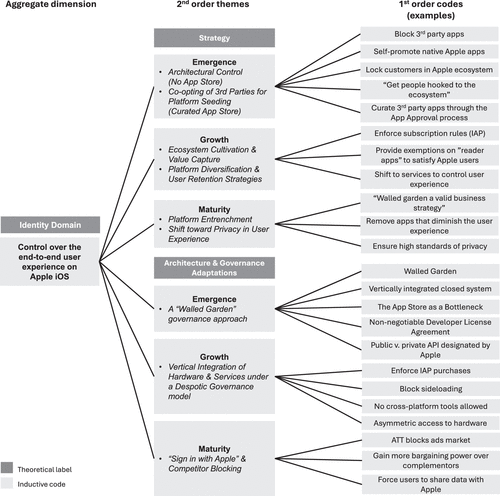
Note. ATT, app tracking transparency; IAP, in-app purchase.
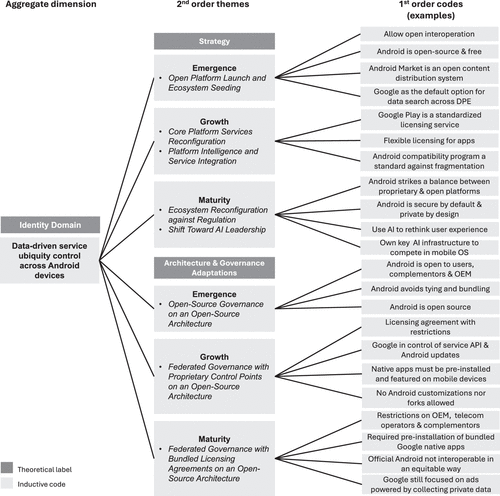
Note. AI, artificial intelligence; OS, operating system.
Third, we moved from within-case to crosscase analysis, paying attention to the similarities and differences between the evolutionary trajectories of the two DPEs to theorize their evolution. In this step, we paid attention to both common and distinct strategic choices made by Apple and Google across the three phases. For example, in 2008, both Apple and Google engaged in platform seeding by offering an SDK and APIs to complementors, allowing them to build apps and to make those available via app stores based on a revenue share model. Yet, the two DPEs faced different challenges along the way with complementors. iOS was criticized as being a “walled garden,” whereas Android suffered from fragmentation across devices and even forked versions of the operating system (OS). The crosscase analysis takes these empirical observations on the distinct evolutionary trajectories of the two DPEs and theorizes why and how each platform sponsor engaged in different architectural and governance adaptations based on their identity domains. The evolutionary trajectories reflect the ways in which each platform sponsor responded to the core tension of value creation versus value capture identified in the literature (i.e., to what extent does the platform sponsor enable third-party value creation and capture on the DPE) with implications on each DPE’s architecture and governance.
Finally, we further theorize the strategic choices made by Apple and Google as coherent within the identity domains of their DPEs (or not) and how this affected the evolutionary trajectories of iOS and Android. Building on the crosscase analysis, we developed a model that theorizes how the identity domain of a DPE frames strategic choices of its platform sponsor and by extension, shapes adaptations to the DPE’s architecture and governance.
4. Findings
In this section, we narrate the evolution of Apple’s iOS and Google’s Android. The narratives focus on the interplay of DPE’s identity domain, strategic choices, and architectural and governance adaptations in the three phases of DPE evolution: emergence, growth, and maturity.
4.1. The Evolution of Apple’s iOS (2007–2024)
The evolution of iOS is one of deliberate, centralized control guided by a remarkably stable identity domain. iOS has been orchestrated since its inception to deliver a “superior,” “seamless,” and “vertically integrated” user experience, which has informed Apple’s strategic choices regarding the architecture and governance of iOS. However, although the identity domain of control over the end-to-end user experience on iOS has remained stable throughout the evolution of iOS, Apple has adapted its strategy. This allowed Apple to respond to market pressures, technological opportunities, and regulatory challenges while retaining its core commitment to the user experience and reinforcing the strategic positioning of iOS and value capture. Table 3 provides a summary of the evolution of iOS.
|
Table 3. iOS Evolution
| Identity domain | Strategy | Architectural and governance adaptations |
|---|---|---|
| Emergence (2007–2010) | ||
| Control over the end-to-end user experience on iOS The identity domain of iOS initially centered on maintaining complete control over the end-to-end user experience through the “seamless integration” of its innovative hardware and software. This domain established iOS as a premium, vertically integrated provider, ensuring that customers who paid a premium for their devices received the high-quality experience that they expected. | Strategy in the beginning of the phase
Guided by its identity domain, Apple’s initial strategy was to exert strict architectural control over the iPhone by prohibiting native third-party apps, citing security and user experience concerns. Strategic choices
Facing market pressure from the jailbreaking community that demonstrated demand for native applications, Apple reversed its stance in 2008 by introducing the App Store and an SDK. This strategic adaptation was not an embrace of openness but rather, a reconfiguration of control, allowing Apple to co-opt third-party innovation through a centrally governed marketplace designed to lock users into its ecosystem. |
To create a walled garden, Apple established the App Store as the sole distribution channel and enforced strict governance rules through a curated approval process and restrictive developer agreements. These architectural and governance choices created a bottleneck, giving Apple the power to control innovation and limit third-party app functionality by restricting API access, all under the justification of maintaining a cohesive and high-quality user experience. |
| Growth (2011–2017) | ||
| Control over the end-to-end user experience on iOS Although the identity domain of iOS remained centered on delivering the best user experience through seamless integration, its scope expanded to include control over a growing ecosystem of services. | Strategy in the beginning of the phase
Spurred by a slowdown in iPhone sales around 2015, Apple’s strategy shifted from a hardware-centric model to one focused on cultivating its ecosystem to deepen user lock-in and to maximize revenue from services. This change involved a significant diversification toward services, elevating revenue streams from the App Store to demonstrate continued growth to investors. Strategic choices
To retain users and control their experience, Apple began aggressively self-promoting its own applications in App Store search results, often burying competitors even if they paid for ads. The company also worked to reduce its dependence on rivals by replacing third-party services, most notably swapping Google Maps for its own Apple Maps to ensure long-term platform independence. |
To control its ecosystem and capture value, Apple enforced its strategy by mandating its proprietary billing system through strict antisteering rules and by giving its own services, like Apple Pay, exclusive access to critical hardware, like the NFC chip. This approach stifled competition and deepened lock-in by pushing developers toward proprietary tools over crossplatform alternatives, whereas a revised revenue model incentivized a shift to subscriptions that maximized service revenues. |
| Maturity (2018–2024) | ||
| Control over the end-to-end user experience on iOS Although the core identity domain of iOS remained stable, it now prominently featured privacy and security, adding to its long-standing focus on user experience and seamless integration. Apple leveraged its end-to-end control over hardware and software to position the App Store as a uniquely safe and trusted place, using this framing as a key differentiator against competitors. | Strategy in the beginning of the phase
Apple’s strategy shifted to platform entrenchment, with executives defending the walled garden in legal proceedings as a valid business practice that benefits both end users and developers. A key tactic was to weaponize privacy through features like App Tracking Transparency, which although framed as a user benefit, competitively hobbled ad-reliant rivals and pushed the ecosystem toward a paid model that reinforced Apple’s emphasis over value capture. Strategic choices
The most significant adaptations during this phase were involuntary as mounting regulatory pressure, such as the EU’s Digital Markets Act, forced Apple to allow alternative app stores and payment systems in Europe. Meanwhile, the company’s pivot to “Apple Intelligence” was a strategic adaptation to generative AI, framed within its core identity of controlling the user experience and protecting privacy to maintain a competitive distinction from Google. |
The architecture and governance configuration of iOS involved a dual effort of tightening ecosystem control through controversial policies, like App Tracking Transparency, while also making forced concessions to regulators. Although complying with mandates to allow alternative app stores, the company simultaneously introduced new hurdles, like the “Sign in with Apple” and “Core Technology Fee” to make alternatives unattractive. |
Note. AI, artificial intelligence; EU, European Union; NFC, near-field communications functionality.
4.1.1. Emergence (2007–2010)
4.1.1.1. Identity Domain.
During the first phase, the identity domain of iOS unequivocally revolved on control over the end-to-end user experience on iOS. This was articulated in Apple’s corporate filings, which consistently stated a commitment to bringing the “best user experience to its customers” through “innovative hardware, software … and seamless integration” (Apple Inc. 10-K forms 2007–2010). The identity domain established a competitive arena in which iOS would operate: a vertically integrated provider of premium hardware and software where ensuring a high-quality user experience was paramount. Apple end users paid a premium for their devices and expected a premium experience on all iOS services, and accordingly, Steve Jobs and the Apple executives aimed to operate iOS like they had done with previous Apple products (Isaacson 2011).
4.1.1.2. Strategy.
Guided by its identity domain, Apple’s initial strategy was one of strict architectural control over the iPhone and iOS. At the iPhone’s launch in 2007, chief executive officer (CEO) Steve Jobs declared that the device would not be open to native apps from third-party developers, citing security and network integrity. The official path for developers was to create web-based applications running in the Safari browser. Jobs pitched this as a “sweet story,” claiming that developers had everything that they needed with web standards and required “no SDK” to develop iOS apps (Steve Jobs at Apple’s World Wide Developers Conference (WWDC), June 14, 2007). This followed Apple’s long-standing vertical integration strategy, aiming to control every aspect of the product and its user experience. However, such a rigid stance proved untenable. The market, specifically the burgeoning community of “jailbreakers” who were creating and distributing native apps outside of Apple’s control, demonstrated a demand for third-party applications (Eaton et al. 2015). This pressure represented a critical market dynamic that forced a significant strategic change. In a pivotal shift in 2008, Apple reversed its position, announcing an SDK and the App Store. Philip Schiller, Apple’s senior vice president of Worldwide Product Marketing, said in a press release (Apple Press Release, June 9, 2008):
Developer reaction to the features, power and simplicity of the iPhone SDK has been incredible. We are seeing some truly amazing native apps from our developers and think users are going to love the breadth and depth of the applications available from the App Store.
The strategic choice was not to embrace openness but to reconfigure control. Apple would allow third-party apps but only through a centrally governed, curated marketplace. The strategy thus evolved from blocking third-party innovation to co-opting it. A commentator argued in the New York Times (Wortham 2010) that
“Apple is doing everything to encourage app development, as long as it’s on their platform. The risk Apple runs is ticking off developers and causing them to want to develop on other platforms,” said Gene Munster, an analyst with Piper Jaffray.
The move aimed to seed the platform with third-party complements while reinforcing architectural control, with Steve Jobs later articulating the goal to “further lock customers into our ecosystem” and make it “even more sticky” (United States of America v. Apple Inc. 2024, p. 6).
4.1.1.3. Architecture and Governance Adaptations.
The architectural and governance adaptations during this phase were designed to erect and maintain what would become known as a “walled garden” (Kenney and Pon 2011). The primary architectural shift was from a completely closed platform to a layered modular architecture with an official SDK that gave developers access to the APIs that Apple used for its own native apps. The App Store was established as the sole, nonnegotiable distribution channel for native iOS apps. This structure created a bottleneck that gave Apple significant power over complementors (NMA 2019, p. 73). Governance was enforced through a strict approval process for apps, allowing Apple to curate the ecosystem and reject apps at its discretion (Eaton et al. 2015). The process of developing apps for iOS, including application submission, approval, and certification, ultimately became a challenge for many complementors, some of whom openly complained about the process being opaque and unfair. Although some complementors were able to benefit from getting access to a fast-track process (i.e., those that integrated their complements tightly with native iOS components), others experienced delays and unexpected rejections. Thus, following Apple’s historical emphasis on hardware development, the central focus of the iOS architectural stack was the device layer while tightly coupling the service layer to it to control the user experience.
Developers were required to sign a nonnegotiable Developer Program License Agreement (DPLA), which dictated the terms of engagement in the DPE. The DPLA prohibited developers from using private APIs, giving Apple the ability to limit the functionality of third-party apps while favoring its own apps (U.S. House of Representatives, Committee on the Judiciary, Subcommittee on Antitrust, Commercial, and Administrative Law 2020a, p. 335). This selective designation of APIs became a key tool for penalizing developers whose technologies threatened to “disrupt, disintermediate, compete with, or erode Apple’s monopoly power” (United States of America v. Apple Inc. 2024, p. 23). In 2009, in-app purchases (IAPs) were introduced, extending Apple’s control to monetization and establishing a 70%–30% revenue share that would become a cornerstone of its business model. These choices created a vertically integrated system where Apple maintained high levels of control over the hardware, the operating system, and the distribution of applications while justifying the approach as necessary for a “more effective and cohesive user experience” (Kenney and Pon 2011, p. 252). Steve Jobs explained in an open letter:1
We know from painful experience that letting a third party layer of software come between the platform and the developer ultimately results in sub-standard apps and hinders the enhancement and progress of the platform.
Apple held a strong stance against third-party development tools, resisted various forms of multihoming, and controlled innovation on the iOS by aiming for a tight integration between platform core components and third-party complements.
4.1.2. Growth (2011–2017)
4.1.2.1. Identity Domain.
The identity domain of iOS remained stable throughout the growth phase, with 10-K forms consistently repeating the commitment to the “best user experience” through “superior ease-of-use, seamless integration, and innovative design” (Apple Inc. 10-K forms 2011–2017). However, the scope of the identity domain expanded to include control over services delivered on Apple devices. Although control over the end-to-end user experience on the iOS remained at the core of the identity domain, Apple responded to a market decline in iPhone sales by realizing the potential of building a multiservice ecosystem on iOS. Its services eventually expanded to cover music, television, health and fitness, and online payments among others, effectively expanding the ecosystem while still controlling the end-to-end user experience on all iOS-enabled Apple devices.
4.1.2.2. Strategy.
The initial strategy in the growth phase was that of ecosystem cultivation and value capture while deepening user lock-in and maximizing revenue from its growing user base. A key strategic choice during this period was to diversify away from a purely hardware-centric revenue model toward services. This was accelerated by a slowdown in iPhone sales in 2015, which increased pressure to demonstrate revenue growth to investors. Tripp Mickle, a Wall Street Journal reporter with close access to Apple executives over the years, noted (Mickle 2022, pp. 337–338):
Cook wanted to focus more attention on the promise and potential of the services offered through those products. The App Store had already become a major revenue pipeline.
Further choices were made to retain users and control the user experience. Apple began to more aggressively self-promote its own apps in App Store search results. “Some searches produced as many as 14 Apple apps before showing results from rivals,” even though app developers participated in the Search Ads service and paid for it (Nicas and Collins 2019). This strategy aimed to reinforce the user’s immersion in Apple’s native services. Apple also made strategic choices to reduce its dependence on competitors, most notably by replacing Google Maps with its own Apple Maps in 2012—a decision that despite initial backlash, prioritized long-term platform independence and control.
4.1.2.3. Architecture and Governance Adaptations.
The architecture and governance of iOS were refined to enforce the strategy of controlled ecosystem cultivation and value capture. In 2011, Apple solidified its IAP rules, mandating that its billing system was used for most digital goods and services sold within apps. Critically, Apple implemented strict “antisteering” rules, prohibiting developers from placing links in their apps that directed customers to outside websites for purchases (Apple Press Release, February 15, 2011). This further suggests the tight coupling between the layered modular architecture of iOS and Apple’s strategy of value capture by means of vertical integration. Some complementors, including Adobe, that used crossplatform web-based tools wanted to reach end users across devices, and operating systems were seen to misalign with the identity domain of iOS. Apple prevented these developers from circumventing Apple’s 30% commission and locked monetization firmly within the App Store.
Some developers found these despotic governance rules to be constraining, whereas others were able to secure preferential treatment as recent documents in antitrust hearings against Apple have revealed (U.S. House of Representatives, Committee on the Judiciary, Subcommittee on Antitrust, Commercial, and Administrative Law 2020c). Specifically, some apps that were classified as reader apps (i.e., apps that “allow a user to access previously purchased content or content subscriptions” (Apple Review Guidelines section 3.1)) were exempted from Apple’s subscription rules if they did not offer a way to sign up outside the app. In contrast, apps that directly competed with Apple’s own apps, like Spotify, were restricted by Apple (Epic Games Inc. v. Apple Inc. 2021). In addition, Apple introduced Apple Pay as an interface to make in-app purchases in the DPE. Although Apple Pay benefited from full access to iPhone and iPad near-field communication (NFC) functionality, third-party apps did not as the Chief Economist of the European Commission’s Directorate-General for Competition (Scott Morton 2025, p. 112) noted:
The near-field communications (NFC) chip that enables secure mobile payments from Apple’s iPhone offers another example of asymmetric access to hardware. Apple does not grant third-party developers access to the iPhone’s NFC chip.
The asymmetric access to hardware ensured that Apple native services, such as Apple Pay, remained the default option available to users, thereby stifling competition from complementors. Apple introduced several proprietary services that benefited from asymmetric access to hardware during this phase. These included the Swift programming language and Metal graphics API in 2014 followed by ARKit and Core ML in 2017, all of which created more lock-in by steering developers away from open, crossplatform tools, such as Unity and Unreal. Proceedings in the lawsuit filed by Epic Games against Apple found that this tight integration of hardware and software gave Apple enormous control over both end users and complementors (Epic Games Inc. v. Apple Inc. 2021, pp. 13 and 22–24):
Consumer lock-in to the iOS ecosystem results in higher costs to developers … the high cost to consumers of leaving the iOS ecosystem gives Apple enormous bargaining power over developers.
During this phase, Apple also introduced a new revenue share model, where the 70%–30% split could be changed to 85%–15% if a user continued to subscribe to an app for more than a year. They also offered a three-month subscription for free to users to incentivize them to stay, especially on Apple Music. Developers, many of whom felt that the pricing model on the App Store was becoming nonviable, were now meant to become more incentivized to sell their apps for a recurring fee instead of a one-time payment. With this revised revenue share model, Apple intensified efforts to maximize revenues via iOS app subscriptions. Apple Music generated “10 million paid subscribers in six months, a milestone that its rival Spotify had taken six years to hit. Within a year, the number would hit 20 million” (Mickle 2022, p. 264). The new revenue share model was favorably received by large complementors, whereas small and less known complementors found the requirement to maintain subscriptions on the App Store to be challenging (Goode 2017). Indeed, with the new rules, Apple assumed more editorial control over app searches, advertising, and how-to guides on the App Store.
4.1.3. Maturity (2018–2024).
4.1.3.1. Identity Domain.
In the maturity phase, the identity domain of iOS, although still centered on user experience and seamless integration, incorporated powerful new elements: privacy and security. In 10-K forms, Apple kept repeating (Apple Inc. 10-K form 2020):
The Company operates various platforms, including the App Store, that allow customers to discover and download applications and digital content, such as books, music, video, games and podcasts … The Company believes it is unique in that it designs and develops nearly the entire solution for its products, including the hardware, operating system, numerous software applications and related services.
By “developing nearly the entire solution” Apple claimed that it “allow[ed] customers to discover and download applications and digital content” (Apple Inc. 10-K form 2024) in a “safe and trusted place … that meets high standards for privacy, security, and content” (Apple Developer News, October 6, 2021). This identity domain framing became a key differentiator against competitors, particularly advertising-based rivals, like Android.
4.1.3.2. Strategy.
In early 2018, the strategy was that of platform entrenchment, with Apple defending its “walled garden” as a “valid business strategy … that benefits both developers and consumers” as Tim Cook and Philip Schiller argued in lawsuit hearings (Epic Games Inc. v. Apple Inc. 2021, pp. 115 and 118). Apple executives defended their platform entrenchment strategy by consistently arguing that controlling the user experience against third-party complementors was “no different than the policies of virtually any other retailer, both brick-and-mortar or online” (U.S. House of Representatives, Committee on the Judiciary, Subcommittee on Antitrust, Commercial, and Administrative Law 2020b, p. 1202 (Apple response to House Judiciary Committee questions)). In 2021, Apple weaponized privacy as a competitive tool with the launch of app tracking transparency (ATT). Although framed as a pro-user privacy feature, ATT significantly weakened the ad-supported business model that many third-party apps relied on while hurting competitors. This strategic choice was seen as a proprietary value capture from Apple (Sokol and Zhu 2021):
[F]rom an open and free ad-supported model toward a paid model that will enable Apple to impose a 15–30% surcharge on formerly free ad-supported apps, enhance the dominance of Apple’s own apps and services within the iOS ecosystem, and entrench the dominance of iOS among mobile operating systems.
However, the most significant strategic choices in this phase were not voluntary but forced upon Apple by mounting regulatory pressure and legal challenges. The European Union (EU) Digital Markets Act (DMA) and antitrust lawsuits, such as the one filed by the U.S. Department of Justice (DoJ) in 2024, directly challenged Apple’s control over the App Store. In response to the DMA, Apple was forced to allow alternative app stores and payment processing in the EU, a fundamental break from its historical insistence on the App Store as the sole distribution channel for apps. This was a reactive choice driven purely by regulation, fundamentally altering the architecture and governance of iOS in that region. Similarly, the pivot to “Apple Intelligence” in 2024 represented a choice based on a technological opportunity created by generative artificial intelligence (AI) but one that was framed in the context of identity domain as controlling the end-to-end user experience to protect users’ privacy. This was an effort to maintain the distinctiveness of iOS against Google Android.
4.1.3.3. Architecture and Governance Adaptations.
The architectural and governance adaptations in the final phase reflect a strategic effort between doubling down on existing control mechanisms and making forced concessions to regulators. The implementation of ATT was a major governance change, requiring apps to get explicit user consent to track them across other apps and websites. Although praised for its privacy benefits by end users (Dwoskin 2021), critics argued that it placed Apple’s own data processing at an advantage and reinforced its market power (Scott Morton 2025). Together with advertisers and business users, complementors flagged ATT as anticompetitive (The Stigler Committee on Digital Platforms 2019). The UK Competition and Markets Authority wrote in an extensive analysis of the impact of the introduction of ATT (UK Competition and Markets Authority 2022, p. J14):
We are concerned that the current implementation of ATT does not maximize comprehension by users, who might not understand the meaning of the prompt and the scope of the ATT policy framework, and might place Apple’s own data processing at an advantage compared with data processing conducted by third parties which are subject to the ATT framework.
In addition, the mandatory introduction of “Sign in with Apple” in 2019 entrenched Apple’s role as an intermediary in the user-developer relationship. Evidence submitted in the lawsuit by Blix against Apple showed that (Blix Inc. v. Apple Inc. 2021, p. 73)
“Sign in with Apple” unnecessarily injects Apple as a gatekeeper that possesses the ability to oversee and control the relationship between third party developers and its end users …
Although the lawsuit was dismissed, the “Sign in with Apple” control was later resurfaced in the U.S. DoJ’s broader antitrust investigation into Apple’s anticompetitive behavior against complementors. The DoJ is investigating whether the requirement for developers to include “Sign in with Apple” makes it more difficult for users to switch to other platforms, thereby reinforcing Apple’s ecosystem control and limiting consumer choice (United States of America v. Apple Inc. 2024).
Architecturally, Apple continued to harden iOS against external threats and modification. The introduction of hardware-based security features, like pointer authentication codes (PACs) in 2018 and signed system volume in 2022, made traditional jailbreaking nearly impossible, solidifying Apple’s control over the core platform. The DPLA continued to be a key control point, with Apple using its “sole discretion” to select apps for distribution and prohibit any app that creates a “store or storefront” for another platform (Epic Games Inc. v. Apple Inc. 2021, pp. 71–72). Thus, the layered modular architecture of iOS remained tightly coupled and vertically integrated, with the service and contents layers (i.e., user data) now becoming more central in Apple’s value capture strategy.
Eventually, in response to European and U.S. antitrust pressures, Apple introduced new business terms for developers, allowing alternative app stores and payment systems. However, this opening came with new architectural and financial hurdles, including a “core technology fee” for high-volume apps distributed outside the App Store. This complex response illustrates Apple’s attempt to comply with regulation while simultaneously making alternatives to its integrated system unattractive, thereby reinforcing its identity domain even when its foundational control mechanisms are challenged. Overall, the evolution of iOS demonstrates how DPE’s strong and stable identity domain shapes its strategy choices across all three phases. Apple’s unwavering focus on controlling the user experience has guided its architectural and governance adaptations from the initial creation of a curated App Store to the strategic use of privacy as a competitive weapon and its complex compliance with new regulations.
4.2. The Evolution of Google Android (2008–2024)
The evolution of Google Android is characterized by dual objectives. The operating system was launched under the banner of openness and choice, a direct ideological counterpoint to the walled garden approach of iOS. However, beneath the open-source banner, Google has consistently pursued a stable DPE identity domain focused on data-driven service ubiquity control across Android devices. The evolution of Android reveals a series of strategic choices adhering to its dual objectives: a public commitment to openness and a private imperative to scale a data-centric, advertising business model. Google’s strategy has been to use openness as a tool for rapid market penetration while systematically making proprietary architectural and governance adaptations to ensure that its core Android services—and the data that they collect—remain central to the ecosystem and controlled by Google. Table 4 provides a summary of the evolution of Android.
|
Table 4. Android Evolution
| Identity domain | Strategy | Architectural and governance adaptations |
|---|---|---|
| Emergence (2008–2011) | ||
| Data-driven service ubiquity control across Android devices The identity domain of Android was driven by Google’s corporate mission to connect people with information and accordingly, to ensure data control across as many devices as possible. To achieve this, Google framed Android as an open-source platform to attract OEMs and complementors as a key strategic differentiator against competitors. | Strategy
Google’s initial strategy was to widely diffuse adoption by launching Android as a free, open-source platform using the Open Handset Alliance to foster a broad coalition of OEMs. However, this open approach was a means to an end, running parallel to a critical strategy of paying billions to secure Google Search as the default option across both Android and iOS devices, revealing that the goal was to funnel user data into its core advertising business. |
Android’s initial architecture and governance were designed for rapid, open expansion, utilizing an open-source license, a hardware abstraction layer for device diversity, and a minimally restrictive market that permitted side loading. However, although outwardly open, Google began a strategic shift toward control by introducing antifragmentation agreements, which required manufacturers wanting any of its popular apps to preinstall an entire suite of them. |
| Growth (2012–2017) | ||
| Data-driven service ubiquity control across Android devices The identity domain of Android remained consistent with the previous phase; however, its scope expanded to include digital content, like movies, music, and apps, which were unified under the new Google Play store. This move reinforced Google Android’s identity domain as a ubiquitous data service provider, leveraging data from over a billion active users to improve its services. | Strategy in the beginning of the phase
To combat Android’s fragmentation, Google’s strategy shifted to reconfiguring Android around a proprietary component: Google Play Services. This profound move, which was enforced with strict contracts, allowed Google to bypass OEMs and push updates directly to users’ phones, effectively recentralizing control over Android while maintaining the illusion of an open-source operating system. Strategic choices
During this phase, Google’s strategy was gradually adapted to leverage real-time user and developer data gathered across its vast suite of services. This access to near-perfect market intelligence collected from both Android and iOS devices drove its advertising business and reinforced its market power. |
The key architectural change during this phase was moving essential APIs into the proprietary Google Play Services, which—through restrictive licensing agreements—forced device manufacturers to accept a bundled suite of Google apps to get the indispensable Play Services. This tying and bundling combined with contractual prohibitions against developing unsanctioned versions of Android effectively neutralized the threat of open-source competition and cemented Google’s control over the ecosystem. |
| Maturity (2018–2024) | ||
| Data-driven service ubiquity control across Android devices The identity domain of Android evolved to incorporate commitments to user privacy and leadership in AI. This new framing was a strategic response to regulatory pressure, whereas the pivot to AI reinforced that its core mission remained unchanged: controlling vast amounts of user data as the foundational asset to advance Google’s AI ambitions. | Strategy in the beginning of the phase
Google’s strategy was defensive against major antitrust challenges. Google was compelled to unbundle its suite of apps in Europe and to introduce a new paid licensing agreement for OEMs. Strategic choices
Google made a strategic pivot to generative AI using its ownership of key infrastructure to create a new layer of competitive advantage and user entrenchment. In contrast to Apple, Google’s privacy adaptations were more measured to avoid disrupting its core advertising business, with even seemingly open features, like app side loading, being leveraged to collect data. |
In response to antitrust rulings, Google Android’s architecture and governance became a complex patchwork of forced changes; it complied by unbundling its apps in Europe but introduced new licensing fees to financially penalize manufacturers that deviated from its preferred, preinstalled bundle. This ensured that the open-source version of Android remained functionally inferior to the model proposed by Google and created high switching costs for third-party developers. |
4.2.1. Emergence (2008–2011).
4.2.1.1. Identity Domain.
From its inception, the identity domain of Android was rooted in Google’s broader corporate mission “on improving the ways people connect with information” (Google Inc. 10-K form 2008). For Android, this translated into achieving data service ubiquity: ensuring that Google’s services were available on as many devices as possible to maintain its “entire Google index” of online content and connect with users. “Google Mobile extends our products and services by providing mobile-specific features to mobile device users,” the company claimed (Google Inc., 10-K form 2010). Thus, Google was focused on data services from the start. This identity domain was publicly framed through claims of openness, a powerful way to differentiate the DPE from the closed approach of Apple and other incumbents (Google Founders Letter 2008):
We acquired the start-up Android in 2005 and set about the ambitious goal of creating a new mobile operating system that would allow open interoperation across carriers and manufacturers. … As it is open source, anyone is free to use it and modify it. We look forward to seeing how this open platform will spur greater innovation.
4.2.1.2. Strategy.
Google’s initial strategy was an open platform launch and ecosystem seeding. The core of this strategy was to offer Android as a free and open-source operating system that anyone could use and modify. Google cofounded the Open Handset Alliance with various device manufacturers (OEMs) and carriers to foster a broad coalition that would accelerate the platform’s adoption and create network effects. The goal was for Android “to be open to developers, open to the industry, and open to users” (Paul 2008). The Android Market (the precursor to the Play Store) was launched as an “open content distribution system” with minimal restrictions, initially only supporting free applications (Android Developers Blog, August 28, 2008). In addition, even though Google later imposed the same revenue share model as Apple did in iOS, the 30% cut was used to settle billing settlement fees with OEMs (Android Developers Blog, October 22, 2008), thus aligning with the free and open-source value of Android. This open strategy successfully lowered barriers to entry for OEMs and developers, rapidly building scale to compete with iOS.
However, a critical and revealing strategic choice ran in parallel to this open-source push: securing default status for Google Search. Recognizing the power of defaults, Google entered lucrative distribution contracts with OEMs and even with its chief rival Apple, paying billions annually to be the default search engine (The Stigler Committee on Digital Platforms 2019). Hearings in a U.S. DoJ antitrust investigation against Google showed that (United States of America v. Google LLC 2024, p. 2)
[f]or years, Google has secured default placements through distribution contracts. It has entered into such agreements with browser developers, mobile device manufacturers, and wireless carriers. These partners agree to install Google as the search engine that is delivered to the user right out of the box at key search access points.
This was a foundational element of the strategy behind Android, demonstrating that the goal of the open ecosystem was to funnel users and their data into Google’s core advertising business model. The promise of an open operating system was thus a means to an end: data-driven service ubiquity control.
4.2.1.3. Architecture and Governance Adaptations.
The initial architecture and governance were designed to support rapid, open expansion that was strategically important for Android. Android was released under the Apache License, allowing OEMs to freely use and modify its source code (the Android Open Source Project). A key architectural innovation was the hardware abstraction layer, which defined standard interfaces for hardware components, like cameras and sensors. This loose coupling was crucial as it enabled a wide variety of OEMs to build Android devices without having to rewrite the core operating system, promoting hardware diversity and scale. Complementors were given the freedom to replace many core components and to access data stores through open APIs (Karhu et al. 2018). The early Android Market operated with a minimal review process, allowing developers to quickly publish apps. The ability to “side-load” apps (install them from outside the official market) was also possible, reinforcing the platform’s open credentials. One analyst compared Android with the US Federal Communications Commission’s (FCC) landmark 1968 Carterfone decision (Paul 2008):
[The] Carterfone decision opened the conventional telephone network to third-party devices and facilitated significant advancements in telecommunications technology … Android aims to tear down some of those barriers so that independent developers can enrich the mobile software ecosystem in a fully supported way without having to resort to reverse engineering.
However, although outwardly open, Google began laying the groundwork for future control. Toward the end of this phase, in 2011, Google began to enforce antifragmentation agreements (AFAs). These contracts, which would become central to Google’s governance model, required that OEMs wishing to include any of Google’s popular proprietary apps (like Gmail or Maps) had to preinstall a whole suite of them (Edelman 2014). This signaled a shift away from pure openness toward a more controlled ecosystem, a move necessary to manage the fragmentation that openness itself had created.
4.2.2. Growth (2012–2017)
4.2.2.1. Identity Domain.
In the growth phase, the identity domain of Android revolved consistently on “organizing the world’s information” but now, also included content like movies and music accessible no matter which device the user had (Google Inc. 10-K form 2014):
[P]roviding ways to access knowledge and information has been core to Google and our products have come a long way in the last decade. … Over time, we have added other services that let you access information quickly and easily. … What if we could provide easy access to movies, books, music and apps, no matter which device you’re on? That’s Google Play.
The launch of Google Play as a unified storefront reinforced the identity domain of a ubiquitous data service provider. The company’s 10-K forms emphasized constant improvement of its products by leveraging user data collected from its ecosystem of services, which already boasted over a billion active users during this phase (Alphabet Inc. 10-K form 2016).
4.2.2.2. Strategy.
The strategy during the growth phase shifted decisively toward core platform services reconfiguration. Having achieved massive scale, Google’s primary challenge was the fragmentation of the ecosystem, which made it difficult to roll out new features and created inconsistent user experiences. A strategy choice was made to solve this fragmentation by reconfiguring Android’s core platform services with a proprietary component: Google Play Services. This move allowed Google to bypass slow-moving OEMs and push updates directly to most Android devices (Hildenbrand 2013), which effectively recentralized control while maintaining the illusion of an open-source OS. Analysts and academics pointed out that Google Play—which culminated in Google’s Mobile Application Distribution Agreement (MADA)2 with OEMs and the preinstallation of bundled Google components—limited the open-source options of complementors (Edelman 2014, Karhu et al. 2018).
Following the Google Play introduction, as Android diffused across devices, Google adapted its strategy toward platform intelligence and service integration. Evidence from internal communications in Google submitted in antitrust hearings revealed that (U.S. House of Representatives, Committee on the Judiciary, Subcommittee on Antitrust, Commercial, and Administrative Law 2020a, p. 15)
Google exploits information asymmetries and closely tracks real-time data across markets, which—given Google’s scale—provide it with near-perfect market intelligence. … Each of its services provides Google with a trove of user data, reinforcing its dominance across markets and driving greater monetization through online ads. Through linking these services together, Google increasingly functions as an ecosystem of interlocking monopolies.
The UK Competition and Markets Authority (2022, pp. 75 and 211) also reported on the ways by which Google gained access to “commercially sensitive information on the businesses of the app developers … to identify fast-growing or successful apps … [and] to determine pricing models for new products.” This trove of user and complementor data from interlocking services across Android devices—and even Apple devices that used Google Search as their default search engine—reinforced its dominance and drove its advertising business model, creating an “ecosystem of interlocking monopolies.”
4.2.2.3. Architecture and Governance Adaptations.
The architecture and governance of Android were fundamentally reshaped to cement Google’s control. The launch of Google Play Services in 2012 was the key architectural change. By shifting essential APIs for location, notifications, and other services into a proprietary layer, Google made it practically impossible for an OEM to create a competitive device using only the open-source Android. To access these critical APIs and the Google Play Store, OEMs had to license the full suite of Google Mobile Services (GMS). As the Chief Economist of the European Commission’s Directorate-General for Competition explained (Scott Morton 2025, p. 334):
GMS includes, among other apps and functionalities, the Google Search Widget, Chrome, and Google Play. Because Google Play services contain SDKs (software development kits) and APIs (application programming interfaces) that are critical to the proper functioning of the OS, and because Google Play services and the Google Play Store are available only as a part of the GMS suite, OEMs must as a practical matter accept MADAs that require the installation of the entire GMS suite, including the Google Search Widget and Chrome (which defaults to Google Search).
Thus, through restrictive licensing agreements, Google mandated OEMs to sign up for all Google services if they wanted to benefit from the indispensable Play Services. This was a classic “tie and bundling” anticompetitive approach that antitrust authorities across the world eventually picked up. It forced strict control on IP rights and licensing agreements with OEMs as well as over complement development. The first control influenced the second because depending on whether OEMs run Google Play Services or a different version of the Android App Store, complementors were restricted in their choices to connect to important API, such as the Maps API, that enabled them to build key functionality. These negative cross-side effects forced OEMs and complementors to align to the new rules or otherwise, risk compromising their offerings to end users. Thus, although the new rules were implemented as “flexible licensing policies,” analysts quickly identified these as a “proprietary coup” by Google, an “all-or-nothing affair” (Amadeo 2014).
Google also required OEMs to agree that they would not run unsanctioned versions of Android on other hardware products, or they risked losing access to the Google Play Store and other popular apps across all of their devices (see the cases with Motorola and OnePlus described in Epic Games Inc. v. Google LLC 2020, pp. 41–42). This prevented any competitor from taking the open-source code and building a rival ecosystem with it, effectively neutralizing the biggest threat posed by an open-source strategy. These contract restrictions revealed that what Google claimed as open was, at best, a federated governance model with proprietary control points. In fact, although the layered modular architecture of Android appeared to be loosely coupled, especially regarding the device and network layers, the proprietary APIs sitting in between those layers and the service and contents layers gave Google tight control over the layers. The ultimate objective was more data-driven service ubiquity control across OEMs, developers, and end users.
4.2.3. Maturity (2018–2024)
4.2.3.1. Identity Domain.
In its maturity phase, the identity domain of Android evolved to incorporate commitments to user privacy and leadership in artificial intelligence. Google began to frame its products as “secure by default” and “private by design” (Google I/O keynote, May 18, 2021, Google Media Events). This new framing was a response to growing market and regulatory scrutiny, attempting to relegitimize its DPE in a shifting environment. At the same time, as generative AI became more widely diffused, Google began to reframe its mission to “make AI more helpful for everyone with the introduction of Gemini, our natively multimodal AI model” (Alphabet Inc. 10-K form 2024). The core identity domain of maintaining control over data ubiquity across Android devices and even competitor devices was still visible in its corporate communications (Alphabet Inc. 10-K form 2022):
Our mission to organize the world’s information and make it universally accessible and useful is as relevant today as it was when we were founded in 1998 … We believe that AI is a foundational and transformational technology … As an information and computer science company, we will continue to be at the forefront of advancing the frontier of AI. … continuously investing in building products that are secure by default; strictly upholding responsible data practices that emphasize privacy by design.
Data remained the core asset, and controlling such data to advance the new frontier of AI was part and parcel of Android’s identity domain.
4.2.3.2. Strategy.
This phase was defined by defensive adaptations to major antitrust challenges and an ecosystem reconfiguration against regulation. Following a €4.34 billion EU fine, CEO Sundar Pichai claimed that the decision would “upset the careful balance that we have struck with Android, and that it sends a troubling signal in favor of proprietary systems over open platforms” (Sundar Pichai, Google Press Release, July 18, 2018). The forced adaptation was to unbundle its apps in Europe and “introduce a new paid licensing agreement for smartphones and tablets shipped into the EEA” (European Economic Area) (Google Press Release, October 16, 2018). Concurrently, Google pivoted heavily to AI, where the “integration of generative AI is perhaps the clearest example of competition advancing search quality,” a strategic move to create a new layer of competitive advantage and entrenchment. Evidence submitted as part of the U.S. DoJ antitrust hearings by Google has Sundar Pichai argue that (United States of America v. Google LLC 2024, pp. 39–42)
[n]ow with artificial intelligence, I think we are again in the early stages of completely rethinking what’s possible for our users.
This was not just a product enhancement but a strategic move to create a new layer of competitive advantage and user lock-in, leveraging its ownership of key AI infrastructure, like data centers and cloud computing facilities (UK Competition and Markets Authority 2023). In contrast to Apple’s ATT, Google’s privacy adaptations were more measured. Although introducing features like Android’s Private Compute Core, Google carefully avoided disrupting its core advertising business model (Privacy International 2021). Unlike Apple, Google could have never implemented a policy like ATT because doing so would have killed its star app, Google Search, and the key source of revenue for the platform sponsor. In relation to this, despite Google always permitting the side loading of apps through alternative app stores or web stores, such side loading was used by Google to collect both user and app data on Android and subsequently, use these data to benchmark the company’s own apps against third-party apps (U.S. House of Representatives, Committee on the Judiciary, Subcommittee on Antitrust, Commercial, and Administrative Law 2020d).
4.2.3.3. Architecture and Governance Adaptations.
The governance of the DPE became a complex patchwork of Android’s original structure and regulator-mandated changes. In particular, in response to the EU ruling, Google began offering separate licenses for its app bundles in the EEA, allowing OEMs to license GMS without being forced to preinstall Chrome and Search. It also allowed OEMs to distribute Google apps on forked versions of Android in the EEA but at a cost, thereby introducing new fees to compensate for the loss of its tying power.
The only caveat was that Google changed its rules to offer separate licenses for each bundle of Google apps, such as Google Maps, YouTube, and Gmail, while charging for them. OEMs that chose to sign up to preinstall Google apps on their devices could get these bundles for free (Google Press Release, October 16, 2018). However, for everyone else who chose to distribute apps on forked Android versions, new licensing agreements would apply. Thus, Google enforced tools and incentives to align OEMs and complementors to its DPE identity domain while restricting alternative choices that deviated from its identity domain.
As one media analyst noted, despite Google’s claims of Android remaining free and open source, “[t]his fundamentally changes how Android can be distributed in Europe” (Sawers 2018). Precisely because Google Play had become the default option and with it, several other Google apps—especially Google Search, Google Maps, and YouTube—OEMs and complementors were deterred from leaving the Android ecosystem given the high switching costs (The Stigler Committee on Digital Platforms 2019). These anticompetitive practices have taken an even bigger toll on some developers. According to the Epic Games lawsuit against Google (Epic Games Inc. v. Google LLC 2020, pp. 48–49),
Google conditions app developers’ ability to effectively advertise their apps to Android users on being listed in the Google Play Store … by coercing Android app developers to list their apps in the Google Play Store or risk losing access to a great many Android users they could otherwise advertise to but for Google’s restrictions.
This meant that even if an OEM built a phone using only open-source Android, the apps on that phone could “experience performance glitches or lack certain functionalities,” making the “official Android” that was bundled with Google’s apps a superior and practically necessary choice (Scott Morton 2025, p. 105). Overall, the evolution of Android is a case study in leveraging an open-source strategy to achieve market scale followed by a systematic and strategic layering of proprietary controls to defend a core business model built on data. Android’s evolution shows how Google adapted its architecture and governance from open source to proprietary services and from forced bundling to paid licensing to navigate market dynamics and regulatory pressures while pursuing a stable underlying identity domain.
5. Crosscase Analysis
The case narratives show that iOS and Android have evolved coherently with respect to their specific identity domains. The identity domain of iOS has been consistently communicated as a commitment to an end-to-end user experience control. This has justified a vertically integrated approach through the different layers of the platform’s modular architecture (Yoo et al. 2010), where value is captured through premium products and a seamlessly curated ecosystem. Although Apple adapted their perception of user experience to respond to complementor dynamics, regulatory pressures, and new technological opportunities and has likewise adapted their strategy, their core commitment to controlling the user experience has remained stable over time. For example, as we explain below, Apple has evolved its strategy by differentiating itself not just as a maker of premium devices but as the provider of a secure and private DPE (e.g., their ATT strategy).
In contrast, the identity domain of Android can be defined as a pursuit of data-driven service ubiquity control. This has justified a horizontally scaled approach where value is captured through the monetization of data and user attention across devices, platforms, and even competing DPEs. Also, Google’s perception of what data-driven service ubiquity means has evolved to respond to ecosystem demands and exogenous shocks, such as regulatory interventions (e.g., by appearing to offer flexible platform licenses while locking in complementors and OEMs to essential Google apps). So, again, Google’s core commitment to controlling data-driven service ubiquity across Android devices has remained stable over time.
These differences in the identity domains of iOS and Android have then led to different adaptations to the core tension between value creation and value capture. At times, the strategic choices of platform sponsors and resulting architectural and governance adaptations operated coherently within the identity domain of each DPE. At other times, however, these choices and adaptations created dissonance and loss of distinctiveness in the eyes of complementors and other parties, forcing Apple and Google to retreat iOS and Android to their identity domains.
5.1. Identity-Coherent DPE Orchestration
The most successful adaptations of both DPEs occurred when ecosystem participants saw strategic choices as authentic expressions of DPE identity domains. The identity domain of iOS revolving around user experience control meant that its primary mode of value creation should be perfecting the end-user product. Apple stayed true to this identity in the emergence phase by creating the curated App Store. Instead of a fully open architecture, which would have threatened the control over user experience, Apple made architectural and governance adaptations to enact controlled openness. It allowed third-party value creation but only within the strict confines of its app approval process that is a form of “input control” (Tiwana 2015). This was a masterful expression of the iOS identity domain and a crucial complement to increasingly powerful APIs provided to third-party developers over the years (Tiwana 2015, Um et al. 2023). The better resourced the developers became with new APIs, the more important it was to control their complements to avoid the overall user experience in the DPE veering off course. By strictly vetting every app, Apple ensured that developer innovation accelerated the platform’s evolution and enhanced its market performance without compromising quality. This consequently legitimized the identity domain of iOS and allowed Apple to justify capturing 30% of the value created on iOS.
Android’s identity domain of data service ubiquity implied a different approach to value creation and capture; its primary mode of value creation was maximizing the reach of its data-gathering services. The most identity-coherent strategic choice was the initial open-source strategy in Android. By offering the operating system for free under an open-source license, Google unleashed massive value creation by third-party software developers and OEMs, quickly achieving its goal of data-driven service ubiquity. This low-control strategy, however, was not devoid of a value capture logic. Google’s release of its own apps served to stimulate entire categories, increasing overall user engagement and thus, expanding the data pool from which it could indirectly capture value (Foerderer et al. 2018).
In both DPEs, identity domain distinctiveness was achieved both strategically and architecturally. On the one hand, controlling the user experience meant placing strong emphasis on the device layer as the product extension of end users. By tightly coupling via vertical integration the device layer with the service and contents layers, Apple claimed control over the end-to-end user experience. On the other hand, for Google, controlling data across OEMs, developers, and end users meant that the most critical layers were the service and contents layers. Tight coupling between these layers was to be achieved via horizontal or lateral connections established via open APIs and crossplatform tools, all of which were controlled via a set of proprietary API. Thus, although both Apple and Google made similar strategic choices on core components, such as offering app stores and engaging with third-party complementors via APIs and SDKs, they differentiated their architectural and governance adaptations according to their respective identity domains.
5.2. Dissonance in DPE Orchestration
Both DPEs also encountered significant challenges when their strategic choices and resulting architectural and governance adaptations became dissonant with their identity domains. Challenges arose for iOS when Apple’s obsession with control started to overshadow its identity domain revolving around offering the “best user experience.” For instance, the initial absolute ban on all native third-party apps was a misstep diminishing the user experience and creating a vacuum filled by apps from the jailbreaking community, which forced a reactive course correction. Later, the “cat and mouse game” of issuing updates that would “brick” jailbroken iPhones created a hostile relationship with some of the most engaged users as an instance where enforcing control led to a directly negative user experience (Eaton et al. 2015, Zhang et al. 2022). Even after establishing the App Store, the arbitrary nature of its app review process initially created some dissonance. For instance, rejection of apps for containing objectionable content was perceived not as quality control but as censorship, forcing Apple to sometimes reverse its decisions following a public outcry that challenged the legitimacy of the DPE (Eaton et al. 2015).
The primary challenge for Android stemmed from the dissonance between its public positioning and its strategic need for data control. The initial claims of an open platform that avoided including bundled services became at odds with the identity domain revolving around central control over its data-gathering services. As Google implemented increasingly restrictive tying arrangements, like the MADA and AFA, this contradiction became undeniable (Edelman 2014, Karhu et al. 2018). In turn, regulators in Europe did not fine Google simply for being dominant but for abusing that dominance in a way that violated the open principles that it had publicly espoused (European Commission 2018). Similarly, its early hands-off approach led to severe platform fragmentation, which resulted in a poor and inconsistent user experience. This violated the part of its mission to make information “universally accessible and useful” and created a reputation for lower quality compared with iOS, a challenge that forced Google to later increase control via Google Play Services.
5.3. Identity Domain Overlap and Loss of DPE Distinctiveness
By the middle to late growth phase (roughly 2014–2017), the evolutionary paths of iOS and Android began to converge, creating a period of partial identity domain overlap and the loss of distinctiveness between the two DPEs because they seemingly started replicating each other’s strategic choices. The DPEs tried to mitigate the value creation versus value capture tension in their ecosystem by copying what seemed to work for the competing DPE. To combat the high ecosystem fragmentation that challenged quality on Android, Google tried to make the DPE more like iOS. For instance, it introduced Material Design (that is, an interface design system to support a more consistent user experience), began using staff-reviewed submissions for the Play Store, and tightened rules against spam and deceptive behavior. These steps took Android toward the high-input-control model of iOS. The launch of the Pixel phone line further signaled a desire for device-layer control, competing directly with iPhone and blurring the identity domain of Android.
Conversely, to grow its services revenue, Apple made iOS more like Android. Apple launched data-driven services like Proactive Intelligence and opened service APIs, moving closer to the data-centric model of Android. The introduction of Apple Search Ads pushed it directly into the advertising business that is at the core of the identity domain of Android. Furthermore, major operating system and hardware updates introduced new forms of complexity for iOS developers. This convergence created ambiguity and new challenges to third-party complementors (Kapoor and Agarwal 2017). For instance, governance rules became less predictable for developers. As Google tried to reduce the complexity of Android and Apple’s adaptations created new forms of complexity in iOS, developers’ established capabilities became devalued (Rietveld et al. 2020). The identity domain overlap tarnished the open values of Android and challenged the proprietary nature of iOS, weakening their differentiation and intensifying direct competition.
5.4. Re-Establishing Distinctiveness by Retreating to the DPE Identity Domain
The most recent strategic choices and resulting architectural and governance adaptations made by iOS and Android can be understood as deliberate attempts to resolve the lack of differentiation and to end the period of identity domain overlap. Faced with market saturation and regulatory pressure, both iOS and Android have retreated to their identity domain to re-establish clear, powerful points of differentiation. Apple has decisively shifted iOS toward a centrally controlled DPE and reframed its control of the end-to-end user experience under the banner of protecting user privacy. The launch of ATT is a direct expression of this, leveraging the curated, vertical architecture of iOS to offer features that its rival could not easily replicate. Also, the latest push into Apple Intelligence with an emphasis on on-device processing is a continuation of this strategy. Apple is differentiating itself not just as a maker of premium devices but as the provider of a secure, private, and seamlessly integrated DPE—a position that helps iOS achieve distinctiveness in relation to Android.
Google, in turn, has fully committed to its organizational identity of data-driven control albeit with a rebranding as an AI provider. Abandoning any lingering pretense of being a simple operating system provider, its approach is now to leverage its massive data advantage to lead the next AI frontier. The deep integration of its Gemini AI across all of its products, including at the core of Android, is an unambiguous declaration of this strategy. Google’s Android is differentiating itself on the promise of a more intelligent user experience, one that is powered by its ubiquitous services and vast data repositories. This move re-establishes its unique value proposition grounded on its data-based capabilities and creates a new powerful layer for continued value creation and capture, a strategy that is aligned with its DPE identity domain.
6. An Identity Domain Model of DPE Evolution
The comparative analysis of the evolution of iOS and Android allows us to develop an identity domain model of DPE evolution as illustrated in Figure 3. The model theorizes that the identity domain of a DPE frames the strategic choices that the platform sponsor makes to resolve the value creation and value capture tension in the ecosystem, which lead to architectural and governance adaptations to the DPE. As a result, DPE evolution is not equifinal, and DPEs do not necessarily converge toward homogeneous designs. Next, we discuss the model, abstracting away from the specifics of the two cases to focus on the underlying process of adaptations and thus, DPE evolution, which we argue is generalizable to other innovation platforms, such as those in the video game and enterprise markets (Cusumano et al. 2019). To do this, we develop theoretical conjectures to capture generalizable aspects of the model.
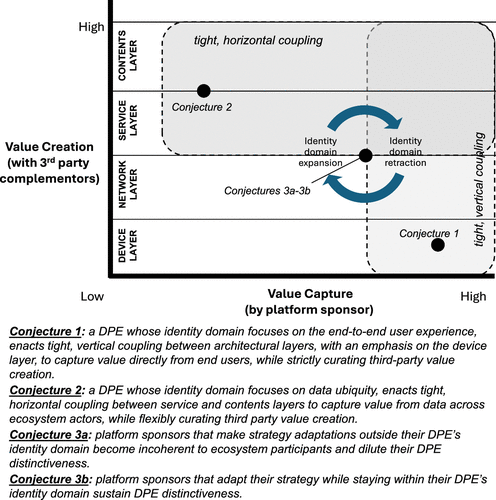
6.1. Theoretical Conjectures
An identity domain centered on controlling the user experience frames strategic choices as questions of seamless hardware and software integration. The device layer offers direct access to end users, and thus, platform sponsors can control the user experience by enacting tight, vertical coupling between the device layer and the service and contents layers. This ensures that end users who pay a premium for their devices receive a higher-quality experience because the platform sponsor is in a better position to curate both native and third-party services (Kapoor and Agarwal 2017). Just like Apple has historically enacted a tight coupling between its devices before eventually shifting its focus to services (while doing so via a walled garden approach), so too have video game console platform sponsors, such as Sony and Microsoft, used tight, vertical coupling to manage a highly curated relationship with game developers (Cennamo 2018). In both cases, an emphasis is placed on controlling the end-to-end user experience through superior technology and a strong library of complements while actively courting top-tier developers to differentiate the platform (e.g., Halo for Xbox) (Cennamo and Santalo 2013). This strategy aims to make the DPE the only place to access must-have complements, which creates a powerful draw for both end users and consequently, other third-party developers who need access to a growing user base. Although the platform sponsor curates third-party complements, the primary objective is to eventually scale value creation toward native complements to also capture value from end-user subscriptions and service monetization on the DPE. Thus, we theorize Conjecture 1.
A DPE whose identity domain focuses on the end-to-end user experience enacts tight, vertical coupling between architectural layers with an emphasis on the device layer to capture value directly from end users while strictly curating third-party value creation.
By contrast, an identity domain that is centered on controlling data across OEMs, developers, and end users frames strategic choices as questions of horizontal coupling of the service and contents layers. Vertical integration would be dissonant with this identity domain because third-party innovation and value creation are needed to capture value from data generated across the ecosystem and even competing ecosystems. Representative examples of such DPEs include Android and Amazon Web Services, which provide considerable flexibility to integrate various services into the ecosystem. However, as these DPEs collect more data, they begin to leverage such data to provide additional services and expand the ecosystem accordingly (e.g., Alaimo et al. 2020). Data thus serve as a powerful resource and medium for orchestrating the DPE, which grants superior market intelligence to the platform sponsor. The intelligence can eventually be exploited by the platform sponsor to its own advantage over third-party complements’ interests. Recent antitrust investigations into both Google and Amazon found that both implement restrictive software licensing practices that limit customer choice and stifle competition while locking in third-party developers to their DPE (UK Competition and Markets Authority 2025). Thus, we theorize Conjecture 2.
A DPE whose identity domain focuses on data ubiquity enacts tight, horizontal coupling between service and contents layers to capture value from data across ecosystem actors while flexibly curating third-party value creation.
Although the identity domains of different DPEs may frame their strategic choices toward different architectural and governance adaptations, we do acknowledge that DPEs in the same competitive arena will make similar strategic choices. For example, both Apple and Google offered app stores engaged with third-party complementors via APIs and SDKs to benefit from network effects on their respective DPEs. They also have similar revenue share models and adaptations to those (e.g., from a 70%–30% split to an 85%–15% split under similar conditions). As platform sponsors make strategic choices to adapt the architecture and governance of their DPEs to market pressures, regulatory scrutiny, and technological opportunities, they need to remain “the same and different at the same time” (Brewer 1991, p. 475). DPEs need to engage in adaptations that simultaneously make them coherent and legitimate in the eyes of ecosystem participants while engaging in competitive differentiation (Gioia et al. 2010, Kroezen and Heugens 2012, Zhao and Glynn 2022). For example, as we discussed in the crosscase analysis, Apple engaged in data-centric strategies by blocking third-party ad networks and adding their own under the banner of a more secure and private DPE. Google engaged in user-centric strategies, offering complementors better user interface design tools and launching their Pixel line of phones to cater to end users. These strategies necessitated architectural adaptations that verged outside their identity domain and generated dissonance among ecosystem actors.
In the internet of things (IoT) and automation industry, Tesla can be thought of as aligning with Conjecture 1, which is characterized by tight, vertical coupling between architectural layers to ensure a premium end-to-end user experience. Yet, recent strategic choices toward full self-driving and AI automation (via Grok) have led to an invasion of user privacy—with privately shared invasive images and videos recorded by customer vehicles3—contradicting Tesla’s claims of providing a “safe and trusted” integrated experience. In the retail and logistics industry, the Amazon Marketplace can be thought of as aligning with Conjecture 2, which focuses on horizontal coupling, enabling third-party value creation to maximize the data pool that it can process and monetize. However, its strategic choices have often created identity domain incoherence by using that very data to undermine its complementors. A recent study found that “sellers experience Amazon’s governance as presenting sustained discrepancies between its declared practices, which ostensibly support sellers’ interests, and undeclared practices that appear not to” (Gawer and Harracá 2025, p. 2).
These examples show that when strategic choices and resulting adaptations become incoherent with the DPE identity domain or suggest an identity domain overlap with those of a competitor, ambiguity ensues in terms of what the ecosystem means to its participants and how they should relate to it (Tripsas 2009, Gioia et al. 2013). The identity domain model thus helps explain why different DPEs in the same market can successfully differentiate through different architectural and governance adaptations despite the converging force of network effects. Thus, we theorize Conjectures 3a and 3b.
Platform sponsors that make strategy adaptations outside their identity domain become incoherent to ecosystem participants and dilute the distinctiveness of the DPE.
Platform sponsors that adapt their strategy while staying within their identity domain can sustain the distinctiveness of their DPE.
The above conjectures are not meant to confer typological claims but rather, to support a process-oriented theorizing of possible DPE evolution. The conjectures help to explain how identity domains frame strategic choices and adaptations to DPE architecture and governance over time. We do, however, acknowledge that the identity domain may constrain strategy adaptations in a DPE’s evolution and push the platform sponsor to failed outcomes. Two failed examples in mobile operating systems illustrate such outcomes: BlackBerry and Windows Phone.
BlackBerry’s identity domain focused on “professional-grade communications and productivity tools” and “enterprise-grade security and controls” (BlackBerry 2008). Its core value proposition was built on its best-in-class push email integration, its robust security, and the tactile efficiency of its physical keyboard. Such an identity domain translated into neatly aligned strategy, DPE architecture, and governance. The platform sponsor, Research In Motion, focused on direct sales to corporations, carrier partnerships, and building a reputation for unparalleled reliability. The critical juncture for BlackBerry was the launch of the iPhone in 2007 and the App Store in 2008 followed by the rise of the Android ecosystem. The market shifted from a focus on professionally secure communications, which were BlackBerry’s turf, to a consumer-centric model driven by user experience, multimedia, and a vast ecosystem of third-party applications. Research In Motion was unable to adapt its DPE strategy without diverging too far from its identity domain. The company failed to grasp that the disparity in the number and quality of consumer applications was not a secondary feature but the central battleground of the new mobile ecosystem. BlackBerry was initially following a strategy like iOS as a closely integrated proprietary operating system with no APIs for developers. Yet, it was late to make adaptations and the shift to third-party innovation in 2013. By then, the duopoly of Android and iOS was already cemented. The platform sponsor of the DPE failed to realize, like Apple did, that they could remain true to their identity domain by enacting tight, vertical coupling in a proprietary architecture while making architectural and governance adaptations to accommodate the burgeoning ecosystem of developers and increased demand by users for more variety in apps.
On the other hand, Windows Phone faced a different challenge: an ambiguous identity domain that generated uncertainty for developers and users from the outset. It was unclear what the identity domain of Windows Phone’s ecosystem was. Although a joint Microsoft and Nokia press release on February 10, 2011 announced the beginning of “a three horse race”4 and Andy Lees, then president of Microsoft’s Windows Phone division, called it the “third ecosystem”5—against the duopoly of iOS and Android—Microsoft’s formidable enterprise identity domain lingered over the strategy of the suggestive new DPE. The strategic incoherence manifested in a contradictory approach to the market. Microsoft attempted to pursue an Apple-like strategy of tight, vertical coupling over a proprietary ecosystem. It imposed strict hardware requirements on its OEM partners (e.g., dedicated camera and search buttons), and initially, it charged licensing fees for the operating system itself. However, it tried to execute this strategy without a legitimizing force, like the anchoring of iOS to an identity domain centered on user experience. In essence, Microsoft was demanding that both OEMs and developers pay a premium to enter an ecosystem that had no users, a proposition that was a failure from the outset. As a result, the identity domain of Windows Phone was always ambiguous; it strived to serve Microsoft’s formidable enterprise identity while at the same time, making unreasonable demands to users who now had to buy new devices and developers who were already hesitant to support a platform with few users. They now had a powerful, rational reason to avoid Windows Phone entirely.
The Windows Phone and Blackberry examples offer contrasting evolutionary trajectories to those of iOS and Android. Our identity domain model can inform future research by being applied in these and similar cases (e.g., Nokia) to more carefully examine the strategic choices that platform sponsors make, whether those choices confer DPEs a distinctive identity, or whether they generate incoherence and strategic dissonance among ecosystem actors. We next discuss the theoretical contributions of our identity domain model.
6.2. Theoretical Contributions
First, the identity domain model of DPE evolution and the associated conjectures extend existing platform and ecosystem theory (Tiwana et al. 2010, Adner 2017, Parker et al. 2017, Jacobides et al. 2018). We explain why and how platform sponsors make different strategic choices and adaptations, launching their DPEs onto different evolutionary trajectories. Previous work pointed at the link between an “internal fit” (how architecture and governance in a DPE fit each other) and an “environmental fit” (how the strategic choices that a DPE makes fit the market within which it operates) (Tiwana et al. 2010) or the “alignment structure” of an ecosystem (Adner 2017). Our model complements these works by explaining how the different fits and alignments are orchestrated in a DPE. Central to our model is the assumption that the internal-to-external fit is defined by the identity domain of the DPE. The identity domain defines the opportunities for successful positioning of the DPE against other DPEs in the same market by signaling its distinctiveness to customers and complementors alike, which must be reflected in how the platform sponsor keeps adapting the architecture and governance of its DPE. We show that DPE evolution is a result of efforts by the platform sponsor to align strategic choices and by extension architectural and governance adaptations along the identity domain without leading to structural isomorphism across competing DPEs.
Second, the model also connects existing research on platform governance and evolution (Tiwana et al. 2010, Chen et al. 2022) to the body of knowledge focusing on more traditional organizational issues, such as how the identity of the firm can enhance or inhibit strategic repositioning (Tripsas 2009, Ravasi and Phillips 2011). The model shows how the identity domain of a DPE provides a reference point for how to coherently resolve ongoing challenges that emerge because of the interdependencies between ecosystem actors that push and pull a DPE toward different directions. Although different market opportunities and challenges will push a platform sponsor to implement changes in their DPE, a strong identity domain can keep the DPE from losing its positioning and fragmenting its scope (Livengood and Reger 2010). Without the identity domain standing as a “true north,” the DPE may drift with competing demands in a way that makes it vulnerable to competition. By contrast, orchestrating the DPE along the identity domain allows it to sustain distinctiveness.
Third, the identity domain model of DPE evolution provides a lens to interpret how platform sponsors respond to disruptive technological shocks, such as generative AI. Rather than converging toward a common architectural solution dictated by technological imperatives alone, our model suggests that Apple and Google perceive generative AI in ways that are consistent with their respective DPE identity domains.
For Apple, whose DPE identity domain is centered on delivering an integrated, high-quality user experience anchored in privacy and device-centric control, generative AI is primarily interpreted as an enhancement of device capabilities. Apple Intelligence is positioned not as a stand-alone, data-maximizing infrastructure layer but as an embedded feature designed to augment the performance and usability of Apple’s hardware and native services. Consistent with prior patterns of architectural evolution in its ecosystem, Apple prioritizes optimization of vertical complementarities—across silicon, operating system, and native applications6—before selectively exposing generative AI capabilities to third-party developers through controlled interfaces. Such an approach mirrors earlier governance choices in the iOS ecosystem, where tight coupling and curated access have been used to manage generativity while safeguarding user experience and privacy. In this sense, generative AI becomes another architectural layer through which Apple reinforces its vertically integrated value creation logic while preserving its established balance between ecosystem openness and value capture.
Google’s response, by contrast, is consistent with an identity domain centered on organizing, processing, and monetizing data flows at scale. From this perspective, generative AI is not primarily a feature embedded within a device ecosystem but a foundational extension of Google’s data infrastructure. The development of large-scale foundation models and their deployment across search, advertising, cloud, productivity tools, and external APIs reflect a data-centric framing. Generative AI is interpreted as a mechanism to enhance data-driven complementarities across services, deepen crosslayer integration, and generate new feedback loops of information creation and refinement. In line with prior governance patterns in the Android and Google services ecosystem, one would expect broader exposure of AI capabilities across layers and potentially, across competing ecosystems insofar as such diffusion reinforces Google’s centrality in information intermediation. Here, value creation is amplified through horizontal data complementarities, whereas value capture is sustained via control over core data assets and model capabilities.
These divergent responses illustrate the nonequifinality of DPE evolution predicted by the identity domain model. Even when facing the same technological opportunities, platform sponsors neither mechanically optimize for scale nor converge toward a dominant architectural form. Instead, identity domain shapes which complementarities are prioritized (e.g., vertical experience-based complementarities versus horizontal data-driven complementarities) and how value creation and value capture are governed (e.g., controlled exposure versus broad diffusion). More generally, the disruption caused by generative AI underscores a key feature of DPE evolution that is captured in our model; exogenous technological shocks expand the feasible set of architectural configurations, but identity domain constrains and channels adaptation. Where a DPE’s identity is deeply embedded in organizational routines, technological architecture, and governance norms, radical reorientation is unlikely, even when new technologies appear to invite it. This suggests a boundary condition for convergence theories of platform evolution. Technological discontinuities do not eliminate heterogeneity; rather, they often amplify it by revealing how differently platform sponsors interpret and operationalize the same opportunity space.
6.3. Boundary Conditions and Future Research
There are a few boundary conditions that further research should take into consideration with respect to the theoretical model of DPE evolution. First, the model rests on the assumption that there is a strong relationship between identity and strategy (Livengood and Reger 2010, Ravasi et al. 2020, Cennamo 2021), and therefore, it has a better fit with innovation platforms that are formed and evolve on specific ecosystem interdependencies with complementors (Jacobides et al. 2018). This is because the types of challenges observed on innovation platforms are more likely to challenge a platform sponsor’s strategy (Cusumano et al. 2019). Such interdependencies are not observed to the same degree on transaction and information platforms, and they do not generate the same types of externalities and implications to DPE evolution on the latter type of platforms as on innovation platforms. By contrast, on innovation platforms, the structural relationships and processual dynamics necessitate aligning strategic decisions and by extension, architectural and governance adaptations along the identity domain, or else, the platform sponsor risks ecosystem fragmentation and failure (Jacobides et al. 2024).
At the same time, although our identity perspective offers a rationale for why some firms take strategic choices toward unique DPE evolution trajectories, it does not predict the resulting performance outcomes of such identity positioning and evolution. Those outcomes are influenced by competitive dynamics within and across platform ecosystems, most notably those exerted by complementors (e.g., see Tiwana 2015, Cennamo and Santaló 2019, and Zhang et al. 2022); strategic responses by rival DPEs (e.g., Rietveld and Schilling 2021); and exogenous shifts in the competitive arena, including regulation (e.g., see Cennamo et al. 2023) and changes in consumer demand (e.g., see Barua and Mukherjee 2021). Further research needs to examine the relationship between the identity domain of a DPE and its competitive outcomes.
Second, we are largely agnostic about how the model would apply to platforms in highly regulated sectors, such as healthcare and finance (Ozalp et al. 2022, Constantinides 2023). In such sectors, platforms are very protective of their data about users because in these sectors, data use tends to be highly regulated (Kazemargi et al. 2023, Spagnoletti et al. 2025). This makes it difficult to both incentivize and control the use of data. It is also difficult to achieve unbounded innovation growth (Fürstenau et al. 2023) as platform sponsors are constrained in the ways that they can monetize data and spur further complement development. Future research could explore how strategic decisions in highly regulated sectors would require different architectural and governance adaptations by platform sponsors and how this affects DPE evolution.
Third, we focus primarily on strategic choices that platform sponsors make to address incentives of participation and behavioral change as well as control of actions that may go against the DPE (Chen et al. 2022). However, we do not address more radical strategic moves, such as acquisitions of complementor companies (Wang et al. 2024) or adjacent platforms (Miric et al. 2021). The literature shows that acquisitions affect DPE growth and value appropriability; however, “questions remain regarding the reasons behind acquisitions made by platform companies” (Miric et al. 2021). Further research could use the model to explore such questions and develop a deeper understanding of how a DPE’s identity domain informs acquisitions, especially as platform sponsors seek out vertical or horizontal coupling of third-party complements to the DPE.
Fourth, our model points at latent opportunities for revisiting some policy debates on antitrust. For instance, the antitrust cases against Apple and Google are largely clashes over different architectural and governance adaptations to serve ecosystem actor demands. Recent decisions favoring the claimant (e.g., Epic Games) over the defendants (Apple and Google) essentially impose a regulatory intervention (e.g., a more open platform in relation to in-app purchases) as a de jure standard, impacting the opportunities to define a unique strategic positioning in a market. On the one hand, by curbing Apple’s ability to set rules to enforce tight integration in the ecosystem, the new de jure standard may hinder the platform sponsor’s efforts to strategically differentiate the user experience. On the other hand, Google would also likely lose some share of value capture, but the positioning of Android would not be similarly undermined as it does not aim at seamless user experience across the ecosystem but rather, aims to aggregate data across multiple DPEs. Therefore, what may seem like a fair decision to rein in the power of major platform sponsors may have a differential impact on them and their ecosystems. Future research could explore how our model can be applied to understand the enforcement of ex ante and ex post regulatory approaches that can account for the dynamic evolution of DPEs as informed by their unique identity domain. This would challenge the validity of attempts, such as the EU Digital Markets Act, to define the boundaries of DPE as “gatekeepers” by means of size thresholds (Cennamo et al. 2023). Regulators should instead carefully examine the identity domain of each DPE to understand its underlying strategic positioning and how it may evolve along specific trajectories.
7. Conclusion
We conducted a longitudinal crosscase analysis of Apple’s iOS and Google’s Android, and we developed a theoretical model of DPE evolution. Our model puts the agency of platform sponsor at center stage and thus, helps address a recent criticism that existing literature on DPEs is excessively focused on aggregate-level dynamics while taking “attention away from the firm-specific factors that are critical for creating value … [and fail to explain] how and why particular complementarities or interdependencies emerge in the first place” (Felin and Foss 2023 (emphasis in original)). The model allows us to explain why and how platform owners make strategic choices and adaptations that result in nonequifinal DPE evolution by linking the identity and strategic positioning of DPE to how complementors are supposed to align with each other and the platform itself. Our work is cumulative in the sense that the model of DPE evolution builds on and extends the existing body of knowledge to advance research on platform ecosystem dynamics.
The authors are grateful to the developmental editorship of Youngjin Yoo and Robert Gregory, as well as the constructive feedback of the three anonymous reviewers. The paper has improved tremendously because of them. The authors are also grateful to Jonathan Wareham, Kalle Lyytinen, and Stefan Haelfiger for comments on earlier drafts, and to participants of seminar series at the Digitalisation Department at CBS, and the MIS group at the Fox Business School at Temple University where earlier versions of the paper were presented.
1 See https://web.archive.org/web/20170615060422/https://www.apple.com/hotnews/thoughts-on-flash/.
2 See an example MADA document signed by HTC. This was released as part of litigation between Oracle America versus Google (https://www.benedelman.org/docs/htc-mada.pdf).
3 See the U.S. Senate letter to Elon Musk regarding user privacy: https://www.markey.senate.gov/imo/media/doc/letter_to_tesla_on_vehicle_camera_recordings_from_senators_markey_and_blumenthal.pdf.
6 Apple has optimized its Neural Engine (part of the A-series and M-series chips) to run large language models locally. It uses a dedicated 3 billion parameter model that runs entirely on device for tasks like text summarization and smart replies, and for more complex tasks, it uses the Private Cloud Compute that runs on custom Apple Silicon servers.
References
- (2017) Ecosystem as structure: An actionable construct for strategy. J. Management 43(1):39–58.Crossref, Google Scholar
- (2016) Innovation ecosystems and the pace of substitution: Re-examining technology S-curves. Strategic Management J. 37(4):625–648.Crossref, Google Scholar
- (2020) Platforms as service ecosystems: Lessons from social media. J. Inform. Tech. 35(1):25–48.Crossref, Google Scholar
- (1985) Organizational identity. Res. Organ. Behav. 7:263–295.Google Scholar
- (2014) New Android OEM licensing terms leak; “Open” comes with a lot of restrictions. Ars Technica (February 13), https://arstechnica.com/gadgets/2014/02/new-android-oem-licensing-terms-leak-open-comes-with-restrictions/.Google Scholar
- (2016) The disruptor’s dilemma: TiVo and the U.S. television ecosystem. Strategic Management J. 37(9):1829–1853.Crossref, Google Scholar
- (2021) Multi-homing revisited: Level of adoption and competitive strategies. MIS Quart. 45(2):897–924.Crossref, Google Scholar
- (2018) Invoking Alphonse: The founder figure as a historical resource for organizational identity work. Organ. Stud. 39(12):1685–1708.Crossref, Google Scholar
BlackBerry (2008) 2008 Annual report. Research in motion. Accessed December 12, 2025, https://www.annualreports.com/HostedData/AnnualReportArchive/B/TSX_BB_2008.pdf.Google ScholarBlix Inc. v. Apple Inc . (2021) Case 1:19-cv-01869-LPS. Accessed December 12, 2025, https://law.justia.com/cases/federal/appellate-courts/cafc/21-2203/21-2203-2022-12-06.html.Google Scholar- (2012) Let a thousand flowers bloom? An early look at large numbers of software app developers and patterns of innovation. Organ. Sci. 23(5):1409–1427.Link, Google Scholar
- (2015) Unpaid crowd complementors: The platform network effect mirage. Strategic Management J. 36(12):1761–1777.Crossref, Google Scholar
- (2009) The Google Guys: Inside the Brilliant Minds of Google Founders Larry Page and Sergey Brin (Portfolio/Penguin, New York).Google Scholar
- (1991) The social self: On being the same and different at the same time. Personality Soc. Psych. Bull. 17(5):475–482.Crossref, Google Scholar
- (2005) Organizational identity orientation: Forging a link between organizational identity and organizations’ relations with stakeholders. Admin. Sci. Quart. 50(4):576–609.Crossref, Google Scholar
- (2018) Building the value of next-generation platforms: The paradox of diminishing returns. J. Management 44(8):3038–3069.Crossref, Google Scholar
- (2021) Competing in digital markets: A platform-based perspective. Acad. Management Perspect. 35(2):265–291.Crossref, Google Scholar
- (2013) Platform competition: Strategic trade-offs in platform markets. Strategic Management J. 34(11):1331–1350.Crossref, Google Scholar
- (2019) Generativity tension and value creation in platform ecosystems. Organ. Sci. 30(3):617–641.Link, Google Scholar
- (2023) Digital platforms regulation: An innovation-centric view of the EU’s Digital Markets Act. J. Eur. Competition Law Practice 14(1):44–51.Crossref, Google Scholar
- (2022) Governance and design of digital platforms: A review and future research directions on a meta-organization. J. Management 48(1):147–184.Crossref, Google Scholar
- (2023) Digital Transformation in Healthcare: An Ecosystem Approach (Routledge, London).Google Scholar
- (2018) Platforms and infrastructures in the digital age. Inform. Systems Res. 29(2):381–400.Link, Google Scholar
- (2019) The Business of Platforms: Strategy in the Age of Digital Competition, Innovation, and Power (Harper Business, New York).Google Scholar
- (2021) Zuckerberg slams Apple in an earnings call casting Facebook as a victim. Washington Post (January 27), https://www.washingtonpost.com/technology/2021/01/27/zuckerberg-facebook-apple-anti-competitive/.Google Scholar
- (2015) Distributed tuning of boundary resources: The case of Apple’s iOS service system. MIS Quart. 39(1):217–244.Crossref, Google Scholar
- (2014) Secret ties in Google’s “open” Android. Ben Edelman Blog (February 13), https://www.benedelman.org/news-021314/.Google Scholar
- (2021) What is the Eisenhardt Method, really? Strategic Organ. 19(1):147–160.Crossref, Google Scholar
- (2007) Theory building from cases: Opportunities and challenges. Acad. Management J. 50(1):25–32.Crossref, Google Scholar
- (2009)
Opening platforms: How, when and why ? Gawer A, ed. Platforms, Markets and Innovation (Edward Elgar, Cheltenham, UK), 131–162.Crossref, Google Scholar Epic Games Inc. v. Apple Inc . (2021) Case No. 4:20-cv-05640-YGR (N.D. Cal. Accessed December 12, 2025, https://cand.uscourts.gov/wp-content/uploads/cases-of-interest/epic-games-v-apple/20-5640_Epic_Games_Dkt_276_Joint_Submission_Regarding_Trial_Elements_Legal_Framework_and_Remedies.pdf.Google ScholarEpic Games Inc. v. Google LLC (2020) Case No. 3:20-cv-05671 (N.D. Cal. Accessed December 12, 2025, https://www.courtlistener.com/docket/17443962/epic-games-inc-v-google-llc/.Google ScholarEuropean Commission (2018) Antitrust case 40099. Google Android. Accessed December 10, 2025, https://www.europeansources.info/record/antitrust-case-40099-google-android/.Google ScholarEuropean Union v. Apple Inc . (2020) Apple - App store practices. AT. 4037. Accessed December 10, 2025, https://competition-cases.ec.europa.eu/cases/AT.40437.Google ScholarEuropean Union v. Google LLC (2018) Google android. AT.40099. Accessed December 10, 2025, https://competition-cases.ec.europa.eu/cases/AT.40099.Google Scholar- (2023) Microfoundations of ecosystems: The theory-led firm and capability growth. Strategic Organ. 21(2):476–488.Crossref, Google Scholar
- (2018) Does platform owner’s entry crowd out innovation? Evidence from Google Photos. Inform. Systems Res. 29(2):444–460.Link, Google Scholar
- (2023) Extended generativity theory on digital platforms. Inform. Systems Res. 34(4):1686–1710.Link, Google Scholar
- (2025) Inconsistent platform governance and social contagion of misconduct in digital ecosystems: A complementors perspective. Res. Policy 54(8):105300.Crossref, Google Scholar
- (2013) Organizational identity formation and change. Acad. Management Ann. 7(1):123–193.Crossref, Google Scholar
- (2010) Forging an identity: An insider-outsider study of processes involved in the formation of organizational identity. Admin. Sci. Quart. 55(1):1–46.Crossref, Google Scholar
- (2017) New report suggests app makers should charge more if they want people to buy subscriptions. Verge (August 15), https://www.theverge.com/2017/8/15/16147954/liftoff-report-apple-ios-android-app-subscriptions-conversion-rate-2017.Google Scholar
Google Founders Letter (2008) Alphabet investor relations 2008. Accessed December 10, 2025, https://abc.xyz/investor/founders-letters/2008/default.aspx.Google Scholar- (2017) Language and competition: Communication vagueness, interpretation difficulties, and market entry. Acad. Management J. 60(6):2073–2098.Crossref, Google Scholar
- (2013) Google Play Services gives control of Android back to Google. Android Central (May 17), https://www.androidcentral.com/new-google-play-services.Google Scholar
- (2017) Governance practices in platform ecosystems: Navigating tensions between cocreated value and governance. Inform. Systems Res. 28(3):563–584.Link, Google Scholar
- (2011) Steve Jobs (Simon & Schuster, New York).Google Scholar
- (2018) Towards a theory of ecosystems. Strategic Management J. 39(8):2255–2276.Crossref, Google Scholar
- (2024) Externalities and complementarities in platforms and ecosystems: From structural solutions to endogenous failures. Res. Policy 53(1):104906.Crossref, Google Scholar
- (2017) Sustaining superior performance in business ecosystems: Evidence from application software developers in the iOS and Android smartphone ecosystems. Organ. Sci. 28(3):531–551.Link, Google Scholar
- (2018) Exploiting and defending open digital platforms with boundary resources: Android’s five platform forks. Inform. Systems Res. 29(2):479–497.Link, Google Scholar
- (2023)
Data control coordination in cloud-based ecosystems: The EU GAIA-X ecosystem . Cennamo C, Dagnino GB, Zhu F, eds. Research Handbook on Digital Strategy, Research Handbooks in Business and Management Series (Edward Elgar, Cheltenham, UK), 289–307.Google Scholar - (2011) Structuring the smartphone industry: Is the mobile internet OS platform the key? J. Indust. Competition Trade 11(3):239–261.Crossref, Google Scholar
- (2012)
Organizational identity formation: Processes of identity imprinting and enactment in the Dutch microbrewing landscape . Schultz M, Maguire S, Langley A, Tsoukas H, eds. Constructing Identity in and Around Organizations (Oxford University Press, Oxford, UK), 89–127.Crossref, Google Scholar - (2015) Managing identity tensions during mobile ecosystem evolution. J. Inform. Tech. 30(3):229–244.Crossref, Google Scholar
- (2010) That’s our turf! Identity domains and competitive dynamics. Acad. Management Rev. 35(1):48–66.Crossref, Google Scholar
- (2022) After Steve: How Apple Became a Trillion-Dollar Company and Lost Its Soul (William Morrow, New York).Google Scholar
- (2021) When and who do platform companies acquire? Understanding the role of acquisitions in the growth of platform companies. MIS Quart. 45(4):2159–2174.Crossref, Google Scholar
- (2007) The intersection of organizational identity, knowledge, and practice: Attempting strategic change via knowledge grafting. Acad. Management J. 50(4):821–847.Crossref, Google Scholar
- (2010)
Categories in markets: Origins and evolution . Negro GN, Koçak Ö, Hsu G, eds. Research in the Sociology of Organizations (Emerald Group Publishing, Leeds, UK), 3–35.Google Scholar - (2019) How Apple’s apps topped rivals in the App Store it controls. New York Times (September 9), https://www.nytimes.com/interactive/2019/09/09/technology/apple-app-store-competition.html.Google Scholar
NMA (2019) Market study into mobile app stores (case no. ACM/18/032693). The Netherlands Authority for Consumers and Markets. Market study into mobile app stores (case no. ACM/18/032693). Accessed December 10, 2025, https://www.acm.nl/sites/default/files/documents/2019-04/marktstudies-appstores.pdf.Google Scholar- (2022) “Digital colonization” of highly regulated industries: An analysis of Big Tech platforms’ entry into health care and education. Calif. Management Rev. 64(4):78–107.Crossref, Google Scholar
- (2018) Innovation, openness, & platform control. Management Sci. 64(7):3015–3032.Link, Google Scholar
- (2017) Platform ecosystems: How developers invert the firm. MIS Quart. 41(1):255–266.Crossref, Google Scholar
- (2008) Google talks up Android Open ecosystems lead to innovation. Ars Technica (April 15), https://arstechnica.com/gadgets/2008/04/google-talks-up-android-open-ecosystems-lead-to-innovation/.Google Scholar
Privacy International (2021) New Android 12 privacy features don’t mean Google actually care about your privacy. (May 20), https://privacyinternational.org/news-analysis/4517/new-android-12-privacy-features-dont-mean-google-actually-care-about-your.Google Scholar- (2011) Strategies of alignment: Organizational identity management and strategic change at Bang & Olufsen. Strategic Organ. 9(2):103–135.Crossref, Google Scholar
- (2020) Exploring the strategy-identity nexus. Strategic Organ. 18(1):5–19.Crossref, Google Scholar
- (2021) Platform competition: A systematic and interdisciplinary review of the literature. J. Management 47(6):1528–1563.Crossref, Google Scholar
- (2020) Coevolution of platform dominance and governance strategies: Effects on complementor performance outcomes. Acad. Management Discoveries 6(3):488–513.Google Scholar
- (2019) Platform strategy: Managing ecosystem value through selective promotion of complements. Organ. Sci. 30(6):1232–1251.Link, Google Scholar
- (2018) Google will charge Android device makers a licensing fee to preinstall its apps in Europe. Venture Beat (October 16), https://venturebeat.com/mobile/google-will-charge-android-device-makers-a-licensing-fee-to-preinstall-its-apps-in-europe.Google Scholar
- (2015) How Google Works (Grand Central Publishing, New York).Google Scholar
- (2020) Temporal interplay between strategy and identity: Punctuated, subsumed, and sustained modes. Strategic Organ. 18(1):106–135.Crossref, Google Scholar
- (2025) Digital platform regulation: Making markets work for people. Accessed December 12, 2025, https://som.yale.edu/centers/thurman-arnold-project-yale/digital-platform-regulation.Google Scholar
- (2023) Comparing platform owners’ early and late entry into complementary markets. MIS Quart. 47(4):1727–1744.Crossref, Google Scholar
- (2010)
The strategy and identity relationship: Towards a processual understanding . Baum JAC, Lampel J, eds. Advances in Strategic Management (Emerald Group Publishing, Leeds, UK), 111–143.Google Scholar - (2021) Harming competition and consumers under the guise of protecting privacy: An analysis of Apple’s iOS 14 policy updates. Cornell Law Rev. Online 107:94.Google Scholar
- (2025) Data control coordination in the formation of ecosystems in highly regulated sectors. J. Assoc. Inform. Systems 26(4):977–1008.Google Scholar
- (1997) Dynamic capabilities and strategic management. Strategic Management J. 18(7):509–533.Crossref, Google Scholar
The Stigler Committee on Digital Platforms (2019) Final report. Univ. Chicago Booth School Bus. (September 16), https://www.chicagobooth.edu/research/stigler/news-and-media/committee-on-digital-platforms-final-report.Google Scholar- (2015) Evolutionary competition in platform ecosystems. Inform. Systems Res. 26(2):266–281.Link, Google Scholar
- (2018) Platform synergy: Architectural origins and competitive consequences. Inform. Systems Res. 29(4):829–848.Link, Google Scholar
- (2010) Platform evolution: Coevolution of platform architecture, governance, and environmental dynamics. Inform. Systems Res. 21(4):675–687.Link, Google Scholar
- (2009) Technology, identity, and inertia through the lens of “The Digital Photography Company.” Organ. Sci. 20(2):441–460.Link, Google Scholar
UK Competition and Markets Authority (2022) Mobile ecosystems market study. (June 10), https://www.gov.uk/cma-cases/mobile-ecosystems-market-study.Google ScholarUK Competition and Markets Authority (2023) AI foundational models initial report. (September 18), https://assets.publishing.service.gov.uk/media/65081d3aa41cc300145612c0/Full_report_.pdf.Google ScholarUK Competition and Markets Authority (2025) Cloud services market investigation. (July 31), https://assets.publishing.service.gov.uk/media/688b8891fdde2b8f73469544/final_decision_report.pdf.Google Scholar- (2023) Software components and product variety in a platform ecosystem: A dynamic network analysis of WordPress. Inform. Systems Res. 34(4):1339–1374.Link, Google Scholar
- (2020) Collaboration and identity formation in strategic interorganizational partnerships: An exploration of swift identity processes. Strategic Organ. 18(1):171–211.Crossref, Google Scholar
United States of America v. Apple Inc . (2024) Case 2:24-cv-04055 (D.N.J). Accessed December 12, 2025, https://www.courtlistener.com/docket/68362334/united-states-v-apple-inc/.Google ScholarUnited States of America v. Google LLC (2024) Case 1:20-cv-03010 (D.D.C). Accessed December 12, 2025, https://www.texasattorneygeneral.gov/sites/default/files/images/press/Google%20Search%20Engine%20Monopoly%20Ruling.pdf.Google ScholarU.S. House of Representatives, Committee on the Judiciary, Subcommittee on Antitrust, Commercial, and Administrative Law (2020a) Investigation of competition in digital markets: Majority staff report and recommendations (Part I). Accessed December 12, 2025, https://www.govinfo.gov/content/pkg/CPRT-117HPRT47832/pdf/CPRT-117HPRT47832.pdf.Google ScholarU.S. House of Representatives, Committee on the Judiciary, Subcommittee on Antitrust, Commercial, and Administrative Law (2020b) Investigation of competition in digital markets: Majority staff report and recommendations (Part II). Accessed December 12, 2025, https://www.congress.gov/117/cprt/HPRT47833/CPRT-117HPRT47833.pdf.Google ScholarU.S. House of Representatives, Committee on the Judiciary, Subcommittee on Antitrust, Commercial, and Administrative Law (2020c) Online platforms and market power: Part 2—Innovation and entrepreneurship. Accessed December 12, 2025, https://www.congress.gov/event/116th-congress/house-event/109793.Google ScholarU.S. House of Representatives, Committee on the Judiciary, Subcommittee on Antitrust, Commercial, and Administrative Law (2020d) Online platforms and market power: Part 3—The role of data and privacy in competition. Accessed December 12, 2025, https://www.congress.gov/event/116th-congress/house-event/110098.Google Scholar- (2017) A formal theory of strategy. Management Sci. 63(8):2616–2636.Link, Google Scholar
- (2024) The entry-deterring effects of synergies in complementor acquisitions: Evidence from Apple’s digital platform market, the iOS App Store. Strategic Management J. 45(13):2791–2817.Crossref, Google Scholar
- (2014) Technology ecosystem governance. Organ. Sci. 25(4):1195–1215.Link, Google Scholar
- (1984) A resource-based view of the firm. Strategic Management J. 5(2):171–180.Crossref, Google Scholar
- (1979) Transaction-cost economics: The governance of contractual relations. J. Law Econom. 22(2):233–261.Google Scholar
- (2010) Apple places limits on app developers. New York Times (April 13), https://www.nytimes.com/2010/04/13/technology/companies/13apple.html.Google Scholar
- (2010) The new organizing logic of digital innovation: An agenda for information systems research. Inform. Systems Res. 21(4):724–735.Link, Google Scholar
- (2024) The next frontiers of digital innovation research. Inform. Systems Res. 35(4):1507–1523.Link, Google Scholar
- (2022) Platform governance matters: How platform gatekeeping affects knowledge sharing among complementors. Strategic Management J. 43(3):599–626.Crossref, Google Scholar
- (2022) Optimal distinctiveness: On being the same and different. Organ. Theory 3(1):26317877221079340.Google Scholar
- (2018) Competing with complementors: An empirical look at Amazon.com. Strategic Management J. 39(10):2618–2642.Crossref, Google Scholar
Panos Constantinides is a professor of digital innovation at Alliance Manchester Business School, a visiting professor at the Stockholm School of Economics, and a fellow of the Cambridge Digital Innovation Centre. Panos is also one of the cofounders of the European Digital Platforms Research Network. His research examines human-artificial intelligence collaboration, the strategy and governance of digital platform ecosystems, and their sociotechnical impact.
Carmelo Cennamo is a professor of strategy and entrepreneurship at Copenhagen Business School, a director of the Digital Markets Competition Forum, and an affiliate professor and director of the Platform Economy & Regulation Monitor at SDA Bocconi School of Management. His research examines competition and innovation in digital markets, the governance of platform ecosystems, and the societal impact and regulation of digital platforms and artificial intelligence.
Aleksi Aaltonen is an associate professor of information systems at the School of Business, Stevens Institute of Technology, where he studies data, organizing, and artificial intelligence. His publications have appeared in leading journals, such as Management Science, Information Systems Research, and MIS Quarterly. Aleksi is a member of the Research Advisory Council at Numeris and a deputy editor-in-chief at the Journal of Information Technology, and he maintains the Data Studies Bibliography.

