


Corporate Political Connections and Favorable Environmental Regulatory Enforcement
Abstract
We examine whether the Environmental Protection Agency (EPA) uniformly enforces the Clean Air Act for politically connected and unconnected firms using a close election setting. We find no difference in regulated pollutant emissions or EPA investigations between the two groups, although connected firms experience less regulatory enforcement and lower penalties. These results are more pronounced for firms connected to politicians capable of influencing regulatory bureaucrats and for connected firms that are more important to their supported politicians. Taken together, our results show that campaign contributions can indirectly benefit firms by way of reduced environmental regulatory enforcement and penalties.
This paper was accepted by Colin Mayer for the Special Issue of Management Science: Business and Climate Change.
Supplemental Material: The data files and online appendix are available at https://doi.org/10.1287/mnsc.2020.3931.
1. Introduction
In response to decades of environmental concerns and the public’s growing dissatisfaction with absent or ineffective environmental regulation, the Environmental Protection Agency (EPA) was created by President Nixon as a “strong, independent agency” to facilitate the control of pollution.1 However, the extent of the influence Congress and corporations have over the regulatory agency, as well as its consequences, has recently received intense media scrutiny. When President Trump was elected, he appointed former Oklahoma Senator Scott Pruitt, a self-described “leading advocate against the EPA's activist agenda,” as EPA Administrator (Eder and Tabuchi 2018).2 Major media also reported that the former Oklahoma Senator engaged in a favorable rent deal with the wife of an energy lobbyist, favored procorporate energy policies, and eventually, resigned amid many ethical scandals suggesting that he favored corporate interests.3 Although Pruitt left office before he could be found guilty of any ethical violations, during his term, one of the three largest energy companies that donated to him did not pay a single dollar toward environmental penalties for the first time in the past two decades, and a second had its fines reduce by half.4
Although such anecdotes are consistent with firms using political connections to obtain favorable enforcement by the EPA, to the best of our knowledge, this is the first study that provides systematic evidence of this occurrence and the channels of its implementation. Because clean air provides numerous health benefits and all global citizens are stakeholders, the question of whether corporations can influence environmental regulation is of great importance. Our study contributes to two distinct bodies of literature. The first examines the types of influence that politicians can have over regulators (Stigler 1971, Peltzman 1976, Grossman and Helpman 1994, Correia 2014, Gulen and Myers 2017). Aside from directly passing and implementing regulation itself, we show that politicians can act as a valuable link between regulated firms and regulators and that campaign contributions are a means for firms to establish that link. Not only do we provide evidence that politically connected firms experience more favorable regulatory outcomes, but we also provide empirical evidence indicating the circumstances under which politicians are likely to exert their influence. The second body of literature debates the value of campaign contributions. Some studies suggest that campaign contributions are symptoms of an agency problem, whereas a number of studies conclude that these contributions are valuable by creating “political capital.”5 However, even the studies favoring the “political capital” story debate the channel that these connections take.6 Our results are in favor of the political capital story, suggesting that political connections can create value by way of reducing environmental regulatory enforcement and penalties.
Although regulators should ideally be nonpartisan and enforce regulation uniformly, evidence suggests this is not always true.7 In order to directly influence an individual bureaucrat, a regulated company may engage in illegal bribery8 or take advantage of a past relationship.9 The company may also indirectly influence the bureaucrat by electing officials that promise to create a favorable regulatory environment.10 For example, a business that anticipates benefitting from more lax environmental regulations may provide support to a politician campaigning for more lenient laws and limited agency funding.
We focus our analysis on the regulation of the Clean Air Act (CAA). The act was first passed in 1963 to regulate the emissions from stationary and mobile sources. As part of the CAA, the EPA sets National Ambient Air Quality Standards (NAAQS) for six pollutants, referred to as criteria gasses, considered harmful to public health and the environment.11 The importance of clean air is well documented and has been found to lead to a variety of health and environmental benefits.12 However, the costs associated with obtaining clean air can be substantial. Policy makers must balance the negative externalities associated with pollution with their potential to create jobs, increase economic activity, and lead to positive economic spillovers (Greenstone et al. 2010).
As in Akey (2015), if a firm’s political action committee (PAC) donates to a politician, we consider the firm to be politically connected. Unlike bribery, donating to a politician’s campaign, within stipulated campaign contribution limits, is entirely legal. However, the firm’s decision to donate is endogenous. To overcome this endogeneity challenge, we use the regression discontinuity design (RDD) proposed by Lee (2008) and focus our analysis on close elections where a candidate’s margin of victory is less than 5%. This framework allows us to causally compare the outcomes of firms connected to politicians who just won a close election with those connected to politicians who narrowly lost. By assuming that there is a meaningful component of randomness in the outcome of these realized close elections, we can isolate the exogenous variation in firms’ political networks.
We focus our analysis on two different stages of the enforcement process. First, we examine EPA investigations into firms potentially violating the Clean Air Act. Next, we examine the enforcement actions and their associated penalties. Because the EPA has limited resources, cannot monitor all firms in real time, and cannot investigate all potential violations, the agency has considerable discretion over the investigations it launches and when to enforce the regulation. Depending on agency resources, its own expectation of success, and whether the particular enforcement action requested best fits the agency’s overall policies, the EPA has the ability to choose whether to launch an investigation and subsequently enforce the regulation (Heckler v. Chaney, 470 U.S. 821 (1985) as discussed in detail in Section 2.1). If the EPA uniformly enforces the Clean Air Act, we would not expect to see differences in EPA investigations or enforcement between firms with and without political connections.
Although we find no significant difference in EPA investigations between politically connected firms and their unconnected counterparts, politically connected firms are less likely to incur environmental penalties and realize smaller fines than those without connections. These findings suggest that political connections may indirectly create substantial value by leading to favorable regulatory enforcement. We test two channels through which this connection is most likely to create value. First, we examine whether firms fare better when they are connected with the politicians with greater ability to influence the regulator. Second, we test whether firms that are more important to politicians are more likely to receive favorable regulatory outcomes.
Although politicians can directly influence regulation by passing laws, some may also be able to sway the bureaucrat informally by developing a rapport through repeated contact, such as through relevant committee work, or informally establishing a quid pro quo relationship. For example, politicians may be able to offer regulators access to their networks in exchange for favorable treatment of a particular firm. The literature has also shown that bureaucrats are motivated by career concerns (see Alesina and Tabellini 2007 for a discussion), and individual regulators may seek to transition to employment in government work. To ease the transition, they may align themselves with congressional interests to maximize current and future career prospects. To test this empirically, we define powerful politicians as those having membership in the majority party, party leadership, high seniority, or seats on committees closely related to environmental matters and EPA funding. For all variables of interest, we confirm our predictions empirically with the data.
Even if a politician can influence the regulatory process, he may not uniformly exert his influence for all firms. We propose that firms most likely to be valuable to politicians receive preferential regulatory enforcement. Theory models of regulation show that politicians are generally assumed to maximize their probability of reelection (Stigler 1971, Peltzman 1976) by catering to their constituencies and optimizing political contributions (Poole and Romer 1985, Stratmann 1995). We first measure firm importance by examining whether the connected firm has a headquarters in the state of the election. Next, following Cohen et al. (2013), we define an “interested industry” as the top three industries, according to sales, of a given state and create a modified classification based on employee count because employees can cast votes in elections. We also compare large and small campaign contributors. Across all categories of importance, we find evidence that firms that are important to the politicians they support are regulated more favorably. In subsequent analysis, we find that our results are robust to a special election setting, and we find suggestive evidence that after politically connected firms lose this connection, there is more stringent environmental enforcement.
To our knowledge, only three other studies examine selective EPA enforcement. Shive and Forster (2019) show that CAA enforcement is not uniform for public and private firms; however, they leave unexplained what drives their findings. Mixon (1995) and Gulen and Myers (2017) examine selective EPA enforcement at the state level; however, they focus on its benefit to politicians rather than on regulated firms. Mixon (1995) shows that carbon emissions violations are not issued uniformly across states, and Gulen and Myers (2017) show that the EPA does not uniformly enforce the Clean Water Act in battleground states. These papers suggest that politicians encourage regulators to selectively enforce regulation to boost their chances of reelection; still, we know little about what drives this selective enforcement at the firm level or whether firms themselves can exert influence.
We further our understanding of selective EPA regulatory enforcement by focusing on the choice of enforcement targets as well as firm-level outcomes. Even within a given state, politically connected firms receive more favorable regulatory enforcement. Although Mixon (1995) and Gulen and Myers (2017) suggest that politicians can encourage regulators to selectively enforce the regulation in ways that benefit their chance of reelection at the state level, our results suggest that firms can tap into this connection by using campaign contributions and that this relationship transcends state boundaries. We also examine the circumstances in which politicians are more likely to exert their influence and situations where firms can encourage politicians to exert this influence to benefit corporate interests.
2. Background
2.1. EPA Regulation, Discretion, and Enforcement
The EPA enforces environmental regulations, such as the Clean Air Act, which limits emissions of air pollutants coming from sources like chemical plants, utilities, and steel mills.13 As part of the act, the EPA sets NAAQS for six criteria gasses considered harmful to both public health and the environment and publishes detailed guidelines for allowable limits for each gas.14 These criteria gasses are CO, NO2, O3, Pb, PM10 and PM2.5, and SO2.
The agency monitors pollutants and ensures plants complicit with regulation by carrying out routine inspections and launching subsequent investigations because of a triggering event, such as a facility exceeding allowable amounts of emissions. However, given the EPA’s limited resources, it has considerable discretion over the investigations it launches. According to Heckler v. Chaney, 470 U.S. 821 (1985), “[a]n agency decision not to enforce often involves a complicated balancing of a number of factors which are particularly within its expertise. Thus, the agency must not only assess whether a violation has occurred, but whether agency resources are best spent on this violation or another, whether the agency is likely to succeed if it acts, whether the particular enforcement action requested best fits the agency’s overall policies, and indeed, whether the agency has enough resources to undertake the action at all.”
At the conclusion of an investigation, the staff makes a recommendation to the administrator, who can directly assess a fine if the firm is found to be violating the regulation. However, if the violation is severe, the administrator can seek charges through the Department of Justice, which may pursue either civil or criminal legal action, if necessary. If legal action is deemed necessary, a judge, with guidance from the EPA’s legal representation, will impose a penalty, which could consist of a monetary and/or nonmonetary component. When determining penalties, the EPA considers the monetary benefit that the violator received from noncompliance. However, even after the court or administrator awards penalties, the EPA has further discretion regarding to whether to collect the assessed penalties.
2.2. Congressional Influence over Regulatory Agencies
A number of studies have examined the effect politicians can have on independent regulatory agencies. Congress drafts and passes federal environmental laws, such as the Clean Air Act, which are enforced by the EPA. Furthermore, Weingast and Moran (1983), Weingast (1984), and McCubbins et al. (1998) discuss how members of Congress can use the appointment of commissioners, agency funding, and oversight to reward (or punish) regulatory agencies that impact their constituencies in favorable (or unfavorable) ways.
A number of studies assume that both politicians and regulatory bureaucrats seek to advance their careers, desiring to maximize both their current and future rewards. Politicians maximize their probability of reelection (Stigler 1971, Peltzman 1976) by garnering constituent support and maximizing political contributions (Poole and Romer 1985, Stratmann 1995). Bureaucrats fulfill the goals of their organization to be perceived as competent by their peers (Alesina and Tabellini 2007), affecting their ability to maintain current employment as well as outside job opportunities.
With confirmation by the Senate, the president of the United States appoints the EPA Administrator, who is typically aligned with the president’s environmental policies (see Fredrickson et al. 2018 for discussion). Although individual EPA staff members are not political appointees, many use jobs in regulation as a stepping stone either before or after employment with lobbying firms or congressman.15 Career concerns may incentivize staffers to align themselves with powerful politicians to improve their current or future career trajectories (Correia 2014).16
By designating funding, Congress directly influences agency employment, thereby directly impacting employee career prospects, as well as the resources available to enforce the regulation. The model proposed by Weingast (1984) shows that agency funding serves as a mechanism for politicians to reward (or punish) agencies for decisions that increase (or decrease) their constituencies. Finally, congressional oversight functions as a mechanism for influence. Oversight can formally occur when a committee holds a public hearing on an agency’s implementation of a federal program within the committee’s jurisdiction. However, less formal oversight is more pervasive, which occurs when committee staff members communicate with high-ranking agency staff (Lazarus 1991).
3. Identification of Political Connections
Because the firm’s decision to donate to a politician is endogenous, unobserved heterogeneity may potentially drive the decision to donate, as well as the observed differences between connected and unconnected firms for the outcome variables. To examine the causal effect of political connections, we implement the RDD framework proposed by Lee (2008), allowing us to compare the outcomes of firms connected to politicians who just won a close election with those of politicians who just lost (if specific criteria are met).
Following Lee (2008), we assume that a component of randomness determines the outcome of a close election. Without a way to measure the randomness in the outcome of a particular race, we must make assumptions about which elections are likely affected by this randomness. Following Lee (2008), Do et al. (2012, 2015), and Akey (2015), we use an ex post close election setting, where the elected official only won by five percentage points or fewer. The firms who contributed to politicians who narrowly won are exogenously connected to the elected officials, whereas those connected to those who narrowly lost do not have a connection. Thereby, we can compare the outcomes of firms donating to candidates who just won versus just lost the election.
There are two types of elections of federal Congress: general and special. The House of Representative and Senate general elections occur in November in even-numbered years, and a special election is held when a politician’s seat unexpectedly vacates before standard term expirations, typically because of death or resignation. Because there is usually only one election at a time, implementing the RDD setting in close special elections is cleaner, although their infrequency dramatically reduces our sample size. Although we examine both types of elections, we choose to use general elections for our primary analyses; however, our results are robust to using special elections (see Section 6).
Because of overlapping races in general elections, studying firm connections can be complicated. Thus, in line with Akey (2015) we construct portfolios of firms’ connection shocks on each election by recording the number of winning (losing) candidates j that each firm f supported in the two years (one cycle) before each close election at time t. For each firm-cycle-candidate combination, we compute
4. Data Sources and Variables
4.1. Variables of EPA Enforcement Actions
The EPA’s Integrated Compliance Information System (ICIS) for Federal Civil Enforcement Case Data contains the data for all administrative and judicial cases starting in 1980, and we focus our analysis on those relating to the CAA. Each case’s filing date signals the initiation of an EPA investigation, and we compute total the number of investigations each firm has in a given year (Action_Num). We subsequently examine whether the firm was found to be violating the law and the amount and type of penalties assessed. For each firm-year, we calculate the number of penalties that occur at the federal (Fed_Penalty_Num) and state/local levels (State_Local_Penalty_Num) and further aggregate the corresponding dollar amount of the fines. We also aggregate federal and state/local variables (Total_Penalty_Num and Total_Penalty_Amt) by firm and plant.
To offset a portion of the monetary penalty associated with the settlement of a civil penalty action, the firm may take part in a Supplemental Environmental Project (SEP). A SEP provides tangible environmental or public health benefits to the affected community that would not have been otherwise legally required. Because SEPs can substitute for the instance or amount of penalties, we separately examine their annual occurrence (SEP_Num) and associated costs (SEP_Amt). A firm may also incur costs, which can be monetary or otherwise, in order to return to environmental compliance. For each firm-year, we compute the number of times the firm needs to perform compliance (Settlement_Num) and the total associated costs (Settlement_Amt).
We augment the Enforcement and Compliance History Online (ECHO) data with plant-level Toxics Release Inventory (TRI) data to analyze the number of pollution-emitting facilities per firm. TRI contains information identifying industrial plants emitting toxic pollutants as well as an identifier Data Universal Numbering System (DUNS) for many of the plant’s parent firms. For every firm with a DUNS number, we use Dun & Bradstreet hoover to query its trading ticker and merge to Compustat. For any firm without a DUNS number, we use the name-headquarter-state comparison with hand match the firm-plant pair. Each firm-year, we compute the number of toxic gas-emitting plants.
Table 1, Panel A contains summary statistics for the raw enforcement variables. The summary statistics indicate that the number of penalty types, as well as associated monetary damages, is skewed right. The average firm experiences 0.421 EPA investigations in a given year and 0.235 penalties. Consistent with EPA enforcement primarily being conducted at the state/local level, penalties are more likely to be assessed at the state/local level, as opposed to the federal level. Although federal penalties occur less frequently than state/local penalties, they are more expensive. To account for the skewness of these variables, we analyze the natural logarithm of these variables (Table 1, Panel B).
|

Table 1. Summary Statistics
| Observations | Mean | Standard deviation | |
|---|---|---|---|
| Environmental action and penalties | |||
| Panel A: Raw value of interest | |||
| Action_Num | 4,805 | 0.421 | 2.624 |
| Fed_Penalty_Amt | 4,805 | 57,735 | 1,029,634 |
| Fed_Penalty_Num | 4,805 | 0.072 | 0.694 |
| Penalty_Plant_Num | 4,805 | 0.213 | 0.976 |
| SEP_Amt | 4,805 | 12,400 | 411,491 |
| SEP_Num | 4,805 | 0.010 | 0.270 |
| Settlement_Amt | 4,805 | 985,214 | 32,722,560 |
| Settlement_Num | 4,805 | 0.030 | 0.414 |
| State_Local_Penalty_Amt | 4,805 | 28,849 | 614,372 |
| State_Local_Penalty_Num | 4,805 | 0.202 | 1.521 |
| Total_Penalty_Amt | 4,805 | 776,953 | 23,213,490 |
| Total_Penalty_Num | 4,805 | 0.235 | 1.654 |
| Panel B: Log values used in analysis | |||
| Action_Num | 4,805 | 0.124 | 0.447 |
| Fed_Penalty_Amt | 4,805 | 0.291 | 1.909 |
| Fed_Penalty_Num | 4,805 | 0.029 | 0.201 |
| Penalty_Plant_Num | 4,805 | 0.098 | 0.336 |
| SEP_Amt | 4,805 | 0.030 | 0.670 |
| SEP_Num | 4,805 | 0.003 | 0.075 |
| Settlement_Amt | 4,805 | 0.115 | 1.268 |
| Settlement_Num | 4,805 | 0.012 | 0.131 |
| State_Local_Penalty_Amt | 4,805 | 0.580 | 2.414 |
| State_Local_Penalty_Num | 4,805 | 0.069 | 0.323 |
| Total_Penalty_Amt | 4,805 | 0.714 | 2.797 |
| Total_Penalty_Num | 4,805 | 0.079 | 0.346 |
| Political contribution measures | |||
| Panel C: Types of political contributions | |||
| WinRatio | 4,805 | 0.567 | 0.322 |
| ChallengerWinRatio | 4,805 | 0.074 | 0.180 |
| IncumbentLoseRatio | 4,805 | 0.362 | 0.320 |
| IncumbentWinRatio | 4,805 | 0.493 | 0.328 |
| AmountWinRatio | 4,805 | 0.563 | 0.342 |
| DemLoseRatio | 4,805 | 0.124 | 0.237 |
| DemWinRatio | 4,805 | 0.219 | 0.299 |
| RepWinRatio | 4,805 | 0.348 | 0.320 |
| Interaction variables | |||
| Panel D: Cross-sectional interactions | |||
| Agri_Committee | 4,805 | 0.828 | 0.378 |
| Appropriations_Committee | 4,805 | 0.907 | 0.290 |
| Budget_Committee | 4,805 | 0.856 | 0.351 |
| Leadership | 4,805 | 0.385 | 0.487 |
| Majority_Seats | 4,805 | 0.971 | 0.168 |
| Seniority | 4,805 | 0.387 | 0.487 |
| Donate10K | 4,805 | 0.092 | 0.290 |
| Donate10Pct | 4,805 | 0.071 | 0.256 |
| Energy_Committee | 4,805 | 0.888 | 0.315 |
| Env_Committee | 4,805 | 0.895 | 0.307 |
| Oversight_Committee | 4,805 | 0.792 | 0.406 |
| Crucial_Industry_Emp | 4,805 | 0.314 | 0.464 |
| Crucial_Industry_Sales | 4,805 | 0.354 | 0.478 |
| Same_State | 4,805 | 0.867 | 0.340 |
| Top10Pct_Donor | 4,805 | 0.249 | 0.432 |
| Top5_Donor | 4,805 | 0.236 | 0.425 |
| Control variables | |||
| Panel E: Yearly firm controls | |||
| LEVERAGE | 4,805 | 0.254 | 0.235 |
| SIZE | 4,805 | 7.870 | 2.254 |
| CHG_NOLCF | 4,805 | 0.007 | 0.418 |
| NOLCF | 4,805 | 0.672 | 31.374 |
| LOSS | 4,805 | 0.267 | 0.442 |
| SGA | 4,805 | 0.249 | 4.679 |
| CAPEX | 4,805 | 0.072 | 0.074 |
| EBITDA_SIGMA | 4,805 | 0.270 | 14.804 |
| EBITDA | 4,805 | 0.057 | 4.737 |
| Air pollution | |||
| Panel F: Raw value of interest | |||
| CO | 4,415 | 0.361 | 0.455 |
| NO2 | 3,244 | 13.301 | 20.609 |
| O3 | 5,128 | 0.025 | 0.022 |
| Pb | 5,843 | 0.012 | 0.089 |
| PM10 | 7,450 | 6.003 | 11.569 |
| PM25 | 12,571 | 1.427 | 5.057 |
| SO2 | 5,730 | 2.372 | 3.376 |
| Panel G: Log values used in analysis | |||
| CO | 4,415 | 0.260 | 0.301 |
| NO2 | 3,244 | 1.352 | 1.689 |
| O3 | 5,128 | 0.024 | 0.021 |
| Pb | 5,843 | 0.009 | 0.058 |
| PM10 | 7,450 | 0.756 | 1.379 |
| PM25 | 12,571 | 0.242 | 0.791 |
| SO2 | 5,730 | 0.778 | 0.908 |
| Politician characteristics variables | |||
| Panel H: Characteristics of politicians | |||
| FAV | 26,882 | −0.626 | 4.267 |
| Criteria_Stock | 13,785 | 0.019 | 0.137 |
| Annual_Score | 4,902 | 62.196 | 36.286 |
| Lifetime_Score | 4,907 | 57.928 | 32.882 |
| Annual_Score_Air | 4,912 | 50.918 | 46.702 |
| Lifetime_Score_Air | 4,871 | 57.166 | 40.258 |
| Lifetime_Score_Clean_Air | 1,423 | 24.297 | 40.211 |
4.2. Data and Variables of Political Connections
Senate election results spanning 1976–2016 are from the Federal Election Committee (FEC), and House of Representative election results from 1980 are from Constituency-Level Elections Archive. In order to make a political contribution to a candidate in federal congressional elections, a firm must establish a PAC and contribute to the candidate’s PAC. After the Supreme Court Ruling in Citizens United v. Federal Elections Commission on January 21, 2010, an additional type of “Super PACs” was created, which allowed donors to obstruct their identities. Thus, we restrict our sample to 1980–2010.18
To construct the contribution data set, we first download the committee-level, candidate-level, and contribution-level data sets from the FEC bulk data sets. We first match the firm names in the contribution-level data with Compustat and obtain 1,580,770 contribution records donated by Compustat firm PACs. We then restrict our sample to candidates running for either the Senate or House of Representatives and candidate PACs that are designated as either authorized by a candidate, authorized by the principal campaign committee of a candidate, or unauthorized,19 resulting in 1,392,256 contribution records. Then, we use committee IDs to link the committee-level data to the candidate-level data. After excluding observations with missing candidate IDs, donations to candidates who are not members of the Democratic or Republican party, and candidates who are neither challengers nor incumbents,20 1,255,415 contribution records remain.
Next, we merge the contribution-level data with the election results data, which include election outcomes and voting shares. We drop observations where candidate names are unavailable and manually match each candidate name to the election data. This merge results in 984,604 contribution records, where 119,369 records pertain to Senate elections and 865,235 records pertain to House elections. We focus our analysis on “close elections,” whereby the winner’s voting share differs from that of its largest opponent by less than 5%, resulting in 90,071 contribution records.
We then aggregate the contribution amount for each firm PAC-candidate PAC-election cycle observation to obtain 45,726 observations21 and subsequently aggregate by firm-cycle level to obtain 6,850 observations. In line with Akey (2015), we record the number of winning and losing candidates j who each firm i supported one cycle prior to each close election at time t. We then construct the political connection variables described in Section 3 and controls.
Panel (a) of Figure OA.1 in the online appendix depicts the history of the margin of victory for all U.S. elections between 1980 and 2010. The average election victory, including the nonclose elections, was 33.59%, and the imposed 5% cutoff falls at about the eighth percentile. Panel (b) of Figure OA.1 in the online appendix reports the average proportion of contributions received by the winning candidate against his margin of victory. For elections with a margin of victory less than 5%, the proportion of contributions hovers around 50% and is statistically uncorrelated with the margin of victory for elections won by less than 5%. This provides evidence that the close elections in our sample are not ex ante predictable.
5. Empirical Analysis
5.1. EPA Investigations
In this section, we consider the first step in the investigation process, referred to as an EPA action. Our outcome variable is the natural logarithm of one + the number of actions in the next year, where action indicates an ICIS investigation, information request, or inspection activity. These EPA actions include scheduled facility inspections as well as investigations based on reported potential violations or emissions data that they observe. As discussed in Section 2.1, the EPA publishes guidelines on acceptable amounts of hazardous gas emissions. Although allowable emissions can change over time, our yearly fixed effects absorb this effect.
We first examine whether politically connected firms are investigated more than those without connections using the close election framework from Section 3, which allows us to causally compare the outcomes of firms connected to politicians narrowly winning with those who lost. We use the following regression framework:
The variable measures the dependent variable of interest in the next year for a firm f in an election cycle t. The variable represents various measures of political connection, such as WinRatio, established in an election cycle during year t. All regressions include firm fixed effects, ; time fixed effects, ; and nine firm-year controls, designated by . Certain less environmentally friendly industries (such as mining) may be more prone to environmental regulation than others, and because environmental regulation is primarily implemented at the state level, enforcement may vary at the state level. Firm fixed effects absorb firm-level characteristics that do not vary with time, such as state headquarters and industry, and time-invariant firm policy preferences, including the inclination to always contribute to candidates of a specific party. Meanwhile, our time fixed effects absorb time-varying changes in regulatory enforcement, agency funding, and congressional composition, including the identity of the president and majority party.22
We scale the following firm-year control variables by total assets: capital expenditures (CAPEX); EBITDA; long-term debt (LEVERAGE); net operating loss carryforward (NOLCF); and selling, general, and administrative expenses (SGA). We also include controls for the change in net operating loss carryforward (CHG_NOLCF), standard deviation of EBITDA (EBITDA_SIGMA), incidence of loss in the last three years (LOSS), and log assets (SIZE).
We present our results in Table 2, and column (1) indicates that the coefficient on WinRatio is not statistically different from zero, indicating that politically connected firms are no less likely to be investigated by the EPA than those without connections. However, because an investigation is just the first step in the regulatory enforcement process, we examine if these connections are valuable in subsequent regulation enforcement, where the EPA can continue to exercise discretion.
|
Table 2. General Election Contribution and the Number of EPA CAA Actions, Penalties, and Fines by Type
| (1) | (2) | (3) | (4) | (5) | (6) | (7) | (8) | (9) | (10) | (11) | (12) | |
|---|---|---|---|---|---|---|---|---|---|---|---|---|
| Action_Num | Penalty_Plant_Num | Total_Penalty_Num | Fed_Penalty_Num | State_Local_Penalty_Num | SEP_Num | Settlement_Num | Total_Penalty_Amt | Fed_Penalty_Amt | State_Local_Penalty_Amt | SEP_Amt | Settlement_Amt | |
| WinRatio | −0.0053 | −0.0253*** | −0.0207** | −0.0172*** | −0.0319*** | −0.0047** | −0.0119** | −0.1387** | −0.2141*** | −0.2191*** | −0.0644** | −0.1045*** |
| (–0.43) | (–2.92) | (–2.02) | (–2.98) | (–3.04) | (–2.26) | (–2.98) | (–1.98) | (–3.85) | (–3.28) | (–2.49) | (–2.78) | |
| LEVERAGE | 0.0184 | 0.0119 | 0.0064 | −0.0076 | 0.0139 | 0.0028 | −0.0067 | 0.1517 | −0.1362 | 0.3279** | 0.0317 | −0.0192 |
| (0.70) | (0.71) | (0.28) | (–0.52) | (0.72) | (0.54) | (–0.59) | (0.92) | (–0.94) | (2.10) | (0.63) | (–0.18) | |
| SIZE | 0.0055 | 0.0043 | −0.0053 | −0.0025 | 0.0003 | −0.0011 | −0.0016 | 0.0091 | −0.0015 | 0.0212 | 0.0066 | −0.0047 |
| (0.42) | (0.50) | (–0.45) | (–0.53) | (0.02) | (–0.68) | (–0.39) | (0.13) | (–0.03) | (0.22) | (0.34) | (–0.11) | |
| CHG_NOLCF | 0.0041 | 0.0020 | 0.0003 | 0.0001 | 0.0062 | 0.0007 | 0.0025 | 0.0145 | −0.0013 | 0.0193** | 0.0099 | 0.0157 |
| (1.03) | (0.99) | (0.15) | (0.05) | (1.00) | (1.46) | (0.85) | (1.32) | (–0.10) | (2.15) | (1.44) | (0.72) | |
| NOLCF | 0.0000 | −0.0000 | −0.0001 | −0.0000* | −0.0000 | −0.0000 | −0.0000 | −0.0004 | −0.0003 | −0.0003 | −0.0000 | −0.0002 |
| (0.25) | (–0.25) | (–1.13) | (–1.78) | (–0.44) | (–1.35) | (–0.76) | (–1.18) | (–1.46) | (–0.66) | (–0.49) | (–0.99) | |
| LOSS | −0.0076 | −0.0055 | −0.0000 | −0.0085 | 0.0007 | 0.0025 | −0.0047 | −0.1094 | −0.1236 | −0.0713 | −0.0082 | −0.0607 |
| (–0.56) | (–0.67) | (–0.00) | (–0.89) | (0.07) | (0.98) | (–0.79) | (–1.44) | (–1.63) | (–0.69) | (–0.31) | (–0.83) | |
| SGA | −0.0341 | −0.0135 | −0.0131 | 0.0006 | −0.0015 | 0.0038 | 0.0054 | 0.0816 | 0.0185 | −0.0116 | 0.0349 | 0.0332 |
| (–1.22) | (–0.69) | (–0.59) | (0.08) | (–0.08) | (1.08) | (1.15) | (0.57) | (0.25) | (–0.06) | (1.06) | (0.81) | |
| CAPEX | −0.0090 | 0.0119 | −0.0372 | −0.0085 | −0.0539 | −0.0378 | −0.0207 | −0.6189 | 0.1146 | −0.5277 | −0.3250* | −0.3436 |
| (–0.17) | (0.30) | (–0.72) | (–0.29) | (–0.83) | (–1.51) | (–0.89) | (–1.37) | (0.36) | (–1.08) | (–1.72) | (–1.49) | |
| EBITDA_SIGMA | 0.0105 | 0.0044 | 0.0080 | −0.0005 | 0.0006 | −0.0011 | −0.0017 | −0.0278 | −0.0065 | 0.0055 | −0.0117 | −0.0135 |
| (1.24) | (0.75) | (0.95) | (–0.24) | (0.11) | (–1.02) | (–1.17) | (–0.66) | (–0.31) | (0.09) | (–1.15) | (–1.07) | |
| EBITDA | −0.0008 | 0.0005 | 0.0125 | −0.0009 | 0.0003 | 0.0004 | 0.0001 | −0.0063 | −0.0020 | 0.0050 | −0.0022 | −0.0097 |
| (–0.28) | (0.21) | (0.47) | (–0.83) | (0.13) | (0.72) | (0.13) | (–0.46) | (–0.20) | (0.28) | (–0.60) | (–1.15) | |
| Constant | 0.0875 | 0.0784 | 0.1338 | 0.0635* | 0.0852 | 0.0152 | 0.0347 | 0.7438 | 0.4824 | 0.5116 | 0.0271 | 0.2534 |
| (0.85) | (1.18) | (1.45) | (1.65) | (0.77) | (1.08) | (1.01) | (1.31) | (1.24) | (0.69) | (0.18) | (0.71) | |
| Firm fixed effects (FE) | Yes | Yes | Yes | Yes | Yes | Yes | Yes | Yes | Yes | Yes | Yes | Yes |
| Year FE | Yes | Yes | Yes | Yes | Yes | Yes | Yes | Yes | Yes | Yes | Yes | Yes |
| Cluster | Firm | Firm | Firm | Firm | Firm | Firm | Firm | Firm | Firm | Firm | Firm | Firm |
| Observations | 4,805 | 4,805 | 4,805 | 4,805 | 4,805 | 4,805 | 4,805 | 4,805 | 4,805 | 4,805 | 4,805 | 4,805 |
| R2 | 0.70 | 0.71 | 0.67 | 0.43 | 0.64 | 0.25 | 0.31 | 0.66 | 0.44 | 0.58 | 0.18 | 0.30 |
Notes. This table presents the ordinary least squares (OLS) regression results. The dependent variables are the number of EPA CAA actions, penalties, and fines by types incurred in the next year. The independent variables of interest are WinRatio. Fixed effects and firm-year controls including LEVERAGE, SIZE, CHG_NOLCF, NOLCF, LOSS, SGA, CAPEX, EBITDA_SIGMA, and EBITDA are included in all regressions. Standard errors are clustered by firm. Robust t statistics are in parentheses.
*Significance at 1%; **significance at 5%; ***significance at 10%.
5.2. EPA Penalties
In this next stage of analysis, we examine all enforcement data pertaining to all administrative and judicial cases. Although regulations for criteria pollutants themselves are narrowly defined, the enforcement process is subject to EPA discretion.23 If the EPA uniformly enforces regulation, we may not expect to see differences in the instances of penalties or associated fines. However, if discretion is not applied uniformly, we may observe differences at this stage of the enforcement process.
We examine the number of plants within a firm that experience penalties and find evidence of decreased plant-level penalties (Table 2, column (2)). These results are also consistent for total penalties at the federal, state, SEP, and settlement levels (Table 2, columns (3)–(7)). We control for time-varying controls, firm fixed effects, and time fixed effects. These results indicate that a politically connected firm is less likely to be penalized than its unconnected counterpart.
It is worth noting that campaign contributions are not bribes to politicians or environmental regulators. It is legal for a firm to contribute to a political candidate as long as the firm stays within campaign contribution limits. However, it is possible that politicians are more likely to advocate for firms that support their campaigns or interact with regulators on their behalf.
5.3. EPA Fines
If firms with and without political connections receive equal EPA regulatory enforcement, we would not expect to see differences in the monetary amount of EPA penalties firms incur. Similar to the analysis in Section 5.2, the amount and type of fine assessed may be impacted by EPA discretion. Table 2, columns (8)–(12) show that politically connected firms realize correspondingly lower total penalties for all categories. The variable WinRatio is negatively associated with total, federal, and state penalties, along with money paid out through SEPs and settlements.
The economic magnitudes associated with penalty decreases are large. For example, Table 2, column (8) indicates that a one-standard deviation increase in WinRatio is associated with a reduction in log total penalties by 0.045,24 which translates to roughly a 4.4% change in total (unlogged) penalties.25 Taken together, the results in Table 2 indicate that the EPA does not uniformly enforce environmental regulation. Firms with political connections are more likely to experience selective enforcement, realizing fewer penalties and lower monetary fines.26
The analysis presented in Table 2 also has a broader policy implication. As discussed in Section 2.1, the agency currently has considerable discretion over regulatory enforcement, and our analysis indicates that firm political connections are an important determinant of this discretionary enforcement. One potential way for the agency to be able to provide more uniform enforcement is to take away some of its discretionary powers, which can be done by changing the existing laws to be more explicit in terms of which types of violations lead to enforcement. Alternatively, Congress can elect to make agency funding more long term, which would shield it from political pressures of a given administration and give the agency the resources to investigate and enforce more regulation overall.
5.4. Powerful Politicians and Select Enforcement
Next, we examine if firms with connections to more powerful politicians experience more favorable enforcement outcomes. The literature has shown that regulatory bureaucrats are concerned with maximizing current and future career prospects, and we test whether they are more likely to selectively enforce firms tied to politicians with powerful networks that may enhance their career trajectories. This scenario may be most likely for politicians who are incumbents, are members of the majority party, hold leadership positions, or have high seniority.
To test this hypothesis, we first examine whether firms connected to incumbents experience more favorable selective regulation. We construct a variable similar to WinRatio but for incumbents and challengers. IncumbentWinRatio (ChallengerWinRatio) represents firm ties to winning incumbents (challengers), and IncumbentLoseRatio is computed analogously.27 The results, shown in Table 3, are consistent across all variables examining the instances of penalties and the total amount of penalties, although in the interest of space, we only report the results for total penalties and aggregate fines. We also find no difference between EPA investigations. Table 3, columns (1) and (2) show that firms more closely connected to both winning incumbents and challengers have fewer penalties and lower fines.
|
Table 3. Interaction with Political Power of the Elected Politicians
| (1) | (2) | (3) | (4) | |
|---|---|---|---|---|
| Total_Penalty_Num | Total_Penalty_Amt | Total_Penalty_Num | Total_Penalty_Amt | |
| IncumbentWinRatio | −0.0487* | −0.3116** | ||
| (–1.90) | (–2.08) | |||
| ChallengerWinRatio | −0.0442** | −0.4239*** | ||
| (–2.12) | (–2.84) | |||
| IncumbentLoseRatio | −0.0329 | −0.2234 | ||
| (–1.41) | (–1.46) | |||
| DemWinRatio | −0.0127 | −0.1742 | ||
| (–0.85) | (–1.44) | |||
| RepWinRatio | −0.0260* | −0.1626* | ||
| (–1.94) | (–1.79) | |||
| DemLoseRatio | −0.0027 | −0.0871 | ||
| (–0.17) | (–0.66) | |||
| LEVERAGE | 0.0058 | 0.1466 | 0.0060 | 0.1516 |
| (0.25) | (0.89) | (0.26) | (0.92) | |
| SIZE | −0.0055 | 0.0101 | −0.0052 | 0.0090 |
| (–0.46) | (0.14) | (–0.43) | (0.13) | |
| CHG_NOLCF | 0.0004 | 0.0145 | −0.0000 | 0.0145 |
| (0.27) | (1.28) | (–0.00) | (1.31) | |
| NOLCF | −0.0001 | −0.0004 | −0.0001 | −0.0004 |
| (–1.07) | (–1.13) | (–1.11) | (–1.20) | |
| LOSS | 0.0000 | −0.1120 | 0.0002 | −0.1100 |
| (0.00) | (–1.47) | (0.01) | (–1.44) | |
| SGA | −0.0127 | 0.0800 | −0.0134 | 0.0826 |
| (–0.57) | (0.56) | (–0.60) | (0.58) | |
| CAPEX | −0.0358 | −0.6165 | −0.0358 | −0.6234 |
| (–0.69) | (–1.36) | (–0.69) | (–1.37) | |
| EBITDA_SIGMA | 0.0083 | −0.0266 | 0.0083 | −0.0281 |
| (0.98) | (–0.63) | (0.97) | (–0.66) | |
| EBITDA | 0.0138 | −0.0045 | 0.0131 | −0.0063 |
| (0.52) | (–0.32) | (0.49) | (–0.45) | |
| Constant | 0.1620* | 0.9249 | 0.1328 | 0.7713 |
| (1.72) | (1.60) | (1.43) | (1.36) | |
| Firm FE | Yes | Yes | Yes | Yes |
| Year FE | Yes | Yes | Yes | Yes |
| Cluster | Firm | Firm | Firm | Firm |
| Observations | 4,805 | 4,805 | 4,805 | 4,805 |
| R2 | 0.67 | 0.66 | 0.67 | 0.66 |
Notes. This table presents the OLS regression results. The dependent variables are the next year’s total EPA violations (Total_Penalty_Num) and total fines assessed (Total_Penalty_Amt). The independent variables of interest are IncumbentWinRatio, IncumbentLoseRatio, ChallengerWinRatio, RepWinRatio, DemWinRatio, and DemLoseRatio. Fixed effects and firm-year controls including LEVERAGE, SIZE, CHG_NOLCF, NOLCF, LOSS, SGA, CAPEX, EBITDA_SIGMA, and EBITDA are included in all regressions. Standard errors are clustered by firm. Robust t statistics are in parentheses.
*Significance at 1%; **significance at 5%; ***significance at 10%.
Next, we examine whether selective enforcement differs across party lines. Correia (2014) suggests that bureaucrats may choose to align themselves with politicians in a given party if they believe that this will provide future rewards. Traditionally, Republicans have taken a probusiness approach to environmental regulation and favored laxer enforcement, whereas policies belonging to the Democratic Party have typically preferred stricter environmental regulation (Fredrickson et al. 2018). To test this, we construct a variable indicating firm connections to winning Republicans and Democrats. Table 3, columns (3) and (4) show that firms connected to winning Republicans associated with lower enforcement instances and penalties, although connections to Democrats have no effect. Taken together, the results in Table 3 suggest that enforcement does not vary based on whether firms are connected to challengers or incumbents, although enforcement is more favorable toward firms with connections to Republicans.
Across party lines, a politician may be more capable of influencing a bureaucrat as a member of the majority party. The politician may have better relationships or more interactions with members of his own party. Thus, he may be able to connect the bureaucrat to party members with the ability to enhance his career. Alternatively, with majority support, it may be easier for the politician to credibly threaten cuts to agency funding. In Table 4, we implement the framework from Equation (3):
|
Table 4. Politician Status, Politician Committee Membership, Important Firms, and Important Donors
| Coefficient and t statistic of WinRatio × Interaction | ||
|---|---|---|
| Dependent variable = Total_Penalty_Num | Dependent variable = Total_Penalty_Amt | |
| Panel A: Powerful politicians and committees | ||
| Majority_Seats | −0.0827** | −0.4077** |
| (–2.29) | (–2.07) | |
| Leadership | −0.0375** | −0.2942** |
| (–2.03) | (–2.26) | |
| Seniority | −0.0810** | −0.6335*** |
| (–2.25) | (–2.70) | |
| Oversight_Committee | −0.0505*** | −0.3815** |
| (–2.68) | (–2.50) | |
| Agri_Committee | −0.0327** | −0.2602** |
| (–2.26) | (–2.33) | |
| Env_Committee | −0.0407*** | −0.2921** |
| (–2.63) | (–2.31) | |
| Energy_Committee | −0.0292** | −0.2287* |
| (–2.08) | (–1.92) | |
| Appropriation_Committee | −0.0479*** | −0.3597*** |
| (–2.75) | (–2.90) | |
| Budget_Committee | −0.0359** | −0.2881** |
| (–2.15) | (–2.26) | |
| Panel B: Important firms and important firm donors | ||
| Same_State | –0.0379* | –0.3912*** |
| (–1.95) | (–3.57) | |
| Crucial_Industry_Emp | –0.0640** | –0.2787* |
| (–2.40) | (–1.96) | |
| Crucial_Industry_Sales | –0.0572** | –0.4702*** |
| (–2.44) | (–3.23) | |
| Donate10K | –0.2096** | –1.2735** |
| (–2.23) | (–2.30) | |
| Donate10Pct | –0.2144*** | –1.3217** |
| (–2.87) | (–2.56) | |
| Top10Pct_Donor | –0.0917** | –0.5730** |
| (–2.15) | (–2.39) | |
| Top5_Donor | –0.1035** | –0.5615** |
| (–2.54) | (–2.11) | |
Notes. This table presents the estimated coefficients and t statistics of OLS interaction terms. Each regression gives one pair of coefficients and t statistics. The dependent variables are the next year’s total EPA violations (Total_Penalty_Num) and total fines assessed (Total_Penalty_Amt). The independent variables of interest are the interactions between WinRatio and each of the nine interaction variables indicated. Fixed effects and firm-year controls including LEVERAGE, SIZE, CHG_NOLCF, NOLCF, LOSS, SGA, CAPEX, EBITDA_SIGMA, and EBITDA are included in all regressions. Standard errors are clustered by firm. Robust t statistics are in parentheses.
*Significance at 1%; **significance at 5%; ***significance at 10%.
The variable Majority_Seats takes a value of one if at least one of the firm’s supported candidates wins the election and the party wins the majority in both the House and Senate.28 We apply the framework in Equation (3) and report our results in Table 4, Panel A. In the interest of space, we only report the interaction terms for WinRatio and the variable of interest when the outcome variable is total penalty occurrences (left column) or amounts (right column), although all controls referenced in Equation (3) and observed in Tables 2 and 3 are included, as well as the direct effect of the connection type.
The negative estimate of the interaction term, WinRatio × Majority_Seats, indicates that firms connected to politicians with majority representation experience favorable regulatory outcomes by means of fewer penalties and lower fines. We examine firms connected to politicians holding leadership positions in either the majority or minority party, defined in a similar way. Only 3.8% of firms have connections to candidates holding leadership positions, yet the negative estimate of the interaction term, WinRatio × Leadership, indicates that firms connected to politicians with leadership are penalized less and pay smaller fines.
Next, we examine firms tied to relatively senior politicians. We define an indicator variable that takes a value of one if the firm is connected to a member of the House or Senate who has seniority in the top quarter.29 Consistent with our previous results, the interaction term WinRatio × Seniority is negative and statistically significant at the 1% level, indicating that firms connected to more senior politicians experience fewer penalties and smaller fines.
We are also interested in examining whether firms connected to politicians with more influence over EPA policies are associated with more favorable regulatory enforcement. If a politician has repeated interaction with a bureaucrat, he may be able to exert more influence over him. As Lazarus (1991) points out, the most pervasive method of congressional oversight is communication between committee and agency staff. Alternatively, the politician may also have power in designating agency funding if he holds a seat on the Appropriations or Budget Committee.
We first focus on the types of committees that are most likely to have repeated interaction with the politicians and create a dummy variable that takes a value of one if at least one of the firm’s supported candidates wins the election and joins the Oversight Committee. The interaction term TotalP × Oversight_Committee is negative and significant for both instances and amounts of penalties.
Numerous committees have jurisdiction over environmental regulation.30 We group together House and Senate committees that hold similar responsibilities and create dummy variables, which take a value of one if at least one of the firm’s supported candidates wins the election and joins the Agriculture Committee, Environmental Committee, or Energy Committee in either the House or Senate. For each committee examined and either penalty measure, the interaction between WinRatio and the committee is negative and significant, indicating more infrequent penalties and fewer fines.
To generate further insight, we separately examine connections to politicians serving on the Appropriations or Budget Committee, which designates agency funding. Although these politicians may not have as much repeated interaction with the regulatory bureaucrat, they help determine the bureaucrat’s career trajectory by allocating resources to the agency. We find that firms with connections to politicians on these committees are less likely to be penalized and receive smaller fines, suggesting that these connections are also valuable.
5.5. Important Firms and Selective Enforcement
Theory models of regulation show that politicians are generally assumed to maximize their probability of reelection (Stigler 1971, Peltzman 1976) by catering to their constituencies and maximizing political contributions (Poole and Romer 1985, Stratmann 1995). In this section, we test if firms that are likely to be more valuable to politicians are associated with greater instances of selective regulatory enforcement.
If the firms in a politician’s state or district are successful, constituents may take that as an indicator of the politician’s success in office. Furthermore, employees in local firms vote in elections, and if the employees feel as though their jobs are in jeopardy, they may be less likely to support a given candidate. Therefore, a politician may be more likely to exert his influence over a regulator if it has a headquarters in the same state as the politician. We define an indicator variable that takes a value of one if at least one of the firm's supported candidates wins the election and is from the same state of the firm’s headquarters (Same_State); we interact this variable with WinRatio, utilizing the same framework presented in Equation (3), and present the results in Table 4, Panel B. The coefficient on WinRatio × Same_State is negative and significant, indicating that firms realize fewer penalties and smaller fines when they are better connected to politicians in their own states.
Our next measure of firm importance follows Cohen et al. (2013), who define “interested industries” in each state as the top three industries according to sales. Echoing their measure, we create an indicator variable that equals one if the firm's industry is one of the top three among all industries in the state-year in terms of sales (Crocial_Industry_Sales) or employment (Crucial_Industry_Emp). The interaction terms in Table 4, Panel B present evidence that firms in important local industries connected to local politicians experience fewer penalties and smaller fines.
Next, we examine whether corporations that are large campaign contributors are more selectively regulated by creating four measures of donor importance. Because the legal limit on campaign contributions is $10,000 per election cycle, we create an indicator variable that takes a value of one if the firm donates $10,000 to one of its supported candidates who wins the election (Donate10k), contributes over 10% of a winning candidate’s total donations (Donate10Pct), is within the top 10% of donors for a given politician (Top10Pct_Donor), or if the firm is one of the top five donors of at least one of the firm’s supported candidates (Top5_Donor). The results in Table 4, Panel B show that the interaction between WinRatio and each measure donor importance is negative and significant for the instance of penalties as well as the fines, indicating that large donors experience favorable EPA enforcement.
5.6. Criteria Gas Emissions
Next, we examine whether the reduction of penalties for politically connected firms is because of those firms emitting fewer criteria gasses than those without connections. Because of data limitations, we conduct this analysis at the plant level.31 Using more than 80,000 monitoring stations that take pollutant readings at either the hourly or daily frequency,32 the EPA monitors outdoor pollutants to enforce the Clean Air Act. These data are available through the EPA’s Air Quality System database.33
In order to estimate toxic emissions, we obtain factory coordinates, as well as the identity of the parent corporation for each plant, from the EPA’s TRI database. For each plant, we identify the closest air monitor location from AirData and retain the observation if the nearest air monitor is within two miles. Currie et al. (2015) show that plants' chemical levels can be detected within two miles, although the density measure becomes noisy if the monitor is farther away from the plant.34 For each plant-year, compute the annual density of each of the criteria pollutants. Consistent with other studies examining toxic air pollutants (Currie et al. 2015, Shive and Forester 2019), we use the natural log of each of these variables in our analysis. An advantage of using the data from the air monitors is that data on toxin emissions are monitored and collected in real time and unlikely to be systematically manipulated by monitored firms.
For this analysis, our dependent variable, , is measured at the plant-year level, and we include plant-level fixed effects, , which control for time invariant plant-level characteristics, and time fixed effects, . Our contribution measure, is at the parent-firm level, and we implement Equation (4):
We present our results for each of the criteria gasses in Table 5. We find no statistical difference in pollutant emissions between politically connected firms and those without connections for any type of criteria gas at the 5% level, although we do find that connected firms emit more carbon monoxide at the 10% significance level.
|
Table 5. General Election Contribution and Air Toxins Emissions
| (1) | (2) | (3) | (4) | (5) | (6) | (7) | |
|---|---|---|---|---|---|---|---|
| CO | NO2 | O3 | Pb | PM10 | PM2.5 | SO2 | |
| WinRatio | 0.0285* | −0.0368 | 0.0010 | 0.0021 | −0.0530 | 0.0382 | 0.0085 |
| (1.82) | (–0.32) | (0.76) | (0.54) | (–0.84) | (1.34) | (0.21) | |
| Constant | 0.2434*** | 1.3732*** | 0.0236*** | 0.0081*** | 0.7874*** | 0.2198*** | 0.7733*** |
| (27.04) | (20.98) | (32.36) | (3.70) | (21.48) | (13.45) | (34.45) | |
| Plant FE | Yes | Yes | Yes | Yes | Yes | Yes | Yes |
| Year FE | Yes | Yes | Yes | Yes | Yes | Yes | Yes |
| Cluster | Firm | Firm | Firm | Firm | Firm | Firm | Firm |
| Observations | 4,415 | 3,244 | 5,128 | 5,843 | 7,450 | 12,571 | 5,730 |
| R2 | 0.64 | 0.52 | 0.60 | 0.37 | 0.49 | 0.49 | 0.64 |
Notes. This table presents the OLS regression results with fixed effects for the plant-year–level sample. The dependent variables are regulated air toxins densities recorded by the nearest air monitor within two miles of each TRI plant in year t + 1. The independent variable of interest is each plant’s parent firm’s political connection measure WinRatio. Year fixed effects and plant fixed effects are included in all regressions. Standard errors are clustered by firm. Robust t statistics are in parentheses.
*Significance at 1%; ***significance at 10%.
Our plant-level criteria gas analysis complements our previous findings. By showing that there is little difference in emitted criteria gasses for plants with parent firms that have political connections,35 it naturally follows that politically connected parent firms are no more likely to be investigated than those without connections, as shown in Table 2. However, coupled with the finding that politically connected firms are less likely to experience an enforcement action and conditional on that action, experience smaller penalties, the results suggest that the EPA is selectively enforcing the Clean Air Act and that politically connected firms realize sizeable benefits.
5.7. Lost Connections
Our results presented in Table 2 indicate that politically connected firms realize more infrequent penalties and lower fines. In this section, we analyze the effect on firm penalties after a connected politician loses office. Ramelli et al. (2019) find that when Donald Trump was elected, carbon-intensive firms benefitted, although investors also rewarded firms with long-term plans in place to transition to a low-carbon economy. They attribute the gains realized by these environmentally friendly firms as evidence that investors were expecting a “regulatory boomerang” after President Trump left office. That is, they expected environmental regulation to revert in the future, and firms with measures in place to deal with increased environmental regulation would benefit in the long term.
In order to perform this analysis, we construct two new variables: PastDonatedWin and PastDonatedLose. PastDonatedWin is defined as the number of candidates who the firm has previously supported with campaign contributions in the previous cycle, won in the past election cycle, and also win in the current election cycle. PastDonatedLose is the number of candidates who the firm has previously supported with campaign contributions in a previous cycle and won in the past election cycle yet also lose in the current election cycle.
We present these results in Table 6 and find evidence that the favorable CAA regulation indicated in Table 2 reverts when a politician loses office. Although there continues to be no difference in investigations for either group, the coefficient in PastDonatedLose is positive and significant for both number of penalties and amount of fines, indicating that when firms lose their political connections, they realize more stringent CAA enforcement. In contrast, PastDonatedWin is negatively associated with total penalties at the 10% level, suggesting that favorable CAA enforcement exists for firms that remain politically connected. These findings indicate that when a firm’s supported politician loses office, the effect of the favorable CAA enforcement reverts, whereas limited evidence suggests that those that maintain connections continue to benefit.
|
Table 6. When Previously Connected Politicians Lose Current Elections
| (1) | (2) | (3) | |
|---|---|---|---|
| Action_Num | Total_Penalty_Num | Total_Penalty_Amt | |
| PastDonatedWin | –0.0000 | –0.0006* | –0.0042 |
| (–0.08) | (–1.84) | (–1.55) | |
| PastDonatedLose | 0.0003 | 0.0022** | 0.0186* |
| (0.26) | (2.07) | (1.93) | |
| LEVERAGE | –0.0124 | –0.0035 | 0.0103 |
| (–0.36) | (–0.11) | (0.05) | |
| SIZE | 0.0032 | –0.0021 | –0.0385 |
| (0.21) | (–0.14) | (–0.38) | |
| CHG_NOLCF | 0.0020 | 0.0044 | 0.0085 |
| (0.43) | (0.68) | (0.28) | |
| NOLCF | –0.0000 | –0.0001 | –0.0005 |
| (–0.32) | (–0.72) | (–0.97) | |
| LOSS | –0.0097 | 0.0005 | –0.0258 |
| (–0.61) | (0.04) | (–0.22) | |
| SGA | –0.0275 | –0.0108 | –0.0486 |
| (–0.85) | (–0.42) | (–0.16) | |
| CAPEX | 0.0658 | –0.0134 | –0.5290 |
| (0.92) | (–0.20) | (–0.81) | |
| EBITDA_SIGMA | 0.0431 | 0.0353 | 0.4788 |
| (0.57) | (0.54) | (0.70) | |
| EBITDA | –0.0061 | –0.0049 | 0.1503 |
| (–0.56) | (–0.53) | (0.47) | |
| Constant | 0.1264 | 0.1367 | 1.2870* |
| (1.05) | (1.12) | (1.66) | |
| Firm FE | Yes | Yes | Yes |
| Year FE | Yes | Yes | Yes |
| Cluster | Firm | Firm | Firm |
| Observations | 4,239 | 4,239 | 4,239 |
| R2 | 0.69 | 0.66 | 0.60 |
Notes. This table presents OLS regression results with fixed effects. The dependent variables are the next year’s total EPA investigations (Action_Num), violations (Total_Penalty_Num), and total fines assessed (Total_Penalty_Amt). The independent variables of interest are PastDonatedWin and PastDonatedLose. Fixed effects and firm-year controls including LEVERAGE, SIZE, CHG_NOLCF, NOLCF, LOSS, SGA, CAPEX, EBITDA_SIGMA, and EBITDA are included in all regressions. Standard errors are clustered by firm. Robust t statistics are in parentheses.
*Significance at 1%; **significance at 5%.
5.8. Politician Environmental Commitment and Campaign Contributions
Next, we examine whether firms donate to reward a politician’s prior actions in a new two-stage analysis. The first-stage regressions estimate a measure of the degree of “favoritism” each politician has for a firm. In the first stage, we run one firm-level regression for each even-numbered (election) year. Each regression contains cycle-level observations in cycles before the even-number year, and each observation’s dependent variable is the firm’s total penalty amount in this election cycle (both in year t + 1 and t + 2). The independent variables are a list of dummy variables at the politician-cycle level. A politician’s dummy variable equals one if he is in office in the given cycle and zero if he is not. For each firm-level regression, we control for cycle fixed effects.36 The estimate of each politician dummy’s coefficient on the firm-cycle total penalty measures the association between the politician and the firm’s penalty for a given cycle. Equation (5) illustrates each firm-level, f, regression
In the second stage’s regressions, we regress (1) the politician-firm-cycle donation dummy, which equals one if the firm donates to the politician, and (2) the donation amount on the first-stage FAV coefficients, controlling for politician × firm fixed effects, firm × cycle fixed effects, and politician × cycle fixed effects. The second-stage regression formula is as follows:
We present our results in Table 7 and find that the estimated FAV coefficients are not significantly associated with the future donations. These results indicate that it is unlikely that firms are donating to politicians to reward their prior “favoritism” pertaining to EPA CAA enforcement.
|
Table 7. Politician Favoritism
| (1) | (2) | |
|---|---|---|
| Donation_Dummy | Donation_Amount | |
| FAV | −0.0005 | −0.0036 |
| (–1.35) | (–1.45) | |
| Constant | 0.0167*** | 0.1272*** |
| (79.89) | (81.97) | |
| Firm × Cycle FE | Yes | Yes |
| Politician × Firm FE | Yes | Yes |
| Politician × Cycle FE | Yes | Yes |
| Cluster | Firm | Firm |
| Observations | 26,882 | 26,882 |
| R2 | 0.87 | 0.89 |
Notes. This table presents the second-stage regression results for the effects of politician favoritism on firm donations. In the first stage, we regress penalty on politician-cycle dummies, controlling cycle fixed effects. A politician’s dummy equals one if he is in office in the given cycle and zero otherwise. The following regression formula illustrates each regression:
for all c < t and for each f where c = cycle, i = politician, f = firm, and t = year. The estimate of each politician dummy’s coefficient on the firm-cycle total penalty measures how much this politician is associated with the firm-cycle’s penalty. This analysis consists of running multiple regressions, one regression for each firm’s even-numbered election cycle year. We define FAV (favoritism) as the negative value of the politician-cycle’s coefficient, , and present the results of the following second-stage regression:
***Significance at 10%.
5.9. Politicians’ Demonstrated Environmental Commitment
We build on the analysis in Section 5.8 by examining whether firms donate to politicians based on the politician’s commitment to clean air and create six proxies for the politician’s level of commitment by using two new data sets.
Every year, both senators and congressmen are required to file Financial Disclosure Statements, which disclose their asset valuations from the prior year. We obtain these data from OpenSecrets’ CRP, which makes PDFs of these disclosures available on their website. CRP makes transcribed data available post-2008, but pre-2008, we manually transcribe the equity asset records from these PDFs. Next, we obtain a list of firms that have plants that emit criteria gasses from TRI. Each year, we check whether a politician holds equity in a firm with a plant that emits criteria gas and create an indicator variable that takes a value of one if he holds such a stock (Criteria_Stock).
Additionally, from the League of Conservation Voters, we obtain five scores related to each politician’s commitment to clean air (Annual_Score, Lifetime_Score, Annual_Score_Air, Lifetime_Score_Air, and Lifetime_Score_Clean_Air). Annual scores are based on a scale of 0 to 100 and calculated by dividing the number of proenvironment votes cast by the total number of votes scored.37 Lifetime scores are calculated in the same manner such that each vote counts equally. Note that lifetime scores are not the average of annual scores, which would assign different weights to votes because the total number of votes scored varies from year to year.38
In Table 8, we use these clean air conservation indicators as the independent variables and regress a firm donation dummy and its amount on them. The estimated coefficients on Criteria_Stock are significantly positive, indicating that politicians holding stocks with factories that appear in TRI solicit more frequent and larger donations. Correspondingly, those on the environmental friendliness scores are significantly negative, indicating that the when a politician votes more frequently in favor of clean air legislation, the probability for firms to donate to the politician is lower. Taken together, these results indicate firms are less likely to make campaign contributions to politicians who have demonstrated commitments to clean air.
|
Table 8. Politicians’ Environmental Commitment and Firm Donation
| (1) | (2) | (3) | (4) | (5) | (6) | (7) | (8) | (9) | (10) | (11) | (12) | |
|---|---|---|---|---|---|---|---|---|---|---|---|---|
| Donation_Dummy | Donation_Amount | Donation_Dummy | Donation_Amount | Donation_Dummy | Donation_Amount | Donation_Dummy | Donation_Amount | Donation_Dummy | Donation_Amount | Donation_Dummy | Donation_Amount | |
| Criteria_Stock | 0.0673*** | 0.5256*** | ||||||||||
| (4.27) | (4.26) | |||||||||||
| Annual_Score | −0.0002* | −0.0014* | ||||||||||
| (–1.81) | (–1.83) | |||||||||||
| Lifetime_Score | −0.0002* | −0.0017* | ||||||||||
| (–1.89) | (–1.95) | |||||||||||
| Annual_Score_Air | −0.0002** | −0.0013** | ||||||||||
| (–2.38) | (–2.29) | |||||||||||
| Lifetime_Score_Air | −0.0002** | −0.0013** | ||||||||||
| (–2.03) | (–2.12) | |||||||||||
| Lifetime_Score_Clean_Air | −0.0004*** | −0.0032*** | ||||||||||
| (–3.95) | (–3.84) | |||||||||||
| Firm-year Controls | Yes | Yes | Yes | Yes | Yes | Yes | Yes | Yes | Yes | Yes | Yes | Yes |
| Constant | Yes | Yes | Yes | Yes | Yes | Yes | Yes | Yes | Yes | Yes | Yes | Yes |
| Firm FE | Yes | Yes | Yes | Yes | Yes | Yes | Yes | Yes | Yes | Yes | Yes | Yes |
| Year FE | Yes | Yes | Yes | Yes | Yes | Yes | Yes | Yes | Yes | Yes | Yes | Yes |
| Cluster | Firm | Firm | Firm | Firm | Firm | Firm | Firm | Firm | Firm | Firm | Firm | Firm |
| Observations | 13,785 | 13,785 | 4,902 | 4,902 | 4,907 | 4,907 | 4,912 | 4,912 | 4,871 | 4,871 | 1,423 | 1,423 |
| R2 | 0.21 | 0.22 | 0.30 | 0.31 | 0.30 | 0.31 | 0.29 | 0.30 | 0.29 | 0.30 | 0.46 | 0.46 |
Notes. This table presents the regression results for how politicians’ clean air commitments are related to firm campaign donations. The two dependent variables are firm donation dummy and amount. The independent variables are Criteria_Stock, indicating whether the politician holds equity in a firm with a factory that produces criteria gasses, and five clean air commitment scores for each politician (Annual_Score, Lifetime_Score, Annual_Score_Air, Lifetime_Score_Air, and Lifetime_Score_Clean_Air). Fixed effects and firm-year controls including LEVERAGE, SIZE, CHG_NOLCF, NOLCF, LOSS, SGA, CAPEX, EBITDA_SIGMA, and EBITDA are included in all regressions. Standard errors are clustered by firm. Robust t statistics are in parentheses.
*Significance at 1%; **significance at 5%; ***significance at 10%.
6. Special Election Setting
When a politician’s seat unexpectedly vacates before standard term expirations, typically because of a resignation or a death, a special election is held. The unanticipated nature of these elections offers us a better setting to examine the effect of firm political connections. However, there were only 27 Senate and House close elections from 1980 to 2010. We examine the top two candidates with the highest voting shares in close special elections. Excluding elections with victory margins greater than 5%, we are left with 2,742 contribution records for 52 close election candidates. We next aggregate the contribution amount for each firm-candidate election cycle observation and append outcome variables and controls.39
In order for our regression discontinuity design to provide causal inference, we need to show “local” exogenous variation and show that neither politicians nor firms can perfectly manipulate election outcomes near the cutoff threshold. To the extent that there is some randomness in the election outcomes, we can causally compare firms connected to politicians who narrowly won an election to firms connected to politicians narrowly losing. We first create a figure that shows that the distribution of victory margins is relatively smooth around the 50% cutoff, suggesting that election outcomes cannot be easily manipulated (available in the online appendix).
We present the RDD results in Figure 1, which allows us to visually check the relation around the cutoff. The plots present the relationship between the number (or amount) of total penalties and the margin of victory around the victory margin threshold (0%). The margin of victory is divided into equally spaced bins. In all plots displayed, firms that supported the losing (winning) candidates are to the left (right) of the 0% threshold. The dots in Figure 1 depict the average log number (or amount) of penalties by bin. The solid lines represent the fitted quadratic polynomial estimate with a 95% confidence interval around the fitted value. Both panels show a discontinuity in the number and amount of penalties at the threshold. Specifically, within a close proximity to the threshold, the average log number and log amount of penalties drop after the victory margin crosses the 0% cutoff point. One interpretation for this observation is that firm connections to a victorious candidate negatively impact firm environmental penalties.
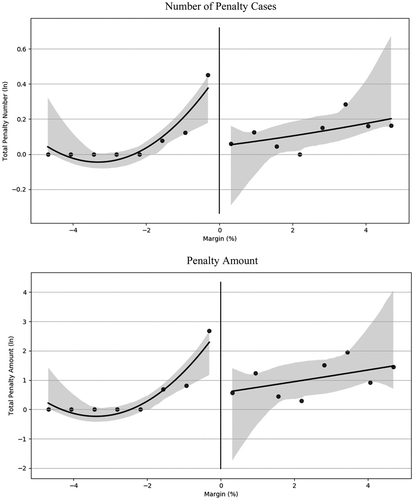
Notes. The figure presents regression discontinuity plots using a fitted quadratic polynomial estimate with a 90% confidence interval around the fitted value. The horizontal axis is the margin, which for the winning candidates (right panels), is the difference between the share of votes cast for the winning candidate and the second-place candidate in an election and for the losing candidates (left panels), is the share of votes cast for the losing candidate and the winning candidate in an election. The outcome variables are the log number and amount of penalties in the year of the special election. (Upper panel) Number of penalty cases. (Lower panel) Penalty amount.
We next present the regression discontinuity analysis. Formally, we estimate the following regressions for dependent variables of EPA actions and penalties:
|
Table 9. Robustness Checks Using Special Election Contribution
| (1) | (3) | (3) | |
|---|---|---|---|
| Action_Num | Total_Penalty_Amt | Total_Penalty_Amt | |
| Win | −0.0860 | −0.1361*** | −0.8961*** |
| (–1.27) | (–3.80) | (–3.10) | |
| LEVERAGE | −0.0373 | −0.0742 | 0.2992 |
| (–0.19) | (–0.47) | (0.24) | |
| SIZE | 0.0848 | 0.0416 | −0.0076 |
| (1.07) | (0.86) | (–0.02) | |
| CHG_NOLCF | 0.0666 | 0.2005 | −0.6193 |
| (0.37) | (1.42) | (–0.66) | |
| NOLCF | 0.2594 | 0.0036 | 2.3844 |
| (0.76) | (0.07) | (1.30) | |
| LOSS | 0.0996 | −0.0237 | −0.1448 |
| (1.30) | (–0.46) | (–0.32) | |
| SGA | 0.1369 | 0.0076 | 0.8170 |
| (0.45) | (0.11) | (1.63) | |
| CAPEX | −0.1772 | 0.0918 | 0.7240 |
| (–0.29) | (0.23) | (0.19) | |
| EBITDA_SIGMA | 0.5231 | 1.2499 | −1.2901 |
| (0.49) | (1.54) | (–0.26) | |
| EBITDA | 0.3789 | 0.2877 | 1.6854 |
| (1.27) | (0.85) | (1.15) | |
| Constant | −0.5077 | −0.2325 | 1.5182 |
| (–0.79) | (–0.52) | (0.44) | |
| Firm FE | Yes | Yes | Yes |
| Year FE | Yes | Yes | Yes |
| Cluster | Firm | Firm | Firm |
| Observations | 773 | 773 | 773 |
| R2 | 0.80 | 0.83 | 0.79 |
Notes. This table presents the OLS regression results with fixed effects for special elections. The dependent variables are the next year’s total EPA investigations (Action_Num), violations (Total_Penalty_Num), and total fines assessed (Total_Penalty_Amt). The independent variable of interest is Win, which is an indicator variable that equals one if the firm-supporting candidate won a close election and zero otherwise. Fixed effects and firm-year controls including LEVERAGE, SIZE, CHG_NOLCF, NOLCF, LOSS, SGA, CAPEX, EBITDA_SIGMA, and EBITDA are included in all regressions. Standard errors are clustered by firm. Robust t statistics are in parentheses.
***Significance at 10%.
Although the RDD is a powerful setting that allows us to draw causal inference between firms narrowly connected to politicians and those that are not, we acknowledge that our results may have limited generalizability. Although we can causally compare public firms connected to politicians who narrowly won close elections with those without connections within our sample period, our estimates cannot speak to the effect political connections have on private firms, different types of environmental penalties, or connections made outside our time frame.
7. Conclusion
In this paper, we examine whether the EPA selectively enforces regulation for politically connected firms. We find no difference in EPA investigations between politically connected and unconnected firms, although firms with political connections are less likely to receive penalties and incur lower fines. We also find evidence that after politically connected firms lose this connection, there is more stringent environmental enforcement. Using a setting that allows us to causally examine the differences in regulatory enforcement between firms with and without connections, we contribute to the literature debating whether corporate campaign contributions are beneficial to firms. We conclude that these contributions can benefit firms by way of reduced environmental regulatory enforcement.
Not only do we provide evidence that politically connected firms experience more favorable regulatory outcomes, but we also provide theories and empirical evidence indicating the circumstances in which this influence is likely to be exerted, contributing to the literature examining the influence politicians have over regulators. Firms that donate to politicians who are more likely to be capable of influencing regulators experience more favorable regulatory outcomes, and firms that are likely to be more important to politicians by way of industry, potential voters, or campaign contributions are less likely to experience penalties and fines. Furthermore, we also find that politicians demonstrating less of a commitment to the environment are more likely to receive campaign contributions.
Although there are numerous anecdotes suggesting that corporations use political connections to obtain favorable treatment by the EPA, this study provides the first systematic evidence of this occurrence. Our evidence suggests that campaign contributions are an effective way to link firms to regulators and that firms that establish this link receive favorable regulatory enforcement.
The authors are thankful to Pat Akey, Adam Babich, Patrick Bolton, David Brown, Gilles Chemia, Mark Flannery, Hamed Ghoddusi, John Griffin, Joel Houston, Chris James, Ye Wendy Jin, Sehoon Kim, Tao Li, Chen Lin, Laura Xiaolei Liu (discussant), Victor Luo, Ron Masulis, Gans Narayanamoorthy, Papa Ndiaye, Ryan Peters, Xuan Ren, Jay Ritter, Alexander Rodivilov, Hongxun Ruan, Eric Set, Tao Shu, Chang Sun, Alessio Saretto, Baolian Wang, Yihui Wang, Alexander Wagner, Qi Xu, Bohui Zhang, Yu Zhang, Rui Zhong (discussant), and Morad Zekhnini for helpful discussion. They also thank the seminar audience at the 2019 China International Conference in Finance (Guangzhou), 2019 European Summer Symposium in Financial Markets (ESSFM, Gerzensee), Cass School of Business, Fordham University (Gabelli School of Business), NYU Shanghai, Peking University (Guanghua School of Management), Stevens Institute of Technology, Tsinghua PBC School of Business Green Finance and ESG Analysis Workshop, University of Florida (Warrington College of Business), and Zhejiang University for insightful comments. The authors thank Yan Li for excellent research assistance.
1 Former President Nixon established the EPA through an executive order on July 9, 1970 (Nixon 1970).
2 This was reported in the New York Times (Eder and Tabuchi 2018).
3 See Eder and Tabuchi (2018).
4 Fines were calculated using penalty data from the EPA’s ECHO database EPA.gov (accessed January 21, 2019).
5 For example, Aggarwal et al. (2012), Coates (2012), and Borisov et al. (2016) find evidence that campaign contributions are indicative of agency problems. For evidence that political connections create value, see De Soto (1989), Johnson and Mitton (2003), Joh and Chiu (2004), Cull and Xu (2005), Khwaja and Mian (2005), Faccio (2006), Faccio et al. (2007), Ramanna (2008), Cooper et al. (2010), Yu and Yu (2011), Duchin and Sosyura (2012, 2014), Fulmer and Knill (2012), Correia (2014), Tahoun (2014), Arayavechkit et al. (2018), and Brown and Huang (2020).
6 See Ansolabehere et al. (2003) for a survey.
7 Kedia and Rajgopal (2011), Correia (2014), and Heese (2015) suggest Securities and Exchange Commission enforcement is not uniform, whereas Mixon (1995) and Gulen and Myers (2017) provide evidence against consistent EPA enforcement. Hunter and Nelson (1995) and Young et al. (2001) show similar results for the Internal Revenue Service, whereas Faith et al. (1982) and Weingast and Moran (1983) show consistency with the Federal Trade Commission. Brown and Huang (2020) also show that corporate executive meetings with key policy makers are associated with positive abnormal stock returns, and these firms are more likely to receive regulatory relief.
8 The Associated Press (2018) reported, for example, that “[a]n elected Arizona utility regulator who is now accused of accepting bribes had $31,000 funneled to him from a water company owner and tried to get the owner to buy him a $350,000 piece of land” (May 27, 2018).
9 According to the Los Angeles Times (1985), “[u]pon discovering that her former employer, Aerojet, had dumped hazardous waste, Rita Lavelle, the former head of the EPA’s Superfund (toxic waste) program failed to excuse herself from the case and lied about it” (April 20, 1985).
10 President Trump, who had campaigned on a promise to revive the coal industry, issued an executive order to revise or withdraw the Clean Power Plan within his first days of office, targeting “regulatory burdens that unnecessarily encumber energy production … and prevent job creation” (White House 2017).
11 These gasses are carbon monoxide (CO), nitrogen dioxide (NO2), ozone (O3), lead (Pb), particulate matter (PM10 and PM2.5), and sulfur dioxide (SO2).
12 See Graff Zivin and Neidell (2012) for a survey. Also, see Dockery et al. (1993), Pope et al. (2002), Chay and Greenstone (2003), Currie and Neidell (2005), and Isen et al. (2017).
13 For further details on air regulation, see https://www.epa.gov/regulatory-information-topic/regulatory-information-topic-air#toxic.
14 Further information on regulation on each one of these criteria pollutants can be found at https://www.epa.gov/criteria-air-pollutants/naaqs-table.
15 The Center for Responsive Politics (CRP) identified 89 EPA staff members as going through the revolving door.
16 For further discussion on how internalizing the goals of the organization enhances career prospects for bureaucrats, see chapter 9 in Wilson (1989).
17 We thank the anonymous referee for suggesting scaling the independent variable by the number of total candidates who received firm contributions.
18 After 2010, we cannot clearly map Super PAC donors to recipient politicians. Our results are also robust to excluding observations of the 2010 election cycle.
19 Other than the three categories, the data set also has the other three PAC designations, including lobbyist/registrant PACs, joint fundraisers, and leadership PACs.
20 In the data, the incumbency status includes being a challenger, an incumbent, or an “open seat.” Open seats are seats where the incumbent never sought reelection.
21 A minimal number of aggregated contributions are zero or even negative, which are very likely because of data input errors. We exclude these observations.
22 We also conduct our analysis using various combinations of fixed effects. The economic motivation for these tests is described in detail within the online appendix. Regardless of the fixed effects implemented, our results are quantitatively similar, and tables are available upon request.
23 See Section 2.1 for a general discussion. Furthermore, a formal description of the EPA’s discretion in enforcing regulation can be found at https://www.epa.gov/sites/production/files/2013-10/documents/proreq-hermn-mem.pdf.
24 We calculate this number as −0.1387 × 0.322.
25 We calculate this number as e^(−0.045) − 1.
26 All results presented in Table 2 are also robust to analyzing the dependent variable at year t + 2. Because there is an election cycle every two years, a firm’s political connections are valid for two years. That is, a firm’s portfolio of political connections is in place for two years, until the next election cycle. These unreported results are available upon request.
27 We cannot include a ChallengerLoseRatio variable in the regressions because the sum of ChallengerLoseRatio, IncumbentWinRatio, ChallengerWinRatio, and IncumbentLoseRatio would be one, indicating a multicollinearity problem.
28 Although unreported, the results are robust to defining this variable at just the House or Senate level.
29 Because the Senate consists of 100 senators and the House of Representatives consists of 435 congressmen, the Seniority indicator variable will equal one for the 25 longest-serving senators or 109 longest-serving members of the House of Representatives.
30 House committees with EPA jurisdiction are at https://archive.epa.gov/ocir/leglibrary/pdf/112housejuris.pdf. Senate committees with EPA jurisdiction are at https://archive.epa.gov/ocir/leglibrary/pdf/112senatejuris.pdf.
31 Not all monitors are functioning at all times, and not all monitors track all criteria gasses. Therefore, we conduct our primary criteria gas analysis at the plant level because we do not have complete data for all criteria gas emissions pertaining to all firm plants.
32 This web page presents more information on the basics of how these monitors work: https://www.epa.gov/outdoor-air-quality-data/air-data-basic-information.
33 We do not use firm-level toxin data from the EPA’s TRI database because the data are less granular than the monitor data. The EPA’s TRI database also contains information on aggregated toxins, as opposed to individual criteria gasses. Data contained in the TRI database are self-reported, and not all firms measure or report their hazardous emissions. For a discussion on the unreliability of the TRI self-reported data, especially for large polluters, see https://www.environmentalintegrity.org/wp-content/uploads/2017/02/Toxic-Shell-Game.pdf.
34 Each year, approximately 6% of monitors contain two or more plants within two miles, and 3% of monitors contain two or more plants within one mile. In untabulated results, we find that our results are robust to using a one-mile cutoff and dropping observations where there are two or more plants within two miles of an air monitor.
35 If anything, our results suggest that firms with more political connections emit more carbon monoxide yet realize more infrequent and fewer penalties.
36 Because these individual regressions are conducted at the firm level, we cannot include firm fixed effects.
37 Data are available at https://scorecard.lcv.org/.
38 For details, see https://scorecard.lcv.org/methodology.
39 Following Akey (2015), we exclude the firms that donated to both competing candidates in one cycle to have the cleanest identification because those firms could be trying to hedge risk by betting on both sides.
References
- (2012) Corporate political donations: Investment or agency? Bus. Politics 14(01):1–38.Crossref, Google Scholar
- (2015) Valuing changes in political networks: Evidence from campaign contributions to close congressional elections. Rev. Financial Stud. 28(11):3188–3223.Crossref, Google Scholar
- (2007) Bureaucrats or politicians? Part I. A single policy task. Amer. Econom. Rev. 97(1):169–179.Crossref, Google Scholar
- (2003) Why is there so little money in U.S. politics? J. Econom. Perspect. 17(1):105–130.Crossref, Google Scholar
- (2018) Capital-based corporate tax benefits: Endogenous misallocation through lobbying. Working paper, University of Maryland, College Park, MD.Google Scholar
Associated Press (2018) Ex-Arizona regulator charged with bribery heads to trial Wednesday. The Arizona Republic (May 27), https://www.azcentral.com/story/money/business/consumers/2018/05/27/ex-arizona-regulator-gary-pierce-charged-bribery-heads-trial-wednesday/649013002/.Google Scholar- (2016) The corporate value of (corrupt) lobbying. Rev. Financial Stud. 29(4):1039–1071.Crossref, Google Scholar
- (2020) All the president’s friends: Political access and firm value. J. Financial Econom. 138(2):415–431.Crossref, Google Scholar
- (2003) The impact of air pollution on infant mortality: Evidence from geographic variation in pollution shocks induced by a recession. Quart. J. Econom. 118(3):1121–1167.Crossref, Google Scholar
- (2012) Corporate politics, governance, and value before and after citizens united. J. Empirical Legal Stud. 9(4):657–696.Crossref, Google Scholar
- (2013) Legislating stock prices. J. Financial Econom. 110(3):574–595.Crossref, Google Scholar
- (2010) Corporate political contributions and stock returns. J. Finance 65(2):687–724.Crossref, Google Scholar
- (2014) Political connections and SEC enforcement. J. Accounting Econom. 57(2-3):241–262.Crossref, Google Scholar
- (2005) Institutions, ownership, and finance: The determinants of profit reinvestment among Chinese firms. J. Financial Econom. 77(1):117–146.Crossref, Google Scholar
- (2015) Environmental health risks and housing values: Evidence from 1,600 toxic plant openings and closings. Amer. Econom. Rev. 105(2):678–709.Crossref, Google Scholar
- (2005) Air pollution and infant health: What can we learn from California’s recent experience? Quart. J. Econom. 120(3):1003–1030.Google Scholar
- (1989) The Other Path: The Invisible Revolution in the Third World (Harper and Row, New York).Google Scholar
- (2012) Out of sight, out of mind: The value of political connections in social networks. Working paper, University of Cambridge, Cambridge, UK.Google Scholar
- (2015) Political connections and firm value: Evidence from the regression discontinuity design of close gubernatorial elections. Working paper, Sciences Po, Paris.Google Scholar
- (1993) An association between air pollution and mortality in six U.S. cities. New England J. Medicine 329(24):1753–1759.Crossref, Google Scholar
- (2012) The politics of government investment. J. Financial Econom. 106(1):24–48.Crossref, Google Scholar
- (2014) Safer ratios, riskier portfolios: Banks’ response to government aid. J. Financial Econom. 113(1):1–28.Crossref, Google Scholar
- (2018) Scott Pruitt before the E.P.A.: Fancy homes, a shell company and friends with money. New York Times (April 21), https://www.nytimes.com/2018/04/21/us/politics/scott-pruitt-oklahoma-epa.html.Google Scholar
- (2006) Politically connected firms. Amer. Econom. Rev. 96(1):369–386.Crossref, Google Scholar
- (2007) Political connections and corporate bailouts. J. Finance 61(6):2597–2635.Crossref, Google Scholar
- (1982) Antitrust pork barrel. J. Law Econom. 25(2):329–342.Crossref, Google Scholar
- (2018) History of US presidential assaults on modern environmental health protection. Amer. J. Public Health 108(S2):95–103.Crossref, Google Scholar
- (2012) Political contributions and the severity of government enforcement. Unpublished manuscript, Florida State University, Tallahassee, FL.Google Scholar
- (2012) The impact of pollution on worker productivity. Amer. Econom. Rev. 102(7):3652–3673.Crossref, Google Scholar
- (2010) Identifying agglomeration spillovers: Evidence from winners and losers of large plant openings. J. Political Econom. 118(3):536–598.Crossref, Google Scholar
- (1994) Protection for sale. Amer. Econom. Rev. 84(4):833–850.Google Scholar
- (2017) The selective enforcement of government regulation: Battleground states and the EPA. Working paper, Purdue University, West Lafayette, IN.Google Scholar
- (2015) Government preferences and SEC enforcement. Harvard Business School Working Paper No. 15-054, Boston.Google Scholar
- (1995) Tax enforcement: A public choice perspective. Public Choice 82(1-2):53–67.Crossref, Google Scholar
- (2017) Every breath you take—every dollar you’ll make: The long-term consequences of the Clean Air Act of 1970. J. Political Econom. 125(3):848–902.Crossref, Google Scholar
- (2004) Loans to distressed firms: Political connections, related lending, business group affiliation and bank governance. Unpublished manuscript, Seoul National University, Seoul, Korea.Google Scholar
- (2003) Cronyism and capital controls: Evidence from Malaysia. J. Financial Econom. 67(2):351–382.Crossref, Google Scholar
- (2011) Do the SEC’s enforcement preferences affect corporate misconduct? J. Accounting Econom. 51(3):259–278.Crossref, Google Scholar
- (2005) Do lenders favor politically connected firms? Rent provision in an emerging financial market. Quart. J. Econom. 120(4):1371–1411.Crossref, Google Scholar
- (1991) The neglected question of Congressional oversight of EPA: Quis custodiet ipsos custodees (who shall watch the watchers themselves). Law Contemporary Problems 54(4):205–239.Crossref, Google Scholar
- (2008) Randomized experiments from non-random selection in US House elections. J. Econometrics 142(2):675–697.Crossref, Google Scholar
Los Angeles Times (1985) Convicted of lying to Congress: Rita Lavelle surrenders at prison for 6-month term. Los Angeles Times (April 20), http://articles.latimes.com/1985-04-20/news/mn-21740_1_rita-lavelle.Google Scholar- (1998) Political control of the bureaucracy. Newman P, ed. The New Palgrave Dictionary of Economics and the Law, vol. 3 (Palgrave Macmillan, London), 50–54.Google Scholar
- (1995) Public choice and the EPA: Empirical evidence on carbon emissions violations. Public Choice 83(1-2):127–137.Crossref, Google Scholar
- (1970) Reorganization Plan No. 3 of 1970: Special message from the President to the Congress about reorganization plans to establish the Environmental Protection Agency and the National Oceanic and Atmospheric Administration. Accessed February 25, 2019, https://archive.epa.gov/epa/aboutepa/reorganization-plan-no-3-1970.html.Google Scholar
- (1976) Toward a more general theory of regulation. J. Law Econom. 19(2):211–240.Crossref, Google Scholar
- (1985) Patterns of political action committee contributions to the 1980 campaigns for the United States House of Representatives. Public Choice 47(1):63–111.Crossref, Google Scholar
- (2002) Lung cancer, cardiopulmonary mortality and long-term exposure to fine particulate air pollution. J. Amer. Medical Assoc. 287(9):1132–1141.Crossref, Google Scholar
- (2008) The implications of unverifiable fair-value accounting: Evidence from the political economy of goodwill accounting. J. Accounting Econom. 45(2-3):253–281.Crossref, Google Scholar
- (2019) Investor rewards to climate responsibility: Evidence from the 2016 climate policy shock. NBER Working Paper No. 25310, National Bureau of Economic Research, Cambridge, MA.Google Scholar
- (2019) Corporate governance and pollution externalities of public and private firms.. Working paper, Notre Dame University, Notre Dame, IN.Google Scholar
- (1971) The theory of economic regulation. Bell J. Econom. Management Sci. 2(1):3–21.Crossref, Google Scholar
- (1995) Campaign contributions and Congressional voting: Does the timing of contributions matter? Rev. Econom. Statist. 77(1):127–136.Crossref, Google Scholar
- (2014) The role of stock ownership by US members of Congress on the market for political Favors. J. Financial Econom. 111(1):86–110.Crossref, Google Scholar
- (1984) The Congressional-bureaucratic system: A principal agent perspective (with applications to the SEC). Public Choice 44(1):147–191.Crossref, Google Scholar
- (1983) Bureaucratic discretion or Congressional control? Regulatory policymaking by the Federal Trade Commission. J. Political Econom. 91(5):765–800.Crossref, Google Scholar
White House (2017) Presidential Executive Order on Promoting Energy Independence and Economic Growth. Accessed February 25, 2019, https://www.whitehouse.gov/presidential-actions/presidential-executive-order-promoting-energy-independence-economic-growth/.Google Scholar- (1989) Bureaucracy: What Government Agencies Do and Why They Do It (Basic Books, New York).Google Scholar
- (2001) The political economy of the IRS. Econom. Politics 13(2):201–220.Crossref, Google Scholar
- (2011) Corporate lobbying and fraud detection. J. Financial Quant. Anal. 46(6):1865–1891.Crossref, Google Scholar

