


Bidder-Specific Synergies and the Evolution of Acquirer Returns
Abstract
Largely constant average acquirer returns over the past four decades mask fundamental changes in the takeover market. Controlling for bidder composition, the common component of acquirer returns has increased by five percentage points relative to the 1980s. Offsetting this increase, the average bidder-specific component has declined. We propose a theory of bidder-specific synergies to help interpret these opposing trends. In our theory and in the data, acquirer returns increase with the extent to which synergies are unique to that bidder. The composition effect reflects bidder uniqueness. Overall, the evidence is consistent with rising merger synergies that have become less bidder specific.
This paper was accepted by Victoria Ivashina, finance.
Funding: A. Golubov acknowledges financial support from the Bank of Canada [Governor’s Award].
Supplemental Material: The online appendix and data files are available at https://doi.org/10.1287/mnsc.2022.02208.
1. Introduction
In their reviews of first-generation empirical estimates of takeover gains, Jensen and Ruback (1983) and Roll (1986) made two important observations. First, acquirer announcement returns are positive but small on average. Second, target shareholders appear to capture the lion’s share of synergy gains. More than three decades later, an expansive literature—benefiting from access to large-scale electronic databases—largely confirms these two conclusions (Betton et al. 2008). This literature also proposes several potential explanations for why average bidder returns are low. The hypotheses range from competition among bidder firms to more complex explanations involving bidder agency costs, managerial hubris, or measurement issues due to market deal anticipation and revelations about bidder stand-alone values. However, no single view has emerged as the dominant explanation for continued lackluster bidder performance.
We offer a new perspective on this literature by studying the evolution of announcement returns over time in a comprehensive sample of U.S. acquirers. Our focus on the time series evolution is motivated by the profound changes in the capital markets and the market for corporate control over the last four decades. Empirical evidence suggests that corporate governance practices in listed firms have improved (Gillan and Starks 2007), that executives and directors are now more highly educated (Krueger et al. 2015), and that financial markets may have become more open and informative (Bai et al. 2016). It is reasonable to expect that such broad-based developments have also resulted in improved corporate decision making, including acquisition decisions as one of the most prominent and consequential forms of corporate investment. And yet, there is little evidence of any such improvement. It is as if none of these developments have benefited acquirers and their shareholders.
In this paper, we show that existing evidence on the evolution of average acquirer returns is incomplete, as it masks two fundamental but opposing underlying trends in the data. Our starting point is the observation that the composition of listed firms—the focus of all studies of acquirer returns—has changed dramatically over the last decades (Fama and French 2004, Doidge et al. 2017, Eckbo and Lithell 2023). Such changes may have profound implications for the evolution of acquirer returns, because much of the variation in bidder takeover gains is firm specific (Golubov et al. 2015). Indeed, our first contribution is to demonstrate that a change in the composition of bidders has confounded a general trend toward higher acquirer returns. Holding bidder composition constant, acquirer returns have been on the rise over much of the past four decades—a finding we refer to as a common trend. This increase has gone undetected because the mix of bidders undertaking acquisitions has changed in a way that offsets the upward common trend. We refer to this offsetting force as a composition effect. Having established the two opposing trends in the data, our second contribution is to examine their economic nature, culminating in a novel theory of what we call bidder-specific synergies.
We begin by documenting new stylized facts about bidder takeover gains. In line with prior research on the evolution of acquirer returns (Moeller et al. 2005), we show that average acquirer gains have remained close to zero and largely flat over the last four decades. This is true both unconditionally as well as after controlling for various firm- and deal-specific characteristics. In sharp contrast to this received wisdom, we uncover a strong positive time trend in acquirer returns when we further control for bidder composition via firm fixed effects. Holding bidder composition constant, acquirer returns have increased by as much as five percentage points relative to the 1980s. This common trend is broad based: It is equally present in acquisitions of public and private targets, in cash and stock deals, in focused and diversifying transactions, and in domestic and cross-border acquisitions.1 Counteracting this common trend, the composition of bidders making acquisitions has changed significantly over time. We find that the average bidder-specific (i.e., fixed effect) component of acquirer returns has declined just enough to offset the rising common trend. Simulation analysis confirms the tight link between the two opposing trends.
In the second part of the paper, we turn to theory to guide our interpretation of the new stylized facts. At a high level, our evidence indicates that the mix of bidders making acquisitions has changed. The nature of this change in bidder composition is therefore key to making sense of the temporal patterns we document. Golubov et al. (2015) argue that firm-specific heterogeneity in acquirer returns is likely due to “bidder-specific synergies, such as those arising from unique assets or skills.” Building on their insight, we develop a simple theoretical framework that links announcement returns to merger-induced synergies and how unique they are to the winning bidder. Bidder uniqueness in our theory represents the degree of substitutability between potential rival bidders. For example, synergies are more bidder-specific when the bidder contributes a unique distribution network for the target’s product and less bidder-specific when the target sells itself to a cash-rich buyer to fund its continued operations. Because cash is fungible, synergies in the latter case are not unique to any particular bidder, and competition among perfect-substitute bidders drives down the share of synergies the ultimate buyer can extract. The main insight is that acquirer returns increase with the uniqueness of the winning bidder in terms of the resources it brings to the deal. This insight is new to the literature: Whereas prior studies have focused on the role of similarity between the bidder and the target in determining synergies (Hoberg and Phillips 2010), our theory highlights the role of similarity between potential rival bidders in determining bargaining power. We develop four empirical proxies for bidder uniqueness that closely follow the associated notion in our theoretical framework, namely, the (dis)similarity between the winning bidder and the latent second-best alternative buyer. Bidder uniqueness has a first-order effect on acquirer returns in the data: more unique bidders earn higher acquisition returns. We also propose a novel approach to measuring the split of synergy gains between the bidder and the target, the application of which confirms the main mechanism of our framework, namely that more unique bidders receive a larger share of synergies.
We then use our theoretical framework to help interpret the time series evidence. Starting with the composition effect, we test whether the bidder-specific (fixed effect) component of acquirer returns reflects bidder uniqueness. We find that all four proxies for bidder uniqueness directly explain the variation in the estimated bidder fixed effects. Moreover, proxies for bidder uniqueness no longer explain acquirer returns when bidder composition is controlled for. Finally, we find that our bidder uniqueness proxies trend downward over time—just as the bidder-specific component of acquirer returns. The evidence is thus consistent with the composition effect reflecting a decline in bidder uniqueness. This implies that merger synergies, whatever their source, have become less unique to the winning bidder. Put differently, acquirers have become less differentiated from their latent competition in the takeover market.
This interpretation of the composition effect, in turn, generates testable predictions about the economic nature of the rising common trend in acquirer returns. In our theoretical framework, acquirer returns are positively related to bidder uniqueness and overall deal synergies. If bidder uniqueness has declined, while average acquirer returns have not, then merger synergies must have contemporaneously increased. Using the public-target subsample as a laboratory, we find that combined firm abnormal returns and operating performance improvements—proxies for merger synergies—have indeed increased over time. Moreover, target firm returns have also increased, in line with declining bidder uniqueness benefiting targets through an improvement in their outside option. Overall, the evidence is consistent with a general increase in merger synergies that have become less bidder-specific over time.
We conclude the paper with exploratory evidence on the potential reasons for declining bidder uniqueness and rising merger synergies, linking our findings to the mergers and acquisitions (M&A) and the broader finance literature. Declining bidder uniqueness implies that the resources bidders bring to the negotiating table are becoming less scarce. We show that financing power—one known source of synergy gains—is no longer unique to the population of bidders, as other firms in the economy have seen a relaxation of their financing constraints. We also find that bidders are falling behind in terms of hard-to-replicate resources, such as knowledge capital arising from investment in innovation. As for the source of rising synergies, the analysis is notable for what does not work. First, learning through acquisition activity—discussed extensively in the literature—does not explain the upward trend we document. Second, we fail to find support for the hypothesis that temporal improvements in the quality of corporate governance resulted in improved deal-making over time. Third, we examine whether the increase in merger gains is related to the trend toward increased industry concentration in the United States but find no such statistical link. Finally, we do find some (weak) evidence on the link between the upward common trend in acquirer returns and changes in the composition of M&A advisors—as if acquirers have gravitated toward higher value-added advisors over time. However, the upward trend is also present in deals that likely involved no advisors. Thus, the origins of rising merger synergies is a puzzle to be resolved.
Our paper makes two distinct contributions to the M&A literature. First, we provide the most comprehensive analysis of the time series evolution of takeover gains to date. This analysis uncovers two countervailing temporal trends: (i) controlling for the composition of bidders making acquisitions, acquirer returns have been steadily on the rise, and ii) offsetting this conditional increase, the composition of bidders has changed toward “lower types.” The time series focus of our work complements prior contributions by Rosen (2006), Netter et al. (2011), and Alexandridis et al. (2017). Second, we introduce a simple theory of bidder-specific synergies, which predicts that acquirer returns should be higher for more unique bidders, that is, those whose contribution to the generation of synergies cannot be replicated by rival bidders. We demonstrate that proxies for bidder uniqueness can explain the cross section of acquirer returns and that the changing composition of bidders over time is, at least partly, related to bidder uniqueness. This part of our work is related to the early concepts of bidder uniqueness found in James and Wier (1987) and Capron and Pistre (2002), as well as to the findings of bidder-specific heterogeneity in acquirer returns in Golubov et al. (2015).
The rest of the paper is organized as follows. Section 2 describes our sample, whereas Section 3 establishes our basic results concerning the evolution of acquirer returns over time. Section 4 demonstrates how the time series evidence can be rationalized within a simple theoretical framework of merger synergies and their specificity. Section 5 explores potential drivers of declining bidder uniqueness and rising merger synergies. We conclude in Section 6. The Online Appendix contains various supplementary materials referenced throughout the paper.
2. Sample Selection and Description
The M&A data come from Thomson Reuters SDC M&A database and cover all acquisitions (repurchases and recapitalizations excluded) announced by U.S. public firms during the period from January 1, 1981, to December 31, 2017 (37 years). Our sample selection steps, which yield a total of 23,553 deals by 5,356 distinct bidders, are as follows:
(1) Completed or withdrawn M&A deal announcements from Thomson Reuters SDC, excluding repurchases.
(2) Bidders are U.S. public firms listed on NYSE, AMEX, or Nasdaq with a market capitalization of at least $1 million, excluding penny stocks (stock price below $1).
(3) Targets are U.S. or foreign, public, private, or subsidiary firms.
(4) Deals are worth at least $1 million and represent at least 1% of bidder market capitalization four days prior to the deal announcement.
(5) The bidder owns less than 50% of the target before the acquisition and is seeking a transfer of control.
(6) Deal announcements falling within 5 days of a quarterly earnings release are excluded.
(7) The bidder has sufficient data on CRSP and Compustat to compute announcement period returns and standard control variables.
(8) The acquirer conducts at least two deals over the sample period (same-day announcements are excluded).
Restriction (8) ensures that we are able to control for bidder heterogeneity via bidder fixed effects. This requirement is not onerous as it results in only a modest reduction in sample size: from 27,638 to 23,553 deals. That is, more than 85% of the deals in a typical M&A sample are undertaken by repeat acquirers.
Table 1 illuminates the panel structure of our data in terms of the number of deals per bidder and the time between deals. As shown in Panel A, as many as 1,706 bidders out of the total of 5,356 (32%) conduct at least five acquisitions over the sample period, representing 59% of the deal-level observations (13,814 of 23,553). The most acquisitive bidder conducts 37 deals in our sample. This understates the true acquisitiveness, as we have excluded deals whose announcements overlap with quarterly earnings releases (for event study purposes). Panel B shows the frequency distribution of the average number of months between successive deals by a given bidder and the time between the first and last bids. A median bidder conducts an acquisition every 17 months, and the 75th percentile of the average time between bids is 40 months. Also important, bidders tend to be active for a relatively short-lived period: the median time between first and last bid is just over four years (53 months). The 75th percentile of the time between first and last bids is 128 months. In other words, 75% of bidders are active within a period of only 10 years. This evidence is important for the following analysis as it suggests that the composition of bidders changes substantially over the four decades spanning our sample period.
|

Table 1. M&A Sample: Panel Structure
| Panel A: Number of deals per bidder | ||||||
|---|---|---|---|---|---|---|
| Deals per bidder | No. of bidders | Percentage | Cumulative percentage | No. of deals | Percentage | Cumulative percentage |
| 2 | 1,890 | 35.29 | 35.29 | 3,780 | 16.05 | 16.05 |
| 3 | 1,081 | 20.18 | 55.47 | 3,243 | 13.77 | 29.82 |
| 4 | 679 | 12.68 | 68.15 | 2,716 | 11.53 | 41.35 |
| 5 | 464 | 8.66 | 76.81 | 2,320 | 9.85 | 51.20 |
| 6 | 317 | 5.92 | 82.73 | 1,902 | 8.08 | 59.27 |
| 7 | 233 | 4.35 | 87.08 | 1,631 | 6.92 | 66.20 |
| 8 | 172 | 3.21 | 90.29 | 1,376 | 5.84 | 72.04 |
| 9 | 124 | 2.32 | 92.61 | 1,116 | 4.74 | 76.78 |
| 10 | 80 | 1.49 | 94.10 | 800 | 3.40 | 80.18 |
| 11 | 63 | 1.18 | 95.28 | 693 | 2.94 | 83.12 |
| 12 | 69 | 1.29 | 96.56 | 828 | 3.52 | 86.63 |
| 13 | 39 | 0.73 | 97.29 | 507 | 2.15 | 88.79 |
| 14 | 30 | 0.56 | 97.85 | 420 | 1.78 | 90.57 |
| 15 | 30 | 0.56 | 98.41 | 450 | 1.91 | 92.48 |
| 16 | 13 | 0.24 | 98.66 | 208 | 0.88 | 93.36 |
| 17 | 11 | 0.21 | 98.86 | 187 | 0.79 | 94.16 |
| 18 | 8 | 0.15 | 99.01 | 144 | 0.61 | 94.77 |
| 19 | 12 | 0.22 | 99.23 | 228 | 0.97 | 95.74 |
| 20+ | 41 | 0.77 | 100.00 | 1,004 | 4.26 | 100.00 |
| Total | 5,356 | 100.00 | 23,553 | 100.00 | ||
| Panel B: Distribution of time between deals of a given bidder | ||||||
|---|---|---|---|---|---|---|
| Mean | 10 pctl. | 25 pctl. | Median | 75 pctl. | 90 pctl. | |
| Mean t between deals | 32.00 | 2.27 | 6.50 | 16.77 | 40.43 | 81.90 |
| t between first and last deals | 85.20 | 7.27 | 19.13 | 53.52 | 128.48 | 209.33 |
Notes. The table describes the panel structure of our sample of U.S. M&A deals over the period 1981–2017. All bidders are U.S. public firms with common stock listed on NYSE, Nasdaq, or Amex with a market capitalization of at least $1 million and a stock price of at least $1. All targets are either U.S. or foreign public, private, and subsidiary firms. Deals with missing transaction values, deals worth less than U.S. $1 million or smaller than 1% of acquirer market capitalization, and deals falling within five days of a quarterly earnings announcement are excluded. Panel A presents the distribution of the number of deals per bidder. Panel B presents the distribution of the mean time between successive deals, as well as the time between first and last deal of a given bidder.
We use standard event study methodology to compute announcement returns for our sample bidders. For firms with multiple classes of common stock, we compute the cumulative abnormal return (CAR) as the weighted average of CARs for the different share classes with the respective market capitalizations as weights. For most of the analysis, we base our conclusion on CARs for the seven-day event window [−3, +3] centered on the announcement date (day 0). However, we show that the main results are robust to alternative event windows, including [−1, +1] and [−2, +2], [−5, +5]. The benchmark return is the return predicted by the one-factor market model estimated over the period from 300 to 46 days prior to the first public bid announcement, using the CRSP value-weighted index as the market portfolio. In unreported results, we also find that the main results are robust to alternative factor models for generating expected returns. All return variables and financial ratios are winsorized at the 1st and 99th percentiles (we perform the winsorization by year to preserve trends, if any).2
The Online Appendix, Tables 1 and 2, provides the definitions and descriptive statistics of all variables used in the analysis. Consistent with the extant literature (Betton et al. 2008), the unconditional average acquirer CAR [−3, +3] is positive but modest, with a mean (median) of 0.97% (0.33%). About 23% of the targets are public firms, with the remainder of the transactions targeting private or subsidiary companies. The majority of targets are domestic, with 13% of the targets being foreign (cross-border deals). Mean (median) relative size of the deal as percentage of acquirer market capitalization is 24% (9%). For the subset of public targets, we also estimate target CAR [−3, +3], which averages about 22% (median of 19%). The mean (median) takeover premium relative to the stock price four weeks prior to the announcement is 46.29% (39.15%) We also compute the combined firm CAR [−3, +3] as the weighted-average of acquirer and target CARs with the respective market capitalizations on day −4 as weights. Combined firm CAR, which may be interpreted as the overall synergy gain from the combination, has a mean (median) value of 1.79% (1.06%) in our sample.
Table 2 shows the annual distribution of mean and median acquirer CAR [−3, +3], number of deals, mean and median deal value, and total deal value by year. In our analysis, we benchmark the estimation of any temporal changes against M&A activity in the first decade of our sample, 1981–1989. Of the overall total of $14+ trillion worth of M&A activity by U.S. firms, 13.09 trillion occurs during 1990–2017. Moreover, as shown, annual average and median bidder CARs are small and mostly positive. Unconditionally, the evolution of acquirer returns over the four-decade sample period shows no particular patterns.
|
Table 2. Acquirer Announcement Returns by Year
| Year | Mean CAR | Median CAR | No. of deals | Mean deal value | Median deal value | Total deal value |
|---|---|---|---|---|---|---|
| 1981 | −1.82 | −1.50 | 213 | 481.79 | 64.28 | 102,621 |
| 1982 | 0.49 | 0.16 | 254 | 246.93 | 51.81 | 62,719 |
| 1983 | 0.16 | −0.18 | 355 | 201.52 | 58.41 | 71,541 |
| 1984 | 0.46 | −0.28 | 390 | 429.60 | 53.83 | 167,543 |
| 1985 | −0.39 | −0.79 | 250 | 904.11 | 264.11 | 226,027 |
| 1986 | 0.77 | 0.11 | 336 | 539.15 | 148.42 | 181,156 |
| 1987 | 1.20 | −0.12 | 309 | 564.13 | 141.68 | 174,318 |
| 1988 | 0.58 | −0.31 | 324 | 463.45 | 129.38 | 150,159 |
| 1989 | 0.04 | −0.30 | 406 | 546.43 | 83.58 | 221,850 |
| 1990 | 0.07 | −0.29 | 376 | 276.86 | 44.28 | 104,101 |
| 1991 | 1.63 | 0.57 | 389 | 216.08 | 41.15 | 84,055 |
| 1992 | 2.47 | 1.00 | 595 | 167.20 | 34.08 | 99,485 |
| 1993 | 1.57 | 0.71 | 781 | 349.07 | 34.14 | 272,622 |
| 1994 | 1.48 | 0.64 | 1,042 | 245.23 | 38.29 | 255,528 |
| 1995 | 0.84 | 0.11 | 1,085 | 346.89 | 43.43 | 376,373 |
| 1996 | 1.79 | 0.75 | 1,328 | 365.89 | 47.17 | 485,901 |
| 1997 | 1.80 | 1.01 | 1,631 | 392.19 | 46.48 | 639,664 |
| 1998 | 0.22 | −0.63 | 1,607 | 833.36 | 56.13 | 1,339,213 |
| 1999 | 1.14 | 0.33 | 1,276 | 911.37 | 80.69 | 1,162,910 |
| 2000 | −1.24 | −0.66 | 1,062 | 1,280.32 | 87.92 | 1,359,695 |
| 2001 | 1.10 | 0.34 | 743 | 858.79 | 76.17 | 638,084 |
| 2002 | 0.63 | 0.29 | 703 | 260.50 | 57.46 | 183,133 |
| 2003 | 1.08 | 0.52 | 650 | 468.27 | 66.97 | 304,377 |
| 2004 | 1.10 | 0.49 | 761 | 600.22 | 66.88 | 456,765 |
| 2005 | 1.07 | 0.24 | 760 | 675.88 | 75.53 | 513,669 |
| 2006 | 0.66 | 0.33 | 759 | 756.03 | 75.69 | 573,826 |
| 2007 | 1.20 | 0.14 | 721 | 557.15 | 72.69 | 401,703 |
| 2008 | 0.02 | 0.00 | 527 | 752.70 | 71.24 | 396,674 |
| 2009 | 1.44 | 0.40 | 341 | 999.19 | 83.84 | 340,724 |
| 2010 | 0.50 | 0.13 | 453 | 614.32 | 124.78 | 278,285 |
| 2011 | 0.89 | 0.64 | 471 | 738.60 | 103.76 | 347,880 |
| 2012 | 1.37 | 0.72 | 480 | 473.17 | 82.00 | 227,120 |
| 2013 | 1.97 | 1.26 | 426 | 539.48 | 108.47 | 229,820 |
| 2014 | 1.90 | 0.83 | 540 | 1,112.09 | 116.81 | 600,530 |
| 2015 | 1.85 | 1.27 | 461 | 1,371.38 | 146.22 | 632,207 |
| 2016 | 1.36 | 0.97 | 388 | 1,171.19 | 161.90 | 454,420 |
| 2017 | 1.17 | 0.95 | 360 | 916.61 | 157.58 | 329,978 |
| 1981–1989 | 0.25 | −0.33 | 2,837 | 478.65 | 93.79 | 1,357,934 |
| 1990–2017 | 1.06 | 0.44 | 20,716 | 631.82 | 64.78 | 13,088,743 |
Notes. The table presents average acquirer returns and deal activity by year for a sample of U.S. M&A deals over the period 1981–2017. All bidders are U.S. public firms with common stock listed on NYSE, Nasdaq, or Amex with a market capitalization of at least $1 million and a stock price of at least $1. All targets are either U.S. or foreign public, private, and subsidiary firms. Deals with missing transaction values, deals worth less than U.S. $1 million or smaller than 1% of acquirer market capitalization, and deals falling within five days of a quarterly earnings announcement are excluded.
3. Evolution of Acquirer Returns
We develop and report our analysis of the evolution of acquirer returns in two steps. First, we estimate whether the average acquirer return has changed over time without controlling for bidder composition. This involves running a cross-sectional regression of acquirer CARs on year dummies, with controls for firm and deal characteristics and industry heterogeneity added progressively. In the second step, we replace industry fixed effects with bidder firm fixed effects. This allows us to estimate any temporal change in acquirer returns unconfounded by changes in bidder composition.
3.1. Regression Specification with Year Dummies
In the first-step estimation, we run the following three cross-sectional regressions, which successively add explanatory variables:
The vector includes 28 annual dummy variables for the deal announcement years 1990–2017, with all of the 1980s as the omitted category, and coefficients estimate the change in average acquirer CAR [−3, +3] relative to acquisitions announced during the 1981–1989 period. In other words, the estimated coefficients are changes in the average acquirer CAR in the corresponding year relative to the average acquirer CAR observed during the 1980s.3 is a vector of observable firm and deal characteristics.
In the second step, we replace industry fixed effects (IndFE) with bidder fixed effects (BidderFE):
We use an extensive list of time-varying control variables , all of which have been shown to help explain the cross-sectional variation in bidder CARs by prior studies. Among bidder characteristics, we include (the log of) acquirer size, Tobin’s Q, stock price run-up, idiosyncratic stock return volatility, cash holdings, and leverage. The acquirer size control is particularly relevant given our focus on the evolution of gains, as firms tend to grow over time, and acquirer size has a robust negative effect on acquirer returns (Eckbo and Thorburn 2000, Moeller et al. 2004, Schneider and Spalt 2024). In terms of deal-specific variables, includes industry relatedness of the deal, tender offer, hostility, and cross-border indicators, as well as a set of interactions of target type (public/private/subsidiary) and the method of payment (cash/stock).4 For reasons that will become apparent and discussed once we introduce our theoretical framework in Section 4, we do not include the relative size of the deal among our control variables; our headline conclusions are not sensitive to this.
3.2. Baseline Coefficient Estimates
Table 3 and Figure 1 report our baseline coefficient estimate and . The standard errors in parentheses are double-clustered by acquirer industry (two-digit Standard Industrial Classification (SIC) level) and by year. The column numbers in Table 3 correspond to the equation numbers above. To facilitate presentation, the table reports the estimates of only and omits the year-dummy coefficient estimates . Instead, the latter are plotted in the four graphs in Figure 1 along with the associated 99% confidence intervals. The top two graphs plot the year-dummy coefficient estimates for regression models (1) and (2), whereas the bottom two graphs report the estimates of in regressions (3) and (4), respectively.
|
Table 3. Estimation of the Time Trend in Acquirer Announcement Returns Using Year Dummies
| No controls | Controls | Controls + industry fixed effects | Controls + acquirer fixed effects | |
|---|---|---|---|---|
| (1) | (2) | (3) | (4) | |
| Public target × stock | −3.66*** | −3.49*** | −3.30*** | |
| (−10.18) | (−8.57) | (−5.99) | ||
| Public target × cash | −1.21*** | −1.19*** | −0.98*** | |
| (−3.67) | (−3.69) | (−2.88) | ||
| Private target × cash | −1.25*** | −1.24*** | −0.93*** | |
| (−4.64) | (−4.66) | (−3.06) | ||
| Private target × stock | −0.90*** | −0.81*** | −0.32 | |
| (−3.03) | (−2.79) | (−1.19) | ||
| Subsidiary target × cash | −0.63** | −0.71** | −0.43 | |
| (−2.27) | (−2.46) | (−1.58) | ||
| Same industry | −0.02 | 0.13 | 0.37* | |
| (−0.12) | (0.70) | (1.75) | ||
| Cross-border | −0.24 | −0.30 | −0.25 | |
| (−1.10) | (−1.44) | (−1.00) | ||
| Hostile | −0.42 | −0.47 | −0.66 | |
| (−0.99) | (−1.15) | (−1.21) | ||
| Tender offer | 0.46 | 0.35 | 0.20 | |
| (1.29) | (0.98) | (0.55) | ||
| Ln (Acquirer size) | −0.57*** | −0.59*** | −1.78*** | |
| (−7.06) | (−7.40) | (−7.11) | ||
| Acquirer run-up | −1.69*** | −1.68*** | −1.71*** | |
| (−5.18) | (−5.04) | (−4.38) | ||
| Acquirer idiosyncratic vol. | 7.19 | 6.14 | −12.18 | |
| (0.58) | (0.53) | (−0.85) | ||
| Acquirer Tobin’s Q | −0.02 | −0.01 | 0.03 | |
| (−0.45) | (−0.38) | (0.85) | ||
| Acquirer leverage | 1.37** | 1.22*** | 1.30 | |
| (2.70) | (2.81) | (1.47) | ||
| Acquirer cash holdings | −0.17 | −0.07 | 1.07 | |
| (−0.27) | (−0.12) | (1.21) | ||
| Year fixed effects included | Figure 1 | Figure 1 | Figure 1 | Figure 1 |
| N (without singletons) | 23,553 | 23,553 | 23,553 | 23,553 |
Notes. The table presents the results of regression analysis of acquirer announcement returns and related variables for a sample of U.S. acquirers over the 1981–2017 period. The dependent variable in all columns is Acquirer CAR % [−3, +3], which is the cumulative abnormal return of the acquirer in the seven-day event window centered on the announcement date. The main explanatory variables in all columns are year dummies for each year during the period 1990–2017 (coefficients suppressed and shown graphically in Figure 1). Column (1) includes no control variables. Column (2) adds controls for acquirer- and deal-specific characteristics. Column (3) further adds acquirer industry (two-digit SIC level) fixed effects. Column (4) replaces acquirer industry fixed effects with bidder firm fixed effects. t statistics in parentheses are based on standard errors double clustered by acquirer industry (two-digit SIC level) and year.
***, **, and *Statistical significance at the 1%, 5%, and 10% level, respectively.
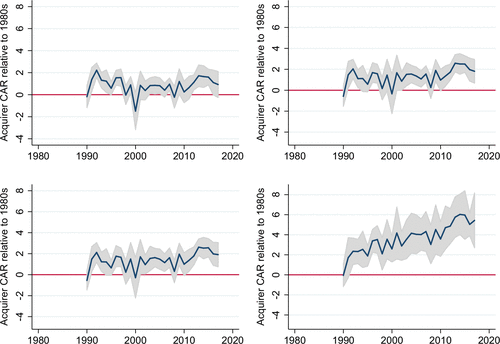
Notes. The four panels plot the coefficients for the vector of year dummies corresponding to the CAR regressions reported in Table 3, as follows:
The vector includes indicator variables for deal announcement years from 1990 to 2017, with all the 1980s as the omitted category. Thus, coefficients estimate the change in average acquirer CAR [−3, +3] relative to acquisitions announced during the 1981–1989 period. Grey-shaded areas correspond to a 99% confidence interval.
In the top left graph in Figure 1, which excludes all control variables, several of the year-dummy coefficient estimates are positive and statistically significant at the 1% level. However, their magnitudes are small, and there is no monotonic temporal trend.5 Adding the control variables in column (2) of Table 3 produces the year-dummy coefficient estimates in the top-right graph in Figure 1, which also does not show a noticeable time trend in average acquirer CARs. The coefficient estimates on the control variables in are, however, consistent with prior literature. For example, the effect of acquirer size and stock price run-up on acquirer CAR is negative, whereas the effect of leverage is positive.6 Moreover, as documented by earlier studies, acquisitions of public targets are associated with lower acquirer returns, in particular when the payment method is all-stock.7 For the interested reader, we also document the time series behavior of the control variables in , which can be found in the Online Appendix, Figures 1 and 2.8
Next, we add acquirer two-digit SIC industry fixed effects—as commonly done in the extant literature—in column (3) of Table 3. As shown in the lower left graph in Figure 1, this control for sectoral composition changes in the M&A market also does not produce a noticeable time trend in average acquirer CARs. Our findings thus far are consistent with the extant literature that shows no improvement in average acquirer returns over time (Rosen 2006, Netter et al. 2011). Although Alexandridis et al. (2017) document an uptick in average acquirer gains in the years following the financial crisis of 2007–2008, which is detectable in Figure 1, the figure also shows through our longer sample period that this up-tick has largely reversed by the end of 2017.
3.3. Controlling for Bidder Composition Effects
We now turn to the striking positive time trend seen in the lower-right graph in Figure 1. As shown in column (4) of Table 3, this time trend in average bidder CARs emerges after we replace industry fixed effects with bidder fixed effects. This replacement helps control for the possibility that acquirers conducting acquisitions late in the sample period are fundamentally different—in terms of unobservable heterogeneity—from those conducting acquisitions early on. Our inclusion of firm fixed effects is also motivated by evidence in Golubov et al. (2015), who find that time-invariant latent firm-specific attributes are a major determinant of acquirer CARs.
In the estimates in the bottom right chart in Figure 1, the estimated coefficients on the year indicators show a surprisingly smooth monotonic upward trend. In the last year of our sample (2017), the average acquirer CAR is 5.4 percentage points higher than the average acquirer CAR during the benchmark period (the 1980s). This conditional increase is economically large considering that the unconditional acquirer CAR in our sample averages 0.97% (median 0.33%) over the sample period (Table 2).9
The fact that acquirer returns are largely flat when we do not control for bidder composition—and trending upward when we do—suggests that there has been a change in the average bidder-specific component of acquirer returns. In other words, there must have been an influx of “low fixed effect bidders” over the sample period. To examine this proposition, we record the estimated bidder fixed effects from the regression specification in column (4) of Table 3 and regress them on year dummies, once again omitting dummies for all of the 1980s to serve as a benchmark:
The resulting coefficients show the change in the average bidder fixed effect for all bidders conducting deals in a given year relative to the average bidder fixed effect in the benchmark period.10 We run two additional specifications where we progressively add controls for (i) time-varying deal and bidder characteristics and (ii) industry dummies (at the two-digit SIC level). These three regressions are similar to those in columns (1), (2), and (3) of Table 3, except that the dependent variable is the estimated bidder fixed effect.11
The upper left panel in Figure 2 illustrates the coefficients from a simple regression of estimated bidder fixed effects on year dummies. It is evident that, relative to the 1980s, the average bidder conducting acquisitions is of significantly lower fixed effect. The average firm-specific component declines in the early 1990s and remains between one and two percentage points lower than in the benchmark period. We add time-varying deal and bidder characteristics to the regression and report the coefficients on year dummies in the upper right panel of Figure 2. Controlling for these characteristics, we find that the decline in the average bidder fixed effect over time is even more pronounced and reaches three percentage points by the year 2017. Further addition of industry dummies makes little difference to the estimated decline, with the results reported in the lower left panel of Figure 2.
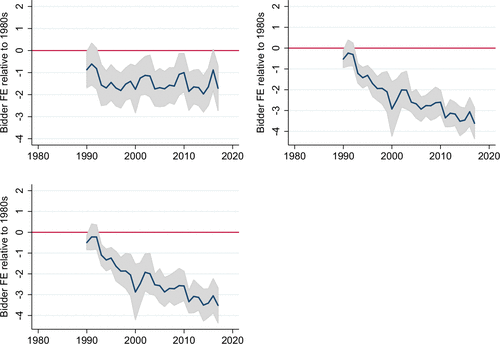
Notes. The three subfigures plot the coefficients for the vector from a regression of estimated bidder fixed effects on year dummies, as follows:
The vector includes indicator variables for deal announcement years from 1990 to 2017, with all the 1980s as the omitted category. Thus, coefficients estimate the change in the average bidder fixed effect for all bidders conducting deals in a given year relative to the average bidder fixed effect during the 1981–1989 period. Bidder fixed effects are estimated in a regression specification reported in column (4) of Table 3. Gray-shaded areas correspond to a 99% confidence interval.
3.4. Linear Trend Specification
Regressions reported in Table 4, Panel A, provide a further check on the existence of a significant common time trend in acquirer returns. Here we replace the year dummies with a simple year counter, Year trend, which increases by one each year starting in 1990 (years 1981–1989 continue to serve as our baseline period). Thus, in this regression specification, we impose a linear relationship between acquirer returns and calendar time in years. Otherwise, we maintain the same four regression specifications as in Table 3. Therefore, the coefficient on the Year trend counter can be interpreted as the slope of the corresponding trend lines pictured in Figure 1. As shown in column (1), when the regression excludes control variables, there is again no evidence of a significant linear trend in average acquirer returns.
|
Table 4. Estimation of the Time Trend in Acquirer Announcement Returns Using a Linear Trend Structure
| No controls | Controls | Controls + industry fixed effects | Controls + acquirer fixed effects | |
|---|---|---|---|---|
| (1) | (2) | (3) | (4) | |
| Panel A: Common component | ||||
| Year trend | 0.02 | 0.06*** | 0.06*** | 0.17*** |
| (1.17) | (5.67) | (5.30) | (5.50) | |
| N (without singletons) | 23,553 | 23,553 | 23,553 | 23,553 |
| Panel B: Firm-specific component | ||||
| Year trend | −0.04** | −0.12*** | −0.12*** | N/A |
| (−2.64) | (−11.92) | (−11.44) | N/A | |
| N (without singletons) | 23,553 | 23,553 | 23,553 | N/A |
Notes. The table presents the results of regression analysis of acquirer announcement returns for a sample of U.S. acquirers over the 1981–2017 period. In Panel A, the dependent variable in all columns is Acquirer CAR % [−3, +3], which is the cumulative abnormal return on the acquiring firm stock in the seven-day event window centered on the announcement date. In Panel B, the dependent variable is the estimated bidder fixed effect (), as estimated in column (4) of Table 3. The main explanatory variable in all columns is a linear trend variable, Year trend, that takes the value of zero for the period 1981–1989 and increments by one every subsequent year. Column (1) includes no control variables. Column (2) adds controls for acquirer- and deal-specific characteristics. Column (3) further adds acquirer industry fixed effects (two-digit SIC level). Column (4) replaces acquirer industry fixed effects with bidder firm fixed effects (not applicable for Panel B). t statistics in parentheses are based on standard errors double clustered by acquirer industry (two-digit SIC level) and year. N/A, not applicable.
***, **, and *Statistical significance at the 1%, 5%, and 10% level, respectively.
In column (2) of Table 4, we estimate the baseline year trend effect with control variables included. The coefficient on the Year trend variable becomes significant, but its economic magnitude is small: The average improvement in acquirer returns is six basis points per year, which translates into a 1.68-percentage-point improvement by the end of our sample period (six basis points multiplied by 28 years over which the trend line is estimated, 1990–2017). This conclusion does not change when acquirer industry fixed effects are added in column (3). In column (4), we replace acquirer industry fixed effects with bidder fixed effects. Here the magnitude of the Year trend coefficient increases almost by a factor of three—to 17 basis points per year on average. Over the 28-year period to the end of our sample, this would imply an improvement of 4.76 percentage points, which is similar to the magnitude of the coefficient on the year dummy for 2017 pictured in the bottom right chart of Figure 1.
Finally, using the estimation procedure behind Panel A of Table 4, in Panel B of Table 4, we estimate the slopes of the three annual trends lines for average bidder fixed effect plotted in Figure 2, by swapping the dependent variable for the estimated bidder fixed effect. We find statistically significant negative coefficients in all three cases, equal to , , and , respectively. This confirms that the composition of bidders has indeed changed toward lower fixed effect bidders over time. In sum, the increase in the common component of acquirer returns is offset by a decline in the average firm-specific component, which results in a largely flat unconditional average acquirer return.
In terms of robustness, in the Online Appendix, Table 3, we show that the baseline estimate of the upward time trend is largely invariant to alternative definitions of acquirer CAR, including after varying the event window to [−1, +1], [−2, +2], [−5, +5], and to using market-adjusted returns and computing dollar gains and dollar gains scaled by deal value (i.e., Net Present Value (NPV) per dollar invested). In addition, the estimate holds up in more restrictive samples in terms of absolute and relative deal size and the number of deals per bidder. We also examine whether the conditional time trend in acquirer returns is broad-based or limited to certain subsets of the data by interacting the Year trend coefficient with various deal or bidder characteristics. We find that the conditional time trend in acquirer returns is broad based: It applies equally well to deals involving listed and unlisted targets, cash and stock deals, focused and diversifying acquisitions, and domestic and cross-border deals. A significant portion of our bidders come from financial (17%) and high-tech (26%) industries (the latter defined as in Loughran and Ritter 2004). Interestingly, the upward trend is more pronounced for bidders from the finance industry (banks, insurance firms, brokerage firms). To conserve space, these results are reported in the Online Appendix, Table 4.
Finally, we consider whether the upward trend we document is simply an artifact of more timely pricing of event-induced gains by the stock market. First, we test whether the upward trend is observed for both value-creative and value-destroying transactions. We define a variable Positive CAR, which equals acquirer CAR when the latter is positive and zero otherwise. Similarly, we define a variable Negative CAR, which equals the acquirer CAR when the latter is negative, and zero otherwise. If more timely market pricing is the answer, we expect to find a negative coefficient on the Year trend variable when the dependent variable is Negative CAR. This is not the case: Both Positive CAR and Negative CAR load positively on the time trend, as shown in the Online Appendix, Table 5. Second, we estimate our results using a series of extended event windows, namely [−3, +21], [−3, +42], and [−3, +63]. More timely pricing of constant acquirer gains would imply that the upward time trend should dissipate as the event window is lengthened. The Online Appendix, Table 5, shows that the opposite is true.12
3.5. Simulation Analysis
Are the two opposing trends we document related to each other? Or is the emergence of a positive common trend in a firm fixed effects specification simply an artifact of saturating the regression with high-dimensional fixed effects? To examine this important question, we test whether one can obtain the same year trend effect in a firm fixed effects specification, but where firm identifiers are shuffled across firms within year. This permutation of the data preserves the time dimension of our panel, such that each acquirer is observed the same number of times and in the same years as in the real data. However, the permutation breaks the panel structure of the data whereby acquirers are assigned to deals conducted by other firms. If our finding of a strong positive trend in the common component of acquirer returns is indeed attributable to properly controlling for a composition effect, we should no longer find the same effect and observe a trend similar to that when firm fixed effects are omitted altogether.
We perform 1,000 such permutations of the data, each time repeating our regression specification from column (4) in Panel A of Table 4 and recording the coefficient on the Year trend variable. Figure 3 presents the distribution of the resulting coefficients across the permutations. The distribution of the Year trend coefficient is centered on 0.06, which coincides with the magnitude observed in column (3) in Panel A of Table 4 where no firm fixed effects are included in the regression at all. In fact, none of the 1,000 permutations results in a coefficient higher than 0.09, whereas the coefficient we obtain from the actual firm fixed effects specification is 0.17 as indicated by the vertical line in Figure 3. Overall, the results of the simulation analysis confirm the tight link between the two opposing trends documented previously.
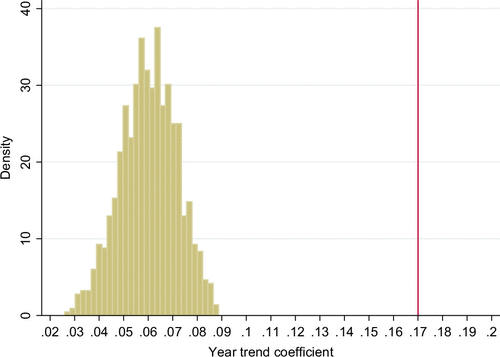
Notes. The histogram presents the distribution of the coefficient on the Year trend variable in a firm fixed effects specification across the permutations. One thousand permutations of the data are performed: each time the acquiring firm identifiers are randomly shuffled across firms within a given year. The vertical line indicates the coefficient on the Year trend variable in the firm fixed effects specification run on the actual data.
3.6. Can Sample Truncation Bias Account for the Two Trends?
Because the observed acquisition histories of the earliest and the most recent bidders in our sample are likely incomplete, one may be wondering about the implications of truncation bias for our findings. In particular, consider a world with overlapping generations of bidders whose returns from acquisitions increase with experience. In that world, truncating acquisition histories at both ends of the sample would result in an upward (downward) bias in the average return of early (recent) bidders. Moreover, controlling for bidder composition would reveal an upward trend in returns within bidders. Can the two opposing trends we document be rationalized this way?
We argue that this is not the case. First, the previous explanation relies on increasing returns to acquisitions over a bidder’s lifetime. The data are known to show the opposite: Acquirer returns tend to decline over the course of acquisition sequences (Fuller et al. 2002, Billett and Qian 2008). This is true also in our sample. Second, in unreported analysis we re-estimate our results on a sample where each and every bidder is switched out (i.e., truncated) after its second deal, which puts all bidders on an equal footing. We find that our results become even more pronounced. We conclude that truncation of acquisition histories cannot account for the two trends we document.
4. A Theory of Bidder-Specific Merger Synergies
The results thus far indicate that the average common component of acquirer returns has increased, while the average bidder-specific component has declined. These two trends counteract each other to produce largely stable unconditional average acquirer returns. How should one interpret these trends? At a high level, the results indicate that there has been a change in the composition of bidders over the sample period. Understanding the nature of this composition change is therefore key to decoding the patterns seen in the data. Golubov et al. (2015) undertake a comprehensive examination of firm-specific heterogeneity in acquirer returns and conclude that it likely represents latent bidder-specific resources—unique assets, business processes, or management skill unobservable to the econometrician—that the bidder contributes to the generation of synergies. Although intuitive, the notion of bidder-specific synergies is largely new to the M&A literature.13 Therefore, to discipline any further conjectures, we first analyze the notion of bidder-specific synergies in the context of a simple takeover model. Let us preview a more formal analysis with some basic intuition.
In a typical merger, the two parties to a deal bring to the bargaining table resources that are deemed necessary to generate deal synergies. The uniqueness of these resources, in turn, determines that party’s bargaining power. For example, deal synergies are mostly target-specific when a financially constrained target owns a unique technology (e.g., a patent) and the primary role of the bidder is to fund further technological developments. In this case, synergies are not specific to any particular bidder—as long as the bidder can provide the requisite funding. Competition among financially unconstrained bidders drives the bulk of deal synergies to the target shareholders. In contrast, suppose the bidder owns a unique downstream distribution network for the target’s product. Absence of other potential bidders with a similarly cost-effective distribution network locks the target and the bidder in a bilateral, monopsonistic bargaining game. Synergy gains are now more bidder-specific, and the bidder has considerable power to extract a larger share of them. The key insight is that acquirer (and target) returns depend on the degree of the winning bidder’s uniqueness in terms of the resources it brings to the deal.
The same intuition regarding uniqueness applies to target firm resources: Just like the presence of rival bidders increases the target’s outside option, the availability of alternative synergistic targets increases the outside option of the bidder. For simplicity, we do not model target uniqueness and consider a setting that features a single target and one or more possible bidders. In what follows, we formalize our intuition in a simple theoretical framework linking announcement returns to total acquisition-induced synergies and the sharing of those gains between the winning bidder and the target. We then subject our framework’s main prediction to rigorous empirical testing. Finally, we use this framework to guide our interpretation of the time series evolution of common and bidder-specific components of acquirer returns.
4.1. Formalization
Our basic framework and notation are similar to those in Betton et al. (2014). Suppose that a merger deal between an acquirer A and the target T has just been announced to the market. The announcement drives the market’s prior deal probability from zero to one—There is no market deal anticipation and a zero conditional risk of deal failure. Suppose also that the deal announcement does not alter the market’s prior assessment of the stand-alone values of A () and T (). The announcement reveals merger synergies totaling S dollars, generated by combining the resources of A with those of T. The acquirer A will receive the fraction of the total synergies S, and the target T will receive the fraction ). Thus, the announcement returns to the two parties are given by and .
Deals are agreed to as follows. Bidders do not undertake negative NPV investments. Hence, A is willing to offer up to the stand-alone value plus the full value of synergies S (net of transaction costs), equivalent to . The target does not accept a bid that is less attractive than its outside option; that is, its participation constraint is . Here, K is the value that T can extract from a combination with another bidder (K is bounded from below by if no other bidder exists). The alternative transaction generates synergies , and ’s ability to pay is limited by the same participation constraint of nonnegative NPV. It follows that the highest synergy bidder reaches a deal with the target; observing a deal between A and T implies that .
In this framework, the notion of bidder-specific synergies is reflected in the equilibrium synergy-sharing parameter . First, consider a case of synergies S that are not unique to any particular bidder: All bidders are perfect substitutes and a merger of T with any of them generates the same synergy . In this case, the target’s outside option, , forces the successful bidder A to offer the full value of synergies S (net of transaction costs), resulting in . In contrast, suppose the synergies S are fully bidder-specific: The bidder A is so unique that only a merger of A and T creates any value, whereas a merger between and T offers no synergies (). Because no alternative bidders exist, the value of the target’s outside option K is its stand-alone value . Therefore, A bids (where is infinitesimal when bid revisions are costless), which the target ultimately accepts, resulting in . In intermediate cases, whereby , A’s offer is competed up to the valuation of the second-best bidder plus , resulting in . The closer the second-best is to one, the closer to zero will be. Hence, the equilibrium outcome reflects the parties’ bargaining power, as determined by the degree of substitutability between the winning bidder A and the second-best bidder .
We can formally express as , where is bidder uniqueness and is a constant parameter that governs the sharing of synergies over and above those of the second best, depending on the modeling choice.14 The main prediction of this simple theory is that, holding other things equal, acquirer returns should increase with the degree of the winning bidder’s uniqueness relative to the second best. In other words, when synergies are more bidder-specific, acquirers gain more because they extract a larger share of synergies. At the same time, targets gain less as they receive a lower share of synergies. To our knowledge, this theoretical framework is one of the first attempts to model bargaining power in mergers and acquisitions. Below, we develop four empirical proxies for bidder uniqueness to validate our theory.
Before proceeding, we note that our simple framework produces an additional insight regarding suitable control variables in regressions of acquirer (or target) announcement returns, and in particular, deal relative size. This control is commonly seen in the literature but excluded from our regressions. Deal value (offer made to the target) is given by , that is, the standalone value of the target and its share of synergies. The relative size of the deal is therefore given by . Including this quantity as a control variable in a regression of acquirer CARs or target CARs ( results in a model that has the same key bargaining outcome and synergies S on the left and the right-hand sides. This poses a challenge for interpreting the coefficient on such relative size control (and likely confounds the effect of other regressors).15
4.2. Empirical Testing of the Framework
We would like to test whether a bidder’s uniqueness in terms of ability to generate synergies with a given target has explanatory power for the cross-section of acquirer returns. This is a nontrivial task, because the extent to which deal synergies are specific to the winning bidder is inherently unobservable: Counterfactual combinations and the associated synergies are not observed. To overcome this challenge, we build on the idea that, in principle, identical firms are perfect substitutes as bidders and should therefore generate the same level of synergies with a given target. In other words, similarity between the observed (winning) bidder and all alternate buyers it must have outbid can be seen as a proxy for . Therefore, an empirical proxy for bidder uniqueness requires us to (i) identify a set of alternate buyers (possible set of ) and (ii) measure the degree of similarity between the winning bidder and the second-best alternative from that set.
We identify the set of likely competing bidders for each deal in our sample as the set of all U.S. public firms at the time of deal announcement that satisfy two criteria: they come from the same two-digit SIC industry as the winning bidder and are at least as large as the target (deal value) by market capitalization. In the very few cases where the winning bidder is smaller than the target, we use the size of the winning bidder as the lower bound constraint.16 The intuition behind this approach is simple: We assume that the second-best use of the target firm’s assets is in the same industry as the observed use (assumed first-best), and that various feasibility constraints prevent potential bidders from bidding for targets that are bigger than themselves (as is typically the case in the data).17 Thus, our set of potential rival bidders is tailored to each transaction on the basis of timing, industry, and size. A limitation of this approach, however, is that our set of alternate buyers excludes private and foreign firms.
To measure the degree of similarity between the winning bidder and each potential rival bidder, we use four different proxies that capture the commonality in stock returns, fundamentals, and product offerings of the two firms. Specifically, our four proxies are pairwise (i) idiosyncratic stock return correlation, (ii) sales growth correlation, (iii) cash flow (Return on Assets (ROA)) correlation, and (iv) textual similarity of product descriptions. The stock-return based proxy is inspired by the work of de Bodt et al. (2024), who use pairwise idiosyncratic stock return correlations as an all-encompassing measure of firm similarity to study how firms respond to competition shocks (e.g., by differentiating). Similar to their work, we use the correlation of daily stock return residuals from a two-factor model estimated over a one-year period prior to deal announcement, with the market and industry returns (value-weighted two-digit SIC industry portfolio) as factors.
Sales growth correlation and cash flow correlation proxies build on the same notion: Similar firms should have highly correlated fundamentals. We compute these correlations using quarterly observations on industry-adjusted sales growth and industry-adjusted operating return on assets from Compustat over a five-year period prior to deal announcement. Our fourth text-based proxy for bidder uniqueness builds on the work of Hoberg and Phillips (2010, 2016) who conduct textual analysis of product descriptions for the universe of Compustat firms starting from 1996. Specifically, they compute firm-by-firm cosine similarity for vectors characterizing product market language found in firms’ 10-K filings. Once again, the idea behind this proxy for bidder uniqueness is that bidders with similar product portfolios should offer similar product market synergies with a given target. These data come directly from the authors.18
Having obtained these pairwise similarities between the winning bidder and each of its potential rival bidders, we select three rivals with the highest similarity as our proxy for the second-best bidder , and their average similarity as the theoretical .19 The three-correlation based proxies for are bounded between −1 and 1, but the negative values comprise only 2% and we set them equal to zero. The Hoberg-Phillips text-based similarity measure is bounded between zero and one by construction. Our final measures of bidder uniqueness are equal to , labeled Uniqueness ( ret), Uniqueness ( sales), Uniqueness ( ROA), and Uniqueness (HP).
Table 5 presents descriptive statistics and pairwise correlations for the four proxies. The average Uniqueness ( ret) is 0.80, implying that the average idiosyncratic stock return correlation between the bidder and top three potential rivals is 0.20. The mean Uniqueness ( sales) and Uniqueness ( ROA) are 0.33 and 0.30, respectively. Their values are lower, on average, because fundamentals tend to be more correlated than returns. The mean of the text-based proxy Uniqueness (HP) is 0.81, similar to that of the returns-based proxy. As one would expect for empirical measures of the same theoretical concept, the four proxies are positively correlated with each other. Not surprisingly, the highest pairwise correlation of 0.60 is between the two cash flow-based measures Uniqueness ( sales) and Uniqueness ( ROA). Other pairwise correlations do not exceed 0.34.
|
Table 5. Empirical Proxies for Bidder Uniqueness
| Panel A: Descriptive statistics | ||||
| N | Mean | Median | Standard deviation | |
| Uniqueness ( ret) | 22,917 | 0.801 | 0.808 | 0.091 |
| Uniqueness ( sales) | 18,978 | 0.330 | 0.302 | 0.193 |
| Uniqueness ( ROA) | 16,493 | 0.303 | 0.263 | 0.192 |
| Uniqueness (HP) | 14,747 | 0.806 | 0.822 | 0.094 |
| Panel B: Pairwise correlations | ||||
| Uniqueness ( ret) | Uniqueness ( sales) | Uniqueness ( ROA) | Uniqueness (HP) | |
| Uniqueness ( ret) | 1 | |||
| Uniqueness ( sales) | 0.286 | 1 | ||
| Uniqueness ( ROA) | 0.340 | 0.600 | 1 | |
| Uniqueness (HP) | 0.276 | 0.250 | 0.257 | 1 |
Notes. The table presents descriptive statistics (Panel A) and pairwise correlations (Panel B) of four empirical proxies for bidder uniqueness. Uniqueness ( returns) is defined as one minus the average correlation of daily stock return residuals of the bidder and its three closest peers from the same two-digit SIC industry that are at least as large as the minimum of deal value and bidder size. Residuals are obtained from a two-factor model (market and two-digit SIC industry portfolio) factors estimated over a one year prior to deal announcement subject to a minimum of one hundred nonmissing observations. Uniqueness ( sales) is defined as one minus the average quarterly sales growth correlation of the bidder and its three closest peers from the same two-digit SIC industry that are at least as large as the minimum of deal value and bidder size. Correlations are estimated over a five-year period prior to deal announcement subject to a minimum of eight nonmissing observations. Uniqueness ( ROA) is defined as one minus the average correlation of quarterly ROAs of the bidder and its three closest peers from the same two-digit SIC industry that are at least as large as the minimum of deal value and bidder size. Correlations are estimated over a five-year period prior to deal announcement subject to a minimum of eight nonmissing observations. All correlation-based proxies are set to one when the average correlation between the bidder and its three closest peers is negative. Uniqueness (HP) is defined as one minus the average Hoberg and Phillips (2010, 2016) product similarity score between the bidder and its three closest peers from the two-digit SIC industry that are at least as large as the minimum of deal value and bidder size, as of the year prior to deal announcement.
Armed with these four proxies, we test our framework’s main prediction, namely that acquirer returns should increase with bidder uniqueness. The results of these cross-sectional association tests are reported in Table 6. For each of the four bidder uniqueness proxies, we estimate three specifications that progressively add control variables: a simple univariate regression with year fixed effects, then adding our usual set of bidder- and deal-specific controls, and then further adding acquirer industry fixed effects. Using all four proxies, we find robust evidence that the degree of the winning bidder’s uniqueness is associated with higher acquirer returns, regardless of the regression specification. The effects are not only statistically significant, but also economically large. Focusing on the most comprehensive specification in columns (3), (6), (9), and (12), we find that a one-standard-deviation change in bidder uniqueness is associated with a 0.27- to 0.45-percentage-point higher acquirer return. For comparison, the sample mean acquirer return is 0.97%. The coefficient estimates in this table provide another way to assess the economic magnitude of the effect. Recall that our proxies are bounded between zero and one, implying that the coefficient can be interpreted as the difference in acquirer returns between a fully substitutable bidder (uniqueness equal to zero) and a completely unique one (uniqueness equal to one). Focusing on the most complete specifications, this effect is between 1.43 to 4.77 percentage points difference in acquirer CAR. Thus, the effects of bidder uniqueness on acquirer returns are clearly of a first order.
|
Table 6. Bidder Uniqueness and the Cross Section of Acquirer Returns
| (1) | (2) | (3) | (4) | (5) | (6) | (7) | (8) | (9) | (10) | (11) | (12) | |
|---|---|---|---|---|---|---|---|---|---|---|---|---|
| Uniqueness ( ret) | 4.14*** | 3.81*** | 3.10** | |||||||||
| (3.72) | (4.15) | (2.67) | ||||||||||
| Uniqueness ( sales) | 1.29*** | 2.18*** | 2.06*** | |||||||||
| (3.04) | (8.95) | (5.71) | ||||||||||
| Uniqueness ( ROA) | 0.88* | 1.87*** | 1.43*** | |||||||||
| (1.90) | (5.38) | (3.64) | ||||||||||
| Uniqueness (HP) | 6.17*** | 4.11*** | 4.77*** | |||||||||
| (8.48) | (7.45) | (6.32) | ||||||||||
| Year fixed effects | Yes | Yes | Yes | Yes | Yes | Yes | Yes | Yes | Yes | Yes | Yes | Yes |
| Controls | No | Yes | Yes | No | Yes | Yes | No | Yes | Yes | No | Yes | Yes |
| Industry fixed effects | No | No | Yes | No | No | Yes | No | No | Yes | No | No | Yes |
| N (without singletons) | 22,917 | 22,917 | 22,917 | 18,978 | 18,978 | 18,977 | 16,493 | 16,493 | 16,492 | 14,747 | 14,747 | 14,746 |
Notes. The table presents the results of regression analysis of acquirer announcement returns for a sample of U.S. acquirers over the 1981–2017 period. The dependent variable in all columns is Acquirer CAR % [−3, +3], which is the cumulative abnormal return on the acquiring firm stock in the seven-day event window centered on the announcement date. The main explanatory variables are proxies for bidder uniqueness based on stock return correlation (Uniqueness ( returns)), sales growth correlation (Uniqueness ( sales)), cash flow correlation (Uniqueness ( ROA)) and product similarity (Uniqueness (HP)). All regressions include year fixed effects. Bidder- and deal-specific control variables as in Table 3, as well as acquirer industry (two-digit SIC) fixed effects are further included as indicated. t statistics in parentheses are based on standard errors double clustered by acquirer industry (two-digit SIC level) and year.
***, **, and *Statistical significance at the 1%, 5%, and 10% level, respectively.
Our framework also has implications for target firm gains. The increase in acquirer returns for more unique bidders operates via higher , which is the share of synergies captured by the acquirer. It follows that the share of synergies captured by the target, , should be lower when the winning bidder is more unique, resulting in lower target returns. This can be clearly seen from our definition of target firm announcement return: . To test this prediction of our framework, we resort to the public target subsample in which we can observe target firm returns. We use both Target CAR [−3, +3] and Target CAR [−41, +3] as our dependent variables. The latter measure includes the run-up period, which is important when measuring target firm gains. We regress these variables on our proxies for bidder uniqueness using our most complete regression specifications that include controls for acquirer- and deal-specific characteristics, as well as year and industry fixed effects. Our sample here is considerably smaller because only 22% of the targets are public. The results are reported in Table 7. We find that target firm gains indeed decline with bidder uniqueness. The coefficients on bidder uniqueness proxies are consistently negative, albeit not statistically significant for the Hoberg-Phillips text-based similarity measure.
|
Table 7. Bidder Uniqueness and the Cross Section of Target Gains
| Target CAR [−3, +3] | Target CAR [−41, +3] | Target CAR [−3, +3] | Target CAR [−41, +3] | Target CAR [−3, +3] | Target CAR [−41, +3] | Target CAR [−3, +3] | Target CAR [−41, +3] | |
|---|---|---|---|---|---|---|---|---|
| (1) | (2) | (3) | (4) | (5) | (6) | (7) | (8) | |
| Uniqueness ( ret) | −14.66*** | −15.90*** | ||||||
| (−3.68) | (−2.99) | |||||||
| Uniqueness ( sales) | −5.54*** | −7.20*** | ||||||
| (−7.04) | (−3.07) | |||||||
| Uniqueness ( ROA) | −6.72** | −7.91* | ||||||
| (−2.67) | (−1.96) | |||||||
| Uniqueness (HP) | −0.65 | −8.46 | ||||||
| (−0.07) | (−0.70) | |||||||
| Year fixed effects | Yes | Yes | Yes | Yes | Yes | Yes | Yes | Yes |
| Controls | Yes | Yes | Yes | Yes | Yes | Yes | Yes | Yes |
| Industry fixed effects | Yes | Yes | Yes | Yes | Yes | Yes | Yes | Yes |
| N (without singletons) | 3,242 | 3,242 | 2,835 | 2,836 | 2,545 | 2,546 | 1,904 | 1,904 |
Notes. The table presents the results of regression analysis of measures of target gains for a sample of U.S. acquirers and public U.S. targets over the 1981–2017 period. The dependent variable in odd-numbered columns is Target CAR % [−3, +3], which is the cumulative abnormal return on the target firm stock in the seven-day event window centered on the announcement date. The dependent variable in even-numbered columns is Target CAR % [−41, +3], which is the announcement period abnormal return of the target firm over the period from two months leading up to deal announcement to 3 days following the announcement. The main explanatory variables are proxies for bidder uniqueness based on stock return correlation (Uniqueness ( ret)), sales growth correlation (Uniqueness ( sales)), cash flow correlation (Uniqueness ( ROA)) and product similarity (Uniqueness (HP)). All regressions include year fixed effects, bidder- and deal-specific control variables as in Table 3, as well as acquirer industry (two-digit SIC) fixed effects. t statistics in parentheses are based on standard errors double clustered by acquirer industry (two-digit SIC level) and year.
***, **, and *Statistical significance at the 1%, 5%, and 10% level, respectively.
As a final test of our synergy-sharing mechanism, we attempt to estimate directly. In our framework, is the share of synergies captured by the bidder. If one perfectly observed deal synergies S, one could compute as a ratio of acquirer dollar gains to dollar synergies (or, equivalently, one minus the ratio of target dollar gains to dollar synergies). In practice, the ratio approach is problematic because the combined firm gain, an empirical counterpart of dollar synergies S, is often negative. In our sample, the combined firm CAR is negative in 40% of the cases, which is due almost entirely to the frequent occurrence of negative acquirer gains in the public-target subsample.20 Although in our simple framework announcement, returns reflect only deal synergies and their sharing, in practice the market reaction also reflects the likelihood of deal completion and can be further distorted by stand-alone value revelation, price pressure from merger arbitrage, liquidity effects, and pure noise trading. In other words, the combined firm CAR is a noisy proxy for (scaled) S. Omitting subscripts for simplicity,
However, the premium offered to the target is not affected by stock market noise. Moreover, the premium offered to the target is an outcome of bargaining over deal synergies and therefore reflects synergies S and their sharing . Specifically, according to our framework, the dollar premium (DP) offered to the target is given by
Importantly, there is an absence of an error term in (7). Rearranging Equation (7), we obtain that . Substituting this expression for S into Equation (6), we obtain
Finally, is the dollar premium adjusted for the probability of completion and scaled by the combined firm market capitalization. This quantity is just a rescaled target CAR. Recall that , which is the same as when ignoring closing risk, and when allowing for deal failure. Intuitively, the target CAR reflects the premium that target shareholders expect to receive. Hence,
Denote the quantity in (9) as . We can therefore rewrite (8) as
Let us now introduce subscript i for individual deals and allow the error term to have a constant term and a mean-zero random term . If we are willing to assume that a certain group of deals shares the same , then we can write Equation (10) as the following estimable regression model:
When estimated via OLS, the slope coefficient will equal . In other words, the cross-sectional relationship between the noisy combined CAR and the actual bargaining outcome (reflected in the premium priced by the market) allows us to recover , leaving the noise in the combined CAR to be absorbed by the intercept and the error term.
We confirm the validity of this approach via simulation. In particular, we generate a distribution of deals characterized by a uniformly distributed (ranging from zero to one) and a normally distributed positive dollar synergy S. We also generate randomly distributed acquirer and target sizes ( and ), allowing us to compute acquirer and target CARs according to our expressions. We further add a random measurement error term with a negative mean to the acquirer CAR, which results in a negative average acquirer return and frequent occurrence of negative combined firm returns, just as in the real data. When deals are grouped together in terms of (e.g., from 0.0 to 0.1, 0.1 to 0.2, etc.), regressing the combined firm return on the rescaled target return plus a constant properly recovers the true as one minus the inverse of the slope coefficient. Moreover, the intercept properly recovers the mean of the error term.
To estimate Equation (11) for our sample, we group deals according to buckets of bidder uniqueness. Because each bidder uniqueness proxy varies between zero and one, we create four groups: [0.00–0.25], [0.25–0.50], [0.50–0.75], [0.75–1.00].21 is the combined firm abnormal return following Bradley et al. (1988). We use the Target CAR [−41, +3] in computing both on the left-hand side and on the right-hand side to ensure that any target run-up is properly captured in our measures. We exclude roughly 10% of the sample in which the Target CAR [−41, +3] is negative, as such instances cannot be rationalized in our framework. For each proxy and for each grouping, we estimate Equation (11) and recover as one minus the inverse of the slope coefficient. We plot the resulting and the associated confidence interval in Figure 4.
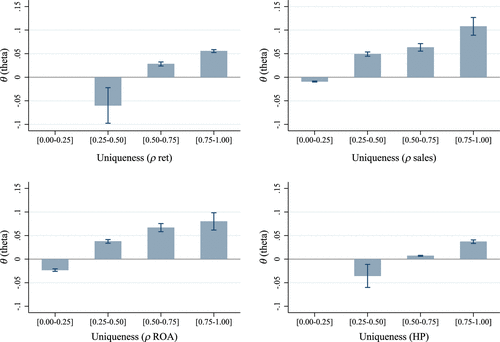
Notes. This figure plots the estimated synergy-sharing parameter and the associated 99% confidence intervals for subsamples according to bidder uniqueness; is obtained as one minus the inverse of the slope coefficient (i.e. ) from the following cross-sectional regression: is the weighted average of Target CAR [−41, +3] and Acquirer CAR [−3, +3] with respective market capitalizations (−42 for the target and −4 for the acqurier) as weights; is the target dollar gain obtained from multiplying the Target CAR [−41, +3] by the target market capitalization on day −42 and scaled by the combined market capitalization of the target on day −42 and the bidder on day −4. Regressions are estimated separately for each subsample according to each of the four bidder uniqueness proxies. The top left plot refers to subsamples according to the returns-based proxy for bidder uniqueness (Uniqueness ( ret)). The top right plot refers to subsamples according to the sales-correlation-based proxy for bidder uniqueness (Uniqueness ( sales)). The bottom left plot refers to subsamples according to the ROA correlation–based proxy for bidder uniqueness (Uniqueness ( ROA)). The bottom right plot refers to subsamples according to the text-based proxy for bidder uniqueness (Uniqueness (HP)). An empty space indicates that the particular subsample is unpopulated.
Our results are consistent with bidder uniqueness shaping the synergy-sharing parameter . For all four proxies we observe a monotonic increase in the estimated from the lowest to the highest bucket of bidder uniqueness, and the associated confidence intervals show little overlap. In other words, more unique bidders extract a larger share of synergies. The magnitude of estimated , generally varying between 0.00 and 0.10, is also of interest, as it suggests that bidders capture only a small share of synergies while targets capture the lion’s share.22
Overall, the evidence reported in this section is consistent with our theory of bidder-specific synergies and represents an important addition to the literature on the determinants of takeover gains. The framework for estimating the synergy-sharing parameter proposed here could be utilized in other contexts, whereby researchers could estimate this parameter for subsamples split according to hypothesized differences in bargaining power. Having established the validity of our theory, we now return to our time series focus and use our theoretical framework to guide our interpretation of the evidence.
4.3. Interpreting the Time Series Evidence
In our analysis of the evolution of acquirer returns over time, none of the control variables in directly measure the degree of bidder uniqueness in terms of generating deal synergies. Realistically, any attempt to proxy for the uniqueness of the bidder in question (including our own efforts above) will be necessarily incomplete. Indeed, in most cases such uniqueness is an unobservable firm-specific characteristic that is best captured by the bidder’s identity itself. Bidders that systematically bring unique resources to the bargaining table will be characterized by systematically high acquirer returns, reflecting high average . Therefore, the variation in acquirer returns that is due to bidder uniqueness will be reflected in the econometric counterpart of a bidder’s identity: bidder fixed effect estimate. This logic is behind the (speculative) interpretation of firm-specific heterogeneity in acquirer returns by Golubov et al. (2015) as reflecting bidder-specific synergies.
We now put this potential interpretation to an empirical test. If bidder fixed effects in acquirer returns reflect bidder uniqueness, then we would expect that the strong explanatory power of bidder uniqueness proxies documented above disappears when we control for bidder composition via bidder fixed effects. This is the test reported in Table 8. For each of the four proxies we report two regression specifications. In the first one (odd-numbered columns) we repeat the most complete regression specification from Table 6 on a sample without singleton bidders, and in the second one (even-numbered columns) we replace industry fixed effects with bidder fixed effects. For all four bidder uniqueness proxies, we find that their explanatory power for the cross-section of acquirer returns is fully subsumed by bidder fixed effects. All coefficients lose statistical significance, and the magnitudes of the coefficients go down toward zero. In other words, bidder composition effectively controls for bidder uniqueness.
|
Table 8. Bidder Uniqueness and the Composition Effect: Controlling for Bidder Fixed Effects
| (1) | (2) | (3) | (4) | (5) | (6) | (7) | (8) | |
|---|---|---|---|---|---|---|---|---|
| Uniqueness ( ret) | 2.99** | 2.51 | ||||||
| (2.62) | (1.27) | |||||||
| Uniqueness ( sales) | 2.07*** | 0.75 | ||||||
| (5.98) | (1.58) | |||||||
| Uniqueness ( ROA) | 1.47*** | 0.71 | ||||||
| (3.54) | (1.10) | |||||||
| Uniqueness (HP) | 4.03*** | 0.67 | ||||||
| (5.74) | (0.27) | |||||||
| Controls | Yes | Yes | Yes | Yes | Yes | Yes | Yes | Yes |
| Year fixed effects | Yes | Yes | Yes | Yes | Yes | Yes | Yes | Yes |
| Industry fixed effects | Yes | No | Yes | No | Yes | No | Yes | No |
| Acquirer fixed effects | No | Yes | No | Yes | No | Yes | No | Yes |
| N (without singletons) | 22,796 | 22,796 | 18,651 | 18,651 | 15,958 | 15,958 | 14,110 | 14,110 |
Notes. The table presents the results of regression analysis of acquirer announcement returns for a sample of U.S. acquirers over the 1981–2017 period. The dependent variable in all columns is Acquirer CAR % [−3, +3], which is the cumulative abnormal return on the acquiring firm stock in the seven-day event window centered on the announcement date. The main explanatory variables are proxies for bidder uniqueness based on stock return correlation (Uniqueness ( returns)), sales growth correlation (Uniqueness ( sales)), cash flow correlation (Uniqueness ( ROA)) and product similarity (Uniqueness (HP)). All regressions include year fixed effects. Bidder- and deal-specific control variables as in Table 3, as well as acquirer industry (two-digit SIC) fixed effects are further included as indicated. t statistics in parentheses are based on standard errors double clustered by acquirer industry (two-digit SIC level) and year.
***, **, and *Statistical significance at the 1%, 5%, and 10% level, respectively.
In Table 9, we perform an even more direct test of the hypothesis that bidder composition effects in acquirer returns reflect bidder uniqueness. We do so by regressing the estimated fixed effects on bidder uniqueness proxies. These regressions are the same as those in Panel B of Table 4, except that now the main explanatory variable is each of our proxies for bidder uniqueness and we also apply regression weights to ensure that each bidder contributes equally to the estimated effect. We find that, regardless of the set of other regressors, bidder uniqueness proxies positively predict the estimated bidder fixed effect. The coefficients are statistically significant at the 1% level in 11 of 12 specifications and at the 5% level in the remaining one. The economic magnitudes are once again large. The difference between a fully substitutable bidder (uniqueness equal to zero) and a completely unique one (uniqueness equal to one) in terms of the associated bidder fixed effect estimates is between 2.3% and 5.95%. For comparison, an interquartile range in the estimated bidder fixed effects is 6.92%.
|
Table 9. Bidder Uniqueness and the Composition Effect: Direct Association
| (1) | (2) | (3) | (4) | (5) | (6) | (7) | (8) | (9) | (10) | (11) | (12) | |
|---|---|---|---|---|---|---|---|---|---|---|---|---|
| Uniqueness ( ret) | 5.78*** | 5.95*** | 5.22*** | |||||||||
| (4.95) | (5.89) | (4.60) | ||||||||||
| Uniqueness ( sales) | 5.04*** | 3.04*** | 2.71*** | |||||||||
| (10.15) | (7.79) | (6.94) | ||||||||||
| Uniqueness ( ROA) | 4.79*** | 2.62*** | 2.29*** | |||||||||
| (9.25) | (6.58) | (7.58) | ||||||||||
| Uniqueness (HP) | 3.79** | 4.09*** | 3.25*** | |||||||||
| (2.36) | (5.54) | (3.03) | ||||||||||
| Controls | No | Yes | Yes | No | Yes | Yes | No | Yes | Yes | No | Yes | Yes |
| Industry fixed effects | No | No | Yes | No | No | Yes | No | No | Yes | No | No | Yes |
| N (without singletons) | 22,917 | 22,917 | 22,917 | 18,978 | 18,978 | 18,977 | 16,493 | 16,493 | 16,492 | 14,747 | 14,747 | 14,746 |
Notes. The table presents the results of regression tests of the association between acquirer fixed effect estimates and proxies for bidder uniqueness for a sample of U.S. acquirers over the 1981–2017 period. Regressions are weighted by the inverse of the number of observations for a given bidder, such that each bidder cotributes equally to the estimated association. The dependent variable in all columns is the estimated acquirer fixed effect from the regression model in column (4) of Table 3. The main explanatory variables are proxies for bidder uniqueness based on stock return correlation (Uniqueness ( returns)), sales growth correlation (Uniqueness ( sales)), cash flow correlation (Uniqueness ( ROA)) and product similarity (Uniqueness (HP)). Bidder and deal-specific characteristics as in Table 3, as well as acquirer industry (two-digit SIC) fixed effects are included as indicated. t statistics in parentheses are based on standard errors double clustered by acquirer industry (two-digit SIC level) and year.
***, **, and *Statistical significance at the 1%, 5%, and 10% level, respectively.
The conclusion from the above tests is that bidder composition effects in acquirer returns reflect bidder uniqueness or the bidder’s average via its average () across its deals. Our ability to characterize the composition effect allows us to interpret the time series evidence. If bidder fixed effect estimates capture bidder uniqueness, then our evidence of declining average bidder fixed effects (Figure 2) suggests that bidders are becoming relatively less unique during our sample period, reflecting merger synergies that are less bidder-specific. In other words, whatever the source of merger synergies may be, they are becoming less unique to the winning bidder, which drives down the share of synergies it can extract and lowers acquirer returns.
Table 10 provides evidence that corroborates this particular interpretation of changing bidder composition. In this table we report regressions of our bidder uniqueness proxies on the time trend variable, conditional on all the other regressors in our full regression specifications. We find that the coefficient on the Year trend variable is negative and statistically significant for three of the four proxies, namely Uniqueness ( ret), Uniqueness ( sales), and Uniqueness ( ROA). The time series coefficient is indistinguishable from zero for the Uniqueness (HP) proxy, but this measure is not available for half of our sample period, hence the coefficient reflects the change during the post-1996 period only. We conclude that bidder uniqueness has declined over time, and that the downward trending bidder-specific component of acquirer returns can be interpreted as a decline in bidder specificity of merger synergies.23,24
|
Table 10. Bidder Uniqueness in the Time Series
| Uniqueness ( ret) | Uniqueness ( sales) | Uniqueness ( ROA) | Uniqueness (HP) | |
|---|---|---|---|---|
| (1) | (2) | (3) | (4) | |
| Year trend | −0.36*** | −0.13* | −0.22*** | 0.06 |
| (−4.49) | (−1.91) | (−3.22) | (1.32) | |
| Controls | Yes | Yes | Yes | Yes |
| Industry fixed effects | Yes | Yes | Yes | Yes |
| N (without singletons) | 22,917 | 18,977 | 16,492 | 14,746 |
Notes. The table presents the results of regression analysis of empirical proxies for bidder uniqueness for a sample of U.S. acquirers over the 1981–2017 period (except for column (4) where the sample period is 1996–2017). The dependent variable in column (1) is a proxy for bidder uniqueness based on stock return correlation (Uniqueness ( returns)). The dependent variable in column (2) is a proxy for bidder uniqueness based on sales growth correlation (Uniqueness ( sales)). The dependent variable in column (3) is a proxy for bidder uniqueness based on cash flow correlation (Uniqueness ( ROA)). The dependent variable in column (4) is bidder uniqueness based on product similarity (Uniqueness (HP)). The main explanatory variable is a linear trend variable (Year trend) that takes the value of zero for the period 1981–1989 and increments by one every subsequent year. The coefficient shown in the table is scaled up by 100. All regressions include bidder- and deal-specific control variables as in Table 3, as well as acquirer industry (two-digit SIC) fixed effects. t statistics in parentheses are based on standard errors double clustered by acquirer industry (two-digit SIC level) and year.
***, **, and *Statistical significance at the 1%, 5%, and 10% level, respectively.
Finally, our theoretical framework and the empirical evidence above further help interpret the upward trending common component of acquirer returns. It is useful to restate that, in our framework, the acquirer return is . In other words, bidder announcement returns are a function of the total synergy pie S and the synergy-sharing parameter . If changing bidder composition reflects a temporal change in average , then the variation in acquirer CARs that remains after controlling for bidder composition should reveal the variation in S. Put differently, when declines, acquirer CAR should go down: pressure from rival bidders drives down the winning bidder’s gains. Yet, this is not what we observe in the data. As shown in Figure 1, unconditional average acquirer returns are largely flat. It is as if acquirer returns have not declined on average to reflect the putative lower bidder uniqueness. The only way to rationalize this within our framework is by rising overall deal synergies, that is, the decline in bidder uniqueness has been offset by an increase in total deal synergies S.
To test this conjecture, we resort to the public target subsample as a laboratory in which we can proxy for merger synergies S. As in Bradley et al. (1988), our first proxy for (scaled) merger synergies S is the combined firm abnormal return (bidder-target portfolio). In column (1) of Panel A, Table 11, we regress the combined firm CAR on the time trend and a set of control variables that mimics the covariates used in Table 3, but we omit bidder fixed effects (replaced with industry fixed effects) to obtain estimates of unconditional changes over time.25 The coefficient on the year trend indicator is positive and highly statistically significant, implying that combined firm gains (proxy for scaled S) have unconditionally increased. The coefficient magnitude of 0.10 suggests that the increase is 10 basis points per year, on average. That is, over a 28-year period since the 1980s, combined firm gains have increased by a cumulative 2.8 percentage points. Compared with the overall sample average of 1.79%, this increase is highly economically relevant.
|
Table 11. Evolution of Total Synergy Gains and Target Returns
| Panel A | ||||
|---|---|---|---|---|
| Combined CAR [−3, +3] | OI/Assets [−1, +3] | OI/Sales [−1, +3] | OI/Emp. [−1, +3] | |
| (1) | (2) | (3) | (4) | |
| Year trend | 0.10*** | 0.06** | 0.08** | 1.03** |
| (4.31) | (2.06) | (2.16) | (2.33) | |
| Controls | Yes | Yes | Yes | Yes |
| Industry fixed effects | Yes | Yes | Yes | Yes |
| N (without singletons) | 3,355 | 2,625 | 2,593 | 2,280 |
| Panel B | ||||
|---|---|---|---|---|
| Target CAR [−3, +3] | Target CAR [−3, +3] | Target CAR [−41, +3] | Target CAR [−41, Comp +3] | |
| (1) | (2) | (3) | (4) | |
| Year trend | 0.20* | 0.34*** | 0.22* | 0.27 |
| (1.83) | (2.97) | (2.15) | (1.66) | |
| Controls | Yes | Yes | Yes | Yes |
| Industry fixed effects | Yes | Yes | Yes | Yes |
| Target firm controls | No | Yes | Yes | Yes |
| N (without singletons) | 3,356 | 3,096 | 3,095 | 2,310 |
Notes. The table presents the results of regression analysis of various merger-related outcomes for a sample of U.S. acquirers and public U.S. targets over the period 1981–2017. Regressions in Panel A employ proxies for total synergy gains as the dependent variable. The dependent variable in column (1) is the Combined CAR % [−3, +3], which is the announcement period abnormal returns of the bidder-target portfolio with market capitalizations as weights. The dependent variable in column (2) is OI/Assets [−1, +3], which is the industry (two-digit SIC) adjusted change in the combined firm operating income scaled by total assets from one year prior to three years following deal completion. The dependent variable in column (2) is OI/Sales [−1, +3], which is the industry (two-digit SIC) adjusted change in the combined firm operating income scaled by sales from one year prior to 3 years following deal completion. The dependent variable in column (4) is OI/Emp. [−1, +3], which is the industry (two-digit SIC) adjusted change in the combined firm operating income scaled by total employment from one year prior to three years following deal completion. Regressions in Panel B use proxies for target firm gains as the dependent variable. The dependent variable in columns (1) and (2) is the Target CAR % [−3, +3], which is the announcement period abnormal return of the target firm in the 7 day event window around the announcement. The dependent variable in column (3) is the Target CAR % [−41, +3], which is the announcement period abnormal return of the target firm over the period from two months leading up to deal announcement to three days following the announcement. The dependent variable in column (4) is the Target CAR % [Ann −41, Comp +3], which is the announcement period abnormal return of the target firm over the period of two months leading up to deal announcement to 3 days following deal completion (estimation is limited to completed deals only). The main explanatory variable in all columns is a linear trend variable, (Year trend), that takes the value of zero for the period 1981–1989 and increments by one every subsequent year. All regressions include acquirer- and deal-specific controls, year fixed effects, and acquirer industry (two-digit SIC level) firm fixed effects. Regression in columns (2), (3), and (4) of Panel B further include controls for target characteristics mirroring those of the bidder. t statistics in parentheses are based on standard errors double clustered by acquirer industry (two-digit SIC level) and year.
***, **, and *Statistical significance at the 1%, 5%, and 10% level, respectively.
To further buttress the interpretation of the rising common component in acquirer returns as reflecting an increase in merger synergies, we compare the respective coefficient magnitudes. Given the scaler of the combined CAR variable, the coefficient magnitude implies a 10 basis points increase in per year. We therefore rescale acquirer CAR to have the same scaler–combined firm market capitalization as opposed to acquirer market capitalization–and use it to rerun the conditional acquirer return regression (with bidder fixed effects) on the same sample. If our interpretation of the upward trend in the common component of acquirer returns as rising synergies is correct, we should find that the coefficient on the Year trend variable in this regression equals that in column (1). We obtain a coefficient of 0.10 with a t statistic of 1.90. We are unaware of alternative interpretations that would predict these two different regressions to produce the same coefficient.
In the rest of Panel A, we use three additional fundamentals-based proxies for merger efficiency gains. Specifically, we measure the industry-adjusted change in the combined firm operating income in year three following completion of the deal relative to the weighted average of the bidder and target in the year prior to the merger. We scale operating income using three different scalers: total assets, sales, and the number of employees. Hence, the three variables can be interpreted as follows: OI/Assets [−1, +3] is the percentage point change in the industry-adjusted operating return on assets, OI/Sales [−1, +3] is the percentage point change in the industry-adjusted operating margin, and OI/Emp. [−1, +3] is the industry-adjusted change in operating income per employee (in $thousand).
The results in column (2) indicate that the incremental improvement in the merged firm’s industry-adjusted operating return on assets over time is 0.06 percentage points per year (an improvement of 1.68 percentage points from the 1980s to the end of 2017). Column (3) shows that the incremental improvement over time in the combined firm’s industry-adjusted operating margin is 0.08 percentage points per year (an improvement of 2.24 percentage points from the 1980s to the end of 2017). Finally, column (4) shows that the incremental temporal improvement in the merged entity’s operating income per employee is $1.03 thousand per year (an improvement of $28.9 thousand from the 1980s to the end of 2017). These results further corroborate our interpretation of the rising common component of acquirer returns as resulting from an increase in merger synergies.
We obtain our final confirmatory evidence from target firm abnormal returns. In our framework, target firm return is . Thus, targets benefit from declining bidder uniqueness, as reflected in , as well as from the rise in S, though the latter depends on the specific setup.26 Therefore, we would expect target firm returns to have increased over time. We test this prediction in Panel B of Table 11. In column (1), we regress the seven-day target firm announcement return, Target CAR [−3, +3], on the Year trend variable, and the same set of control variables as in Panel A. The time series coefficient is positive and marginally statistically significant, with the magnitude of 0.20 indicating a 20-basis-point improvement in target CAR per year.
Our framework demonstrates the target CAR is scaled by , and has undoubtedly increased over time, potentially biasing the coefficient on the Year trend variable downward. Therefore, in column (2) we additionally control for the same set of target firm characteristics as those of the acquirer, including target size. We find that the magnitude of the time trend coefficient increases to 0.34 and statistical significance improves to 1% level. To ensure that the observed increase in target returns is not simply due to lower run-ups and a more pronounced reaction at the announcement (with the overall return remaining constant), in column (3), we repeat the test but this time include the run-up period in the computation of the target firm return: Target CAR [−41, +3]. The coefficient magnitude drops slightly but remains statistically significant at 10% level. Finally, to ensure that the temporal increase in target announcement returns does not simply reflect greater expected probability of deal completion, in column (4), we exclude withdrawn deals and further extend the event window to three days following the completion date: Target CAR [−41, Compl +3]. There is little change in the estimated coefficient when potential temporal differences in completion expectations are taken into account, albeit the p-value drops slightly to 0.105.
Overall, the results of the tests reported in this section are consistent with a world in which merger synergies have increased over time but have become less bidder-specific. The two forces counteract each other to produce largely constant bidder gains over time. In the remainder of the paper, we briefly explore potential economic drivers of declining bidder uniqueness and rising merger synergies. This also provides an opportunity to discuss our results in the context of the M&A and broader finance literature.
5. Drivers of Declining Bidder Uniqueness and Rising Synergies
Our findings that overall synergies are now higher but less bidder-specific naturally raise questions about the underlying economic drivers of these changes. What is the source of rising synergies? Why have they become less bidder-specific; that is, why has bidder uniqueness declined? Although we do not provide definitive answers to those questions, we do offer some exploratory evidence that may help guide future work on these questions. We first consider why bidder uniqueness may have declined and conclude with an examination of the source of rising synergies.
5.1. Why Has Bidder Uniqueness Declined?
Generally speaking, generating synergies requires a combination of various resources coming from the target and the acquirer. One possible explanation for the decline in bidder uniqueness is that bidders today contribute inputs that are more commonly available in the economy and thus no longer represent a unique resource. Here, we provide some suggestive evidence of this evolution, focusing on two key inputs: knowledge capital (e.g., patents, expertise, innovation), and financial capital (e.g., cash, financing capacity).
We focus on those inputs for two reasons. First, studies of mergers and acquisitions have identified them as a source of merger synergies (see Erel et al. (2015) for financing power and Bena and Li (2014) for innovation capabilities). Second, the broader finance literature suggests that there have been temporal shifts in their importance and/or availability. For instance, studies on intangible capital suggest that investment in innovation contributes to differentiation and is becoming more important over time (Hoberg and Phillips 2016, Peters and Taylor 2017). In contrast, studies of financing markets suggest that financing is now more commonly available due to various financial reforms and innovations, such as banking deregulation (Jayaratne and Strahan 1996), advent of junk bond financing (Lemmon and Roberts 2010), and securitization (Berg et al. 2024). Could it be that bidders are falling behind in terms of hard-to-replicate innovative assets, thereby losing their differentiation? Could it be that deep-pocketed bidders no longer possess a unique resource?
To answer these questions, we study all U.S. nonfinancial firms from Compustat, distinguishing between the population of bidders and all other firms. A firm is considered a bidder if it will engage in one or more M&A deals during the following 12 months according to our sample from SDC, or if it records acquisition spending in its cash flow statement over the next fiscal year greater than $1M. Nonbidders are all other firms in Compustat in that year. We evaluate and compare the financing flexibility of bidders vis-a-vis nonbidders. Our measure of financial flexibility rests on the idea that constrained firms rely more heavily on internal cash flow to finance investment and that observing greater model when adding cash flow to a regression of investment on Tobin’s Q is indicative of financing constraints. Every year, we regress investment on Q for the two cross-sections and capture the impact of adding internal cash flow to the of the regression. Formally, we calculate this impact as , where is the of the regression without (with) cash flow.
Figure 5 shows the evolution of this incremental for bidders and nonbidders. This graphic reveals three main patterns. First, bidders (solid line) are generally less financially constrained than firms that do not undertake acquisitions (dashed line), consistent with bidders being generally deep-pocketed. Second, there has been a general increase in financial flexibility. Financing constraints have decreased modestly for bidders and significantly so for nonbidders. Third, by the end of our sample period financing constraints of bidders and nonbidders have converged to the same level. In other words, bidders are no longer different from other firms in the economy in terms of their financial flexibility. Overall, Figure 5 suggests that firms making acquisitions in the early part of the sample had a comparative advantage in terms of access to financing, but this comparative advantage no longer exists today.
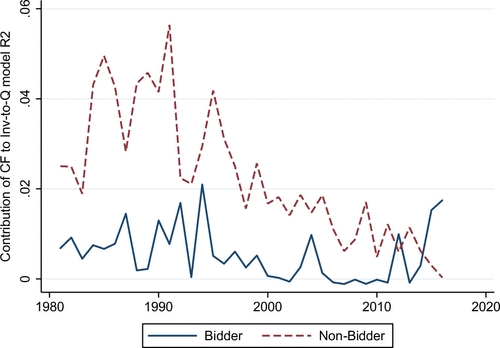
Notes. The graph plots the incremental R2 effect of adding a measure of cash flow to annual cross-sectional investment-to-Q regressions run separately for bidders and nonbidders over time. Bidders (solid line) are all firms conducting an acquisition that satisfies our sample selection criteria, as well as any firm that reports positive acquisition CAPEX in its cash flow statement in Compustat in a given year. Nonbidders (dashed line) are all other firms in Compustat in that year.
Next we investigate the level of hard-to-replicate knowledge capital for bidders and the average nonbidder in the economy. Our measure here comes from Peters and Taylor (2017) and represents the percentage of knowledge capital (capitalized R&D investment) in total capital of the firm, both tangible and intangible. We compute and plot the average percentage of knowledge capital every year for the two groups of firms: bidders (solid line) and nonbidders (dashed line). Figure 6 presents the results of this analysis. We find that bidders, on average, tend to have less knowledge capital than the others do, suggesting that firms making acquisitions are lagging behind in terms of innovation. More importantly, we find that the fraction of knowledge capital that bidders have prior to making a bid has increased, but not by enough to offset the gap relative to the average firm. This gap has in fact widened considerably over the sample period, suggesting an erosion in terms of the ability to contribute hard-to-replicate assets to the merger.
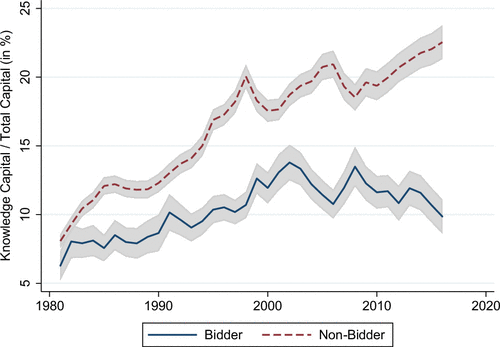
Notes. The graph plots the average percentage of knowledge capital to total capital (R&D stock based on perpetual inventory method divided by the sum of tangible and intangible capital) following Peters and Taylor (2017) separately for bidders and nonbidders over time. Bidders (solid line) are all firms conducting an acquisition that satisfies our sample selection criteria, as well as any firm that reports positive acquisition CAPEX in its cash flow statement in Compustat in a given year. Nonbidders (dashed line) are all other firms in Compustat in that year. Gray-shaded areas correspond to a 99% confidence interval.
Overall, the results reported here are consistent with the notion that bidding firms are losing their comparative advantage in terms of unique resources. They have fallen behind the average nonbidding firm in terms of innovation, whereas nonbidders have caught up with bidders in terms of financing power. However, changes in bidder composition (including the two dimensions documented here) may themselves be rooted in other developments. For instance, the type of bidders we observe in any given year is endogenous to the type of available targets. Therefore, it is possible that the targets available for sale in more recent years are such that they fit well with a wider range of possible bidders.
5.2. Why Have Merger Synergies Increased?
Finally, we examine a number of hypotheses for why merger synergies may have increased. Because our analysis shows that the upward trend is broad-based, we focus on economic hypotheses that could predict a market-wide improvement in overall takeover gains over time. These hypotheses span learning and age effects, better corporate governance, trends in industry concentration, and changes in the market for M&A advisory. Interestingly, the results of this analysis are notable for what does not work. We provide only a brief summary here; detailed discussion can be found in the Online Appendix.
First, improved deal-making over time by repeat acquirers could be consistent with a learning-by-doing effect: Bidders could be learning how to select suitable acquisition targets and integrate them. Although the literature on serial acquirers documents a declining trend in acquirers’ cumulative abnormal returns in successive acquisitions (Fuller et al. 2002, Billett and Qian 2008, Aktas et al. 2013), to our knowledge, these studies do not control for bidder composition. It is thus possible that bidder composition has previously obscured the learning effect in the data. However, as shown in the Online Appendix, Tables 6 and 7, we find no evidence that the upward trend in the common component of acquirer returns is related to deal experience. We also consider whether firm age—collinear with the time trend in a firm fixed effects specification—has any explanatory power. It does not. The takeaway is that the upward trend in the common component of acquirer returns is a calendar time effect, not an experience or an age effect.
Second, the literature points to a potential for better corporate governance to improve acquisition decisions, increasing the fraction of deals undertaken for efficiency-seeking reasons.27 Incidentally, there has been a trend in pertinent governance characteristics: a decline in the frequency of staggered boards (Cremers et al. 2017), an increase in board independence (Duchin et al. 2010), increased equity-based compensation (Edmans et al. 2017), and a rise in institutional ownership (Lewellen 2011). Nevertheless, as shown in the Online Appendix, Table 8, we fail to find support for the hypothesis that changes in these governance characteristics at the firm level can explain the upward trend in the common component of acquirer returns. It is still possible that improved governance is at work, but in ways not amenable to large sample testing (e.g. through increased shareholder activism (Brav et al. 2018)).
Third, Gutiérrez and Philippon (2017) and Grullon et al. (2019) show that U.S. industries have become more concentrated over time, prompting us to consider market power effects (either upstream or downstream) as a potential source of increased merger gains. The trend toward higher industry concentration is of further interest because the degree of product market competition may constrain corporate mismanagement (Giroud and Mueller 2010, 2011). Because firms in highly competitive industries operate with thin profit margins, there is more room for mismanagement of free cash flow in monopolistic industries. We perform two sets of tests that lead us to reject this potential link. First, in the Online Appendix, Table 9, we find no corresponding time trends in the market reaction of rival, customer, and supplier firms. Second, in the Online Appendix, Table 10, various measures of industry concentration fail to explain the upward trend we document.
Finally, several studies point to the importance of financial advisors in mergers and acquisitions (Servaes and Zenner 1996, Rau 2000, Kale et al. 2003, Golubov et al. 2012). We examine the possibility that changes in the market for M&A advisors have affected the quality of M&A deals they propose and execute. For example, during the 1980s and 1990s, major investment banking houses converted from partnerships to corporations and went public (Morrison and Wilhelm 2008). The industry has also seen mergers between banks and securities firms during the late 1990s and early 2000s and the entry of “boutique” M&A advisors (Song et al. 2013). During this industry transformation, traditional investment banking relationships have become increasingly transactional, with acquirers switching advisors more frequently (Corwin and Stegemoller 2014). In the Online Appendix, Table 11 and Figure 3, we find some limited evidence that the composition of advisors can explain a small portion of the upward trending common component of acquirer returns: as if bidders are gravitating toward higher value-added advisors over time. However, the upward trend is also present in deals that likely involved no advisors.
Overall, the source of rising merger synergies eludes us. That said, to the extent that merger synergies arise from economies of scale and scope, our results are consistent with a world in which these economies have increased. For instance, in their analysis of disappearing IPOs in the United States, Gao et al. (2013) argue that the importance of economies of scale and scope has increased over time, making it more profitable for young firms to sell out to corporate buyers. Our evidence on rising merger synergies is consistent with that hypothesis.
In addition, rising merger synergies are also consistent with a world in which barriers to value-increasing M&A have been lowered. Take the financials industry as an example (recall our finding that the upward trend is more pronounced for financials). The financials industry has experienced a gradual removal of various barriers to mergers through deregulation (e.g., allowance of interstate acquisitions and of mergers between commercial and investment banks). This removal means that first-best synergies go up: Synergistic deals that were previously held back by regulations are now feasible. This can be shown, at least theoretically, in a simple simulation. We generate a distribution of 50 targets (one per state) and 100 bidders (two per state) with randomly distributed synergies for each potential bidder-target pair. We then draw arbitrary boundaries on M&A activity (state border restrictions). We calculate the first-best available synergies for each state, then remove barriers to interstate acquisitions and compute the first-best available synergies again. We then repeat the exercise 1,000 times. Comparing the two cases (with and without restrictions), it is clear that available synergies increase when restrictions are removed.28 The intuition from this observation and exercise extend beyond the financial industry and the impact of regulations. In general, the removal of various barriers to participation in shareholder value-increasing mergers (e.g., fewer financing constraints for bidders, etc.) will increase observed synergies through allowing more first-best combinations.29
6. Conclusion
The seemingly unchanged average acquirer returns over the last four decades mask two fundamental shifts in the market for corporate control. Controlling for bidder composition, we find that acquirer returns have actually increased by as much as five percentage points relative to the 1980s. This increase is broad-based: it is equally present in deals involving public and private targets, cash and stock deals, diversifying and focused acquisitions, and domestic and cross-border deals. Working against this increase, the average bidder-specific component of acquirer returns has declined.
We develop and test a single, unifying theoretical framework of bidder-specific merger synergies that helps interpret our findings of time series and composition effects in acquirer returns. In our theory, acquirer returns increase with the degree of the winning bidder’s uniqueness in terms of generating deal synergies relative to the second-best alternate buyer. We develop empirical proxies for bidder uniqueness and find strong support for our prediction in the data. Bidder composition effects we document are related to bidder uniqueness. We argue that the time series evidence is consistent with declining bidder uniqueness, whereby merger synergies are becoming less bidder-specific. This trend has been offset by rising total deal synergies, thereby keeping acquirer returns flat over time.
We also undertake a search for the economic drivers of declining bidder uniqueness and rising merger synergies. We find that bidders have fallen behind in terms of the uniqueness of the resources they bring into the deal: Financing power is no longer limited to bidders, and they are now lagging other firms in terms of hard-to-replicate innovative assets. The drivers of rising synergy gains elude us, as we find no support for channels such as learning, improved corporate governance, or increased industry concentration. The source of rising synergies remains a puzzle to be addressed in future research.
The authors thank three anonymous referees whose feedback helped improve the paper and Yakov Amihud, Leonce Bargeron, Sanjai Bhagat, Eric de Bodt, Jean-Gabriel Cousin, Robert Dam, François Derrien, Eliezer Fich, Laurent Frésard, Gerard Hoberg, Clemens Otto, Dimitris Petmezas, Gordon Phillips, Raghavendra Rau, Christoph Schneider, Shawn Thomas, Karin Thorburn, Wenyu Wang, Alfred Yawson, Huizhong Zhang, Alexei Zhdanov, and seminar participants at BI Norwegian Business School, Dartmouth College (Tuck), Federal Reserve Bank of Chicago, Frankfurt School of Finance and Management, Joint Finance Seminar (Bonn, Cologne, Dortmund, WHU, Wuppertal), Norwegian School of Economics, SKEMA Business School, Università Cattolica del Sacro Cuore, University of Lausanne, University of New South Wales, Université Paris-Dauphine, University of Pittsburgh (Katz), University of Toronto (Rotman), University of Washington (Foster), WHU-Otto Beisheim School of Management, European Finance Association 2020 Meetings, Financial Management Association 2021 Annual Meetings, Fourth Cass Mergers and Acquisitions Research Centre Conference, Midwest Finance Association 2019 Meetings, Northern Finance Association 2019 Meetings, and 2019 University of North Carolina Junior Finance Roundtable for comments and suggestions. The views expressed herein are not necessarily those of the Bank of Canada and are the authors’ alone.
1 Moreover, the increase is present in both value-creative and value-destroying deals and robust to event windows of substantially varying length, ruling out explanations such as the efficiency and speed of market pricing.
2 When working with the significantly smaller public-target subsample and the associated variables, we increase the by-year winsorized fraction to 2% at both ends. For event study purposes on the target side, we disregard follow-up bids for the same target, unless a year has passed since the resolution date of the previous bid, penny-stock targets (priced below $1), and announcements that fall within five days of the target’s quarterly earnings announcement.
3 Our inferences are unchanged when using only the first five years of the 1980s as the baseline period and when we exclude the 1980s altogether and use the first five years of the 1990s as our benchmark. We have also experimented with replacing year dummies in vector with indicators for five-year periods or decades, and our conclusions continue to hold.
4 Subsidiary target × stock is the omitted category and serves as the benchmark for interpreting the coefficients on the interaction terms.
5 The large drop in average acquirer returns in year 2000 is consistent with the evidence of large negative bidder dollar returns following the collapse of the “tech bubble” documented by Moeller et al. (2005). They attribute the large losses in that period to revelations about bidder stand-alone values.
6 For example, Moeller et al. (2004), Rosen (2006), Maloney et al. (1993), and Betton et al. (2014).
7 For example, Travlos (1987), Fuller et al. (2002), Faccio et al. (2006), and Eckbo et al. (2018).
8 Key observations can be summarized as follows. Dollar market capitalizations of acquirers trend upward over time (this persists if we use CPI-adjusted values). Acquirer Tobin’s Q is largely flat, except for a large spike around the year 2000. A similar, albeit less pronounced, spike around 2000 is also observed for acquirer run-ups. Acquirer idiosyncratic volatility first trends upward and peaks around the year 2000 before coming back down, except for another spike associated with the global financial crisis of 2008. The prevalence of cash deals has increased post-2000, although this increase has reverted abruptly in the final three years of our sample. The fraction of cross-border deals has been rising up until 2010, after which a partial reversal is observed. A higher fraction of deals in the post-1980 period is same industry. Public targets are somewhat less prevalent throughout the sample relative to the 1980s; the same is true for hostile deals and tender offers.
9 Note also that the addition of firm fixed effects mitigates the sharp decline in average acquirer returns in year 2000 documented by Moeller et al. (2005).
10 To reiterate, the firm fixed effect is estimated over the entire sample and, thus, does not change over time. What changes is the composition of bidders whose (constant) fixed effects make up the average fixed effect in a given year. The assumption of a stable bidder fixed effect is supported by the findings of Golubov et al. (2015), who show that period-specific fixed effects provide no additional explanatory power. In addition, as discussed in Section 2, less than a quarter of bidders is active beyond a 10-year period, preventing period-specific estimation for the majority of bidders.
11 The dependent variables in these regressions are themselves regression estimates. Standard errors in such second-stage regressions can be heteroskedastic and inefficient. Historically, weighted least squares (WLS) regressions were used to address such econometric issues, whereby observations are weighted by the inverse of the standard error of the estimated dependent variable (Hornstein and Greene 2012). However, Lewis and Linzer (2005) show that OLS with heteroskedasticity-robust standard errors tends to be a superior remedy and should be preferred to WLS in most cases. We follow their recommendation (our double-clustered standard errors are hetoroskedasticity-robust).
12 We also considered the role of potentially time-varying deal anticipation using acquirer industry dormant periods following Cai et al. (2011) and industry M&A liquidity (both acquirer and target) following Schlingemann et al. (2002), in explaining the patterns we document. These industry characteristics do not exhibit a noticeable time trend, and their inclusion in our regressions does not change the coefficients of interest.
13 One exception can be found in the strategy literature; see Capron and Pistre (2002) and studies cited therein.
14 To derive this, consider first a second-price auction, where the winning bidder makes an offer equal to and gains an amount equal to . Expressing this gain as a fraction of synergies S, we obtain . If the target further captures a portion of the surplus synergies , then A gains , where . Expressed as a fraction of synergies S, this gives . For example, in a Nash bargaining game with full information.
15 To avoid this issue, in samples consisting of only public targets, the relative size variable can be constructed using the pre-announcement (or pre-runup period) value of the target, that is, standalone value of the target .
16 Naturally, targets of the deal in question are further purged from the set of possible competing bidders.
17 The fact that transaction value (numerator of deal relative size) feeds into the construction of our bidder uniqueness proxies is another reason to exclude relative size from our list of controls. The correlation between deal relative size and bidder uniqueness is not just by construction but makes theoretic sense: the larger the target, the smaller is the number of firms that could take it over, making any eligible bidder more unique. Therefore, relative deal size is a “bad control” in our context because it partly controls for the effect we are after.
18 We use the full TNIC file available from http://hobergphillips.tuck.dartmouth.edu/. We are grateful to Gerard Hoberg and Gordon Phillips for making these data available.
19 We use the top three closest alternate buyers to account for noise in the estimation of the first-best similarity and for potential constraints on the participation of any one firm in the contest for the target. Nevertheless, our results are robust to alternatives, such as top 1 and top 5 closest rival bidders.
20 To avoid the negative denominator problem, Ahern (2012) proposes to proxy for the sharing of gains by taking the difference between target and acquirer dollar gains and scaling it by the combined firm market capitalization. To be comparable across deals, this measure requires an assumption that synergy gains are a constant fraction of the combined firm market value.
21 For the returns-based and text-based proxy, the lowest bucket of [0.00–0.25] is empty, as the values of this proxy are skewed toward one. We opt for this threshold-based split rather than a quartile split to ensure sufficient differentiation between the buckets.
22 It is also interesting to note that the estimated intercept in these regressions is consistently negative and statistically significant, on the order of −0.01 to −0.02. Recall that in Equation (11) captures any systematic (non-mean-zero) measurement error in the combined CAR. Thus, our estimation suggests that the combined CAR underestimates expected synergies by roughly one to two percentage points. This is sizeable, considering that the sample mean combined CAR is about 2%. The downward bias is consistent with negative revelations about bidder standalone values, as well as price pressure by merger arbitrageurs who short-sell acquirer stock in stock-financed deals.
23 Our contention that synergies have become less bidder-specific also has implications for takeover competition: we would expect that, over time, competition for a given target has intensified. This prediction appears to be borne out by existing literature. Consider the findings of Liu and Mulherin (2018), who examine temporal changes in observable and behind-the-scenes takeover competition. Although they show a decline in hostile deals and multiple bidder contests playing out in the public relative to 1980s, they also find (Table B.2) that the number of contacted potential buyers grows from an average of 5.90 in the 1980s to 7.93 in the 1990s and further to 13.36 in the 2000s. Similarly, the number of potential bidders signing confidentiality/standstill agreements grows from 2.51 in the 1980s to 3.71 in the 1990s and to 6.07 in the 2000s. In the same vein, submissions of indications of interest with a price range grow from 1.70 in the 1980s to 1.81 in the 1990s and to 2.75 in the 2000s. Furthermore, Brown et al. (2022) show that, over time, targets have become more likely to initiate auctions themselves, and that the length of the private negotiation process has increased.
24 Declining bidder-specificity of synergies is also consistent with the rise of financial buyers (the private equity industry) over time. Because financial buyers provide mostly capital and management skill/incentive structures, their contribution to the generation of takeover gains can be viewed as largely fungible: what KKR brings to the table can also be done by Carlyle, Apollo, TPG, Cinven, and so on. Consistent with declining bidder-specificity of synergies bolstering the position of financial buyers in the M&A market, in unreported analysis we find two notable trends. First, the incidence of leveraged buyouts has increased relative to the 1980s. Second, the completion rate of leveraged buyouts has increased compared with the 1980s, both in absolute terms and relative to the completion rate of strategic buyers in the same target industry.
25 The only modification in the set of controls is that the method of payment-listing status interactions are replaced with just the method of payment indicator because all targets are public. The cross-border indicator is further omitted because all deals are domestic.
26 Recall that, in our framework, the winning bidder has to outbid the second-best bidder and therefore offers a dollar premium equal to at least . Whether the target extracts a price higher than that depends on the model setup, as summarized by the parameter k in the previous theoretical framework. When the target does not share in the surplus synergies , the target return can be written as , that is, not a direct function of synergies S.
27 See, for example, Datta et al. (2001) for equity-based compensation, Masulis et al. (2007) for antitakeover provisions, and Dahya et al. (2019) for board independence.
28 We do not report the output of this simulation due to its simplicity, as well as for brevity.
29 For a given target firm, the removal of barriers to first-best combinations also means that the winning bidder faces increased competition from potential rival bidders, making the winning bidder less unique. This effect is also confirmed by our simulation. Of course, the removal of barriers to acquisitions can also increase the pool of available targets.
References
- (2012) Bargaining power and industry dependence in mergers. J. Financial Econom. 103(3):530–550.Crossref, Google Scholar
- (2013) Learning from repetitive acquisitions: Evidence from the time between deals. J. Financial Econom. 108(1):99–117.Crossref, Google Scholar
- (2017) Value creation from M&As: New evidence. J. Corporate Finance 45:632–650.Crossref, Google Scholar
- (2016) Have financial markets become more informative? J. Financial Econom. 122(3):625–654.Crossref, Google Scholar
- (2014) Corporate innovations and mergers and acquisitions. J. Finance 69(5):1923–1960.Crossref, Google Scholar
- (2024) Credit supply shocks: Financing real growth or takeovers? Rev. Corporate Finance Stud. 13(2):428–458.Google Scholar
- (2008)
Corporate takeovers . Eckbo BE, ed. Handbook of Corporate Finance: Empirical Corporate Finance, vol. 2 (Elsevier/North-Holland, New York), 291–430.Crossref, Google Scholar - (2014) Merger negotiations with stock market feedback. J. Finance 69:1705–1745.Crossref, Google Scholar
- (2008) Are overconfident CEOs born or made? Evidence of self-attribution bias from frequent acquirers. Management Sci. 54(6):1037–1051.Link, Google Scholar
- (1988) Synergistic gains from corporate acquisitions and their division between the stockholders of target and acquiring firms. J. Financial Econom. 21(1):3–40.Crossref, Google Scholar
- (2018) How does hedge fund activism reshape corporate innovation? J. Financial Econom. 130(2):237–264.Crossref, Google Scholar
- (2022) The development of the takeover auction process: The evolution of property rights in the modern Wild West. J. Law Econom. 65(4):715–751.Crossref, Google Scholar
- (2011) Anticipation, acquisitions, and bidder returns: Industry shocks and the transfer of information across rivals. Rev. Financial Stud. 27(7):2242–2285.Crossref, Google Scholar
- (2002) When do acquirers earn abnormal returns? Strategic Management J. 23(9):781–794.Crossref, Google Scholar
- (2014) The changing nature of investment banking relationships. Working paper, University of Notre Dame, Notre Dame, IN and Baylor University, Waco, TX.Google Scholar
- (2017) Staggered boards and long-tern firm value, revisited. J. Financial Econom. 126(2):422–444.Crossref, Google Scholar
- (2019) Governance mandates, outside directors, and acquirer performance. J. Corporate Finance 59:218–238.Crossref, Google Scholar
- (2001) Executive compensation and corporate acquisition decisions. J. Finance 56(6):2299–2336.Crossref, Google Scholar
- (2024) Competition shocks, rival reactions, and stock return comovement. Working paper, Lille University, Villeneuve-d'Ascq, France, Dartmouth College, Hanover, NH, and California Institute of Technology, Pasadena, CA.Google Scholar
- (2017) The US listing gap. J. Financial Econom. 123(3):464–487.Crossref, Google Scholar
- (2010) When are outside directors effective? J. Financial Econom. 96(2):195–214.Crossref, Google Scholar
- (2023) Merger-driven listing dynamics. Working paper, Tuck School of Business at Dartmouth College, Hanover, NH.Google Scholar
- (2000) Gains to bidder firms revisited: Domestic and foreign acquisitions in Canada. J. Financial Quant. Anal. 35:1–25.Crossref, Google Scholar
- (2018) Are stock-financed takeovers opportunitstic? J. Financial Econom. 128(3):443–465.Crossref, Google Scholar
- (2017)
Executive compensation: A survey of theory and evidence . Hermalin BE, Weisbach MS, eds. Handbook of the Economics of Corporate Governance, vol. 1 (Elsevier, Amsterdam), 383–539.Crossref, Google Scholar - (2015) Do acquisitions relieve target firms’ financial constraints? J. Finance 70(1):289–328.Crossref, Google Scholar
- (2006) Returns to acquirers of listed and unlisted targets. J. Financial Quant. Anal. 41(1):197–220.Crossref, Google Scholar
- (2004) New lists: Fundamentals and survival rates. J. Financial Econom. 73(2):229–269.Crossref, Google Scholar
- (2002) What do returns to acquiring firms tell us? Evidence from firms that make many acquisitions. J. Finance 57(4):1763–1793.Crossref, Google Scholar
- (2013) Where have all the IPOs gone? J. Financial Quant. Anal. 48(6):1663–1692.Crossref, Google Scholar
- (2007) The evolution of shareholder activism in the United States. J. Appl. Corporate Finance 19(1):55–73.Crossref, Google Scholar
- (2010) Does corporate governance matter in competitive industries? J. Financial Econom. 95(3):312–331.Crossref, Google Scholar
- (2011) Corporate governance, product market competition, and equity prices. J. Finance 66(2):563–600.Crossref, Google Scholar
- (2012) When it pays to pay your investment banker: New evidence on the role of financial advisors in M&As. J. Finance 67(1):271–311.Crossref, Google Scholar
- (2015) Extraordinary acquirers. J. Financial Econom. 116(2):314–330.Crossref, Google Scholar
- (2019) Are US industries becoming more concentrated? Rev. Finance 67(4):1499–1537.Crossref, Google Scholar
- (2017) Declining competition and investment in the US. Working paper, New York University, New York.Google Scholar
- (2010) Product market synergies and competition in mergers and acquisitions: A text-based analysis. Rev. Financial Stud. 23(10):3773–3811.Crossref, Google Scholar
- (2016) Text-based network industries and endogenous product differentiation. J. Political Econom. 124(5):1423–1465.Crossref, Google Scholar
- (2012) Usage of an estimated coefficient as a dependent variable. Econom. Lett. 116(3):316–318.Crossref, Google Scholar
- (1996) The finance-growth nexus: Evidence from bank branch deregulation. Quart. J. Econom. 11(3):639–670.Crossref, Google Scholar
- (1983) The market for corporate control. J. Financial Econom. 11(1–4):5–50.Crossref, Google Scholar
- (2003) Financial advisors and shareholder wealth gains in corporate takeovers. J. Financial Quant. Anal. 38(3):475–501.Crossref, Google Scholar
- (2015) The WACC fallacy: The real effects of using a unique discount rate. J. Finance 70(3):1253–1285.Crossref, Google Scholar
- (2010) The response of corporate financing and investment to changes in the supply of credit. J. Financial Quant. Anal. 45(3):555–587.Crossref, Google Scholar
- (2011) Institutional investors and the limits of arbitrage. J. Financial Econom. 102(1):62–80.Crossref, Google Scholar
- (2005) Estimating regression models in which the dependent variable is based on estimates. Political Anal. 13(4):345–364.Crossref, Google Scholar
- (2018) How has takeover competition changed over time? J. Corporate Finance 49:104–119.Crossref, Google Scholar
- (2004) Why has IPO underpricing changed over time? Financial Management 33(3):5–37.Google Scholar
- (1993) Managerial decision making and capital structure. J. Bus. 66(2):189–217.Crossref, Google Scholar
- (2007) Corporate governance and acquirer returns. J. Finance 62(4):1851–1889.Crossref, Google Scholar
- (2004) Firm size and the gains from acquisitions. J. Financial Econom. 73(2):201–228.Crossref, Google Scholar
- (2005) Wealth destruction on a massive scale? A study of acquiring firm returns in the recent merger wave. J. Finance 60(2):757–782.Crossref, Google Scholar
- (2008) The demise of investment banking partnerships: Theory and evidence. J. Finance 63(1):311–350.Crossref, Google Scholar
- (2011) Implications of data screens on merger and acquisition analysis: A large sample study of mergers and acquisitions from 1992–2009. Rev. Financial Stud. 24(7):2242–2285.Crossref, Google Scholar
- (2017) Intangible capital and the investment-q relation. J. Financial Econom. 123(2):251–272.Crossref, Google Scholar
- (2000) Investment bank market share, contingent fee payments, and the performance of acquiring firms. J. Financial Econom. 56(2):293–324.Crossref, Google Scholar
- (1986) The hubris hypothesis of corporate takeovers. J. Bus. 59(2):437–467.Crossref, Google Scholar
- (2006) Merger momentum and investor sentiment: The stock market reaction to merger announcements. J. Bus. 79(2):987–1017.Crossref, Google Scholar
- (2002) Divestitures and the liquidity of the market for corporate assets. J. Financial Econom. 64(1):117–144.Crossref, Google Scholar
- (2024) Bidder and target size effects in M&A are not driven by overconfidence or agency problems. Critical Finance Rev. Forthcoming.Google Scholar
- (1996) The role of investment banks in acquisitions. Rev. Financial Stud. 9(3):787–815.Crossref, Google Scholar
- (2013) The value of “boutique” financial advisors in mergers and acquisitions. J. Corporate Finance 20:94–114.Crossref, Google Scholar
- (1987) Corporate takeover bids, method of payment, and bidding firms’ stock returns. J. Finance 42(4):943–963.Crossref, Google Scholar

