


Asset Reclassifications and Bank Recapitalization During the Financial Crisis
Abstract
Regulators frequently relax accounting rules during a financial crisis as a means of regulatory forbearance. The new accounting options provide banks with an opportunity for an accrual-based increase in their regulatory capital. The use of such an accounting option helps reduce the costs of government interventions such as bailouts and avoid the dilution of existing shareholders’ ownership rights. We examine the introduction of the reclassification option for financial assets during the 2008 financial crisis and study the position of accrual-based options in the pecking order of banks’ recapitalization measures. The findings suggest that the accrual-based increase in regulatory capital is temporary and does not provide permanent relief. Consistent with the long-term costs of accrual-based measures, investors perceive the accounting choice as a negative signal. If banks do not complement their use of the accounting option by other corrective actions that result in a real capital increase and a liquidity injection, they continue to suffer from low capitalization and financial difficulties in the following years. Ultimately, government interventions in accounting regulation are unlikely to offer a sustainable solution to capital shortfalls in the banking sector if they are not supported by the concurrent enforcement of real corrective actions.
This paper was accepted by Brian Bushee, accounting.
Funding: The authors acknowledge financial support from Deutsche Forschungsgemeinschaft (Project-ID 403041268-TRR 266) as well as from IAAER and KPMG under the “Research Informing the IASB Standard Setting” grant.
Supplemental Material: The data files and online appendix are available at https://doi.org/10.1287/mnsc.2022.4364.
1. Introduction
When regulators and politicians seek adequate policy responses to a financial crisis and to restore financial stability, they frequently turn to the introduction of accounting options that enable bank managers to create an additional equity buffer and thus relax banks’ capital requirements. The option to postpone the adoption of the expected credit loss standard that the U.S. government granted to public banks during the COVID-19 pandemic offers a recent example (see Sections 4013 and 4014 of the CARES Act signed into law on March 27, 2020). In a similar vein, the European Central Bank (ECB) issued a recommendation to use the most optimistic scenario in the estimation of credit losses that banks expect to be caused by the COVID-19 pandemic (ECB (2020)). These rule changes led to fairly low levels of loan loss recognition during the early phase of the pandemic and thus helped keep bank capital stable (Bischof et al. 2021, ECB 2021).
Prior accounting literature has documented how managers use these kinds of options to delay loss recognition and avoid violating minimum capital restrictions (Skinner 2008, Giner and Mora 2020). However, evidence also shows that there are other means of bank recapitalization during a crisis, and banks also avail themselves of government support programs (such as direct capital injections or guarantees), issue equity on public markets, or take corrective actions such as reducing high-risk assets (Hoshi and Kashyap 2010, De Jonghe and Öztekin 2015, Acharya et al. 2021). Little evidence exists on the costs and benefits of managers’ accounting discretion relative to these measures and thus on the tradeoff in the design of a bank’s recapitalization strategy when regulators provide an accrual-based option to increase equity.
We use a setting from the 2008 financial crisis to address this question and provide evidence on how managers’ strategic use of accounting options ranks in the pecking order of banks’ recapitalization measures. In October 2008, the International Accounting Standards Board (IASB) permitted the reclassification of financial assets out of fair value categories and into amortized cost categories. The new accounting rule provided banks with the option to forgo fair value write-downs and, if regulatory capital was linked to IFRS accounting, a further reduction in the capital buffer. The rule change came at a time when banks lacked the opportunity to increase their capital buffer by measures they typically preferred, especially when they were unable to accumulate internal funds (Myers 2001) because their profits were shrinking or even negative. Therefore, we can observe the managerial choice of recapitalization measures in a laboratory where all available options are second best and therefore have some significant cost.
The consequences of managers’ use of the accounting option in this situation are ambiguous. On the one hand, the reclassification of assets that had deteriorated in value directly increased equity capital without immediate transaction costs that a bank would incur when issuing the same amount of equity to the public or a government. The accounting option also avoids the transfer of control rights and a dilution of the position of existing shareholders. On the other hand, unlike capital injections or asset sales, asset reclassifications fail to alleviate liquidity constraints, which are often coupled with a capital shortfall. Moreover, the change in accounting measurement affects bank transparency, and the tradeoff will depend on how investors perceive the visible accounting choice. For example, asset reclassifications plausibly signal that managers are expecting additional future losses, the timely recognition of which they seek to forgo in the new cost category.1
Our analyses address four alternatives against which we benchmark the use of asset reclassifications for regulatory capital management. These options are (i) capital injections through transactions in public equity markets, (ii) capital injections through government support programs (e.g., as part of a bailout in the event of a financial crisis), (iii) real capital management (asset sales), and (iv) other accrual-based accounting options (discretionary loan loss provisions, deferred tax assets). We proceed in two steps. First, we investigate the role of asset reclassifications in banks’ recapitalization strategies. We document the frequency and magnitude of these reclassifications and benchmark their capital effect against the other recapitalization measures. To examine the pecking order of bank recapitalization, we then test whether these other measures are positively associated (i.e., complement) or negatively associated (i.e., substitute) with reclassifications and whether this association varies with a bank’s capital buffer. Second, we explore the consequences of the different recapitalization strategies and compare immediate stock market reactions to asset reclassifications with reactions to other capitalization announcements. We also examine bid-ask spreads as a proxy for bank transparency and provide descriptive evidence on the long-term outcomes of measures for bank stability (stress test results, credit ratings) and for bank performance in the stock market.
When estimating the impact of financial accounting on bank capital, it is notoriously difficult to disentangle regulatory capital incentives from other management incentives to select accounting options such as asset reclassifications because a shortfall of regulatory capital often overlaps with other plausible management objectives, for example, the beating of earnings targets (Beatty et al. 1995, Collins et al. 1995). To address this issue, we exploit the international variation in our data and, in particular, institutional differences in how the IFRS accounting choice maps onto regulatory capital. Specifically, local regulation varies in the extent to which unrealized fair value gains and losses of certain financial assets, those in the available-for-sale (AFS) category, are included in the regulatory capital computation (prudential filters). The existence of prudential filters mutes the potential impact of a reclassification of these assets on regulatory capital but does not systematically alter other plausible incentives (e.g., for earnings management). We interact a bank’s capital buffer with the existence of a prudential filter to assess whether the use of the accounting option meaningfully corresponds with its potential impact on regulatory capital under the specific local rules.
Our analysis yields the following results. We find that the regulatory capital of our sample banks, on aggregate, is higher by approximately EUR 19.1 bn at the end of financial year 2008 because of the reclassification choice. The capital increase represents approximately 9% of the total effect of the recapitalization measures by our sample banks. Compared with existing accounting options, the effect of asset reclassifications is slightly lower than the aggregate effects of other accrual-based measures, such as recognizing deferred tax assets (EUR 23.7 bn) or reporting lower loan loss provisions (EUR 35.8 bn). The effect is also meaningfully large compared with the aggregate effects of a real capital measure such as asset sales (EUR 3.6 bn). However, asset reclassifications contribute much less to regulatory capital than capital injections from government support programs (EUR 107.8 bn) and from market transactions (EUR 29.7 bn). These numbers suggest that accrual-based options hardly suffice to fully achieve the required recapitalization but rather complement other more relevant measures.
Our regression analysis of the reclassification choice supports this interpretation. We find strong evidence consistent with regulatory capital incentives explaining banks’ reclassification choice. Banks with the tightest capital constraints are also most likely to reclassify assets out of fair value categories. Adding confidence to the causality of this explanation, banks’ likelihood of reclassifying AFS assets significantly declines if prudential filters eliminate the potential capital gains from reclassifications. Asset reclassifications do not substitute but rather complement other capital measures, especially injections through market transactions, asset sales, and accrual-based measures (especially deferred tax assets). However, the complementary relationship is weaker if these other measures already suffice to build an adequate capital buffer, implying that asset reclassifications rank low in the pecking order of bank recapitalization. We do not find any significant interaction between asset reclassifications and banks’ receipt of government support, most likely because once a bank decides to rely on this support, the sheer magnitude of the injected capital makes other recapitalization measures much less relevant.
The evidence from our analysis of the economic consequences of banks’ asset reclassifications, both in the short term and in the long run, conforms with the existence of substantial costs that plausibly explain the low rank of the accounting choice in the pecking order. The short-term stock market reactions in the narrow windows around the announcements of the regulation and bank announcements to use the option are significantly negative (with abnormal returns of approximately −1.0% each), unless information about complementary measures such as guarantees or bailouts accompanies these announcements. The use of asset reclassifications is also associated with a decline in bank transparency, as reflected in bid-ask spreads over a 12-month horizon, unless fully compliant disclosures provide complete information about the source of the capital effects. In the international environment of our study, we observe substantial variation in the incentives to fully comply with the disclosure requirements accompanying the reclassification choice.
Evidence on other long-term consequences points in the same direction. Banks that choose to reclassify financial assets for short-term regulatory relief are in a systematically worse financial situation in the following years than other banks, especially if they do not receive additional government support (i.e., they have lower capital buffers in stress scenarios, their lower ratings reflect a higher default risk, and they experience a slower recovery of their stock price). The results have implications for policymakers and the design of regulatory responses to a banking crisis. Overall, the evidence suggests that the use of accounting regulation to relax binding capital constraints does result in some short-term relief for distressed banks and helps reduce the transaction costs of raising capital or transferring control rights. However, although we refrain from making any causal statements here, our findings are also consistent with the benefits from a delay of accounting losses not being persistent in the long run, unless the use of accounting discretion is supported by additional measures through which real capital is injected. Therefore, market participants interpret the disclosure of discretionary accounting policies as a signal of financial distress that counters and significantly mutes (or even reverses) positive market reactions to short-term relief.
Our paper belongs to a series of studies of banks’ use of accrual-based options for recapitalization. Prior literature has investigated different options, such as deferred tax assets (Skinner 2008) and asset reclassifications (Paananen et al. 2012, Lim et al. 2013, Bowen and Khan 2014, Fiechter et al. 2017); see Acharya and Ryan (2016) and Becker et al. (2021, section 3.5) for an overview. We add two contributions. First, at the conceptual level, our study is the first to address the interaction of the accrual-based accounting choice with other means of bank capitalization and, thus, helps understand the position of this option in the pecking order of recapitalization measures that are available to banks during a financial crisis. These results also highlight the long-term costs that are associated with a purely accrual-based recapitalization strategy and the corresponding decline in bank transparency. These costs are important for the overall evaluation of the regulatory policy. Second, at the technical level, we offer more than purely descriptive evidence on the reclassification choice because, unlike prior studies, we clearly distinguish among different reclassification types that vary in their accounting effects on prudential ratios and exploit cross-country variation in prudential filters for empirical identification. We are thus able to offer tighter identification of the regulatory capital motivation.
Our paper also contributes to the more general literature on government interventions and bank recapitalization during the global financial crisis. Most of these papers analyze the costs and benefits of government support programs, through which capital and liquidity are directly injected into the banking sector or guarantees are issued (Hoshi and Kashyap 2010; Veronesi and Zingales 2010; Bayazitova and Shivdasani 2012; Acharya et al. 2014, 2021; Calomiris and Khan 2015; Flannery and Giacomini 2015). Although this literature suggests that timely government support that is sufficiently high can avoid bank failures and reduce the adverse consequences of banks’ capital shortfalls for lending, the benefits come at the cost of excessive public spending and potential moral hazard (Dam and Koetter 2012, Duchin and Sosyura 2014). We add to this literature by documenting that the introduction of accrual-based accounting options to avoid these costs hardly achieves the same benefits in the long run and, at best, provides temporary and short-term relief. Therefore, even if adopted by regulators, banks tend to select the accounting option only as a complement and to reduce the costs of real capital injections.
2. Accounting Regulation and Bank Recapitalization During the 2008–2009 Financial Crisis
2.1. Introduction of the IAS 39 Reclassification Option
Until the end of the third quarter of 2008, international banks (similar to their U.S. peers) experienced a substantial decline in equity, with regulatory ratios approaching regulatory minimum thresholds. With the banking crisis having the potential to harm financial stability and give rise to a severe recession in the global economy (Reinhart and Rogoff 2009), governments and regulators worldwide had clear incentives to intervene and ultimately avoid bank failures. These interventions took different forms and included direct injections of capital and liquidity, the issuance of guarantees, or the purchase of troubled bank assets. The magnitude and frequency of these measures peaked in October 2008 (see Stolz and Wedow 2010, Fratianni and Marchionne 2013, and Acharya et al. 2021 for an overview of worldwide support measures).
On October 13, 2008, the IASB amended International Accounting Standard (IAS) 39 and IFRS 7 and allowed reclassifications of financial assets out of fair value categories (IASB 2008). In a press release, the Board stressed that this action was “consistent with the request made by European leaders and finance ministers,” thus highlighting the political pressure under which the IASB had introduced the amendments. By using the reclassification option, banks could forgo the recognition of fair value losses and the corresponding decrease in equity capital (for a limited time even with perfect hindsight).2 To the extent that prudential supervision is linked to financial reporting, the accounting measurement of equity also affects regulatory capital. For reclassifications of financial assets, the link depends on country-specific regulation that varies in the extent to which unrealized fair value changes are included in regulatory capital (prudential filters). In line with the political intention, the newly introduced reclassification option thus provided banks with another measure to increase their regulatory capital and avoid the violation of regulatory minimum thresholds.
We can distinguish three potential effects of these asset reclassifications on the recognition of gains and losses and correspondingly equity capital (see Appendix A for an overview). First, reclassifications from the trading category into the held-to-maturity (HTM) or loans and receivables (L&R) category potentially affect both net income and shareholders’ equity. When an asset is reclassified, fair value gains and losses cease to be recognized in profit or loss (P&L) and thus in equity unless a fair value loss also triggers an impairment write-down.3 Second, reclassifications from the trading category into the available-for-sale (AFS) category potentially affect net income and other comprehensive income (OCI) but not shareholders’ equity. After reclassification, fair value changes are reported in OCI rather than in P&L (again, unless the asset becomes impaired). Because accumulated OCI is part of shareholders’ equity (typically separately reported as a revaluation reserve), these fair value changes continue to be included in equity. Third, reclassifications from the AFS category into the L&R or HTM category potentially affect future equity and OCI but not net income. After reclassification, fair value gains and losses will no longer be reported in OCI. Thus, any unrecognized fair value changes after the reclassification (i.e., those that do not trigger an impairment) will also no longer be included in accumulated OCI as part of shareholders’ equity.
2.2. Tradeoffs in Banks’ Choice of the Recapitalization Measures
Prior literature has established a pecking order of capital measures for banks (Hoshi and Kashyap 2010). In line with the general theory of capital structure (Myers 1984, Myers and Majluf 1984), banks prefer to meet their funding needs internally. When internal funds are insufficient and they have to raise external funds, they prefer debt to equity. Little evidence exists on how accrual-based accounting measures rank in this pecking order and relate to the use of the other measures.
Banks’ demand for capital is particularly urgent during a financial crisis when they are at risk for violating minimum capital requirements and ultimately facing insolvency. Under the circumstances of such a crisis, the two options at the top of the pecking order are often infeasible. The issuance of standard debt contracts, while enhancing liquidity, does not solve the capitalization issue because it does not count toward regulatory capital. The accumulation of internal funds requires the generation of these funds through banks’ real activities in the first place. In our setting of the 2008 financial crisis, those banks with the greatest capital constraints and the most urgent need for recapitalization were making severe losses and had substantial liquidity outflows; therefore, the option was not available to them. Relatedly, dividend cuts were not a feasible option in October 2008 simply because for international banks, such a decision was not due until spring of next year, postponing the benefits of any dividend cut until long after the relevant time window for the recapitalization.4
Against this background, with banks lacking the opportunity to accumulate internal funds and issue debt instruments, they have to shore up capital in other, less preferred ways. Generally, three options for recapitalization remain during a crisis. First, banks can obtain capital injections through market transactions (e.g., seasoned equity offerings (SEOs) or the sale of treasury shares) or through government support programs (e.g., as part of a bailout). Second, banks can strategically adjust their real activities to achieve a one-time effect on net income and generate additional funds (e.g., through the selective selling of assets) or to lower the risk weights and thus the capital need (i.e., real capital management). Third, banks can adjust the accounting measurement of assets and liabilities to achieve an accrual-based effect on net income, which also generates additional capital via accounting equity. Asset reclassifications out of fair value categories are one example for this measure; other examples include the discretionary reduction of loan loss provisions or the recognition of deferred tax assets.
2.2.1. Asset Reclassifications vs. Capital Injections.
Capital injections imply a transfer of control rights to new shareholders and, if capital is injected through a bailout, to government agencies. Shareholders perceive the dilution of their existing position as a cost of the recapitalization strategy that the concurrent use of equity-increasing accrual-based measures can help minimize. The cost is generally reflected in negative market reactions to new equity issuances (Cornett and Tehranian 1994, Cornett et al. 1998). In the case of a bailout, the loss of control rights also manifests in government influence on future investment and risk policies or limits to executive compensation, which are all potentially detrimental to bank value (La Porta et al. 2002, Bayazitova and Shivdasani 2012, Shen and Lin 2012, Farruggio et al. 2013).
Bank managers weigh these costs of capital injections against the benefits. Especially if a liquidity shortage accompanies the depletion of bank capital in a period of crisis, only the injection of capital will also meet the liquidity needs of the bank, whereas accrual-based measures only affect its book equity. The greater the capital shortfall, the more likely accrual-based measures are to fail to alleviate the constraint (especially because of its natural limits, e.g., from the availability of eligible assets), with capital injections becoming the only feasible way to sufficiently recapitalize the bank and to avoid the regulatory costs of undercapitalization, outweighing the dilution effect of the transaction (Cornett and Tehranian 1994).
Overall, accrual-based measures such as asset reclassifications are unlikely to offer a full substitute for capital injections, especially if capital constraints are large in magnitude during a crisis. In the short run, complementing capital injections by asset reclassifications can still help reduce the amount of injected capital and thus minimize the dilution effect, especially if the bolstering of accounting equity signals bank stability (e.g., by breaking a downward spiral; Gorton 2008, p. 217) and investors in a bank’s SEO do not perceive the use of asset reclassifications as a signal that managers expect future losses. If these losses are more than temporary declines in asset values, asset reclassifications (or other accrual-based measures) cannot shield equity capital from bearing these losses in the long run and instead lead to a reversal of capital savings. Therefore, these accrual-based measures can only offer temporary relief and are unlikely to suffice for a sustainable recapitalization strategy on their own.
2.2.2. Asset Reclassifications vs. Real Capital Management.
Real capital management is a change in operating and investing decisions by bank managers that is primarily intended to change the bank’s regulatory capital (i.e., a decision that would not be made in the absence of any regulatory capital incentives). In contrast to accrual-based measures, these real capital measures alter a bank’s cash flows and then result in a deviation from a bank’s optimal plan of action (similar to other real earnings management activities; Badertscher 2011, Zang 2012). One common example of these costs of real capital management is asset sales at discounted prices in forced transactions (fire sales; Shleifer and Vishny 2012). In addition to these value-reducing effects, the measures typically result in additional transactions (especially sales of risky assets and purchases of assets with lower risk weights) and thus higher transaction costs. These costs are particularly high in a crisis when markets are illiquid and asset prices are depressed.
Managers have to weigh these costs of real capital management against indirect costs of accrual-based measures such as potentially greater scrutiny during the auditing process (Ewert and Wagenhofer 2005, 2011). Perhaps more important, real capital management can enhance bank liquidity, especially if cash is generated by asset sales. Similar to capital injections, these potential liquidity effects have a clear advantage over accrual-based measures. The tighter the capital constraint, the more plausible is a simultaneous shortage of liquidity and the less likely a full substitution of real capital measures by accrual-based measures appears to be. However, banks likely tend to complement real capital measures by accrual-based measures such as asset reclassifications and, thereby, reduce the volume of asset sales and their respective costs.
2.2.3. Asset Reclassifications vs. Other Accrual-Based Measures.
The previous discussion has shown that the potential for accrual-based measures to fully substitute for capital injections and real capital management is very limited because of (i) their lack of a liquidity effect, (ii) their temporary nature, and (iii) their limited magnitude (subject to the existence of accounting slack, e.g., eligible assets for reclassifications). However, there are very plausible incentives for management to use accounting options as a complement to these measures, especially during a crisis. Given that managers consider newly introduced accounting options within the portfolio of existing options (Ramesh and Revsine 2001), the question is whether management prefers asset reclassifications over alternative options that include, most important, the downward management of loan loss reserves (Beatty and Liao 2014) and the opportunistic recognition of deferred tax assets (Skinner 2008). In contrast to these existing alternatives, asset reclassifications have two unique features.
First, the use of asset reclassifications is highly visible because of the extensive disclosure requirements under IFRS 7 and the public debate surrounding its introduction, which focused analysts’ attention on that issue (Bischof et al. 2014). Of course, banks also disclose information related to the other options. However, their use is not discretionary per se, and it is notoriously difficult to disentangle the discretionary portion of those accounting choices from the normal level of accruals. Unlike for reclassifications, there are no disclosures that make this discretion explicit. Second, for a limited period of time (see Section 2.1), banks were able to backdate the reclassification of financial assets and thus use hindsight. In other words, managers had full information about the magnitude of the fair value losses that they would forgo by electing the option at this time and thus about the amount of capital savings. Unlike other accrual-based options, this choice is fully legal and not subject to increased auditor and enforcement scrutiny.
Ultimately, management will weigh the relatively high level of certainty against the visibility of accounting discretion to market participants. The managerial preference for a certain accounting option is therefore ambiguous. However, it will likely tilt against the use of reclassifications after uncertainty about the associated capital effects increased with the expiration of the backdating option on October 31, 2008.
We summarize our predictions in Appendix B. The summary shows that bank managers are unlikely to prefer asset reclassifications over alternative capital measures. If the accounting choice ranks low in the pecking order of banks’ capital measures, investors will react negatively to its announcement, and long-term outcomes are likely to be less favorable for banks that turn to reclassification as a last resort.
3. Data
3.1. Sample and Summary Statistics
Our sample selection proceeds as follows: We identify 702 financial firms with publicly listed stocks that are classified as IFRS users for financial year 2008 in the databases BvD Bankscope, Worldscope (Industry Groups 102 and 127), and Compustat Global (Industry Groups 4310 and 4320).5 We exclude 264 firms that are not covered by Thomson Reuters Datastream, our source for capital market data. We exclude another 112 firms that are not subject to external capital oversight (hedge funds, brokerage houses, and securities firms) or for which we cannot retrieve any data on regulatory capital. Finally, we exclude another 24 firms that do not publish a financial report in English, French, German, or Chinese on their websites. This procedure yields a final sample of 302 banks from 39 countries. For this sample, we collect information on country-specific capital regulation (see Appendix C) and bank-specific capital measures under the Basel II Framework (see Table OA.1 in the online appendix).
Table 1 provides details on the sample composition and the use of capital measures across countries. A total of 124 of the 302 banks in the sample used the reclassification option in financial year 2008. The subset of reclassifying banks comprises 82 banks that generate capital savings through reclassifications.6 Although other accrual-based measures are used by more banks in our sample (deferred tax assets: 102 banks; lower loan loss provisions: 148 banks), only 62 banks engage in real capital management through asset sales. A total of 145 sample banks received capital injections during financial year 2008, either through market transactions (92 banks) or by government support such as bailouts or guarantees (53 banks). Governments supported these banks through bailouts (20 banks), bank-specific guarantees (6 banks), or country-wide guarantee schemes (27 banks from Austria, France, Germany, Ireland, Norway, and Spain).
|

Table 1. Descriptive Statistics by Country
| Country | Number of banks (sample) | Reclassification | Capital injection | Real capital management | Accrual-based capital management | ||||
|---|---|---|---|---|---|---|---|---|---|
| All | Capital Savings > 0 | AFS | Market transactions | Government support | Asset sales | Deferred tax assets | Lower LLP | ||
| Australia | 9 | 1 | 1 | 1 | 5 | 0 | 1 | 0 | 2 |
| Austria | 2 | 1 | 0 | 0 | 0 | 2 | 0 | 0 | 0 |
| Bahrain | 9 | 3 | 1 | 3 | 2 | 0 | 1 | 1 | 3 |
| Belgium | 2 | 2 | 1 | 2 | 0 | 2 | 0 | 0 | 2 |
| China | 10 | 0 | 0 | 0 | 0 | 0 | 2 | 9 | 8 |
| Cyprus | 4 | 2 | 2 | 2 | 4 | 0 | 2 | 0 | 4 |
| Denmark | 10 | 4 | 0 | 0 | 2 | 0 | 0 | 0 | 0 |
| Finland | 2 | 1 | 1 | 1 | 0 | 0 | 0 | 0 | 1 |
| France | 19 | 5 | 5 | 3 | 0 | 11 | 6 | 15 | 5 |
| Germany | 14 | 7 | 4 | 7 | 0 | 6 | 2 | 4 | 5 |
| Hong Kong | 10 | 4 | 4 | 4 | 4 | 0 | 1 | 9 | 9 |
| Hungary | 2 | 0 | 0 | 0 | 0 | 0 | 0 | 0 | 0 |
| Ireland | 3 | 3 | 1 | 2 | 0 | 3 | 2 | 1 | 3 |
| Italy | 21 | 13 | 13 | 8 | 15 | 0 | 8 | 20 | 5 |
| Jordan | 11 | 5 | 4 | 2 | 2 | 0 | 3 | 0 | 8 |
| Kazakhstan | 1 | 1 | 0 | 0 | 0 | 0 | 0 | 0 | 1 |
| Kuwait | 9 | 4 | 4 | 0 | 5 | 0 | 1 | 0 | 3 |
| Liechtenstein | 2 | 0 | 0 | 0 | 1 | 0 | 0 | 2 | 1 |
| Lithuania | 4 | 0 | 0 | 0 | 1 | 0 | 1 | 3 | 3 |
| Netherlands | 5 | 2 | 1 | 1 | 1 | 2 | 0 | 1 | 1 |
| Norway | 12 | 4 | 0 | 0 | 0 | 9 | 0 | 0 | 0 |
| Oman | 5 | 0 | 0 | 0 | 0 | 0 | 0 | 2 | 4 |
| Philippines | 11 | 9 | 5 | 7 | 5 | 0 | 1 | 0 | 9 |
| Poland | 13 | 4 | 2 | 3 | 6 | 0 | 6 | 8 | 7 |
| Portugal | 5 | 5 | 4 | 3 | 3 | 1 | 3 | 1 | 4 |
| Qatar | 7 | 2 | 0 | 2 | 1 | 1 | 1 | 0 | 6 |
| Russian Federation | 5 | 3 | 3 | 2 | 1 | 0 | 1 | 4 | 3 |
| Saudi Arabia | 9 | 2 | 1 | 1 | 1 | 0 | 0 | 0 | 8 |
| Singapore | 5 | 1 | 1 | 1 | 3 | 0 | 1 | 0 | 0 |
| Slovakia | 1 | 0 | 0 | 0 | 0 | 0 | 0 | 1 | 1 |
| Slovenia | 2 | 2 | 1 | 1 | 2 | 0 | 1 | 0 | 1 |
| South Africa | 8 | 1 | 1 | 0 | 1 | 0 | 1 | 0 | 6 |
| Spain | 8 | 1 | 1 | 0 | 0 | 6 | 4 | 0 | 4 |
| Sweden | 7 | 3 | 3 | 2 | 2 | 1 | 2 | 0 | 3 |
| Switzerland | 8 | 2 | 1 | 0 | 6 | 1 | 2 | 6 | 1 |
| Taiwan | 9 | 5 | 3 | 1 | 4 | 0 | 1 | 0 | 7 |
| Turkey | 13 | 8 | 1 | 8 | 7 | 0 | 0 | 7 | 6 |
| United Arab Emirates | 15 | 8 | 7 | 2 | 7 | 1 | 6 | 2 | 10 |
| United Kingdom | 10 | 6 | 6 | 3 | 1 | 7 | 2 | 6 | 4 |
| Total | 302 | 124 | 82 | 72 | 92 | 53 | 62 | 102 | 148 |
Notes. Number of banks in the sample that use various capital measures in financial year 2008. The sample comprises 302 banks from 39 countries. Reclassification (All) indicates banks that reclassify trading or available-for-sale (AFS) assets. Reclassification (Capital Savings > 0) indicates reclassifying banks that save tier 1 regulatory capital through reclassification. Reclassification (AFS) indicates banks that reclassify AFS assets. For details on the other capital measures, see Table OA.1 in the online appendix.
3.2. Descriptive Evidence on Banks’ Use of Capital Measures
Table 2, Panel A, presents the estimated savings of tier 1 regulatory capital accumulated over all sample banks.7 In financial year 2008, the aggregate capital of our sample banks amounted to EUR 219.0 bn. We estimate the effect of these reclassifications on regulatory capital to be approximately EUR 19.1 bn for financial year 2008 (8.7% of total). This outcome is relatively on par with the effects of accrual-based capital management through the recognition of deferred tax assets (EUR 23.7 bn) and lower than those resulting from reporting of lower loan loss provisions (EUR 35.8 bn). The recognition of gains from selling assets with hidden reserves contributes little (EUR 3.6 bn), which is not surprising given the depressed level of asset prices during the crisis. The aggregate impact of reclassifications and the other accrual-based measures is relatively small compared with the effects of capital injections (market transactions of EUR 29.7 bn; government support of EUR 107.8 bn). Taken together, the evidence suggests that accounting discretion can complement but, in most situations, not replace real measures to safeguard regulatory capital.
|
Table 2. Descriptive Statistics by Bank
| Panel A: Regulatory capital savings: Aggregate statistics | ||||||||
|---|---|---|---|---|---|---|---|---|
| Capital measure | Financial year 2008 | Financial year 2009 | ||||||
| Number of banks | Regulatory capital savings | Number of banks | Regulatory capital savings | |||||
| With data | Capital savings > 0 | In EUR (000) | Share of aggregated savings | With data | Capital savings > 0 | In EUR (000) | Share of aggregated savings | |
| Reclassification | 302 | 82 | 19,124,043 | 8.73% | 302 | 8 | 460,602 | 0.21% |
| Capital injection | ||||||||
| Market transactions | 234 | 92 | 29,662,249 | 13.54% | 232 | 92 | 24,262,639 | 10.87% |
| Government support | 234 | 53 | 107,791,588 | 49.21% | 232 | 44 | 119,243,003 | 53.40% |
| Real capital management | ||||||||
| Asset sales | 235 | 62 | 3,550,848 | 1.62% | 232 | 94 | 19,067,310 | 8.54% |
| Accrual-based capital management | ||||||||
| Deferred tax assets | 263 | 102 | 23,697,084 | 10.82% | 263 | 106 | 14,649,918 | 6.56% |
| Lower LLP | 217 | 148 | 35,823,794 | 16.31% | 209 | 123 | 54,516,526 | 23.48% |
| Total | 219,649,606 | 100.00% | 232,199,197 | 100.00% | ||||
| Panel B: Regulatory capital savings: Bank-level statistics | ||||||||
|---|---|---|---|---|---|---|---|---|
| Capital measure | Number of banks | Regulatory capital savings (financial year 2008) | ||||||
| Mean | Standard deviation | P5 | Median | P95 | ||||
| Reclassification | 82 | 0.2725 | 0.4806 | 0.0004 | 0.0877 | 1.3324 | ||
| Capital injection | ||||||||
| Market transactions | 92 | 1.1882 | 1.6515 | 0.0003 | 0.5298 | 5.6815 | ||
| Government support | 53 | 1.1175 | 1.8197 | 0.0027 | 0.1724 | 5.8215 | ||
| Real capital management | ||||||||
| Asset sales | 62 | 0.2350 | 0.8014 | 0.0007 | 0.0454 | 0.7013 | ||
| Accrual-based capital management | ||||||||
| Deferred tax assets | 102 | 0.2074 | 0.3625 | 0.0022 | 0.0821 | 0.6010 | ||
| Lower LLP | 148 | 0.5342 | 1.0125 | 0.0101 | 0.2541 | 1.9131 | ||
| Panel C: Determinants of reclassification choice: Bank-level statistics | ||||||||
| Variables | Number of banks | Mean | Standard deviation | P5 | Median | P95 | ||
| Reclassification (All) | 302 | 0.411 | ||||||
| Reclassification (Capital Savings > 0) | 302 | 0.272 | ||||||
| Capital buffer | 302 | 7.691 | 7.118 | 2.431 | 5.871 | 19.132 | ||
| Return on assets | 302 | 0.013 | 0.026 | −0.021 | 0.011 | 0.048 | ||
| Local GAAP regulation | 302 | 0.116 | ||||||
| Percentage FV assets | 302 | 0.109 | 0.096 | 0.003 | 0.083 | 0.272 | ||
| LLP quality | 302 | 0.379 | 0.332 | 0.000 | 0.340 | 0.934 | ||
| IIF membership | 302 | 0.308 | ||||||
| AFS reclassification | 124 | 0.581 | ||||||
| AFS prudential filter | 124 | 0.734 | ||||||
| Percentage AFS assets | 124 | 0.097 | 0.087 | 0.000 | 0.075 | 0.246 | ||
Notes. Descriptive statistics by bank. The sample comprises 302 banks from 39 countries. Panel A reports aggregate statistics on savings of tier 1 regulatory capital through various capital measures for financial years 2008 and 2009, respectively. For details on these measures, see Online Appendix IV. Panel B presents statistics on regulatory capital savings as a percentage of risk-weighted assets (source: SNL Financial) for financial year 2008. Panel C presents statistics on the determinants of the reclassification choice. Reclassification (All) is an indicator variable equal to one if the bank reclassifies trading or available-for-sale (AFS) assets in financial year 2008, and zero otherwise. Reclassification (Capital Savings > 0) is an indicator variable equal to one for reclassifying banks that save tier 1 regulatory capital through reclassification, and zero otherwise. Capital Buffer is the difference between the bank’s tier 1 capital ratio at the end of financial year 2008 (adjusted for reclassification effects) and the minimum tier 1 capital ratio in the bank’s home country in percentage points. Return on Assets is the ratio of net income for financial year 2008 over risk-weighted assets at the end of financial year 2008 (adjusted for reclassification effects). Local GAAP Regulation is an indicator variable equal to one if the bank’s regulatory capital is determined based on local GAAP, and zero otherwise. Percentage FV Assets is the proportion of financial assets that are eligible for reclassification calculated as the sum of the book values of trading and AFS assets scaled by the book value of total assets at the end of financial year 2008 (adjusted for reclassification effects). LLP Quality is the ratio of loan loss provisions over nonperforming loans. For each bank in our sample, we compute the average ratio over financial years 2005 to 2007. We convert these averages into ranks within the sample with higher ranks representing higher financial reporting quality. The ranks are scaled from 0 to 1. IIF Membership is an indicator variable equal to one if the bank is a member of the International Institute of Finance, and zero otherwise. AFS Reclassification is an indicator variable equal to one if the bank reclassifies available-for-sale (AFS) assets in financial year 2008, and zero otherwise. AFS Prudential Filter is an indicator variable equal to one if the bank is subject to a prudential filter for available-for-sale (AFS) assets of more than 0%, and zero otherwise. The prudential filter is defined as the proportion of the revaluation reserves (accumulated unrealized gains and losses) from AFS debt securities that is excluded from the determination of total regulatory capital. The variable is measured at the country level (including tax adjustments). We make the following adjustments to account for bank-specific circumstances: (1) We use the sign of the bank’s revaluation reserves to choose the relevant filter in countries where accumulated unrealized fair value gains and losses are treated asymmetrically. (2) We set the filter to 100% if the bank does not use IFRS in the calculation of its regulatory capital. (3) In countries where the filter is determined instrument-by-instrument, we use the filter for accumulated losses. For further details, see Appendix III. Percentage AFS Assets is the proportion of available-for-sale (AFS) assets that are eligible for reclassification calculated as the sum of the book values of AFS assets scaled by the book value of total assets at the end of financial year 2008 (adjusted for reclassification effects).
Panel A also shows the extent to which banks use capital measures in the following financial year 2009. The overall picture is similar to 2008. Asset reclassifications are the most notable exception. The impact of reclassification on regulatory capital drops to almost zero (EUR 0.5 bn, 0.2% of total). Hence, in contrast to the other accrual-based and real capital measures, the reclassifications provide only one-time relief and are hardly used by any banks in later periods.8 We attribute the more widespread use of the reclassification option in 2008 to its retroactive feature that allowed banks to forgo fair value write-downs with hindsight (i.e., without the uncertainty of a reversal in asset values and potentially foregone gains).
Although capital savings from reclassifications seem modest in aggregate, Panel B of Table 2 shows that these savings vary substantially across banks with a mean (median) of 0.27% (0.09%) of RWAs and with a few banks in the upper decile of the sample distribution achieving capital savings of more than 100 basis points. Hence, at least for a few banks, reclassifications apparently help realize an economically meaningful recapitalization. In contrast, average capital savings through lower loan loss provisions are relatively large at the bank level (mean: 0.53%; median: 0.25%). Consistent with the aggregate numbers, the statistics for the accrual-based measures are smaller than those for real capital measures.
4. Reclassification Choice and the Pecking Order of Banks’ Capital Measures
In our first set of analyses, we examine whether banks have used asset reclassifications for recapitalization and how the accounting choice ranks in the pecking order of capital measures. The analysis focuses on financial year 2008.9
4.1. Research Design
4.1.1. Identification of the Regulatory Capital Incentive.
In a first step, our aim is to establish that bank managers use asset reclassifications for recapitalization by linking the accounting choice to regulatory capital incentives. To do so, we use the following cross-sectional model to estimate the probability that a bank selects the reclassification option:
We use two different versions of the dependent variable. Reclassification (All) is an indicator variable equal to one if the bank reclassifies trading or AFS assets in accordance with IAS 39 in financial year 2008 and zero otherwise. Reclassification (Capital Savings > 0) is an indicator variable equal to one for reclassifying banks that save tier 1 regulatory capital through reclassification and zero otherwise. We estimate Equation (1) by ordinary least squares (OLS) using robust standard errors adjusted for heteroscedasticity.
The key independent variable Capital Buffer (Median Split) indicates banks with relatively high regulatory capital. This variable is equal to one if the difference between the bank’s tier 1 capital ratio at the end of financial year 2008 and the minimum tier 1 capital ratio in the bank’s home country in percentage points is above the sample median and zero otherwise. In computing this variable, we adjust the bank’s tier 1 capital ratio for the effects of reclassifications but not for the effects of other capital measures. The variable is conceptually equivalent to the Financing Deficit variable in classic models of the pecking order of capital structure (Helwege and Liang 1996, Shyam-Sunder and Myers 1999, Frank and Goyal 2003). The idea is that regulatory capital requirements constitute the most relevant financing need for banks during a crisis. We predict a negative association between Capital Buffer (Median Split) and the dependent variable (i.e., β1 < 0) because banks that are less likely to violate the regulatory capital restriction after using other measures have fewer incentives to resort to asset reclassifications for recapitalization.
A key concern with the interpretation of the coefficient estimate for β1 is the overlap between the incentives for capital management and earnings management. A low capital buffer is plausibly correlated with other financial difficulties that give rise to at least partially unobservable earnings management incentives. Therefore, it is unclear to what extent β1 is actually confounded by these effects. To address this concern and isolate the regulatory capital incentive, we re-estimate Equation (1) as part of a two-stage approach (Heckprob). Specifically, we model the probability that a bank chooses to reclassify AFS assets conditional on the bank’s choice to use the reclassification option. The inclusion of unrealized fair value changes of these AFS assets in regulatory capital is subject to prudential filters that vary both across countries (depending on country-specific regulation) and across firms (depending on the sign of the revaluation reserves in a bank’s accounting equity). The variation in these filters is thus plausibly exogenous to a bank’s earnings management incentives. Since the amount of regulatory capital that a reclassification of AFS assets can potentially safeguard against fair value declines is decreasing with the magnitude of the prudential filter, a negative association between the magnitude of the filter and a bank’s choice to reclassify AFS assets would lend further support to banks using reclassifications for recapitalization. We use the following cross-sectional probit model:
The dependent variable AFS Reclassification is an indicator variable that equals one if the bank reclassifies AFS assets to amortized cost categories in accordance with IAS 39 in financial year 2008 and zero otherwise. The key independent variable in Equation (2), AFS Prudential Filter, accounts for cross-country differences in the extent to which AFS reclassifications potentially affect a bank’s regulatory capital. AFS Prudential Filter is an indicator variable equal to one if the bank is subject to a prudential filter for AFS assets of more than 0% and zero otherwise. The prudential filter is defined as the proportion of the revaluation reserves (accumulated unrealized gains and losses) from AFS debt securities that is excluded from the determination of total regulatory capital. We measure the variable at the country level (including tax adjustments). To account for bank-specific circumstances, we make the following adjustments. First, we use the sign of the bank’s revaluation reserves to choose the relevant filter in countries where accumulated unrealized fair value gains and losses are treated asymmetrically. Second, we set the filter to 100% if the bank does not use IFRS in the calculation of its regulatory capital. Third, in countries where the filter is determined instrument-by-instrument, we use the filter for accumulated losses (see Appendix C for details).
We include the following control variables. Return on Assets is the ratio of net income for financial year 2008 to risk-weighted assets at the end of financial year 2008 (adjusted for reclassification effects). We include this variable because banks that are more profitable are more likely to generate internal funds and thus less likely to need to rely on additional capital measures. The variable Local GAAP Regulation is an indicator equal to one if the bank’s regulatory capital is determined based on local generally accepted accounting principles (GAAP) and zero otherwise. This control is important because if the reclassification option under IFRS has no direct impact on regulatory capital, regulatory capital incentives cannot plausibly explain its use. The variable % FV Assets is the sum of the book values of trading and AFS assets scaled by the book value of total assets at the end of financial year 2008 (adjusted for reclassification effects). We use the variable to control for the magnitude of eligible financial assets. LLP Quality is a measure of the timeliness of loan loss provisions and for a bank’s general financial reporting quality. Building on prior literature (Beatty and Liao 2014, Akins et al. 2017), we calculate this measure as the ratio of loan loss provisions to nonperforming loans. For each bank in our sample, we compute the average ratio over financial years 2005 to 2007. We convert these averages into ranks within the sample with higher ranks representing higher financial reporting quality. IIF Membership equals one if a bank is a member of the International Institute of Finance (IIF) and zero otherwise. The IIF had a leading role in the lobbying for the introduction of the reclassification option, and the variable controls for the possible influence of a bank’s previous lobbying activities on the reclassification choice. In the second-stage regression, we include the variable % AFS Assets to control for the proportion of AFS financial assets that are eligible for reclassification. We calculate this variable as the sum of the book values of AFS assets scaled by the book value of total assets at the end of financial year 2008 (adjusted for reclassification effects).
4.1.2. Interaction Between the Reclassification Choice and Alternative Capital Measures.
In the second step, we examine the pecking order of reclassifications. We expand Equation (1) to test how the reclassification choice interacts with other capital measures:
We include the same set of control variables as in Equation (1) and apply the same estimation method (i.e., OLS using robust standard errors adjusted for heteroscedasticity). We now focus on reclassifications that result in an increase in regulatory capital, that is, that actually contribute to bank recapitalization. Therefore, we use Reclassification (Capital Savings > 0) as the only dependent variable across all specifications. We also define our first main independent variable Capital Buffer (Median Split) as earlier. The design follows classic tests of the pecking order of capital structure choices (Helwege and Liang 1996, Shyam-Sunder and Myers 1999, Frank and Goyal 2003), and the variable serves as our proxy for a bank’s financing deficit during the crisis. The second independent variable of interest is the indicator Capital Measure. The variable describes the baseline relation between a bank’s use of asset reclassifications to achieve capital effects and its use of an alternative capital measure. If reclassifications were a relevant means of bank recapitalization that was suited to complement the other measure, we would expect a positive relation (i.e., β2 > 0).
However, this baseline relationship does not reveal anything about management’s preference and, thus, the rank of reclassifications in the pecking order of capital measures. Therefore, we introduce a third term, which interacts Capital Buffer (Median Split) with Capital Measure. If the alternative measure (e.g., a capital injection through market transactions) is preferred, management will be more likely to complement this measure by asset reclassifications if the buffer remains tight even after its use. In other words, if the use of the alternative measure suffices to generate a buffer that is sufficiently high, asset reclassifications, which we predict to rank lower in the pecking order, would become a less likely option. Consistent with our empirical predictions, we would thus expect β3 to be negative for capital measures that managers prefer over asset reclassifications (i.e., that they use first in their recapitalization strategy). The tests are not intended to establish a complete order of capital measures but focus on the rank of asset reclassifications relative to the most relevant alternatives that banks could use for recapitalization at this time during the financial crisis.
We estimate Equation (3) separately for each alternative capital measure. We use the three different measures (capital injections, asset sales, and other accrual-based measures) that we discuss in the conceptual section (see Section 2.2). For capital injection, we distinguish between the receipt of government support (bailouts and guarantees) and transactions on public equity markets. For the accrual-based measures, we distinguish between the recognition of deferred tax assets and discretionary loan loss provisions (see the descriptive evidence in Section 3.2). Hence, we have five different specifications. In the specifications that focus on capital injections, the indicator variable Capital Measure is equal to one if the bank receives a capital injection in financial year 2008 and zero otherwise. In the other specifications, we use a different definition because it is less clear to what extent asset sales and the accrual-based measures (i.e., recognizing deferred tax assets and reporting lower loan provisions) are the result of regulatory capital incentives (e.g., they can be subject to their own prudential filters; see Appendix C). We therefore set Capital Measure to one if the change in the tier 1 capital ratio that can be attributed to the respective measure is above the sample median in financial year 2008 and zero otherwise.
4.2. Results
Table 2, Panel C, shows descriptive statistics for the variables used in the estimation of Equations (1) and (2). The mean of the dependent variable Reclassification (All) illustrates that 0.411 × 302 = 124 banks reclassified trading or AFS assets in accordance with the amendment to IAS 39 in financial year 2008. Eighty-two of these banks achieved capital savings through reclassifications (mean of Reclassification (Capital Savings > 0) = 0.272). Table 3 presents regression results on the link between asset reclassifications and regulatory capital incentives.
|
Table 3. Determinants of Reclassification Choice
| Independent variables | Expected sign | Dependent variable: Reclassification (All) | Dependent variable: Reclassification (Capital Savings > 0) | Dependent variable: Reclassification (Capital Savings > 0) | |||
|---|---|---|---|---|---|---|---|
| Full sample | Full sample | Without banks with low % FVA | EU only | ||||
| OLS | Heckprob | OLS | Heckprob | Heckprob | Heckprob | ||
| Stage 1 model: Reclassification | |||||||
| Capital Buffer (Median Split) | — | −0.201*** | −0.191*** | −0.235*** | −0.219*** | −0.203*** | −0.178*** |
| (−3.71) | (−3.89) | (−4.66) | (−5.35) | (−4.70) | (−2.65) | ||
| Return on Assets | — | −3.889*** | −5.101*** | −2.834*** | −3.337*** | −4.481*** | −3.230** |
| (−4.93) | (−4.24) | (−3.72) | (−3.27) | (−3.60) | (−2.48) | ||
| Local GAAP Regulation | — | −0.125 | −0.134* | −0.375*** | −1.646*** | −1.758*** | −1.699*** |
| (−1.54) | (−1.67) | (−8.46) | (−14.28) | (−14.16) | (−14.20) | ||
| % FV Assets | + | 1.597*** | 1.587*** | 0.863*** | 0.745*** | 0.705** | 1.010** |
| (5.23) | (4.65) | (3.49) | (2.85) | (2.55) | (2.02) | ||
| LLP Quality | — | 0.011 | 0.037 | −0.053 | −0.045 | −0.059 | 0.000 |
| (0.15) | (0.49) | (−0.79) | (−0.68) | (−0.85) | (0.00) | ||
| IIF Membership | + | 0.158*** | 0.163*** | 0.084 | 0.087* | 0.095** | 0.159 |
| (2.83) | (3.23) | (1.60) | (1.89) | (2.00) | (1.42) | ||
| Intercept | 0.348*** | 0.369*** | |||||
| (6.10) | (6.73) | ||||||
| Number of observations | 302 | 302 | 302 | 302 | 287 | 134 | |
| R2 (adjusted) | 0.23 | 0.20 | |||||
| Stage 2 model: AFS reclassification (conditional on reclassification = 1) | |||||||
| AFS Prudential Filter | — | −0.165* | −0.257** | −0.258** | −0.255** | ||
| (−1.77) | (−2.25) | (−2.29) | (−2.04) | ||||
| % AFS Assets | + | 2.442*** | 1.897*** | 2.020*** | 1.607 | ||
| (3.89) | (2.63) | (2.75) | (1.52) | ||||
| Number of observations | 124 | 82 | 81 | 45 | |||
Notes. Results from cross-sectional regressions that examine the determinants of the reclassification choice (Equation (1) in Section 4.1) and the determinants of the AFS reclassification choice (Equation (2) in Section 4.1). We estimate these regressions either by OLS or jointly by maximum likelihood (Heckprob). Columns 1 to 4 are based on the full sample of 302 banks. Column 5 uses a subsample that excludes banks with a low proportion of fair value assets that are eligible for reclassification (i.e., the variable % FV Assets is lower than 0.3%, which is the fifth percentile within the sample). Column 6 focuses on banks that are domiciled in the European Union. For details on the variables, see Table 1 (descriptive statistics by country) and Panel C of Table 2 (descriptive statistics by bank). The table reports OLS coefficient estimates and t-statistics (in parentheses) in columns 1 and 3, respectively. In the other columns, the table reports marginal effects at the mean (median) of all continuous (indicator) independent variables and z-statistics (in parentheses). The t-statistics and the z-statistics are based on robust standard errors adjusted for heteroscedasticity.
***, **, and *denote statistical significance at the 1%, 5%, and 10% levels, respectively.
In the estimation of Equation (1), the coefficient estimate on the key independent variable, Capital Buffer (Median Split), has the predicted negative sign and is statistically significant in all six specifications. These associations are also economically meaningful. For example, the marginal effect of −0.191 in the second specification indicates that, all else being equal, the reclassification probability of banks with relatively a high capital buffer is 19.1 percentage points lower than for the rest of the sample. Most of the other specifications yield even stronger associations between Capital Buffer (Median Split) and the reclassification indicators, both for the full sample and for subsamples that exclude banks with a low proportion ofeligible financial assets or that focus on banks from the European Union (EU). These results are consistent with regulatory capital incentives explaining banks’ reclassification choice.
The coefficient estimate on Local GAAP Regulation has a negative sign and is statistically significant in five of the six specifications. Although these associations are almost mechanical in specifications 3 to 6, where the dependent variable is Reclassification (Capital Savings > 0), the weaker associations in specifications 1 and 2 support the notion that the reclassification choice is not solely driven by regulatory capital management incentives.10 The coefficient estimates on the other control variables are statistically significant with the plausible sign in most specifications.
In the estimation of Equation (2), the coefficient estimate on AFS Prudential Filter is negative, as predicted, and statistically significant in all four specifications. The marginal effect is −0.165 (−0.257) in specification 2 (4), indicating that, all else being equal, the probability of reclassifying AFS assets of banks from countries with prudential filters is 16.5 (25.7) percentage points lower than for banks from countries without prudential filters (conditional on these banks using the reclassification option at all).11 This result corroborates our evidence on the link between regulatory capital incentives and the reclassification choice.
Table 4 shows the regression results on the interaction between the reclassification choice and the alternative capital measures. In the first specification that focuses on capital injections through market transactions, the coefficient estimate on the key independent variable, Capital Measure, is positive and statistically significant. The magnitude of the coefficient (β2 = 0.308) suggests that, all else being equal, banks with a low capital buffer (Capital Buffer (Median Split) = 0) have a reclassification probability that is 30.8 percentage points higher if they also receive capital injections through market transactions. This result is consistent with the prediction that asset reclassifications complement these real capital injections. However, the complementary relation is substantially weaker for banks with a relatively high capital buffer, as the negative and statistically significant coefficient estimate on the interaction term Capital Measure * Capital Buffer (Median Split) suggests (β3 = −0.255). In other words, if other measures sufficiently contribute to full recapitalization, banks do not additionally choose to reclassify financial assets. This finding implies that asset reclassifications rank low in the pecking order of bank recapitalization.12
|
Table 4. Interaction Between Reclassification Choice and Alternative Capital Measures
| Dependent variable: Reclassification (Capital Savings > 0) | ||||||
|---|---|---|---|---|---|---|
| Capital injection | Real capital management | Accrual-based capital management | ||||
| Independent variables | Expected sign | Market transactions | Government support | Asset sales | Deferred tax assets | Lower LLP |
| Capital Buffer (Median Split) | — | −0.126* | −0.272*** | −0.237*** | −0.194*** | −0.214*** |
| (−1.86) | (−3.92) | (−3.82) | (−3.27) | (−2.88) | ||
| Capital Measure | + | 0.308*** | −0.014 | 0.234** | 0.175* | 0.112 |
| (3.67) | (−0.16) | (2.02) | (1.76) | (1.12) | ||
| Capital Buffer × Capital Measure | −0.255** | 0.143 | −0.047 | −0.280** | −0.101 | |
| (−2.16) | (1.06) | (−0.26) | (−2.28) | (−0.83) | ||
| Return on Assets | — | −2.744** | −2.167 | −2.467 | −2.649*** | −2.927** |
| (−1.98) | (−1.59) | (−1.62) | (−2.79) | (−2.35) | ||
| Control variables | Included | Included | Included | Included | Included | |
| Number of observations | 234 | 234 | 235 | 263 | 217 | |
| R2 (adjusted) | 0.23 | 0.19 | 0.20 | 0.23 | 0.19 | |
Notes. Results from cross-sectional regressions that examine the interaction of the reclassification choice with other capital measures (Equation (3) in Section 4.1). The samples comprise all banks with available data on the respective capital measure (see Panel A of Table 2 for details). Capital Measure is an indicator variable. In the first two specifications, this variable is equal to one if the bank receives a capital injection in financial year 2008, and zero otherwise. In the other specifications that focus on real and accrual-based capital management, Capital Measure is equal to one if the change in the tier 1 capital ratio that can be attributed to the respective measure is above the sample median in financial year 2008, and zero otherwise. For details on all other variables, see Table 1 (descriptive statistics by country) and Panel C of Table 2 (descriptive statistics by bank). The table reports OLS coefficient estimates and t-statistics (in parentheses). The t-statistics are based on robust standard errors adjusted for heteroscedasticity.
***, **, and *denote statistical significance at the 1%, 5%, and 10% levels, respectively.
The second specification in Table 4 shows that there is no statistically significant interaction between asset reclassifications and capital injections through government support. One potential explanation for this finding is that the average size of government support suffices for full recapitalization such that asset reclassifications become redundant as a potential complement (see also the aggregate and bank-level statistics in Table 2, Panels A and B). In the third specification, the positive and statistically significant coefficient estimate on Capital Measure (β2 = 0.234) is consistent with our prediction that asset reclassifications complement real capital management through asset sales. The last two specifications show results that are similar to those for capital injections through market transactions. Specifically, the relation between asset reclassifications and other accrual-based capital measures is complementary (i.e., β2 > 0) but only if the capital buffer is still low after the use of these other measures (i.e., β3 < 0), consistent with a preference for alternative accrual-based measures. The relevant coefficient estimates are statistically significant only for the recognition of deferred tax assets.
Across all specifications, we observe a negative relation between the choice of asset reclassifications and a bank’s Return on Assets. Consistent with classic pecking order theories for the choice of the capital structure (Myers and Majluf 1984), this observation supports the view that banks generally prefer the use of internal funds to strengthen their equity capital.
Taken together, our evidence is consistent with the view that bank managers use asset reclassifications as a complement to each alternative category of capital measures (capital injections, real capital management, and accrual-based capital management). Our results also suggest that asset reclassifications rank low in the pecking order of bank recapitalization; that is, managers do not prefer this accrual-based choice over the alternative capital measures and do not use reclassifications if the other measures sufficiently contribute to the recapitalization.
5. Capital Market Responses
In the next set of analyses, we study capital market responses to reclassifications during the relevant crisis period, that is, from July 1, 2008, to June 30, 2009. We test whether investors perceive reclassifications as (1) a negative signal about future performance and (2) a decrease in bank transparency.
5.1. Stock Market Returns Around Recapitalization Announcements
We first compare short-term market reactions to asset reclassifications with reactions to other recapitalization announcements. To this end, we regress daily abnormal returns during the period from July 1, 2008, to June 30, 2009, on various announcement indicators and day fixed effects. The dependent variable Abnormal Return is the difference between the bank-specific log return and the log return of the leading stock market index in the bank’s country of domicile (as identified by Pukthuanthong and Roll 2009).13
To capture reactions to asset reclassifications, we use two indicators related to (1) the IASB’s official announcement of amendment to IAS 39 on October 13, 2008, and (2) subsequent bank announcements of reclassifications with tier 1 capital savings. We collect information on bank-specific reclassification announcements from various sources, such as Dow Jones Factiva, LexisNexis, and the banks’ websites. To capture reactions to other capital measures, we include two indicators related to (1) regulatory announcements of government support programs and (2) bank announcements of market-based equity injections. We collect information on these announcements from SNL Financial and prior literature (see Table OA.1 in the online appendix for further details).
Table 5 presents the regression results for three different specifications (e.g., with and without controls for confounding events). The coefficient estimate on the indicator related to the IASB announcement is negative and statistically significant in all specifications. The size of the estimate suggests that the regulatory announcement triggers an abnormal return of −0.9% on average.14 The coefficient estimate on the indicator related to subsequent reclassification announcements by banks is also negative and very similar in size. In contrast, abnormal returns to announcements of other capital measures are positive, as the coefficient estimates on the related indicators suggest. In particular, investors react most positively to the announcement of government support programs (with an abnormal return of up to 4.9%). Additional F-statistics show that the difference between abnormal returns to reclassification events and abnormal returns to other recapitalization events is statistically significant (see the middle part of the table).
|
Table 5. Stock Market Returns Around Recapitalization Announcements
| Independent variables | Expected sign | Dependent variable: Abnormal Return | ||
|---|---|---|---|---|
| [1] IASB Announcement (October 13/14, 2008) | − | −0.009* | −0.009* | −0.009* |
| (−1.85) | (−1.85) | (−1.82) | ||
| [2] Reclassification Announcement | − | −0.009 | −0.009 | −0.010* |
| (−1.40) | (−1.40) | (−1.71) | ||
| [3] Government Support Announcement | + | 0.049** | 0.026 | |
| (2.27) | (1.51) | |||
| [4] Capital Injection Announcement | + | 0.006 | 0.006 | |
| (0.83) | (0.82) | |||
| Additional tests (F-statistics) | ||||
| [1] = [3] | 6.12** | 4.09** | ||
| [1] = [4] | 2.88* | 2.83* | ||
| [2] = [3] | 6.82*** | 3.99** | ||
| [2] = [4] | 2.52 | 3.25* | ||
| Controls for confounding events | ||||
| Government support and IASB announcement (October 13/14, 2008) | + | 0.066*** | ||
| (3.79) | ||||
| Reclassification announcement (after government support anouncement) | 0.006 | |||
| (0.22) | ||||
| Non-reclassification announcement | 0.006 | 0.006 | 0.006 | |
| (1.49) | (1.41) | (1.46) | ||
| Fixed effects | Day | Day | Day | |
| Number of observations | 72,002 | 72,002 | 72,002 | |
| R2 (adjusted) | 0.02 | 0.02 | 0.02 | |
Notes. Results from panel regressions that relate abnormal stock returns to various announcement indicators. The sample comprises 72,002 bank-day observations from 278 banks. The sample is reduced because some of the announcements cannot be identified for all banks. The estimation period is July 1, 2008, to June 30, 2009 (i.e., we include each bank with a maximum of 259 daily observations in the panel regression). The dependent variable Abnormal Return is the difference between the bank-specific log-return and the log-return of the leading stock market index in the bank’s country of domicile (as identified by Pukthuanthong and Roll 2009). The key announcement indicators are defined as follows: IASB Announcement (October 13/14, 2008) is equal to one around the IASB’s official announcement of the amendment to IAS 39 for bank that subsequently announce reclassifications with tier 1 capital savings. The event window covers two days because the amendment was announced in the late afternoon of October 13, 2008 (GMT) when the stock exchanges in many countries had already closed. Reclassification Announcement is equal to one on the day when a bank announces reclassifications with tier 1 capital savings (77 banks; announcement date missing or outside sample period for other 5 banks), and zero otherwise. Government Support Announcement is equal to one on the day when a government announces a support program (45 banks), and zero otherwise. Capital Injection Announcement is equal to one on the day when a bank announces a market-based equity injection (23 banks), and zero otherwise. The controls for confounding events are defined as follows: Government Support & IASB Announcement (October 13/14, 2008) is equal to one on October 13 or 14 for the subset of banks for which the government support program announcement coincides with the IASB announcement (16 banks), and zero otherwise. Reclassification Announcement (After Government Support Announcement) is equal to one on the day of a reclassification announcement for the subset of banks for which government support programs had been announced beforehand (11 banks), and zero otherwise. Non-Reclassification Announcement is equal to one on day when a bank announces reclassifications without tier 1 capital savings or when a nonreclassifying bank announces its first earnings after the IASB announcement (199 banks), and zero otherwise. The table reports OLS coefficient estimates and t-statistics (in parentheses). The t-statistics are based on robust standard errors adjusted for heteroscedasticity and clustering by bank and day.
***, **, and *denote statistical significance at the 1%, 5%, and 10% levels, respectively.
Taken together, these results suggest that investors react rather skeptically to the introduction of the new reclassification option, especially compared with the concurrent announcements of other capital measures. Once banks actually decide to exercise this option, investors perceive asset reclassifications as a negative signal of the bank’s financial situation. Collectively, these findings are consistent with the notion that banks turn to this accounting choice as a last resort in the pecking order of bank recapitalization.
5.2. Disclosures and Bid-Ask Spreads
We further examine the bid-ask spread as an established proxy for information asymmetry among investors (Leuz and Verrecchia 2000) and the transparency of banks (Flannery et al. 2013). A bank’s reclassification choice plausibly increases information asymmetry if the fair value disclosures after the reclassification are less useful than the previously recognized fair values. The change in information asymmetry thus depends on the quality of footnote disclosures on reclassified assets. We observe that the compliance with required disclosures is very heterogeneous among our sample banks. IFRS 7 requires nine different disclosure items for each class of reclassified assets. The compliance rates vary between 32% and 100% (see Table OA.3A in the online appendix for details). The disclosure practice is also diverse regarding the location and the format of the information presented. Overall, only 42 of the 124 sample banks provide fully compliant disclosures (see Table OA.3B in the online appendix for descriptive statistics of the disclosure practices on the country level), suggesting that most reclassifying banks choose not to be entirely transparent about their accounting choice. Such a lack of disclosure makes it costlier for users to adjust for the effects of reclassifications and therefore increases their disclosure processing costs (Blankespoor et al. 2020).
Table 6 presents an analysis of the characteristics of the fully compliant banks. Column (1) shows coefficient estimates and t-statistics from simple OLS regressions of an indicator variable for full disclosure compliance (Complete Disclosure) on various country-level and bank-level variables. These variables approximate for the quality of governance and enforcement mechanisms and other incentives for transparent reporting. Column (2) shows the results from a multiple regression on the combined set of these variables. Overall, the results suggest that compliance with reclassification disclosure requirements is most strongly associated with reporting incentives related to auditing and enforcement (e.g., legal origin and bank size), consistent with the literature on transparency in banking (Costello et al. 2019). Therefore, we view the compliance indicator as a proxy for the general disclosure policy and thus the transparency of a bank during the crisis.
|
Table 6. Reclassification Disclosures: Determinants
| Independent variables | Expected sign | Dependent variable: Complete Disclosure | |
|---|---|---|---|
| Simple regression | Multiple regression | ||
| Country level | |||
| Code Law | − | −0.470*** | −0.351*** |
| (−4.25) | (−2.89) | ||
| High Audit Score | + | 0.323*** | 0.098 |
| (4.00) | (0.72) | ||
| High Enforcement Score | + | 0.151* | −0.035 |
| (1.78) | (−0.30) | ||
| Bank level | |||
| Log(Total Assets) | + | 0.095*** | 0.064** |
| (5.13) | (2.46) | ||
| Big 4 Auditor | + | 0.245** | 0.064 |
| (2.14) | (0.49) | ||
| LLP Quality | + | −0.221 | −0.124 |
| (−1.55) | (−0.86) | ||
| IIF Membership | + | 0.245*** | 0.045 |
| (2.84) | (0.47) | ||
| Intercept | −0.082 | ||
| (−0.28) | |||
| Number of observations | 124 | ||
| R2 (adjusted) | 0.23 | ||
Notes. Results from simple and multiple OLS regressions that relate the reclassification disclosure strategy to various country-level and bank-level variables. The sample focuses on 124 reclassifying banks. Complete Disclosure indicates reclassifying banks that disclose all items required by IFRS 7 (para. 12A) in the footnotes to its financial statements for financial year 2008 (see Table OA.3A in the online appendix for details). The country-level variables are from Brown et al. (2014) and indicate banks domiciled in countries with code law (Code Law) or audit and enforcement scores that are higher than the cross-country median as of 2008 (High Audit Score, High Enforcement Score). We retrieve information on Total Assets and Big 4 Auditor from the banks’ financial statements for financial year 2008. For details on LLP Quality and IIF Membership, see Table 2. We provide descriptive statistics on all independent variables in Table OA.3B in the online appendix. The t-statistics are based on robust standard errors.
***, **, and *denote statistical significance at the 1%, 5%, and 10% levels (two-tailed), respectively.
To assess investors’ perceptions of the information asymmetry resulting from the reclassification choice, we regress weekly bid-ask spreads over the period from July 1, 2008, to June 30, 2009, on indicators related to the accompanying disclosures, control variables (i.e., share turnover, market value and return variability) and bank and week fixed effects. We use the natural logarithm of the dependent variable and the control variables to adjust for the skewness of the raw values. The key independent variable is the indicator Post-Reclassification. This variable is equal to one for all weeks that follow the reclassification announcement of the respective bank and zero otherwise. We interact this variable with two time-invariant indicators: Complete Disclosure captures reclassifying banks that are fully compliant with the corresponding IFRS 7 disclosure requirements for financial year 2008 (as explained in Table 6). Regulatory Capital Effect (Median Split)) indicates banks whose reclassifications have a material impact on tier 1 capital. For nonreclassifying banks, all indicator variables equal zero throughout the sample period.
Table 7 presents the regression results. In the first specification, the coefficient estimate on Post-Reclassification is positive and statistically significant (β1 = 0.146). This result suggests that reclassifying banks experience an increase in bid-ask spreads relative to nonreclassifying banks. In the second specification, this estimate becomes larger (β1 = 0.225), but the coefficient estimate on the added interaction term Post-Reclassification × Complete Disclosure is significantly negative (β2 = −0.243). The additional test at the bottom of the table reveals that the sum of the two coefficient estimates is statistically insignificant. These results indicate that banks that are fully compliant with the disclosure requirements do not experience an increase in bid-ask spreads. The third specification shows that the increase in bid-ask spreads is confined to banks that achieve a material effect on their regulatory capital through asset reclassifications but incompletely disclose their accounting choice.
|
Table 7. Bid-Ask Spreads
| Independent variables | Expected sign | Dependent variable: Log(Bid-Ask Spread) | ||
|---|---|---|---|---|
| [1] Post-Reclassification | + | 0.146** | 0.225*** | 0.008 |
| (2.49) | (2.90) | (0.13) | ||
| [2] Post-Reclassification × Complete Disclosure | − | −0.243*** | −0.066 | |
| (−2.82) | (−0.77) | |||
| [3] Post-Reclassification × Regulatory Capital Effect (Median Split) | + | 0.454*** | ||
| (3.16) | ||||
| [4] Post-Reclassification × Complete Disclosure × Regulatory Capital Effect (Median Split) | − | −0.389** | ||
| (−2.33) | ||||
| Log(Share Turnover) | − | −0.125*** | −0.126*** | −0.126*** |
| (−13.25) | (−13.45) | (−13.49) | ||
| Log(Market Value) | − | −0.269*** | −0.268*** | −0.276*** |
| (−4.56) | (−4.54) | (−4.58) | ||
| Log(Return Variability) | + | 0.172*** | 0.172*** | 0.172*** |
| (12.23) | (12.26) | (12.39) | ||
| Additional tests | ||||
| [1] + [2] | +/− | −0.018 | −0.058 | |
| (−0.37) | (−0.84) | |||
| [1] + [3] | + | 0.462*** | ||
| (3.48) | ||||
| [1] + [2] + [3] + [4] | +/− | 0.007 | ||
| (0.12) | ||||
| Fixed effects | Bank, Week | Bank, Week | Bank, Week | |
| Number of observations | 14,589 | 14,589 | 14,589 | |
| R2 (adjusted) | 0.83 | 0.83 | 0.84 | |
Notes. Results from panel regressions that examine bid-ask spreads around reclassification announcements. The sample comprises 14,589 bank-week observations from 124 reclassifying and 178 nonreclassifying banks. The estimation period is July 1, 2008, to June 30, 2009 (i.e., we include each bank with a maximum of 52 weekly observations in the panel regression). The dependent variable Log(Bid-Ask Spread) is the natural logarithm of the median daily closing bid-ask spreads over the respective bank-week. Post-Reclassification is an indicator variable. For reclassifying banks, the variable is equal to one for all weeks that follow the reclassification announcement of the respective bank, and zero otherwise. For nonreclassifying banks, the variable is equal to zero throughout the sample period. Complete Disclosure is a time-invariant indicator variable for each individual bank: For reclassifying banks, the variable is equal to one if the bank discloses all six items (a) to (f) required by IFRS 7 (para. 12A) in the footnotes to its financial statements for financial year 2008, and zero otherwise. For nonreclassifying banks, the variable is equal to zero throughout the sample period. Regulatory Capital Effect (Median Split) is a time-invariant indicator variable for each individual bank: For reclassifying banks, the variable is equal to one if the difference between tier 1 capital as reported and tier 1 capital excluding reclassification effects is above the median across reclassifying banks in our sample at the end of financial year 2008, and zero otherwise. For nonreclassifying banks, the variable is equal to zero throughout the sample period. Log(Share Turnover) is the natural logarithm of the average daily share turnover (i.e., trading volume in units divided by the number of outstanding shares) over the respective bank-week. Log(Market Value) is the natural logarithm of the median of the daily closing market value of outstanding equity in million Euros over the respective bank-week. Log(Return Variability) is the natural logarithm of the standard deviation of daily stock returns over the respective bank-week. The table reports OLS coefficient estimates and t-statistics (in parentheses). The t-statistics are based on robust standard errors adjusted for heteroskedasticity and clustering by bank.
***, **, and *denote statistical significance at the 1%, 5%, and 10% levels, respectively.
Taken together, the analysis of bid-ask spreads suggests that investors perceive asset reclassifications as a decline in bank transparency unless banks provide fully compliant disclosures about this accounting choice and its effect on regulatory capital.
6. Long-Term Outcomes
In the final set of analyses, we present evidence on the long-term outcomes of banks that took the reclassification option. While being descriptive, the analyses have two purposes. First, the long-term outcomes help place the negative stock market reactions to the announcement events in perspective (see Section 5.1). The question is whether the negative signal that investors perceive is consistent with a higher likelihood of future distress for reclassifying banks and thus further helps explain the low rank of the accounting choice in the pecking order of banks’ capital measures. Second, the evidence speaks to the effectiveness of asset reclassifications in providing regulatory relief relative to alternative policy measures and is therefore relevant for potential policy implications.
We derive the relevant long-term outcomes that we examine in this section from the objectives stated by policymakers in October 2008 (e.g., the Summit of European G8 Members on October 4 or the Summit of the Euro Area Countries on October 12). The ECB later summarized these objectives as “(i) safeguarding financial stability and (ii) promoting a timely return to normal market conditions.”15 We use three different constructs (stress-test outcomes, credit ratings, and stock price performance) to proxy for these outcomes over a five-year period, ranging from the initial start of the financial crisis in mid-2007 until 2012, when most countries had recovered from the following Great Recession.
For all three measures, we compare the long-term outcome of reclassifying banks with other banks that did not use this option in 2008. For credit ratings and stock price performance, we have a sufficient number of observations to further distinguish between reclassifying banks that received additional government support (through bailouts or guarantees) in financial year 2008 and other reclassifying banks that did not receive such support.
6.1. Stress Tests
Regulators frequently view stable capital ratios as a measure of financial stability (Flannery and Giacomini 2015). The stress tests that many supervisors conducted after the crisis reflect this idea, as they build on the sensitivity of bank capital to adverse macroeconomic shocks. The European banking supervision has published the results of a series of stress tests beginning in 2009 (Bischof and Daske 2013). We use these data (i.e., simulated capital ratios under different macroeconomic scenarios for 2011 and 2012; see https://www.eba.europa.eu/risk-analysis-and-data/eu-wide-stress-testing/2011) to derive a first set of outcome measures for our sample banks. The results are in Table 8 and present a significantly lower tier 1 capital ratio for reclassifying banks under both the base and adverse scenarios and thus signal greater distress risk. The difference between the two groups has a magnitude of up to two percentage points of tier 1 capital, which is economically significant.
|
Table 8. Stress Tests
| Simulation results | Reclassifying banks (Capital Savings > 0) | Other sample banks | Difference | |||||
|---|---|---|---|---|---|---|---|---|
| No. of banks | Mean | Median | No. of banks | Mean | Median | Mean | Median | |
| Tier 1 ratio (adverse scenario 2011) | 28 | 0.0753 | 0.0742 | 20 | 0.0873 | 0.0858 | −0.0121 | −0.0116* |
| Tier 1 ratio (baseline scenario 2011) | 28 | 0.0867 | 0.0839 | 20 | 0.0968 | 0.0926 | −0.0101 | −0.0087 |
| Tier 1 ratio (adverse scenario 2012) | 28 | 0.0668 | 0.0655 | 20 | 0.0832 | 0.0860 | −0.0164* | −0.0205* |
| Tier 1 ratio (baseline scenario 2012) | 28 | 0.0887 | 0.0876 | 20 | 0.1029 | 0.0984 | −0.0141 | −0.0109* |
Notes. Descriptive statistics of banks’ tier 1 capital ratios that were simulated in the 2011 EU-wide stress tests under the baseline and adverse scenario for the years 2011 and 2012 (see https://www.eba.europa.eu/risk-analysis-and-data/eu-wide-stress-testing/2011 for technical background and the database). The sample comprises 48 banks from 18 countries. The table reports mean and median statistics for two groups of banks and differences between these groups.
***, **, and *denote statistical significance at the 1%, 5%, and 10% levels, respectively.
6.2. Credit Ratings
Credit ratings reflect a bank’s risk and are thus another plausible proxy for stability. Previous studies on bank stability rely on supervisory CAMEL ratings that are available for U.S. banks and capture different risk dimensions (Hirtle et al. 2020). Because we cannot use similar supervisory ratings for our international sample of banks, we turn to long-term credit ratings issued by Standard & Poor’s (S&P). These S&P ratings describe a bank’s probability of default, which is one dimension of supervisory ratings.
Following prior literature (Alissa et al. 2013), we transform these ratings into an ordinal variable that ranges from 1 (for ratings of B− or below) to 16 (for AAA ratings) and compute the median credit rating by year for each of the three groups mentioned above (i.e., reclassifying banks with and without government support, other banks). Finally, we scale each yearly credit rating by the rating for 2008 to evaluate credit rating changes around the peak of the financial crisis. The graphical evidence in Figure 1 shows that credit ratings deteriorate for all banks over the sample period. This deterioration is particularly pronounced for reclassifying banks that receive no additional government support. Although the average rating value for these banks is 10.30 in 2008 (corresponding to a credit rating of A−), this value decreases to 7.87 in 2012 (corresponding to a credit rating of BBB).
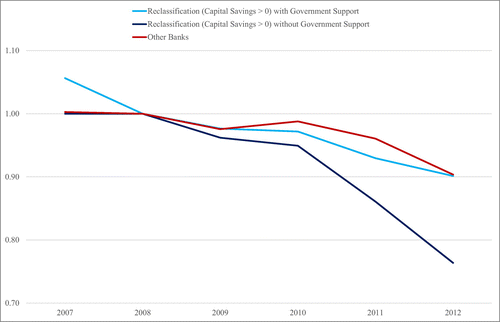
Notes. Standard & Poor’s long-term credit ratings by year. We transform these ratings into an ordinal variable ranging from 1 for ratings of B− or below to 16 for AAA ratings. Each yearly rating is scaled by the rating for 2008 to evaluate changes around the peak of the financial crisis. We compute yearly averages of these scaled ratings for three groups of banks. The first group comprises 23 banks that use the reclassification option to achieve tier 1 capital savings and that receive government support in financial year 2008. The second group comprises 18 banks that use the reclassification option to achieve tier 1 capital savings but do not receive government support in financial year 2008. The third group comprises 69 banks that do not use the reclassification option or do so without achieving tier 1 capital savings in financial year 2008. The analysis is based on a balanced subsample with available stock return and credit rating data throughout the period 2007 to 2012.
6.3. Stock Price Performance
Finally, we examine the stock market to address the second policy objective as stated by the ECB (i.e., the “return to normal market conditions”). Stock returns are a widely established proxy for bank performance (Beltratti and Stulz 2012) and capture benefits for a broader set of stakeholders, especially shareholders.
The analysis focuses on cumulative monthly stock returns over the period from July 2007 to July 2012. We compute these returns relative to September 2008 to evaluate the stock price performance around the peak of the financial crisis. Figure 2 plots average cumulative log-returns for the same three groups of banks as in the analysis of credit ratings. The graphical evidence suggests that the stocks of banks that use the reclassification option for short-term regulatory relief perform substantially worse in the following years than the stocks of other banks. Although reclassifying banks experience, on average, log returns of about −70% between September 2008 and July 2012, average log returns of other banks are only about −20% over the same period.
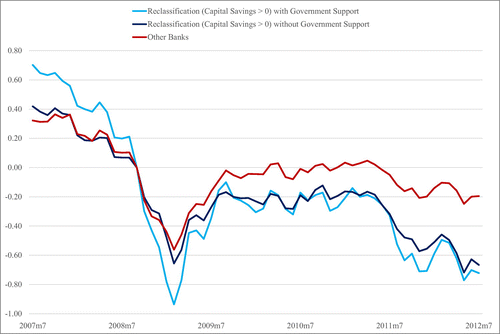
Notes. Cumulative monthly stock returns relative to September 2008 to evaluate the stock price performance around the peak of the financial crisis. We compute average cumulative log-returns by month for three groups of banks. The first group comprises 20 banks that use the reclassification option to achieve tier 1 capital savings and that receive government support such as bailouts or guarantees in financial year 2008. The second group comprises 18 banks that use the reclassification option to achieve tier 1 capital savings but do not receive government support in financial year 2008. The third group comprises 64 banks that do not use the reclassification option or do so without achieving tier 1 capital savings in financial year 2008. The analysis focuses on a balanced subsample with available stock return and credit rating data throughout the period 2007 to 2012.
Taken together, the descriptive evidence across all three measures points in the same direction. Banks that choose to increase their capital through reclassifications appear weaker in the long run, especially if not supported by additional government aid.
7. Conclusion
In this study, we exploit the introduction of a new accounting option that banks could use for recapitalization during the 2008 financial crisis to examine the consequences and effectiveness of accrual-based capital measures. During a crisis, the options that generally rank highest on the pecking order of banks’ capital measures are often unavailable, as banks are unable to generate sufficient amounts of internal funds and debt issuances do not help avoid the violation of minimum capital requirements. Politicians and regulators then frequently turn to accounting regulations to achieve an increase in banks’ regulatory capital. In our setting, new accounting rules provided an option to reclassify financial assets out of fair value categories. Such a change in accounting rules can help reduce loss recognition and thus increase equity capital without the dilution of control rights for existing shareholders and other transaction costs.
However, accrual-based bank recapitalization also has clear disadvantages. First, accrual-based measures cannot inject liquidity and thus fail to alleviate liquidity shortages that often accompany shortfalls in capital. Second, accrual-based measures are only able to provide temporary relief because, by their nature, they reverse in the long run and are only able to delay a reduction in capital. Third, such a delay in loss recognition has informational costs because investors often perceive their use as compromising transparency and a signal of financial difficulties. Fourth, banks’ use of an accounting option generally requires the availability of accounting slack, such as the availability of eligible assets, which tends to confine the potential magnitude of the capital effect. Therefore, it is unclear how accrual-based measures rank in the pecking order of bank recapitalization and how effective they are in the long run.
To examine these questions, we first compare banks’ use of the reclassification option with the use of other available capital measures (capital injections through transactions on public equity markets and through government bailouts and real capital management through asset sales) and existing accrual-based options (discretionary recognition of deferred tax assets and delayed loan loss recognition). Although the use of asset reclassifications is only somewhat lower than that of other accrual-based options, the reclassifications contribute much less to regulatory capital than capital injections, especially those from government support programs but also from capital injections on public equity markets. These statistics suggest that accrual-based options hardly suffice to fully achieve the required recapitalization but rather complement other, more relevant measures. Our regression analysis of the reclassification choice supports this interpretation.
In the next step of our analysis, we provide evidence on the economic consequences of banks’ asset reclassifications, in both the short term and long run. The short-term stock market reaction to reclassification announcements is significantly negative unless information about simultaneous government support accompanies these announcements. Similarly, we observe a relative increase in bid-ask spreads for reclassifying banks if disclosures fail to provide complete information about the accounting effect. These results conform with the existence of substantial costs that plausibly explain the low rank of the accounting choice in the pecking order of bank recapitalization. Evidence on other long-term consequences, such as stock market returns, credit ratings, and capital buffers, points in the same direction.
The results have implications for the design of regulatory responses to a banking crisis. The relaxation of accounting regulation and the corresponding delay of banks’ loss recognition often appear attractive because it reduces the transaction costs of raising capital or transferring control rights during the crisis. However, delayed loss recognition also leads to more pronounced transparency concerns in an international environment, where noncompliance with disclosure requirements is much more critical than in the United States (Street and Gray 2002, Bischof et al. 2022). Moreover, the short-term benefits of accrual-based recapitalization tend not to be persistent in the long run unless additional corrective actions lead to an injection of real capital. These costs explain why accrual-based capital measures rank low in the pecking order of banks’ recapitalization choices and, at best, provide some temporary short-term relief when serving as a complement to more sustainable options. These findings only justify the intervention in accounting regulation in a banking crisis when regulators concurrently implement multiple rescue measures as a circuit breaker to a downward spiral and enforce real corrective actions.
Against this background, it appears highly questionable whether the regulatory responses to the COVID-19 crisis help stabilize bank capital in the long run. The ECB’s decision not to enforce the strict recognition of expected credit losses in Europe and the delayed introduction of the CECL standards in the United States resemble the introduction of the reclassification option during the financial crisis as they also delay loss recognition and help avoid an accrual-based decrease in bank capital. Our results suggest that these interventions mitigated incentives for banks to take corrective actions early during the crisis (see Bischof et al. 2021 for a similar discussion).
The authors appreciate helpful comments from Brian Bushee (editor), the associate editor, two anonymous referees, Yakov Amihud, Mary Barth, John Gallemore, Günther Gebhardt, Silviu Glavan, Joerg-Markus Hitz, Bob Holthausen, Paul Klumpes, Jim Leisenring, Christian Leuz, Edgar Löw, Stuart McLeay, Scott Richardson, Katherine Schipper, Doug Skinner, Donna Street, Mary Tokar, Johannes Voget, Gero Wiechens and Steve Young, as well as workshop participants at the Global Issues in Accounting Conference (University of North Carolina at Chapel Hill), the 4th Tel Aviv International Conference in Accounting, the Workshop on Accounting and Economics in Vienna, the 33rd EAA Annual Congress in Istanbul, the INTACCT workshop in Paris, the 11th IAAER World Congress in Singapore, Alliance Manchester Business School, BI Norwegian Business School, Cass Business School, ESMT Berlin, Free University Berlin, Georg August University Göttingen, Goethe University Frankfurt, IESE Business School, Ludwig Maximilian University of Munich, London Business School, Maastricht University, Stockholm School of Economics, Unversité de Neuchâtel, University of Chicago Booth School of Business, University of Mannheim, Vienna University of Economics and Business, the Institute of Chartered Accountants in England and Wales, London, and the Lisbon Accounting Conference. The authors thank Si Yue Li, Philip Di Salvo, Jan Schwarting, and Linda Tjoa for excellent research assistance. The paper is based in part on our earlier manuscript “Fair Value Reclassifications of Financial Assets During the Financial Crisis.”
Appendix A. Reclassification Effects by Reclassification Type
|
| Reclassification effect on | Reclassification type | ||
|---|---|---|---|
| Trading to HTM/L&R | Trading to AFS | AFS to HTM/L&R | |
| Profit or loss | Yes | Yes | No |
| Shareholder’s equity | Yes | No | Yes |
| Tier 1 capital | Yes | Country-specific capital regulation | Country-specific capital regulation |
| Tier 2 capital | No | Country-specific capital regulation | Country-specific capital regulation |
Notes. This table illustrates how potential reclassification effects on profit or loss, shareholder’s equity and regulatory capital vary by reclassification type. A prerequisite for these effects to materialize is that fair value losses after reclassification do not trigger an impairment. Appendix C provides details on capital regulation by country that determines how reclassifications from and to the AFS category affect regulatory capital.
Appendix B. Summary of Empirical Predictions
|
| Are reclassifications a preferred substitute? | Are reclassifications a plausible complement? | |
|---|---|---|
| Capital injections: Market transactions | The more unlikely the greater the capital constraint | Likely |
| Capital injections: Government support | The more unlikely the greater the capital constraint | Open (depending on government preferences) |
| Net income: Real capital measures | Unlikely if capital constraint is accompanied by a liquidity shortage | Likely |
| Net income: Other accrual-based measures | Tradeoff between the signal to investors and the uncertainty of the capital effect | |
Note. This table provides a summary of the empirical predictions that we develop in Section 2.2 of the paper.
Appendix C. Capital Regulation by Country
|
| Country | Regulatory authority | Minimum tier 1 capital ratio | Minimum total capital ratio | Regulatory accounting standard | Prudential filter for AFS debt securities (as of 2008) | Prudential filter for deferred tax assets (DTA) | Legal source | ||||
|---|---|---|---|---|---|---|---|---|---|---|---|
| Gains | Losses | Basis of calculation | |||||||||
| Capital | Post-tax filter | Capital | Post-tax filter | ||||||||
| Australia | Australian Prudential Regulation Authority | 4.00% | 8.00% | IFRS | Tier 2 | 55.00% | Tier 1 | 0.00% | Portfolio | |DTA-DTL| | Prudential Standard APS 111 |
| Austria | Financial Market Authority | 4.00% | 8.00% | IFRS/ LGAAP | Tier 2 | 47.50% | Tier 1 | 0.00% | Portfolio | 0.00% | Austrian Banking Act |
| Bahrain | Central Bank | 6.00% | 12.00% | IFRS | 100.00% | 100.00% | Portfolio | 0.00% | Rulebook Vol. 1 Part A CA-2 | ||
| Belgium | Banking, Finance and Insurance Commission | 4.00% | 8.00% | IFRS | 100.00% | 100.00% | Portfolio | Amount > 10% of Tier 1 | CBFA Circular PPB-2007-1-CPB | ||
| China | China Banking Regulatory Commission | 4.00% | 8.00% | IFRS | 100.00% | 100.00% | Portfolio | 0.00% | Capital Adequacy Regulation | ||
| Cyprus | Central Bank | 4.00% | 8.00% | IFRS | Tier 2 | 0.00% | Tier 1 | 0.00% | Portfolio | 0.00% | Directive 436/2006 & 328/2007 |
| Denmark | Finanstilsynet (Danish FSA) | 4.00% | 8.00% | LGAAP | 100.00% | 100.00% | Portfolio | 0.00% | Financial Business Act | ||
| Finland | Financial Supervisory Authority | 4.00% | 8.00% | IFRS | Tier 2 | 26.00% | Tier 1 | 0.00% | Portfolio | 0.00% | FIN-FSA Standard 4 |
| France | Central Bank | 4.00% | 8.00% | IFRS | 100.00% | 100.00% | Portfolio | 0.00% | Regulation 90/02 | ||
| Germany | Federal Financial Supervisory Authority | 4.00% | 8.00% | IFRS/LGAAP | Tier 2 | 55.00% | Tier 1 | 0.00% | Portfolio | 0.00% | Regulation KonÜV |
| Hong Kong | Hong Kong Monetary Authority | 4.00% | 8.00% | IFRS | Tier 2 | 55.00% | Tier 1 | 0.00% | Portfolio | 0.00% | Banking (Capital) Rules |
| Hungary | Hungarian Financial Supervisory Authority | 4.00% | 8.00% | LGAAP | Tier 2 | 0.00% | Tier 1 | 0.00% | Portfolio | 0.00% | HFSA Regulation |
| Ireland | Irish Financial Regulator | 4.00% | 8.00% | IFRS | Tier 2 | 15.50% | Tier 1 | 0.00% | Portfolio | 0.00% | Notice BSD S 2/00 |
| Italy | Central Bank | 4.00% | 8.00% | IFRS | Tier 2 | 63.75% | Tier 1 | 0.00% | Portfolio | 0.00% | Circular 263 |
| Jordan | Central Bank | 6.00% | 12.00% | IFRS | Tier 2 | 55.00% | Tier 2 | 0.00% | Portfolio | 100.00% | CBJ Instructions |
| Kazakhstan | Financial Supervision Agency | 6.00% | 8.00% | IFRS | Tier 2 | 20.00% | Tier 1 | 0.00% | Portfolio | 0.00% | Kazakhstan Banking Law |
| Kuwait | Central Bank | 6.00% | 12.00% | IFRS | Tier 2 | 55.00% | Tier 2 | 55.00% | Portfolio | 0.00% | Circular 2/BS/94/2002 |
| Liechtenstein | Financial Market Authority | 4.00% | 8.00% | IFRS | 100.00% | 100.00% | Portfolio | 0.00% | Regulation ERV | ||
| Lithuania | Central Bank | 4.00% | 8.00% | IFRS | Tier 2 | 32.00% | Tier 1 | 0.00% | Portfolio | 0.00% | Resolution No. 138 |
| Netherlands | Central Bank | 4.00% | 8.00% | IFRS | 100.00% | 100.00% | Item-by-Item | 0.00% | Decree on Prudential Rules | ||
| Norway | Finanstilsynet (FSA of Norway) | 4.00% | 8.00% | LGAAP | 100.00% | 100.00% | Portfolio | 100.00% | Capital Adequacy Framework | ||
| Oman | Central Bank | 6.00% | 10.00% | IFRS | 100.00% | 100.00% | Portfolio | 0.00% | Capital Guidelines II.A | ||
| Philippines | Central Bank | 6.00% | 10.00% | IFRS | 100.00% | 100.00% | Portfolio | 100.00% | Circular 538/06 | ||
| Poland | Polish Financial Supervision Authority | 4.00% | 8.00% | IFRS | 100.00% | 100.00% | Portfolio | 0.00% | KNF Resolutions | ||
| Portugal | Central Bank | 4.00% | 8.00% | IFRS | Tier 2 | 55.00% | Tier 1 | 0.00% | Item-by-Item | Amount > 10% of Tier 1 | Notice 12/92 |
| Qatar | Central Bank | 6.00% | 10.00% | IFRS | Tier 2 | 55.00% | Tier 2 | 0.00% | Portfolio | 100.00% | QCB Instructions Part 7 |
| Russian Federation | Central Bank | 5.00% | 10.00% | IFRS | 100.00% | 100.00% | Portfolio | 0.00% | Instruction on Bank Regulation | ||
| Saudi Arabia | Saudi Arabia Monetary Agency | 4.00% | 8.00% | IFRS | Tier 2 | 55.00% | Tier 1 | 0.00% | Portfolio | 0.00% | SAMA Capital Requirements |
| Singapore | Monetary Authority of Singapore | 6.00% | 10.00% | IFRS | 100.00% | 100.00% | Portfolio | 100.00% | Notice 637 | ||
| Slovakia | Central Bank | 4.00% | 8.00% | IFRS | 100.00% | 100.00% | Item-by-Item | 0.00% | Decree 4/2007 | ||
| Slovenia | Central Bank | 4.00% | 8.00% | IFRS | 100.00% | 100.00% | Item-by-Item | 0.00% | Regulation OJ 135/06 & 104/07 | ||
| South Africa | Central Bank | 7.00% | 9.50% | IFRS | 100.00% | 100.00% | Portfolio | 100.00% | Notice R3/2008 | ||
| Spain | Central Bank | 4.00% | 8.00% | IFRS | Tier 2 | 65.00% | Tier 1 | 0.00% | Portfolio | 0.00% | Circular 4/2004 |
| Sweden | Swedish Finansinspektionen | 4.00% | 8.00% | IFRS | 100.00% | 100.00% | Portfolio | 100.00% | Regulation FFFS 2007:1 | ||
| Switzerland | Financial Market Supervisory Authority FINMA | 4.00% | 8.00% | IFRS | Tier 2 | 55.00% | Tier 1 | 0.00% | Portfolio | 0.00% | Circular 2008/34 |
| Taiwan | Financial Supervisory Commission | 4.00% | 8.00% | IFRS | Tier 2 | 55.00% | Tier 1 | 0.00% | Portfolio | 100.00% | Capital Adequacy Regulation |
| Turkey | Banking Regulation and Supervision Agency | 4.00% | 8.00% | IFRS | Tier 2 | 55.00% | Tier 2 | 0.00% | Portfolio | Amount > 10% of Tier 1 | Regulation OJ 26333/06 |
| United Arab Emirates | Central Bank | 8.00% | 8.00% | IFRS | Tier 2 | 55.00% | Tier 2 | 0.00% | Portfolio | 0.00% | Circular 13/1993 |
| United Kingdom | Financial Services Authority | 4.00% | 8.00% | IFRS | 100.00% | 100.00% | Portfolio | 0.00% | Handbook GENPRU 2.2.185 | ||
Notes. This table presents institutional details related to capital regulation by country. Regulatory Authority denotes the institution that is responsible for the capital regulation of banks at the country level. Minimum Total Capital Ratio is the tier 1 capital ratio or the total capital ratio (tier 1 + tier 2) required for banks by the responsible regulatory authority. Regulatory Accounting Standard indicates whether regulatory capital is determined based on IFRS, local GAAP (LGAAP) or whether banks can choose between IFRS and local GAAP. Prudential Filter for AFS Debt Securities is the proportion of accumulated unrealized gains or losses from AFS debt securities that is deducted from equity in the determination of tier 1 or tier 2 capital (including tax effects) as of financial year 2008. Basis of Calculation indicates whether the filter is determined on a portfolio basis or instrument-by-instrument). Prudential Filter for Deferred Tax Assets (DTA) is the proportion of deferred income tax recognized in profit and loss that is deducted from equity in the determination of tier 1 or tier 2 capital (including tax effects) as of financial year 2008. Legal Source provides the primary source of our information about the capital regulation variables. We enhance this information with data from the World Bank data set by Čihák et al. (2012), from the CEBS (2007) report and from an own survey of bank regulators in each sample country.
1 Consistent with market participants perceiving reclassifications as such a signal, many analyst and investor groups initially opposed the change in accounting standards and publicly argued that the new rules “threaten to undermine investor confidence in company accounts” (Financial Times, October 20, 2008).
2 Until November 1, 2008, managers could retroactively reclassify financial assets, taking effect as of any chosen date between July 1, 2008, and October 31, 2008. The transitional rule enabled a bank whose reporting period (or interim period) ended before November 1, 2008, but that had not yet released its financial statements when the amendment became effective, to fully assess the reclassification effects on net income and equity during this period. In this situation, a bank was able to make the reclassification decision with hindsight by comparing fair values of financial assets at the end of the reporting period with prior fair values going back to July 1, 2008. In later periods, such a perfect anticipation of the accounting effect was no longer possible.
3 The IAS 39 impairment rules follow an incurred loss model that requires objective evidence relating to a specific loss event (e.g., an actual default or a significant downgrade in the credit rating). A decrease in fair value does not lead to an impairment write-down if it is not accompanied by such a specific loss event. Generally, impairment write-downs therefore appear in P&L substantially later than fair value declines.
4 In addition, dividend cuts are associated with substantial signaling costs (Michaely et al. 1995, Slovin et al. 1999). Evidence from the financial crisis is consistent with managers’ reluctance to cut dividends (Acharya et al. 2017).
5 We treat banks from Taiwan as IFRS users because Taiwanese SFAS 34 and 36 largely correspond to IAS 39 and IFRS 7. Both standards have been effective since 2006, and the reclassification amendments were endorsed by Taiwanese authorities on October 17, 2008 (i.e., shortly after the IASB announcement).
6 We note that 42 banks in our sample use the reclassification option without achieving any regulatory capital savings through this accounting choice. This observation suggests that accounting incentives other than regulatory capital management also play into the reclassification choice, most likely earnings management motivations.
7 These estimates are based on the availability of public information and subject to the assumptions that we apply for each measure (see Table OA.1 in the online appendix for details). In Panel A of Table 2, we provide the number of banks for which we have sufficient data available to estimate the capital savings and the number of banks that actually realized capital savings using a specific measure.
8 We check the following years until 2012 and find no evidence of further use of reclassifications.
9 The sample includes all financial years ending between October 2008 and September 2009.
10 Note that 12 of the 35 banks in our sample whose regulatory capital is determined based on local GAAP use the reclassification option. By construction, none of these banks generates capital savings through reclassifications under IFRS.
11 The results are very similar for the specifications (5) and (6) that focus on subsamples. For example, the marginal effect of AFS Prudential Filter is −0.255 when estimated for EU banks only.
12 In robustness tests, these results hold when we exclude the banks with a negligible portion of fair value assets that are eligible for reclassifications (Low %FVA). However, the statistical significance of the results is weaker when we restrict the sample to EU banks only, see Tables OA.2A and OA.2B in the online appendix.
13 The statistical significance of the main results is weaker when we use the S&P 500 index as a uniform benchmark in all sample countries. One explanation is that the market return for U.S. stocks injects factors in the benchmark that are unrelated to local market conditions.
14 Bowen and Khan (2014) also include a time window in their analysis during which the IASB announced the amendment of IAS 39. The market reaction is statistically insignificant during this particular time window. Although we observe a slightly negative market reaction to the IASB announcement, the reaction turns positive for those banks that simultaneously announce the use of government guarantees during the same time window. Therefore, our findings are generally consistent with Bowen and Khan (2014).
15 See ECB (2010), p. 43. The ECB adds three additional objectives that all relate to effects on the real economy (e.g., bank lending) and public finances and are thus beyond the scope of this paper.
References
- (2016) Banks’ financial reporting and financial system stability. J. Accounting Res. 54(2):277–340.Crossref, Google Scholar
- (2014) A pyrrhic victory? Bank bailouts and sovereign credit risk. J. Finance 69(6):2689–2739.Crossref, Google Scholar
- (2017) Bank capital and dividend externalities. Rev. Financial Stud. 30(3):988–1018.Crossref, Google Scholar
- (2021) Kicking the can down the road: Government interventions in the European banking sector. Rev. Financial Stud. 34(9):4090–4131.Crossref, Google Scholar
- (2017) Corruption in bank lending: The role of timely loan loss recognition. J. Accounting Econom. 63(2-3):454–478.Crossref, Google Scholar
- (2013) Firms’ use of accounting discretion to influence their credit ratings. J. Accounting Econom. 55(2-3):129–147.Crossref, Google Scholar
- (2011) Overvaluation and the choice of alternative earnings management mechanisms. Accounting Rev. 86(5):1491–1518.Crossref, Google Scholar
- (2012) Assessing TARP. Rev. Financial Stud. 25(2):377–407.Crossref, Google Scholar
- (2014) Financial accounting in the banking industry: A review of the empirical literature. J. Accounting Econom. 58(2–3):339–383.Crossref, Google Scholar
- (1995) Managing financial reports of commercial banks: The influence of taxes, regulatory capital and earnings. J. Accounting Res. 33(2):231–261.Crossref, Google Scholar
- (2021) IFRS: Markets, practice, and politics. Foundations Trends Accounting 15(1–2):1–262.Crossref, Google Scholar
- (2012) The credit crisis around the globe: Why did some banks perform better? J. Financial Econom. 105(1):1–17.Crossref, Google Scholar
- (2013) Mandatory disclosure, voluntary disclosure, and stock market liquidity: Evidence from the EU bank stress tests. J. Accounting Res. 51(5):997–1029.Crossref, Google Scholar
- (2014) Fair value‐related information in analysts’ decision processes: Evidence from the financial crisis. J. Bus. Finance Accounting 41(3–4):363–400.Crossref, Google Scholar
- (2021) Accounting for financial stability: Bank disclosure and loss recognition in the financial crisis. J. Financial Econom. 141(3):1188–1217.Crossref, Google Scholar
- (2022) A tale of two supervisors: Compliance with risk disclosure regulation in the banking sector. Contempory Accounting Res. 39(1):498–536.Crossref, Google Scholar
- (2020) Disclosure processing costs, investors’ information choice, and equity market outcomes: A review. J. Accounting Econom. 70(2–3):101344.Crossref, Google Scholar
- (2014) Market reactions to policy deliberations on fair value accounting and impairment rules during the financial crisis of 2008–2009. J. Accounting Public Policy 33(3):233–259.Crossref, Google Scholar
- (2014) Measuring country differences in enforcement of accounting standards: An audit and enforcement proxy. J. Bus. Finance Accounting 41(1&2):1–52.Crossref, Google Scholar
- (2015) An assessment of TARP assistance to financial institutions. J. Econom. Perspective 29(2):53–80.Crossref, Google Scholar
Committee of European Banking Supervisors (CEBS) (2007) Analytical report on prudential filters for regulatory capital. Accessed March 18, 2022, https://www.eba.europa.eu/cebs-publishes-an-analytical-report-on-prudential-filters.Google Scholar- (2012) Bank regulation and supervision around the world. Policy Research Working Paper 6286, The World Bank.Google Scholar
- (1995) Bank differences in the coordination of regulatory capital, earnings, and taxes. J. Accounting Res. 33(2):263–291.Crossref, Google Scholar
- (1994) An examination of voluntary vs. involuntary security issuances by commercial banks: The impact of capital regulations on common stock returns. J. Financial Econom. 35(1):99–122.Crossref, Google Scholar
- (1998) Are financial markets overly optimistic about the prospects of firms that issue equity? Evidence from voluntary vs. involuntary equity issuances by banks. J. Finance 53(6):2139–2159.Crossref, Google Scholar
- (2019) Do strict regulators increase the transparency of banks? J. Accounting Res. 57(3):603–637.Crossref, Google Scholar
- (2012) Bank bailouts and moral hazard: Evidence from Germany. Rev. Financial Stud. 25(8):2343–2380.Crossref, Google Scholar
- (2015) Bank capital management: International evidence. J. Financial Intermediaries 24(2):154–177.Crossref, Google Scholar
- (2014) Safer ratios, riskier portfolios: Banks’ response to government aid. J. Financial Econom. 113(1):1–28.Crossref, Google Scholar
ECB (2010) The great financial crisis. Lessons for financial stability and monetary policy. Accessed March 18, 2022, https://www.ecb.europa.eu/pub/pdf/other/greatfinancialcrisisecbcolloquiump apademos201203en.pdf.Google Scholar- ECB (2020) IFRS 9 in the context of the coronavirus (COVID-19) pandemic. https://www.bankingsupervision.europa.eu/press/letterstobanks/shared/pdf/2020/ssm.2020_letter_IFRS_9_in_the_context_of_the_coronavirus_COVID-19_pandemic.en.pdf.Google Scholar
ECB (2021) The post-pandemic outlook in the banking union. Accessed March 18, 2022, https://www.bankingsupervision.europa.eu/press/speeches/date/2021/html/ssm.sp210707∼3e 6cca4069.en.pdf.Google Scholar- (2005) Economic effects of tightening accounting standards to restrict earnings management. Accounting Rev. 80(4):1101–1124.Crossref, Google Scholar
- (2011) Earnings management, conservatism, and earnings quality. Foundations Trends Accounting 6(2):65–186.Crossref, Google Scholar
- (2013) The light and dark side of TARP. J. Banking Finance 37(7):2586–2604.Crossref, Google Scholar
- (2017) The IFRS option to reclassify financial assets out of fair value in 2008: The roles played by regulatory capital and too-important-to-fail status. Rev. Accounting Stud. 22(4):1698–1731.Crossref, Google Scholar
Financial Times (2008) Changes threaten confidence in accounts. Financial Times. Accessed March 18, 2022, https://www.ft.com/content/923b42fe-9ed2-11dd-98bd-000077b07658.Google Scholar- (2015) Maintaining adequate bank capital: An empirical analysis of the supervision of European banks. J. Banking Finance 59:236–249.Crossref, Google Scholar
- (2013) The 2007–2009 financial crisis and bank opaqueness. J. Financial Intermediaries 22(1):55–84.Crossref, Google Scholar
- (2003) Testing the pecking order theory of capital structure. J. Financial Econom. 67(2):217–248.Crossref, Google Scholar
- (2013) The fading stock market response to announcements of bank bailouts. J. Financial Stability 9(1):69–89.Crossref, Google Scholar
- (2020) Political interference in private entities’ financial reporting and the public interest: Evidence from the Spanish financial crisis. Accounting Auditing Accounting J. 34(7):1581–1607.Crossref, Google Scholar
- (2008) The panic of 2007. Maintaining stability in a changing financial system. Proc. 2008 Jackson Hole Econom. Policy Sympos., Jackson Hole, Wyoming, August 21–23, 2008. (Federal Reserve Bank of Kansas City, Kansas City, MO), 131–262.Google Scholar
- (1996) Is there a pecking order? Evidence from a panel of IPO firms. J. Financial Econom. 40(3):429–458.Crossref, Google Scholar
- (2020) The impact of supervision on bank performance. J. Finance 75(5):2765–2808.Crossref, Google Scholar
- (2010) Will the US bank recapitalization succeed? Eight lessons from Japan. J. Financial Econom. 97(3):398–417.Crossref, Google Scholar
International Accounting Standards Board (IASB) (2008) Reclassification of Financial Assets (Amendments to IAS 39 Financial Instruments: Recognition and Measurement and IFRS 7 Financial Instruments: Disclosures) (IASB, London).Google Scholar- (2002) Investor protection and corporate valuation. J. Finance 57(3):1147–1170.Crossref, Google Scholar
- (2000) The economic consequences of increased disclosure. J. Accounting Res. 38(suppl):91–124.Crossref, Google Scholar
- (2013) IAS 39 reclassification choice and analyst earnings forecast properties. J. Accounting Public Policy 32(5):342–356.Crossref, Google Scholar
- (1995) Price reactions to dividend initiations and omissions: Overreaction or drift? J. Finance 50(2):573–608.Crossref, Google Scholar
- Myers S (1984) The capital structure puzzle. J. Finance 39(3):575–592.Google Scholar
- (2001) Capital structure. J. Econom. Perspective 15(2):81–102.Crossref, Google Scholar
- (1984) Corporate financing and investment decisions when firms have information that investors do not have. J. Financial Econom. 13(2):187–221.Crossref, Google Scholar
- (2012) The amendments of IAS 39: Determinants of reclassification behavior and capital market consequences. J. Accounting Auditing Finances 27(2):208–235.Crossref, Google Scholar
- (2009) Global market integration: An alternative measure and its application. J. Financial Econom. 94(2):214–232.Crossref, Google Scholar
- (2001) The effects of regulatory and contracting costs on banks’ choice of accounting method for other postretirement employee benefits. J. Accounting Econom. 30(2):159–186.Crossref, Google Scholar
- (2009) The aftermath of the financial crisis. Amer. Econom. Rev. 99(2):466–472.Crossref, Google Scholar
- (2012) Why government banks underperform: A political interference view. J. Financial Intermediary 21(2):181–202.Crossref, Google Scholar
- (2012) Fire sales in finance and macroeconomics. J. Econom. Perspective 25(1):29–48.Crossref, Google Scholar
- (1999) Testing static tradeoff against pecking order models of capital structure. J. Financial Econom. 51(2):219–244.Crossref, Google Scholar
- (2008) The rise of deferred tax assets in Japan: The role of deferred tax accounting in the Japanese banking crisis. J. Accounting Econom. 46(2–3):218–239.Crossref, Google Scholar
- (1999) An analysis of contagion and competitive effects at commercial banks. J. Financial Econom. 54(2):197–225.Crossref, Google Scholar
- (2010) Extraordinary measures in extraordinary times: Public measures in support of the financial sector in the EU and the United States. ECB Occasional Paper Series No. 117, European Central Bank (ECB), Frankfurt, Germany.Google Scholar
- (2002) Factors influencing the extent of corporate compliance with International Accounting Standards: Summary of a research monograph. J. Internat. Accounting Auditing Tax 11(1):51–76.Crossref, Google Scholar
- (2010) Paulson’s gift. J. Financial Econom. 97(3):339–368.Crossref, Google Scholar
- (2010) Econometric Analysis of Cross Section and Panel Data, 2nd ed. (MIT Press, Cambridge, MA).Google Scholar
- (2012) Evidence on the trade-off between real activities manipulation and accrual-based earnings management. Accounting Rev. 87(2):675–703.Crossref, Google Scholar

