Bank Compensation for the Penalty-Free Loan Prepayment Option: Theory and Evidence
Abstract
While it is standard for corporate bonds to include a loan cancellation fee, a surprising 90% of tranche A commercial and industrial term loans allow borrowers to prepay the loan without penalty. We use a simple framework with dynamic learning to derive testable implications for the required bank compensation when including a penalty-free prepayment option. In this framework, after loan origination, borrowers receive noncontractible public information about the value of the project funded by the bank loan. This information causes some ex post high-value borrowers to prepay or renegotiate the loan to obtain a lower rate, deteriorating the credit quality of the bank’s remaining borrower pool. To avoid credit rationing of borrowers with a high prepayment risk, we show that the bank’s compensation must be in the form of an upfront fee rather than a higher initial loan rate, as the latter only exacerbates the adverse prepayment incentive. The model also accounts for the possibility that in relationship lending, an upfront fee may dominate a loan cancellation fee when the latter triggers costly ex post bargaining with high-value clients. To test model predictions, we construct a prepayment risk index, which contains proxies for borrower upside potential and loan renegotiation costs, and we use aggregate industry-level merger and acquisition (M&A) activity as an instrument for exogenous variation in loan prepayment risk. The tests support that upfront fees increase with borrower prepayment risk. In addition, upfront fees are lower for credit lines and loans with performance-sensitive pricing, as predicted.
This paper was accepted by Victoria Ivashina, finance.
Funding: Partial financial support from Tuck’s Lindenauer Forum for Corporate Governance (Eckbo) and from the Norwegian Research Council [Grant 273678] (Thorburn and Su) is gratefully acknowledged.
Supplemental Material: The data files are available at https://doi.org/10.1287/mnsc.2023.00159.
1. Introduction
When issuing commercial and industrial (C&I) loans, banks charge a fixed spread to compensate for the borrower’s default risk and a variety of loan fees. Fees paid upfront are traditionally viewed as payment for loan origination costs (associated with the evaluation of borrower credit quality), whereas other fees are used to cover the lender’s cost of granting the borrower various contractual option features. For example, a much-analyzed option feature is the right to delay the drawdown of the loan commitment. As theorized by Thakor (1982) and others, because this drawdown option insures the borrower against future increases in the spot market rate, the bank must be compensated with a periodic commitment fee on the undrawn amount.1 The evidence on loan fees in Berg et al. (2016) and others is consistent with upfront fees compensating for loan origination costs, whereas commitment fees compensate for the loan drawdown option in credit lines, with both fees representing bank compensation for borrower downside risk.2
In this paper, we focus on a largely ignored form of compensation in C&I bank loans that is not driven by downside risk but, rather, by the upside potential of the borrower. As we show both theoretically and empirically, the upside potential is itself economically relevant when the bank permits the loan to be prepaid or renegotiated before maturity without penalty. Some borrowers prepay to move the loan to a competing lender with more favorable terms, whereas others renegotiate by threatening prepayment to obtain better terms with the current lender. Whereas issuers of corporate bonds uniformly rely on an ex post cancellation fee (call premium) to compensate for early repayment, we show that C&I loan issuers overwhelmingly choose a zero cancellation fee—a contractual difference that we address. An interesting theoretical result is that if the penalty-free prepayment option is not compensated up front, high borrower upside potential may trigger credit rationing. This credit rationing is an equilibrium outcome that is driven by borrowers’ ex post information-based prepayment decisions rather than moral hazard.
The paper has two parts, one theoretical and one empirical. The theoretical analysis derives the minimum upfront fee for a competitive bank to accept a penalty-free prepayment option in a term loan contract. We assume that lenders and borrowers are symmetrically informed at the time of loan origination, and borrowers use the loan to fund valuable investment projects. Following project startup, however, borrowers receive public but noncontractible credit-related information about the project’s expected payoff. Good news improves the credit quality of the borrower and can trigger prepayment to lower the loan spread. However, following bad news, the borrower continues with the loan, which is now priced below the market rate. This ex post adverse selection in the loan continuation decision, which causes a deterioration in the quality of the bank’s borrower pool, is supported by the evidence in Roberts and Sufi (2009) and Roberts (2015). They find that when renegotiating their loans, borrowers often demand a lowering of the loan rate. Although covenant violations also trigger loan renegotiation (Chava and Roberts 2008, Nini et al. 2012), they more often result in higher loan spreads.
Because borrowers in our model receive new information after loan origination and investment, our assumption of symmetrically informed agents ex ante is one of convenience only. In other words, our main propositions hold whether or not the initial contracting process itself resolves all information asymmetries between the contracting parties.3 Also important, whereas the bank’s initial screening of borrowers is itself costly and must be compensated up front, this cost is sunk ex post and therefore does not affect the optimal bank compensation for the penalty-free prepayment option itself. In sum, our model identifies a new fee component that is in addition to the usual interpretation of the upfront fee as compensation for loan origination costs.
We use this framework to derive four sets of testable implications. First, we show that a competitive bank must price the penalty-free prepayment option using two instruments: the loan rate and a minimum upfront fee that is increasing in the borrower’s prepayment risk. The minimum upfront fee is necessary because increasing the loan rate further increases the prepayment risk, possibly to the point of causing credit rationing for borrowers with a high risk of loan prepayment. Interestingly, this credit rationing problem differs from that of Stiglitz and Weiss (1981) and Boot et al. (1987), where the bank is concerned with ex post opportunistic risk shifting by the borrower. Whereas the earlier literature resolves the credit rationing problem by requiring loan collateral, the solution in our model is an upfront fee, which we argue eliminates costly ex post bargaining issues.
Second, we extend the analysis to the pricing of penalty-free prepayment options in credit lines and performance-sensitive debt (PSD).4 Whereas Asquith et al. (2005) do not examine loan fees, they hypothesize that rate-decreasing PSD is motivated by prepayment risk, while rate-increasing PSD is motivated by bank concerns with borrower risk shifting. Our pricing model does not require moral hazard to motivate rate-increasing PSD because both spread-increasing and spread-decreasing PSD lower prepayment risk. Hence, the minimum upfront fee is predicted to be lower for PSD than for standard loans, regardless of the pricing grid. A similar prediction holds for upfront fees in credit lines, where borrowers also use the prepayment option to initiate renegotiation of loan terms.
Third, also new to the literature, we show that (i) bank compensation for the penalty-free prepayment option must come in the form of a one-time upfront fee (not a periodic commitment fee), and (ii) banks must use a periodic commitment fee (not an upfront fee) to compensate for the drawdown option in credit lines. Intuitively, raising periodic loan payments, such as the interest rate and the commitment fee at the time of loan origination, only increases the prepayment risk and hence exacerbates the credit rationing problem. In contrast, in our setting, the penalty-free prepayment option is priced fairly through the upfront fee. As for the drawdown option, because only the commitment fee varies over time with the undrawn amount, it constitutes a more efficient form of compensation for the drawdown risk than the upfront fee.
Fourth, while our model framework assumes the existence of a penalty-free prepayment option, it nevertheless provides a reasonable intuition for when banks are likely to prefer this option over an ex post cancellation fee: because the prepayment option is exercised by ex post high-quality borrowers, a cancellation fee may be time inconsistent (Kydland and Prescott 1977). That is, it may not be enforceable ex post, as it triggers bargaining with precisely the type of clients that a relationship bank would like to keep in its portfolio. In contrast, the upfront fee effectively eliminates such costly bargaining over the prepayment penalty with these high-quality borrowers.
In support of our time-inconsistency argument, institutional lenders of tranche B C&I loans specify an ex post prepayment penalty more often than do the more relationship-oriented commercial bank lenders in tranche A. Specifically, in our large sample of term loans, borrowers in almost 90% of loans held by commercial banks (the prorata tranche A) have the right to prepay the loan without any ex post penalty, whereas about half of the loans held by institutional lenders (tranche B) specify penalty-free prepayment. The more distant tranche B lenders are likely to have less to lose from the ex post bargaining than are tranche A lenders. Also, for corporate bonds, where lenders are numerous and distant—making it particularly costly for the borrower to initiate loan renegotiation (Bolton and Scharfstein 1996, Sufi 2007, Brunner and Krahnen 2008)—the debt contracts typically include a call premium (Asquith and Mullins 1991).
The major task of our empirical analysis is to show that in addition to loan origination costs, the upfront fee—and no other fee—compensates for the penalty-free prepayment option. As our theoretical model clarifies, to correctly price this option, the bank must separate borrowers with high upside potential—here labeled high-prepayment-risk borrowers—from borrowers with high downside (credit) risk. The former type of risk drives the value of the penalty-free prepayment option (and hence the upfront fee), and the latter drives higher fee compensation for the bank’s loan origination costs (and the value of the drawdown option in credit lines).
Berg et al. (2016) present systematic evidence that loan fees are increasing in the volatility of borrower stock returns. However, because stock return volatility reflects both upside potential and downside risk, their evidence does not address the main issue of this paper—that upfront fees compensate for the penalty-free prepayment option. To identify prepayment risk per se, we implement a test strategy that controls for a number of proxies for borrower upside potential, credit risk, and loan renegotiation costs. Rather than following the usual procedure of allowing unconstrained estimation of the regression parameters, we combine the variables used as proxies for borrower prepayment risk into a prepayment risk index. This avoids issues of multicollinearity and, more importantly, constrains the variables to enter with their theoretically predicted sign. To corroborate the validity of our prepayment risk index as a measure of upside potential, we show that it is positively associated with the likelihood that the loan is later amended favorably to the firm. Also, as suggested by our model, we find that the upfront fee is higher the sooner the first favorable loan amendment occurs (the lower the fraction of the term that has elapsed).
To address potential issues of self-selection, we use industry-level M&A activity as an instrument for exogenous variation in prepayment risk. We know from the merger literature that corporate acquisitions tend to coinsure the target’s debt obligations (Billett et al. 2004, Jankowitsch and Pauer 2025) and increase the likelihood of prepayment of the target’s debt obligations (Harford et al. 2009, Uysal 2011). Moreover, because high-quality firms are more likely to become targets than low-quality firms (Betton et al. 2008, Dessaint et al. 2024), it follows that borrowers with relatively high upside potential—precisely the borrower-type requiring upfront fees in our model—are more likely to prepay and issue new loans in periods of relatively high industry-level takeover activity. As the merged firm’s credit risk is generally lower, this instrument also helps separate the impact of prepayment risk variation on upfront fees from variation in loan origination costs—the other major component of the upfront fee.
We perform our empirical tests on a sample comprising almost 8,000 C&I loan facilities that report the upfront fee. The source of this data is WRDS Thomson Reuters LPC Dealscan from the period 1987 through 2018. The upfront fee is economically significant, averaging 73 basis points (bps) in term loans (52 bps in credit lines), with fees in the top quartile averaging as much as 198 bps (median, 200 bps). Importantly, we account for the fact that whereas most fees are specified in the loan contract and reported by the firm, the upfront fee itself is stated in a separate fee letter, which is often withheld from the public. Using a two-stage least-squares (2SLS) estimation, we implement a Heckman (1979) self-selection model to control for the endogenous fee-reporting decision.
Our main finding is that upfront fees are positively associated with prepayment risk and increasing in industry-level merger intensity. As also predicted, upfront fees are lower in credit lines than in term loans and lower for PSD than for standard loans. We further show that the commitment fee in credit lines is uncorrelated with our prepayment risk index, which confirms our theoretical prediction that banks are compensated for the penalty-free prepayment option with the upfront fee alone. Finally, we show that our main finding is robust to using a forward-looking measure of prepayment risk computed using stock return volatilities derived from option prices.
In sum, our model with dynamic learning is the first to explain why lenders of C&I loans overwhelmingly prefer to include a penalty-free prepayment option rather than charging an ex post loan cancellation fee and that this option must be compensated by an upfront fee that increases in the borrower’s prepayment risk. As predicted, our empirical results support that upfront fees are increasing in proxies for prepayment risk and are lower for credit lines and PSD. The component of the total observed upfront fee that we argue covers the penalty-free prepayment option comes, of course, in addition to the usual compensation for the lender’s loan origination costs.
2. A Two-Part Loan Pricing Model
2.1. Basic Motivation
As stated in the introduction, as much as 90% of the prorata (tranche A) loans and 50% of the institutional (tranche B) loans include a penalty-free prepayment option. In the model below, we use a simple equilibrium model with dynamic learning that explains how a bank that decides to include this option must be compensated to avoid credit rationing. Although we do not formalize the choice between alternative contract designs, the model highlights an intuitive economic reason for why both the lender and the borrower may prefer the penalty-free prepayment option over an ex post prepayment penalty that can trigger costly renegotiation.
Under any security design, new and important information emerging after the parties have entered into the contract induces self-interested contractual parties to take permissible actions under the contract. In our model, firms borrow to fund investment projects and subsequently receive new information about project values, which affects borrower credit risk ex post. In this setting, it is the ex post most valuable borrowers who will approach the bank to renegotiate for a lower loan rate by threatening to prepay. Borrowers who receive negative project-related information are satisfied with the fixed loan spread and do not self-select to prepay.
Interestingly, the credit rationing problem in our simple setting differs from that of Stiglitz and Weiss (1981), where the bank is instead concerned with ex post opportunistic risk shifting (moral hazard) by the borrower. Whereas Stiglitz and Weiss (1981) resolve their credit rationing problem by requiring loan collateral, in our model, credit rationing is resolved by an upfront fee. The choice between collateral and a fee as an instrument to resolve credit rationing is not obvious. For example, because the value of any collateral decreases when the firm receives the low signal, the collateral may not be sufficient to provide a full recovery for the bank.5 Therefore, collateral does not necessarily eliminate the need for an upfront fee. Moreover, because collateral comes with its own lender-born costs associated with screening, monitoring, and repossessing the pledged assets (Berger et al. 2011), collateral may be more costly for the bank than charging an upfront fee.
Why would both parties to the loan prefer an upfront fee to an ex post prepayment penalty? From the bank’s point of view, there is a distinct possibility that a cancellation fee will be time inconsistent and therefore unenforceable (Kydland and Prescott 1977). That is, in our setting, charging a fee ex post may not be incentive compatible for the bank, as it triggers bargaining with precisely the type of clients that a relationship bank would like to keep in its portfolio. The upfront fee effectively eliminates such costly bargaining over the prepayment penalty with these high-quality borrowers. Moreover, borrowers may prefer an upfront fee to avoid renegotiation costs that may lower the value of new investment opportunities ex post.
The above considerations are consistent with the fact that tranche A lenders, which are often characterized by valuable relationship lending, almost always prefer the penalty-free prepayment option. In contrast, tranche B lenders, which are typically more distant institutions with little to lose from ex post bargaining, more often contain the ex post cancelation fee. At the extreme, because bond investors are so numerous that there is little to be lost in terms of the lending relationship between investors (the lenders) and the bond issuers—and because renegotiation may be prohibitively costly to organize (Bolton and Jeanne 2007, Bradley and Roberts 2015)—both investors and bond issuers prefer bond contracts to contain a call premium.6
Next, we formalize, in three parts, the competing incentives in term loans that contain the penalty-free prepayment option. We first show that compensating the bank through the loan rate alone is not sufficient to avoid credit rationing. Second, we derive the solution to the credit rationing problem, which is a two-part pricing scheme that trades off the equilibrium loan rate with a minimum upfront fee. Finally, we extend the analysis to other loan types, including credit lines and performance-sensitive debt.
2.2. Model Setup
2.2.1. Timeline.
There are two risk-neutral agents—a firm and a bank—and one risky investment project that must be financed with a bank loan. Figure 1 shows the payoff structure for the project, and Figure 2 summarizes the timeline of events. There are three dates, t = 0, , and t = 1, where . The project requires an investment outlay of I = 1 at time t = 0, which the firm must borrow, and generates a stochastic payoff at t = 1 that is H > 1 or zero. The bank loan of one matures at t = 1 but can be prepaid without penalty at time .
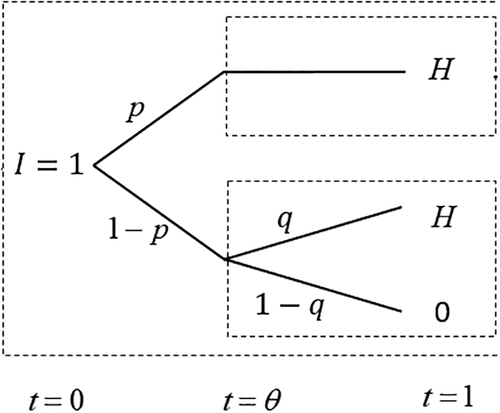
Notes. The figure shows the payoff structure of the project. There are three dates, t = 0, , and t = 1, where . At t = 0, the firm borrows 1 dollar to invest in a project that generates a stochastic payoff of H or zero at t = 1. At , the firm receives a noncontractible public signal about the quality of the project. With probability p, the signal is good, and the project will generate payoff H with certainty. With probability , the signal is bad, and the project will generate H with probability q. The firm invests only if project NPV > 0 ex ante, that is, if , where is the probability of project success (payoff H).
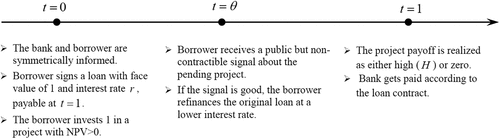
Notes. The figure shows the timeline of the model. At t = 0, the firm borrows and invests in a project with the payoff structure described in Figure 1. At , the firm receives a signal about the quality of the project and decides whether to prepay the loan or not. At t = 1, the project payoff is realized and distributed between the bank and the firm.
2.2.2. Dynamic Learning.
At time t = 0, the firm and the bank are symmetrically informed. The bank either agrees to lend 1 dollar at the loan rate of r or refuses to extend a loan (credit rationing). For simplicity, we assume a risk-free rate of zero, so the loan rate r > 0 represents the fixed default spread on the loan. At time , however, the firm receives a noncontractible public signal about the project’s expected payoff. The signal contains new information about project fundamentals (e.g., the outcome of R&D, customer demand, competing products). With probability p, a high signal reveals that the payoff will be H with certainty and the project is therefore risk-free. With probability , the signal is low, and the probability of high payoff is q. We assume qH < 1, so the bank expects a loss after a low signal. The ex ante probability of receiving H—the project’s success probability—is, therefore, . The firm borrows and invests only if the NPV of the project is positive, that is, if .
2.2.3. Prepayment Decision.
Following a positive signal at , the ex post high-quality firm prepays the loan if the interest payment remaining on the loan exceeds the cost of a new loan. The firm incurs a cost to verify and convey to lenders its improved credit quality inherent in the positive signal, which supports the new competitive loan rate of zero. The cost α, which is not captured by the lenders, represents a deadweight loss when refinancing at time . Hence, following the high signal, the borrower prepays only if
To ensure that the high signal induces prepayment for feasible loan contracts that satisfy Equation (1), we assume . The right-hand side of this inequality is the borrower’s cost of keeping a loan with a loan rate of H − 1 until maturity.7
2.3. The Credit Rationing Problem
We first consider the equilibrium loan price as a function of the project success probability s when the bank cannot use an upfront fee y to compensate for the risk of prepayment:
(
At time t = 0, the competitive bank prices the loan so as to break even, taking into account that the ex post high-quality borrower may prepay at time . The bank’s break-even constraint absent an upfront fee is
In Equation (2), is the bank’s payoff when the signal is high, where θr is the interest accrued up to time when the firm prepays the loan. Moreover, is the bank’s expected payoff conditional on the low signal as the firm continues the loan until maturity. These two payoffs are weighted by their respective probabilities, p and . Solving Equation (2) for the loan rate yields
The rate is an equilibrium loan rate provided that the bank’s promised payment, , does not exceed the firm’s cash flow H. Combining the upper boundary of a feasible loan contract, , with Equation (3) yields the values for which is the equilibrium loan rate, where is given by
For , there is no equilibrium loan rate that satisfies both the bank’s break-even condition and the feasible loan contract condition. Because the firm requires sH > 1 (positive NPV), the firm is credit rationed for . To complete the proof, the existence of is also limited by , where
Figure 3(a) illustrates the region where the firm is credited rationed. For the firm to borrow and invest, the expected cash flow sH must exceed the bank-financed investment amount I = 1. The horizontal line H − 1 is the upper boundary for a feasible loan contract, and the equilibrium loan rate is , which only exists when , or .
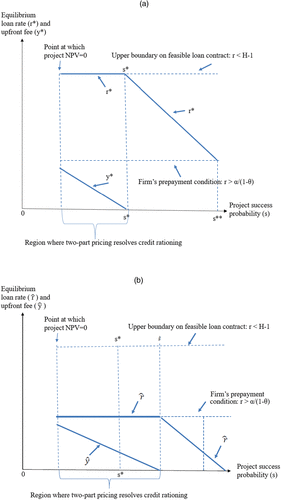
Notes. The two-part equilibrium loan pricing schedule has two equilibria. In (a) (Proposition 2), the schedule has a maximum loan rate and a minimum upfront fee . This schedule compensates the bank for the penalty-free prepayment option while leaving the borrower with an ex-post incentive to prepay when the borrower’s success probabilities . In (b) (Proposition 3), the loan-pricing schedule is , where for a given because never exceeds the borrower’s prepayment condition. Hence, the loan is never prepaid, and the prepayment option has a value of zero.
2.4. Resolving Credit Rationing with an Upfront Fee
In this section, we introduce an upfront fee of y paid by the borrower. For notational simplicity (without affecting the model predictions), we assume that the borrower has sufficient internal funds to pay y upfront and borrows I = 1 as before.
(
With an upfront fee y, the bank’s break-even constraint changes to
For , the upper boundary on a feasible loan contract limits the equilibrium loan rate to the following maximum:
Substituting this maximum loan rate into Equation (6) yields the following minimum upfront fee to satisfy the bank’s break-even constraint:
There also exists a second equilibrium two-part pricing schedule where the bank does not increase the loan rate after it reaches the borrower’s prepayment condition. This alternative pricing strategy requires that the bank, to break even, must increase the size of the minimum upfront fee and start to add the fee earlier than in Figure 3(a). As illustrated in Figure 3(b) and summarized in Proposition 3, this second pricing schedule implies an equilibrium with no prepayment even if the borrower receives the favorable project-quality signal at .
(
Satisfying the bank’s break-even condition requires that
Combining Equation (9) with the maximum interest rate for the firm to never prepay, , implies the following boundary:
Moreover, substituting the maximum interest rate into the bank’s break-even constraint with an upfront fee, = 1, yields the following minimum upfront fee:
In other words, for the bank to lower the interest rate to a maximum that causes the borrower to never prepay, the upfront fee must be larger () and become positive earlier () for declining values of s.
Whereas the above derivations hold for term loans, we next extend the equilibrium two-part pricing scheme with prepayment risk (Proposition 2) to two alternative debt contracts: PSD and credit lines. We also use our model framework to highlight the separate pricing functions of upfront and periodic (commitment) fees and, finally, why the bank may prefer loan pricing with an upfront fee rather than an ex post prepayment penalty as compensation for the prepayment option.
2.5. Extension to Performance-Sensitive Debt
Suppose the signal received at time is contractible. Consider a PSD contract with penalty-free prepayment where the loan rate is adjusted up or down following the signal. Relative to the standard term loan contract underlying Propositions 2 and 3, PSD lowers the borrower’s incentive to exercise the penalty-free prepayment option after the high signal and increases the bank’s compensation after the low signal. Because the bank cannot raise the rate sufficiently to break even following a low signal, the PSD contract reduces, but does not fully resolve, the credit rationing problem. Hence, whereas it is lower than for the standard debt contract, an upfront fee is still required to compensate for the penalty-free prepayment option:
(
To compare a PSD contract to the standard contract, let r denote the initial loan rate and rh and rl the adjusted loan rates following a high and low signal, respectively, at time , where . Recall that in the standard loan contract in Proposition 2, the equilibrium loan rate is , which is also the maximum feasible rate. Thus, in a PSD contract with , the loan rate cannot be raised following a low signal, so rl = r.8 Moreover, recall that in the standard contract, the rate is reset to zero when the borrower exercises the penalty-free prepayment option. In the PSD contract, however, the bank specifies without inducing prepayment (see Equation (1) above). With rl = r, the bank’s break-even condition is therefore
Comparing Equation (12) with Equation (6), the difference is in the square bracket: with PSD, the bank receives not only the interest payment of θr until the high signal but also thereafter. This extra interest payment following the high signal lowers the minimum upfront fee, which solves the credit rationing problem in a PSD contract. While this proof focuses on rate-decreasing PSD, the proposition also holds for rate-increasing PSD. □
2.6. Extension to Credit Lines
In our analysis, the key difference between a term loan and a credit line is that only the latter provides the option to delay the drawdown of the loan. This leads to the following proposition:
(
Suppose that the firm commits to the investment project at time t = 0 but postpones the start of the project. To be able to match project funding with this delay, the firm selects a credit line instead of a term loan at time t = 0. Suppose that delaying the startup also postpones the signal about project quality, so there is no adverse selection in the drawdown decision. Let γ denote the signal delay, where . The firm’s incentive to refinance is now . Ceteris paribus, this shifts upward the firm’s prepayment incentive in Figure 3 from to , which lowers the required upfront fee . In other words, whereas the firm commits at t = 0 to a loan with a face value of one, the delayed signal lowers the prepayment risk, which, in turn, lowers the minimum upfront fee required to avoid credit rationing.9 □
2.7. Informal Extensions: Optimal Fee Design
Whereas Berg et al. (2016) propose that both upfront fees and commitment fees are used to compensate the bank for the drawdown option in credit lines (their hypothesis 2), our theoretical framework with dynamic learning instead implies two very different and separate functions played by the two fee types:
(
To motivate prediction (1) of Lemma 1, recall that the commitment fee ends when the loan is prepaid. It therefore suffers from the same problem as the loan rate: increasing the commitment fee ex ante raises the borrower’s incentive to prepay the loan (leading to the credit rationing in Proposition 1). Hence, the only fee that can compensate for the penalty-free prepayment option is the upfront fee. As to prediction (2), because the commitment fee varies over time with the undrawn amount, it is a more efficient payment mechanism for the drawdown option than the upfront fee. Hence, the commitment fee dominates the upfront fee as compensation for the drawdown risk.
Our model framework also suggests an explanation for why it may be optimal to include a penalty-free prepayment option rather than an ex post cancellation fee in the loan contract (a nonzero exercise price in the prepayment option):
(
To motivate Lemma 2, recall that all agents are symmetrically informed ex ante. Hence, there is no adverse selection at the time of loan origination, and the penalty-free prepayment option is fairly priced through the upfront fee. On the other hand, an ex post cancellation fee is likely to be time inconsistent in the sense of Kydland and Prescott (1977) and, hence, not renegotiation proof. Moreover, because only the ex post high-quality borrowers prepay to obtain a lower rate, forcing these borrowers to pay a cancellation fee may damage the bank’s relationship with its preferred clients. From the borrower’s point of view, the upfront fee (paid by all borrowers) is lower than the corresponding ex post cancellation fee (paid by the ex post high-quality borrowers). Also, because the upfront fee is a sunk cost at , it does not affect the borrower’s subsequent investment decisions.10 Hence, both the bank and the firm may prefer to compensate the bank for prepayment using an upfront fee rather than a cancellation fee.11 □
We next turn to a large-sample empirical examination of the main cross-sectional model predictions using data on upfront fees in C&I loans.
3. Empirical Test Strategy
In this section, we first specify the reduced-form regression model used to test our main theoretical predictions. We then motivate our selection of firm- and loan-specific variables used to generate our prepayment risk proxy and control for borrower credit risk. Our objective is to empirically identify whether the upfront fee contains a component that compensates the bank for the penalty-free prepayment option in addition to the cost of credit-quality screening and loan origination. Hence, the empirical strategy attempts to identify the theoretically predicted association between upfront fees and prepayment risk while controlling for cross-sectional variation in credit quality.
3.1. Reduced-Form Regression Model
The main cross-sectional prediction to be tested is motivated by Equation (8): the minimum upfront fee increases with prepayment risk (the bank’s expected loss of interest from prepayment) and the project’s credit risk (driven by the success probability s). Our measure of loan-specific prepayment risk is the composite index Prepayment-, which consists of a set of variables motivated in Section 3.2 below. Hence, Proposition 2 predicts for the following cross-sectional regression in a sample of N loans:
Propositions 4 and 5 are tested by including dummy variables that indicate whether the loan contract is a PSD or a credit line and where both dummies are predicted to enter with a negative sign. Moreover, to examine Lemma 1—that only the upfront fee compensates the bank for prepayment risk—we replace Upfront Fee with the logarithm of the all-in-spread undrawn (AISU) as the dependent variable in Equation (13). Lemma 1 predicts that AISU is uncorrelated with Prepayment Risk Index.
Finally, note that Lemma 2—that relationship banking increases the use of the penalty-free prepayment option rather than an ex post prepayment penalty—does not require a regression test. It is readily examined by comparing the frequency of the penalty-free prepayment option in tranche A and tranche B term loans, as well as in corporate bonds, all of which differ in the distance between the lender and the borrower and, hence, in the lending relationship.
3.2. Motivating the Prepayment Risk Index
The variable Prepayment-Risk Index is constructed as follows (variable definitions are given in Table 1):
|

Table 1. Variable Definitions
| Variable name | Definition | Source |
|---|---|---|
| Panel A: Proxies for prepayment risk | ||
| Return Volatility | The borrower’s monthly stock return volatility measured over 12 months just prior to the loan origination month | CCM |
| Cash Flow Volatility | Variance of EBITDA (oibdpq) over the past eight quarters/total assets [atq] | CCM |
| Relationship Intensity | The number of loans borrowed from the lead bank by the firm over the past five years. If there are multiple lead banks, we use the highest loan frequency | D |
| Number of Lenders | Log of the number of lenders in the bank syndicate | D |
| Bond Spread | Log of the quarterly average of Moody’s Seasoned Baa Corporate Bond Yield relative to yield on 10-year treasury constant maturity in bps | FRED |
| Prepayment-Risk Index | Equal-weighted index containing Return Volatility, Cash Flow Volatility, Relationship Intensity, Number of Lenders, and Bond Spread. Each variable is standardized with its cross-sectional mean and standard deviation, , and Relationship Intensity and Multiple Lenders enter with negative signs | |
| Option Upside Potential | The average daily ratio of the call option price to the underlying stock price (S), computed over the month leading up to the loan origination date. We select the option with (i) a maturity closest to 180 days and <360 days, and (ii) a strike price closest to S and within ±20% of S at loan origination | OM, CCM |
| Industry M&A Intensity | Log of the annual value of the total M&A activity in the target’s SIC3 industry. We select all complete and pending bids for U.S. targets | SDC, CCM |
| Industry Star Index | The past three years’ average sales growth rate of the fastest-growing firm minus the average in the SIC3 industry | CCM |
| High | Prefix indicating above-median variable values | |
| Panel B: Firm characteristics | ||
| Firm Size | Log of total assets [atq] | CCM |
| Market/Book | (Total debt + market value of equity)/total assets [(dltt + dlc + prccq × cshoq)/atq] | CCM |
| Leverage | Total debt/(total debt + market value of equity) [(dltt + dlc)/(dltt + dlc + prccq × cshoq)] | CCM |
| Profitability | Earnings before interest, taxes, depreciation, and amortization (EBITDA)/total assets [oibdpq/atq] | CCM |
| Tangibility | Property, plant, and equipment/total assets [ppentq/atq] | CCM |
| Z-Score | Altman’s Z-score [] | CCM |
| Rated | Indicator that the borrower is rated by Standard & Poor’s | CCM |
| Panel C: Loan fees, spreads, and other characteristics | ||
| Upfront Fee | Log of the loan facility’s upfront fee (including original issue discount) in bps | D |
| Credit Line | Indicates that the loan facility is a credit line (vs. term loan) | D |
| PSD | Indicator that the loan facility has performance pricing | D |
| PSD-Increasing | Indicator that the loan facility has interest-increasing performance pricing | D |
| PSD-Decreasing | Indicator that the loan facility has interest-decreasing performance pricing | D |
| AISD | Log of all-in-spread drawn in bps = spread + annual fees on drawn amount | D |
| AISU | Log of all-in-spread undrawn in bps = commitment fee + facility fee | D |
| Loan Size | Ratio of the loan facility size to total assets [atq] | D, CCM |
| Maturity | Maturity of loan facility in months | D |
| Security | Indicator that the loan is secured (vs. unsecured) | D |
| Institutional Term Loan | Indicator that a term loan facility is tranche B or lower | D |
| Cancellation Fee | Indicator that the loan facility has a cancellation fee | D |
| Loan Purpose FE | Indicators for the following loan purposes: (i) general purposes (working capital, general corporate purposes), (ii) recapitalization (debt repayment, recapitalization, debtor-in-possession loan), and (iii) acquisition | D |
| Distance to NYC | Log of the distance between the firm’s headquarters and New York City, using latitude and longitude coordinatesa | CCM |
Notes. The table defines the variables used in the empirical analyses and lists the data source. All logs are natural logarithms. CCM, Compustat-CRSP merged; D, WRDS Thomson Reuters LPC Dealscan; FRED, Federal Reserve Bank of St. Louis (https://fred.stlouisfed.org); OM, Option Metrics; SDC, Refinitiv SDC Platinum; S, stock’s closing price.
aCoordinates from https://simplemaps.com/data/us-cities and equation (1) in Coval and Moskowitz (1999).
The function Z standardizes each variable with its cross-sectional mean and standard deviation (measured at the time of loan origination). While we also show the unconstrained coefficient estimates of the five variables, combining them into an index has two main benefits. First, it allows us to constrain the sign of each variable to be consistent with basic economic intuition. Second, it eliminates the impact of multicollinearity between the variables. Moreover, the standardization Z prevents the index parameter estimate from being unduly affected by the different variable sizes.
By way of motivation, recall that the borrower’s decision to prepay the loan is triggered by a positive shock to firm performance. The first two variables of the Prepayment-Risk Index are (correlated) proxies for this upside potential. Return Volatility is the borrower’s monthly stock return volatility measured over 12 months prior to the loan origination month. The second variable, Cash Flow Volatility, is the variance of the borrower’s earnings before interests, taxes, depreciation, and amortization (EBITDA) over the past eight quarters scaled by the book value of total assets.
Whereas volatility per se does not separate upside potential from downside risk, the additional three variables do help uniquely identify prepayment risk. First, Relationship Intensity and Number of Lenders capture variation in borrowers’ cost of refinancing the loan in the credit market (the parameter α in Equation (1)). Relationship Intensity is defined as the number of loans obtained by the firm from the lead bank over the past five years (with multiple lead banks, we use the highest loan frequency from any of these banks). This variable captures the notion that the bank’s information about the borrower increases with the number of loans and, hence, strengthens the banking relationship. We argue that the stronger the relationship, the higher the borrower’s costs of switching to another lender and the lower the incentive to prepay.
Our second measure of the refinancing cost, Number of Lenders, is the number of lenders in the loan syndicate (in logs). The larger the syndicate, the more complex the contracting process and the higher the renegotiation costs (Brunner and Krahnen 2008). Hence, prepayment risk should decline with the size of the syndicate. Whereas it is conceivable that loan origination costs are higher for larger syndicates and drive a positive association with upfront fees (Sufi 2007), we force this variable to enter the prepayment index with a negative sign to properly reflect prepayment risk (and not loan origination costs).
The fifth variable, Bond Spread, is intended to control for time variation in the market price of credit risk. It is defined as the monthly spread between the Moody’s seasoned Aaa corporate bond rate minus the federal funds rate.13 Loans issued in periods with relatively high market spreads are more likely to be refinanced than loans issued when spreads are low (Xu 2018).14 In contrast, the drawdown risk is lower for loans issued in periods with high market-wide spreads because the value of the drawdown option falls with a decrease in market rates. Therefore, restricting Bond Spread to have a positive sign in the Prepayment-Risk Index, as we do, ensures that this variable captures prepayment risk only (and not drawdown risk).
3.3. Choice of Control Variables X for Credit Risk
Recall that in our theoretical framework, the upfront fee is a function of the unobservable (counterfactual) equilibrium loan spread absent an upfront fee (). This counterfactual loan spread is not the observed all-in-spread drawn (AISD; the loan spread plus annual fees on the drawn amount), which is determined jointly with the fee itself. Our baseline regression, therefore, excludes AISD from the vector X and instead includes firm and loan characteristics that may drive the counterfactual spread.15 That is, the characteristics in X are intended to control for the cross-sectional variation in the credit risk that underlies this unobservable spread (the second term, , in Equation (8)) and which may drive the loan origination costs also compensated with the upfront fee. Note also that, as demonstrated empirically by Mosk (2017), the loan origination process involves bargaining over the upfront fee and loan spread after the nonprice loan characteristics (loan size, maturity, collateral, etc.) have been determined. This sequential bargaining process means that the nonprice loan characteristics in X are largely exogenous to the upfront fee.
The vector X contains a total of 12 firm and loan characteristics. The seven firm characteristics are Firm Size (log of total assets), Market/Book ((total debt + market value of equity)/total assets), Leverage (total debt/(total debt + market value of equity)), Profitability (EBITDA/total assets), Tangibility (property, plant, and equipment (PPE)/total assets), Z-Score (Z-score as defined by Altman (1968)), and Rated (a dummy variable indicating that the firm is rated by Standard and Poor (S&P)). The empirical literature on financial constraints uses rating as a proxy for the firm being less constrained (Farre-Mensa and Ljungqvist 2016).16
The five loan characteristics in X are Loan Size (the ratio of the loan amount to total assets) and Maturity (log of loan maturity in months) and the three dummy variables: Security (indicating that the loan is collateralized), Institutional Term Loan (the term loan facility is tranche B or lower), and Cancellation Fee. The cancellation fee is an ex post prepayment penalty, tantamount to an exercise price in the prepayment option, which is mainly included in loans sold to institutional investors. Recall that whereas our theory assumes that prepayment is penalty free, it does not rule out the possibility of a positive exercise price in the prepayment option. For a given borrower, a cancellation fee lowers the upfront fee (they are substitutes). In the cross-section of borrowers, however, the predicted sign of Cancellation Fee is ambiguous, as varying degrees of relationship banking give rise to different ex post bargaining costs over the cancellation fee.
The vector FE includes five different types of fixed effects. The first three are fixed effects for year, state, and industry at the two-digit Standard Industrial Classification (SIC) code level. The fourth is lead-bank fixed effects, which indicate the 10 largest banks by lending frequency, as discussed by Ross (2010).17 The fifth fixed effect is the purpose of the loan: general, recapitalization, and acquisition, as classified in Carey et al. (1998).18
4. Selection of Loan Facilities and Sample Characteristics
4.1. Selection of Loan Facilities
A loan package (or loan agreement) can consist of both a term loan and a credit line. The term loan is often structured into different tranches, where lower tranches pay higher spreads. Commercial banks typically participate in tranche A (the prorata tranche), whereas the lower tranches (the institutional tranches) are held by institutional investors, such as insurance companies, pension funds, mutual funds, and hedge funds—often through collateralized loan obligations (CLOs). We use loan data from Dealscan and select all loans in U.S. dollars issued by U.S. public firms between January 1987 and December 2018.19 Dealscan contains information on the individual loan facilities, that is, at the level of a term loan tranche or a credit line, and indicates if they belong to the same loan package.
The loan information is merged with Compustat-CRSP Merged (CCM) through the legacy Dealscan-Compustat linking table on WRDS up to 2010 (see Chava and Roberts 2008 for details), after which we match manually on firm names up through 2018. We exclude borrowers in regulated and financial industries (two-digit SIC codes 40–45, 49, 60–69, and 99) and restrict the sample to term loans and credit lines, for a total of 44,963 loan facilities. We further require nonmissing values in Dealscan and CCM for all explanatory variables in the vector X in our cross-sectional analysis below, which results in a sample of 31,109 loan facilities (10,138 term loans and 20,971 credit lines)—referenced below as the expanded sample.
Three-quarters (23,284) of the loan facilities in the expanded sample do not report an upfront fee. Our final sample with nonmissing upfront fee information totals 7,825 loan facilities: 3,412 term loans and 4,411 credit lines in 5,381 unique loan packages issued by 3,119 firms, 1987–2018. Two-thirds (3,645) of these loan packages have one single facility, of which 1,175 are term loans and 2,470 are credit lines, whereas one-third (1,736) have both a term loan and a credit line.20 We conduct the empirical analysis at the facility level. Of the term loans in our sample, 66.4% are tranche A, 30.2% are tranche B, and 3.4% are tranche C or lower. Credit lines typically belong to tranche A.21
4.2. Borrower and Loan Characteristics
Figure 4(a) shows the distribution over time of the 3,414 term loans in the final sample. The number of sample loans peaks in 1997–1998, with a drop in the loan frequency in 2004–2009. As shown (and verified by the SDC New Issuance of Syndicated Loans database), there was little performance pricing prior to 1994. In addition, the relative use of PSD in term loans decreases after the financial crisis. Figure 4(b) illustrates the same statistics for the final sample of 4,411 credit lines. In contrast to term loans, after the financial crisis, the number of new credit lines remains low, and most have performance pricing. The figure further plots the annual average upfront fee. In term loans, the upfront fee is relatively stable around 60 bps in the 1990s, reaches a peak of 175 bps in the tight credit markets of 2009, and falls back to about 85 bps in the postcrisis years (2012–2018). In credit lines, upfront fees peak in 2009 and are generally lower than in term loans.22
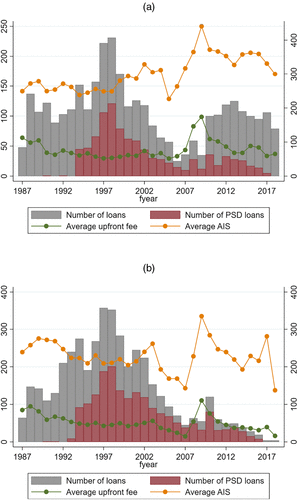
Notes. The figure shows the annual number (left y-axis) of total loan facilities and facilities with performance pricing in the sample. The two lines present the annual average upfront fee and all in spread in basis points (right y-axis). The sample is 3,414 term loan facilities in (a) and 4,411 credit lines facilities in (b). The data are Commercial & Industrial (C&I) loans issued by U.S. public firms, 1987–2018, from Dealscan. We exclude loans to regulated and financial industries and require data on all explanatory variables used in the regressions.
Turning to loan rates, Figure 4 also shows the annual average AISD. In Figure 4(a), AISD in term loans average about 250 bps in the 1990s, increase in the early 2000s, and peak at 440 bps in 2009. As the figure indicates, the average upfront fee and AISD are positively correlated. At the individual loan level, the correlation coefficient is 0.43 in term loans and 0.44 in credit lines. Recall that for a given loan, loan spreads and upfront fees are substitutes. However, in the cross section, loan origination costs increase in credit risk and, hence, so does the loan spread, which may explain the positive correlation in our sample.
Table 2 reports sample summary statistics for the variables used in the empirical analysis, split by term loans (the first four columns) and credit lines (the last four columns). All variables are defined in Table 1. However, for expositional clarity, none of the variables are transformed using logs in this table. Panel A lists statistics for the key variables of interest. The average upfront fee in term loans is 73 bps or $2.1 million, with a median of 50 bps or $0.43 million. Consistent with Proposition 5, credit lines have somewhat lower upfront fees, with a mean and median of 52 bps and 34 bps, respectively.
|
Table 2. Sample Summary Statistics
| Variable | Term loans | Credit lines | ||||||
|---|---|---|---|---|---|---|---|---|
| N | Mean | Median | Standard deviation | N | Mean | Median | Standard deviation | |
| (1) | (2) | (3) | (4) | (5) | (6) | (7) | (8) | |
| Panel A: Upfront fee, prepayment risk, and performance pricing | ||||||||
| Upfront Fee (in bps) | 3,412 | 72.90 | 50.00 | 67.55 | 4,411 | 52.45 | 33.75 | 54.62 |
| Upfront Fee (in millions of dollars) | 3,412 | 2.15 | 0.43 | 4.31 | 4,411 | 0.94 | 0.15 | 2.58 |
| Return Volatility | 3,412 | 14.01 | 12.01 | 7.90 | 4,411 | 14.99 | 12.77 | 8.49 |
| Cash Flow Volatility | 3,412 | 1.22 | 0.76 | 1.35 | 4,411 | 1.67 | 1.02 | 1.76 |
| Relationship Intensity | 3,412 | 0.94 | 0.00 | 1.29 | 4,411 | 0.67 | 0.00 | 1.09 |
| Number of Lenders | 3,412 | 7.21 | 4.00 | 9.91 | 4,411 | 7.19 | 3.00 | 9.71 |
| Bond Spread (in bps) | 3,412 | 214.74 | 207.20 | 60.66 | 4,411 | 205.84 | 190.32 | 60.30 |
| Prepayment-Risk Index | 3,412 | 0.31 | 0.30 | 2.70 | 4,411 | 0.89 | 0.72 | 3.03 |
| Option Upside Potential | 1,247 | 11.25 | 9.95 | 5.27 | 1,275 | 11.81 | 10.61 | 5.25 |
| Industry M&A Intensity | 3,412 | 3,600 | 1,188 | 7,044 | 4,411 | 3,502 | 968 | 6,879 |
| Industry Star Index | 3,329 | 2.10 | 1.50 | 2.01 | 4,405 | 2.25 | 1.60 | 2.22 |
| PSD | 3,412 | 0.28 | 0.00 | 0.45 | 4,411 | 0.42 | 0.00 | 0.49 |
| PSD-Increasing | 3,412 | 0.12 | 0.00 | 0.32 | 4,411 | 0.24 | 0.00 | 0.43 |
| PSD-Decreasing | 3,412 | 0.25 | 0.00 | 0.43 | 4,411 | 0.37 | 0.00 | 0.48 |
| Panel B: Firm characteristics | ||||||||
| Firm Size (in millions of dollars) | 3,412 | 2,862 | 654.7 | 6,609 | 4,411 | 2,825 | 283 | 8,865 |
| Market/Book | 3,412 | 1.58 | 1.36 | 0.84 | 4,411 | 1.70 | 1.37 | 1.01 |
| Leverage | 3,412 | 0.39 | 0.37 | 0.23 | 4,411 | 0.31 | 0.27 | 0.24 |
| Profitability | 3,412 | 0.03 | 0.03 | 0.03 | 4,411 | 0.02 | 0.03 | 0.04 |
| Tangibility | 3,412 | 0.31 | 0.25 | 0.23 | 4,411 | 0.30 | 0.24 | 0.23 |
| Z-Score | 3,412 | 1.53 | 1.09 | 2.20 | 4,411 | 2.09 | 1.44 | 2.69 |
| Rated | 3,412 | 0.43 | 0.00 | 0.50 | 4,411 | 0.35 | 0.00 | 0.48 |
| Panel C: Loan characteristics | ||||||||
| AISD (in bps) | 3,412 | 293.21 | 275.00 | 134.92 | 4,411 | 227.96 | 225.00 | 130.33 |
| Loan Size | 3,412 | 0.19 | 0.13 | 0.19 | 4,411 | 0.22 | 0.17 | 0.19 |
| Maturity | 3,412 | 63.28 | 62.00 | 22.56 | 4,411 | 39.06 | 36.00 | 21.84 |
| Security | 3,412 | 0.83 | 1.00 | 0.38 | 4,411 | 0.68 | 1.00 | 0.47 |
| Cancellation Fee | 3,412 | 0.26 | 0.00 | 0.44 | 4,411 | 0.12 | 0.00 | 0.32 |
| Cancellation Fee (in bps) | 892 | 141.89 | 100.00 | 89.36 | 521 | 189.67 | 200.00 | 117.46 |
| Institutional Term Loan | 3,412 | 0.34 | 0.00 | 0.47 | 4,411 | 0.00 | 0.00 | 0.00 |
Notes. The table shows summary statistics for the sample of 3,412 term loans (columns (1)–(4)) and 4,411 credit lines (columns (5)–(8)) issued by U.S. public firms in 1987–2018. The data are Commercial & Industrial (C&I) loan facilities from WRDS Thomson Reuters LPC Dealscan. We exclude firms in regulated and financial industries and require information on all control variables used in the empirical analysis. The variables are as defined in Table 1, except we do not take the log of any variable in this table.
The substantial right tail of the fees is interesting, as it suggests that the upfront fee may reflect more than just compensation for origination costs. Although not reported in the table, about one-third (31.0%) of the upfront fees in term loans (19.1% in credit lines) exceed 100 bps, and 8.9% of the fees exceed 200 bps (4.1% in credit lines). The average upfront fee in the top quartile of the fee distribution is 198.1 bps (median, 200 bps) for term loans and 138.2 bps (median, 110.3 bps) for credit lines. The top percentile of fees exceeds 302.6 bps, or $23 million.23
Turning to the prepayment risk proxies, Return Volatility averages 14 (median 12) in term loans and 15 (median 13) in credit lines. Cash Flow Volatility is also lower in term loans than in credit lines, with an average of 1.2 (median 0.8) versus 1.7 (median 1.0). Regarding proxies for renegotiating costs, the average borrower of a term loan has used the same lead bank 0.9 times in the last five years (Relationship Intensity) and has 7.2 participating banks in the loan syndicate (Number of lenders). The mean value of Bond Spread is 215 bps in term loans and 206 bps in credit lines.
Panel A further shows that 28% of the term loans have performance pricing: 12% with an interest-increasing pricing grid and 25% with an interest-decreasing grid, so one-third of the PSD contracts in term loans adjust the interest rate both up and down. Performance pricing is more common in credit lines, with 42% of revolvers having adjustable rates: 24% with an up grid and 37% with a down grid.
Panel B of Table 2 reports summary statistics for the firm characteristics in X. The average term loan borrower has total assets of $2.8 billion (median $650 million) and a market leverage of 0.39 (median 0.37), suggesting that it is relatively highly leveraged (Graham and Leary 2011). Moreover, it has a market-to-book ratio of 1.6, a return on assets (Profitability) of 3%, a ratio of PPE to total assets (Tangibility) of 0.31, and a Z-score of 1.5. Four out of 10 borrowers have an S&P credit rating. Firms with credit lines have a lower mean leverage (0.31) and a higher Z-score (2.1) than firms with term loans.
Finally, panel C of Table 2 provides descriptive statistics for the loan facilities themselves. The average term loan has an AISD of 293 bps (median, 275 bps) and a loan amount representing 19% of the firm’s total assets (median, 13%). The mean term loan maturity is about five years (63 months) at issuance, and most loans (83%) are secured. Credit lines have a somewhat lower average AISD (228 bps), shorter maturity (39 months), and are less frequently secured (68%). Twenty-six percent of term loans and 12% of credit lines have a cancellation fee. Conditional on having a cancellation fee, the average penalty for loan repayment in the first year is 142 bps (median, 100 bps) in term loans and 190 bps (median, 200 bps) in credit lines.24 The indicator Institutional Term Loan represents one-third of the term loan facilities that are tranche B or lower. Whereas they are not tabulated, 53% of the institutional term loans in our sample have a cancellation fee, compared with only 13% of the prorata tranches in term loans (tranche A) and 12% of the credit lines.
4.3. Univariate Statistics
Before turning to the multivariate regressions below, Table 3 shows univariate statistics that address Propositions 2–4: ceteris paribus, a higher prepayment risk implies higher upfront fees, and PSD implies lower upfront fees. The first five columns use the sample of term loans, whereas columns (6) to (10) use the sample of credit lines. Panel A addresses Proposition 2 by reporting the average and median upfront fee across high and low levels of prepayment risk for the five individual measures (Return Volatility, Cash Flow Volatility, Relationship Intensity, Number of Lenders, Bond Spread) as well as Prepayment-Risk Index, split by the median. For each of these measures, columns (5) and (10) report the difference in the mean upfront fee across loans with high and low prepayment risk and its significance.
|
Table 3. Univariate Analysis of Upfront Fees Across Loans with High and Low Prepayment Risk
| Sort and fee by sort | Term loans | Credit lines | ||||||||
|---|---|---|---|---|---|---|---|---|---|---|
| Low prepayment risk | High prepayment risk | Difference in mean | Low prepayment risk | High prepayment risk | Difference in mean | |||||
| Mean | Median | Mean | Median | Mean | Median | Mean | Median | |||
| (1) | (2) | (3) | (4) | (5) | (6) | (7) | (8) | (9) | (10) | |
| Panel A: Sample split by low vs. high prepayment risk | ||||||||||
| Return Volatility | 8.42 | 8.56 | 19.58 | 17.10 | 8.88 | 9.11 | 21.09 | 18.52 | ||
| Upfront Fee | 63.94 | 50.00 | 81.87 | 56.50 | 17.93*** | 40.78 | 25.00 | 64.12 | 50.00 | 23.33*** |
| Cash Flow Volatility | 0.44 | 0.44 | 1.98 | 1.41 | 0.57 | 0.57 | 2.76 | 2.07 | ||
| Upfront Fee | 69.99 | 50.00 | 75.81 | 50.00 | 5.82*** | 47.06 | 25.00 | 57.85 | 37.50 | 10.79*** |
| Relationship Intensity | 1.98 | 2.00 | 0.00 | 0.00 | 1.79 | 1.00 | 0.00 | 0.00 | ||
| Upfront Fee | 64.56 | 50.00 | 80.41 | 51.01 | 15.85*** | 43.32 | 25.00 | 57.91 | 37.50 | 14.59*** |
| Number of Lenders | 14.21 | 10.00 | 1.78 | 1.00 | 14.31 | 10.00 | 1.37 | 1.00 | ||
| Upfront Fee | 67.59 | 50.00 | 77.03 | 50.00 | 9.44*** | 46.13 | 25.00 | 57.62 | 37.50 | 11.48*** |
| Bond Spread | 165.68 | 165.00 | 263.92 | 258.74 | 159.00 | 159.19 | 252.90 | 244.54 | ||
| Upfront Fee | 66.22 | 50.00 | 79.60 | 50.00 | 13.38*** | 50.65 | 27.27 | 54.26 | 37.50 | 3.61** |
| Prepayment-Risk Index | −1.82 | −1.49 | 2.44 | 1.97 | −1.20 | −1.51 | 3.29 | 2.74 | ||
| Upfront Fee | 59.93 | 50.00 | 85.87 | 62.50 | 25.94*** | 41.71 | 25.00 | 63.20 | 50.00 | 21.49*** |
| Panel B: Sample split by performance pricing or not | ||||||||||
| PSD | 1.00 | 1.00 | 0.00 | 0.00 | 1.00 | 1.00 | 0.00 | 0.00 | ||
| Upfront Fee | 52.08 | 45.00 | 80.96 | 50.00 | 28.88*** | 40.07 | 25.00 | 61.49 | 40.00 | 21.41*** |
Notes. The table reports the mean and median upfront fee in bps for loan facilities with high and low prepayment risk (panel A) and loan facilities with and without performance pricing (panel B). For Relationship Intensity, Number of Lenders, and PSD, prepayment risk is low (high) when the variable takes a high (low) value. The sample contains 3,412 C&I term loan facilities (columns (1)–(5)) and 4,411 C&I credit line facilities (columns (6)–(10)) issued by U.S. nonregulated and nonfinancial public firms, 1987–2018, from Dealscan. Columns (5) and (10) report the difference in the mean upfront fee across loans with high vs. low prepayment risk. The variables are as defined in Table 1, except we do not take the log of any variable in this table.
***, **, and * indicate significance at the 1%, 5%, and 10% levels, respectively, using a standard t-test.
Consistent with Proposition 2, the average upfront fee is significantly higher for loans with greater prepayment risk. The difference is statistically significant at the 1% level for all five measures in the sample of term loans and four of the five measures in the sample of credit lines (for Bond Spread, the difference is significant at the 5% level). Focusing on Prepayment-Risk Index, the average upfront fee is 60 bps in term loans with low prepayment risk and 86 bps in term loans with high prepayment risk, with a fee difference of 26 bps. For credit lines, the upfront fee averages 42 bps for loans with low prepayment risk and 63 bps for high-prepayment-risk loans, with a difference of 21 bps. Whereas not reported in the table, the upfront fee increases monotonically when sorting the loans into quintiles of Prepayment-Risk Index. In sum, this evidence suggests a positive relationship between upfront fees and prepayment risk, as predicted by our model.
Panel B of Table 3 splits the loan samples based on performance pricing. As shown, the average upfront fee is 52 bps in term loans with performance-sensitive loan rates (PSD = 1) and 81 bps in term loans with fixed spread (PSD = 0). The difference of 29 bps is significant at the 1% level. In credit lines, the average upfront fee is 40 bps and 61 bps across loans with and without PSD, respectively, with a highly significant difference of 21 bps. Hence, consistent with Proposition 4, this evidence suggests that upfront fees are lower in PSD than in loans without performance pricing.
4.4. Addressing Self-Selection in Fee Reporting
To control for the self-selection in the reporting of upfront fees, we perform a 2SLS estimation. The first stage accounts for the choice of self-reporting the upfront fee. The upfront fee is generally determined at the facility level and is documented in a confidential fee letter, which is separate from the loan agreement itself. Consultations with investment banks suggest that all C&I loans have an upfront fee. However, whereas other material loan terms must be disclosed to the public, a majority of firms choose to keep the fee letter confidential (Taylor and Sansone 2006).
As the first paper to address the potential issue of self-selection in the reporting of the upfront fee, we use the following probit model in the first step of the 2SLS estimation:
Because being located close to NYC enhances direct competition, we expect the estimate of b to be positive. This prediction is borne out by the estimation (p-value of 0.03) for the expanded sample of 31,109 loan facilities. Therefore, we include the inverse Mill’s ratio from step 1 in all our 2SLS estimations of the impact of prepayment risk on upfront fees, captured by λ in Equation (13). In Section 6.2, we further show that the second-stage results in the 2SLS estimation are robust to alternative specifications of Equation (15), such as excluding state fixed effects and controlling for firm and loan characteristics.
5. Do Upfront Fees Increase with Prepayment Risk?
In this section, we report the main tests of the model implications in the second step of the 2SLS estimation of equation Equation (13).
5.1. Upfront Fees and the Prepayment Risk Index
Table 4 shows the parameter estimates for term loans (columns (1) and (4)), credit lines (columns (2) and (5)), and the full sample of loans (columns (3) and (6)). All regressions include the firm and loan characteristics in X and the fixed effects in FE, whereas the full sample regressions also include a dummy for credit lines. The first three columns show the coefficient estimates for each of the five individual variables in Prepayment-Risk Index, whereas the next three use the index itself. Standard errors are clustered at the firm level.
|
Table 4. Regressing the Upfront Fee on the Prepayment Risk Index
| Explanatory variable | Term loans | Credit lines | All loans | Term loans | Credit lines | All loans |
|---|---|---|---|---|---|---|
| (1) | (2) | (3) | (4) | (5) | (6) | |
| Proxies for prepayment risk | ||||||
| Return Volatility | 0.01*** | 0.01*** | 0.01*** | |||
| (5.48) | (7.73) | (9.98) | ||||
| Cash Flow Volatility | 0.03*** | 0.03*** | 0.03*** | |||
| (2.61) | (3.77) | (4.36) | ||||
| Relationship Intensity | −0.08*** | −0.06*** | −0.08*** | |||
| (−6.06) | (−4.76) | (−8.53) | ||||
| Number of Lenders | −0.04** | 0.03* | −0.00 | |||
| (−2.07) | (1.76) | (−0.18) | ||||
| Bond Spread | 0.47*** | 0.05 | 0.20** | |||
| (3.23) | (0.41) | (2.16) | ||||
| Prepayment-Risk Index | 0.08*** | 0.07*** | 0.08*** | |||
| (9.97) | (9.41) | (14.01) | ||||
| Credit Line | −0.16*** | −0.16*** | ||||
| (−6.55) | (−6.48) | |||||
| Firm and loan characteristics | ||||||
| Firm Size | −0.00 | −0.13*** | −0.07*** | 0.01 | −0.09*** | −0.04*** |
| (−0.04) | (−8.44) | (−5.98) | (0.72) | (−6.67) | (−4.09) | |
| Market/Book | 0.03 | 0.03* | 0.04*** | 0.03 | 0.05*** | 0.04*** |
| (1.42) | (1.94) | (2.59) | (1.29) | (2.73) | (2.97) | |
| Leverage | 0.50*** | 0.67*** | 0.60*** | 0.50*** | 0.68*** | 0.61*** |
| (5.40) | (8.91) | (10.38) | (5.69) | (9.21) | (10.76) | |
| Profitability | −2.43*** | −1.56*** | −1.83*** | −2.39*** | −1.59*** | −1.79*** |
| (−4.51) | (−4.05) | (−5.86) | (−4.66) | (−4.20) | (−5.81) | |
| Tangibility | −0.05 | −0.21** | −0.12** | −0.06 | −0.21** | −0.13** |
| (−0.54) | (−2.49) | (−2.00) | (−0.63) | (−2.56) | (−2.14) | |
| Z-Score | −0.02* | −0.04*** | −0.03*** | −0.02** | −0.04*** | −0.03*** |
| (−1.95) | (−5.25) | (−5.52) | (−2.09) | (−5.92) | (−5.90) | |
| Rated | 0.07 | 0.16*** | 0.13*** | 0.07* | 0.17*** | 0.13*** |
| (1.56) | (4.06) | (4.38) | (1.75) | (4.40) | (4.73) | |
| Loan Size | 0.21** | −0.68*** | −0.28*** | 0.25*** | −0.58*** | −0.22*** |
| (2.18) | (−8.33) | (−4.63) | (2.75) | (−7.36) | (−3.73) | |
| Maturity | −0.00*** | 0.01*** | 0.00*** | −0.00*** | 0.01*** | 0.00*** |
| (−3.74) | (9.87) | (5.14) | (−3.72) | (10.77) | (5.89) | |
| Security | 0.44*** | 0.46*** | 0.47*** | 0.45*** | 0.46*** | 0.48*** |
| (10.04) | (14.49) | (18.58) | (10.57) | (14.71) | (18.81) | |
| Institutional Term Loan | −0.09** | −0.15*** | −0.10** | −0.18*** | ||
| (−2.09) | (−4.02) | (−2.56) | (−4.82) | |||
| Cancellation Fee | 0.34*** | 0.36*** | 0.37*** | 0.33*** | 0.34*** | 0.36*** |
| (8.07) | (8.39) | (12.69) | (8.24) | (7.88) | (12.20) | |
| Other controls | ||||||
| Inverse Mill’s Ratio | 1.48 | −0.27 | 1.14* | 1.38 | −0.18 | 1.10* |
| (1.37) | (−0.25) | (1.71) | (1.35) | (−0.17) | (1.66) | |
| Fixed effects | Yes | Yes | Yes | Yes | Yes | Yes |
| N | 3,412 | 4,411 | 7,823 | 3,412 | 4,411 | 7,823 |
| Adjusted | 0.265 | 0.378 | 0.339 | 0.264 | 0.376 | 0.338 |
Notes. The table shows the OLS coefficient estimates for the determinants of Upfront Fee from the second-step regressions of Equation (13), where the first step estimates the inverse Mill’s ratio for self-selection in the borrower’s decision to publicly disclose the upfront fee. The key explanatory variables are the individual components of the Prepayment-Risk Index, defined in Equation (14), in columns (1)–(3) and the index itself in columns (4)–(6). All variables are defined in Table 1. The sample is 3,412 term loans (columns (1) and (4)) and 4,411 credit lines (columns (2) and (5)), for a total of 7,823 C&I loan facilities (columns (3) and (6)) issued by U.S. nonregulated and nonfinancial public firms, 1987–2018, from Dealscan. All regressions include the firm and loan characteristics in X, the year, industry, loan purpose, bank, and state fixed effects in FE, and an indicator for credit lines in columns (3) and (6). Standard errors are clustered at the firm level, and t-statistics are in parentheses.
The coefficient estimates for Return Volatility, Cash Flow Risk, and Relationship Intensity are statistically significant at the 1% level across term loans and credit lines. Moreover, the coefficient signs are all the signs given these variables in our construction of Prepayment-Risk Index in Equation (14). Return Volatility and Cash Flow Risk have positive signs, which is consistent with our proposition that borrower upside potential increases the value of the penalty-free prepayment option and therefore the upfront fee.
Moreover, the negative sign of Relationship Intensity is consistent with the notion that relationship banks tend to develop superior information about the borrower, increasing the borrower’s adverse selection cost of switching to other lenders. In terms of our model, this increases the parameter α, which decreases the value of the prepayment option and the upfront fee. For the term loans in column (1), Number of Lenders further supports this argument, as it receives a statistically significant and negative coefficient estimate: larger syndicates make it more costly to renegotiate—that is, higher α—and therefore lower the value of the prepayment option. The negative coefficient estimate is also interesting because loan origination costs most likely increase with the size of the loan syndicate. Hence, the negative correlation is likely driven by factors other than loan syndication costs per se—such as lower prepayment risk as modeled here. In column (2), Number of Lenders is positive but statistically significant at the 10% level only, suggesting that the bargaining issue may be less important for credit lines.
Next, consider the positive and highly significant coefficient estimate for Bond Spread, the spread of Baa-rated corporate bonds. It suggests that upfront fees tend to be higher in periods with high credit spreads when the likelihood of subsequent prepayment because of improved market conditions is also relatively high (Xu 2018). Hence, the positive sign is consistent with upfront fees compensating for the penalty-free prepayment option. Moreover, because the drawdown risk is lower for loans issued in periods of high bond spreads, the positive coefficient is inconsistent with hypothesis 2 of Berg et al. (2016) that upfront fees are designed to compensate for the drawdown option in credit lines. Rather, as motivated by our Lemma 1, we conclude that whereas commitment fees compensate for the drawdown option, upfront fees cannot play this function.
Turning to columns (4)–(6), Prepayment-Risk Index, which combines the five individual proxies for prepayment risk, receives a positive and highly significant coefficient estimate in all three regressions, consistent with Proposition 2. Whereas it is not tabulated, the coefficient estimate is positive and highly significant also when the index is replaced by an indicator for above-median prepayment risk. Moreover, in columns (3) and (6), the dummy variable Credit Line receives a negative and significant coefficient, as predicted by Proposition 5. Because a credit line offers the option to delay drawdown, the expected interest-bearing loan amount is lower than for term loans, which lowers the value of the prepayment option and, hence, the upfront fee. Furthermore, interacting Credit Line with Prepayment-Risk Index or the high prepayment risk indicator generates statistically insignificant coefficients, suggesting that the marginal impact of prepayment risk on the upfront fee is similar across credit lines and term loans.25
The firm and loan characteristics in Table 4 are included to control for cross-sectional variation in loan origination, administration, and syndication costs, which are likely covered by the upfront fee. Among the firm characteristics, Leverage and Profitability are associated with, respectively, higher and lower upfront fees in both term loans and credit lines. Because highly leveraged and unprofitable firms have greater default risk, they also have greater origination costs. As for Leverage, firms with a higher risk of bankruptcy measured using Z-Score pay higher upfront fees, whereas larger firm size and asset tangibility tend to imply relatively low origination costs and, accordingly, lower upfront fees.
Turning to the loan characteristics, recall from Table 2 that some loan facilities include a cancellation fee. In the cross section, Cancellation Fee receives a positive and significant coefficient estimate. It is possible that lenders require a cancellation fee for riskier borrowers, where the loan origination costs are likely to be higher. Notice also the negative coefficient estimate for the dummy variable Institutional Term Loans, which indicates tranche B or lower. Recall from Section 4.2 that the use of a cancellation fee is largely concentrated among the institutional term loan tranches (B and lower). Given the inclusion of Cancellation Fee, Institutional Term Loans picks up term loan facilities without a cancellation fee and, therefore, with a relatively low prepayment risk, hence the relatively low upfront fee.26 Finally, Security receives a positive and significant coefficient estimate, as in Ivashina (2009). Because banks tend to demand collateral from high-credit-risk borrowers, these loans tend to have high origination costs as reflected in higher upfront fees.
The sign and significance of the coefficient estimates in columns (3) and (6), which pool term loans and credit lines, are generally consistent with those reported for the individual loan types. The exceptions are the coefficient estimates for Loan Size and Maturity, where, in term loans, the upfront fee increases with loan size and decreases with loan maturity, whereas the opposite result emerges for credit lines. However, using the pooled regression to resolve this contradiction, upfront fees are declining in loan size, indicating a fixed component in the loan origination costs, and increasing in maturity, implying higher loan origination costs for longer-lived loans.
In the following, we include the control variables in X in the regressions while suppressing the individual coefficient estimates for expositional simplicity. Our main empirical focus is the association between upfront fees and various measures of prepayment risk. We begin with the impact of exogenous variation in prepayment risk caused by industry merger activity.
5.2. Adding Exogenous Variation in the Prepayment Risk
As is well-known, corporate takeovers often trigger prepayment or renegotiation of the target’s debt obligations. This happens in part because successful acquirers tend to be less financially constrained than the target and in part because change-of-control and cross-default covenants trigger acceleration of the maturity date. In addition, extant evidence indicates that high-quality firms (firms with a high upside potential) are more likely to become targets (Eckbo 2014). As a result, in periods of high industry-level M&A activity, firms with high upside potential are more likely to prepay and issue new loans, which, in our model, implies higher upfront fees. On the other hand, periods with high industry-level merger activity are, if anything, associated with lower (not higher) average credit risk, which tends to lower loan origination fees—the other component of the total upfront fee. Hence, the net effect on the upfront fee of the exogenous variation in industry-level M&A activity is an empirical issue. Moreover, evidence of a net positive effect suggests that high industry-level merger activity is associated with relatively high prepayment risk.27
To examine how changes in industry-level M&A activity affect upfront fees, we use the variable Industry M&A Intensity shown in panel A of Table 5. This variable is defined as the log of the annual dollar value of the total M&A activity in the borrower’s three-digit SIC industry announced in the year of loan origination. It is measured across all completed and pending deals of U.S. targets in the Refinitiv SDC Platinum M&A database (SDC). Industry M&A Intensity is added to our baseline model (columns (4)–(6) in Table 4), which itself includes the loan-specific prepayment risk index. Because we measure merger intensity at the industry level, the regressions do not include industry fixed effects. Industry M&A Intensity is used in the even-numbered columns of Table 5, whereas High M&A Intensity—a dummy indicating above-median values of the industry merger intensity—is included in the odd-numbered columns. We expect upfront fees to be increasing in both industry merger variables.
|
Table 5. Regressing the Upfront Fee on Industry-Based Prepayment Risk Measures
| Explanatory variable | Term loans | Credit lines | All loans | |||
|---|---|---|---|---|---|---|
| (1) | (2) | (3) | (4) | (5) | (6) | |
| Panel A: Industry M&A intensity | ||||||
| Proxies for prepayment risk | ||||||
| Industry M&A Intensity | 0.05** | 0.04** | 0.05*** | |||
| (2.05) | (2.11) | (3.15) | ||||
| High M&A Intensity | 0.06* | 0.08*** | 0.08*** | |||
| (1.83) | (2.82) | (3.65) | ||||
| Prepayment-Risk Index | 0.08*** | 0.08*** | 0.07*** | 0.07*** | 0.07*** | 0.07*** |
| (9.78) | (9.73) | (9.35) | (9.38) | (13.80) | (13.78) | |
| Credit Line | −0.16*** | −0.16*** | ||||
| (−6.43) | (−6.39) | |||||
| Control variables | ||||||
| Inverse Mill’s Ratio | −0.24* | −0.22 | −0.46*** | −0.43*** | −0.40*** | −0.36*** |
| (−1.74) | (−1.58) | (−3.37) | (−3.16) | (−3.98) | (−3.56) | |
| Firm and loan characteristics | Yes | Yes | Yes | Yes | Yes | Yes |
| Fixed effects | Yes | Yes | Yes | Yes | Yes | Yes |
| N | 3,412 | 3,412 | 4,411 | 4,411 | 7,823 | 7,823 |
| Adjusted R2 | 0.252 | 0.252 | 0.366 | 0.366 | 0.328 | 0.328 |
| Panel B: Industry Star Index | ||||||
| Proxies for prepayment risk | ||||||
| Industry Star Index | 0.01 | 0.02** | 0.02*** | |||
| (1.50) | (2.52) | (3.07) | ||||
| High Star Index | 0.09*** | 0.09*** | 0.10*** | |||
| (2.98) | (3.18) | (4.57) | ||||
| Prepayment-Risk Index | 0.08*** | 0.08*** | 0.07*** | 0.07*** | 0.07*** | 0.07*** |
| (9.55) | (9.56) | (9.32) | (9.39) | (13.61) | (13.67) | |
| Credit Line | −0.15*** | −0.15*** | ||||
| (−6.29) | (−6.25) | |||||
| Control variables | ||||||
| Inverse Mill’s Ratio | −0.24* | −0.24* | −0.45*** | −0.42*** | −0.39*** | −0.36*** |
| (−1.71) | (−1.70) | (−3.34) | (−3.11) | (−3.88) | (−3.55) | |
| Firm and loan characteristics | Yes | Yes | Yes | Yes | Yes | Yes |
| Fixed effects | Yes | Yes | Yes | Yes | Yes | Yes |
| N | 3,327 | 3,327 | 4,405 | 4,405 | 7,732 | 7,732 |
| Adjusted R2 | 0.254 | 0.255 | 0.366 | 0.366 | 0.329 | 0.330 |
Notes. The table shows the OLS coefficient estimates for the determinants of Upfront Fee from the second-step regressions of Equation (13), where the first step estimates the inverse Mill’s ratio for self-selection in the borrower’s decision to publicly disclose the upfront fee. The key explanatory variables capturing exogenous variations in prepayment risk are Industry M&A Intensity (panel A), defined as the value of merger and acquisition (M&A) transactions in the firm’s SIC3 industry-year, and Industry Star Index (panel B), defined as the past three years’ average sales-growth rate of the fastest-growing firm in the SIC3 industry minus the average. The prefix High indicates above-median variable values. The variables are defined in Table 1. The sample is 3,412 term loans (columns (1) and (2)) and 4,411 credit lines (columns (3) and (4)), for a total of 7,823 C&I loan facilities (columns (5) and (6)) issued by U.S. public firms, 1987–2018 (from Dealscan). We exclude firms in regulated and financial industries, and we require information on all control variables used in the empirical analysis. All regressions include the firm and loan characteristics in X; the loan purpose, bank, year, and state fixed effects in FE; and an indicator for credit lines in columns (5) and (6). Standard errors are clustered at the firm level, and t-statistics are in parentheses.
Table 5 shows that both Industry M&A Intensity and High M&A Intensity receive positive and statistically significant coefficient estimates both in term loans and credit lines, as predicted. Note also that Prepayment-Risk Index continues to receive a positive and significant coefficient of a similar magnitude as in Table 4. Furthermore, in columns (5) and (6), the indicator Credit Line retains its magnitude and negative sign after adding merger intensity.
As an alternative industry measure of upside potential, we use Industry Star Index and the indicator variable High Star Index for the above-median values in panel B of Table 5. This variable is defined as the past three years’ average sales growth rate of the fastest-growing firm (the industry star) in the borrower’s three-digit SIC industry net of the industry average sales growth. We argue that the likelihood of receiving firm-specific positive news is relatively high in industries where the leading (star) company has done particularly well—here in terms of sales growth. Because firms in the same industry share product characteristics and technology, the good news that result in high sales growth for one firm may spill over to other (rival) firms. Hence, the greater the sales growth of the star firm in the borrower’s industry, the greater the likelihood that also the borrower will experience high growth and the higher the borrower’s prepayment risk. Like Industry M&A Intensity, variation in Industry Star Index is exogenous to the individual borrower.
Panel B of Table 5 shows that Industry Star Index receives a statistically significant coefficient in both column (3) (credit lines) and column (5) (all loans). Moreover, replacing Industry Star Index with High Star Index in the even-numbered columns produces positive and highly significant coefficient estimates. As before, Prepayment-Risk Index enters with a positive and highly significant coefficient estimate. In sum, both the industry M&A activity and the industry star index help explain the variation in upfront fees above and beyond the prepayment risk index itself, supporting our theory that upfront fees are used to compensate the bank for the penalty-free prepayment option.
5.3. Performance-Sensitive Debt
Table 6 tests the prediction of Proposition 4 that upfront fees are lower in PSD, whether the grid increases or decreases the loan rate. In the first row of the table, columns (1), (3), and (5) show that the coefficient estimate for the PSD dummy variable is negative and highly significant for both term loans and credit lines. In other words, PSD lowers the upfront fee as predicted. Notice also that in all specifications, Prepayment-Risk Index receives positive and significant coefficient estimates, indicating that prepayment risk helps explain the variation in upfront fees beyond the PSD.
|
Table 6. Regressing the Upfront Fee on the Prepayment Risk Index and PSD Indicators
| Explanatory variable | Term loans | Credit lines | All loans | |||
|---|---|---|---|---|---|---|
| (1) | (2) | (3) | (4) | (5) | (6) | |
| Performance-sensitive debt | ||||||
| PSD | −0.18*** | −0.10*** | −0.14*** | |||
| (−4.91) | (−3.17) | (−5.63) | ||||
| PSD-Increasing | −0.10* | −0.01 | −0.05* | |||
| (−1.88) | (−0.14) | (−1.81) | ||||
| PSD-Decreasing | −0.13*** | −0.09** | −0.09*** | |||
| (−3.09) | (−2.56) | (−3.50) | ||||
| Proxies for prepayment risk | ||||||
| Prepayment-Risk Index | 0.08*** | 0.08*** | 0.06*** | 0.06*** | 0.07*** | 0.07*** |
| (9.35) | (9.12) | (9.04) | (9.05) | (13.36) | (13.38) | |
| Credit Line | −0.15*** | −0.15*** | ||||
| (−5.95) | (−6.05) | |||||
| Control variables | ||||||
| Inverse Mill’s Ratio | 1.43 | 1.47 | −0.10 | −0.14 | 1.19* | 1.20* |
| (1.38) | (1.37) | (−0.09) | (−0.13) | (1.77) | (1.78) | |
| Firm and loan characteristics | Yes | Yes | Yes | Yes | Yes | Yes |
| Fixed effects | Yes | Yes | Yes | Yes | Yes | Yes |
| N | 3,412 | 3,412 | 4,411 | 4,411 | 7,823 | 7,823 |
| Adjusted R2 | 0.269 | 0.268 | 0.367 | 0.367 | 0.330 | 0.330 |
Notes. The table shows the OLS coefficient estimates for the determinants of Upfront Fee from the second-step regressions of Equation (13), where the first step estimates the inverse Mill’s ratio for self-selection in the borrower’s decision to publicly disclose the upfront fee. The key explanatory variables are Prepayment-Risk Index, PSD (an indicator for performance priced debt), PSD-Increasing (indicating an increasing pricing grid), and PSD-Decreasing (indicating a decreasing pricing grid). All variables are defined in Table 1. The sample is 3,412 term loans (columns (1) and (2)) and 4,411 credit lines (columns (3) and (4)), for a total of 7,823 C&I loan facilities (columns (5) and (6)) issued by U.S. nonregulated and nonfinancial public firms, 1987–2018, from Dealscan. All regressions include the firm and loan characteristics in X; the year, industry, loan purpose, bank, and state fixed effects in FE; and an indicator for credit lines in columns (5) and (6). Standard errors are clustered at the firm level, and t-statistics are in parentheses.
The even-numbered columns in Table 6 separate the impact of rate-decreasing and rate-increasing PSD pricing grids on the upfront fee. The coefficient estimate for the variable PSD-Decreasing is negative and highly significant for both term loans and credit lines. The coefficient estimate for PSD-Increasing is also negative but significant at the 10% level only. Moreover, the coefficient on PSD-Decreasing is significantly more negative than the coefficient on PSD-Increasing.28 We conclude from Table 6 that upfront fees are lower in PSD, whether the grid increases or decreases the loan rate, which is what Proposition 4 predicts. Again, our incremental test power relative to the literature emanates from our use of the Prepayment-Risk Index to measure borrower upside potential, whereas the literature has instead relied on the association between fees and borrower return volatility (which embodies both upside and downside risk).
5.4. Using Option Prices to Quantify Borrower Upside Potential
In this section, we replace Prepayment-Risk Index with a forward-looking measure based on option prices. The variable Option Upside Potential is estimated using call option prices from Option Metrics for a subsample of 2,522 term loan and credit line facilities from 1997 to 2018. For each borrower, we select the call option with (i) an exercise price closest to the stock price, and (ii) a maturity closest to 180 days among all options trading on the loan origination date.29 Option Upside Potential is the average daily ratio of the call option price to the underlying stock’s closing price over the month leading up to the loan origination date.
The odd-numbered columns in Table 7 include Option Upside Potential, whereas the even-numbered columns include the dummy variable High Option Upside Potential, indicating above-median values of the continuous variable. The explanatory variables are otherwise the same as in Table 4. As predicted, the coefficient estimate for the Option Upside Potential is positive and highly significant for both term loans and credit lines, with a similar result for High Option Upside Potential. These results support our earlier inferences that upfront fees increase in prepayment risk, consistent with Proposition 2.
|
Table 7. Regressing the Upfront Fee on the Option-Implied Prepayment Risk
| Explanatory variable | Term loans | Credit lines | All loans | |||
|---|---|---|---|---|---|---|
| (1) | (2) | (3) | (4) | (5) | (6) | |
| Proxies for prepayment risk | ||||||
| Option Upside Potential | 0.02*** | 0.02*** | 0.02** | |||
| (3.52) | (3.84) | (2.17) | ||||
| High Option Upside Potential | 0.23*** | 0.13** | 0.17* | |||
| (3.98) | (2.31) | (1.81) | ||||
| Credit Line | −0.22** | −0.22** | ||||
| (−2.05) | (−2.21) | |||||
| Control variables | ||||||
| Inverse Mill’s Ratio | −0.81 | −0.60 | −1.34 | −1.34 | −4.14 | −3.90 |
| (−0.57) | (−0.43) | (−1.06) | (−1.06) | (−1.02) | (−1.02) | |
| Firm and loan characteristics | Yes | Yes | Yes | Yes | Yes | Yes |
| Fixed effects | Yes | Yes | Yes | Yes | Yes | Yes |
| N | 1,247 | 1,247 | 1,275 | 1,275 | 2,522 | 2,522 |
| Adjusted R2 | 0.304 | 0.304 | 0.470 | 0.466 | 0.455 | 0.454 |
Notes. The table shows the OLS coefficient estimates for the determinants of Upfront Fee from the second-step regressions of Equation (13), where the first step estimates the inverse Mill’s ratio for self-selection in the borrower’s decision to publicly disclose the upfront fee. The key explanatory variables are Option Upside Potential, defined as the average ratio of the daily call option price (from OptionMetrics) to the underlying stock’s closing price over the month prior to loan origination, and High Option Upside Potential, indicating above-median values of Option Upside Potential. All variables are defined in Table 1. Call option prices are available for 1,247 term loans (columns (1) and (2)) and 1,275 credit lines (columns (3) and (4)), for a total of 2,522 C&I loan facilities (columns (5) and (6)) issued by U.S. nonregulated and nonfinancial public firms, 1987–2018, from Dealscan. All regressions include the firm and loan characteristics in X; the year, industry, loan purpose, bank, and state fixed effects in FE; and an indicator for credit lines in columns (5) and (6). Standard errors are clustered at the firm level, and t-statistics are in parentheses.
5.5. AISD, AISU, and the Prepayment Risk Index
As discussed in Section 3.3, our baseline regression excludes AISD because it does not represent the theoretical (counterfactual) spread in the absence of an upfront fee. However, because credit risk is the main driver of the loan spread, the first three columns of Table 8 add AISD to the baseline regression as a check on the impact of our prepayment risk index. As expected, the coefficient estimate for AISD is positive and highly significant. More important, adding AISD does not affect the sign or significance of Prepayment-Risk Index. In fact, the coefficient estimates for Prepayment-Risk Index are only slightly lower than in Table 4. Moreover, credit lines continue to have lower upfront fees than term loans. Overall, this evidence indicates that prepayment risk is reflected in the upfront fee and is not subsumed by the loan rate itself.
|
Table 8. AISD, AISU, and the Prepayment Risk Index
| Explanatory variable | Upfront fee | AISU | |||
|---|---|---|---|---|---|
| Term loans | Credit lines | All loans | Credit lines | Credit lines | |
| (1) | (2) | (3) | (4) | (5) | |
| Proxies for prepayment risk | |||||
| Prepayment-Risk Index | 0.06*** | 0.04*** | 0.05*** | −0.00 | 0.00 |
| (7.18) | (6.73) | (9.83) | (−0.22) | (0.94) | |
| Credit Line | −0.08*** | ||||
| (−3.62) | |||||
| Control variables | |||||
| AISD | 0.67*** | 0.81*** | 0.77*** | 0.55*** | 0.48*** |
| (21.61) | (32.47) | (39.94) | (45.96) | (19.24) | |
| Inverse Mill’s Ratio | 1.04 | −0.95 | 0.22 | ||
| (1.14) | (−0.94) | (0.40) | |||
| Firm and loan characteristics | Yes | Yes | Yes | Yes | Yes |
| Fixed effects | Yes | Yes | Yes | Yes | Yes |
| N | 3,412 | 4,411 | 7,823 | 12,773 | 3,032 |
| Adjusted R2 | 0.354 | 0.497 | 0.453 | 0.581 | 0.426 |
Notes. Columns (1)–(3) show the OLS coefficient estimates for the determinants of Upfront Fee from the second-step regressions of Equation (13), where the first step estimates the inverse Mill’s ratio for self-selection in the borrower’s decision to publicly disclose the upfront fee. Columns (4) and (5) show the coefficient estimates in OLS regressions for the all-in-spread undrawn (AISU), defined as the commitment fee plus the facility fee (on the unused amount). The key explanatory variables are the Prepayment-Risk Index, defined in Equation (14), and the all-in-spread drawn (AISD), defined as the spread plus annual fees on the drawn amount. All variables are defined in Table 1. The sample is 3,412 term loans (column (1)) and 4,411 credit lines (column (2)), for a total of 7,823 loan facilities (column (3)) with reported upfront fees. Column (4) uses 12,795 credit line facilities in Dealscan with a commitment or facility fee, whereas column (5) also requires a reported upfront fee, limiting the sample to 3,032 credit lines. The sample is C&I loan facilities issued by U.S. nonregulated and nonfinancial public firms, 1987–2018, from Dealscan. All regressions include the firm and loan characteristics in X; the year, industry, loan purpose, bank, and state fixed effects in FE; and an indicator for credit lines in column (3). Standard errors are clustered at the firm level, and t-statistics are in parentheses.
Next, we examine Lemma 1 in further detail. Recall that it has two parts: (1) the upfront fee is the only fee that can compensate the bank for the penalty-free prepayment option, and (2) it does not compensate for the drawdown option in credit lines. The second part already receives support from the above evidence of a lower upfront fee in spread-decreasing PSD. Turning to part (1) of the lemma, we now regress AISU (commitment fee and facility fee) on our prepayment risk index. Because, under the lemma, the commitment fee does not compensate for prepayment risk, we expect AISU to be statistically independent of Prepayment-Risk Index. The coefficient estimates are shown in columns (4) and (5) of Table 8.30 In column (4), the sample consists of all credit lines in the expanded sample with a commitment or facility fee, whereas Column (5) also requires an upfront fee to be reported. As before, the coefficient for AISD is positive and highly significant. So, like the upfront fee, the commitment fee is increasing in the loan rate. More importantly, consistent with part (1) of Lemma 1, Prepayment-Risk Index receives a statistically insignificant coefficient in both columns.
5.6. Ex Ante Prepayment Risk and Ex Post Loan Amendment Frequency
In our model, the upfront fee y is (weakly) increasing in the borrower’s ex ante prepayment risk, which the above empirical tests support. In this section, we examine whether also the frequency of ex post loan amendments (as reported by Dealscan) is positively associated with the prepayment risk. By way of motivation, recall that the relevant prepayment in our model is one in which the borrower renegotiates to achieve a lower rate following a positive credit risk–reducing signal. Furthermore, recall that the prepayment frequency depends on whether the bank selects the two-part equilibrium pricing scheme in Proposition 2 or the one in Proposition 3.31
Also important, the relevant prepayment risk is limited to renegotiations that occur relatively soon in the loan term (within the time θ). For prepayments that occur after the fraction θ of the loan maturity has elapsed, the bank in our theoretical setting has been sufficiently compensated (through accrued interest payments) not to require additional compensation in the form of an upfront fee. Therefore, in our analysis below, we are not only looking for a positive relation between our prepayment risk index and the rate of positive loan amendments but also whether the upfront fee is negatively related to the time it takes for this positive amendment to occur.
As loan prepayment data are not publicly available, we use information on loan amendments and renegotiations in Dealscan.32 We include both loan amendments and renegotiations because they are synonymous with our theoretical concept of prepayment (it is not important whether the borrower chooses to refinance with the current bank or another loan provider). Moreover, we limit our analysis to amendments of term loans, which are the main focus of our model, and we ignore amendments beyond the first because the first amendment is also the theoretically most important in our model.
Starting with the likelihood of a loan amendment, we estimate the following probit model:
We next classify the first amendment as being positive for the borrower, either by lowering the loan spread or increasing the loan amount without a spread increase. Of the first amendments with available information on Dealscan to make this classification, 79% are positive, and the remainder are nonpositive. We use term loans to estimate the likelihood of a positive first amendment as a function of the prepayment risk index, again using the regression specification in Equation (16). The coefficient estimate for the prepayment risk index is now 0.05 and highly significant in both the expanded sample of term loans (t-value, 3.37) and, even more important, in the subsample of term loans with an available upfront fee (t-value, 2.23). This positive relationship corroborates the empirical relevance of Prepayment-Risk Index as a proxy for the type of prepayment risk driving the upfront fee in our model.
Finally, we use the regression specification from Table 4 to test whether the upfront fee has the theoretically predicted negative relation with the fraction θ of the term until maturity that elapses before the first positive amendment. For data description purposes, Figure 5(a) shows that the frequency distribution of the time elapsed to the first amendment (positive or nonpositive) is somewhat skewed to the left for the amended term loans relative to all amended loans (typically within 20% of the stated maturity). Moreover, Figure 5(b) also shows that positive amendments occur sooner in the data than the case is for nonpositive amendments, all of which is comforting, as it suggests that the model parameter θ may well be empirically relevant for the determination of the upfront fee.
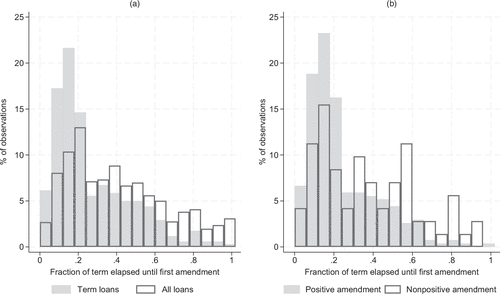
Notes. The figure shows the sample distribution of the time elapsed until the first amendment as a fraction of the stated maturity. The sample labeled “All loans” in (a) are the amended loans from the expanded sample (including loans with a missing upfront fee). The two samples in (b) are the term loans in (a) with a first amendment that is classified as either positive or nonpositive for the borrower. An amendment is positive if it lowers the loan spread or increases the loan amount without a spread increase.
To test the intuitive notion that a high prepayment risk requires a higher upfront fee and results in earlier prepayment, we use the regression specification from Table 4, where the dependent variable is the upfront fee in term loans but where the variable Prepayment-Risk Index is now replaced by Time to First Amendment. Moreover, the sample is limited to term loans with a positive first amendment:
As predicted, the estimated coefficient of interest is negative: β = −0.94, and it is statistically significant at the 1% level (t-value of −2.85). In sum, the evidence of both the likelihood of a positive first amendment and the time elapsed to this amendment is consistent with our model predictions.
6. Robustness Issues
6.1. Loans with Zero Cancellation Fee
Recall from Table 2 that 26% of our sample term loans have a positive cancellation fee. Because our theoretical model derives the minimum upfront fee when prepayment is penalty free (a zero cancellation fee), it does not provide a prediction for the effect on the upfront fee of including an ex post prepayment penalty. However, for a given loan, an intuitive prediction is that of a negative relation between these two fee types, as the cancellation fee compensates the bank ex post for prepayment. In Table 4, however, the variable Cancellation Fee instead receives a positive and significant coefficient in the cross-section of C&I loans.
In our model, the adverse effect of prepayment on the quality of the borrower pool is larger for riskier borrowers. Hence, as pointed out in our discussion of Table 4 above, lenders may require a cancellation fee for relatively risky loans. Because the bank’s loan origination costs are higher for riskier borrowers, we interpret the cross-sectionally positive coefficient on the variable Cancellation Fee as reflecting the borrower’s credit risk. That is, in principle, both the upfront fee and the ex post cancellation fee could be higher for riskier borrowers, which may result in a positive association in the cross section. Under this credit-risk interpretation of the cancellation fee, eliminating loans with a positive cancellation fee from the regression sample should not affect our main prediction of a positive association between upfront fees and our prepayment risk index. Next, we investigate this notion in Table 9.
|
Table 9. Focusing on Sample Loans with Zero Cancellation Fees
| Explanatory variable | Term loan tranche A | Term loan B and lower | All term loans | All with zero cancellation fee |
|---|---|---|---|---|
| (1) | (2) | (3) | (4) | |
| Proxies for prepayment risk | ||||
| Prepayment-Risk Index | 0.07*** | 0.08*** | 0.09*** | 0.08*** |
| (3.96) | (5.81) | (9.28) | (7.62) | |
| Control variables | ||||
| Inverse Mill’s Ratio | 2.43 | 0.09 | 1.72 | 0.34 |
| (1.16) | (0.18) | (1.38) | (0.48) | |
| Firm and loan characteristics | Yes | Yes | Yes | Yes |
| Fixed effects | Yes | Yes | Yes | Yes |
| N | 2,268 | 1,140 | 3,412 | 2,519 |
| Adjusted R2 | 0.287 | 0.333 | 0.247 | 0.245 |
Notes. The table examines the robustness of the positive and significant coefficient estimate of 0.08 for the Prepayment-Risk Index for term loans shown in column (4) of Table 4. As before, the table reports the OLS coefficient estimates for the determinants of Upfront Fee from the second-step regressions of Equation (13), where the first step estimates the inverse Mill’s ratio for self-selection in the borrower’s decision to publicly disclose the upfront fee. The variable Prepayment-Risk Index is defined in Equation (14) and Table 1. The sample is 3,412 term loan facilities issued by U.S. nonregulated and nonfinancial public firms, 1987–2018, from Dealscan. The sample of term loans is limited to tranche A in column (1) and to tranche B or lower (institutional) in column (2). Column (3) uses all term loans but drops the two control variables Maturity and Cancellation fee, whereas Column (4) limits the sample to those with a zero cancellation fee. All regressions include the firm and loan characteristics in X, and the year, industry, loan purpose, bank, and state fixed effects in FE. Standard errors are clustered at the firm level, and t-statistics are in parentheses.
Table 9 repeats the regression in column (4) of Table 4 after lowering the impact of the cancellation fee in different ways. First, recall that 87% of tranche A term loans have zero cancellation fee, whereas this percentage is 47% for tranche B or lower, where the loans are generally held by institutions through CLOs and, hence, remote from the borrower. Thus, separating tranche A loans from the rest of the regression sample largely isolates loans where the cancellation fee is zero. This is done in column (1) of Table 9, whereas column (2) restricts the sample to the remaining term loans in tranche B or lower. As reported above, 66% (2,268 of 3,412) of our total sample of term loans are tranche A, and the remaining 34% are a lower tranche. Importantly, the coefficient estimate for Prepayment-Risk Index (of 0.07 and 0.08, respectively) is unaffected across the two subsamples and continues to be positive and highly statistically significant, as predicted.
In columns (3) and (4) of Table 9, we focus on term loans with zero cancellation fees in two different ways. In column (3), we simply eliminate the cancellation fee variable from the total sample. In this regression, we also eliminate the variable Maturity as a further robustness test. Again, both the sign, size, and significance level of the coefficient on Prepayment-Risk Index are unchanged. As a final reassurance, column (4) shows that simply eliminating all loans with a positive cancellation fee from the regression yields the exact same inference: upfront fees are significantly and positively associated with Prepayment-Risk Index.
6.2. Alternative Treatment of the Upfront Fee Reporting
As discussed in Section 4.4 above, whereas we have been informed by investment banks and loan officers that C&I loans always carry an upfront fee, the associated fee letter is private, and only about one-quarter of our sample firms publish the upfront fee. Hence, we use a 2SLS estimation where the likelihood of a self-selected fee disclosure is estimated in the first step, and the second step includes the Mill’s ratio from the first step. In the first-step regression, Equation (15), which underlies the results in Table 4, we include year, industry, bank, and state fixed effects in addition to the variable Distance to NYC (the distance between the borrower’s headquarters and New York City). As explained above, we use Distance to NYC as our instrument for the likelihood of reporting the upfront fee under the hypothesis that it contains sensitive within-syndicate fee allocation information, which is more likely to be kept confidential the higher the degree of banking competition (the shorter the distance to NYC).
Recall the firm and loan characteristics reported in Table 2 above for 3,412 term loans and 4,411 credit lines with fee information. In Table 10, we group term loans and credit lines and compare select characteristics for the 7,823 loans with those of the 23,284 loans without fee information in the expanded sample (see Section 4.1 above). Based on the two-sided t-test of differences in means, loans with fee information have higher spreads and somewhat longer maturities and, more often, have a cancellation fee. On the firm side, upfront fee information is more often available for smaller borrowers with lower market-to-book ratio (M/B), higher leverage, and lower Z-scores and are less often rated.
|
Table 10. Characteristics of Loans with and Without Reported Upfront Fee
| Explanatory variable | With upfront fee | Missing upfront fee | Difference in mean | |||||
|---|---|---|---|---|---|---|---|---|
| N | Mean | Median | N | Mean | Median | Difference | t-Statistic | |
| (1) | (2) | (3) | (4) | (5) | (6) | (7) | (8) | |
| Panel A: Firm characteristics | ||||||||
| Firm Size | 7,823 | 2,841.02 | 387.54 | 23,284 | 4,297.00 | 922.65 | 1,455.98 | 11.87 |
| Market/Book | 7,823 | 1.65 | 1.36 | 23,284 | 1.74 | 1.45 | 0.09 | 7.32 |
| Leverage | 7,823 | 0.35 | 0.32 | 23,284 | 0.29 | 0.25 | −0.05 | −17.28 |
| Profitability | 7,823 | 0.03 | 0.03 | 23,284 | 0.03 | 0.03 | 0.01 | 18.94 |
| Tangibility | 7,823 | 0.31 | 0.24 | 23,284 | 0.30 | 0.24 | 0.00 | −1.23 |
| Z-Score | 7,823 | 1.84 | 1.28 | 23,284 | 2.20 | 1.66 | 0.36 | 11.28 |
| Rated | 7,823 | 0.38 | 0.00 | 23,284 | 0.44 | 0.00 | 0.06 | 9.28 |
| Panel B: Loan characteristics | ||||||||
| AISD | 7,823 | 256.43 | 250.00 | 23,284 | 191.32 | 175.00 | −65.11 | −39.6 |
| Loan Size | 7,823 | 0.21 | 0.15 | 23,284 | 0.19 | 0.14 | −0.02 | −9.15 |
| Maturity | 7,823 | 49.63 | 53.00 | 23,284 | 48.07 | 60.00 | −1.56 | −5.32 |
| Security | 7,823 | 0.74 | 1.00 | 23,284 | 0.53 | 1.00 | −0.21 | −33.42 |
| Institutional Term Loan | 7,823 | 0.15 | 0.00 | 23,284 | 0.07 | 0.00 | −0.07 | −20.03 |
| Cancellation Fee | 7,823 | 0.18 | 0.00 | 23,284 | 0.06 | 0.00 | −0.13 | −34.6 |
Notes. The table shows summary statistics for the expanded sample of C&I loans, which includes the loans in Dealscan with missing upfront fee. Columns (2) and (3) show the mean and median for loans with a positive upfront fee, whereas columns (5) and (6) report the mean and median for loans with missing upfront fees. All variables are defined in Table 1. The sample is 31,109 loan facilities (term loans and credit lines) issued by U.S. nonregulated and nonfinancial public firms, 1987–2018, from Dealscan. The t-statistic in column (8) for the difference in the mean is from a two-sided t-test with equal variances.
The information in Table 10 suggests that there may be systematic differences in the loan and firm characteristics that drive the self-selection of fee disclosure underlying the second-stage 2SLS estimates reported in Table 4. We therefore also examine the sensitivity of the main conclusion in Table 4—that upfront fees are increasing in the prepayment risk index—by varying the regression specification in Equation (15). The resulting second-stage coefficients are reported in Table 11.
|
Table 11. Robustness: Varying the First-Stage Model Specification (Equation (13))
| Explanatory variable | Dependent variable: Upfront fee in term loans | |||||
|---|---|---|---|---|---|---|
| No state FE | Vector X Added | X added, no state FE | ||||
| (1) | (2) | (3) | (4) | (5) | (6) | |
| Proxies for prepayment risk | ||||||
| Return Volatility | 0.01*** | 0.01*** | 0.01*** | |||
| (4.30) | (5.71) | (5.69) | ||||
| Cash Flow Volatility | 0.03** | 0.03*** | 0.03** | |||
| (2.07) | (2.75) | (2.78) | ||||
| Relationship Intensity | −0.08*** | −0.08*** | −0.08*** | |||
| (−4.78) | (−6.11) | (−6.13) | ||||
| Number of Lenders | −0.04 | −0.04** | −0.04** | |||
| (1.62) | (−2.05) | (−2.02) | ||||
| Bond Spread | 0.47*** | 0.48*** | 0.48*** | |||
| (2.59) | (3.49) | (3.49) | ||||
| Prepayment-Risk Index | 0.08*** | 0.08*** | 0.08*** | |||
| (8.29) | (9.89) | (9.92) | ||||
| Control variables | ||||||
| Inverse Mill’s Ratio | 1.88 | 1.72 | −0.74* | −0.73* | −1.25*** | −1.25*** |
| (0.93) | (0.93) | (−1.81) | (−1.80) | (−2.68) | (−2.68) | |
| Firm and loan characteristics | Yes | Yes | Yes | Yes | Yes | Yes |
| Fixed effects | Yes | Yes | Yes | Yes | Yes | Yes |
| N | 3,412 | 3,412 | 3,412 | 3,412 | 3,412 | 3,412 |
| Adjusted R2 | 0.0.265 | 0.264 | 0.265 | 0.264 | 0.266 | 0.265 |
Notes. The table examines the robustness of the positive and significant coefficient estimate for Prepayment-Risk Index in term loans shown in column (4) of Table 4 by varying the first-step regression model. The table reports the OLS coefficient estimates for the determinants of Upfront Fee from the second-step regressions of Equation (13), where the first step estimates the inverse Mill’s ratio for self-selection in the borrower’s decision to publicly disclose the upfront fee. The variable Prepayment-Risk Index is defined in Equation (14) and Table 1. The sample is 3,412 term loan facilities issued by U.S. nonregulated and nonfinancial public firms, 1987–2018, from Dealscan (8,037 term loans in step 1). The first-step model removes the state fixed effects from Equation (15) in columns (1) and (2), adds the firm and loan characteristics in X (from Equation (13)) in columns (3) and (4), and adds the characteristics in X but excludes the state fixed effects in columns (5) and (6). All regressions include the year, industry, loan purpose, bank, and state fixed effects in FE. Standard errors are clustered at the firm level, and t-statistics are in parentheses.
*, **, and *** denote statistical significance at the 10%, 5%, and 1% levels, respectively.
In columns (1) and (2), the only change is to remove the state fixed effects from Equation (15). This is to address the concern that the state fixed effects unduly constrain the effect of the variable Distance to NYC in the first stage. However, as shown in column (2) of Table 11, the coefficient on the prepayment risk index remains positive and significant and of the same magnitude as in column (4) of Table 4: 0.08 (with t-values of eight and nine, respectively) under both specifications. Furthermore, in columns (3) and (4), we add the firm and loan characteristics in X from Equation (13) to Equation (15), whereas in columns (5) and (6), we also add the characteristics in X but exclude the state fixed effects. None of these variations change the conclusion that upfront fees are increasing in the prepayment risk index.34
7. Conclusion
We provide a novel theoretical and empirical analysis of optimal bank compensation for the penalty-free prepayment option that is used pervasively in C&I bank loans. Our simple model framework with dynamic learning provides several new insights. We assume that following loan origination, borrowers receive public but noncontractible firm-specific information about the value of the project funded by the bank loan. Hence, some ex post high-value borrowers prepay or renegotiate the loan to obtain a lower rate. Our main theoretical result is that to avoid credit rationing of high prepayment risk borrowers, the bank must be compensated with a minimum upfront fee, as increasing the initial loan rate only worsens the ex post selection problem. Our model also clarifies why an upfront fee is the only type of fee that can compensate for the penalty-free prepayment option and why an upfront fee may dominate an ex post cancelation fee, as the latter risks costly bargaining with the bank’s high-value clients. Because lending relationships are much less important in corporate bonds, this also helps to explain why bond contracts—in contrast to C&I term loans—regularly include an ex post prepayment penalty.
We test our main theoretical prediction—that the upfront fee is increasing in the borrower’s ex ante prepayment risk (upside potential)—using a large sample of term loans and credit lines, 1987–2018. We are also the first to implement a two-stage least-squares estimation procedure that addresses the self-selection in the decision to make the upfront fee information in the private fee letter (which is kept separate from the loan contract) available to the public. Moreover, to identify prepayment risk, we construct an index that is designed to capture the borrower’s upside potential. In this index, we constrain the individual components to enter with their theoretically predicted sign, which reduces the usual concerns with multicollinearity. The prepayment risk index increases test power beyond what can be inferred based solely on borrower stock return volatility, as it more accurately reflects borrower upside potential and renegotiation costs—the two main drivers of the prepayment decision. To corroborate the validity of our prepayment risk index as a measure of the upside potential, we also show that it is positively associated with the likelihood of a (first) loan amendment that is favorable to the borrower.
As predicted by our theory, upfront fees are significantly increasing in the prepayment risk index and are negatively associated with the fraction of the loan term that elapses before the first positive loan amendment. The positive association with our empirical prepayment risk index is robust to using forward-looking (option-like) measures of loan prepayment risk and the borrower’s industry-level M&A activity as an instrument for exogenous variation in this risk. The latter instrument is particularly interesting, as it exploits the substantial extant evidence that high-quality firms are more likely than low-quality firms to become targets and that acquiring firms typically refinance the target’s debt following a change of control. We find that upfront fees are significantly increasing in the borrower’s industry-level M&A activity—an effect that is unlikely to be explained by variation in loan origination costs. Also, as predicted, we find that upfront fees are lower in credit lines than in term loans and lower for PSD than for standard debt. The latter prediction reflects that PSD reduces—but does not eliminate—the need to compensate the bank for the ex post reclassification of borrowers.
In sum, our evidence is the first to explicitly indicate that upfront fees in C&I bank loans cover not only direct loan origination costs (which is commonly viewed as driven by the borrower’s downside risk) but also a significant compensation for the penalty-free prepayment option (which we show is driven by the borrower’s upside potential). In future research, because our model provides the minimum upfront fee only, it would be useful to model the total value of the penalty-free prepayment option relative to the loan origination cost to further determine the economic importance of the option value as a component of the upfront fee.
Eckbo and Thorburn dedicate this paper to the memory of their coauthor Xunhua Su, whose contribution was invaluable. The authors are also grateful for the comments and suggestions of Sonny Biswas (discussant), Re-Jin Guo (discussant), Victoria Ivashina (the editor), Michael Kisser, Johnsub Lee (discussant), Greg Nini, Gordon Phillips, Diane Pierret (discussant), Michael Roberts, Anjan Thakor, Anders Vilhelmsson (discussant), Gregory Udell, Jean-Lauren Viviani (discussant), and seminar participants at Drexel University, Lingnan College at Sun Yat-sen University, Lund University, Norwegian School of Economics, Norwegian School of Science and Technology, Shanghai University of Finance and Economics, Sichuan University, Stockholm Business School, the University of Edinburgh, the University of Geneva, the University of Houston, the University of Lausanne, the University of Massachusetts Boston, the University of Pennsylvania (Wharton), and the University of Stavanger. The authors have also received valuable input from participants at the meetings of the French Finance Association, China International Conference in Finance, Financial Management Association, Financial Management Association Europe, Marstrand Finance Conference, UBC Summer Finance Conference, and Exeter Corporate Finance Conference. The authors thank Andre Lot for his valuable research assistance.
1 See also Boot et al. (1987), Thakor and Udell (1987), and Shockley and Thakor (1997).
2 In their internet appendix, Berg et al. (2016) further show that upfront fees in term loans are an increasing function of borrower return volatility—their measure of “creditworthiness” (downside risk).
3 As the extant literature shows, allowing borrowers to choose from a menu of commitment and drawdown fees in credit lines can result in a fully revealing separating equilibrium at loan origination (Thakor and Udell 1987, Shockley and Thakor 1997). The assumption of ex ante symmetrically informed agents combined with dynamic learning is also used by Boot et al. (1987) in the context of the drawdown option in credit lines. In their model, the upfront fee compensates for the risk of ex post risk shifting, whereas in our setting, it compensates for loan prepayment or renegotiation. Note that loan prepayment and renegotiation are inherently observable outcomes, while risk-shifting is not.
4 See, for example, Asquith et al. (2005) and Manso et al. (2010) for analyses of PSD. During our sample period, 25% of all syndicated term loans issued by public U.S. firms had performance-linked loan pricing (Refinitiv SDC Platinum’s Global New Issuance database).
5 Empirically, the collateral value often falls short of the bank’s claim upon default (Bris et al. 2006). This is also the case when firms filing for Chapter 11 manage to obtain new debtor-in-possession (DIP) loans and where the collateral value is effectively transferred to the DIP lender (Eckbo et al. 2023).
6 Bond call premiums and term loan cancellation fees typically approach zero toward the maturity date. Bonds also often include a defeasance clause, which allows the firm to promptly remove restrictive covenants (Bienz et al. 2024).
7 Whereas the cost parameter α affects the prepayment decision, any loan origination costs paid at time t = 0 are sunk at time and, hence, do not affect the prepayment decision. Therefore, for simplicity, loan origination costs are set to zero in our model. However, our empirical analysis recognizes that the upfront fee also compensates for the bank’s loan origination cost.
8 Similarly, in Proposition 3, a higher loan rate will satisfy the prepayment condition, hence violating the nonprepayment equilibrium, so rl = r.
9 An alternative intuition is that in credit lines, the average drawn amount will be lower than the committed loan value, hence lowering the expected interest loss from prepayment.
10 A cancellation fee may induce the firm to underinvest at . For example, following the high signal, the borrower may be looking at undertaking a corporate acquisition that requires refinancing (Becher et al. 2021). In this case, the cancellation fee lowers the firm’s incentive to accept the acquisition opportunity, or the cancellation fee may lower an owner-manager’s incentive to keep investing in firm-specific human capital (Hart and Moore 1994).
11 Dunn and Spatt (1985) and Mayer et al. (2013) argue that in fixed-rate mortgages, a cancellation fee may improve household welfare and dominate an upfront fee, which may constrain low-income households from obtaining a mortgage. This welfare analysis is not relevant in the context of C&I loans.
12 Upfront fees are one-time fees paid at the closing of the transaction, sometimes in the form of an original issue discount (OID), where the principal exceeds the paid-out loan amount. We use the upfront fee in logs because of its skewed empirical distribution.
13 The spread data are from https://fred.stlouisfed.org/series/AAAFFM.
14 Because the incentive to refinance based on changes in the market price of credit risk does not require private information, this type of refinancing falls outside of our model but is included to help explain the empirical variation in prepayment risk.
15 In the empirical analysis below, we demonstrate that adding AISD to the baseline regression does not affect our main conclusions.
16 All variables are winsorized at the first and 99th percentiles. Replacing EBITDA/total assets with EBITDA/debt or EBITDA/interest expense—other common measures of credit risk—does not change any of our conclusions.
17 In the Dealscan database, the 10 largest banks arrange more than 85% of loans in the United States. Identifying the largest banks using dollar lending volume generates an almost identical list.
18 Our inferences are robust to replacing the bank and year fixed effects with a bank-year fixed effect, which controls for the possibility that upfront fees respond to changing competition among banks over time.
19 Dealscan contains 50%–75% of all U.S. C&I loans into the early 1990s, with coverage increasing to 80%–90% in 1992–2002 (Carey and Nini 2007).
20 In 407 of the loan packages that include both a term loan and a credit line, Dealscan records the fee for the credit line only. For these cases, we assign the upfront fee in the credit line to the term loan as well.
21 See the review by Nini and Smith (2024) for a discussion of different types of term loans.
22 A limited investigation of fee terms from DeaLogic and 10Ks, supported by conversations with loan officers in several major banks, reveals that all participants in the loan syndicate share in the upfront fee (also called agent fee, syndication fee, and participation fee).
23 For example, Solutia Inc. paid an upfront fee of $108 million (500 bps) for a $1.2 billion loan in February 2008, and the upfront fee for Western Digital Corp. was $112.5 million (300 bps) for a $3.2 billion loan in April 2016.
24 A typical cancellation fee has a shorter life than the loan and decreases over time. For example, it would pay lenders 2% if the loan is repaid within one year and 1% if repaid within two years.
25 Restricting the sample to the 1,736 loan packages with both a credit line and a term loan yields the same inference.
26 We return to cancellation fees in Section 6.1 below.
27 As discussed in Section 3.2, loans issued in periods of low credit spreads are less likely to be prepaid. The merger literature shows that merger waves are negatively correlated with credit spreads (Harford 2005). We control for this effect on the incentive to prepay (and, hence, on the upfront fee) by including the prepayment risk index along with the M&A activity indicator in the regression specification.
28 This finding contradicts hypothesis 3 in Berg et al. (2016), which instead predicts that upfront fees will be higher in credit lines with a spread-decreasing than with a spread-increasing PSD schedule.
29 Options with a maturity exceeding 360 days and with a strike price that is 20% above or below the stock’s closing price are eliminated. These restrictions help ensure that stock volatility is the primary driver of the cross-sectional variation in the call prices.
30 The two columns exclude Inverse Mill’s Ratio because, unlike the upfront fee, the commitment fee is always reported in the loan contract itself. Hence, these regressions do not require an adjustment for endogenous self-reporting.
31 The prepayment frequency that follows from Proposition 2, where the loan rate is at its maximum and the upfront fee is at its minimum, is higher than the frequency implied by Proposition 3, where the loan rate is already constrained to be so low as to satisfy the borrower’s incentive to prepay.
32 Several studies use SEC filings or Dealscan to examine potential determinants of loan amendments. See, for example, Chava and Roberts (2008), Roberts and Sufi (2009), Nini et al. (2012), Denis and Wang (2014), Roberts (2015), Nikolaev (2018), and Dou (2020). Studies that rely on hand collection or text-based data searches tend to identify greater amendment frequencies than what is found in Dealscan.
33 Limiting the sample to 2,996 term loans with an upfront fee, the coefficient estimate is 0.02 (t-value, 1.86).
34 As a final robustness check, we set the missing upfront fees to zero and estimate Equation (13) using ordinary least squares (OLS) on our expanded sample. Again, the conclusion is that upfront fees are increasing in our prepayment risk index.
References
- (1968) Financial ratios, discriminant analysis and the prediction of corporate bankruptcy. J. Finance 23(4):589–609.Crossref, Google Scholar
- (1991) Convertible debt: Corporate call policy, and voluntary conversion. J. Finance 46(4):1273–1289.Crossref, Google Scholar
- (2005) Performance pricing in bank debt contracts. J. Accounting Econom. 40(1–3):101–128.Crossref, Google Scholar
- (2021) Creditor control of corporate acquisitions. Rev. Financial Stud. 35(4):1897–1932.Crossref, Google Scholar
- (2016) The total cost of corporate borrowing in the loan market: Don’t ignore the fees. J. Finance 71(3):1357–1392.Crossref, Google Scholar
- (2011) Tests of ex ante versus ex post theories of collateral using private and public information. J. Financial Econom. 100(1):85–97.Crossref, Google Scholar
- (2008)
Corporate takeovers . Eckbo BE, ed. Handbook of Corporate Finance: Empirical Corporate Finance, Handbooks in Finance, vol. 2 (Elsevier/North-Holland, Amsterdam), 291–430.Crossref, Google Scholar - (2024) The covenant removal option in corporate bonds. Preprint, submitted August 7, http://dx.doi.org/10.2139/ssrn.4904342.Google Scholar
- (2004) Bondholder wealth effects in mergers and acquisitions: Evidence from the 1980s and 1990s. J. Finance 59(1):107–135.Crossref, Google Scholar
- (2007) Structuring and restructuring sovereign debt: The role of a bankruptcy regime. J. Political Econom. 115(6):901–924.Crossref, Google Scholar
- (1996) Optimal debt structure and the number of creditors. J. Political Econom. 104(1):1–25.Crossref, Google Scholar
- (1987) Competition, risk neutrality and loan commitments. J. Banking Finance 11(3):449–472.Crossref, Google Scholar
- (2015) The structure and pricing of corporate debt covenants. Quart. J. Finance 5(2):1–37.Crossref, Google Scholar
- (2006) The costs of bankruptcy: Chapter 7 liquidation versus Chapter 11 reorganizations. J. Finance 61(3):1253–1303.Crossref, Google Scholar
- (2008) Multiple lenders and corporate distress: Evidence on debt restructuring. Rev. Econom. Stud. 75(2):415–442.Crossref, Google Scholar
- (2007) Is the corporate loan market globally integrated? A pricing puzzle. J. Finance 62(6):2969–3007.Crossref, Google Scholar
- (1998) Does corporate lending by banks and finance companies differ? Evidence on specialization in private debt contracting. J. Finance 53(3):845–878.Crossref, Google Scholar
- (2008) How does financing impact investment? The role of debt covenants. J. Finance 63(5):2085–2121.Crossref, Google Scholar
- (1999) Home bias at home: Local equity preference in domestic portfolios. J. Finance 54(6):2045–2073.Crossref, Google Scholar
- (2014) Debt covenant renegotiations and creditor control rights. J. Financial Econom. 113(3):348–367.Crossref, Google Scholar
- (2024) Bidder-specific synergies and the evolution of acquirer returns. Management Sci. 71(2):1391–1417.Link, Google Scholar
- (2020) The debt-contract value of accounting numbers and financial covenant renegotiation. Management Sci. 66(3):1124–1148.Link, Google Scholar
- (1985) An analysis of mortgage contracting: Prepayment penalties and the due-on-sale clause. J. Finance 40(1):293–308.Google Scholar
- (2014) Corporate takeovers and economic efficiency. Annual Rev. Financial Econom. 6:51–74.Crossref, Google Scholar
- (2023) Loans to Chapter 11 firms: Contract design, repayment risk, and pricing. J. Law Econom. 66(3):465–509.Crossref, Google Scholar
- (2016) Do measures of financial constraints measure financial constraints? Rev. Financial Stud. 29(2):271–308.Crossref, Google Scholar
- (2011) A review of empirical capital structure research and directions for the future. Annual Rev. Financial Econom. 3:309–345.Crossref, Google Scholar
- (2005) What drives merger waves? J. Financial Econom. 77(3):529–560.Crossref, Google Scholar
- (2009) Do firms have leverage targets? Evidence from acquisitions. J. Financial Econom. 93(1):1–14.Crossref, Google Scholar
- (1994) A theory of debt based on the inalienability of human capital. Quart. J. Econom. 109(4):841–879.Crossref, Google Scholar
- (1979) Sample selection bias as a specification error. Econometrica 47(1):153–161.Crossref, Google Scholar
- (2009) Asymmetric information effects on loan spreads. J. Financial Econom. 92(2):300–319.Crossref, Google Scholar
- (2025) The effect of credit, liquidity and rollover risk on bondholder wealth in mergers and acquisitions. J. Fixed Income. https://www.pm-research.com/content/iijfixinc/early/2025/01/04/jfi20251203.Google Scholar
- (1977) Rules rather than discretion: The inconsistency of optimal plans. J. Political Econom. 87(3):473–492.Crossref, Google Scholar
- (2010) Performance-sensitive debt. Rev. Financial Stud. 23(5):1819–1854.Crossref, Google Scholar
- (2013) The inefficiency of refinancing: Why prepayment penalties are good for risky borrowers. J. Financial Econom. 107(3):694–714.Crossref, Google Scholar
- (2017) Bargaining with a bank. Preprint, submitted October 16, http://dx.doi.org/10.2139/ssrn.3053508.Google Scholar
- (2018) Scope for renegotiation in private debt contracts. J. Accounting Econom. 65(2–3):270–301.Crossref, Google Scholar
- (2024) Chapter 6: Leveraged finance. Denis DJ, ed. Handbook of Corporate Finance (Edward Elgar Publishing, Cheltenham, UK), 249–293.Google Scholar
- (2012) Creditor control rights, corporate governance, and firm value. Rev. Financial Stud. 25(6):1713–1761.Crossref, Google Scholar
- (2015) The role of dynamic renegotiation and asymmetric information in financial contracting. J. Financial Econom. 116(1):61–81.Crossref, Google Scholar
- (2009) Renegotiation of financial contracts: Evidence from private credit agreements. J. Financial Econom. 93(2):159–184.Crossref, Google Scholar
- (2010) The dominant bank effect: How high lender reputation affects the information content and terms of bank loans. Rev. Financial Stud. 23(7):1–27.Crossref, Google Scholar
- (1997) Bank loan commitment contracts: Data, theory, and tests. J. Money Credit Banking 29(4):517–534.Crossref, Google Scholar
- (1981) Credit rationing in markets with imperfect information. Amer. Econom. Rev. 71(3):393–410.Google Scholar
- (2007) Information asymmetry and financing arrangements: Evidence from syndicated loans. J. Finance 62(2):629–668.Crossref, Google Scholar
- Taylor A, Sansone A, eds. (2006) The Handbook of Loan Syndications & Trading (McGraw Hill Companies, New York).Google Scholar
- (1982) Toward a theory of bank loan commitments. J. Banking Finance 6(1):55–83.Crossref, Google Scholar
- (1987) An economic rationale for the pricing structure of bank loan commitments. J. Banking Finance 11(2):217–289.Crossref, Google Scholar
- (2011) Deviation from the target capital structure and acquisition choices. J. Financial Econom. 102(3):602–620.Crossref, Google Scholar
- (2018) Kicking maturity down the road: Early refinancing and maturity management in the corporate bond market. Rev. Financial Stud. 31(8):3061–3097.Crossref, Google Scholar