Retailer-Led Marketplaces
Abstract
Leading retailers have opened up their online storefronts to competitors by operating marketplaces for third-party sellers. We develop a model of entry and price competition at the product market level to analyze the competitive interactions arising within these retailer-led marketplaces. We show that the retailer benefits from the marketplace by mitigating his own capacity constraints and manages competition from third-party sellers through his control of the storefront: by setting the marketplace fee, by steering consumers, and by allocating his own capacity in response to the product supply choices of third-party sellers. We draw managerial implications and examine policy interventions. We find that regulation of marketplace fees has the strongest potential to increase welfare outcomes. Our model provides novel insights into the mechanisms at play in retailer-led marketplaces and explains their prominent role in online retail.
This paper was accepted by Raphael Thomadsen, marketing.
Funding: This work was supported by H2020 European Research Council [Grant FAPoD 101044072]; Fundación Carmen y Severo Ochoa [Grant CEX2019-000915-S]; Ministerio de Economía y Competitividad [Grant RYC-2016-20307]; BBVA Foundation grant within program “Ayudas Fundacion BBVA a Equipos de Investigacion Cientifica 2019.”
1. Introduction
The rise of retailer-led marketplaces operated by dominant online retailers such as Amazon or Jingdong, and more recently adopted by traditional brick-and-mortar retailers such as Walmart or Carrefour, has transformed the retail landscape over the last two decades. These retailers started out as resellers, purchasing products from suppliers and selling them to consumers, and eventually created marketplaces by opening up their online storefronts to third-party sellers willing to post their product offers alongside theirs. In doing so, they operate simultaneously as a retailer and as a marketplace owner, providing a platform for their potential competitors to sell to their customers in exchange for fees. These retailer-led marketplaces already account for a substantial share of online retail sales and their growth continues apace, to the extent that the largest in the United States (Amazon) now accounts for more than one third of online retail sales in the country.1
Operating a marketplace enables the retailer to expand the product assortment offered on his storefront and collect marketplace fees from third-party sales. Both effects can be substantial. Third-party sellers accounted for 57% of total units sold on Amazon’s storefront in 2022 and paid $117 billion in fees to Amazon, which contributed more than a third of Amazon’s total sales revenues.2 However, third-party sellers can also displace the retailer’s own sales by supplying products in which he would otherwise enjoy a monopoly on the storefront, eroding his profitability. The retailer will therefore need to manage the marketplace to maximize fee revenues and the benefits of increased assortment while minimizing the downsides of competition. Studying these strategic interactions within retailer-led marketplaces is an important avenue to understand the recent evolution of retail.
In this paper, we present a novel model to analyze retailer-led marketplaces such as Amazon’s. We build a model where a monopolist retailer can operate a marketplace and interact with third-party sellers and consumers. There is a product space over which consumers express heterogeneous valuations ensuring that products differ in their profitability. The availability and price of products on the storefront will hinge on the interactions that arise between all participating firms. Our model has two stages: an entry game, where the monopolist and third-party sellers choose which products to supply, and a price competition game where firms in each product market (supplying the same product) compete against each other.
We introduce key elements to analyze the strategic interactions that arise within retailer-led marketplaces. First, we introduce a constraint on assortment capacity that limits the assortment size (the number of distinct products) the monopolist can supply. This captures the fact that no single retailer can efficiently supply all products. Second, we account for the monopolist’s control of the storefront and its impact on competition. The monopolist sets the marketplace fee incurred by third-party sellers and has the ability to steer consumers when presenting competing offers from different sellers. To the best of our knowledge, our model is the first to encompass this set of features that characterize retailer-led marketplaces.
We show that the retailer manages the extent of competition with third-party sellers by strategically allocating his capacity over the product space. He competes against third-party sellers to supply the most profitable products, since participating in those product markets pays off despite competition. But he allocates additional capacity, if available, to unsupplied products where there is no competition. These products are less profitable but can be monopolized. This reduces the extent of competition, though the retailer still collects fee revenues from the product markets he cedes to third-party sellers. And by deploying capacity to unsupplied products, he also expands the product assortment for consumers.
Assortment capacity constraints are fundamental to retail activity.3 Amazon carries a deep assortment of products across its warehouse network compared with traditional brick and mortar retailers, yet is still capacity-constrained. No single retailer is able to efficiently supply all the products that consumers may demand, given the vast variety of physical goods manufactured in modern market economies. Several factors contribute to this, such as the informational requirements of identifying and negotiating with every supplier, the scaling of logistics efficiency with larger assortments, or the organizational complexity of supporting product pages and customer service for an ever increasing variety of products. The capacity constraint in our model captures these challenges in the most simple form by preventing the monopolist from supplying the full product space.
We also show that control of the storefront is a key strategic lever to soften competition from the marketplace. Price competition can be very intense when firms compete to supply the same product or close substitutes, as is often the case in online storefronts where multiple offers are presented side by side. There are two key mechanisms at play that soften competition. First, because the retailer can steer consumers toward a given seller by promoting his offer in search results or by presenting it as the default purchasing option on the product page, he can ensure that higher-price sellers also serve demand. Second, because the retailer extracts fees from the sales of third-party sellers, he stands to profit when losing sales to competitors. Our price competition game incorporates these two mechanisms and explains how they shape market outcomes for all participants.
A second contribution of our work is a policy analysis exercise. The growth of online marketplaces has been accompanied by heightened regulatory scrutiny, with major industry players currently facing new regulations and a bevy of antitrust probes in the United States and Europe. We use our model to examine the impact of structural remedies as well as two behavioral policies that target the key storefront levers controlled by the retailer; a proconsumer policy to reduce consumer steering and fee regulation that caps the marketplace fee. We show that the latter is the more effective avenue for intervention because it directly addresses the main distortion present in the market, namely the retailer charging the monopoly price (fee) to sellers who rely on his storefront to transact with consumers.
Our modeling approach has some limitations we should note upfront. Our analysis considers a monopolist retailer with a captive customer base; third-party sellers need to participate in the retailer’s marketplace to sell to these consumers. The literature has studied extensively the coexistence of multiple retail channels. Instead, we focus on the case of a marketplace operating in isolation, which enables us to build a richer model of the economic forces operating within it. The exercise is therefore most relevant to dominant retailers that enjoy significant market power.4
Unserved consumer demand plays an important role in our analysis, as firms supply additional products on the storefront in order to tap into unserved demand. We show that this is a powerful driver to explain the rationale for a marketplace, but acknowledge that complementary mechanisms not captured in our model can also be at play. This includes the logic of becoming an “always low price store” such that competition paired with elastic demand expand sales. Or the benefits of becoming an “everything store” such that the supply of new products increases the demand for existing products due to demand spillovers across them. These mechanisms are compatible with those we study and could strengthen our results if present in the model, but are not the focus of our analysis.
In the next section, we position our paper within the relevant academic literature. Section 2 introduces the building blocks of our model and the timing of the game. We then proceed to solve the game by backward induction. We solve the pricing subgame in Section 3, the entry subgame in Section 4, and the marketplace fee setting problem in Section 5 where we also draw key managerial implications. In Section 6 we examine the impact of different policy interventions, and in Section 7 we conclude.
1.1. Literature
Our work relates to the theoretical literature on vertical relations and platforms, which studies the impact of different revenue models within supply chains. Johnson (2017) examines the impact of four revenue models on retailers and suppliers depending on which party sets the retail price and how sales revenues are shared. Our analysis is based on the agency model where third-party sellers set prices and share revenues with the platform by paying an ad valorem fee, as is common practice in online marketplaces. We also study the consignment model where these sellers pay a fixed unit fee in Appendix B.3 and show why it is dominated by the agency model in our setting.
A retailer-led marketplace intermediates transactions between third-party sellers and consumers and, therefore, operates as a two-sided platform. A novel feature is that the platform (the leading retailer) participates as a seller, so also plays the role of agents on one of the sides. Participation by the platform has been studied through the lens of network effects by Halaburda et al. (2018), Belleflamme and Peitz (2018), and Karle et al. (2020). These contributions have flagged the importance of investigating the platform’s incentives to participate and directly serve buyers when this lessens the profits of third-party sellers, a line of inquiry we aim to contribute to.
A recent literature strand has modeled retailer-led marketplaces as platforms while also recognizing the participation of the retailer. Etro (2021, 2023), Zennyo (2022), and Anderson and Bedre-Defolie (2024) use horizontal differentiation frameworks based on quasi-linear preferences to model the product space and the competition that arises between the platform and sellers. This literature strand is closely related to our present work. Common threads include a focus on the platform’s fee-setting strategy, some form of self-preferencing by the retailer, and an examination of how the introduction of additional products affects the equilibrium.
What sets our contribution apart is that we consider a heterogeneous product space where firms compete by supplying perfect substitutes, motivated by the observation that the retailer and third-party sellers often compete to supply the exact same products on the storefront. We enrich the product space by letting products differ in their valuation, but assume each product is independent of other products (i.e., sacrifice substitutability or complementarity across products) to maintain tractability. This generates novel insights into the product entry and pricing strategies of firms and the equilibrium composition of the product assortment. We discuss in more detail how our findings compare with those reported in this literature strand in Section 5.
Other related contributions include Hagiu et al. (2022) and Shopova (2023), which study the imitation or copying of third-party seller products by the retailer as well as self-preferencing. They employ vertical differentiation frameworks to do so and, for the most part, abstract from product assortment considerations. Recent studies have examined the empirical evidence for self-preferencing on Amazon’s storefront. Raval (2023) and Lee and Musolff (2023) find that Amazon prioritizes its own retail offers when assigning the Buy Box on each product page; a counterfactual exercise by the first author reveals that even a “perfect” third-party seller would be substantially penalized. Chen and Tsai (2024) find evidence of self-preferencing in Amazon’s “Frequently Bought Together” product recommendations that cannot be explained by consumer product preferences. In our model, consistent with these findings, the retailer profits from engaging in self-preferencing.
In other related work, Jiang et al. (2011) study the principal-agent problem that arises between Amazon and a third-party seller due to the threat of product market entry by the former. In our model, the entry threat is present but entry cannot be deterred, and instead we focus on how competitive interactions shape the entry decisions of firms.
Our model simplifies the informational dimension of the problem by assuming all market participants are perfectly informed about products. Recent contributions to the literature have analyzed the role of advertising in online storefronts. Kuksov et al. (2017) show that online storefronts can benefit from hosting advertising that promotes competing storefronts, as this softens competition between platforms when lost sales are compensated by advertising revenues. Long et al. (2022) examine the strategic interactions generated by sponsored advertising between the platform and sellers, given that sellers reveal private information about the positioning of their products when making choices about how to promote them. Abhishek et al. (2024) use a large-scale marketplace experiment to study the performance of sponsored advertising across different product categories and its profitability for the platform. In another large-scale experiment, Yang et al. (2024) show that sponsored advertising generates valuable information about new products that can be exploited by the platform.
The store-within-a-store format, where retailers allow manufacturers to operate autonomous stores within their own physical stores (such as department stores hosting Chanel or Estée Lauder cosmetic boutiques, or electronics retailers hosting Apple or Samsung mini-stores) is the closest instance of a retailer-led marketplace in brick and mortar retail. Jerath and Zhang (2010) study the conditions under which these arrangements can be profitable for the retailer. For our purposes, a key difference is that a store-within-a-store enjoys exclusivity on the products it supplies, while sellers in a retailer-led marketplace face the threat of direct competition from the retailer.
2. The Model
A monopoly retailer M sells directly to consumers through its storefront and operates a marketplace for third-party sellers to also do so. The marketplace is a contractual arrangement that enables third-party sellers to sell on the retailer’s storefront in exchange for paying fees. The retailer and third-party sellers operate as resellers, purchasing products from manufacturers and selling them to consumers.5 We refer to M as a monopolist (“he”) due to the market power he derives from managing the marketplace and controlling the storefront, that is, setting fees and steering consumers as described below. The marketplace exposes him to competition with third-party sellers (“she”).
There is a unit mass of products that differ in their value to consumers v. The product valuations are distributed according to CDF G(v) on with a density function g(v). In Section 5 we pin down the properties of distribution G(v) to ensure that the equilibrium characterization is well behaved. We use the exponential distribution with for products to illustrate our results throughout this article. The exponential distribution describes the case where high valuation products represent a small share of the product space (the tail of the distribution), which we believe is a good match for our application and is numerically convenient.
We consider the simplest possible demand structure. Each product is an independent product market, such that the demand for each product is independent of the demand for other products. In each product market, there is a unit mass of consumers with unit demand. So, consumers will purchase one unit of a product with valuation v if it is supplied at price , and otherwise the product will not be consumed. The specification implies that consumer demand is inelastic, and we discuss the welfare implications of this assumption in Section 6.
On the supply side, for each product v there is a single third-party seller Tv who can supply the product through the marketplace. To simplify notation, we suppress subscript v and refer to every third-party seller by T, although each seller can only be active in her respective product market. We assume T relies on the monopolist’s storefront to reach consumers, and thus her outside option is zero. Product v may be supplied on the storefront by both M and T, by one firm only, or not be supplied at all. This market structure allows for competition within product markets while maintaining tractability.
We keep the cost structure simple. Firms incur a marginal cost c when supplying a unit of any given product. This marginal cost can be understood to capture the (unmodeled) price charged by the manufacturer, as well as the listing, stocking, handling, shipping, and customer service costs. Without loss of generality, we focus on the space of viable products that can be supplied profitably under monopoly, G(c) = 0.
In turn, we enrich other aspects of the model to capture the asymmetries that arise between the monopolist and third-party sellers given the strategic levers available to the former. A first strategic lever available to the monopolist is to charge a marketplace fee. We consider an ad valorem fee f that applies to all third-party seller sales. The fee specifies the percentage to be paid; for example, a fee f = 0.15 implies that sellers must pay 15% of their marketplace sales revenue to the monopolist. In Appendix B.3 we show that this type of fee dominates a per unit fee (a fixed fee per unit sold) and thus is the preferred tariff scheme for the monopolist.
A second strategic lever available to the monopolist is to influence consumer purchasing decisions when presenting competing offers on the storefront. We model consumer steering by letting M select the seller from which fraction λ of consumers in any given product market buy from, provided that the purchase price does not exceed v. The remaining consumers inspect all available offers and buy from the cheapest seller, with price ties broken in favor of M (this simplifies the exposition by avoiding the need for price-undercutting arguments on behalf of M). Therefore, parameter λ describes the share of inattentive consumers the monopolist can steer, and can be interpreted as a catch-all parameter for the various competitive advantages M enjoys by controlling the storefront. Additional assumptions on λ are introduced in Section 4 to simplify the analysis. We keep parameter λ exogenous in our analysis but discuss the mechanisms that can influence it in Section 6.2.
The monopolist is subject to an assortment capacity constraint, such that he can only supply a fraction of all products. If k = 0, he cannot operate as a retailer, but can generate revenues by running the marketplace. If k > 0, he can operate as a retailer and will allocate capacity by choosing which products to sell. Products that are not sold by the monopolist can still be supplied by third-party sellers through the marketplace and generate fee revenues for M. Note that this capacity constraint applies over the product space and therefore implies diseconomies of scope, because the monopolist cannot increase the number of distinct products supplied (the assortment size) beyond k. However, when the monopolist supplies a given product, he can supply additional units of this product with constant marginal cost c, so there are constant returns to scale per product.
The timing of the game is as follows. In Stage 1, M announces marketplace fee f. Entry decisions take place in Stage 2. First, for each product v, seller T decides whether to enter or not the marketplace in order to sell the product. Next, after observing T’s entry decisions, M decides whether to enter and sell each product v subject to his capacity constraint. In Stage 3, firms set their price for each product they supply. Consumers in each product market then realize purchasing decisions (the details of the pricing game are described in Section 3). We solve the game by backward induction starting from the last stage, focusing on the Subgame Perfect Nash Equilibrium.
3. Pricing
We use the simplest price competition model that captures the key properties of pricing interactions in our setting. This model will serve as a building block for the remaining of our analysis. In each product market v where the third-party seller and the monopolist are present, we consider a sequential pricing game where T quotes her price first and, second, M quotes his price and decides whether to steer inattentive consumers to himself or to the third-party. We denote these steering choices by S = M and S = T respectively (we disregard product subindex v to simplify notation). We state below the pricing and steering choices of firms in equilibrium, restricting our attention of T to product markets in which she remains viable (T will not enter the remaining). Our analysis can be found in Appendix A.
Equilibrium outcomes in product market v will be given by one of the following supply configurations, depending on which firms have entered:
SBM (sold by the monopolist): M steers inattentive consumers to himself S = M and sets price , serves all consumers and derives profits .
SBT (sold by the third-party seller): M steers inattentive consumers to the third-party S = T and T sets price , serves all consumers, and derives profits while M derives profits from fee revenues.
SBMT (sold by the monopolist and the third-party seller): M steers inattentive consumers to himself S = M, firms set prices
M serves inattentive consumers and T serves attentive consumers, and firms derive profits and .
See Appendix A. □
We find that marketplace fees and consumer steering soften price competition in competitive product markets (SBMT). These mechanisms operate as follows. First, the marketplace fee f allows the monopolist to appropriate some of the profits generated by his competitor, and this softens competition by reducing his incentives to undercut her price. Second, consumer steering λ allows the monopolist to charge inattentive consumers a higher price. As a result, the monopolist chooses to serve inattentive demand at the monopoly price and lets the third-party cater to attentive demand at a lower price, collecting fees on her sales revenues. The third-party price pT is increasing in both f and λ, and set low enough to ensure that M is indifferent between sustaining the monopoly price or undercutting to serve all consumers. The combination of both mechanisms ensures that firms can maintain higher prices in equilibrium than they would otherwise.6
The pricing equilibrium described above exhibits the following crucial comparative statics:
Property 1 (no entry deterrence): T’s profits satisfy and if and only if . This ensures that T’s entry cannot be deterred by M’s entry.
Property 2 (substitutability of fees and direct sales): M’s profits satisfy so that M benefits more from increasing fee f in a product market monopolized by T (SBT) than in a market in which he also competes (SBMT). This follows from the fact that M’s revenues originate exclusively from fees in the former, while in the latter he also sells directly to consumers. This property will affect the fee level set by the monopolist depending on the relative weights of SBT and SBMT product configurations he anticipates over the product space.
Property 3 (substitutability of fees and steering): M’s profits satisfy so that f and λ are substitutes for extracting value in SBMT product markets. This implies that more effective consumer steering provides incentives for M to reduce the fee.
The robustness of our qualitative results in this paper will hinge on the above properties. We have derived these properties from a simple model of duopoly price competition in which firms price sequentially. This pricing model is useful because it ensures tractability and reduces complexity for our study of product market entry and marketplace management decisions. But it is important to stress that these properties are satisfied across a broader family of price competition models featuring ad valorem fees and consumer steering.
We have examined the oligopoly case with third-party sellers and present our derivations in Appendix B.1. In SBT product markets, competition arises between third-party sellers to serve inattentive consumers provided that there is enough inattentive demand , which drives sellers to quote the monopoly price . In SBMT product markets, third-party sellers are instead forced to compete for attentive consumers, and this drives their prices down to the fee-adjusted marginal cost .
We have also studied the case where firms price simultaneously and present the equilibrium in Appendix B.2. This result is based on our study of a generalized version of this pricing game in Hervas-Drane and Shelegia (2022). The complexity of the problem increases, given that the unique equilibrium is in mixed strategies such that firm prices are determined by probability distributions over the price support. Note, however, that the solutions to the oligopoly and the simultaneous versions of the game satisfy the three properties highlighted above, and thus the number of third-party sellers and the timing of the game are not critical to our results.
Additional properties of these price competition models merit further discussion. With respect to the level of equilibrium prices, we have p = v in monopoly product markets (SBM and SBT). This can be counter-intuitive given casual observation of low prices in online storefronts. It should be stressed that parameter v describes the maximum price consumers are willing to pay to purchase on the online storefront. Cavallo (2017) provides a comprehensive comparison of online and offline retail prices and finds that Amazon.com’s prices (“Sold by Amazon.com” products) are 6% lower on average than those of large brick-and-mortar stores. This is compatible with our model if consumers are willing to pay less to order a product online rather than to purchase it from a brick-and-mortar store. Therefore, the monopoly price p = v in our model should be interpreted as the highest price consumers will pay before switching to a competing sales channel.
Regarding the dispersion of prices in equilibrium, the monopolist quotes a higher price than third-party sellers when competing against them (pM > pT in SBMT). The price gap between both firms decreases with f and λ, and converges to zero as . Thus, we expect low price dispersion when the intensity of competition on the storefront is low. It is worth noting that in the simultaneous pricing game featured in Appendix B.2 the monopolist also quotes a higher price on average, though, with some positive probability chooses to undercut the third-party seller.
4. Entry
Consider the entry subgame in Stage 2. Firms do not incur entry costs and will make entry decisions based on expected Stage 3 profits, taking as a given marketplace fee f set by the monopolist in Stage 1. Consider T’s entry problem in product market v. Given the profits derived in Proposition 1, T will only enter to operate under monopoly if or under duopoly if . Both conditions identify the same lower boundary on v,
This common threshold under both supply configurations is due to the fact that when , such that T obtains zero profits when entering this product market independently of M’s entry choice.
T enters product markets and stays out of the remaining markets.
Follows directly from the analysis above. □
Threshold vT implies that the third-party will enter product markets where consumer valuations are sufficiently high given marginal cost and fees. Third-party profits in each of these product markets will hinge on M’s entry choice given that for . Product markets remain empty unless M enters. Note that Property 1 (no entry deterrence) is satisfied in our model, and therefore the timing of entry is not critical because third-party entry choices are unaffected if the monopolist is the first-mover.7
We turn to the monopolist’s entry problem. The first step is to characterize M’s profitability when entering each product market. Entering a nonmarketplace product enables M to monopolize it and yields profits by Proposition 1, while staying out ensures that the product market remains empty and M derives zero profits. Thus, the marginal profitability of entry into a nonmarketplace product is given by .
Entering a marketplace product implies competing with T and yields duopoly profits by Proposition 1. Staying out allows M to collect fee revenues from T’s sales. The marginal profitability of entry will be positive if , which simplifies to
The condition is satisfied when the ratio of consumers the monopolist can steer over those he cannot exceeds the ad valorem fee. We expect the empirically relevant case to be high λ, that is, high effectiveness of consumer steering. Consumer behavior in retail storefronts suggests that most customers are inattentive when navigating search results and preselected purchasing options.8 So with the goal of further simplifying the model we make the following assumption.
The monopolist can steer over half of the consumers, that is, .
The assumption ensures that (2) is always satisfied for any f, so that and it pays off for M to enter marketplace products (capacity permitting).9 Note that the assumption requires threshold value due to the unit demand structure in our model, and this would vary with alternative demand specifications.
The capacity constraint implies that the monopolist can enter at most fraction k of the product space. For what follows, it is useful to define vK as the lowest-valuation market the monopolist can enter if he allocates all his capacity to the highest-valuation products. Formally,
The final step to characterize M’s entry strategy is to pin down his capacity allocation choices. We relegate this analysis to Appendix A (where we solve for , vL and vH used in the following proposition) and summarize our results below.
There exists a threshold such that the product market entry choices of firms ensure the monopolist operates the marketplace in
Mode I if he has low capacity ; products are supplied under configuration SBT and products under SBMT.
Mode II if he has high capacity ; products are supplied under configuration SBM, products under SBT, and products under SBMT, where vL and vH equalize M’s marginal profitability from entry into SBMT and SBM while simultaneously ensuring that all capacity is utilized.
See Appendix A. □
The entry choices of third-party sellers ensure that marketplace activity is concentrated in the high-value segment of the product space. Third-party entry is characterized by threshold vT which partitions the product space into marketplace products with (where third-parties enter) and nonmarketplace products with (where they do not). This implies that the marketplace is larger, with more third-parties choosing to enter (vT is smaller), when the ad valorem fee f and the marginal cost c are lower.
The monopolist’s entry problem is more complex. The monopolist allocates capacity first to high-valuation marketplace products , as these provide the highest profitability. If capacity is exhausted at this step, he operates the marketplace in Mode I such that high-valuation marketplace products are supplied under configuration SBMT and lower valuation marketplace products under SBT. If the monopolist can enter all products with additional capacity remaining, the marketplace will operate instead in Mode II. In this mode, the monopolist allocates remaining capacity across two product pools: marketplace products as well as nonmarketplace products . The monopolist derives similar profitability from entering these two product pools, as the lower valuations of products in the second one are compensated by the fact that they can be monopolized. So he spreads remaining capacity across both pools, entering products in each by decreasing order of valuation until capacity is exhausted. If the monopolist were capacity-unconstrained , he would enter products and v = c last (the lowest valuation products in both pools) as he breaks even on those. As a result, Mode II is characterized by SBM, SBT, and SBMT configurations over the product space. Note that Mode II also encompasses the special case where f = 1 such that and the marketplace is foreclosed; in this corner case, and so that only configuration SBM is present in equilibrium.
We are aware of one study that has analyzed the empirical evidence on product entry choices by marketplace owners. Zhu and Liu (2018) study Amazon’s entry patterns into marketplace products and find that Amazon chooses to enter a small subset of third-party products (approximately 3% of the third-party product space over a ten-month period), enters only successful products (those with high sales or good consumer reviews), and entry has limited effect on posted prices but can benefit consumers through lower shipping costs. These findings are consistent with our model. In particular, they suggest a scenario in which the monopolist has low capacity k relative to the entire product space, benefits from effective consumer steering with high λ, and sets a high ad valorem fee f. These parameters are conducive to an equilibrium with a marketplace operating in Mode I with small SBMT footprint and low price competition intensity.
5. Optimal Fee
We are ready to solve the first stage of the game in which the monopolist sets the marketplace fee. Based on the entry and pricing strategies we characterized above, we can write M’s total profits as a function of fee f,
This profit function encompasses both marketplace modes characterized in Proposition 2 by letting vL = vT and vH = vK when .
Inspection of the monopolist’s profit function yields our first result.
The monopolist always charges a strictly positive ad valorem fee, .
The result follows trivially from inspection of ΠM. At f = 0, we have and the derivative satisfies . □
There are two effects driving this result. First, when f = 0, a marginal increase in f causes some third-party sellers to exit. Since no fees were collected in the first place, exit by these sellers does not impact fee revenues. And second, a marginal increase in f increases fee revenues from the remaining sellers in SBT and SBMT product markets, and this second effect dominates the first.
Our analysis of the monopolist’s optimal fee-setting problem can be found in Appendix A. There we provide technical assumptions required to ensure the maximization problem is well behaved, including the existence of a unique capacity threshold, denoted by , that separates the two modes characterized in Proposition 2 which arise in equilibrium. The following proposition summarizes our findings.
A threshold exists under appropriate assumptions such that the monopolist sets marketplace fee
if capacity is low ; M operates the marketplace in Mode I and derives profits .
if capacity is high ; M operates the marketplace in Mode II and derives profits .
See Appendix A. □
The fee determines the entry choices of third-party sellers (the size of the marketplace), which together with the monopolist’s entry choices determine supply configurations over the product space. Figure 1 depicts equilibrium configurations as a function of capacity k for two different values of steering λ. The left panel depicts the (more generic) case while the right panel depicts the corner case of perfect steering λ = 1. The monopolist operates the marketplace in Mode I whenever . Under Mode I, he allocates all capacity to high-valuation marketplace products (SBMT) as characterized in Proposition 2. Competing against third-party sellers in this segment of the product space is the most profitable choice, because capacity k is low enough that it is exhausted by doing so or consumer steering λ is high enough that competition intensity is very low. When the monopolist operates the marketplace in Mode II by additionally allocating capacity to lower valuation nonmarketplace products (SBM), as observed in the left panel of Figure 1. This mode holds in equilibrium when k is high or λ is low.10
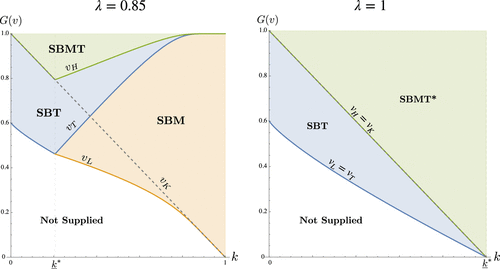
Notes. Supply configurations as a function of capacity k and valuations mapped to G(v) on the vertical axis. The left panel depicts a typical case with imperfect consumer steering , where Mode I holds on the left side and Mode II on the right side including a region where the marketplace is foreclosed. The right panel depicts the corner case of perfect steering λ = 1 where all equilibria are in Mode I. Note that SBMT* is a degenerate case when λ = 1, given that product market outcomes are equivalent to SBM despite T’s entry. Plotted for , γ = 2, c = 1, (left panel) and λ = 1 (right panel).
The competitive interaction between the monopolist and the marketplace determines the optimal fee . The fee-setting trade-off can be summarized as follows: a higher fee enables the monopolist to extract more from marketplace products (active third-party sellers), and a lower fee increases the number of marketplace products from which fee revenues can be extracted (additional sellers). The monopolist’s fee-setting strategy hinges on his capacity and his steering effectiveness. Consider first the impact of capacity. In Mode I, the optimal fee-setting strategy is marketplace-accommodating in k. That is, as the monopolist’s footprint expands vis-a-vis the marketplace (higher k) he lowers the fee to foster additional entry. This can be observed in Figure 1 under Mode I equilibria (range in both panels) where the trajectories of vT, which follow f, are decreasing in k. The mechanisms at play are as follows. When k increases in Mode I, the monopolist enters more high-valuation marketplace products. As these products transition from SBT to SBMT, by Property 2, he relies less on fee revenues for rent extraction from these product markets and thus is willing to lower fee f to increase fee revenues from additional third-party sellers. Crucially, note that new sellers entering around vT operate under SBT and do not compete with the monopolist, though he captures some of the surplus they generate through fees. These sellers are, in effect, complementing the monopolist’s own capacity.
The optimal fee-setting strategy eventually becomes marketplace-deterring in k under Mode II. As the monopolist’s footprint expands and he uses his capacity to also enter low-valuation nonmarketplace products (SBM), at some point he starts to increase the fee, thereby reverting its trajectory and reducing the size of the marketplace. As we have and he forecloses the marketplace. This can be observed in the left panel of Figure 1 where the trajectory of vt increases with k over . Consider the mechanisms at play. When k increases under Mode II, the fee-reducing force from entry into SBMT products discussed above is still present, although weaker than before as additional capacity is partially allocated to SBM products. The latter triggers a new fee-increasing force. As the monopolist enters more SBM products, the profitability of marginal product vL decreases. This provides incentives to increase vT and push third-party sellers out of the marketplace, replacing them with his own offers to transition low-valuation SBT products to SBM. It is this fee-increasing force that drives the monopolist to become marketplace-deterring under Mode II for high enough k.
Steering effectiveness is the other key factor shaping the monopolist’s fee-setting strategy. The monopolist is marketplace-accommodating in λ as described by Property 3 (substitutability of fees and steering); an increase in λ leads the monopolist to reduce the fee. It also increases the profitability of SBMT over SBM, providing incentives for the monopolist to allocate more capacity to high-valuation products. If λ becomes sufficiently high, it triggers a shift from Mode II to Mode I (i.e., full capacity allocation to high-valuation SBMT products). In the corner case of perfect steering λ = 1 depicted in the right panel of Figure 1, all equilibria are in Mode I ( when ). In this scenario the monopolist faces no effective competition in SBMT product markets, so they operate in an equivalent fashion to SBM and the monopolist captures all sales despite entry by third-party sellers (we label this degenerate case as SBMT* in Figure 1). The monopolist still operates a marketplace by allowing third-party sellers to supply lower valuation products and sets the fee to maximize SBT fee revenues accordingly.
Our analysis assumes that the monopolist supplies all products under the same conditions and charges a uniform fee across the entire product space. However, an examination of Amazon.com’s marketplace fee schedule shows that while most categories have a 15% fee, there are exceptions. For example, the fee for electronics is 8%, the fee for clothing is 17%, and the fee for Amazon device accessories (such as covers for Kindle e-readers) is 45%. Such a high fee effectively limits competition for Amazon device accessories. These fee discrepancies may be driven by different underlying conditions across product categories, such as the monopolist allocating different levels of capacity or commanding different degrees of consumers steering across them. These fee discrepancies can be evaluated with our model by adjusting the parameters to reflect category-specific conditions (capacity k, steering λ, valuations distribution G, marginal cost c). For example, the high fee for Amazon device accessories could be due to high capacity, if Amazon can meet the demand for most Kindle accessories, or less effective consumer steering in this category.
The monopolist’s capacity is exogenous in our model. This reflects the observation that prices, fees, or product supply choices can be more readily adjusted than capacity in the short term. However, in the longer term, capacity becomes an additional strategic variable. To illustrate this decision, consider the case where the monopolist chooses capacity in the initial stage of the game (stage zero) with each unit of capacity having a fixed and sunk cost. The monopolist will evaluate the marginal profit generated by each additional unit of capacity based on his profit-maximizing strategy characterized above. We have plotted marginal profit from extra capacity in Figure A.3 in Appendix A. Inspection reveals that is infinite at k = 0 (due to entry into product ), zero at k = 1 (as viable products are exhausted), continuous in k, and, at least for the case of an exponential distribution, monotonically decreasing in k Thus, the capacity choice problem has a well-defined interior optimum .
We can now clearly delineate our contribution within the hybrid retail platforms literature. Our modeling effort is the first to consider an ordinal product space, where products are valuation-ranked and firms choose in which product markets to compete. Recent contributions by Etro (2021, 2023), Zennyo (2022), and Anderson and Bedre-Defolie (2024) have considered horizontal product differentiation frameworks where additional supply by firms adds unique product varieties symmetrically positioned with respect to those of other firms. In our model, once entry by one firm has occurred in a specific product market, additional entry by other firms does not expand product variety. Furthermore, product entry is targeted (by valuation v), and hence the monopolist’s entry choices have differential effects on intra and infra-marginal third-party sellers. The equilibrium supply configurations depicted in Figure 1 reflect the outcomes of these mechanisms.
The above has implications for the fee-setting strategy of the monopolist. In a horizontal differentiation framework, an expansion of the platform’s footprint always increases the number of product varieties competing against each other on the storefront.11 As explained by Etro (2023), such an expansion by the platform has two effects. First, it provides incentives for the platform to raise rivals’ cost by setting a higher fee, which ensures the platform profits more from its own product varieties.12 Second, infra-marginal third-party sellers also loose sales to the new varieties and this drives them to exit, creating a countervailing force toward a lower fee. In Anderson and Bedre-Defolie (2024) the first force always dominates, but in Etro (2023) it need not. In our model, the forces at play are very different because, as noted above, entry is targeted and its location on the product space is crucial. In particular, when the retailer’s relative footprint is small (Mode I), this explains why the monopolist can profit from adopting a marketplace-accommodating posture by lowering the fee. In this scenario, which we find to be empirically relevant as noted in Section 4, our model explains why the monopolist’s expansion can go hand-in-hand with a larger marketplace.
Our model predicts that operating a marketplace expands the depth of the assortment on the storefront. This effect can be observed in Figure 1, as the equilibrium number of products offered to consumers would decrease in the absence of the marketplace. This result is relevant to the literature on the long tail phenomenon. Bar-Isaac et al. (2012), Yang (2013), and Hervas-Drane (2015) examine the drivers of expanded product variety and better sales performance of less popular products in online retail. This literature has shown that improvements in consumer search (lower search costs, targeted search, personalized recommendations) can trigger the supply of less popular products and increase their market share. Our model contributes a novel and complementary explanation for the long tail: that these products benefit from changes in intermediation facilitated by online retail, and in particular by business model innovations through retailer-led marketplaces.
6. Policy Analysis
We next study structural and behavioral interventions to curtail the monopolist’s market power. Our model endogenizes key strategy levers controlled by the monopolist, so it provides an effective tool to study policies that target these levers. We examine structural interventions that prohibit the hybrid model as well as behavioral interventions that target consumer steering and marketplace fees.
Because our model is built on the assumption of inelastic demand, the welfare generated in each active product market is constant. Prices shift welfare between consumers and suppliers, and total welfare depends solely on which products are supplied. This places some limitations on our policy analysis; our model is devoid of deadweight losses from double-marginalization (fees) so it likely underestimates the welfare gains of introducing competition into product markets. Similarly, it can underestimate the welfare gains of increasing the number of products supplied, given that monopolized product markets (SBT and SBM) do not generate consumer surplus. These properties should be taken into account when interpreting our results.
6.1. Hybrid Model Prohibition
We start our policy analysis by evaluating the potential for structural interventions. We examine a prohibition of the hybrid model which forces the monopolist to operate either as a pure retailer or as a pure marketplace.
A prohibition of the hybrid model drives the monopolist to
become a pure retailer if by closing the marketplace, which reduces consumer surplus and total welfare.
become a pure marketplace if by ceasing direct sales, which (i) reduces consumer surplus; (ii) has an ambiguous effect on total welfare.
See Appendix A. □
The monopolist’s response to the prohibition hinges on his capacity. He will choose to operate as a pure retailer if he has sufficient capacity and otherwise will choose to operate as a pure marketplace. Figure A.3 in Appendix A depicts the monopolist’s profit frontiers under the hybrid, pure retailer, and pure marketplace models. The two possible outcomes of the prohibition reduce consumer surplus and can reduce total welfare. The latter effect is ambiguous when transitioning to a pure marketplace, as it depends on the direction of the fee change which determines the impact on third-party profits and the number of products supplied. We have evaluated the problem numerically and found that the fee always increases when G follows an exponential distribution. So, at least in this case, we conclude that structural interventions reduce total welfare.13
Hagiu et al. (2022) and Anderson and Bedre-Defolie (2024) have also examined the impact of a hybrid model prohibition. The welfare implications they report are mostly in line with ours, though the mechanisms at play differ and, in one case, the transition to a pure marketplace benefits consumers (due to a decrease in the marketplace fee).
6.2. Consumer Steering Regulation
Consumer steering λ is exogenous in our model and a higher λ is always profitable for the monopolist. High levels of steering have been documented on Amazon’s storefront (see our discussion in Assumption 1) and third-party sellers have long claimed that they face a competitive disadvantage because of it. Regulators have responded by implementing proconsumer policies to ensure fair and effective competition on the storefront. For example, the EU Commission required Amazon to commit to nondiscriminatory Buy Box assignment criteria and to display a secondary Buy Box, which clearly reduces Amazon’s ability to steer consumers in the EU.14 We next study the effects of proconsumer policies by examining the impact of a reduction in consumer steering parameter .15
A proconsumer policy that reduces consumer steering to drives the monopolist to
accept the regulation if by continuing to operate the marketplace but raise the marketplace fee ; which (i) has an ambiguous effect on consumer surplus; (ii) reduces total welfare, except, possibly, if the marketplace transitions to Mode II.
reject the regulation if by closing the marketplace and operating as a pure retailer, which reduces consumer surplus and total welfare.
See Appendix A. □
A proconsumer policy reduces the profitability of the marketplace. Threshold λA identifies the minimum degree of consumer steering the monopolist accepts to operate it. The threshold is weakly increasing in k, so a given policy intervention is less likely to be accepted the larger the monopolist’s capacity. If the monopolist rejects the policy () he closes the marketplace. The number of products supplied falls and all products are priced at consumer’s willingness to pay v. This drives consumer surplus and third-party profits down to zero and reduces total welfare.
If the monopolist accepts the policy () he continues to operate the marketplace and adjusts his competitive choices. First, by Property 3 (substitutability of fees and steering), he raises the fee. This has an ambiguous effect on product prices in competitive markets due to the countervailing effects of λ and f on pT. Second, in Mode II, he reallocates capacity away from competitive product markets toward unsupplied products (from SBMT to SBM) which further strengthens his incentive to raise the fee.
Hagiu et al. (2022) have also examined steering regulation by considering a self-preferencing ban. They report similar welfare implications if the regulation is rejected, but there are consumer and total welfare gains if it is accepted. This contrasts with our findings for the equivalent case of λ = 0 in our model, though the mechanisms they study differ substantially from those featured here.
6.3. Fee Regulation
The monopolist exerts market power on both sides of the market by setting a high fee for third-party sellers and setting high product prices for consumers. The seller side of the market provides a natural target for price controls due to the simpler structure of the marketplace fee and its downstream effect on consumer prices in SBMT markets. Moreover, the ad valorem fee structure used in our model is consistent with widespread practice in online storefronts and dominates fixed fees in our setting, as shown in Appendix B.3. We examine a policy that caps the fee below the profit-maximizing level set by the monopolist.
A binding fee cap drives the monopolist to
accept the regulation if by continuing to operate the marketplace, which (i) increases consumer surplus; (ii) increases total welfare except, possibly, if the marketplace was in Mode II to begin with.
reject the regulation if by closing the marketplace and operating as a pure retailer, which reduces consumer surplus and total welfare.
See Appendix A. □
Threshold fA identifies the minimum fee the monopolist accepts. The left panel in Figure 2 depicts the trajectories of optimal fee and minimum fee fA, and the right panel shows the acceptance and rejection regions for a given fee cap over parameter space . A fee cap is less likely to be accepted by the monopolist ( if his capacity is high or consumer steering is low, and rejection implies marketplace closure with the same outcome as that described in the preceding section.
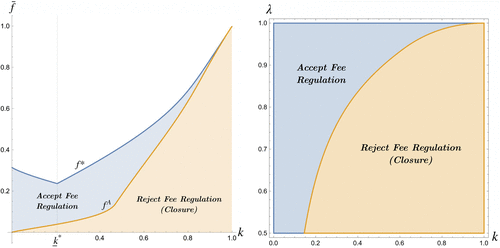
Notes. In the left panel, the profit-maximizing fee and the minimum accepted fee as a function of capacity k. In the right panel, the monopolist’s response to a binding fee cap in () parameter space. Across both panels, the monopolist accepts a fee cap in the top-left region and rejects it in the bottom-right region. Plotted for , γ = 2, c = 1, and (left panel).
If the monopolist accepts fee regulation (), entry by third-party sellers increases and expands the marketplace. Under Mode I, there is no change in the monopolist’s competitive choices. Under Mode II, third-party entry into product markets that would otherwise operate under SBM (due to reduction in vT) drives the monopolist to reallocate capacity away from such products and supply instead lower valuation unsupplied products and higher valuation marketplace products (thresholds vL and vH shift).
Fee regulation increases consumer surplus when the marketplace remains open. The intuition is straightforward: prices decrease in competitive product markets (pt is increasing in f) and the number of such markets increases in Mode II. The impact on third-party profits is ambiguous. Most third-party sellers benefit from the lower fee, though those facing entry by the monopolist due to capacity reallocation are worse off. The effect on total welfare is generally positive, with the possible exception of mode II if the total number of products supplied is reduced (due to capacity reallocation toward SBMT). Numerical analysis reveals that this is never the case when G follows an exponential distribution, so for this case at least we conclude that fee regulation is welfare-improving when the marketplace remains open.
Our findings suggest that a binding fee cap is a promising avenue for regulation. With the caveat that the monopolist can respond by closing the marketplace. While there is an extensive literature on the regulation of prices and fees in the broader context of online marketplaces, we are not aware of any instance that has evaluated the tensions we study here.16 Regulators seeking to improve consumer surplus with a fee cap should approach the acceptance frontier fA but not cross it. The gap between and fA in the left panel of Figure 2 shows that there is scope to reduce the monopolist’s fee while avoiding marketplace closure. In particular, the monopolist will accept very low fee caps when capacity k is low and steering λ is high, given that he does not suffer much from marketplace competition as discussed in Section 5. However, abolishing fees altogether is certain to trigger marketplace closure unless the monopolist derives substantial nonfee benefits from the marketplace in addition to those captured in our model.17
7. Concluding Remarks
Reflecting on the benefits of globalization in 1920, John Maynard Keynes wrote that “the inhabitant of London could order by telephone, sipping his morning tea in bed, the various products of the whole Earth, in such quantity as he might see fit, and reasonably expect their early delivery upon his doorstep.”18 A century later, the rise of online marketplaces is delivering these benefits to millions of consumers beyond those residing in wealthy urban areas. Our present work has analyzed how retailers embracing these marketplaces can use them to overcome their own organizational constraints, expanding the product assortment on their storefronts while managing the competition they generate.
Our work has considered the retailing of physical goods, as it constitutes an early and widespread example of the mechanisms we study. Similar hybrid models have gained prominence in other sectors, such as software stores (Apple’s App Store, Google Play, Valve’s Steam) and more recently inside popular applications and video games (Minecraft Marketplace, Snapchat Lenses, Unity Asset Store). These trends suggest that the hybrid model pioneered in online retail will play an important role in the wider digital economy. We hope that our work provides a foundation for deepening our understanding of marketplaces and the strategic interactions that arise within them.
The authors thank the journal’s editors and three anonymous referees for suggestions that helped to improve this paper. The authors also thank Leslie Marx, Jorge Padilla, Martin Peitz, and Patrick Rey for insightful discussions and helpful comments, as well as seminar participants at UPF, Toulouse ICT conference, Tel Aviv University, European University Institute, Bonn-Berlin Microeconomics seminar, Bocconi University, CEPR VIO seminar, EARIE conference, Mannheim Platforms workshop, Ashoka Economics conference, European Commission DG for Competition, BECCLE conference, CRESSE conference, ZEW ICT conference, UEA Digital Economics workshop, Bergamo Winter Symposium, UIB, and Bayes.
Appendix
A. Proofs
We characterize the equilibrium of the price competition game under both monopoly and duopoly. For SBT and SBMT markets, we only consider the cases relevant to T’s entry where . Consider first the monopoly case. The market for product v will operate under monopoly if only M enters or only T enters. In the first case, M monopolizes the product market, sets price and steers inattentive demand to himself. All consumers purchase, and the monopolist’s profits are given by . There are no marketplace fees levied, as there are no third-party sales for this product.
In the case that only T enters, M cedes the product market and steers inattentive demand to T but collects fee revenues. If T sets price pT, M collects fpT in fees and T keeps of sales revenues. The third-party will charge the monopoly price , and the resulting profits are and . Note that T earns non-negative profits given that .
If both M and T enter the product market, it will operate under duopoly. First, consider M’s demand steering choice under duopoly given prices pM and pT. If one of the firms has priced above consumer’s willingness to pay, or , the problem is trivial, as M steers demand to the firm pricing no higher than v to ensure that inattentive consumers buy. If both firms price above v, no consumer in the product market will purchase, so M is indifferent when steering demand. In what follows, consider and .
For each inattentive consumer who purchases, if M steers demand to himself (S = M) he earns and if he steers to the third-party (S = T) he earns . Thus M will prefer to self-preference by steering demand towards himself whenever
Next we turn to pricing decisions given these demand-steering choices. Consider M’s pricing problem given pT. First, note that undercutting T is not optimal, as it is dominated by the option of matching T’s price pM = pT and serving the full product market with demand steering of inattentive consumers and tie-breaking for attentive consumers. Second, pricing above pT and below v such that cannot be optimal either. This follows from the fact that M would only serve inattentive demand when (A.1) is satisfied and profits increase in price pM reaching a maximum at (which ensures S = M).
This implies that there are two candidate best-responses for M, either pM = pT or . In the first case, (A.1) must be satisfied because T is viable, so M chooses to self-preference S = M. The monopolist serves all demand and derives profits
In the second case where , (A.1) is satisfied because and T is viable so that , so M self-preferences S = M. The monopolist serves inattentive demand and T serves attentive demand. M’s profits are given by
Inspection of both profit expressions reveals that M will choose to match T’s price by setting pM = pT when
We can now solve T’s pricing decision under duopoly. M’s pricing strategy imposes an upper bound on T’s price, as pricing above results in zero profits. Thus, T prefers to price in the range and serve attentive consumers. T’s profits in this price range are
Because T’s profits are increasing in pT, T will set and otherwise will set and sell to no one. Importantly, ensures , thus T can always earn non-negative profits under duopoly when charging .
We analyze the monopolist’s capacity allocation problem in order to pin down his entry strategy. The capacity constraint implies that M can enter at most fraction k of all products.
The monopolist’s problem is straightforward when there are no marketplace products, that is, when f = 1 such that . Recall that entering a non-marketplace product yields profits and staying out yields zero profits. Given that increases in v, M allocates capacity to the highest-valuation products.
The monopolist’s entry problem is substantially more complex in the presence of marketplace products. Given Proposition 1 payoffs, entering a marketplace product yields duopoly profits . Staying out allows M to collect fee revenues from T’s sales. Therefore, the marginal profitability of the monopolist when entering one of these products can be written as
Figure A.1 plots the marginal profitability of entry for the monopolist as given by for non-marketplace products and by for marketplace products (both plotted as solid lines) and for third-party sellers both under monopoly and duopoly (dashed lines). The monopolist’s entry problem in the presence of the marketplace therefore consists of allocating capacity across two product pools: non-marketplace products and marketplace products .
To determine how the monopolist will allocate capacity, first, note that M’s marginal profitability of entry is positive across both product pools, and for . Second, within each product pool, high-valuation products are more profitable to enter than low-valuation products, and . Furthermore, there exists some that satisfies
We note that satisfies for f > 0 and at f = 0.
It is straightforward to define the level of capacity required for M to enter all marketplace products with valuations ,
We can pin down M’s entry strategy by separating two cases in equilibrium as depicted in Figure A.2. One case arises if , so that M exhausts his capacity simply by entering high-valuation marketplace products . Within this product range, M will enter high-valuation products first given that . The lowest valuation product M will have the capacity to enter is given by vk.
The other case arises when such that M has enough capacity to enter high-valuation marketplace products with spare capacity remaining. In this case M will select which products to enter by comparing their marginal profitability, and will allocate capacity across both the marketplace and the non-marketplace product pools. Define thresholds and such that M enters SBM products with as well as SBMT products with . The solution will be characterized by two conditions: the marginal profitability of entry must be equalized across both products pools, and all capacity must be utilized. That is,
These equations identify a unique solution for vL and vH. To see this, note that at vH = vT we have , which when plugged into the second equation provides given that . At such that vL = vT we have . Furthermore, decreases in vH, so a unique solution for vH must exist. A unique solution for exists because our definition of implies . Also note that the reallocation of capacity to product markets with or with cannot be profitable because both and are increasing in v.
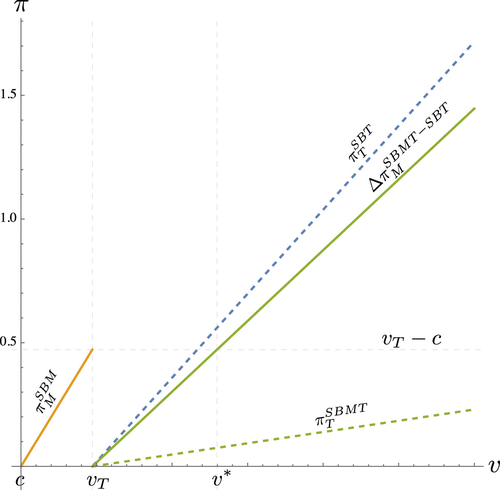
Notes. Marginal profitability of product market entry as a function of product valuation v. The profitability of entry for firms varies under monopoly and duopoly, and the monopolist has the outside option of collecting fees. Plotted for , γ = 2, c = 1, , k = 0.35, and corresponding optimal fee as characterized in Proposition 3.
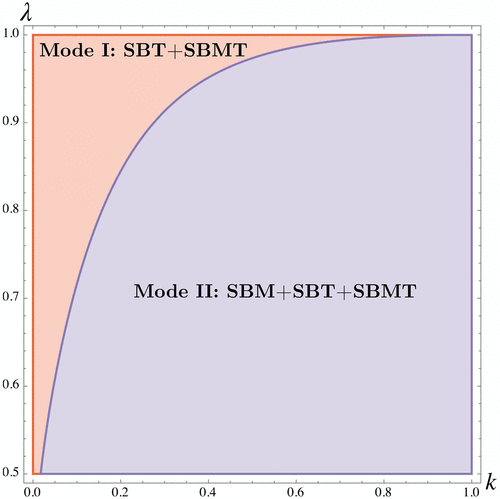
Notes. Equilibrium marketplace modes over the parameter space for the monopolist’s capacity k (horizontal axis) and consumer steering effectiveness λ (vertical axis), where Mode I is on the top-left, Mode II with an active marketplace closer to the center, and Mode II with foreclosed marketplace on the right side of the plot (though not highlighted). Only one of the two modes holds in equilibrium. Plotted for with γ = 2 and c = 1.
We evaluate the monopolist’s fee-setting problem in the first stage of the game. The problem is well behaved because ΠM is continuous and differentiable in f which belongs to a compact set , achieving one or several maxima. However, it is useful to make the following simplifying assumptions.
The distribution of product valuations G(v) is such that the monopolist’s profit function is strictly quasi-concave in f for all k and λ, and holds.
This assumption simplifies the analysis and rules out multiple optimal f. It is difficult to identify direct conditions on G(v) that ensure that the first part of the assumption holds, but it is easy to do so numerically, and the condition holds for the exponential distribution. The second part is easily verified and also holds for the exponential distribution. We require an additional assumption (provided further below) to ensure that the marketplace transitions smoothly in equilibrium between the two entry modes described in Section 4.
There exists a unique threshold such that the marketplace operates in Mode I for and in Mode II for , where solves
This solution exists and is unique because in (A.2) is strictly increasing in f and goes from c to whereas . Note that, by convention, for k = 0 we use f = 1 to ensure that .
By Assumption A.1 there is a unique maximizer for every k. Let this maximizer be denoted by . For each k we either have so that the marketplace operates in Mode I or so that it operates in Mode II.
If such that the marketplace operates in Mode I, the fee must solve the FOC given by
Conversely, if such that the marketplace operates in Mode II, then the fee must solve the following FOC
In this case, the gains on the left-hand side accrue from both SBT and SBMT product markets. Losses on the right-hand side originate from the exit of third-party sellers, which are replaced by M reallocating capacity from the lowest-valuation products (thus sacrificing profits per replacement).
Equation (A.3) must have a unique solution by strict quasi-concavity and the fact that it does not hold at f = 0, and at f = 1 Mode I cannot hold, except when k = 0 where f = 1 cannot be optimal. However, Equation (A.4) has one or two solutions because at f = 1 the FOC holds given that , vL = vK, and by Assumption A.1
Denote by the unique solution to Equation (A.3) and by the smallest solution (of possibly two) to Equation (A.4). For k = 0 we have , so by Assumption A.1 and the fact that for k = 0 we must have . On the contrary, for k = 1 we have , and since cannot be optimal we must have .
As k increases from zero to 1, the marketplace can switch from Mode I to Mode II multiple times. To see this, note that as k increases from zero, decreases, and (as we clarify below) so does so it may well be the case that modes switch more than once. To avoid this possibility, we make the following assumption.
There exists a unique implicitly defined by such that for all we have and for we have .
With Assumptions A.1 and A.2 and the definition of in place, the statement of the proposition follows directly.
We start by formalizing the notation for our welfare analysis. Total consumer surplus can be written as
Total third-party profits are the sum of individual seller profits,
The profits of the monopolist ΠM correspond to or depending on the mode in which the marketplace operates. The total welfare W is given by the sum of all the preceding.
The monopolist’s profits when operating as a pure retailer are given by in (A.5). Clearly, the minimum and maximum achievable profits are and , respectively. Furthermore, is strictly increasing in k.
The profits when operating as a pure marketplace, denoted by , are given by ΠM in (4) for the case where k = 0 such that the retailer has no retail footprint,
The isoprofit condition identifies the threshold capacity level kA. Since and such a solution must exist and is unique. Figure A.3 plots the monopolist’s profit frontiers as a function of k for these two cases as well as the hybrid model.
Consider next the welfare impact of a hybrid model prohibition. The relevant counterfactual is the equilibrium characterized in Proposition 1 that precedes the prohibition. If M becomes a pure retailer and closes the marketplace then third-party sellers exit and all products are monopolized, so CS and ΠT fall to zero. By revealed preference, M’s profits (weakly) fall. The number of products supplied is reduced, given that all interior equilibria with an active marketplace feature products supplied under SBT, and thus total welfare W also decreases.
If M instead becomes a pure marketplace, all products are monopolized by third-party sellers, so CS falls to zero. However, the change in the marketplace fee is ambiguous, and therefore the change in the number of products supplied is also ambiguous. So ΠT and W can increase or decrease. By revealed preference, M’s profits (weakly) fall when switching away from the hybrid model.
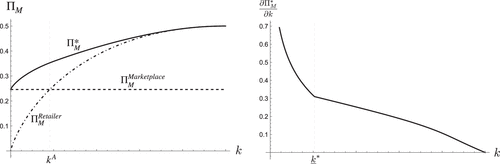
Notes. In the left panel, the monopolist’s total profit when operating the hybrid model (solid curve), as a pure retailer (dot-dashed curve), and as a pure marketplace (dashed curve) as a function of capacity k. In the right panel, the marginal profitability of capacity under the hybrid model. The hybrid model dominates profit-wise and exhibits decreasing returns to capacity. Plotted for , γ = 2, c = 1, and .
We analyze the impact of a proconsumer policy that reduces λ down to , where the lower bound ensures that Assumption 1 remains satisfied.
First, note that M’s profits are increasing in λ, and strictly so if k > 0 and f < 1. This follows from the fact that SBMT product markets profits increase, , and SBM and SBT profits are unaffected. So if k > 0 and f < 1, M’s profits must increase in Mode I. Similarly, under Mode II, profits strictly increase with λ if vL and vH are kept fixed, so the maximized profits must also increase.
The profits from closing the marketplace are independent of λ. For λ = 1, M’s profits with a marketplace must exceed profits without a marketplace, given that . Since profits with a marketplace decrease as λ decreases, either there exists such that for any the policy will be accepted and for any it will be rejected, or it will be accepted for any .
We next prove the second part of the proposition regarding optimal fees and welfare. In Mode I, M’s entry choices are not affected by a marginal reduction in λ. However, incentives to set fees change because λ and f operate as substitutes for value extraction, (Property 3). If λ falls, then M has incentives to increase f to compensate, so increases. The impact on CS is ambiguous because pT is increasing in both λ and f, so there are two countervailing effects on prices in SBMT markets. The impact on ΠT is also ambiguous, since lower λ is beneficial for third-party sellers in SBMT product markets ( is decreasing), but higher is detrimental to all sellers. Total welfare W decreases because a higher reduces third-party entry, which reduces the number of products supplied.
In Mode II, M’s entry patterns will change given that a reduction in λ for a given f reduces vL and increases vH. Because M’s profits in SBMT product markets are increasing in λ, given that , he reallocates capacity from SBMT to SBM product markets. This increases his incentives to extract value through the fee and reduces the downsides of doing so, because the marginal SBM market is less profitable. Inspection of the Mode II FOC in (A.4) reveals that an increase in vH increases the LHS and a decrease in vL reduces the RHS, so increases. In summary, a reduction in λ reduces vL and increases vH and .
This combination of effects in Mode II has ambiguous welfare implications. The reduction in the number of SBMT product markets is detrimental to CS, although the price change could be beneficial depending on the countervailing effects of λ and f on pT. The impact on ΠT is ambiguous due to the countervailing effects of λ and on , though capacity reallocation is beneficial. Finally, the impact on W cannot be signed because the increase in the fee reduces third-party entry, which reduces the total number of products supplied, but the reallocation of M’s capacity towards SBM product markets could potentially offset this.
We analyze the impact of fee regulation that reduces f. Consider first a marketplace operating in Mode I. A reduction in f will reduce third-party entry threshold vT, increasing the number of products supplied, and will also lower prices pT in SBMT product markets. Prices in SBT markets and M’s entry choices are unaffected. Clearly, CS increases, ΠT also increases with the lower fee, and so does total welfare W. Only M is worse off.
Consider next a marketplace operating in Mode II. A reduction in f will change vT, and vL, thus affecting M’s entry choices. From and and the definition of vH one can show that . To see this, use and to obtain
Based on the above, we can conclude that the CS increases in Mode II, because the number of competitive product markets increases (vH decreases) and prices in those markets decrease. The impact on ΠT is ambiguous, as the fee reduction is beneficial but competition with M in more product markets is detrimental. The impact on W is ambiguous in Mode II because we cannot rule out the possibility that vL increases.
We next examine M’s decision to close or not the marketplace when subject to fee regulation. If he closes the marketplace, M operates as a pure retailer and monopolizes all products he has the capacity to supply. His profits in this scenario, denoted by , are then
Denote by the fee level that equates the profits of operating the marketplace with those obtained when closing it down. This fee level is identified by the following iso-profit condition
Since the monopolist operates the marketplace in the first place, for sufficiently close to it must be the case that . In contrast, at we have . By and the strict quasi-concavity of in f, is strictly increasing in , so a unique solution to Equation (A.6) must exist.
The welfare impact of marketplace closure is characterized in Proposition 4.
B. Extensions
B.1. Price Competition with Multiple Third-Party Sellers
Consider what happens in our price competition model if there are third-party sellers. Consider first the case of an SBT product market where n sellers have entered (note that even if there are n potential sellers it is not guaranteed that all choose to enter). For a given vector of prices, M will steer inattentive demand to the highest priced seller whose price does not exceed v. If all n sellers charge the same price v, then each of these sellers has the same probability of serving inattentive demand. No seller will wish to undercut v if or when . In this case there is a unique pure strategy equilibrium where all third-party sellers charge v. All sellers derive equal (expected) profits in this equilibrium and will therefore enter if , which is the same condition as that of our baseline model. If there is a mixed strategy equilibrium that is more difficult to characterize. We do not solve this mixed strategy equilibrium here, given that we believe the empirically relevant case is that of high λ as stated in the main text.
Next, consider the case of a SBMT product market with n third-party sellers. Arguments similar to those of the baseline model imply that, in equilibrium, M will steer the inattentive demand towards his own offering and charge while third-party sellers all charge . Then, M earns . And in this case
B.2. Price Competition with Simultaneous Pricing
In Hervas-Drane and Shelegia (2022) we analyze the simultaneous price competition game with two firms. Based on the model presented there, our baseline analysis in the present paper maps to the case where and . This parameter mapping ensures that M steers inattentive demand towards his own offering. Next, we describe the properties of the unique mixed strategy equilibrium of the game.
Both firms continuously randomize their price on the support where
Equilibrium profits are and
We next argue that this equilibrium satisfies the key comparative statics used to derive our entry, fee setting, and policy results. First, if and only if because is a weighted average of v and . Second, , or equivalently . For this, note that taking the relevant derivatives obtains
B.3. Unit Fee
We introduce a unit fee t and show that, provided it is non-negative (i.e., not a subsidy), it is dominated by ad valorem fee f and thus the monopolist sets t = 0.
The unit fee does not affect T’s price in SBT product markets. In SBMT product markets, the equilibrium price of the third-party seller becomes
The remaining properties of the price competition equilibrium derived in our baseline analysis are unaffected. T will only derive positive profits in an SBT market if or . In an SBMT market, T will derive positive profits if which is again equivalent to . We thus redefine and note that all our entry analysis is intact subject to this change. In particular, the monopolist’s entry condition (2) will not depend on the per unit fee t because its effect is akin to a marginal cost increase for T and this does not alter marginal profitability of entry for the monopolist.
The monopolist will not charge a per-unit fee, .
We prove this lemma by contradiction. Assume that fees are optimal and consider an alternative set of fees with a lower per unit fee and a higher ad valorem fee
We next compare M’s profits when switching from fees to . To identify a lower bound for the profit change induced by the fee change, assume that M does not alter his own entry decisions. Note that only fee revenues from the SBT and SBMT product markets are affected, since revenues from M’s sales are unaffected. In each SBT product market, M derives higher revenue from fees with if , which is equivalent to . In each SBMT product market, M derives higher fees from if where pT is given by (B.1), which is also equivalent to . This condition is satisfied whenever third-party sellers participate in the marketplace. This implies that M’s profits are higher with fees than with fees , a contradiction. □
The ad valorem fee is more effective than the per-unit fee as a taxation device. The monopolist can implement the same level of marketplace participation vT by using the ad valorem fee f instead of the per unit fee t, and can also extract higher fee revenues from supramarginal sellers. In other words, total fee revenues are determined both at the extensive and the intensive margin, and by using f instead t the monopolist can achieve the same level of marketplace participation vT (extensive margin) while increasing the fee revenues from supramarginal sellers supplying high valuation products (intensive margin). This logic also applies when t = 0; in fact, the monopolist would benefit from setting a negative per unit fee t < 0 (a subsidy) and further increasing the ad valorem fee f. The optimal fee structure of the monopolist is and so that all third-parties enter and their surplus is fully extracted. However, we interpret as a corner solution because the implementation of a blanket subsidization scheme in marketplaces with many thousands (or even millions) of third-party sellers appears unfeasible and prone to opportunism.
The result relates to the literature on taxation and fees, starting with Suits and Musgrave (1953) who showed that taxing a monopoly with an ad valorem sales tax generates higher revenues than a unit sales tax for the same final price. We have derived the result with inelastic demand, as is the case in their paper, although the result also extends to the case of elastic demand (where the monopolist also sets a per unit fee t = 0 in equilibrium). Recent contributions, including Gaudin and White (2014), Llobet and Padilla (2016), and Wang and Wright (2017) have examined the comparative impact of ad valorem and per unit schemes in the context of taxation and fee collection. Johnson (2017) provides a detailed discussion of this literature. Similarly to Wang and Wright (2017), the ad valorem fee in our model enables a two-sided platform to extract different amounts based on the value of the good, and our analysis shows that the argument holds even if the platform participates and competes with agents on one of the sides.
1 See “Amazon US Ecommerce Sales by Product Category 2023,” InsiderIntelligence.com, March 24, 2023.
2 The data are reported by Amazon and comprises activity across all their storefronts. For marketplace fee revenues, see “Amazon Third-Party Seller Services Sales,” MarketplacePulse.com, April 30, 2024. For share of units sold by third-party sellers, see “Amazon Percent of Units by Third-Party Sellers,” MarketplacePulse.com, April 30, 2024. For a breakdown of first party sales and marketplace fee revenues see “Amazon Didn’t Grow in 2022,” MarketplacePulse.com, February 3, 2023.
3 See Brea-Solís et al. (2014) for a performance analysis of Walmart’s investments in inventory management. These investments include the deployment of the largest private satellite communication network in the US during the 80s, which enabled the retailer to make quick and informed decisions about which products to stock and which products to drop across its store network.
4 Amazon is an example of a retailer-led marketplace with a loyal customer base. A 2021 survey of US consumers who shopped on Amazon in the previous two years found that 62% start their search for new products on Amazon, 95% are satisfied with Amazon search results, 75% check prices on Amazon before making a purchase, 71% go to Amazon when they are ready to buy a specific product, and 92% agreed with the statement “I am more likely to buy products from Amazon than other E-commerce sites.” See “The 2021 Amazon Consumer Behavior Report,” FeedVisor.com, November 3, 2021.
5 Because firms operate as resellers and do not control upstream supply, they cannot preclude competition on the storefront. A manufacturer selling its products directly on the storefront could attempt to preclude competition by refraining to serve competitors, though this may not be effective against the supply of close substitutes. For example, products supplied by Amazon under its Amazon Basics brand are often perceived by consumers to be close substitutes of original manufacturer products.
6 Our price competition model can be interpreted as an instance of biased intermediation among competing sellers, where the intermediary managing the bias (steering consumers) is aligned with one of the sellers; in our model, the intermediary and the seller are one and the same. De Cornière and Taylor (2019) study a more general version of this problem and show that the consumer impact of the intermediary’s bias hinges on whether seller and consumer payoffs are in conflict or not.
7 Introducing entry costs or marginal cost asymmetry between M and T alters the outcome of the entry subgame. For example, if the marginal cost of third-party sellers is higher than that of the monopolist, then the v-threshold for third-party entry into SBMT will be higher than that for SBT. This precludes entry by third-party sellers whose product is valued between the two thresholds, due to a threat of entry by the monopolist, and raises additional considerations beyond the scope of our present analysis. It is also worth noting that marginal cost asymmetry in our model is isomorphic to quality differences between M and T that affect consumer’s willingness to pay when purchasing from each firm.
8 For example, over 90% of all Amazon storefront transactions reportedly go to the default sellers presented on each product page in the Buy Box. This suggests that only a small share of consumers click to browse and purchase from the additional offers featured outside the Buy Box. See “CASE AT.40462 - Amazon Marketplace and AT.40703 – Amazon Buy Box,” European Commission DG for Competition, December 20, 2022.
9 Otherwise, if , M does not enter marketplace products. As a result, the configuration SBMT does not arise in equilibrium and all active product markets are monopolized. This case is straightforward to analyze and renders the marketplace less profitable for the monopolist.
10 The frontier separating Mode I and Mode II equilibria depends on k, λ, as well as G’s density around vt and vh as this determines the profitability of allocating capacity to vt instead of vh when displacing third-party sellers in Mode II. The code used to produce the figures in this paper is available from the authors on request.
11 Hagiu et al. (2022) and Shopova (2023) model the products supplied the by the monopolist and third-parties as vertically differentiated. While some of the properties discussed carry over to those settings, the implications for fee-setting strategies can vary depending on the specific values of the differentiation parameters.
12 Note that Property 2 in our model has the opposite flavor to the raising rivals’ cost effect, as competition in more SBMT product markets provides incentives for the monopolist to lower the fee.
13 We have also considered structural remedies based on divestment, which forces the monopolist to separate his retail and marketplace operations into two separate and independent units. We have examined the case where the retail unit inherits the monopolist’s capacity constraint and the marketplace unit steers consumers and controls fees. We find that the marketplace unit steers consumers toward the highest price in each product market and sets the same fee as a monopolist operating as a pure marketplace. Consumer surplus always falls, but the impact on third-party profits and total welfare is ambiguous as it depends on the direction of the fee change. The joint profits of the divested units are always lower than those of the monopolist prior to divestment.
14 See “CASE AT.40462 - Amazon Marketplace and AT.40703 – Amazon Buy Box,” European Commission DG for Competition, December 20th 2022. Note that λ is constant across all product markets in our model, though this constraint is of no consequence as λ = 1 is optimal for the monopolist across all SBMT products. We acknowledge that Amazon is unlikely to implement the maximum possible extent of steering in real-world scenarios. Two key mechanisms not captured in our model are bound to moderate the monopolist’s steering choices. First, the presence of competing retail channels that lure away consumers and third-party sellers forces the monopolist to offer more favorable terms by moderating steering. Second, the risk of regulatory intervention and the opportunity to preclude it can prompt the monopolist to preemptively limit steering.
15 Parameter range ensures that Assumption 1 remains satisfied. We note that in Proposition 5 may fall below this minimum threshold, and thus for some k the monopolist may accept any . Although this limits the effectiveness of pro-consumer policies in our analysis, we obtain similar results for the case of full transparency λ = 0 (which triggers full capacity reallocation away from SBMT such that all product markets are monopolized and consumer surplus falls to zero). Nonetheless, we anticipate that full transparency is unlikely to be achieved; as long as the monopolist retains some degree of control, his storefront management choices will remain aligned with profit maximization.
16 Two contributions close to our focus are Loertscher and Marx (2020) and Gomes and Mantovani (2024). The first examines the benefits of price regulation in a monopoly market where there is a tension between privacy and price markups. The second examines the effectiveness of fee regulation as an alternative to price parity clauses in online marketplaces.
17 In an earlier iteration of this work we studied a richer specification of the model where the monopolist is also information constrained in addition to capacity constrained. The information constraint implies that the monopolist is unaware of a fraction of the product space and can only become informed and supply those products if a third-party seller supplies them first. In that model, when the information constraint is stringent such that the monopolist can only learn about many products through the participation of third-party sellers, he is willing to operate a zero-fee marketplace due to the information benefits alone.
18 Keynes JM (1920) The Economic Consequences of the Peace (Harcourt, Brace and Howe, New York), p. 11.
References
- (2024) The Impact of “retail media” on online marketplaces: Insights from a field experiment. Inform. Systems Res., ePub ahead of print May 15, https://doi.org/10.1287/isre.2022.0188.Link, Google Scholar
- (2024) Hybrid platform model: Monopolistic competition and a dominant firm. RAND J. Econom. 55(4):684–718.Google Scholar
- (2012) Search, design, and market structure. Amer. Econom. Rev. 102(2):1140–1160.Crossref, Google Scholar
- (2018) Managing competition on a two-sided platform. Econom. Management Strategy 28(1):5–22.Crossref, Google Scholar
- (2014) Business model evaluation. Quantifying Walmart’s sources of advantage. Strategic Entrepreneurship J. 9(1):12–33.Crossref, Google Scholar
- (2017) Are online and offline prices similar? Evidence from large multi-channel retailers. Amer. Econom. Rev. 107(1):283–303.Crossref, Google Scholar
- Chen N, Tsai H-T (2024) Steering via algorithmic recommendations. RAND J. Econom. 55(4):501–518.Google Scholar
- (2019) A model of biased intermediation. RAND J. Econom. 50(4):854–882.Crossref, Google Scholar
- (2021) Product selection in online marketplaces. Econom. Management Strategy 30(3):614–637.Crossref, Google Scholar
- (2023) Hybrid marketplaces with free entry of sellers. Rev. Indust. Organ. 62:119–148.Crossref, Google Scholar
- (2014) Unit vs. ad valorem taxes under revenue maximization. Working paper, University of Freiburg, Freiburg, Germany.Google Scholar
- Gomes R, Andrea M (2024) Regulating platform fees under price parity. J. Eur. Econom. Assoc. jvae014.Google Scholar
- (2022) Should platforms be allowed to sell on their own marketplaces? RAND J. Econom. 53(2):297–327.Crossref, Google Scholar
- (2018) Competing by restricting choice: The case of matching platforms. Management Sci. 64(8):3574–3594.Link, Google Scholar
- (2015) Recommended for you: The effect of word of mouth on sales concentration. Internat. J. Res. Marketing 32(2):207–218.Crossref, Google Scholar
- (2022) Price competition with a stake in your rival. Internat. J. Indust. Organ. 84:102862.Crossref, Google Scholar
- (2010) Store within a store. J. Marketing Res. 47:748–763.Crossref, Google Scholar
- (2011) Firm strategies in the “mid tail” of platform-based retailing. Marketing Sci. 30(5):757–775.Link, Google Scholar
- (2017) The agency model and MFN clauses. Rev. Econom. Stud. 84:1151–1185.Crossref, Google Scholar
- (2020) Segmentation versus agglomeration: Competition between platforms with competitive sellers. J. Political Econom. 128(6):2329–2374.Crossref, Google Scholar
- (2017) In-store advertising by competitors. Marketing Sci. 36(3):402–425.Link, Google Scholar
- (2023) Entry into two-sided markets shaped by platform-guided search. Working paper, National University of Singapore (NUS) Business School, Singapore.Google Scholar
- (2016) The optimal scope of the royalty base in patent licensing. J. Law Econom. 59(1):45–73.Crossref, Google Scholar
- (2020) Digital monopolies: Privacy protection or price regulation? Internat. J. Indust. Organ. 71:102623.Crossref, Google Scholar
- (2022) Designing an online retail marketplace: Leveraging information from sponsored advertising. Marketing Sci. 41(1):115–138.Link, Google Scholar
- (2023) Steering in one click: Platform self-preferencing in the Amazon Buy Box. Working paper, Federal Trade Commission, Washington, DC.Google Scholar
- (2023) Private labels in marketplaces. Internat. J. Indust. Organ. 89:102949.Crossref, Google Scholar
- (1953) Ad valorem and unit taxes compared. Quart. J. Econom. 67(4):598–604.Crossref, Google Scholar
- (2017) Ad-valorem platform fees, indirect taxes and efficient price discrimination. RAND J. Econom. 48(2):467–484.Crossref, Google Scholar
- (2013) Targeted search and the long tail effect. RAND J. Econom. 44(4):733–756.Crossref, Google Scholar
- (2024) Advertising as information for ranking e-commerce search listings. Marketing Sci. 43(2):360–377.Link, Google Scholar
- (2022) Platform encroachment and own-content bias. J. Indust. Econom. 70(3):684–710.Crossref, Google Scholar
- (2018) Competing with complementors: An empirical look at Amazon.com. Strategic Management J. 39:2618–2642.Crossref, Google Scholar